When modern readers study the reign of Constantine the Great they often notice something that appears contradictory.
Constantine claimed to receive a sign connected with Christ before the Battle of the Milvian Bridge in AD 312. Yet for years afterward his coins still displayed Sol Invictus, the Unconquered Sun. His triumphal arch in Rome included images of the sun god. In AD 321 he issued a law honoring dies Solis, the Day of the Sun.
To modern readers these details can seem confusing. But in the Roman world of the third and early fourth centuries, the language of the sun and the language of Christ overlapped in ways that made the confusion almost inevitable.
Long before Constantine’s conversion, pagans and Christians were already interpreting similar symbols in very different ways.
The Rise of the Sun God in Roman Imperial Religion
Solar imagery became central to Roman imperial religion during the reign of Aurelian.
After decades of political chaos known as the Crisis of the Third Century, Aurelian reunited the empire in AD 274 and promoted the sun god as a universal divine patron for Rome.
The Roman historical work known as the Historia Augusta describes Aurelian’s program.
“He built a magnificent temple to the Sun and established games in honor of the Sun.”
(Historia Augusta, Life of Aurelian 25, written late fourth century)
The same passage records that Aurelian reorganized the priesthood of the sun god.
“He established priests of the Sun and made the worship of the Sun prominent.”
(Historia Augusta, Life of Aurelian 25)
From that point forward Sol Invictus became one of the most powerful religious symbols of Roman imperial authority.
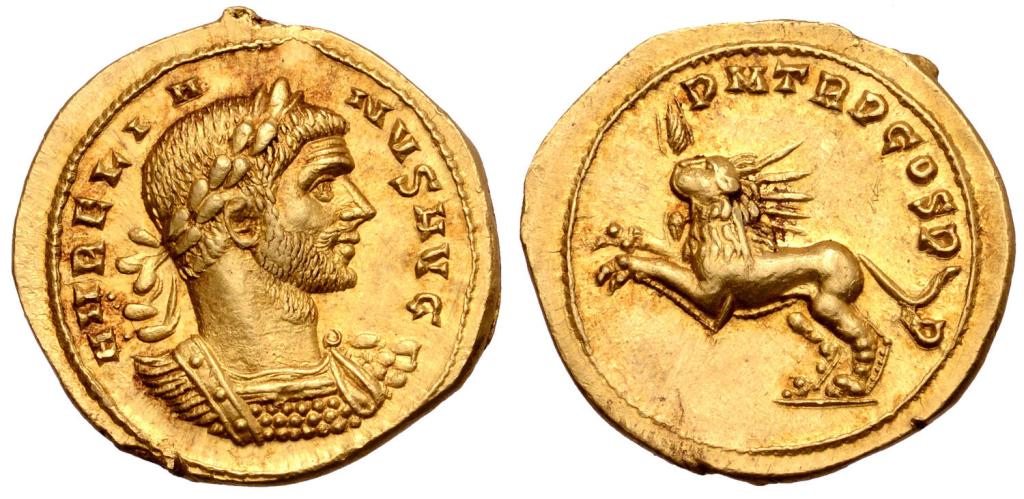
Back: P M TR P COS P P “Chief Priest, holder of tribunician power, consul, father of the fatherland.”The reverse image shows a radiate lion leaping left with a thunderbolt in its mouth.
Each element carries religious meaning. The radiate crown is a solar symbol associated with the sun god Sol. It visually links the lion with solar power. In ancient symbolism the lion was associated with the sun and the east. The lion was connected with:
the rising sun, strength, royal authority. In Greco-Roman thought the east was the land where the sun rises, so lions often symbolized eastern power. The thunderbolt belongs to Jupiter, the chief god of Roman religion. Jupiter’s weapon symbolizes divine authority and cosmic rule.
The sun god represented divine victory, cosmic power, and universal rule. Roman emperors began placing the sun god on their coinage to communicate that the emperor ruled under the protection of heaven.
Constantine’s Coins and the Unconquered Sun
When Constantine became emperor in AD 306 he inherited this system of symbolism.
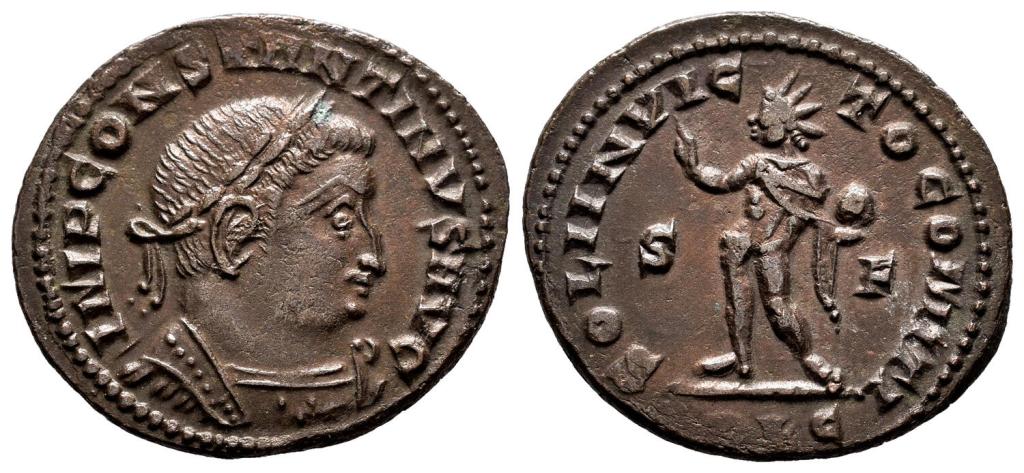
Back: SOLI INVICTO COMITI “To the Unconquered Sun, companion of the emperor.” The figure is Sol Invictus, the Roman sun god. Key identifying features: radiate crown around the head representing the rays of the sun, right hand raised in greeting or blessing, globe in the left hand symbolizing cosmic authority.
Many coins issued during the early part of his reign bear the inscription:
SOLI INVICTO COMITI
The phrase means:
“To the Unconquered Sun, companion of the emperor.”
These coins typically depict Sol standing with a radiate crown, raising his right hand while holding a globe representing universal dominion. This imagery communicated a clear message to the Roman world. The emperor ruled under the protection of the cosmic sun. The use of solar imagery was not unique to Constantine. It had become standard imperial propaganda throughout the empire.
However the situation becomes more interesting after the Battle of the Milvian Bridge. Even after Constantine associated his victory with the Christian God, coins honoring Sol continued to circulate for more than a decade.
This reflects the transitional religious environment in which Constantine ruled.
Constantine’s Vision of Apollo (AD 310)
One of the most revealing sources about Constantine’s early religious environment comes from a speech delivered in AD 310.
The speech belongs to a collection known as the Panegyrici Latini, a series of formal praise speeches delivered before Roman emperors. The orator describes a vision Constantine supposedly experienced at a temple of Apollo.
“You saw, I believe, Constantine, your Apollo accompanied by Victory offering you laurel crowns.”
(Panegyrici Latini 6.21, delivered AD 310)
The speech continues:
“The god himself recognized you in the likeness of the one to whom the rule of the whole world is due.”
(Panegyrici Latini 6.21)
Apollo had long been associated with solar imagery in Roman religion. In this speech Constantine is portrayed as receiving divine confirmation from the solar deity. Only two years later Christian writers would describe Constantine seeing a different sign.
The Christian historian Eusebius of Caesarea records the event.
“He saw with his own eyes the trophy of a cross of light in the heavens above the sun.”
(Eusebius, Life of Constantine 1.28, written c. AD 337)
The overlap of imagery is striking. The divine sign appears above the sun. This suggests that Constantine’s religious symbolism developed within an already existing solar framework.
The Arch of Constantine
The same transitional symbolism appears on the Arch of Constantine.
The arch was erected by the Roman Senate in AD 315 to commemorate Constantine’s victory over Maxentius.
One relief panel shows Sol driving a four horse chariot across the sky. Another depicts Luna driving the moon chariot. These two figures represent the cosmic order of day and night.
The inscription on the arch explains the victory.
“To the Emperor Caesar Flavius Constantine… because by the inspiration of divinity and by the greatness of his mind he avenged the state with just arms against the tyrant.”
(Arch of Constantine inscription, AD 315)
The phrase instinctu divinitatis means “by the inspiration of divinity.”
Notice that the inscription deliberately avoids naming a specific god. The wording allowed different religious groups to interpret the victory in different ways.
Why Pagans Thought Christians Worshiped the Sun
Long before Constantine’s reign pagans already suspected that Christians worshiped the sun.
The Christian writer Tertullian addresses this rumor directly.
“Others, with better information and something closer to the truth, believe that the sun is our god.”
(Tertullian, Apology 16, written c. AD 197)
What Tertullian is doing rhetorically is interesting. He is saying:
- Some pagans invent ridiculous accusations about Christians.
- Others try to explain Christianity more rationally.
- Their “reasonable” guess is that Christians worship the sun because:
- they pray toward the east
- they gather on Sunday
Tertullian then rejects the idea but admits why people would think that. Tertullian explains why pagans believed this.
“It is said that the sun is the god of the Christians because it is well known that we pray toward the east and that we make Sunday a day of festivity.”
(Tertullian, Apology 16)
Christians prayed toward the east, the direction of sunrise. They gathered for worship on Sunday. They spoke about Christ as the light of the world. In a Roman culture filled with solar religion these practices naturally led to confusion.
Eastward Prayer and Church Orientation
Early Christians explained that the east symbolized the place where divine light appears.
Clement of Alexandria writes:
“The east is the image of the birth of light.”
(Clement of Alexandria, Stromata 7.7, written c. AD 200)
The theologian Origen gives a more detailed explanation.
“The direction of the rising sun is an evident symbol of the soul looking toward the place where the true light arises.”
(Origen, On Prayer 31, written c. AD 233)
By the fourth century churches themselves were often built facing east.
“Let the building be oblong and turned toward the east.”
(Apostolic Constitutions 2.57, compiled c. AD 375)
The bishop Basil of Caesarea confirms the practice.
“We all look toward the east when we pray.”
(Basil, On the Holy Spirit 27, written c. AD 375)
Sunday and the Day of the Sun
The Romans already used a seven day planetary week. The historian Cassius Dio explains the system.
“The custom of referring the days to the seven planets began with the Egyptians and has spread among all mankind.”
(Cassius Dio, Roman History 37.18, written early third century)
The first day of the week was called dies Solis, the Day of the Sun. Christians had already adopted this day for worship because they believed Jesus rose from the dead on the first day of the week.
Justin Martyr writes:
“We all hold our common assembly on the day of the Sun, because it is the first day on which God made the world and Jesus Christ our Savior on the same day rose from the dead.”
(Justin Martyr, First Apology 67, written c. AD 155)
Constantine later issued a civil law recognizing this day but did not connect it to Christianity specifically.
“On the venerable day of the Sun let the magistrates and people residing in cities rest, and let all workshops be closed.
In the country, however, persons engaged in agriculture may freely and lawfully continue their pursuits, because it often happens that another day is not suitable for grain-sowing or vine-planting; lest by neglecting the proper moment for such operations the bounty of heaven should be lost.”
(Codex Justinianus 3.12.2, law of Constantine issued March 7, AD 321)This law used the traditional Roman name for Sunday and regulated the work schedule of the empire.
December 25 and the Birth of Christ
TThe date December 25 appears in both pagan and Christian traditions, and the relationship between the two has been debated for centuries. A Roman calendar compiled in AD 354, known as the Chronography of 354, records a solar festival on that date. The calendar entry reads:
“Natalis Invicti.”
(Chronography of 354, Philocalian Calendar, AD 354)
The phrase means “the birthday of the Unconquered Sun.” The festival was associated with the cult of Sol Invictus, the solar deity strongly promoted in the Roman Empire during the third century, especially after the reign of the emperor Aurelian. Yet the same Roman calendar also records a Christian observance on that exact day. Another entry reads:
“VIII kal. Ian. natus Christus in Betleem Iudeae.”
(Chronography of 354, AD 354)
Translated, this states: “December 25. Christ was born in Bethlehem of Judea.” By the middle of the fourth century the church in Rome was therefore celebrating the birth of Christ on December 25.
Evidence for the date may actually appear much earlier. The Christian theologian Hippolytus of Rome wrote a commentary on the Book of Daniel around AD 204, and in that work he states:
“The first advent of our Lord in the flesh, when he was born in Bethlehem, took place eight days before the Kalends of January.”
(Hippolytus, Commentary on Daniel 4.23, written c. AD 204)
In the Roman calendar system, eight days before the Kalends of January corresponds to December 25. If Hippolytus is preserving an earlier tradition, then some Christians were already associating Christ’s birth with December 25 decades before the solar festival is recorded in the Roman calendar.
Another early Christian chronologist also plays an important role in this discussion. The historian Sextus Julius Africanus attempted to calculate the chronology of biblical history around AD 221. Africanus concluded that the incarnation of Christ occurred on March 25, which he regarded as the date of the creation of the world and the date of the conception of Christ. Later Christian writers connected this calculation with the birth of Jesus nine months later. Although Africanus does not explicitly mention December 25, his calculation of March 25 as the date of the incarnation became foundational for later Christian chronologies.
The connection between March 25 and the birth of Christ is explained clearly by Augustine of Hippo. Augustine describes a tradition circulating among Christians that the conception of Jesus occurred on the same calendar day as his crucifixion. Augustine writes:
“For he is believed to have been conceived on the 25th of March, upon which day also he suffered; so the womb of the Virgin in which he was conceived corresponds to the new tomb in which he was buried. But he was born, according to tradition, on December the 25th.”
(Augustine, On the Trinity 4.5, written c. AD 400)
In this calculation the logic is straightforward. March 25 was believed to be the date of the crucifixion. If Christ was conceived on that same date, then nine months later the birth would fall on December 25. This explanation shows that some Christians arrived at the date through theological reasoning rather than by borrowing a pagan festival.
The date March 25 itself appears in earlier Christian writings about the crucifixion. The North African writer Tertullian calculated the chronology of Christ’s death in relation to the Roman calendar. He writes:
“In the month of March, at the times of the Passover, on the eighth day before the Kalends of April.”
(Tertullian, Against the Jews 8, written c. AD 200)
The phrase “eighth day before the Kalends of April” corresponds to March 25 in the Roman dating system. This calculation later became part of the tradition linking the conception and crucifixion of Christ to the same calendar day.
Another early Christian text also connects Christ’s birth with cosmic symbolism related to light and the sun. An anonymous writer often associated with Cyprian composed a work titled De Pascha Computus in AD 243. In this work the author writes:
“O how admirable and divine is the providence of the Lord that on that day on which the sun was made, on that same day Christ should be born.”
(De Pascha Computus, written AD 243)
This passage demonstrates that by the mid third century Christian writers were already interpreting Christ’s birth through the symbolism of light and creation.
At the same time the Roman world already celebrated several festivals around the winter solstice. One of the most famous was Saturnalia, which occurred from December 17 through December 23. The Roman writer Macrobius describes the celebration:
“During the Saturnalia all business is suspended and the schools are closed.”
(Macrobius, Saturnalia 1.10, written early fifth century)
These celebrations involved feasting, gift giving, and public festivities. The solar festival recorded in the Chronography of 354 likely celebrated the rebirth of the sun after the winter solstice, when daylight begins to increase again.
Christian leaders were aware of the solar symbolism surrounding the date but interpreted it differently. Augustine addressed this directly in one of his sermons:
“Let us celebrate this day not in honor of the sun but in honor of Him who made the sun.”
(Augustine, Sermon 190, preached late fourth century)
For Augustine and other Christian writers the symbolism pointed beyond the physical sun to Christ himself, whom they believed to be the true light of the world.
By the fourth century two traditions had converged on the same date. The Roman world celebrated the rebirth of the sun after the winter solstice, while Christians celebrated the birth of Christ, whom they proclaimed as the light that had come into the world. The overlap of December 25 therefore reflects the broader religious transition taking place in the Roman Empire as solar symbolism was increasingly reinterpreted in Christian terms.
Christ as the Rising Sun
Christian writers frequently used solar imagery to describe Christ.
“The sun of righteousness shall rise with healing in its wings.”
(Malachi 4:2)
Clement of Alexandria writes:
“The Word has appeared as the Sun of righteousness.”
(Clement, Exhortation to the Greeks 11, written c. AD 200)
Cyprian of Carthage writes:
“Christ is the true sun and the true day.”
(Cyprian, On the Lord’s Prayer, written c. AD 250)
Origen quotes a Christian hymn:
“Christ is the rising sun who shines upon those who sit in darkness.”
(Origen, Homilies on Luke, written early third century)
Christ Depicted as the Sun
Archaeology confirms that some Christians also expressed solar imagery visually. One of the most striking examples was discovered in the Vatican necropolis beneath St Peter’s Basilica in Rome, in a burial chamber known today as the Tomb of the Julii. The tomb dates to the early third century, most likely the late second or early third century AD, long before the reign of Constantine.
At the center of the ceiling mosaic in this tomb appears a remarkable image. A youthful figure drives a chariot drawn by horses across the sky. The figure has rays around his head and moves across a background filled with vines and cosmic imagery. The composition closely resembles traditional depictions of the sun god driving his chariot across the heavens.
For this reason historians often refer to the image as “Christ Helios,” meaning Christ as the Sun.
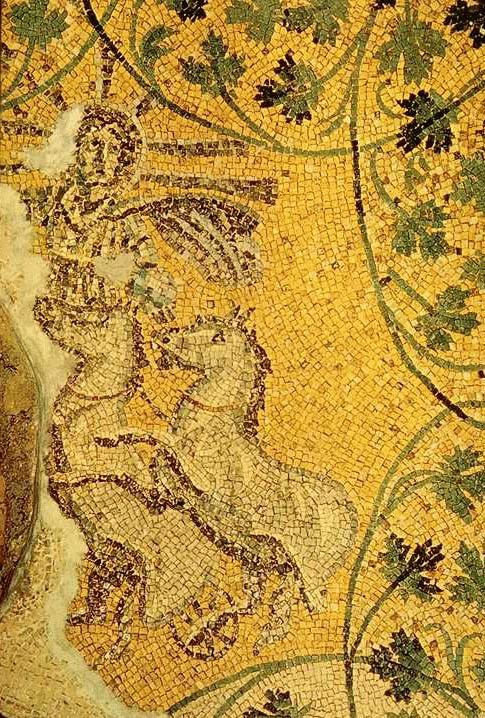
The mosaic was discovered during excavations conducted between 1940 and 1949 beneath St Peter’s Basilica. Archaeologists uncovered an entire Roman cemetery along the ancient Vatican hillside, including both pagan and Christian tombs. The Tomb of the Julii contains a mixture of imagery that reflects the transitional artistic language of early Christianity. Alongside the charioteer mosaic are scenes such as Jonah and the great fish, as well as pastoral imagery associated with Christ the Good Shepherd.
Because the tomb contains clear Christian imagery, most scholars interpret the charioteer figure not as the pagan sun god but as Christ portrayed using the visual language of solar imagery. The image communicates the idea that Christ is the true cosmic ruler who brings light to the world.
The mosaic in the Tomb of the Julii therefore provides archaeological evidence that some Christians were already comfortable expressing their faith using solar imagery well before Constantine’s reign. In a Roman world filled with symbols of the sun god, portraying Christ as the true source of light allowed Christian artists to communicate the supremacy of Christ using imagery that their contemporaries already understood.
This helps explain why solar symbolism and Christian language could overlap so easily in the early fourth century. When Constantine later associated his victories with Christ, he was operating in a world where the visual and symbolic language of the sun had already been used by both pagans and Christians.
Why the Confusion Was Almost Inevitable
By the early fourth century two symbolic systems had developed side by side.
Romans honored Sol Invictus as the cosmic ruler of the heavens. Christians proclaimed Christ as the true light of the world and the rising sun of righteousness.
They prayed toward the east. They gathered on the Day of the Sun. They described Christ using solar imagery.
When Constantine began associating his victories with Christ after the Battle of the Milvian Bridge, it occurred within a world where these symbolic languages already overlapped. For many Romans the difference between the sun god and the Christian God was not immediately obvious.
Constantine’s reign therefore stands at the center of one of the most remarkable religious transitions in the history of the Roman Empire.
Discover more from Living the Bible
Subscribe to get the latest posts sent to your email.
 Living the Bible