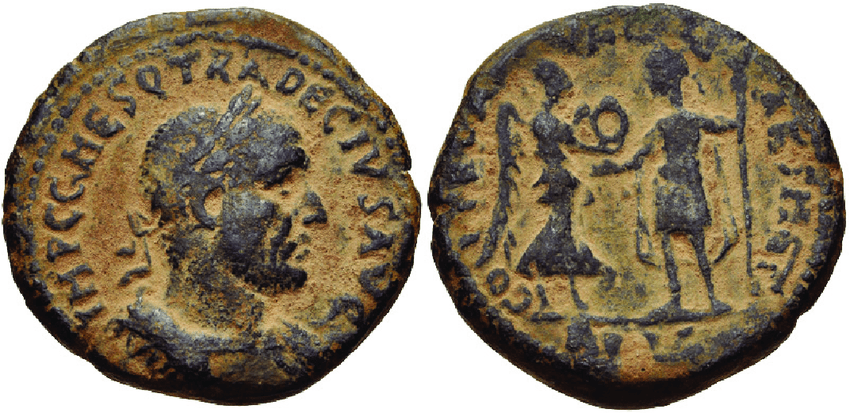
In AD 249, the Roman emperor Decius looked across an empire in decline and believed he saw the cause clearly. Rome had forgotten the gods. Old discipline had collapsed. Armies rebelled, frontiers failed, provinces grew restless, and a strange new disease was beginning to appear in major cities. His solution was drastic: force every inhabitant of the empire to offer sacrifice to the ancestral gods, renewing the divine favor that had once made Rome strong.
Aurelius Victor, a pagan Roman historian writing around AD 360, explains Decius’s reasoning:
“Decius wished to restore the old discipline, for he thought the state had been corrupted by the neglect of ancestral customs.”
(De Caesaribus 29)
Zosimus, a pagan historian hostile to Christianity writing around AD 500, reports the same motive:
“Decius strove to restore the ancient religion.”
(New History 1.23)
Cyprian of Carthage, a Christian bishop writing in the AD 250s, saw the truth directly:
“Decius wished to compel every man to sacrifice.”
(Letter 55)
Decius believed enforced religious unity would stabilize Rome. Instead, the empire fell into one of the worst crises in its history.
Rome’s Crisis Deepened and the Plague Swept the Empire
Within two years of Decius’s edict:
- he died in battle against the Goths (AD 251),
- military rebellions multiplied,
- pretenders seized the throne,
- frontier defenses collapsed,
- and the plague exploded.
Eutropius, a pagan Roman imperial official writing around AD 369, summarizes these years in a single devastating sentence:
“The state was wasted by pestilence, devastated by enemies, and its strength exhausted.”
(Breviarium 9.5)
Aurelius Victor, writing as a secular historian around AD 360, echoes it:
“The State was collapsing under its misfortunes.”
(De Caesaribus 30)
The most severe blow was not military—it was biological.
The Plague of Cyprian (AD 249–262): One of the Deadliest Pandemics of Antiquity
The epidemic we now call the Plague of Cyprian lasted roughly thirteen years (AD 249–262). Evidence suggests it reached nearly every major region of the Roman Empire:
- North Africa (Cyprian’s home)
- Egypt (Dionysius’s letters)
- Rome and Italy
- Asia Minor (Firmilian of Caesarea)
- Syria, Judea, and Palestine
- Greece
- Gaul
- The Danube provinces
- Possibly Britain
Firmilian of Cappadocia, a Christian bishop writing around AD 256, states plainly:
“The pestilence is raging everywhere, and the whole world is devastated.”
(Epistle 74 to Cyprian)
Historians estimate:
- Urban mortality: 20–30%
- Some cities: up to 50%
- Total empire-wide deaths: 5–10 million
No Roman epidemic produced more detailed Christian eyewitness testimony.
Cyprian’s Full Plague Description (On Mortality 14)
Cyprian of Carthage, a Christian bishop writing in the mid-250s, recorded the most vivid medical description of the plague. Here is the complete account:
“This trial, that is now common to all, puts us on equal terms. Whatever is the character of the plague which now ravages the human race, it attacks all without distinction. It lays waste the people equally as it perpetually rages among them; and though it may injure many, still it should improve the discipline of all.
This death, in its devastations, as it attacks the righteous and the unrighteous, does not spare the brave or the peaceful; the man of learning and the unlearned; the strong and the weak.
This trial, that now the bowels loosen into a constant flux; that a fire originated in the marrow boils up in the throat; that the intestines are shaken with continual vomiting; that the eyes are on fire with the injected blood; that in some cases the feet or some parts of the limbs are taken off by the contagion of diseased and corrupted putrefaction; and that from the weakness caused by the failing and loss of the body, either the gait is enfeebled, or the hearing obstructed, or the sight darkened—this devastates countless bodies, and destroys whole families and households…
But nevertheless it profits, in that it searches out the righteousness of each one and examines the minds of the human race: whether one who is in health cares for the sick; whether a relation affectionately loves his kindred; whether masters have compassion on their languishing servants; whether physicians do not desert the afflicted; whether the fierce restrain their violence; whether the rapacious can quench the ever insatiable fire of their furious desires; whether the haughty bend their necks; whether the wicked soften their daring; whether, when their dear ones perish, the rich, even then, give anything.”
(On Mortality 14)
Christian Bravery During the Plague
Dionysius of Alexandria, a Christian bishop writing c. AD 260, preserved by Eusebius:
“Most of our brethren, in their exceeding love and affection for the brotherhood, did not spare themselves. They visited the sick fearlessly, ministered to them continually, tended to them in Christ, and died with them most joyfully.”
(Eusebius, Ecclesiastical History 7.22.7–8)
He adds:
“The heathen thrust aside those who began to be sick and fled from their dearest. They cast the dying into the roads before they were dead.”
(Eusebius, HE 7.22.10)
Christians stayed.
They carried the sick.
They buried the dead.
And they died doing it.
Cyprian’s Theology of Charity During Crisis
Cyprian’s On Works and Alms (c. AD 252–254) shows how Christians understood charity in plague and persecution.
“What a great and honorable thing it is, beloved brethren, to wash away the stains of sin by the works of mercy! What a glorious thing to convert earthly possessions into heavenly treasures!”
(On Works and Alms 2)
“Christ taught that He was hungry in His poor… Whatever is given to these is given to Christ.”
(On Works and Alms 6–7)
“Let no one be hindered from doing good by the fear of death. He cannot fear to die who is already dying to the world.”
(On Works and Alms 20–21)
“Even the widow’s two mites were accepted… He who gives to the poor makes God his debtor.”
(On Works and Alms 18)
“Almsgiving prepares us for the crown. He who shows mercy learns to suffer.”
(On Works and Alms 34)
This ethic shaped Christian identity more deeply than any imperial decree.
Gallus and Aemilian: Crisis Without Coherence
Trebonianus Gallus (AD 251–253) inherited an empire collapsing under plague and war.
Aurelius Victor, a pagan historian around AD 360, writes:
“Gallus possessed neither the authority nor the industry necessary for ruling a state collapsing under its misfortunes.”
(De Caesaribus 30)
Eutropius, a pagan imperial official writing c. AD 369, says:
“Pestilence and war wasted every part of the state.”
(Breviarium 9.5)
Cyprian of Carthage, a Christian bishop writing in the mid-250s, provides direct testimony:
“Gallus, at once hostile and timid, succeeded the empire. He drove Cornelius, the bishop, into exile, and pursued the pastors of the Church with wicked fury.”
(Epistle 55.9)
Aemilian (AD 253) ruled only months.
Zosimus, the pagan historian hostile to Christianity, says:
“Aemilian ruled so briefly that nothing worth remembering could be accomplished.”
(New History 1.24)
Valerian: A Brief Peace and Then a Sharp Persecution
Valerian (AD 253–260) began with unusual favor toward Christians.
Dionysius of Alexandria, writing c. AD 260, recalls:
“In the early days of Valerian, there was not even a whisper of hatred against us. Men of God were in his household.”
(Eusebius, HE 7.10.3–4)
But everything changed dramatically under the influence of Macrianus, his powerful financial officer.
Macrianus: The Architect of Valerian’s Shift
Macrianus was a pagan imperial financial officer—the Rationalis, responsible for taxation, troop pay, and imperial expenditures. With Rome’s finances collapsing under plague, invasion, and mutiny, he wielded enormous bureaucratic power and shaped the emperor’s thinking. Christian writers remembered him as deeply hostile toward Christians, viewing them as destabilizing because they refused state sacrifices.
Lactantius, a Christian historian writing c. AD 310–320, explains Valerian’s reversal:
“He was corrupted by Macrianus, who was long hostile to the Christian name.”
(De Mortibus Persecutorum 5)
Valerian’s First Edict (AD 257)
Lactantius, a Christian historian writing c. AD 310–320, preserves the full legal summary:
“He sent a rescript that bishops, presbyters, and deacons should be punished immediately.
Senators and men of importance who practiced Christianity were to lose their dignities, and if they persisted, be deprived of their property.
Matrons were to be deprived of their goods and banished.
And all members of the imperial household who confessed Christ were to be sent in chains.”
(De Mortibus Persecutorum 5)
Dionysius of Alexandria, Christian bishop writing c. AD 260, adds a key detail:
“It was not permitted for us to assemble, not even in the cemeteries.”
(Eusebius, Ecclesiastical History 7.11.10)
Banning Christian burial gatherings was a direct attack on the most basic expression of the Christian community.
Valerian’s Second Edict (AD 258)
Valerian’s second edict escalated sharply.
Lactantius:
“He ordered that bishops, presbyters, and deacons be executed immediately.
Senators and men of rank who persisted in Christianity were to lose their property and, if they continued, be beheaded.
Matrons were to be deprived of their property and exiled.
And members of the imperial household who confessed Christ were to be sent in chains and assigned to work on the imperial estates.”
(De Mortibus 6)
This was the most targeted persecution since Nero, and the most systematically organized until Diocletian.
It ruthlessly attacked:
- The clergy (execution)
- The upper classes (confiscation, then execution)
- Wealthy Christian women (exile)
- Christian imperial slaves and staff (forced labor)
By striking at bishops and deacons first, Valerian tried to dismantle Christian leadership.
By attacking Christian senators and matrons, he tried to destroy Christian influence.
By enslaving Christian palace staff, he tried to cleanse the imperial household of the faith.
The Execution of Sixtus II and the Roman Deacons
Eusebius, Christian historian c. AD 310–325, writes:
“Sixtus was seized in the cemetery and put to death with four deacons.”
(Ecclesiastical History 7.14)
The Liber Pontificalis (drawing on much earlier Roman records) gives the names of the deacons:
- Januarius
- Magnus
- Vincent
- Stephen
Fourth-century bishop Ambrose of Milan, using earlier Roman tradition, expands this event:
“The prefect found Sixtus seated, preaching to the brethren, and said, ‘Are you the bishop?’
Sixtus replied, ‘I am.’
And he was led away to suffer with his deacons.”
(De Officiis 2.28)
Rome remembered that Sixtus and his deacons died during worship, defying Valerian’s ban on assembly in cemeteries, choosing obedience to God over obedience to Rome.
The Full Interrogation of Cyprian of Carthage
This is one of the best-documented martyrdom interrogations from the ancient world.
Eusebius, quoting the official Roman court transcript:
“When Cyprian had been brought before the tribunal, the proconsul said to him:
‘Are you Thascius Cyprian?’
Cyprian replied: ‘I am.’
The proconsul Galerius Maximus said: ‘The most sacred emperors have commanded you to sacrifice.’
Cyprian said: ‘I will not sacrifice.’
Galerius Maximus said: ‘Consider your position.’
Cyprian replied: ‘Do what you are commanded. In so just a cause there is no need of deliberation.’
After conferring with his council, Galerius Maximus reluctantly pronounced the sentence:
‘You have long lived sacrilegiously and have attracted many by your wickedness.
You have shown yourself an enemy to the gods and the laws of Rome.The sacred emperors have commanded that those who do not sacrifice shall be executed with the sword.
Therefore Thascius Cyprian, you are to be executed with the sword.’
Cyprian responded: ‘Thanks be to God.’”
(Eusebius, Ecclesiastical History 7.11*)
This transcript is extraordinary:
It shows a bishop speaking directly, calmly, and fearlessly to the Roman state.
Eyewitness Account of Cyprian’s Final Moments (Pontius the Deacon)
Pontius of Carthage, Cyprian’s deacon and an eyewitness writing in the AD 260s, describes what happened next:
“When he came to the place appointed for execution, Cyprian prayed on his knees.
He took off his cloak and folded it carefully before kneeling upon it.
He removed his dalmatic and handed it to the deacons, remaining in his linen tunic.
Then he bound his own eyes with his handkerchief.
The faithful spread cloths and napkins before him to catch his blood.
Cyprian himself commanded the executioner to do his duty, and the executioner struck the blow.”
(Pontius, Life of Cyprian 19–20)
Pontius adds one more vivid detail:
“There was a great cry from the brethren, many saying: ‘Let us be slain with him!’
But Cyprian had already received the crown.”
(Life of Cyprian 20)
Additional 3rd-Century Witnesses to Cyprian’s Martyrdom
Early Carthaginian martyr traditions remember:
“He knelt upon the earth and clasped his hands in prayer.
The soldiers marveled at his calmness.”
(Acts of Cyprian, fragment)
And:
“He offered himself willingly, and the people wept as for a father.”
(Acts of Cyprian, fragment)
These traditions formed part of the earliest Christian liturgical memory in North Africa.
Valerian’s Catastrophic End
In AD 260, Valerian marched east to confront the rising Persian king Shapur I.
He was defeated, captured alive, and humiliated—an unprecedented disaster.
Shapur I, Zoroastrian Persian king writing c. AD 260, proudly carved:
“We captured Valerian, the emperor of the Romans, with our own hands.”
(Res Gestae Divi Saporis)
Roman historians—pagan and Christian—agreed that nothing like this had ever happened in Rome’s history.
For Christians, it confirmed the justice of God.
For pagans, it proved the empire was in unprecedented crisis.
Valerian’s son, Gallienus, now ruled alone.
The First Pro-Christian Law in Roman History
Gallienus immediately reversed his father’s policies.
He issued a rescript restoring Christian property and protecting their right to assemble.
Eusebius, Christian historian c. AD 310–325, preserves the text:
“The places which were seized are to be restored to you,
and the governors shall desist from molesting you.”
(Ecclesiastical History 7.13)
This was the first legal recognition of Christianity by a Roman emperor.
It inaugurated what historians call the Little Peace of the Church (AD 260–303)—a 40-year span of relative safety before the Great Persecution under Diocletian.
Why Gallienus Did This
Gallienus reversed the persecution because the empire needed stability, not conflict.
After Valerian’s capture, the Roman world was breaking apart:
- provinces were rebelling,
- armies were mutinying,
- and the plague still ravaged cities.
Christians were:
- organized,
- peaceful,
- widespread,
- and exceptionally charitable.
Restoring their property strengthened urban life at zero cost to the state.
Another major reason was the downfall of Macrianus, the architect of the persecution.
Macrianus was the empire’s powerful financial officer. After Valerian’s capture, he betrayed the imperial family by attempting to put his own sons on the throne. His rebellion failed, discrediting both his faction and his policies.
Continuing a persecution designed by a traitor would have undermined Gallienus’s legitimacy.
Ending it unified support behind his rule.
Gallienus’s toleration was not theological. It was practical statecraft in the middle of collapse.
Why Christianity Grew Stronger While Rome Collapsed
From Decius to Valerian, Rome tried to save itself through:
- fear,
- coercion,
- forced sacrifice,
- and violence.
Christians grew through:
- sacrificial charity,
- unity across classes,
- courage in martyrdom,
- doctrinal clarity,
- care for the sick,
- and unshakable resurrection hope.
Where Rome fled the plague, Christians carried the dying.
Where Rome cast out its sick, Christians welcomed them.
Where Rome fractured, Christians unified.
Where Rome enforced loyalty through fear, Christians won loyalty through love.
This is why Christianity endured Rome’s darkest decades—not through power, but through faithful love in the face of death, a way of life no emperor could crush.
 Living the Bible