Something Divine Among Them: The Letter to Diognetus and the Life of the First Christians

The Epistle to Diognetus does not begin with a creed, a miracle story, a martyrdom account, or a formal list of Christian doctrines. It begins with the questions of an outsider. That beginning is important because the first paragraph gives us the whole shape of the letter. Before the author explains Christian worship, before he contrasts Christians with pagans and Jews, before he gives one of the most beautiful descriptions of Christian life in the ancient world, he first tells us what Diognetus wants to know.

Diognetus wants to know what kind of people Christians are. He wants to know what God they trust, how they worship Him, why they reject the gods honored by the Greeks, why they do not simply follow Jewish religious practice, why they seem unafraid of death, why they love one another so intensely, and why this new people or practice has appeared now rather than earlier.

In other words, the opening paragraph is not only a polite introduction. It is one of the clearest windows we have into the questions educated outsiders were asking about the Christian Church in the second century.

“I see, most excellent Diognetus, that you are deeply eager to understand the religion of the Christians. You ask carefully and clearly about them: what God they trust in, how they worship Him, why they all look beyond the world and despise death, why they do not acknowledge the gods honored by the Greeks, why they do not observe the superstition of the Jews, what kind of affection they have for one another, and why this new people or practice has entered human life now, and not earlier. I welcome this eagerness in you, and I ask God, who gives both speaking and hearing, to grant me words that will make you better by listening, and to grant you hearing that will not make the speaker regret having spoken.”

Anonymous, Epistle to Diognetus 1.1 to 1.2, c. A.D. 180.

This opening is full of historical value. Diognetus is not asking an internal church question. He is not asking how bishops should be ordained, how Christians should calculate the date of Easter, or how one difficult passage of Scripture should be reconciled with another. He is asking from the outside. He has observed Christians as a social, religious, and historical phenomenon, and now he wants an explanation.

By c. A.D. 180, Christians were still a minority, and in many places they were still vulnerable. Yet they were visible enough that a cultivated outsider could ask serious questions about them. Their refusal of the gods was noticed. Their courage before death was noticed. Their brotherly affection was noticed. Their strange combination of ordinary life and heavenly citizenship was noticed. Their newness was noticed.

The author accepts the questions as an opportunity. He does not treat Diognetus as an enemy to be crushed. He treats him as a serious hearer. He even prays that God would grant both speaking and hearing. The letter begins, then, with a Christian writer receiving the honest questions of a powerful outsider and turning them into a witness to Christ.

That is the key to the whole work. The Epistle to Diognetus is not merely defending Christianity in abstract terms. It is answering the questions people were asking when they looked at the early Church and could not explain what they saw.


Most Excellent Theophilus and Most Excellent Diognetus

The opening address to Diognetus has a significant parallel in the opening of the Gospel traditionally called Luke. Both works are anonymous in the text itself. Both are written in polished Greek. Both address a named recipient. Both seem to be written for someone who is not an ordinary casual reader. Most importantly, both use the same Greek term of address: kratiste, usually translated “most excellent.”

The anonymous author traditionally called Luke opens his Gospel this way:

“Since many have undertaken to arrange an account of the things fulfilled among us, just as those who from the beginning were eyewitnesses and servants of the word handed them down to us, it seemed good to me also, having followed everything carefully from the first, to write to you in an orderly way, most excellent Theophilus, so that you may know the certainty of the things in which you have been instructed.”

Anonymous author traditionally called Luke, Gospel According to Luke 1.1 to 1.4, c. A.D. 80.

The Epistle to Diognetus opens in the same social register:

“I see, most excellent Diognetus, that you are deeply eager to understand the religion of the Christians.”

Anonymous, Epistle to Diognetus 1.1, c. A.D. 180.

The important word is “most excellent.” In Greek, it is kratiste. This is not the tone of casual conversation. It is a title of honor, the kind of address used for someone of dignity, rank, or influence. We can see that clearly because the same anonymous author who wrote Luke also uses this title in Acts for Roman officials.

When Claudius Lysias writes to the governor Felix, the letter begins:

“Claudius Lysias, to the most excellent governor Felix: greetings.”

Anonymous author traditionally called Luke, Acts of the Apostles 23.26, c. A.D. 85.

When the lawyer Tertullus flatters Felix before accusing Paul, he uses the same form of address:

“Since through you we enjoy much peace, and reforms are being made for this nation by your foresight, in every way and everywhere we welcome this with all gratitude, most excellent Felix.”

Anonymous author traditionally called Luke, Acts of the Apostles 24.2 to 24.3, c. A.D. 85.

And when Paul answers Festus, he again uses the same title:

“I am not out of my mind, most excellent Festus, but I am speaking words of truth and sober reason.”

Anonymous author traditionally called Luke, Acts of the Apostles 26.25, c. A.D. 85.

That matters for how we read Theophilus and Diognetus. In Acts, kratiste is used for Roman officials. In Luke, it is used for Theophilus. In Diognetus, it is used for Diognetus. The title does not prove every detail about either man, but it strongly suggests that they are being addressed as persons of standing.

So when the anonymous Christian writer says, “most excellent Diognetus,” we should not picture a random passerby asking a private religious question. We should picture a serious, educated, probably wealthy or influential man who has the means and social position to request an explanation in writing. In the ancient world, literary works often moved through networks of patronage. A named recipient could be the person for whom the work was written, the person who requested it, the person who helped pay for its production, or the person whose status helped it circulate.

That possibility gives the opening paragraph more weight. The Church is not merely explaining itself to a curious neighbor. It is being asked to account for itself before the kind of person whose opinion could matter in public life. Theophilus receives an orderly account of the things fulfilled among the Christians. Diognetus receives an answer to the questions raised by Christian life in the Roman world.

Both openings show the same Christian confidence. The faith can be explained. The story can be told. The questions of influential outsiders need not be feared, because Christianity is not a private superstition hiding from examination. It is a public witness to what God has done.


Anonymous Writers and a Received Witness

Both the Gospel traditionally called Luke and the Epistle to Diognetus are anonymous in the text itself. Luke’s Gospel does not begin, “I, Luke, write this.” The Epistle to Diognetus does not identify its author by personal name either.

That does not mean the writings lack confidence. It simply means the authors do not make their own names the center of the work. Luke’s Gospel points Theophilus to the things fulfilled among the believers and handed down by eyewitnesses and servants of the word. The Epistle to Diognetus points Diognetus to the God who explains the Christian people.

In the received text of Diognetus, the author describes himself not by a personal name, but by his relationship to the apostolic message.

“I do not speak of things strange to me, nor do I chase after unreasonable speculations. Having become a disciple of the apostles, I become a teacher of the nations. I minister what has been handed down to me to those who become worthy disciples of the truth.”

Anonymous, Epistle to Diognetus 11.1, c. A.D. 180.

That is enough for our purposes. The author is anonymous, but he is not rootless. He sees himself as a disciple of the apostles and a minister of what has been handed down. There is a simple Christian humility in that. He does not present Christianity as his own invention, and he does not present himself as the main figure. He is a witness passing on what he has received.

The parallel with Luke matters. The anonymous author of Luke writes so that Theophilus may know the certainty of what he has been taught. The anonymous author of Diognetus writes so that Diognetus may understand the Christians he has observed. In both cases, an unnamed Christian writer addresses a high-status recipient and gives an ordered account of the faith.

The writer’s name recedes, but the witness remains.


The Questions Were Real

The questions in the opening of Diognetus were not imaginary. Other pagan sources from the first and second centuries show that outsiders really did notice the same features of Christian life.

Around A.D. 112, Pliny the Younger wrote to the emperor Trajan because he was uncertain how to handle Christians in his province. Pliny was not sympathetic. He was a Roman official trying to decide what punishment was appropriate. Yet his letter confirms that Christians were known for refusing to deny Christ, even under threat.

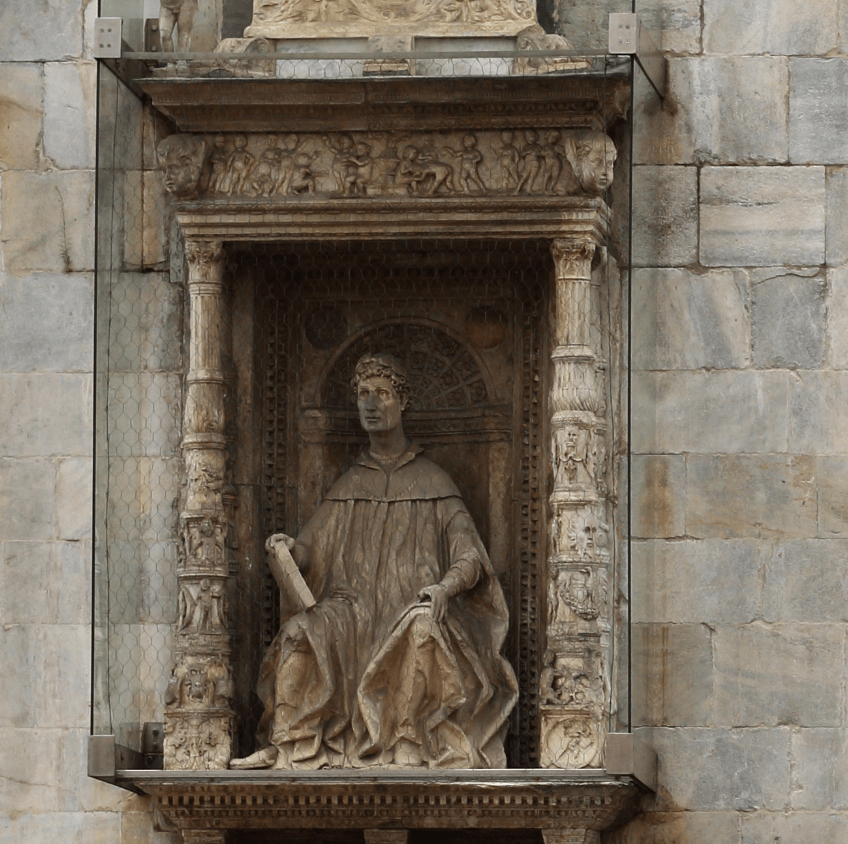
Pliny on the Catholic cathedral of the city of Como, Lombardy, Italy

“I asked them whether they were Christians. Those who confessed, I asked a second and a third time, threatening punishment. Those who persisted, I ordered to be executed. For whatever the nature of their belief, I had no doubt that stubbornness and unyielding obstinacy deserved punishment.”

Pliny the Younger, Letters 10.96, to Trajan, c. A.D. 112.

Pliny calls Christian steadfastness “stubbornness.” Diognetus asks why Christians despise death. They are seeing the same thing from different angles. The Christian refusal to deny Christ was visible enough that Roman officials had to interpret it.

Pliny also describes what he learned about Christian worship.

“They said that the sum of their fault or error was this: they were accustomed to meet on a fixed day before dawn, to sing responsively a hymn to Christ as to a god, and to bind themselves by oath, not to commit crime, but to avoid fraud, theft, adultery, breach of trust, and refusal to return what had been entrusted to them.”

Pliny the Younger, Letters 10.96, to Trajan, c. A.D. 112.

Here we hear, from a Roman perspective, the kind of issue Diognetus raises in the first paragraph: What God do Christians trust, and how do they worship Him? Pliny’s report is brief, but it is revealing. Christians gather before dawn. They sing to Christ as to a god. They bind themselves to moral purity.

A later pagan satirist, Lucian of Samosata, gives another outside witness. He mocks Christians, but even his mockery preserves the public impression they made.

“They have persuaded themselves that they are immortal and will live forever, and because of this they despise death and many of them willingly give themselves up. Their first lawgiver persuaded them that they are all brothers, once they have denied the Greek gods, worshiped that crucified sophist, and lived according to his laws.”

Lucian of Samosata, The Passing of Peregrinus 13, c. A.D. 170.

Lucian intends insult. But he confirms the same basic questions. Christians deny the Greek gods. They worship the crucified one. They call one another brothers. They face death differently.

So when Diognetus asks about Christian worship, Christian love, Christian courage, and Christian newness, he is not asking in isolation. He is voicing questions that belonged to the public reputation of the Church.


Not Monks, but Ordinary Christians

One of the most important things to notice about these sources is that they are describing Christians in general. Pliny is not describing monks. Lucian is not describing a small ascetic faction inside the Church. The author of Diognetus is not describing a spiritual elite that has separated itself from ordinary Christian life. These writers are describing what Christians, as Christians, were known to be like.

That is easy to miss when we read the second century from the far side of later Christian history. By the fourth and fifth centuries, after Christianity became legal, favored, and eventually culturally common in many parts of the Roman world, the more radical features of Christian discipleship could begin to look like the special calling of monks, virgins, hermits, and ascetics. Those movements were deeply important, but they can also tempt later readers to misunderstand the second century. In the world of Pliny, Lucian, and Diognetus, the things being described are not yet the peculiar marks of monastic Christianity. They are the public reputation of normal Christians.

Pliny does not write to Trajan and say that he has discovered an extreme spiritual movement within Christianity. He says that those accused of being Christians gather before dawn, sing to Christ as to a god, and bind themselves to moral obedience.

“They were accustomed to meet on a fixed day before dawn, to sing responsively a hymn to Christ as to a god, and to bind themselves by oath, not to commit crime, but to avoid fraud, theft, adultery, breach of trust, and refusal to return what had been entrusted to them.”

Pliny the Younger, Letters 10.96, to Trajan, c. A.D. 112.

For Pliny, this is what Christians do. They worship Christ, refuse crimes, and order their lives around moral faithfulness. He does not present this as the lifestyle of a spiritual elite. It is the basic pattern he discovers when he investigates the Christian name.

Lucian is similar, even though his tone is mocking. He does not say that a handful of unusually zealous Christians believe they are brothers or despise death. He speaks about Christians as a recognizable people.

“Their first lawgiver persuaded them that they are all brothers, once they have denied the Greek gods, worshiped that crucified sophist, and lived according to his laws.”

Lucian of Samosata, The Passing of Peregrinus 13, c. A.D. 170.

Lucian thinks this is foolish, but he still shows us what outsiders thought they were seeing. Christians denied the Greek gods. Christians worshiped the crucified one. Christians called one another brothers. Christians faced death differently. Again, this is not a description of monks. This is the pagan world trying to explain the normal life of Christians.

That makes the testimony of Diognetus even more powerful. The author does not say, “There are some Christians who live this way.” He simply says, “Christians.” His description is sweeping because he is presenting Christian identity itself.

“Christians are not distinguished from other people by country, language, or customs. They do not live in cities of their own, or use some unusual speech, or practice a strange way of life. Their teaching was not invented by human speculation, nor do they champion a merely human doctrine.”

Anonymous, Epistle to Diognetus 5.1 to 5.3, c. A.D. 180.

He then describes their marriages, their children, their tables, their citizenship, their obedience to laws, their suffering, and their hope.

“Every foreign land is their homeland, and every homeland is foreign. They marry like everyone else and have children, but they do not expose their offspring. They share a common table, but not a common bed. They are in the flesh, but they do not live according to the flesh. They spend their days on earth, but their citizenship is in heaven.”

Anonymous, Epistle to Diognetus 5.5 to 5.9, c. A.D. 180.

This is ordinary Christian life in the second century, at least as the Church wanted to present it and as outsiders often recognized it. Christians married, had children, ate meals, lived in cities, and followed local customs in clothing and food. Yet in the middle of that ordinary life, they refused infant exposure, rejected sexual lawlessness, confessed heavenly citizenship, loved one another, and faced persecution with courage.

This point is easy to lose once Christianity becomes common. In later centuries, costly discipleship could be treated as the work of specially devoted Christians, while ordinary believers lived closer to the assumptions of the surrounding culture. But in these earlier sources, heavenly citizenship, moral distinctness, refusal of idols, brotherly love, care for children, courage before death, and burden-bearing mercy are not advanced electives in the Christian life. They are what Christians were known for.

This is part of why Diognetus asks his questions. He is not asking about a sect within Christianity. He is asking about the Christians themselves.


The Slave Women Pliny Tortured

Pliny’s letter gives us one more detail that belongs in this story. After describing Christian worship, moral discipline, and their ordinary meal together, Pliny says he wanted to discover the truth more fully. So he turned to two enslaved Christian women.

“For this reason I judged it all the more necessary to find out the truth by torture from two female slaves, who were called ministrae. But I discovered nothing else except a depraved and excessive superstition.”

Pliny the Younger, Letters 10.96, to Trajan, c. A.D. 112.

This is a chilling sentence. Pliny writes it almost casually because to a Roman governor the torture of enslaved persons could be treated as an ordinary instrument of investigation. But for our purposes, the sentence reveals something extraordinary about the Christian community.

The two women are enslaved. In Roman society, that places them near the bottom of the social order. They are also women, which in that world often meant limited public authority. Yet Pliny says they were called ministrae. The Latin word can mean female ministers, attendants, or servants, and many English translations render it “deaconesses.” We should be careful not to force a later, fully developed office of deaconess back into this moment too rigidly. But even with that caution, the point remains powerful. These enslaved women were recognized in some kind of ministry or service within the Christian community, and Pliny believed they were significant enough to interrogate for information.

That is a remarkable reversal. The Roman world saw two enslaved women as bodies that could be tortured for evidence. The Church appears to have seen them as servants of Christ with recognized responsibility among the believers.

This fits perfectly with the world described in Diognetus. Christians were not marked off by one social class. They were scattered through cities, villages, households, and ranks of society. Pliny himself says the movement had touched people of every age, every rank, and both sexes.

“Many persons of every age, every rank, and also of both sexes are and will be endangered. For the contagion of this superstition has spread not only to the cities but also to the villages and farms.”

Pliny the Younger, Letters 10.96, to Trajan, c. A.D. 112.

Pliny means this as a warning. But for the historian of the Church, it is evidence. Christianity had entered the lives of men and women, free and enslaved, city dwellers and villagers, people of rank and people without rank. And within that new people, even those whom Roman society placed at the margins could become recognized servants of the Church.

The Church was not a philosophical club for elite men. It was not a mystery society for one social class. It was not an ethnic enclave. It was a new people formed by the Word, and that new people reordered human worth around Christ. The enslaved could become ministers. Women could be recognized as servants of the Church. The poor could make many rich. Those with no standing in the empire could become living witnesses to the kingdom of God.

This does not take us away from Diognetus. It deepens the point. When the author says that Christians are not distinguished by country, language, or ordinary customs, he is describing a people whose identity cuts across the old social markers. In that people, the ancient world’s hierarchies were not erased in a simplistic way, but they were profoundly relativized. The deepest identity was no longer master or slave, male or female, rich or poor, official or peasant. The deepest identity was belonging to Christ.


Why Christians Refused the Gods

The author first answers Diognetus by explaining why Christians cannot worship the gods of the Greeks. He asks Diognetus to look honestly at the objects people call gods. They are made of stone, bronze, wood, silver, iron, and clay. They are shaped by craftsmen, guarded by men, and subject to decay.

“Is not one of them stone, like what is trampled underfoot? Another bronze, no better than the vessels made for our use? Another wood, already rotting? Another silver, needing someone to guard it lest it be stolen? Another iron, eaten away by rust? Another clay, no more honorable than what is made for the most common service?”

Anonymous, Epistle to Diognetus 2.2, c. A.D. 180.

The argument is direct. If the gods are made by human hands, they cannot be the Maker of human hands. If they need to be guarded, they cannot guard the world. If they can decay, they cannot be the source of life.

The author then makes the point sharper.

“These things you call gods. These things you serve. These things you worship. In the end, you become like them. Therefore you hate the Christians, because they do not regard these things as gods.”

Anonymous, Epistle to Diognetus 2.5 to 2.6, c. A.D. 180.

This explains why Christian refusal created hostility. Christians were not merely adding a private devotion to the religious life of the empire. They were refusing the gods everyone else honored. Their refusal exposed the idols as lifeless things.

Pliny’s test for accused Christians makes the same point. A person could prove he was not truly Christian by worshiping the gods and cursing Christ.

“Those who denied that they were or had been Christians invoked the gods in words I dictated, offered incense and wine to your image, which I had ordered brought with statues of the gods, and cursed Christ. It is said that those who are truly Christians cannot be forced to do these things.”

Pliny the Younger, Letters 10.96, to Trajan, c. A.D. 112.

This was the line Christians could not cross. They could live in Roman cities. They could marry, work, buy, sell, and obey the ordinary laws. But they could not call idols gods, and they could not curse Christ.

Again, the point is not that a few unusually zealous Christians refused idolatry while ordinary Christians found ways to blend in. Pliny treats refusal to worship the gods and curse Christ as the mark of a true Christian. The author of Diognetus says Christians are hated because they do not regard these things as gods. The refusal belonged to Christian identity itself.

That refusal made them visible.


Why Christians Were Not Simply Another Jewish Group

Diognetus also asks why Christians do not follow Jewish religious practice. This part of the letter needs careful handling because the author uses sharp polemical language about Jewish observances. It reflects an early Christian argument in the painful separation between Church and synagogue. It should not be turned into contempt for Jewish people.

The author’s theological point is that the Creator does not need to be supplied by the creatures He made.

“The one who made heaven and earth and all that is in them, and who supplies us all with what we need, cannot Himself need the very things that He supplies to those who imagine they are giving them to Him.”

Anonymous, Epistle to Diognetus 3.4, c. A.D. 180.

This helps us see how the author places Christianity. Christians are not pagans because they refuse idols. They are not simply another Jewish sect because they believe the decisive revelation of God has come through the Son. Their worship is not centered on images, and it is not defined by temple sacrifice. It is centered on the living God who has sent His Word.

That is why the question of timing matters so much. If Christians worship the ancient Creator, why does their way of life seem new? If the God of Christians is the Maker of heaven and earth, why has this people appeared now?

The author will answer that question by pointing to Christ as the eternal Word revealed in time.


Christians in the World

After saying what Christians are not, the author describes what they are. This is the most famous passage in Diognetus, and it remains one of the richest descriptions of early Christian identity.

Christians are not marked off by country, language, or clothing. They do not live in separate Christian cities. They do not speak a secret dialect. They do not withdraw from ordinary life into a private civilization.

“Christians are not distinguished from other people by country, language, or customs. They do not live in cities of their own, or use some unusual speech, or practice a strange way of life. Their teaching was not invented by human speculation, nor do they champion a merely human doctrine.”

Anonymous, Epistle to Diognetus 5.1 to 5.3, c. A.D. 180.

This is an important answer to Diognetus. Christians are not a nation in the ordinary sense. They do not belong to one ethnic group or one language. They live among the peoples of the empire, and yet their life reveals a different citizenship.

“They live in Greek and barbarian cities, as each person’s lot has been assigned, and they follow local customs in clothing, food, and the rest of life. Yet they display a wonderful and admittedly astonishing form of citizenship. They live in their own countries, but as sojourners. They share all things as citizens, yet endure all things as foreigners.”

Anonymous, Epistle to Diognetus 5.4 to 5.5, c. A.D. 180.

The author then gives one of the great summaries of Christian life in the ancient world:

“Every foreign land is their homeland, and every homeland is foreign. They marry like everyone else and have children, but they do not expose their offspring. They share a common table, but not a common bed. They are in the flesh, but they do not live according to the flesh. They spend their days on earth, but their citizenship is in heaven.”

Anonymous, Epistle to Diognetus 5.5 to 5.9, c. A.D. 180.

The point is not that Christians are strange because they reject ordinary human life. The point is that they inhabit ordinary life differently. They marry. They have children. They share meals. They live in cities. But they do not expose infants. They do not turn sexual desire into lawlessness. They do not confuse earthly citizenship with ultimate belonging.

Their difference is not chiefly in location, language, or costume. Their difference is in allegiance.

The author continues:

“They obey the established laws, and by their lives they surpass the laws. They love all people, and are persecuted by all. They are unknown and condemned. They are put to death, and restored to life. They are poor, yet make many rich. They lack everything, yet abound in everything.”

Anonymous, Epistle to Diognetus 5.10 to 5.13, c. A.D. 180.

Then comes the famous image. But the image should be heard through its conclusion, because the conclusion tells us that this is not merely how Christians happen to live. It is the place God has assigned them.

“To say it simply: what the soul is in the body, Christians are in the world. The soul is spread through all the members of the body, and Christians are scattered through the cities of the world. The soul dwells in the body, yet is not of the body; Christians dwell in the world, yet are not of the world. The invisible soul is guarded by the visible body, and Christians are known to be in the world, but their godliness remains unseen. The flesh hates the soul and wars against it, though the soul does it no harm, because the soul prevents it from indulging its pleasures. So also the world hates Christians, though they do it no wrong, because they oppose its pleasures. The soul loves the flesh that hates it, and Christians love those who hate them. The soul is enclosed in the body, yet it holds the body together. Christians are held in the world as in a prison, yet they hold the world together. The immortal soul dwells in a mortal tent, and Christians dwell as sojourners among corruptible things while waiting for incorruptibility in heaven. The soul becomes better when treated harshly in food and drink, and Christians increase daily when they are punished. God has assigned them this great post, and they are not permitted to abandon it.”

Anonymous, Epistle to Diognetus 6.1 to 6.10, c. A.D. 180.

That final sentence is crucial. Christians are not merely scattered because history happened to scatter them. They are scattered because God has assigned them this role. They are not merely in the world by accident. They have been placed there as the soul is placed in the body.

This strengthens the whole argument. The author is not describing monastic withdrawal, and he is not describing a private spiritual elite. He is describing the ordinary Christian vocation in the world. Christians marry, raise children, eat at tables, obey laws, live in cities, and work among their neighbors. Yet they do all of this as a people whose citizenship is in heaven and whose presence in the world has been appointed by God.

This is how the author answers an influential outsider. He does not say that Christians are politically dominant or socially impressive. He says that Christians have been assigned a divine post inside the same world everyone else inhabits. They are not permitted to abandon it.


The God Who Sent His Word

The author then turns from Christian life to the divine action that explains it. The Christian way of life did not arise because someone invented a better moral philosophy. It is not a merely human system. It begins with God revealing Himself.

“This was no earthly invention delivered to them. It is no merely human system of opinion that they think worthy of such careful preservation. It is not a stewardship of human mysteries that has been entrusted to them. Rather, the almighty God Himself, the Creator of all things, invisible and sovereign, sent from heaven and planted among human beings the truth, the holy and incomprehensible Word, and fixed Him firmly in their hearts.”

Anonymous, Epistle to Diognetus 7.1 to 7.2, c. A.D. 180.

This passage is crucial. Christians are not different because they discovered God by superior reasoning. They are different because God sent His Word. The Church is not the origin of the message. The Church is the result of God’s revelation.

The author then clarifies who this Word is. God did not send an angel, a servant, or a lower heavenly minister. He sent the one through whom creation itself was made and ordered.

“He did not send, as someone might suppose, a servant, or angel, or ruler, or one who governs earthly things, or one entrusted with the ordering of heaven. He sent the very Creator and Fashioner of all things, by whom He made the heavens, by whom He enclosed the sea within its bounds, whose mysteries all the elements faithfully keep.”

Anonymous, Epistle to Diognetus 7.2, c. A.D. 180.

Here the author begins to answer the deepest question in the opening paragraph. If Christianity seems new, how can it claim to reveal the ancient Creator? The answer is that the one who appeared in time is not a creature of time. He is the Word through whom the heavens were made.

The author then describes the manner of His coming.

“Did He send Him, as one might imagine, to rule by tyranny, fear, and terror? Not at all. He sent Him in gentleness and meekness. As a king sends his son, who is also a king, so He sent Him. He sent Him as God; He sent Him as to human beings; He sent Him as Savior; He sent Him to persuade, not to compel, for violence has no place in the character of God.”

Anonymous, Epistle to Diognetus 7.3 to 7.4, c. A.D. 180.

This tells us not only who Christ is, but what God is like. God does not reveal Himself by crushing the world into submission. He sends His Son in gentleness. He persuades rather than compels. He saves rather than terrifies.

This also explains why Christians are supposed to live the way they do. If the Son comes in meekness, His people cannot make coercion their highest tool. If the Son bears with sinners, His people must learn patience. If the Son gives Himself, His people must become a people of self-giving love.

Christian ethics flow from the character of the God revealed in Christ.


The Word the Gentiles Were Reaching For

There is another layer to the author’s answer that should not be missed. The Christians did not present Christ only as the fulfillment of Jewish Scripture and Jewish expectation, though He certainly was that. They also presented Him as the answer to the deepest questions of the Gentile world.

This matters because Diognetus is not being addressed as a synagogue ruler or a student of the prophets. He is addressed as “most excellent Diognetus,” probably a man of education, status, and influence in the Greek and Roman world. He asks why Christians reject the gods of the Greeks, why they do not simply become Jews, and why this new way of life has appeared now. So the author answers him in a way that speaks to Gentile categories as well. He speaks of the Word, the Creator, the Fashioner of all things, the one by whom the heavens, sea, stars, sun, moon, and all creation are ordered.

“He sent the very Creator and Fashioner of all things, by whom He made the heavens, by whom He enclosed the sea within its bounds, whose mysteries all the elements faithfully keep, from whom the sun has received the measure of the courses of the day, whom the moon obeys as He commands it to shine by night, and whom the stars obey as they follow the course of the moon.”

Anonymous, Epistle to Diognetus 7.2, c. A.D. 180.

That language does more than answer Jewish expectation. It answers Gentile longing for the rational order behind the world. Philosophers had asked what held reality together. They had spoken of reason, nature, providence, order, and the divine principle behind all things. The Christian answer was not that these longings were meaningless. The Christian answer was that the one whom Gentile wisdom sought dimly had now been revealed personally in Christ.

At the same time, Diognetus is careful. The author does not flatter pagan philosophy as though it had already arrived at the truth by itself. He criticizes those who identified God with created elements.

“Do you accept the vain and silly doctrines of those who are considered trustworthy philosophers? Some said that fire was God, calling that God to which they themselves will one day come. Others said water. Others named some other element formed by God. But if any one of these theories is worthy of approval, then every created thing might just as well be declared God.”

Anonymous, Epistle to Diognetus 8.2 to 8.4, c. A.D. 180.

The point is not that Gentile philosophy already knew God clearly. The point is that Gentile philosophy was asking real questions but could not reach the final answer on its own. According to the author, God had to reveal Himself.

“No human being has either seen Him or made Him known, but He revealed Himself. And He revealed Himself through faith, by which alone it is given to behold God.”

Anonymous, Epistle to Diognetus 8.5 to 8.6, c. A.D. 180.

This is where Diognetus fits beautifully alongside Justin Martyr. Justin, writing earlier in the second century, makes the philosophical claim more explicitly. For Justin, Christ is the Logos, the Word, in whom all peoples have shared to some degree. Therefore, whatever the philosophers saw truly, they saw because the Word was already at work.

“We have been taught that Christ is the firstborn of God, and we have declared above that He is the Word of whom every race of human beings has been a partaker. Those who lived according to reason are Christians, even though they have been thought atheists, such as Socrates and Heraclitus among the Greeks, and others like them.”

Justin Martyr, First Apology 46, c. A.D. 155.

Justin says the same thing even more directly in his Second Apology:

“Whatever things were rightly said among all people are the property of us Christians. For next to God, we worship and love the Word who is from the unbegotten and ineffable God, since He also became man for our sake, that by sharing in our sufferings He might bring us healing.”

Justin Martyr, Second Apology 13, c. A.D. 155 to 160.

That helps us understand the broader Christian claim. Christ fulfills Israel’s Scriptures, but He also fulfills the scattered hopes of the nations. He is the answer to the prophets, and He is the answer to the philosophers. The prophets saw more clearly because they received revelation. The philosophers saw partially and often confusedly because they grasped fragments of truth through reason. But both streams find their fullness in the same person: the Word who was from the beginning and appeared in time.

This makes the central line of Diognetus even stronger.

“This is He who was from the beginning, who appeared as new and was found to be ancient, and who is always being born anew in the hearts of the saints.”

Anonymous, Epistle to Diognetus 11.4, c. A.D. 180.

To the Jew, He is ancient because He is the one prepared and promised from the beginning. To the Gentile, He is ancient because He is the Logos, the divine Word, the reason and order behind creation itself. To both, He appears new because He has now come in the flesh.

That is why Christianity could stand before both synagogue and empire, before both Scripture and philosophy, and say: the one you were waiting for, and the one you were reaching for, has appeared.


Why This New People Appeared Now

Diognetus asks why this new people or practice has entered human life now and not earlier. That question is one of the most important in the whole letter.

The author’s answer is not that God only recently began to care about humanity. It is not that humanity finally became wise enough to earn revelation. The answer is that God was patient, allowing human beings to see the poverty of their own works so that His mercy would be revealed as mercy.

“In the former time, He permitted us to be carried along by disorderly impulses, drawn away by pleasures and desires. This was not because He delighted in our sins, but because He was patient with us. It was not because He approved that season of iniquity, but because He was preparing the present season of righteousness, so that, having been shown by our own works to be unworthy of life, we might now be made worthy by the goodness of God.”

Anonymous, Epistle to Diognetus 9.1, c. A.D. 180.

The delay is not indifference. It is patience. The world had to see that it could not save itself. Human beings had to learn that their own works could not make them worthy of life.

Then the author describes the appointed time of God’s mercy:

“When our wickedness had reached its fullness, and it had become clear that punishment and death were its expected reward, then came the time God had appointed to reveal His goodness and power. O the surpassing kindness and love of God! He did not hate us, reject us, or remember our evil against us. He was patient; He bore with us; in mercy He took our sins upon Himself. He gave His own Son as a ransom for us: the holy for the lawless, the innocent for the evil, the righteous for the unrighteous, the incorruptible for the corruptible, the immortal for the mortal.”

Anonymous, Epistle to Diognetus 9.2, c. A.D. 180.

This is the heart of the author’s answer. Christianity appears now because now is the appointed season of mercy. The Son has been given as a ransom. The righteous one has been given for the unrighteous. The incorruptible one has been given for the corruptible. The immortal one has been given for mortals.

Then the author cries out in wonder:

“O sweet exchange! O unsearchable work! O benefits beyond all expectation! The lawlessness of many is hidden in one righteous Man, and the righteousness of one justifies many lawless people.”

Anonymous, Epistle to Diognetus 9.5, c. A.D. 180.

This is not merely explanation. It is worship. The author is overwhelmed by the mercy he is describing.

Diognetus asks why Christians despise death. Here is part of the answer. They have come to believe that death has been answered by the immortal one who gave Himself for mortals. Diognetus asks why this new people appeared now. Here is part of the answer. The appointed time of divine kindness has arrived.

But the author still has one more answer to give. Christianity is new in its historical appearance, but Christ is ancient in His divine identity.


The Ancient Word Appearing New

The central line comes in chapter 11 of the received text. It gathers the force of the letter into one sentence. Diognetus has asked why this new people has appeared now, and the author answers by pointing to the ancient Word who has entered time and now lives in His people.

“This is He who was from the beginning, who appeared as new and was found to be ancient, and who is always being born anew in the hearts of the saints. This is He who is eternal, who today is called Son, through whom the Church is enriched and grace, spread widely, increases among the saints.”

Anonymous, Epistle to Diognetus 11.4 to 11.5, c. A.D. 180.

The author does not deny that Christianity has appeared in history. He does not pretend that the Church has always existed in the same visible form. He says something more profound. The one who appeared new is the one who was from the beginning.

Jesus was born recently in time, yet He is ancient as God. He appeared within history, yet He is not merely a historical founder. He is the eternal Son. He is the Word through whom the world was made. He is the one who seemed new because He was revealed in time, but when He was revealed, He was found to be ancient.

This is the perfect answer to Diognetus’s question. The Christian movement looks new because the incarnation occurred in time. But the Christian faith is not a novelty because the one incarnate is the eternal Word. The Church is historically recent, but Christ is not recently divine. The Son appears in the fullness of time, but He was from the beginning.

The line also says that He is “always being born anew in the hearts of the saints.” That phrase does not mean the incarnation is repeated in the same way over and over. The Word became flesh uniquely in Jesus Christ. But the life of Christ is continually formed in believers. The ancient Word who appeared in time now makes His dwelling in the hearts of the saints.

The author had already prepared us for this idea:

“The almighty God Himself, the Creator of all things, invisible and sovereign, sent from heaven and planted among human beings the truth, the holy and incomprehensible Word, and fixed Him firmly in their hearts.”

Anonymous, Epistle to Diognetus 7.2, c. A.D. 180.

The Word is sent. The Word is planted. The Word is fixed in human hearts. Then chapter 11 says He is ever born anew in the saints.

That is why Christian life itself becomes an answer to Diognetus. The Church is not merely a group of people who admire a teacher from the past. The Church is a people in whom the living Word is at work. Their love, courage, chastity, mercy, and heavenly citizenship are not separate from Christ. They are signs that the ancient Word is making people new.


Born Recently in Time, Ancient as God

The power of the sentence in chapter 11 is that it holds together truths that can easily be separated.

Jesus is born recently in time. From the perspective of c. A.D. 180, the life, death, and resurrection of Jesus belong to recent history. Christianity is not a myth buried in the distant past. It is tied to remembered events, public preaching, apostolic witness, and communities still living in the aftermath of what they claim God has done.

Luke’s Gospel tells the story in exactly this historical register. The anonymous author does not begin with vague mythic time. He writes of a child born during the days of imperial power, in a named place, within the ordinary conditions of human birth.

“While they were there, the days were fulfilled for her to give birth, and she gave birth to her firstborn Son. She wrapped Him in swaddling cloths and laid Him in a manger, because there was no place for them in the lodging place.”

Anonymous author traditionally called Luke, Gospel According to Luke 2.6 to 2.7, c. A.D. 80.

This is the newness of Christianity in its historical form. The Son is born. He enters time. He has a mother. He is wrapped in cloths. He is laid in a manger. The Christian proclamation is not embarrassed by this nearness. It does not hide the humility of the birth.

At the same time, Diognetus insists that the one born in time is ancient as God.

“He sent the very Creator and Fashioner of all things, by whom He made the heavens, by whom He enclosed the sea within its bounds, whose mysteries all the elements faithfully keep.”

Anonymous, Epistle to Diognetus 7.2, c. A.D. 180.

The one born in time is the one through whom time itself exists. The one who appeared in recent history is the one by whom the heavens were made. The Christian claim is not simply that a remarkable man appeared and founded a new movement. The claim is that the Creator’s own Word entered human history.

This is why the author can say He “appeared as new” and “was found to be ancient.” Both are true. He appeared new because He came in the flesh at a particular moment. He was found ancient because He was from the beginning.

Luke writes to Theophilus so that he may know certainty about the things fulfilled among Christians. The author of Diognetus writes to Diognetus so that he may understand the Christian people and the God who explains them. Both works are addressed to “most excellent” recipients. Both are anonymous. Both present Christian truth as something that can be set before serious, influential readers.

But Diognetus presses the question of newness with special force. If Jesus appeared recently, does that make Christianity a recent invention? The author’s answer is no. Christianity is new as revelation, but ancient as divine truth. The one born recently in time is ancient as God.


Something Divine Among Them

The line about the Word being born anew in the hearts of the saints should not be treated as a vague devotional phrase. It is the theological explanation for what outsiders were seeing in Christian life. The author of Diognetus is not merely saying that Christians remember Jesus. He is saying that the living presence of God is active within them.

That is why chapter 7 is so important. After describing Christians thrown to wild beasts and yet not overcome, the author does not say merely that Christians are brave. He says their endurance is evidence that God is present.

“Do you not see them thrown to wild beasts, so that they might be persuaded to deny the Lord, and yet they are not overcome? Do you not see that the more they are punished, the more others increase? These things do not seem to be the works of man. They are the power of God. They are proofs of His presence.”

Anonymous, Epistle to Diognetus 7.7 to 7.9, c. A.D. 180.

That phrase, “proofs of His presence,” belongs beside the central line of chapter 11.

“This is He who was from the beginning, who appeared as new and was found to be ancient, and who is always being born anew in the hearts of the saints.”

Anonymous, Epistle to Diognetus 11.4, c. A.D. 180.

The connection is powerful. Christ has died, risen, and ascended. He is no longer walking the roads of Galilee in the same visible way. Yet the author of Diognetus does not speak as though Christ has simply gone away and left Christians with memories, moral instructions, and institutions. He speaks as though the Word remains actively present in His people.

The Word is planted in their hearts. The Word is born anew in the saints. The courage of the martyrs, the love of the brethren, the refusal of idols, the bearing of burdens, and the growth of the Church under persecution are not merely human achievements. They are “the power of God” and “proofs of His presence.”

This is where Aristides helps us see that Diognetus was not alone. Writing earlier in the second century, Aristides also describes Christian conduct and then concludes that there is something divine in them.

“It is enough for us to have briefly made known to your Majesty the conduct and the truth of the Christians. For great indeed and wonderful is their teaching to the one who is willing to examine and understand it. And truly this people is a new people, and there is something divine mingled with it.”

Aristides, Apology 16, c. A.D. 125.

That phrase says almost exactly what Diognetus is showing. The Christian life is not simply admirable. It bears witness to divine presence. Outsiders can mock it, governors can interrogate it, philosophers can test it, and emperors can be asked to examine it. But the Christian claim is that something more than human discipline is at work in the Church.

The ancient Word is still living in His people.

This also helps us understand why ordinary Christian life appeared so strange. If Christianity were only a set of ideas, then it could be evaluated as one philosophy among others. If it were only a social movement, it could be explained by common loyalty, group identity, or shared pressure. But writers like Aristides and the author of Diognetus see something deeper. They see a new people, and they interpret the life of that people as evidence that God is present among them.


Christ Suffering in the Saints

The same idea appears in another second-century letter, the Letter of the Churches of Vienne and Lyons, written after the persecution in Gaul around A.D. 177 and preserved by Eusebius. This letter is not an apology addressed to an outsider like Diognetus. It is a church letter about martyrs. But it gives us the same theology of Christ’s ongoing presence in believers.

When the letter describes Sanctus enduring torture, it does not interpret his endurance as merely human courage.

“In him Christ suffering wrought great wonders, destroying the adversary, and showing for an example to the rest that there is nothing fearful where there is the Father’s love, and nothing painful where there is Christ’s glory.”

Letter of the Churches of Vienne and Lyons, preserved in Eusebius, Ecclesiastical History 5.1, c. A.D. 177.

That is very close to the logic of Diognetus. The martyr is not simply copying Christ from a distance. Christ is active in him. Christ suffers in him. Christ displays His power through him.

The same letter says something even more vivid about Blandina, an enslaved Christian woman who became one of the great witnesses of the persecution. When she was fastened to a stake, the other Christians saw in her body a living sign of the crucified Christ.

“Through her presenting the spectacle of one suspended on something like a cross, and through her earnest prayers, she inspired the combatants with great eagerness. For in the combat they saw, by means of their sister, with their bodily eyes, Him who was crucified for them.”

Letter of the Churches of Vienne and Lyons, preserved in Eusebius, Ecclesiastical History 5.1, c. A.D. 177.

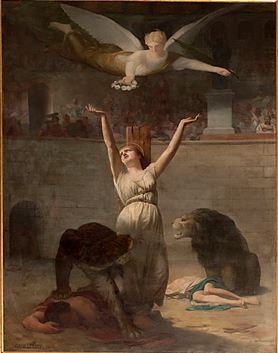
Guillemet’s 1862 Martyrdom of Saint Blandine

Christ is not absent from the post-ascension Church. He is present in His saints. He is not incarnate again in the same unique way as Bethlehem, but His life is being manifested again and again in His people.

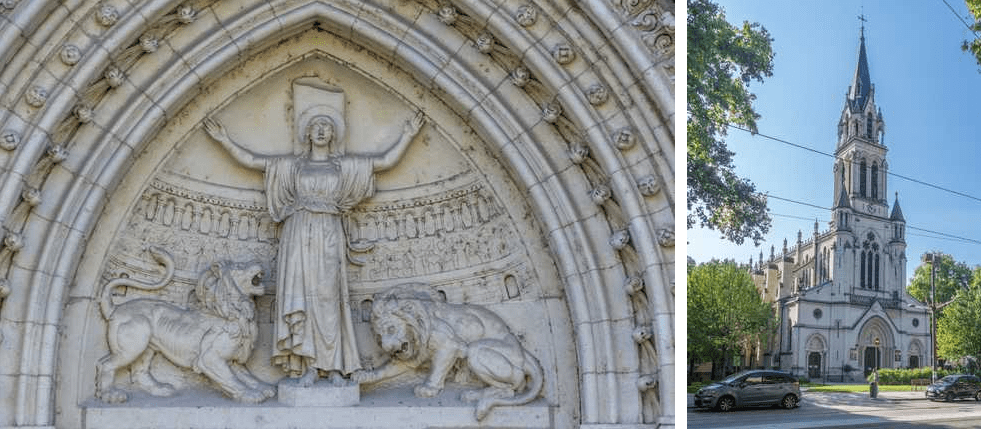
Jules Comparat, The Martyrdom of Saint Blandina, tympanum sculpture, Lyon 1886

That gives more force to Diognetus 11.4. The Word who was from the beginning appeared new in history, and now He is always being born anew in the hearts of the saints. This is not only a mystical phrase. It is how early Christians interpreted the visible transformation of ordinary believers.

The slave woman becomes a witness. The tortured deacon refuses to deny Christ. The poor make many rich. The persecuted bless. The condemned are brought to life. The Church’s life becomes the place where the ascended Christ is still seen.

This also draws Pliny’s tortured slave women into the wider picture. Pliny sees enslaved women as sources of information to be extracted by force. The Church sees women like them as servants of Christ. The Lyons letter shows an enslaved woman, Blandina, becoming a living icon of the crucified Lord before the eyes of the suffering Church. In both cases, the Roman world and the Christian world are looking at the same kind of person but seeing two different realities. Rome sees low status. The Church sees the place where Christ can be made visible.


The Word Born Again in Believers

The line about the Word being “always born anew in the hearts of the saints” becomes clearer when we read it alongside the author’s description of Christian imitation.

In chapter 10, the author turns directly to Diognetus and explains what happens when someone receives the knowledge of the Father. The Christian life begins with God’s love, not with human achievement.

“If you also desire this faith, first receive the knowledge of the Father. For God loved human beings. For their sake He made the world, subjected all things on earth to them, gave them reason and understanding, permitted them alone to look upward to Him, formed them after His own image, sent to them His only-begotten Son, promised them the kingdom in heaven, and will give it to those who love Him.”

Anonymous, Epistle to Diognetus 10.1 to 10.2, c. A.D. 180.

The Christian life is rooted in divine generosity. God made, gave, formed, sent, promised, and will give. Human beings do not climb up to God by their own strength. They receive the love of the Father revealed in the Son.

Then the author describes the result:

“When you have come to know Him, with what joy do you think you will be filled? How will you love Him who first loved you so greatly? And loving Him, you will become an imitator of His goodness. Do not marvel that a human being can become an imitator of God. He can, if God wills it.”

Anonymous, Epistle to Diognetus 10.3 to 10.4, c. A.D. 180.

This is what it means for the Word to be born anew in believers. They become imitators of God’s goodness. That imitation is not domination, force, or worldly greatness. The author is careful about that.

“Happiness is not found in ruling over one’s neighbors, or in wanting to have more than the weak, or in being rich and using force against those beneath you. No one can imitate God in these things. They are foreign to His greatness.”

Anonymous, Epistle to Diognetus 10.5, c. A.D. 180.

This is a direct challenge to ordinary ancient ideas of status. The powerful man rules. The wealthy man gives from above and receives honor. The influential man gathers dependents and clients. But the Christian imitates God by bearing burdens.

“Whoever takes upon himself the burden of his neighbor, whoever is willing to benefit another who lacks what he himself has, whoever supplies to the needy what he has received from God and becomes a gift of God to those who receive it, this person is an imitator of God.”

Anonymous, Epistle to Diognetus 10.6, c. A.D. 180.

This is where the author’s theology becomes visible in ordinary life. The Word born in the heart produces people who bear the burdens of others. The ancient Christ appears newly in acts of mercy. The eternal Son becomes visible in patience, generosity, courage, and love.

So when Diognetus asks what kind of affection Christians have for one another, the answer is not merely that Christians are unusually friendly. The answer is that the Word is living in them. The love of God has taken root in human hearts, and that love has created a new kind of community.

And again, in the second-century sources, this is not presented as an optional higher path for a few unusually serious believers. This is Christian life. To receive the Father’s love is to become an imitator of His goodness. To know the Son is to bear the burdens of the neighbor. To have the Word born in the heart is to become, in some visible way, a gift of God to others.

This also connects back to the divine assignment in chapter 6. Christians are not permitted to abandon their post in the world because the Word is being born in them for the sake of the world. Their holiness is not an escape from the body of humanity. It is the soul-like presence by which God blesses the world that misunderstands them.


Why Christians Face Death Differently

Diognetus also asks why Christians despise death. The author answers that Christians do not fear bodily death as the ultimate evil because they have come to know true life in God.

“Then you will love and admire those who are punished because they will not deny God. Then you will condemn the deceit and error of the world, when you recognize the true life in heaven, when you despise what is only thought to be death here, and when you fear the true death reserved for those condemned to the eternal fire.”

Anonymous, Epistle to Diognetus 10.7, c. A.D. 180.

This is not a hatred of life or a desire for suffering. It is a reordering of fear. Christians can face earthly death because they believe the immortal one has given Himself for mortals. They believe that denying God is worse than dying. They believe that true life is found in heaven.

The author also points to martyrdom as evidence that Christianity is not merely human.

“Do you not see them thrown to wild beasts, so that they might be persuaded to deny the Lord, and yet they are not overcome? Do you not see that the more they are punished, the more others increase? These things do not seem to be the works of man. They are the power of God. They are proofs of His presence.”

Anonymous, Epistle to Diognetus 7.7 to 7.9, c. A.D. 180.

That last sentence is essential. The courage of Christians is not presented as natural bravery. It is a proof of God’s presence. Pliny saw stubbornness. Lucian saw delusion. The author of Diognetus sees the power of God at work.

This brings us back to the central line. If the Word is always being born anew in the hearts of the saints, then the courage of the martyrs is not merely admiration for a past teacher. It is the life of the risen Christ present in His people.

This courage also belongs to the general portrait of Christians. Pliny’s Christians are ordinary accused believers. Lucian’s Christians are the people he thinks he can mock as a group. Diognetus speaks broadly of Christians thrown to beasts and yet not overcome. These sources do not present courage before death as the private achievement of a spiritual elite. They present it as part of the public reputation of the Church.

That is what made the question unavoidable. The world knew how people normally behaved under threat. Christians did not always behave normally. Diognetus wanted to know why.


The Church as the Living Answer

By the end of the letter, we can see that the author answers Diognetus in two ways at once. He gives theological explanations, and he points to the Christian community as evidence.

Diognetus asks what God Christians worship. The author answers: the Creator who sent His Word. But he also points to Christians who refuse idols and worship the living God.

Diognetus asks why Christians love one another. The author answers: because God first loved them. But he also points to Christians who share tables, bear burdens, care for children, and live as brothers and sisters across the ordinary divisions of ancient society.

Diognetus asks why Christians despise death. The author answers: because the immortal one has been given for mortals. But he also points to Christians who endure punishment without denying the Lord.

Diognetus asks why this new people has appeared now. The author answers: because the appointed season of mercy has arrived. But he also points to the Church as the place where the ancient Word is being born anew.

The soul-and-body image helps us understand this. The Church is visible in the world, but the life that animates her is hidden in God. And the end of the image makes clear that this hidden life is not an optional calling. God has assigned Christians this post in the world, and they are not permitted to abandon it.

“Christians are held in the world as in a prison, yet they hold the world together. The immortal soul dwells in a mortal tent, and Christians dwell as sojourners among corruptible things while waiting for incorruptibility in heaven. The soul becomes better when treated harshly in food and drink, and Christians increase daily when they are punished. God has assigned them this great post, and they are not permitted to abandon it.”

Anonymous, Epistle to Diognetus 6.7 to 6.10, c. A.D. 180.

This is a daring claim. Christians appear weak, scattered, and vulnerable. Yet the author says they hold the world together. Not by political command, military strength, or social prestige, but by being the soul within it.

This is another place where the second-century context matters. Before Christianity became culturally common, the Church’s difference was easier to see. Christians were not yet the default religious population of the empire. They were a people whose worship, ethics, courage, family life, and mutual love stood out strongly enough to provoke questions.

And in Diognetus, the Church’s visible life is not merely a moral illustration added after the theology. It is part of the evidence. The author points to Christians and says, in effect, that their life cannot finally be explained by human invention. Their endurance is the power of God. Their courage is proof of His presence. Their love is the Word born anew in their hearts. Their place in the world is not accidental. It has been assigned by God.

That is why Diognetus is so valuable. It shows us Christianity before it became ordinary in the cultural sense. And precisely there, it shows that ordinary Christians were expected to be extraordinary by the standards of the world, not because they had abandoned ordinary life, but because God had placed them within ordinary life as the soul within the body.


Returning to Diognetus’s Opening Questions

By the end of the letter, the opening questions have all been answered.

Diognetus asks what God Christians trust. The author answers: the Creator of all things, invisible and sovereign, who sent His holy and incomprehensible Word.

Diognetus asks how Christians worship. The author answers: not by worshiping idols made of stone, bronze, wood, silver, iron, or clay, but by receiving the Word, living in faith, and becoming imitators of God’s goodness.

Diognetus asks why Christians reject the gods of the Greeks. The author answers: because those gods are lifeless works of human hands.

Diognetus asks why Christians do not simply practice religion like the Jews. The author answers, in his polemical way: because the Creator needs nothing from human hands and has now revealed Himself through His Son.

Diognetus asks what kind of affection Christians have for one another. The author answers: they love because God first loved them, and the Word is being formed in their hearts.

Diognetus asks why Christians despise death. The author answers: because the immortal one has been given for mortals, and Christians have learned to distinguish earthly death from the true death to be feared.

Diognetus asks why this new people has appeared now and not earlier. The author answers: because the appointed season of mercy has arrived, and the one who appeared new was from the beginning.

The whole letter gathers itself into this sentence:

“This is He who was from the beginning, who appeared as new and was found to be ancient, and who is always being born anew in the hearts of the saints.”

Anonymous, Epistle to Diognetus 11.4, c. A.D. 180.

That is the answer to Diognetus. The Church appears new because Christ has appeared in time. The faith is ancient because Christ is from the beginning. The Christian life continues because Christ is born anew in the hearts of the saints.

The author’s answer is not merely, “Here is what Christians believe.” It is, “Here is the one who explains Christians.”


What Later Centuries Could Obscure

The second-century witness matters because later Christian history can change how we hear these texts. Once Christianity became legal, favored, and socially normal, the contrast between Church and world could become harder to see. When large numbers of people became Christian by culture, family inheritance, imperial favor, or social expectation, the older marks of discipleship could seem less like the normal Christian life and more like the special calling of the unusually devout.

This does not mean that later monks, virgins, hermits, and ascetics were wrong. In many cases, they preserved and intensified a seriousness about discipleship that earlier Christians had regarded as basic. The problem comes when later readers project that division back into the second century and imagine that Pliny, Lucian, and Diognetus must be describing spiritual specialists.

They are not.

Pliny describes Christians who gather to worship Christ and bind themselves to moral obedience. Lucian describes Christians who deny the Greek gods, worship the crucified one, call one another brothers, and despise death. The author of Diognetus describes Christians who marry, have children, refuse infant exposure, share tables, live in cities, obey laws, suffer persecution, love all people, and confess heavenly citizenship.

These are not portraits of a monastery. They are portraits of the Church.

That is one reason the Epistle to Diognetus still has such force. It does not allow Christianity to become merely a private belief system held inside an otherwise ordinary pagan life. It presents Christianity as a whole way of being human, visible in worship, family, money, sexuality, courage, citizenship, and love.

The Word who was from the beginning does not merely give Christians new ideas. He makes them a new people.

And according to the author, He does not make them a new people only by giving them memories of something that happened long ago. He makes them new by being present in them. The ancient Word who appeared in history continues to be born anew in the hearts of the saints. That is why their life becomes evidence. That is why Aristides can say there is “something divine” mingled with this new people. That is why the Lyons martyrs can see Christ in Blandina. That is why Diognetus can call Christian endurance the power of God and proof of His presence.

The early Christian claim is not simply that Christ once lived. It is that Christ lives in His people.

And because Christ lives in His people, they are not permitted to abandon their post. The answer to a compromised world is not withdrawal into invisibility, nor surrender into sameness. The answer is the Church living as the soul in the body, scattered through the cities of the world, bearing witness to the Word who was from the beginning.


The Word Still Answers the Outsider

Every age has people like Diognetus. Some are skeptical. Some are sympathetic. Some are powerful. Some are patrons, readers, officials, intellectuals, or neighbors who have watched Christians closely enough to ask real questions.

What God do Christians trust? Why do they worship Jesus? Why do they refuse the idols everyone else accepts? Why do they speak of heaven while living on earth? Why do they call each other brothers and sisters? Why do they care for the weak? Why do they forgive enemies? Why do they face death with hope? Why does this ancient faith keep appearing new?

The Epistle to Diognetus answers those questions by pointing to Christ.

He is the Creator’s Word sent into the world. He is the Son sent not in tyranny but in gentleness. He is the righteous one given for the unrighteous, the incorruptible for the corruptible, the immortal for mortals. He is born in time, yet ancient as God. He appears new, yet He is from the beginning. He is not merely remembered by Christians; He is born anew in the hearts of the saints.

That is why the Christian people cannot be explained only as a social movement, a moral philosophy, or a religious association. The author insists that something more is happening in them. The ancient Word is making human beings new.

And because He is the Word, He answers both worlds addressed in this script. He fulfills the Scriptures of Israel, but He also answers the Gentile search for truth, reason, order, and the divine source of all things. What the prophets awaited and what the philosophers reached toward are fulfilled in the same living person.

The anonymous author does not give Diognetus a slogan. He gives him a vision of the Church as the place where the eternal Son is made visible in ordinary lives. Christians live in the world, but their citizenship is in heaven. They share tables, but not lawless beds. They have children, but do not expose them. They are persecuted, yet they love. They are put to death, yet they live. They lack everything, yet they abound.

And their place in the world is not an accident. It is an assignment.

“God has assigned them this great post, and they are not permitted to abandon it.”

Anonymous, Epistle to Diognetus 6.10, c. A.D. 180.

That line belongs beside the letter’s central confession of Christ.

“This is He who was from the beginning, who appeared as new and was found to be ancient, and who is always being born anew in the hearts of the saints.”

Anonymous, Epistle to Diognetus 11.4, c. A.D. 180.

That is the heart of the Epistle to Diognetus. It begins with the questions of a “most excellent” outsider, probably a man of influence, perhaps even the kind of patron who could request or sponsor such a written defense. It answers him not by hiding the strangeness of Christianity, but by explaining it.

The Church is strange because the Word has come. The Church is new because the eternal Son has appeared in time. The Church endures because that same Word continues to be born anew in the hearts of believers.

And in the second century, that was not supposed to describe only the rarest Christians. It was the life of the Church itself. God had placed them in the world as the soul in the body, and they were not permitted to abandon that post.

John Chrysostom and the Question Paul Already Fought: Must Christians Keep the Law?

John Chrysostom’s sermons against Judaizing Christians are often quoted in fragments. When they are reduced to a few shocking lines, they can sound like simple hatred. When they are read in context, the picture is more complicated.

Chrysostom was not writing a calm treatise on Judaism. He was preaching in Antioch because some Christians in his own church were attending Jewish festivals, observing Jewish fasts, revering synagogues, using synagogue oaths, seeking healing at Jewish sacred places, and following Jewish calculations for sacred time.

He believed those Christians were not merely appreciating Jewish culture. He believed they were being drawn back under the old covenant after Christ had fulfilled it.

That puts him close to Paul in Galatians. The strongest defense of Chrysostom is that his central theological argument is Pauline: Christ has come; the Law has served its purpose; Christians must not return to circumcision, ritual obligation, or calendar observance as though Christ had not fulfilled the old dispensation.

But the controversial part is real. Chrysostom sometimes uses extreme rhetoric about Jews, Jewish worship, and synagogues. A fair defense should not hide those lines. It should show their context and ask what he was trying to do with them.


The Crisis Chrysostom Thought He Saw

Chrysostom begins the first sermon by saying that he had intended to continue a different theological argument. He had been preaching against the Anomoeans, a radical Arian group, and discussing the incomprehensibility of God. But then a more urgent crisis interrupted him.

“Another very serious illness calls for whatever cure my words can bring, an illness planted in the body of the church. We must first root out this sickness among our own people, and only then concern ourselves with those outside.”

John Chrysostom, Discourses Against Judaizing Christians, Homily 1, §4, 386 AD.

Then he names the crisis.

“The festivals of the Jews are about to come upon us one after another: Trumpets, Tabernacles, and the fasts. Many in our own ranks say they think as we do, yet some will go to watch the festivals, and others will join the Jews in keeping their feasts and observing their fasts.”

John Chrysostom, Discourses Against Judaizing Christians, Homily 1, §5, 386 AD.

This is the key to the whole series. Chrysostom is not primarily speaking to Jews. He is speaking to Christians who “say they think as we do” but who are participating in Jewish ritual life.

He wants to stop the practice before the festivals arrive.

“I want to drive this corrupt custom from the church right now.”

John Chrysostom, Discourses Against Judaizing Christians, Homily 1, §5, 386 AD.

Then comes one of the famous phrases.

“If I fail to cure those who are sick with the Judaizing disease, I fear that some Christians may share in these transgressions.”

John Chrysostom, Discourses Against Judaizing Christians, Homily 1, §5, 386 AD.

The language is harsh, but the metaphor matters. Chrysostom sees himself as a physician treating an illness inside the Christian body. In his mind, Judaizing is not an ethnic issue first. It is a pastoral danger inside the church.

A defense of Chrysostom should begin there. He is not addressing Jews in a synagogue. He is addressing Christians who were crossing into Jewish ritual practice.


Paul Behind Chrysostom

The reason Chrysostom sounds forceful is that he thinks Paul was forceful.

For Chrysostom, the issue is not whether the Old Testament is holy. It is. The issue is whether Christians, after Christ, may go back under the ritual obligations of the Law.

Paul had already asked that question in Galatians.

“If you accept circumcision, Christ will be of no benefit to you.”

Paul, Letter to the Galatians, 5:2, c. 49 to 55 AD.

Paul also warned the Galatians about returning to sacred calendars as though the coming of Christ had not changed their covenantal position.

“You observe days and months and seasons and years. I fear that I may have labored over you in vain.”

Paul, Letter to the Galatians, 4:10 to 11, c. 49 to 55 AD.

And Paul describes Peter’s conduct at Antioch with the verb that gives us the later term “Judaize.”

“If you, though a Jew, live like a Gentile and not like a Jew, how can you compel the Gentiles to Judaize?”

Paul, Letter to the Galatians, 2:14, c. 49 to 55 AD.

This is the theological world Chrysostom believes he is inhabiting. He is not trying to invent a new issue. He sees the same danger Paul saw: Christians being drawn into Law observance as though faith in Christ were not sufficient.

Chrysostom explicitly sends Paul after the Judaizers.

“Let us send after them the best of hunters, the blessed Paul, who once cried out, ‘If you are circumcised, Christ will profit you nothing.’”

John Chrysostom, Discourses Against Judaizing Christians, Homily 2, §1.4, 386 AD.

And he explains why Paul is the right witness. Paul knew Jewish life from within.

“Paul was circumcised on the eighth day, an Israelite by birth, a Hebrew of Hebrews, of the tribe of Benjamin, a Pharisee according to the Law.”

John Chrysostom, Discourses Against Judaizing Christians, Homily 2, §2.3, 386 AD.

Then Chrysostom says Paul did not reject Jewish ritual from ignorance or hatred.

“He set down this teaching not from hatred of Jewish things and not from ignorance, but from full knowledge of the surpassing truth of Christ.”

John Chrysostom, Discourses Against Judaizing Christians, Homily 2, §2.3, 386 AD.

This is one of the strongest lines for defending Chrysostom. He is consciously following Paul’s logic. He knows someone could accuse him of simply hating Jewish things. His answer is: no, Paul himself was Jewish, knew the Law, and still taught that Christians must not put themselves back under the yoke after Christ.


Chrysostom Is Not Rejecting the Old Testament

Another essential point: Chrysostom does not reject the Old Testament. He does not treat Moses, the Prophets, or the Psalms as false. He says the opposite.

Some Christians apparently defended synagogue attendance by saying the Law and Prophets were read there.

“They answer, ‘The Law and the books of the prophets are kept there.’”

John Chrysostom, Discourses Against Judaizing Christians, Homily 1, §5, 386 AD.

Chrysostom responds by distinguishing the Scriptures from synagogue practice.

“I am not speaking against the Scriptures. God forbid. It was the Scriptures that took me by the hand and led me to Christ.”

John Chrysostom, Discourses Against Judaizing Christians, Homily 1, §5, 386 AD.

He says the same thing in the second homily.

“We do not say this as an accusation against the Law. God forbid. We say it to show the surpassing riches of the grace of Christ.”

John Chrysostom, Discourses Against Judaizing Christians, Homily 2, §2.5, 386 AD.

Then he makes the point even clearer:

“The Law is not contrary to Christ. How could it be, when Christ gave the Law and the Law leads us to him?”

John Chrysostom, Discourses Against Judaizing Christians, Homily 2, §2.5, 386 AD.

This is the best theological defense of Chrysostom. His argument is not Marcionite. He is not saying the Old Testament is evil. He is saying the Law was good in its time and purpose, and that purpose was to lead to Christ.

Once Christ has come, Christians should not return to Jewish ritual obligation as though the old covenant ceremonies still governed the people of God.


The Legal World: Protected, Restricted, and Watched

To understand why Chrysostom’s sermons landed the way they did, we need the legal background. Jews in the late Roman Empire were not simply treated as ordinary pagans, nor were they simply outlawed. Their status was complicated. They were an ancient religious community with legal recognition, synagogues, internal leaders, courts of arbitration, Sabbath protections, and imperial protection from mob attacks.

But at the same time, the Christian empire increasingly restricted Jewish influence over Christians. The law did not want Christians converting to Judaism. It did not want Jews circumcising Christian slaves. It did not want Christians and Jews intermarrying. Later laws restricted new synagogues, Jewish public office, and Jewish authority over Christians.

So the legal picture was not simple tolerance or simple persecution. It was protected marginality. Jews were allowed to exist, worship, and maintain communal life, but under growing Christian imperial limits.

That is the world in which Chrysostom preached.


Conversion From Christianity to Judaism Was Punished

The empire treated movement from Christianity into Judaism as apostasy. A law of Constantius II ordered confiscation of property for someone who became Jewish after being Christian and joined Jewish assemblies.

“If anyone becomes a Jew after being a Christian and joins their sacrilegious assemblies, once the accusation has been proved, we order his property to be claimed by the imperial treasury.”

Constantius II, Theodosian Code 16.8.7, law issued c. 353 to 357 AD, compiled 438 AD.

This matters for Chrysostom’s sermons because he was preaching in a world where imperial law already treated Christian movement toward Jewish religious life as a serious public offense. Chrysostom’s target was not only theological confusion. It was a kind of religious boundary crossing that the Christian empire itself was beginning to police.


Jews Were Forbidden to Convert Christian Slaves

The law also worried about Jewish influence over Christian slaves. A law under Gratian, Valentinian II, and Theodosius I forbade Jews from buying Christian slaves or converting them to Jewish practice.

“No Jew shall buy a Christian slave, nor shall he contaminate him with Jewish rites and convert him from Christian to Jew.”

Gratian, Valentinian II, and Theodosius I, Theodosian Code 16.9.2, September 384 AD, compiled 438 AD.

The same law required that Christian slaves held by Jews be removed from Jewish ownership.

“If Christian slaves, or slaves who have become Christians, are found in the possession of Jews, they shall be redeemed from shameful slavery by payment of the proper price.”

Gratian, Valentinian II, and Theodosius I, Theodosian Code 16.9.2, September 384 AD, compiled 438 AD.

This shows the empire’s concern clearly. Jewish communal life was legally tolerated, but Jews were not supposed to exercise religious authority over Christians in their households.


Christian and Jewish Intermarriage Was Forbidden

In 388, the law treated intermarriage between Christians and Jews as a criminal matter. The language is severe.

“No Jew shall take a Christian woman in marriage, and no Christian shall marry a Jewish woman. If anyone does such a thing, the crime shall be considered adultery, and the right to accuse shall be open to the general public.”

Valentinian II, Theodosius I, and Arcadius, Theodosian Code 3.7.2, March 14, 388 AD, compiled 438 AD.

This is one of the clearest pieces of evidence that the Christian empire wanted hard social boundaries between Christians and Jews. Marriage was not treated as a private arrangement. It was treated as a place where religious identity had to be protected.


Jewish Assemblies and Synagogues Were Still Legally Protected

At the same time, imperial law did not simply declare Jewish worship illegal. In 393, Theodosius I, Arcadius, and Honorius explicitly protected Jewish assemblies and synagogues from Christian attacks.

“It is sufficiently established that the sect of the Jews is prohibited by no law.”

Theodosius I, Arcadius, and Honorius, Theodosian Code 16.8.9, September 29, 393 AD, compiled 438 AD.

The same law condemns those who attacked synagogues under cover of Christian zeal.

“We are gravely disturbed by the interdiction imposed in some places on their assemblies. You shall repress with due severity the excess of those who presume to commit illegal acts under the name of the Christian religion and attempt to destroy and despoil synagogues.”

Theodosius I, Arcadius, and Honorius, Theodosian Code 16.8.9, September 29, 393 AD, compiled 438 AD.

This is crucial for balance. Chrysostom’s rhetoric against synagogues was fierce, but imperial law could still protect synagogues from destruction. The state did not simply tell Christians they could attack Jewish worship spaces.

A later law in 397 repeats that protection.

“It is necessary to repel the assaults of those who attack Jews, and their synagogues should remain in their accustomed peace.”

Arcadius and Honorius, Theodosian Code 16.8.12, June 17, 397 AD, compiled 438 AD.

This is the “protected” side of protected marginality.


Jewish Sabbath Observance Received Legal Protection

The empire also protected Jewish Sabbath observance in legal proceedings. Jews were not to be forced into court or public obligations on the Sabbath or their holy days.

“On the Sabbath Day, and on all other days when the Jews observe the reverence of their own worship, we command that none of them shall be compelled to do anything or be sued in any way.”

Honorius and Theodosius II, Theodosian Code 2.8.26, July 26, 409 AD, compiled 438 AD.

The interpretation attached to the law makes the point even more plainly.

“No Jew shall be sued on the Sabbath Day, either for any fiscal advantage or for any business transaction, because the day of their religion must not be disturbed by legal action.”

Honorius and Theodosius II, Theodosian Code 2.8.26, Interpretation, July 26, 409 AD, compiled 438 AD.

So Jewish worship was not simply erased. The law recognized the Sabbath as a day requiring protection. But that protection existed beside other laws that restricted Jewish influence over Christians.


Jewish Internal Authority Was Recognized, Then Limited

The empire also recognized Jewish communal authority in some circumstances. In 392, the law allowed Jewish leaders to discipline members of their own community without Roman judges forcing readmission.

“Those who have been cast out by the judgment and will of the leaders of their Law shall not gain aid for improper readmission through the authority of judges or by rescript, against the will of their leaders.”

Theodosius I, Arcadius, and Honorius, Theodosian Code 16.8.8, April 17, 392 AD, compiled 438 AD.

But that internal authority had limits. In 398, the law said Jews should normally go to Roman courts for matters governed by Roman law, while allowing Jewish arbitration by mutual consent in civil matters.

“The Jews, who live under Roman common law, shall address the courts in the usual way in cases that concern courts, laws, and rights. They shall bring actions and defend themselves under Roman laws.”

Arcadius and Honorius, Theodosian Code 16.8.15, February 3, 398 AD, compiled 438 AD.

But the same law still allowed Jewish arbitration when both parties agreed.

“If some choose to litigate before the Jews or the patriarchs by mutual agreement, in the manner of arbitration, with the consent of both parties and in civil matters only, they shall not be prohibited by public law from accepting their verdict.”

Arcadius and Honorius, Theodosian Code 16.8.15, February 3, 398 AD, compiled 438 AD.

This gives us a more complex picture. Jewish authority was not abolished. It was recognized, narrowed, and subordinated to Roman law.


New Synagogues Were Later Restricted

By the early fifth century, laws became more restrictive about synagogue construction. In 415, the Jewish patriarch Gamaliel was punished and ordered not to establish new synagogues.

“The documents of appointment to the honorary prefecture shall be taken from him. He shall remain in the honor he held before that dignity was granted. From now on, he shall cause no synagogues to be founded.”

Honorius and Theodosius II, Theodosian Code 16.8.22, October 20, 415 AD, compiled 438 AD.

The same law limited his authority over Christians.

“He shall have no power to judge Christians. If any dispute arises between them and the Jews, it shall be settled by the governors of the province.”

Honorius and Theodosius II, Theodosian Code 16.8.22, October 20, 415 AD, compiled 438 AD.

Then, in 423, the law protected existing synagogues while banning new ones.

“None of the synagogues of the Jews shall be indiscriminately seized or burned.”

Honorius and Theodosius II, Theodosian Code 16.8.25, February 15, 423 AD, compiled 438 AD.

But in the same law:

“No synagogue shall be constructed from now on, and the old ones shall remain in their present condition.”

Honorius and Theodosius II, Theodosian Code 16.8.25, February 15, 423 AD, compiled 438 AD.

That is the legal tension in one law: do not burn synagogues, do not seize them unlawfully, but also do not build new ones.

Another law from the same year repeats the balance.

“They shall never be permitted to build new synagogues, but they shall not fear that the old ones will be seized from them.”

Honorius and Theodosius II, Theodosian Code 16.8.27, June 8, 423 AD, compiled 438 AD.

And the same law forbids Christians from attacking peaceful Jews.

“Christians, whether truly such or falsely so called, shall not dare to raise their hands, abusing the authority of religion, against peaceful Jews and pagans who are attempting nothing seditious or unlawful.”

Honorius and Theodosius II, Theodosian Code 16.8.27, June 8, 423 AD, compiled 438 AD.

Again, this is not simple persecution and not simple freedom. It is protection with restriction.


Jews Were Restricted From Imperial Service

In 418, Jews were excluded from entering certain forms of state service, though some already serving could finish their term and Jews could still practice as advocates under that law.

“The entrance to State Service shall be closed from now on to those living in the Jewish superstition who attempt to enter it.”

Honorius and Theodosius II, Theodosian Code 16.8.24, March 10, 418 AD, compiled 438 AD.

The same law says Jewish soldiers in imperial military service were to be removed.

“Those who are subject to the perversity of this nation and are proven to have entered Military Service, we decree that their military belt shall be undone without hesitation.”

Honorius and Theodosius II, Theodosian Code 16.8.24, March 10, 418 AD, compiled 438 AD.

But the same law preserves one area of professional life.

“We do not exclude Jews educated in liberal studies from the freedom of practicing as advocates.”

Honorius and Theodosius II, Theodosian Code 16.8.24, March 10, 418 AD, compiled 438 AD.

So even here, the law is not total exclusion. It blocks State Service and military office, but still allows legal advocacy.

That allowance changed in later legislation. In 425, a law denied Jews and pagans both legal practice and State Service.

“We deny to Jews and pagans the right to practice law and to serve in State Service.”

Theodosius II and Valentinian III, Sirmondian Constitution 6, July 9, 425 AD.

The law explains the reason in explicitly Christian terms:

“We do not wish persons of the Christian law to serve them, lest, because of this superior position, they substitute a sect for the venerable religion.”

Theodosius II and Valentinian III, Sirmondian Constitution 6, July 9, 425 AD.

This shows the empire’s concern about authority. It was not merely that Jews were non-Christian. The law worried that Christians might come under Jewish professional, legal, or administrative power.


The 438 Law: Protection, Restriction, and Christian Supremacy Together

By 438, the imperial policy is very clear: Jews and Samaritans could continue some religious life, repair old synagogues, and exist under law, but they were barred from certain public honors and forbidden to convert Christians.

“No Jew and no Samaritan shall attain any honor of State government or administration.”

Theodosius II and Valentinian III, Novella Theodosii 3, January 31, 438 AD.

The law specifically bars offices that could give Jews power over Christians.

“On no account shall they receive the office of Protector or prison guard, lest under the pretext of any office they dare to molest Christians, or even priests.”

Theodosius II and Valentinian III, Novella Theodosii 3, January 31, 438 AD.

It also forbids new synagogues, while allowing repairs.

“They shall not dare to construct any new synagogue. But they are allowed to repair the ruins of their synagogues.”

Theodosius II and Valentinian III, Novella Theodosii 3, January 31, 438 AD.

And it forbids Jewish efforts to convert Christians, with severe penalties.

“No Jew shall dare to transfer to his law a Christian, whether slave or freeborn, by any persuasion whatsoever. If he does so, he shall be punished by death and loss of property.”

Theodosius II and Valentinian III, Novella Theodosii 3, January 31, 438 AD.

This is the mature form of the policy: old synagogues may be repaired, but new ones may not be built; Jews may exist under law, but may not exercise certain public offices; Jewish communal life is recognized, but Jewish influence over Christians is criminalized.


What This Legal World Means for Chrysostom

This legal background helps keep Chrysostom in historical context.

When Chrysostom warned Christians not to attend Jewish festivals, use synagogue oaths, or follow Jewish sacred calendars, he was not speaking in a vacuum. The Christian empire itself was increasingly drawing legal boundaries around Christian identity. The law feared Christians moving toward Judaism. It feared Jewish authority over Christian slaves. It feared intermarriage. It feared Jewish public office when Christians might come under Jewish judgment or command.

At the same time, the empire still protected Jews from mob violence, protected synagogues from burning or seizure, recognized Sabbath observance, and allowed some internal Jewish communal authority. That means the empire’s policy was not simply “destroy Judaism.” It was: Judaism may remain, but subordinated, contained, and prevented from drawing Christians into its religious life.

This is the world behind Chrysostom’s concern. His sermons should be read as part of a broader late antique Christian effort to draw hard boundaries between church and synagogue, especially where Christians were crossing those boundaries.


The Council of Laodicea: Chrysostom Was Not Inventing the Concern

Chrysostom’s concern did not appear from nowhere. A few decades earlier, the regional Council of Laodicea had already forbidden Christians from Judaizing.

Laodicea was not an ecumenical council like Nicaea. It was a regional synod held in Laodicea in Phrygia Pacatiana, probably in the later fourth century, often dated around 363 to 364 AD. We do not know with certainty who called it. The surviving preface describes it as a gathering of bishops from different regions of Asia who issued rules for church discipline, worship, clergy conduct, catechumens, heretical assemblies, amulets, angel-invocation, and boundary issues with Jews.

Its most famous anti-Judaizing canon says:

“Christians must not Judaize by resting on the Sabbath. They should work on that day and honor the Lord’s Day instead. If they can, they should rest then as Christians. If anyone is found Judaizing, let him be anathema from Christ.”

Council of Laodicea, Canon 29, c. 363 to 364 AD.

Other canons show the same concern about shared ritual life.

“It is not permitted to receive festival gifts from Jews or heretics, nor to feast together with them.”

Council of Laodicea, Canon 37, c. 363 to 364 AD.

“It is not permitted to receive unleavened bread from the Jews, nor to take part in their impiety.”

Council of Laodicea, Canon 38, c. 363 to 364 AD.

The council was not only dealing with Jews. Its other canons address a broad world of religious mixture. Canon 35 warns Christians not to leave the church and gather in assemblies invoking angels.

“Christians must not forsake the Church of God and go away and invoke angels and gather assemblies.”

Council of Laodicea, Canon 35, c. 363 to 364 AD.

Canon 36 forbids clergy to practice magic or make amulets.

“Those of the priesthood or clergy must not be magicians, enchanters, mathematicians, or astrologers, nor make what are called amulets.”

Council of Laodicea, Canon 36, c. 363 to 364 AD.

This matters. Laodicea was trying to regulate Christian identity in a region where many believers still moved among overlapping religious practices. The council was concerned about Sabbath observance, Jewish festival foods, shared meals, unleavened bread, amulets, angel cults, astrology, and irregular assemblies.

That is very close to what we see later in Chrysostom. Judaizing was not a fantasy. Christian leaders really were trying to stop overlapping practice.


Constantine and Easter: A Wider Christian Boundary

The issue of Jewish time had already become a major Christian concern at the Council of Nicaea in 325. Eusebius preserves Constantine’s letter after the council, where the emperor argues that Christians should celebrate Easter together and not depend on Jewish reckoning.

“It has been judged by all that the most holy festival of Easter should be celebrated everywhere on one and the same day.”

Eusebius of Caesarea, Life of Constantine, Book III, chapter 19, c. 337 to 339 AD, preserving Constantine’s letter of 325 AD.

Constantine then frames the issue as separation from Jewish authority.

“Let us have nothing in common with the Jewish crowd, for we have received from our Savior a different way.”

Eusebius of Caesarea, Life of Constantine, Book III, chapter 18, c. 337 to 339 AD, preserving Constantine’s letter of 325 AD.

The language is severe, but it shows that Chrysostom’s later Pascha argument was part of a larger fourth-century movement. The Christian calendar itself was becoming a place where church leaders wanted separation from Jewish calculation.

Chrysostom will later make a similar argument, though in a more pastoral way: the exact date matters less than the unity of the church.


Ambrose and the Synagogue at Callinicum

There is another important contemporary example.

In 388, a synagogue at Callinicum was burned by Christians, reportedly at the instigation of a local bishop. Emperor Theodosius ordered punishment and rebuilding. Ambrose of Milan objected and urged the emperor not to force the bishop to rebuild the synagogue.

Ambrose writes:

“A report was made that a synagogue had been burned, and that this was done at the instigation of the bishop. You commanded that the synagogue be rebuilt by the bishop himself.”

Ambrose of Milan, Letter 40 to Theodosius, §6, 388 AD.

Then Ambrose presses the emperor:

“Shall a place be provided from the spoils of the Church for the unbelief of the Jews?”

Ambrose of Milan, Letter 40 to Theodosius, §10, 388 AD.

And he makes the political question explicit:

“Which is more important: a demonstration of discipline, or the cause of religion? Civil order should be secondary to religion.”

Ambrose of Milan, Letter 40 to Theodosius, §10, 388 AD.

This does not make Chrysostom’s rhetoric mild. It shows the broader world. Christian bishops were increasingly willing to see synagogues not simply as civic buildings but as rival religious spaces. The emperor sometimes tried to protect Jewish legal rights; bishops sometimes argued that Christian religious priority should override civil protection.

That is the social background for Chrysostom’s sermons. He is preaching inside a Christianizing empire where the synagogue is still visible, legally protected in some contexts, attractive to some Christians, and increasingly contested as a religious rival.


What Were the Judaizing Christians Thinking?

We do not have a surviving Antiochene Judaizer manifesto. We hear them mostly through hostile Christian sources. So we should be cautious.

Still, Chrysostom’s own sermons tell us enough to reconstruct the attraction.

First, some Christians thought synagogues were holy because Scripture was read there.

“They answer, ‘The Law and the books of the prophets are kept there.’”

John Chrysostom, Discourses Against Judaizing Christians, Homily 1, §5, 386 AD.

That is important. These Christians were not necessarily rejecting the Bible. They may have thought the synagogue was venerable precisely because the Law and Prophets were there.

Second, some believed synagogue oaths had special power. Chrysostom tells a story about a Christian woman being forced to swear in a synagogue.

“Three days ago, I saw a free woman of good standing, modest and a believer, being forced by a brutal man who was reputed to be a Christian to enter the shrine of the Hebrews and swear an oath there.”

John Chrysostom, Discourses Against Judaizing Christians, Homily 1, §4, 386 AD.

The woman came to him for help.

“She came to me and begged me to prevent this unlawful violence, because it was forbidden for her, who had shared in the divine mysteries, to enter that place.”

John Chrysostom, Discourses Against Judaizing Christians, Homily 1, §4, 386 AD.

Chrysostom says he intervened.

“I became angry, rose up, and refused to let her be dragged into that transgression. I snatched her from the hands of the one who was forcing her.”

John Chrysostom, Discourses Against Judaizing Christians, Homily 1, §4, 386 AD.

Then he asked the man why the oath had to be sworn there.

“I asked him why he rejected the church and dragged the woman to the place where the Hebrews assembled. He answered that many people had told him that oaths sworn there were more to be feared.”

John Chrysostom, Discourses Against Judaizing Christians, Homily 1, §4, 386 AD.

That is one of the clearest windows into the Judaizer perspective. Some Christians believed synagogue oaths carried special force. Chrysostom saw this as intolerable because it implied the synagogue had spiritual authority the church lacked.

Third, some Christians were drawn to Jewish festivals.

“Some will go to watch the festivals, and others will join the Jews in keeping their feasts and observing their fasts.”

John Chrysostom, Discourses Against Judaizing Christians, Homily 1, §5, 386 AD.

Fourth, some followed Jewish timing for Pascha, or the paschal fast.

“The untimely stubbornness of those who wish to keep the first paschal fast forces me to devote my entire instruction to their cure.”

John Chrysostom, Discourses Against Judaizing Christians, Homily 3, §1, 387 AD.

Fifth, some sought healing or sacred power at Jewish-associated places. Chrysostom mentions a place at Daphne called Matrona’s, where Christians apparently went and slept near the site, likely seeking healing.

“At Daphne there is a place they call Matrona’s. I have heard that many of the faithful go up there and sleep beside the place.”

John Chrysostom, Discourses Against Judaizing Christians, Homily 1, §6, 386 AD.

So the Judaizers probably did not think, “We are rejecting Christ.” They may have thought, “We honor Christ, but the synagogue preserves biblical holiness, ancient festivals, powerful oaths, sacred time, and healing.”

Chrysostom’s answer was: that is exactly the danger.


The Controversial Lines, With Context

Now we should look directly at the most controversial lines. The defense is not to pretend they are soft. The defense is to show what he is doing in context.


“Fit for Slaughter”

This is one of the harshest lines.

“Although such beasts are unfit for work, they are fit for killing. This is what happened to the Jews: while they made themselves unfit for work, they became fit for slaughter.”

John Chrysostom, Discourses Against Judaizing Christians, Homily 1, §2.6, 386 AD.

Out of context, this can sound like a call to violence.

But in context, Chrysostom is building a biblical argument about rebellion, fasting, and judgment. He has just quoted prophetic imagery about Israel as an untamed animal that rejected the yoke. He uses “yoke” language to mean refusal of divine rule. Then he recalls Christ’s parable in Luke 19: “Bring here those enemies of mine who did not want me to reign over them and slay them.”

The larger context is not: Christians should kill Jews.

The larger context is: those who rejected the kingship of Christ are under divine judgment, and therefore their present fasts are not acceptable to God.

Immediately after the “slaughter” line, he turns to fasting.

“You should have fasted then, when drunkenness was doing those terrible things to you. Now your fasting is untimely and an abomination.”

John Chrysostom, Discourses Against Judaizing Christians, Homily 1, §2.6, 386 AD.

So the controversial line is part of an argument against Jewish fasts after Christ. He is not issuing an instruction for Christians to attack Jews. He is using biblical judgment language to say that fasting after rejection of Christ is not holy.

The phrase is still extreme. But its function in the sermon is theological and rhetorical, not legislative or military.


“The Synagogue Is a Brothel and a Theater”

Another notorious line is his description of the synagogue.

“There is no difference between the theater and the synagogue.”

John Chrysostom, Discourses Against Judaizing Christians, Homily 1, §2.7, 386 AD.

Then he intensifies the comparison.

“Where a harlot has set herself up, that place is a brothel.”

John Chrysostom, Discourses Against Judaizing Christians, Homily 1, §3.1, 386 AD.

And then:

“The synagogue is not only a brothel and a theater. It is also a den of robbers and a lodging place for wild beasts.”

John Chrysostom, Discourses Against Judaizing Christians, Homily 1, §3.1, 386 AD.

This is where Chrysostom clearly goes beyond a calm Pauline argument. He is trying to destroy Christian reverence for the synagogue.

But notice the question he is answering. Some Christians thought the synagogue was holy because the Scriptures were there.

“They answer, ‘The Law and the books of the prophets are kept there.’”

John Chrysostom, Discourses Against Judaizing Christians, Homily 1, §5, 386 AD.

Chrysostom’s answer is: sacred books do not sanctify a place if the place rejects what those books teach.

He gives an analogy.

“If you saw a venerable man dragged into a den of robbers and mistreated there, would you honor the den because the venerable man had been inside it?”

John Chrysostom, Discourses Against Judaizing Christians, Homily 1, §5, 386 AD.

Then he applies it to Scripture.

“They brought Moses and the prophets into the synagogue not to honor them, but to dishonor them.”

John Chrysostom, Discourses Against Judaizing Christians, Homily 1, §5, 386 AD.

This is the context. He is not attacking Moses or the prophets. He is arguing that the synagogue’s possession of the Scriptures makes its rejection of Christ more culpable, not more holy.

The defense is this: Chrysostom is trying to stop Christians from revering the synagogue because the Old Testament is read there. His logic is Christological. His rhetoric is inflammatory.


“No Jew Worships God”

This is perhaps the strongest theological line.

“No Jew worships God.”

John Chrysostom, Discourses Against Judaizing Christians, Homily 1, §3.2, 386 AD.

Again, this sounds shocking. But his context is John’s Gospel. He immediately grounds the claim in Christ’s words.

“If you knew my Father, you would know me also. But you know neither me nor my Father.”

John Chrysostom, Discourses Against Judaizing Christians, Homily 1, §3.2, 386 AD.

Chrysostom’s argument is not ethnic in the sense of bloodline alone. It is Christological. In his view, after Christ, the claim to worship the Father while rejecting the Son is false worship.

That is why he concludes:

“If they do not know the Father, if they crucified the Son, if they thrust away the help of the Spirit, who would not say plainly that the synagogue is a dwelling of demons?”

John Chrysostom, Discourses Against Judaizing Christians, Homily 1, §3.3, 386 AD.

This is where the Christological argument becomes demonizing rhetoric. The defense is not that the language is gentle. The defense is that the claim is rooted in Christian doctrine about the Son: rejecting Christ means not truly knowing the Father.

That resembles the logic of New Testament texts like the Gospel of John and First John. Chrysostom’s added move is to apply it in a sweeping, polemical way to contemporary synagogues.


“Demons Dwell in the Synagogue”

Chrysostom says:

“When God forsakes a place, that place becomes the dwelling of demons.”

John Chrysostom, Discourses Against Judaizing Christians, Homily 1, §3.1, 386 AD.

Later he applies it directly.

“Even if there is no idol there, still demons inhabit the place.”

John Chrysostom, Discourses Against Judaizing Christians, Homily 1, §6.2, 386 AD.

The immediate context is important. Chrysostom is talking about Christians who go to Jewish sacred spaces for healing. He mentions Matrona at Daphne, where some Christians apparently went and slept near the place.

“At Daphne there is a place they call Matrona’s. I have heard that many of the faithful go up there and sleep beside the place.”

John Chrysostom, Discourses Against Judaizing Christians, Homily 1, §6.2, 386 AD.

Then he argues that even if a rival sacred place seems to heal, Christians should not go there.

“If some sign or cure is used to call you away from Christ, do not listen.”

John Chrysostom, Discourses Against Judaizing Christians, Homily 1, §6.8, 386 AD.

He uses Moses’s warning about false prophets who perform signs but lead Israel to other gods.

“If a prophet performs a sign, and then says, ‘Let us serve other gods,’ do not listen to him.”

John Chrysostom, Discourses Against Judaizing Christians, Homily 1, §6.8, 386 AD.

This context helps the defense. Chrysostom is not merely insulting Jewish buildings. He is arguing against Christians seeking supernatural power from a rival religious site. He treats that as equivalent to seeking healing from demons.

Again, the rhetoric is extreme. But the issue is not race. The issue is competing sacred power.


“Dancing With Demons”

In Homily 2, Chrysostom returns to the same idea. Christians who attend Jewish festivals and then return to the Eucharist are, in his view, moving between incompatible tables.

“How do you Judaizers have the boldness, after dancing with demons, to come back to the assembly of the apostles?”

John Chrysostom, Discourses Against Judaizing Christians, Homily 2, §3.5, 386 AD.

Then he says:

“After you have gone off and shared with those who shed the blood of Christ, how do you not tremble to return and share in his sacred banquet?”

John Chrysostom, Discourses Against Judaizing Christians, Homily 2, §3.5, 386 AD.

This is Eucharistic logic. For Chrysostom, the Christian altar and Jewish festival table cannot both be spiritually authoritative for the same believer. The Christian cannot commune with Christ at the Eucharist and then join a feast that Chrysostom believes denies Christ.

This is close in structure to Paul’s warning in First Corinthians about the Lord’s table and the table of demons, though Chrysostom applies it to synagogue festivals in a severe way.

“You cannot drink the cup of the Lord and the cup of demons. You cannot share in the table of the Lord and the table of demons.”

Paul, First Letter to the Corinthians, 10:21, c. 53 to 55 AD.

A defender can say Chrysostom is using Pauline Eucharistic categories. A critic can say his application of those categories to Jewish festivals creates harsh anti-synagogue rhetoric. Both points are true.


“Hunting Dogs” and “Nets”

Chrysostom tells his congregation to go find Judaizing Christians.

“Let us spread out the nets of instruction. Like hunting dogs, let us circle around and surround our quarry.”

John Chrysostom, Discourses Against Judaizing Christians, Homily 2, §1.4, 386 AD.

Out of context, that sounds coercive. In context, he is not telling them to hunt Jews. He is telling Christians to retrieve other Christians who are Judaizing.

He makes this clearer in Homily 1 when he compares the church to an army. If a soldier favors the Persians, the others must report it. Then he clarifies the purpose.

“Make his presence known, not so that we may put him to death, nor that we may punish him or take revenge, but that we may free him from error and make him entirely our own.”

John Chrysostom, Discourses Against Judaizing Christians, Homily 1, §4.9, 386 AD.

That line is essential for a defense. Chrysostom explicitly says the goal is not death, punishment, or vengeance. The goal is recovery.

His metaphor is aggressive, but his stated purpose is pastoral restoration.


Exclusion From the Holy Table

Chrysostom does call for church discipline.

“If a catechumen is sick with this disease, let him be kept outside the church doors. If the sick one is a believer and already initiated, let him be driven from the holy table.”

John Chrysostom, Discourses Against Judaizing Christians, Homily 2, §3.6, 386 AD.

Then he explains with medical imagery.

“Not all sins need exhortation and counsel. Some sins demand cure by a quick and sharp excision.”

John Chrysostom, Discourses Against Judaizing Christians, Homily 2, §3.6, 386 AD.

And:

“Wounds that fester and feed on the rest of the body need cauterization with steel.”

John Chrysostom, Discourses Against Judaizing Christians, Homily 2, §3.6, 386 AD.

This is severe, but it is ecclesiastical discipline, not civil violence. He is saying: do not admit the catechumen to baptismal progress, and do not admit the baptized Judaizer to communion.

That fits his pastoral model. If Judaizing is a spiritual infection, communion discipline is surgery.

A defender can say: Chrysostom is not commanding violence against Jews. He is applying internal church discipline to Christians who participate in Jewish ritual life.


“They Slew Christ”

Chrysostom repeatedly uses the charge that Jews killed Christ.

“You go off and share with those who shed the blood of Christ.”

John Chrysostom, Discourses Against Judaizing Christians, Homily 2, §3.5, 386 AD.

And in Homily 6:

“You did slay Christ. You did lift violent hands against the Master. You did spill his precious blood.”

John Chrysostom, Discourses Against Judaizing Christians, Homily 6, §1.10, 387 AD.

This is one of the hardest points. Chrysostom speaks collectively, as if his contemporary Jewish audience stands within the same rejection of Christ as those involved in the Passion.

But again, his theological context is covenantal and historical. He is arguing that the destruction of Jerusalem and the loss of the temple show that the old ritual order has ended. He compares earlier exiles, where Israel returned to Jerusalem, with the long post-70 AD condition, where the temple has not been restored.

He asks why earlier sins did not permanently end Israel’s temple life, but the present condition did.

“In former days God endured your idolatries and many transgressions. Why has he turned away now?”

John Chrysostom, Discourses Against Judaizing Christians, Homily 6, §1.9, 387 AD.

Then he gives his answer:

“Your rage against Christ left no way for anyone to surpass your sin. This is why the penalty you now pay is greater than that paid by your fathers.”

John Chrysostom, Discourses Against Judaizing Christians, Homily 6, §1.10, 387 AD.

His point is not merely blame. It is a temple argument. Because Christ has come and been rejected, the old sacrificial order has ended. Therefore Christians must not act as if the temple order, calendar order, and ritual order still govern them.

That is the theological context. The problematic part is the sweeping collective rhetoric. The defensive part is that he is not making a bloodline privilege argument. He is making a Christological argument about acceptance or rejection of Christ.


The Temple Will Not Be Restored

Chrysostom argues from the destruction of the temple. For him, the absence of temple, priesthood, sacrifice, and king proves that the old ritual order has ended.

“Once I have proved that the temple will never be restored to its former state, I have also proved that the rest of the ritual worship will not return to its former condition.”

John Chrysostom, Discourses Against Judaizing Christians, Homily 6, §7.2, 387 AD.

He then draws the conclusion:

“There will be no sacrifice, no priesthood, and no king among the Jews.”

John Chrysostom, Discourses Against Judaizing Christians, Homily 6, §7.2, 387 AD.

This is not a random insult. It is part of his larger argument against Judaizing. If the old ritual order depended on temple sacrifice, and the temple is gone, then Christians should not imitate rites that no longer have their proper covenantal center.

This also explains why Chrysostom can honor Moses and the prophets while rejecting Jewish ritual practice after Christ. He thinks the old order was divinely given, but temporary.


Julian’s Failed Temple Rebuilding and Christian Interpretation

Chrysostom was not alone in treating the failure of the temple’s restoration as theologically significant.

The emperor Julian, who ruled from 361 to 363, wanted to reverse Christian dominance and restore older religious traditions. Christian writers remembered his attempt to rebuild the Jerusalem temple as a direct challenge to Christian claims. Even the pagan historian Ammianus Marcellinus reports that the project was stopped after terrifying eruptions from the foundations.

“Julian planned to rebuild at extravagant expense the proud temple at Jerusalem. He committed the task to Alypius of Antioch. But fearful balls of flame, bursting out near the foundations, made the place inaccessible to the workers, and the undertaking came to a stop.”

Ammianus Marcellinus, Res Gestae, Book XXIII, chapter 1, §§2 to 3, c. 380s AD.

Chrysostom uses the same kind of argument. If even an emperor tried to restore the temple and failed, that reinforced his claim that the old sacrificial order had permanently passed.

“The emperor who surpassed all men in impiety tried to rebuild the temple, and he brought Jews together from every place. But the power of God opposed the attempt and stopped the work.”

John Chrysostom, Discourses Against Judaizing Christians, Homily 5, §11, 387 AD.

For Chrysostom, this was not an architectural argument. It was a theological proof. If the temple could not be restored, then the ritual system tied to the temple could not be restored. And if that system had passed, Christians had no business returning to its shadow.


Malachi and the New Sacrifice

Chrysostom also uses the prophet Malachi to argue that the old sacrifices have been replaced by a new, universal offering among the nations.

He points to Malachi’s prophecy of a pure offering from the rising of the sun to its setting.

“Malachi predicted that sacrifice would be offered not in one city, as in the time of the Jewish sacrifice, but from the rising of the sun to its setting.”

John Chrysostom, Discourses Against Judaizing Christians, Homily 5, §7.5, 387 AD.

He emphasizes that the new offering is among the nations.

“He did not say, ‘in Israel,’ but ‘among the nations.’”

John Chrysostom, Discourses Against Judaizing Christians, Homily 5, §7.6, 387 AD.

Then he contrasts the old sacrifice with the new.

“The new sacrifice is not offered by smoke and fat, nor by blood and ransom-price, but by the grace of the Spirit.”

John Chrysostom, Discourses Against Judaizing Christians, Homily 5, §7.7, 387 AD.

This is how Chrysostom ties anti-Judaizing preaching to Eucharistic and ecclesial theology. He believes the church now possesses the universal sacrifice promised by the prophets. Therefore Christians who go back to Jewish ritual practice are not merely adding extra devotion. They are turning away from the fulfillment already given in the church.


Calendar: His Most Moderate Argument

Chrysostom is actually more moderate than expected when discussing the exact date of Pascha. His argument is not, “The date must be perfectly calculated.” It is almost the opposite. He says church unity matters more than exact calendrical precision.

“The best time to approach the mysteries is determined by the purity of conscience, not by the observance of seasons.”

John Chrysostom, Discourses Against Judaizing Christians, Homily 3, §5, 387 AD.

He continues:

“The church does not recognize the exact observance of dates.”

John Chrysostom, Discourses Against Judaizing Christians, Homily 3, §12, 387 AD.

Then he explains what matters more:

“The church respected the harmony of their thinking, loved their oneness of mind, and accepted the date they appointed.”

John Chrysostom, Discourses Against Judaizing Christians, Homily 3, §12, 387 AD.

And then:

“Fasting at this or that time is not what deserves blame. But tearing the church apart, stirring up rivalry, creating division, and robbing oneself of the benefits of the church’s gatherings are unforgivable.”

John Chrysostom, Discourses Against Judaizing Christians, Homily 3, §13, 387 AD.

This is one of the strongest pieces for defending him. Chrysostom’s Pascha argument is not narrow legalism. He says the exact date is less important than church unity. The Judaizer, in his mind, is not simply choosing a different date. He is separating from the church’s common worship in order to follow a rival calendar.

Here Chrysostom sounds like a bishop trying to preserve ecclesial unity more than a man obsessed with attacking Jews.


The Church as One Body

Chrysostom’s final aim, at least in his own stated terms, is reunion.

At the end of Homily 3, he urges prayer for those who have separated from the church’s common observance.

“Let us all pray together that our brothers return to us.”

John Chrysostom, Discourses Against Judaizing Christians, Homily 3, §14, 387 AD.

He wants them freed from calendar rivalry.

“Let us pray that they cling to peace, stand apart from untimely rivalry, and be freed from this observance of days.”

John Chrysostom, Discourses Against Judaizing Christians, Homily 3, §14, 387 AD.

Then he describes the desired result.

“Then all of us, with one heart and one voice, may give glory to God.”

John Chrysostom, Discourses Against Judaizing Christians, Homily 3, §14, 387 AD.

This matters. Chrysostom calls the Judaizers “brothers.” He wants them back. He does not present his goal as civil punishment of Jews. He presents it as restored Christian unity.

The issue is that his method of restoring unity includes severe rhetoric against Jews and synagogues.


Did Chrysostom Call for Violence?

The careful answer is no, not directly.

He does not say, “Go attack Jews.” He does not say, “Burn synagogues.” He does not call Christians to civil violence.

In fact, when he uses the army analogy, he explicitly says the goal is not death, punishment, or vengeance.

“Make his presence known, not so that we may put him to death, nor that we may punish him or take revenge, but that we may free him from error and make him entirely our own.”

John Chrysostom, Discourses Against Judaizing Christians, Homily 1, §4.9, 386 AD.

What he does call for is internal church discipline and aggressive pastoral recovery of Christians who Judaize.

“If the sick one is a believer and already initiated, let him be driven from the holy table.”

John Chrysostom, Discourses Against Judaizing Christians, Homily 2, §3.6, 386 AD.

So the defense is strong on this point: Chrysostom’s practical command is not anti-Jewish violence. It is Christian boundary enforcement.

But the critique is also real: his rhetoric about synagogues and Jews is severe enough that later readers could weaponize it. A defender should not deny that. The better argument is that his own immediate pastoral program was preaching, correction, recovery, and Eucharistic discipline, not mob violence.


How Chrysostom’s View Fits the Empire’s View

When we put Chrysostom beside the imperial laws, we see a shared concern: Christian identity must not be pulled into Jewish religious life.

The law punished Christians who converted to Judaism. Chrysostom preached against Christians who joined Jewish festivals.

The law restricted Jews from converting Christian slaves. Chrysostom warned Christians not to concede spiritual authority to synagogues.

The law forbade Christian-Jewish intermarriage. Chrysostom wanted visible separation between church observance and Jewish ritual observance.

The law protected synagogues from destruction, even as it later restricted new synagogues. Chrysostom attacks synagogue participation rhetorically, but he does not command synagogue destruction.

This is why the phrase “protected marginality” fits. Jews were not treated simply like ordinary pagans, and they were not simply erased from imperial life. They were protected in some ways and increasingly restricted in others. They could have synagogues, Sabbath protections, and communal life. But the Christian empire increasingly limited their capacity to influence Christians, hold authority over Christians, or expand public religious presence.

Chrysostom’s sermons belong to that world. They are not isolated personal anger. They are a preacher’s fierce version of a larger late antique Christian project: drawing a hard boundary between church and synagogue.


The Strongest Defense of Chrysostom

The strongest defense of Chrysostom is not to pretend that his controversial words do not exist. The strongest defense is to read them in the argument where they appear.

He was preaching in Antioch at a time when the boundary between church and synagogue was still porous. Some Christians were attending Jewish festivals, keeping Jewish fasts, revering synagogues because the Scriptures were read there, seeking healing at Jewish sacred sites, and following Jewish calculations for Pascha. Chrysostom believed that if this continued, Christians would be pulled away from the Gospel into a religious system that Christ had already fulfilled.

His central argument was the same basic argument Paul makes in Galatians: if Christians take up circumcision or ritual Law as necessary, they return to the yoke from which Christ has freed them. The Law was good in its time. The prophets are holy. The Scriptures lead to Christ. But Christians must not live as if the old covenant ceremonies still govern the people of God after the coming of Christ.

His most severe lines are best understood as attempts to shatter Christian reverence for the synagogue. When Christians said, “The Law and Prophets are there,” Chrysostom answered, “Yes, but those Scriptures witness to Christ.” When Christians treated synagogue oaths as powerful, he answered that the church must not concede spiritual authority to a place that rejects Christ. When Christians followed Jewish festival time, he answered that the unity of the church matters more than calendar calculation.

He does not appear to call for Christians to attack Jews. His direct practical commands are internal: find the Judaizing Christians, correct them, bring them back, and if necessary exclude them from the Eucharist until they repent. That is severe church discipline, but it is not a program of physical violence.

At the same time, a defender should be honest that his language is not mild. He demonizes the synagogue. He speaks collectively about Jews rejecting Christ. He uses images of beasts, disease, hunting, and surgical excision. Those words are why the sermons have been so controversial. But the context shows what he was trying to do: defend Christian identity, protect the church from mixed ritual practice, and insist that after Christ, no ethnic lineage, sacred calendar, or ancient ceremony gives anyone standing apart from faith in him.

Read that way, Chrysostom is not simply “hating Jews.” He is preaching a hard-edged, late antique, pastoral version of the same question Paul fought over: what does it mean for the people of God now that Christ has come?


Conclusion: What Chrysostom Was Fighting For

Chrysostom’s sermons against Judaizing Christians are difficult because they contain both a defensible theological argument and severe polemical language.

The defensible argument is clear. Christians should not go back under the Law after Christ. They should not treat circumcision, Jewish fasts, Jewish feasts, synagogue oaths, or Jewish calendar authority as binding or spiritually superior. The Law and Prophets are holy because they point to Christ. Once Christ has come, Christians must read Moses and the Prophets through him and remain in the unity of the church.

That is why Chrysostom says the Scriptures led him to Christ. That is why he quotes Paul. That is why he argues from Galatians. That is why he is so concerned about Pascha. He is trying to keep Christians from living as if Christ had not fulfilled the old covenant.

The difficult rhetoric also has to be read carefully. When Chrysostom calls the synagogue demonic, compares it to a theater, speaks of Jews as under judgment, or uses the language of slaughter, he is not giving a civil order for violence. He is trying to destroy the attraction that synagogue life held for Christians in Antioch. He wants Christians to stop thinking of the synagogue as a holier place for oaths, a more ancient place for Scripture, a more biblical place for festivals, or a more powerful place for healing.

His words are severe because he thinks the danger is severe.

The broader imperial context helps explain why this mattered. Jews in the Christian Roman Empire were protected, restricted, and watched. Laws protected synagogues from mob destruction and protected Sabbath observance, but other laws punished conversion from Christianity to Judaism, forbade intermarriage, restricted Jewish ownership or influence over Christian slaves, limited new synagogues, and later barred Jews from certain public offices. The empire did not simply abolish Jewish communal life. It contained it and increasingly tried to prevent Christians from moving into it.

Chrysostom’s sermons belong to that same boundary-making world. He is not acting as a modern pluralist, and he is not speaking in the calm language modern readers might prefer. He is preaching as a fourth-century bishop who believes the church is in danger of being pulled back into the shadows after the substance has come.

So the fairest defense is not to soften his words. It is to put them where he put them: inside a pastoral campaign to stop Christians from Judaizing, inside a Pauline argument about the Law and Christ, inside a church struggling to define itself apart from the synagogue, and inside an empire that was still trying to decide how a legally protected Jewish minority should exist in a Christian political order.

That context does not make every phrase gentle. It does make the purpose clearer. Chrysostom was not trying to erase the Old Testament. He was not telling Christians to attack Jews. He was trying to persuade Christians that the Law, the Prophets, the temple, the sacrifices, the calendar, and the festivals had reached their goal in Christ, and that to go back to them as necessary religious obligations was to misunderstand what Christ had accomplished.

Athanasius: The Bishop Who Would Not Move

Athanasius of Alexandria lived at the center of one of the most decisive centuries in Christian history. He was born near the end of the third century, when the church still carried the memory of persecution. He came of age as Christianity moved from the margins of Roman society into the favor of emperors. He served as a young deacon at the Council of Nicaea in 325. He became bishop of Alexandria in 328. Then, for the next forty-five years, he defended the Nicene confession through accusations, forced removals, imperial pressure, theological controversy, and repeated exile.

His life was not the life of a quiet scholar. It was the life of a bishop under siege. He was accused of violence, conspiracy, sacrilege, political manipulation, and even murder. He was exiled five times. He spent years away from Alexandria, hid among Egyptian monks, wrote while being hunted, and returned again and again to the city that his enemies tried to take from him.

But Athanasius did not become important merely because he suffered. His significance lies in the reason he suffered. He believed that the whole Christian gospel depended on the identity of Jesus Christ.

The question was direct: Is the Son of God truly eternal God, or is he a created being?

Arius and his supporters claimed that the Son was exalted above all other creatures, but still made. Athanasius believed that this destroyed the Christian faith at its center. If Christ was a creature, then God had not truly entered human life. If Christ was a creature, then Christians were worshiping something less than God. If Christ was a creature, then the incarnation was not the Creator coming to rescue creation, but one creature being sent to help another.

Athanasius could not accept that. For him, salvation required God himself.

Near the end of On the Incarnation, he gives the sentence that has become the summary of his theology:

“For He was made man that we might be made God.”

Athanasius, On the Incarnation, 54

That line is powerful, but it must be handled carefully. Athanasius does not mean that human beings become gods by nature. He does not mean that redeemed humans become divine beings equal to the Father. He means that the eternal Son took human nature so that human beings, while remaining creatures, might be adopted, restored, sanctified, immortalized, and brought into communion with God by grace.

That conviction shaped his life. Athanasius fought because he believed that if the church confessed less than the full deity of Christ, it would lose the gospel.


Alexandria and the Limits of What We Know

When we come to Athanasius’s childhood, we have to begin with restraint. We do not have a full childhood biography from Athanasius himself. We do not know the details of his parents, his household, his earliest teachers, or the exact path of his education. Later Christian tradition supplied stories, but the safest early source for his formation is Gregory of Nazianzus, who preached a famous oration in honor of Athanasius after his death.

Gregory was not writing a modern biography. He was preaching a panegyric, a speech of praise. That means his language is elevated and idealized. Still, it is valuable because it shows how Athanasius was remembered by Christians close to his own age.

Gregory says:

“He was brought up, from the first, in religious habits and practices, after a brief study of literature and philosophy, so that he might not be utterly unskilled in such subjects, or ignorant of matters which he had determined to despise.”

Gregory of Nazianzus, Oration 21: On the Great Athanasius, 6

That is an important source for the way we should describe his youth. Athanasius was not remembered as a man formed primarily by pagan literature or philosophical ambition. But neither was he ignorant. Gregory presents him as someone who learned enough literature and philosophy to understand the world he would later challenge, while being primarily formed in Christian practice.

Gregory continues:

“From meditating on every book of the Old and New Testament, with a depth such as none else has applied even to one of them, he grew rich in contemplation, rich in splendour of life.”

Gregory of Nazianzus, Oration 21: On the Great Athanasius, 6

This fits the Athanasius we meet in his writings. He does not use Scripture as decoration. He argues from Scripture, returns to Scripture, and believes that the church’s confession of Christ must be governed by Scripture. Even when he defends a non-biblical word like homoousios, “of one substance,” he does so because he believes that word protects the meaning of Scripture from being twisted.

Gregory joins contemplation and life in a way that is especially important for Athanasius:

“He used life as the guide of contemplation, contemplation as the seal of life.”

Gregory of Nazianzus, Oration 21: On the Great Athanasius, 6

That line gives us a responsible entrance into Athanasius’s early formation. We should not invent childhood scenes that the sources do not give us. What we can say is that he emerged from Alexandria as a Scripture-shaped Christian, educated enough to engage the intellectual world, and formed for a life in which theology and action would be inseparable.

Alexandria itself mattered. It was one of the great cities of the Roman world, a place of learning, politics, trade, religious conflict, and Christian theological depth. Its church already had a powerful tradition of reflecting on the Logos, the Word of God. Athanasius inherited that tradition, but he gave it a new urgency. The Word was not merely a concept. The Word was the eternal Son. The Word was Creator. And only the Creator could restore creation.

In the opening of On the Incarnation, Athanasius states the logic that would govern his theology:

“The renewal of creation has been the work of the self-same Word that made it at the beginning.”

Athanasius, On the Incarnation, 1

That is the mature Athanasius already in seed form. The one who saves is the one who made. Salvation is not delegated to a lesser being. The Creator enters his own creation to restore what sin and death have corrupted.


The Problem Athanasius Saw: Humanity Under Corruption

Before Athanasius became famous as the opponent of Arius, he was already thinking deeply about creation, fall, corruption, and restoration. In On the Incarnation, he describes humanity as created in the image of God, yet moving toward ruin through sin. Death, for Athanasius, is not merely the final event at the end of human life. It is a power that has begun to undo the human race.

He asks:

“What then was God, being good, to do? Was He to let corruption and death have their way with them?”

Athanasius, On the Incarnation, 6

This question reveals the emotional and theological force of Athanasius’s thought. God is good. Humanity is God’s creation. Humanity bears God’s image. Therefore, God will not abandon the work of his hands to corruption.

Athanasius continues:

“It was unworthy of the goodness of God that creatures made by Him should be brought to nothing.”

Athanasius, On the Incarnation, 6

For Athanasius, the incarnation begins with the goodness of God. God does not look at humanity’s ruin with indifference. He does not simply discard what he has made. He does not merely send another commandment, because the problem is deeper than lack of instruction. Humanity needs renewal. Humanity needs recreation. Humanity needs the Image of the Father to restore the image in man.

This is why Athanasius’s theology of Christ is inseparable from his theology of salvation. If the problem is only ignorance, perhaps a teacher is enough. If the problem is only disobedience, perhaps a command is enough. But if the problem is corruption, death, and the loss of the divine image, then only the Creator can truly heal the creature.

So Athanasius writes:

“The Word of God came in His own person, because it was He alone, the Image of the Father, who could recreate man made after the Image.”

Athanasius, On the Incarnation, 13

That sentence is one of the keys to his whole life. The Image restores the image. The Word who made humanity becomes human to remake humanity. Athanasius’s battle with Arius begins here, in the conviction that salvation requires the personal coming of the eternal Word.


Arius and the Crisis Over Christ

The controversy that defined Athanasius’s life began with Arius, a presbyter in Alexandria. Arius was not a pagan critic of Christianity. He was a Christian priest who believed he was defending the uniqueness of God the Father. His concern was that calling the Son eternal in the same divine sense as the Father might confuse the distinction between Father and Son, or compromise the supremacy of the one God.

Arius could speak highly of Christ. He believed the Son existed before the world. He believed the Son was greater than all other creatures. He could call the Son Word, Wisdom, and even God in a subordinate sense. But for Arius, the Son was made. He was not eternal in the same sense as the Father.

Athanasius preserved the shocking edge of Arius’s teaching in phrases like these:

“God was not always a Father.”

Arius, as quoted by Athanasius, Against the Arians, 1.5

“The Son was not always.”

Arius, as quoted by Athanasius, Against the Arians, 1.5

“Once He was not.”

Arius, as quoted by Athanasius, Against the Arians, 1.5

Those phrases became the fault line of the fourth century. Arius was saying that the Son had a beginning. Even if the Son was made before time, even if he was the highest of all beings under the Father, he was still made. He belonged to the created order.

Athanasius believed this broke the Christian gospel. If the Son is a creature, then the incarnation is not God himself entering human life. If the Son is a creature, then the cross is not the eternal Word offering human flesh for the life of the world. If the Son is a creature, then Christian worship is directed toward a created being. And if a creature is worshiped as God, then the church has fallen into idolatry.

Athanasius presses the dilemma sharply:

“If the Word is a creature and a work out of nothing, either He is not True God because He is Himself one of the creatures, or if they name Him God from regard for the Scriptures, they must of necessity say that there are two Gods, one Creator, the other creature.”

Athanasius, Against the Arians, 3.16

This is why Athanasius could not treat Arianism as a minor mistake. Arius thought he was protecting monotheism. Athanasius believed Arius had made Christian worship incoherent. If Christ is not true God, then the church must not worship him. But if the church is right to worship him, then Christ cannot be a creature.

The Son, for Athanasius, is not a tool made by God. He is not a heavenly agent promoted above other beings. He is from the Father’s own being.

Athanasius writes:

“What is from the essence of the Father, and proper to Him, is entirely the Son.”

Athanasius, Against the Arians, 1.16

That is the heart of his anti-Arian theology. The Son is not external to God. The Son is proper to the Father. He belongs eternally to the divine life.


Nicaea and the Word Arius Could Not Evade

In 325, Emperor Constantine called the Council of Nicaea. Constantine wanted unity in the church. Christianity had only recently moved from persecution into imperial favor, and the emperor did not want theological division tearing apart the church he now supported.

Athanasius attended the council as a deacon alongside Alexander, bishop of Alexandria. He was young and not yet the famous bishop of later years, but Gregory of Nazianzus remembered his role at Nicaea in striking terms:

“Though not yet ranked among the Bishops, he held the first rank among the members of the Council, for preference was given to virtue just as much as to office.”

Gregory of Nazianzus, Oration 21: On the Great Athanasius, 14

That is panegyric, and we should hear it as praise. But it shows how later Nicene Christians remembered Athanasius: not merely as someone who accepted Nicaea afterward, but as a man whose theological instincts were already present at the council.

The council rejected Arius and confessed that the Son was not made. The creed declared:

“God from God, Light from Light, true God from true God, begotten, not made, being of one substance with the Father.”

The Creed of Nicaea, 325

The crucial phrase was “being of one substance with the Father.” In Greek, this was homoousios. Athanasius would spend the rest of his life defending the truth that word protected.

Nicaea also condemned the Arian slogans directly:

“But those who say, ‘There was when He was not,’ and, ‘Before being begotten He was not,’ and that He came into being from things that were not, these the catholic and apostolic church anathematizes.”

The Anathemas of Nicaea, 325

For Athanasius, Nicaea did not invent a new faith. It defended the faith Christians already confessed in Scripture, baptism, prayer, and worship. The problem was that Arians could use biblical language while emptying it of Nicene meaning. They could say “Son,” but mean a created son. They could say “Word,” but mean a made instrument. They could say “God,” but mean a lesser divine being by participation.

Athanasius later explained why the council had to speak with unusual precision:

“The Fathers, perceiving their craft and the cunning of their irreligion, were forced to express more distinctly the sense of the words ‘from God.’”

Athanasius, On the Decrees of Nicaea, 19

This is one of Athanasius’s lasting insights. Sometimes the church uses a word not found directly in Scripture in order to protect the meaning of Scripture. For Athanasius, homoousios was not a philosophical ornament. It was a fence around the confession that the Son is truly God.


Bishop of Alexandria

In 328, Alexander died, and Athanasius became bishop of Alexandria. He was young for such a powerful office. The bishop of Alexandria held authority across Egypt and beyond, and the city itself was intense, crowded, learned, and volatile. A bishop there had to be pastor, theologian, administrator, public figure, and political survivor.

Gregory of Nazianzus describes Athanasius’s election in idealized but useful language:

“By the vote of the whole people, not in the evil fashion which has since prevailed, nor by means of bloodshed and oppression, but in an apostolic and spiritual manner, he is led up to the throne of Saint Mark.”

Gregory of Nazianzus, Oration 21: On the Great Athanasius, 8

Athanasius’s enemies would not have described the situation so peacefully. His election was contested, and his early episcopate was immediately entangled with conflict. The Arian controversy had not ended at Nicaea. Many bishops disliked the Nicene word homoousios. Others wanted Arius restored. Still others wanted peace and unity even if the theological language became vague.

Athanasius also inherited the Meletian schism in Egypt, a local church division that challenged Alexandrian authority. The Meletians became useful allies for his anti-Nicene opponents. Soon Athanasius was facing accusations not only about doctrine, but about conduct.

He was accused of mistreating opponents, using violence, breaking a sacred chalice, threatening the grain supply, and even murdering a bishop named Arsenius. The murder accusation became infamous because Arsenius was eventually found alive.

Athanasius and his supporters answered the accusation bluntly:

“No murder has been committed either by Athanasius or on his account.”

Athanasius, Apologia Contra Arianos

Then they added:

“For Arsenius, who they said had been murdered by Athanasius, is still alive, and is numbered among the living.”

Athanasius, Apologia Contra Arianos

The point is not that Athanasius was a harmless modern administrator. He was a forceful fourth-century bishop in a brutal fourth-century world. His writings are not neutral reports. They are defenses, arguments, and weapons. But the accusations against him also show how theological conflict became political conflict. To remove Athanasius, his enemies did not need only to defeat his arguments. They needed to destroy his credibility.

Athanasius understood that history itself was part of the battlefield. That is why he preserved letters, quoted documents, named opponents, and retold events. He wanted later Christians to know that his exiles were not random punishments. In his account, they were part of a campaign against Nicaea.


First Exile: Trier

In 335, Athanasius was condemned at the Council of Tyre. He rejected the proceedings as corrupt and manipulated by his enemies. The controversy eventually reached Constantine. The decisive charge was not simply theological. Athanasius was accused of threatening the grain supply from Egypt to Constantinople, a serious political accusation because Egyptian grain mattered deeply to imperial stability.

Constantine exiled him to Trier, far in the western empire. This was Athanasius’s first exile.

Exile meant being removed from his church, his clergy, his city, and his people. It meant watching opponents attempt to take control of Alexandria. It meant being treated as a danger to imperial order. But exile also expanded Athanasius’s influence. In Trier, he was received by western Christians, and his cause became known outside Egypt. His enemies had tried to isolate him, but exile made him a wider symbol.

Constantine died in 337, and Athanasius returned to Alexandria. His supporters welcomed him, but the peace did not last. The empire was divided among Constantine’s sons, and the Arian controversy became entangled with imperial rivalry. Athanasius would soon learn that exile was not an interruption in his ministry. It would become one of its defining patterns.


Second Exile: Rome and the Wider Church

In 339, Athanasius was driven from Alexandria again. A rival bishop, Gregory of Cappadocia, was installed in his place. Athanasius went west to Rome, where Pope Julius and western bishops supported him.

This second exile widened the controversy. Athanasius was no longer only an Egyptian bishop defending his local office. His case involved Rome, western councils, eastern bishops, imperial politics, and the authority of Nicaea. He argued that his enemies had violated church order by forcing a bishop on Alexandria and using imperial power to support theological compromise.

For Athanasius, his personal defense and his doctrinal defense were bound together. He believed his enemies wanted him removed because he refused to abandon Nicaea. His opponents saw him as an obstacle to peace. Athanasius saw himself as an obstacle to false peace.

In 346, he returned to Alexandria again. The next decade was the most stable period of his episcopate. It gave him time to govern, teach, write, strengthen monastic relationships, and shape the spiritual life of the Egyptian church.


The Pastor in the Middle of Controversy

The quieter years after 346 remind us that Athanasius was more than a fugitive and controversialist. He was a pastor. As bishop of Alexandria, he sent annual Festal Letters announcing the date of Easter and instructing the churches. Through these letters he warned against false teaching, encouraged Christian discipline, and taught the faithful how to read and live within the Scriptures.

His 39th Festal Letter, written in 367, became especially famous because it lists the 27 books of the New Testament as Christians know them today. Athanasius did not single-handedly create the New Testament canon. The church’s recognition of the canon developed over time. But his letter is one of the clearest fourth-century witnesses to the complete 27-book New Testament.

He describes the canonical Scriptures this way:

“These are fountains of salvation, that they who thirst may be satisfied with the living words they contain.”

Athanasius, Festal Letter 39

Then he warns:

“In these alone is proclaimed the doctrine of godliness. Let no man add to these, neither let him take ought from these.”

Athanasius, Festal Letter 39

This is pastoral Athanasius. He is not only fighting Arians. He is guarding the church’s reading, worship, and formation. For him, Scripture and doctrine belong together. The same church that confesses Christ as true God must be nourished by the writings that bear apostolic witness to him.

The bishop who argued over the word homoousios also told ordinary Christians where the fountains of salvation were to be found.


Personal Discipline and Practical Christian Living

Athanasius is remembered as the great defender of Nicene doctrine, but he did not think doctrine could remain in the mouth. For him, the confession of Christ had to become a way of life. The same Word who became flesh to renew humanity also called human beings into a renewed pattern of prayer, fasting, humility, purity, mercy, courage, and love.

That is why, in one of his Festal Letters, Athanasius describes Christian teaching as moving from the knowledge of Christ to the correction of life. He says the apostle Paul first made known the mystery of Christ, and only then taught believers how to live.

“He deemed it necessary, in the first place, to make known the word concerning Christ, and the mystery regarding Him; and then afterwards to point to the correction of habits, so that when they had learned to know the Lord, they might earnestly desire to do those things which He commanded.”

Athanasius, Festal Letter 11

That sentence gives us Athanasius’s basic order. First, know the Lord. Then, because you know the Lord, obey what he commands. Christian ethics were not separate from Christian doctrine. Practical holiness was the fruit of true worship.

This also helps explain the famous saying that appears in modern quotation graphics. Athanasius really did speak of the path of the saints as a difficult and pressed-down road, though the older translation gives the wording this way:

“For truly, my brethren, the course of the saints here is straitened.”

Athanasius, Festal Letter 11

Then he explains what he means:

“They either toil painfully through longing for those things which are to come, as he who said, ‘Woe is me that my pilgrimage is prolonged,’ or they are distressed and spent for the salvation of other men.”

Athanasius, Festal Letter 11

Athanasius is not saying that Christian life is gloomy for the sake of being gloomy. He is saying that the saints are never entirely at ease in this world. They long for the kingdom that is coming, and they ache for the salvation of others. Their troubles are not just personal suffering. Their troubles come from love, longing, intercession, grief, and hope.

So he turns the thought into an exhortation:

“Since we are thus circumstanced, my brethren, let us never loiter in the path of virtue.”

Athanasius, Festal Letter 11

That is Athanasius’s view of practical Christianity. The Christian life is a road. It is narrow, pressed, and full of struggle, but believers are not to loiter on it. They are to walk.

For Athanasius, one of the chief disciplines of that walk was fasting. But he was not interested in fasting as a religious performance. He warned that a fast could be polluted by pride, fraud, anger, and evil against one’s neighbor. The body could abstain from food while the soul still fed on sin.

So he writes:

“It is required that not only with the body should we fast, but with the soul.”

Athanasius, Festal Letter 1

Then he explains what fasting of the soul means:

“Now the soul is humbled when it does not follow wicked opinions, but feeds on becoming virtues.”

Athanasius, Festal Letter 1

And he continues:

“For virtues and vices are the food of the soul, and it can eat either of these two meats, and incline to either of the two, according to its own will.”

Athanasius, Festal Letter 1

That is a powerful image. The soul eats. It feeds on something. It can feed on righteousness, temperance, meekness, courage, and the word of truth. Or it can feed on sin. Athanasius’s practical Christianity begins with that question: what is forming the soul?

He describes the holy fast as nourishment in virtue:

“He commands them to be nourished with the food of virtue; namely, humbleness of mind, lowliness to endure humiliations, the acknowledgment of God.”

Athanasius, Festal Letter 1

This is why Athanasius cannot be reduced to a doctrinal fighter. He was certainly a fighter, but his pastoral writings show that he wanted Christians to become humble, truthful, disciplined, merciful, and watchful. He wanted their feasts to be holy, not because they observed the correct date only, but because their lives matched the gospel they celebrated.

He says:

“Let us keep the Feast, not with old leaven, neither with the leaven of malice and wickedness; but with the unleavened bread of sincerity and truth.”

Athanasius, Festal Letter 1

Then he gives a fuller picture of practical Christian living:

“Putting off the old man and his deeds, let us put on the new man, which is created in God, in humbleness of mind, and a pure conscience; in meditation of the law by night and by day.”

Athanasius, Festal Letter 1

And then:

“Casting away all hypocrisy and fraud, putting far from us all pride and deceit, let us take upon us love towards God and towards our neighbour.”

Athanasius, Festal Letter 1

This is Athanasius as pastor. He wants Christians to cast away hypocrisy, fraud, pride, and deceit. He wants them to meditate on Scripture. He wants a pure conscience. He wants humility. He wants love for God and neighbor. The Christian life, in his vision, is not only correct doctrine against heresy. It is a whole person being remade.

That is why he closes the same letter with concrete acts of mercy:

“Let us remember the poor, and not forget kindness to strangers; above all, let us love God with all our soul, and might, and strength, and our neighbour as ourselves.”

Athanasius, Festal Letter 1

Athanasius’s ethics were not abstract. Remember the poor. Practice hospitality. Love your neighbor. Reject pride. Refuse deceit. Meditate on Scripture. Fast with the soul as well as the body. These are not side issues. For Athanasius, they are what it looks like when the gospel enters ordinary life.

Gregory of Nazianzus, preaching after Athanasius’s death, says that Athanasius himself embodied this kind of life. Gregory’s speech is a eulogy, so we should read it as praise, not as detached biography. But it tells us how Athanasius was remembered by those who revered him.

Gregory says:

“He was sublime in action, lowly in mind; inaccessible in virtue, most accessible in intercourse; gentle, free from anger, sympathetic, sweet in words, sweeter in disposition.”

Gregory of Nazianzus, Oration 21: On the Great Athanasius, 9

Then Gregory invites different groups to remember different virtues in him:

“Let one praise him in his fastings and prayers as if he had been disembodied and immaterial, another his unweariedness and zeal for vigils and psalmody, another his patronage of the needy, another his dauntlessness towards the powerful, or his condescension to the lowly.”

Gregory of Nazianzus, Oration 21: On the Great Athanasius, 10

That gives us an image of Athanasius’s personal ethics: fasting, prayer, vigils, psalmody, care for the needy, courage before the powerful, and gentleness toward the lowly. He was not only a defender of the creed. He was remembered as a man of discipline.

Gregory even says that after one of Athanasius’s returns from exile, he did not use his restoration as an opportunity for revenge.

“He treated so mildly and gently those who had injured him, that even they themselves, if I may say so, did not find his restoration distasteful.”

Gregory of Nazianzus, Oration 21: On the Great Athanasius, 30

That is an important detail to include, because Athanasius can easily be portrayed only as severe. He could be severe. His polemics could be fierce. But his admirers remembered another side: discipline without vanity, courage without fear of rulers, and restoration without vindictiveness.

So what did practical Christian living look like for Athanasius?

It looked like doctrine becoming discipline. It looked like fasting with the soul, not only the body. It looked like Scripture meditated on day and night. It looked like humility, purity, truthfulness, prayer, hospitality, care for the poor, watchfulness over the thoughts, courage before power, and mercy toward enemies.

For Athanasius, the Christian life was not a soft road. The course of the saints was “straitened.” But that narrow road was not meaningless suffering. It was the life of people being remade by the Word who had become flesh.


The Night Raid and the Third Exile

The golden decade ended under Emperor Constantius II. Constantius favored anti-Nicene or non-Nicene coalitions and wanted Athanasius removed. Councils condemned him. Bishops were pressured. Some were exiled. Others signed statements they might not have signed freely.

In 356, soldiers entered a church in Alexandria during a night vigil. Athanasius later described the scene in his defense to Constantius:

“He burst into the Church with his soldiers, while we were engaged in our usual services; for it was a vigil, preparatory to a communion on the morrow.”

Athanasius, Apologia ad Constantium, 25

Athanasius says the attack was not random. He believed Arians were present and encouraged the assault:

“For the General brought them with him; and they were the instigators and advisers of the attack.”

Athanasius, Apologia ad Constantium, 25

According to Athanasius, he urged the people to leave safely before he himself withdrew:

“When therefore I saw the assault begun, I first exhorted the people to retire, and then withdrew myself after them, God hiding and guiding me.”

Athanasius, Apologia ad Constantium, 25

His enemies mocked him for fleeing. They said a faithful bishop should have stayed. Athanasius answered in Apology for His Flight. He did not deny that he had fled. Instead, he argued that flight from persecution could be biblical, wise, and faithful. Moses fled. David fled. Elijah fled. The apostles fled. Christ himself taught his disciples to flee from one city to another when persecuted.

Then Athanasius turned the accusation back against his persecutors:

“For if it be a bad thing to flee, it is much worse to persecute.”

Athanasius, Apology for His Flight, 1

He continues:

“Let them cease to conspire, and they who flee will forthwith cease to do so.”

Athanasius, Apology for His Flight, 1

This is one of the critical moments where Athanasius becomes sharp, and the sharpness matters. He refuses to let violent men define courage for their victims. He does not believe he owes his enemies a corpse. Flight, for him, is not automatically cowardice. Sometimes it preserves the witness. Sometimes it protects the church. Sometimes it keeps the bishop alive so he can continue to teach.

This third exile lasted about six years. Athanasius disappeared into Egypt, protected by monks, ascetics, clergy, and loyal believers. Imperial power could seize churches, but it could not easily control the deserts, villages, monasteries, and hidden networks of Egyptian Christianity.


Athanasius and the Desert Monks

Athanasius’s relationship with Egyptian monasticism is one of the most important parts of his life. The monks were not merely convenient allies who hid him during persecution. They were central to his vision of Christian victory. He believed the ascetic life showed that Christ had conquered demons, passions, fear, and death.

The greatest example was Antony of Egypt. After Antony’s death, Athanasius wrote The Life of Antony, one of the most influential Christian biographies ever written. He wrote it for Christians outside Egypt who wanted to understand Antony’s discipline and imitate his life.

Athanasius says in the preface:

“For monks the life of Antony is a sufficient pattern of discipline.”

Athanasius, Life of Antony, Preface

Athanasius does not present Antony as an eccentric who escaped the church. He presents him as a Christian athlete, a man whose life displays the power of Christ in the body, in prayer, in temptation, and in endurance. Antony’s desert battles are not distractions from Athanasius’s theology. They are part of it. If the Word truly became flesh, then the body matters. Discipline matters. Holiness matters. The Christian life is not an escape from creation, but the renewal of created life under Christ.

In Antony’s own exhortation to monks, Athanasius has him say:

“The Scriptures are enough for instruction, but it is a good thing to encourage one another in the faith, and to stir up with words.”

Athanasius, Life of Antony, 16

Then Antony teaches them not to measure holiness by how long they have practiced discipline:

“Let this especially be the common aim of all, neither to give way having once begun, nor to faint in trouble, nor to say: We have lived in the discipline a long time.”

Athanasius, Life of Antony, 16

And then:

“As though making a beginning daily let us increase our earnestness.”

Athanasius, Life of Antony, 16

That line helps us understand why Athanasius loved the monks. Their life was not merely withdrawal. It was endurance. It was daily beginning. Athanasius’s own life had the same shape. He returned, rebuilt, was exiled, returned again, and continued the same confession.

One of the most striking scenes in The Life of Antony concerns imperial power. Constantine and his sons wrote to Antony, and some monks were amazed that emperors would write to a desert ascetic. Antony’s answer places imperial honor in perspective:

“Do not be astonished if an emperor writes to us, for he is a man; but rather wonder that God wrote the Law for men and has spoken to us through His own Son.”

Athanasius, Life of Antony, 81

This scene is deeply Athanasian. Athanasius had seen bishops tremble before emperors. He had seen councils shaped by fear. He had seen imperial pressure used to bend doctrine. In Antony, he gives the church a man who is not dazzled by power.

The emperor is a man. God has spoken by his Son.

That distinction mattered for Athanasius’s whole life.

Athanasius also uses Antony to teach detachment from possessions. Antony tells the monks that Christians should seek what they can carry into eternity.

“Let the desire of possession take hold of no one, for what gain is it to acquire these things which we cannot take with us?”

Athanasius, Life of Antony, 17

Then he names the virtues Christians should seek instead:

“Why not rather get those things which we can take away with us, to wit, prudence, justice, temperance, courage, understanding, love, kindness to the poor, faith in Christ, freedom from wrath, hospitality?”

Athanasius, Life of Antony, 17

That list sounds very much like Athanasius’s own pastoral counsel in the Festal Letters. Love, kindness to the poor, freedom from wrath, hospitality, purity, discipline, courage. This is not a Christianity of ideas only. It is a disciplined way of life.

Antony also teaches watchfulness over the heart:

“For if we too live as though dying daily, we shall not sin.”

Athanasius, Life of Antony, 19

Then he explains what that means:

“As we rise day by day we should think that we shall not abide till evening; and again, when about to lie down to sleep, we should think that we shall not rise up.”

Athanasius, Life of Antony, 19

This was not meant to make Christians morbid. It was meant to make them sober. If each day may be the last, then anger cannot be cherished, lust cannot be excused, greed cannot be allowed to grow, and forgiveness cannot be postponed.

Athanasius has Antony say:

“Thus ordering our daily life, we shall neither fall into sin, nor have a lust for anything, nor cherish wrath against any, nor shall we heap up treasure upon earth.”

Athanasius, Life of Antony, 19

He even gives a practical method for resisting hidden sin:

“Let us each one note and write down our actions and the impulses of our soul as though we were going to relate them to each other.”

Athanasius, Life of Antony, 55

Then he adds:

“If we should be utterly ashamed to have them known, we shall abstain from sin and harbour no base thoughts in our mind.”

Athanasius, Life of Antony, 55

This is spiritual discipline at the level of the inner life. Athanasius is not content with outward respectability. He wants the thoughts watched, the desires examined, the conscience purified, and the soul brought before God.


The Theology Beneath the Conflict

Athanasius’s fight with Arianism was not only about vocabulary. It was about salvation. He defended the full deity of the Son because he believed only God could save humanity from corruption.

He writes:

“He took to Himself a body, a human body even as our own.”

Athanasius, On the Incarnation, 8

This is crucial. Athanasius does not only insist that Christ is truly God. He also insists that the Word truly became human. The Son did not merely appear in human form. He took real flesh. He entered the condition of those he came to save.

The body matters because death must be defeated in the body. The Word does not save humanity from a distance. He takes human flesh, offers it, carries it through death, and raises it into life.

Athanasius writes:

“By surrendering unto death the body which He had taken, as an offering and sacrifice free from every stain, He abolished death.”

Athanasius, On the Incarnation, 9

This is why Athanasius cannot accept a created Christ. A creature cannot recreate creation. A creature cannot unite humanity to the uncreated life of God. A creature cannot be worshiped without confusion. The redeemer must be truly human, because human nature must be healed. But he must also be truly God, because only God can heal human nature at its root.

In Against the Arians, Athanasius gives the argument in one of its most forceful forms:

“For if, being a creature, He had become man, man had remained just what he was, not joined to God.”

Athanasius, Against the Arians, 2.69

Then he presses the point:

“For how had a work been joined to the Creator by a work? Or what succour had come from like to like, when one as well as other needed it?”

Athanasius, Against the Arians, 2.69

This is the logic that drives Athanasius. If Christ is a creature, he is on our side of the divide. He may be greater than us, but he is still creaturely. He cannot bridge the divide between creature and Creator because he himself stands within creation. For Athanasius, the gospel requires the Creator crossing that divide.


“He Was God, and Then Became Man”

Athanasius returns again and again to the direction of the incarnation. Christ does not begin as a man and rise into divinity. He does not become God as a reward for obedience. He is God, and then he becomes man for our salvation.

Athanasius writes:

“Therefore He was not man, and then became God, but He was God, and then became man, and that to deify us.”

Athanasius, Against the Arians, 1.39

This sentence guards the entire structure of his Christology. The incarnation is not a story of human ascent into godhood. It is the story of divine descent for human restoration. The Son does not receive divine status after becoming man. He possesses divine glory eternally and takes human nature in order to lift humanity into communion with God.

This is why Nicaea’s phrase “begotten, not made” mattered so deeply. To be made is to belong to creation. To be begotten, in the case of the eternal Son, is to be from the Father without being a creature, without having a beginning, and without being external to God’s own life.

Athanasius explains that Christ’s exaltation language in Scripture must be read through the incarnation. When Scripture says Christ is exalted, Athanasius does not think the eternal Word receives a divine status he previously lacked. Rather, the humanity he assumed is exalted, and we are lifted in him.

He writes:

“For when our Lord Jesus Christ had been among us, we indeed were promoted, as rescued from sin; but He is the same; nor did He alter, when He became man.”

Athanasius, Against the Arians, 1.41

The Word does not change into something higher. He remains what he eternally is, while taking what we are. The incarnation does not improve Christ. It saves us.


The “Made God” Line and Why It Can Be Misunderstood

Now we need to slow down over Athanasius’s most famous line, because it is magnificent, but it is also easy to misunderstand.

Again, Athanasius writes:

“For He was made man that we might be made God.”

Athanasius, On the Incarnation, 54

At first hearing, this can sound as if Athanasius is saying that human beings become gods in the same sense that the Father is God. It can sound as if Christianity teaches that redeemed people become divine beings by nature. That is not what Athanasius means.

This matters especially in a modern context because Latter-day Saint theology, often called Mormon theology, uses “becoming gods” language in a very different framework. In Latter-day Saint scripture, Doctrine and Covenants 132 says of exalted persons:

“Then shall they be gods, because they have no end.”

Doctrine and Covenants, 132:20

Joseph Smith’s King Follett discourse also includes the famous claim:

“God himself was once as we are now, and is an exalted man.”

Joseph Smith, King Follett Discourse, 1844

That is not Athanasius’s doctrine. Athanasius is not saying that God the Father was once a man. He is not saying that human beings can become the same kind of being as the uncreated God. He is not teaching a ladder of exaltation into independent godhood. He is not saying that creatures become uncreated.

Athanasius’s entire theology rules that out.

For Athanasius, there is one uncreated God. The Son is not a creature. The Son is eternally begotten from the Father. Human beings, by contrast, are creatures. Even when redeemed, adopted, and glorified, they remain creatures who receive divine life by grace.

Athanasius makes this distinction clearly:

“They are not called sons by nature but by adoption.”

Athanasius, Against the Arians, 2.59

Then he says:

“From the beginning we were creatures by nature, and God is our Creator through the Word; but afterwards we were made sons.”

Athanasius, Against the Arians, 2.59

And again:

“We are not sons by nature, but the Son who is in us.”

Athanasius, Against the Arians, 2.59

That is the guardrail. Christ is Son by nature. We are sons by adoption. Christ is true God from true God. We are creatures brought into communion with God by grace. Christ possesses divine life eternally. We receive life through union with him.

So when Athanasius says that Christ became man so that we might be “made God,” he means deification in the Nicene sense: participation in God’s life through the incarnate Son. He means adoption, restoration, sanctification, immortality, and communion with God. He does not mean that human beings become gods by nature.

Athanasius’s anti-Arian argument makes this even clearer:

“For man had not been deified if joined to a creature, or unless the Son were very God.”

Athanasius, Against the Arians, 2.70

Then he says:

“The man had not been deified, unless the Word who became flesh had been by nature from the Father and true and proper to Him.”

Athanasius, Against the Arians, 2.70

That is the decisive point. Athanasius’s doctrine of deification depends on the absolute difference between the uncreated Son and created humanity. We do not become God in the way the Son is God. We participate in God because the Son, who is true God, became truly human.

So the famous line should be heard this way: the eternal Son became what we are so that we might share in what is his. Not his divine nature as something we possess by right. Not equality with the Father. Not independent godhood. But his life, his sonship, his immortality, his communion with the Father, received by grace.

That is Nicene deification. It is not Mormon exaltation.


Constantius and the Pressure of Empire

Athanasius’s greatest imperial opponent was Constantius II. Constantius wanted unity in the church, but the unity he pursued often favored anti-Nicene formulas and anti-Athanasian coalitions. Bishops were pressured. Councils were used. Exile became a tool of theological policy.

Athanasius saw this as a corruption of church order. The emperor could protect the church, but he could not define the apostolic faith. Councils held under intimidation did not prove that truth had changed. Bishops who signed under threat did not make Arianism true.

Athanasius was not a modern advocate of religious liberty in the contemporary sense. He was a fourth-century bishop with fourth-century assumptions. But his life still shows the danger of a church too easily managed by political power. He had seen Christian emperors help the church. He had also seen emperors pressure the church to compromise its confession of Christ.

In his account, the anti-Nicene party used force because it could not win by truth. He describes the logic of persecution in personal terms:

“They reproach us with our present flight, not for the sake of virtue, as wishing us to show manliness by coming forward, but being full of malice, they pretend this.”

Athanasius, Apology for His Flight, 1

This is not simply self-defense. Athanasius is exposing a spiritual danger. Persecutors often want their victims to call recklessness courage. Athanasius refuses. He believes the church must resist false doctrine, but it need not obey the theater of martyrdom created by its enemies.


Writing While Hunted

One of the most remarkable things about Athanasius is that exile did not silence him. Some of his most important writings were produced under pressure, during conflict, or in defense of his conduct. His works are not detached academic treatises written in calm safety. They are theological arguments, legal defenses, historical records, pastoral letters, and spiritual biographies written by a bishop who believed the truth was under attack.

In Against the Arians, he presses the theological case. In On the Decrees of Nicaea, he defends the council’s language. In Apology for His Flight, he explains why fleeing persecution can be faithful. In The Life of Antony, he gives the Christian world a model of monastic holiness. In his Festal Letters, he instructs ordinary believers in Scripture, Easter, and the Christian life.

His range matters. Athanasius was not only a polemicist. He was a biblical interpreter, doctrinal theologian, pastor, church historian, and spiritual writer.

Even his fierce arguments have a pastoral center. He believes that false teaching about Christ harms Christian souls. If Christ is a creature, then baptism is confused, worship is distorted, and salvation is diminished.

This is why he asks:

“Why is a thing made classed with the Maker in the consecration of all of us?”

Athanasius, Against the Arians, 2.41

He is talking about baptism. Christians are baptized in the name of the Father, Son, and Holy Spirit. Athanasius asks how a creature could be placed beside the Creator in the act that consecrates the faithful. The church’s worship, he argues, already confesses what Arian theology denies.


The Holy Spirit and the Fullness of the Trinity

Athanasius is best known for defending the deity of the Son, but later in life he also defended the deity of the Holy Spirit. Some Christians who rejected Arianism still hesitated to confess the Spirit as fully divine. They accepted the Son’s deity but spoke of the Spirit as a creature or ministering power.

Athanasius saw the same danger returning in another form. If the Spirit sanctifies, gives life, and brings believers into communion with God, then the Spirit cannot be merely a creature. If baptism is in the name of Father, Son, and Holy Spirit, then the Spirit cannot be placed on the creaturely side of reality.

In his letters to Serapion, Athanasius writes:

“The divine Scriptures, then, consistently show that the Holy Spirit is not a creature, but is proper to the Word and to the Godhead of the Father.”

Athanasius, Letters to Serapion, 1.32

And again:

“Thus the Spirit is not a creature but proper to the essence of the Word and proper to God in whom he is said to be.”

Athanasius, Letters to Serapion, 4.4

This shows that Athanasius’s Nicene theology was not only about the Son in isolation. It was about the whole shape of Trinitarian salvation. The Christian life is from the Father, through the Son, in the Holy Spirit. To reduce the Son or the Spirit to creaturely status is to break the grammar of redemption.

Athanasius died before the Council of Constantinople in 381, where Nicene Trinitarian theology received fuller expression. But his work helped prepare the way. He defended the Son’s full deity when the Nicene cause seemed politically fragile, and he helped clarify the Spirit’s full deity when that question became urgent.


Julian, Return, and the Synod of Alexandria

Constantius died in 361. The new emperor was Julian, remembered by Christians as Julian the Apostate because he rejected Christianity and attempted to revive traditional pagan religion. Julian allowed exiled bishops to return, likely hoping that Christian divisions would weaken the church from within.

Athanasius returned to Alexandria in 362. That same year, he presided over the Synod of Alexandria, one of the most constructive moments in his career. This synod showed that Athanasius was not simply stubborn about every word. He could distinguish between real heresy and different language being used to confess the same faith.

Some Christians used one set of terms to emphasize the unity of God. Others used different language to emphasize the distinction of Father, Son, and Holy Spirit. Athanasius helped make space for reconciliation when the meaning was orthodox, even if the terminology needed clarification.

Gregory of Nazianzus later praised this aspect of Athanasius’s work:

“Seeing and hearing this, our blessed one, true man of God and great steward of souls as he was, felt it inconsistent with his duty to overlook so absurd and unreasonable a rending of the word, and applied his medicine to the disease.”

Gregory of Nazianzus, Oration 21: On the Great Athanasius, 35

This is mature Athanasius. He is unyielding when the gospel is at stake, but he is not incapable of nuance. He understands that words matter, but he also understands that the meaning behind words must be examined. The Synod of Alexandria helped prepare the way for later Trinitarian clarity.

Julian soon realized that Athanasius was too powerful to ignore. The bishop was strengthening Christianity in Egypt, and Julian ordered him into exile again. This fourth exile was brief. Julian died in 363, and Athanasius returned under Jovian, a Christian emperor more favorable to Nicene faith.


Final Exile and Last Years

After Jovian’s short reign, Valens came to power in the East. Valens favored Arian or anti-Nicene Christianity, and Athanasius once again became vulnerable. In 365, he faced his fifth exile. By now he was an old man, and the people of Alexandria had seen the pattern too many times. Athanasius would be removed, a rival would be supported, pressure would rise, and eventually Athanasius would return.

This final exile was brief. Local support for him remained strong, and he was allowed to return. After 366, Athanasius finally spent his last years in relative peace. He wrote, taught, strengthened the church, and prepared for succession.

Gregory of Nazianzus describes the public love for Athanasius during one of his returns in extravagant language:

“Not one has been recorded more numerously attended or more brilliant than this.”

Gregory of Nazianzus, Oration 21: On the Great Athanasius, 27

Gregory says the people came from every direction:

“They ran together from every side, from the furthest limits of the country, simply to hear the voice of Athanasius, or feast their eyes upon the sight of him.”

Gregory of Nazianzus, Oration 21: On the Great Athanasius, 27

Again, this is panegyric, but it captures something true. Athanasius had become more than an administrator. He had become a symbol. To his supporters, he was the bishop who would not surrender Christ to imperial convenience.

Athanasius died on May 2, 373. Significantly, he did not die in exile. He died in Alexandria, the city he had spent his life fighting to serve.


Why Athanasius Matters

Athanasius matters because he saw with unusual clarity that Christology and salvation belong together. He did not defend the deity of Christ as an isolated doctrine. He defended it because he believed the whole Christian hope depended on it.

If Christ is not truly God, then God has not truly come. If Christ is not truly human, then human nature has not truly been healed. If Christ is a creature, then humanity is not united to the Creator. If the Son is not eternal, then the church’s worship has been misdirected.

His theology gathers around one great movement: the eternal Word becomes human so that humanity might be restored to God.

Athanasius writes:

“For therefore did He assume the body originate and human, that having renewed it as its Framer, He might deify it in Himself.”

Athanasius, Against the Arians, 2.70

Notice the logic. Christ renews the body as its Framer. The one who made human nature takes human nature and restores it. This is why he must be Creator. This is why he must be truly God.

Athanasius continues:

“For therefore the union was of this kind, that He might unite what is man by nature to Him who is in the nature of the Godhead, and his salvation and deification might be sure.”

Athanasius, Against the Arians, 2.70

That is the heart of Athanasius. Human nature is united to the divine life in Christ. Not because human beings become uncreated. Not because creatures become gods by nature. But because the true Son of God assumes what we are and brings it into communion with what he is.

Near the end of On the Incarnation, Athanasius gives another beautiful summary of Christ’s work:

“He manifested Himself by a body that we might receive the idea of the unseen Father.”

Athanasius, On the Incarnation, 54

And then:

“He endured the insolence of men that we might inherit immortality.”

Athanasius, On the Incarnation, 54

These lines show that Athanasius was not merely a fighter. He was a theologian of divine generosity. God reveals himself. God enters human flesh. God endures human hostility. God conquers death. God gives immortality.


Closing

The life of Athanasius is the story of a bishop who spent nearly half a century defending one central confession: the Son of God is not a creature.

That confession sent him into exile. It brought him back to Alexandria. It drove him into the desert. It placed him before emperors. It made him one of the most important theologians in Christian history.

He was shaped by Alexandria, tested by Arius, marked by Nicaea, hardened by exile, sustained by monks, and remembered by later Christians as one of the great defenders of orthodoxy. His enemies tried to remove him by accusation, council, imperial order, and force. They succeeded temporarily, again and again. But they never succeeded finally.

Athanasius was not perfect. He could be severe. His writings are polemical. His world was rough, and he fought roughly. But he understood what was at stake. The church could not worship Christ as Lord while treating him as a creature. It could not preach salvation through Christ while denying that God himself had come in Christ.

The creed he defended says:

“True God from true God, begotten, not made, being of one substance with the Father.”

The Creed of Nicaea, 325

For Athanasius, that was not a slogan. It was the grammar of salvation.

And his most famous line, rightly understood, brings us back to the same truth:

“For He was made man that we might be made God.”

Athanasius, On the Incarnation, 54

Not gods by nature. Not rivals to the Father. Not divine beings of the same order as the uncreated God. But creatures adopted by grace, restored through the incarnate Son, and brought into communion with the living God.

That is why Athanasius fought.

The Creator did not abandon creation. The Word did not remain far off. The eternal Son became flesh. And because he was true God and true man, salvation was not merely promised from a distance.

It came near.

Conversion Forbidden, Courage Unstoppable: Severus and the Early Church

The assassination of Commodus on December 31, AD 192 plunged Rome into civil war. In what became known as the Year of the Five Emperors (AD 193), power passed rapidly between Pertinax, Didius Julianus, Pescennius Niger, and Clodius Albinus. Finally, Septimius Severus—an African-born general from Leptis Magna—emerged victorious. He would rule for nearly two decades (193–211).

For Christians, nothing new is recorded under these brief emperors—only the continued, by now ancient, tradition that those accused of the name and refusing to deny it could be put to death. This tradition reached back to Nero’s precedent, when Christians were first condemned in Rome.

Once Severus consolidated power, however, a new wave of persecution broke out. By his tenth year (AD 202/203), we find evidence across Africa and Egypt of Christians martyred, catechumens executed, and great teachers forced to reckon with Rome’s hostility. And although only one late source names it directly, the tradition survives that Severus had issued a law forbidding conversions to Judaism and Christianity.


The Edict, Plainly Stated

Historia Augusta, Life of Severus 17.1 (Loeb):

“He forbade anyone to become a Jew, and he enacted severe penalties against those who attempted to convert to Judaism and Christianity.”

This is our sole explicit witness to the edict. The Historia Augusta was written in the 4th century and is often unreliable. But the law it describes explains why, at precisely this time, catechumens and teachers were executed from Carthage to Alexandria.


Eusebius: A Wave of Persecution

Eusebius, Church History 6.1.1–2 (Loeb):

“When Severus had been emperor for ten years, he stirred up persecution against the churches, and illustrious testimonies of martyrdom were given at that time. At Alexandria the great teachers of the faith were most distinguished, and in other regions also a great many received crowns of martyrdom with all kinds of tortures and punishments. At that time Origen, a young man, devoted himself with all earnestness to the divine word, while his father Leonidas received the crown of martyrdom.”

Here Carthage and Alexandria are linked. In North Africa, women and slaves were led to the arena. In Egypt, a father was executed, leaving his son to become the greatest theologian of early Christianity.


The Martyrs of Carthage: Perpetua, Felicitas, and Saturus (North Africa, AD 203)

The most vivid testimony of Severus’ persecution comes from the Passion of Perpetua and Felicitas. Its uniqueness lies in the fact that it is partly autobiographical—the first-person diary of Perpetua herself, later woven together with Saturus’ vision and an eyewitness account of their deaths.

When her father begged her to deny Christ, Perpetua answered with a simplicity Rome could not overcome:

“Father, do you see this little pitcher? Can it be called by any other name than what it is? … So too I cannot call myself anything else than what I am, a Christian.” (Passion 3–4)

She was imprisoned with several other catechumens. Among them was Saturus, a Christian teacher who had not been arrested at first but chose to surrender himself so he could share their chains. His voluntary imprisonment made him a model of pastoral courage, and in Perpetua’s visions he appears as her guide.

At first, Perpetua struggled with the darkness and the crowding of prison, but her greatest fear was for her baby:

“I was horrified, for I had never experienced such darkness. Oh, terrible day! The crowding of the mob, the harsh treatment by the soldiers, the extortion of the jailers. Then I was distressed by anxiety for my baby.” (Passion 3–5)

Eventually she was allowed to nurse her son in prison:

“Then I was allowed to nurse him in prison, and I recovered my strength, and my prison became to me a palace, so that I would rather have been there than anywhere else.” (Passion 5)

Later the baby was given into the care of her family. Though she grieved, she found freedom to face martyrdom without distraction:

“I endured great pain because I saw my infant wasted with hunger … Then I arranged for the child to stay with my mother and brother. For a little while I took care of the child in prison, but later I gave him up. And immediately the prison became a place of refreshment to me, and my anxiety for the child no longer consumed me.” (Passion 6)

That is the last we hear of her son, who survived, raised by his grandmother. The absence of any mention of her husband is striking. Whether she was widowed or separated we do not know; the editor of the Passion was not interested in her social status, but in her confession of Christ.

Perpetua’s visions gave her courage. She saw a narrow bronze ladder stretching to heaven, lined with swords and hooks, with a dragon lurking at its base. Saturus climbed first, and she followed, treading on the dragon’s head and entering a garden where a shepherd gave her milk turned into a cake, and all around said “Amen” (Passion 4).

Her fellow prisoner Felicitas faced her own trial. She was a slave woman, eight months pregnant when arrested. Roman law forbade executing pregnant women, and she feared she might be separated from her companions. She prayed to give birth before the day of the games, and her prayers were answered. When mocked by a jailer for her cries in labor, she replied:

“Now I myself suffer what I suffer, but then another will be in me who will suffer for me, because I am to suffer for him.” (Passion 15)

At last came the day of execution:

“The day of their victory dawned, and they marched from the prison into the amphitheater, as if into heaven, with cheerful looks and graceful bearing. Perpetua followed with shining step as the true spouse of Christ. When the young gladiator trembled to strike her, she guided his hand to her throat, for it was as if such a woman could not be slain unless she herself were willing.” (Passion 18, 21)

Rome called it punishment; the Christians called it victory. The amphitheater was meant to shame them before the crowd, but Perpetua, Felicitas, and Saturus walked into it as though into heaven.


Tertullian of Carthage (North Africa, c. 197–220)

Before the main outbreak of persecution under Severus, another Carthaginian gave voice to the church in Latin: Tertullian. A lawyer by training and a fiery Christian apologist, he addressed his works to Roman officials, governors, and pagan audiences who misunderstood the church. His writings prove that Christians in Africa were already living under suspicion and facing punishment years before Severus’ edict of 202/203.

In his Apology (c. AD 197), addressed to the provincial governors and magistrates of North Africa, Tertullian insists that Christians are everywhere:

Apology 37 (Loeb):

“We are but of yesterday, and we have filled every place among you—cities, islands, fortresses, towns, marketplaces, the very camp, tribes, companies, palace, senate, forum; we have left nothing to you but the temples of your gods.”

Persecution was already a reality. Christians were blamed for every disaster:

Ad Nationes 1.7:

“If the Tiber rises as high as the city walls, if the Nile does not rise into the fields, if the heavens give no rain, if the earth quakes, if there is a famine or a plague, the cry at once is, ‘The Christians to the lion!’”

And yet, persecution only multiplied them:

Apology 50:

“We multiply whenever we are mown down by you: the blood of Christians is seed.”

Later, in To Scapula (written around AD 212 to Scapula, the proconsul of Africa), he warned Rome’s governor directly:

To Scapula 5 (Loeb):

“Kill us, torture us, condemn us, grind us to dust; your injustice is the proof that we are innocent. … The more often you mow us down, the more we grow; the blood of Christians is seed.”

Tertullian’s writings show that persecution was not sudden but constant. By the time Severus issued his edict, the soil had already been watered with blood—and, as Tertullian argued, that blood was the seed of growth.


Clement of Alexandria (Egypt, c. 190–203+)

Meanwhile in Alexandria, the church had established a tradition of Christian teaching known as the catechetical school. Its master was Clement of Alexandria, a philosopher-turned-Christian who wrote in Greek to the city’s educated elite.

Clement’s trilogy of major works shows the breadth of his teaching:

Protrepticus (Exhortation to the Greeks):

“Leave the old delusion, flee from the ancient plague; seek after the new song, the new Logos, who has appeared among us from heaven. He alone is both God and man, the source of all our good.” (Protrepticus 1.5)

Paedagogus (The Instructor):

“The Word is all things to the child: father and mother, tutor and nurse. ‘Eat my flesh,’ He says, ‘and drink my blood.’ Such is suitable food for children, the Lord Himself made nourishment, love, and instruction.” (Paedagogus 1.6)

Stromata (Miscellanies):

“The true gnostic is one who imitates God as far as possible: he rests on faith, is founded on love, is educated by hope, and is perfected by knowledge. He has already attained the likeness of God, being righteous and holy with wisdom.” (Stromata 7.10)

On martyrdom, he wrote plainly:

“Many martyrs are daily burned, confined, or beheaded before our eyes, so that not only in ancient times but also among ourselves may one see such examples, being set forth in their thousands.” (Stromata 4.4)

And on wealth and charity:

Who Is the Rich Man That Shall Be Saved? 27:

“Wealth is not to be thrown away. It is a material for virtue, if it be rightly used. Riches are called good if they are distributed well; for they can become instruments of righteousness. Let the rich man do good, let him give liberally, let him share willingly, and he will be perfect.”

For Clement, charity was not about ascetic rejection but about transformed stewardship. Wealth was a tool, not a curse—its danger was in clinging to it selfishly, its virtue in giving it freely. He presented charity as a spiritual discipline: rational, cheerful, and loving generosity for the good of others.

When Severus’ persecution reached Alexandria around AD 202, Clement fled the city and took refuge in Cappadocia, never to return. Leadership of the Alexandrian school passed to the teenage Origen. But Clement’s writings remained a legacy: in the empire’s intellectual capital, he had given Christianity an intellectual defense, a moral handbook, and a vision of charity rooted not in fear but in love.


Origen and Leonidas (Alexandria, Egypt, AD 202/203)

When Leonidas, Origen’s father, was executed, Origen was only about seventeen years old. He was the eldest of seven children, and his family’s property was confiscated. He suddenly found himself destitute, responsible for his widowed mother and six younger siblings.

Eusebius, Church History 6.2.2–3 (Loeb):

“Leonidas, the father of Origen, was beheaded. Origen was eager to accompany him and to die as a martyr, but his mother prevented him by hiding all his clothes and thus compelled him to remain in the house. And he wrote to his father in prison, saying: ‘Take heed not to change your mind on our account.’”

Eusebius, Church History 6.3.9–11 (Loeb):

“Leonidas would often, when Origen was sleeping, uncover his breast and reverently kiss it, as though it were already sanctified by the divine Spirit within him. He educated his boy not only in general studies but above all in the Holy Scriptures.”

To support his family, Origen opened a school of grammar and literature, teaching pagans by day and catechumens by night. He lived with radical austerity, sleeping on the ground and fasting, so he could provide for his mother and siblings. In time, wealthy patrons like Ambrose of Alexandria also supported him, funding secretaries to copy his works.

When Clement fled, Origen inherited the catechetical school. This “school” (didaskaleion) was not simply a building but a tradition of Christian teaching in Alexandria, begun by Pantaenus, a Stoic philosopher turned Christian. Now, still in his teens, Origen became its master. From there he wrote commentaries on nearly every book of the Bible, debated pagan philosophers, and composed On First Principles, the first systematic theology in Christian history.

The persecution that took his father’s life launched his own.


Hippolytus of Rome (Italy, c. 200–215)

In Rome, the church was codifying its order even under threat. Hippolytus, writing in Greek, preserved the earliest liturgy and church order that has survived.

Apostolic Tradition (On Ordination, ch. 3):

“Let the bishop be ordained after he has been chosen by all the people. … Let all lay hands on him and pray, saying: ‘O God, pour forth the power of your Spirit upon this your servant, whom you have chosen to be shepherd of your people.’”

Apostolic Tradition (On Baptism, ch. 21):

“Do you believe in God the Father Almighty? … Do you believe in Christ Jesus, the Son of God, who was born … crucified … and rose again … and will come to judge the living and the dead? … Do you believe in the Holy Spirit, and the holy Church, and the resurrection of the flesh? … And so he is baptized a third time.”

Apostolic Tradition (On the Eucharist, ch. 4):

“We give you thanks, O God, through your beloved Son Jesus Christ, whom you sent to us as Savior and Redeemer … and when he had given thanks, he said: ‘This is my body, which is for you.’ … Remembering therefore his death and resurrection, we offer to you this bread and this cup, giving thanks to you.”

From the same hand we also have the Refutation of All Heresies, in which he exposed pagan astrology and Gnostic sects:

Refutation 4.37:

“If everything is under the control of fate, then let no one be blamed for sins, nor praised for virtues. But if this is absurd, then their teaching is false. For man has been made free by God.”

Refutation 9.7:

“There are those who, under the name of Christ, corrupt the truth by their deceit. But we have the tradition from the apostles, delivered through the succession of bishops, and we guard it in the Church by the Holy Spirit.”

Hippolytus shows us that in Rome itself—at the empire’s heart—Christians were not retreating underground but continuing to baptize, ordain, and celebrate the Eucharist. At the very time Severus forbade conversions, Rome’s church was still welcoming new converts and defending its doctrine.


Minucius Felix (Rome or North Africa, c. 197–210)

Octavius is the earliest surviving Christian apology written in elegant Latin. It is framed as a dialogue between Caecilius, a pagan, and Octavius, a Christian, with Minucius himself as arbiter.

On slanders against Christians, Caecilius charges:

Octavius 9:

“It is said that in your sacred rites you slay an infant and drink its blood, and that after the banquet you join in incestuous unions in shameless darkness. These are the fables you believe of us—things which you would not even believe of your own enemies.”

Octavius replies with a portrait of Christian life:

Octavius 31–32:

“They love one another before they know one another; they call one another brother and sister, and with reason. They are ready even to die for one another. … We neither keep our religion hidden, for our life is made known by its teachings, nor are we silent, since we are always being accused.”

On worship:

Octavius 33:

“We do not worship the images you make, for we know they are made of stone and wood. … Our sacrifice is a pure prayer proceeding from a pure heart.”

On persecution:

Octavius 35:

“Do you think that we are to be pitied, who are counted as your enemies? When we are slain, we conquer; when we are struck down, we are crowned; when we are condemned, we are acquitted.”

Minucius shows us Christianity in Rome’s own idiom: clear, concise, legal Latin rhetoric. He captures both the accusations Christians faced in Severus’ time and the moral beauty of their reply—love, openness, prayer, courage.


Bardaisan of Edessa (Syria/Mesopotamia, c. 200–222)

Far from Rome and Carthage, in the eastern frontier city of Edessa, the philosopher Bardaisan defended Christianity in Syriac against astrology and fatalism. His Book of the Laws of Countries, preserved by his disciples, is a dialogue on fate, free will, and culture.

On free will:

Laws of Countries 617 (Wright trans.):

“The constellations do not compel a man either to be righteous or to be a sinner, nor does fate constrain him to be rich or poor. But every man, according to his own will, approaches what is right, and departs from what is evil.”

On cultural diversity:

Laws of Countries 619:

“The same stars shine everywhere, yet laws differ among the Parthians, the Romans, and the Syrians. If fate compelled, all would live the same way. But men live according to their laws, and these laws are the fruit of free will.”

On the universality of Christianity:

Laws of Countries 622:

“The new law of our Lord is not written on stone but on the heart. Because of it, men from every nation have renounced their former customs and are ready to suffer and even to die rather than transgress it.”

On martyrdom:

Laws of Countries 623:

“This law has not only been written and spoken, but it is practiced. For in all places and in every land, men and women, young and old, endure persecution for the sake of this law, and they do not deny it.”

Bardaisan’s “law” is not Roman statute or Jewish Torah, but the gospel of Christ written on the heart. He stresses that this law is already global: Romans, Syrians, Parthians alike live by it, and all are ready to suffer for it. From the eastern frontier of the empire, Bardaisan shows us Christianity as a universal faith that conquers fatalism with freedom, and unites nations in one confession.


Conclusion

The reign of Septimius Severus (AD 193–211) was decisive for Christianity.

  • The edict: remembered in the Historia Augusta, forbidding conversion.
  • The martyrs: Perpetua, Felicitas, and Saturus in Carthage; Leonidas in Alexandria.
  • The writers:
    • Tertullian (Carthage) — lawyer turned apologist, addressing governors and magistrates, insisting that persecution was constant and blood was seed.
    • Clement (Alexandria) — philosopher turned teacher, whose writings shaped Christian virtue, charity, and knowledge before he fled persecution.
    • Origen (Alexandria) — teenage prodigy, shaped by his father’s death, who built the greatest Christian school of the ancient world.
    • Hippolytus (Rome) — presbyter preserving baptismal, eucharistic, and ordination rites, proving the church’s order survived in the capital.
    • Minucius Felix (Rome/Africa) — polished Latin lawyer refuting slander and showing Christian innocence and love.
    • Bardaisan (Edessa) — philosopher on the frontier, proclaiming the gospel as the new law written on the heart, freely obeyed in every nation.

By Severus’ reign, Christian voices were speaking from every corner of the empire. Rome tried to choke Christianity at its source—conversion—but instead gave the church martyrs, apologists, and theologians whose words and courage still inspire today.

The Church’s Voice in an Emperor’s “Peaceful” Reign

Antoninus Pius (AD 138–161) is remembered as one of Rome’s “Five Good Emperors.” His reign lasted twenty-three years and was marked by peace, stability, and prosperity. He earned the title Pius because of his devotion: to his adoptive father Hadrian, whose memory he defended; to Roman religion, which he honored scrupulously; and to his family. Ancient writers portray him as the model of dutifulness and justice.

But beneath this outward calm, Christianity continued to grow. For Christians, Antoninus’ reign was not simply peaceful. It was a season of both intellectual flourishing and enduring danger. Some of the earliest apologies — reasoned defenses of Christianity addressed to emperors — come from this time, as well as one of the most famous martyrdom accounts of the ancient church.


Antoninus and His Reputation

The Historia Augusta reports:

“He was called Pius for the following reason: When the Senate wanted to annul Hadrian’s decrees, he persuaded them not to do so. He supported the father of his wife Faustina, who had been accused, and obtained his pardon. He always treated his stepmother with respect and honor. And he always sacrificed to the gods, showing reverence in every way.” (Life of Antoninus Pius, 6).

This reputation for reverence and stability carried into later Roman memory. He was remembered as a benevolent emperor who avoided war, strengthened the law, and ensured financial security.


Justin Martyr: Pleading Before the Emperors

During Antoninus’ reign, the Christian philosopher Justin Martyr composed his First Apology (c. 155), addressed to Antoninus Pius, Marcus Aurelius, Lucius Verus, and the Roman Senate. Why multiple emperors? Because Antoninus had adopted Marcus and Lucius as his heirs. By addressing all of them, Justin was not only appealing to the reigning emperor but also to those who would succeed him. He wanted Christianity to be judged fairly at the highest level of Rome.

Justin’s central plea was simple: stop condemning Christians for their name alone.

“Reason requires that those who are accused should not be condemned without a trial, nor hated on account of a name. For what is the accusation? That we are called Christians. This is no crime. The charge is only that we bear a name. If any is found guilty of evil, let him be punished as an evildoer; but not on account of the name, if he is found to be guiltless.” (First Apology 4, Loeb).

He exposed the absurdity of condemning someone merely for a title:

“For from a name neither praise nor punishment could reasonably spring, unless something excellent or base in action can be shown about it. Those who accuse us of atheism, because we do not worship the same gods as you, charge us falsely; for we worship the Maker of this universe, declaring that He has no need of streams of blood and libations and incense.” (First Apology 6, Loeb).

Justin also wanted to show that Christians lived morally upright lives:

“We who once delighted in fornication, now embrace chastity alone. We who used magical arts dedicate ourselves to the good and unbegotten God. We who loved gain above all things now bring what we have into a common stock, and share with every needy one. We who hated and destroyed one another, and on account of our different customs would not live with men of a different tribe, now, since the coming of Christ, live familiarly with them, and pray for our enemies.” (First Apology 14, Loeb).

Describing Christian Worship

Before Justin, the Roman governor Pliny the Younger had reported what former Christians told him under interrogation (ca. AD 112 under Trajan):

“They declared that the sum of their fault or error had been that they were accustomed to meet on a fixed day before dawn, and to sing responsively a hymn to Christ as to a god, and to bind themselves by an oath, not to some crime, but not to commit theft, robbery, or adultery, not to break their word, and not to refuse to return a deposit when asked for it. After this it was their custom to depart, and then to assemble again to partake of food — but ordinary and innocent food.” (Pliny, Letters 10.96, Loeb).

But Justin’s First Apology is the first time a Christian himself described worship directly to the Roman emperors. His account is fuller, and deliberately meant to explain Christian practice in detail:

“On the day called Sunday, all who live in cities or in the country gather together in one place, and the memoirs of the apostles or the writings of the prophets are read, as long as time permits. Then, when the reader has finished, the president verbally instructs, and exhorts to the imitation of these good things. Then we all rise together and pray, and, as we said before, when our prayer is ended, bread and wine and water are brought, and the president in like manner offers prayers and thanksgivings, according to his ability, and the people assent, saying Amen; and there is a distribution to each, and a sharing of that over which thanks have been given, and to those who are absent a portion is sent by the deacons.” (First Apology 67, Loeb).

And on the Eucharist:

“This food is called among us the Eucharist, of which no one is allowed to partake but the man who believes that the things which we teach are true, and who has been washed with the washing for the remission of sins, and unto regeneration, and who is so living as Christ has enjoined. For not as common bread and common drink do we receive these; but in like manner as Jesus Christ our Savior, having been made flesh by the Word of God, had both flesh and blood for our salvation, so likewise have we been taught that the food which is blessed by the prayer of His word, and from which our blood and flesh are nourished, is the flesh and blood of that Jesus who was made flesh.” (First Apology 66, Loeb).

Justin left no doubt: Christians worshiped Christ as God, and their meal was not symbolic but sacred — the body and blood of Jesus.

In his Second Apology, Justin gave examples of how Christians were still executed for the name alone:

“When a certain woman, who had been made a disciple of Christ, remained with her husband for a time and tried to persuade him to live in chastity, and when he continued in licentiousness, she left him. Then, when she was about to be married to another, her former husband accused her of being a Christian. She presented a petition to delay the case until she could arrange her affairs, but her instructor in the faith was arrested and punished merely for being called a Christian.” (Second Apology 2, Loeb).

Even under Antoninus, Christians died for their confession of Christ.


Polycarp: Faithful Unto Death

At roughly the same time, Polycarp — bishop of Smyrna and disciple of the apostle John — was brought before the Roman proconsul.

When pressed to deny Christ, he famously replied:

“Eighty-six years I have served him, and he has done me no wrong. How then can I blaspheme my King who saved me?” (Martyrdom of Polycarp 9, Loeb).

The proconsul urged him to swear by Caesar:

“Swear by the fortune of Caesar; repent, and say, Away with the atheists!’ But Polycarp, with solemn countenance, looked upon all the lawless heathen in the arena, and waving his hand toward them, groaned, and looking up to heaven, said: ‘Away with the atheists.’” (Martyrdom of Polycarp 10, Loeb).

As they bound him for the fire, he prayed:

“O Lord God Almighty, Father of Thy beloved and blessed Son Jesus Christ, by whom we have received the knowledge of Thee, the God of angels and powers and every creature, and of all the righteous who live before Thee, I bless Thee that Thou hast counted me worthy of this day and hour, that I may share, among the number of the martyrs, in the cup of Thy Christ, for resurrection to eternal life both of soul and body, in the incorruptibility of the Holy Spirit.” (Martyrdom of Polycarp 14, Loeb).

Polycarp’s death under Antoninus shows that Rome still demanded worship of Caesar — and Christians who refused still died.


The Epistle to Diognetus: Citizens of Another World

From the same period comes the anonymous Epistle to Diognetus. It begins with a fictional inquirer raising the questions that many pagans asked about Christians:

“Since I see, most excellent Diognetus, that you are exceedingly anxious to learn the religion of the Christians, and are searching into it with the most careful and exact inquiry — as to what God they trust, and how they worship Him, that they all despise the world and disregard death, and neither account the acknowledged gods of the Greeks to be gods, nor observe the superstition of the Jews; and what kind of love they have for one another, and why this new race or practice has entered into life now and not before — I welcome this zeal of yours, and I beg of God, who enables both us to speak and you to hear, that it may be granted to both of us to profit by what we learn.” (Epistle to Diognetus 1, Loeb).

After dismissing both idol worship and Jewish ritual sacrifices as unworthy of God, the author explains that Christianity did not come from human speculation, but from revelation:

“When then you have freed yourself from all these things, and laid aside the error of the common talk, and are rid of the deception of the gods, and no longer suppose, like the Jews, that God has need of sacrifices — then shall you learn what is the true mystery of the Christian faith. For neither by curiosity nor by busy inquiry have we learned it, nor did we discover it through the art of men, as in some empty talk; but it has been handed down to us from the very Word of God Himself, who was sent from heaven by God to men.” (Epistle to Diognetus 4, Loeb).

And then comes one of the most moving descriptions of the Christian life in the entire second century — a vision of paradox, resilience, and heavenly citizenship:

“For Christians are not distinguished from the rest of mankind by country or by speech or by customs. For they do not dwell somewhere in their own cities, nor do they use some different language, nor practice a peculiar kind of life. This teaching of theirs has not been discovered by the thought and reflection of inquisitive men, nor do they champion any human doctrine, as some do. But while they dwell in both Greek and barbarian cities, as each has fallen to their lot, and follow the native customs in clothing and food and the other matters of daily life, yet the condition of citizenship which they exhibit is wonderful, and admittedly strange. They live in their own countries, but only as sojourners; they share all things as citizens, and suffer all things as foreigners. Every foreign country is a fatherland to them, and every fatherland is foreign.

They marry like all other men, and they beget children; but they do not cast away their offspring. They have their meals in common, but not their wives. They are found in the flesh, yet they do not live after the flesh. They spend their days upon earth, but their citizenship is in heaven. They obey the established laws, and they surpass the laws in their own lives. They love all men, and are persecuted by all. They are not known, and yet they are condemned. They are put to death, and yet they are quickened into life. They are poor, yet make many rich; they lack all things, and yet abound in all things. They are dishonored, and yet are glorified in their dishonor. They are spoken evil of, and yet are justified. They are reviled, and bless; they are insulted, and repay the insult with honor. They do good, yet are punished as evildoers. Being punished, they rejoice as though they were thereby quickened into life. The Jews make war upon them as foreigners, and the Greeks persecute them; and those who hate them cannot state the cause of their enmity.” (Epistle to Diognetus 5–6, Loeb).

This is how Christians under Antoninus saw themselves: rooted in Roman cities, yet belonging to another world; hated and persecuted, yet bringing life to others; dishonored, yet glorified; punished, yet rejoicing.


Hegesippus: Guarding the Apostolic Tradition

During Antoninus’ reign, the writer Hegesippus began preserving Christian memory in his five books of Memoirs. Sadly the work is lost, but fragments survive in Eusebius:

  • On the uniformity of doctrine:

“And the Church of Corinth continued in the true faith until Primus was bishop in Corinth; and I conversed with them on my voyage to Rome, and we were refreshed together in the true doctrine. And being in Rome I made a succession up to Anicetus, whose deacon was Eleutherus. And after Anicetus, Soter succeeded, and after him Eleutherus. In every succession and in every city things are as the Law and the Prophets and the Lord proclaim.” (Hist. Eccl. 4.22.1–3, Loeb).

  • On the family of Jesus (“desposyni”):

“There still survived of the kindred of the Lord the grandsons of Jude, who had been called his brother according to the flesh. … Domitian asked them how much property they owned; they said they had only thirty-nine plethra of land, and showed their calloused hands from farming. Asked about Christ and his kingdom, they replied that it was not earthly but heavenly and angelic, to appear at the end of the world. At this Domitian let them go, and they became leaders of the churches, both as witnesses and as of the Lord’s family.” (Hist. Eccl. 3.19–20, Loeb).

  • On James the Just:

“James, the brother of the Lord, succeeded to the government of the Church in conjunction with the apostles. … His knees became hard like a camel’s because of his constant worship, kneeling and asking forgiveness for the people. … They threw him down from the temple, stoned him, and finally a fuller’s club struck his head. Thus he bore witness, and they buried him by the temple, and his monument still remains.” (Hist. Eccl. 2.23, Loeb, citing Hegesippus).

  • On heresies after the apostles:

“Until the times of Trajan the Church continued a pure and uncorrupted virgin. But when the sacred band of apostles had closed their lives, and that generation passed away, then the conspiracy of godless error arose through the fraud of false teachers.” (Hist. Eccl. 4.22.4–7, Loeb).

Hegesippus stands as one of the earliest church historians, traveling through cities, checking successions of bishops, and insisting on continuity with the apostles.


The Rescript of Antoninus — and Why It Fails

Eusebius also preserves a decree attributed to Antoninus, which seems to restrain mob violence against Christians:

“If, therefore, the provincials are able to make a clear case against the Christians in court, let them bring charges. But it is unlawful to persecute them merely for the name. If anyone continues to harass them, let the one accused be released, even though he be found to be a Christian, and let the informer be punished.” (Church History IV.13, Loeb).

At first glance, this sounds as if Antoninus protected Christians. But the evidence of the time says otherwise.

  • Justin begged that Christians not be condemned for the name alone — which shows they were.
  • Polycarp was executed for refusing to deny Christ.
  • Justin’s Second Apology explicitly describes Christians punished “merely for being called a Christian.”

For these reasons, most historians conclude that Eusebius was wrong in this instance — either quoting a spurious decree or idealizing Antoninus. Whatever Antoninus may have written, Christians still died for their confession of Christ.


Conclusion

Antoninus Pius is remembered by Roman historians as the calmest, most peaceful emperor of the second century. But for Christians, his reign looked different.

  • Justin Martyr wrote eloquent defenses of Christianity, describing their moral life and Sunday worship — but still had to plead that Christians not be killed for the name alone.
  • Polycarp was executed, proving that even in a so-called peaceful reign, death was the cost of faith.
  • The Epistle to Diognetus portrayed Christians as citizens of heaven, foreigners in every land.
  • Hegesippus preserved the memory of apostolic succession and the purity of the early church.
  • And Eusebius’ rosy decree about Antoninus was almost certainly wrong.

Antoninus’ reign demonstrates a crucial point: even when Rome was at peace, Christians were not safe. Their very identity was enough to condemn them. Yet it was in this climate that Christianity’s first great apologists wrote, its first great martyrdom was recorded, and its distinct self-understanding emerged.

The empire might call Antoninus Pius — dutiful and devout. But for Christians, true piety meant loyalty to a greater King, even unto death.

How We Know Paul’s Letters Were Accurately Preserved

How do we know that the Apostle Paul’s original letters—written between 48 and 64 AD—were accurately transmitted before our earliest surviving manuscript copy from around 200 AD?

In this post, we walk through internal evidence from the New Testament, quotes from early Christian leaders, and even comparisons with other ancient writings. The result is a compelling historical case for the reliable preservation of Paul’s seven undisputed letters: Romans, 1–2 Corinthians, Galatians, Philippians, 1 Thessalonians, and Philemon.


Comparing Paul to Other Ancient Authors

Before jumping into Christian sources, let’s compare Paul’s letters with other ancient texts that historians accept without controversy:

AuthorWorkDate WrittenEarliest CopyTime Gap
JosephusJewish War75–79 AD9th century~800 years
TacitusAnnals~100 AD~850 AD~750 years
Pliny the YoungerLetters~100–112 AD~850 AD~750 years
SuetoniusLives of the Caesars~121 AD9th century~700–800 years
Paul the Apostle7 Undisputed Letters48–64 AD~175–200 AD (P46)~125–150 years

Paul’s letters have the shortest gap between composition and manuscript evidence—yet are often treated with far more suspicion. Why?


Internal Evidence from Paul’s Own Letters

Even during Paul’s lifetime, his letters were being circulated and discussed:

1 Corinthians 1:2
“To the church of God which is at Corinth… with all who in every place call on the name of Jesus Christ our Lord.”

2 Corinthians 1:1
“To the church of God which is at Corinth, with all the saints who are in all Achaia.”

Galatians 1:2
“To the churches of Galatia.”

These greetings show that Paul’s letters were meant for entire regions, not just local churches.

2 Corinthians 10:10
“For his letters,” they say, “are weighty and powerful, but his bodily presence is weak, and his speech contemptible.”

Even his opponents knew and discussed his letters, plural—during his lifetime.

2 Peter 3:15–16 (likely early 60s AD):
“…as also in all his epistles… as they do also the rest of the Scriptures.”

Paul’s letters were already being grouped together and treated as Scripture.

Colossians 4:16 (disputed):
“…see that it is read also in the church of the Laodiceans…”

Bart Ehrman, agnostic scholar:
“The passage in Colossians suggests that even by the time of its composition—whoever wrote it—there was a custom of circulating Christian letters.” (Forged, 2011)


Early Christian Witness (95–180 AD)

Clement of Rome (c. 95 AD)
“Take up the epistle of the blessed Paul the Apostle. What did he write to you at the time when the Gospel first began to be preached?” (1 Clement 47)

Clement assumes the Corinthians still had Paul’s letter over 40 years later.

David F. Wright (Christian historian):
“The rhetoric and theological framing of 1 Clement are unmistakably Pauline, using patterns found in Galatians and Romans—even where exact verbal citation is absent.” (Journal of Ecclesiastical History, 2014)

Ignatius of Antioch (c. 110 AD)
“You are associates in the mysteries with Paul… who in every letter makes mention of you in Christ Jesus.” (To the Ephesians 12.2)

Ignatius refers to “every letter” of Paul, indicating a corpus already known to his readers.

Michael Holmes (Christian textual scholar):
“Ignatius’s epistles are built upon the structure and tone of Paul, especially in areas such as ecclesiology and unity.” (The Apostolic Fathers, 2nd ed.)

Polycarp of Smyrna (c. 110–140 AD)
“The blessed Paul wrote letters to you… which, if you study them, you will be able to build yourselves up in the faith.” (To the Philippians 3.2)

Polycarp speaks of “letters” plural—implying either multiple communications or a collection.

Kenneth Berding (Christian professor of New Testament):
“Polycarp’s theology and phraseology… show clear mimēsis of Pauline thought—not mere influence, but conscious imitation.” (Polycarp and Paul, Brill)

Theophilus of Antioch (c. 180 AD)
“Paul says: ‘If you confess with your mouth that Jesus is Lord and believe in your heart that God raised him from the dead, you shall be saved.’” (To Autolycus 3.14, quoting Romans 10:9)

Theophilus refers to Romans as “Scripture.”

Irenaeus of Lyons (c. 180 AD)
“Paul… ‘There is one God… and one Lord Jesus Christ.’” (Against Heresies 3.12.12, quoting 1 Corinthians 8:6)

Irenaeus quotes all seven undisputed letters and explicitly names Paul.


Canon Lists and Heretical Canons

The Muratorian Fragment (c. 170–200 AD)
“As to the epistles of Paul, they themselves make clear to those desiring to understand which ones they are. First of all, he wrote to the Corinthians, addressing them in two letters. Then to the Ephesians, to the Philippians, to the Colossians, to the Galatians, to the Thessalonians—twice, and to the Romans. It is plain that he wrote these letters for the sake of instruction. There is yet another addressed to Philemon, one to Titus, and two to Timothy in affection and love. These are held sacred in the esteem of the Church and form part of the universal Church’s discipline and teaching.”

Marcion’s Canon (c. 140 AD)
The first known Christian canon was created by a heretic—and it included 10 Pauline letters.

Bart Ehrman:
“Marcion’s canon shows that the letters of Paul were already being collected and circulated as a group by the early second century.” (Lost Christianities, 2003)


The Importance of John’s Long Life

Irenaeus (c. 180 AD):
“Then John, the disciple of the Lord… lived on until the times of Trajan.” (Against Heresies 3.1.1)

Polycrates of Ephesus (c. 190 AD):
“John… being a priest, wore the high-priestly plate.”

If John was 20 years old in 30 AD, he would have been about 90 when Trajan’s reign began in 98 AD—allowing him to influence and oversee the preservation of apostolic teaching decades after Paul’s death.

Richard Bauckham:
“The Beloved Disciple… may well have been quite young during Jesus’ ministry. This possibility makes good sense of the tradition that he lived to extreme old age.” (Jesus and the Eyewitnesses, 2006)

Bart Ehrman:
“It is certainly possible—indeed plausible—that John was very young when he followed Jesus, which would help explain the later traditions about his longevity.” (How Jesus Became God, 2014)


Conclusion: Proven by Perseverance

We don’t have Paul’s original letters.
And we don’t have an unbroken chain of manuscripts from 50 to 200 AD.

But what we do have may be even more compelling:
A generation of people who lived and died for Paul’s message.

They didn’t preserve his letters in silence.
They preserved them through suffering.

They weren’t philosophers in libraries—they were men and women who had seen their lives overturned. Enemies became brothers. The immoral became upright. The fearful became fearless. And when persecution came, they didn’t flinch. They held to Paul’s gospel of Christ crucified and risen—because they had seen its power.

They copied Paul’s words because they were living what those words described.
They circulated them because they believed others could encounter the same Spirit they had.
And they called them Scripture because, to them, no other explanation made sense.

Miracles were reported. Communities of mutual love sprang up where none had existed. Even skeptics were forced to admit: something had changed.

If you’re agnostic, this doesn’t demand blind faith.

It invites a hard look at the kind of people who believed Paul’s words—and what happened when they did.

We’re not just trusting that the church preserved his letters.

We’re trusting why they preserved them.

Because those letters changed lives.

How Accurate Are Paul’s Letters? What the Manuscripts and Scholars Say

Manuscript Evidence for the Seven Undisputed Letters

Can we really know what Paul wrote nearly 2,000 years ago? This post explores the earliest manuscripts, key textual variants, and what even secular scholars say about the reliability of Paul’s seven undisputed letters.

Whether you approach the Bible with faith or skepticism, the transmission of Paul’s seven undisputed letters offers a rare meeting point where historians and believers find surprising agreement. These seven letters—Romans, 1 and 2 Corinthians, Galatians, Philippians, 1 Thessalonians, and Philemon—are universally accepted by scholars as genuine works of Paul. But can we be confident that the words we read today are the same ones Paul wrote in the 50s AD?


What Manuscripts Do We Actually Have?

Before the invention of the printing press, texts were copied by hand. That led to thousands of variations over time. But for Paul’s seven undisputed letters, we have a remarkable collection of early manuscripts and translations.

Approximate counts by language:

  • Greek: ~900 manuscripts
  • Latin: 3,000–4,000+ manuscripts
  • Coptic: 200–300 manuscripts
  • Syriac: 200–300 manuscripts
  • Other languages (Armenian, Gothic, Ethiopic, etc.): ~500 combined

Bart Ehrman, an agnostic scholar, says:
“We have more manuscripts of the New Testament than any other book from antiquity—many thousands. And many of these manuscripts date from quite early times.”
(Misquoting Jesus, 2005)


The Earliest Manuscript: P46

The earliest confirmed manuscript of Paul’s seven letters is Papyrus 46 (P46), dated between 175–225 AD.

It was discovered in Egypt and now resides in both Dublin and Michigan. It originally had 104 leaves, but only 86 survive.

P46 includes the following:

  • Romans 5:17–16:27 (chapters 1–5:16 are missing)
  • 1 Corinthians 1:1–15:58 (chapter 16 missing)
  • 2 Corinthians 1:1–9:6 (chapters 9:7–13:13 missing)
  • Galatians: fully preserved
  • Philippians: fully preserved
  • 1 Thessalonians: fully preserved
  • Philemon: not included—likely in the missing final leaves

Brent Nongbri, a secular papyrologist, says:
“There is little doubt that additional material once followed the current end of the manuscript.”

By 200 AD, Paul’s letters were already being copied and circulated as a collection—less than 150 years after they were written.


Manuscripts Between 200 and 325 AD

To bridge the gap between Paul and the major codices of the fourth century, we have three key papyrus fragments:

  • P30 (c. 225–250): 1 Thessalonians 4:12–5:18
  • P65 (c. 200–250): 1 Thessalonians 1:3–2:13
  • P87 (c. 250–300): Philemon 13–15, 24–25

These fragments confirm continued copying of Paul’s letters across different regions before Christianity was legalized.


Then Come the Codices

Two of the most important Greek Bibles appear shortly after 325 AD:

  • Codex Vaticanus (c. 325–350): Contains all 7 undisputed letters; preserved in the Vatican Library
  • Codex Sinaiticus (c. 330–360): Also contains all 7; discovered at St. Catherine’s Monastery in Sinai

Despite coming from different regions, they show strong agreement with each other and with earlier papyri like P46 and P87.


Early Translations

By the early 4th century, Paul’s letters had also been translated into major Christian languages:

  • Old Latin (c. 250–300): Includes Romans and Galatians
  • Coptic (Sahidic dialect) (c. 300–325): Includes Galatians
  • Syriac: Citations from the letters appear by the early 4th century

This wide translation effort confirms the value and authority of Paul’s letters in diverse early communities.


What About Textual Variants?

Across all manuscripts of Paul’s seven letters, scholars estimate about 7,000–8,000 textual variants. That number may sound high—until you consider that these variants are spread across thousands of manuscripts written by hand over centuries.

More importantly, the vast majority of these variants are completely insignificant—they affect spelling, word order, or have no impact on the meaning at all.

Two Examples of Insignificant Variants:

Romans 12:11

  • “Serve the Lord” vs. “Serve the Spirit”
    🡒 The difference is one Greek word—both emphasize faithful living and make theological sense.

Galatians 1:3

  • “God our Father” vs. “God the Father”
    🡒 Both readings are grammatically and doctrinally acceptable. No core teaching is affected.

Bart Ehrman comments:
“Most of the textual changes in our manuscripts are completely insignificant.”
(Misquoting Jesus, 2005)

But Are There Any That Matter?

Yes, a few variants are more significant. Here are five that are often discussed:

Romans 8:1

  • Short: “There is therefore now no condemnation…”
  • Long: adds “…who walk not according to the flesh…”
    🡒 The longer phrase is likely borrowed from verse 4—a case of scribal harmonization.

1 Thessalonians 2:7

  • “We were gentle among you” vs. “We were like children among you”
    🡒 The difference hinges on a single Greek letter. Both are consistent with Paul’s tone and message.

Galatians 2:12

  • Some manuscripts omit “certain men from James”
    🡒 Possibly removed to soften the perceived tension between Paul and the Jerusalem church.

1 Corinthians 14:34–35

  • These verses about women keeping silent appear in different places in some manuscripts or are marked with symbols
    🡒 Their placement suggests that some early copyists were unsure of their originality.

Romans 5:1

  • “We have peace…” vs. “Let us have peace…”
    🡒 A single vowel shifts the tone from statement to exhortation—both readings are ancient and meaningful.

Even in these cases, none of the variants creates a contradiction or changes Christian doctrine. They are precisely the kind of variations you’d expect in a vast and ancient copying tradition.

Eldon J. Epp, a respected textual critic, concludes:
“The massive number of manuscripts gives us confidence in recovering a reliable text.”
(Perspectives on New Testament Textual Criticism, 2005)


Conclusion: We Can Know What Paul Wrote

Paul’s letters were written around 50 AD. By 200 AD, we have Papyrus 46. Between 200 and 325, we have fragmentary manuscripts and early translations. By 350, we have complete codices that show strong agreement with the earlier copies.

Despite being copied by hand for centuries, the content of Paul’s seven letters remains remarkably stable.

What we read today is—by all major accounts—what Paul wrote.

Christianity Before Paul: The Traditions He Inherited

Was the Apostle Paul the founder of Christianity?

Some critics think so. They argue that Paul transformed the ethical teachings of Jesus into a new religion focused on worshiping Jesus himself.

But when we turn to Paul’s own writings—especially his seven undisputed letters—we find something very different. Paul repeatedly emphasizes that the core beliefs of the Christian faith were not his invention. Instead, he insists he was passing on traditions that were already established in the church before he began his ministry.

This post explores those pre-Pauline traditions and how they directly challenge the idea that Paul “created” Christianity.


The Claim: Paul Invented Christianity

Many modern scholars—especially those skeptical of the Christian faith—assert that Paul is responsible for transforming Jesus into the object of worship.

“The religion of Jesus was transformed into a religion about Jesus. This transformation was largely the work of the apostle Paul.”
— Bart D. Ehrman, Peter, Paul and Mary Magdalene (2006), p. 124

“Paul was the founder of Christianity as a new religion which broke away from Judaism… Jesus himself had no intention of founding a new religion.”
— Hyam Maccoby, The Mythmaker: Paul and the Invention of Christianity (1986), p. 15

But what does Paul say about this in his own letters?


A Pre-Existing Creed: 1 Corinthians 15:3–8

One of the most important passages in all of Paul’s letters is found in 1 Corinthians 15, where he writes:

“For I delivered to you first of all that which I also received: that Christ died for our sins according to the Scriptures, and that He was buried, and that He rose again the third day according to the Scriptures, and that He was seen by Cephas, then by the twelve. After that He was seen by over five hundred brethren at once… After that He was seen by James, then by all the apostles. Then last of all He was seen by me also, as by one born out of due time.”
— 1 Corinthians 15:3–8 (NKJV)

Paul’s use of the Greek verbs παραλαμβάνω (“I received”) and παραδίδωμι (“I delivered”) are not casual. These were technical terms for handing down authoritative teaching—especially in rabbinic Judaism.

“Paul explicitly says that he ‘received’ and ‘delivered’ the gospel, using the terminology of the transmission of tradition. This is how Jewish rabbis passed down teachings: from master to disciple.”
— E.P. Sanders, Paul: A Very Short Introduction (2001), p. 50

Even Bart Ehrman acknowledges this:

“Paul is not inventing the creed in 1 Corinthians 15:3–5; he is quoting it. The use of terms like ‘received’ and ‘delivered’ show that it was already being passed on as a tradition.”
— Ehrman, The New Testament (2016), p. 333

Multiple scholars agree that this creed originated within a few years of Jesus’ crucifixion, long before Paul’s letters were written.

“This is the earliest Christian tradition we have. It goes back at least to the early 30s—just a few years after Jesus died.”
— Ehrman, Did Jesus Exist? (2012), p. 230

“The elements in the tradition are to be dated to the first two years after the crucifixion of Jesus… not later than three years.”
— Gerd Lüdemann, The Resurrection of Jesus (1994), p. 38

“The creed in 1 Corinthians 15 must predate Paul. He’s clearly quoting an existing Christian formula.”
— Richard Carrier, On the Historicity of Jesus (2014), p. 536


The Lord’s Supper Tradition: 1 Corinthians 11:23–26

Paul also uses this same tradition language in 1 Corinthians 11, where he recounts Jesus’ words at the Last Supper:

“For I received from the Lord that which I also delivered to you…” (v. 23)

Even though Paul says he received this “from the Lord,” most scholars interpret this to mean from the Christian tradition about the Lord—not a direct revelation. The language and structure of the passage closely mirror what later appears in Luke 22, indicating that a standardized Eucharistic tradition was already being observed by early Christians before the Gospels were written.

“Paul is recounting a tradition. These were words of Jesus that had already been passed down.”
— Ehrman, The New Testament (2016), p. 333


Tradition Throughout Paul’s Letters

Paul’s other letters confirm the same pattern:

  • Galatians 1:9 – “If anyone preaches any other gospel than what you have received…”
  • Philippians 4:9 – “What you learned and received and heard and saw in me…”
  • Romans 6:17 – “That form of doctrine to which you were delivered…”

Paul consistently uses the language of handing on tradition—not creating it.


The Cultural Context: Jewish and Greco-Roman Parallels

This kind of tradition-based language was not unique to Paul. Both Jewish and Greco-Roman cultures emphasized the faithful transmission of teachings—often using similar terminology.

Jewish Examples

  • Josephus wrote: “…no one has been so bold as either to add anything to them, or to take anything from them, or to make any change in them… And these books have been handed down to us (παραδεδομένα).”
    Against Apion 1.8
  • Mishnah Avot 1:1 teaches: “Moses received the Torah from Sinai and handed it to Joshua, and Joshua to the elders…”

Greco-Roman Examples

  • Epictetus, the Stoic philosopher, said: “Have you not heard the philosophers say that certain doctrines have been handed down to us?”
    Discourses 1.9.13
  • Polybius, the Greek historian, commented: “I will not hand down (παραδώσω) this report unless I have verified it from multiple sources.”
    Histories 12.25e
  • Quintilian, the Roman rhetorician, emphasized continuity of instruction: “Our rhetorical training is drawn from principles passed down by our predecessors, and we must preserve their methods faithfully.”
    Institutio Oratoria, Preface

Whether written in Greek, Hebrew, or Latin, these texts reflect a shared cultural assumption: important knowledge is preserved by faithfully receiving and handing it on—not inventing it.

That’s exactly how Paul frames his gospel message—using the same vocabulary and logic respected by his Jewish and Gentile audiences alike.


Conclusion: The Real Origin of Christianity

Paul’s letters are the earliest Christian writings we have—but the message they proclaim is even older.

Even scholars who reject the Christian faith affirm that these traditions go back to the earliest days of the Jesus movement—before Paul’s letters, before his ministry, and even before his conversion.

And that’s where skeptical theories run into a contradiction.

Critics like Ehrman and Maccoby want to say that Paul created Christianity. But they also affirm that creeds, hymns, Eucharistic practices, and resurrection proclamations were already circulating before Paul ever wrote a letter.

That raises an important point:

If Paul is simply repeating and passing along what early Christians already believed and practiced, he was not the creator of Christianity.

What Paul gives us is not innovation, but transmission.
Not invention, but inheritance.

So if you want to know what the first Christians believed, you don’t start with the Gospels.
You don’t even really start with Paul’s letters.
You start with the creeds, poems, hymns, and traditions that Paul refers to in his letters to capture Christianity immediately after the crucifixion.

These are the oldest strands of the Christian faith—and they directly contradict the idea that Paul was its architect.
Instead, he was its most faithful messenger.

When Atheists and Christians Agree: The 7 Undisputed Letters of Paul

What if one of the most skeptical atheist scholars and one of the most influential agnostic historians both agree that seven letters in the New Testament were genuinely written by Paul? That’s not just a talking point—it’s a shared conclusion across the scholarly spectrum, and it’s a powerful starting point for understanding the roots of Christianity.

These are known as the seven undisputed letters of Paul—Galatians, 1 & 2 Corinthians, Romans, 1 Thessalonians, Philippians, and Philemon. For over 150 years, both Christian and secular scholars have agreed that these letters were authentically written by the Apostle Paul.

This includes scholars like:

  • Bart Ehrman, an agnostic and New Testament critic, who writes:
    “There is no doubt that Paul wrote Galatians, Romans, 1 and 2 Corinthians, 1 Thessalonians, Philippians, and Philemon.”
    (Forged: Writing in the Name of God, p. 112)
  • Richard Carrier, an atheist and vocal mythicist, who says:
    “The seven letters generally agreed upon as authentic… are sufficient to reconstruct the basic outline of Paul’s theology and missionary activity.”
    (On the Historicity of Jesus, p. 510)

So what’s so important about these seven letters?


They Are the Earliest Christian Writings

These letters were written before any of the four Gospels—between 48 and 61 AD, during Paul’s active ministry. They offer us the oldest surviving descriptions of Jesus, the earliest theological explanations of his death and resurrection, and references to traditions already circulating among the first Christian communities.


Galatians Contains a 17-Year Timeline

One of the most important letters—Galatians—includes Paul’s autobiographical testimony. In chapters 1 and 2, he describes events spanning at least 17 years, including his own conversion, early preaching, and eventual meeting with Peter and James, the brother of Jesus.

When you line up Paul’s dates with the widely accepted crucifixion date of 30 AD, Paul’s conversion likely happened between 31 and 33 AD—that is, within 1 to 3 years of Jesus’ death.

This makes Paul not only a first-generation Christian, but someone who was contemporaneous with Jesus’ earliest followers, directly connected to the events and people we read about in the Gospels.


Paul Already Knew and Quoted Jesus’ Teachings

Even though Paul wrote before the Gospels were compiled, his letters contain direct echoes of Jesus’ teachings, including:

  • The Lord’s Supper (1 Corinthians 11:23–25) “This is My body… This cup is the new covenant in My blood…”
    (cf. Matthew 26:26–28; Mark 14:22–24; Luke 22:19–20)
  • On divorce (1 Corinthians 7:10–11) “Now to the married I command, yet not I but the Lord…”
    (cf. Mark 10:11–12; Luke 16:18)
  • On ministry support (1 Corinthians 9:14) “Even so the Lord has commanded that those who preach the gospel should live from the gospel.”
    (cf. Luke 10:7)

This is solid evidence that Jesus’ teachings were already being preserved and passed along in oral form within just a few years of his death.


He Also Quotes Early Creeds and Hymns

Paul didn’t invent Christian doctrine from scratch—he inherited creeds and confessions that predate his writings. For example:

  • The Resurrection Creed (1 Corinthians 15:3–7): “Christ died for our sins according to the Scriptures… he was buried… he was raised on the third day… and appeared to Peter, then to the Twelve…”
    Scholars widely agree this creed originated within 3–5 years after Jesus’ death, making it the earliest known Christian confession.
  • The Christ Hymn (Philippians 2:6–11):
    A poetic passage describing Jesus’ divine nature, incarnation, death, and exaltation: “He humbled Himself… even to the death of the cross. Therefore God also has highly exalted Him…”
    Scholars believe this hymn predates Paul and was likely sung or recited by early believers before the Gospels were written.

These creeds show that Christian theology didn’t evolve slowly over centuries—it was rich, reverent, and centered on the risen Christ from the very beginning.


Why This Matters

When we read the seven undisputed letters of Paul, we’re not peering through layers of centuries-old church tradition. We’re reading first-generation testimony—from someone who was personally transformed by the very movement he once tried to destroy.

And when even critics of Christianity agree that these letters are genuine, that tells us something profound: these writings are a shared historical foundation, offering common ground for skeptics, seekers, and believers alike.