Something Divine Among Them: The Letter to Diognetus and the Life of the First Christians

The Epistle to Diognetus does not begin with a creed, a miracle story, a martyrdom account, or a formal list of Christian doctrines. It begins with the questions of an outsider. That beginning is important because the first paragraph gives us the whole shape of the letter. Before the author explains Christian worship, before he contrasts Christians with pagans and Jews, before he gives one of the most beautiful descriptions of Christian life in the ancient world, he first tells us what Diognetus wants to know.

Diognetus wants to know what kind of people Christians are. He wants to know what God they trust, how they worship Him, why they reject the gods honored by the Greeks, why they do not simply follow Jewish religious practice, why they seem unafraid of death, why they love one another so intensely, and why this new people or practice has appeared now rather than earlier.

In other words, the opening paragraph is not only a polite introduction. It is one of the clearest windows we have into the questions educated outsiders were asking about the Christian Church in the second century.

“I see, most excellent Diognetus, that you are deeply eager to understand the religion of the Christians. You ask carefully and clearly about them: what God they trust in, how they worship Him, why they all look beyond the world and despise death, why they do not acknowledge the gods honored by the Greeks, why they do not observe the superstition of the Jews, what kind of affection they have for one another, and why this new people or practice has entered human life now, and not earlier. I welcome this eagerness in you, and I ask God, who gives both speaking and hearing, to grant me words that will make you better by listening, and to grant you hearing that will not make the speaker regret having spoken.”

Anonymous, Epistle to Diognetus 1.1 to 1.2, c. A.D. 180.

This opening is full of historical value. Diognetus is not asking an internal church question. He is not asking how bishops should be ordained, how Christians should calculate the date of Easter, or how one difficult passage of Scripture should be reconciled with another. He is asking from the outside. He has observed Christians as a social, religious, and historical phenomenon, and now he wants an explanation.

By c. A.D. 180, Christians were still a minority, and in many places they were still vulnerable. Yet they were visible enough that a cultivated outsider could ask serious questions about them. Their refusal of the gods was noticed. Their courage before death was noticed. Their brotherly affection was noticed. Their strange combination of ordinary life and heavenly citizenship was noticed. Their newness was noticed.

The author accepts the questions as an opportunity. He does not treat Diognetus as an enemy to be crushed. He treats him as a serious hearer. He even prays that God would grant both speaking and hearing. The letter begins, then, with a Christian writer receiving the honest questions of a powerful outsider and turning them into a witness to Christ.

That is the key to the whole work. The Epistle to Diognetus is not merely defending Christianity in abstract terms. It is answering the questions people were asking when they looked at the early Church and could not explain what they saw.


Most Excellent Theophilus and Most Excellent Diognetus

The opening address to Diognetus has a significant parallel in the opening of the Gospel traditionally called Luke. Both works are anonymous in the text itself. Both are written in polished Greek. Both address a named recipient. Both seem to be written for someone who is not an ordinary casual reader. Most importantly, both use the same Greek term of address: kratiste, usually translated “most excellent.”

The anonymous author traditionally called Luke opens his Gospel this way:

“Since many have undertaken to arrange an account of the things fulfilled among us, just as those who from the beginning were eyewitnesses and servants of the word handed them down to us, it seemed good to me also, having followed everything carefully from the first, to write to you in an orderly way, most excellent Theophilus, so that you may know the certainty of the things in which you have been instructed.”

Anonymous author traditionally called Luke, Gospel According to Luke 1.1 to 1.4, c. A.D. 80.

The Epistle to Diognetus opens in the same social register:

“I see, most excellent Diognetus, that you are deeply eager to understand the religion of the Christians.”

Anonymous, Epistle to Diognetus 1.1, c. A.D. 180.

The important word is “most excellent.” In Greek, it is kratiste. This is not the tone of casual conversation. It is a title of honor, the kind of address used for someone of dignity, rank, or influence. We can see that clearly because the same anonymous author who wrote Luke also uses this title in Acts for Roman officials.

When Claudius Lysias writes to the governor Felix, the letter begins:

“Claudius Lysias, to the most excellent governor Felix: greetings.”

Anonymous author traditionally called Luke, Acts of the Apostles 23.26, c. A.D. 85.

When the lawyer Tertullus flatters Felix before accusing Paul, he uses the same form of address:

“Since through you we enjoy much peace, and reforms are being made for this nation by your foresight, in every way and everywhere we welcome this with all gratitude, most excellent Felix.”

Anonymous author traditionally called Luke, Acts of the Apostles 24.2 to 24.3, c. A.D. 85.

And when Paul answers Festus, he again uses the same title:

“I am not out of my mind, most excellent Festus, but I am speaking words of truth and sober reason.”

Anonymous author traditionally called Luke, Acts of the Apostles 26.25, c. A.D. 85.

That matters for how we read Theophilus and Diognetus. In Acts, kratiste is used for Roman officials. In Luke, it is used for Theophilus. In Diognetus, it is used for Diognetus. The title does not prove every detail about either man, but it strongly suggests that they are being addressed as persons of standing.

So when the anonymous Christian writer says, “most excellent Diognetus,” we should not picture a random passerby asking a private religious question. We should picture a serious, educated, probably wealthy or influential man who has the means and social position to request an explanation in writing. In the ancient world, literary works often moved through networks of patronage. A named recipient could be the person for whom the work was written, the person who requested it, the person who helped pay for its production, or the person whose status helped it circulate.

That possibility gives the opening paragraph more weight. The Church is not merely explaining itself to a curious neighbor. It is being asked to account for itself before the kind of person whose opinion could matter in public life. Theophilus receives an orderly account of the things fulfilled among the Christians. Diognetus receives an answer to the questions raised by Christian life in the Roman world.

Both openings show the same Christian confidence. The faith can be explained. The story can be told. The questions of influential outsiders need not be feared, because Christianity is not a private superstition hiding from examination. It is a public witness to what God has done.


Anonymous Writers and a Received Witness

Both the Gospel traditionally called Luke and the Epistle to Diognetus are anonymous in the text itself. Luke’s Gospel does not begin, “I, Luke, write this.” The Epistle to Diognetus does not identify its author by personal name either.

That does not mean the writings lack confidence. It simply means the authors do not make their own names the center of the work. Luke’s Gospel points Theophilus to the things fulfilled among the believers and handed down by eyewitnesses and servants of the word. The Epistle to Diognetus points Diognetus to the God who explains the Christian people.

In the received text of Diognetus, the author describes himself not by a personal name, but by his relationship to the apostolic message.

“I do not speak of things strange to me, nor do I chase after unreasonable speculations. Having become a disciple of the apostles, I become a teacher of the nations. I minister what has been handed down to me to those who become worthy disciples of the truth.”

Anonymous, Epistle to Diognetus 11.1, c. A.D. 180.

That is enough for our purposes. The author is anonymous, but he is not rootless. He sees himself as a disciple of the apostles and a minister of what has been handed down. There is a simple Christian humility in that. He does not present Christianity as his own invention, and he does not present himself as the main figure. He is a witness passing on what he has received.

The parallel with Luke matters. The anonymous author of Luke writes so that Theophilus may know the certainty of what he has been taught. The anonymous author of Diognetus writes so that Diognetus may understand the Christians he has observed. In both cases, an unnamed Christian writer addresses a high-status recipient and gives an ordered account of the faith.

The writer’s name recedes, but the witness remains.


The Questions Were Real

The questions in the opening of Diognetus were not imaginary. Other pagan sources from the first and second centuries show that outsiders really did notice the same features of Christian life.

Around A.D. 112, Pliny the Younger wrote to the emperor Trajan because he was uncertain how to handle Christians in his province. Pliny was not sympathetic. He was a Roman official trying to decide what punishment was appropriate. Yet his letter confirms that Christians were known for refusing to deny Christ, even under threat.
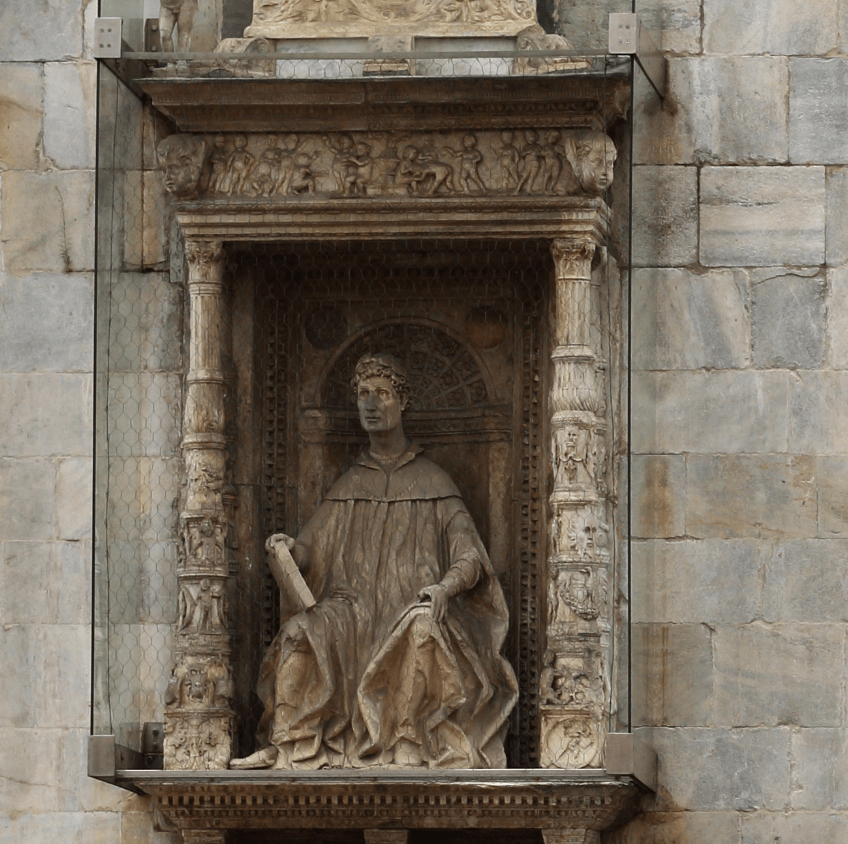
Pliny on the Catholic cathedral of the city of Como, Lombardy, Italy

“I asked them whether they were Christians. Those who confessed, I asked a second and a third time, threatening punishment. Those who persisted, I ordered to be executed. For whatever the nature of their belief, I had no doubt that stubbornness and unyielding obstinacy deserved punishment.”

Pliny the Younger, Letters 10.96, to Trajan, c. A.D. 112.

Pliny calls Christian steadfastness “stubbornness.” Diognetus asks why Christians despise death. They are seeing the same thing from different angles. The Christian refusal to deny Christ was visible enough that Roman officials had to interpret it.

Pliny also describes what he learned about Christian worship.

“They said that the sum of their fault or error was this: they were accustomed to meet on a fixed day before dawn, to sing responsively a hymn to Christ as to a god, and to bind themselves by oath, not to commit crime, but to avoid fraud, theft, adultery, breach of trust, and refusal to return what had been entrusted to them.”

Pliny the Younger, Letters 10.96, to Trajan, c. A.D. 112.

Here we hear, from a Roman perspective, the kind of issue Diognetus raises in the first paragraph: What God do Christians trust, and how do they worship Him? Pliny’s report is brief, but it is revealing. Christians gather before dawn. They sing to Christ as to a god. They bind themselves to moral purity.

A later pagan satirist, Lucian of Samosata, gives another outside witness. He mocks Christians, but even his mockery preserves the public impression they made.

“They have persuaded themselves that they are immortal and will live forever, and because of this they despise death and many of them willingly give themselves up. Their first lawgiver persuaded them that they are all brothers, once they have denied the Greek gods, worshiped that crucified sophist, and lived according to his laws.”

Lucian of Samosata, The Passing of Peregrinus 13, c. A.D. 170.

Lucian intends insult. But he confirms the same basic questions. Christians deny the Greek gods. They worship the crucified one. They call one another brothers. They face death differently.

So when Diognetus asks about Christian worship, Christian love, Christian courage, and Christian newness, he is not asking in isolation. He is voicing questions that belonged to the public reputation of the Church.


Not Monks, but Ordinary Christians

One of the most important things to notice about these sources is that they are describing Christians in general. Pliny is not describing monks. Lucian is not describing a small ascetic faction inside the Church. The author of Diognetus is not describing a spiritual elite that has separated itself from ordinary Christian life. These writers are describing what Christians, as Christians, were known to be like.

That is easy to miss when we read the second century from the far side of later Christian history. By the fourth and fifth centuries, after Christianity became legal, favored, and eventually culturally common in many parts of the Roman world, the more radical features of Christian discipleship could begin to look like the special calling of monks, virgins, hermits, and ascetics. Those movements were deeply important, but they can also tempt later readers to misunderstand the second century. In the world of Pliny, Lucian, and Diognetus, the things being described are not yet the peculiar marks of monastic Christianity. They are the public reputation of normal Christians.

Pliny does not write to Trajan and say that he has discovered an extreme spiritual movement within Christianity. He says that those accused of being Christians gather before dawn, sing to Christ as to a god, and bind themselves to moral obedience.

“They were accustomed to meet on a fixed day before dawn, to sing responsively a hymn to Christ as to a god, and to bind themselves by oath, not to commit crime, but to avoid fraud, theft, adultery, breach of trust, and refusal to return what had been entrusted to them.”

Pliny the Younger, Letters 10.96, to Trajan, c. A.D. 112.

For Pliny, this is what Christians do. They worship Christ, refuse crimes, and order their lives around moral faithfulness. He does not present this as the lifestyle of a spiritual elite. It is the basic pattern he discovers when he investigates the Christian name.

Lucian is similar, even though his tone is mocking. He does not say that a handful of unusually zealous Christians believe they are brothers or despise death. He speaks about Christians as a recognizable people.

“Their first lawgiver persuaded them that they are all brothers, once they have denied the Greek gods, worshiped that crucified sophist, and lived according to his laws.”

Lucian of Samosata, The Passing of Peregrinus 13, c. A.D. 170.

Lucian thinks this is foolish, but he still shows us what outsiders thought they were seeing. Christians denied the Greek gods. Christians worshiped the crucified one. Christians called one another brothers. Christians faced death differently. Again, this is not a description of monks. This is the pagan world trying to explain the normal life of Christians.

That makes the testimony of Diognetus even more powerful. The author does not say, “There are some Christians who live this way.” He simply says, “Christians.” His description is sweeping because he is presenting Christian identity itself.

“Christians are not distinguished from other people by country, language, or customs. They do not live in cities of their own, or use some unusual speech, or practice a strange way of life. Their teaching was not invented by human speculation, nor do they champion a merely human doctrine.”

Anonymous, Epistle to Diognetus 5.1 to 5.3, c. A.D. 180.

He then describes their marriages, their children, their tables, their citizenship, their obedience to laws, their suffering, and their hope.

“Every foreign land is their homeland, and every homeland is foreign. They marry like everyone else and have children, but they do not expose their offspring. They share a common table, but not a common bed. They are in the flesh, but they do not live according to the flesh. They spend their days on earth, but their citizenship is in heaven.”

Anonymous, Epistle to Diognetus 5.5 to 5.9, c. A.D. 180.

This is ordinary Christian life in the second century, at least as the Church wanted to present it and as outsiders often recognized it. Christians married, had children, ate meals, lived in cities, and followed local customs in clothing and food. Yet in the middle of that ordinary life, they refused infant exposure, rejected sexual lawlessness, confessed heavenly citizenship, loved one another, and faced persecution with courage.

This point is easy to lose once Christianity becomes common. In later centuries, costly discipleship could be treated as the work of specially devoted Christians, while ordinary believers lived closer to the assumptions of the surrounding culture. But in these earlier sources, heavenly citizenship, moral distinctness, refusal of idols, brotherly love, care for children, courage before death, and burden-bearing mercy are not advanced electives in the Christian life. They are what Christians were known for.

This is part of why Diognetus asks his questions. He is not asking about a sect within Christianity. He is asking about the Christians themselves.


The Slave Women Pliny Tortured

Pliny’s letter gives us one more detail that belongs in this story. After describing Christian worship, moral discipline, and their ordinary meal together, Pliny says he wanted to discover the truth more fully. So he turned to two enslaved Christian women.

“For this reason I judged it all the more necessary to find out the truth by torture from two female slaves, who were called ministrae. But I discovered nothing else except a depraved and excessive superstition.”

Pliny the Younger, Letters 10.96, to Trajan, c. A.D. 112.

This is a chilling sentence. Pliny writes it almost casually because to a Roman governor the torture of enslaved persons could be treated as an ordinary instrument of investigation. But for our purposes, the sentence reveals something extraordinary about the Christian community.

The two women are enslaved. In Roman society, that places them near the bottom of the social order. They are also women, which in that world often meant limited public authority. Yet Pliny says they were called ministrae. The Latin word can mean female ministers, attendants, or servants, and many English translations render it “deaconesses.” We should be careful not to force a later, fully developed office of deaconess back into this moment too rigidly. But even with that caution, the point remains powerful. These enslaved women were recognized in some kind of ministry or service within the Christian community, and Pliny believed they were significant enough to interrogate for information.

That is a remarkable reversal. The Roman world saw two enslaved women as bodies that could be tortured for evidence. The Church appears to have seen them as servants of Christ with recognized responsibility among the believers.

This fits perfectly with the world described in Diognetus. Christians were not marked off by one social class. They were scattered through cities, villages, households, and ranks of society. Pliny himself says the movement had touched people of every age, every rank, and both sexes.

“Many persons of every age, every rank, and also of both sexes are and will be endangered. For the contagion of this superstition has spread not only to the cities but also to the villages and farms.”

Pliny the Younger, Letters 10.96, to Trajan, c. A.D. 112.

Pliny means this as a warning. But for the historian of the Church, it is evidence. Christianity had entered the lives of men and women, free and enslaved, city dwellers and villagers, people of rank and people without rank. And within that new people, even those whom Roman society placed at the margins could become recognized servants of the Church.

The Church was not a philosophical club for elite men. It was not a mystery society for one social class. It was not an ethnic enclave. It was a new people formed by the Word, and that new people reordered human worth around Christ. The enslaved could become ministers. Women could be recognized as servants of the Church. The poor could make many rich. Those with no standing in the empire could become living witnesses to the kingdom of God.

This does not take us away from Diognetus. It deepens the point. When the author says that Christians are not distinguished by country, language, or ordinary customs, he is describing a people whose identity cuts across the old social markers. In that people, the ancient world’s hierarchies were not erased in a simplistic way, but they were profoundly relativized. The deepest identity was no longer master or slave, male or female, rich or poor, official or peasant. The deepest identity was belonging to Christ.


Why Christians Refused the Gods

The author first answers Diognetus by explaining why Christians cannot worship the gods of the Greeks. He asks Diognetus to look honestly at the objects people call gods. They are made of stone, bronze, wood, silver, iron, and clay. They are shaped by craftsmen, guarded by men, and subject to decay.

“Is not one of them stone, like what is trampled underfoot? Another bronze, no better than the vessels made for our use? Another wood, already rotting? Another silver, needing someone to guard it lest it be stolen? Another iron, eaten away by rust? Another clay, no more honorable than what is made for the most common service?”

Anonymous, Epistle to Diognetus 2.2, c. A.D. 180.

The argument is direct. If the gods are made by human hands, they cannot be the Maker of human hands. If they need to be guarded, they cannot guard the world. If they can decay, they cannot be the source of life.

The author then makes the point sharper.

“These things you call gods. These things you serve. These things you worship. In the end, you become like them. Therefore you hate the Christians, because they do not regard these things as gods.”

Anonymous, Epistle to Diognetus 2.5 to 2.6, c. A.D. 180.

This explains why Christian refusal created hostility. Christians were not merely adding a private devotion to the religious life of the empire. They were refusing the gods everyone else honored. Their refusal exposed the idols as lifeless things.

Pliny’s test for accused Christians makes the same point. A person could prove he was not truly Christian by worshiping the gods and cursing Christ.

“Those who denied that they were or had been Christians invoked the gods in words I dictated, offered incense and wine to your image, which I had ordered brought with statues of the gods, and cursed Christ. It is said that those who are truly Christians cannot be forced to do these things.”

Pliny the Younger, Letters 10.96, to Trajan, c. A.D. 112.

This was the line Christians could not cross. They could live in Roman cities. They could marry, work, buy, sell, and obey the ordinary laws. But they could not call idols gods, and they could not curse Christ.

Again, the point is not that a few unusually zealous Christians refused idolatry while ordinary Christians found ways to blend in. Pliny treats refusal to worship the gods and curse Christ as the mark of a true Christian. The author of Diognetus says Christians are hated because they do not regard these things as gods. The refusal belonged to Christian identity itself.

That refusal made them visible.


Why Christians Were Not Simply Another Jewish Group

Diognetus also asks why Christians do not follow Jewish religious practice. This part of the letter needs careful handling because the author uses sharp polemical language about Jewish observances. It reflects an early Christian argument in the painful separation between Church and synagogue. It should not be turned into contempt for Jewish people.

The author’s theological point is that the Creator does not need to be supplied by the creatures He made.

“The one who made heaven and earth and all that is in them, and who supplies us all with what we need, cannot Himself need the very things that He supplies to those who imagine they are giving them to Him.”

Anonymous, Epistle to Diognetus 3.4, c. A.D. 180.

This helps us see how the author places Christianity. Christians are not pagans because they refuse idols. They are not simply another Jewish sect because they believe the decisive revelation of God has come through the Son. Their worship is not centered on images, and it is not defined by temple sacrifice. It is centered on the living God who has sent His Word.

That is why the question of timing matters so much. If Christians worship the ancient Creator, why does their way of life seem new? If the God of Christians is the Maker of heaven and earth, why has this people appeared now?

The author will answer that question by pointing to Christ as the eternal Word revealed in time.


Christians in the World

After saying what Christians are not, the author describes what they are. This is the most famous passage in Diognetus, and it remains one of the richest descriptions of early Christian identity.

Christians are not marked off by country, language, or clothing. They do not live in separate Christian cities. They do not speak a secret dialect. They do not withdraw from ordinary life into a private civilization.

“Christians are not distinguished from other people by country, language, or customs. They do not live in cities of their own, or use some unusual speech, or practice a strange way of life. Their teaching was not invented by human speculation, nor do they champion a merely human doctrine.”

Anonymous, Epistle to Diognetus 5.1 to 5.3, c. A.D. 180.

This is an important answer to Diognetus. Christians are not a nation in the ordinary sense. They do not belong to one ethnic group or one language. They live among the peoples of the empire, and yet their life reveals a different citizenship.

“They live in Greek and barbarian cities, as each person’s lot has been assigned, and they follow local customs in clothing, food, and the rest of life. Yet they display a wonderful and admittedly astonishing form of citizenship. They live in their own countries, but as sojourners. They share all things as citizens, yet endure all things as foreigners.”

Anonymous, Epistle to Diognetus 5.4 to 5.5, c. A.D. 180.

The author then gives one of the great summaries of Christian life in the ancient world:

“Every foreign land is their homeland, and every homeland is foreign. They marry like everyone else and have children, but they do not expose their offspring. They share a common table, but not a common bed. They are in the flesh, but they do not live according to the flesh. They spend their days on earth, but their citizenship is in heaven.”

Anonymous, Epistle to Diognetus 5.5 to 5.9, c. A.D. 180.

The point is not that Christians are strange because they reject ordinary human life. The point is that they inhabit ordinary life differently. They marry. They have children. They share meals. They live in cities. But they do not expose infants. They do not turn sexual desire into lawlessness. They do not confuse earthly citizenship with ultimate belonging.

Their difference is not chiefly in location, language, or costume. Their difference is in allegiance.

The author continues:

“They obey the established laws, and by their lives they surpass the laws. They love all people, and are persecuted by all. They are unknown and condemned. They are put to death, and restored to life. They are poor, yet make many rich. They lack everything, yet abound in everything.”

Anonymous, Epistle to Diognetus 5.10 to 5.13, c. A.D. 180.

Then comes the famous image. But the image should be heard through its conclusion, because the conclusion tells us that this is not merely how Christians happen to live. It is the place God has assigned them.

“To say it simply: what the soul is in the body, Christians are in the world. The soul is spread through all the members of the body, and Christians are scattered through the cities of the world. The soul dwells in the body, yet is not of the body; Christians dwell in the world, yet are not of the world. The invisible soul is guarded by the visible body, and Christians are known to be in the world, but their godliness remains unseen. The flesh hates the soul and wars against it, though the soul does it no harm, because the soul prevents it from indulging its pleasures. So also the world hates Christians, though they do it no wrong, because they oppose its pleasures. The soul loves the flesh that hates it, and Christians love those who hate them. The soul is enclosed in the body, yet it holds the body together. Christians are held in the world as in a prison, yet they hold the world together. The immortal soul dwells in a mortal tent, and Christians dwell as sojourners among corruptible things while waiting for incorruptibility in heaven. The soul becomes better when treated harshly in food and drink, and Christians increase daily when they are punished. God has assigned them this great post, and they are not permitted to abandon it.”

Anonymous, Epistle to Diognetus 6.1 to 6.10, c. A.D. 180.

That final sentence is crucial. Christians are not merely scattered because history happened to scatter them. They are scattered because God has assigned them this role. They are not merely in the world by accident. They have been placed there as the soul is placed in the body.

This strengthens the whole argument. The author is not describing monastic withdrawal, and he is not describing a private spiritual elite. He is describing the ordinary Christian vocation in the world. Christians marry, raise children, eat at tables, obey laws, live in cities, and work among their neighbors. Yet they do all of this as a people whose citizenship is in heaven and whose presence in the world has been appointed by God.

This is how the author answers an influential outsider. He does not say that Christians are politically dominant or socially impressive. He says that Christians have been assigned a divine post inside the same world everyone else inhabits. They are not permitted to abandon it.


The God Who Sent His Word

The author then turns from Christian life to the divine action that explains it. The Christian way of life did not arise because someone invented a better moral philosophy. It is not a merely human system. It begins with God revealing Himself.

“This was no earthly invention delivered to them. It is no merely human system of opinion that they think worthy of such careful preservation. It is not a stewardship of human mysteries that has been entrusted to them. Rather, the almighty God Himself, the Creator of all things, invisible and sovereign, sent from heaven and planted among human beings the truth, the holy and incomprehensible Word, and fixed Him firmly in their hearts.”

Anonymous, Epistle to Diognetus 7.1 to 7.2, c. A.D. 180.

This passage is crucial. Christians are not different because they discovered God by superior reasoning. They are different because God sent His Word. The Church is not the origin of the message. The Church is the result of God’s revelation.

The author then clarifies who this Word is. God did not send an angel, a servant, or a lower heavenly minister. He sent the one through whom creation itself was made and ordered.

“He did not send, as someone might suppose, a servant, or angel, or ruler, or one who governs earthly things, or one entrusted with the ordering of heaven. He sent the very Creator and Fashioner of all things, by whom He made the heavens, by whom He enclosed the sea within its bounds, whose mysteries all the elements faithfully keep.”

Anonymous, Epistle to Diognetus 7.2, c. A.D. 180.

Here the author begins to answer the deepest question in the opening paragraph. If Christianity seems new, how can it claim to reveal the ancient Creator? The answer is that the one who appeared in time is not a creature of time. He is the Word through whom the heavens were made.

The author then describes the manner of His coming.

“Did He send Him, as one might imagine, to rule by tyranny, fear, and terror? Not at all. He sent Him in gentleness and meekness. As a king sends his son, who is also a king, so He sent Him. He sent Him as God; He sent Him as to human beings; He sent Him as Savior; He sent Him to persuade, not to compel, for violence has no place in the character of God.”

Anonymous, Epistle to Diognetus 7.3 to 7.4, c. A.D. 180.

This tells us not only who Christ is, but what God is like. God does not reveal Himself by crushing the world into submission. He sends His Son in gentleness. He persuades rather than compels. He saves rather than terrifies.

This also explains why Christians are supposed to live the way they do. If the Son comes in meekness, His people cannot make coercion their highest tool. If the Son bears with sinners, His people must learn patience. If the Son gives Himself, His people must become a people of self-giving love.

Christian ethics flow from the character of the God revealed in Christ.


The Word the Gentiles Were Reaching For

There is another layer to the author’s answer that should not be missed. The Christians did not present Christ only as the fulfillment of Jewish Scripture and Jewish expectation, though He certainly was that. They also presented Him as the answer to the deepest questions of the Gentile world.

This matters because Diognetus is not being addressed as a synagogue ruler or a student of the prophets. He is addressed as “most excellent Diognetus,” probably a man of education, status, and influence in the Greek and Roman world. He asks why Christians reject the gods of the Greeks, why they do not simply become Jews, and why this new way of life has appeared now. So the author answers him in a way that speaks to Gentile categories as well. He speaks of the Word, the Creator, the Fashioner of all things, the one by whom the heavens, sea, stars, sun, moon, and all creation are ordered.

“He sent the very Creator and Fashioner of all things, by whom He made the heavens, by whom He enclosed the sea within its bounds, whose mysteries all the elements faithfully keep, from whom the sun has received the measure of the courses of the day, whom the moon obeys as He commands it to shine by night, and whom the stars obey as they follow the course of the moon.”

Anonymous, Epistle to Diognetus 7.2, c. A.D. 180.

That language does more than answer Jewish expectation. It answers Gentile longing for the rational order behind the world. Philosophers had asked what held reality together. They had spoken of reason, nature, providence, order, and the divine principle behind all things. The Christian answer was not that these longings were meaningless. The Christian answer was that the one whom Gentile wisdom sought dimly had now been revealed personally in Christ.

At the same time, Diognetus is careful. The author does not flatter pagan philosophy as though it had already arrived at the truth by itself. He criticizes those who identified God with created elements.

“Do you accept the vain and silly doctrines of those who are considered trustworthy philosophers? Some said that fire was God, calling that God to which they themselves will one day come. Others said water. Others named some other element formed by God. But if any one of these theories is worthy of approval, then every created thing might just as well be declared God.”

Anonymous, Epistle to Diognetus 8.2 to 8.4, c. A.D. 180.

The point is not that Gentile philosophy already knew God clearly. The point is that Gentile philosophy was asking real questions but could not reach the final answer on its own. According to the author, God had to reveal Himself.

“No human being has either seen Him or made Him known, but He revealed Himself. And He revealed Himself through faith, by which alone it is given to behold God.”

Anonymous, Epistle to Diognetus 8.5 to 8.6, c. A.D. 180.

This is where Diognetus fits beautifully alongside Justin Martyr. Justin, writing earlier in the second century, makes the philosophical claim more explicitly. For Justin, Christ is the Logos, the Word, in whom all peoples have shared to some degree. Therefore, whatever the philosophers saw truly, they saw because the Word was already at work.

“We have been taught that Christ is the firstborn of God, and we have declared above that He is the Word of whom every race of human beings has been a partaker. Those who lived according to reason are Christians, even though they have been thought atheists, such as Socrates and Heraclitus among the Greeks, and others like them.”

Justin Martyr, First Apology 46, c. A.D. 155.

Justin says the same thing even more directly in his Second Apology:

“Whatever things were rightly said among all people are the property of us Christians. For next to God, we worship and love the Word who is from the unbegotten and ineffable God, since He also became man for our sake, that by sharing in our sufferings He might bring us healing.”

Justin Martyr, Second Apology 13, c. A.D. 155 to 160.

That helps us understand the broader Christian claim. Christ fulfills Israel’s Scriptures, but He also fulfills the scattered hopes of the nations. He is the answer to the prophets, and He is the answer to the philosophers. The prophets saw more clearly because they received revelation. The philosophers saw partially and often confusedly because they grasped fragments of truth through reason. But both streams find their fullness in the same person: the Word who was from the beginning and appeared in time.

This makes the central line of Diognetus even stronger.

“This is He who was from the beginning, who appeared as new and was found to be ancient, and who is always being born anew in the hearts of the saints.”

Anonymous, Epistle to Diognetus 11.4, c. A.D. 180.

To the Jew, He is ancient because He is the one prepared and promised from the beginning. To the Gentile, He is ancient because He is the Logos, the divine Word, the reason and order behind creation itself. To both, He appears new because He has now come in the flesh.

That is why Christianity could stand before both synagogue and empire, before both Scripture and philosophy, and say: the one you were waiting for, and the one you were reaching for, has appeared.


Why This New People Appeared Now

Diognetus asks why this new people or practice has entered human life now and not earlier. That question is one of the most important in the whole letter.

The author’s answer is not that God only recently began to care about humanity. It is not that humanity finally became wise enough to earn revelation. The answer is that God was patient, allowing human beings to see the poverty of their own works so that His mercy would be revealed as mercy.

“In the former time, He permitted us to be carried along by disorderly impulses, drawn away by pleasures and desires. This was not because He delighted in our sins, but because He was patient with us. It was not because He approved that season of iniquity, but because He was preparing the present season of righteousness, so that, having been shown by our own works to be unworthy of life, we might now be made worthy by the goodness of God.”

Anonymous, Epistle to Diognetus 9.1, c. A.D. 180.

The delay is not indifference. It is patience. The world had to see that it could not save itself. Human beings had to learn that their own works could not make them worthy of life.

Then the author describes the appointed time of God’s mercy:

“When our wickedness had reached its fullness, and it had become clear that punishment and death were its expected reward, then came the time God had appointed to reveal His goodness and power. O the surpassing kindness and love of God! He did not hate us, reject us, or remember our evil against us. He was patient; He bore with us; in mercy He took our sins upon Himself. He gave His own Son as a ransom for us: the holy for the lawless, the innocent for the evil, the righteous for the unrighteous, the incorruptible for the corruptible, the immortal for the mortal.”

Anonymous, Epistle to Diognetus 9.2, c. A.D. 180.

This is the heart of the author’s answer. Christianity appears now because now is the appointed season of mercy. The Son has been given as a ransom. The righteous one has been given for the unrighteous. The incorruptible one has been given for the corruptible. The immortal one has been given for mortals.

Then the author cries out in wonder:

“O sweet exchange! O unsearchable work! O benefits beyond all expectation! The lawlessness of many is hidden in one righteous Man, and the righteousness of one justifies many lawless people.”

Anonymous, Epistle to Diognetus 9.5, c. A.D. 180.

This is not merely explanation. It is worship. The author is overwhelmed by the mercy he is describing.

Diognetus asks why Christians despise death. Here is part of the answer. They have come to believe that death has been answered by the immortal one who gave Himself for mortals. Diognetus asks why this new people appeared now. Here is part of the answer. The appointed time of divine kindness has arrived.

But the author still has one more answer to give. Christianity is new in its historical appearance, but Christ is ancient in His divine identity.


The Ancient Word Appearing New

The central line comes in chapter 11 of the received text. It gathers the force of the letter into one sentence. Diognetus has asked why this new people has appeared now, and the author answers by pointing to the ancient Word who has entered time and now lives in His people.

“This is He who was from the beginning, who appeared as new and was found to be ancient, and who is always being born anew in the hearts of the saints. This is He who is eternal, who today is called Son, through whom the Church is enriched and grace, spread widely, increases among the saints.”

Anonymous, Epistle to Diognetus 11.4 to 11.5, c. A.D. 180.

The author does not deny that Christianity has appeared in history. He does not pretend that the Church has always existed in the same visible form. He says something more profound. The one who appeared new is the one who was from the beginning.

Jesus was born recently in time, yet He is ancient as God. He appeared within history, yet He is not merely a historical founder. He is the eternal Son. He is the Word through whom the world was made. He is the one who seemed new because He was revealed in time, but when He was revealed, He was found to be ancient.

This is the perfect answer to Diognetus’s question. The Christian movement looks new because the incarnation occurred in time. But the Christian faith is not a novelty because the one incarnate is the eternal Word. The Church is historically recent, but Christ is not recently divine. The Son appears in the fullness of time, but He was from the beginning.

The line also says that He is “always being born anew in the hearts of the saints.” That phrase does not mean the incarnation is repeated in the same way over and over. The Word became flesh uniquely in Jesus Christ. But the life of Christ is continually formed in believers. The ancient Word who appeared in time now makes His dwelling in the hearts of the saints.

The author had already prepared us for this idea:

“The almighty God Himself, the Creator of all things, invisible and sovereign, sent from heaven and planted among human beings the truth, the holy and incomprehensible Word, and fixed Him firmly in their hearts.”

Anonymous, Epistle to Diognetus 7.2, c. A.D. 180.

The Word is sent. The Word is planted. The Word is fixed in human hearts. Then chapter 11 says He is ever born anew in the saints.

That is why Christian life itself becomes an answer to Diognetus. The Church is not merely a group of people who admire a teacher from the past. The Church is a people in whom the living Word is at work. Their love, courage, chastity, mercy, and heavenly citizenship are not separate from Christ. They are signs that the ancient Word is making people new.


Born Recently in Time, Ancient as God

The power of the sentence in chapter 11 is that it holds together truths that can easily be separated.

Jesus is born recently in time. From the perspective of c. A.D. 180, the life, death, and resurrection of Jesus belong to recent history. Christianity is not a myth buried in the distant past. It is tied to remembered events, public preaching, apostolic witness, and communities still living in the aftermath of what they claim God has done.

Luke’s Gospel tells the story in exactly this historical register. The anonymous author does not begin with vague mythic time. He writes of a child born during the days of imperial power, in a named place, within the ordinary conditions of human birth.

“While they were there, the days were fulfilled for her to give birth, and she gave birth to her firstborn Son. She wrapped Him in swaddling cloths and laid Him in a manger, because there was no place for them in the lodging place.”

Anonymous author traditionally called Luke, Gospel According to Luke 2.6 to 2.7, c. A.D. 80.

This is the newness of Christianity in its historical form. The Son is born. He enters time. He has a mother. He is wrapped in cloths. He is laid in a manger. The Christian proclamation is not embarrassed by this nearness. It does not hide the humility of the birth.

At the same time, Diognetus insists that the one born in time is ancient as God.

“He sent the very Creator and Fashioner of all things, by whom He made the heavens, by whom He enclosed the sea within its bounds, whose mysteries all the elements faithfully keep.”

Anonymous, Epistle to Diognetus 7.2, c. A.D. 180.

The one born in time is the one through whom time itself exists. The one who appeared in recent history is the one by whom the heavens were made. The Christian claim is not simply that a remarkable man appeared and founded a new movement. The claim is that the Creator’s own Word entered human history.

This is why the author can say He “appeared as new” and “was found to be ancient.” Both are true. He appeared new because He came in the flesh at a particular moment. He was found ancient because He was from the beginning.

Luke writes to Theophilus so that he may know certainty about the things fulfilled among Christians. The author of Diognetus writes to Diognetus so that he may understand the Christian people and the God who explains them. Both works are addressed to “most excellent” recipients. Both are anonymous. Both present Christian truth as something that can be set before serious, influential readers.

But Diognetus presses the question of newness with special force. If Jesus appeared recently, does that make Christianity a recent invention? The author’s answer is no. Christianity is new as revelation, but ancient as divine truth. The one born recently in time is ancient as God.


Something Divine Among Them

The line about the Word being born anew in the hearts of the saints should not be treated as a vague devotional phrase. It is the theological explanation for what outsiders were seeing in Christian life. The author of Diognetus is not merely saying that Christians remember Jesus. He is saying that the living presence of God is active within them.

That is why chapter 7 is so important. After describing Christians thrown to wild beasts and yet not overcome, the author does not say merely that Christians are brave. He says their endurance is evidence that God is present.

“Do you not see them thrown to wild beasts, so that they might be persuaded to deny the Lord, and yet they are not overcome? Do you not see that the more they are punished, the more others increase? These things do not seem to be the works of man. They are the power of God. They are proofs of His presence.”

Anonymous, Epistle to Diognetus 7.7 to 7.9, c. A.D. 180.

That phrase, “proofs of His presence,” belongs beside the central line of chapter 11.

“This is He who was from the beginning, who appeared as new and was found to be ancient, and who is always being born anew in the hearts of the saints.”

Anonymous, Epistle to Diognetus 11.4, c. A.D. 180.

The connection is powerful. Christ has died, risen, and ascended. He is no longer walking the roads of Galilee in the same visible way. Yet the author of Diognetus does not speak as though Christ has simply gone away and left Christians with memories, moral instructions, and institutions. He speaks as though the Word remains actively present in His people.

The Word is planted in their hearts. The Word is born anew in the saints. The courage of the martyrs, the love of the brethren, the refusal of idols, the bearing of burdens, and the growth of the Church under persecution are not merely human achievements. They are “the power of God” and “proofs of His presence.”

This is where Aristides helps us see that Diognetus was not alone. Writing earlier in the second century, Aristides also describes Christian conduct and then concludes that there is something divine in them.

“It is enough for us to have briefly made known to your Majesty the conduct and the truth of the Christians. For great indeed and wonderful is their teaching to the one who is willing to examine and understand it. And truly this people is a new people, and there is something divine mingled with it.”

Aristides, Apology 16, c. A.D. 125.

That phrase says almost exactly what Diognetus is showing. The Christian life is not simply admirable. It bears witness to divine presence. Outsiders can mock it, governors can interrogate it, philosophers can test it, and emperors can be asked to examine it. But the Christian claim is that something more than human discipline is at work in the Church.

The ancient Word is still living in His people.

This also helps us understand why ordinary Christian life appeared so strange. If Christianity were only a set of ideas, then it could be evaluated as one philosophy among others. If it were only a social movement, it could be explained by common loyalty, group identity, or shared pressure. But writers like Aristides and the author of Diognetus see something deeper. They see a new people, and they interpret the life of that people as evidence that God is present among them.


Christ Suffering in the Saints

The same idea appears in another second-century letter, the Letter of the Churches of Vienne and Lyons, written after the persecution in Gaul around A.D. 177 and preserved by Eusebius. This letter is not an apology addressed to an outsider like Diognetus. It is a church letter about martyrs. But it gives us the same theology of Christ’s ongoing presence in believers.

When the letter describes Sanctus enduring torture, it does not interpret his endurance as merely human courage.

“In him Christ suffering wrought great wonders, destroying the adversary, and showing for an example to the rest that there is nothing fearful where there is the Father’s love, and nothing painful where there is Christ’s glory.”

Letter of the Churches of Vienne and Lyons, preserved in Eusebius, Ecclesiastical History 5.1, c. A.D. 177.
That is very close to the logic of Diognetus. The martyr is not simply copying Christ from a distance. Christ is active in him. Christ suffers in him. Christ displays His power through him.

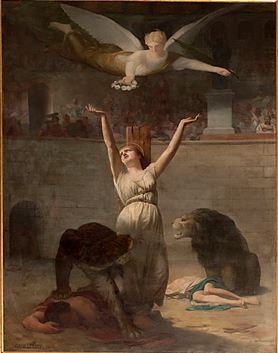
The same letter says something even more vivid about Blandina, an enslaved Christian woman who became one of the great witnesses of the persecution. When she was fastened to a stake, the other Christians saw in her body a living sign of the crucified Christ.

“Through her presenting the spectacle of one suspended on something like a cross, and through her earnest prayers, she inspired the combatants with great eagerness. For in the combat they saw, by means of their sister, with their bodily eyes, Him who was crucified for them.”

Letter of the Churches of Vienne and Lyons, preserved in Eusebius, Ecclesiastical History 5.1, c. A.D. 177.

Guillemet’s 1862 Martyrdom of Saint Blandine

Christ is not absent from the post-ascension Church. He is present in His saints. He is not incarnate again in the same unique way as Bethlehem, but His life is being manifested again and again in His people.
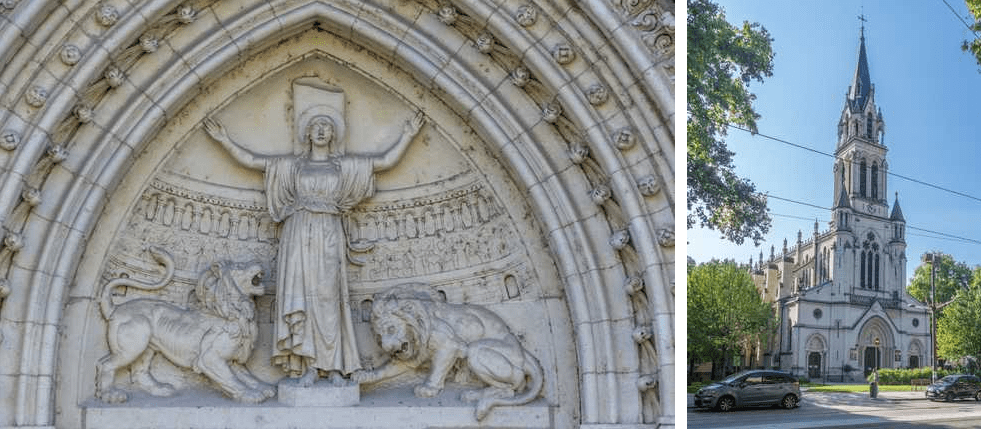
Jules Comparat, The Martyrdom of Saint Blandina, tympanum sculpture, Lyon 1886

That gives more force to Diognetus 11.4. The Word who was from the beginning appeared new in history, and now He is always being born anew in the hearts of the saints. This is not only a mystical phrase. It is how early Christians interpreted the visible transformation of ordinary believers.

The slave woman becomes a witness. The tortured deacon refuses to deny Christ. The poor make many rich. The persecuted bless. The condemned are brought to life. The Church’s life becomes the place where the ascended Christ is still seen.

This also draws Pliny’s tortured slave women into the wider picture. Pliny sees enslaved women as sources of information to be extracted by force. The Church sees women like them as servants of Christ. The Lyons letter shows an enslaved woman, Blandina, becoming a living icon of the crucified Lord before the eyes of the suffering Church. In both cases, the Roman world and the Christian world are looking at the same kind of person but seeing two different realities. Rome sees low status. The Church sees the place where Christ can be made visible.


The Word Born Again in Believers

The line about the Word being “always born anew in the hearts of the saints” becomes clearer when we read it alongside the author’s description of Christian imitation.

In chapter 10, the author turns directly to Diognetus and explains what happens when someone receives the knowledge of the Father. The Christian life begins with God’s love, not with human achievement.

“If you also desire this faith, first receive the knowledge of the Father. For God loved human beings. For their sake He made the world, subjected all things on earth to them, gave them reason and understanding, permitted them alone to look upward to Him, formed them after His own image, sent to them His only-begotten Son, promised them the kingdom in heaven, and will give it to those who love Him.”

Anonymous, Epistle to Diognetus 10.1 to 10.2, c. A.D. 180.

The Christian life is rooted in divine generosity. God made, gave, formed, sent, promised, and will give. Human beings do not climb up to God by their own strength. They receive the love of the Father revealed in the Son.

Then the author describes the result:

“When you have come to know Him, with what joy do you think you will be filled? How will you love Him who first loved you so greatly? And loving Him, you will become an imitator of His goodness. Do not marvel that a human being can become an imitator of God. He can, if God wills it.”

Anonymous, Epistle to Diognetus 10.3 to 10.4, c. A.D. 180.

This is what it means for the Word to be born anew in believers. They become imitators of God’s goodness. That imitation is not domination, force, or worldly greatness. The author is careful about that.

“Happiness is not found in ruling over one’s neighbors, or in wanting to have more than the weak, or in being rich and using force against those beneath you. No one can imitate God in these things. They are foreign to His greatness.”

Anonymous, Epistle to Diognetus 10.5, c. A.D. 180.

This is a direct challenge to ordinary ancient ideas of status. The powerful man rules. The wealthy man gives from above and receives honor. The influential man gathers dependents and clients. But the Christian imitates God by bearing burdens.

“Whoever takes upon himself the burden of his neighbor, whoever is willing to benefit another who lacks what he himself has, whoever supplies to the needy what he has received from God and becomes a gift of God to those who receive it, this person is an imitator of God.”

Anonymous, Epistle to Diognetus 10.6, c. A.D. 180.

This is where the author’s theology becomes visible in ordinary life. The Word born in the heart produces people who bear the burdens of others. The ancient Christ appears newly in acts of mercy. The eternal Son becomes visible in patience, generosity, courage, and love.

So when Diognetus asks what kind of affection Christians have for one another, the answer is not merely that Christians are unusually friendly. The answer is that the Word is living in them. The love of God has taken root in human hearts, and that love has created a new kind of community.

And again, in the second-century sources, this is not presented as an optional higher path for a few unusually serious believers. This is Christian life. To receive the Father’s love is to become an imitator of His goodness. To know the Son is to bear the burdens of the neighbor. To have the Word born in the heart is to become, in some visible way, a gift of God to others.

This also connects back to the divine assignment in chapter 6. Christians are not permitted to abandon their post in the world because the Word is being born in them for the sake of the world. Their holiness is not an escape from the body of humanity. It is the soul-like presence by which God blesses the world that misunderstands them.


Why Christians Face Death Differently

Diognetus also asks why Christians despise death. The author answers that Christians do not fear bodily death as the ultimate evil because they have come to know true life in God.

“Then you will love and admire those who are punished because they will not deny God. Then you will condemn the deceit and error of the world, when you recognize the true life in heaven, when you despise what is only thought to be death here, and when you fear the true death reserved for those condemned to the eternal fire.”

Anonymous, Epistle to Diognetus 10.7, c. A.D. 180.

This is not a hatred of life or a desire for suffering. It is a reordering of fear. Christians can face earthly death because they believe the immortal one has given Himself for mortals. They believe that denying God is worse than dying. They believe that true life is found in heaven.

The author also points to martyrdom as evidence that Christianity is not merely human.

“Do you not see them thrown to wild beasts, so that they might be persuaded to deny the Lord, and yet they are not overcome? Do you not see that the more they are punished, the more others increase? These things do not seem to be the works of man. They are the power of God. They are proofs of His presence.”

Anonymous, Epistle to Diognetus 7.7 to 7.9, c. A.D. 180.

That last sentence is essential. The courage of Christians is not presented as natural bravery. It is a proof of God’s presence. Pliny saw stubbornness. Lucian saw delusion. The author of Diognetus sees the power of God at work.

This brings us back to the central line. If the Word is always being born anew in the hearts of the saints, then the courage of the martyrs is not merely admiration for a past teacher. It is the life of the risen Christ present in His people.

This courage also belongs to the general portrait of Christians. Pliny’s Christians are ordinary accused believers. Lucian’s Christians are the people he thinks he can mock as a group. Diognetus speaks broadly of Christians thrown to beasts and yet not overcome. These sources do not present courage before death as the private achievement of a spiritual elite. They present it as part of the public reputation of the Church.

That is what made the question unavoidable. The world knew how people normally behaved under threat. Christians did not always behave normally. Diognetus wanted to know why.


The Church as the Living Answer

By the end of the letter, we can see that the author answers Diognetus in two ways at once. He gives theological explanations, and he points to the Christian community as evidence.

Diognetus asks what God Christians worship. The author answers: the Creator who sent His Word. But he also points to Christians who refuse idols and worship the living God.

Diognetus asks why Christians love one another. The author answers: because God first loved them. But he also points to Christians who share tables, bear burdens, care for children, and live as brothers and sisters across the ordinary divisions of ancient society.

Diognetus asks why Christians despise death. The author answers: because the immortal one has been given for mortals. But he also points to Christians who endure punishment without denying the Lord.

Diognetus asks why this new people has appeared now. The author answers: because the appointed season of mercy has arrived. But he also points to the Church as the place where the ancient Word is being born anew.

The soul-and-body image helps us understand this. The Church is visible in the world, but the life that animates her is hidden in God. And the end of the image makes clear that this hidden life is not an optional calling. God has assigned Christians this post in the world, and they are not permitted to abandon it.

“Christians are held in the world as in a prison, yet they hold the world together. The immortal soul dwells in a mortal tent, and Christians dwell as sojourners among corruptible things while waiting for incorruptibility in heaven. The soul becomes better when treated harshly in food and drink, and Christians increase daily when they are punished. God has assigned them this great post, and they are not permitted to abandon it.”

Anonymous, Epistle to Diognetus 6.7 to 6.10, c. A.D. 180.

This is a daring claim. Christians appear weak, scattered, and vulnerable. Yet the author says they hold the world together. Not by political command, military strength, or social prestige, but by being the soul within it.

This is another place where the second-century context matters. Before Christianity became culturally common, the Church’s difference was easier to see. Christians were not yet the default religious population of the empire. They were a people whose worship, ethics, courage, family life, and mutual love stood out strongly enough to provoke questions.

And in Diognetus, the Church’s visible life is not merely a moral illustration added after the theology. It is part of the evidence. The author points to Christians and says, in effect, that their life cannot finally be explained by human invention. Their endurance is the power of God. Their courage is proof of His presence. Their love is the Word born anew in their hearts. Their place in the world is not accidental. It has been assigned by God.

That is why Diognetus is so valuable. It shows us Christianity before it became ordinary in the cultural sense. And precisely there, it shows that ordinary Christians were expected to be extraordinary by the standards of the world, not because they had abandoned ordinary life, but because God had placed them within ordinary life as the soul within the body.


Returning to Diognetus’s Opening Questions

By the end of the letter, the opening questions have all been answered.

Diognetus asks what God Christians trust. The author answers: the Creator of all things, invisible and sovereign, who sent His holy and incomprehensible Word.

Diognetus asks how Christians worship. The author answers: not by worshiping idols made of stone, bronze, wood, silver, iron, or clay, but by receiving the Word, living in faith, and becoming imitators of God’s goodness.

Diognetus asks why Christians reject the gods of the Greeks. The author answers: because those gods are lifeless works of human hands.

Diognetus asks why Christians do not simply practice religion like the Jews. The author answers, in his polemical way: because the Creator needs nothing from human hands and has now revealed Himself through His Son.

Diognetus asks what kind of affection Christians have for one another. The author answers: they love because God first loved them, and the Word is being formed in their hearts.

Diognetus asks why Christians despise death. The author answers: because the immortal one has been given for mortals, and Christians have learned to distinguish earthly death from the true death to be feared.

Diognetus asks why this new people has appeared now and not earlier. The author answers: because the appointed season of mercy has arrived, and the one who appeared new was from the beginning.

The whole letter gathers itself into this sentence:

“This is He who was from the beginning, who appeared as new and was found to be ancient, and who is always being born anew in the hearts of the saints.”

Anonymous, Epistle to Diognetus 11.4, c. A.D. 180.

That is the answer to Diognetus. The Church appears new because Christ has appeared in time. The faith is ancient because Christ is from the beginning. The Christian life continues because Christ is born anew in the hearts of the saints.

The author’s answer is not merely, “Here is what Christians believe.” It is, “Here is the one who explains Christians.”


What Later Centuries Could Obscure

The second-century witness matters because later Christian history can change how we hear these texts. Once Christianity became legal, favored, and socially normal, the contrast between Church and world could become harder to see. When large numbers of people became Christian by culture, family inheritance, imperial favor, or social expectation, the older marks of discipleship could seem less like the normal Christian life and more like the special calling of the unusually devout.

This does not mean that later monks, virgins, hermits, and ascetics were wrong. In many cases, they preserved and intensified a seriousness about discipleship that earlier Christians had regarded as basic. The problem comes when later readers project that division back into the second century and imagine that Pliny, Lucian, and Diognetus must be describing spiritual specialists.

They are not.

Pliny describes Christians who gather to worship Christ and bind themselves to moral obedience. Lucian describes Christians who deny the Greek gods, worship the crucified one, call one another brothers, and despise death. The author of Diognetus describes Christians who marry, have children, refuse infant exposure, share tables, live in cities, obey laws, suffer persecution, love all people, and confess heavenly citizenship.

These are not portraits of a monastery. They are portraits of the Church.

That is one reason the Epistle to Diognetus still has such force. It does not allow Christianity to become merely a private belief system held inside an otherwise ordinary pagan life. It presents Christianity as a whole way of being human, visible in worship, family, money, sexuality, courage, citizenship, and love.

The Word who was from the beginning does not merely give Christians new ideas. He makes them a new people.

And according to the author, He does not make them a new people only by giving them memories of something that happened long ago. He makes them new by being present in them. The ancient Word who appeared in history continues to be born anew in the hearts of the saints. That is why their life becomes evidence. That is why Aristides can say there is “something divine” mingled with this new people. That is why the Lyons martyrs can see Christ in Blandina. That is why Diognetus can call Christian endurance the power of God and proof of His presence.

The early Christian claim is not simply that Christ once lived. It is that Christ lives in His people.

And because Christ lives in His people, they are not permitted to abandon their post. The answer to a compromised world is not withdrawal into invisibility, nor surrender into sameness. The answer is the Church living as the soul in the body, scattered through the cities of the world, bearing witness to the Word who was from the beginning.


The Word Still Answers the Outsider

Every age has people like Diognetus. Some are skeptical. Some are sympathetic. Some are powerful. Some are patrons, readers, officials, intellectuals, or neighbors who have watched Christians closely enough to ask real questions.

What God do Christians trust? Why do they worship Jesus? Why do they refuse the idols everyone else accepts? Why do they speak of heaven while living on earth? Why do they call each other brothers and sisters? Why do they care for the weak? Why do they forgive enemies? Why do they face death with hope? Why does this ancient faith keep appearing new?

The Epistle to Diognetus answers those questions by pointing to Christ.

He is the Creator’s Word sent into the world. He is the Son sent not in tyranny but in gentleness. He is the righteous one given for the unrighteous, the incorruptible for the corruptible, the immortal for mortals. He is born in time, yet ancient as God. He appears new, yet He is from the beginning. He is not merely remembered by Christians; He is born anew in the hearts of the saints.

That is why the Christian people cannot be explained only as a social movement, a moral philosophy, or a religious association. The author insists that something more is happening in them. The ancient Word is making human beings new.

And because He is the Word, He answers both worlds addressed in this script. He fulfills the Scriptures of Israel, but He also answers the Gentile search for truth, reason, order, and the divine source of all things. What the prophets awaited and what the philosophers reached toward are fulfilled in the same living person.

The anonymous author does not give Diognetus a slogan. He gives him a vision of the Church as the place where the eternal Son is made visible in ordinary lives. Christians live in the world, but their citizenship is in heaven. They share tables, but not lawless beds. They have children, but do not expose them. They are persecuted, yet they love. They are put to death, yet they live. They lack everything, yet they abound.

And their place in the world is not an accident. It is an assignment.

“God has assigned them this great post, and they are not permitted to abandon it.”

Anonymous, Epistle to Diognetus 6.10, c. A.D. 180.

That line belongs beside the letter’s central confession of Christ.

“This is He who was from the beginning, who appeared as new and was found to be ancient, and who is always being born anew in the hearts of the saints.”

Anonymous, Epistle to Diognetus 11.4, c. A.D. 180.

That is the heart of the Epistle to Diognetus. It begins with the questions of a “most excellent” outsider, probably a man of influence, perhaps even the kind of patron who could request or sponsor such a written defense. It answers him not by hiding the strangeness of Christianity, but by explaining it.

The Church is strange because the Word has come. The Church is new because the eternal Son has appeared in time. The Church endures because that same Word continues to be born anew in the hearts of believers.

And in the second century, that was not supposed to describe only the rarest Christians. It was the life of the Church itself. God had placed them in the world as the soul in the body, and they were not permitted to abandon that post.

When Emperors Entered the Church: The Road from Constantine to Theodosius

Constantine changed the church’s public position, but the decades after him show how complicated that change really was.

By the time Constantine died in 337 AD, Christianity was legal, favored, public, wealthy in new ways, and entangled with imperial power. Bishops could meet openly. Church buildings could be restored or built with imperial support. Christian disputes could reach the emperor’s court. The Council of Nicaea had confessed the Son as truly God. But Nicaea did not end the controversy. In many ways, it clarified the battlefield.

The question after Constantine was no longer simply whether Christianity would survive persecution.

The question was what emperors would do with the church once they claimed to favor it.

Some emperors defended Christianity. Some tried to control it. One rejected it and attempted a pagan revival. Some were personally Christian but doctrinally hostile to Nicaea. Some were restrained. Some were coercive. By the end of the century, Theodosius would make Nicene Christianity the official religious standard of the empire.

But the story does not end with the emperor standing over the church. It ends with an emperor being rebuked by a bishop and called to repentance.

The church gained imperial favor.

But the emperor entered the church.

And once inside, he came under the judgment of Christ.


The Creed Constantine Left Behind

Constantine ruled from 306 to 337 AD. This episode does not need to retell his whole story. His vision before the Milvian Bridge in 312, his patronage of the church, and his role at the Council of Nicaea in 325 deserve separate treatment. For this arc, what matters is what Constantine left behind.

He left a church that was no longer illegal.

He also left a creed.

At Nicaea in 325, the bishops confessed that the Son of God was not a creature, not a lesser divine being, and not external to the eternal life of God. The creed spoke with language meant to shut the door on Arius’s claim that the Son had a beginning.

“God from God, Light from Light, true God from true God.”

The Creed of Nicaea, 325 AD.

Then came the decisive confession:

“Begotten, not made, being of one substance with the Father.”

The Creed of Nicaea, 325 AD.

The phrase “of one substance” comes from the Greek word homoousios. It does not mean that the Father and the Son are the same person. It means the Son shares the same divine being as the Father. He is not made. He is not outside God. He is truly God from the Father eternally.

The creed also rejected Arian slogans directly.

“Those who say, ‘There was when He was not,’ and, ‘Before He was begotten He was not,’ and that He came into being from things that were not, the catholic and apostolic Church anathematizes.”

The Anathemas of Nicaea, 325 AD.

The word catholic here means the universal church confessing the apostolic faith. It is not a reference to later Roman Catholic versus Protestant categories. In this fourth-century setting, it means the whole church’s confession of the apostolic faith against teachings judged to be outside it.

Constantine wanted unity. But after his death in 337, the Nicene settlement did not immediately triumph. Instead, the empire entered decades of rival councils, exiled bishops, imperial pressure, theological formulas, and bitter conflict over the identity of Christ.

Nicaea gave the church a creed.

The emperors after Constantine tested whether that creed would survive imperial power.


Constantius II: A Christian Emperor Against the Nicene Cause

Constantius II was one of Constantine’s sons. He ruled from 337 to 361 AD, and after the death or defeat of his brothers and rivals, he became sole emperor from 353 to 361 AD.

He was not a pagan persecutor. He was a Christian emperor. That is why his reign is so important. Under Constantius, Nicene Christians learned that danger could come not only from rulers who hated Christianity, but also from rulers who claimed Christianity while resisting the Nicene confession of Christ.

Constantius favored anti-Nicene and non-Nicene formulas. The theological landscape was complicated. Not every opponent of Nicaea repeated Arius word for word. Some wanted to say that the Son was “like” the Father. Others wanted to avoid the word “substance” altogether. But Nicene bishops feared that these formulas weakened the confession that the Son is truly and eternally God.

Ammianus Marcellinus, a pagan historian writing around 390 AD, did not care about defending Nicene theology. His concern was that Constantius turned Christian doctrine into imperial chaos.

“The plain and simple religion of the Christians he confused by old-womanish superstition.”

Ammianus Marcellinus, Res Gestae, 21.16.18, c. 390 AD.

Ammianus says Constantius did not heal the disputes, but multiplied them.

“By subtle and involved discussions about dogma, rather than by seriously trying to make them agree, he aroused many controversies.”

Ammianus Marcellinus, Res Gestae, 21.16.18, c. 390 AD.

He also mocked the constant movement of bishops to councils under imperial sponsorship.

“Throngs of bishops hastened hither and thither on the public post-horses to the various synods, as they call them.”

Ammianus Marcellinus, Res Gestae, 21.16.18, c. 390 AD.

That outside witness matters. Ammianus was not asking which creed was true. He was watching the machinery of empire become tangled in Christian controversy. Bishops traveled at public expense. Councils multiplied. The emperor tried to pull church doctrine and church order toward his own will.

From the Nicene side, the problem was much deeper. Athanasius of Alexandria believed Constantius was not merely confused. He believed the emperor had become a persecutor of the truth.

Athanasius wrote History of the Arians around 358 AD, while the conflict was still alive. His language is severe because he believed the emperor had turned Christian power against Christ.

“Who, then, that has witnessed these things, can call him a Christian, and not rather the image of Antichrist?”

Athanasius, History of the Arians, 67, c. 358 AD.

That sentence should not be softened too quickly. Athanasius was not saying Constantius was a pagan. He was saying something more frightening. A man could be a Christian emperor, call councils, speak about unity, favor bishops, and still become an enemy of Christ if he used power against the truth.

This was the great crisis after Constantine.

The church had survived persecution from outside.

Now it had to survive coercion from inside a Christian empire.


Sirmium: When Imperial Theology Tried to Avoid Nicaea

One of the clearest examples of the pressure under Constantius came in 357 AD with the so-called Second Creed of Sirmium. Nicene writers later called it the “Blasphemy of Sirmium” because it tried to remove the language that protected the Nicene confession.

The creed objected to the terms “essence” and “substance,” including the Nicene word homoousios.

“There ought to be no mention of any of these at all, nor exposition of them in the Church.”

Second Creed of Sirmium, issued 357 AD, preserved in Athanasius, On the Councils, 28, c. 359 AD.

It gave a reason that sounded pious.

“For the reason and consideration that there is nothing written about them in the divine Scriptures.”

Second Creed of Sirmium, issued 357 AD, preserved in Athanasius, On the Councils, 28, c. 359 AD.

At first glance, that might sound like a return to biblical language. But Nicene defenders saw the danger. Arians and anti-Nicenes could use biblical words while changing their meaning. They could say Christ is Son, but mean a created son. They could say Christ is Word, but mean a made instrument. They could say Christ is God, but mean a subordinate divine being.

This is why the controversy was not a petty fight over a technical term. The dispute over one word, homoousios, was really a dispute over salvation.

If Christ is a creature, God himself has not come to save us.

If Christ is truly God, then in him the Creator has entered creation to redeem it.

Jerome later looked back on the confusion after the councils of Ariminum and Seleucia in 359 AD and summarized the crisis in one famous sentence.

“The whole world groaned and was astonished to find itself Arian.”

Jerome, Dialogue Against the Luciferians, 19, c. 379 AD.

Jerome’s sentence is rhetorical. It does not mean every Christian in the world carefully chose Arian theology. It means that imperial pressure and compromise formulas had made it seem, for a moment, as if the Nicene faith had been overwhelmed.

The emperor wanted unity.

The church had to ask whether unity without truth was faithfulness at all.


Athanasius Under Constantius: Flight and the Limits of Imperial Power

Athanasius had been bishop of Alexandria since 328 AD. By the time Constantius became sole emperor, Athanasius had already become the living symbol of Nicene resistance. His enemies understood that if they wanted to weaken Nicaea, they had to remove him from Alexandria.

In 356 AD, soldiers entered a church in Alexandria during a vigil. Athanasius later described the scene in his Apology to Constantius, written around 356 AD.

“He burst into the Church with his soldiers, while we were engaged in our usual services.”

Athanasius, Apologia ad Constantium, 25, c. 356 AD.

He says the attack came during worship.

“It was a vigil, preparatory to a communion on the morrow.”

Athanasius, Apologia ad Constantium, 25, c. 356 AD.

Athanasius escaped. His enemies mocked him for fleeing, but he answered in Apology for His Flight, written around 357 AD. He did not deny that he fled. He argued that flight from persecution could be biblical and faithful. Moses fled. David fled. Elijah fled. Paul escaped. Christ himself told his disciples to flee from one city to another when persecuted.

Then Athanasius turned the accusation back on his persecutors.

“For if it be a bad thing to flee, it is much worse to persecute.”

Athanasius, Apology for His Flight, 1, c. 357 AD.

He continued:

“Let them cease to conspire, and they who flee will forthwith cease to do so.”

Athanasius, Apology for His Flight, 1, c. 357 AD.

This is more than self-defense. Athanasius refused to let violent men define courage for their victims. He would not let persecutors demand that the faithful stand still so they could be destroyed.

Constantius could command armies. He could exile bishops. He could summon councils. He could pressure clergy.

But he could not make the Son of God a creature.


Julian: The Emperor Who Tried to Reverse the Christian Turn

Julian ruled as sole emperor from 361 to 363 AD. Christians later called him Julian the Apostate because he had been raised in a Christian imperial world, but rejected Christianity and turned to the old gods.

Julian was not merely nostalgic. He was a philosopher emperor. He understood that paganism could not defeat Christianity simply by reopening temples and restoring sacrifices. He wanted pagan religion to become morally disciplined, socially organized, intellectually serious, and publicly charitable.

Ammianus Marcellinus admired Julian in many ways. Writing around 390 AD, he says Julian openly revealed his pagan devotion once he became sole emperor.

“He made no secret of his attachment to the worship of the gods.”

Ammianus Marcellinus, Res Gestae, 22.5.1, c. 390 AD.

Julian restored sacrifices, reopened temples, honored pagan priests, and tried to rebuild the old cultic life of the empire. But his campaign against Christianity was subtler than the persecution of Diocletian. He did not simply want martyrs. He wanted Christianity weakened socially and culturally.

One of his strategies was to recall exiled Christian bishops. That might sound merciful, but Ammianus explains the motive. Julian knew Christians were divided, and he expected their quarrels to weaken them.

“No wild beasts are so hostile to mankind as are most of the Christians in their deadly hatred of one another.”

Ammianus Marcellinus, Res Gestae, 22.5.4, c. 390 AD.

That sentence is unfair as a total judgment on the church, but it exposes a real scandal. The decades after Nicaea had produced rival bishops, accusations, exiles, riots, and imperial pressure. Julian believed Christian division could do more damage to the church than pagan persecution.

Julian also understood Christian charity. In his Letter to Arsacius, written around 362 AD, he complained that Christianity had grown because Christians cared for strangers, the poor, and the dead.

“Their benevolence to strangers, their care for the graves of the dead, and the pretended holiness of their lives.”

Julian, Letter to Arsacius, c. 362 AD.

Then came his famous admission:

“The impious Galilaeans support not only their own poor but ours as well.”

Julian, Letter to Arsacius, c. 362 AD.

Julian called Christians “Galilaeans” because he wanted to make Christianity sound local and provincial rather than universal. He called Christianity “atheism” because Christians rejected the pagan gods. But his complaint is one of the strongest pagan testimonies to Christian mercy.

The church’s care for the poor had become so visible that an enemy of Christianity saw it as a threat.

Julian did not answer Christian charity by saying mercy was useless. He tried to make pagan priests imitate it. He wanted hostels, public generosity, moral discipline, and care for the needy.

Christian charity had become public apologetics.


Julian and Christian Education: A Cultural Strike

Julian also attacked Christian education. Classical education was built on authors like Homer, Hesiod, the tragedians, and the orators. Christian teachers often taught those texts while rejecting the gods honored in them. Julian argued that this was dishonest.

His Rescript on Christian Teachers, issued in 362 AD, begins with a serious claim about education.

“I hold that a proper education results, not in laboriously acquired symmetry of phrases and language, but in a healthy condition of mind.”

Julian, Rescript on Christian Teachers, issued 362 AD.

Then he attacks Christian teachers as hypocrites.

“When a man thinks one thing and teaches his pupils another, in my opinion he fails to educate exactly in proportion as he fails to be an honest man.”

Julian, Rescript on Christian Teachers, issued 362 AD.

If Christians rejected the gods of the classical authors, Julian said they should teach their own Scriptures instead.

“Let them betake themselves to the churches of the Galilaeans and expound Matthew and Luke.”

Julian, Rescript on Christian Teachers, issued 362 AD.

This was not martyrdom by sword. It was cultural exclusion. Julian understood that teachers shape the future. If Christians could be removed from elite education, their influence among the governing classes would be weakened.

Ammianus admired Julian, but even he thought this policy was cruel.

“But this one thing was inhumane, that he forbade teachers of rhetoric and literature to practise their profession, if they were followers of the Christian religion.”

Ammianus Marcellinus, Res Gestae, 22.10.7, c. 390 AD.

That pairing is important. Julian thought he was defending intellectual honesty. Ammianus, a pagan admirer of Julian, still judged the policy inhumane.

Julian’s reign was short. He died during a Persian campaign in 363 AD. His pagan revival collapsed quickly.

But he understood something many casual Christians did not.

Christianity had become more than a private belief. It had become a whole way of life, with doctrine, charity, schools, bishops, Scriptures, and public memory.


Jovian: A Brief Christian Reset

After Julian died in 363 AD, the army chose Jovian. He ruled only from 363 to 364 AD, so we should not overstate his importance. He did not have time to reshape the empire. But symbolically, he mattered.

Later Christian historians remembered Jovian as the emperor who restored Christian imperial identity after Julian’s pagan experiment. Theodoret wrote his Ecclesiastical History around 449 AD, long after the events, so his account should be read as Christian memory rather than a transcript. Still, it shows how Christians interpreted Jovian’s accession.

Theodoret says Jovian hesitated to accept the throne because he was Christian and did not want to command an army shaped by Julian.

“I am a Christian, and cannot command men such as these.”

Theodoret, Ecclesiastical History, 4.1, c. 449 AD, describing events of 363 AD.

According to Theodoret, the soldiers answered that they too were Christians.

“You shall command Christians.”

Theodoret, Ecclesiastical History, 4.1, c. 449 AD, describing events of 363 AD.

Socrates Scholasticus, writing around 439 AD, also presents Jovian as quickly showing Christian commitment.

“Jovian, who had been proclaimed emperor, immediately gave proof of his attachment to the Christian religion.”

Socrates Scholasticus, Ecclesiastical History, 3.22, c. 439 AD, describing events of 363 AD.

Jovian’s reign was too short to settle the Nicene controversy. But his accession marked the end of Julian’s pagan reversal.

After Jovian, the empire’s question was no longer whether paganism would permanently reclaim the throne.

The question was which kind of Christianity would shape imperial rule.


Valentinian I: Personal Christianity with Political Restraint

After Jovian’s death in 364 AD, Valentinian I became emperor. He appointed his brother Valens to rule the East, while Valentinian ruled the West from 364 to 375 AD.

Valentinian was Christian, but his religious policy was comparatively restrained. Ammianus Marcellinus, writing around 390 AD, praises him for not forcing his own religious convictions on his subjects.

“He troubled no one on account of religion.”

Ammianus Marcellinus, Res Gestae, 30.9.5, c. 390 AD.

Ammianus explains what that restraint looked like.

“He did not command that anyone should worship this or that.”

Ammianus Marcellinus, Res Gestae, 30.9.5, c. 390 AD.

And again:

“He did not bend the necks of his subjects to his own belief by threatening edicts.”

Ammianus Marcellinus, Res Gestae, 30.9.5, c. 390 AD.

This does not make Valentinian a modern secular ruler. He was a Christian emperor in a Christianizing empire. But compared with Constantius and Valens, he was less eager to settle doctrinal disputes by force.

His reign also brought Ambrose to the episcopate. Ambrose was not yet baptized when he was chosen bishop of Milan in 374 AD. He was a Roman official trying to calm a divided city after the death of the previous bishop. Milan was split between Nicene and anti-Nicene factions. Later tradition says the people suddenly cried out for Ambrose himself.

Paulinus of Milan wrote a Life of Ambrose around 422 AD. He preserves the famous cry:

“Ambrose is bishop.”

Paulinus of Milan, Life of Ambrose, 6, c. 422 AD, describing events of 374 AD.

The details of the crowd’s cry belong partly to Christian memory, especially the story that it began with a child. But the central event is historical. Ambrose moved with astonishing speed from imperial official to baptized Christian, then bishop.

Theodoret, writing around 449 AD, says Valentinian approved of Ambrose because rulers themselves needed bishops who could correct them.

“We who rule may sincerely bow our heads before him.”

Theodoret, Ecclesiastical History, 4.6, c. 449 AD, describing events of 374 AD.

That line matters for the arc of the century. Constantine had imagined the emperor as guardian of the church’s outward peace. Valentinian, at least in Christian memory, could imagine a bishop before whom rulers might bow their heads.

Valentinian’s personal Christianity did not become a campaign of constant religious coercion. His restraint stands out precisely because the fourth century gave many examples of the opposite.

He reminds us that a Christian emperor did not have to treat every theological dispute as a matter for imperial threats.


Valens: A Christian Emperor Against Nicene Christians

Valens, the brother of Valentinian I, ruled the East from 364 to 378 AD. He was Christian, but he favored anti-Nicene theology, especially the Homoian position.

The Homoians preferred to say that the Son was “like” the Father, while avoiding the Nicene language of essence or substance. To Nicene Christians, this was not a harmless compromise. The question was whether the Son is truly God. If Christ is not truly God, then Christian worship and salvation are damaged at the root.

Valens used imperial pressure against Nicene bishops. The most famous confrontation in Christian memory was with Basil of Caesarea.

Basil was bishop, theologian, monk, preacher, organizer of charity, and defender of Nicene faith. He was not fighting for a word because he loved controversy. He believed the church’s worship of Father, Son, and Holy Spirit required the full deity of the Son and the Spirit.

Basil’s own work On the Holy Spirit, written around 375 AD, shows how practical his Trinitarian theology was. He connects the Spirit directly to salvation and Christian living.

“Through the Holy Spirit comes our restoration to paradise, our ascent into the kingdom of heaven, our return to the adoption of sons.”

Basil of Caesarea, On the Holy Spirit, 15.36, c. 375 AD.

He continues:

“Our liberty to call God our Father, our being made partakers of the grace of Christ, our being called children of light.”

Basil of Caesarea, On the Holy Spirit, 15.36, c. 375 AD.

This was not abstract speculation. Basil believed Trinitarian doctrine described the actual salvation of Christians. The Father sends, the Son redeems, the Spirit sanctifies. If the Son or the Spirit is reduced to creaturely status, the Christian life itself is misunderstood.

Gregory of Nazianzus, Basil’s friend, preached his funeral oration for Basil around 381 AD. Gregory tells the famous story of Basil’s confrontation with the imperial prefect Modestus. The prefect threatened Basil with confiscation, exile, torture, and death. Basil replied that such threats had little power over a man who possessed almost nothing, saw the whole earth as God’s, had a frail body, and regarded death as the road to God.

Gregory summarizes Basil’s answer:

“Threaten boys with these things.”

Gregory of Nazianzus, Oration 43, 50, c. 381 AD.

When Modestus said no one had ever spoken to him like that, Basil answered:

“Perhaps you have never before met a bishop.”

Gregory of Nazianzus, Oration 43, 50, c. 381 AD.

Because Gregory was Basil’s friend and admirer, this should not be treated like a courtroom transcript. It is a funeral oration, shaped to honor Basil. But it preserves the meaning of the conflict. Imperial power could threaten a bishop, but it could not easily force a Basil to surrender the creed.

Theodoret, writing later around 449 AD, preserves another saying attributed to Basil.

“The emperor’s friendship I hold to be of great value if conjoined with true religion.”

Theodoret, Ecclesiastical History, 4.19, c. 449 AD, describing events under Valens.

Then Basil adds the warning:

“Otherwise I doom it for a deadly thing.”

Theodoret, Ecclesiastical History, 4.19, c. 449 AD, describing events under Valens.

This does not mean Basil despised rulers. He believed Christians should honor authority and seek peace. But imperial friendship becomes spiritually deadly when it requires betrayal of the faith.

Valens died at the Battle of Adrianople in 378 AD, a catastrophic defeat against the Goths. Later Christian writers often treated his death as judgment because of his opposition to Nicene Christians. We should be careful here. The military causes of Adrianople were complex. But in Christian memory, Valens became a warning.

A man could be Christian and still oppose the church’s confession of Christ.

That is one of the sober lessons of the fourth century.


Gratian: The West Turns Against the Old Public Religion

Gratian became Augustus in the West in 367 AD and ruled as senior western emperor after the death of Valentinian I in 375 AD. His reign helped move the empire further away from public support for pagan worship.

The old religion had not disappeared under Constantine. Temples remained. Pagan senators still held office. Traditional rites continued. The Roman Senate still included men deeply attached to ancestral religion.

By Gratian’s reign, the question had become sharper.

Could a Christian emperor continue publicly honoring the old gods?

The controversy over the Altar of Victory in the Roman Senate shows the change. The pagan senator Symmachus asked for the altar to be restored. His Relatio 3, written in 384 AD, is one of the most eloquent pagan pleas from the late fourth century.

Symmachus appealed to ancestral religion.

“We ask, then, for peace for the gods of our fathers.”

Symmachus, Relatio 3, 384 AD.

He reminded the emperor that all people share the same world.

“We gaze up at the same stars; the sky is common to all.”

Symmachus, Relatio 3, 384 AD.

Then came his most famous line:

“It is not by one path alone that men may arrive at so great a mystery.”

Symmachus, Relatio 3, 384 AD.

To modern readers, Symmachus can sound generous and tolerant. But Ambrose saw the matter differently. For Ambrose, a Christian emperor could not publicly fund or honor worship that Christians understood as idolatry. The issue was not whether pagans existed. The issue was whether a Christian ruler could support pagan worship with imperial authority.

Ambrose wrote against the restoration of pagan privileges in 384 AD.

“You have given your faith to God; keep your faith.”

Ambrose, Letter 17, 384 AD.

He also imagined what the church might say to an emperor who adorned pagan temples.

“The Church does not seek your gifts, because you have adorned the temples of the heathen with gifts.”

Ambrose, Letter 17, 384 AD.

This was another stage in the century’s transformation. Christians were no longer only asking for the freedom to worship. Christian bishops were now asking whether the empire could continue to honor the old gods at all.

Gratian’s reign did not erase paganism. Pagan aristocrats continued to argue. Old customs persisted. But the direction was clear.

The empire’s public religion was being judged by the claims of Christ.


Valentinian II: Ambrose and the Question of Church Buildings

Valentinian II became emperor as a child in 375 AD and ruled in the West until 392 AD. Because he was young, his court was heavily influenced by his mother Justina, who favored the anti-Nicene or Homoian party.

This led to a major confrontation with Ambrose in Milan in 386 AD. The imperial court pressured Ambrose to surrender a basilica for Homoian worship. This was not merely a property dispute. Church buildings represented worship, doctrine, and public authority. If the emperor could command a Nicene bishop to hand over a church for anti-Nicene worship, then imperial power could decide which confession occupied the sacred spaces of the city.

Ambrose refused.

In Letter 20, written in 386 AD, Ambrose acknowledged that the church paid taxes. He did not deny ordinary civil obligations.

“If he asks for tribute, we do not deny it. The lands of the Church pay tribute.”

Ambrose, Letter 20, 386 AD.

Then he drew the line:

“But the Church belongs to God, and therefore it ought not to be assigned to Caesar.”

Ambrose, Letter 20, 386 AD.

Ambrose compared the demanded basilica to Naboth’s vineyard. Naboth refused to surrender his inheritance to King Ahab. Ambrose saw the church as God’s inheritance, not imperial property.

“Naboth would not give up the vineyard of his fathers, and shall I give up the Church of Christ?”

Ambrose, Letter 20, 386 AD.

In the same crisis, Ambrose preached against Auxentius, the Homoian bishop supported by the court. His sermon, delivered in 386 AD, contains one of the most important principles in Christian political theology.

“The emperor is within the Church, not above the Church.”

Ambrose, Sermon Against Auxentius, 36, 386 AD.

This line must be explained carefully. Ambrose was not saying bishops should govern the empire. He was not saying civil authority is illegitimate. He was saying that a Christian emperor is not spiritually above the body of Christ. He is a member of the church, not its lord.

This conflict prepared the way for Ambrose’s later confrontation with Theodosius. Ambrose had already learned to say no to imperial pressure. He had already argued that sacred things do not belong to Caesar.

The emperor may rule the empire.

But he does not own the church.


Theodosius: A Nicene Emperor in a Divided East

Theodosius I came to power in the East in 379 AD, after Valens died at Adrianople in 378 AD. The empire was militarily shaken, and the eastern church was divided. Constantinople, the imperial city of the East, had long been dominated by anti-Nicene leadership.

Theodosius entered this world as a committed Nicene Christian. Ancient church historians connect his baptism directly with Nicene faith.

Socrates Scholasticus wrote his Ecclesiastical History around 439 AD. He says Theodosius became seriously ill at Thessalonica and desired baptism. Before receiving it, Theodosius asked Bishop Ascholius what doctrine he held.

“He inquired of the bishop what faith he held.”

Socrates Scholasticus, Ecclesiastical History, 5.6, c. 439 AD, describing events of 380 AD.

When he learned that Ascholius confessed the Nicene faith, Theodosius received baptism gladly.

“He was most gladly baptized by the bishop.”

Socrates Scholasticus, Ecclesiastical History, 5.6, c. 439 AD, describing events of 380 AD.

This matters. Theodosius did not merely identify as Christian in a broad cultural sense. He identified with the Nicene confession. His faith was doctrinally defined.

In 380 AD, Theodosius issued the law often called the Edict of Thessalonica. It was issued in the names of Theodosius, Gratian, and Valentinian II. This law went far beyond Constantine’s policy of toleration.

Constantine had legalized Christianity.

Theodosius defined true Christianity.

The law begins:

“It is our desire that all the various nations should continue to profess that religion.”

Theodosian Code, 16.1.2, issued February 27, 380 AD.

It identifies that religion with apostolic faith.

“Which was delivered to the Romans by the divine Apostle Peter.”

Theodosian Code, 16.1.2, issued February 27, 380 AD.

Then it defines the faith in Trinitarian terms.

“We shall believe in the single deity of the Father, the Son and the Holy Spirit.”

Theodosian Code, 16.1.2, issued February 27, 380 AD.

The law names those who follow this confession.

“We command that those persons who follow this rule shall embrace the name of Catholic Christians.”

Theodosian Code, 16.1.2, issued February 27, 380 AD.

Again, Catholic here means the universal orthodox church as defined by Nicene communion. It is not a reference to later Roman Catholic versus Protestant divisions.

The law then condemns dissenters with severe language.

“The rest, however, we adjudge demented and insane.”

Theodosian Code, 16.1.2, issued February 27, 380 AD.

This is one of the great turning points in church history. Christianity was no longer merely protected by imperial law. Nicene Christianity was now the official religious standard of the empire.

The empire that once tried to suppress Christians now commanded its peoples to confess the Trinity.


Theodosius in Constantinople: Nicene Christianity Takes the Churches

Theodosius did not leave Nicene policy on parchment. He acted on it in Constantinople.

For decades, the city’s major churches had been controlled by anti-Nicene clergy. Gregory of Nazianzus had come to the city to minister to a small Nicene community. His congregation met in a house church called Anastasia, meaning resurrection, because Nicene faith was being restored there.

When Theodosius entered Constantinople in 380 AD, he confronted Demophilus, the anti-Nicene bishop. Socrates Scholasticus, writing around 439 AD, says Theodosius asked whether Demophilus would accept the Nicene faith and live in unity. Demophilus refused.

Theodosius ordered him out.

“Since you reject peace and harmony, I order you to quit the churches.”

Socrates Scholasticus, Ecclesiastical History, 5.7, c. 439 AD, describing events of 380 AD.

That line shows Theodosius’s understanding of Christian public order. Peace meant Nicene unity. Those who rejected that unity would not control the churches.

To Nicene Christians, this was restoration. To those removed, it was imperial coercion. Both realities should be seen. The theology being restored was the theology that would become central to historic Christianity. But the restoration came through imperial command.

In 381 AD, the Council of Constantinople confirmed the Nicene faith and gave fuller language concerning the Holy Spirit.

“And in the Holy Spirit, the Lord and giver of life.”

The Creed of Constantinople, 381 AD.

Then the creed confesses the Spirit’s divine worship.

“Who with the Father and the Son together is worshiped and glorified.”

The Creed of Constantinople, 381 AD.

This was not a minor addition. Some Christians who rejected Arius still hesitated to confess the full divinity of the Holy Spirit. The creed places the Spirit with the Father and the Son in the worship of the church.

Gregory of Nazianzus, who preached his famous theological orations in Constantinople around 380 AD, pressed the point directly.

“What then? Is the Spirit God? Most certainly.”

Gregory of Nazianzus, Oration 31, 10, c. 380 AD.

Then he adds:

“Is He consubstantial? Yes, if He is God.”

Gregory of Nazianzus, Oration 31, 10, c. 380 AD.

This helps explain what Theodosius was enforcing. Nicene Christianity was not merely an anti-Arian slogan. It was the full confession of the one God in Father, Son, and Holy Spirit.

Theodosius did not invent this theology. Athanasius, Basil, Gregory of Nazianzus, Gregory of Nyssa, Hilary of Poitiers, and many others had defended and refined it through decades of controversy.

But Theodosius gave it imperial force.

The doctrine had been defended by bishops.

Now it was enforced by law.


Theodosius and Pagan Worship: The Old Public Religion Loses Protection

Theodosius also moved against traditional pagan worship more forcefully than Constantine had done. Paganism did not disappear in a moment. Temples remained. Local customs continued. Aristocratic pagans still wrote, argued, and served in public life. Rural practices persisted. Laws do not instantly transform a civilization.

But the direction of imperial policy changed sharply.

A law issued in 391 AD condemned sacrifice.

“No person shall pollute himself with sacrificial victims.”

Theodosian Code, 16.10.10, issued 391 AD.

Another law, issued in 392 AD, forbade sacrifice before images.

“No one shall sacrifice an innocent victim to senseless images.”

Theodosian Code, 16.10.12, issued 392 AD.

The same law also targeted private acts of household devotion.

“No person shall venerate with secret wickedness his lar with fire, his genius with wine, his penates with fragrant odors.”

Theodosian Code, 16.10.12, issued 392 AD.

This is a major reversal in Roman religious imagination. What older Romans had viewed as piety, Christian emperors increasingly described as pollution and idolatry.

The old gods no longer held the empire’s official loyalty. Public sacrifice, once central to Roman civic religion, was now condemned by Christian law.

This does not mean every pagan vanished or every temple closed overnight. Historical change is rarely that clean. But the legal and symbolic transformation was enormous.

Rome’s public religious center had moved.

The empire no longer asked how Christianity could be tolerated within Roman religion.

It asked how Roman religion could continue within a Christian empire.


Theodosius and Ambrose: The Emperor Must Repent

The most famous story about Theodosius is not only about doctrine. It is about repentance.

In 390 AD, a riot broke out in Thessalonica. In response, imperial forces massacred many inhabitants. Ancient sources differ on the details and the number killed, and later Christian memory shaped the event dramatically. But the moral center is clear. Theodosius bore responsibility for an act of imperial vengeance.

Ambrose, bishop of Milan, confronted him.

Here we need to distinguish evidence carefully. Ambrose’s own letter to Theodosius, written in 390 AD, is primary evidence from the bishop himself. Later, Theodoret gives a more dramatic narrative in which Ambrose stops Theodosius at the church door. Theodoret’s account may preserve the remembered meaning of a real confrontation, but Ambrose’s letter is the firmer witness.

Ambrose wrote as a pastor. He was not denying that Theodosius was emperor. He was denying that an emperor could approach the altar without repentance.

“Sin is not taken away but by tears and penitence.”

Ambrose, Letter 51, 390 AD.

Ambrose then made the Eucharistic issue plain.

“I dare not offer the sacrifice, if you intend to be present.”

Ambrose, Letter 51, 390 AD.

The word “sacrifice” here refers to the Eucharistic offering, not pagan sacrifice. Ambrose is speaking as a bishop responsible for the altar. Communion cannot be separated from repentance.

Theodoret, writing around 449 AD, gives the confrontation its dramatic form. He has Ambrose ask Theodosius how he could enter the church after shedding innocent blood.

“With what eyes will you look upon the temple of our common Lord?”

Theodoret, Ecclesiastical History, 5.17, c. 449 AD, describing events of 390 AD.

Then he presses the horror of bloodguilt.

“How will you stretch forth your hands still dripping with the blood of unjust slaughter?”

Theodoret, Ecclesiastical History, 5.17, c. 449 AD, describing events of 390 AD.

According to Theodoret, Theodosius accepted rebuke and did public penance. Whether every detail happened exactly as Theodoret narrates it, the theological meaning is powerful. The emperor who enforced Nicene Christianity had to submit to Christian discipline.

Theodoret also preserves a later moment in which Theodosius tried to enter the sanctuary area reserved for clergy. Ambrose corrected him.

“The purple makes emperors, but not priests.”

Theodoret, Ecclesiastical History, 5.18, c. 449 AD, describing events under Theodosius.

This line is important because it does not deny imperial authority. It defines its limit. The emperor remains emperor, but his imperial dignity does not make him a priest.

Ambrose’s principle from the earlier basilica conflict explains the meaning of this moment.

“The emperor is within the Church, not above the Church.”

Ambrose, Sermon Against Auxentius, 36, 386 AD.

This does not mean bishops should govern the empire. It does not mean civil authority is illegitimate. It means that a Christian ruler is not spiritually above the body of Christ. He is a member of the church, accountable to God, subject to repentance, and answerable to the gospel he claims to defend.

Theodosius could legislate against heresy.

Ambrose reminded him that he could not legislate away sin.


The Personal Faith of Theodosius

Theodosius is often remembered as the emperor who made Nicene Christianity imperial law. That is true, but it is not the whole story. The sources also present him as a ruler whose public policy was tied to personal religious commitment.

Theodosius came to power in the East in 379 AD, after Valens died at Adrianople in 378 AD. The empire was militarily shaken, and the eastern church was divided. Constantinople had long been dominated by anti-Nicene leadership. Theodosius entered that world not as a vague Christian ruler, but as a Nicene Christian emperor.

Socrates Scholasticus, writing around 439 AD, says that Theodosius became seriously ill at Thessalonica around 380 AD and desired baptism. Before receiving it, he asked Bishop Ascholius what doctrine he held.

“He inquired of the bishop what faith he held.”

Socrates Scholasticus, Ecclesiastical History, 5.6, c. 439 AD, describing events of 380 AD.

When Theodosius learned that Ascholius confessed the Nicene faith, he received baptism gladly.

“He was most gladly baptized by the bishop.”

Socrates Scholasticus, Ecclesiastical History, 5.6, c. 439 AD, describing events of 380 AD.

This detail matters. Theodosius was not merely using Christianity as a convenient public language. At least in the way the church historians remembered him, his imperial identity was joined to a specific confession of the Trinity. He was baptized into the Nicene faith, and he governed as an emperor who believed that faith should define the public religion of the empire.

That same year, 380 AD, the law often called the Edict of Thessalonica declared Nicene Christianity to be the official religious standard of the empire.

“It is our desire that all the various nations should continue to profess that religion.”

Theodosian Code, 16.1.2, issued February 27, 380 AD.

The law identified that religion with apostolic faith.

“Which was delivered to the Romans by the divine Apostle Peter.”

Theodosian Code, 16.1.2, issued February 27, 380 AD.

Then it defined the faith in Trinitarian terms.

“We shall believe in the single deity of the Father, the Son and the Holy Spirit.”

Theodosian Code, 16.1.2, issued February 27, 380 AD.

The law named those who followed this confession as Catholic Christians.

“We command that those persons who follow this rule shall embrace the name of Catholic Christians.”

Theodosian Code, 16.1.2, issued February 27, 380 AD.

The word Catholic here means the universal orthodox church as defined by Nicene communion. It is not a reference to later Roman Catholic versus Protestant divisions. In this fourth-century setting, it means the church confessing the apostolic and Nicene faith against teachings judged to be outside it.

The law also condemned dissenters with severe language.

“The rest, however, we adjudge demented and insane.”

Theodosian Code, 16.1.2, issued February 27, 380 AD.

This was a massive change from Constantine’s day. Constantine had legalized Christianity and favored the church. Theodosius defined true Christianity by law. His personal faith was not merely private devotion. It became imperial policy.

But Theodosius’s personal faith also meant that he could not stand outside the moral demands of the church. He was not only the emperor who enforced Nicene Christianity. He was also a baptized Christian who could be corrected, disciplined, and called to repentance.

That became clear after the massacre at Thessalonica in 390 AD. Ambrose of Milan wrote to Theodosius not as a political revolutionary, but as a bishop to a Christian emperor whose soul was in danger.

“Sin is not taken away but by tears and penitence.”

Ambrose, Letter 51, 390 AD.

Ambrose also made clear that Theodosius could not approach the Eucharist as though bloodguilt did not matter.

“I dare not offer the sacrifice, if you intend to be present.”

Ambrose, Letter 51, 390 AD.

The word “sacrifice” here refers to the Eucharistic offering, not pagan sacrifice. Ambrose was speaking as a bishop responsible for the altar. Communion could not be separated from repentance.

Later, Theodoret gives the scene in a more dramatic form. Writing around 449 AD, he says Ambrose confronted Theodosius with the horror of what had happened.

“With what eyes will you look upon the temple of our common Lord?”

Theodoret, Ecclesiastical History, 5.17, c. 449 AD, describing events of 390 AD.

Then he has Ambrose press the emperor’s bloodguilt.

“How will you stretch forth your hands still dripping with the blood of unjust slaughter?”

Theodoret, Ecclesiastical History, 5.17, c. 449 AD, describing events of 390 AD.

Theodoret’s account is later Christian memory, not a transcript. Ambrose’s own letter is the firmer evidence. But both witnesses point to the same theological meaning. The emperor who made Nicene Christianity imperial law still had to repent like every other Christian.

Theodosius’s faith was imperial, doctrinal, and public.

But it was also personal enough that he could be judged by the gospel he claimed to defend.


Conclusion: The Humbling of Rome Before Christ

The arc from Constantius to Theodosius is not a simple story of darkness giving way to light. It is a story of tests.

Constantius II ruled from 337 to 361 AD. He showed that a Christian emperor could become dangerous when he tried to manage doctrine through force. He wanted unity, but his pressure wounded the Nicene cause. Athanasius, writing around 358 AD, believed Constantius had turned Christian power against Christ.

“Who, then, that has witnessed these things, can call him a Christian, and not rather the image of Antichrist?”

Athanasius, History of the Arians, 67, c. 358 AD.

That line is severe, but it captures the new post-Constantinian danger. The church had survived persecution from pagan rulers. Now it had to survive pressure from Christian rulers who wanted to bend the church toward imperial unity.

Julian ruled from 361 to 363 AD. He tried to reverse the Christian turn. He restored pagan worship, reopened temples, attacked Christian education, and tried to exploit Christian division. Ammianus Marcellinus, a pagan historian writing around 390 AD, says Julian recalled exiled bishops partly because he expected Christians to fight one another.

“No wild beasts are so hostile to mankind as are most of the Christians in their deadly hatred of one another.”

Ammianus Marcellinus, Res Gestae, 22.5.4, c. 390 AD.

Julian also saw something else. Christianity had become powerful not only through imperial favor, but through mercy. In his Letter to Arsacius, written around 362 AD, Julian complained that Christians supported both their own poor and pagan poor.

“The impious Galilaeans support not only their own poor but ours as well.”

Julian, Letter to Arsacius, c. 362 AD.

That is one of the strongest pagan testimonies to Christian charity in the fourth century. Julian hated Christianity, but he could not ignore the public force of Christian mercy.

Jovian ruled only from 363 to 364 AD. His reign was brief, but it marked the failure of Julian’s pagan reversal. Later Christian historians remembered him as the emperor who restored Christian imperial identity after Julian’s death.

Valentinian I ruled in the West from 364 to 375 AD. He was Christian, but he was comparatively restrained in religious policy. Ammianus praised him because he did not force his subjects into his own belief.

“He did not bend the necks of his subjects to his own belief by threatening edicts.”

Ammianus Marcellinus, Res Gestae, 30.9.5, c. 390 AD.

Valens ruled in the East from 364 to 378 AD. He was also Christian, but he favored anti-Nicene theology and pressured Nicene bishops. In Christian memory, his conflict with Basil of Caesarea became one of the great examples of a bishop resisting imperial pressure. Theodoret, writing around 449 AD, preserves Basil’s warning about imperial friendship.

“The emperor’s friendship I hold to be of great value if conjoined with true religion.”

Theodoret, Ecclesiastical History, 4.19, c. 449 AD, describing events under Valens.

Then comes the warning:

“Otherwise I doom it for a deadly thing.”

Theodoret, Ecclesiastical History, 4.19, c. 449 AD, describing events under Valens.

Basil was not despising rulers. He was saying that imperial favor becomes spiritually deadly when it requires the betrayal of the faith.

Gratian ruled as western emperor from 367 to 383 AD. His reign helped move the West away from public support for pagan worship. By his time, Christian bishops were no longer merely asking whether Christians could worship freely. They were asking whether a Christian emperor could continue publicly honoring the old gods.

Symmachus, writing in 384 AD, pleaded for Rome’s ancestral religious customs.

“It is not by one path alone that men may arrive at so great a mystery.”

Symmachus, Relatio 3, 384 AD.

Ambrose answered from the other side. For him, a Christian emperor could not fund or honor worship that Christians understood as idolatry.

“You have given your faith to God; keep your faith.”

Ambrose, Letter 17, 384 AD.

Valentinian II ruled from 375 to 392 AD. His conflict with Ambrose in 386 AD showed that even a Christian emperor could become a threat when imperial power demanded sacred space for anti-Nicene worship. Ambrose refused to surrender a basilica for Homoian use.

“The Church belongs to God, and therefore it ought not to be assigned to Caesar.”

Ambrose, Letter 20, 386 AD.

In the same crisis, Ambrose stated one of the most important principles in Christian political theology.

“The emperor is within the Church, not above the Church.”

Ambrose, Sermon Against Auxentius, 36, 386 AD.

That sentence does not mean bishops should govern the empire. It does not mean civil authority is illegitimate. It means that a Christian emperor is not spiritually above the body of Christ. He is a member of the church, not its lord.

Then came Theodosius. He ruled from 379 to 395 AD. He completed the legal transformation. Nicene Christianity became the official religious standard of the empire. Anti-Nicene bishops lost churches. The Council of Constantinople in 381 AD confirmed the full Trinitarian confession. Pagan sacrifice was increasingly restricted by law.

A law issued in 392 AD forbade sacrifice before images.

“No one shall sacrifice an innocent victim to senseless images.”

Theodosian Code, 16.10.12, issued 392 AD.

The same law targeted private acts of household devotion.

“No person shall venerate with secret wickedness his lar with fire, his genius with wine, his penates with fragrant odors.”

Theodosian Code, 16.10.12, issued 392 AD.

The old public religion of Rome had lost imperial protection. Nicene Christianity now stood at the center of the empire’s official religious identity.

But the fourth-century story does not end with law.

It ends at the altar.

Theodosius could legislate against heresy, but Ambrose reminded him that he could not legislate away sin. He could defend the Nicene faith, but he still had to repent after Thessalonica. He could command armies, remove bishops, and issue religious laws, but he could not approach the Eucharist as a man above accountability.

That is why this century should not be treated as a simple triumph story or a simple corruption story. Imperial favor brought real gifts. Christians could worship openly. Bishops could gather in councils. Doctrine could be clarified. The Nicene confession could be defended in public. The full Trinitarian faith of Father, Son, and Holy Spirit became the public confession of the empire.

But imperial favor also brought danger. Emperors could pressure bishops. Councils could be manipulated. Exile could become a tool of doctrine. Christian rulers could confuse unity with truth. Orthodoxy could be defended by law, but law could never replace repentance, holiness, or faith.

That is the lesson of the emperors after Constantine.

The church gained protection, but it also gained temptation.

The emperor gained Christian identity, but he also gained accountability.

By the end of the fourth century, the Roman emperor was no longer outside the church looking in. He was inside the church, under the same Christ, judged by the same gospel, and called to the same repentance as every other Christian.

That is the arc from Constantius to Theodosius.

Not simply the Christianization of Rome.

The humbling of Rome before Christ.

Multiplying by Mission: Session 9 at Mission Lake

40% Growth Then, 5% Growth Now — What We Must Learn Anew

Our goal in this session is to present the essence of the Christian faith as seen through the earliest and most significant pieces of literature from the ancient church and from the Roman world in which it emerged. We are seeking to understand what is essential for Christianity—those truths that form the common foundation of belief and moral life—as distinguished from what is diverse in local application or interpretation. From the earliest creeds of the 30s AD to the writings of Eusebius in the early 300s, the evidence will show that the rule of faith remained consistent in its core confession of God, Christ, the Spirit, resurrection, judgment, and ethical life, while at the same time the Church celebrated and respected diversity in practice and interpretation among its many communities.


Earliest Christian Creeds and Hymns

PassageApprox. Date (Content)Theme / FocusBroad Scholarly Consensus
1 Cor 15:3-7Early 30s ADDeath, burial, and resurrection of ChristUniversal — accepted by atheist and believing scholars as the earliest Christian tradition
Phil 2:6-11Early 30s ADPre-existence, incarnation, and exaltationUniversal — recognized as a pre-Pauline hymn used in earliest worship
Rom 1:3-4Early 30s ADSon of God declared in power by resurrectionStrong — widely regarded as an early Palestinian creed
1 Thess 4:1440s ADResurrection hope and life to comeStrong — early confessional formula of faith and hope
Gal 3:2840s ADEquality and unity of believers in ChristStrong — baptismal or ethical confession of oneness
Rom 12:9-1340s ADLove and moral conduct among believersModerate–Strong — early ethical summary shaped by creed
Col 1:15-2040s AD (Pauline authorship disputed)Cosmic Christ reconciling all thingsStrong — pre-Pauline hymn emphasizing Christ’s lordship

Romans 1:3-4

Cited by Paul in Romans (AD 57-58); creed from the early 30s AD.

Concerning his Son, who was descended from David according to the flesh,
and was declared to be the Son of God in power according to the Spirit of holiness
by his resurrection from the dead, Jesus Christ our Lord.
(Rom 1:3-4 ESV)


1 Corinthians 15:3-11

Cited by Paul in 1 Corinthians (AD 54-55); creed from the early 30s AD.

For I delivered to you as of first importance what I also received:
that Christ died for our sins in accordance with the Scriptures,
that he was buried,
that he was raised on the third day in accordance with the Scriptures,
and that he appeared to Cephas, then to the twelve.
Then he appeared to more than five hundred brothers at one time, most of whom are still alive, though some have fallen asleep.
Then he appeared to James, then to all the apostles.
Last of all, as to one untimely born, he appeared also to me.
For I am the least of the apostles, unworthy to be called an apostle, because I persecuted the church of God.
But by the grace of God I am what I am, and his grace toward me was not in vain. On the contrary, I worked harder than any of them — though it was not I, but the grace of God that is with me.
Whether then it was I or they, so we preach and so you believed.
(1 Cor 15:3-11 ESV)


Philippians 2:6-11

Cited by Paul in Philippians (AD 55-60); chiastic hymn from the early 30s AD.

Christ Jesus, who, though he was in the form of God,
did not count equality with God a thing to be grasped,
but emptied himself, by taking the form of a servant,
being born in the likeness of men.
And being found in human form, he humbled himself
by becoming obedient to the point of death, even death on a cross.
Therefore God has highly exalted him
and bestowed on him the name that is above every name,
so that at the name of Jesus every knee should bow,
in heaven and on earth and under the earth,
and every tongue confess that Jesus Christ is Lord,
to the glory of God the Father.
(Phil 2:6-11 ESV)


1 Thessalonians 4:14

Cited by Paul in 1 Thessalonians (AD 49-50); confessional line from the 40s AD.

For since we believe that Jesus died and rose again, even so, through Jesus, God will bring with him those who have fallen asleep.
(1 Thess 4:14 ESV)


Galatians 3:28

Cited by Paul in Galatians (AD 48-49); baptismal or ethical formula from the 40s AD.

There is neither Jew nor Greek, there is neither slave nor free, there is no male and female, for you are all one in Christ Jesus.
(Gal 3:28 ESV)


Romans 12:9-13

Cited by Paul in Romans (AD 57-58); early ethical summary reflecting creedal life of the 40s AD.

Let love be genuine. Abhor what is evil; hold fast to what is good.
Love one another with brotherly affection. Outdo one another in showing honor.
Do not be slothful in zeal, be fervent in spirit, serve the Lord.
Rejoice in hope, be patient in tribulation, be constant in prayer.
Contribute to the needs of the saints and seek to show hospitality.
(Rom 12:9-13 ESV)


Colossians 1:15-20

Quoted in the (disputed) Letter to the Colossians (AD 55-60); chiastic hymn originating in the 40s AD.

He is the image of the invisible God, the firstborn of all creation.
For by him all things were created, in heaven and on earth, visible and invisible, whether thrones or dominions or rulers or authorities — all things were created through him and for him.
And he is before all things, and in him all things hold together.
And he is the head of the body, the church. He is the beginning, the firstborn from the dead, that in everything he might be preeminent.
For in him all the fullness of God was pleased to dwell,
and through him to reconcile to himself all things, whether on earth or in heaven, making peace by the blood of his cross.
(Col 1:15-20 ESV)


Ignatius of Antioch

Letter to the Philadelphians 3–4
Written about AD 107 while en route to martyrdom.

Be careful to share in only one Eucharist, for there is one flesh of our Lord Jesus Christ and one cup that brings us together in His blood, one altar just as there is one bishop with the presbyters and deacons who serve with him.
Whatever you do, then, do it as those who serve God.

Do not be misled by strange teachings or by old tales that are useless.
If we still live according to the standards of Judaism, we admit that we have not received grace.
The most divine prophets lived according to Christ Jesus, and for this reason they were persecuted; they were inspired by His grace to convince the unbelieving that there is one God who has revealed Himself through Jesus Christ His Son—His Word, who came forth from silence, and who in every way pleased the One who sent Him.

Therefore, my brothers and sisters, make every effort to share in the one Eucharist; for there is one flesh of our Lord Jesus Christ, and one cup that brings us together in His blood, one altar, as there is one bishop with the presbytery and deacons, my fellow servants.
Whatever you do, do it in harmony with God. Where there is diversity, if there is unity of faith and love, there God is glorified.

Those who repent and come together in the unity of the Church will belong to God, so that they may live according to Jesus Christ.
Do not let anything be done without the bishop; keep your bodies as the temple of God; love unity; avoid divisions; be imitators of Jesus Christ as He is of His Father.
The Lord forgives all who repent, if they turn back to the unity of God and to the council of the bishop.
I trust in the grace of Jesus Christ that He will free you from every chain.

I warn you, then, to stay away from the evil plants that Jesus Christ does not cultivate, because they are not the planting of the Father.
I have not found division among you, but rather a kind of purification.
For all who belong to God and Jesus Christ are with the bishop; and those who repent and return to the unity of the Church will also belong to God, that they may live according to Jesus Christ.

Historical Note

Ignatius is addressing a mixed congregation of Jewish and Gentile believers still learning how to relate the Mosaic law to the grace of Christ. His warning not to “live according to Judaism” meant that Gentile Christians must not treat the law as binding for salvation, yet his comment about diversity within unity shows that he respected those Jewish believers who continued their ancestral customs. Like James and Paul at the Jerusalem Council in Acts 15, Ignatius maintains that grace and unity in Christ are essential, while cultural practices may differ as long as they do not divide the Church.


Pliny the Younger to Emperor Trajan

Letters 10.96–97
Written about AD 112 describing the Christians of Bithynia.

It is my practice, my lord, to refer to you all matters concerning which I am in doubt.
For who can better give guidance to my hesitation or inform my ignorance?
I have never participated in trials of Christians; therefore I do not know what offenses are to be punished or investigated, or to what extent.

Meanwhile, in the case of those who were denounced to me as Christians, I have observed the following procedure.
I interrogated them as to whether they were Christians; those who confessed I interrogated a second and a third time, threatening them with punishment; those who persisted I ordered executed.
For I had no doubt that, whatever the nature of their creed, stubbornness and inflexible obstinacy surely deserve to be punished.

Those who denied that they were or had been Christians, when they invoked the gods in words dictated by me, offered prayer with incense and wine to your image, which I had ordered to be brought for this purpose together with statues of the gods, and moreover cursed Christ—none of which, it is said, those who are really Christians can be forced to do—these I thought should be discharged.
Others named by the informer declared that they were Christians, but then denied it; they said that they had ceased to be so, some three years before, others many years, some as much as twenty years.
They all worshiped your image and the statues of the gods, and cursed Christ.

They asserted, however, that the sum and substance of their fault or error had been that they were accustomed to meet on a fixed day before dawn and sing responsively a hymn to Christ as to a god, and to bind themselves by an oath—not to some crime, but not to commit fraud, theft, or adultery, not to falsify their trust, nor to refuse to return a deposit when called upon to do so.
When this was over, it was their custom to depart and to assemble again to partake of food—but ordinary and innocent food.

Even this, they affirmed, they had ceased to do after my edict, by which, in accordance with your instructions, I had forbidden political associations.

Accordingly, I judged it all the more necessary to find out what the truth was by torturing two female slaves who were called deaconesses.
But I discovered nothing else but depraved, excessive superstition.
I therefore postponed the investigation and hastened to consult you.
For many persons of every age, every rank, and also of both sexes are and will be endangered.
For the contagion of this superstition has spread not only to the cities but also to the villages and farms.

But it seems possible to check and cure it.

Trajan’s Reply

You have followed the right course, my dear Secundus, in investigating the cases of those who were denounced to you as Christians, for it is not possible to lay down any general rule that would apply as a fixed standard.
They are not to be sought out; if they are brought before you and the charge against them is proved, they are to be punished, with this reservation, however, that if anyone denies that he is a Christian and really proves it—that is, by worshiping our gods—he shall be pardoned on the ground of repentance.
Anonymous accusations have no place in any prosecution, for this is both a bad precedent and out of keeping with the spirit of our age.


Aristides of Athens

Apology XV–XVI
Written about AD 125–140 to Emperor Hadrian.

But the Christians, O King, reckon the beginning of their religion from Jesus Christ, who is named the Son of God Most High; and it is said that God came down from heaven, and from a Hebrew virgin took and clothed Himself with flesh, and that the Son of God lived in a daughter of man.
This is taught in the gospel, as it is called, which a short time ago was preached among them; and you also, if you will read therein, may perceive the power which belongs to it.

This Jesus, then, was born of the race of the Hebrews; and He had twelve disciples, in order that a certain dispensation of His might be fulfilled.
He was pierced by the Jews, and He died and was buried; and they say that after three days He rose and ascended to heaven.

Thereupon these twelve disciples went forth into the known parts of the world and taught concerning His greatness with all humility and soberness.
And those then who still observe the righteousness which was enjoined by their preaching are called Christians.

And these are they who more than all the nations of the earth have found the truth.
For they acknowledge God, the Creator and Maker of all things, in the only-begotten Son and in the Holy Spirit; and besides Him they worship no other God.

They have the commandments of the Lord Jesus Christ Himself graven upon their hearts; and they keep them, looking for the resurrection of the dead and the life of the world to come.

They do not commit adultery or fornication; they do not bear false witness; they do not covet the things of others; they honor father and mother; they do good to those who are their neighbors; and they judge uprightly.

They do not worship idols made in the likeness of man.
Whatever they would not wish others to do to them, they do not practice themselves.

They do not eat of the food offered to idols, for they are pure.
They comfort their oppressors and make them their friends; they do good to their enemies.

Their women are pure as virgins, and their daughters are modest.
Their men abstain from all unlawful union and from all uncleanness, in the hope of a recompense to come in another world.

They love one another.
They do not turn away a widow, and they rescue the orphan.
He who has gives ungrudgingly to him who has not.

If they see a stranger, they take him under their roof, and they rejoice over him as over a real brother.
If anyone among them is poor and needy, and they have no spare food, they fast two or three days in order to supply the needy with their necessary food.

They observe scrupulously the commandments of their Messiah.
They live honestly and soberly, as the Lord their God ordered them.
They give thanks to Him every hour, for all meat and drink and other blessings.

If any righteous man among them passes away from the world, they rejoice and thank God, and escort his body with songs and thanksgiving as if he were setting out from one place to another.

When a child has been born to one of them, they give thanks to God; and if it chance to die in childhood, they praise God mightily, as for one who has passed through the world without sins.

If anyone of them be a man of wealth, and he sees that one of their number is in want, he provides for the needy without boasting.

And if they see a stranger, they take him under their roof and rejoice over him as over a brother; for they do not call them brethren after the flesh, but brethren after the Spirit and in God.

Whenever one of their poor passes away from the world, each of them, according to his ability, gives heed to him and carefully sees to his burial.

Such is the law of the Christians, O King, and such is their manner of life.
And verily, this is a new people, and there is something divine in them.


Epistle to Diognetus

Written about AD 150–180 by an unknown Christian author probably from Asia Minor. He refers to himself as a “disciple of the Apostles” and a “teacher of the Gentiles.”

1 – Purpose of Writing

Most excellent Diognetus: I can see that you deeply desire to learn how Christians worship their God. You have so carefully and earnestly asked your questions about them: What is it about the God they believe in, and the form of religion they observe, that lets them look down upon the world and despise death? Why do they reject the Greek gods and the Jewish superstitions alike? What about the affection they all have for each other? And why has this new group and their practices come to life only now, and not long ago?

5 – The Manners of Christians

For the Christians are distinguished from other men neither by country, nor language, nor the customs which they observe. For they neither inhabit cities of their own, nor employ a peculiar form of speech, nor lead a life which is marked out by any singularity. The course of conduct which they follow has not been devised by any speculation or deliberation of inquisitive men; nor do they, like some, proclaim themselves the advocates of any merely human doctrines.

But, inhabiting Greek as well as barbarian cities, according as the lot of each of them has determined, and following the customs of the natives in respect to clothing, food, and the rest of their ordinary conduct, they display to us their wonderful and confessedly striking method of life. They dwell in their own countries, but simply as sojourners. As citizens, they share in all things with others, and yet endure all things as if foreigners. Every foreign land is to them as their native country, and every land of their birth as a land of strangers. They marry, as do all [others]; they beget children; but they do not destroy their offspring. They have a common table, but not a common bed. They are in the flesh, but they do not live after the flesh. They pass their days on earth, but they are citizens of heaven

They obey the prescribed laws, and at the same time surpass the laws by their lives. They love all men and are persecuted by all. They are unknown and condemned; they are put to death, and restored to life. They are poor, yet make many rich; they are in lack of all things, and yet abound in all; they are dishonored, and yet in their very dishonor are glorified. They are evil spoken of, and yet are justified; they are reviled, and bless; they are insulted, and repay the insult with honor; they do good, yet are punished as evil-doers. When punished, they rejoice as if quickened into life; they are assailed by the Jews as foreigners, and are persecuted by the Greeks; yet those who hate them are unable to assign any reason for their hatred.

6 – The Relation of Christians to the World

To sum up all in one word — what the soul is in the body, Christians are in the world. The soul is dispersed through all the members of the body, and Christians are scattered through all the cities of the world. The soul dwells in the body, yet is not of the body; and Christians dwell in the world, yet are not of the world. The invisible soul is guarded by the visible body, and Christians are known indeed to be in the world, but their godliness remains invisible.

The flesh hates the soul, and wars against it, though itself suffering no injury, because it is prevented from enjoying pleasures; the world also hates the Christians, though in nowise injured, because they renounce pleasures. The soul loves the flesh that hates it, and [loves also] the members; Christians likewise love those that hate them. The soul is imprisoned in the body, yet keeps together that very body; and Christians are confined in the world as in a prison, and yet they keep together the world. The immortal soul dwells in a mortal tabernacle; and Christians dwell as sojourners in corruptible [bodies], looking for an incorruptible dwelling in the heavens. The soul, when but ill-provided with food and drink, becomes better; in like manner, the Christians, though subjected day by day to punishment, increase the more in number. God has assigned them this illustrious position, which it were unlawful for them to forsake.

7 – The Manifestation of Christ

For, as I said, this was no mere earthly invention which was delivered to them, nor is it a mere human system of opinion, which they judge it right to preserve so carefully, nor has a dispensation of mere human mysteries been committed to them, but truly God Himself, who is almighty, the Creator of all things, and invisible, has sent from heaven, and placed among men, [Him who is] the truth, and the holy and incomprehensible Word, and has firmly established Him in their hearts. He did not, as one might have imagined, send to men any servant, or angel, or ruler, or any one of those who bear sway over earthly things, or one of those to whom the government of things in the heavens has been entrusted, but the very Creator and Fashioner of all things — by whom He made the heavens — by whom he enclosed the sea within its proper bounds — whose ordinances all the stars faithfully observe — from whom the sun has received the measure of his daily course to be observed — whom the moon obeys, being commanded to shine in the night, and whom the stars also obey, following the moon in her course; by whom all things have been arranged, and placed within their proper limits, and to whom all are subject — the heavens and the things that are therein, the earth and the things that are therein, the sea and the things that are therein — fire, air, and the abyss — the things which are in the heights, the things which are in the depths, and the things which lie between. This [messenger] He sent to them. Was it then, as one might conceive, for the purpose of exercising tyranny, or of inspiring fear and terror? By no means, but under the influence of clemency and meekness. As a king sends his son, who is also a king, so sent He Him; as God He sent Him; as to men He sent Him; as a Savior He sent Him, and as seeking to persuade, not to compel us; for violence has no place in the character of God. As calling us He sent Him, not as vengefully pursuing us; as loving us He sent Him, not as judging us. For He will yet send Him to judge us, and who shall endure His appearing?

– There is a gap in the manuscript evidence that resumes with this below –

Do you not see them exposed to wild beasts, that they may be persuaded to deny the Lord, and yet not overcome? Do you not see that the more of them are punished, the greater becomes the number of the rest? This does not seem to be the work of man: this is the power of God; these are the evidences of His manifestation.

10 – Imitating God

… And if you love Him, you will be an imitator of His kindness. And do not wonder that a man may become an imitator of God. He can, if he is willing. For it is not by ruling over his neighbors, or by seeking to hold the supremacy over those that are weaker, or by being rich, and showing violence towards those that are inferior, that happiness is found; nor can any one by these things become an imitator of God. But these things do not at all constitute His majesty.

On the contrary he who takes upon himself the burden of his neighbor; he who, in whatsoever respect he may be superior, is ready to benefit another who is deficient; he who, whatsoever things he has received from God, by distributing these to the needy, becomes a god to those who receive it: he is an imitator of God. Then you shall see, while still on earth, that God in the heavens rules over all; then you shall begin to speak the mysteries of God; then shall you both love and admire those that suffer punishment because they will not deny God; then shall you condemn the deceit and error of the world when you shall know what it is to live truly in heaven, when you shall despise that which is here esteemed to be death, when you shall fear what is truly death, which is reserved for those who shall be condemned to the eternal fire, which shall afflict those even to the end that are committed to it. Then shall you admire those who for righteousness’ sake endure the fire that is but for a moment, and shall count them happy when you understand the nature of that fire.


Justin Martyr

First Apology 13, 14, 67
Written about AD 155–160 from Rome to Emperor Antoninus Pius.

13 – Confession of Faith

We worship the Creator of this universe, declaring that He has no need of sacrifices and libations. We have learned that He desires those who imitate the excellences which reside in Him—temperance, justice, philanthropy, and all other virtues.

We reasonably worship Jesus Christ, having learned that He is the Son of the true God Himself, and holding Him in the second place, and the prophetic Spirit in the third.
We proclaim Him who was crucified under Pontius Pilate, who died, rose again, ascended into heaven, and will come again to judge the world.
He is the Logos who existed before all things and through whom the Father created and orders the universe.

14 – The Moral Transformation of Christians

We who once delighted in fornication now embrace chastity alone.
We who once used magical arts now dedicate ourselves to the good and unbegotten God.
We who once loved the acquisition of wealth and possessions above all things now bring what we have into a common stock and share with everyone in need.
We who hated and destroyed one another, and would not live with men of another tribe because of different customs, now, since the coming of Christ, live together and pray for our enemies, striving to persuade those who hate us unjustly to live according to the good precepts of Christ, so that they too may share in the same joyful hope of reward from God, the ruler of all.

67 – The Gathering of the Church on Sunday

And on the day called Sunday all who live in cities or in the countryside gather together in one place.
The memoirs of the apostles or the writings of the prophets are read as long as time permits.
When the reader has finished, the president gives an address, urging the imitation of these good things.

Then we all rise together and offer prayers. When our prayers are finished, bread and wine and water are brought, and the president likewise offers prayers and thanksgivings, according to his ability, and the people respond, “Amen.”
There is then distributed to each a portion of the consecrated elements, and those who are absent have it carried to them by the deacons.

Those who are well-to-do, and willing, give what each thinks fit; what is collected is deposited with the president, who aids orphans and widows, those who through sickness or any other cause are in need, those who are in bonds, and strangers who sojourn among us. In a word, he is the protector of all who are in need.

Sunday is the day on which we all hold our common assembly because it is the first day on which God, transforming darkness and matter, made the world, and because Jesus Christ our Saviour rose from the dead on the same day.


Athenagoras of Athens

A Plea for the Christians 4–5, 10, 31
Written about AD 176–180 to Emperors Marcus Aurelius and Commodus.

4 – One God, the Creator and Sustainer of All

We are not atheists, for we acknowledge one God, uncreated, eternal, invisible, impassible, incomprehensible, who comprehends all things and is Himself comprehended by none. He is without beginning and without end, eternal and unchangeable, being the source of all existence and Himself the cause and maker of the universe. We know that He is not contained in space but contains all things; that He is not subject to time but is the author of time; that He is not made but is the maker. We recognize His power and majesty by the order and harmony of the things He has made and by the governance of the universe.

5 – The Son of God and the Holy Spirit

We also acknowledge a Son of God. Let no one think it strange that God should have a Son. The Son is the Word of the Father, in idea and in energy; for by Him and through Him all things were made, the Father and the Son being one. The Son is in the Father and the Father in the Son, in unity and power of the Spirit. The Son is the Father’s mind and Word. If you give close attention to the emanation of the Word, you will perceive that He is the first offspring of the Father, not as created, for God being eternal mind Himself had within Himself His Word, being eternally rational, but as coming forth to give form and order to creation.

We say also that there is a Holy Spirit, who is an effluence of God, flowing from Him and returning to Him like a ray of the sun. Who, then, would not be astonished to hear men who speak of God the Father, and of God the Son, and of the Holy Spirit, who show both their power in unity and their distinction in order, accused of atheism? The Father is the source of all, the Son is the Word through whom all things were made, and the Holy Spirit is the power that brings them into order and sustains them.

10 – The Life and Conduct of Christians

We are persuaded that there will be a life to come. Therefore we restrain ourselves from all wrongdoing, and we keep ourselves from evil deeds, words, and thoughts. We have learned to love even our enemies and to pray for those who persecute us, that all people may be counted worthy of the grace of God.

Among us you will find men and women and children of every age, who, though they may not be trained in letters, demonstrate by their actions the excellence of their lives. We do not commit murder or adultery; we do not practice sorcery; we do not worship idols of gold or silver or stone. We live chastely, we speak truthfully, and we serve one another in love, knowing that we shall give an account to God of both our thoughts and our words. We have renounced everything which is contrary to reason and have embraced everything which accords with reason. Our speech and our lives are ruled by the same law of truth.

31 – The Unity of Faith in the Triune God

Who among you, O emperors, would not be grieved if he were accused of atheism while he worships one God—the Father—and His Son, the Word, and the Holy Spirit, who are one in power: the Father in His being, the Son in His working, and the Spirit in His operation? We confess God and His Son and the Holy Spirit, showing both their unity of power and their distinction in order. We know that the life which follows this one is eternal, and therefore we seek to live purely and justly, so that we may obtain it from the God who is judge of all.


Irenaeus of Lyons

Against Heresies 1.10.1–2
Written about AD 180.

The Church, though dispersed throughout the whole world, even to the ends of the earth, has received from the apostles and their disciples this faith:
One God, the Father Almighty, Maker of heaven and earth and the sea and all things that are in them;
and in one Christ Jesus, the Son of God, who became incarnate for our salvation;
and in the Holy Spirit, who proclaimed through the prophets the dispensations of God and the coming of the birth from a virgin and the passion and the resurrection from the dead, and the ascension into heaven in the flesh of the beloved Christ Jesus our Lord, and His manifestation from heaven in the glory of the Father to gather all things in one, and to raise up anew all flesh of the whole human race, in order that to Christ Jesus, our Lord, and God, and Savior, and King, according to the will of the invisible Father, every knee should bow of things in heaven and things in earth and things under the earth, and that every tongue should confess to Him, and that He should execute just judgment toward all; that He may send spiritual wickedness and the angels who transgressed and became apostates, together with the ungodly and unrighteous and wicked and profane among men, into everlasting fire; but may, in the exercise of His grace, confer immortality on the righteous and holy and those who have kept His commandments and have persevered in His love, some from the beginning and others from the time of their repentance, and may surround them with everlasting glory.

As I have already said, the Church, having received this preaching and this faith, although scattered throughout the whole world, yet, as if occupying but one house, carefully preserves it.
She also believes these points of doctrine just as if she had but one soul and one heart, and she proclaims them and teaches them and hands them down with perfect harmony, as if she possessed only one mouth.
For, although the languages of the world are different, yet the meaning of the tradition is one and the same.
For the churches which have been planted in Germany do not believe or hand down anything different, nor do those in Spain, nor those in Gaul, nor those in the East, nor those in Egypt, nor those in Libya, nor those which have been established in the middle regions of the world.
But as the sun, that creature of God, is one and the same throughout the whole world, so also the preaching of the truth shines everywhere and enlightens all who are willing to come to the knowledge of the truth.
Nor will any one of the rulers in the churches, however eloquent he may be, teach doctrines different from these (for no one is above the Master); nor, on the other hand, will one who is weak in speech diminish the tradition.
For the faith being one and the same, neither does one who can speak at length add to it, nor does one who can say little take away from it.


Irenaeus of Lyons

Letter to Victor of Rome on Easter
(Preserved in Eusebius, Ecclesiastical History 5.24.13–17)

For the controversy is not only about the day, but also about the very manner of fasting.
For some think that they should fast one day, others two, others still more; some count their day as forty hours of day and night together.
And yet all these live in peace with one another, and their disagreement in the fast confirms the agreement in the faith.

The presbyters before Soter, who presided over the Church which you now rule—I mean Anicetus and Pius and Hyginus and Telesphorus and Xystus—did not observe it themselves; and yet they were at peace with those who came to them from the parishes in which it was observed.
For the difference in the observance of the fast had not originated in our time, but long before, in the days of our forefathers; and yet they lived in peace with one another, and the difference in practice confirmed their unity in faith.


Tertullian of Carthage

Prescription Against Heretics 13
Written about AD 200.

Now, with regard to this rule of faith—that we may from this point acknowledge what it is we defend—it is that by which we believe that there is only one God, and no other besides the Creator of the world, who produced all things out of nothing through His own Word, sent forth before all things; that this Word, called His Son, was seen of the patriarchs under various forms, was ever heard in the prophets, and at last was sent by the Father through the Spirit and Power of God the Father into the Virgin Mary, was made flesh in her womb, and, being born of her, went forth as Jesus Christ; thenceforth He preached the new law and the new promise of the kingdom of heaven, worked miracles; having been crucified, He rose again the third day; was received into heaven, and sat at the right hand of the Father.
He sent in His place the Power of the Holy Spirit to lead such as believe.
He will come again in glory to take the saints into the enjoyment of everlasting life and of the heavenly promises, and to condemn the wicked to everlasting fire, after the resurrection of both the good and the evil, together with the restoration of their flesh.
This rule, as it will be proved, was taught by Christ, and admits of no question among us, except as it be raised by those who teach heresy.


Tertullian of Carthage

On Baptism 17
Written about AD 198–200.

There is no difference in the substance of the faith, whether a person be washed in the sea or in a pool, in a river or in a fountain, in a lake or in a trough; nor is there any distinction between those whom John baptized in the Jordan and those whom Peter baptized in the Tiber.
The same God is everywhere, and the same completeness of faith is everywhere the same.
What matters is not the place but the faith; not the element but the name.
In all things the same faith is one.
In matters of discipline and ceremony there is liberty; in the substance of the faith there is unity.


Origen of Alexandria

On First Principles, Preface 3–5
Written about AD 230–240.

All who believe and are assured that grace and truth came by Jesus Christ, and who know Christ to be the truth, agree that there are certain doctrines which are clearly delivered in the teaching of the apostles.
This is that doctrine which preserves the unity of the Church throughout the whole world, as the whole body of believers maintains one and the same faith.
But since there are many who think they believe what the Church teaches and yet differ among themselves in matters not plainly delivered, it seems necessary to set forth what are the main points which are clearly handed down by the apostolic preaching.

First, that there is one God, who created and arranged all things, who, when nothing existed, made the universe to be; this God from whom are all things, and through whom are all things, and in whom are all things.

Secondly, that Jesus Christ Himself, who came into the world, was born of the Father before all creation, being God, and afterwards took flesh and became man, and, having assumed human nature, was both God and man at the same time; that He truly suffered and was crucified, and truly died, and truly rose again, and, having conversed with His disciples, was taken up into heaven, and sits at the right hand of the Father, and shall come again with glory to judge the living and the dead.

Thirdly, that the Holy Spirit was associated in honor and dignity with the Father and the Son; that He inspired the saints, the prophets, and the apostles, and that through Him the gifts of the Spirit are distributed to each believer as God wills.

Next, that the soul, having a substance and life of its own, shall, after departing from this world, be rewarded according to what it deserves, being destined either to obtain an inheritance of eternal life and blessedness, if its deeds have been good, or to be delivered over to eternal fire and punishment, if its crimes have been great and unrepented.

We also hold that the world was created and is governed by divine providence, and that, at its consummation, there will be a resurrection of the dead, when the body, which is now sown in corruption, shall be raised in incorruption, and every soul shall receive, according to what it deserves, either the reward of good deeds or the punishment of evil deeds.

These are the principal points which are clearly taught in the apostolic preaching. It is necessary for everyone who wishes to belong to the Church to know and believe them.
But concerning other matters, which are subjects of inquiry, the holy Scriptures have not spoken clearly; and it is left to those who are skilled in the word of wisdom to exercise their understanding and by investigation to discover the meaning of Scripture.
In such matters, if anyone, after diligent search, thinks differently from another who is also seeking truth, the peace and unity of the Church are not thereby broken.

For the apostles left such questions open for the exercise of those who would come after, that they might show their diligence and their love of wisdom.


Cyprian of Carthage

Letter 72 to Stephen, Bishop of Rome. Written about AD 255 concerning whether Christians need to be rebaptized if they were first baptized by heretical leaders.

Cyprian and his fellow bishops to their brother Stephen, greetings in the Lord.

We have read your letter which you wrote to our colleague Pompeius, concerning those who come to us from heresy, that you do not think it necessary that they should be baptized, but that only by the laying on of hands they should receive the Holy Spirit.
We, however, as far as our humble capacity allows, have judged otherwise, holding fast to the truth of the gospel and the tradition of the apostles.

For when heretics are baptized outside the Church, they have no part in the baptism of the Church, since there is but one baptism, which is in the Catholic Church alone.
Therefore we think that those who come to us must be baptized, so that they may receive within the Church the remission of their sins.
This we have decided in several councils and will continue to maintain; and we leave to each bishop the liberty of his own judgment, knowing that we are all to be judged by our Lord Jesus Christ for our actions.

No one among us sets himself up as a bishop of bishops, or by tyrannical terror compels his colleagues to obedience.
For every bishop, according to the liberty of his own will and power, has his own right of judgment, and can no more be judged by another than he himself can judge another.
But let us all await the judgment of our Lord Jesus Christ, who alone has the power both to appoint us in the government of His Church and to judge our acts.

We therefore pray that you, dear brother, would not think ill of us for maintaining this opinion, which has been established among us by long-standing custom and by many councils of bishops.
We preserve unity with you and with all our brothers in faith and charity, even though in this matter our practice differs.
For diversity of custom does not destroy the bond of peace and concord in the Church.


Eusebius of Caesarea

Ecclesiastical History 6.44.2–3
Written about AD 310, describing the churches after the Decian persecution.

Each of the churches took its own course in the matter: some were more lenient toward the fallen, thinking that they should be received after a reasonable time of repentance; others treated them more strictly.
In this diversity of procedure, unity of faith was preserved throughout, and the Lord was glorified in all.

For the treatment of those who had fallen did not originate with the present bishops, but had been handed down from their predecessors long ago.
So that, even though they differed in judgment about the healing of those who had lapsed, they were all of one mind in the same faith toward our Lord and Savior Jesus Christ.


Eusebius of Caesarea

Ecclesiastical History 10.1–2, 10.4, 10.8
Written about AD 313–314, immediately after the end of the Diocletian persecution.

When the dreadful storm had ceased, then, as after a long and dark night, a bright day shone on the churches.
Their rulers in every place repaired what was destroyed, rebuilding the houses of prayer, enlarging them, and restoring unity by mutual peace.
Each shepherd of the churches acted as seemed best for his own flock, yet the faith was one, and thanksgiving rose from all together to the one God through Jesus Christ.

Thus from city to city and from region to region men assembled with one accord, and great multitudes thronged the restored churches, singing hymns of praise to the God of all, the Author of their deliverance.

There was a perfect fulfillment of the divine word: “Out of the darkness light has shone.”
And the Lord granted to His people peace and joy and the privilege of rebuilding the temples that had been destroyed, raising them larger and more magnificent than before.
They dedicated them to the Lord with one heart and one faith, though the forms of their services varied according to the customs of each place.


Lactantius

On the Deaths of the Persecutors 48–52
Written about AD 315 from Gaul.

When liberty was restored, every man began to worship God according to his own conscience, and the altars of the Lord were rebuilt in every place.
There was one religion again in the world, but many kinds of service, all directed to the same God who had overthrown the impious.

Then the worshipers of false gods were confounded; for when they saw the churches rebuilt and the people gathering together, they knew that the religion they had sought to extinguish was living again and flourishing.
And so they fled, ashamed of their own folly.
Peace was restored, and concord among all who called upon the name of Christ.

At last the Church, which for so long a time had been cast down, arose and spread itself over the whole world.
The altars of the true God were restored, and sacrifices of praise were offered not by a few but by many nations.
The people of God rejoiced, and all differences of manner and custom were reconciled in the unity of the faith.
Thus the worship of the one true God was renewed in purity, and the world, long divided, was brought again into harmony under the name of Christ.


Constantine’s Letter to the Bishops at Arles

Recorded in Eusebius, Life of Constantine 2.64
Written about AD 314.

Since through the favor of Almighty God peace has been granted to the Church, it is fitting that all differences should be resolved, that faith may remain one, while customs may vary according to place and usage.
For the holy doctrine of the faith is everywhere the same, though its outward forms may differ according to time and circumstance.
Therefore let there be no envy or contention among the ministers of God, but let each hold to what he has received, so long as he confesses the one truth of the gospel.


Eusebius of Caesarea

Life of Constantine 2.28–30
Written about AD 325–337.

The emperor permitted each bishop to arrange the affairs of his own community, yet he himself labored unceasingly that all should hold one faith in God.
For he knew that unity of faith, even among diverse customs, brings peace to the whole world.

He sought to heal every division by persuasion rather than by compulsion, reasoning that the worship of God should be voluntary and not forced.
He rejoiced to see the churches filled and the people assembling for prayer; he honored those who differed in practice yet agreed in faith, knowing that the grace of God is not confined to one form of observance.