From Eyewitnesses to Greek Masterpieces: The Real Story of Gospel Origins

This script traces how the Gospels and Acts moved from eyewitness proclamation to the Greek literary works we have today. We look at modern views of Scripture, the rise of inerrancy, the early church’s rule of faith, Origen’s view of the Bible, the anonymity of the earliest manuscripts, and how ancient books were written through dictation and scribal collaboration. We then show why the Gospels fit perfectly into that world and why their central message — the death and resurrection of Jesus, witnessed by many — remains consistent from Paul’s earliest letters all the way through the second century. Finally, we address the claim that Jesus is just another myth and explain why the earliest Christian testimony belongs in a completely different category.

SECTION 1 — How Christians View Scripture Today

Overview

Major survey organizations such as Gallup, Barna/ABS, and Pew consistently report that the strict “word-for-word literal” or “error-free in every detail” view of Scripture represents a minority position among Christians today.


I. Gallup Poll (2022)

Gallup’s most recent national data show:

Only 20 percent of American adults say “the Bible is the actual word of God and is to be taken literally, word for word.”
Gallup, 2022

Among Christians, that rises only to 25 percent.

A majority—58 percent—say the Bible is inspired by God but

“…not everything in it should be taken literally.”


II. American Bible Society / Barna Group — State of the Bible (2021)

Barna/ABS data further show:

  • 26 percent believe the Bible is “the actual word of God and should be taken literally.”
  • 29 percent believe the Bible is the word of God and without error, though parts may be symbolic.
  • 55 percent of U.S. adults hold what the survey calls a “high view of Scripture,” a broad category that does not require strict inerrancy.

Source: State of the Bible 2021.


III. Pew Research Center (2017)

Among Christians in the United States:

  • 39 percent say the Bible is the word of God and should be taken literally, word for word.
  • 36 percent say the Bible is the word of God but should not be taken literally.

Source: Pew Research Center, 2017.


IV. Combined Analysis and Key Conclusions

Across all three major data sets:

  • The strict literalist or strict inerrant view appears consistently in the 20–30 percent range among Christians.
  • A larger group, typically 40–60 percent, views Scripture as inspired and authoritative but not strictly literal and not perfect in every technical detail.
  • The remaining share hold alternative views (e.g., inspired but not unique, ancient wisdom, not inspired).

Key Insight for Historical Study

Strict inerrancy is not the global or majority Christian position.
The majority of Christians today read Scripture as inspired without assuming complete literal precision.


SECTION 2 — When and Why the Doctrine of Inerrancy Developed

I. Overview

The modern doctrine of biblical inerrancy—the belief that Scripture is absolutely without error in every detail, including matters of history, science, chronology, and geography—is not an ancient Christian doctrine.

It does not appear:

  • in the early Church,
  • in the writings of the Church Fathers,
  • in medieval theology,
  • or even in the Protestant Reformation.

It arose late in Christian history, in response to developments in the Enlightenment and the rise of historical-critical scholarship during the 1700s–1800s.

This section describes that development factually and systematically.


II. The Rise of Historical-Critical Scholarship (18th–19th Centuries)

Beginning in the late 1700s, European scholars began studying the Bible the way they studied all other ancient literature.

This involved:

  • comparing manuscripts,
  • examining internal contradictions,
  • studying literary sources and editorial layers,
  • questioning traditional views on authorship,
  • analyzing historical claims.

Major figures in this intellectual shift include:

  • Johann Salomo Semler (1725–1791) — developed early concepts of canon criticism
  • Gotthold Ephraim Lessing (1729–1781) — raised questions about the “ugly ditch” between history and faith
  • Friedrich Schleiermacher (1768–1834) — encouraged historical methods in theology
  • F. C. Baur (1792–1860) and the Tübingen School — interpreted the New Testament through Hegelian historical development

Baur’s work was especially influential.
He argued that:

  • the early church contained competing theological factions (“Petrine” vs. “Pauline”),
  • some New Testament books were pseudonymous,
  • Acts was a harmonizing narrative,
  • and the Gospels reflected theological interpretation rather than raw historical memory.

This was the most sustained academic challenge to traditional Christian assumptions in 1,700 years.


III. The “Seven Undisputed Letters of Paul” — A Major Scholarly Gain

While the rise of historical criticism challenged traditional views, it also produced one of the most important positive contributions to modern Christian historical study:
the identification of Paul’s seven undisputed letters.

Across the entire scholarly spectrum—conservative, moderate, liberal, Jewish, atheist—there is near-unanimous agreement that the following letters are authentic, first-person writings of Paul, composed in the 50s AD:

  1. Romans
  2. 1 Corinthians
  3. 2 Corinthians
  4. Galatians
  5. Philippians
  6. 1 Thessalonians
  7. Philemon

Their significance:

  • They are the earliest Christian documents we possess.
  • They were written within 20–25 years of Jesus’ death.
  • They reflect the beliefs of the first generation of Christians.
  • They give direct access to how the earliest churches functioned.
  • They anchor Christian history in verifiable first-person testimony.

This is one of the strongest historical foundations Christianity possesses.
It comes directly out of the same academic movement that challenged traditional assumptions.


IV. The Princeton Response — Birth of Modern Inerrancy (Late 1800s)

In the late 19th century, conservative Protestant theologians in America formulated a new doctrine designed to defend Scripture against the challenges of historical criticism.

This movement centered at Princeton Theological Seminary with:

  • Charles Hodge (1797–1878)
  • B. B. Warfield (1851–1921)

They argued:

  1. Scripture is inspired by God.
  2. God cannot err.
  3. Therefore Scripture must be without error in everything it affirms.

This produced—for the first time in Christian history—a formal doctrine of verbal plenary inerrancy.

This formulation differs from earlier Christian attitudes in several ways:

  • Early Christians accepted non-literal readings and apparent contradictions (e.g., Origen).
  • Medieval theologians focused on spiritual senses, not literal precision.
  • Reformers emphasized authority and clarity, not inerrancy in scientific or historical detail.

The Princeton formulation represented a new doctrinal development, driven by the desire to provide a clear defense of Scripture in an age of modern criticism.


V. Spread and Codification of Inerrancy (1900s)

The Fundamentals (1910–1915)

A series of booklets published between 1910 and 1915 that defined “fundamental doctrines.”
One of the central doctrines was:

  • Biblical inerrancy.

This launched the American fundamentalist movement.

Chicago Statement on Biblical Inerrancy (1978)

Written by over 200 evangelical leaders, defining inerrancy as:

“Scripture is without error or fault in all its teaching.”

This document became the standard articulation of inerrancy in evangelical seminaries and churches.


VI. Combined Historical Analysis

  • The ancient Church did not define Scripture as inerrant in the modern, technical sense.
  • Medieval and Reformation theology did not articulate verbal plenary inerrancy.
  • Modern inerrancy developed in the late 1800s as a response to the intellectual challenges of the Enlightenment and historical criticism.
  • Meanwhile, critical scholarship also produced the seven undisputed letters of Paul, which remain some of the earliest and most historically secure Christian documents.

This historical framing allows for honest examination of the composition of the Gospels and Acts without assuming modern categories that did not exist in the early Church.


SECTION 3 — The Ancient Rule of Faith, Origen’s View of Scripture, and Internal Evidence from the Gospels and Acts

I. The Ancient Rule of Faith

Early Christians summarized their core beliefs in a short confession known as the rule of faith (regula fidei).
While only some writers explicitly use the phrase, the content of the rule of faith appears consistently across all major early Christian sources of the 1st, 2nd, and 3rd centuries — including the New Testament, the Apostolic Fathers, early apologists, and even in anti-christian works.

Core elements of the ancient rule of faith:

  1. Belief in one God, the Father, the Creator and Sovereign
  2. Belief in Jesus Christ, the Son of God, who became flesh, was crucified, died, was buried, rose, and ascended
  3. Belief in the Holy Spirit, who indwells believers and produces righteous living
  4. Belief in final judgment, in which Christ judges the living and the dead

The rule of faith does not include:

  • inerrancy
  • doctrines of textual perfection
  • literalism
  • attempts to harmonize every Gospel detail
  • modern demands of historical precision

Early Christian faith celebrated inspiration, but inspiration was not equated with technical inerrancy or literal exactitude.


II. Origen (c. AD 185–253): Background and Significance

Origen of Alexandria (later Caesarea):

  • produced the first systematic Christian theology (De Principiis),
  • created the Hexapla, an enormous comparative edition of the Old Testament,
  • and wrote extensive commentaries, including the earliest surviving major commentary on a Gospel (the Commentary on John).

Origen provides the earliest comprehensive Christian doctrine of Scripture, showing how early Christians understood Scripture’s complexity, its non-literal elements, and its theological depth. The important takeaway from Origen is that he readily recognized contradictions and historical inaccuracies in the biblical documents. We don’t need to necessarily take on his solution to them but to understand that a Christian can readily admit them.


III. Origen’s View of Scripture — De Principiis, Book IV

1. Scripture contains literal history AND non-literal elements

“The Scriptures were written by the Spirit of God, and because they are divine they contain within them a meaning which escapes the casual reader.
Many things that are literally true are inserted for the edification of those unable to see beyond the letter.
But others — indeed very many — are written so that they cannot possibly have happened as they are described, nor be literally true, yet they contain deep mysteries.”
De Principiis IV.1.6


2. The Spirit intentionally inserted “stumbling-blocks”

“The Word of God has purposely inserted certain things which appear impossible, absurd, or contradictory, that we may be driven to search for a meaning worthy of God.
For the simple are edified by what is written, but those who have advanced may be exercised by the stumbling-blocks in the text.”
De Principiis IV.2.9

“If everything in Scripture were plain history, we should not believe it to be inspired by God;
but now, by means of these apparent inconsistencies, the Spirit calls us to the hidden sense.”
De Principiis IV.2.9


3. Apparent Gospel discrepancies are theologically purposeful

“If, when we read the Gospels, we find things which cannot both be true in the letter — if the same event is said to have happened differently or in a different order —
let us not charge the writers with error, but seek the deeper intention of the Spirit.
For these very differences lead us from the bodily sense to the soul of Scripture.”
De Principiis IV.3.5

“He who insists that all the details must literally agree is like one who insists that Christ’s words are only human and not divine.”
De Principiis IV.3.5


4. The threefold sense of Scripture

“The bodily sense is the outward narrative.
The psychic sense teaches moral conduct.
The spiritual sense reveals Christ the Logos and the heavenly realities.
Wherever in Scripture the narrative appears impossible or irrational, the Holy Spirit warns us not to remain at the letter but to seek the truth hidden beneath.”
De Principiis IV.2.4–5


5. Scripture as spiritual training

“The divine Word has adapted Himself to our weakness as a wise physician, mixing truth with difficulty so that we may be both nourished and tested.
The simple find milk; the mature are compelled to search for solid food.
Thus Scripture is a training ground for the soul, not merely a record of history.”
De Principiis IV.2.8


6. Apparent contradictions are deliberate divine design

“If one observes with care, he will find many things in Scripture which appear to be at variance.
But this very difficulty shows that the divine wisdom has so arranged them to prevent the unworthy from understanding, and to urge the worthy to seek the hidden harmony.”
De Principiis IV.2.9


IV. Origen’s Commentary on John (Book X)

Origen applies his interpretive method directly to the Gospel narratives while recognizing their historical inaccuracies and contradictions.

1. Non-literal events with spiritual truth

“In the Scriptures many things are written which did not actually happen, and yet spiritually they happened.
The deeper truth is discerned only by one who has the mind of Christ.”
Commentary on John X.4

2. Purposeful “interruptions of history”

“The Word of God arranged the Scriptures with wisdom, placing certain stumbling-blocks and interruptions of history,
that we might not be drawn to the letter but be summoned to the Spirit.”
Commentary on John X.18

3. Literalism yields absurdity

“If we dwell upon the letter and follow the narrative as mere history, absurdities will necessarily result —
impossible statements will be present.
But if we seek the spiritual meaning, these things will be found to be beautiful and divine.”
Commentary on John X.20

4. Inconsistency is not error

“Where the narrative appears inconsistent, we must not suppose the Spirit of God to be at fault;
rather we must ask what deeper meaning the Spirit intends us to seek.”
Commentary on John X.21


SECTION 4 — The Gospels and Acts: From Anonymity to Authorship

I. Early Gospel and Acts Manuscripts Are Anonymous

The earliest surviving manuscripts of the Gospels and Acts are anonymous.
No author names appear in the original text of any early papyrus.

Key early papyri:

  • P52 — fragment of John 18, dated c. AD 125–150
  • P45 — fragments of all four Gospels + Acts, dated c. AD 200–250
  • P66 — large portion of John, dated c. AD 175–200

These manuscripts contain only the narrative text.
They do not include titles such as:

  • “The Gospel according to Matthew”
  • “The Gospel according to Mark”
  • “The Gospel according to Luke”
  • “The Gospel according to John”

The familiar title headings (Κατὰ Ματθαῖον, Κατὰ Μᾶρκον, Κατὰ Λουκᾶν, Κατὰ Ἰωάννην) were added later by scribes during the process of copying and circulating the texts.

Thus, the earliest physical evidence confirms that the Gospels and Acts were originally anonymous documents.


II. Internal Evidence from the Gospels and Acts

1. Matthew (Matthew 9:9)

Matthew’s calling:

“As Jesus passed on from there, he saw a man called Matthew sitting at the tax booth; and he said to him, ‘Follow me.’ And he rose and followed him.”

  • Third-person narration
  • No autobiographical detail
  • Based on Mark 2:13–17 (where the name is Levi)
    → Indicates literary dependence, not personal recollection.

2. John (John 21:24)

Final editorial voice:

“This is the disciple who is bearing witness to these things, and we know that his testimony is true.”

→ Indicates multiple hands involved — a community affirming the witness, not a lone author.


3. Luke–Acts (Luke 1:1–4; Acts 1:1–2)

Luke’s prologue:

“Many have undertaken to compile a narrative…
just as those who from the beginning were eyewitnesses…
it seemed good to me also… to write an orderly account…
for you, most excellent Theophilus…”

  • Luke is a compiler, not an eyewitness
  • Used written sources
  • Employed investigation
  • Wrote under patronage

Acts 1:1–2 confirms Luke wrote both volumes.


4. Mark

Mark contains no internal claim of authorship.
It begins abruptly and presents no first-person markers.


5. Summary of Internal Literary Evidence

Across all four Gospels and Acts:

  • All are anonymous in their original text.
  • None claims to be written by an apostle.
  • Luke explicitly describes a research-based, source-dependent, patron-funded project.
  • John reflects community authorship.
  • Matthew depends on earlier written sources.
  • Mark presents no authorial claim.

This internal evidence aligns with the historical realities of ancient literary production and the external evidence described in later sections.


III. Early Christian Writers Treat the Gospels as Anonymous (AD 95–180)

For approximately eighty-five years after the composition of the Gospels, Christian authors quote or use Gospel material without naming Matthew, Mark, Luke, or John.

Early Christian Writers (AD 95–180) Who Use the Gospels Anonymously

WriterApprox. DateHow They Use Gospel MaterialDo They Name Matthew, Mark, Luke, John?
1 Clement (Rome)c. AD 95Quotes Jesus’ teachingsNo
Ignatius of Antiochc. AD 110Echoes Matthew and LukeNo
The Didachec. AD 100–120Parallels Sermon on the MountNo
Polycarp of Smyrnac. AD 110–135Quotes Matthew, Luke, ActsNo
Quadratus (Apologist)c. AD 125Mentions living eyewitnessesNo
Aristides of Athensc. AD 125–138Summarizes Jesus’ life and teachingNo
Marcion of Pontusc. AD 140–150Uses shortened form of Luke’s GospelNo — never calls it “Luke”
Justin Martyrc. AD 150Calls them “Memoirs of the Apostles”No
Tatian of Assyriac. AD 170Produces Diatessaron (four-Gospel harmony)No
Athenagoras of Athensc. AD 177Uses Gospel traditionsNo
Theophilus of Antiochc. AD 180Quotes John 1:1No

Summary of this pattern

Across Rome, Syria, Asia Minor, and Athens — and across genres (letters, apologies, summaries, harmonies) — Christian writers:

  • quote the Gospels,
  • depend on them,
  • appeal to them,
  • arrange them,
  • and harmonize them,

…but never attach the names Matthew, Mark, Luke, or John.

In the first 85 years of Christian writing, the Gospels functioned as anonymous authoritative narratives.


IV. The First Surviving Attributions: Papias of Hierapolis (AD 110–130)

Papias is the earliest figure to associate specific authors with Gospel material.
His work survives only in quotations preserved by Eusebius (4th century), and his information is not firsthand.

Papias explicitly attributes his knowledge to someone he calls “the Elder”, whose identity is unknown.

The Elder said this:
Mark, having become Peter’s interpreter, wrote down accurately whatever he remembered—though not in order—for he had not heard the Lord nor followed Him,
but afterwards followed Peter, who used to give teaching as necessity demanded,
not making an ordered arrangement of the Lord’s sayings.

Therefore Mark did nothing wrong in writing down some things as he remembered them,
for he took care not to omit anything he had heard or to falsify anything in them.”

And on Matthew:

Matthew compiled the logia in the Hebrew language,
and each interpreted them as he could.” (Eusebius, Ecclesiastical History 3.39.15–16)

Key historical observations:

  • Papias’ statements rely entirely on “the Elder”, an unidentified figure.
  • Papias does not claim personal acquaintance with any apostle.
  • He discusses only Mark and Matthew, not Luke or John.
  • He acknowledges Mark’s account is not in chronological order.
  • He says Matthew wrote logia (“sayings”) in Hebrew, requiring later translation.

Papias provides partial, indirect, and secondhand authorial attributions.


V. The Muratorian Fragment (c. AD 170, Probably Rome)

The Muratorian Fragment, the earliest surviving list of New Testament books, dates to c. AD 170 and was likely composed in Rome.

“The third book of the Gospel is that according to Luke.
Luke, the well-known physician… composed it in his own name according to Paul’s thinking.

The fourth of the Gospels is that of John, one of the disciples…” Excerpt (Metzger translation)

The beginning is damaged but almost certainly mentioned Matthew and Mark.

This is the first surviving document to name Luke and John explicitly as Gospel authors.


VI. Irenaeus of Lyons (c. AD 180)

In Against Heresies 3.1.1, Irenaeus gives the earliest complete fourfold authorship tradition:

“Matthew among the Hebrews issued a written Gospel…
Mark, the interpreter of Peter, handed down in writing what Peter preached.
Luke, the companion of Paul, recorded the Gospel preached by him.
John, the disciple of the Lord, published his Gospel while living in Ephesus.”

From Irenaeus onward, the fourfold authorship tradition becomes standard in the Christian movement.


VII. Why These Names Arise in the Late Second Century

The second century saw the emergence of numerous writings claiming apostolic authority:

  • Gospel of Peter,
  • Gospel of Thomas,
  • Gospel of Mary,
  • Gospel of the Egyptians,
  • Acts of Paul and Thecla,
  • multiple apocalypses.

To establish which texts preserved authentic apostolic teaching, church leaders anchored the four trusted Gospels to four authoritative figures.

The chosen pattern: two apostles + two apostolic companions

GospelConnection ClaimedReason
MatthewOne of the TwelveEyewitness authority
JohnOne of the TwelveEyewitness authority
MarkLinked to PeterPeter’s interpreter
LukeLinked to PaulPaul’s companion

This pairing reflects the early Church’s two central missionary pillars: Peter and Paul.


VIII. Historical Reconstruction

A historian synthesizing manuscript and literary evidence would conclude:

  1. The Gospels and Acts were originally anonymous.
  2. Early Christians used them anonymously for nearly a century.
  3. The first authorial attributions arise between AD 110–180.
  4. Papias provides partial, indirect information from an unknown Elder.
  5. The Muratorian Fragment names Luke and John.
  6. Irenaeus supplies the first full fourfold tradition.
  7. The chosen authors (two apostles, two companions) represented a balanced response to competing apocryphal and pseudonymous texts.

This remains the most historically probable explanation for the development of Gospel authorship traditions.


SECTION 5 — Literacy, Education, and How the Gospels Could Be Written in Greek

I. Historical Problem Statement

The Gospels are written in coherent, well-structured Greek prose—capable of quoting the Septuagint, arranging material thematically, shaping narratives, and using established literary techniques.

This raises a central historical question:

How could Aramaic-speaking Galilean laborers produce Greek literary works of this quality?

To answer this, we must examine:

  • literacy in the Greco-Roman world
  • literacy in Judea and Galilee
  • the ancient system of dictation and secretaries
  • scribal labor
  • the earliest Christian written material
  • and Luke’s own description of Gospel writing

II. Literacy in the Greco-Roman World

The standard reference is William V. Harris, Ancient Literacy (Harvard University Press, 1989).

Harris’s findings:

  • Only 10–15% of the Roman Empire could read at all.
  • Only 1–2% could write sustained prose.
  • Literary composition required elite education in grammar and rhetoric.
  • Writing was normally performed by professional scribes, not by authors.
  • Producing a literary Greek work required:
    • advanced schooling
    • rhetorical training
    • scribal assistance
    • materials and time

III. How Educated Romans Actually Produced Literature

Even highly educated Romans rarely wrote with their own hands.
They composed through dictation to trained secretaries (amanuenses) who expanded, corrected, and produced written texts.

Pliny the Younger (AD 61–113)

“When I dictate while walking, my secretary writes beside me, and I note down in my tablets whatever comes to me. Later I revise and correct what he has taken down.”
Epistles 3.5.10

“Often I dictate even in my carriage; the jolting of the road only sharpens my invention.”
Epistles 9.36

Cicero (106–43 BC)

“I am sending you the copy just as my secretary took it down from my dictation.”
Ad Fam. 16.21

“Tiro has written this for me; my eyes are tired, and I cannot write myself.”
Ad Att. 13.25

Seneca (4 BC – AD 65)

“I dictate even while walking; my voice serves for my hand.”
Epistle 83.2

Dictation was the standard method of literary composition.


IV. Literacy in Judea and Galilee

The standard reference is Catherine Hezser, Jewish Literacy in Roman Palestine (Mohr Siebeck, 2001)

Hezser’s findings:

Literacy in 1st-century Judea occurred in four levels:

1. Basic Reading Literacy

  • Recognizing letters or simple words.
  • Typically limited to trained synagogue readers.

2. Functional Writing Literacy

  • Writing one’s name or simple marks.
  • Does not imply the ability to write sentences or documents.

3. Document Literacy

  • Ability to produce legal or commercial documents.
  • In Roman Palestine these were produced by professional scribes, not by ordinary people.

4. Literary Writing Literacy

  • Ability to compose extended Greek/Hebrew prose:
    narratives, histories, letters, theological works.
  • Required years of elite education in grammar, rhetoric, and composition.
  • Restricted to a very small elite:
    • priests
    • wealthy urban families
    • administrators
    • trained scribes

Hezser’s conclusions:

  • Rural reading literacy: under 5%
  • Rural writing literacy: even lower
  • Literary writing ability: virtually nonexistent among Galilean laborers
  • Writing was a professional trade, not a household skill

Acts 4:13 confirms Hezser’s findings

“Now when they saw the boldness of Peter and John, and perceived that they were unlettered and ordinary men, they were astonished.”
Acts 4:13

Agrammatoi = lacking formal literary education.


V. Only Two Palestinian Jews in the First Century Are Known to Have Written Greek Books

Only two Palestinian Jews from the 1st century produced Greek literary works:

1. Flavius Josephus (AD 37 – c.100)

Priestly aristocrat; author of Jewish War, Antiquities, Life, Against Apion.

2. Justus of Tiberias (late 1st century)

Galilean administrator; author of a Chronicle of the Jewish Kings.

Sources: Eusebius, HE 3.10; Photius, Bibliotheca 33.

This underscores how rare Greek literary writing was among Palestinian Jews.


VI. How Ancient Romans Wrote Books and Letters

The New Testament was produced inside the same literary ecosystem described by six major secular scholars, none of whom write from a religious or apologetic standpoint.


1. William A. Johnson — Duke University

Field: Classics, papyrology
Key Work: Readers and Reading Culture in the High Roman Empire (Oxford, 2010)

Johnson’s findings:

  • Authors dictated.
  • Secretaries expanded speech into polished prose.
  • Scribes prepared fair copies.
  • Literary slaves corrected grammar.
  • Archives managed manuscripts.
  • Authorship = authority over content, not handwriting.

2. A. N. Sherwin-White — Oxford University

Field: Roman imperial history
Key Work: The Letters of Pliny (Oxford, 1966)

Sherwin-White’s findings:

  • Pliny dictated nearly everything.
  • Used multiple secretaries.
  • Wrote only brief signatures “in my own hand.”
  • Approved drafts produced by scribes.

3. Stanley K. Stowers — Brown University

Field: Greco-Roman religion and ancient letter-writing
Key Work: Letter Writing in Greco-Roman Antiquity (1986)

Stowers’ findings:

  • Letters followed standard rhetorical forms.
  • Secretaries shaped style and texture.
  • Stylistic variation is expected with different scribes.
  • Stylistic differences do not imply different authors.

4. Roger S. Bagnall — Columbia University / NYU ISAW

Field: Papyrology
Key Works: Reading Papyri, Writing Ancient History (1995); Everyday Writing (2011)

Bagnall’s findings:

  • Literacy was very low.
  • Writing was a professional trade.
  • Even private letters were often dictated.
  • Scribes controlled written production.

5. Harry Y. Gamble — University of Virginia

Field: Early Christian book culture
Key Work: Books and Readers in the Early Church (Yale, 1995)

Gamble’s findings:

  • Early Christians used Roman scribal systems.
  • NT writings followed the workflow:
    dictation → draft → revision → fair copy → circulation
  • Manuscripts show multiple scribal layers.

6. E. G. Turner — University College London

Field: Greek papyrology
Key Work: Greek Manuscripts of the Ancient World (1987)

Turner’s findings:

  • Manuscripts show correction and collaboration.
  • Literary works involved teams:
    • dictating author
    • shorthand secretary
    • literary scribe
    • corrector

VII. The New Testament’s Own Evidence for Secretaries

Romans 16:22

“I, Tertius, who wrote this letter, greet you in the Lord.”

Galatians 6:11

“See what large letters I am writing to you with my own hand.”

1 Corinthians 16:21

“I, Paul, write this greeting with my own hand.”

Colossians 4:18

“I, Paul, write this greeting with my own hand. Remember my chains. Grace be with you.”

2 Thessalonians 3:17

“I, Paul, write this greeting with my own hand. This is the sign of genuineness in every letter of mine; this is the way I write.”

1 Peter 5:12

“Through Silvanus, a faithful brother as I regard him, I have written briefly to you, exhorting and declaring that this is the true grace of God.”

John 21:24

“This is the disciple who is bearing witness to these things, and we know that his testimony is true.”

These passages reveal:

  • dictation,
  • secretaries,
  • final signatures,
  • and collaborative authorship.

VIII. Most Probable Historical Model for Gospel Composition

1. Eyewitness proclamation

Apostolic preaching in Aramaic.

2. Translation and early written forms

As Christianity spread, its teachings were rendered into Greek in short written forms:

  • sayings collections
  • narrative summaries
  • early creeds and hymns (1 Cor 15:3–5; Phil 2:6–11; Rom 1:3–4)

3. Literary composition by educated Greek-speaking Christians

Skilled writers shaped these into the four Gospels.

4. Secretarial and scribal collaboration

Secretaries shaped language; scribes produced copies; correctors refined grammar.

5. Patronage

Producing a Gospel required time, resources, and scribal labor.
Luke names his patron: “most excellent Theophilus.”

6. Final Gospels as collaborative literary products

The Gospels represent apostolic testimony, not apostolic penmanship.


IX. Internal Confirmation from Luke’s Prologue

Luke 1:1–4 confirms the entire model above:

“Many have undertaken to compile a narrative…
just as those who were eyewitnesses delivered them to us.
It seemed good to me also, having traced everything carefully,
to write an orderly account for you, most excellent Theophilus.”

Luke confirms:

  • earlier written accounts
  • eyewitness memory
  • investigation
  • orderly literary arrangement
  • patronage

Luke 1:1–4 is the clearest ancient statement of how Gospel-writing actually worked.


SECTION 6 — “True Myth,” Pagan Parallels, and the Uniqueness of the Gospels

I. The Conversation That Changed C. S. Lewis’s Life

Before examining ancient claims about dying-and-rising gods, it is helpful to begin with one of the most important intellectual conversions of the 20th century — the conversion of C. S. Lewis, a long-time atheist, literary scholar, and expert in ancient myth.

Lewis was not persuaded by sermons or emotional appeals.
He was convinced by history, reason, and the nature of myth — especially through the influence of his close friend:

John Ronald Reuel Tolkien

  • Devout Roman Catholic
  • Philologist at Oxford
  • Scholar of ancient languages, Norse and Germanic myth, and medieval literature
  • Later author of The Lord of the Rings

On the night of September 19–20, 1931, Lewis, Tolkien, and Hugo Dyson walked and talked for hours along Addison’s Walk at Magdalen College.

Lewis argued that Christianity carried the shape of myth and therefore could not be historically true.

Tolkien answered by explaining the nature of myth from a Catholic and philological perspective.
The key idea, expressed later in Tolkien’s own writings, is:

“We have come from God, and inevitably the myths woven by us, though they contain error,
will also reflect a splintered fragment of the true light, the eternal truth that is with God.”

— J. R. R. Tolkien, Letter 131 (to Milton Waldman)

All human myths — the dying gods, the heroic sacrifices, the returning kings — contain glimpses or refractions of divine truth, because human imagination itself reflects the image of God.

Lewis later reflected that Tolkien told him:

“The story of Christ is simply a true myth… the myth that really happened.”
— C. S. Lewis, Letter to Arthur Greeves, Oct. 18, 1931

This became the hinge of Lewis’s conversion.


II. Lewis’s Own Testimony About That Night

Two weeks after that conversation, Lewis wrote to his closest friend, Arthur Greeves:

“I have just passed on from believing in God to definitely believing in Christ — in Christianity.
My long night talk with Dyson and Tolkien had a great deal to do with it.
I have just discovered that the story of Christ is simply a true myth:
a myth working on us in the same way as the others,
but with this tremendous difference —
that it really happened.”

— C. S. Lewis, Letter to Arthur Greeves, October 18, 1931

This is Lewis — an Oxford scholar of myth — saying that Christianity is:

  • myth-like in emotional and imaginative resonance,
  • but historical in a way no pagan story ever claimed to be.

III. Lewis’s Mature Statement: “Myth Became Fact”

More than a decade later, Lewis articulated the same insight in its most famous form:

“The heart of Christianity is a myth which is also a fact.
By becoming fact it does not cease to be myth: that is the miracle.
Myth became fact.
It is the marriage of heaven and earth: Perfect Myth and Perfect Fact.”

— C. S. Lewis, “Myth Became Fact,” in God in the Dock (1944)

Lewis held that Christianity combines two realities:

  1. Mythic form — the universal human story-pattern of sacrifice, descent, rising, triumph
  2. Historical fact — real events in a real province under a real governor witnessed by real people

This led him to the conclusion that Christianity is unique, not one myth among many.


IV. Lewis on Myth and History Together

From Surprised by Joy:

“A myth is a story which conveys, in the world of imagination, a truth about the universe.
I did not know how to distinguish truth from myth
until I discovered that they could fit together,
that the true myth of Christianity gave meaning to all the others.”

— C. S. Lewis, Surprised by Joy

This quote bridges the gap between imagination and history:

  • Pagan myths communicate something profound but symbolic.
  • Christianity, Lewis realized, is the real event that the myths dimly echo.

V. Carrier’s Claim: Jesus as One More Dying and Rising God

Modern critics — especially Richard Carrier — argue that Jesus belongs among the ancient “dying and rising gods.”
They point to figures such as:

  • Osiris
  • Tammuz / Dumuzi
  • Adonis
  • Attis
  • Dionysus
  • Baal / Hadad
  • Zalmoxis
  • Inanna / Ishtar
  • Romulus
  • Asclepius
  • Apollonius of Tyana

To evaluate the claim properly, we must examine:

  • the earliest textual sources,
  • the nature of each death,
  • the nature of each “return,”
  • the presence or absence of witnesses,
  • the historical setting,
  • and the genre of the stories.

This is what the comparison chart shows clearly.


VI. Comparison Chart — Carrier’s List vs. Jesus

FigureEarliest Source (Author & Date)Eyewitness Claims?
Tammuz / DumuziSumerian laments & hymns (anonymous; c. 1800–1200 BC)No
AdonisGreek poetry — Hesiod fragments (7th c. BC); Ovid, Metamorphoses (1st c. BC–AD 1)No
AttisCatullus 63 (1st c. BC); Pausanias (2nd c. AD)No
OsirisEgyptian Pyramid Texts (c. 2400 BC); Plutarch, Isis and Osiris (1st c. AD)No
DionysusEuripides, Bacchae (5th c. BC); later Orphic textsNo
AsclepiusHomeric Hymn (7th–6th c. BC); Pausanias (2nd c. AD)No
ZalmoxisHerodotus, Histories 4.94–96 (5th c. BC)No
Inanna / IshtarSumerian/Akkadian descent myths (2nd millennium BC)No
RomulusLivy, History of Rome 1.16 (late 1st c. BC); Plutarch, Romulus (early 2nd c. AD)One visionary claim (Proculus) with multiple conflicting death stories
Apollonius of TyanaPhilostratus, Life of Apollonius (early 3rd c. AD)One visionary claim with multiple conflicting death stories
Jesus of NazarethPaul’s letters (AD 50s); Synoptic Gospels (AD 65–90); John (AD 90–100)Yes — multiple named witnesses, including groups

VII. Why Lewis’s “True Myth” Insight Matters Here

Lewis provides the interpretive key modern readers lack:

The shape of the Christian story looks mythic — but its content is historical.

Pagan myths share the shape of death/descent/return:
but they lack:

  • a date,
  • a place,
  • a known ruler,
  • a legal trial,
  • a specific execution method,
  • a burial,
  • named eyewitnesses,
  • multiple early written accounts.

Lewis’s conclusion applies directly to the comparisons:

Christianity is not less than myth — it is myth that actually happened.


VIII. Summary of Section 6

  • Carrier’s list involves mythic cycles, symbolic cult rites, and legendary stories without historical grounding.
  • None feature bodily resurrection in real history witnessed by named individuals.
  • The Gospels stand in a different category:
    a historical claim inside a specific world with real rulers, places, dates, and witnesses.
  • C. S. Lewis — a scholar of myth — recognized Christianity’s uniqueness as Perfect Myth and Perfect Fact: mythic in resonance, historical in substance.

Conclusion

It is not a problem that the Gospels were originally anonymous. That was normal for ancient biography, and their names were attached later for practical and pastoral reasons. It is also not a problem that the Gospels sometimes differ from one another or contain historical tensions. Ancient writers did not write with modern precision, and early Christians like Origen openly acknowledged this. None of that undermines the central message the Gospels consistently proclaim.

Across all four Gospels and across Acts, the emphasis is clear and unified: Jesus died and was raised, and this was witnessed by real people.
Sometimes the witnesses were alone. Sometimes they were in small groups. Sometimes in large groups. Sometimes indoors. Sometimes outdoors. Sometimes expecting something; at other times not expecting anything at all.

Two of the most significant witnesses — James, the brother of Jesus, and Paul, the persecutor of the church — were not looking for Jesus. They did not imagine these appearances. They did not desire them. They were not in emotional states that could easily produce hallucinations or visions. And yet both independently became convinced that Jesus appeared to them. Both became leaders of the two great branches of early Christianity — James in the Jerusalem church and Paul in the Gentile mission. Both suffered greatly for their testimony, and both ultimately died for the faith they once opposed or misunderstood.

What we gain from the Gospels and Acts is not modern-style biography or precision journalism. What we gain is something far more important and historically stable:
a consistent, early, multi-witness claim that Jesus was crucified, buried, raised, and seen.

This proclamation appears:

  • in the earliest creeds (1 Cor 15:3–5; Phil 2:6–11; Rom 1:3–4),
  • in the seven undisputed letters of Paul,
  • in all four Gospels,
  • in Acts,
  • in the Apostolic Fathers (1 Clement, Ignatius, Polycarp),
  • and in the second-century apologists,
  • and it continues as the heartbeat of Christian faith into the third century and beyond.

And we can trust the Gospels and Acts because they were written the exact same way other ancient writings were produced: through dictation, investigation, scribal collaboration, access to earlier accounts, and the patronage system of the Roman world. Far from making them unreliable, this situates them firmly inside the standard literary practices of their time.

The earliest Christians did not preserve every historical detail with modern precision. They preserved something far more essential — the central truth that the crucified Jesus appeared to people after his death, changed them, sent them, and launched a movement that transformed the world.

That unified testimony — appearing everywhere across the earliest Christian writings — is what the Gospels give us. And that is enough.
Multiplying by Mission: Session 6 at Mission Lake

40% Growth Then, 5% Growth Now — What We Must Learn Anew

When Nero died by suicide in AD 68, the Roman Empire plunged into chaos.
In a single year four emperors—Galba, Otho, Vitellius, and finally Vespasian—rose and fell.
While Rome fought for power, Judea was already on fire.
The revolt that began under Gessius Florus would end with Jerusalem leveled, the Temple burned, and a turning point for both Jews and Christians.


1. Florus and the Spark of Revolt (AD 66)

Florus, the Roman governor of Judea, stole seventeen talents of silver from the Temple treasury—about 1,200 pounds of consecrated silver, worth roughly ten million U.S. dollars today.
This was not ordinary corruption; it was sacrilege.

When Florus took seventeen talents out of the sacred treasure, and the multitude ran together in the Temple crying out against him, some of the youths went about the city carrying baskets and asking alms for poor Florus.
— Josephus, Jewish War 2.14.5 §306–308 (c. AD 75–79)

His answer was bloodshed.

Florus sent soldiers into Jerusalem and ordered a massacre. They slew about three thousand six hundred persons, women and children as well as men; and among them were citizens of Roman knighthood. Some were scourged and then crucified.
— Josephus, Jewish War 2.14.9 (c. AD 75–79)

The outrage united the city. Rebels stormed the Antonia Fortress, the great Roman garrison on the northwest corner of the Temple Mount. To capture it was to challenge Rome itself.

They compelled the garrison to surrender and then slaughtered them. Thus war was now openly begun.
— Josephus, Jewish War 2.17.9 (c. AD 75–79)

Rome’s patience ended. Nero sent Vespasian, the empire’s most seasoned general, and his son Titus to crush the rebellion.


2. Vespasian in Galilee — Fire and Terror (AD 67)

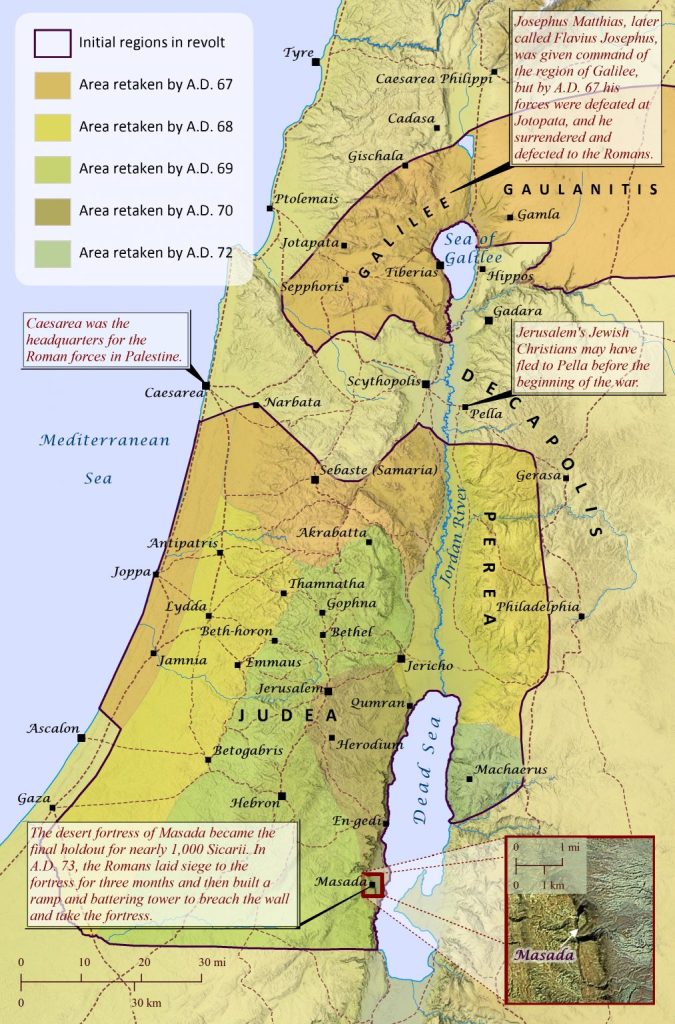
Galilee became Rome’s first target. At Jotapata, a hill fortress commanded by Josephus himself, the walls fell after forty-seven days.

Forty thousand were slain, and the city was utterly demolished; those who had hidden in caves were dragged out and slain.
— Josephus, Jewish War 3.7.36 (c. AD 75–79)

Then came Gamla, a ridge-top city east of the Sea of Galilee. Its name means camel in Aramaic, and its fall was as steep as its slopes.

Men and women alike threw themselves and their children down the precipices; and the whole city was covered with corpses.
— Josephus, Jewish War 4.1.9 (c. AD 75–79)

Josephus summed it simply: “Galilee was filled with fire and blood.”
— Josephus, Jewish War 4.1.9 (c. AD 75–79)

The Roman campaign left the region in ruins, silencing nearly every center of resistance.

It was here that Josephus himself was captured. As commander of Jewish forces in Galilee, he had held out at Jotapata until the city fell. In his own account, he claims that while in captivity he prophesied that Vespasian would soon be emperor:

You, O Vespasian, shall be Caesar and emperor, you and your son. Bind me now still closer, and keep me for yourself; for you, O Caesar, are lord, not only of me, but of the land and sea, and of all mankind.
— Josephus, Jewish War 3.8.9 §401–403 (c. AD 75–79)

When that prophecy appeared to come true the following year, Vespasian spared his life, granted him Roman citizenship, and attached him to his household. From then on Josephus lived in Rome under imperial patronage, taking the family name Flavius from his patrons.

This is how Yosef ben Matityahu, a Jewish priest and rebel general, became Flavius Josephus, historian of the Jewish War. His writings—sometimes defensive, sometimes deferential toward Rome—remain the only detailed eyewitness record of Jerusalem’s destruction.


3. The Siege of Jerusalem (AD 70)

When Nero’s death recalled Vespasian to Rome, Titus took full command.
Inside Jerusalem, zealot factions fought one another while Roman legions built a five-mile siege wall to starve the city into surrender.
This wall—called a circumvallation—completely encircled Jerusalem. Built in only three days by tens of thousands of soldiers, it cut off every road and stopped all supplies. Famine would finish what the legions began.

The famine grew severe and destroyed whole houses and families. The alleys were filled with dead bodies of the aged; children and youths swarmed about the market-places like shadows, and fell wherever famine overtook them. No one buried them; pity was strangers to men; for famine had confounded all natural feeling.
— Josephus, Jewish War 5.12.3–4 (c. AD 75–79)

Then Josephus records one of antiquity’s darkest scenes:

There was a certain woman named Mary, daughter of Eleazar, of the village Bathezor. Driven by famine and rage, she slew her infant son, roasted him, and ate one half, concealing the rest. When the soldiers smelled the roasted meat and rushed in, she said, ‘This is my own son; the deed is mine; eat, for I have eaten. Do not pretend to be more tender-hearted than a woman or more compassionate than a mother.’
— Josephus, Jewish War 6.201–213 (c. AD 75–79)

Titus later claimed he had ordered the Temple spared:

I myself called a council of war and urged that the Temple be saved; but the flame was beyond control, and the sanctuary was burned against my will.
— Josephus, Jewish War 6.4.7 §254 (c. AD 75–79)

Josephus blames undisciplined troops; Tacitus sees deliberate policy:

It was resolved to destroy the Temple that the religion of the Jews might be more completely abolished.
— Tacitus, Histories 5.12 (c. AD 100–110)

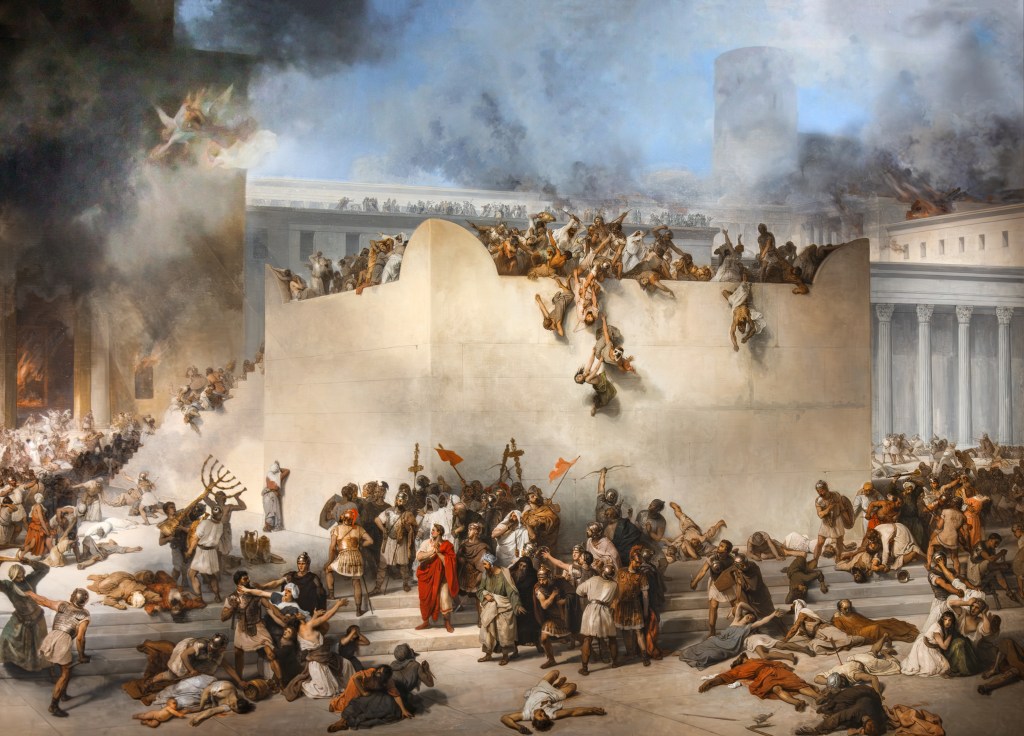
The Destruction of the Temple of Jerusalem – Francesco Hayez, 1867, oil on canvas

Different motives, same outcome: the Temple fell.
For Christians, it confirmed the prophecy of Christ: “Not one stone shall be left upon another.” (Mark 13:2)


4. Crosses Without Number

As for those who had fled from the city and were caught, they were first scourged and then tortured and finally crucified before the walls. In their fury and hatred the soldiers nailed up the prisoners in different postures, by way of jest, and the multitude was so great that room was wanting for the crosses, and crosses for the bodies.
— Josephus, Jewish War 5.11.1 (c. AD 75–79)

Josephus later expands this account:

Those who were taken outside the city he first scourged, and then tormented with all manner of tortures before crucifying them opposite the wall. Titus indeed felt pity for them, but their number was so great that there was no room for the crosses nor crosses for the bodies. About five hundred were crucified each day, and the soldiers, in their rage and hatred, amused themselves by crucifying some one way and some another, until, owing to the multitude, there was no space left for the crosses nor crosses for the bodies.
— Josephus, Jewish War 6.1.1 (c. AD 75–79)

The same empire that boasted of order and civilization turned execution into entertainment.
The hills around Jerusalem stood thick with crosses—not yet symbols of redemption, but monuments of Rome’s rule through fear.


5. Aftermath — Slavery, Spectacle, and Tax

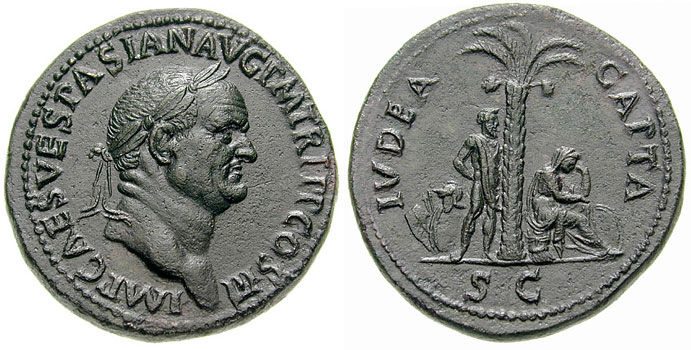
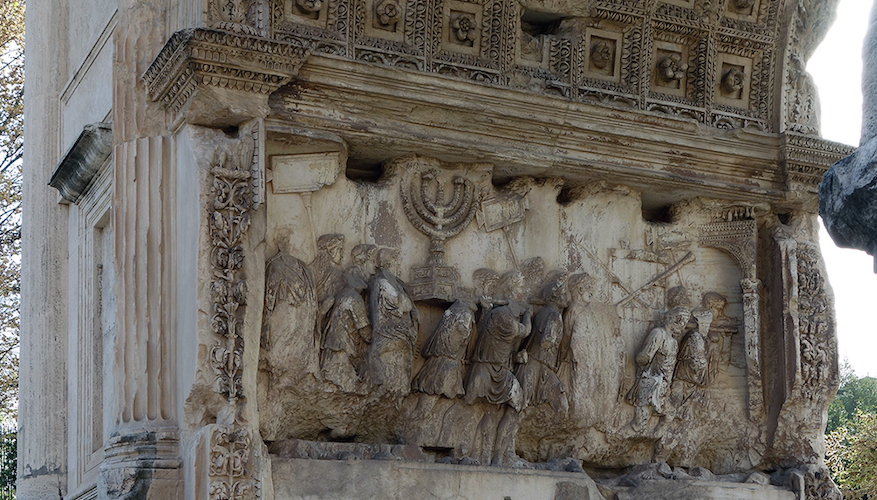
Through Rome’s streets the captives marched, carrying the Menorah and sacred vessels. Coins were struck proclaiming IUDAEA CAPTA—“Judea Captured.” Various versions of these coins were struck and used for 25 years under Vespasian and his two sons Titus and Domitian.

IMP CAES VESPASIAN AUG PM TR P COS III = Commander Caesar Vespasian Augustus, Chief Priest, Holder of Tribunician Power, Consul for the Third Time; IUDEA CAPTA S C = Judea Captured by decree of the Senate

He decreed that all Jews throughout the world should pay each year two drachmas to the Capitol in Rome, as they had previously paid to the Temple in Jerusalem.
— Dio Cassius, Roman History 66.7 (c. AD 200–220)

The fiscus Judaicus turned a holy offering into tribute for pagan gods.
Jewish Christians, still classed as Jews, were forced to pay the same tax of defeat.

Meanwhile, many early believers saw a deeper reason for Jerusalem’s ruin: the death of James the Just, the brother of Jesus and leader of the church in Jerusalem.

Festus was now dead, and Albinus was but upon the road; so Ananus, who had become high priest, assembled the Sanhedrin of judges, and brought before them the brother of Jesus, who was called Christ, whose name was James, and some others; and when he had formed an accusation against them as breakers of the law, he delivered them to be stoned.
— Josephus, Antiquities 20.9.1 §200–203 (c. AD 93)

Hegesippus, a second-century Jewish Christian, adds detail:

They placed James on the pinnacle of the Temple and cried, ‘Tell us, O righteous one, what is the door of Jesus?’ And he answered with a loud voice, ‘Why do you ask me concerning the Son of Man? He sitteth at the right hand of the Great Power, and shall come on the clouds of heaven.’ Then they began to stone him, and a fuller took the club with which he beat clothes and struck the righteous one on the head, and so he suffered martyrdom.
— Hegesippus in Eusebius, Ecclesiastical History 2.23.10–12 (c. AD 170, quoted c. AD 310–325)

Hegesippus concludes that the siege of Jerusalem followed soon after James’s death, calling it divine judgment:

Immediately after this Vespasian began to besiege them; and they remembered the saying of Isaiah the prophet, ‘Let us take away the righteous man, because he is troublesome to us; therefore they shall eat the fruit of their doings.’ Such was their lot, and they suffered these things for the sake of James the Just.
— Hegesippus in Eusebius, Ecclesiastical History 2.23.18 (c. AD 170, quoted c. AD 310–325)

Eusebius agrees, closing his account:

These things happened to the Jews to avenge James the Just, who was the brother of Jesus that is called Christ. For, as Josephus says, these things befell them in accordance with God’s vengeance for the death of James the Just, which they had committed, although he was a most righteous man.
— Eusebius, Ecclesiastical History 2.23.19–20 (c. AD 310–325)

From this moment on, many Christians saw the destruction of Jerusalem not only as Rome’s triumph, but as God’s judgment for rejecting Christ and murdering His righteous servant.


6. The Arch of Titus — The Empire’s Theology in Stone (AD 81)

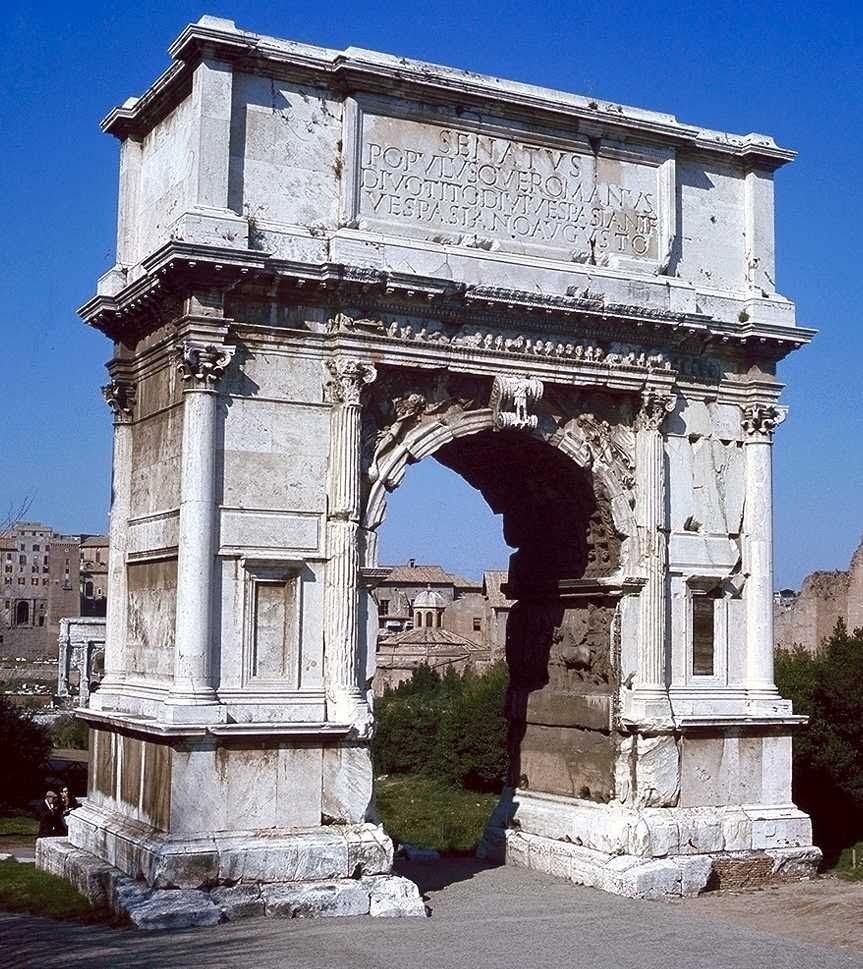
When Titus died, the Senate declared him divine. The arch still standing on the Via Sacra reads:

The Senate and People of Rome [dedicated this] to the deified Titus Vespasian Augustus, son of the deified Vespasian.

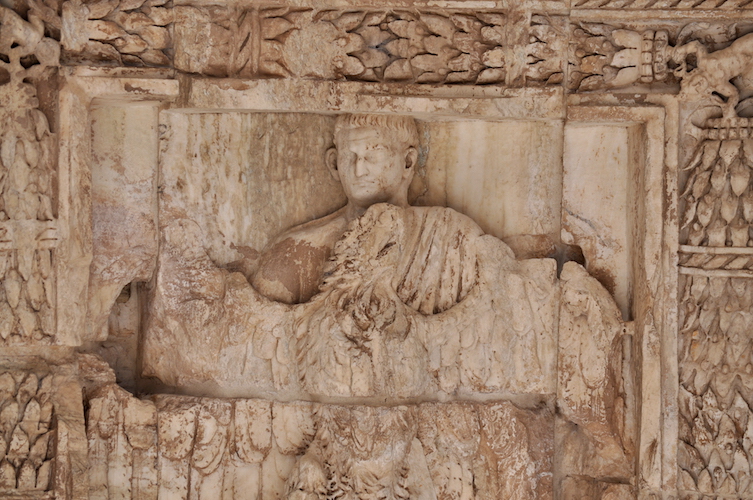
Inside its vault, carvings show Roman soldiers bearing the Temple treasures.

They brought the Menorah and the table of the bread of the Presence, and the last of the spoils was the Law of the Jews; after these, a great number of captives followed.
— Josephus, Jewish War 7.5.5 (c. AD 75–79)

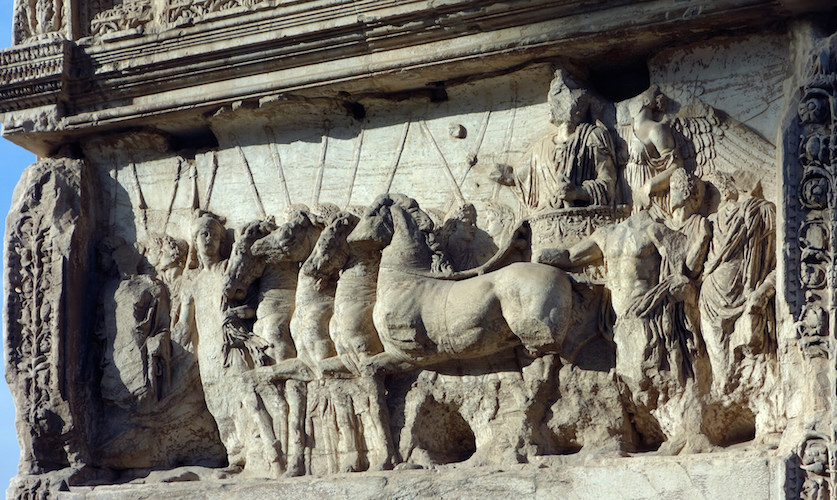
At the top of the arch inside is the depiction of Titus’ ascension to heaven as a god on the wings of an eagle.

For Rome, the arch proclaimed the victory of its gods.
For Christians, it stood as a silent confirmation of prophecy: the Temple of stone was gone, but the Temple of Christ remained.


7. The Flight to Pella — Revelation and Refuge

Amid the ruins of Jerusalem’s revolt, one community escaped—the believers who remembered Christ’s warning to flee.

The people of the church in Jerusalem had been commanded by a revelation, vouchsafed to approved men there before the war, to leave the city and to dwell in a certain town of Perea called Pella. And when those who believed in Christ had come thither from Jerusalem, then, as if the holy men had altogether deserted the royal city of the Jews and the whole land of Judea, the judgment of God at last overtook them for their abominations.
— Eusebius, Ecclesiastical History 3.5.3 (c. AD 310–325)

Eusebius attributes their escape to a divine revelation, while Epiphanius explains it as obedience to Christ’s prophecy:

When all the disciples were settled in Pella because of Christ’s prophecy about the siege, they remained there until the destruction of Jerusalem.
— Epiphanius, Panarion 29.7.7–8 (c. AD 375)

Different explanations—same event. The believers crossed the Jordan to Pella, a Decapolis city about sixty miles northeast of Jerusalem, where they waited out the war.
Their flight fulfilled Jesus’ own words (Luke 21:20–21).
What looked like retreat was obedience.


8. The Nazarenes — Law-Observant, Christ-Confessing

The first branch to emerge from that exile was the Nazarenes—Jewish believers who kept the Mosaic Law yet confessed Jesus as the divine Son of God.
They were the losing party in the Council of Jerusalem (Acts 15).

At that council, certain men from Judea began teaching that Gentile converts must keep the Law of Moses to be saved:

Some men came down from Judea and were teaching the brothers, ‘Unless you are circumcised according to the custom of Moses, you cannot be saved.’
— Acts 15:1

Later Luke identifies who pressed the issue:

But some of the sect of the Pharisees who believed rose up, saying, ‘It is necessary to circumcise them and to command them to keep the law of Moses.’
— Acts 15:5

Peter and James ruled that Gentiles need not bear that yoke:

We should not trouble those of the Gentiles who turn to God, but should write to them to abstain from things polluted by idols, from sexual immorality, from what has been strangled, and from blood.
— Acts 15:19–20

Those Jewish believers who could not release Torah observance continued as a community of Torah-keeping Christians—the Nazarenes.

Two decades later they were still strong. When Paul returned to Jerusalem near the end of his ministry, James the Just, the same leader later martyred near the Temple, recognized their influence:

You see, brother, how many myriads of Jews there are who have believed, and they are all zealous for the Law… Therefore do what we tell you: we have four men who have taken a vow; take them and purify yourself along with them, and pay their expenses, so that all may know that there is nothing in what they have been told about you, but that you yourself also live in observance of the Law.
— Acts 21:20, 23–24

James’s advice shows that the Nazarenes were not fringe but central within the Jerusalem church.

Centuries later, Jerome described them:

“The adherents to this sect are known commonly as Nazarenes; they believe in Christ the Son of God, born of the Virgin Mary; and they say that He who suffered under Pontius Pilate and rose again is the same as the one in whom we believe.”
— Jerome, Letter 75 to Augustine (AD 398–403)

“The Nazarenes accept Messiah in such a way that they do not cease to observe the old Law.”
— Jerome, Commentary on Isaiah 8:14 (AD 398–403)

Even Epiphanius, who condemned most sects, writes:

The Nazarenes are Jews who keep the customs of the Law but also believe in Christ. They say that Jesus was born of the Virgin Mary by the Holy Spirit. They believe that God created all things, that Jesus is His Son, and that the resurrection of the dead has already begun in Him… As for their understanding of Christ, I am not certain—whether they have been misled by false teachers who call Him merely human, or whether, as I think, they confess that He was born of Mary by the Holy Spirit.
— Epiphanius, Panarion 29.7.5–6 (c. AD 375)

Epiphanius lists their beliefs as orthodox and then admits, “I cannot say whether they have been deceived or whether they confess the truth.”
Had they denied Christ’s divinity, he would have said so.
His hesitation confirms that the Nazarenes were orthodox in belief, Jewish in culture—the first generation of Messianic Jews bridging synagogue and church.


9. The Ebionites — The First Denial of Christ’s Divinity

A second group took a different path. Epiphanius places their origin after the flight to Pella:

The Ebionites are later than the Nazoraeans… their sect began after the flight from Jerusalem.
— Epiphanius, Panarion 29.7.7–8 (c. AD 375)

They taught that Jesus was a mere man chosen by God, denied the virgin birth, and altered Scripture to fit their beliefs.

Those who are called Ebionites use the Gospel according to Matthew only, and repudiate the Apostle Paul, maintaining that he was an apostate from the Law.
— Irenaeus, Against Heresies 1.26.2 (c. AD 180)

The Ebionites believe that He was a mere man, born of Joseph and Mary according to the common course of nature, and that He became righteous through the progress of His moral character.
— Origen, Commentary on Matthew 16.12 (c. AD 248)

They falsify the genealogical tables in Matthew’s Gospel, saying that He was begotten of a man and a woman, because they maintain that Jesus is really a man and was justified by His progress in virtue, and that He was called Christ because the Spirit of God descended upon Him at His baptism. They say that this same Spirit, which had come upon Him, was taken away and left Him before the Passion and went back to God; and that then, after His death and resurrection, this same Spirit returned to Him again. Thus they deny that He is God, though they do not deny that He was a man.
— Epiphanius, Panarion 30.14.3–5 (c. AD 375)

They also spread a slander about Paul:

They say that Paul was a Greek who came to Jerusalem and lived there for a time. He desired to marry a daughter of the priests but was refused. Out of anger and disappointment he turned against circumcision, the Sabbath, and the Law. Because of this, they claim, he wrote against these things and founded a new heresy.
— Epiphanius, Panarion 30.16.6–9 (c. AD 375)

For the Ebionites, Jerusalem’s destruction was not punishment for rejecting Christ but for accepting the apostolic Gospel.
They blamed Paul and the church that followed him for turning Israel away from the Law.
Thus they reversed the very lesson of history that Josephus, Hegesippus, and Eusebius had drawn from the death of James the Just.
Where the Nazarenes preserved unity in diversity, the Ebionites cut themselves off from the apostolic faith.


10. Three Waves of Testimony and the Apostolic Standard

When we date the earliest Christian writings, we find three waves of testimony—sources acknowledged even by skeptical historians as genuine first-century evidence.
They give us the historical core around which all later writings revolve.


Three Waves of Early Christian Testimony

Wave of WitnessApproximate DateContent & DescriptionAuthority and Significance
CreedsAD 30s1 Corinthians 15:3–5 — “Christ died, was buried, and rose again according to the Scriptures.”
Philippians 2:6–11 — The Christ-hymn proclaiming His pre-existence, incarnation, humility, and exaltation.
The earliest confessions of faith; already proclaim Jesus as divine and demand worship.
Paul’s EpistlesAD 48–61The seven undisputed letters of PaulRomans, 1 & 2 Corinthians, Galatians, Philippians, 1 Thessalonians, and Philemon.The interpretation of Christ’s work by Paul himself, written within the lifetime of the apostles; Paul quotes and affirms the early creeds as authoritative revelation.
Synoptic GospelsAD 50s–60sMatthew, Mark, and Luke — written within the first generation after Jesus, preserving eyewitness memory of His life, teaching, death, and resurrection.The formal written record of what the earliest witnesses proclaimed; confirms and expands the message already present in the creeds and letters.

This Philippians hymn is not later theology; it is the earliest Christian confession we possess.
It begins with divinity, not humanity.
It declares that the one “existing in the form of God” became man, died on a cross, and was exalted so that every knee should bow and every tongue confess that Jesus Christ is Lord.
It is a proclamation of His divinity and a demand for worship from the very start of the Christian movement.

Modern critics such as Bart Ehrman claim that belief in Jesus’ divinity was a late development, yet their own dating of the evidence proves the opposite.
The earliest sources—the creeds Paul quotes—already worship Him as divine, and Paul treats those creeds as authoritative revelation.
From the beginning, the church bowed to a divine Christ, not a human teacher slowly exalted by legend.

Measured by that apostolic standard, the Nazarenes remained faithful to the original confession, honoring Paul’s letters and the earliest creeds.
The Ebionites, however, altered the Gospels, repudiated Paul, and rejected the Philippians 2 creed, denying Christ’s divinity and placing themselves outside the apostolic faith.


11. Dating the Gospels

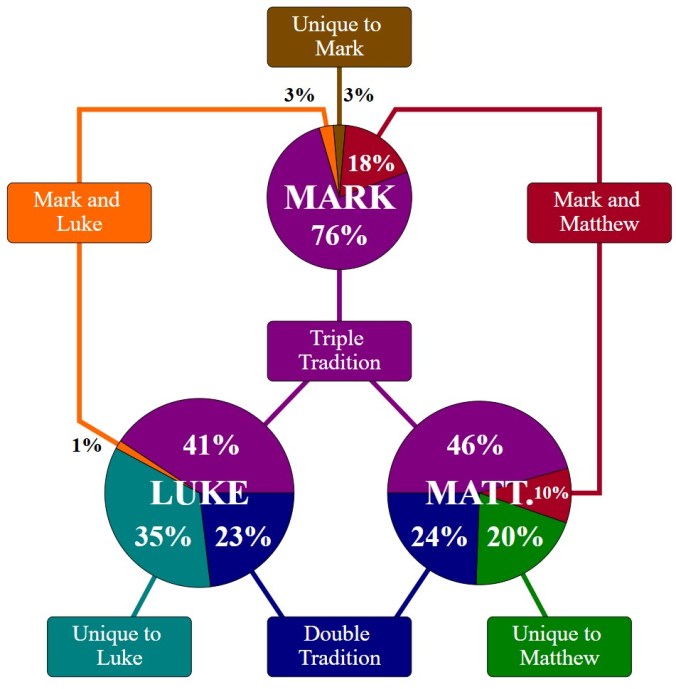
Critical scholars commonly date Mark around AD 70, arguing that Jesus’ prophecy of the Temple’s destruction must have been written after it happened.
But this logic assumes that prophecy is impossible—a philosophical bias, not a historical fact.
If prophecy is real, the foundation for late dating collapses.

Even on their own terms, critics face contradictions.
They argue that Matthew copied Mark and therefore must be later, yet the Ebionites were already using and editing Matthew shortly after Jerusalem’s fall.
If Matthew was being altered in the 70s, it had to exist before then—and if Matthew depended on Mark, Mark must be earlier still.
The evidence forces the Synoptic Gospels back into the 60s or even 50s—within the lifetime of eyewitnesses.

Paul’s letters tighten the timeline further.
In 1 Corinthians, written about AD 54–55, Paul quotes Gospel material three times:

  • 1 Corinthians 7:10 echoes Mark 10:11–12 on divorce — “not I, but the Lord.”
  • 1 Corinthians 9:14 recalls Luke 10:7 — “the Lord commanded that those who proclaim the gospel should get their living by the gospel.”
  • 1 Corinthians 11:23–25 recounts the words of institution at the Lord’s Supper, matching Luke 22:19–20 and Matthew 26:26–28.

These parallels show that the Gospel traditions were already written—or at least formally fixed—by the early 50s.
Paul quotes them as Scripture, not rumor, expecting his readers to recognize their authority.
This means the Gospels, or their written sources, predate 1 Corinthians itself—placing them within twenty years of the crucifixion.

Thus the timeline of Christian testimony runs not forward into myth but backward into eyewitness memory:

  • Creeds (AD 30s): the original confession of Christ’s death, resurrection, and divine status.
  • Paul’s Epistles (AD 48–61): the interpretation of those events by Paul himself, written within the lifetime of the apostles.
  • Synoptic Gospels (AD 50s–60s): the written preservation of what the eyewitnesses had proclaimed from the beginning.

When the evidence is allowed to speak for itself, it shows that the worship of Jesus as divine and the written record of His life both originate within living memory of His death and resurrection.
Even those who date the Gospel of John later, around the 90s, acknowledge that the Synoptics—and the faith they record—were already established decades earlier.
Christianity’s foundation is not legend developed over centuries—it is history written by witnesses and verified by worship.

The True Temple Rises: Christianity After AD 70

When Nero died by suicide in AD 68, the Roman Empire plunged into chaos. In one year, four emperors—Galba, Otho, Vitellius, and finally Vespasian—rose and fell. While Rome burned and battled for power, Judea was in full revolt.

And in the smoldering ruins of that rebellion, Vespasian and his son Titus would become emperors. Their campaign didn’t just crush a revolt—it destroyed Jerusalem, leveled the Temple, and forever reshaped both Jewish and Christian identity.


The Revolt Begins: Taxes, Desecration, and Massacres

In AD 66, the Roman governor of Judea, Gessius Florus, pushed the people beyond their limits. He looted the Temple treasury—seizing 17 talents, equivalent to about $10 million today.

This wasn’t mere corruption — it was an act of sacrilege and robbery of funds consecrated to God.

The people mocked Florus by passing baskets around as though collecting alms for him. His response was slaughter. Josephus (c. AD 75–79) records:

“Florus sent soldiers into Jerusalem and ordered a massacre. They killed 3,600 men, women, and children—even Roman citizens of equestrian rank. Some were scourged, and then crucified.”
— Josephus, Jewish War 2.14.9 (Loeb)

This atrocity ignited full-scale revolt.


Roman Garrisons Overrun

Jewish Zealots stormed the Antonia Fortress, overran the Roman garrison, and then ambushed Roman forces at Masada. Josephus writes:

“They compelled the Roman garrison to surrender and slaughtered them. The war was now started in earnest.”
— Josephus, Jewish War 2.17.9 (Loeb)

Rome had no choice but to respond.


Vespasian in Galilee: Fire and Terror

Nero sent Vespasian, a seasoned general, to crush the uprising. Accompanied by his son Titus, he swept through Galilee.

At Jotapata, Josephus himself was the Jewish commander. He was captured there and became an eyewitness to everything that followed. His account of these events is not second-hand history; it comes from someone who stood in the middle of the war and later wrote under Roman patronage.

Josephus describes the fall of Jotapata:

“Forty thousand were slain, and the city was utterly demolished. Those hiding in caves were dragged out and killed.”
— Josephus, Jewish War 3.7.36 (Loeb)

In Gamla, the scene was horrific:

“People hurled themselves, wives, and children over the cliffs. The entire city was covered with corpses.”
— Josephus, Jewish War 4.1.9 (Loeb)

He sums it up:

“Galilee was filled with fire and blood.”

Christians in Galilee were not spared this. They lived in the same villages and towns, and the Roman army made no distinction. Alongside their Jewish neighbors, they too were killed, crucified, or driven into slavery. The suffering Josephus describes was shared by all, including those who confessed Christ.


Titus and the Siege of Jerusalem

After Nero’s death, Vespasian left for Rome, leaving the siege of Jerusalem in the hands of Titus.

Jerusalem was already fractured from within. Zealots and moderates fought each other while Roman forces built a five-mile siege wall to starve the city.

Josephus, still an eyewitness from the Roman camp, records the horrors inside:

“The famine was so severe that parents stole food from their own children. Dead bodies lay everywhere. No one had strength to bury them.”
— Josephus, Jewish War 5.12.3–4 (Loeb)

And then, one of the darkest accounts in ancient history:

“A woman named Mary… took her infant son, slew him, roasted him, and ate half, hiding the rest. When soldiers smelled the roasted flesh and stormed in, she said, ‘This is my son… I have eaten my own child.’”
— Josephus, Jewish War 6.201–213 (Loeb)

Titus pressed on. Though he claimed to want to spare the Temple:

“I gave orders to preserve the Temple, but my commands were ignored in the madness of battle.”
— Josephus, Jewish War 6.4.7 (6.254 Loeb)

The Temple burned. The city fell. Josephus claimed over 1.1 million people died in the siege.

For Christians, the destruction of the Temple wasn’t only tragedy — it was fulfillment of Jesus’ prophecy (Mark 13:2). The collapse of the Temple-centered world validated their conviction that Christ himself was the new and greater Temple.


Crucifixions Without Number

Josephus gives us two chilling glimpses of Roman cruelty:

“As for those who had fled from within the city, many were caught; and when they were caught, they were scourged and tortured, then crucified opposite the walls. The Roman soldiers, out of anger and hatred, nailed up those they caught, one after one way, and another after another, to entertain themselves by the variety. And so great was their number that there was not room enough for the crosses, and not crosses enough for the bodies.”
— Josephus, Jewish War 5.11.1 (Loeb)

And again:

“They caught those that had fled out of the city… and when they were caught, they were first scourged, then tormented with all sorts of tortures, and finally crucified before the wall of the city. Titus indeed commiserated their fate; yet he understood that their number was so great that room was lacking for the crosses, and crosses lacking for the bodies. About five hundred were crucified daily.”
— Josephus, Jewish War 6.1.1 (Loeb)

This was the empire’s logic of terror — the same system of crucifixion that had killed Jesus, now repeated on a scale of hundreds per day. Early Christians could never look at the Roman cross as anything but a symbol of cruelty and their Lord’s triumph over it.


Aftermath: Slavery, Spectacle, and the Jewish Tax

Thousands of survivors were:

  • Paraded through Rome in Titus’s triumph, forced to carry sacred items like the Menorah.
  • Sold into slavery across the empire.

Rome minted coins that read:

“Judea Capta” — Judea Captured.

And then came the fiscus Judaicus—the Jewish tax.

“He also decreed that all Jews throughout the world should pay each year two drachmas to the Capitol in Rome, as they had previously paid them to the Temple in Jerusalem.”
— Dio Cassius (c. AD 200–220), Roman History 66.7 (Loeb)

For Jewish Christians, this was especially complex. In Judea, they were still outwardly seen as part of the Jewish community and likely taxed along with them. But in Rome, Nero had already distinguished Christians as a separate group. The destruction of the Temple and the imposition of this tax pushed the divide further: Christians were being forced to decide — were they simply another branch of Judaism, or something distinct?

And the atmosphere in Rome was not one of tolerance. Suetonius (c. AD 120) records:

“He banished from the city the philosophers and the astrologers.”
— Suetonius, Vespasian 15 (Loeb)

This wasn’t aimed at Christians directly, but it reveals the suspicion with which Rome viewed any new teachers or rival authorities. The gospel’s claim that Jesus is Lord would have sounded as threatening to imperial ears as the mutterings of philosophers or astrologers.


The Arch of Titus

The victory was immortalized in stone. After Titus’s death, the Roman Senate and People built the Arch of Titus (c. AD 81), which still stands in Rome today.

The dedicatory inscription reads:

“The Senate and People of Rome [dedicated this] to the deified Titus Vespasian Augustus, son of the deified Vespasian.”

Inside the arch, the reliefs show Roman soldiers carrying the sacred objects of the Jerusalem Temple — the Menorah, the Table of Showbread, and even the Torah scrolls. Josephus describes the same scene in his account of Titus’s triumph:

“They brought the menorah and the table of the bread of the Presence, and the last of the spoils was the Law of the Jews. After these, a great number of captives followed.”
— Josephus, Jewish War 7.5.5 (Loeb, c. AD 75–79)

For Rome, this was not just a military victory. It was theological. In Roman eyes, Titus had defeated the Jewish god himself. That is why the arch presents Titus as a god honored for his conquest: our god overcame your god.

For Jews and Christians alike, the arch became a bitter monument. For Christians especially, it underscored the truth that the Temple was gone, but Christ had already promised: “Not one stone shall be left upon another.”


The Christians Who Fled – and the First Heretical Group

The church in Jerusalem did not perish in the siege.

“The people of the church in Jerusalem had been commanded by a revelation… to dwell in a town of Perea called Pella.”
— Eusebius (c. AD 310–325), Ecclesiastical History 3.5.3 (Loeb)

This flight preserved the core of the church, but not all Christians escaped. Those who stayed in Jerusalem, or who were caught in the countryside during Rome’s advance, would have shared the same fate as their Jewish neighbors — famine, crucifixion, or slavery. The Roman army made no distinction. To them, it was one rebellious people.

But at Pella, Christians regrouped. And in the same city, other Jewish survivors settled. Out of this mixture emerged the Ebionites, the first major heretical group.

  • They rejected Paul as an apostle.
  • They insisted on strict adherence to the Law.
  • They denied the full divinity of Jesus.
  • They used only a corrupted form of Matthew’s Gospel, altered to fit their theology.

Epiphanius (c. AD 375–400) writes:

“They accept the Gospel according to Matthew, but only that which is called ‘according to the Hebrews.’ They call it the Gospel of Matthew, however it is not complete and entire but falsified and mutilated.”
Panarion 30.13.2

Irenaeus (c. AD 180) confirms:

“Those who are called Ebionites… use the Gospel according to Matthew only, and repudiate the Apostle Paul, maintaining that he was an apostate from the law.”
Against Heresies 1.26.2

The fact that the Ebionites were already mutilating Matthew’s Gospel in the 70s AD shows that Matthew must have been written before the destruction of the Temple.

This stands in contrast to the critical scholarly view, which typically places Mark around AD 70 and Matthew and Luke in the 80s or later. Their reasoning? Jesus’ prophecy of the Temple’s destruction. They assume prophecy is impossible, and therefore the Gospels must have been written after the event.

But if Matthew was already available to be twisted by the Ebionites in the 70s, then Mark — the source they say Matthew used — must be earlier still. The Gospels, far from being late inventions, stand close to the events they describe.

For more on the Ebionites and their altered gospel, see my earlier blog post: [The Ebionites]


Rome’s Pride, God’s Judgment

Tacitus (c. AD 100–110) gives us the Roman perspective:

“Their temple was famous beyond all other works of men… it was resolved to raze it to the ground, that the religion of the Jews might be more completely abolished.”
— Tacitus, Histories 5.12 (Loeb)

But Jesus had said long before:

“Do you see these great buildings? Not one stone shall be left upon another that shall not be thrown down.”
— Mark 13:2

To Rome, it was conquest.
To Christians, it was fulfillment.


Conclusion: What This Meant for Christians

The fall of Jerusalem was not only a Jewish tragedy but a Christian turning point.

  • It validated Jesus’ prophecy of the Temple’s destruction.
  • It preserved the church through the flight to Pella — though many Christians were slaughtered along with the Jews.
  • It deepened the separation between Christianity and Judaism.
  • It produced the first major heresy (Ebionites), which ironically confirms the early existence of Matthew’s Gospel.

Tacitus summed up Rome’s perspective:

“It was resolved to raze it to the ground, that the religion of the Jews might be more completely abolished.”
— Tacitus, Histories 5.12 (Loeb, c. AD 100–110)

What Rome thought was the abolition of a religion, Christians understood as the vindication of Christ’s words:

“Not one stone shall be left upon another that shall not be thrown down.” (Mark 13:2)

Vespasian and Titus were hailed as saviors of Rome and later deified as gods. But their triumph was also God’s judgment — and the stage on which Christianity stepped into a new identity as the true temple of the living God.

Caligula, the Jews, and the Birth of the Christian Name

Introduction

When the Emperor Tiberius died in AD 37, the empire — and Judea in particular — was ready for change.
Years of suspicion and repression had left the people weary.

Into that moment stepped Gaius Julius Caesar Germanicus — better known by his childhood nickname, Caligula, “little boots.”
At first, he was welcomed as a breath of fresh air: the beloved son of the popular general Germanicus, a man whose family name still inspired loyalty in the legions.

But within months of taking the throne, Caligula’s rule took a shocking turn.
A serious illness changed him — or perhaps revealed him.
He began to speak and act as if he were not just Rome’s ruler, but Rome’s god.

Caligula’s four-year reign takes us into the early chapters of the book of Acts — roughly Acts 8 through Acts 11, and possibly touching Acts 12. This is the period after Stephen’s martyrdom, when Saul is converted, the gospel spreads to Samaria, and the first Gentiles come to faith.
In Acts 11:26 we read, “The disciples were first called Christians in Antioch.”
That moment, the birth of the Christian name, happens right around the time Caligula is assassinated.

At this stage in history, Christians were still viewed by Rome as part of the Jewish community. There was no legal distinction between them. Because of that, they came under the same imperial pressures as the Jews — but their primary opposition, as the book of Acts records, came from certain Jewish religious leaders, not directly from Rome.


Demanding Worship

Caligula’s early popularity soon gave way to demands for divine honors.

Cassius Dio, Roman History 59.28 (c. AD 200–235):
“He gave orders that the statue of Zeus at Olympia be brought to Rome, in order that he might set up a statue of himself in its place, and be worshipped as Zeus.”

Suetonius, Caligula 22 (c. AD 110–130):
“He demanded that all statues of the gods be brought to Rome and have his image set upon them.
Those who failed to swear by his Genius or sacrifice to him were executed or exiled.”

Cassius Dio, Roman History 59.6:
“He became terribly bloodthirsty, once stained with blood. He killed without trial anyone he suspected.
And because he was now calling himself a god, any slight was counted as sacrilege.”

Cassius Dio, Roman History 59.25:
“In Gaul he executed many nobles who failed to show delight at his arrival.
Some were accused of mocking the temples erected in his honor.”

These weren’t harmless eccentricities. Caligula’s divine pretensions were enforced with political terror. Refusal to participate in his worship could mean exile, confiscation of property, or death — whether you were a senator in Rome or a provincial subject.


Christians Were Still Seen as Jews

In the late 30s AD, the Roman state made no distinction between Jews and Christians.

The followers of Jesus still met in synagogues. They kept many Jewish customs. Their proclamation of a crucified and risen Messiah looked, to outsiders, like one more messianic variation within Judaism.

That meant that when Jews came under threat for refusing emperor worship, Christians came under the same threat — not because Rome recognized them as a separate group, but because they were still identified as Jews.

It’s important to remember: in this period, as Acts records, the primary persecution of Christians came from Jewish religious authorities and their allies, not from the Roman state.


The Temple Statue Order

Caligula’s most infamous act toward the Jews came in AD 39 or 40, when he ordered a colossal statue of himself to be placed in the Jerusalem Temple — the holiest site in Judaism.

Josephus, Antiquities 18.261–262 (c. AD 93):
“Petronius, the governor of Syria, was astonished at the constancy of the Jews… Tens of thousands came to meet him, begging him not to allow the laws of their forefathers to be transgressed. They threw themselves on the ground and exposed their necks, declaring they were ready to be slain rather than see the image set up.”

Josephus, War 2.195 (c. AD 75):
“They continued in this posture for forty days, lying prostrate on the ground and praying with tears that the laws of their forefathers not be violated.”

Josephus, Antiquities 18.278:
“They said they would rather let their land lie untilled than submit to such impiety. ‘We will neither fight nor flee,’ they said, ‘but if you wish, kill us. Slaughter us as sacrifices upon our own soil, and we shall die satisfied if we keep our Law.’”

This was a theological line that could not be crossed. The Jewish resistance was total and nonviolent, but it risked triggering a rebellion that could have spread far beyond Judea.


Philo Stands Before Caligula

In Alexandria, Jews were being attacked. Synagogues were seized. A delegation led by Philo of Alexandria (c. AD 40s) was sent to plead their case before Caligula.

Philo’s description in Embassy to Gaius is striking.

Philo, Embassy to Gaius 206:
“He would run to the peacocks and talk to them, then dart off to a cluster of trees… laughing loudly and pretending to judge the beauty of the statues.
We followed him like prisoners in a triumphal procession.”

Philo, Embassy to Gaius 351–352:
“He ridiculed us without restraint.
He said, ‘You are people who do not believe I have been made a god, although I am clearly one!’
And when we tried to explain our ancestral customs, he laughed louder still and said,
‘You are not defending your religion — you are insulting mine!’”

Philo, Embassy to Gaius 358:
“No one could guess what he would do next.
His madness was like the sea, stirred by contrary winds — always shifting, never at peace.”

The emperor’s mood, not the law, was the deciding factor for the fate of entire communities.


Petronius Risks His Life

In Judea, the man tasked with carrying out the statue order was the governor of Syria, Publius Petronius. He saw the Jewish determination to resist and feared the order would ignite a rebellion that could consume the whole region.

Josephus, Antiquities 18.297–299:
“Petronius took the blame upon himself… He wrote to Caligula saying that if he forced the image into the Temple, all Syria would be in revolt.
He told his wife and children to prepare for his death.”

Caligula sent a letter ordering Petronius to commit suicide. But before it arrived:

Josephus, Antiquities 18.302:
“The letter from Caligula, commanding Petronius to kill himself, was already on its way —
but a messenger arrived first announcing that Gaius was dead. And so Petronius was saved.”


What Was Happening in the Church?

During Caligula’s reign:

  • Jesus had been crucified just a few years earlier, c. AD 30.
  • Paul had been converted, c. AD 31–32.
  • The gospel had spread to Samaria and Antioch.
  • According to Acts 11:26, “The disciples were first called Christians in Antioch.”
  • The events of Acts 8–11 — and possibly into Acts 12 — take place during these years.
  • The primary persecution of Christians recorded in Acts during this period came from certain Jewish authorities (Acts 8:1–3; Acts 9:1–2), not from Rome.

Conclusion

Caligula’s reign ended in AD 41 when members of the Praetorian Guard assassinated him.
For the Jews — and for Christians — his death was seen as a deliverance.

But his four years on the throne left a deep impression: the empire could demand worship from its subjects, and refusal could bring you to the brink of death.

The birth of the Christian name in Antioch happened in this very period, under the shadow of an emperor who claimed to be all the gods.

In the next post, we’ll see how the man who succeeded him — Claudius — brought a surprising period of stability, and how, under that stability, the Christian mission exploded across the empire.

The Sons of God: Augustus and the Christ

What did it mean to call someone “Son of God” in the Roman world—and why would anyone believe it about Jesus?

Before Christianity ever faced persecution, the Jewish people had already gained a remarkable status in the Roman Empire. They were allowed to observe the Sabbath, govern themselves according to their laws, and send offerings to the Jerusalem temple. These rights were not typical for most conquered peoples.

But Rome’s tolerance had limits. The story of how the Jewish people moved from protected status to persecution—how revolts turned into crosses—is crucial for understanding the world Jesus was born into.

And even more striking is this: before anyone called Jesus “Son of God,” those words already belonged to another man—Caesar Augustus.


Julius Caesar and Jewish Privilege

Julius Caesar’s relationship with the Jews was rooted in both politics and pragmatism. During the Roman civil war, the Jewish high priest Hyrcanus II supported Caesar against Pompey. In return, Caesar issued formal decrees protecting Jewish religious customs and governance:

“Gaius Julius Caesar… orders that [the Jews] be permitted to observe their own customs and laws and to gather together according to their ancestral customs.”
—Josephus, Antiquities 14.190–192 (Whiston)

“Gaius Caesar… has granted to Hyrcanus… and to the Jewish nation, exemption from tribute every seventh year… and that they may be governed according to their own laws.”
Antiquities 14.213–216

These were not vague gestures—they were publicly posted and sent to provincial officials for enforcement.

By the first century, Jews made up 7–10% of the Roman Empire, with communities spread across nearly every major city. Their presence was especially concentrated along Rome’s eastern frontier, bordering the Parthian Empire, Rome’s greatest military rival. For Caesar, Jewish loyalty brought stability to a region where stability was hard to come by.

“Countless myriads of Jews are in every region… in Asia and Europe, in the islands and mainland, in the East and the West.”
—Philo, Embassy to Gaius §281, c. AD 41

“There is no city, no nation, no people among whom our custom… has not spread… they have penetrated every city.”
—Josephus, Against Apion 2.282, c. AD 95

When Caesar was assassinated in 44 BC, the Jews stood out in their mourning.

“At Caesar’s funeral, the Jews alone mourned for him publicly and for many nights kept vigil at his tomb.”
—Appian, Civil Wars 2.148, c. AD 120


Rome Respected the Ancient

Rome didn’t simply tolerate the Jews because of politics. Their religion was ancient—and that mattered deeply in Roman culture. New religions were suspicious. Old ones were revered.

“Whatever their origin, their customs are at least ancient, and therefore entitled to respect.”
—Tacitus, Histories 5.5, c. AD 100

“All new kinds of religion are suspect… only ancient worships are worthy of divine status.”
—Pliny the Elder, Natural History 30.11, c. AD 77

This perspective explains why Jews were granted legal protection, while newer movements like Christianity eventually provoked suspicion and hostility. The age of a religion—its antiquity—was a Roman marker of legitimacy.


Augustus and the Gospel of the Empire

Jesus was born during the reign of Caesar Augustus (27 BC – AD 14), the adopted son of Julius Caesar. He didn’t just inherit Caesar’s power—he inherited Caesar’s divinity.

Augustus was declared Divi Filius—“Son of the Divine [Julius].” He was called savior, lord, and bringer of peace. These weren’t just political slogans—they were religious titles, printed on coins, etched in stone, and celebrated in public festivals.

“He added the title ‘Son of a God’ to his name.”
—Suetonius, Divus Augustus 94.1, c. AD 120

“After my death… the Senate decreed that my name should be included in the hymns of the Salii and be consecrated as a god.”
Res Gestae Divi Augusti §35, written by Augustus, AD 14

“To the Divine Augustus Caesar, Son of the Divine Julius.”
—Temple Dedication, Pergamon (1st c. BC)

One famous inscription from Priene (9 BC) declared:

“Since Providence… has filled [Augustus] with virtue so that he might benefit mankind… sending him as a Savior (sōtēr)… The birthday of the god Augustus was the beginning for the world of the good tidings (euangelion) that have come through him.”

Even his titles were spiritual:

“To our lord, Augustus Caesar, savior of the inhabited world…”
—Provincial Dedication, Asia Minor

So when the Gospel of Mark opens with:

“The beginning of the gospel of Jesus Christ, the Son of God.”
—Mark 1:1

—it wasn’t just religious language. It was a counterclaim. A direct confrontation with imperial theology.


Herod the Great and the Mass Crucifixions

Jesus was about two years old when Herod the Great died. Though he expanded the Jerusalem temple and was a Roman ally, Herod was known for ruthless paranoia:

“His whole life was a continual scene of bloodshed… even his own sons were not spared.”
—Josephus, Antiquities 17.191–192

“He gave orders to kill a great number of the most illustrious men of the whole Jewish nation…”
Antiquities 17.204

Among Herod’s victims was Hyrcanus II—the same high priest who had once supported Julius Caesar. His death signaled the end of a political era.

When Herod died in 4 BC, Judea erupted in revolt. The Roman governor Varus responded with overwhelming force:

“Varus… crucified about two thousand of those that had been the authors of the revolt.”
Jewish War 2.5.2

This was the world into which Jesus was born: a land where crosses lined the roads, and loyalty to Rome was enforced by terror.


The Census and the Revolt of Judas the Galilean

By AD 6, Jesus was about 12 years old. Rome had removed Herod’s son Archelaus, annexed Judea, and placed it under direct rule. A census for taxation followed.

“Coponius… had the power of life and death put into his hands by Caesar…”
—Josephus, Antiquities 18.1.1

“In those days a decree went out from Caesar Augustus that all the world should be registered…”
—Luke 2:1

For most provinces, a census was normal. But in Judea, taxation felt like a theological betrayal—a declaration that Caesar, not God, was king.

A Galilean named Judas stirred rebellion:

“Judas… said that this taxation was nothing less than slavery… and exhorted the nation to assert their liberty.”
Antiquities 18.4

“They say that God alone is their ruler and lord… and they do not value dying any more than living…”
Jewish War 2.117–118

“This was the beginning of great disturbances.”
Antiquities 18.27

Jesus grew up in Galilee, where this revolt happened. The trauma of crushed rebellion—arrests, crucifixions, suppression—was not distant history. It was personal memory for many families.


Rome Never Forgets

The revolt of Judas the Galilean may have been suppressed, but Rome remembered. Decades later, during the reign of Claudius, Judas’s sons were crucified:

“Two of his sons, James and Simon, were taken and crucified by order of Tiberius Alexander.”
Antiquities 20.102

Even after Jesus’ own crucifixion, Rome continued to hunt down zealot bloodlines. The cross wasn’t just punishment. It was policy.


Other Revolts, Other Crosses

Judea wasn’t the only place that rebelled.

“The Gauls… declared they were being reduced to slavery under the guise of a census and taxation.”
—Tacitus, Annals 3.40, c. AD 100

“The Britons… outraged by abuses and tribute… rose in fury to throw off the Roman yoke.”
Annals 14.31

But the difference in Judea was theological.

The Britons and Gauls wanted political freedom. The Jews wanted God’s reign restored. That made the conflict with Caesar something more than rebellion. It made it blasphemy versus worship.


The Gospel Against the Empire

Jesus was born during a Roman census, raised where a zealot revolt was crushed, and crucified by the same empire that lined Judean roads with crosses.

His death was not the first.
But his death redefined what the cross meant.

The gospel of Caesar said:

“The emperor is savior, son of god, and lord.”

The gospel of Jesus said:

“No. He is.”

Divergence from Christ’s Divinity: What the First-Century Evidence Actually Shows

Welcome to Living the Bible, where we examine the Bible and church history to guide our everyday living. I’m Jason Conrad.

In our previous post, we explored the Christ Hymn of Philippians 2:6–11—a poetic confession that predates Paul’s letters and proclaims Jesus’ divine pre-existence, incarnation, death, and exaltation. This hymn is powerful because it reflects what Christians were already saying and singing about Jesus before the Gospels were written.

But if this high Christology was the original belief, how soon did it face opposition? Were there really many versions of Jesus circulating in the first century, as some modern scholars suggest?

This post will take you directly to the earliest sources, not later summaries or theories. What we find is that, far from a chaotic diversity of Christianities, we see one core proclamation of a divine Christ—and only four identifiable groups that diverged from it during the first century. And even among these, only one group clearly denied Christ’s divinity.


The Nazarenes – 40s AD

Law-Observant Believers Who Affirmed Christ’s Divinity

The Nazarenes are the earliest group to diverge from the apostolic church—not in their view of Jesus, but in their insistence on continued Torah observance. They appear to be the group on the losing side of the Jerusalem Council in Acts 15:

“But some of the sect of the Pharisees who believed rose up, saying, ‘It is necessary to circumcise them and to command them to keep the law of Moses.’” (Acts 15:5)

Though the Council determined that Gentiles were not bound to keep the Law, these Jewish believers did not abandon their heritage. The name “Nazarene,” which originally applied to all Christians (Acts 24:5), gradually came to refer specifically to Jewish Christians who continued observing the Mosaic Law.

James, the brother of Jesus and leader of the Jerusalem church, likely maintained peace and inclusion with these believers. His advice to Paul in Acts 21 seems designed to show the law-observant Jewish Christians that Paul respected their customs:

“You see, brother, how many myriads of Jews there are who have believed, and they are all zealous for the law… Therefore do what we tell you: We have four men who have taken a vow.” (Acts 21:20, 23)

Even though the Nazarenes clung to the Law, they never rejected the divinity of Christ.

Jerome’s Testimony (c. 398–403 AD)

Letter 75 to Augustine:

“The adherents to this sect are known commonly as Nazarenes; they believe in Christ the Son of God, born of the Virgin Mary; and they say that He who suffered under Pontius Pilate and rose again is the same as the one in whom we believe.”

Commentary on Isaiah 8:14:

“The Nazarenes… accept Messiah in such a way that they do not cease to observe the old Law.”

Jerome—writing after the ecumenical councils of Nicaea (325 AD) and Constantinople (381 AD) had carefully defined the Church’s doctrine of Christ’s divinity—still affirms that the Nazarenes believed in “the same” Jesus. This is profoundly important: after all the theological scrutiny of the early church, Jerome still saw their Christology as sound.

Epiphanius’ Ambivalence – Panarion 29.7.5–6 (c. 375 AD)

“They are different from Jews, and different from Christians, only in the following ways. They disagree with Jews because of their belief in Christ; but they are not in accord with Christians because they are still fettered by the Law—circumcision, the Sabbath, and the rest.
As to Christ, I cannot say whether they too are misled by the wickedness of Cerinthus and Merinthus, and regard him as a mere man—or whether, as the truth is, they affirm that he was born of Mary by the Holy Spirit.”

This quote is remarkable. Epiphanius was infamous for aggressively labeling deviations as heresy. The fact that he admits he doesn’t know if the Nazarenes denied Christ’s divinity tells us a lot—if he had any evidence they denied it, he would have used it.


The Ebionites – After 70 AD

A Breakaway Group That Denied Christ’s Divinity

The Ebionites represent the earliest clearly documented group to reject the divinity of Jesus. Unlike the Nazarenes, they stripped away central elements of Christology—the virgin birth, the pre-existence of Christ, and the apostleship of Paul.

Their origins appear after the fall of Jerusalem in 70 AD, when Christians fled to Pella.

Eusebius – Ecclesiastical History 3.5.3 (c. 323 AD)

“But the people of the church in Jerusalem had been commanded by a revelation, vouchsafed to approved men there before the war, to leave the city and to dwell in a certain town of Peraea called Pella.”

Epiphanius – Panarion 29.7.7–8 (c. 375 AD)

“The Ebionites are later than the Nazoraeans, and they came after them. At first their sect began after the flight from Jerusalem, when all the disciples went to live in Pella because of Christ’s prophecy.”

So we can date the rise of the Ebionites to after 70 AD, not before. This was not just a chronological shift—it was a theological fracture. Where the Nazarenes remained within the church and affirmed Christ’s divinity, the Ebionites pulled away entirely, creating a group that:

  • Denied Jesus’ divinity
  • Rejected the virgin birth
  • Falsified Scripture
  • Rejected Paul as a false apostle

Irenaeus – Against Heresies 1.26.2 (c. 180 AD)

“They use the Gospel according to Matthew only, and repudiate the Apostle Paul, maintaining that he was an apostate from the Law.”

Origen – Commentary on Matthew 16.12 (c. 248 AD)

“The Ebionites believe that He was a mere man, born of Joseph and Mary according to the common course of nature, and that He became righteous through the progress of His moral character.”

Eusebius – Ecclesiastical History 3.27 (c. 323 AD)

“They considered Him a plain and common man… born of Mary and Joseph… justified only because of his progress in virtue.”

Epiphanius – Panarion 30.14.3 (c. 375 AD)

“They falsify the genealogical tables in Matthew’s Gospel… This is because they maintain that Jesus is really a man.”

This is key: they removed the virgin birth from Matthew, altering the Gospel to support their theology.

Epiphanius – Panarion 30.16.6–9

“They declare that [Paul] was a Greek… When he failed to get [a priest’s daughter], he flew into a rage and wrote against circumcision and against the sabbath and the Law.”

In contrast to all other groups, the Ebionites knew they were severing themselves from the apostolic church. They rejected Paul’s letters outright and manipulated Scripture to reflect their theology.

Their theology was not just a different emphasis—it was a deliberate break from the Christian movement centered around Jesus as divine.


Conclusion

This evidence confronts a popular scholarly claim: that early Christianity was a landscape of conflicting “Christianities.” What we actually see—based on the earliest surviving sources—is far more limited:

  • One unified apostolic church affirming Christ’s divine identity
  • One group (Nazarenes) that remained inside the church while emphasizing the Mosaic Law
  • One group (Ebionites) that, after 70 AD, openly rejected Christ’s divinity, Paul’s authority, and Gospel material

The others—Cerinthians and Docetists—will be covered in the next post, but neither appears before 70 AD. That means there is only one group we know of before 70 AD that diverged from the apostolic tradition—and they still upheld Christ’s divine nature.

Only after the fall of Jerusalem do we see the first deliberate rejection of Jesus’ divinity. And even then, it was just one group, not many.

In short: the myth of “many Christianities” in the first century is not supported by the evidence. The overwhelming testimony of early sources shows a consistent, early affirmation of Jesus as divine—proclaimed, preserved, and only slowly challenged as the church spread.

A Hymn Older Than the Gospels Calls Jesus Divine

One of the most repeated claims in modern New Testament scholarship is that the early church gradually elevated Jesus to divine status. The argument often follows a literary timeline: Jesus starts out as a humble, misunderstood teacher in the Gospel of Mark (dated around AD 70) and ends up boldly identified as divine in the Gospel of John (around AD 90). That evolution, we’re told, reveals how Jesus went from man to God in the minds of believers.

But that narrative collapses when we examine the earliest Christian writings.

What’s the Real Timeline?

Even if we follow the timeline laid out by non-Christian scholars, the literary progression of early Christianity looks like this:

  1. Early creeds, hymns, and poems — AD 30–45
  2. Paul’s seven undisputed letters — AD 48–61
  3. The Gospels — AD 70–100

If you want to know what the first Christians believed about Jesus, you don’t start with the Gospels. And you don’t even start with Paul’s theological reflections. You start with the traditions he inherited, many of which he quotes within his letters.

One of the clearest examples is a passage in Philippians 2:6–11, widely regarded as a pre-Pauline hymn.


Philippians 2:6–11 (ESV)

Who, though he was in the form of God,
did not count equality with God a thing to be grasped,
but emptied himself, by taking the form of a servant,
being born in the likeness of men.
And being found in human form,
he humbled himself by becoming obedient to the point of death—even death on a cross.

Therefore God has highly exalted him and bestowed on him the name that is above every name,
so that at the name of Jesus every knee should bow,
in heaven and on earth and under the earth,
and every tongue confess that Jesus Christ is Lord,
to the glory of God the Father.


Why This Passage Matters

The structure and elevated language of Philippians 2:6–11 mark it as distinct from Paul’s usual prose. Nearly all scholars agree—this is not original to Paul, but a hymn he quotes from early Christian worship.

Even Bart Ehrman, a leading atheist scholar, wrote:

“This passage appears to embody an early Christian hymn… possibly dating to the 40s CE, and so within a decade or so of Jesus’ death.”
How Jesus Became God (2014)

The late Gerd Lüdemann, also an atheist and a critical historian, wrote:

“The passage is a pre-Pauline hymn which was composed within a few years of Jesus’ death.”
The Resurrection of Jesus (1994)

This means that before Paul ever penned his letters, Christians were already worshiping Jesus as preexistent, divine, and exalted by God.


A Chiastic Structure Reveals Its Heart

This passage follows a literary form known as a chiasm—a mirror-like pattern often used in ancient literature to center the most important idea.

Chiastic Structure:

  • A – Divine Lord
    “Being in the form of God… equality with God”
  • B – Loss of all recognition
    “Did not consider equality with God something to exploit… emptied himself”
  • C – Common name
    “Taking the form of a servant… born in human likeness”
  • D – Obedient to death
    “He humbled himself… even death on a cross”
  • C′ – Highest name
    “God gave him the name that is above every name”
  • B′ – Universal recognition
    “Every knee will bow… every tongue confess”
  • A′ – Divine Lord
    “Jesus Christ is Lord, to the glory of God the Father”

The centerpiece is Jesus’ obedient death, which leads to a universal recognition of his lordship—a direct quotation of Isaiah 45:23, where Yahweh declares:

“To me every knee shall bow, every tongue shall swear allegiance.”

Paul deliberately applies this to Jesus, affirming that the early Christians saw him as sharing in Yahweh’s divine identity.


Jesus Didn’t Cling to Divinity—He Chose Humility

The hymn says Jesus was in the form of God (morphē theou) and had equality with God. Greek philosopher Aristotle explained the word morphē like this:

“The form (morphē) means the essence or reality of a thing—what it truly is.”
Metaphysics 1032b1–2

So Jesus didn’t become divine—he was divine and chose to let go of that divine privilege.

Paul uses the word harpagmos, meaning “something to be seized or held onto.” Jesus didn’t need to seize equality with God—he already had it. And rather than cling to it, he let it go.

The Greek verbs “emptied himself” (ekenōsen) and “humbled himself” (etapeinōsen) are paired with the reflexive pronoun heauton (“himself”), showing that these were deliberate acts—Jesus chose to give himself.


Crucifixion: The Lowest Shame

Paul doesn’t merely say Jesus died—he highlights that it was “even death on a cross.” Crucifixion wasn’t just painful—it was socially degrading.

Seneca wrote:

“Can anyone be found willing to be fastened to the accursed tree… in long-drawn-out agony?”
Dialogues 6.20.3

Cicero called crucifixion:

“A most cruel and disgusting punishment.”
Against Verres 2.5.66

And again:

“The very word ‘cross’ should be far removed not only from the person of a Roman citizen but from his thoughts, his eyes, and his ears.”
Pro Rabirio 16

That Jesus willingly chose such a death, according to the hymn, is the very reason he is exalted above all.


Jewish Parallels to Exalted Figures

Though the Christ Hymn is unique, early Jewish literature gives us conceptual background:

  • 1 Enoch 48:2–5
    “The Son of Man… was chosen and hidden… all who dwell on earth shall worship before him.”
  • 1 Enoch 69:26–29
    “The Son of Man… all the kings shall fall down and worship him.”
  • 4Q246 (Dead Sea Scrolls)
    “He shall be called the Son of God… all nations shall serve him.”
  • Philo
    “The Logos is the image of God, by which the whole world was created.”
    On Dreams 1.239
    “God made man according to the image of his own Logos.”
    Questions on Genesis 2.62

These aren’t Christian writings. They show that Jewish thinkers had already envisioned preexistent, divine-like agents who could be exalted and worshipped—yet none describe such a figure choosing to suffer like Philippians 2 does.


Final Thought: Not a Gradual Climb—A Bold Declaration

Even if we accept the consensus of non-Christian scholars, the Christ Hymn brings us closest to the earliest Christian beliefs.

Long before the Gospels were written, Christians believed Jesus:

  • Preexisted in divine form
  • Humbled himself in obedience
  • Was crucified in shame
  • And was exalted and worshipped as Lord

That’s not a slow myth in the making.

That’s the foundation of the faith—fully formed, right from the start.