Something Divine Among Them: The Letter to Diognetus and the Life of the First Christians

The Epistle to Diognetus does not begin with a creed, a miracle story, a martyrdom account, or a formal list of Christian doctrines. It begins with the questions of an outsider. That beginning is important because the first paragraph gives us the whole shape of the letter. Before the author explains Christian worship, before he contrasts Christians with pagans and Jews, before he gives one of the most beautiful descriptions of Christian life in the ancient world, he first tells us what Diognetus wants to know.

Diognetus wants to know what kind of people Christians are. He wants to know what God they trust, how they worship Him, why they reject the gods honored by the Greeks, why they do not simply follow Jewish religious practice, why they seem unafraid of death, why they love one another so intensely, and why this new people or practice has appeared now rather than earlier.

In other words, the opening paragraph is not only a polite introduction. It is one of the clearest windows we have into the questions educated outsiders were asking about the Christian Church in the second century.

“I see, most excellent Diognetus, that you are deeply eager to understand the religion of the Christians. You ask carefully and clearly about them: what God they trust in, how they worship Him, why they all look beyond the world and despise death, why they do not acknowledge the gods honored by the Greeks, why they do not observe the superstition of the Jews, what kind of affection they have for one another, and why this new people or practice has entered human life now, and not earlier. I welcome this eagerness in you, and I ask God, who gives both speaking and hearing, to grant me words that will make you better by listening, and to grant you hearing that will not make the speaker regret having spoken.”

Anonymous, Epistle to Diognetus 1.1 to 1.2, c. A.D. 180.

This opening is full of historical value. Diognetus is not asking an internal church question. He is not asking how bishops should be ordained, how Christians should calculate the date of Easter, or how one difficult passage of Scripture should be reconciled with another. He is asking from the outside. He has observed Christians as a social, religious, and historical phenomenon, and now he wants an explanation.

By c. A.D. 180, Christians were still a minority, and in many places they were still vulnerable. Yet they were visible enough that a cultivated outsider could ask serious questions about them. Their refusal of the gods was noticed. Their courage before death was noticed. Their brotherly affection was noticed. Their strange combination of ordinary life and heavenly citizenship was noticed. Their newness was noticed.

The author accepts the questions as an opportunity. He does not treat Diognetus as an enemy to be crushed. He treats him as a serious hearer. He even prays that God would grant both speaking and hearing. The letter begins, then, with a Christian writer receiving the honest questions of a powerful outsider and turning them into a witness to Christ.

That is the key to the whole work. The Epistle to Diognetus is not merely defending Christianity in abstract terms. It is answering the questions people were asking when they looked at the early Church and could not explain what they saw.


Most Excellent Theophilus and Most Excellent Diognetus

The opening address to Diognetus has a significant parallel in the opening of the Gospel traditionally called Luke. Both works are anonymous in the text itself. Both are written in polished Greek. Both address a named recipient. Both seem to be written for someone who is not an ordinary casual reader. Most importantly, both use the same Greek term of address: kratiste, usually translated “most excellent.”

The anonymous author traditionally called Luke opens his Gospel this way:

“Since many have undertaken to arrange an account of the things fulfilled among us, just as those who from the beginning were eyewitnesses and servants of the word handed them down to us, it seemed good to me also, having followed everything carefully from the first, to write to you in an orderly way, most excellent Theophilus, so that you may know the certainty of the things in which you have been instructed.”

Anonymous author traditionally called Luke, Gospel According to Luke 1.1 to 1.4, c. A.D. 80.

The Epistle to Diognetus opens in the same social register:

“I see, most excellent Diognetus, that you are deeply eager to understand the religion of the Christians.”

Anonymous, Epistle to Diognetus 1.1, c. A.D. 180.

The important word is “most excellent.” In Greek, it is kratiste. This is not the tone of casual conversation. It is a title of honor, the kind of address used for someone of dignity, rank, or influence. We can see that clearly because the same anonymous author who wrote Luke also uses this title in Acts for Roman officials.

When Claudius Lysias writes to the governor Felix, the letter begins:

“Claudius Lysias, to the most excellent governor Felix: greetings.”

Anonymous author traditionally called Luke, Acts of the Apostles 23.26, c. A.D. 85.

When the lawyer Tertullus flatters Felix before accusing Paul, he uses the same form of address:

“Since through you we enjoy much peace, and reforms are being made for this nation by your foresight, in every way and everywhere we welcome this with all gratitude, most excellent Felix.”

Anonymous author traditionally called Luke, Acts of the Apostles 24.2 to 24.3, c. A.D. 85.

And when Paul answers Festus, he again uses the same title:

“I am not out of my mind, most excellent Festus, but I am speaking words of truth and sober reason.”

Anonymous author traditionally called Luke, Acts of the Apostles 26.25, c. A.D. 85.

That matters for how we read Theophilus and Diognetus. In Acts, kratiste is used for Roman officials. In Luke, it is used for Theophilus. In Diognetus, it is used for Diognetus. The title does not prove every detail about either man, but it strongly suggests that they are being addressed as persons of standing.

So when the anonymous Christian writer says, “most excellent Diognetus,” we should not picture a random passerby asking a private religious question. We should picture a serious, educated, probably wealthy or influential man who has the means and social position to request an explanation in writing. In the ancient world, literary works often moved through networks of patronage. A named recipient could be the person for whom the work was written, the person who requested it, the person who helped pay for its production, or the person whose status helped it circulate.

That possibility gives the opening paragraph more weight. The Church is not merely explaining itself to a curious neighbor. It is being asked to account for itself before the kind of person whose opinion could matter in public life. Theophilus receives an orderly account of the things fulfilled among the Christians. Diognetus receives an answer to the questions raised by Christian life in the Roman world.

Both openings show the same Christian confidence. The faith can be explained. The story can be told. The questions of influential outsiders need not be feared, because Christianity is not a private superstition hiding from examination. It is a public witness to what God has done.


Anonymous Writers and a Received Witness

Both the Gospel traditionally called Luke and the Epistle to Diognetus are anonymous in the text itself. Luke’s Gospel does not begin, “I, Luke, write this.” The Epistle to Diognetus does not identify its author by personal name either.

That does not mean the writings lack confidence. It simply means the authors do not make their own names the center of the work. Luke’s Gospel points Theophilus to the things fulfilled among the believers and handed down by eyewitnesses and servants of the word. The Epistle to Diognetus points Diognetus to the God who explains the Christian people.

In the received text of Diognetus, the author describes himself not by a personal name, but by his relationship to the apostolic message.

“I do not speak of things strange to me, nor do I chase after unreasonable speculations. Having become a disciple of the apostles, I become a teacher of the nations. I minister what has been handed down to me to those who become worthy disciples of the truth.”

Anonymous, Epistle to Diognetus 11.1, c. A.D. 180.

That is enough for our purposes. The author is anonymous, but he is not rootless. He sees himself as a disciple of the apostles and a minister of what has been handed down. There is a simple Christian humility in that. He does not present Christianity as his own invention, and he does not present himself as the main figure. He is a witness passing on what he has received.

The parallel with Luke matters. The anonymous author of Luke writes so that Theophilus may know the certainty of what he has been taught. The anonymous author of Diognetus writes so that Diognetus may understand the Christians he has observed. In both cases, an unnamed Christian writer addresses a high-status recipient and gives an ordered account of the faith.

The writer’s name recedes, but the witness remains.


The Questions Were Real

The questions in the opening of Diognetus were not imaginary. Other pagan sources from the first and second centuries show that outsiders really did notice the same features of Christian life.

Around A.D. 112, Pliny the Younger wrote to the emperor Trajan because he was uncertain how to handle Christians in his province. Pliny was not sympathetic. He was a Roman official trying to decide what punishment was appropriate. Yet his letter confirms that Christians were known for refusing to deny Christ, even under threat.
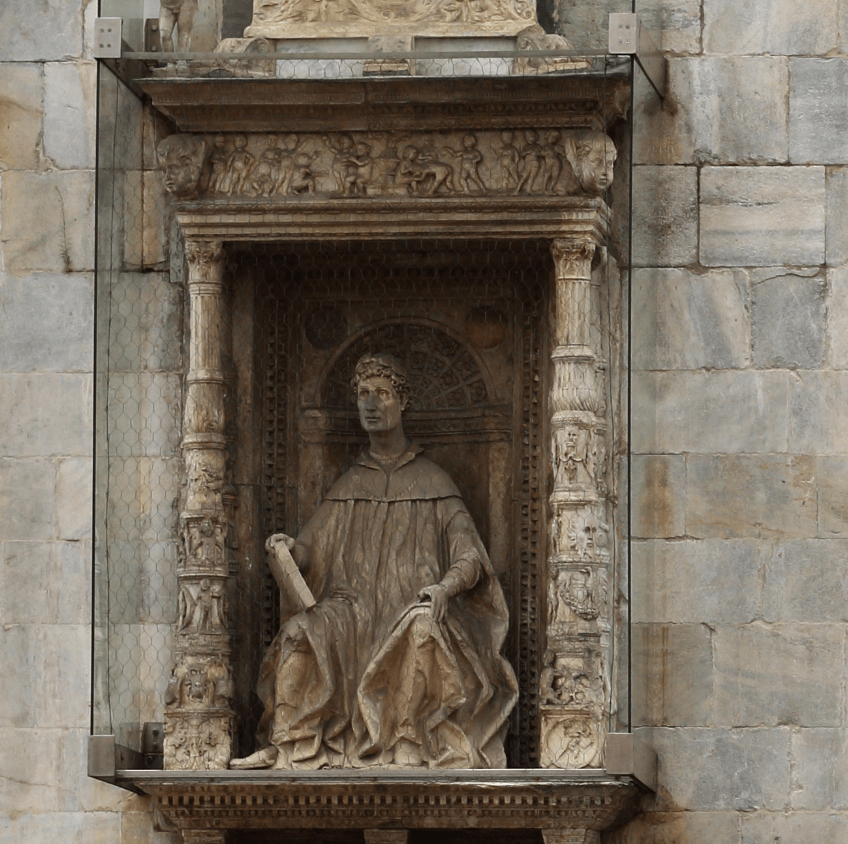
Pliny on the Catholic cathedral of the city of Como, Lombardy, Italy

“I asked them whether they were Christians. Those who confessed, I asked a second and a third time, threatening punishment. Those who persisted, I ordered to be executed. For whatever the nature of their belief, I had no doubt that stubbornness and unyielding obstinacy deserved punishment.”

Pliny the Younger, Letters 10.96, to Trajan, c. A.D. 112.

Pliny calls Christian steadfastness “stubbornness.” Diognetus asks why Christians despise death. They are seeing the same thing from different angles. The Christian refusal to deny Christ was visible enough that Roman officials had to interpret it.

Pliny also describes what he learned about Christian worship.

“They said that the sum of their fault or error was this: they were accustomed to meet on a fixed day before dawn, to sing responsively a hymn to Christ as to a god, and to bind themselves by oath, not to commit crime, but to avoid fraud, theft, adultery, breach of trust, and refusal to return what had been entrusted to them.”

Pliny the Younger, Letters 10.96, to Trajan, c. A.D. 112.

Here we hear, from a Roman perspective, the kind of issue Diognetus raises in the first paragraph: What God do Christians trust, and how do they worship Him? Pliny’s report is brief, but it is revealing. Christians gather before dawn. They sing to Christ as to a god. They bind themselves to moral purity.

A later pagan satirist, Lucian of Samosata, gives another outside witness. He mocks Christians, but even his mockery preserves the public impression they made.

“They have persuaded themselves that they are immortal and will live forever, and because of this they despise death and many of them willingly give themselves up. Their first lawgiver persuaded them that they are all brothers, once they have denied the Greek gods, worshiped that crucified sophist, and lived according to his laws.”

Lucian of Samosata, The Passing of Peregrinus 13, c. A.D. 170.

Lucian intends insult. But he confirms the same basic questions. Christians deny the Greek gods. They worship the crucified one. They call one another brothers. They face death differently.

So when Diognetus asks about Christian worship, Christian love, Christian courage, and Christian newness, he is not asking in isolation. He is voicing questions that belonged to the public reputation of the Church.


Not Monks, but Ordinary Christians

One of the most important things to notice about these sources is that they are describing Christians in general. Pliny is not describing monks. Lucian is not describing a small ascetic faction inside the Church. The author of Diognetus is not describing a spiritual elite that has separated itself from ordinary Christian life. These writers are describing what Christians, as Christians, were known to be like.

That is easy to miss when we read the second century from the far side of later Christian history. By the fourth and fifth centuries, after Christianity became legal, favored, and eventually culturally common in many parts of the Roman world, the more radical features of Christian discipleship could begin to look like the special calling of monks, virgins, hermits, and ascetics. Those movements were deeply important, but they can also tempt later readers to misunderstand the second century. In the world of Pliny, Lucian, and Diognetus, the things being described are not yet the peculiar marks of monastic Christianity. They are the public reputation of normal Christians.

Pliny does not write to Trajan and say that he has discovered an extreme spiritual movement within Christianity. He says that those accused of being Christians gather before dawn, sing to Christ as to a god, and bind themselves to moral obedience.

“They were accustomed to meet on a fixed day before dawn, to sing responsively a hymn to Christ as to a god, and to bind themselves by oath, not to commit crime, but to avoid fraud, theft, adultery, breach of trust, and refusal to return what had been entrusted to them.”

Pliny the Younger, Letters 10.96, to Trajan, c. A.D. 112.

For Pliny, this is what Christians do. They worship Christ, refuse crimes, and order their lives around moral faithfulness. He does not present this as the lifestyle of a spiritual elite. It is the basic pattern he discovers when he investigates the Christian name.

Lucian is similar, even though his tone is mocking. He does not say that a handful of unusually zealous Christians believe they are brothers or despise death. He speaks about Christians as a recognizable people.

“Their first lawgiver persuaded them that they are all brothers, once they have denied the Greek gods, worshiped that crucified sophist, and lived according to his laws.”

Lucian of Samosata, The Passing of Peregrinus 13, c. A.D. 170.

Lucian thinks this is foolish, but he still shows us what outsiders thought they were seeing. Christians denied the Greek gods. Christians worshiped the crucified one. Christians called one another brothers. Christians faced death differently. Again, this is not a description of monks. This is the pagan world trying to explain the normal life of Christians.

That makes the testimony of Diognetus even more powerful. The author does not say, “There are some Christians who live this way.” He simply says, “Christians.” His description is sweeping because he is presenting Christian identity itself.

“Christians are not distinguished from other people by country, language, or customs. They do not live in cities of their own, or use some unusual speech, or practice a strange way of life. Their teaching was not invented by human speculation, nor do they champion a merely human doctrine.”

Anonymous, Epistle to Diognetus 5.1 to 5.3, c. A.D. 180.

He then describes their marriages, their children, their tables, their citizenship, their obedience to laws, their suffering, and their hope.

“Every foreign land is their homeland, and every homeland is foreign. They marry like everyone else and have children, but they do not expose their offspring. They share a common table, but not a common bed. They are in the flesh, but they do not live according to the flesh. They spend their days on earth, but their citizenship is in heaven.”

Anonymous, Epistle to Diognetus 5.5 to 5.9, c. A.D. 180.

This is ordinary Christian life in the second century, at least as the Church wanted to present it and as outsiders often recognized it. Christians married, had children, ate meals, lived in cities, and followed local customs in clothing and food. Yet in the middle of that ordinary life, they refused infant exposure, rejected sexual lawlessness, confessed heavenly citizenship, loved one another, and faced persecution with courage.

This point is easy to lose once Christianity becomes common. In later centuries, costly discipleship could be treated as the work of specially devoted Christians, while ordinary believers lived closer to the assumptions of the surrounding culture. But in these earlier sources, heavenly citizenship, moral distinctness, refusal of idols, brotherly love, care for children, courage before death, and burden-bearing mercy are not advanced electives in the Christian life. They are what Christians were known for.

This is part of why Diognetus asks his questions. He is not asking about a sect within Christianity. He is asking about the Christians themselves.


The Slave Women Pliny Tortured

Pliny’s letter gives us one more detail that belongs in this story. After describing Christian worship, moral discipline, and their ordinary meal together, Pliny says he wanted to discover the truth more fully. So he turned to two enslaved Christian women.

“For this reason I judged it all the more necessary to find out the truth by torture from two female slaves, who were called ministrae. But I discovered nothing else except a depraved and excessive superstition.”

Pliny the Younger, Letters 10.96, to Trajan, c. A.D. 112.

This is a chilling sentence. Pliny writes it almost casually because to a Roman governor the torture of enslaved persons could be treated as an ordinary instrument of investigation. But for our purposes, the sentence reveals something extraordinary about the Christian community.

The two women are enslaved. In Roman society, that places them near the bottom of the social order. They are also women, which in that world often meant limited public authority. Yet Pliny says they were called ministrae. The Latin word can mean female ministers, attendants, or servants, and many English translations render it “deaconesses.” We should be careful not to force a later, fully developed office of deaconess back into this moment too rigidly. But even with that caution, the point remains powerful. These enslaved women were recognized in some kind of ministry or service within the Christian community, and Pliny believed they were significant enough to interrogate for information.

That is a remarkable reversal. The Roman world saw two enslaved women as bodies that could be tortured for evidence. The Church appears to have seen them as servants of Christ with recognized responsibility among the believers.

This fits perfectly with the world described in Diognetus. Christians were not marked off by one social class. They were scattered through cities, villages, households, and ranks of society. Pliny himself says the movement had touched people of every age, every rank, and both sexes.

“Many persons of every age, every rank, and also of both sexes are and will be endangered. For the contagion of this superstition has spread not only to the cities but also to the villages and farms.”

Pliny the Younger, Letters 10.96, to Trajan, c. A.D. 112.

Pliny means this as a warning. But for the historian of the Church, it is evidence. Christianity had entered the lives of men and women, free and enslaved, city dwellers and villagers, people of rank and people without rank. And within that new people, even those whom Roman society placed at the margins could become recognized servants of the Church.

The Church was not a philosophical club for elite men. It was not a mystery society for one social class. It was not an ethnic enclave. It was a new people formed by the Word, and that new people reordered human worth around Christ. The enslaved could become ministers. Women could be recognized as servants of the Church. The poor could make many rich. Those with no standing in the empire could become living witnesses to the kingdom of God.

This does not take us away from Diognetus. It deepens the point. When the author says that Christians are not distinguished by country, language, or ordinary customs, he is describing a people whose identity cuts across the old social markers. In that people, the ancient world’s hierarchies were not erased in a simplistic way, but they were profoundly relativized. The deepest identity was no longer master or slave, male or female, rich or poor, official or peasant. The deepest identity was belonging to Christ.


Why Christians Refused the Gods

The author first answers Diognetus by explaining why Christians cannot worship the gods of the Greeks. He asks Diognetus to look honestly at the objects people call gods. They are made of stone, bronze, wood, silver, iron, and clay. They are shaped by craftsmen, guarded by men, and subject to decay.

“Is not one of them stone, like what is trampled underfoot? Another bronze, no better than the vessels made for our use? Another wood, already rotting? Another silver, needing someone to guard it lest it be stolen? Another iron, eaten away by rust? Another clay, no more honorable than what is made for the most common service?”

Anonymous, Epistle to Diognetus 2.2, c. A.D. 180.

The argument is direct. If the gods are made by human hands, they cannot be the Maker of human hands. If they need to be guarded, they cannot guard the world. If they can decay, they cannot be the source of life.

The author then makes the point sharper.

“These things you call gods. These things you serve. These things you worship. In the end, you become like them. Therefore you hate the Christians, because they do not regard these things as gods.”

Anonymous, Epistle to Diognetus 2.5 to 2.6, c. A.D. 180.

This explains why Christian refusal created hostility. Christians were not merely adding a private devotion to the religious life of the empire. They were refusing the gods everyone else honored. Their refusal exposed the idols as lifeless things.

Pliny’s test for accused Christians makes the same point. A person could prove he was not truly Christian by worshiping the gods and cursing Christ.

“Those who denied that they were or had been Christians invoked the gods in words I dictated, offered incense and wine to your image, which I had ordered brought with statues of the gods, and cursed Christ. It is said that those who are truly Christians cannot be forced to do these things.”

Pliny the Younger, Letters 10.96, to Trajan, c. A.D. 112.

This was the line Christians could not cross. They could live in Roman cities. They could marry, work, buy, sell, and obey the ordinary laws. But they could not call idols gods, and they could not curse Christ.

Again, the point is not that a few unusually zealous Christians refused idolatry while ordinary Christians found ways to blend in. Pliny treats refusal to worship the gods and curse Christ as the mark of a true Christian. The author of Diognetus says Christians are hated because they do not regard these things as gods. The refusal belonged to Christian identity itself.

That refusal made them visible.


Why Christians Were Not Simply Another Jewish Group

Diognetus also asks why Christians do not follow Jewish religious practice. This part of the letter needs careful handling because the author uses sharp polemical language about Jewish observances. It reflects an early Christian argument in the painful separation between Church and synagogue. It should not be turned into contempt for Jewish people.

The author’s theological point is that the Creator does not need to be supplied by the creatures He made.

“The one who made heaven and earth and all that is in them, and who supplies us all with what we need, cannot Himself need the very things that He supplies to those who imagine they are giving them to Him.”

Anonymous, Epistle to Diognetus 3.4, c. A.D. 180.

This helps us see how the author places Christianity. Christians are not pagans because they refuse idols. They are not simply another Jewish sect because they believe the decisive revelation of God has come through the Son. Their worship is not centered on images, and it is not defined by temple sacrifice. It is centered on the living God who has sent His Word.

That is why the question of timing matters so much. If Christians worship the ancient Creator, why does their way of life seem new? If the God of Christians is the Maker of heaven and earth, why has this people appeared now?

The author will answer that question by pointing to Christ as the eternal Word revealed in time.


Christians in the World

After saying what Christians are not, the author describes what they are. This is the most famous passage in Diognetus, and it remains one of the richest descriptions of early Christian identity.

Christians are not marked off by country, language, or clothing. They do not live in separate Christian cities. They do not speak a secret dialect. They do not withdraw from ordinary life into a private civilization.

“Christians are not distinguished from other people by country, language, or customs. They do not live in cities of their own, or use some unusual speech, or practice a strange way of life. Their teaching was not invented by human speculation, nor do they champion a merely human doctrine.”

Anonymous, Epistle to Diognetus 5.1 to 5.3, c. A.D. 180.

This is an important answer to Diognetus. Christians are not a nation in the ordinary sense. They do not belong to one ethnic group or one language. They live among the peoples of the empire, and yet their life reveals a different citizenship.

“They live in Greek and barbarian cities, as each person’s lot has been assigned, and they follow local customs in clothing, food, and the rest of life. Yet they display a wonderful and admittedly astonishing form of citizenship. They live in their own countries, but as sojourners. They share all things as citizens, yet endure all things as foreigners.”

Anonymous, Epistle to Diognetus 5.4 to 5.5, c. A.D. 180.

The author then gives one of the great summaries of Christian life in the ancient world:

“Every foreign land is their homeland, and every homeland is foreign. They marry like everyone else and have children, but they do not expose their offspring. They share a common table, but not a common bed. They are in the flesh, but they do not live according to the flesh. They spend their days on earth, but their citizenship is in heaven.”

Anonymous, Epistle to Diognetus 5.5 to 5.9, c. A.D. 180.

The point is not that Christians are strange because they reject ordinary human life. The point is that they inhabit ordinary life differently. They marry. They have children. They share meals. They live in cities. But they do not expose infants. They do not turn sexual desire into lawlessness. They do not confuse earthly citizenship with ultimate belonging.

Their difference is not chiefly in location, language, or costume. Their difference is in allegiance.

The author continues:

“They obey the established laws, and by their lives they surpass the laws. They love all people, and are persecuted by all. They are unknown and condemned. They are put to death, and restored to life. They are poor, yet make many rich. They lack everything, yet abound in everything.”

Anonymous, Epistle to Diognetus 5.10 to 5.13, c. A.D. 180.

Then comes the famous image. But the image should be heard through its conclusion, because the conclusion tells us that this is not merely how Christians happen to live. It is the place God has assigned them.

“To say it simply: what the soul is in the body, Christians are in the world. The soul is spread through all the members of the body, and Christians are scattered through the cities of the world. The soul dwells in the body, yet is not of the body; Christians dwell in the world, yet are not of the world. The invisible soul is guarded by the visible body, and Christians are known to be in the world, but their godliness remains unseen. The flesh hates the soul and wars against it, though the soul does it no harm, because the soul prevents it from indulging its pleasures. So also the world hates Christians, though they do it no wrong, because they oppose its pleasures. The soul loves the flesh that hates it, and Christians love those who hate them. The soul is enclosed in the body, yet it holds the body together. Christians are held in the world as in a prison, yet they hold the world together. The immortal soul dwells in a mortal tent, and Christians dwell as sojourners among corruptible things while waiting for incorruptibility in heaven. The soul becomes better when treated harshly in food and drink, and Christians increase daily when they are punished. God has assigned them this great post, and they are not permitted to abandon it.”

Anonymous, Epistle to Diognetus 6.1 to 6.10, c. A.D. 180.

That final sentence is crucial. Christians are not merely scattered because history happened to scatter them. They are scattered because God has assigned them this role. They are not merely in the world by accident. They have been placed there as the soul is placed in the body.

This strengthens the whole argument. The author is not describing monastic withdrawal, and he is not describing a private spiritual elite. He is describing the ordinary Christian vocation in the world. Christians marry, raise children, eat at tables, obey laws, live in cities, and work among their neighbors. Yet they do all of this as a people whose citizenship is in heaven and whose presence in the world has been appointed by God.

This is how the author answers an influential outsider. He does not say that Christians are politically dominant or socially impressive. He says that Christians have been assigned a divine post inside the same world everyone else inhabits. They are not permitted to abandon it.


The God Who Sent His Word

The author then turns from Christian life to the divine action that explains it. The Christian way of life did not arise because someone invented a better moral philosophy. It is not a merely human system. It begins with God revealing Himself.

“This was no earthly invention delivered to them. It is no merely human system of opinion that they think worthy of such careful preservation. It is not a stewardship of human mysteries that has been entrusted to them. Rather, the almighty God Himself, the Creator of all things, invisible and sovereign, sent from heaven and planted among human beings the truth, the holy and incomprehensible Word, and fixed Him firmly in their hearts.”

Anonymous, Epistle to Diognetus 7.1 to 7.2, c. A.D. 180.

This passage is crucial. Christians are not different because they discovered God by superior reasoning. They are different because God sent His Word. The Church is not the origin of the message. The Church is the result of God’s revelation.

The author then clarifies who this Word is. God did not send an angel, a servant, or a lower heavenly minister. He sent the one through whom creation itself was made and ordered.

“He did not send, as someone might suppose, a servant, or angel, or ruler, or one who governs earthly things, or one entrusted with the ordering of heaven. He sent the very Creator and Fashioner of all things, by whom He made the heavens, by whom He enclosed the sea within its bounds, whose mysteries all the elements faithfully keep.”

Anonymous, Epistle to Diognetus 7.2, c. A.D. 180.

Here the author begins to answer the deepest question in the opening paragraph. If Christianity seems new, how can it claim to reveal the ancient Creator? The answer is that the one who appeared in time is not a creature of time. He is the Word through whom the heavens were made.

The author then describes the manner of His coming.

“Did He send Him, as one might imagine, to rule by tyranny, fear, and terror? Not at all. He sent Him in gentleness and meekness. As a king sends his son, who is also a king, so He sent Him. He sent Him as God; He sent Him as to human beings; He sent Him as Savior; He sent Him to persuade, not to compel, for violence has no place in the character of God.”

Anonymous, Epistle to Diognetus 7.3 to 7.4, c. A.D. 180.

This tells us not only who Christ is, but what God is like. God does not reveal Himself by crushing the world into submission. He sends His Son in gentleness. He persuades rather than compels. He saves rather than terrifies.

This also explains why Christians are supposed to live the way they do. If the Son comes in meekness, His people cannot make coercion their highest tool. If the Son bears with sinners, His people must learn patience. If the Son gives Himself, His people must become a people of self-giving love.

Christian ethics flow from the character of the God revealed in Christ.


The Word the Gentiles Were Reaching For

There is another layer to the author’s answer that should not be missed. The Christians did not present Christ only as the fulfillment of Jewish Scripture and Jewish expectation, though He certainly was that. They also presented Him as the answer to the deepest questions of the Gentile world.

This matters because Diognetus is not being addressed as a synagogue ruler or a student of the prophets. He is addressed as “most excellent Diognetus,” probably a man of education, status, and influence in the Greek and Roman world. He asks why Christians reject the gods of the Greeks, why they do not simply become Jews, and why this new way of life has appeared now. So the author answers him in a way that speaks to Gentile categories as well. He speaks of the Word, the Creator, the Fashioner of all things, the one by whom the heavens, sea, stars, sun, moon, and all creation are ordered.

“He sent the very Creator and Fashioner of all things, by whom He made the heavens, by whom He enclosed the sea within its bounds, whose mysteries all the elements faithfully keep, from whom the sun has received the measure of the courses of the day, whom the moon obeys as He commands it to shine by night, and whom the stars obey as they follow the course of the moon.”

Anonymous, Epistle to Diognetus 7.2, c. A.D. 180.

That language does more than answer Jewish expectation. It answers Gentile longing for the rational order behind the world. Philosophers had asked what held reality together. They had spoken of reason, nature, providence, order, and the divine principle behind all things. The Christian answer was not that these longings were meaningless. The Christian answer was that the one whom Gentile wisdom sought dimly had now been revealed personally in Christ.

At the same time, Diognetus is careful. The author does not flatter pagan philosophy as though it had already arrived at the truth by itself. He criticizes those who identified God with created elements.

“Do you accept the vain and silly doctrines of those who are considered trustworthy philosophers? Some said that fire was God, calling that God to which they themselves will one day come. Others said water. Others named some other element formed by God. But if any one of these theories is worthy of approval, then every created thing might just as well be declared God.”

Anonymous, Epistle to Diognetus 8.2 to 8.4, c. A.D. 180.

The point is not that Gentile philosophy already knew God clearly. The point is that Gentile philosophy was asking real questions but could not reach the final answer on its own. According to the author, God had to reveal Himself.

“No human being has either seen Him or made Him known, but He revealed Himself. And He revealed Himself through faith, by which alone it is given to behold God.”

Anonymous, Epistle to Diognetus 8.5 to 8.6, c. A.D. 180.

This is where Diognetus fits beautifully alongside Justin Martyr. Justin, writing earlier in the second century, makes the philosophical claim more explicitly. For Justin, Christ is the Logos, the Word, in whom all peoples have shared to some degree. Therefore, whatever the philosophers saw truly, they saw because the Word was already at work.

“We have been taught that Christ is the firstborn of God, and we have declared above that He is the Word of whom every race of human beings has been a partaker. Those who lived according to reason are Christians, even though they have been thought atheists, such as Socrates and Heraclitus among the Greeks, and others like them.”

Justin Martyr, First Apology 46, c. A.D. 155.

Justin says the same thing even more directly in his Second Apology:

“Whatever things were rightly said among all people are the property of us Christians. For next to God, we worship and love the Word who is from the unbegotten and ineffable God, since He also became man for our sake, that by sharing in our sufferings He might bring us healing.”

Justin Martyr, Second Apology 13, c. A.D. 155 to 160.

That helps us understand the broader Christian claim. Christ fulfills Israel’s Scriptures, but He also fulfills the scattered hopes of the nations. He is the answer to the prophets, and He is the answer to the philosophers. The prophets saw more clearly because they received revelation. The philosophers saw partially and often confusedly because they grasped fragments of truth through reason. But both streams find their fullness in the same person: the Word who was from the beginning and appeared in time.

This makes the central line of Diognetus even stronger.

“This is He who was from the beginning, who appeared as new and was found to be ancient, and who is always being born anew in the hearts of the saints.”

Anonymous, Epistle to Diognetus 11.4, c. A.D. 180.

To the Jew, He is ancient because He is the one prepared and promised from the beginning. To the Gentile, He is ancient because He is the Logos, the divine Word, the reason and order behind creation itself. To both, He appears new because He has now come in the flesh.

That is why Christianity could stand before both synagogue and empire, before both Scripture and philosophy, and say: the one you were waiting for, and the one you were reaching for, has appeared.


Why This New People Appeared Now

Diognetus asks why this new people or practice has entered human life now and not earlier. That question is one of the most important in the whole letter.

The author’s answer is not that God only recently began to care about humanity. It is not that humanity finally became wise enough to earn revelation. The answer is that God was patient, allowing human beings to see the poverty of their own works so that His mercy would be revealed as mercy.

“In the former time, He permitted us to be carried along by disorderly impulses, drawn away by pleasures and desires. This was not because He delighted in our sins, but because He was patient with us. It was not because He approved that season of iniquity, but because He was preparing the present season of righteousness, so that, having been shown by our own works to be unworthy of life, we might now be made worthy by the goodness of God.”

Anonymous, Epistle to Diognetus 9.1, c. A.D. 180.

The delay is not indifference. It is patience. The world had to see that it could not save itself. Human beings had to learn that their own works could not make them worthy of life.

Then the author describes the appointed time of God’s mercy:

“When our wickedness had reached its fullness, and it had become clear that punishment and death were its expected reward, then came the time God had appointed to reveal His goodness and power. O the surpassing kindness and love of God! He did not hate us, reject us, or remember our evil against us. He was patient; He bore with us; in mercy He took our sins upon Himself. He gave His own Son as a ransom for us: the holy for the lawless, the innocent for the evil, the righteous for the unrighteous, the incorruptible for the corruptible, the immortal for the mortal.”

Anonymous, Epistle to Diognetus 9.2, c. A.D. 180.

This is the heart of the author’s answer. Christianity appears now because now is the appointed season of mercy. The Son has been given as a ransom. The righteous one has been given for the unrighteous. The incorruptible one has been given for the corruptible. The immortal one has been given for mortals.

Then the author cries out in wonder:

“O sweet exchange! O unsearchable work! O benefits beyond all expectation! The lawlessness of many is hidden in one righteous Man, and the righteousness of one justifies many lawless people.”

Anonymous, Epistle to Diognetus 9.5, c. A.D. 180.

This is not merely explanation. It is worship. The author is overwhelmed by the mercy he is describing.

Diognetus asks why Christians despise death. Here is part of the answer. They have come to believe that death has been answered by the immortal one who gave Himself for mortals. Diognetus asks why this new people appeared now. Here is part of the answer. The appointed time of divine kindness has arrived.

But the author still has one more answer to give. Christianity is new in its historical appearance, but Christ is ancient in His divine identity.


The Ancient Word Appearing New

The central line comes in chapter 11 of the received text. It gathers the force of the letter into one sentence. Diognetus has asked why this new people has appeared now, and the author answers by pointing to the ancient Word who has entered time and now lives in His people.

“This is He who was from the beginning, who appeared as new and was found to be ancient, and who is always being born anew in the hearts of the saints. This is He who is eternal, who today is called Son, through whom the Church is enriched and grace, spread widely, increases among the saints.”

Anonymous, Epistle to Diognetus 11.4 to 11.5, c. A.D. 180.

The author does not deny that Christianity has appeared in history. He does not pretend that the Church has always existed in the same visible form. He says something more profound. The one who appeared new is the one who was from the beginning.

Jesus was born recently in time, yet He is ancient as God. He appeared within history, yet He is not merely a historical founder. He is the eternal Son. He is the Word through whom the world was made. He is the one who seemed new because He was revealed in time, but when He was revealed, He was found to be ancient.

This is the perfect answer to Diognetus’s question. The Christian movement looks new because the incarnation occurred in time. But the Christian faith is not a novelty because the one incarnate is the eternal Word. The Church is historically recent, but Christ is not recently divine. The Son appears in the fullness of time, but He was from the beginning.

The line also says that He is “always being born anew in the hearts of the saints.” That phrase does not mean the incarnation is repeated in the same way over and over. The Word became flesh uniquely in Jesus Christ. But the life of Christ is continually formed in believers. The ancient Word who appeared in time now makes His dwelling in the hearts of the saints.

The author had already prepared us for this idea:

“The almighty God Himself, the Creator of all things, invisible and sovereign, sent from heaven and planted among human beings the truth, the holy and incomprehensible Word, and fixed Him firmly in their hearts.”

Anonymous, Epistle to Diognetus 7.2, c. A.D. 180.

The Word is sent. The Word is planted. The Word is fixed in human hearts. Then chapter 11 says He is ever born anew in the saints.

That is why Christian life itself becomes an answer to Diognetus. The Church is not merely a group of people who admire a teacher from the past. The Church is a people in whom the living Word is at work. Their love, courage, chastity, mercy, and heavenly citizenship are not separate from Christ. They are signs that the ancient Word is making people new.


Born Recently in Time, Ancient as God

The power of the sentence in chapter 11 is that it holds together truths that can easily be separated.

Jesus is born recently in time. From the perspective of c. A.D. 180, the life, death, and resurrection of Jesus belong to recent history. Christianity is not a myth buried in the distant past. It is tied to remembered events, public preaching, apostolic witness, and communities still living in the aftermath of what they claim God has done.

Luke’s Gospel tells the story in exactly this historical register. The anonymous author does not begin with vague mythic time. He writes of a child born during the days of imperial power, in a named place, within the ordinary conditions of human birth.

“While they were there, the days were fulfilled for her to give birth, and she gave birth to her firstborn Son. She wrapped Him in swaddling cloths and laid Him in a manger, because there was no place for them in the lodging place.”

Anonymous author traditionally called Luke, Gospel According to Luke 2.6 to 2.7, c. A.D. 80.

This is the newness of Christianity in its historical form. The Son is born. He enters time. He has a mother. He is wrapped in cloths. He is laid in a manger. The Christian proclamation is not embarrassed by this nearness. It does not hide the humility of the birth.

At the same time, Diognetus insists that the one born in time is ancient as God.

“He sent the very Creator and Fashioner of all things, by whom He made the heavens, by whom He enclosed the sea within its bounds, whose mysteries all the elements faithfully keep.”

Anonymous, Epistle to Diognetus 7.2, c. A.D. 180.

The one born in time is the one through whom time itself exists. The one who appeared in recent history is the one by whom the heavens were made. The Christian claim is not simply that a remarkable man appeared and founded a new movement. The claim is that the Creator’s own Word entered human history.

This is why the author can say He “appeared as new” and “was found to be ancient.” Both are true. He appeared new because He came in the flesh at a particular moment. He was found ancient because He was from the beginning.

Luke writes to Theophilus so that he may know certainty about the things fulfilled among Christians. The author of Diognetus writes to Diognetus so that he may understand the Christian people and the God who explains them. Both works are addressed to “most excellent” recipients. Both are anonymous. Both present Christian truth as something that can be set before serious, influential readers.

But Diognetus presses the question of newness with special force. If Jesus appeared recently, does that make Christianity a recent invention? The author’s answer is no. Christianity is new as revelation, but ancient as divine truth. The one born recently in time is ancient as God.


Something Divine Among Them

The line about the Word being born anew in the hearts of the saints should not be treated as a vague devotional phrase. It is the theological explanation for what outsiders were seeing in Christian life. The author of Diognetus is not merely saying that Christians remember Jesus. He is saying that the living presence of God is active within them.

That is why chapter 7 is so important. After describing Christians thrown to wild beasts and yet not overcome, the author does not say merely that Christians are brave. He says their endurance is evidence that God is present.

“Do you not see them thrown to wild beasts, so that they might be persuaded to deny the Lord, and yet they are not overcome? Do you not see that the more they are punished, the more others increase? These things do not seem to be the works of man. They are the power of God. They are proofs of His presence.”

Anonymous, Epistle to Diognetus 7.7 to 7.9, c. A.D. 180.

That phrase, “proofs of His presence,” belongs beside the central line of chapter 11.

“This is He who was from the beginning, who appeared as new and was found to be ancient, and who is always being born anew in the hearts of the saints.”

Anonymous, Epistle to Diognetus 11.4, c. A.D. 180.

The connection is powerful. Christ has died, risen, and ascended. He is no longer walking the roads of Galilee in the same visible way. Yet the author of Diognetus does not speak as though Christ has simply gone away and left Christians with memories, moral instructions, and institutions. He speaks as though the Word remains actively present in His people.

The Word is planted in their hearts. The Word is born anew in the saints. The courage of the martyrs, the love of the brethren, the refusal of idols, the bearing of burdens, and the growth of the Church under persecution are not merely human achievements. They are “the power of God” and “proofs of His presence.”

This is where Aristides helps us see that Diognetus was not alone. Writing earlier in the second century, Aristides also describes Christian conduct and then concludes that there is something divine in them.

“It is enough for us to have briefly made known to your Majesty the conduct and the truth of the Christians. For great indeed and wonderful is their teaching to the one who is willing to examine and understand it. And truly this people is a new people, and there is something divine mingled with it.”

Aristides, Apology 16, c. A.D. 125.

That phrase says almost exactly what Diognetus is showing. The Christian life is not simply admirable. It bears witness to divine presence. Outsiders can mock it, governors can interrogate it, philosophers can test it, and emperors can be asked to examine it. But the Christian claim is that something more than human discipline is at work in the Church.

The ancient Word is still living in His people.

This also helps us understand why ordinary Christian life appeared so strange. If Christianity were only a set of ideas, then it could be evaluated as one philosophy among others. If it were only a social movement, it could be explained by common loyalty, group identity, or shared pressure. But writers like Aristides and the author of Diognetus see something deeper. They see a new people, and they interpret the life of that people as evidence that God is present among them.


Christ Suffering in the Saints

The same idea appears in another second-century letter, the Letter of the Churches of Vienne and Lyons, written after the persecution in Gaul around A.D. 177 and preserved by Eusebius. This letter is not an apology addressed to an outsider like Diognetus. It is a church letter about martyrs. But it gives us the same theology of Christ’s ongoing presence in believers.

When the letter describes Sanctus enduring torture, it does not interpret his endurance as merely human courage.

“In him Christ suffering wrought great wonders, destroying the adversary, and showing for an example to the rest that there is nothing fearful where there is the Father’s love, and nothing painful where there is Christ’s glory.”

Letter of the Churches of Vienne and Lyons, preserved in Eusebius, Ecclesiastical History 5.1, c. A.D. 177.
That is very close to the logic of Diognetus. The martyr is not simply copying Christ from a distance. Christ is active in him. Christ suffers in him. Christ displays His power through him.

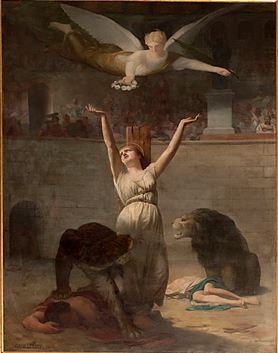
The same letter says something even more vivid about Blandina, an enslaved Christian woman who became one of the great witnesses of the persecution. When she was fastened to a stake, the other Christians saw in her body a living sign of the crucified Christ.

“Through her presenting the spectacle of one suspended on something like a cross, and through her earnest prayers, she inspired the combatants with great eagerness. For in the combat they saw, by means of their sister, with their bodily eyes, Him who was crucified for them.”

Letter of the Churches of Vienne and Lyons, preserved in Eusebius, Ecclesiastical History 5.1, c. A.D. 177.

Guillemet’s 1862 Martyrdom of Saint Blandine

Christ is not absent from the post-ascension Church. He is present in His saints. He is not incarnate again in the same unique way as Bethlehem, but His life is being manifested again and again in His people.
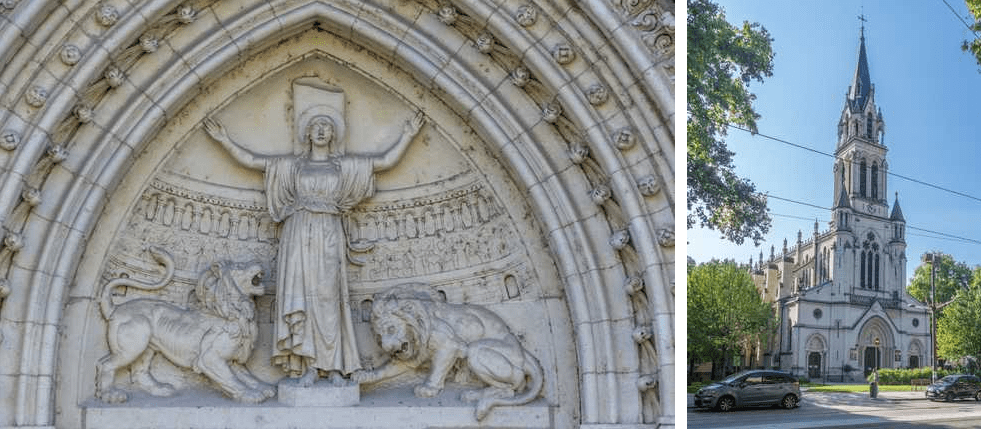
Jules Comparat, The Martyrdom of Saint Blandina, tympanum sculpture, Lyon 1886

That gives more force to Diognetus 11.4. The Word who was from the beginning appeared new in history, and now He is always being born anew in the hearts of the saints. This is not only a mystical phrase. It is how early Christians interpreted the visible transformation of ordinary believers.

The slave woman becomes a witness. The tortured deacon refuses to deny Christ. The poor make many rich. The persecuted bless. The condemned are brought to life. The Church’s life becomes the place where the ascended Christ is still seen.

This also draws Pliny’s tortured slave women into the wider picture. Pliny sees enslaved women as sources of information to be extracted by force. The Church sees women like them as servants of Christ. The Lyons letter shows an enslaved woman, Blandina, becoming a living icon of the crucified Lord before the eyes of the suffering Church. In both cases, the Roman world and the Christian world are looking at the same kind of person but seeing two different realities. Rome sees low status. The Church sees the place where Christ can be made visible.


The Word Born Again in Believers

The line about the Word being “always born anew in the hearts of the saints” becomes clearer when we read it alongside the author’s description of Christian imitation.

In chapter 10, the author turns directly to Diognetus and explains what happens when someone receives the knowledge of the Father. The Christian life begins with God’s love, not with human achievement.

“If you also desire this faith, first receive the knowledge of the Father. For God loved human beings. For their sake He made the world, subjected all things on earth to them, gave them reason and understanding, permitted them alone to look upward to Him, formed them after His own image, sent to them His only-begotten Son, promised them the kingdom in heaven, and will give it to those who love Him.”

Anonymous, Epistle to Diognetus 10.1 to 10.2, c. A.D. 180.

The Christian life is rooted in divine generosity. God made, gave, formed, sent, promised, and will give. Human beings do not climb up to God by their own strength. They receive the love of the Father revealed in the Son.

Then the author describes the result:

“When you have come to know Him, with what joy do you think you will be filled? How will you love Him who first loved you so greatly? And loving Him, you will become an imitator of His goodness. Do not marvel that a human being can become an imitator of God. He can, if God wills it.”

Anonymous, Epistle to Diognetus 10.3 to 10.4, c. A.D. 180.

This is what it means for the Word to be born anew in believers. They become imitators of God’s goodness. That imitation is not domination, force, or worldly greatness. The author is careful about that.

“Happiness is not found in ruling over one’s neighbors, or in wanting to have more than the weak, or in being rich and using force against those beneath you. No one can imitate God in these things. They are foreign to His greatness.”

Anonymous, Epistle to Diognetus 10.5, c. A.D. 180.

This is a direct challenge to ordinary ancient ideas of status. The powerful man rules. The wealthy man gives from above and receives honor. The influential man gathers dependents and clients. But the Christian imitates God by bearing burdens.

“Whoever takes upon himself the burden of his neighbor, whoever is willing to benefit another who lacks what he himself has, whoever supplies to the needy what he has received from God and becomes a gift of God to those who receive it, this person is an imitator of God.”

Anonymous, Epistle to Diognetus 10.6, c. A.D. 180.

This is where the author’s theology becomes visible in ordinary life. The Word born in the heart produces people who bear the burdens of others. The ancient Christ appears newly in acts of mercy. The eternal Son becomes visible in patience, generosity, courage, and love.

So when Diognetus asks what kind of affection Christians have for one another, the answer is not merely that Christians are unusually friendly. The answer is that the Word is living in them. The love of God has taken root in human hearts, and that love has created a new kind of community.

And again, in the second-century sources, this is not presented as an optional higher path for a few unusually serious believers. This is Christian life. To receive the Father’s love is to become an imitator of His goodness. To know the Son is to bear the burdens of the neighbor. To have the Word born in the heart is to become, in some visible way, a gift of God to others.

This also connects back to the divine assignment in chapter 6. Christians are not permitted to abandon their post in the world because the Word is being born in them for the sake of the world. Their holiness is not an escape from the body of humanity. It is the soul-like presence by which God blesses the world that misunderstands them.


Why Christians Face Death Differently

Diognetus also asks why Christians despise death. The author answers that Christians do not fear bodily death as the ultimate evil because they have come to know true life in God.

“Then you will love and admire those who are punished because they will not deny God. Then you will condemn the deceit and error of the world, when you recognize the true life in heaven, when you despise what is only thought to be death here, and when you fear the true death reserved for those condemned to the eternal fire.”

Anonymous, Epistle to Diognetus 10.7, c. A.D. 180.

This is not a hatred of life or a desire for suffering. It is a reordering of fear. Christians can face earthly death because they believe the immortal one has given Himself for mortals. They believe that denying God is worse than dying. They believe that true life is found in heaven.

The author also points to martyrdom as evidence that Christianity is not merely human.

“Do you not see them thrown to wild beasts, so that they might be persuaded to deny the Lord, and yet they are not overcome? Do you not see that the more they are punished, the more others increase? These things do not seem to be the works of man. They are the power of God. They are proofs of His presence.”

Anonymous, Epistle to Diognetus 7.7 to 7.9, c. A.D. 180.

That last sentence is essential. The courage of Christians is not presented as natural bravery. It is a proof of God’s presence. Pliny saw stubbornness. Lucian saw delusion. The author of Diognetus sees the power of God at work.

This brings us back to the central line. If the Word is always being born anew in the hearts of the saints, then the courage of the martyrs is not merely admiration for a past teacher. It is the life of the risen Christ present in His people.

This courage also belongs to the general portrait of Christians. Pliny’s Christians are ordinary accused believers. Lucian’s Christians are the people he thinks he can mock as a group. Diognetus speaks broadly of Christians thrown to beasts and yet not overcome. These sources do not present courage before death as the private achievement of a spiritual elite. They present it as part of the public reputation of the Church.

That is what made the question unavoidable. The world knew how people normally behaved under threat. Christians did not always behave normally. Diognetus wanted to know why.


The Church as the Living Answer

By the end of the letter, we can see that the author answers Diognetus in two ways at once. He gives theological explanations, and he points to the Christian community as evidence.

Diognetus asks what God Christians worship. The author answers: the Creator who sent His Word. But he also points to Christians who refuse idols and worship the living God.

Diognetus asks why Christians love one another. The author answers: because God first loved them. But he also points to Christians who share tables, bear burdens, care for children, and live as brothers and sisters across the ordinary divisions of ancient society.

Diognetus asks why Christians despise death. The author answers: because the immortal one has been given for mortals. But he also points to Christians who endure punishment without denying the Lord.

Diognetus asks why this new people has appeared now. The author answers: because the appointed season of mercy has arrived. But he also points to the Church as the place where the ancient Word is being born anew.

The soul-and-body image helps us understand this. The Church is visible in the world, but the life that animates her is hidden in God. And the end of the image makes clear that this hidden life is not an optional calling. God has assigned Christians this post in the world, and they are not permitted to abandon it.

“Christians are held in the world as in a prison, yet they hold the world together. The immortal soul dwells in a mortal tent, and Christians dwell as sojourners among corruptible things while waiting for incorruptibility in heaven. The soul becomes better when treated harshly in food and drink, and Christians increase daily when they are punished. God has assigned them this great post, and they are not permitted to abandon it.”

Anonymous, Epistle to Diognetus 6.7 to 6.10, c. A.D. 180.

This is a daring claim. Christians appear weak, scattered, and vulnerable. Yet the author says they hold the world together. Not by political command, military strength, or social prestige, but by being the soul within it.

This is another place where the second-century context matters. Before Christianity became culturally common, the Church’s difference was easier to see. Christians were not yet the default religious population of the empire. They were a people whose worship, ethics, courage, family life, and mutual love stood out strongly enough to provoke questions.

And in Diognetus, the Church’s visible life is not merely a moral illustration added after the theology. It is part of the evidence. The author points to Christians and says, in effect, that their life cannot finally be explained by human invention. Their endurance is the power of God. Their courage is proof of His presence. Their love is the Word born anew in their hearts. Their place in the world is not accidental. It has been assigned by God.

That is why Diognetus is so valuable. It shows us Christianity before it became ordinary in the cultural sense. And precisely there, it shows that ordinary Christians were expected to be extraordinary by the standards of the world, not because they had abandoned ordinary life, but because God had placed them within ordinary life as the soul within the body.


Returning to Diognetus’s Opening Questions

By the end of the letter, the opening questions have all been answered.

Diognetus asks what God Christians trust. The author answers: the Creator of all things, invisible and sovereign, who sent His holy and incomprehensible Word.

Diognetus asks how Christians worship. The author answers: not by worshiping idols made of stone, bronze, wood, silver, iron, or clay, but by receiving the Word, living in faith, and becoming imitators of God’s goodness.

Diognetus asks why Christians reject the gods of the Greeks. The author answers: because those gods are lifeless works of human hands.

Diognetus asks why Christians do not simply practice religion like the Jews. The author answers, in his polemical way: because the Creator needs nothing from human hands and has now revealed Himself through His Son.

Diognetus asks what kind of affection Christians have for one another. The author answers: they love because God first loved them, and the Word is being formed in their hearts.

Diognetus asks why Christians despise death. The author answers: because the immortal one has been given for mortals, and Christians have learned to distinguish earthly death from the true death to be feared.

Diognetus asks why this new people has appeared now and not earlier. The author answers: because the appointed season of mercy has arrived, and the one who appeared new was from the beginning.

The whole letter gathers itself into this sentence:

“This is He who was from the beginning, who appeared as new and was found to be ancient, and who is always being born anew in the hearts of the saints.”

Anonymous, Epistle to Diognetus 11.4, c. A.D. 180.

That is the answer to Diognetus. The Church appears new because Christ has appeared in time. The faith is ancient because Christ is from the beginning. The Christian life continues because Christ is born anew in the hearts of the saints.

The author’s answer is not merely, “Here is what Christians believe.” It is, “Here is the one who explains Christians.”


What Later Centuries Could Obscure

The second-century witness matters because later Christian history can change how we hear these texts. Once Christianity became legal, favored, and socially normal, the contrast between Church and world could become harder to see. When large numbers of people became Christian by culture, family inheritance, imperial favor, or social expectation, the older marks of discipleship could seem less like the normal Christian life and more like the special calling of the unusually devout.

This does not mean that later monks, virgins, hermits, and ascetics were wrong. In many cases, they preserved and intensified a seriousness about discipleship that earlier Christians had regarded as basic. The problem comes when later readers project that division back into the second century and imagine that Pliny, Lucian, and Diognetus must be describing spiritual specialists.

They are not.

Pliny describes Christians who gather to worship Christ and bind themselves to moral obedience. Lucian describes Christians who deny the Greek gods, worship the crucified one, call one another brothers, and despise death. The author of Diognetus describes Christians who marry, have children, refuse infant exposure, share tables, live in cities, obey laws, suffer persecution, love all people, and confess heavenly citizenship.

These are not portraits of a monastery. They are portraits of the Church.

That is one reason the Epistle to Diognetus still has such force. It does not allow Christianity to become merely a private belief system held inside an otherwise ordinary pagan life. It presents Christianity as a whole way of being human, visible in worship, family, money, sexuality, courage, citizenship, and love.

The Word who was from the beginning does not merely give Christians new ideas. He makes them a new people.

And according to the author, He does not make them a new people only by giving them memories of something that happened long ago. He makes them new by being present in them. The ancient Word who appeared in history continues to be born anew in the hearts of the saints. That is why their life becomes evidence. That is why Aristides can say there is “something divine” mingled with this new people. That is why the Lyons martyrs can see Christ in Blandina. That is why Diognetus can call Christian endurance the power of God and proof of His presence.

The early Christian claim is not simply that Christ once lived. It is that Christ lives in His people.

And because Christ lives in His people, they are not permitted to abandon their post. The answer to a compromised world is not withdrawal into invisibility, nor surrender into sameness. The answer is the Church living as the soul in the body, scattered through the cities of the world, bearing witness to the Word who was from the beginning.


The Word Still Answers the Outsider

Every age has people like Diognetus. Some are skeptical. Some are sympathetic. Some are powerful. Some are patrons, readers, officials, intellectuals, or neighbors who have watched Christians closely enough to ask real questions.

What God do Christians trust? Why do they worship Jesus? Why do they refuse the idols everyone else accepts? Why do they speak of heaven while living on earth? Why do they call each other brothers and sisters? Why do they care for the weak? Why do they forgive enemies? Why do they face death with hope? Why does this ancient faith keep appearing new?

The Epistle to Diognetus answers those questions by pointing to Christ.

He is the Creator’s Word sent into the world. He is the Son sent not in tyranny but in gentleness. He is the righteous one given for the unrighteous, the incorruptible for the corruptible, the immortal for mortals. He is born in time, yet ancient as God. He appears new, yet He is from the beginning. He is not merely remembered by Christians; He is born anew in the hearts of the saints.

That is why the Christian people cannot be explained only as a social movement, a moral philosophy, or a religious association. The author insists that something more is happening in them. The ancient Word is making human beings new.

And because He is the Word, He answers both worlds addressed in this script. He fulfills the Scriptures of Israel, but He also answers the Gentile search for truth, reason, order, and the divine source of all things. What the prophets awaited and what the philosophers reached toward are fulfilled in the same living person.

The anonymous author does not give Diognetus a slogan. He gives him a vision of the Church as the place where the eternal Son is made visible in ordinary lives. Christians live in the world, but their citizenship is in heaven. They share tables, but not lawless beds. They have children, but do not expose them. They are persecuted, yet they love. They are put to death, yet they live. They lack everything, yet they abound.

And their place in the world is not an accident. It is an assignment.

“God has assigned them this great post, and they are not permitted to abandon it.”

Anonymous, Epistle to Diognetus 6.10, c. A.D. 180.

That line belongs beside the letter’s central confession of Christ.

“This is He who was from the beginning, who appeared as new and was found to be ancient, and who is always being born anew in the hearts of the saints.”

Anonymous, Epistle to Diognetus 11.4, c. A.D. 180.

That is the heart of the Epistle to Diognetus. It begins with the questions of a “most excellent” outsider, probably a man of influence, perhaps even the kind of patron who could request or sponsor such a written defense. It answers him not by hiding the strangeness of Christianity, but by explaining it.

The Church is strange because the Word has come. The Church is new because the eternal Son has appeared in time. The Church endures because that same Word continues to be born anew in the hearts of believers.

And in the second century, that was not supposed to describe only the rarest Christians. It was the life of the Church itself. God had placed them in the world as the soul in the body, and they were not permitted to abandon that post.

Gregory of Nazianzus: The Reluctant Bishop Who Gave the Trinity Its Voice

Gregory of Nazianzus was one of the greatest theologians in Christian history, but he did not move through life like a man chasing power.

He fled ordination. He resisted office. He complained bitterly when Basil forced him toward the obscure bishopric of Sasima. He entered Constantinople reluctantly. He left Constantinople wounded. He gave the church some of its most precise language about the Trinity, and then he walked away from the most important episcopal throne in the East.

That tension is what makes him so compelling.

Gregory was brilliant enough to speak before emperors and councils, but inwardly he longed for quiet. He had the training of a rhetorician, the imagination of a poet, the instincts of a monk, the duties of a bishop, and the burdens of a man who kept being pushed into public conflict.

He did not become “the Theologian” because he enjoyed religious argument. In fact, one of his strongest warnings is that theology becomes dangerous when it becomes entertainment, ambition, or verbal sport. He believed speech about God required purification, reverence, restraint, and fear.

His whole life can almost be read as a struggle between two callings: the desire to withdraw and the obligation to speak. And when he finally spoke, he gave the church language it never forgot.


A Child Given to God

Gregory was born around 329 or 330 AD near Nazianzus in Cappadocia. His father, Gregory the Elder, became bishop of Nazianzus. His mother, Nonna, was remembered as deeply pious and as a decisive influence in the family’s Christian life.

In his autobiographical poem, Gregory says his mother had prayed for a son and then offered that son back to God.

“She asked God to give her a son, and then she gave as a gift the very one she had asked to receive, her eagerness outrunning the gift.”

Gregory of Nazianzus, De vita sua, opening autobiographical section, c. 381 to 390 AD.

Gregory understood his life as something vowed before he could choose it. That does not mean his vocation was simple or easy. In fact, much of his writing shows how painful that vocation became. But from the beginning, he saw himself as someone whose life had been claimed.

That helps explain why he could never fully become just a rhetorician, just a scholar, or just a private ascetic. He wanted solitude, but he could not forget obligation. He wanted silence, but he believed the church needed speech. He wanted freedom from office, but he repeatedly found himself drawn back into service.

His life was not the story of a man who never resisted God’s call. It was the story of a man who resisted, suffered, returned, and spoke.


Gregory and Basil: One Soul in Two Bodies

Gregory received an elite education. He studied in Cappadocia, Caesarea, Alexandria, and Athens. In Athens, he formed one of the most famous friendships in Christian history with Basil of Caesarea.

In his funeral oration for Basil, Gregory describes their friendship with extraordinary affection.

“We seemed to have one soul inhabiting two bodies.”

Gregory of Nazianzus, Oration 43: Funeral Oration on Basil, §20, c. 381 to 382 AD.

That line is famous because it captures the ideal Gregory wanted to remember: two young men, united by study, prayer, discipline, and a shared desire for virtue. Athens was full of ambition, rhetoric, pagan religion, and social competition, but Gregory says he and Basil tried to live differently.

“We had one great business and name: to be and to be called Christians.”

Gregory of Nazianzus, Oration 43: Funeral Oration on Basil, §21, c. 381 to 382 AD.

He says they knew two roads especially well: the road to sacred teachers and the road to secular learning. Other roads, he suggests, were less important to them. The point is not that Gregory despised education. He was one of the most highly educated Christian writers of his century. The point is that learning had to be governed by Christian purpose.

For Gregory, rhetoric was not enough. Brilliance was not enough. Public success was not enough. The true goal was virtue, and education was valuable only if it served the soul.

This friendship with Basil would later become complicated, painful, and strained. But Gregory never forgot the ideal that first bound them together: Christian learning, disciplined friendship, and the pursuit of God.


The Man Who Loved Solitude

Gregory’s longing for solitude appears throughout his writings. When he later explained why he fled after ordination, he described the contemplative life he had hoped to preserve.

“Nothing seemed to me so desirable as to close the doors of my senses, escape from the flesh and the world, gather myself within myself, and speak to myself and to God.”

Gregory of Nazianzus, Oration 2: In Defense of His Flight to Pontus, §7, c. 362 AD.

Then he describes the inner goal of that life.

“I wanted to live above visible things, preserving in myself the divine impressions pure and unmixed, becoming and always growing more and more into a real, spotless mirror of God and divine things.”

Gregory of Nazianzus, Oration 2: In Defense of His Flight to Pontus, §7, c. 362 AD.

That image matters. Gregory did not want solitude because he hated people. He wanted solitude because he wanted the soul to become clear enough to reflect God. He wanted quiet because noise could distort the divine image. He wanted withdrawal because public life could pull the soul into vanity, anger, ambition, and distraction.

But Gregory’s vocation kept calling him out of the quiet. His father needed him. Basil needed him. The Nicene cause needed him. Constantinople needed him. The council needed him. Each time, Gregory felt the wound of being dragged away from the life he wanted.

That tension gives his theology its particular tone. When Gregory warns that speech about God must be purified, he is not speaking as a comfortable academic. He is speaking as a man who feared what public speech could do to the speaker’s soul.


He Feared the Priesthood

Gregory was ordained to the priesthood by his father, Gregory the Elder, around 361 or 362 AD. He did not respond with immediate joy. He fled.

When he returned, he preached Oration 2, one of the most important early Christian texts on pastoral ministry. The sermon is partly an apology for his flight and partly a theology of the priestly office.

He opens by admitting defeat.

“I have been defeated, and I confess my defeat. I have submitted myself to the Lord.”

Gregory of Nazianzus, Oration 2: In Defense of His Flight to Pontus, §1, c. 362 AD.

Gregory explains that he fled partly because he longed for the quiet life, but also because he feared the sacred office had become too easy for unprepared men to seize.

“I was ashamed of those who, with unwashen hands and uninitiated souls, intrude into the most sacred offices, and before becoming worthy to approach the sanctuary, push themselves around the holy table as though the order were a livelihood instead of a pattern of virtue, an authority instead of a ministry for which we must give account.”

Gregory of Nazianzus, Oration 2: In Defense of His Flight to Pontus, §8, c. 362 AD.

That is not false humility. Gregory really believed the office was dangerous. The priest was not merely a religious functionary. He was a physician of souls, a teacher, a mediator, a public example, and a person whose own spiritual sickness could harm others.

He feared becoming one more unhealed man pretending to heal.


The Physician of Souls

One of Gregory’s strongest images for pastoral ministry is medicine. The pastor is a physician, but the work is more difficult than bodily medicine because the soul is more complex than the body.

“The guiding of humanity, the most variable and manifold of creatures, seems to me truly the art of arts and the science of sciences.”

Gregory of Nazianzus, Oration 2: In Defense of His Flight to Pontus, §16, c. 362 AD.

Then he compares the pastor with the physician.

“Anyone may recognize this by comparing the physician of souls with the treatment of the body, and noticing that, laborious as bodily medicine is, ours is more laborious and more consequential.”

Gregory of Nazianzus, Oration 2: In Defense of His Flight to Pontus, §§16–17, c. 362 AD.

The physician of the body studies diet, disease, medicines, timing, age, temperament, and treatment. Gregory says the physician of souls must do something even harder. He must diagnose habits, passions, wounds, desires, fears, and wills.

“Nothing is so difficult as the diagnosis and cure of our habits, passions, lives, wills, and whatever else is within us.”

Gregory of Nazianzus, Oration 2: In Defense of His Flight to Pontus, §18, c. 362 AD.

This is why Gregory feared the priesthood. He did not think ministry was mainly public honor. He thought it was spiritual surgery. The pastor had to know when to encourage and when to rebuke, when to be gentle and when to be severe, when to speak publicly and when to correct privately.

“Some are led by doctrine, others trained by example; some need the spur, others the curb. Some are benefited by praise, others by blame, both being applied in season.”

Gregory of Nazianzus, Oration 2: In Defense of His Flight to Pontus, §§30–31, c. 362 AD.

That is a remarkable pastoral vision. Gregory does not imagine one method for every soul. The wise pastor adapts the medicine to the person. He must know the wound before applying the cure.

This also explains Gregory’s approach to theology. Doctrine was not a verbal game. It was medicine for the church.


The Pastor Must First Be Purified

Gregory’s fear of ministry was also rooted in his belief that the pastor’s own life must be purified before he presumes to guide others.

“We must guard against being bad painters of the charms of virtue, or poor models for the people, undertaking to heal others while we ourselves are full of sores.”

Gregory of Nazianzus, Oration 2: In Defense of His Flight to Pontus, §13, c. 362 AD.

That line belongs near the center of Gregory’s life. He was terrified of hypocrisy in holy office. A pastor who cannot govern himself may damage those he teaches. A theologian whose own soul is disordered may speak true words in a spiritually dangerous way.

He says the leader must not merely be free from obvious evil. He must be advanced in goodness.

“He must not only wipe out the traces of vice from his soul, but inscribe better ones, so as to surpass others in virtue more than he surpasses them in dignity.”

Gregory of Nazianzus, Oration 2: In Defense of His Flight to Pontus, §14, c. 362 AD.

Then he gives the standard for spiritual leadership.

“Before a man has sufficiently purified his mind and far surpassed others in nearness to God, I do not think it safe for him to be entrusted with the rule over souls, or the office of mediator between God and humanity.”

Gregory of Nazianzus, Oration 2: In Defense of His Flight to Pontus, §91, c. 362 AD.

This is why Gregory’s reluctance is so important. He does not flee because he thinks the church is unimportant. He flees because he thinks it is too important. He does not fear ministry because he is indifferent to souls. He fears ministry because souls are precious.

Gregory’s ideal pastor is not the most ambitious man in the room. He is the man most aware that he is not yet holy enough for the task.


Basil, Sasima, and the Friendship That Never Fully Recovered

Gregory’s friendship with Basil was one of the deepest relationships of his life, but it was also one of the most painful.

In his funeral oration for Basil, Gregory remembered their youth in Athens almost as an ideal Christian friendship. They studied together, prayed together, pursued virtue together, and imagined a common life directed toward God.

“We seemed to have one soul inhabiting two bodies.”

Gregory of Nazianzus, Oration 43: Funeral Oration on Basil, §20, c. 381 to 382 AD.

In his autobiographical poem, Gregory remembers the same early friendship with longing.

“Such were Athens and our common labors in learning, a life under the same roof and at the same table, one mind in two bodies, not two, a marvel of Greece. Our right hands were pledged to cast the world far away, to live a common life for God, and to give our reasonings to the only wise Reason.”

Gregory of Nazianzus, De vita sua, Sasima and Nazianzus section, c. 381 to 390 AD.

But then he immediately says what happened to those hopes.

“All has been scattered, cast to the ground. Breezes carry away the old hopes.”

Gregory of Nazianzus, De vita sua, Sasima and Nazianzus section, c. 381 to 390 AD.

The wound came from Sasima.

In the early 370s, Emperor Valens divided Cappadocia into two civil provinces. That created an ecclesiastical conflict between Basil of Caesarea and Anthimus of Tyana. Basil responded by creating new bishoprics in disputed territory, strengthening his own position by placing loyal bishops in strategic places. One of those places was Sasima, and Basil wanted Gregory there.

Gregory did not see this as a noble assignment. He felt used.

In Letter 48 to Basil, Gregory speaks with unusual sharpness. He says he has realized too late what happened.

“I only know that I saw that I had been deceived — too late indeed, but I saw it — and I throw the blame on your throne, as having on a sudden lifted you above yourself.”

Gregory of Nazianzus, Letter 48: To Basil, c. 372 AD.

Then he describes the humiliation of feeling used and discarded.

“The same person has both to suffer the wrong and to bear the blame, and this is my present case.”

Gregory of Nazianzus, Letter 48: To Basil, c. 372 AD.

And then:

“They throw me on one side after making use of me, like the most valueless vessels, or like the frames upon which arches are built, which after the building is complete are taken down and cast aside.”

Gregory of Nazianzus, Letter 48: To Basil, c. 372 AD.

That is not mild irritation. Gregory feels that Basil has treated him like scaffolding: useful during construction, disposable afterward.

The appointment also placed Gregory in the middle of Basil’s struggle with Anthimus. Gregory had no appetite for that kind of ecclesiastical combat.

“I will not take up arms, nor will I learn tactics which I did not learn in former times, when the occasion seemed more suitable, as everyone was arming and in frenzy.”

Gregory of Nazianzus, Letter 48: To Basil, c. 372 AD.

Then he says exactly what he does not want to do.

“I will not face the martial Anthimus, though he be an untimely warrior, being myself unarmed and unwarlike, and thus the more exposed to wounds.”

Gregory of Nazianzus, Letter 48: To Basil, c. 372 AD.

Then comes one of the most revealing lines in the whole exchange.

“Why should I fight for sucking pigs and fowls, and those not my own, as though for souls and canons?”

Gregory of Nazianzus, Letter 48: To Basil, c. 372 AD.

That line shows how Gregory saw the dispute. Basil may have seen jurisdiction, strategy, and ecclesiastical necessity. Gregory saw a fight over local goods, territorial pride, and church politics dressed up as spiritual urgency.

His final line in that letter is devastating.

“I shall gain this only from your friendship, that I shall learn not to trust in friends, or to esteem anything more valuable than God.”

Gregory of Nazianzus, Letter 48: To Basil, c. 372 AD.

In Letter 49, Gregory responds to Basil’s accusation that he was lazy or idle for refusing Sasima.

“You accuse me of laziness and idleness, because I did not accept your Sasima, and because I have not bestirred myself like a bishop, and do not arm you against each other like a bone thrown into the midst of dogs.”

Gregory of Nazianzus, Letter 49: To Basil, c. 372 AD.

Then Gregory defines his own calling in the opposite direction.

“My greatest business always is to keep free from business.”

Gregory of Nazianzus, Letter 49: To Basil, c. 372 AD.

And he adds:

“If only all men would imitate me, the churches would have no troubles; nor would the faith, which everyone uses as a weapon in his private quarrels, be pulled in pieces.”

Gregory of Nazianzus, Letter 49: To Basil, c. 372 AD.

This is the strain between the two friends. Basil was a strategist. Gregory was a contemplative. Basil was trying to defend Nicene order by building episcopal networks. Gregory felt dragged into the machinery of ecclesiastical conflict.

The friendship did not simply end. Gregory later praised Basil magnificently. He called him great, honored his theology, remembered their youth, and preached his funeral oration. But Sasima left a wound that never entirely disappeared.

That makes Gregory more human. He could love Basil and still feel injured by him. He could honor Basil’s greatness and still remember the cost of being used in Basil’s strategy.


Theology Was Not for Verbal Acrobats

Gregory’s most famous works are the five Theological Orations, delivered in Constantinople around 379 to 380 AD. They were preached in a city where Nicene Christians had been marginalized and where debates over the Trinity had become public, aggressive, and often careless.

The first of the five, Oration 27, does not begin by defining the Trinity. It begins by warning people about how not to talk about God.

Gregory complains that some people treat theology like a game. Every marketplace, dinner party, festival, and gathering becomes an occasion for argument. Sacred mysteries are turned into entertainment.

“Not to everyone, my friends, does it belong to philosophize about God. Not to everyone. The subject is not so cheap and low.”

Gregory of Nazianzus, Oration 27: First Theological Oration, §3, c. 379 to 380 AD.

Then he gives the conditions for theological speech.

“It is permitted only to those who have been examined, who are masters in contemplation, and who have first been purified in soul and body, or at least are being purified.”

Gregory of Nazianzus, Oration 27: First Theological Oration, §3, c. 379 to 380 AD.

That is one of Gregory’s defining convictions. Theology is not merely the ability to win arguments about God. It requires purification. The speaker’s soul matters. The timing matters. The audience matters. The manner of speech matters.

He is not forbidding Christians to remember God. In fact, he says the opposite.

“We ought to think of God even more often than we breathe.”

Gregory of Nazianzus, Oration 27: First Theological Oration, §5, c. 379 to 380 AD.

But he distinguishes remembrance from reckless speech.

“It is not continual remembrance of God that I would hinder, but only talking about God when it is unseasonable; not teaching itself, but lack of moderation.”

Gregory of Nazianzus, Oration 27: First Theological Oration, §5, c. 379 to 380 AD.

This is classic Gregory. He wants both devotion and restraint. Think of God always. Speak of God carefully.


The Mystery Must Be Spoken in a Holy Manner

Gregory’s warning continues. He says theological argument without reverence can damage the church and arm its enemies.

“Let us utter mysteries under our breath, and holy things in a holy manner. Let us not cast to profane ears what may not be uttered.”

Gregory of Nazianzus, Oration 27: First Theological Oration, §5, c. 379 to 380 AD.

He even says there is a proper decorum in speech and silence.

“Let us recognize that as in dress, diet, laughter, and conduct there is a certain decorum, so there is also in speech and silence.”

Gregory of Nazianzus, Oration 27: First Theological Oration, §5, c. 379 to 380 AD.

This matters because Gregory is not anti-theology. He is one of the greatest theologians the church ever produced. His warning is not against doctrine, but against careless doctrine. He does not want the Trinity reduced to a verbal contest, or the mystery of God handled as though cleverness were the same as holiness.

He says the church had become obsessed with speaking while neglecting spiritual practice.

“We do not praise hospitality, brotherly love, marriage, virginity, generosity to the poor, psalmody, vigils, or tears. We do not discipline the body by fasting or go forth to God by prayer.”

Gregory of Nazianzus, Oration 27: First Theological Oration, §7, c. 379 to 380 AD.

The point is not that doctrinal precision is unimportant. Gregory fought fiercely for doctrinal precision. The point is that speech about God must be joined to life before God. Theology without purification becomes noise.

For Gregory, the theologian must be more than a mouth.


God Cannot Be Captured by Words

In the second Theological Oration, Gregory turns to the incomprehensibility of God. He is not saying we know nothing about God. He is saying that God cannot be mastered by human concepts or exhausted by human language.

He gives one of his most famous statements:

“It is difficult to conceive God, but to define him in words is impossible.”

Gregory of Nazianzus, Oration 28: Second Theological Oration, §4, c. 379 to 380 AD.

Then he sharpens it.

“In my opinion, it is impossible to express him, and still more impossible to conceive him fully.”

Gregory of Nazianzus, Oration 28: Second Theological Oration, §4, c. 379 to 380 AD.

Gregory does not mean that Christian faith is empty. He explicitly rejects that conclusion. Christians can know that God exists. They can know God through creation, Scripture, worship, and revelation. But to know that God is, and to comprehend what God is in himself, are not the same thing.

“It is one thing to be persuaded that a thing exists, and quite another to know what it is.”

Gregory of Nazianzus, Oration 28: Second Theological Oration, §5, c. 379 to 380 AD.

This distinction is crucial. Gregory is defending both knowledge and humility. The Christian does not worship an unknown nothing. But neither does the theologian place God inside a definition and call that mastery.

He uses the image of Moses seeing only the “back parts” of God.

“I was running to lay hold of God, and I went up the mountain, drew aside the curtain of the cloud, and withdrew within myself. But when I looked, I scarcely saw the back parts of God, though I was sheltered by the Rock, the Word made flesh for us.”

Gregory of Nazianzus, Oration 28: Second Theological Oration, §3, c. 379 to 380 AD.

That passage reveals Gregory’s theology of humility. The Word made flesh shelters us. God reveals himself. But the divine nature still exceeds us.

For Gregory, the best theologian is not the person who pretends to see everything. It is the person who sees enough to know that God is greater than sight.


Creation Leads Us Toward God, But Not Into Mastery

Gregory argues that the visible world points toward God. The beauty, order, and movement of creation lead the mind toward its maker.

“Our eyes and the law of nature teach us that God exists and that he is the efficient and sustaining cause of all things.”

Gregory of Nazianzus, Oration 28: Second Theological Oration, §6, c. 379 to 380 AD.

He uses the image of a musical instrument.

“Whoever sees a beautifully made lute, or hears its melody, thinks of the maker or player of the lute, even if he does not know him by sight.”

Gregory of Nazianzus, Oration 28: Second Theological Oration, §6, c. 379 to 380 AD.

In the same way, the world leads the mind toward God. But Gregory will not let natural reasoning become pride.

“What God is in nature and essence, no one has ever discovered or can discover.”

Gregory of Nazianzus, Oration 28: Second Theological Oration, §17, c. 379 to 380 AD.

Then he says what we possess now is partial.

“In the present life, all that comes to us is a small outpouring, a faint brightness from a great light.”

Gregory of Nazianzus, Oration 28: Second Theological Oration, §17, c. 379 to 380 AD.

This is why Gregory’s theology is so powerful. He can reason from creation, argue from Scripture, defend Nicene doctrine, and still insist that God is beyond possession. He does not use mystery to avoid thought. He uses thought until it reaches reverence.


The Son Is Not a Lesser God

Gregory’s third and fourth Theological Orations focus especially on the Son. His opponents used biblical passages where Christ is called servant, created, subject, obedient, ignorant, or less than the Father. Gregory’s task is to show that these passages must be read in light of the incarnation.

The Son is fully divine. But the Son also assumed human nature. Therefore some biblical statements refer to his divinity, and others to the humanity he took for our salvation.

In Oration 30, Gregory explains that when Christ is called servant, this refers to his taking our condition in order to liberate us.

“He was in servitude to flesh, birth, and the conditions of our life for our liberation, and for the liberation of all whom he saved, who were in bondage under sin.”

Gregory of Nazianzus, Oration 30: Fourth Theological Oration, §3, c. 379 to 380 AD.

Then he gives one of his most beautiful statements about the incarnation.

“What greater destiny can befall human lowliness than that it should be mingled with God, and by this mingling be deified?”

Gregory of Nazianzus, Oration 30: Fourth Theological Oration, §3, c. 379 to 380 AD.

Gregory’s Christology is not a dry exercise in categories. It is about salvation. Christ becomes what we are so that we may become what he gives. He enters human lowliness to raise it. He takes the form of a servant without ceasing to be God.

Gregory insists that the lower statements about Christ do not reduce his divinity. They reveal the depth of his saving condescension.

“He makes my disobedience his own as Head of the whole body. As long as I am disobedient and rebellious, Christ also is called disobedient on my account.”

Gregory of Nazianzus, Oration 30: Fourth Theological Oration, §5, c. 379 to 380 AD.

This is Gregory’s way of reading the incarnate Christ. The Son does not become less than God. He takes our condition, our weakness, our shame, our curse, our death, and our disobedience into himself in order to heal and restore us.


“What He Has Not Assumed, He Has Not Healed”

Gregory’s most famous Christological line appears not in the Theological Orations, but in Letter 101 to Cledonius, written against Apollinarius.

Apollinarius taught, in effect, that Christ did not assume a complete human mind or rational soul. Gregory saw the danger immediately. If Christ did not assume the full human person, then the full human person was not healed.

“If anyone has put his trust in Christ as a human being without a human mind, he is himself bereft of mind and unworthy of salvation.”

Gregory of Nazianzus, Letter 101: To Cledonius Against Apollinarius, c. 382 AD.

Then comes the famous principle.

“What he has not assumed, he has not healed. But what is united to his Godhead is also saved.”

Gregory of Nazianzus, Letter 101: To Cledonius Against Apollinarius, c. 382 AD.

Gregory presses the logic further.

“If only half of Adam fell, then what Christ assumes and saves may be half also. But if the whole of human nature fell, it must be united to the whole nature of the one begotten, and so be saved as a whole.”

Gregory of Nazianzus, Letter 101: To Cledonius Against Apollinarius, c. 382 AD.

This is one of the most important statements in the history of Christian theology. Gregory is saying that salvation depends on the completeness of the incarnation. Christ does not merely wear a human body. He assumes the whole human reality: body, soul, mind, and will, everything except sin.

The logic is pastoral as much as doctrinal. If the human mind is wounded, Christ must assume a human mind. If the human soul is wounded, Christ must assume a human soul. If the whole human person fell, the whole human person must be united to God in Christ.

Gregory’s Christology is healing theology. The incarnation is not an appearance. It is the medicine of the whole human being.


Christ Assumed Poverty So Humanity Might Be Enriched

Gregory’s theological imagination was not limited to abstract argument. In his festal orations, especially Oration 38 on the Nativity, he speaks of the incarnation with poetic force.

He describes the paradox of the Word becoming flesh.

“The Self-Existent comes into being. The Uncreated is created. The Uncontained is contained.”

Gregory of Nazianzus, Oration 38: On the Theophany, or Birthday of Christ, §13, c. 380 AD.

Then he explains the saving exchange.

“He who gives riches becomes poor, for he assumes the poverty of my flesh, that I may assume the richness of his Godhead.”

Gregory of Nazianzus, Oration 38: On the Theophany, or Birthday of Christ, §13, c. 380 AD.

Then Gregory connects the incarnation to the restoration of the image.

“I had a share in the image, but I did not keep it. He shares in my flesh, both to save the image and to make the flesh immortal.”

Gregory of Nazianzus, Oration 38: On the Theophany, or Birthday of Christ, §13, c. 380 AD.

This is the same theology as Letter 101, but in poetic form. Christ takes what is ours in order to give what is his. He assumes poverty to make us rich. He assumes flesh to make flesh immortal. He takes the fallen image in order to restore it.

For Gregory, the incarnation is not merely that God came near. It is that God entered the full depth of human lowliness so that humanity could be lifted into divine life.


The Paradoxes of Christ

Gregory loved paradox because the incarnation itself is paradoxical. Christ is weak and strong, visible and invisible, passible and impassible, human and divine.

In Oration 29, he strings these contrasts together in a way that became one of the great passages of patristic preaching.

“He hungered, but he fed thousands. He thirsted, but he cried, ‘If anyone thirsts, let him come to me and drink.’ He was weary, but he is the rest of those who are weary and burdened.”

Gregory of Nazianzus, Oration 29: Third Theological Oration, §§19–20, c. 379 to 380 AD.

He continues:

“He was sold, and very cheaply, for only thirty pieces of silver. But he redeemed the world, and at a great price, for the price was his own blood.”

Gregory of Nazianzus, Oration 29: Third Theological Oration, §§19–20, c. 379 to 380 AD.

Then the climax:

“He dies, but he gives life, and by his death destroys death. He is buried, but he rises again. He goes down into hell, but he brings up souls.”

Gregory of Nazianzus, Oration 29: Third Theological Oration, §20, c. 379 to 380 AD.

This is not decorative rhetoric. Gregory is teaching his hearers how to read the Gospels. The lowly things belong to Christ’s assumed humanity. The glorious things reveal his divinity. Both belong to the one Christ.

If you see only the hunger, you miss God. If you see only the glory, you miss the incarnation. Gregory insists on both.

The Word became flesh, and the flesh was not a disguise. It was the means of salvation.


The Spirit Is Not a Creature

The fifth Theological Oration, Oration 31, is Gregory’s great defense of the Holy Spirit.

The controversy was intense. Some Christians who confessed the Son’s divinity still hesitated over the Spirit. They asked where Scripture explicitly calls the Spirit God. They treated the Spirit as a lesser power, a creature, or something below the full divine dignity.

Gregory begins boldly.

“We have so much confidence in the deity of the Spirit whom we adore that we will begin our teaching about his Godhead by fitting to him the names that belong to the Trinity.”

Gregory of Nazianzus, Oration 31: Fifth Theological Oration, §3, c. 379 to 380 AD.

Then he gives the luminous formula.

“The Father was the true Light. The Son was the true Light. The other Comforter was the true Light. Was, and was, and was, but one thing. Light thrice repeated, but one Light and one God.”

Gregory of Nazianzus, Oration 31: Fifth Theological Oration, §3, c. 379 to 380 AD.

This is Gregory at his best: precise, poetic, and doctrinally forceful. The Spirit is not an accessory to God. The Spirit shares the divine light.

Then Gregory says:

“We will exalt the Spirit. We will not be afraid. Or if we are afraid, it will be of keeping silence, not of proclaiming.”

Gregory of Nazianzus, Oration 31: Fifth Theological Oration, §3, c. 379 to 380 AD.

That is the courage of the Theologian. Gregory is not reckless with mystery, but when silence would betray the truth, he speaks.


“Is the Spirit God? Most Certainly.”

Gregory’s argument for the Spirit includes Scripture, worship, baptism, and the Spirit’s divine works. He refuses to let the Spirit be numbered among creatures.

At one point he asks the question plainly.

“Is the Spirit God? Most certainly. Is he consubstantial? Yes, if he is God.”

Gregory of Nazianzus, Oration 31: Fifth Theological Oration, §10, c. 379 to 380 AD.

Then he explains the distinction of the persons without diminishing their shared divine nature.

“The Father is not the Son, yet this is not because of deficiency. The Son is not the Father, yet Sonship is no deficiency. The Spirit is not the Son, yet he is of God. The distinction of the three persons is preserved in the one nature and dignity of the Godhead.”

Gregory of Nazianzus, Oration 31: Fifth Theological Oration, §9, c. 379 to 380 AD.

He summarizes the Trinity in one of his strongest formulas.

“The Three are one in Godhead, and the One is three in properties.”

Gregory of Nazianzus, Oration 31: Fifth Theological Oration, §9, c. 379 to 380 AD.

Gregory also warns against ranking the Spirit with creatures.

“Rank no part of the Trinity with yourself, lest you fall away from the Trinity.”

Gregory of Nazianzus, Oration 31: Fifth Theological Oration, §12, c. 379 to 380 AD.

For Gregory, the doctrine of the Spirit is not optional. The Spirit gives new birth, sanctifies, illuminates, deifies, and perfects. If the Spirit does what God does, the Spirit must not be treated as a servant beneath God.


One God, Three Persons

Gregory’s Trinitarian theology holds together unity and distinction.

He rejects the idea that Father, Son, and Spirit are three unrelated divine beings. But he also rejects the idea that the three persons are merely masks or names for one person. He wants neither a divided God nor a collapsed Trinity.

“To us there is one God, for the Godhead is one, and all that proceeds from him is referred to one, though we believe in three persons.”

Gregory of Nazianzus, Oration 31: Fifth Theological Oration, §14, c. 379 to 380 AD.

Then he explains:

“One is not more and another less God. One is not before and another after. They are not divided in will or parted in power.”

Gregory of Nazianzus, Oration 31: Fifth Theological Oration, §14, c. 379 to 380 AD.

The unity is not numerical flattening. The distinction is not division.

“When we look at the Godhead, or the first cause, we conceive one. But when we look at the persons in whom the Godhead dwells, and those who timelessly and with equal glory have their being from the first cause, there are three whom we worship.”

Gregory of Nazianzus, Oration 31: Fifth Theological Oration, §14, c. 379 to 380 AD.

This is why Gregory became so important. He gave the church language that could protect both realities: the one Godhead and the three persons. The Father is Father. The Son is Son. The Spirit is Spirit. But the divine nature is one, the glory is equal, the worship is undivided.

For Gregory, the doctrine of the Trinity is not arithmetic. It is the grammar of Christian worship.


Revelation Comes Gradually

One of Gregory’s most interesting arguments about the Holy Spirit is that revelation unfolds gradually.

His opponents asked why Scripture did not speak of the Spirit’s deity with the same explicitness they demanded. Gregory answers by describing salvation history as a wise divine pedagogy. God teaches in stages, not because the truth changes, but because human beings need to be led gradually.

“The Old Testament proclaimed the Father openly and the Son more obscurely. The New manifested the Son and suggested the deity of the Spirit. Now the Spirit himself dwells among us and supplies a clearer demonstration of himself.”

Gregory of Nazianzus, Oration 31: Fifth Theological Oration, §26, c. 379 to 380 AD.

Then he explains why God does not force everything at once.

“The change was not made suddenly, nor at the first movement, so that no violence might be done to us, but that we might be moved by persuasion. Nothing involuntary is durable.”

Gregory of Nazianzus, Oration 31: Fifth Theological Oration, §25, c. 379 to 380 AD.

This passage matters because it shows Gregory’s pastoral intelligence. He does not imagine doctrine as a dropped package of propositions. God teaches the human race. Revelation has timing. The truth is one, but human reception has to be healed, prepared, and enlarged.

For Gregory, the Spirit’s divinity is not an innovation. It is the fullness of what God has been revealing.


Constantinople and the Little Church Called Anastasia

Gregory came to Constantinople around 379 AD to strengthen the Nicene community in a city long dominated by anti-Nicene forces. He did not begin with a cathedral. He began with a small house church that came to be called Anastasia, meaning resurrection.

That name mattered. Gregory believed the Nicene faith was being raised again in the imperial city.

In his farewell address, he remembers Anastasia with deep affection.

“Farewell, my Anastasia, whose name is fragrant with piety. You raised up for us the doctrine that had been in contempt. Farewell, scene of our common victory, modern Shiloh.”

Gregory of Nazianzus, Oration 42: The Last Farewell, §26, 381 AD.

That small church became the place where Gregory delivered the theological orations that made his name. He preached the Trinity in a city where the doctrine had been contested, mocked, politicized, and distorted.

Gregory knew that numbers did not prove truth. In the same farewell speech, he says:

“Better is faith with no roof but the sky than impiety rolling in wealth. Three gathered in the name of the Lord count for more with God than tens of thousands who deny the Godhead.”

Gregory of Nazianzus, Oration 42: The Last Farewell, §7, 381 AD.

This is how Gregory understood Anastasia. It was not impressive because of its size. It was important because truth was being confessed there. The doctrine that had been despised was rising.

In that little church, Gregory gave the Trinity a voice in Constantinople.


Constantinople Was Not a Quiet Appointment

Gregory did not come to Constantinople as a comfortable churchman taking over an established Nicene cathedral. He came to a city where Nicene Christians had been reduced to a fragile minority. The great churches were controlled by opponents of Nicene theology. Gregory began not in Hagia Sophia, but in Anastasia.

His own farewell speech confirms how small and fragile the beginning felt. Anastasia “raised up” a doctrine that had been despised.

“Farewell, my Anastasia, whose name is fragrant with piety. You raised up for us the doctrine that had been in contempt.”

Gregory of Nazianzus, Oration 42: The Last Farewell, §26, 381 AD.

In Oration 33, delivered in Constantinople, Gregory speaks as a man facing a hostile majority. He directly addresses opponents who mocked the poverty and smallness of his community.

“Where are they who reproach us with our poverty, and boast themselves of their own riches; who define the church by numbers and scorn the little flock?”

Gregory of Nazianzus, Oration 33: Against the Arians and Concerning Himself, §1, c. 380 AD.

Then he turns to the threats themselves.

“Are you again indignant? Do you again arm yourselves? Do you again insult us? Is this a new faith? Restrain your threats a little while, that I may speak.”

Gregory of Nazianzus, Oration 33: Against the Arians and Concerning Himself, §1, c. 380 AD.

This matters because Gregory’s theological orations were not delivered in a quiet academic setting. They were preached in a city where theological disagreement could turn into street hostility. He was not merely explaining the Trinity. He was trying to revive a persecuted Nicene community in an imperial capital where his opponents had buildings, numbers, and political memory on their side.

Gregory makes that contrast explicit.

“They have the houses, but we have the Dweller in the house. They have the temples, but we have God. They have the people, but we have the angels. They have rash boldness, but we have faith. They have threats, but we have prayer. They have smiting, but we have endurance. They have gold and silver, but we have the pure word.”

Gregory of Nazianzus, Oration 33: Against the Arians and Concerning Himself, §15, c. 380 AD.

That is the Constantinople Gregory entered: a city where the opposing party had buildings, crowds, wealth, and force, while Gregory’s strength was preaching, prayer, and endurance.


What Persecution Looked Like in Constantinople

Gregory’s descriptions of persecution are not vague. He speaks of mobs, armed violence, churches invaded during prayer, psalmody interrupted, sacred spaces profaned, bishops attacked, priests burned, believers exiled, and Christians driven from churches and houses.

Some of this language recalls the wider history of Nicene suffering under Arian dominance. Some of it reflects the hostility Gregory and his people faced in Constantinople itself. In either case, Gregory wants his hearers to know that the argument over the Trinity was not merely a debate over words. It had bodies behind it.

In Oration 33, he asks his opponents what he has done to them, and then he contrasts his behavior with the violence Nicene Christians had endured.

“Whom have I besieged while they were engaged in prayer and lifting up their hands to God? When have I put a stop to psalmody with trumpets? Or mingled the sacramental blood with the blood of massacre?”

Gregory of Nazianzus, Oration 33: Against the Arians and Concerning Himself, §3, c. 380 AD.

Then he asks:

“What house of prayer have I made a burial place? What liturgical vessels have I given over to the hands of the wicked?”

Gregory of Nazianzus, Oration 33: Against the Arians and Concerning Himself, §3, c. 380 AD.

He also speaks of attacks against virgins, bishops, priests, and the faithful.

“What bishop’s aged flesh have we torn with hooks in the presence of his disciples, who could help him only by tears? What priests have fire and water divided, setting a strange beacon over the sea and burning them together with the ship in which they put to sea?”

Gregory of Nazianzus, Oration 33: Against the Arians and Concerning Himself, §§4–5, c. 380 AD.

Then he describes believers treated like animals in confinement.

“Which of the faithful have I exiled from their country and given over to lawless men, that they might be kept like wild beasts in rooms without light, separated from one another, enduring hunger and thirst, with food measured out through narrow openings?”

Gregory of Nazianzus, Oration 33: Against the Arians and Concerning Himself, §5, c. 380 AD.

In his farewell address, Gregory also speaks of his own experience and the experience of his community.

“Have we not been persecuted, maltreated, driven from churches, houses, and, most terrible of all, even from the deserts? Have we not had to endure an enraged people, insolent governors, and the disregard of emperors and their decrees?”

Gregory of Nazianzus, Oration 42: The Last Farewell, §23, 381 AD.

And at the very end of the farewell, he tells his people:

“My children, keep what has been entrusted to you. Remember my stonings.”

Gregory of Nazianzus, Oration 42: The Last Farewell, §27, 381 AD.

That final line is crucial. Gregory did not leave Constantinople remembering only theological arguments. He remembered stones.

The doctrine of the Trinity had been preached in a city where words could provoke violence. Gregory’s opponents did not merely disagree with him. They armed themselves, threatened him, mocked the poverty of his congregation, and treated his small Nicene community as an intrusion into a city they believed belonged to them.


Maximus and the Betrayal Inside the Nicene Camp

Gregory’s troubles in Constantinople did not come only from open opponents. One of the most humiliating episodes came from a man who had first appeared as a friend.

Maximus the Cynic attached himself to Gregory and gained his trust. Gregory says in De vita sua that Maximus shared his house, table, doctrine, and counsels.

“Who was such a sharer as Maximus was for me in roof, table, doctrines, and counsels?”

Gregory of Nazianzus, De vita sua, Maximus section, c. 381 to 390 AD.

Gregory says Maximus presented himself as loyal, orthodox, and zealous.

“He becomes one of the well-disposed and of the very faithful.”

Gregory of Nazianzus, De vita sua, Maximus section, c. 381 to 390 AD.

But Gregory later saw the whole thing as a plot. Maximus, he says, had a sharp eye for opportunity and a talent for deceit.

“He weaves the whole drama not through strangers, but from among ourselves, as a sophist and composer of evils, against those unused to these things and wholly strange to plotting.”

Gregory of Nazianzus, De vita sua, Maximus section, c. 381 to 390 AD.

Then Gregory describes the deeper wound: goodness is often slow to suspect evil, and that makes good people easy prey.

“The one quick to wickedness watches everything and sees the vital points; but the one ready for virtue is by nature slow and dull to suspect the worse. Thus goodness is easily caught.”

Gregory of Nazianzus, De vita sua, Maximus section, c. 381 to 390 AD.

Maximus eventually arranged to have himself consecrated as bishop of Constantinople by Egyptian bishops while Gregory was ill. Later summaries say the attempted consecration happened secretly at night in Gregory’s own church. The people rejected Maximus and drove him out, but the damage was done. Gregory had been betrayed by someone he had publicly trusted.

This episode matters because it helps explain Gregory’s weariness. Constantinople was not only doctrinally hostile. It was politically treacherous. Gregory had to deal with Arian opposition, Nicene factionalism, imperial politics, rival bishops, and men who turned friendship into ambition.

By the time the Council of Constantinople met in 381, Gregory had already been wounded by enemies outside and betrayal inside.


Why Gregory Left Constantinople

Gregory did not leave Constantinople because the doctrine he preached had failed. In fact, the Council of Constantinople in 381 would endorse the Nicene faith he had helped restore in the city. He left because the politics around the episcopal throne had become unbearable.

Several pressures came together.

First, there was the old problem of Sasima. Gregory had technically been consecrated bishop of Sasima years earlier, even though he never truly took possession of that see. When he became bishop of Constantinople, opponents argued that his transfer from Sasima to Constantinople violated church canons. Second, the Maximus affair had poisoned the situation. Egyptian bishops had supported Maximus’s attempted claim, and that controversy did not disappear. Third, Gregory was physically worn down and spiritually exhausted. Fourth, he believed his continued presence might damage the unity of the church more than help it.

But the most important explanation comes from Gregory himself.

In Oration 42, he asks the council to release him for the sake of unity.

“By the Trinity whom you and I alike worship, by our common hope, and for the sake of the unity of this people, grant me this favor: dismiss me with your prayers.”

Gregory of Nazianzus, Oration 42: The Last Farewell, §25, 381 AD.

He compares his resignation to a soldier receiving a certificate of retirement.

“Let this be the proclamation of my contest; give me my certificate of retirement, as sovereigns do to their soldiers.”

Gregory of Nazianzus, Oration 42: The Last Farewell, §25, 381 AD.

This is not the language of a man who sees himself as abandoning the faith. It is the language of a man who believes he has fought his contest and now needs to be released.

He asks them to choose a successor who will be strong, not merely agreeable.

“Let him be one who is the object of envy, not pity; not one who yields everything to all, but one who can on some points offer resistance for the sake of what is best.”

Gregory of Nazianzus, Oration 42: The Last Farewell, §25, 381 AD.

Then, in the farewell, he says goodbye to the throne itself.

“Farewell, my throne, envied and perilous height.”

Gregory of Nazianzus, Oration 42: The Last Farewell, §26, 381 AD.

That phrase explains the whole experience. The throne of Constantinople was not simply a position of honor. It was a height exposed to envy, danger, rivalry, and spiritual risk.

Gregory also makes clear that resigning a throne does not mean losing God.

“Those who resign their thrones will not also lose God, but will have the seat on high, which is far more exalted and secure.”

Gregory of Nazianzus, Oration 42: The Last Farewell, §27, 381 AD.

That is the heart of his resignation. Gregory would rather lose the throne than lose peace. He would rather leave office than become another cause of division. He would rather be judged weak by church politicians than keep power at the expense of unity.

He had come to Constantinople to preach the Trinity. Once the faith had been restored, he refused to let his own position become the next idol.


His Farewell to the People

Gregory’s farewell to Constantinople is one of the most moving passages in his writings. He says goodbye not only to buildings and bishops, but to the people who had gathered around his preaching.

“Farewell, choirs of Nazarites, harmonies of the Psalter, night-long stations, venerable virgins, decorous matrons, gatherings of widows and orphans, and you eyes of the poor, turned toward God and toward me.”

Gregory of Nazianzus, Oration 42: The Last Farewell, §26, 381 AD.

This is not a man leaving an abstract office. He is leaving people: virgins, widows, orphans, the poor, worshipers, hearers, friends, and spiritual children. He remembers their eagerness to hear him.

“Farewell, you lovers of my discourses, in your eagerness and concourse; farewell, the railing pressed by those who pushed forward to hear the word.”

Gregory of Nazianzus, Oration 42: The Last Farewell, §26, 381 AD.

Then he says his tongue has stopped speaking to them, but not forever.

“This troublesome and talkative tongue has ceased to speak to you. Yet it will not utterly cease to speak, for it will fight with hand and ink.”

Gregory of Nazianzus, Oration 42: The Last Farewell, §26, 381 AD.

That sentence is poignant. Gregory leaves the pulpit, but not the work. If he cannot remain as bishop, he will write. If his voice is silenced in the city, his hand and ink will continue.

That is exactly what happened. Gregory’s public career was painful and brief, but his writings endured.


“Farewell, O Trinity”

At the end of his farewell, Gregory turns to the doctrine that had defined his work.

“Farewell, O Trinity, my meditation and my glory.”

Gregory of Nazianzus, Oration 42: The Last Farewell, §27, 381 AD.

Then he prays that the people will preserve the faith.

“May you be preserved by those who are here, and preserve them, my people; for they are mine, even if my place is assigned elsewhere.”

Gregory of Nazianzus, Oration 42: The Last Farewell, §27, 381 AD.

And then he gives one of the most personal lines in the speech.

“My children, keep what has been entrusted to you. Remember my stonings.”

Gregory of Nazianzus, Oration 42: The Last Farewell, §27, 381 AD.

That line compresses the whole Constantinople period. He had preached the Trinity, suffered opposition, endured violence, gathered a people, and then left them with the faith entrusted to them.

Gregory does not ask them to remember his status. He asks them to remember the cost.

His theology was not written in comfort. It came through conflict, illness, loneliness, and opposition. The doctrine of the Trinity was his meditation and glory, but also the cause of his wounds.


The Poor Were Not an Ornament to His Theology

Gregory of Nazianzus is remembered above all as a theologian of the Trinity, but he was not indifferent to the poor. His theology of God was joined to a theology of mercy.

His most important text on this theme is Oration 14, usually called On Love for the Poor. It is one of the great fourth-century sermons on Christian philanthropy. Gregory’s argument is simple: the poor are not an interruption to Christian life. They are one of the places where Christian life is tested.

He tells his hearers to use unstable earthly wealth to seek what lasts.

“Let us now follow the Word. Let us seek the rest that is there. Let us cast away the abundance that is here. Let us possess our own souls in almsgiving. Let us share our possessions with the poor, that we may be rich in the things there.”

Gregory of Nazianzus, Oration 14: On Love for the Poor, §22, c. 370s AD.

Then he presses the point:

“Give a portion also to the soul, not to the flesh alone. Give a portion also to God, not to the world alone. Take something from the belly and dedicate it to the spirit.”

Gregory of Nazianzus, Oration 14: On Love for the Poor, §22, c. 370s AD.

Gregory’s logic is not merely that charity is nice. Charity reveals whether a person understands creation, judgment, and God. To dishonor the poor is to dishonor the one who made them.

“If he who dishonors a poor man provokes the one who made him, then he who cares for the creation honors the maker.”

Gregory of Nazianzus, Oration 14: On Love for the Poor, §36, c. 370s AD.

Then he uses Proverbs to undermine social pride.

“When you hear, ‘The poor and the rich have met one another, and the Lord made them both,’ do not suppose he made the one poor and the other rich so that you might rise up more against the poor man. Both are equally the creation of God, even if their outward circumstances are unequal.”

Gregory of Nazianzus, Oration 14: On Love for the Poor, §36, c. 370s AD.

That line belongs with the Cappadocian moral world. Basil says the bread in your cupboard belongs to the hungry. Gregory of Nyssa says no human being can be owned because every human being bears the image of God. Gregory Nazianzen says the poor and rich are both equally God’s creation, and mercy is one way the soul is cleansed.

“Let us then be cleansed by showing mercy. Let us wash away with the good herb the filth and defilements of our souls.”

Gregory of Nazianzus, Oration 14: On Love for the Poor, §37, c. 370s AD.

Then he connects mercy to Christ himself.

“Reverence him who was wounded and bruised for us; and you will reverence him if you show yourself kind and philanthropic to Christ’s member.”

Gregory of Nazianzus, Oration 14: On Love for the Poor, §37, c. 370s AD.

Gregory did not build a Basileias like Basil. His charity was not as institutionally dramatic as Basil’s hospital-city outside Caesarea. But his preaching on mercy belongs in the same Christian imagination. Theology must become conduct. The Trinity must be glorified not only in words, but in a life that honors the poor as God’s own creation and Christ’s own members.


The Instability of Wealth

Gregory’s concern for the poor was not only rhetorical. After the deaths of his parents, he inherited family wealth, and later tradition says he gave most of it away, keeping only a small piece of land at Arianzus for himself. Whether stated in later biographical summary or in his own preaching, the logic fits the man we meet in his writings. Gregory did not want wealth to become a chain on the soul.

In On Love for the Poor, he says that visible things are unstable by design, so that Christians will learn to move toward the future.

“None of the goods here are trustworthy for human beings or long-lasting. We are made sport of in things seen, which change and are changed in different ways, and flee before they can be grasped, so that, having observed their instability, we may set out for the future.”

Gregory of Nazianzus, Oration 14: On Love for the Poor, §20, c. 370s AD.

This does not mean Gregory despised creation. It means he thought possessions were dangerous when treated as permanent. Wealth could either trap the soul in passing things or be converted into mercy.

That is why his sermon tells Christians to share possessions with the poor. Charity was not only for the sake of the recipient. It was also medicine for the giver. Almsgiving trained the soul to loosen its grip on what could not last.

Gregory’s own life seems to have followed that logic. He did not turn inherited wealth into a public institution like Basil did, but he did turn wealth away from himself and toward the poor.


He Could Rebuke the Ambitious Church

Gregory’s writings often criticize the church’s hunger for status. He had seen what ambition did to bishops. He had watched doctrine become entangled with rivalry. He had lived through councils where truth and politics were not easy to separate.

In Oration 42, he gives a sharp criticism of what people often wanted from church leaders.

“They seek not priests, but orators; not stewards of souls, but treasurers of money; not pure offerers of the sacrifice, but powerful patrons.”

Gregory of Nazianzus, Oration 42: The Last Farewell, §24, 381 AD.

Then he admits that leaders themselves helped train the people this way.

“I will say a word in their defense: we have trained them so.”

Gregory of Nazianzus, Oration 42: The Last Farewell, §24, 381 AD.

That is a strong confession. Gregory is not merely blaming the crowd. He is saying church leaders had helped create distorted expectations. If bishops act like patrons, people will seek patrons. If preachers chase applause, people will seek performers. If clergy become political operators, people will judge them by political usefulness.

Gregory wanted something different. He wanted pastors to be purified physicians of souls. He wanted theologians to speak with reverence. He wanted the Trinity confessed in word and conduct.

That is why he could leave the throne. He was not indifferent to the office. He was trying to refuse what the office could become.


Theology Must Become Conduct

Gregory never thought doctrine was merely verbal. In his farewell, after laying out the faith, he prays that the Trinity will be glorified not only in words, but in conduct.

“May I learn that you ever extol and glorify the Trinity in word and conduct.”

Gregory of Nazianzus, Oration 42: The Last Farewell, §27, 381 AD.

That little phrase is important.

Word and conduct.

Gregory had spent his life defending words: Father, Son, Spirit, essence, person, procession, generation, consubstantiality, Godhead. But the words had to become conduct. If the doctrine of the Trinity did not produce worship, humility, holiness, and love, then the words were being mishandled.

This connects back to his first Theological Oration. The problem was never theology itself. The problem was theology without purification. Theology without restraint. Theology without prayer. Theology without moral transformation.

Gregory gave the church language for the Trinity, but he also warned the church that language alone was not enough.

The doctrine had to become life.


Why Gregory Matters

Gregory of Nazianzus matters because he taught the church how to speak of God without pretending to master God.

He insisted that theology requires purification. He warned that sacred mysteries should not be turned into entertainment. He taught that God can be known, but not comprehended. He defended the Son’s full divinity while preserving the reality of Christ’s human life. He gave the church the principle that what Christ did not assume, he did not heal. He defended the Holy Spirit as true God, not a creature. He gave the church some of its most beautiful language for the Trinity: one Light, one God, three persons, undivided in glory.

But Gregory also matters because his life embodied the cost of theology.

He did not speak from a safe distance. He was pulled between solitude and duty. He fled ordination and then returned. He was wounded by Basil over Sasima and still praised Basil as a great friend and saint. He preached in a city that resisted him. He gathered a Nicene community around a small church called Anastasia. He endured threats, stones, betrayal, and ecclesiastical intrigue. He became bishop of Constantinople and then resigned rather than let his position become another cause of division.

He was not the easiest personality among the Cappadocians. He was sensitive, poetic, wounded, brilliant, reluctant, and sometimes sharp. But those qualities made him the right kind of theologian for a dangerous age. He knew words could heal or harm. He knew theology could become pride. He knew office could become ambition. He knew silence could become cowardice. He knew speech could become vanity.

So he tried to speak only when speech had become necessary.

And when he spoke, the church listened.


Conclusion: The Theologian Who Spoke With Fear

Gregory of Nazianzus did not give the church its doctrine of the Trinity because he loved argument. He gave the church that language because careless argument was endangering the faith.

He saw people turn theology into marketplace chatter, and he answered that not everyone should rush to speak of God. He saw the Son treated as less than God, and he answered that the one who hungered also fed thousands, the one who died also destroyed death, and the one who took the form of a servant remained Lord. He saw the Spirit treated as a creature, and he answered that the Spirit is true Light, that the Spirit is God, and that the Three are one in Godhead. He saw Apollinarius shrink Christ’s humanity, and he answered that what was not assumed was not healed.

Gregory’s theology was careful because he believed salvation was at stake.

If the Son is not fully God, he cannot bring us to God. If Christ is not fully human, he cannot heal the full human person. If the Spirit is not God, baptism, sanctification, and worship lose their foundation. If theology is spoken without purification, the mystery becomes a weapon in unclean hands.

That is why Gregory deserves the name “Theologian.”

Not because he made God easy to define. Not because he loved controversy. Not because he wanted the throne.

He deserves the name because he taught the church to speak of God with precision, poetry, humility, and fear. He gave the Trinity a voice, and then he reminded the church that holy words must be spoken by holy lives.

Athanasius: The Bishop Who Would Not Move

Athanasius of Alexandria lived at the center of one of the most decisive centuries in Christian history. He was born near the end of the third century, when the church still carried the memory of persecution. He came of age as Christianity moved from the margins of Roman society into the favor of emperors. He served as a young deacon at the Council of Nicaea in 325. He became bishop of Alexandria in 328. Then, for the next forty-five years, he defended the Nicene confession through accusations, forced removals, imperial pressure, theological controversy, and repeated exile.

His life was not the life of a quiet scholar. It was the life of a bishop under siege. He was accused of violence, conspiracy, sacrilege, political manipulation, and even murder. He was exiled five times. He spent years away from Alexandria, hid among Egyptian monks, wrote while being hunted, and returned again and again to the city that his enemies tried to take from him.

But Athanasius did not become important merely because he suffered. His significance lies in the reason he suffered. He believed that the whole Christian gospel depended on the identity of Jesus Christ.

The question was direct: Is the Son of God truly eternal God, or is he a created being?

Arius and his supporters claimed that the Son was exalted above all other creatures, but still made. Athanasius believed that this destroyed the Christian faith at its center. If Christ was a creature, then God had not truly entered human life. If Christ was a creature, then Christians were worshiping something less than God. If Christ was a creature, then the incarnation was not the Creator coming to rescue creation, but one creature being sent to help another.

Athanasius could not accept that. For him, salvation required God himself.

Near the end of On the Incarnation, he gives the sentence that has become the summary of his theology:

“For He was made man that we might be made God.”

Athanasius, On the Incarnation, 54

That line is powerful, but it must be handled carefully. Athanasius does not mean that human beings become gods by nature. He does not mean that redeemed humans become divine beings equal to the Father. He means that the eternal Son took human nature so that human beings, while remaining creatures, might be adopted, restored, sanctified, immortalized, and brought into communion with God by grace.

That conviction shaped his life. Athanasius fought because he believed that if the church confessed less than the full deity of Christ, it would lose the gospel.


Alexandria and the Limits of What We Know

When we come to Athanasius’s childhood, we have to begin with restraint. We do not have a full childhood biography from Athanasius himself. We do not know the details of his parents, his household, his earliest teachers, or the exact path of his education. Later Christian tradition supplied stories, but the safest early source for his formation is Gregory of Nazianzus, who preached a famous oration in honor of Athanasius after his death.

Gregory was not writing a modern biography. He was preaching a panegyric, a speech of praise. That means his language is elevated and idealized. Still, it is valuable because it shows how Athanasius was remembered by Christians close to his own age.

Gregory says:

“He was brought up, from the first, in religious habits and practices, after a brief study of literature and philosophy, so that he might not be utterly unskilled in such subjects, or ignorant of matters which he had determined to despise.”

Gregory of Nazianzus, Oration 21: On the Great Athanasius, 6

That is an important source for the way we should describe his youth. Athanasius was not remembered as a man formed primarily by pagan literature or philosophical ambition. But neither was he ignorant. Gregory presents him as someone who learned enough literature and philosophy to understand the world he would later challenge, while being primarily formed in Christian practice.

Gregory continues:

“From meditating on every book of the Old and New Testament, with a depth such as none else has applied even to one of them, he grew rich in contemplation, rich in splendour of life.”

Gregory of Nazianzus, Oration 21: On the Great Athanasius, 6

This fits the Athanasius we meet in his writings. He does not use Scripture as decoration. He argues from Scripture, returns to Scripture, and believes that the church’s confession of Christ must be governed by Scripture. Even when he defends a non-biblical word like homoousios, “of one substance,” he does so because he believes that word protects the meaning of Scripture from being twisted.

Gregory joins contemplation and life in a way that is especially important for Athanasius:

“He used life as the guide of contemplation, contemplation as the seal of life.”

Gregory of Nazianzus, Oration 21: On the Great Athanasius, 6

That line gives us a responsible entrance into Athanasius’s early formation. We should not invent childhood scenes that the sources do not give us. What we can say is that he emerged from Alexandria as a Scripture-shaped Christian, educated enough to engage the intellectual world, and formed for a life in which theology and action would be inseparable.

Alexandria itself mattered. It was one of the great cities of the Roman world, a place of learning, politics, trade, religious conflict, and Christian theological depth. Its church already had a powerful tradition of reflecting on the Logos, the Word of God. Athanasius inherited that tradition, but he gave it a new urgency. The Word was not merely a concept. The Word was the eternal Son. The Word was Creator. And only the Creator could restore creation.

In the opening of On the Incarnation, Athanasius states the logic that would govern his theology:

“The renewal of creation has been the work of the self-same Word that made it at the beginning.”

Athanasius, On the Incarnation, 1

That is the mature Athanasius already in seed form. The one who saves is the one who made. Salvation is not delegated to a lesser being. The Creator enters his own creation to restore what sin and death have corrupted.


The Problem Athanasius Saw: Humanity Under Corruption

Before Athanasius became famous as the opponent of Arius, he was already thinking deeply about creation, fall, corruption, and restoration. In On the Incarnation, he describes humanity as created in the image of God, yet moving toward ruin through sin. Death, for Athanasius, is not merely the final event at the end of human life. It is a power that has begun to undo the human race.

He asks:

“What then was God, being good, to do? Was He to let corruption and death have their way with them?”

Athanasius, On the Incarnation, 6

This question reveals the emotional and theological force of Athanasius’s thought. God is good. Humanity is God’s creation. Humanity bears God’s image. Therefore, God will not abandon the work of his hands to corruption.

Athanasius continues:

“It was unworthy of the goodness of God that creatures made by Him should be brought to nothing.”

Athanasius, On the Incarnation, 6

For Athanasius, the incarnation begins with the goodness of God. God does not look at humanity’s ruin with indifference. He does not simply discard what he has made. He does not merely send another commandment, because the problem is deeper than lack of instruction. Humanity needs renewal. Humanity needs recreation. Humanity needs the Image of the Father to restore the image in man.

This is why Athanasius’s theology of Christ is inseparable from his theology of salvation. If the problem is only ignorance, perhaps a teacher is enough. If the problem is only disobedience, perhaps a command is enough. But if the problem is corruption, death, and the loss of the divine image, then only the Creator can truly heal the creature.

So Athanasius writes:

“The Word of God came in His own person, because it was He alone, the Image of the Father, who could recreate man made after the Image.”

Athanasius, On the Incarnation, 13

That sentence is one of the keys to his whole life. The Image restores the image. The Word who made humanity becomes human to remake humanity. Athanasius’s battle with Arius begins here, in the conviction that salvation requires the personal coming of the eternal Word.


Arius and the Crisis Over Christ

The controversy that defined Athanasius’s life began with Arius, a presbyter in Alexandria. Arius was not a pagan critic of Christianity. He was a Christian priest who believed he was defending the uniqueness of God the Father. His concern was that calling the Son eternal in the same divine sense as the Father might confuse the distinction between Father and Son, or compromise the supremacy of the one God.

Arius could speak highly of Christ. He believed the Son existed before the world. He believed the Son was greater than all other creatures. He could call the Son Word, Wisdom, and even God in a subordinate sense. But for Arius, the Son was made. He was not eternal in the same sense as the Father.

Athanasius preserved the shocking edge of Arius’s teaching in phrases like these:

“God was not always a Father.”

Arius, as quoted by Athanasius, Against the Arians, 1.5

“The Son was not always.”

Arius, as quoted by Athanasius, Against the Arians, 1.5

“Once He was not.”

Arius, as quoted by Athanasius, Against the Arians, 1.5

Those phrases became the fault line of the fourth century. Arius was saying that the Son had a beginning. Even if the Son was made before time, even if he was the highest of all beings under the Father, he was still made. He belonged to the created order.

Athanasius believed this broke the Christian gospel. If the Son is a creature, then the incarnation is not God himself entering human life. If the Son is a creature, then the cross is not the eternal Word offering human flesh for the life of the world. If the Son is a creature, then Christian worship is directed toward a created being. And if a creature is worshiped as God, then the church has fallen into idolatry.

Athanasius presses the dilemma sharply:

“If the Word is a creature and a work out of nothing, either He is not True God because He is Himself one of the creatures, or if they name Him God from regard for the Scriptures, they must of necessity say that there are two Gods, one Creator, the other creature.”

Athanasius, Against the Arians, 3.16

This is why Athanasius could not treat Arianism as a minor mistake. Arius thought he was protecting monotheism. Athanasius believed Arius had made Christian worship incoherent. If Christ is not true God, then the church must not worship him. But if the church is right to worship him, then Christ cannot be a creature.

The Son, for Athanasius, is not a tool made by God. He is not a heavenly agent promoted above other beings. He is from the Father’s own being.

Athanasius writes:

“What is from the essence of the Father, and proper to Him, is entirely the Son.”

Athanasius, Against the Arians, 1.16

That is the heart of his anti-Arian theology. The Son is not external to God. The Son is proper to the Father. He belongs eternally to the divine life.


Nicaea and the Word Arius Could Not Evade

In 325, Emperor Constantine called the Council of Nicaea. Constantine wanted unity in the church. Christianity had only recently moved from persecution into imperial favor, and the emperor did not want theological division tearing apart the church he now supported.

Athanasius attended the council as a deacon alongside Alexander, bishop of Alexandria. He was young and not yet the famous bishop of later years, but Gregory of Nazianzus remembered his role at Nicaea in striking terms:

“Though not yet ranked among the Bishops, he held the first rank among the members of the Council, for preference was given to virtue just as much as to office.”

Gregory of Nazianzus, Oration 21: On the Great Athanasius, 14

That is panegyric, and we should hear it as praise. But it shows how later Nicene Christians remembered Athanasius: not merely as someone who accepted Nicaea afterward, but as a man whose theological instincts were already present at the council.

The council rejected Arius and confessed that the Son was not made. The creed declared:

“God from God, Light from Light, true God from true God, begotten, not made, being of one substance with the Father.”

The Creed of Nicaea, 325

The crucial phrase was “being of one substance with the Father.” In Greek, this was homoousios. Athanasius would spend the rest of his life defending the truth that word protected.

Nicaea also condemned the Arian slogans directly:

“But those who say, ‘There was when He was not,’ and, ‘Before being begotten He was not,’ and that He came into being from things that were not, these the catholic and apostolic church anathematizes.”

The Anathemas of Nicaea, 325

For Athanasius, Nicaea did not invent a new faith. It defended the faith Christians already confessed in Scripture, baptism, prayer, and worship. The problem was that Arians could use biblical language while emptying it of Nicene meaning. They could say “Son,” but mean a created son. They could say “Word,” but mean a made instrument. They could say “God,” but mean a lesser divine being by participation.

Athanasius later explained why the council had to speak with unusual precision:

“The Fathers, perceiving their craft and the cunning of their irreligion, were forced to express more distinctly the sense of the words ‘from God.’”

Athanasius, On the Decrees of Nicaea, 19

This is one of Athanasius’s lasting insights. Sometimes the church uses a word not found directly in Scripture in order to protect the meaning of Scripture. For Athanasius, homoousios was not a philosophical ornament. It was a fence around the confession that the Son is truly God.


Bishop of Alexandria

In 328, Alexander died, and Athanasius became bishop of Alexandria. He was young for such a powerful office. The bishop of Alexandria held authority across Egypt and beyond, and the city itself was intense, crowded, learned, and volatile. A bishop there had to be pastor, theologian, administrator, public figure, and political survivor.

Gregory of Nazianzus describes Athanasius’s election in idealized but useful language:

“By the vote of the whole people, not in the evil fashion which has since prevailed, nor by means of bloodshed and oppression, but in an apostolic and spiritual manner, he is led up to the throne of Saint Mark.”

Gregory of Nazianzus, Oration 21: On the Great Athanasius, 8

Athanasius’s enemies would not have described the situation so peacefully. His election was contested, and his early episcopate was immediately entangled with conflict. The Arian controversy had not ended at Nicaea. Many bishops disliked the Nicene word homoousios. Others wanted Arius restored. Still others wanted peace and unity even if the theological language became vague.

Athanasius also inherited the Meletian schism in Egypt, a local church division that challenged Alexandrian authority. The Meletians became useful allies for his anti-Nicene opponents. Soon Athanasius was facing accusations not only about doctrine, but about conduct.

He was accused of mistreating opponents, using violence, breaking a sacred chalice, threatening the grain supply, and even murdering a bishop named Arsenius. The murder accusation became infamous because Arsenius was eventually found alive.

Athanasius and his supporters answered the accusation bluntly:

“No murder has been committed either by Athanasius or on his account.”

Athanasius, Apologia Contra Arianos

Then they added:

“For Arsenius, who they said had been murdered by Athanasius, is still alive, and is numbered among the living.”

Athanasius, Apologia Contra Arianos

The point is not that Athanasius was a harmless modern administrator. He was a forceful fourth-century bishop in a brutal fourth-century world. His writings are not neutral reports. They are defenses, arguments, and weapons. But the accusations against him also show how theological conflict became political conflict. To remove Athanasius, his enemies did not need only to defeat his arguments. They needed to destroy his credibility.

Athanasius understood that history itself was part of the battlefield. That is why he preserved letters, quoted documents, named opponents, and retold events. He wanted later Christians to know that his exiles were not random punishments. In his account, they were part of a campaign against Nicaea.


First Exile: Trier

In 335, Athanasius was condemned at the Council of Tyre. He rejected the proceedings as corrupt and manipulated by his enemies. The controversy eventually reached Constantine. The decisive charge was not simply theological. Athanasius was accused of threatening the grain supply from Egypt to Constantinople, a serious political accusation because Egyptian grain mattered deeply to imperial stability.

Constantine exiled him to Trier, far in the western empire. This was Athanasius’s first exile.

Exile meant being removed from his church, his clergy, his city, and his people. It meant watching opponents attempt to take control of Alexandria. It meant being treated as a danger to imperial order. But exile also expanded Athanasius’s influence. In Trier, he was received by western Christians, and his cause became known outside Egypt. His enemies had tried to isolate him, but exile made him a wider symbol.

Constantine died in 337, and Athanasius returned to Alexandria. His supporters welcomed him, but the peace did not last. The empire was divided among Constantine’s sons, and the Arian controversy became entangled with imperial rivalry. Athanasius would soon learn that exile was not an interruption in his ministry. It would become one of its defining patterns.


Second Exile: Rome and the Wider Church

In 339, Athanasius was driven from Alexandria again. A rival bishop, Gregory of Cappadocia, was installed in his place. Athanasius went west to Rome, where Pope Julius and western bishops supported him.

This second exile widened the controversy. Athanasius was no longer only an Egyptian bishop defending his local office. His case involved Rome, western councils, eastern bishops, imperial politics, and the authority of Nicaea. He argued that his enemies had violated church order by forcing a bishop on Alexandria and using imperial power to support theological compromise.

For Athanasius, his personal defense and his doctrinal defense were bound together. He believed his enemies wanted him removed because he refused to abandon Nicaea. His opponents saw him as an obstacle to peace. Athanasius saw himself as an obstacle to false peace.

In 346, he returned to Alexandria again. The next decade was the most stable period of his episcopate. It gave him time to govern, teach, write, strengthen monastic relationships, and shape the spiritual life of the Egyptian church.


The Pastor in the Middle of Controversy

The quieter years after 346 remind us that Athanasius was more than a fugitive and controversialist. He was a pastor. As bishop of Alexandria, he sent annual Festal Letters announcing the date of Easter and instructing the churches. Through these letters he warned against false teaching, encouraged Christian discipline, and taught the faithful how to read and live within the Scriptures.

His 39th Festal Letter, written in 367, became especially famous because it lists the 27 books of the New Testament as Christians know them today. Athanasius did not single-handedly create the New Testament canon. The church’s recognition of the canon developed over time. But his letter is one of the clearest fourth-century witnesses to the complete 27-book New Testament.

He describes the canonical Scriptures this way:

“These are fountains of salvation, that they who thirst may be satisfied with the living words they contain.”

Athanasius, Festal Letter 39

Then he warns:

“In these alone is proclaimed the doctrine of godliness. Let no man add to these, neither let him take ought from these.”

Athanasius, Festal Letter 39

This is pastoral Athanasius. He is not only fighting Arians. He is guarding the church’s reading, worship, and formation. For him, Scripture and doctrine belong together. The same church that confesses Christ as true God must be nourished by the writings that bear apostolic witness to him.

The bishop who argued over the word homoousios also told ordinary Christians where the fountains of salvation were to be found.


Personal Discipline and Practical Christian Living

Athanasius is remembered as the great defender of Nicene doctrine, but he did not think doctrine could remain in the mouth. For him, the confession of Christ had to become a way of life. The same Word who became flesh to renew humanity also called human beings into a renewed pattern of prayer, fasting, humility, purity, mercy, courage, and love.

That is why, in one of his Festal Letters, Athanasius describes Christian teaching as moving from the knowledge of Christ to the correction of life. He says the apostle Paul first made known the mystery of Christ, and only then taught believers how to live.

“He deemed it necessary, in the first place, to make known the word concerning Christ, and the mystery regarding Him; and then afterwards to point to the correction of habits, so that when they had learned to know the Lord, they might earnestly desire to do those things which He commanded.”

Athanasius, Festal Letter 11

That sentence gives us Athanasius’s basic order. First, know the Lord. Then, because you know the Lord, obey what he commands. Christian ethics were not separate from Christian doctrine. Practical holiness was the fruit of true worship.

This also helps explain the famous saying that appears in modern quotation graphics. Athanasius really did speak of the path of the saints as a difficult and pressed-down road, though the older translation gives the wording this way:

“For truly, my brethren, the course of the saints here is straitened.”

Athanasius, Festal Letter 11

Then he explains what he means:

“They either toil painfully through longing for those things which are to come, as he who said, ‘Woe is me that my pilgrimage is prolonged,’ or they are distressed and spent for the salvation of other men.”

Athanasius, Festal Letter 11

Athanasius is not saying that Christian life is gloomy for the sake of being gloomy. He is saying that the saints are never entirely at ease in this world. They long for the kingdom that is coming, and they ache for the salvation of others. Their troubles are not just personal suffering. Their troubles come from love, longing, intercession, grief, and hope.

So he turns the thought into an exhortation:

“Since we are thus circumstanced, my brethren, let us never loiter in the path of virtue.”

Athanasius, Festal Letter 11

That is Athanasius’s view of practical Christianity. The Christian life is a road. It is narrow, pressed, and full of struggle, but believers are not to loiter on it. They are to walk.

For Athanasius, one of the chief disciplines of that walk was fasting. But he was not interested in fasting as a religious performance. He warned that a fast could be polluted by pride, fraud, anger, and evil against one’s neighbor. The body could abstain from food while the soul still fed on sin.

So he writes:

“It is required that not only with the body should we fast, but with the soul.”

Athanasius, Festal Letter 1

Then he explains what fasting of the soul means:

“Now the soul is humbled when it does not follow wicked opinions, but feeds on becoming virtues.”

Athanasius, Festal Letter 1

And he continues:

“For virtues and vices are the food of the soul, and it can eat either of these two meats, and incline to either of the two, according to its own will.”

Athanasius, Festal Letter 1

That is a powerful image. The soul eats. It feeds on something. It can feed on righteousness, temperance, meekness, courage, and the word of truth. Or it can feed on sin. Athanasius’s practical Christianity begins with that question: what is forming the soul?

He describes the holy fast as nourishment in virtue:

“He commands them to be nourished with the food of virtue; namely, humbleness of mind, lowliness to endure humiliations, the acknowledgment of God.”

Athanasius, Festal Letter 1

This is why Athanasius cannot be reduced to a doctrinal fighter. He was certainly a fighter, but his pastoral writings show that he wanted Christians to become humble, truthful, disciplined, merciful, and watchful. He wanted their feasts to be holy, not because they observed the correct date only, but because their lives matched the gospel they celebrated.

He says:

“Let us keep the Feast, not with old leaven, neither with the leaven of malice and wickedness; but with the unleavened bread of sincerity and truth.”

Athanasius, Festal Letter 1

Then he gives a fuller picture of practical Christian living:

“Putting off the old man and his deeds, let us put on the new man, which is created in God, in humbleness of mind, and a pure conscience; in meditation of the law by night and by day.”

Athanasius, Festal Letter 1

And then:

“Casting away all hypocrisy and fraud, putting far from us all pride and deceit, let us take upon us love towards God and towards our neighbour.”

Athanasius, Festal Letter 1

This is Athanasius as pastor. He wants Christians to cast away hypocrisy, fraud, pride, and deceit. He wants them to meditate on Scripture. He wants a pure conscience. He wants humility. He wants love for God and neighbor. The Christian life, in his vision, is not only correct doctrine against heresy. It is a whole person being remade.

That is why he closes the same letter with concrete acts of mercy:

“Let us remember the poor, and not forget kindness to strangers; above all, let us love God with all our soul, and might, and strength, and our neighbour as ourselves.”

Athanasius, Festal Letter 1

Athanasius’s ethics were not abstract. Remember the poor. Practice hospitality. Love your neighbor. Reject pride. Refuse deceit. Meditate on Scripture. Fast with the soul as well as the body. These are not side issues. For Athanasius, they are what it looks like when the gospel enters ordinary life.

Gregory of Nazianzus, preaching after Athanasius’s death, says that Athanasius himself embodied this kind of life. Gregory’s speech is a eulogy, so we should read it as praise, not as detached biography. But it tells us how Athanasius was remembered by those who revered him.

Gregory says:

“He was sublime in action, lowly in mind; inaccessible in virtue, most accessible in intercourse; gentle, free from anger, sympathetic, sweet in words, sweeter in disposition.”

Gregory of Nazianzus, Oration 21: On the Great Athanasius, 9

Then Gregory invites different groups to remember different virtues in him:

“Let one praise him in his fastings and prayers as if he had been disembodied and immaterial, another his unweariedness and zeal for vigils and psalmody, another his patronage of the needy, another his dauntlessness towards the powerful, or his condescension to the lowly.”

Gregory of Nazianzus, Oration 21: On the Great Athanasius, 10

That gives us an image of Athanasius’s personal ethics: fasting, prayer, vigils, psalmody, care for the needy, courage before the powerful, and gentleness toward the lowly. He was not only a defender of the creed. He was remembered as a man of discipline.

Gregory even says that after one of Athanasius’s returns from exile, he did not use his restoration as an opportunity for revenge.

“He treated so mildly and gently those who had injured him, that even they themselves, if I may say so, did not find his restoration distasteful.”

Gregory of Nazianzus, Oration 21: On the Great Athanasius, 30

That is an important detail to include, because Athanasius can easily be portrayed only as severe. He could be severe. His polemics could be fierce. But his admirers remembered another side: discipline without vanity, courage without fear of rulers, and restoration without vindictiveness.

So what did practical Christian living look like for Athanasius?

It looked like doctrine becoming discipline. It looked like fasting with the soul, not only the body. It looked like Scripture meditated on day and night. It looked like humility, purity, truthfulness, prayer, hospitality, care for the poor, watchfulness over the thoughts, courage before power, and mercy toward enemies.

For Athanasius, the Christian life was not a soft road. The course of the saints was “straitened.” But that narrow road was not meaningless suffering. It was the life of people being remade by the Word who had become flesh.


The Night Raid and the Third Exile

The golden decade ended under Emperor Constantius II. Constantius favored anti-Nicene or non-Nicene coalitions and wanted Athanasius removed. Councils condemned him. Bishops were pressured. Some were exiled. Others signed statements they might not have signed freely.

In 356, soldiers entered a church in Alexandria during a night vigil. Athanasius later described the scene in his defense to Constantius:

“He burst into the Church with his soldiers, while we were engaged in our usual services; for it was a vigil, preparatory to a communion on the morrow.”

Athanasius, Apologia ad Constantium, 25

Athanasius says the attack was not random. He believed Arians were present and encouraged the assault:

“For the General brought them with him; and they were the instigators and advisers of the attack.”

Athanasius, Apologia ad Constantium, 25

According to Athanasius, he urged the people to leave safely before he himself withdrew:

“When therefore I saw the assault begun, I first exhorted the people to retire, and then withdrew myself after them, God hiding and guiding me.”

Athanasius, Apologia ad Constantium, 25

His enemies mocked him for fleeing. They said a faithful bishop should have stayed. Athanasius answered in Apology for His Flight. He did not deny that he had fled. Instead, he argued that flight from persecution could be biblical, wise, and faithful. Moses fled. David fled. Elijah fled. The apostles fled. Christ himself taught his disciples to flee from one city to another when persecuted.

Then Athanasius turned the accusation back against his persecutors:

“For if it be a bad thing to flee, it is much worse to persecute.”

Athanasius, Apology for His Flight, 1

He continues:

“Let them cease to conspire, and they who flee will forthwith cease to do so.”

Athanasius, Apology for His Flight, 1

This is one of the critical moments where Athanasius becomes sharp, and the sharpness matters. He refuses to let violent men define courage for their victims. He does not believe he owes his enemies a corpse. Flight, for him, is not automatically cowardice. Sometimes it preserves the witness. Sometimes it protects the church. Sometimes it keeps the bishop alive so he can continue to teach.

This third exile lasted about six years. Athanasius disappeared into Egypt, protected by monks, ascetics, clergy, and loyal believers. Imperial power could seize churches, but it could not easily control the deserts, villages, monasteries, and hidden networks of Egyptian Christianity.


Athanasius and the Desert Monks

Athanasius’s relationship with Egyptian monasticism is one of the most important parts of his life. The monks were not merely convenient allies who hid him during persecution. They were central to his vision of Christian victory. He believed the ascetic life showed that Christ had conquered demons, passions, fear, and death.

The greatest example was Antony of Egypt. After Antony’s death, Athanasius wrote The Life of Antony, one of the most influential Christian biographies ever written. He wrote it for Christians outside Egypt who wanted to understand Antony’s discipline and imitate his life.

Athanasius says in the preface:

“For monks the life of Antony is a sufficient pattern of discipline.”

Athanasius, Life of Antony, Preface

Athanasius does not present Antony as an eccentric who escaped the church. He presents him as a Christian athlete, a man whose life displays the power of Christ in the body, in prayer, in temptation, and in endurance. Antony’s desert battles are not distractions from Athanasius’s theology. They are part of it. If the Word truly became flesh, then the body matters. Discipline matters. Holiness matters. The Christian life is not an escape from creation, but the renewal of created life under Christ.

In Antony’s own exhortation to monks, Athanasius has him say:

“The Scriptures are enough for instruction, but it is a good thing to encourage one another in the faith, and to stir up with words.”

Athanasius, Life of Antony, 16

Then Antony teaches them not to measure holiness by how long they have practiced discipline:

“Let this especially be the common aim of all, neither to give way having once begun, nor to faint in trouble, nor to say: We have lived in the discipline a long time.”

Athanasius, Life of Antony, 16

And then:

“As though making a beginning daily let us increase our earnestness.”

Athanasius, Life of Antony, 16

That line helps us understand why Athanasius loved the monks. Their life was not merely withdrawal. It was endurance. It was daily beginning. Athanasius’s own life had the same shape. He returned, rebuilt, was exiled, returned again, and continued the same confession.

One of the most striking scenes in The Life of Antony concerns imperial power. Constantine and his sons wrote to Antony, and some monks were amazed that emperors would write to a desert ascetic. Antony’s answer places imperial honor in perspective:

“Do not be astonished if an emperor writes to us, for he is a man; but rather wonder that God wrote the Law for men and has spoken to us through His own Son.”

Athanasius, Life of Antony, 81

This scene is deeply Athanasian. Athanasius had seen bishops tremble before emperors. He had seen councils shaped by fear. He had seen imperial pressure used to bend doctrine. In Antony, he gives the church a man who is not dazzled by power.

The emperor is a man. God has spoken by his Son.

That distinction mattered for Athanasius’s whole life.

Athanasius also uses Antony to teach detachment from possessions. Antony tells the monks that Christians should seek what they can carry into eternity.

“Let the desire of possession take hold of no one, for what gain is it to acquire these things which we cannot take with us?”

Athanasius, Life of Antony, 17

Then he names the virtues Christians should seek instead:

“Why not rather get those things which we can take away with us, to wit, prudence, justice, temperance, courage, understanding, love, kindness to the poor, faith in Christ, freedom from wrath, hospitality?”

Athanasius, Life of Antony, 17

That list sounds very much like Athanasius’s own pastoral counsel in the Festal Letters. Love, kindness to the poor, freedom from wrath, hospitality, purity, discipline, courage. This is not a Christianity of ideas only. It is a disciplined way of life.

Antony also teaches watchfulness over the heart:

“For if we too live as though dying daily, we shall not sin.”

Athanasius, Life of Antony, 19

Then he explains what that means:

“As we rise day by day we should think that we shall not abide till evening; and again, when about to lie down to sleep, we should think that we shall not rise up.”

Athanasius, Life of Antony, 19

This was not meant to make Christians morbid. It was meant to make them sober. If each day may be the last, then anger cannot be cherished, lust cannot be excused, greed cannot be allowed to grow, and forgiveness cannot be postponed.

Athanasius has Antony say:

“Thus ordering our daily life, we shall neither fall into sin, nor have a lust for anything, nor cherish wrath against any, nor shall we heap up treasure upon earth.”

Athanasius, Life of Antony, 19

He even gives a practical method for resisting hidden sin:

“Let us each one note and write down our actions and the impulses of our soul as though we were going to relate them to each other.”

Athanasius, Life of Antony, 55

Then he adds:

“If we should be utterly ashamed to have them known, we shall abstain from sin and harbour no base thoughts in our mind.”

Athanasius, Life of Antony, 55

This is spiritual discipline at the level of the inner life. Athanasius is not content with outward respectability. He wants the thoughts watched, the desires examined, the conscience purified, and the soul brought before God.


The Theology Beneath the Conflict

Athanasius’s fight with Arianism was not only about vocabulary. It was about salvation. He defended the full deity of the Son because he believed only God could save humanity from corruption.

He writes:

“He took to Himself a body, a human body even as our own.”

Athanasius, On the Incarnation, 8

This is crucial. Athanasius does not only insist that Christ is truly God. He also insists that the Word truly became human. The Son did not merely appear in human form. He took real flesh. He entered the condition of those he came to save.

The body matters because death must be defeated in the body. The Word does not save humanity from a distance. He takes human flesh, offers it, carries it through death, and raises it into life.

Athanasius writes:

“By surrendering unto death the body which He had taken, as an offering and sacrifice free from every stain, He abolished death.”

Athanasius, On the Incarnation, 9

This is why Athanasius cannot accept a created Christ. A creature cannot recreate creation. A creature cannot unite humanity to the uncreated life of God. A creature cannot be worshiped without confusion. The redeemer must be truly human, because human nature must be healed. But he must also be truly God, because only God can heal human nature at its root.

In Against the Arians, Athanasius gives the argument in one of its most forceful forms:

“For if, being a creature, He had become man, man had remained just what he was, not joined to God.”

Athanasius, Against the Arians, 2.69

Then he presses the point:

“For how had a work been joined to the Creator by a work? Or what succour had come from like to like, when one as well as other needed it?”

Athanasius, Against the Arians, 2.69

This is the logic that drives Athanasius. If Christ is a creature, he is on our side of the divide. He may be greater than us, but he is still creaturely. He cannot bridge the divide between creature and Creator because he himself stands within creation. For Athanasius, the gospel requires the Creator crossing that divide.


“He Was God, and Then Became Man”

Athanasius returns again and again to the direction of the incarnation. Christ does not begin as a man and rise into divinity. He does not become God as a reward for obedience. He is God, and then he becomes man for our salvation.

Athanasius writes:

“Therefore He was not man, and then became God, but He was God, and then became man, and that to deify us.”

Athanasius, Against the Arians, 1.39

This sentence guards the entire structure of his Christology. The incarnation is not a story of human ascent into godhood. It is the story of divine descent for human restoration. The Son does not receive divine status after becoming man. He possesses divine glory eternally and takes human nature in order to lift humanity into communion with God.

This is why Nicaea’s phrase “begotten, not made” mattered so deeply. To be made is to belong to creation. To be begotten, in the case of the eternal Son, is to be from the Father without being a creature, without having a beginning, and without being external to God’s own life.

Athanasius explains that Christ’s exaltation language in Scripture must be read through the incarnation. When Scripture says Christ is exalted, Athanasius does not think the eternal Word receives a divine status he previously lacked. Rather, the humanity he assumed is exalted, and we are lifted in him.

He writes:

“For when our Lord Jesus Christ had been among us, we indeed were promoted, as rescued from sin; but He is the same; nor did He alter, when He became man.”

Athanasius, Against the Arians, 1.41

The Word does not change into something higher. He remains what he eternally is, while taking what we are. The incarnation does not improve Christ. It saves us.


The “Made God” Line and Why It Can Be Misunderstood

Now we need to slow down over Athanasius’s most famous line, because it is magnificent, but it is also easy to misunderstand.

Again, Athanasius writes:

“For He was made man that we might be made God.”

Athanasius, On the Incarnation, 54

At first hearing, this can sound as if Athanasius is saying that human beings become gods in the same sense that the Father is God. It can sound as if Christianity teaches that redeemed people become divine beings by nature. That is not what Athanasius means.

This matters especially in a modern context because Latter-day Saint theology, often called Mormon theology, uses “becoming gods” language in a very different framework. In Latter-day Saint scripture, Doctrine and Covenants 132 says of exalted persons:

“Then shall they be gods, because they have no end.”

Doctrine and Covenants, 132:20

Joseph Smith’s King Follett discourse also includes the famous claim:

“God himself was once as we are now, and is an exalted man.”

Joseph Smith, King Follett Discourse, 1844

That is not Athanasius’s doctrine. Athanasius is not saying that God the Father was once a man. He is not saying that human beings can become the same kind of being as the uncreated God. He is not teaching a ladder of exaltation into independent godhood. He is not saying that creatures become uncreated.

Athanasius’s entire theology rules that out.

For Athanasius, there is one uncreated God. The Son is not a creature. The Son is eternally begotten from the Father. Human beings, by contrast, are creatures. Even when redeemed, adopted, and glorified, they remain creatures who receive divine life by grace.

Athanasius makes this distinction clearly:

“They are not called sons by nature but by adoption.”

Athanasius, Against the Arians, 2.59

Then he says:

“From the beginning we were creatures by nature, and God is our Creator through the Word; but afterwards we were made sons.”

Athanasius, Against the Arians, 2.59

And again:

“We are not sons by nature, but the Son who is in us.”

Athanasius, Against the Arians, 2.59

That is the guardrail. Christ is Son by nature. We are sons by adoption. Christ is true God from true God. We are creatures brought into communion with God by grace. Christ possesses divine life eternally. We receive life through union with him.

So when Athanasius says that Christ became man so that we might be “made God,” he means deification in the Nicene sense: participation in God’s life through the incarnate Son. He means adoption, restoration, sanctification, immortality, and communion with God. He does not mean that human beings become gods by nature.

Athanasius’s anti-Arian argument makes this even clearer:

“For man had not been deified if joined to a creature, or unless the Son were very God.”

Athanasius, Against the Arians, 2.70

Then he says:

“The man had not been deified, unless the Word who became flesh had been by nature from the Father and true and proper to Him.”

Athanasius, Against the Arians, 2.70

That is the decisive point. Athanasius’s doctrine of deification depends on the absolute difference between the uncreated Son and created humanity. We do not become God in the way the Son is God. We participate in God because the Son, who is true God, became truly human.

So the famous line should be heard this way: the eternal Son became what we are so that we might share in what is his. Not his divine nature as something we possess by right. Not equality with the Father. Not independent godhood. But his life, his sonship, his immortality, his communion with the Father, received by grace.

That is Nicene deification. It is not Mormon exaltation.


Constantius and the Pressure of Empire

Athanasius’s greatest imperial opponent was Constantius II. Constantius wanted unity in the church, but the unity he pursued often favored anti-Nicene formulas and anti-Athanasian coalitions. Bishops were pressured. Councils were used. Exile became a tool of theological policy.

Athanasius saw this as a corruption of church order. The emperor could protect the church, but he could not define the apostolic faith. Councils held under intimidation did not prove that truth had changed. Bishops who signed under threat did not make Arianism true.

Athanasius was not a modern advocate of religious liberty in the contemporary sense. He was a fourth-century bishop with fourth-century assumptions. But his life still shows the danger of a church too easily managed by political power. He had seen Christian emperors help the church. He had also seen emperors pressure the church to compromise its confession of Christ.

In his account, the anti-Nicene party used force because it could not win by truth. He describes the logic of persecution in personal terms:

“They reproach us with our present flight, not for the sake of virtue, as wishing us to show manliness by coming forward, but being full of malice, they pretend this.”

Athanasius, Apology for His Flight, 1

This is not simply self-defense. Athanasius is exposing a spiritual danger. Persecutors often want their victims to call recklessness courage. Athanasius refuses. He believes the church must resist false doctrine, but it need not obey the theater of martyrdom created by its enemies.


Writing While Hunted

One of the most remarkable things about Athanasius is that exile did not silence him. Some of his most important writings were produced under pressure, during conflict, or in defense of his conduct. His works are not detached academic treatises written in calm safety. They are theological arguments, legal defenses, historical records, pastoral letters, and spiritual biographies written by a bishop who believed the truth was under attack.

In Against the Arians, he presses the theological case. In On the Decrees of Nicaea, he defends the council’s language. In Apology for His Flight, he explains why fleeing persecution can be faithful. In The Life of Antony, he gives the Christian world a model of monastic holiness. In his Festal Letters, he instructs ordinary believers in Scripture, Easter, and the Christian life.

His range matters. Athanasius was not only a polemicist. He was a biblical interpreter, doctrinal theologian, pastor, church historian, and spiritual writer.

Even his fierce arguments have a pastoral center. He believes that false teaching about Christ harms Christian souls. If Christ is a creature, then baptism is confused, worship is distorted, and salvation is diminished.

This is why he asks:

“Why is a thing made classed with the Maker in the consecration of all of us?”

Athanasius, Against the Arians, 2.41

He is talking about baptism. Christians are baptized in the name of the Father, Son, and Holy Spirit. Athanasius asks how a creature could be placed beside the Creator in the act that consecrates the faithful. The church’s worship, he argues, already confesses what Arian theology denies.


The Holy Spirit and the Fullness of the Trinity

Athanasius is best known for defending the deity of the Son, but later in life he also defended the deity of the Holy Spirit. Some Christians who rejected Arianism still hesitated to confess the Spirit as fully divine. They accepted the Son’s deity but spoke of the Spirit as a creature or ministering power.

Athanasius saw the same danger returning in another form. If the Spirit sanctifies, gives life, and brings believers into communion with God, then the Spirit cannot be merely a creature. If baptism is in the name of Father, Son, and Holy Spirit, then the Spirit cannot be placed on the creaturely side of reality.

In his letters to Serapion, Athanasius writes:

“The divine Scriptures, then, consistently show that the Holy Spirit is not a creature, but is proper to the Word and to the Godhead of the Father.”

Athanasius, Letters to Serapion, 1.32

And again:

“Thus the Spirit is not a creature but proper to the essence of the Word and proper to God in whom he is said to be.”

Athanasius, Letters to Serapion, 4.4

This shows that Athanasius’s Nicene theology was not only about the Son in isolation. It was about the whole shape of Trinitarian salvation. The Christian life is from the Father, through the Son, in the Holy Spirit. To reduce the Son or the Spirit to creaturely status is to break the grammar of redemption.

Athanasius died before the Council of Constantinople in 381, where Nicene Trinitarian theology received fuller expression. But his work helped prepare the way. He defended the Son’s full deity when the Nicene cause seemed politically fragile, and he helped clarify the Spirit’s full deity when that question became urgent.


Julian, Return, and the Synod of Alexandria

Constantius died in 361. The new emperor was Julian, remembered by Christians as Julian the Apostate because he rejected Christianity and attempted to revive traditional pagan religion. Julian allowed exiled bishops to return, likely hoping that Christian divisions would weaken the church from within.

Athanasius returned to Alexandria in 362. That same year, he presided over the Synod of Alexandria, one of the most constructive moments in his career. This synod showed that Athanasius was not simply stubborn about every word. He could distinguish between real heresy and different language being used to confess the same faith.

Some Christians used one set of terms to emphasize the unity of God. Others used different language to emphasize the distinction of Father, Son, and Holy Spirit. Athanasius helped make space for reconciliation when the meaning was orthodox, even if the terminology needed clarification.

Gregory of Nazianzus later praised this aspect of Athanasius’s work:

“Seeing and hearing this, our blessed one, true man of God and great steward of souls as he was, felt it inconsistent with his duty to overlook so absurd and unreasonable a rending of the word, and applied his medicine to the disease.”

Gregory of Nazianzus, Oration 21: On the Great Athanasius, 35

This is mature Athanasius. He is unyielding when the gospel is at stake, but he is not incapable of nuance. He understands that words matter, but he also understands that the meaning behind words must be examined. The Synod of Alexandria helped prepare the way for later Trinitarian clarity.

Julian soon realized that Athanasius was too powerful to ignore. The bishop was strengthening Christianity in Egypt, and Julian ordered him into exile again. This fourth exile was brief. Julian died in 363, and Athanasius returned under Jovian, a Christian emperor more favorable to Nicene faith.


Final Exile and Last Years

After Jovian’s short reign, Valens came to power in the East. Valens favored Arian or anti-Nicene Christianity, and Athanasius once again became vulnerable. In 365, he faced his fifth exile. By now he was an old man, and the people of Alexandria had seen the pattern too many times. Athanasius would be removed, a rival would be supported, pressure would rise, and eventually Athanasius would return.

This final exile was brief. Local support for him remained strong, and he was allowed to return. After 366, Athanasius finally spent his last years in relative peace. He wrote, taught, strengthened the church, and prepared for succession.

Gregory of Nazianzus describes the public love for Athanasius during one of his returns in extravagant language:

“Not one has been recorded more numerously attended or more brilliant than this.”

Gregory of Nazianzus, Oration 21: On the Great Athanasius, 27

Gregory says the people came from every direction:

“They ran together from every side, from the furthest limits of the country, simply to hear the voice of Athanasius, or feast their eyes upon the sight of him.”

Gregory of Nazianzus, Oration 21: On the Great Athanasius, 27

Again, this is panegyric, but it captures something true. Athanasius had become more than an administrator. He had become a symbol. To his supporters, he was the bishop who would not surrender Christ to imperial convenience.

Athanasius died on May 2, 373. Significantly, he did not die in exile. He died in Alexandria, the city he had spent his life fighting to serve.


Why Athanasius Matters

Athanasius matters because he saw with unusual clarity that Christology and salvation belong together. He did not defend the deity of Christ as an isolated doctrine. He defended it because he believed the whole Christian hope depended on it.

If Christ is not truly God, then God has not truly come. If Christ is not truly human, then human nature has not truly been healed. If Christ is a creature, then humanity is not united to the Creator. If the Son is not eternal, then the church’s worship has been misdirected.

His theology gathers around one great movement: the eternal Word becomes human so that humanity might be restored to God.

Athanasius writes:

“For therefore did He assume the body originate and human, that having renewed it as its Framer, He might deify it in Himself.”

Athanasius, Against the Arians, 2.70

Notice the logic. Christ renews the body as its Framer. The one who made human nature takes human nature and restores it. This is why he must be Creator. This is why he must be truly God.

Athanasius continues:

“For therefore the union was of this kind, that He might unite what is man by nature to Him who is in the nature of the Godhead, and his salvation and deification might be sure.”

Athanasius, Against the Arians, 2.70

That is the heart of Athanasius. Human nature is united to the divine life in Christ. Not because human beings become uncreated. Not because creatures become gods by nature. But because the true Son of God assumes what we are and brings it into communion with what he is.

Near the end of On the Incarnation, Athanasius gives another beautiful summary of Christ’s work:

“He manifested Himself by a body that we might receive the idea of the unseen Father.”

Athanasius, On the Incarnation, 54

And then:

“He endured the insolence of men that we might inherit immortality.”

Athanasius, On the Incarnation, 54

These lines show that Athanasius was not merely a fighter. He was a theologian of divine generosity. God reveals himself. God enters human flesh. God endures human hostility. God conquers death. God gives immortality.


Closing

The life of Athanasius is the story of a bishop who spent nearly half a century defending one central confession: the Son of God is not a creature.

That confession sent him into exile. It brought him back to Alexandria. It drove him into the desert. It placed him before emperors. It made him one of the most important theologians in Christian history.

He was shaped by Alexandria, tested by Arius, marked by Nicaea, hardened by exile, sustained by monks, and remembered by later Christians as one of the great defenders of orthodoxy. His enemies tried to remove him by accusation, council, imperial order, and force. They succeeded temporarily, again and again. But they never succeeded finally.

Athanasius was not perfect. He could be severe. His writings are polemical. His world was rough, and he fought roughly. But he understood what was at stake. The church could not worship Christ as Lord while treating him as a creature. It could not preach salvation through Christ while denying that God himself had come in Christ.

The creed he defended says:

“True God from true God, begotten, not made, being of one substance with the Father.”

The Creed of Nicaea, 325

For Athanasius, that was not a slogan. It was the grammar of salvation.

And his most famous line, rightly understood, brings us back to the same truth:

“For He was made man that we might be made God.”

Athanasius, On the Incarnation, 54

Not gods by nature. Not rivals to the Father. Not divine beings of the same order as the uncreated God. But creatures adopted by grace, restored through the incarnate Son, and brought into communion with the living God.

That is why Athanasius fought.

The Creator did not abandon creation. The Word did not remain far off. The eternal Son became flesh. And because he was true God and true man, salvation was not merely promised from a distance.

It came near.

Divergence from Christ’s Divinity: What the First-Century Evidence Actually Shows

Welcome to Living the Bible, where we examine the Bible and church history to guide our everyday living. I’m Jason Conrad.

In our previous post, we explored the Christ Hymn of Philippians 2:6–11—a poetic confession that predates Paul’s letters and proclaims Jesus’ divine pre-existence, incarnation, death, and exaltation. This hymn is powerful because it reflects what Christians were already saying and singing about Jesus before the Gospels were written.

But if this high Christology was the original belief, how soon did it face opposition? Were there really many versions of Jesus circulating in the first century, as some modern scholars suggest?

This post will take you directly to the earliest sources, not later summaries or theories. What we find is that, far from a chaotic diversity of Christianities, we see one core proclamation of a divine Christ—and only four identifiable groups that diverged from it during the first century. And even among these, only one group clearly denied Christ’s divinity.


The Nazarenes – 40s AD

Law-Observant Believers Who Affirmed Christ’s Divinity

The Nazarenes are the earliest group to diverge from the apostolic church—not in their view of Jesus, but in their insistence on continued Torah observance. They appear to be the group on the losing side of the Jerusalem Council in Acts 15:

“But some of the sect of the Pharisees who believed rose up, saying, ‘It is necessary to circumcise them and to command them to keep the law of Moses.’” (Acts 15:5)

Though the Council determined that Gentiles were not bound to keep the Law, these Jewish believers did not abandon their heritage. The name “Nazarene,” which originally applied to all Christians (Acts 24:5), gradually came to refer specifically to Jewish Christians who continued observing the Mosaic Law.

James, the brother of Jesus and leader of the Jerusalem church, likely maintained peace and inclusion with these believers. His advice to Paul in Acts 21 seems designed to show the law-observant Jewish Christians that Paul respected their customs:

“You see, brother, how many myriads of Jews there are who have believed, and they are all zealous for the law… Therefore do what we tell you: We have four men who have taken a vow.” (Acts 21:20, 23)

Even though the Nazarenes clung to the Law, they never rejected the divinity of Christ.

Jerome’s Testimony (c. 398–403 AD)

Letter 75 to Augustine:

“The adherents to this sect are known commonly as Nazarenes; they believe in Christ the Son of God, born of the Virgin Mary; and they say that He who suffered under Pontius Pilate and rose again is the same as the one in whom we believe.”

Commentary on Isaiah 8:14:

“The Nazarenes… accept Messiah in such a way that they do not cease to observe the old Law.”

Jerome—writing after the ecumenical councils of Nicaea (325 AD) and Constantinople (381 AD) had carefully defined the Church’s doctrine of Christ’s divinity—still affirms that the Nazarenes believed in “the same” Jesus. This is profoundly important: after all the theological scrutiny of the early church, Jerome still saw their Christology as sound.

Epiphanius’ Ambivalence – Panarion 29.7.5–6 (c. 375 AD)

“They are different from Jews, and different from Christians, only in the following ways. They disagree with Jews because of their belief in Christ; but they are not in accord with Christians because they are still fettered by the Law—circumcision, the Sabbath, and the rest.
As to Christ, I cannot say whether they too are misled by the wickedness of Cerinthus and Merinthus, and regard him as a mere man—or whether, as the truth is, they affirm that he was born of Mary by the Holy Spirit.”

This quote is remarkable. Epiphanius was infamous for aggressively labeling deviations as heresy. The fact that he admits he doesn’t know if the Nazarenes denied Christ’s divinity tells us a lot—if he had any evidence they denied it, he would have used it.


The Ebionites – After 70 AD

A Breakaway Group That Denied Christ’s Divinity

The Ebionites represent the earliest clearly documented group to reject the divinity of Jesus. Unlike the Nazarenes, they stripped away central elements of Christology—the virgin birth, the pre-existence of Christ, and the apostleship of Paul.

Their origins appear after the fall of Jerusalem in 70 AD, when Christians fled to Pella.

Eusebius – Ecclesiastical History 3.5.3 (c. 323 AD)

“But the people of the church in Jerusalem had been commanded by a revelation, vouchsafed to approved men there before the war, to leave the city and to dwell in a certain town of Peraea called Pella.”

Epiphanius – Panarion 29.7.7–8 (c. 375 AD)

“The Ebionites are later than the Nazoraeans, and they came after them. At first their sect began after the flight from Jerusalem, when all the disciples went to live in Pella because of Christ’s prophecy.”

So we can date the rise of the Ebionites to after 70 AD, not before. This was not just a chronological shift—it was a theological fracture. Where the Nazarenes remained within the church and affirmed Christ’s divinity, the Ebionites pulled away entirely, creating a group that:

  • Denied Jesus’ divinity
  • Rejected the virgin birth
  • Falsified Scripture
  • Rejected Paul as a false apostle

Irenaeus – Against Heresies 1.26.2 (c. 180 AD)

“They use the Gospel according to Matthew only, and repudiate the Apostle Paul, maintaining that he was an apostate from the Law.”

Origen – Commentary on Matthew 16.12 (c. 248 AD)

“The Ebionites believe that He was a mere man, born of Joseph and Mary according to the common course of nature, and that He became righteous through the progress of His moral character.”

Eusebius – Ecclesiastical History 3.27 (c. 323 AD)

“They considered Him a plain and common man… born of Mary and Joseph… justified only because of his progress in virtue.”

Epiphanius – Panarion 30.14.3 (c. 375 AD)

“They falsify the genealogical tables in Matthew’s Gospel… This is because they maintain that Jesus is really a man.”

This is key: they removed the virgin birth from Matthew, altering the Gospel to support their theology.

Epiphanius – Panarion 30.16.6–9

“They declare that [Paul] was a Greek… When he failed to get [a priest’s daughter], he flew into a rage and wrote against circumcision and against the sabbath and the Law.”

In contrast to all other groups, the Ebionites knew they were severing themselves from the apostolic church. They rejected Paul’s letters outright and manipulated Scripture to reflect their theology.

Their theology was not just a different emphasis—it was a deliberate break from the Christian movement centered around Jesus as divine.


Conclusion

This evidence confronts a popular scholarly claim: that early Christianity was a landscape of conflicting “Christianities.” What we actually see—based on the earliest surviving sources—is far more limited:

  • One unified apostolic church affirming Christ’s divine identity
  • One group (Nazarenes) that remained inside the church while emphasizing the Mosaic Law
  • One group (Ebionites) that, after 70 AD, openly rejected Christ’s divinity, Paul’s authority, and Gospel material

The others—Cerinthians and Docetists—will be covered in the next post, but neither appears before 70 AD. That means there is only one group we know of before 70 AD that diverged from the apostolic tradition—and they still upheld Christ’s divine nature.

Only after the fall of Jerusalem do we see the first deliberate rejection of Jesus’ divinity. And even then, it was just one group, not many.

In short: the myth of “many Christianities” in the first century is not supported by the evidence. The overwhelming testimony of early sources shows a consistent, early affirmation of Jesus as divine—proclaimed, preserved, and only slowly challenged as the church spread.