40% Growth Then, 5% Growth Now — What We Must Learn Anew
When Tiberius died in AD 37, the Roman people rejoiced at the promise of change. Into power stepped Gaius Julius Caesar Germanicus (r. AD 37-41), beloved son of the general Germanicus, great-grandson of Augustus through Agrippina the Elder, and nephew of Tiberius. To the legions, he was known by the childhood nickname Caligula — “little boots.”
At first, he was adored as the heir of Augustus’ line. Yet within months, the empire discovered that Caligula was not content to be Caesar. He demanded to be a god.
A Different Kind of “Son of God”
Augustus (27 BC–AD 14) had styled himself Divi Filius — “Son of the Deified One” — because Julius Caesar had been declared a god after his assassination in 44 BC. Augustus allowed temples to himself in the provinces, but in Rome he restrained such worship and was only deified by the Senate after his death.
Tiberius (AD 14–37) likewise resisted divine honors while alive.
Tacitus, Annals 4.37 §37 (c. AD 115, Loeb):
“The emperor was not to be worshipped as a god; that title, he said, was reserved for the memory of princes.”
But Caligula (AD 37–41) broke with precedent. He did not wait for death or the Senate’s decree. He demanded worship as Jupiter himself.
Suetonius, Caligula 27 §27 (c. AD 121, Loeb):
“He claimed divine honors, set up temples and priests in his name, and placed a golden image of himself in the temple of Jupiter, beside which stood another likeness of the god. Every day he had this dressed in clothes like his own.”
Cassius Dio, Roman History 59.6 §6 (c. AD 229, Loeb):
“Since he was now styling himself a god, he pretended that those who failed to address him as such were guilty of impiety.”
Manipulating the Gods
Caligula’s ambition was not content with prayers and sacrifice. He replaced the very faces of the gods with his own.
Suetonius, Caligula 22 §22 (c. AD 121, Loeb):
“He caused the heads to be removed from several statues of gods and his own to be set on them instead. In such fashion he was even represented as Jove.”
Cassius Dio, Roman History 59.28 §28 (c. AD 229, Loeb):
“He ordered that the statue of Olympian Zeus be brought from Greece, in order that his own statue, which he had made as a copy of it, might be set up in its place, and he wished to be thought to be Zeus.”
By altering the sacred images of Jupiter and Zeus, Caligula declared that the gods themselves must yield to his likeness. If he could replace the greatest gods of Greece and Rome, what god was left to resist him? Inevitably his eyes turned to Jerusalem.
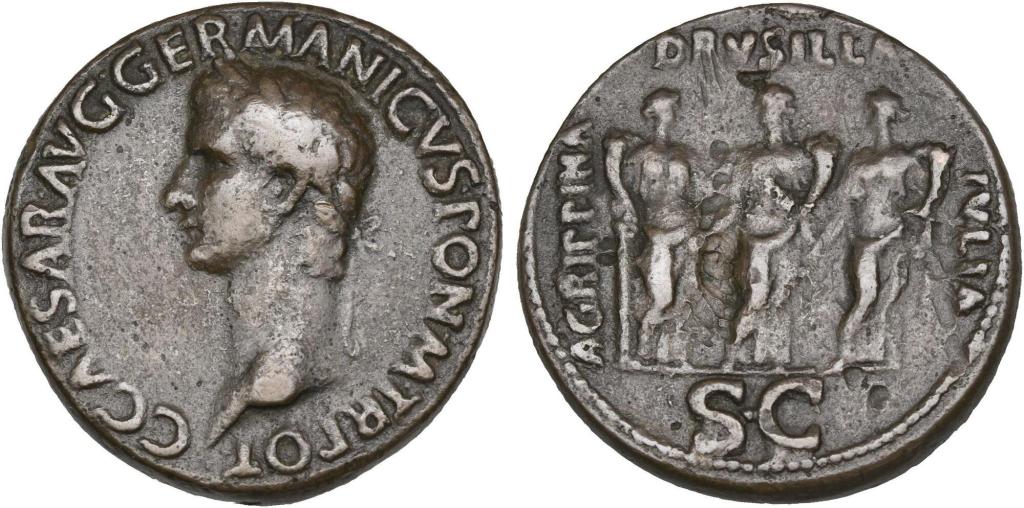
Cruelty Without Bound
Divinity was not the only claim Caligula made. He also made himself the arbiter of life and death, delighting in cruelty.
Suetonius, Caligula 30 §30 (c. AD 121, Loeb):
“He often had men of consular rank scourged with rods and forced to carry heavy loads for miles together. Others he compelled to stand all night long in the rain, in their linen tunics; and he had some killed for mere trifles.”
Suetonius, Caligula 32 §32 (c. AD 121, Loeb):
“He delighted in witnessing the suffering and slaughter of those who were being punished, and would from time to time make their agonies longer by ordering their wounds to be dressed and their bodies rubbed, only that they might be tortured with renewed severity.”
Cassius Dio, Roman History 59.27 §27 (c. AD 229, Loeb):
“He would kill men of the noblest rank and make their wives watch; he would invite them to dinner and suddenly have them seized and put to death before his eyes. He took pleasure in seeing the looks and hearing the cries of those who were perishing.”
This is why ancient historians consistently remember Caligula as one of the most depraved rulers in Roman history.
A Statue in the Holy of Holies
In AD 39–40, Caligula issued his most dangerous order: to set up a colossal statue of himself in the Temple at Jerusalem. To Jews, this was unthinkable. They chose defiance, prepared to die rather than allow their sanctuary to be defiled.
Josephus, Antiquities 18.8.2 §261–262 (c. AD 93, Loeb):
“Petronius was amazed at their determination, and assembling the people of the Jews in a plain, he asked them why they opposed Gaius, their lord, and his proposal to set up the statue. But they threw themselves down on the ground and laid bare their necks, and declared that they were ready to be slain rather than transgress the law.”
Josephus, Antiquities 18.8.4 §278 (c. AD 93, Loeb):
“‘We will neither fight nor flee,’ they said, ‘but we will die with our children and wives; if you desire, kill us; we shall die willingly, since we shall not by living transgress the laws of our worship.’”
Josephus, War 2.10.4 §195 (c. AD 75, Loeb):
“They lay prostrate for forty days together, fasting the while, and besought Petronius that he would not compel them to transgress the law of their fathers.”
The man charged with enforcing this order was Publius Petronius, the Roman governor of Syria. His role made him one of the most powerful men in the East, with direct oversight of Judea. Loyal to Rome yet cautious by temperament, Petronius knew his first duty was to preserve the peace of Rome.
He saw what Caligula could not: forcing this statue into the Temple would ignite rebellion not only in Judea but across Syria.
Josephus, Antiquities 18.8.9 §297–299 (c. AD 93, Loeb):
“Petronius, seeing the determination of the people, took the blame upon himself. He wrote to Gaius saying that all Judaea would be in revolt if he insisted on setting up the statue, and he prepared his wife and children for his own death.”
This was no act of cowardice. It was Roman statecraft. Petronius delayed Caligula’s order to preserve stability in the East. But Caligula’s madness could not endure defiance. He sent a letter commanding Petronius to commit suicide.
Josephus, Antiquities 18.8.9 §302 (c. AD 93, Loeb):
“While the letter commanding Petronius to take his own life was on its way, a message came that Gaius had been slain. So Petronius was saved.”
Thus the Temple was spared, Judea preserved, and Petronius’ life delivered — not because Caligula relented, but because Caligula himself was assassinated in AD 41. For Jews and Christians alike, his death was remembered as a deliverance.
A Philosopher Before a Madman
At the same time in Alexandria, Jewish synagogues were seized and mobs attacked. A delegation was sent to Rome to plead their case before the emperor. It was led by Philo of Alexandria (c. 20 BC – AD 50), a Jewish philosopher who blended Greek philosophy with Jewish faith. In his work Embassy to Gaius, Philo gives us an eyewitness account of standing before Caligula.
Philo, Embassy to Gaius §206 (c. AD 41–42, Loeb):
“He would run off in one direction to some peacocks, and then dart away in another to a grove of trees… We followed him like men in a triumphal procession, prisoners led along.”
Philo, Embassy to Gaius §§351–352 (c. AD 41–42, Loeb):
“‘You are men who refuse to acknowledge that I have been made a god, though I am clearly so.’ And when we tried to tell him about our national customs, he laughed the more and said: ‘You are not defending your own religion, you are accusing mine.’”
Philo, Embassy to Gaius §358 (c. AD 41–42, Loeb):
“No one could predict what he would do. His madness was like the sea, driven now this way, now that, by opposing winds.”
Philo’s description is chilling. The Jews stood as petitioners for their lives, but Caligula mocked them, dismissed their ancestral faith, and insisted on being recognized as divine. For Christians, still indistinguishable from Jews in the eyes of Rome, the fate of the synagogue was their fate as well.
And Philo’s embassy brought no relief. The violence in Alexandria did not stop; persecution of Jews — and by extension Christians — continued in the city. When Claudius became emperor, one of his earliest acts was to issue a decree to Alexandria ordering both Greeks and Jews to cease hostilities. This confirms that the hostility Philo described under Caligula was not resolved by his death.
Herod Agrippa I: A King Like His Friend Caligula
The madness of Caligula did not stop at Rome’s throne. His friend and client king, Herod Agrippa I, was appointed ruler of Judea by Caligula himself. Agrippa, also Herod the Great’s grandson, enjoyed Caligula’s favor and mirrored his arrogance. Like Caligula, he accepted divine honors — and, like Caligula, he met a sudden and humiliating end.
But before his death, Herod Agrippa turned his power against the church.
Acts 12:1–3 (c. AD 62):
“About that time Herod the king laid violent hands on some who belonged to the church. He killed James the brother of John with the sword, and when he saw that it pleased the Jews, he proceeded to arrest Peter also. This was during the days of Unleavened Bread.”
James, son of Zebedee and brother of John, thus became the first apostle to be martyred. Peter was imprisoned, but God intervened.
Acts 12:6–11 (c. AD 62):
“Now when Herod was about to bring him out, on that very night, Peter was sleeping between two soldiers, bound with two chains, and sentries before the door were guarding the prison. And behold, an angel of the Lord stood next to him, and a light shone in the cell. He struck Peter on the side and woke him, saying, ‘Get up quickly.’ And the chains fell off his hands. … Peter said, ‘Now I am sure that the Lord has sent his angel and rescued me from the hand of Herod and from all that the Jewish people were expecting.’”
So in one chapter, Herod Agrippa I presides over both the martyrdom of James and the near-martyrdom of Peter.
Then comes the climactic scene.
Acts 12:21–23 (c. AD 62):
“On the appointed day Herod, wearing his royal robes, sat on his throne and delivered a public address to the people. They shouted, ‘This is the voice of a god, not of a man.’ Immediately, because Herod did not give praise to God, an angel of the Lord struck him down, and he was eaten by worms and died.”
Amazingly, the Jewish historian Josephus (writing c. AD 93) gives an independent account of the same event in Caesarea.
Josephus, Antiquities 19.8.2 §§343–361 (c. AD 93, Loeb):
“On the second day of the shows, clad in a garment woven completely of silver so that its texture was wondrous, he entered the theater at daybreak. There the silver, illumined by the touch of the first rays of the sun, was wondrously radiant and by its glitter inspired fear and awe in those who gazed intently upon him.
Straightway his flatterers raised their voices from various directions—though hardly for his good—addressing him as a god. ‘Be gracious to us!’ they cried. ‘Hitherto we have revered you as a human being, but henceforth we confess you to be more than mortal.’
The king did not rebuke them nor reject their impious flattery. A little later he looked up and saw an owl sitting on a rope above his head, and at once recognized it as a messenger of evil as it had once been a messenger of good to him. A pang of grief pierced his heart. He was also seized with a severe pain in his belly which began with a violent attack.
Accordingly he looked upon his friends and said, ‘I, whom you call a god, am commanded presently to depart this life, while Providence thus reproves the lying words you just now addressed to me. I, who was by you called immortal, am immediately to be hurried away by death.’
And when he had suffered continuously for five days from pain in his belly, he departed this life, in the fifty-fourth year of his age and the seventh year of his reign.”
Comparison: Acts 12 and Josephus
- Setting: Both place the event at Caesarea, during a public festival.
- Robes: Acts says Agrippa wore “royal robes.” Josephus specifies a robe woven entirely of silver, dazzling in the sunlight.
- Acclamation: Both record the crowd shouting that he was more than a man, a god.
- Judgment: Acts says an angel struck him and he was “eaten by worms.” Josephus says an owl appeared as an omen, he was struck with severe abdominal pain, and died five days later.
- Theological Frame: Acts interprets the cause as divine judgment for not giving glory to God. Josephus interprets it as ominous fate, but preserves the same sudden, humiliating sequence of events.
Key Insight: The details differ — “worms” versus “abdominal agony,” “angel” versus “owl omen” — but the core story is the same. Herod Agrippa accepted divine honors, was immediately struck with sudden illness, and died a painful death at Caesarea. The agreement between Luke (in Acts) and Josephus on these essentials is one of the most striking convergences between the New Testament and external history.
Conclusion: The Church Under Caligula
Caligula’s reign (AD 37–41) was one of the most dangerous moments in Jewish and Christian history. His demand for divine worship and his order to set up his statue in the Jerusalem Temple threatened to destroy Jewish life altogether. In Alexandria, Jews were attacked in the streets, their synagogues seized, and they were mocked before the emperor himself. Since Rome still regarded Christians as a branch of Judaism, they shared the same precarious fate. Any blow that fell on the synagogue would inevitably fall on the church as well.
And yet — while Jews and Christians alike were under crushing imperial pressure in Judea and Alexandria, the gospel was quietly taking root elsewhere. In the great city of Antioch in Syria, well outside Judea’s geography, a new Christian community grew strong. It became the first great headquarters of the Gentile mission.
Luke records this simple but profound line:
Acts 11:26 (c. AD 62):
“And in Antioch the disciples were first called Christians.”
Notice the phrasing: they were called Christians. It is a passive statement. They did not name themselves; society around them began to recognize that this movement was not simply another form of Judaism. This is the first time in history that the church was publicly marked out as distinct from the synagogue.
So under Caligula, while Jews and Christians together faced threats of extinction in Judea and Alexandria, the church simultaneously broke into new ground. By AD 41, there was not only a thriving congregation in Antioch, but one that was recognized by outsiders as a new kind of community, centered on Christ.
Key Insight: Caligula’s reign shows both the fragility and the resilience of the early church. At the very moment when an emperor demanded worship as a god and threatened the Temple itself, the church expanded beyond its Jewish cradle. From Jerusalem to Samaria to Antioch, it gained a new identity and a new name: Christian.
Claudius (AD 41–54)
When Caligula was assassinated in AD 41, Rome teetered on the edge of chaos. The Senate debated restoring the Republic, but the Praetorian Guard found Caligula’s uncle, Tiberius Claudius Caesar Augustus Germanicus, hiding behind a curtain in the palace. They dragged him out, proclaimed him emperor, and Rome accepted their choice.
Claudius was the younger brother of Germanicus (Caligula’s father), making him Caligula’s uncle. Through his grandmother Livia, he was also the step-grandson of Augustus. Though mocked in his youth for his limp and his stammer, Claudius proved to be a capable administrator. His reign lasted thirteen years (AD 41–54) and brought stability after the madness of Caligula.
For Jews — and for Christians still regarded as Jews in Roman eyes — Claudius’ reign marked an important turning point. He revived the protections first granted by Julius Caesar, reaffirmed by Augustus, and now extended them across the empire. Yet he also ordered the expulsion of Jews from Rome when unrest broke out — an act that swept up Jewish Christians as well.
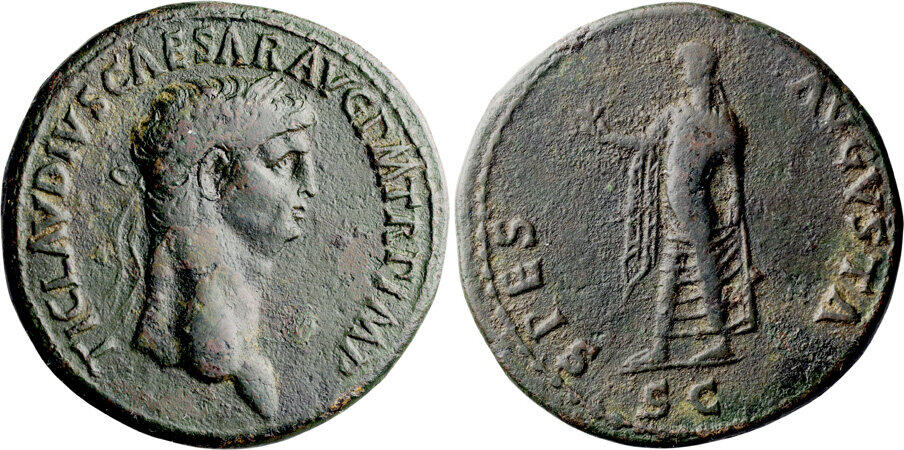
Claudius’ Letter to the Alexandrians
One of Claudius’ earliest acts was to settle the unrest in Alexandria, where Jews and Greeks had clashed violently under Caligula. His letter, preserved by Josephus, confirms Jewish rights while commanding peace.
Josephus, Antiquities 19.5.2 §§278–285 (c. AD 93, Loeb):
“Tiberius Claudius Caesar Augustus Germanicus, imperator, consul, tribune of the people, to the city of the Alexandrians, greeting.
I have long been aware of the feuds existing among you with the Jewish community, and now I have learned that seditions and wars are being stirred up afresh by them, against their own advantage and that of the general good.
Therefore I enjoin the Alexandrians to behave peaceably and kindly toward the Jews who have for a long time dwelt in the same city, and not to insult any of their customs in the practice of their worship, but to allow them to keep to their own ways, as they did under the divine Augustus.
As for the Jews, I order them not to seek to extend their settlements any further, but to be content with what they have long possessed, and not to bring in or admit Jews from Syria or Egypt, but only those already resident may remain.
I also forbid them to send out any embassy, or to hold meetings outside their synagogues; and in general I command both parties to stop stirring up further quarrels.
If they obey, I shall also show them all possible goodwill; but if they disobey, I shall proceed against them as disturbers of the peace.”
Here Claudius restored the balance Augustus had maintained: Jews could live by their ancestral customs without harassment, but were forbidden to expand or disturb the peace.
Claudius’ General Decree to the Provinces
Claudius’ policy was not limited to Alexandria. He issued a broader decree protecting Jews throughout the empire.
Josephus, Antiquities 19.5.3 §§286–291 (c. AD 93, Loeb):
“Tiberius Claudius Caesar Augustus Germanicus, imperator and consul for the second time, to the magistrates, senate, and people of the Alexandrians, greeting.
I am convinced that the Jews in all the world are increasing in number, and prospering greatly, and especially that they are loyal to the Empire; and I have therefore decided that they should continue to observe their ancestral customs without hindrance.
I command, accordingly, that they shall not be compelled to violate their traditional mode of life, but shall be permitted to keep the laws of their fathers, as they have been allowed to do by Augustus and after him by my father Drusus and my brother Germanicus.
None shall molest them in any way, particularly in connection with their sacred offerings to Jerusalem, or their keeping of the Sabbath and other rites.
If anyone disobeys this ordinance, I shall proceed against him severely, as one guilty of violating the majesty of the Empire.”
Claudius explicitly grounded his decision in precedent, tying it to Augustus, Drusus, and Germanicus — and ultimately back to Julius Caesar, who had first established legal protections for Jewish worship. For Christians, still legally sheltered under Judaism’s umbrella, these decrees provided a rare window of protection.
Expulsion from Rome
Yet Claudius was not unconditionally favorable to the Jews. Around AD 49–50, disturbances broke out in the Jewish community of Rome, likely over disputes about Jesus as the Messiah. Claudius responded with a sweeping expulsion.
Acts 18:2
“And he found a Jew named Aquila, a native of Pontus, recently come from Italy with his wife Priscilla, because Claudius had commanded all the Jews to leave Rome.”
Suetonius, Claudius 25.4 (c. AD 121, Loeb):
“Since the Jews constantly made disturbances at the instigation of Chrestus, he expelled them from Rome.”
The reference to “Chrestus” is almost certainly a misunderstanding of “Christus” — Christ. The unrest was likely between Jews who accepted Jesus as Messiah and those who rejected him. Among those expelled were Aquila and Priscilla, who soon became Paul’s close partners in ministry (Acts 18:2–3). They appear as mature Christians when they partner with Paul.
For Christians, this episode reveals a turning point. While Claudius’ decrees gave them protection under Judaism’s legal umbrella, their identification with disputes about Christ already made them a flashpoint of unrest — and increasingly distinct from Judaism itself.
The Church Under Claudius
Claudius’ reign coincided with a decisive era in the life of the church:
- AD 44: Herod Agrippa I (appointed by Caligula) executed James the son of Zebedee and imprisoned Peter (Acts 12).
- AD 46–48: Paul undertook his First Missionary Journey (Acts 13–14), traveling through Cyprus and Galatia.
- AD 49: The Jerusalem Council met to decide whether Gentile converts must keep the Mosaic Law (Acts 15).
- AD 49–52: Paul carried out his Second Missionary Journey (Acts 15:36–18:22), planting churches in Macedonia and Greece, including Philippi, Thessalonica, and Corinth.
- AD 52–54: Paul began his Third Missionary Journey (Acts 18:23–21:16), centering in Ephesus for nearly three years.
It was also during Claudius’ reign that Paul wrote some of his earliest letters. These were not to individual congregations only, but to entire regions of Christians.
Galatians 1:2 (c. AD 48–49):
“To the churches of Galatia.”
Already by the late 40s, Christianity had spread across a whole region of Asia Minor. Paul’s letter shows how critical this moment was: the debate was not simply about circumcision, but about whether Gentile Christians needed to keep the entire Jewish Law.
Galatians 2:16 (c. AD 48–49):
“We know that a person is not justified by works of the law but through faith in Jesus Christ, so we also have believed in Christ Jesus, in order to be justified by faith in Christ and not by works of the law, because by works of the law no one will be justified.”
This is the very issue resolved at the Jerusalem Council in Acts 15. Together, Galatians and Acts 15 mark a turning point: Christians were deciding that they were not simply part of Judaism, but a distinct people of God under a new covenant in Christ.
Paul’s letters also reflect the wide scope of his mission:
1 Corinthians 1:2 (c. AD 53–54):
“To the church of God that is in Corinth, to those sanctified in Christ Jesus, called to be saints together with all those who in every place call upon the name of our Lord Jesus Christ, both their Lord and ours.”
Even when addressing a single city, Paul wrote with the wider Christian world in mind: “all those in every place.” His letters carried authority not just for one congregation, but for a network of churches spread across the empire.
Conclusion: The Church Under Claudius
Claudius’ reign (AD 41–54) was marked by paradox. On the one hand, his decrees restored the Jewish privileges established by Julius Caesar and Augustus, protecting Christians as long as they were still seen as part of Judaism. On the other hand, his expulsion of Jews from Rome disrupted the lives of Jewish Christians and revealed that disputes about Christ were already pushing the church into a distinct identity.
And yet, this was one of the most formative eras in Christian history. Under Claudius:
- The gospel spread beyond Antioch into Asia Minor, Macedonia, and Greece.
- The first great council of the church met in Jerusalem to define Gentile inclusion.
- Paul completed his first three missionary journeys.
- The earliest New Testament letters were written, not just to churches, but to regions of believers.
By the time Claudius died in AD 54, Christianity had moved far beyond its Jewish cradle. It was now a trans-Mediterranean faith, with thriving congregations in Galatia, Macedonia, Achaia, and Asia Minor, bound together by letters that still shape the church today. Claudius’ stability gave the church room to expand — setting the stage for its greatest test yet under his successor, Nero.
Nero (AD 54–68)
When Claudius died in AD 54, his stepson Nero — great-great-grandson of Augustus through his mother Agrippina — ascended the throne at the age of sixteen. At first, guided by advisors like Seneca and Burrus, Nero showed promise. But his reign soon descended into extravagance, cruelty, and bloodshed.
The turning point came in July AD 64, when a fire broke out in Rome and destroyed much of the city. Ancient historians disagree on whether Nero himself was responsible, but rumors spread quickly that he had ordered the blaze. To deflect suspicion, Nero sought a scapegoat — and found one in the Christians.
The Great Fire and the First Imperial Persecution
Tacitus, Annals 15.44 §§1–3 (c. AD 116, Loeb):
“To suppress the rumor, Nero fabricated scapegoats and punished with exquisite cruelty the notoriously depraved Christians (as they were popularly called). Their originator, Christ, had been executed in Tiberius’ reign by the procurator of Judea, Pontius Pilatus. Checked for a moment, this pernicious superstition again broke out — not only in Judea, the home of the disease, but even in Rome, where all things horrible or shameful in the world collect and find a vogue.
First, those who confessed were arrested; then, on their information, a vast multitude was convicted, not so much on the charge of arson as for hatred of the human race.
Mockery of every sort was added to their deaths. Dressed in wild animal skins, they were torn to pieces by dogs, or crucified, or made into torches to be ignited after dark as substitutes for daylight. Nero provided his gardens for the spectacle, and exhibited displays in the Circus, at which he mingled with the crowd — dressed as a charioteer or mounted on a chariot.
Hence, in spite of a guilt which had earned the most exemplary punishment, there arose a sentiment of pity, due to the impression that they were being sacrificed not for the welfare of the state but to the ferocity of a single man.”
Key Insights from Tacitus
- Scapegoats for Nero. Christians were chosen not because they set the fire, but because they were already despised as “haters of the human race.”
- Already notorious. Tacitus calls them “notoriously depraved” and their faith a “pernicious superstition.” By AD 64, Christians were widely recognized in Rome and widely hated.
- A vast multitude. His phrase multitudo ingens (“a vast multitude”) shows how large the Christian community in Rome already was, and how severe this persecution was — not dozens but hundreds, possibly thousands.
- No real crimes. Their guilt was not arson or sedition, but their view of Christ, their ethics, and their condemnation of Roman life.
- Rome thought it was finished. Tacitus says Christianity was “checked for a moment” when Christ was crucified. Rome thought Jesus’ death ended the movement — but it “again broke out,” spreading even to the capital itself.
- Confession was enough. “Those who confessed” were arrested. Being a Christian was itself the crime.
- “On their information.” The Latin phrase (per indicium eorum) may mean confessors named others, or that confession itself was the evidence. Either way, the name alone condemned them.
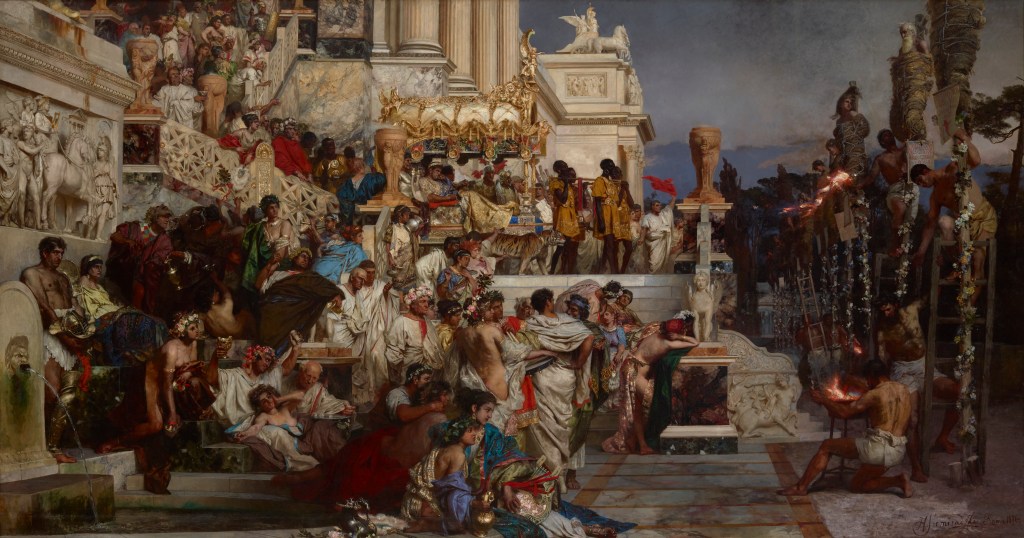
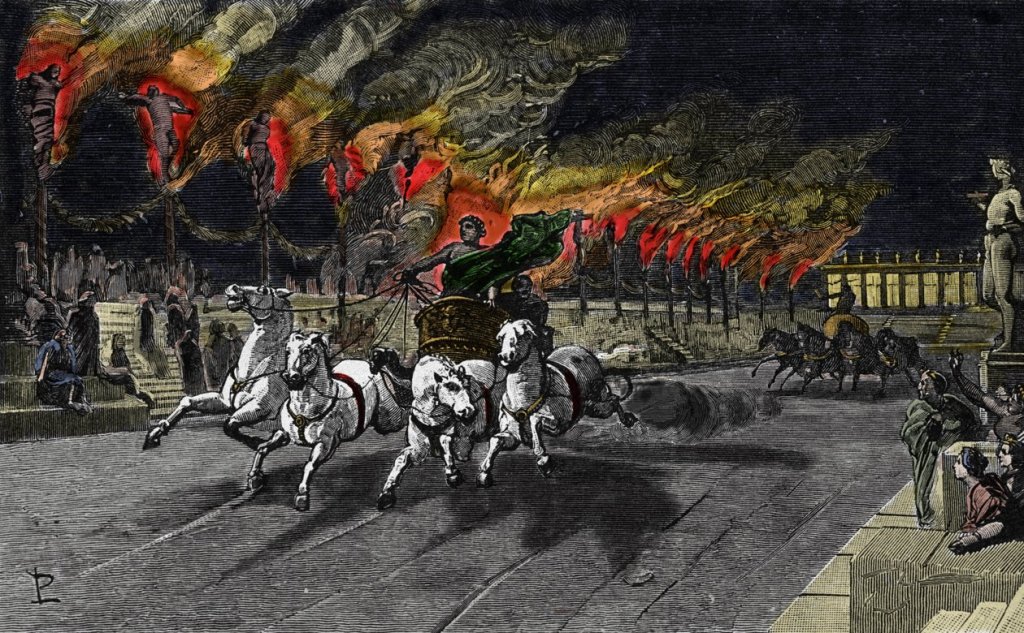
Suetonius on Nero’s Persecution
Suetonius, Nero 16.2 (c. AD 121, Loeb):
“Punishments were also inflicted on the Christians, a sect professing a new and mischievous religious belief.”
Key Insights from Suetonius
- A distinct sect. By Suetonius’ day, Christianity was clearly recognized as distinct from Judaism.
- “New and mischievous.” “New” meant unauthorized and suspicious; “mischievous” (malefica) implied socially harmful.
- Punished for belief, not crime. He mentions no crimes like arson or sedition. The offense was the belief itself.
Cassius Dio (via Zonaras) on Nero’s Persecution
Cassius Dio, Roman History 62.16 (via Zonaras, c. AD 229, Loeb):
“Nero was the first to persecute the Christians; and though they were guilty of no crime, they were subjected to the most extraordinary punishments. And in their death they were made the subjects of sport; for they were covered with the hides of wild beasts and torn to pieces by dogs, or they were nailed to crosses, or they were doomed to the flames and burnt, to serve as nightly illumination when daylight had expired. Nero offered his own gardens for the spectacle, and gave a circus show, mingling with the crowd in the dress of a charioteer, or mounted on a car. Hence, even for criminals who deserved extreme and exemplary punishment, there arose a feeling of compassion; for it was felt that they were being destroyed not for the public good, but to gratify the cruelty of a single man.”
Note on Sources: Dio’s Roman History is fragmentary for this period; this passage is preserved in the 12th-century epitome of John Zonaras.
Key Insights from Dio
- Innocent of crimes. Dio is explicit: Christians were “guilty of no crime.”
- Public spectacle. Executions turned into grotesque entertainment — torn by dogs, crucified, burned alive.
- Public pity. Even Romans who despised Christians pitied them, realizing they died for Nero’s cruelty, not Rome’s good.
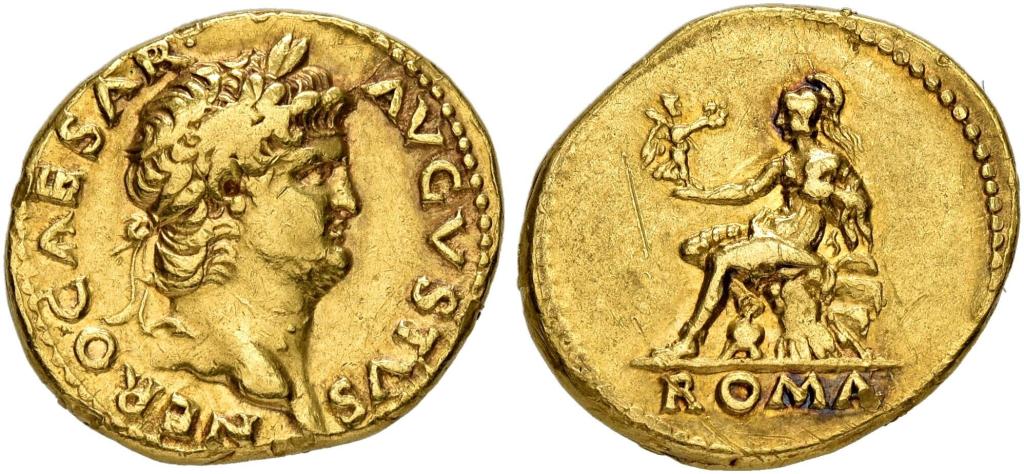
Old Religions vs. New Religions
Tacitus, Histories 5.5 §5 (c. AD 105, Loeb):
“Whatever is novel in religion is forbidden; but whatever is ancient is respected — even if it be based on error.”
Pliny the Elder, Natural History 30.11 §30.11 (c. AD 77, Loeb):
“Ancient religions win tolerance through their antiquity; new ones are looked on with suspicion, particularly when they refuse to worship the Roman gods.”
Judaism was tolerated as an ancient superstition. Christianity was branded a new superstition (superstitio nova), and thus unlawful. Nero’s persecution formalized this: Christians were no longer sheltered under Judaism but treated as an illicit movement.
The Uniqueness of Nero’s Persecution
Nero’s decision to blame an entire people group for the fire was without precedent in Roman history.
Before this, Rome punished individuals — conspirators, rivals, or outspoken philosophers — but never criminalized a community for its beliefs.
Candida Moss, in The Myth of Persecution: How Early Christians Invented a Story of Martyrdom (2013, pp. 37–38), notes that only one earlier group was treated in a vaguely similar way: the Druids of Britannia.
Tacitus, Annals 14.30 (c. AD 116, Loeb):
“The savage superstitions of the Druids were put down; for they considered it right to make their altars run with the blood of captives and to consult their gods by means of human entrails.”
That campaign, led by Suetonius Paulinus in AD 60, was a military operation, not an urban persecution. Rome destroyed the Druids’ sacred groves as part of conquest, not as a civic punishment for religious identity.
By contrast, Nero’s actions in AD 64 were entirely domestic. He used the Christians as scapegoats inside the capital itself. Tacitus writes that “those who confessed were arrested, and on their information a vast multitude was convicted.” This was not a handful of leaders, but an entire population, criminalized for existing.
Other groups, such as the Stoics, also suffered under Nero — but in a completely different way.
Tacitus, Annals 16.21 (c. AD 116, Loeb):
“Thrasea Paetus was put to death for his independence, Barea Soranus for his friendship with him, and many others for no crime except their virtues.”
These were individual executions within a small circle of senators and philosophers — men admired for their moral independence, not a mass suppression of Stoicism. The philosophy itself continued; it was never outlawed.
Nero’s persecution of Christians, by contrast, targeted a whole people. Their faith, not their conduct, was the crime.
Key Insight
- The Druids were wiped out as a wartime measure in Britannia, not as an internal religious purge.
- The Stoics were punished as individuals for political virtue, not as a philosophical school.
- The Christians were the first group in Roman history to be executed collectively for belief alone.
Candida Moss is right that the Druids are the closest parallel — but Nero’s act went further. It was not conquest or politics. It was religion itself that was put on trial.
Agrippa II and Paul’s Journey to Rome
During Nero’s reign we also encounter Herod Agrippa II, son of Agrippa I. By this time he ruled parts of northern Palestine. When Paul was imprisoned at Caesarea under the procurator Festus, Agrippa II and his sister Bernice were invited to hear his case.
Acts 26:28 (c. AD 62):
“And Agrippa said to Paul, ‘In a short time would you persuade me to be a Christian?’”
Agrippa’s verdict was striking:
Acts 26:31–32 (c. AD 62):
“This man is doing nothing to deserve death or imprisonment. … This man could have been set free if he had not appealed to Caesar.”
Agrippa II did not condemn Paul. Yet because Paul had appealed to Caesar, his case was forwarded to Nero. This set Paul on his journey to Rome (Acts 27–28), where tradition holds he was later executed.
The Martyrdom of Peter and Paul: Early Witnesses
- Dionysius of Corinth, fragment in Eusebius, Church History 2.25.8 (c. AD 170, Loeb): “Peter and Paul … taught together in Italy, and were martyred at the same time.”
- Tertullian, Scorpiace 15 (c. AD 200, Loeb): “Where Peter endures a passion like his Lord’s, Paul wins his crown in death like John’s.”
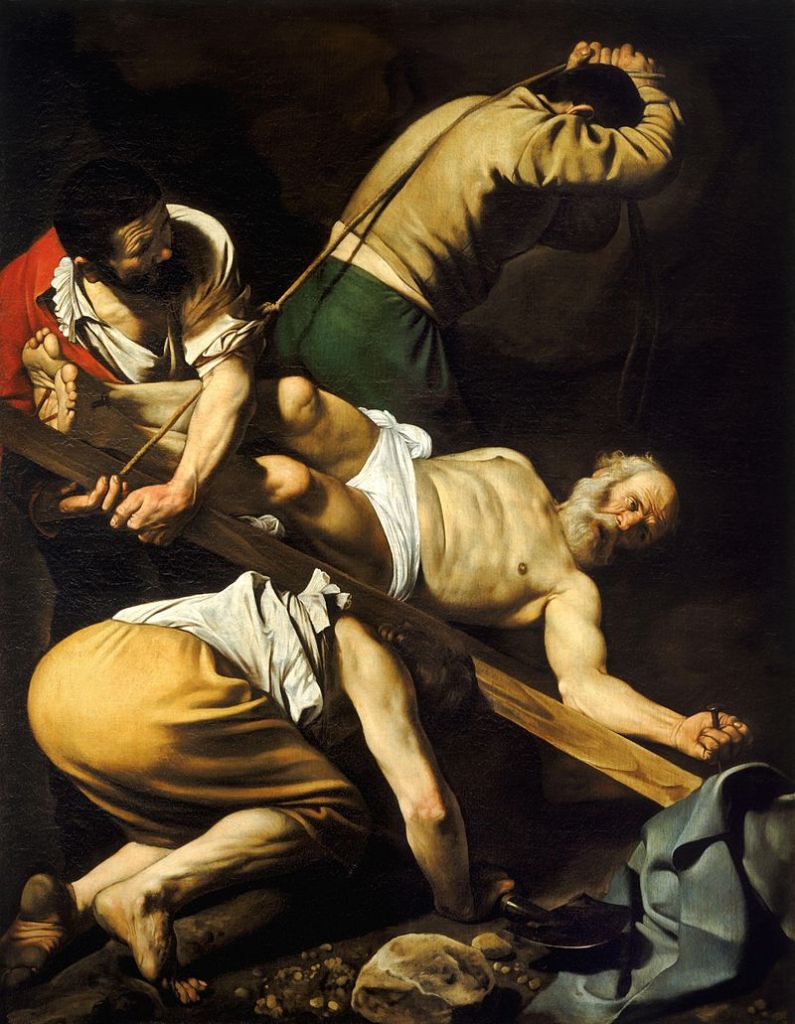
- Eusebius, Church History 2.25.5–8 (c. AD 325, Loeb): “Paul was beheaded in Rome itself, and Peter likewise was crucified under Nero. Peter was crucified head downwards, for so he had asked to suffer.”
The core tradition is plain: Peter crucified, Paul beheaded, both in Rome under Nero.
The Apocryphal Acts: Legendary Expansions
By the late 2nd and 3rd centuries, apocryphal Acts circulated widely, retelling the apostles’ deaths with miracles and signs.
- Acts of Paul 11 (c. AD 160–180, Apocryphal Acts): “And when they had beheaded Paul, milk flowed out upon the ground from his neck, so that the soldiers marveled.”
- Martyrdom of Paul (c. AD 200–250, Apocryphal Acts): “And Paul, having prayed, said to the executioner, ‘Come, do thy work.’ And the soldier struck off his head, and immediately milk and blood issued forth.”
- Acts of Peter and Paul 7 (c. AD 200–250, Apocryphal Acts): “And when he had prayed, he gave his neck to the sword without fear. And when the soldier struck off his head, there came forth milk and blood, and a great fragrance filled the place, so that many of those who stood by believed.”
- Acts of Peter 37–39 (c. AD 180–200, Apocryphal Acts): “Peter, having come to the place, asked to be crucified head downwards. And while he was hanging there, he said: ‘Since my Lord was crucified head upwards, it is fitting for me to be crucified head downwards, so that the difference may be clear between the Lord and his servant.’”
Why Did Christians Embellish?
These miracle stories were not created to erase the truth — they were built on the core memory of Nero’s persecution. They aimed to:
- Encourage believers in their own sufferings.
- Show God’s power in weakness and death.
- Magnify Peter and Paul as models of courage and humility.
Candida Moss’ Critique and a Response
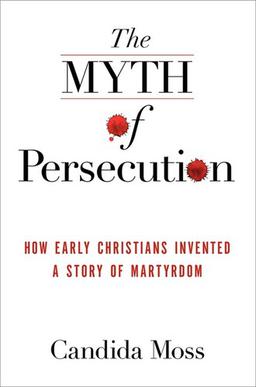
Modern scholar Candida Moss, in The Myth of Persecution (2013), argues that most martyrdom accounts were exaggerated or fabricated, and that the church later built a “myth” of constant persecution. She points to the apocryphal Acts as evidence that Christians mythologized their sufferings with miracles and wonders.
Response:
- The embellishments are real — milk, blood, heavenly fragrances, sermons from the cross.
- But that does not erase the historical core.
- The early witnesses (Dionysius, Tertullian, Eusebius) give us a plain, consistent story: Peter crucified, Paul beheaded, under Nero.
- The apocryphal Acts show how popular devotion expanded these stories, not how they were invented.
- The very existence of later embellishments shows there was a real core event to embellish.
Nero’s Lasting Precedent
Nero’s persecution was short, but its effects were lasting. For the first time, Christianity was officially branded a new and unlawful superstition. The charge was not arson, violence, or rebellion. It was the name itself.
From that moment on, this precedent endured:
- Trajan (rescript to Pliny, c. AD 112): Christians are not to be hunted, but if accused and proven, they must be punished unless they recant and worship the gods.
- Hadrian (rescript to Minucius Fundanus, c. AD 124): Christians cannot be condemned by mob accusations; formal charges and evidence are required.
- Apollonius the Senator (c. AD 185, Eusebius, Church History 5.21.2, Loeb): Tried before the Senate, he confessed Christ and was executed “in compliance with an ancient law.”
This shows that Nero’s precedent was remembered and enforced for centuries. Later crackdowns under emperors like Decius or Diocletian were not innovations — they were intensifications of the same ancient law first established under Nero.
Final Key Insight
Candida Moss is wrong to claim that persecution was a myth built around a few exaggerated episodes. The evidence shows that from Nero onward, Christians lived under a standing legal threat.
- They were not always hunted, but they were never safe.
- Simply confessing Christ was enough for punishment, even death.
- Nero’s fire did not burn out the church; it created the conditions under which the church would always exist: fragile in the eyes of Rome, yet resilient in the power of Christ.
The fire that consumed Rome lit a flame of witness that spread across the empire — a fire no emperor could extinguish.
 Living the Bible