From Eyewitnesses to Greek Masterpieces: The Real Story of Gospel Origins

This script traces how the Gospels and Acts moved from eyewitness proclamation to the Greek literary works we have today. We look at modern views of Scripture, the rise of inerrancy, the early church’s rule of faith, Origen’s view of the Bible, the anonymity of the earliest manuscripts, and how ancient books were written through dictation and scribal collaboration. We then show why the Gospels fit perfectly into that world and why their central message — the death and resurrection of Jesus, witnessed by many — remains consistent from Paul’s earliest letters all the way through the second century. Finally, we address the claim that Jesus is just another myth and explain why the earliest Christian testimony belongs in a completely different category.

SECTION 1 — How Christians View Scripture Today

Overview

Major survey organizations such as Gallup, Barna/ABS, and Pew consistently report that the strict “word-for-word literal” or “error-free in every detail” view of Scripture represents a minority position among Christians today.


I. Gallup Poll (2022)

Gallup’s most recent national data show:

Only 20 percent of American adults say “the Bible is the actual word of God and is to be taken literally, word for word.”
Gallup, 2022

Among Christians, that rises only to 25 percent.

A majority—58 percent—say the Bible is inspired by God but

“…not everything in it should be taken literally.”


II. American Bible Society / Barna Group — State of the Bible (2021)

Barna/ABS data further show:

  • 26 percent believe the Bible is “the actual word of God and should be taken literally.”
  • 29 percent believe the Bible is the word of God and without error, though parts may be symbolic.
  • 55 percent of U.S. adults hold what the survey calls a “high view of Scripture,” a broad category that does not require strict inerrancy.

Source: State of the Bible 2021.


III. Pew Research Center (2017)

Among Christians in the United States:

  • 39 percent say the Bible is the word of God and should be taken literally, word for word.
  • 36 percent say the Bible is the word of God but should not be taken literally.

Source: Pew Research Center, 2017.


IV. Combined Analysis and Key Conclusions

Across all three major data sets:

  • The strict literalist or strict inerrant view appears consistently in the 20–30 percent range among Christians.
  • A larger group, typically 40–60 percent, views Scripture as inspired and authoritative but not strictly literal and not perfect in every technical detail.
  • The remaining share hold alternative views (e.g., inspired but not unique, ancient wisdom, not inspired).

Key Insight for Historical Study

Strict inerrancy is not the global or majority Christian position.
The majority of Christians today read Scripture as inspired without assuming complete literal precision.


SECTION 2 — When and Why the Doctrine of Inerrancy Developed

I. Overview

The modern doctrine of biblical inerrancy—the belief that Scripture is absolutely without error in every detail, including matters of history, science, chronology, and geography—is not an ancient Christian doctrine.

It does not appear:

  • in the early Church,
  • in the writings of the Church Fathers,
  • in medieval theology,
  • or even in the Protestant Reformation.

It arose late in Christian history, in response to developments in the Enlightenment and the rise of historical-critical scholarship during the 1700s–1800s.

This section describes that development factually and systematically.


II. The Rise of Historical-Critical Scholarship (18th–19th Centuries)

Beginning in the late 1700s, European scholars began studying the Bible the way they studied all other ancient literature.

This involved:

  • comparing manuscripts,
  • examining internal contradictions,
  • studying literary sources and editorial layers,
  • questioning traditional views on authorship,
  • analyzing historical claims.

Major figures in this intellectual shift include:

  • Johann Salomo Semler (1725–1791) — developed early concepts of canon criticism
  • Gotthold Ephraim Lessing (1729–1781) — raised questions about the “ugly ditch” between history and faith
  • Friedrich Schleiermacher (1768–1834) — encouraged historical methods in theology
  • F. C. Baur (1792–1860) and the Tübingen School — interpreted the New Testament through Hegelian historical development

Baur’s work was especially influential.
He argued that:

  • the early church contained competing theological factions (“Petrine” vs. “Pauline”),
  • some New Testament books were pseudonymous,
  • Acts was a harmonizing narrative,
  • and the Gospels reflected theological interpretation rather than raw historical memory.

This was the most sustained academic challenge to traditional Christian assumptions in 1,700 years.


III. The “Seven Undisputed Letters of Paul” — A Major Scholarly Gain

While the rise of historical criticism challenged traditional views, it also produced one of the most important positive contributions to modern Christian historical study:
the identification of Paul’s seven undisputed letters.

Across the entire scholarly spectrum—conservative, moderate, liberal, Jewish, atheist—there is near-unanimous agreement that the following letters are authentic, first-person writings of Paul, composed in the 50s AD:

  1. Romans
  2. 1 Corinthians
  3. 2 Corinthians
  4. Galatians
  5. Philippians
  6. 1 Thessalonians
  7. Philemon

Their significance:

  • They are the earliest Christian documents we possess.
  • They were written within 20–25 years of Jesus’ death.
  • They reflect the beliefs of the first generation of Christians.
  • They give direct access to how the earliest churches functioned.
  • They anchor Christian history in verifiable first-person testimony.

This is one of the strongest historical foundations Christianity possesses.
It comes directly out of the same academic movement that challenged traditional assumptions.


IV. The Princeton Response — Birth of Modern Inerrancy (Late 1800s)

In the late 19th century, conservative Protestant theologians in America formulated a new doctrine designed to defend Scripture against the challenges of historical criticism.

This movement centered at Princeton Theological Seminary with:

  • Charles Hodge (1797–1878)
  • B. B. Warfield (1851–1921)

They argued:

  1. Scripture is inspired by God.
  2. God cannot err.
  3. Therefore Scripture must be without error in everything it affirms.

This produced—for the first time in Christian history—a formal doctrine of verbal plenary inerrancy.

This formulation differs from earlier Christian attitudes in several ways:

  • Early Christians accepted non-literal readings and apparent contradictions (e.g., Origen).
  • Medieval theologians focused on spiritual senses, not literal precision.
  • Reformers emphasized authority and clarity, not inerrancy in scientific or historical detail.

The Princeton formulation represented a new doctrinal development, driven by the desire to provide a clear defense of Scripture in an age of modern criticism.


V. Spread and Codification of Inerrancy (1900s)

The Fundamentals (1910–1915)

A series of booklets published between 1910 and 1915 that defined “fundamental doctrines.”
One of the central doctrines was:

  • Biblical inerrancy.

This launched the American fundamentalist movement.

Chicago Statement on Biblical Inerrancy (1978)

Written by over 200 evangelical leaders, defining inerrancy as:

“Scripture is without error or fault in all its teaching.”

This document became the standard articulation of inerrancy in evangelical seminaries and churches.


VI. Combined Historical Analysis

  • The ancient Church did not define Scripture as inerrant in the modern, technical sense.
  • Medieval and Reformation theology did not articulate verbal plenary inerrancy.
  • Modern inerrancy developed in the late 1800s as a response to the intellectual challenges of the Enlightenment and historical criticism.
  • Meanwhile, critical scholarship also produced the seven undisputed letters of Paul, which remain some of the earliest and most historically secure Christian documents.

This historical framing allows for honest examination of the composition of the Gospels and Acts without assuming modern categories that did not exist in the early Church.


SECTION 3 — The Ancient Rule of Faith, Origen’s View of Scripture, and Internal Evidence from the Gospels and Acts

I. The Ancient Rule of Faith

Early Christians summarized their core beliefs in a short confession known as the rule of faith (regula fidei).
While only some writers explicitly use the phrase, the content of the rule of faith appears consistently across all major early Christian sources of the 1st, 2nd, and 3rd centuries — including the New Testament, the Apostolic Fathers, early apologists, and even in anti-christian works.

Core elements of the ancient rule of faith:

  1. Belief in one God, the Father, the Creator and Sovereign
  2. Belief in Jesus Christ, the Son of God, who became flesh, was crucified, died, was buried, rose, and ascended
  3. Belief in the Holy Spirit, who indwells believers and produces righteous living
  4. Belief in final judgment, in which Christ judges the living and the dead

The rule of faith does not include:

  • inerrancy
  • doctrines of textual perfection
  • literalism
  • attempts to harmonize every Gospel detail
  • modern demands of historical precision

Early Christian faith celebrated inspiration, but inspiration was not equated with technical inerrancy or literal exactitude.


II. Origen (c. AD 185–253): Background and Significance

Origen of Alexandria (later Caesarea):

  • produced the first systematic Christian theology (De Principiis),
  • created the Hexapla, an enormous comparative edition of the Old Testament,
  • and wrote extensive commentaries, including the earliest surviving major commentary on a Gospel (the Commentary on John).

Origen provides the earliest comprehensive Christian doctrine of Scripture, showing how early Christians understood Scripture’s complexity, its non-literal elements, and its theological depth. The important takeaway from Origen is that he readily recognized contradictions and historical inaccuracies in the biblical documents. We don’t need to necessarily take on his solution to them but to understand that a Christian can readily admit them.


III. Origen’s View of Scripture — De Principiis, Book IV

1. Scripture contains literal history AND non-literal elements

“The Scriptures were written by the Spirit of God, and because they are divine they contain within them a meaning which escapes the casual reader.
Many things that are literally true are inserted for the edification of those unable to see beyond the letter.
But others — indeed very many — are written so that they cannot possibly have happened as they are described, nor be literally true, yet they contain deep mysteries.”
De Principiis IV.1.6


2. The Spirit intentionally inserted “stumbling-blocks”

“The Word of God has purposely inserted certain things which appear impossible, absurd, or contradictory, that we may be driven to search for a meaning worthy of God.
For the simple are edified by what is written, but those who have advanced may be exercised by the stumbling-blocks in the text.”
De Principiis IV.2.9

“If everything in Scripture were plain history, we should not believe it to be inspired by God;
but now, by means of these apparent inconsistencies, the Spirit calls us to the hidden sense.”
De Principiis IV.2.9


3. Apparent Gospel discrepancies are theologically purposeful

“If, when we read the Gospels, we find things which cannot both be true in the letter — if the same event is said to have happened differently or in a different order —
let us not charge the writers with error, but seek the deeper intention of the Spirit.
For these very differences lead us from the bodily sense to the soul of Scripture.”
De Principiis IV.3.5

“He who insists that all the details must literally agree is like one who insists that Christ’s words are only human and not divine.”
De Principiis IV.3.5


4. The threefold sense of Scripture

“The bodily sense is the outward narrative.
The psychic sense teaches moral conduct.
The spiritual sense reveals Christ the Logos and the heavenly realities.
Wherever in Scripture the narrative appears impossible or irrational, the Holy Spirit warns us not to remain at the letter but to seek the truth hidden beneath.”
De Principiis IV.2.4–5


5. Scripture as spiritual training

“The divine Word has adapted Himself to our weakness as a wise physician, mixing truth with difficulty so that we may be both nourished and tested.
The simple find milk; the mature are compelled to search for solid food.
Thus Scripture is a training ground for the soul, not merely a record of history.”
De Principiis IV.2.8


6. Apparent contradictions are deliberate divine design

“If one observes with care, he will find many things in Scripture which appear to be at variance.
But this very difficulty shows that the divine wisdom has so arranged them to prevent the unworthy from understanding, and to urge the worthy to seek the hidden harmony.”
De Principiis IV.2.9


IV. Origen’s Commentary on John (Book X)

Origen applies his interpretive method directly to the Gospel narratives while recognizing their historical inaccuracies and contradictions.

1. Non-literal events with spiritual truth

“In the Scriptures many things are written which did not actually happen, and yet spiritually they happened.
The deeper truth is discerned only by one who has the mind of Christ.”
Commentary on John X.4

2. Purposeful “interruptions of history”

“The Word of God arranged the Scriptures with wisdom, placing certain stumbling-blocks and interruptions of history,
that we might not be drawn to the letter but be summoned to the Spirit.”
Commentary on John X.18

3. Literalism yields absurdity

“If we dwell upon the letter and follow the narrative as mere history, absurdities will necessarily result —
impossible statements will be present.
But if we seek the spiritual meaning, these things will be found to be beautiful and divine.”
Commentary on John X.20

4. Inconsistency is not error

“Where the narrative appears inconsistent, we must not suppose the Spirit of God to be at fault;
rather we must ask what deeper meaning the Spirit intends us to seek.”
Commentary on John X.21


SECTION 4 — The Gospels and Acts: From Anonymity to Authorship

I. Early Gospel and Acts Manuscripts Are Anonymous

The earliest surviving manuscripts of the Gospels and Acts are anonymous.
No author names appear in the original text of any early papyrus.

Key early papyri:

  • P52 — fragment of John 18, dated c. AD 125–150
  • P45 — fragments of all four Gospels + Acts, dated c. AD 200–250
  • P66 — large portion of John, dated c. AD 175–200

These manuscripts contain only the narrative text.
They do not include titles such as:

  • “The Gospel according to Matthew”
  • “The Gospel according to Mark”
  • “The Gospel according to Luke”
  • “The Gospel according to John”

The familiar title headings (Κατὰ Ματθαῖον, Κατὰ Μᾶρκον, Κατὰ Λουκᾶν, Κατὰ Ἰωάννην) were added later by scribes during the process of copying and circulating the texts.

Thus, the earliest physical evidence confirms that the Gospels and Acts were originally anonymous documents.


II. Internal Evidence from the Gospels and Acts

1. Matthew (Matthew 9:9)

Matthew’s calling:

“As Jesus passed on from there, he saw a man called Matthew sitting at the tax booth; and he said to him, ‘Follow me.’ And he rose and followed him.”

  • Third-person narration
  • No autobiographical detail
  • Based on Mark 2:13–17 (where the name is Levi)
    → Indicates literary dependence, not personal recollection.

2. John (John 21:24)

Final editorial voice:

“This is the disciple who is bearing witness to these things, and we know that his testimony is true.”

→ Indicates multiple hands involved — a community affirming the witness, not a lone author.


3. Luke–Acts (Luke 1:1–4; Acts 1:1–2)

Luke’s prologue:

“Many have undertaken to compile a narrative…
just as those who from the beginning were eyewitnesses…
it seemed good to me also… to write an orderly account…
for you, most excellent Theophilus…”

  • Luke is a compiler, not an eyewitness
  • Used written sources
  • Employed investigation
  • Wrote under patronage

Acts 1:1–2 confirms Luke wrote both volumes.


4. Mark

Mark contains no internal claim of authorship.
It begins abruptly and presents no first-person markers.


5. Summary of Internal Literary Evidence

Across all four Gospels and Acts:

  • All are anonymous in their original text.
  • None claims to be written by an apostle.
  • Luke explicitly describes a research-based, source-dependent, patron-funded project.
  • John reflects community authorship.
  • Matthew depends on earlier written sources.
  • Mark presents no authorial claim.

This internal evidence aligns with the historical realities of ancient literary production and the external evidence described in later sections.


III. Early Christian Writers Treat the Gospels as Anonymous (AD 95–180)

For approximately eighty-five years after the composition of the Gospels, Christian authors quote or use Gospel material without naming Matthew, Mark, Luke, or John.

Early Christian Writers (AD 95–180) Who Use the Gospels Anonymously

WriterApprox. DateHow They Use Gospel MaterialDo They Name Matthew, Mark, Luke, John?
1 Clement (Rome)c. AD 95Quotes Jesus’ teachingsNo
Ignatius of Antiochc. AD 110Echoes Matthew and LukeNo
The Didachec. AD 100–120Parallels Sermon on the MountNo
Polycarp of Smyrnac. AD 110–135Quotes Matthew, Luke, ActsNo
Quadratus (Apologist)c. AD 125Mentions living eyewitnessesNo
Aristides of Athensc. AD 125–138Summarizes Jesus’ life and teachingNo
Marcion of Pontusc. AD 140–150Uses shortened form of Luke’s GospelNo — never calls it “Luke”
Justin Martyrc. AD 150Calls them “Memoirs of the Apostles”No
Tatian of Assyriac. AD 170Produces Diatessaron (four-Gospel harmony)No
Athenagoras of Athensc. AD 177Uses Gospel traditionsNo
Theophilus of Antiochc. AD 180Quotes John 1:1No

Summary of this pattern

Across Rome, Syria, Asia Minor, and Athens — and across genres (letters, apologies, summaries, harmonies) — Christian writers:

  • quote the Gospels,
  • depend on them,
  • appeal to them,
  • arrange them,
  • and harmonize them,

…but never attach the names Matthew, Mark, Luke, or John.

In the first 85 years of Christian writing, the Gospels functioned as anonymous authoritative narratives.


IV. The First Surviving Attributions: Papias of Hierapolis (AD 110–130)

Papias is the earliest figure to associate specific authors with Gospel material.
His work survives only in quotations preserved by Eusebius (4th century), and his information is not firsthand.

Papias explicitly attributes his knowledge to someone he calls “the Elder”, whose identity is unknown.

The Elder said this:
Mark, having become Peter’s interpreter, wrote down accurately whatever he remembered—though not in order—for he had not heard the Lord nor followed Him,
but afterwards followed Peter, who used to give teaching as necessity demanded,
not making an ordered arrangement of the Lord’s sayings.

Therefore Mark did nothing wrong in writing down some things as he remembered them,
for he took care not to omit anything he had heard or to falsify anything in them.”

And on Matthew:

Matthew compiled the logia in the Hebrew language,
and each interpreted them as he could.” (Eusebius, Ecclesiastical History 3.39.15–16)

Key historical observations:

  • Papias’ statements rely entirely on “the Elder”, an unidentified figure.
  • Papias does not claim personal acquaintance with any apostle.
  • He discusses only Mark and Matthew, not Luke or John.
  • He acknowledges Mark’s account is not in chronological order.
  • He says Matthew wrote logia (“sayings”) in Hebrew, requiring later translation.

Papias provides partial, indirect, and secondhand authorial attributions.


V. The Muratorian Fragment (c. AD 170, Probably Rome)

The Muratorian Fragment, the earliest surviving list of New Testament books, dates to c. AD 170 and was likely composed in Rome.

“The third book of the Gospel is that according to Luke.
Luke, the well-known physician… composed it in his own name according to Paul’s thinking.

The fourth of the Gospels is that of John, one of the disciples…” Excerpt (Metzger translation)

The beginning is damaged but almost certainly mentioned Matthew and Mark.

This is the first surviving document to name Luke and John explicitly as Gospel authors.


VI. Irenaeus of Lyons (c. AD 180)

In Against Heresies 3.1.1, Irenaeus gives the earliest complete fourfold authorship tradition:

“Matthew among the Hebrews issued a written Gospel…
Mark, the interpreter of Peter, handed down in writing what Peter preached.
Luke, the companion of Paul, recorded the Gospel preached by him.
John, the disciple of the Lord, published his Gospel while living in Ephesus.”

From Irenaeus onward, the fourfold authorship tradition becomes standard in the Christian movement.


VII. Why These Names Arise in the Late Second Century

The second century saw the emergence of numerous writings claiming apostolic authority:

  • Gospel of Peter,
  • Gospel of Thomas,
  • Gospel of Mary,
  • Gospel of the Egyptians,
  • Acts of Paul and Thecla,
  • multiple apocalypses.

To establish which texts preserved authentic apostolic teaching, church leaders anchored the four trusted Gospels to four authoritative figures.

The chosen pattern: two apostles + two apostolic companions

GospelConnection ClaimedReason
MatthewOne of the TwelveEyewitness authority
JohnOne of the TwelveEyewitness authority
MarkLinked to PeterPeter’s interpreter
LukeLinked to PaulPaul’s companion

This pairing reflects the early Church’s two central missionary pillars: Peter and Paul.


VIII. Historical Reconstruction

A historian synthesizing manuscript and literary evidence would conclude:

  1. The Gospels and Acts were originally anonymous.
  2. Early Christians used them anonymously for nearly a century.
  3. The first authorial attributions arise between AD 110–180.
  4. Papias provides partial, indirect information from an unknown Elder.
  5. The Muratorian Fragment names Luke and John.
  6. Irenaeus supplies the first full fourfold tradition.
  7. The chosen authors (two apostles, two companions) represented a balanced response to competing apocryphal and pseudonymous texts.

This remains the most historically probable explanation for the development of Gospel authorship traditions.


SECTION 5 — Literacy, Education, and How the Gospels Could Be Written in Greek

I. Historical Problem Statement

The Gospels are written in coherent, well-structured Greek prose—capable of quoting the Septuagint, arranging material thematically, shaping narratives, and using established literary techniques.

This raises a central historical question:

How could Aramaic-speaking Galilean laborers produce Greek literary works of this quality?

To answer this, we must examine:

  • literacy in the Greco-Roman world
  • literacy in Judea and Galilee
  • the ancient system of dictation and secretaries
  • scribal labor
  • the earliest Christian written material
  • and Luke’s own description of Gospel writing

II. Literacy in the Greco-Roman World

The standard reference is William V. Harris, Ancient Literacy (Harvard University Press, 1989).

Harris’s findings:

  • Only 10–15% of the Roman Empire could read at all.
  • Only 1–2% could write sustained prose.
  • Literary composition required elite education in grammar and rhetoric.
  • Writing was normally performed by professional scribes, not by authors.
  • Producing a literary Greek work required:
    • advanced schooling
    • rhetorical training
    • scribal assistance
    • materials and time

III. How Educated Romans Actually Produced Literature

Even highly educated Romans rarely wrote with their own hands.
They composed through dictation to trained secretaries (amanuenses) who expanded, corrected, and produced written texts.

Pliny the Younger (AD 61–113)

“When I dictate while walking, my secretary writes beside me, and I note down in my tablets whatever comes to me. Later I revise and correct what he has taken down.”
Epistles 3.5.10

“Often I dictate even in my carriage; the jolting of the road only sharpens my invention.”
Epistles 9.36

Cicero (106–43 BC)

“I am sending you the copy just as my secretary took it down from my dictation.”
Ad Fam. 16.21

“Tiro has written this for me; my eyes are tired, and I cannot write myself.”
Ad Att. 13.25

Seneca (4 BC – AD 65)

“I dictate even while walking; my voice serves for my hand.”
Epistle 83.2

Dictation was the standard method of literary composition.


IV. Literacy in Judea and Galilee

The standard reference is Catherine Hezser, Jewish Literacy in Roman Palestine (Mohr Siebeck, 2001)

Hezser’s findings:

Literacy in 1st-century Judea occurred in four levels:

1. Basic Reading Literacy

  • Recognizing letters or simple words.
  • Typically limited to trained synagogue readers.

2. Functional Writing Literacy

  • Writing one’s name or simple marks.
  • Does not imply the ability to write sentences or documents.

3. Document Literacy

  • Ability to produce legal or commercial documents.
  • In Roman Palestine these were produced by professional scribes, not by ordinary people.

4. Literary Writing Literacy

  • Ability to compose extended Greek/Hebrew prose:
    narratives, histories, letters, theological works.
  • Required years of elite education in grammar, rhetoric, and composition.
  • Restricted to a very small elite:
    • priests
    • wealthy urban families
    • administrators
    • trained scribes

Hezser’s conclusions:

  • Rural reading literacy: under 5%
  • Rural writing literacy: even lower
  • Literary writing ability: virtually nonexistent among Galilean laborers
  • Writing was a professional trade, not a household skill

Acts 4:13 confirms Hezser’s findings

“Now when they saw the boldness of Peter and John, and perceived that they were unlettered and ordinary men, they were astonished.”
Acts 4:13

Agrammatoi = lacking formal literary education.


V. Only Two Palestinian Jews in the First Century Are Known to Have Written Greek Books

Only two Palestinian Jews from the 1st century produced Greek literary works:

1. Flavius Josephus (AD 37 – c.100)

Priestly aristocrat; author of Jewish War, Antiquities, Life, Against Apion.

2. Justus of Tiberias (late 1st century)

Galilean administrator; author of a Chronicle of the Jewish Kings.

Sources: Eusebius, HE 3.10; Photius, Bibliotheca 33.

This underscores how rare Greek literary writing was among Palestinian Jews.


VI. How Ancient Romans Wrote Books and Letters

The New Testament was produced inside the same literary ecosystem described by six major secular scholars, none of whom write from a religious or apologetic standpoint.


1. William A. Johnson — Duke University

Field: Classics, papyrology
Key Work: Readers and Reading Culture in the High Roman Empire (Oxford, 2010)

Johnson’s findings:

  • Authors dictated.
  • Secretaries expanded speech into polished prose.
  • Scribes prepared fair copies.
  • Literary slaves corrected grammar.
  • Archives managed manuscripts.
  • Authorship = authority over content, not handwriting.

2. A. N. Sherwin-White — Oxford University

Field: Roman imperial history
Key Work: The Letters of Pliny (Oxford, 1966)

Sherwin-White’s findings:

  • Pliny dictated nearly everything.
  • Used multiple secretaries.
  • Wrote only brief signatures “in my own hand.”
  • Approved drafts produced by scribes.

3. Stanley K. Stowers — Brown University

Field: Greco-Roman religion and ancient letter-writing
Key Work: Letter Writing in Greco-Roman Antiquity (1986)

Stowers’ findings:

  • Letters followed standard rhetorical forms.
  • Secretaries shaped style and texture.
  • Stylistic variation is expected with different scribes.
  • Stylistic differences do not imply different authors.

4. Roger S. Bagnall — Columbia University / NYU ISAW

Field: Papyrology
Key Works: Reading Papyri, Writing Ancient History (1995); Everyday Writing (2011)

Bagnall’s findings:

  • Literacy was very low.
  • Writing was a professional trade.
  • Even private letters were often dictated.
  • Scribes controlled written production.

5. Harry Y. Gamble — University of Virginia

Field: Early Christian book culture
Key Work: Books and Readers in the Early Church (Yale, 1995)

Gamble’s findings:

  • Early Christians used Roman scribal systems.
  • NT writings followed the workflow:
    dictation → draft → revision → fair copy → circulation
  • Manuscripts show multiple scribal layers.

6. E. G. Turner — University College London

Field: Greek papyrology
Key Work: Greek Manuscripts of the Ancient World (1987)

Turner’s findings:

  • Manuscripts show correction and collaboration.
  • Literary works involved teams:
    • dictating author
    • shorthand secretary
    • literary scribe
    • corrector

VII. The New Testament’s Own Evidence for Secretaries

Romans 16:22

“I, Tertius, who wrote this letter, greet you in the Lord.”

Galatians 6:11

“See what large letters I am writing to you with my own hand.”

1 Corinthians 16:21

“I, Paul, write this greeting with my own hand.”

Colossians 4:18

“I, Paul, write this greeting with my own hand. Remember my chains. Grace be with you.”

2 Thessalonians 3:17

“I, Paul, write this greeting with my own hand. This is the sign of genuineness in every letter of mine; this is the way I write.”

1 Peter 5:12

“Through Silvanus, a faithful brother as I regard him, I have written briefly to you, exhorting and declaring that this is the true grace of God.”

John 21:24

“This is the disciple who is bearing witness to these things, and we know that his testimony is true.”

These passages reveal:

  • dictation,
  • secretaries,
  • final signatures,
  • and collaborative authorship.

VIII. Most Probable Historical Model for Gospel Composition

1. Eyewitness proclamation

Apostolic preaching in Aramaic.

2. Translation and early written forms

As Christianity spread, its teachings were rendered into Greek in short written forms:

  • sayings collections
  • narrative summaries
  • early creeds and hymns (1 Cor 15:3–5; Phil 2:6–11; Rom 1:3–4)

3. Literary composition by educated Greek-speaking Christians

Skilled writers shaped these into the four Gospels.

4. Secretarial and scribal collaboration

Secretaries shaped language; scribes produced copies; correctors refined grammar.

5. Patronage

Producing a Gospel required time, resources, and scribal labor.
Luke names his patron: “most excellent Theophilus.”

6. Final Gospels as collaborative literary products

The Gospels represent apostolic testimony, not apostolic penmanship.


IX. Internal Confirmation from Luke’s Prologue

Luke 1:1–4 confirms the entire model above:

“Many have undertaken to compile a narrative…
just as those who were eyewitnesses delivered them to us.
It seemed good to me also, having traced everything carefully,
to write an orderly account for you, most excellent Theophilus.”

Luke confirms:

  • earlier written accounts
  • eyewitness memory
  • investigation
  • orderly literary arrangement
  • patronage

Luke 1:1–4 is the clearest ancient statement of how Gospel-writing actually worked.


SECTION 6 — “True Myth,” Pagan Parallels, and the Uniqueness of the Gospels

I. The Conversation That Changed C. S. Lewis’s Life

Before examining ancient claims about dying-and-rising gods, it is helpful to begin with one of the most important intellectual conversions of the 20th century — the conversion of C. S. Lewis, a long-time atheist, literary scholar, and expert in ancient myth.

Lewis was not persuaded by sermons or emotional appeals.
He was convinced by history, reason, and the nature of myth — especially through the influence of his close friend:

John Ronald Reuel Tolkien

  • Devout Roman Catholic
  • Philologist at Oxford
  • Scholar of ancient languages, Norse and Germanic myth, and medieval literature
  • Later author of The Lord of the Rings

On the night of September 19–20, 1931, Lewis, Tolkien, and Hugo Dyson walked and talked for hours along Addison’s Walk at Magdalen College.

Lewis argued that Christianity carried the shape of myth and therefore could not be historically true.

Tolkien answered by explaining the nature of myth from a Catholic and philological perspective.
The key idea, expressed later in Tolkien’s own writings, is:

“We have come from God, and inevitably the myths woven by us, though they contain error,
will also reflect a splintered fragment of the true light, the eternal truth that is with God.”

— J. R. R. Tolkien, Letter 131 (to Milton Waldman)

All human myths — the dying gods, the heroic sacrifices, the returning kings — contain glimpses or refractions of divine truth, because human imagination itself reflects the image of God.

Lewis later reflected that Tolkien told him:

“The story of Christ is simply a true myth… the myth that really happened.”
— C. S. Lewis, Letter to Arthur Greeves, Oct. 18, 1931

This became the hinge of Lewis’s conversion.


II. Lewis’s Own Testimony About That Night

Two weeks after that conversation, Lewis wrote to his closest friend, Arthur Greeves:

“I have just passed on from believing in God to definitely believing in Christ — in Christianity.
My long night talk with Dyson and Tolkien had a great deal to do with it.
I have just discovered that the story of Christ is simply a true myth:
a myth working on us in the same way as the others,
but with this tremendous difference —
that it really happened.”

— C. S. Lewis, Letter to Arthur Greeves, October 18, 1931

This is Lewis — an Oxford scholar of myth — saying that Christianity is:

  • myth-like in emotional and imaginative resonance,
  • but historical in a way no pagan story ever claimed to be.

III. Lewis’s Mature Statement: “Myth Became Fact”

More than a decade later, Lewis articulated the same insight in its most famous form:

“The heart of Christianity is a myth which is also a fact.
By becoming fact it does not cease to be myth: that is the miracle.
Myth became fact.
It is the marriage of heaven and earth: Perfect Myth and Perfect Fact.”

— C. S. Lewis, “Myth Became Fact,” in God in the Dock (1944)

Lewis held that Christianity combines two realities:

  1. Mythic form — the universal human story-pattern of sacrifice, descent, rising, triumph
  2. Historical fact — real events in a real province under a real governor witnessed by real people

This led him to the conclusion that Christianity is unique, not one myth among many.


IV. Lewis on Myth and History Together

From Surprised by Joy:

“A myth is a story which conveys, in the world of imagination, a truth about the universe.
I did not know how to distinguish truth from myth
until I discovered that they could fit together,
that the true myth of Christianity gave meaning to all the others.”

— C. S. Lewis, Surprised by Joy

This quote bridges the gap between imagination and history:

  • Pagan myths communicate something profound but symbolic.
  • Christianity, Lewis realized, is the real event that the myths dimly echo.

V. Carrier’s Claim: Jesus as One More Dying and Rising God

Modern critics — especially Richard Carrier — argue that Jesus belongs among the ancient “dying and rising gods.”
They point to figures such as:

  • Osiris
  • Tammuz / Dumuzi
  • Adonis
  • Attis
  • Dionysus
  • Baal / Hadad
  • Zalmoxis
  • Inanna / Ishtar
  • Romulus
  • Asclepius
  • Apollonius of Tyana

To evaluate the claim properly, we must examine:

  • the earliest textual sources,
  • the nature of each death,
  • the nature of each “return,”
  • the presence or absence of witnesses,
  • the historical setting,
  • and the genre of the stories.

This is what the comparison chart shows clearly.


VI. Comparison Chart — Carrier’s List vs. Jesus

FigureEarliest Source (Author & Date)Eyewitness Claims?
Tammuz / DumuziSumerian laments & hymns (anonymous; c. 1800–1200 BC)No
AdonisGreek poetry — Hesiod fragments (7th c. BC); Ovid, Metamorphoses (1st c. BC–AD 1)No
AttisCatullus 63 (1st c. BC); Pausanias (2nd c. AD)No
OsirisEgyptian Pyramid Texts (c. 2400 BC); Plutarch, Isis and Osiris (1st c. AD)No
DionysusEuripides, Bacchae (5th c. BC); later Orphic textsNo
AsclepiusHomeric Hymn (7th–6th c. BC); Pausanias (2nd c. AD)No
ZalmoxisHerodotus, Histories 4.94–96 (5th c. BC)No
Inanna / IshtarSumerian/Akkadian descent myths (2nd millennium BC)No
RomulusLivy, History of Rome 1.16 (late 1st c. BC); Plutarch, Romulus (early 2nd c. AD)One visionary claim (Proculus) with multiple conflicting death stories
Apollonius of TyanaPhilostratus, Life of Apollonius (early 3rd c. AD)One visionary claim with multiple conflicting death stories
Jesus of NazarethPaul’s letters (AD 50s); Synoptic Gospels (AD 65–90); John (AD 90–100)Yes — multiple named witnesses, including groups

VII. Why Lewis’s “True Myth” Insight Matters Here

Lewis provides the interpretive key modern readers lack:

The shape of the Christian story looks mythic — but its content is historical.

Pagan myths share the shape of death/descent/return:
but they lack:

  • a date,
  • a place,
  • a known ruler,
  • a legal trial,
  • a specific execution method,
  • a burial,
  • named eyewitnesses,
  • multiple early written accounts.

Lewis’s conclusion applies directly to the comparisons:

Christianity is not less than myth — it is myth that actually happened.


VIII. Summary of Section 6

  • Carrier’s list involves mythic cycles, symbolic cult rites, and legendary stories without historical grounding.
  • None feature bodily resurrection in real history witnessed by named individuals.
  • The Gospels stand in a different category:
    a historical claim inside a specific world with real rulers, places, dates, and witnesses.
  • C. S. Lewis — a scholar of myth — recognized Christianity’s uniqueness as Perfect Myth and Perfect Fact: mythic in resonance, historical in substance.

Conclusion

It is not a problem that the Gospels were originally anonymous. That was normal for ancient biography, and their names were attached later for practical and pastoral reasons. It is also not a problem that the Gospels sometimes differ from one another or contain historical tensions. Ancient writers did not write with modern precision, and early Christians like Origen openly acknowledged this. None of that undermines the central message the Gospels consistently proclaim.

Across all four Gospels and across Acts, the emphasis is clear and unified: Jesus died and was raised, and this was witnessed by real people.
Sometimes the witnesses were alone. Sometimes they were in small groups. Sometimes in large groups. Sometimes indoors. Sometimes outdoors. Sometimes expecting something; at other times not expecting anything at all.

Two of the most significant witnesses — James, the brother of Jesus, and Paul, the persecutor of the church — were not looking for Jesus. They did not imagine these appearances. They did not desire them. They were not in emotional states that could easily produce hallucinations or visions. And yet both independently became convinced that Jesus appeared to them. Both became leaders of the two great branches of early Christianity — James in the Jerusalem church and Paul in the Gentile mission. Both suffered greatly for their testimony, and both ultimately died for the faith they once opposed or misunderstood.

What we gain from the Gospels and Acts is not modern-style biography or precision journalism. What we gain is something far more important and historically stable:
a consistent, early, multi-witness claim that Jesus was crucified, buried, raised, and seen.

This proclamation appears:

  • in the earliest creeds (1 Cor 15:3–5; Phil 2:6–11; Rom 1:3–4),
  • in the seven undisputed letters of Paul,
  • in all four Gospels,
  • in Acts,
  • in the Apostolic Fathers (1 Clement, Ignatius, Polycarp),
  • and in the second-century apologists,
  • and it continues as the heartbeat of Christian faith into the third century and beyond.

And we can trust the Gospels and Acts because they were written the exact same way other ancient writings were produced: through dictation, investigation, scribal collaboration, access to earlier accounts, and the patronage system of the Roman world. Far from making them unreliable, this situates them firmly inside the standard literary practices of their time.

The earliest Christians did not preserve every historical detail with modern precision. They preserved something far more essential — the central truth that the crucified Jesus appeared to people after his death, changed them, sent them, and launched a movement that transformed the world.

That unified testimony — appearing everywhere across the earliest Christian writings — is what the Gospels give us. And that is enough.

From Illusion to History: Why the Resurrection Stands Apart from Every Vision

1. How Historians Work

Every historian begins with a simple task: to determine what most probably happened.
We cannot replay the past; we weigh evidence, compare sources, and choose the explanation that best fits the facts.
When we study Christianity’s beginnings, we apply the same discipline.
We ask: Given what we know from documents, archaeology, and human behavior, what is the most probable explanation for the events those first witnesses described?
And that leads to the hardest question of all—can the most probable explanation ever be a miracle?


2. Can a Miracle Ever Be the Most Probable Explanation?

Historians examine what is ordinary and repeatable; miracles and visions claim what is extraordinary and unique.
If we rule them out before hearing the evidence, our conclusions are fixed in advance.
If we leave the door open, we must ask what kind of testimony could ever justify believing that the impossible happened.

Christianity rests entirely on one such claim: that Jesus of Nazareth, executed under Pontius Pilate, was seen alive again.
Whether those appearances were real or imagined decides the truth of the entire faith.


3. Why Philosophical Arguments Are Not Enough

1. Atheists often win the philosophical debate.

  • Classical proofs for God—design, fine-tuning, first cause—sound persuasive until we look closely at the data.
  • The fine-tuning argument claims that the constants of nature are so precise that life could not exist unless a Creator adjusted them perfectly.
  • But the same evidence can be read the opposite way: in a universe that may contain two hundred billion galaxies and perhaps countless more beyond, chance had nearly infinite opportunities to assemble one planet with the right conditions.
  • Earth could simply be the lucky combination—the one world where chemistry and time happened to produce life.
  • The rest of the cosmos is vast and lifeless; we have found no sign of life anywhere else.
  • What we actually observe is not elegant or symmetrical design but a messy, wasteful, and violent process: stars explode, galaxies collide, and most of space is deadly to life.
  • The universe looks more random than purposeful—beautiful in places, but mostly silent and cold.

2. Human experience looks unfair.

  • Even here on the one world that sustains life, chance seems to rule.
  • The wicked often prosper; the good and innocent suffer.
  • If a good and all-powerful God directs everything, why does He allow that?
  • This question—the problem of suffering—is what turned Bart Ehrman from faith to atheism.

3. Christianity begins somewhere else—an event, not an idea.

  • The first Christians did not try to prove God by philosophy or science.
  • They proclaimed a moment in history: the resurrection of a crucified man.
  • No one would have invented that story.
    • We would have placed it earlier in history so more people could see it.
    • We would not have made a tortured, executed criminal the center of faith.
  • Yet that is exactly what happened.

4. Without that event, Christianity does not exist.

  • The resurrection, if real, explains why the movement began at all.
  • If false, the philosophical arguments for God would have faded long ago.
  • The faith of billions rests on something that should never have been imagined—unless it was true.

5. Paul himself recognized how implausible it sounds.

“We preach Christ crucified, a stumbling block to Jews and foolishness to Gentiles, but to those who are called, Christ the power of God and the wisdom of God.” — 1 Corinthians 1:23–24

The earliest missionary of the faith admitted that the message defied both Jewish expectation and Greek philosophy.
Christianity began not because it made sense, but because the impossible appeared to have happened.


4. David Hume and the Historian’s Dilemma

In 1748 the Scottish philosopher David Hume gave the modern world its rule of doubt.
In An Enquiry Concerning Human Understanding, Section X, he wrote:

“A wise man … proportions his belief to the evidence. A miracle … is a violation of the laws of nature; and as a firm and unalterable experience has established these laws, the proof against a miracle … is as strong as any argument from experience can be.”

When Hume spoke of the laws of nature, he meant what human experience tells us always happens.
We call something a law because it never seems to fail—but what counts as ordinary depends entirely on experience.

If we paused to think about it, gravity itself would feel miraculous.
Right now the planet beneath our feet is spinning at about 1,000 miles per hour at the equator and racing around the Sun at roughly 67,000 miles per hour—while our entire Solar System hurtles around the super-massive black hole at the center of the Milky Way at nearly 490,000 miles per hour.
Yet none of us is flung into space. The air moves with the Earth, the oceans stay bound to it, and we walk steadily across a surface moving faster than a bullet.
We do not call this a miracle only because it happens to everyone all the time.
If a single person in the ancient world had experienced that invisible pull while the rest of humanity floated away, it would have been recorded as a divine wonder.
Regularity turns the wondrous into the expected.

That is what Hume meant by a law of nature—uniform experience.
But defining miracles as violations of uniform experience assumes that no new kind of experience could ever occur.
The question Christianity raises is whether an event could happen once in history—seen by real witnesses—and still be true even though it never happened again.

Hume continued:

“When anyone tells me, that he saw a dead man restored to life, I immediately consider with myself, whether it be more probable that this person should either deceive or be deceived, or that the fact, which he relates, should really have happened. … I always reject the greater miracle. If the falsehood of his testimony would be more miraculous, than the event which he relates; then, and not till then, can he pretend to command my belief.”

And finally he added the clause most readers forget:

“No testimony is sufficient to establish a miracle, unless the testimony be of such a kind, that its falsehood would be more miraculous than the fact which it endeavors to establish.”

Together these three statements summarize Hume’s logic:

  1. Miracles are violations of nature and therefore highly improbable.
  2. Deception or error will almost always be more likely than miracle.
  3. Yet if the witnesses are so credible that their deceit would itself be a greater miracle, reason should believe them.

That final concession is the opening Hume left.


5. Bart Ehrman and the Modern Wall

Modern historians often repeat Hume’s first two points and omit the third.
Bart D. Ehrman writes in How Jesus Became God (2014):

“Historians, by the very nature of their craft, cannot show whether miracles happened. History can only establish what probably happened in the past. And miracles, by definition, are the least probable events.” (p. 229)

This is Hume’s argument restated—but without the door left ajar.
By defining “probable” as “natural,” the possibility of miracle is closed before the evidence is heard.
For Hume, belief might still be rational if testimony made the falsehood the greater miracle; for Ehrman, that option no longer exists.

Ehrman himself does not argue that the disciples fabricated the story.
He accepts that Peter, James (the brother of Jesus), and Paul were all convinced that they had seen Jesus alive again.
In his view, their experiences were psychologically real but mistaken—the result of sincere self-deception, not deliberate fraud.
He explains:

“There is no doubt in my mind that some of the disciples claimed to have seen Jesus alive after his death. This is what they believed. I don’t think they were lying. They truly believed it. But just because they believed it doesn’t mean that it really happened. People have visions of loved ones all the time after they have died.” — Bart D. Ehrman, How Jesus Became God (2014), pp. 182–183

Ehrman therefore grants the sincerity of the witnesses but denies the event itself, choosing the “deception through misperception” explanation over fabrication.


6. Bayesian Probability and the Weight of Evidence

Only fifteen years after Hume, the English minister-mathematician Thomas Bayes (1702–1761) published posthumously the paper that gave the mathematics of evidence.
His formula, Bayes’s Theorem, shows how probability should be updated when new evidence appears:

The crucial term is the prior probability P(H)—our estimate before considering the evidence.
If that number is near zero, no amount of evidence will matter; if it is small but real, convincing testimony can dramatically change the outcome.


7. Atheist and Agnostic Philosophers Who Keep a Non-Zero Prior

Across the modern era, several non-theistic philosophers have recognized that a miracle may be improbable but not impossible.
They begin with a small yet real prior probability—roughly one to ten percent—that such an event could occur if the evidence were strong enough.

Philosopher (date)ViewpointKey Idea
Michael Scriven (1966)Atheist philosopher of science“It is a mistake to say that miracles cannot happen; the right claim is that no miracle has yet been shown to have happened.”
J. L. Mackie (1982)Agnostic (Oxford)“If we had a really impressive testimony from many sensible and independent witnesses, the balance of probability might tilt even for a miracle.”
Kai Nielsen (1989)Atheist (Canada)“The fact that something is unprecedented is not itself a decisive reason to reject it; unprecedented things sometimes happen.”
Antony Flew (1966 → 2007)Atheist → DeistEarly: “Probability is always against miracles.” Later: “The laws of nature cannot rule out a God who can act within them.”
Michael Shermer (1997)Atheist historian of science“The more extraordinary the claim, the more extraordinary the evidence must be.”
Peter Millican (2003)Agnostic (Hume scholar)“Hume does not show that belief in miracles is irrational; only that it would require evidence of an order rarely, but not impossibly, met.”
Paul Draper (1989 → present)Agnostic Bayesian philosopher“A low prior probability can be overcome by very strong evidence.”
John Earman (2000)Atheist philosopher of science“Hume’s argument is an abject failure… sufficiently strong testimony can raise even a very improbable event to high probability.”
Julian Baggini (2003)Atheist popular philosopher“Atheists need not claim that miracles are impossible—only that no evidence yet meets the burden of proof.”

Despite their differences, all admit what Hume’s disciples often deny: a miracle could be credible if the testimony were overwhelming.


8. The Outlier: Richard Carrier and the Closed Universe

The modern mythicist Richard Carrier uses Bayes’s Theorem but begins with what he calls an “extraordinarily low” prior for any miracle claim:

“I will assume the prior probability that any miracle claim is true is extraordinarily low, because we have an enormous background knowledge of the frequency of such claims being false.”
Proving History (2012), p. 231

He concludes:

“When all relevant background knowledge and evidence are taken into account, I find it about one in three that Jesus existed as a historical person.”
On the Historicity of Jesus (2014), p. 600

and openly admits, “These estimates depend on my priors.” (p. 601 n. 23)

Carrier’s near-zero starting point guarantees his result.
The mathematics merely reflects the assumption that divine action never happens.


9. How the Starting Assumption Changes the Outcome

ApproachStarting Assumption (Prior for a Miracle)Effect on Final Probability of ResurrectionMeaning
Richard Carrier (strict naturalism)0.01 % — miracles virtually impossible< 1 %Evidence cannot move a closed universe; resurrection remains “impossible.”
Moderate Prior (1 %) — Mackie / Draper style1 % — miracles rare but possible≈ 50 %Balanced starting point lets credible testimony make belief reasonable.
Open Prior (10 %)10 % — God may act in history≈ 90 %Same data now makes the resurrection the most probable explanation.

The math is neutral; the priors are not.
Carrier begins so close to zero that no evidence could ever change the result.
Starting even modestly higher—1 % or 10 %—lets the evidence from Paul and the early witnesses actually speak.


10. Paul, the Gospels, and the Earliest Evidence

Even the most skeptical scholars—atheist or agnostic—agree on one remarkable fact: Paul of Tarsus is a genuine historical witness whose letters are the earliest Christian writings we possess.
Ehrman himself calls Paul’s testimony “the only firsthand account from someone who claimed to have seen Jesus alive after his death.” (How Jesus Became God, p. 183.)
That admission alone is striking: a first-century Pharisee, hostile to the movement, became convinced he had seen the risen Jesus and changed history.

Skeptical scholars often contrast Paul’s authentic letters with other New Testament writings such as 1 & 2 Peter, Jude, and James, which they consider forgeries.
Their primary reason is the highly polished Greek of these letters—language and rhetoric they believe unlikely for Galilean fishermen or village Jews who spoke Aramaic as a first language.
Other arguments are secondary: the letters’ developed theology, later church structures, and literary dependence on earlier texts.

Yet the use of amanuenses—professional secretaries or scribes—offers a historically plausible explanation.
The New Testament itself names Tertius as the scribe for Paul’s Letter to the Romans (Rom. 16:22) and mentions Silvanus as the intermediary or co-writer in 1 Peter 5:12.
Luke’s own prologue likewise reflects the work of a trained writer composing on behalf of others.
Such evidence makes it entirely credible that leaders like Peter, Jude, or James could have dictated or supervised letters written in sophisticated Greek by trusted collaborators—consistent with first-century literary practice rather than contrary to it.

But Paul was not the first source of the resurrection claim.

In fact, Paul appears to quote or paraphrase written Gospel narratives at least three times in 1 Corinthians: Jesus’ teaching on divorce (1 Cor 7:10–11), His instruction that “those who proclaim the gospel should live by the gospel” (1 Cor 9:14), and the words spoken at the Last Supper (1 Cor 11:23–25).
These references correspond closely to passages preserved in the Synoptic Gospels—Matthew, Mark, and Luke—though Paul wrote around AD 54, well before critics think those Gospels were formally composed.
Whether he is paraphrasing from memory or citing a written source known to the churches, his allusions confirm that written accounts of Jesus’ teachings and final meal were already circulating within twenty years of the crucifixion.
This strongly supports Luke’s statement that “many have undertaken to compile a narrative” and pushes the origin of the Synoptic tradition—or versions of it—earlier than the mid-first century.

The Gospels as Multiple Independent Sources

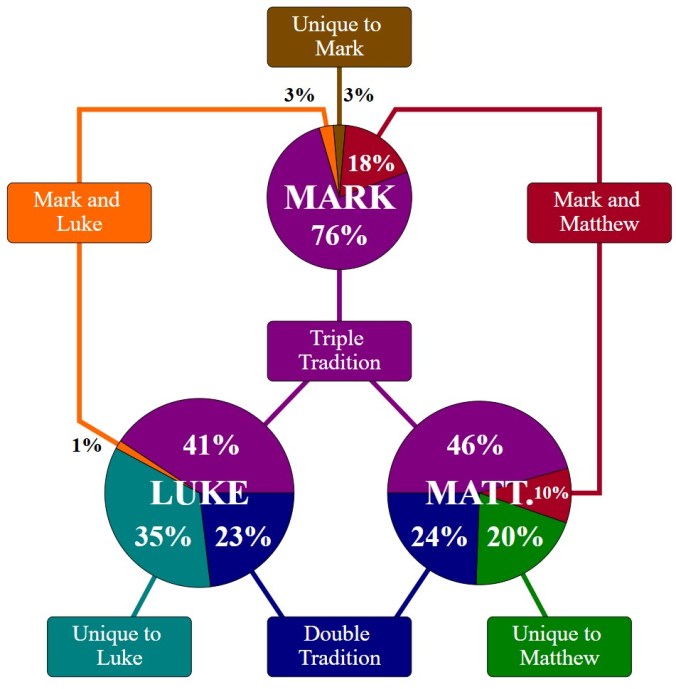
The four Gospels preserve at least five independent streams of early information:

  1. Mark, our earliest narrative.
  2. Matthew’s unique material (M).
  3. Luke’s unique material (L).
  4. The sayings source (Q) shared by Matthew and Luke.
  5. The independent Johannine tradition more than 90% different than the synoptics.

Luke himself opens his Gospel acknowledging many earlier accounts and explaining his historical method in detail:

Luke 1:1–4 (ESV)
“Inasmuch as many have undertaken to compile a narrative of the things that have been accomplished among us,
just as those who from the beginning were eyewitnesses and ministers of the word have delivered them to us,
it seemed good to me also, having followed all things closely for some time past,
to write an orderly account for you, most excellent Theophilus,
that you may have certainty concerning the things you have been taught.”

Luke’s Introduction: What It Implies

  • “Many have undertaken …” – Luke’s Gospel is part of an already-active literary effort.
    • Several written accounts existed before his, showing that Jesus’ life was being recorded early and from multiple angles.
  • “Eyewitnesses and ministers …” – Luke affirms that his material derives from people present “from the beginning.”
    • He places himself in the second generation: a historian gathering and arranging what eyewitnesses had handed down.
  • “It seemed good to me also … to write an orderly account …” – Luke’s Greek indicates education and deliberate composition.
    • Such writing often employed an amanuensis—a professional scribe—just as other New Testament authors mention Tertius (Rom 16:22) and Silvanus (1 Pet 5:12).
    • Early Christians and their patrons worked together to preserve testimony in polished literary form.
  • “For you, most excellent Theophilus …” – The dedication implies sponsorship by a wealthy or influential Roman believer.
    • This hints at a pattern likely both before and after Luke: educated Christians with means supported the research, writing, and copying of the Gospel story.
    • Such partnerships between patrons and writers help explain how high-level Greek compositions could emerge from a movement that began among Galilean laborers.
  • “That you may have certainty …” – Luke writes to confirm, not invent, the message his audience already knows.
    • Christianity spread through confidence that its message rested on verifiable history, not legend.
  • From Aramaic fishermen to Greek historians.
    • This collaboration between eyewitnesses, patrons, and literate scribes shows how the message of Jesus moved from illiterate Aramaic-speaking Jews in Judea to high-level Greek writings circulating across the Roman world within one generation.
    • The very existence of Luke’s prologue demonstrates the extraordinary effort the earliest believers made to preserve what they had seen and heard.

The Two Early Creeds and the Christ Hymn

Within Paul’s letters we find ancient formulas he inherited, not invented—texts that even atheist historians date to within a few years of the crucifixion.

  1. The Resurrection Creed (1 Cor 15:3-5):

“For I delivered to you as of first importance what I also received: that Christ died for our sins according to the Scriptures, that He was buried, that He was raised on the third day according to the Scriptures, and that He appeared to Cephas, then to the Twelve, and to all the apostles.”

Every major critical scholar—Ehrman, Lüdemann, Dunn—dates this to A.D. 30–35, perhaps within months of the crucifixion.

  1. The Gospel Summary (Rom 1:3-4):

“Concerning His Son, who was descended from David according to the flesh and was declared to be the Son of God in power by His resurrection from the dead — Jesus Christ our Lord.”

  1. The Christ Hymn (Phil 2:6-11):

“Who, though He was in the form of God, did not count equality with God a thing to be grasped … Therefore God has highly exalted Him …”

All three focus on Jesus’ death, resurrection, and exaltation.
Because Paul received them, their origin lies earlier than Paul—in the faith and worship of those who knew Jesus personally.

Paul’s Contact with the Earliest Witnesses

Three years after his conversion Paul went to Jerusalem “to visit Cephas and stay with him fifteen days; I saw none of the other apostles except James the Lord’s brother” (Gal 1:18-19).
Later he names James, Cephas, and John as pillars of the Jerusalem church (Gal 2:9).
Within a few years of the crucifixion, Paul had direct access to those who claimed to have seen Jesus alive.

Even if one accepts Ehrman’s skepticism about the Gospels, belief in the resurrection did not originate with Paul; he inherited it from a living network of witnesses already proclaiming it as the core of their faith.


11. Earliest Witnesses to the Resurrection

The Christian proclamation is rooted in testimony—people who said they personally saw Jesus alive after His death.
Those witnesses come from at least six independent sources
Paul’s letters, Mark, Matthew’s material (M), Luke’s gospel material (L) along with Acts, the sayings source shared by Matthew and Luke (Q), and the independent Johannine tradition
and, as Luke himself says, “many have undertaken to compile a narrative” (Luke 1:1).
That means still more written or oral accounts were circulating even before our four canonical Gospels.

Witness / GroupSource(s)Setting or Description
Mary MagdaleneMark 16 : 1-8 (abr.), Matt 28 : 1-10, Luke 24 : 1-11, John 20 : 1-18Arrives first at the tomb; sees the stone removed; in John, meets the risen Jesus and hears her name.
Mary the mother of James, Salome, Joanna, and “other women”Mark 16 : 1-8; Luke 24 : 10; Matt 28 : 1Accompany Mary Magdalene; encounter angels announcing the resurrection.
Peter (Cephas)1 Cor 15 : 5; Luke 24 : 34Private appearance soon after the tomb discovery.
The Eleven (“the Twelve”)1 Cor 15 : 5; Luke 24 : 36-49; John 20 : 19-23; Matt 28 : 16-20Group appearance in Jerusalem; Jesus shows wounds, eats with them, and commissions them.
Cleopas and his companion (on the road to Emmaus)Luke 24 : 13-35Two disciples recognize Jesus in the breaking of bread.
Thomas (with the others a week later)John 20 : 24-29Invited to touch Jesus’ wounds; confesses, “My Lord and my God.”
Seven disciples at the Sea of Galilee (Peter, Thomas, Nathaniel, James, John, and two others)John 21 : 1-14Breakfast by the sea; Jesus restores Peter.
“More than five hundred brothers and sisters at once”1 Cor 15 : 6Collective appearance—unique in ancient literature; Paul notes that most were still alive.
James (the Lord’s brother)1 Cor 15 : 7; Gal 1 : 19Once skeptical (John 7 : 5); later leader of the Jerusalem church.
“All the apostles” (broader missionary circle)1 Cor 15 : 7Broader group beyond the Twelve.
Paul of Tarsus1 Cor 15 : 8; Acts 9 : 1-19Later appearance—“last of all… as to one untimely born.”

Key Observations

  • The witnesses span both genders, multiple social levels, and private and group experiences.
  • The tradition lists named people, many of whom were still alive when the letters circulated—an open invitation to verify.
  • The creeds and hymn Paul “received” are dated by even skeptical scholars (Ehrman, Lüdemann, Dunn) to within five years of the crucifixion.
  • No other ancient religion begins with such a network of living witnesses claiming to have seen the same person alive again.

12. The Pagan Parallel: Apollonius of Tyana

Some critics have suggested that stories of Jesus’ miracles and resurrection merely echo pagan legends such as Apollonius of Tyana—a first-century philosopher and wonder-worker who lived around AD 15 to 100.
At first glance the comparison sounds plausible: both figures are described as miracle workers.
But when we examine the sources historically, the parallels collapse.
The differences in number of witnesses, consistency of narrative, time gap between event and record, and the moral and social impact of the movements are enormous.

CategoryJesus of Nazareth (d. AD 30)Apollonius of Tyana (c. AD 15–100)
Primary SourcesFour Gospels (Mark, Matthew, Luke, John) + Acts + independent early material (M, L, Q) + Paul’s letters (esp. 1 Cor 15)Life of Apollonius by Philostratus, written c. AD 220–230 — about 120 years after Apollonius’ death
Time Between Events and AccountsWithin one generation (20–40 yrs); Paul’s creeds within ≈ 5 yrs of the crucifixionRoughly 120 yrs after events; no contemporary documentation
Number of Named WitnessesDozens of named individuals (Mary Magdalene, Peter, James, John, Thomas, etc.) plus groups up to ≈ 500 people (1 Cor 15)None contemporary; Philostratus claims to use a lost memoir by “Damis,” a follower never verified
Consistency of Death / Resurrection StoriesUnified pattern: crucifixion under Pilate → burial → empty tomb → multiple appearances proving resurrectionPhilostratus admits “many stories” about Apollonius’ death and disappearance (8.30–31); no single version agreed upon
Nature of “Resurrection” or DepartureBodily resurrection attested by multiple witnesses who claimed physical contact and verbal interactionA single-person vision not verified even by those with the person; one death story has him vanishing in a temple but no witnesses.
Community and ContinuityImmediate movement spreading through eyewitness preaching about his resurrection and willingness to die for it. Key enemies of the faith converted due to resurrection encounters (Paul and James, Jesus’ brother)No lasting cult or ethical movement; admiration remained literary and elite
Writers’ Admission of SourcesLuke explicitly cites “many accounts” based on eyewitnesses and ministers of the word (Luke 1:1–4)Philostratus offers hearsay and conflicting legends, openly admitting uncertainty with one unverified source
Overall CharacterEarly, multi-sourced, historically anchored, morally transformativeLate, single-sourced, contradictory, purely literary

Conflicting Endings in the Life of Apollonius

“…as for the manner of his death—if he really died—there are many stories, though Damis repeats none of them…

Some say he died in Ephesus, cared for by two maidservants…

Others say he died in Lindus, where he entered the temple of Athena and disappeared. Others again claim that he died on Crete in a far more remarkable way. One night he went to the temple of Dictynna. The fierce watchdogs guarding it fawned on him instead of barking. The guards, thinking him a sorcerer, bound him. About midnight he freed himself, called his captors to watch, ran to the temple doors, which opened by themselves; he entered, the doors shut, and from within came a chorus of maidens singing, ‘Hasten from earth, hasten to heaven, hasten…’

Later, in Tyana, a young skeptic denied the immortality of the soul, saying, ‘I have prayed to Apollonius for nine months to show me the truth, but he is so utterly dead that he will not appear.’ Five days later, while discussing the same topic, the youth leapt up, drenched in sweat, crying, ‘I believe you, Apollonius!’ He said that Apollonius was present, unseen to others, reciting verses about the soul:

‘The soul is immortal; it is not yours but Providence’s.
When the body wastes away, it leaps forward like a freed horse,
Mingling with the light air and escaping the painful slavery it endured.
But for you—why worry? When you are gone, you will know.’

Here we find a clear statement from Apollonius, standing firm like a prophetic guide, meant to help us understand the mysteries of the soul—so that, with confidence and a true awareness of who we are, we can move forward toward the destiny set for us. I have travelled the whole earth, and I know of no tomb of him anywhere, though his shrine at Tyana is honored with imperial guardianship.”
Philostratus, Life of Apollonius of Tyana 8.30–33 (Loeb Classical Library II, pp. 399–407)

What These Passages Show

  • Multiple death stories: at least three contradictory versions—Ephesus, Lindus, and Crete—with Philostratus openly acknowledging “many stories.”
  • No eyewitness testimony: his supposed companion Damis “repeats none.” All are anonymous hearsay recorded more than a century later.
  • A single private vision: one young man alone claims to see Apollonius reciting verses; no one else perceives anything.
  • Unremarkable teaching: the message is a generic claim that the soul is immortal and a dismissal of inquiry—“you’ll find out when you die.”
  • No enduring movement: the story ends with a civic shrine, not a community transformed by moral conviction.

In summary:
Apollonius’ ending is late, contradictory, and philosophically shallow—a literary imitation of divine ascent rather than a historical claim verified by witnesses.
The resurrection of Jesus, by contrast, was proclaimed within years by many named witnesses and launched a movement that reshaped the moral and spiritual history of the world.


13. Visions and New Religious Movements Across History

The resurrection of Jesus stands within a broader human pattern of visions and revelations that have launched new faiths or sects.
But in every other case the experiences are isolated, private, and far removed from public verification.
Christianity began with numerous named witnesses claiming to have seen the same person alive again—an unparalleled claim in religious history.

Figure / Movement (approx. date of founding vision)Core Vision Claim (Who / When)How Many Claimed to See?Net-New Movement or Sect Formed?
Jesus of Nazareth (c. AD 30)Resurrection appearances – Cephas, the Twelve, ≈ 500 at once, James, all apostles, Paul (1 Cor 15); plus women (Mary Magdalene, Mary mother of James, Salome, Joanna etc.), Cleopas and companion (Emmaus), the Eleven (Jerusalem), and seven disciples (Galilee).Many – groups and crowdsYes → Christianity
Romulus (8th cent. BCE)Post-mortem appearance to Proculus Julius after disappearance.1No (state cult only)
Zoroaster (c. 1200–600 BCE)Foundational vision of Ahura Mazda via Vohu Manah.1Yes → Zoroastrianism
Asclepius cult (5th–4th cent. BCE)Healing dream-visions in temples (Epidaurus etc.).Many (private)Expansion of existing cult
Apollonius of Tyana (c. AD 15–100)Contradictory death accounts; later one young man claims vision of him reciting verses about the soul.1No (enduring cult absent)**
Simon Magus (mid-1st cent. AD)Magical signs and visions recorded by followers.1 (+ followers)Yes → early sect
Mani (AD 228 & 240)Revelatory visions; claims prophetic commission.1Yes → Manichaeism
Muhammad (AD 610)Revelation through Gabriel beginning at Ḥirāʾ.1Yes → Islam
Montanus with Priscilla & Maximilla (c. AD 156–172)Trance-prophecies and visions of Spirit’s coming (New Prophecy).3Sect within Christianity
Guru Nanak (c. 1500)Vision after three-day disappearance in River Bein.1Yes → Sikhism
Sabbatai Zevi (AD 1648–1666)Ecstatic visions; declares himself Messiah; later apostasy.1 (+ followers)Yes → Sabbatean sects
Israel ben Eliezer, “Baal Shem Tov” (c. 1700–1760)Jewish mystic whose visions and ecstatic prayer experiences inspired the rise of Hasidic Judaism. Claimed encounters with angels and a vision of the Messiah saying redemption would come when his teachings spread.1 (primary seer)Yes → Hasidic movement within Judaism
Emanuel Swedenborg (AD 1744–1745)Visions of heaven and hell.1Yes → Church of the New Jerusalem
Ann Lee (c. AD 1770)Visions of Christ’s “second appearing.”1Yes → Shaker movement
Handsome Lake (1799)Series of visions inspiring Iroquoian reform.1Yes → Longhouse Code
Native American Vision Ceremonies (ancient → present)Vision-seeking through fasting, isolation, or sacramental plants (e.g., Plains vision quest, peyote rites of the Native American Church). Experiences interpreted as encounters with spirit beings or the Great Spirit.Individuals or small groups in ritual contextNo – practice within Indigenous traditions (Native American Church formalized 19th–20th cent.)
Joseph Smith (1820–1829)“First Vision” (1820: God the Father & Jesus Christ); angel Moroni visitations (1823–29); later Three Witnesses & Eight Witnesses see gold plates but no divine figures.1 (primary seer) + 11 plate witnessesYes → Church of Jesus Christ of Latter-day Saints
Ellen G. White (1844 – 1915)Extensive visions and dreams guiding doctrine and practice throughout her ministry.1Yes → Seventh-day Adventist Church
The Báb (AD 1844)Night-long revelation and public declaration.1Yes → Bábism
Bahá’u’lláh (AD 1852–1863)Prison theophany and Ridván declaration.1Yes → Bahá’í Faith
Black Elk (1872)“Great Vision” at age 9.1Cultural renewal movement
Mirza Ghulam Ahmad (1882–1889)Divine revelations and visions.1Yes → Ahmadiyya Islam
Deguchi Nao (1892)Possession / revelations of “Ushitora no Konjin.”1Yes → Ōmoto
Hong Xiuquan (1837–1843)Visions claiming to be Jesus’ younger brother.1Yes → Taiping movement
Rabbi Menachem Mendel Schneerson (1902–1994)Revered leader of the Chabad-Lubavitch movement; after his death, a minority of followers within this already small Hasidic branch claimed to see him in visions and expected his messianic return. He remains buried in a verifiable tomb (the Ohel, Queens, New York).Small number of individual claimantsNo – renewal and expectation within Judaism (not a new religion)
Sun Myung Moon (1936)Vision of Jesus at age 16; church founded 1954.1Yes → Unification Church
Catholic Marian Apparitions (1531 → present)Reported appearances of Mary (e.g., Guadalupe 1531; Lourdes 1858; Fátima 1917; Zeitoun 1968–71). The Church has officially recognized ≈ 16 of more than 1,500 reported apparitions worldwide after rigorous investigation. Most involve one or a few seers, occasionally crowds of tens of thousands.Variable – usually 1 to few; occasionally crowdsNo – devotional renewal within Catholic faith

Ancient accounts of the Asclepius healing temples—especially at Epidaurus, Pergamum, and Kos—show that visions and even miraculous healings were part of Greco-Roman religious life.
The process was deliberate and carefully prepared:

  • Purification and preparation: visitors bathed in sacred springs, fasted, and wore clean garments before entering the abaton, the inner sanctuary where they would sleep.
  • Offerings and prayer: worshippers made small sacrifices and prayed for a dream or appearance of Asclepius to reveal the cure.
  • Incubation: during the night they expected the god—often depicted as a physician or serpent—to appear and prescribe or perform healing.
  • Interpretation and testimony: priests interpreted the dreams the next morning, and those who claimed to be healed offered public inscriptions describing what had happened.

Sources such as Pausanias, Aelius Aristides, and the Epidaurian inscriptions record numerous cases of healing and divine encounters.
There is no reason to doubt that people in these temples had powerful visionary or even miraculous experiences.

But these accounts are not comparable to the resurrection appearances of Jesus.
Every Asclepian vision was sought through ritual expectation—participants came prepared, purified, and hoping to see the god.
The resurrection appearances, by contrast, occurred among people who were not expecting anything: they were frightened, defeated, and convinced that Jesus was dead.
Whatever one concludes about either set of experiences, the context and character of the events are entirely different—ritual healing visions in a temple versus unexpected encounters with a crucified man alive again.

Key Contrasts

  • Apart from Jesus’ resurrection, every founding vision in history begins with one person or a very small circle claiming a private experience.
  • None involve hundreds of simultaneous eyewitnesses or early written creeds within years of the claimed event.
  • Most other revelations appear centuries after the traditions they reference, whereas the resurrection was proclaimed immediately within its own culture.
  • Devotional phenomena such as Marian apparitions, Native American vision ceremonies, and post-Rebbe expectations renew existing faiths but do not create new religions.

14. Visions: Real, Mistaken, or Manufactured?

History has to allow three possibilities whenever someone claims a vision:

  1. They truly perceived something real (veridical).
  2. They misperceived—a dream, illusion, or grief-induced image (non-veridical).
  3. They fabricated the claim (deception).

The New Testament openly acknowledges this range and calls for discernment:

  • Test the spirits to see whether they are from God, for many false prophets have gone out into the world.” — 1 John 4:1–3
  • “Even if we or an angel from heaven should preach a different gospel, let him be accursed.” — Galatians 1:8–9
  • Satan disguises himself as an angel of light.” — 2 Corinthians 11:14–15
  • Jesus warned that false christs and false prophets would perform “great signs and wonders” to mislead, “even the elect if possible.” — Matthew 24:23–26
  • The Colossian letter also acknowledges teachers who practiced the worship of angels and boasted about visions they had seen: “Do not let anyone who delights in false humility and the worship of angels disqualify you. Such a person goes into great detail about what they have seen; they are puffed up with idle notions by their unspiritual mind. They have lost connection with the Head, from whom the whole body grows.” — Colossians 2:18–19

The early apologist Origen made the same point when replying to pagan critics: some wonders are tricks or demonic imitations, but Jesus’ works differ in moral effect:

“We know of many who have deceived multitudes by magical illusions, but Jesus’ works were not such, for they reformed those who beheld them.” — Contra Celsum 2.48

Why the Earliest Christian Claims Stand Apart

  • Breadth and convergence: not one seer but a network of named witnesses—women at the tomb, Peter, the Eleven, the Emmaus pair, the Galilee seven, about 500 at once, James, all the apostles, and finally Paul.
  • Public, embodied encounters: appearances in groups, with touch, conversation, and shared meals—claims open to verification, not private impressions.
  • Earliest focus on a single historical event: pre-Pauline creeds and hymn (1 Cor 15:3–5; Rom 1:3–4; Phil 2:6–11) already center on death → burial → resurrection → exaltation.
  • Costly conviction: those witnesses proclaimed what they saw at great personal risk; they gained no wealth or power, only hardship and martyrdom.

Christianity therefore recognizes that visions can be true, mistaken, or manufactured, yet the resurrection testimony remains unique on every historical test—number, independence, embodiment, and enduring moral consequence.


15. The Greater Miracle

David Hume challenged the world to ask which is more probable:
that witnesses of a miracle are deceived, or that the miracle actually occurred.
Across history, countless founders and visionaries have claimed revelations—usually alone, often private, and rarely verifiable.
But the resurrection of Jesus stands apart:

  • Multiple named witnesses—men and women, groups and crowds—claimed to see the same person alive again.
  • Independent, early sources—Paul’s letters, the Gospels, and Acts—record the claim within a generation.
  • A unified message—death, burial, resurrection, exaltation—runs across all streams of tradition.
  • A moral and social transformation followed: those who once fled in fear became proclaimers willing to suffer and die.

If all this were false, we must believe that hundreds across diverse settings shared the same deception and that a movement built on that deception outlasted the empires that tried to crush it.
If it is true, then history has been opened to its Author.

So Hume’s question remains the right one:
Which is the greater miracle—
that so many credible witnesses were deceived,
or that the resurrection they proclaimed really happened?

Multiplying by Mission: Session 6 at Mission Lake

40% Growth Then, 5% Growth Now — What We Must Learn Anew

When Nero died by suicide in AD 68, the Roman Empire plunged into chaos.
In a single year four emperors—Galba, Otho, Vitellius, and finally Vespasian—rose and fell.
While Rome fought for power, Judea was already on fire.
The revolt that began under Gessius Florus would end with Jerusalem leveled, the Temple burned, and a turning point for both Jews and Christians.


1. Florus and the Spark of Revolt (AD 66)

Florus, the Roman governor of Judea, stole seventeen talents of silver from the Temple treasury—about 1,200 pounds of consecrated silver, worth roughly ten million U.S. dollars today.
This was not ordinary corruption; it was sacrilege.

When Florus took seventeen talents out of the sacred treasure, and the multitude ran together in the Temple crying out against him, some of the youths went about the city carrying baskets and asking alms for poor Florus.
— Josephus, Jewish War 2.14.5 §306–308 (c. AD 75–79)

His answer was bloodshed.

Florus sent soldiers into Jerusalem and ordered a massacre. They slew about three thousand six hundred persons, women and children as well as men; and among them were citizens of Roman knighthood. Some were scourged and then crucified.
— Josephus, Jewish War 2.14.9 (c. AD 75–79)

The outrage united the city. Rebels stormed the Antonia Fortress, the great Roman garrison on the northwest corner of the Temple Mount. To capture it was to challenge Rome itself.

They compelled the garrison to surrender and then slaughtered them. Thus war was now openly begun.
— Josephus, Jewish War 2.17.9 (c. AD 75–79)

Rome’s patience ended. Nero sent Vespasian, the empire’s most seasoned general, and his son Titus to crush the rebellion.


2. Vespasian in Galilee — Fire and Terror (AD 67)

Galilee became Rome’s first target. At Jotapata, a hill fortress commanded by Josephus himself, the walls fell after forty-seven days.

Forty thousand were slain, and the city was utterly demolished; those who had hidden in caves were dragged out and slain.
— Josephus, Jewish War 3.7.36 (c. AD 75–79)

Then came Gamla, a ridge-top city east of the Sea of Galilee. Its name means camel in Aramaic, and its fall was as steep as its slopes.

Men and women alike threw themselves and their children down the precipices; and the whole city was covered with corpses.
— Josephus, Jewish War 4.1.9 (c. AD 75–79)

Josephus summed it simply: “Galilee was filled with fire and blood.”
— Josephus, Jewish War 4.1.9 (c. AD 75–79)

The Roman campaign left the region in ruins, silencing nearly every center of resistance.

It was here that Josephus himself was captured. As commander of Jewish forces in Galilee, he had held out at Jotapata until the city fell. In his own account, he claims that while in captivity he prophesied that Vespasian would soon be emperor:

You, O Vespasian, shall be Caesar and emperor, you and your son. Bind me now still closer, and keep me for yourself; for you, O Caesar, are lord, not only of me, but of the land and sea, and of all mankind.
— Josephus, Jewish War 3.8.9 §401–403 (c. AD 75–79)

When that prophecy appeared to come true the following year, Vespasian spared his life, granted him Roman citizenship, and attached him to his household. From then on Josephus lived in Rome under imperial patronage, taking the family name Flavius from his patrons.

This is how Yosef ben Matityahu, a Jewish priest and rebel general, became Flavius Josephus, historian of the Jewish War. His writings—sometimes defensive, sometimes deferential toward Rome—remain the only detailed eyewitness record of Jerusalem’s destruction.


3. The Siege of Jerusalem (AD 70)

When Nero’s death recalled Vespasian to Rome, Titus took full command.
Inside Jerusalem, zealot factions fought one another while Roman legions built a five-mile siege wall to starve the city into surrender.
This wall—called a circumvallation—completely encircled Jerusalem. Built in only three days by tens of thousands of soldiers, it cut off every road and stopped all supplies. Famine would finish what the legions began.

The famine grew severe and destroyed whole houses and families. The alleys were filled with dead bodies of the aged; children and youths swarmed about the market-places like shadows, and fell wherever famine overtook them. No one buried them; pity was strangers to men; for famine had confounded all natural feeling.
— Josephus, Jewish War 5.12.3–4 (c. AD 75–79)

Then Josephus records one of antiquity’s darkest scenes:

There was a certain woman named Mary, daughter of Eleazar, of the village Bathezor. Driven by famine and rage, she slew her infant son, roasted him, and ate one half, concealing the rest. When the soldiers smelled the roasted meat and rushed in, she said, ‘This is my own son; the deed is mine; eat, for I have eaten. Do not pretend to be more tender-hearted than a woman or more compassionate than a mother.’
— Josephus, Jewish War 6.201–213 (c. AD 75–79)

Titus later claimed he had ordered the Temple spared:

I myself called a council of war and urged that the Temple be saved; but the flame was beyond control, and the sanctuary was burned against my will.
— Josephus, Jewish War 6.4.7 §254 (c. AD 75–79)

Josephus blames undisciplined troops; Tacitus sees deliberate policy:

It was resolved to destroy the Temple that the religion of the Jews might be more completely abolished.
— Tacitus, Histories 5.12 (c. AD 100–110)

The Destruction of the Temple of Jerusalem – Francesco Hayez, 1867, oil on canvas

Different motives, same outcome: the Temple fell.
For Christians, it confirmed the prophecy of Christ: “Not one stone shall be left upon another.” (Mark 13:2)


4. Crosses Without Number

As for those who had fled from the city and were caught, they were first scourged and then tortured and finally crucified before the walls. In their fury and hatred the soldiers nailed up the prisoners in different postures, by way of jest, and the multitude was so great that room was wanting for the crosses, and crosses for the bodies.
— Josephus, Jewish War 5.11.1 (c. AD 75–79)

Josephus later expands this account:

Those who were taken outside the city he first scourged, and then tormented with all manner of tortures before crucifying them opposite the wall. Titus indeed felt pity for them, but their number was so great that there was no room for the crosses nor crosses for the bodies. About five hundred were crucified each day, and the soldiers, in their rage and hatred, amused themselves by crucifying some one way and some another, until, owing to the multitude, there was no space left for the crosses nor crosses for the bodies.
— Josephus, Jewish War 6.1.1 (c. AD 75–79)

The same empire that boasted of order and civilization turned execution into entertainment.
The hills around Jerusalem stood thick with crosses—not yet symbols of redemption, but monuments of Rome’s rule through fear.


5. Aftermath — Slavery, Spectacle, and Tax

Through Rome’s streets the captives marched, carrying the Menorah and sacred vessels. Coins were struck proclaiming IUDAEA CAPTA—“Judea Captured.” Various versions of these coins were struck and used for 25 years under Vespasian and his two sons Titus and Domitian.

IMP CAES VESPASIAN AUG PM TR P COS III = Commander Caesar Vespasian Augustus, Chief Priest, Holder of Tribunician Power, Consul for the Third Time; IUDEA CAPTA S C = Judea Captured by decree of the Senate

He decreed that all Jews throughout the world should pay each year two drachmas to the Capitol in Rome, as they had previously paid to the Temple in Jerusalem.
— Dio Cassius, Roman History 66.7 (c. AD 200–220)

The fiscus Judaicus turned a holy offering into tribute for pagan gods.
Jewish Christians, still classed as Jews, were forced to pay the same tax of defeat.

Meanwhile, many early believers saw a deeper reason for Jerusalem’s ruin: the death of James the Just, the brother of Jesus and leader of the church in Jerusalem.

Festus was now dead, and Albinus was but upon the road; so Ananus, who had become high priest, assembled the Sanhedrin of judges, and brought before them the brother of Jesus, who was called Christ, whose name was James, and some others; and when he had formed an accusation against them as breakers of the law, he delivered them to be stoned.
— Josephus, Antiquities 20.9.1 §200–203 (c. AD 93)

Hegesippus, a second-century Jewish Christian, adds detail:

They placed James on the pinnacle of the Temple and cried, ‘Tell us, O righteous one, what is the door of Jesus?’ And he answered with a loud voice, ‘Why do you ask me concerning the Son of Man? He sitteth at the right hand of the Great Power, and shall come on the clouds of heaven.’ Then they began to stone him, and a fuller took the club with which he beat clothes and struck the righteous one on the head, and so he suffered martyrdom.
— Hegesippus in Eusebius, Ecclesiastical History 2.23.10–12 (c. AD 170, quoted c. AD 310–325)

Hegesippus concludes that the siege of Jerusalem followed soon after James’s death, calling it divine judgment:

Immediately after this Vespasian began to besiege them; and they remembered the saying of Isaiah the prophet, ‘Let us take away the righteous man, because he is troublesome to us; therefore they shall eat the fruit of their doings.’ Such was their lot, and they suffered these things for the sake of James the Just.
— Hegesippus in Eusebius, Ecclesiastical History 2.23.18 (c. AD 170, quoted c. AD 310–325)

Eusebius agrees, closing his account:

These things happened to the Jews to avenge James the Just, who was the brother of Jesus that is called Christ. For, as Josephus says, these things befell them in accordance with God’s vengeance for the death of James the Just, which they had committed, although he was a most righteous man.
— Eusebius, Ecclesiastical History 2.23.19–20 (c. AD 310–325)

From this moment on, many Christians saw the destruction of Jerusalem not only as Rome’s triumph, but as God’s judgment for rejecting Christ and murdering His righteous servant.


6. The Arch of Titus — The Empire’s Theology in Stone (AD 81)

When Titus died, the Senate declared him divine. The arch still standing on the Via Sacra reads:

The Senate and People of Rome [dedicated this] to the deified Titus Vespasian Augustus, son of the deified Vespasian.

Inside its vault, carvings show Roman soldiers bearing the Temple treasures.

They brought the Menorah and the table of the bread of the Presence, and the last of the spoils was the Law of the Jews; after these, a great number of captives followed.
— Josephus, Jewish War 7.5.5 (c. AD 75–79)

At the top of the arch inside is the depiction of Titus’ ascension to heaven as a god on the wings of an eagle.

For Rome, the arch proclaimed the victory of its gods.
For Christians, it stood as a silent confirmation of prophecy: the Temple of stone was gone, but the Temple of Christ remained.


7. The Flight to Pella — Revelation and Refuge

Amid the ruins of Jerusalem’s revolt, one community escaped—the believers who remembered Christ’s warning to flee.

The people of the church in Jerusalem had been commanded by a revelation, vouchsafed to approved men there before the war, to leave the city and to dwell in a certain town of Perea called Pella. And when those who believed in Christ had come thither from Jerusalem, then, as if the holy men had altogether deserted the royal city of the Jews and the whole land of Judea, the judgment of God at last overtook them for their abominations.
— Eusebius, Ecclesiastical History 3.5.3 (c. AD 310–325)

Eusebius attributes their escape to a divine revelation, while Epiphanius explains it as obedience to Christ’s prophecy:

When all the disciples were settled in Pella because of Christ’s prophecy about the siege, they remained there until the destruction of Jerusalem.
— Epiphanius, Panarion 29.7.7–8 (c. AD 375)

Different explanations—same event. The believers crossed the Jordan to Pella, a Decapolis city about sixty miles northeast of Jerusalem, where they waited out the war.
Their flight fulfilled Jesus’ own words (Luke 21:20–21).
What looked like retreat was obedience.


8. The Nazarenes — Law-Observant, Christ-Confessing

The first branch to emerge from that exile was the Nazarenes—Jewish believers who kept the Mosaic Law yet confessed Jesus as the divine Son of God.
They were the losing party in the Council of Jerusalem (Acts 15).

At that council, certain men from Judea began teaching that Gentile converts must keep the Law of Moses to be saved:

Some men came down from Judea and were teaching the brothers, ‘Unless you are circumcised according to the custom of Moses, you cannot be saved.’
— Acts 15:1

Later Luke identifies who pressed the issue:

But some of the sect of the Pharisees who believed rose up, saying, ‘It is necessary to circumcise them and to command them to keep the law of Moses.’
— Acts 15:5

Peter and James ruled that Gentiles need not bear that yoke:

We should not trouble those of the Gentiles who turn to God, but should write to them to abstain from things polluted by idols, from sexual immorality, from what has been strangled, and from blood.
— Acts 15:19–20

Those Jewish believers who could not release Torah observance continued as a community of Torah-keeping Christians—the Nazarenes.

Two decades later they were still strong. When Paul returned to Jerusalem near the end of his ministry, James the Just, the same leader later martyred near the Temple, recognized their influence:

You see, brother, how many myriads of Jews there are who have believed, and they are all zealous for the Law… Therefore do what we tell you: we have four men who have taken a vow; take them and purify yourself along with them, and pay their expenses, so that all may know that there is nothing in what they have been told about you, but that you yourself also live in observance of the Law.
— Acts 21:20, 23–24

James’s advice shows that the Nazarenes were not fringe but central within the Jerusalem church.

Centuries later, Jerome described them:

“The adherents to this sect are known commonly as Nazarenes; they believe in Christ the Son of God, born of the Virgin Mary; and they say that He who suffered under Pontius Pilate and rose again is the same as the one in whom we believe.”
— Jerome, Letter 75 to Augustine (AD 398–403)

“The Nazarenes accept Messiah in such a way that they do not cease to observe the old Law.”
— Jerome, Commentary on Isaiah 8:14 (AD 398–403)

Even Epiphanius, who condemned most sects, writes:

The Nazarenes are Jews who keep the customs of the Law but also believe in Christ. They say that Jesus was born of the Virgin Mary by the Holy Spirit. They believe that God created all things, that Jesus is His Son, and that the resurrection of the dead has already begun in Him… As for their understanding of Christ, I am not certain—whether they have been misled by false teachers who call Him merely human, or whether, as I think, they confess that He was born of Mary by the Holy Spirit.
— Epiphanius, Panarion 29.7.5–6 (c. AD 375)

Epiphanius lists their beliefs as orthodox and then admits, “I cannot say whether they have been deceived or whether they confess the truth.”
Had they denied Christ’s divinity, he would have said so.
His hesitation confirms that the Nazarenes were orthodox in belief, Jewish in culture—the first generation of Messianic Jews bridging synagogue and church.


9. The Ebionites — The First Denial of Christ’s Divinity

A second group took a different path. Epiphanius places their origin after the flight to Pella:

The Ebionites are later than the Nazoraeans… their sect began after the flight from Jerusalem.
— Epiphanius, Panarion 29.7.7–8 (c. AD 375)

They taught that Jesus was a mere man chosen by God, denied the virgin birth, and altered Scripture to fit their beliefs.

Those who are called Ebionites use the Gospel according to Matthew only, and repudiate the Apostle Paul, maintaining that he was an apostate from the Law.
— Irenaeus, Against Heresies 1.26.2 (c. AD 180)

The Ebionites believe that He was a mere man, born of Joseph and Mary according to the common course of nature, and that He became righteous through the progress of His moral character.
— Origen, Commentary on Matthew 16.12 (c. AD 248)

They falsify the genealogical tables in Matthew’s Gospel, saying that He was begotten of a man and a woman, because they maintain that Jesus is really a man and was justified by His progress in virtue, and that He was called Christ because the Spirit of God descended upon Him at His baptism. They say that this same Spirit, which had come upon Him, was taken away and left Him before the Passion and went back to God; and that then, after His death and resurrection, this same Spirit returned to Him again. Thus they deny that He is God, though they do not deny that He was a man.
— Epiphanius, Panarion 30.14.3–5 (c. AD 375)

They also spread a slander about Paul:

They say that Paul was a Greek who came to Jerusalem and lived there for a time. He desired to marry a daughter of the priests but was refused. Out of anger and disappointment he turned against circumcision, the Sabbath, and the Law. Because of this, they claim, he wrote against these things and founded a new heresy.
— Epiphanius, Panarion 30.16.6–9 (c. AD 375)

For the Ebionites, Jerusalem’s destruction was not punishment for rejecting Christ but for accepting the apostolic Gospel.
They blamed Paul and the church that followed him for turning Israel away from the Law.
Thus they reversed the very lesson of history that Josephus, Hegesippus, and Eusebius had drawn from the death of James the Just.
Where the Nazarenes preserved unity in diversity, the Ebionites cut themselves off from the apostolic faith.


10. Three Waves of Testimony and the Apostolic Standard

When we date the earliest Christian writings, we find three waves of testimony—sources acknowledged even by skeptical historians as genuine first-century evidence.
They give us the historical core around which all later writings revolve.


Three Waves of Early Christian Testimony

Wave of WitnessApproximate DateContent & DescriptionAuthority and Significance
CreedsAD 30s1 Corinthians 15:3–5 — “Christ died, was buried, and rose again according to the Scriptures.”
Philippians 2:6–11 — The Christ-hymn proclaiming His pre-existence, incarnation, humility, and exaltation.
The earliest confessions of faith; already proclaim Jesus as divine and demand worship.
Paul’s EpistlesAD 48–61The seven undisputed letters of PaulRomans, 1 & 2 Corinthians, Galatians, Philippians, 1 Thessalonians, and Philemon.The interpretation of Christ’s work by Paul himself, written within the lifetime of the apostles; Paul quotes and affirms the early creeds as authoritative revelation.
Synoptic GospelsAD 50s–60sMatthew, Mark, and Luke — written within the first generation after Jesus, preserving eyewitness memory of His life, teaching, death, and resurrection.The formal written record of what the earliest witnesses proclaimed; confirms and expands the message already present in the creeds and letters.

This Philippians hymn is not later theology; it is the earliest Christian confession we possess.
It begins with divinity, not humanity.
It declares that the one “existing in the form of God” became man, died on a cross, and was exalted so that every knee should bow and every tongue confess that Jesus Christ is Lord.
It is a proclamation of His divinity and a demand for worship from the very start of the Christian movement.

Modern critics such as Bart Ehrman claim that belief in Jesus’ divinity was a late development, yet their own dating of the evidence proves the opposite.
The earliest sources—the creeds Paul quotes—already worship Him as divine, and Paul treats those creeds as authoritative revelation.
From the beginning, the church bowed to a divine Christ, not a human teacher slowly exalted by legend.

Measured by that apostolic standard, the Nazarenes remained faithful to the original confession, honoring Paul’s letters and the earliest creeds.
The Ebionites, however, altered the Gospels, repudiated Paul, and rejected the Philippians 2 creed, denying Christ’s divinity and placing themselves outside the apostolic faith.


11. Dating the Gospels

Critical scholars commonly date Mark around AD 70, arguing that Jesus’ prophecy of the Temple’s destruction must have been written after it happened.
But this logic assumes that prophecy is impossible—a philosophical bias, not a historical fact.
If prophecy is real, the foundation for late dating collapses.

Even on their own terms, critics face contradictions.
They argue that Matthew copied Mark and therefore must be later, yet the Ebionites were already using and editing Matthew shortly after Jerusalem’s fall.
If Matthew was being altered in the 70s, it had to exist before then—and if Matthew depended on Mark, Mark must be earlier still.
The evidence forces the Synoptic Gospels back into the 60s or even 50s—within the lifetime of eyewitnesses.

Paul’s letters tighten the timeline further.
In 1 Corinthians, written about AD 54–55, Paul quotes Gospel material three times:

  • 1 Corinthians 7:10 echoes Mark 10:11–12 on divorce — “not I, but the Lord.”
  • 1 Corinthians 9:14 recalls Luke 10:7 — “the Lord commanded that those who proclaim the gospel should get their living by the gospel.”
  • 1 Corinthians 11:23–25 recounts the words of institution at the Lord’s Supper, matching Luke 22:19–20 and Matthew 26:26–28.

These parallels show that the Gospel traditions were already written—or at least formally fixed—by the early 50s.
Paul quotes them as Scripture, not rumor, expecting his readers to recognize their authority.
This means the Gospels, or their written sources, predate 1 Corinthians itself—placing them within twenty years of the crucifixion.

Thus the timeline of Christian testimony runs not forward into myth but backward into eyewitness memory:

  • Creeds (AD 30s): the original confession of Christ’s death, resurrection, and divine status.
  • Paul’s Epistles (AD 48–61): the interpretation of those events by Paul himself, written within the lifetime of the apostles.
  • Synoptic Gospels (AD 50s–60s): the written preservation of what the eyewitnesses had proclaimed from the beginning.

When the evidence is allowed to speak for itself, it shows that the worship of Jesus as divine and the written record of His life both originate within living memory of His death and resurrection.
Even those who date the Gospel of John later, around the 90s, acknowledge that the Synoptics—and the faith they record—were already established decades earlier.
Christianity’s foundation is not legend developed over centuries—it is history written by witnesses and verified by worship.

Multiplying by Mission: Session 1 at Mission Lake

40% Growth Then, 5% Growth Now — What We Must Learn Anew

Opening & Welcome

Good evening, everyone, and welcome to our first session of Multiplying by Mission.

My name is Jason Conrad. I live here in South Carolina with my wife Jen and our family. By profession, I serve as a district leader with CVS Health, overseeing nearly twenty stores and hundreds of employees. My background is in healthcare and leadership — I hold both a Doctor of Pharmacy (PharmD) and a Master of Business Administration (MBA) — and I’ve spent many years leading in that field.

But alongside that, my deepest calling is teaching God’s Word and the history of His church. I also hold a Bachelor’s degree in Biblical Studies and a Master of Divinity, with a focus on the New Testament, early Christian history, and how the first believers lived out their faith in the Roman Empire.

Back in 2000, I moved to South Carolina to help start Christ Central Institute. From the very beginning, I’ve believed in the vision of equipping leaders and serving communities through Christ Central. I’ve been teaching for years in the church, and I’ve seen again and again how knowing our history strengthens our faith.

This series has a big title: Multiplying by Mission — 40% Growth Then, 5% Growth Now — What We Must Learn Anew.


The State of Christianity in the World Today

Christianity is still the largest global religion, but the landscape is shifting. According to Pew Research Center (The Future of World Religions: Population Growth Projections, 2017–2021 updates):

MetricChristianityIslamUnaffiliated
2020 Total Share28.8%25.6%24.2%
2010–2020 Growth+5.7%+20.7%+11.4%
Primary Growth AreasAfrica, AsiaAfrica, Asia, MENANorth America, Europe, East Asia

Now compare that with the first three centuries of the church. Sociologist Rodney Stark, in his book The Rise of Christianity (HarperCollins, 1996), famously calculated Christianity’s growth at about 40% per decade. Stark wasn’t writing as a theologian but as a sociologist, showing how a small sect could realistically have expanded to millions within three centuries. His analysis demonstrates that Christianity’s explosive rise is historically plausible, not legendary.

  • AD 40: ~1,000 Christians
  • AD 100: ~7,000–10,000
  • AD 150: ~40,000
  • AD 200: ~200,000
  • AD 250: ~1,000,000
  • AD 300: ~6,000,000
  • AD 350: ~30,000,000 (roughly half the empire)

If today’s church grew at that same rate, 2.3 billion Christians would become nearly the entire global population by AD 2070.

This is why our series is called Multiplying by Mission. The first Christians multiplied by 40% a decade. Today, we grow at 5%. The question before us is: what did they know that we must learn anew?


What Would It Take to Grow Like That Again?

So what would it take for us to recover that kind of momentum? Here’s one way to think about it:

SourceTarget % per DecadeHow to Get There
Retention of Christians+10%Keep 75–80% of all who enter the church — whether raised Christian or converted as adults — through discipleship, mentoring, apologetics, and community
Evangelism of Unaffiliated+15%Reconnect ~20% of “nones” each decade through service, digital outreach, hospitality, and apologetics
Combined Total25% per decadeSignificant growth, but still below the early church’s ~40% per decade

Now, you might be wondering: is 75–80% retention even possible? Today in America, only about half of kids raised Christian stay Christian as adults — and many adults who convert later in life also drift away. Retention is not just about keeping youth; it’s about keeping everyone who enters the church.

In the early church, retention had to be much higher across the board. Why? Because persecution weeded out nominal believers, catechesis trained converts before baptism, and Christian community bound people together in ways far stronger than what we often see today.

And this doesn’t even include conversions from other religions like Islam or Hinduism, or the natural increase from Christian birth rates. When you factor those in, the growth potential could push even higher.


The 18-Year-Old in the Classroom

Picture an 18-year-old. She’s grown up in church her whole life. She’s been told the Bible is true, and she’s never really faced serious doubt.

She graduates high school and heads to university. She signs up for “Introduction to the New Testament” — thinking it’ll be an easy A.

What she doesn’t realize is that the professor is one of the most famous Bible scholars in the world today. He’s written or edited more than 30 books, several bestsellers. He’s the author of the textbook used in universities across the country. He used to be a devout evangelical Christian — but he lost his faith. In his own words: “I no longer go to church, no longer believe, no longer consider myself a Christian.”

Now picture her in a lecture hall with 400+ students. Many grew up in church. Many think this will reinforce what they already know.

Instead, the professor walks in with humor, confidence, and command of the text — and begins by dismantling assumptions: contradictions, manuscript problems, alleged forged letters, the problem of suffering, and arguments against miracles.

By the end of the semester, she isn’t angry. She isn’t hostile. She’s just unsure. On a survey, she checks “unaffiliated.”

That’s the world we live in. Christianity is growing slowly in much of the West, and defections are common. This is why this class matters.


The Seven Tactics of Skeptical Professors

1. The Apollonius of Tyana Comparison

“I sometimes begin my undergraduate classes in New Testament studies by telling my students that I am going to describe a person to them, and they have to tell me who it is. I then talk about a man who lived some time ago, who was said to have been miraculously born, who taught his followers, did miracles to confirm that he was a son of God, convinced many people that he was divine, and then at the end of his life ascended to heaven. When I ask them who this sounds like, they invariably say Jesus. But the person I’m describing is Apollonius of Tyana.”
— Bart D. Ehrman, Did Jesus Exist? (2012), p. 211

2. Textual Variants in the New Testament

“Not only do we not have the originals, we don’t have the first copies of the originals… What we have are copies made later — much later… And these copies all differ from one another, in many thousands of places… there are more variations among our manuscripts than there are words in the New Testament.”
— Bart D. Ehrman, Misquoting Jesus (2005), pp. 10–11

3. Contradictions in the Gospels

“In the Gospel of Mark, Jesus says, ‘Whoever is not against us is for us’ (9:40). In Matthew he says, ‘Whoever is not with me is against me’ (12:30). Did Jesus say both things? Could he really mean both? Isn’t there a contradiction here?”
— Bart D. Ehrman, Jesus Interrupted (2009), p. 41

“In Mark’s account, Jairus comes to Jesus and tells him that his daughter is near death… In Matthew’s version… Jairus comes to Jesus and tells him that his daughter has already died. Which is it?”
Jesus Interrupted, pp. 39–40

4. Authorship and Pseudonymity

“Of the thirteen letters that go under Paul’s name in the New Testament… Six of them are widely regarded as pseudonymous… That leaves seven letters that virtually all scholars agree Paul actually wrote.”
— Bart D. Ehrman, Forged (2011), p. 106

5. The Problem of Suffering

“For me the problem of suffering is the reason I lost my faith… For many people who inhabit this planet, life is a cesspool of misery and suffering. I came to a point where I simply could not believe there is a good and kindly disposed Ruler who is in charge of it. That is why I left the faith.”
— Bart D. Ehrman, God’s Problem (2008), p. 2

6. The Limits of History and Miracles

David Hume, writing in 1748, is often quoted as if he “disproved” miracles. In his Enquiry Concerning Human Understanding (Section 10), he wrote:

“A wise man… proportions his belief to the evidence. A miracle… is a violation of the laws of nature… and the proof against a miracle… is as strong as any argument from experience can be.”

Bart Ehrman echoes the same line:

“Historians, by the very nature of their craft, cannot show whether miracles happened… History can only establish what probably happened in the past. And miracles, by definition, are the least probable events.”
— Bart D. Ehrman, How Jesus Became God (2014), p. 229

But Hume also admitted:

“No testimony is sufficient to establish a miracle, unless the testimony be of such a kind, that its falsehood would be more miraculous than the fact which it endeavors to establish.”

So even Hume acknowledged that miracles are not impossible — if the evidence is strong enough.

7. Student Reactions

“Most of my students have never heard this before… They discover that we don’t have the original copies of any of the biblical books but only copies made centuries later, all of which have been altered.”
— Bart D. Ehrman, Misquoting Jesus (2005), p. 10

“I came into this class a Christian; I don’t know if I can still call myself that.”
Misquoting Jesus, p. 11


Discussion and Reflection

  • Which of these seven tactics strikes you the hardest?
  • Why do you think so many 18-year-olds leave their first semester doubting their faith?

The Seven Undisputed Letters of Paul

Now here’s where things get really important. We’ve just seen how skeptical professors use tactics to shake students. But this is where atheists and Christians agree.

For more than 150 years, across the entire scholarly spectrum, critics and believers alike have affirmed that at least seven letters of Paul are authentic. These are not in dispute. They are the bedrock of New Testament studies.

These seven letters are:

  • Galatians
  • 1 Thessalonians
  • 1 Corinthians
  • 2 Corinthians
  • Romans
  • Philippians
  • Philemon

Bart Ehrman writes:

“There is no doubt that Paul wrote Galatians, Romans, 1 and 2 Corinthians, 1 Thessalonians, Philippians, and Philemon.”
(Forged, 2011, p. 112)

Richard Carrier agrees:

“The seven letters generally agreed upon as authentic… are sufficient to reconstruct the basic outline of Paul’s theology and missionary activity.”
(On the Historicity of Jesus, 2014, p. 510)

And this consensus is not new. In the mid-1800s, the German scholar Ferdinand Christian Baur, founder of the Tübingen School of criticism, argued that only four Pauline letters were authentic: Galatians, 1 & 2 Corinthians, and Romans. Even Baur, one of the most radical critics of his time, accepted those. Over time, scholarship expanded that number to seven. For more than 150 years now, across skeptical and believing scholarship alike, the consensus has held firm at these seven letters.


The Skeptic Consensus of Early Christian Literature

  • AD 30 — Crucifixion of Jesus
  • AD 31–33 (31–35 by skeptical allowance) — Paul’s conversion and the earliest Christian creeds (1 Cor 15; Phil 2)
  • AD 48–50 — Galatians
  • AD 50–51 — 1 Thessalonians
  • AD 53–54 — 1 & 2 Corinthians
  • AD 56–57 — Romans
  • AD 60–61 — Philippians, Philemon
  • AD 70 — Gospel of Mark
  • AD 80 — Matthew, Luke
  • AD 90 — Acts
  • AD 90–95 — John
  • AD 95–100 — Revelation, 1–3 John, 1 Clement, Didache
  • AD 70–110 — All the rest of the New Testament writings

What We Gain from the Seven Letters

1. Resurrection proclaimed almost immediately
“For what I received I passed on to you as of first importance: that Christ died for our sins according to the Scriptures, that he was buried, that he was raised on the third day according to the Scriptures, and that he appeared to Cephas, and then to the Twelve. After that, he appeared to more than five hundred… Then he appeared to James, then to all the apostles, and last of all he appeared to me also.”
1 Corinthians 15:3–7

2. Paul’s conversion shockingly early
“…But when God… was pleased to reveal his Son in me so that I might preach him among the Gentiles, my immediate response was not to consult any human being. I did not go up to Jerusalem to see those who were apostles before I was, but I went into Arabia. Later I returned to Damascus. Then after three years, I went up to Jerusalem to get acquainted with Cephas…”
Galatians 1:15–18

“Then after fourteen years, I went up again to Jerusalem, this time with Barnabas. I took Titus along also.”
Galatians 2:1

Together, these two passages account for 17 years after Paul’s conversion. If Galatians was written by AD 48–50, Paul’s conversion falls between AD 31–33 — skeptics stretch to AD 35 at the latest.

3. Persecution unbroken since AD 30

Persecution runs as an unbroken line from the cross itself, through Paul’s own life before and after conversion, and into the churches he planted.

  • Jesus was crucified under Pontius Pilate (the Roman state itself initiating persecution, AD 30).
  • Paul confesses himself a persecutor:
    “For you have heard of my previous way of life in Judaism, how intensely I persecuted the church of God and tried to destroy it.”Galatians 1:13
    “For I am the least of the apostles and do not even deserve to be called an apostle, because I persecuted the church of God.”1 Corinthians 15:9
    “…as to zeal, persecuting the church; as to righteousness under the law, faultless.”Philippians 3:6
  • Persecution continued after Paul’s conversion:
    “You became imitators of God’s churches in Judea, which are in Christ Jesus: You suffered from your own people the same things those churches suffered from the Jews, who killed the Lord Jesus and the prophets and also drove us out.”1 Thessalonians 2:14–15

This shows that from AD 30 onward, persecution was a constant reality — first in Jesus’ death, then in Paul’s own role as persecutor, and then in the sufferings of the churches themselves.

4. Paul quoting Jesus traditions already circulating

Paul’s letters contain direct echoes of Jesus’ words — traditions that match the Gospels, even though they were written earlier:

  • The Lord’s Supper
    “For I received from the Lord what I also passed on to you: The Lord Jesus, on the night he was betrayed, took bread, and when he had given thanks, he broke it and said, ‘This is my body, which is for you; do this in remembrance of me.’ In the same way, after supper he took the cup, saying, ‘This cup is the new covenant in my blood; do this, whenever you drink it, in remembrance of me.’”
    1 Corinthians 11:23–25
    (Matches Matthew 26:26–28; Mark 14:22–24; Luke 22:19–20)
  • On Divorce
    “To the married I give this command (not I, but the Lord): A wife must not separate from her husband. But if she does, she must remain unmarried or else be reconciled to her husband. And a husband must not divorce his wife.”
    1 Corinthians 7:10–11
    (Matches Mark 10:11–12; Luke 16:18)
  • On Ministry Support
    “In the same way, the Lord has commanded that those who preach the gospel should receive their living from the gospel.”
    1 Corinthians 9:14
    (Matches Luke 10:7: “The worker deserves his wages.”)

These passages show that Jesus’ words were already circulating and authoritative decades before the Gospels were written.

5. Jesus worshiped as divine

The Christ Hymn of Philippians 2:6–11 is structured as a chiasm — a mirror-like pattern where the descent of Christ is matched by his exaltation:

Chiastic Structure (Philippians 2:6–11):

  • A – Divine Lord
    “Being in the form of God… equality with God”
  • B – Loss of all recognition
    “Did not consider equality with God something to hold tightly… emptied himself”
  • C – Common name
    “Taking the form of a servant… born in human likeness”
  • D – Obedient to death
    “He humbled himself… even death on a cross”
  • C′ – Highest name
    “God gave him the name that is above every name”
  • B′ – Universal recognition
    “Every knee will bow… every tongue confess”
  • A′ – Divine Lord
    “Jesus Christ is Lord, to the glory of God the Father”

This hymn shows that within the very first generation, Christians were already worshiping Jesus as divine Lord. The wording echoes Isaiah 45, where every knee bows to Yahweh — now applied to Jesus.

6. Transformed lives
“Do not be deceived: Neither the sexually immoral nor idolaters nor adulterers nor men who have sex with men nor thieves nor the greedy nor drunkards nor slanderers nor swindlers will inherit the kingdom of God. And that is what some of you were. But you were washed, you were sanctified, you were justified in the name of the Lord Jesus Christ and by the Spirit of our God.”
1 Corinthians 6:9–11

7. Missionary movement
“From Jerusalem and all the way around to Illyricum, I have fully proclaimed the gospel of Christ… It has always been my ambition to preach the gospel where Christ was not known, so that I would not be building on someone else’s foundation… But now that there is no more place for me to work in these regions… I plan to do so when I go to Spain.”
Romans 15:19–24


Conclusion

From the seven undisputed letters — writings atheists and Christians alike affirm — we know:

  • Jesus was crucified.
  • The resurrection was proclaimed immediately.
  • Paul converted within just a few years.
  • Persecution has been unbroken since AD 30.
  • Jesus was worshiped as divine.
  • Eyewitnesses were consulted.
  • Lives were transformed.
  • The mission was global from the start.

Even on skeptical terms, the core of Christianity stands firm.


Reinforcement: Blog & Podcast

For further study, students are encouraged to listen to and read supplemental content on Jason’s Living the Bible podcast and blog:

  • Podcast: When Atheists and Christians Agree: The 7 Undisputed Letters of Paul (May 26, 2025).
  • Podcast: Christianity Before Paul: The Traditions He Inherited (May 28, 2025).
  • Blog Post: Christianity’s Unstoppable Growth in the First 300 Years.

These reinforce today’s themes: the growth of Christianity, the consensus on Paul’s letters, and the firm historical core of the faith even on skeptical terms.