What did Christians understand the heart of their faith to be before the great councils of the fourth century? What should that shared faith mean for us now?
That is not merely a historical question. Christians today belong to many churches and traditions, and our disagreements are real. Yet beneath those disagreements stands a common confession: one God, the Father and Creator; Jesus Christ, his Son, who truly entered human life, suffered, died, rose, ascended, and will return; the Holy Spirit; the resurrection of the dead; the judgment to come; and the call to live in holiness and love.
My purpose in presenting these passages is to let that center become visible again. Christians should be able to recognize one another around it and begin to see ourselves, across our divisions, as one church called to a common faith and a common life.
A critic or nonbeliever should also be able to see exactly what Christianity asks a person to believe. The question is not simply whether these ideas later became orthodox doctrine. The deeper question is why the first Christians believed them and what evidence supports them. The writers studied here help establish the continuity and geographical spread of the confession. They then direct us backward toward the first-century sources where its historical claims must be examined.
Three writers give us especially substantial accounts: Irenaeus in Lyons in Roman Gaul, Tertullian in Carthage in North Africa, and Origen in Alexandria in Egypt. Their writings take us across the northern and southern shores of the Mediterranean during the late second and early third centuries.
They do not use identical wording or settle every theological question in the same way. They do preserve a recognizable account of God, Jesus Christ, the Holy Spirit, salvation, resurrection, judgment, and Christian conduct.
The passages deserve room to speak for themselves. As we read them, three questions should remain before us:
- What central faith do these writers share?
- How does that faith connect with the New Testament and the first-century church?
- What should it produce in Christians who confess it today?
Irenaeus in Gaul: The Faith the Church Received
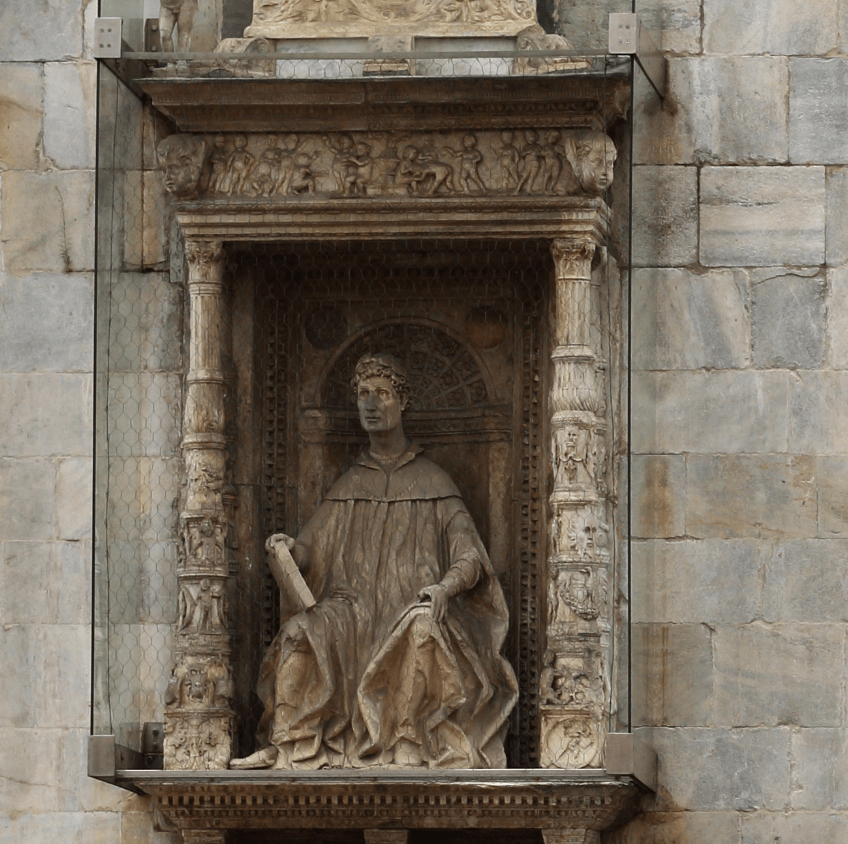
Around AD 180, Irenaeus wrote Against Heresies while serving as bishop of Lyons in Roman Gaul, modern Lyon in France. His own background connected him with Asia Minor, where he had heard Polycarp.
His concern was that rival teachers were changing the identity of the Christian message. Some distinguished the Creator from the highest God; others offered elaborate accounts of divine beings or denied essential aspects of Christ’s humanity. Irenaeus answered by setting out the faith he understood the churches to have received.
As you read, notice both the beliefs Irenaeus names and the life he says those beliefs require.
“The church, although scattered throughout the whole world, even to the ends of the earth, has received this faith from the apostles and their disciples:
She believes in one God, the Father Almighty, who made heaven and earth and the sea and everything in them;
and in one Christ Jesus, the Son of God, who became human for our salvation;
and in the Holy Spirit, who announced through the prophets God’s saving arrangements, the comings of Christ, his birth from a virgin, his suffering, his resurrection from the dead, and the bodily ascension into heaven of our beloved Lord, Christ Jesus.
The Spirit also announced his coming from heaven in the Father’s glory to bring all things together under one head and to raise the whole human race bodily from the dead. Then, according to the will of the invisible Father, every knee in heaven, on earth, and under the earth will bow to Christ Jesus, our Lord and God and Savior and King, and every tongue will confess him.
He will judge everyone justly. He will send the evil spiritual powers, the angels who transgressed and rebelled, and the ungodly, unrighteous, wicked, and profane among humanity into everlasting fire.
But in his grace he will grant immortality to the righteous and holy, to those who have kept his commandments and persevered in his love, some from the beginning and others from the time of their repentance. He will surround them with everlasting glory.”
Irenaeus of Lyons, Against Heresies 1.10.1, c. AD 180
This is a substantial confession. The Creator is the Father of Jesus Christ. The Son truly enters human life for salvation. The Spirit speaks through the prophets. Christ suffers, rises, ascends, and will return. Human beings face resurrection and judgment.
The ending also belongs to the confession. Irenaeus connects the hope of immortality with God’s grace, repentance, obedience, and perseverance in love. The faith has consequences for how a person lives.
Irenaeus Names the Regions Sharing This Faith
Irenaeus immediately explains how widely this confession is shared. His geographical claim is part of the passage itself:
Listen especially for the regions he names and for his repeated insistence that the churches share one faith.
“As I have already said, the church has received this proclamation and this faith. Although scattered throughout the whole world, she carefully preserves it as though she lived in a single house. She believes these things as though she had one soul and the same heart. She proclaims them, teaches them, and hands them on in harmony, as though she had one mouth.
Although the languages of the world differ, the meaning of the tradition is one and the same. The churches established in the German regions do not believe or hand down anything different. Neither do those in Spain, Gaul, the East, Egypt, Libya, or the central regions of the world.
Just as the sun, God’s creation, is one and the same throughout the whole world, so the proclamation of the truth shines everywhere and enlightens everyone willing to come to a knowledge of the truth.
No leader of the churches, however gifted in speaking, will teach something different from these things, for no one is greater than the Master. Nor will someone who lacks the ability to express himself well damage the tradition.
Since the faith is always one and the same, someone who can explain it at great length does not add to it, and someone who can say only a little does not diminish it.”
Irenaeus of Lyons, Against Heresies 1.10.2, c. AD 180
A bishop writing in Gaul names communities across Europe, the eastern Mediterranean, and North Africa. Their languages differ, but he says their confession remains recognizable.
His final observation is particularly helpful. An eloquent teacher can explain the faith at length, while another Christian may struggle to express it. Their unequal ability does not require an unequal faith. Understanding can grow without giving the most articulate person a different Christianity.
Irenaeus is describing the churches he recognizes as preserving apostolic teaching. His argument does not establish that everyone claiming the Christian name agreed with him; the existence of his book makes the disputes plain. It does give us an explicit ancient claim that this confession belonged to a geographically widespread fellowship.
Tertullian in Carthage: The Rule of Faith Stated Directly
Around AD 200, Tertullian wrote in the Christian setting of Carthage, in what is now Tunisia. Here we encounter a Latin-speaking Christian writer on the southern shore of the Mediterranean.
In Prescription Against Heretics, he uses the expression “rule of faith” and explains exactly what he means:
As you read, compare its structure with Irenaeus: Creator, Son, incarnation, Spirit, resurrection, return, and judgment.
“Now, concerning the rule of faith, so that we may acknowledge at this point what it is we defend, you should know that it requires this belief:
There is only one God, and he is none other than the Creator of the world. He brought everything into being from nothing through his own Word, sent forth before all things.
This Word is called his Son. Under the name of God, he appeared in different ways to the patriarchs and was continually heard through the prophets. Finally, he was brought by the Spirit and power of the Father into the Virgin Mary, became flesh in her womb, and was born from her as Jesus Christ.
He then preached the new law and the new promise of the kingdom of heaven and performed miracles. He was crucified and rose again on the third day. He ascended into heaven and sat at the Father’s right hand. In his place, he sent the power of the Holy Spirit to guide those who believe.
He will come in glory to bring the saints into the enjoyment of everlasting life and the heavenly promises, and to condemn the wicked to everlasting fire. This will take place after both groups have been raised from the dead and their bodies restored.
This rule, as we will demonstrate, was taught by Christ. Among us it raises no questions except those introduced by heresies, which make people heretics.”
Tertullian, Prescription Against Heretics 13, c. AD 200
The resemblance to Irenaeus is easy to recognize, even though the wording differs. The same Creator, Son, incarnation, resurrection, Spirit, return, and judgment hold the account together.
Tertullian’s closing sentence is forceful. He is defending the boundaries of the faith against rival teachings. We should hear that force without overlooking what he actually places within the rule: a connected account of God’s action through Christ and the future awaiting humanity.
Tertullian Describes a Unity People Could Experience
Later in the same work, Tertullian explains how he understands this faith to have traveled from Christ through the apostles into the churches.
His opening temporarily sets aside the disputed descriptions of Christ so that he can ask where Christ’s own teaching was handed down. The chapter then moves from transmission to practical fellowship:
Notice that for Tertullian one faith produces a visible unity: peace, brotherhood, and hospitality among the churches.
“Christ Jesus our Lord, who will, I hope, bear with me for a moment in speaking this way, whoever he is, of whatever God he is the Son, of whatever nature he is as man and God, whatever faith he teaches, and whatever reward he promises, himself declared these things while he lived on earth.
He declared what he was, what he had been, what the Father’s will was that he was carrying out, and what human duty he was prescribing. He did this either openly before the people or privately with his disciples. From among them he had chosen twelve to remain beside him, and he appointed them to become teachers of the nations.
After one of these had been removed, he commanded the other eleven, as he departed to the Father, to go and teach all nations, baptizing them into the Father and the Son and the Holy Spirit.
The apostles, whose name means ‘those who are sent,’ immediately acted accordingly. On the authority of a prophecy in a psalm of David, they chose Matthias by lot as the twelfth apostle in Judas’s place. They received the promised power of the Holy Spirit for miracles and speech. After first bearing witness to faith in Jesus Christ throughout Judea and establishing churches there, they went out into the world and proclaimed the same teaching of the same faith to the nations.
In the same way, they established churches in every city. From these churches, all the other churches, one after another, received the tradition of the faith and the seeds of teaching. They continue to receive them every day so that they may become churches. For this reason they too can be regarded as apostolic, because they are the offspring of apostolic churches. Everything must be classified by tracing it back to its origin.
Therefore, although the churches are so numerous and so great, they comprise the one original church founded by the apostles, from which they all come. In this way, all are original and all are apostolic.
Their unity is demonstrated by their peaceful fellowship, by calling one another brothers, and by the bond of hospitality. These relationships are governed by no other rule than the single tradition of the same sacred mystery.”
Tertullian, Prescription Against Heretics 20, c. AD 200
Tertullian describes a network of churches connected by a received message. The communities become recognizable as one through fellowship, brotherhood, and hospitality.
That is a demanding account of unity. Christians receive one another, acknowledge one another as family, and open their lives to one another. Agreement takes a social form.
His account also reminds us that these witnesses were connected. We are looking at a faith transmitted through relationships among churches, rather than at isolated communities independently arriving at the same ideas.
Origen in Alexandria: A Received Faith and Questions Still Open
Our third witness takes us east along the North African coast to Alexandria in Egypt.
Origen wrote On First Principles around AD 220 to 230, during his Alexandrian period. Its preface explains what he understands the church to have received and what he believes still requires investigation.
Origen begins by acknowledging disagreement:
As you read, notice his controlling distinction: some teachings have been clearly handed down to the whole church, while other questions remain open to investigation.
“Many who profess to believe in Christ differ from one another, not only in small and minor matters, but also on subjects of the greatest importance: God, the Lord Jesus Christ, and the Holy Spirit. They also disagree about created beings, including the heavenly powers and holy spiritual forces.
It therefore seems necessary first to establish a definite boundary and a clear rule concerning these matters, and then to proceed to the investigation of other questions.
Once we believed that Christ was the Son of God and became convinced that we must learn the truth from him, we stopped looking for it among those who attached the name of truth to mistaken opinions, despite the claims made by many Greeks and non-Greeks.
Likewise, many people think they hold the teaching of Christ, yet some differ from those who came before them. But the church’s teaching, handed down in an orderly succession from the apostles and continuing in the churches to the present day, is still preserved. Therefore, only that teaching should be accepted as true which does not differ in any respect from the tradition of the church and the apostles.
We should understand that, when the holy apostles preached faith in Christ, they spoke with the greatest clarity about certain matters they considered necessary for everyone, even for those who were less capable of investigating divine knowledge.
They left the reasons underlying these teachings to be examined by those who would receive the outstanding gifts of the Spirit, especially those who, through the Holy Spirit himself, would receive gifts of speech, wisdom, and knowledge.
On other subjects, they stated only that certain things exist, while remaining silent about how they exist or where they originated. They clearly intended that the more diligent of their successors, who love wisdom, should have matters on which to exercise their abilities and show their fruit. I mean those who prepare themselves to become fit and worthy recipients of wisdom.”
Origen of Alexandria, On First Principles, preface 2–3, c. AD 220–230
Origen does not mistake the existence of disagreement for the absence of a received faith. He proposes beginning with what has been handed down and then investigating further.
He also distinguishes believing a teaching from possessing a complete explanation of it. A person may confess the faith before being able to answer every question someone could ask about it.
Origen Sets Out the Teaching and Its Unanswered Questions
Origen’s account is longer than the previous summaries. It includes both the teachings he regards as established and questions he believes remain unresolved. Reading it in full allows us to see where he draws those distinctions.
The essential phrases are “clearly handed down” and “not clearly stated.” They show us the boundary Origen sees between the shared faith and matters Christians may continue to examine.
“The particular matters clearly handed down in the teaching of the apostles are these:
First, there is one God who created and ordered everything. When nothing existed, he brought all things into being. He has been God from the first creation and foundation of the world. He is the God of all the righteous: Adam, Abel, Seth, Enosh, Enoch, Noah, Shem, Abraham, Isaac, Jacob, the twelve patriarchs, Moses, and the prophets.
In these last days, as he had previously announced through his prophets, this God sent our Lord Jesus Christ to call Israel to himself first, and then the Gentiles after the unfaithfulness of the people of Israel.
This just and good God, the Father of our Lord Jesus Christ, himself gave the law, the prophets, and the Gospels. He is also the God of the apostles and of the Old and New Testaments.
Second, Jesus Christ himself, who came into the world, was begotten from the Father before all created things. He served the Father in the creation of everything, for all things were made through him. In the last times he emptied himself and became human. Although he was God, he took flesh; and when he became human, he remained the God he was.
He took a body like our own, differing only in that it was born from a virgin and the Holy Spirit. This Jesus Christ was truly born and truly suffered. He did not merely appear to undergo the death common to humanity, but truly died. He truly rose from the dead, spoke with his disciples after his resurrection, and was taken up into heaven.
Third, the apostles taught that the Holy Spirit is joined with the Father and the Son in honor and dignity. But whether he should be understood as begotten or unbegotten, or whether he should also be called a Son of God, is not clearly distinguished. These matters must be investigated from sacred Scripture as carefully as we are able.
It is, however, very clearly taught throughout the churches that this Spirit inspired each of the holy people, whether prophets or apostles. There was not one Spirit in the people of the old covenant and a different Spirit in those inspired at Christ’s coming.
After these matters, apostolic teaching also holds that the soul has an existence and life of its own. After leaving this world, it will receive what it deserves: an inheritance of eternal life and blessedness if its deeds have obtained this, or eternal fire and punishment if the guilt of its offenses has brought it to that end.
There will also be a resurrection of the dead. This body, now sown in decay, will rise free from decay; and what is sown in dishonor will rise in glory.
The church’s teaching also clearly establishes that every rational soul possesses free choice and will. It must struggle against the devil, his angels, and hostile powers, because they try to weigh it down with sins. But by living rightly and wisely, we should strive to free ourselves from that burden.
It follows that we do not regard ourselves as subject to a necessity that forces us, even against our will, to do either good or evil. Since we have control over our choices, some influences may urge us toward sin and others may help us toward salvation, but no necessity forces us to act rightly or wrongly.
Those who say that the courses and movements of the stars cause human actions think otherwise. They attribute to the stars not only events beyond our freedom of choice, but also actions that lie within our own power.
As for the soul’s origin, however, the church’s teaching does not explain it with sufficient clarity. Is it passed on through human seed, so that its essential nature is contained in the bodily seed itself? Or does it have some other beginning? Does that beginning involve generation, or not? Is the soul introduced into the body from outside, or not? These matters have not been clearly distinguished.
Concerning the devil, his angels, and the hostile powers, the church’s teaching establishes that these beings exist. But it does not explain clearly enough what they are or how they exist.
Most hold the view that the devil was an angel who rebelled and persuaded as many other angels as possible to fall away with him. Those beings continue to be called his angels.
The church also teaches that the world was made, that it began at a particular time, and that it will be destroyed because of its wickedness.
But what existed before this world, or what will exist after it, is not certainly known to most people, because the church’s teaching contains no clear statement about it.”
Origen of Alexandria, On First Principles, preface 4–7, c. AD 220–230
The central confession remains recognizable. Yet Origen also preserves uncertainties that later Christians may find surprising, especially concerning the Holy Spirit. We should allow those differences to remain visible. His account belongs to the early third century, before the later councils gave more precise definitions.
Notice also the difference between his confidence in moral responsibility and his uncertainty about the soul’s origin. He does not need to settle every question about how a soul comes into existence before insisting that human beings are responsible for their actions.
He continues with Scripture, spiritual beings, and the work of theological investigation:
“Finally, the Scriptures were written through the Spirit of God. They have not only the meaning apparent at first sight, but also another meaning that escapes most readers. The written words give form to sacred mysteries and represent divine realities.
The whole church agrees that the entire law is spiritual. But the spiritual meaning it conveys is not known to everyone, only to those who receive the grace of the Holy Spirit in words of wisdom and knowledge.
The term ‘incorporeal,’ meaning ‘without a body,’ is unfamiliar and unused in many other writings and also in our own Scriptures.
Someone might quote it from the little work called the Teaching of Peter, in which the Savior appears to say to his disciples, ‘I am not an incorporeal demon.’ My first reply is that this work is not included among the church’s books. We can show that it was not composed by Peter or by any other person inspired by God’s Spirit.
But even if that point were conceded, the word ‘incorporeal’ there would not have the same meaning it has when Greek and pagan philosophers discuss a nature without a body.
In that little work, the expression ‘incorporeal demon’ refers to a demonic body whose form or appearance, whatever it may be, differs from our dense and visible bodies. The author’s meaning must be understood as saying that Jesus did not have the kind of body demons have, naturally fine and thin, as though made of air, which is why many people consider or call it incorporeal. Instead, he had a solid body that could be touched.
In ordinary speech, people without specialized knowledge call things incorporeal when they do not have this solid character. Someone might, for example, call the air we breathe incorporeal because it cannot be grasped and held or offer resistance to pressure.
We must investigate whether what Greek philosophers call ‘incorporeal’ appears in holy Scripture under another name.
We must also investigate how God himself should be understood: whether as having a body and a particular shape, or as having a nature different from bodies. This point is not clearly stated in our teaching. The same questions must be asked concerning Christ, the Holy Spirit, every soul, and everything possessing a rational nature.
The church also teaches that there are angels of God and good spiritual powers who serve him in accomplishing human salvation. But when they were created, what their nature is, and how they exist are not clearly stated.
Nor is there a definite teaching about whether the sun, moon, and stars are living beings or have no life.
Anyone who wishes to form an ordered and connected account of these truths must therefore begin with elements and foundations such as these, following the command, ‘Enlighten yourselves with the light of knowledge.’
Through clear statements and sound reasoning, such a person should seek to establish the truth concerning each subject and bring it into one body of teaching. This should be done through illustrations and arguments found in holy Scripture or reached by carefully tracing their consequences and following a sound method.”
Origen of Alexandria, On First Principles, preface 8–10, c. AD 220–230
Some of these questions belong to an ancient intellectual world that feels unfamiliar today. Their presence helps us see what Origen is doing. He begins with received teaching, identifies uncertainties, and invites disciplined investigation.
He does not place every proposed explanation on the same level as the confession itself.
The Same Center Is Already Visible in the First Century
Irenaeus, Tertullian, and Origen did not create this faith in the late second or early third century. Its central claims are already present in the earliest Christian writings.
The seven letters most widely accepted as genuinely written by Paul are Galatians, 1 Thessalonians, 1 and 2 Corinthians, Romans, Philippians, and Philemon. They take us into the first century, beginning within roughly two decades of Jesus’ death. More importantly, Paul sometimes identifies material that he himself had previously received.
The clearest example is his summary of the resurrection proclamation:
“I handed on to you, as of first importance, what I had also received: that Christ died for our sins in accordance with the Scriptures, that he was buried, that he was raised on the third day in accordance with the Scriptures, and that he appeared to Cephas and then to the Twelve.
After that, he appeared to more than five hundred brothers and sisters at one time, most of whom were still alive, though some had died. Then he appeared to James, then to all the apostles, and last of all he appeared also to me.”
First Corinthians 15:3–8, c. AD 54–55
Paul distinguishes between composing an argument and handing on something he had received. That takes the resurrection proclamation earlier than the letter itself.
The larger structure found in the rule of faith is also distributed throughout these first-century letters:
| Central belief | First-century evidence |
|---|---|
| One God, the Father and Creator | First Corinthians 8:6 |
| Jesus Christ as Son and Lord | Romans 1:3–4; First Corinthians 8:6; Philippians 2:6–11 |
| Christ’s real human life and death | Romans 1:3; Galatians 4:4; First Corinthians 2:2; Philippians 2:7–8 |
| Christ’s burial, resurrection, and appearances | First Corinthians 15:3–8 |
| The Holy Spirit active in believers and the church | Romans 8:9–17; First Corinthians 2:10–13; 12:3–13; Galatians 3:1–5 |
| Christ’s return and the resurrection of believers | First Thessalonians 4:13–18; First Corinthians 15:20–28, 35–57 |
| Future judgment according to how people have lived | Romans 2:5–11; First Corinthians 3:10–15; Second Corinthians 5:10 |
| Faith expressed through love and a transformed life | Galatians 5:6, 13–26; First Corinthians 13; Romans 12 |
Near the end of the first century, the church at Rome wrote to a divided church in Corinth. The letter known as First Clement appeals to what the two congregations already share:
“Why are there conflicts, anger, divisions, schisms, and fighting among you? Do we not have one God and one Christ? Is there not one Spirit of grace poured out upon us? Do we not have one calling in Christ?
Why do we divide and tear apart the members of Christ and rebel against our own body? Have we reached such madness that we have forgotten that we are members of one another?”
Church at Rome, traditionally associated with Clement, First Letter to the Corinthians 46.5–7, c. AD 96
This is especially important for the purpose of this article. The shared confession is not presented merely as a list of correct beliefs. One God, one Christ, one Spirit, and one calling make division within Christ’s body intolerable.
The first-century evidence does not contain one complete document identical to the later rule of faith. It contains the beliefs from which that rule is formed. By the time Irenaeus, Tertullian, and Origen explain the faith at greater length, they are organizing convictions already present in the earliest sources.
Judgment Is Part of the Core Christian Confession
The rule of faith does not end with Christ’s resurrection. It moves toward his return, the resurrection of humanity, and judgment. That theme appears in all three principal witnesses.
Irenaeus says that Christ will return, raise humanity, judge justly, and grant immortality to those who have persevered in holiness and love. Tertullian speaks of Christ bringing the saints into everlasting life and condemning the wicked after the resurrection of both. Origen says that each soul will receive a future corresponding to its deeds and insists that human beings possess genuine moral responsibility.
None of them treats Christians as exempt from moral judgment simply because they identify as Christians. The same point appears in the New Testament.
“God will repay each person according to what that person has done. To those who persevere in doing good, seeking glory, honor, and immortality, he will give eternal life. But for those who are self-seeking, rejecting the truth and following wrongdoing, there will be wrath and anger.
There will be suffering and distress for everyone who does evil, first for the Jew and also for the Greek; but glory, honor, and peace for everyone who does good, first for the Jew and also for the Greek. For God shows no partiality.”
Romans 2:6–11, c. AD 57
Paul later speaks directly to Christians:
“All of us must appear before Christ’s judgment seat, so that each person may receive what is due for what was done in the body, whether good or evil.”
Second Corinthians 5:10, c. AD 55–56
This does not require us to deny grace or imagine that human beings save themselves through moral achievement. Paul also speaks emphatically of grace, faith, and God’s saving action in Christ. But grace does not make our lives irrelevant. The same Paul describes what counts as “faith working through love” and warns Christians not to use freedom as an opportunity for self-indulgence.
Judgment therefore belongs to the center of Christian faith, not to an optional appendix. It gives seriousness to self-examination, repentance, perseverance, and holiness. It also gives seriousness to charity. How we treat other people is not disconnected from what we confess about Christ.
This is one reason Christian unity cannot mean merely agreeing to a short list of doctrines. The shared confession calls one people into a shared life. We will answer to the same Lord for what we have done with the faith we profess.
What About the Apostles’ Creed?
Readers who know the Apostles’ Creed will recognize the resemblance immediately: God the Father, Jesus Christ his Son, the Holy Spirit, Christ’s birth and suffering, his resurrection and return, and the hope of our own resurrection.
The connection is real, but the dates require care. The familiar Apostles’ Creed developed from an older confession associated with the church at Rome, commonly called the Old Roman Creed or Old Roman Symbol.
| Creed | Location | Date | Authorship |
|---|---|---|---|
| Old Roman Creed | Rome, Italy | A Greek form appears in Marcellus of Ancyra’s profession of faith, c. AD 340–341; Rufinus discusses the Roman form in the early fifth century. Its earlier development is less securely dated. | No individual composer is known. Marcellus and Rufinus are witnesses to the text, not its established authors. |
| Apostles’ Creed | Developed in the Latin-speaking Western churches from the older Roman confession | Its familiar full form is attested by the eighth century, following several centuries of development. | No individual author is known. The title expresses its claim to preserve apostolic teaching. |
Despite its name, we cannot establish that the twelve apostles personally composed the Apostles’ Creed. Rufinus recounts a tradition that they jointly produced a confession before departing to preach, but his account comes centuries after their lifetime. It does not establish their authorship of the received text.
Nor should we assume that Irenaeus, Tertullian, and Origen were quoting the familiar Apostles’ Creed word for word. Their writings are earlier than that creed’s completed form. The resemblance shows how much of the confession’s substance was already present in the faith they describe.
This distinction strengthens the historical point. We can read the shared content directly in writings from Gaul, Carthage, and Alexandria without projecting a later text backward into their period. The older Roman tradition adds Rome to the geographical picture, although its surviving forms must be dated on their own evidence.
The Apostles’ Creed is therefore a useful point of recognition for readers. Its familiar wording helps us recognize the older pattern, while the passages from these three authors let us examine that pattern in their own places, dates, and words.
What These Three Witnesses Allow Us to See
The geographical span is substantial: Irenaeus writes from Lyons in Gaul, modern France; Tertullian from Carthage, modern Tunisia; and Origen from Alexandria in Egypt. These are distinct regions across the northern and southern shores of the Mediterranean. Irenaeus also explicitly names churches across the German regions, Spain, the East, Egypt, and Libya as sharing the faith he describes.
Their accounts preserve a common structure across different settings. The God who created the world is the Father of Jesus Christ. The Son truly became human, suffered, died, and rose. The Holy Spirit belongs to the life and teaching of the church. Human beings face resurrection and judgment, and their conduct matters.
Their statements are not identical. Origen includes questions and distinctions that do not appear in the shorter summaries. Nor were these men offering a neutral survey of everyone who claimed to be Christian. They were defending what they understood to be the apostolic inheritance.
Those qualifications help us describe the evidence accurately. A recognizable confession was being articulated across distant regions well before Christianity received imperial sponsorship. That establishes age, continuity, and geographical spread. It does not, by itself, prove that Jesus rose from the dead or that the Christian account of God is true.
For that question, the investigation must move backward. What can be established from the seven undisputed letters? How early is the tradition Paul says he received? What explains the conviction of Peter, James, Paul, and the other named witnesses that Jesus had appeared to them alive? The rule of faith tells the critic what Christianity claims; the first-century evidence is where the historical case for its central event must be tested.
For a critic, that clarity matters. Before someone can fairly judge Christianity, the Christian message needs to be stated plainly enough to be understood.
For Christians, these passages raise a different question. If believers in different traditions confess this same central faith, can we begin to see ourselves again as one church? That does not erase every theological or institutional division. It does mean those divisions should not be allowed to hide the deeper unity already given in one God, one Christ, one Spirit, one hope, and one coming judgment.
Tertullian’s answer includes peace, brotherhood, and hospitality. Agreement should become visible in how we receive and help one another.
The personal demand is just as clear. Irenaeus speaks of repentance, obedience, and perseverance in love. Origen insists upon moral responsibility. The faith we confess gives us reason to examine our own lives honestly.
For me, these belong together: a Christianity that a critic can understand, a confession around which Christians can recognize one another, and a life directed toward holiness and charity.
That means asking whether my faith is making me more truthful, more willing to repent, and more faithful when obedience is costly. It also means asking whether the stranger, the hungry person, and the suffering neighbor experience anything of that faith through my actions.
The rule of faith gives the critic something definite to examine and Christians something definite around which to unite. It points backward to the first-century proclamation that must be tested and forward to the judgment before which every life will be revealed.
The challenge is not only to repeat the confession. It is to become one church around it: a people who seek truth honestly, repent seriously, pursue holiness, welcome one another, and make their faith visible through love.