Diocletian and the Great Persecution

Nothing in the long history of Roman hostility toward Christians compares to what unfolded under Diocletian. Earlier persecutions were real and often severe, but under Diocletian the empire launched a decade-long, organized effort to dismantle Christianity itself. His political reforms, his religious worldview, and the system he created known as the Tetrarchy all collided with a rapidly growing Christian movement that refused to participate in Rome’s sacrificial life. The result was the largest and most systematic attempt ever made to extinguish the Christian name.

Understanding why the Great Persecution erupts with such force in 303 requires beginning with the political and religious system Diocletian put into place.


The Tetrarchy and the Ideology of Unified Rule

The formal Tetrarchy was established in AD 293, but the divine pairing of Diocletian and Maximian began earlier, when they ruled together as co-emperors. This divine alignment was already well established before Galerius and Constantius were added as Caesars.

A panegyric delivered before the Tetrarchy was formally created makes this divine association unmistakable:

Panegyrici Latini 10.4 (AD 289)
“Diocletian and Maximian, the one associated with Jupiter and the other with Hercules, govern the world with the majesty of the gods and the strength of heroes.”

This does not mean the emperors claimed personal divinity in the manner of Caligula or Domitian. They did not demand that sacrifices be offered to themselves. Instead, they presented themselves as ruling under Jupiter and Hercules, receiving divine legitimacy from these gods.

Under this political theology, unified worship was essential.
Sacrifice maintained the gods’ favor.
Refusal to sacrifice undermined the religious foundation that supported imperial stability.

When the Tetrarchy was formally created in AD 293, this divine framework expanded to include Galerius and Constantius as partners in the same cosmic order.


Diocletian’s Rise and His Vision for Stability

Fourth-century historian Aurelius Victor describes the turbulent origins of Diocletian’s reign:

Aurelius Victor, Epitome 39 (AD 360s)
“Diocletian, a man of low birth but keen mind, was hailed emperor by the army after Numerian had been treacherously slain.”

Diocletian inherited an empire weakened by half a century of civil war, invasion, inflation, and constant leadership changes. For him, restoring Rome required both administrative reconstruction and the renewal of Rome’s relationship with the gods.

His public image reflected this divine partnership. Inscriptions and coins throughout his reign repeatedly invoke the gods who upheld his rule:

IOVI CONSERVATORI
“To Jupiter the Protector”

HERCVLI DEFENSORI
“To Hercules the Defender”

GENIVS POPVLI ROMANI
“To the Guardian Spirit of the Roman People”
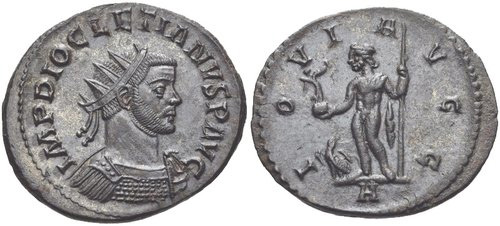
Obverse: IMP DIOCLETIANVS P AVG — “Emperor Diocletian, Dutiful Augustus,” radiate and cuirassed bust right.
Reverse: IOVI AVGG — “To Jupiter of the Emperors,” showing Jupiter standing facing, head left, holding a scepter and Victory on a globe; eagle at his feet to the left

These inscriptions show not emperor worship but emperor alignment. Diocletian ruled under Jupiter’s protection, not as Jupiter himself. Christian refusal to sacrifice therefore struck at the foundation of the very system that legitimized the Tetrarchy.


A Rapidly Expanding Christian Movement

By the early fourth century, Christian communities were thriving. Eusebius describes this moment as a period of remarkable growth and public visibility:

Eusebius, Ecclesiastical History 8.1.1 (AD 311–325)
“Before the persecution, the churches were at peace and multiplied everywhere. Rulers honored the Christians. Crowds assembled in the churches. New buildings rose from their foundations in every city.”

Archaeology confirms this account. Christian buildings became larger and more numerous; clergy gained public recognition; and Christians entered civic roles and even imperial service. A movement that once met quietly in homes now built large structures in major cities.

For an imperial system built upon unified sacrifice, this expanding Christian public life created unavoidable tension.


Galerius and the Push Toward Hostility

Lactantius, an eyewitness to these events, identifies Galerius as the chief instigator behind the coming persecution:

Lactantius, On the Deaths of the Persecutors 11 (AD 313–315)
“Galerius, a man fierce in nature and hostile to the name of the Christians, urged the emperor daily to destroy the churches and to compel all to sacrifice.”

Galerius believed the empire’s troubles stemmed from neglect of the gods. Christian refusal to sacrifice was not private dissent but a direct challenge to Rome’s divine protection and the religious foundation of the Tetrarchy.

Diocletian hesitated for several years, but as pressure increased, he gradually shifted toward Galerius’s position.


Signs, Omens, and the Turning Point

Lactantius records a critical moment in AD 299, when the imperial household sought omens through a traditional sacrifice:

Lactantius, On the Deaths of the Persecutors 10 (AD 313–315)
“When Diocletian and Galerius consulted the oracle, the diviners declared that the presence of Christians had disturbed the sacred rites.”

Christians in the imperial service did not participate in the gestures of reverence. The diviners blamed them for the failure of the ritual. In a political system where divine favor upheld the rulers, this carried enormous weight.

Eusebius describes the resulting shift in Diocletian’s attitude:

Eusebius, Ecclesiastical History 8.2.1 (AD 311–325)
“Diocletian was persuaded that the time had come to wage war against the churches as if against enemies of the state.”

By AD 302, the decision was near.
By early AD 303, it was set.


The Destruction of the Nicomedia Church

The Great Persecution opened with a symbolic act carried out at the political center of the Eastern empire. On February 23, AD 303, Diocletian ordered the destruction of the major church in Nicomedia. Lactantius, writing only a decade later, gives us a vivid description of what happened that morning:

Lactantius, On the Deaths of the Persecutors 12 (AD 313–315)
“On the morning of the day appointed for the celebration of the Terminalia, when the sun had not yet risen, the prefect together with tribunes and officers arrived at the church in Nicomedia, and having broken open the doors, they searched for the image of the god of the Christians, the Scriptures, and all that they used in their worship. When they found the Scriptures, they burned them; everything else they destroyed. The soldiers were allowed to seize whatever was found inside.”

The reference to the Terminalia, a festival dedicated to boundaries, is significant. Diocletian was drawing a line between the old religious order and the presence of Christianity in public life. By choosing this date, he signaled that the empire was redrawing its religious boundaries.

Eusebius, writing from within the Eastern provinces, confirms the same event from a different vantage point:

Eusebius, Ecclesiastical History 8.2.4 (AD 311–325)
“The imperial edict commanded that the church in Nicomedia be leveled to the ground. Those who were present saw the building demolished from its foundations, and the sacred Scriptures committed to the flames.”

The two accounts, one Western and Latin (Lactantius) and one Eastern and Greek (Eusebius), give us the fullest picture we have of this opening blow.


The First Edict of 303

After the church was destroyed, Diocletian issued the first of four imperial laws. Lactantius reproduces the text in summary form, and his account is our primary source for its contents. According to him, the first edict contained four major provisions:

  1. All churches were to be destroyed.
  2. All Scriptures were to be burned.
  3. Christians were to lose legal rights and protections.
  4. Those in government positions were to be removed unless they sacrificed.

Here is the full text as preserved in Lactantius:

Lactantius, On the Deaths of the Persecutors 13 (AD 313–315)
“An edict was published ordering that the assemblies of the Christians should be abolished, that their churches be torn down, that the Scriptures be burned, that those who held places of honor be degraded, that servants who persisted in the Christian faith be made incapable of freedom, and that those under accusation of following Christianity be not allowed to defend themselves in court.”

The brutality of the law becomes clear as Lactantius explains its underlying logic:

Lactantius, On the Deaths of the Persecutors 13 (AD 313–315)
“The emperor believed that if he took away the opportunity of meeting for worship and destroyed their Scriptures, the religion itself could be abolished.”

This is the key sentence.
It shows the intent behind the Great Persecution: not merely to pressure Christians, but to erase the Christian movement by attacking its buildings, its Scriptures, and its legal status.


Refusal and Immediate Violence

Eusebius records the immediate resistance of some Christians in Nicomedia who tore down the imperial edict publicly:

Eusebius, Ecclesiastical History 8.5.1 (AD 311–325)
“One of the Christians, moved with holy zeal, tore down the imperial edict that had been posted in a public place and put it into shreds as something profane and illegal.”

According to Eusebius, this man was arrested, tortured, and executed. His act represents one of the earliest martyrdoms of the Great Persecution.


Impact Across the Empire

The First Edict was carried out differently in East and West. In the East, where Galerius wielded influence, the laws were enforced strictly. Eusebius describes widespread destruction:

Eusebius, Ecclesiastical History 8.2.5 (AD 311–325)
“Churches were torn down from top to bottom, and the sacred Scriptures were cast into the fire in the open marketplaces.”

In the West, Constantius enforced the law only minimally. Churches were destroyed, but he did not pursue Christians or burn Scriptures with the same severity. As Lactantius notes:

Lactantius, On the Deaths of the Persecutors 15 (AD 313–315)
“Constantius, although he destroyed a few buildings, spared the Christians themselves and took no delight in their suffering.”

This divergence becomes much more pronounced in the years that follow. The edicts will be applied ruthlessly in the East and with comparative restraint in the West.


The Second Edict: Imprisonment of the Clergy

The First Edict had targeted buildings, Scriptures, and legal rights. When this failed to break Christian resolve, the imperial court issued a second command. This time, the goal was to dismantle the leadership of the churches.

Lactantius provides the clearest account:

Lactantius, On the Deaths of the Persecutors 15 (AD 313–315)
“Diocletian published another edict, ordering that all the bishops and ministers should be thrown into prison.”

This marked a dramatic escalation. It was not aimed at all Christians, but at the entire structure that led and organized Christian communities.

Eusebius confirms the severity in the Eastern provinces:

Eusebius, Ecclesiastical History 8.6.1 (AD 311–325)
“An edict was issued that all who were called ministers of the Word should be seized and committed to prison. And there was nothing mild in the execution of this command.”

Prisons filled rapidly. Eusebius writes:

Eusebius, Ecclesiastical History 8.6.6 (AD 311–325)
“The prisons, which had previously held murderers and robbers, were now filled with bishops, presbyters, deacons, readers, and exorcists.”

This detail is important.
It shows the scale of the arrests and also how the empire quickly ran out of space to hold so many clergy.


The Third Edict: Forcing the Clergy to Sacrifice

By late 303, the prisons were overflowing. Rather than release the clergy, the imperial court issued a third edict directing that all imprisoned leaders be compelled to sacrifice.

Lactantius writes:

Lactantius, On the Deaths of the Persecutors 16 (AD 313–315)
“A third edict commanded that all those in prison should be forced by every means to sacrifice.”

The phrase “by every means” implies torture, starvation, deprivation, and psychological pressure. Eusebius describes what happened in the East:

Eusebius, Ecclesiastical History 8.6.8 (AD 311–325)
“Some endured every form of punishment in the attempt to force them to sacrifice; they suffered rackings, burnings, and all kinds of torment.”

Some clergy yielded. Many did not.
Those who refused were either kept imprisoned or executed.


The Fourth Edict: Universal Sacrifice

The fourth edict marked the full and final escalation. While the first three focused on property and clergy, the fourth edict extended to every Christian, commanding everyone to sacrifice to the gods or face punishment.

Lactantius states:

Lactantius, On the Deaths of the Persecutors 17 (AD 313–315)
“A fourth edict was issued ordering that all persons, without exception, should sacrifice and taste the offerings.”

This was the heart of the Great Persecution.
For the first time in Roman history, a universal law required every Christian in the empire to sacrifice on pain of imprisonment, torture, or death.

Eusebius describes the impact:

Eusebius, Ecclesiastical History 8.6.9 (AD 311–325)
“The command was given that all the inhabitants of the cities should be compelled to sacrifice and pour libations to the idols. Those who refused were subjected to various punishments.”

This edict brought the entire Christian population into direct conflict with the state.


Diverging Paths: East and West

The edicts applied to the whole empire, but enforcement differed dramatically.

The Western Provinces

Constantius, ruling in Gaul and Britain, enforced only part of the First Edict. He destroyed some church buildings but refused to persecute Christians themselves.

Lactantius remarks on this restraint:

Lactantius, On the Deaths of the Persecutors 15 (AD 313–315)
“Constantius, though he destroyed a few buildings, did not harm the Christians and took no pleasure in their suffering.”

Under Constantine (after 306), persecution ceased entirely in the West.

The Eastern Provinces

The East was ruled first by Diocletian and Galerius, then by Galerius alone, and finally by Maximinus Daia. Here the edicts were enforced with full severity for nearly a decade.

Eusebius records the intense suffering that followed:

Eusebius, Ecclesiastical History 8.9.1 (AD 311–325)
“In the regions under the rule of Maximinus an unbroken series of evils overwhelmed the Christians.”

This distinction between East and West explains why the Great Persecution lasted much longer in some regions. The universal sacrifice edict was enforced fiercely in the East and only lightly in the West.


The Scale of the Persecution

The four edicts created the most comprehensive legal assault Christianity ever faced:

• Churches destroyed
• Scriptures burned
• Legal rights removed
• Clergy imprisoned
• Clergy forced to sacrifice
• All Christians required to sacrifice
• Severe punishments for refusal
• Enforcement lasting nearly a decade in the East

This was not a short moment, like the requirement under Decius.
This was an attempt to eradicate Christian identity, its leadership, its Scripture, and its existence as a public movement.


The Height of the Persecution

After the fourth edict extended the requirement of sacrifice to every Christian in the empire, the persecution entered its most violent phase. This period, stretching from 303 through the early 310s in the East, produced scenes of cruelty unmatched in earlier Roman history. Eusebius and Lactantius, both eyewitnesses to portions of these events, provide detailed accounts of torture, imprisonments, and executions across the provinces.


Torture and Public Punishments

Eusebius describes how the authorities attempted to break Christian resolve with punishments designed to terrify the entire population.

Eusebius, Ecclesiastical History 8.7.1 (AD 311–325)
“Some were scourged with whips, torn by the rack, and stretched out upon instruments of torture; some were burned with fire; others were crucified; some were beheaded; many were condemned to the mines or to the wild beasts.”

He emphasizes that these punishments were not isolated incidents but part of a coordinated effort:

Eusebius, Ecclesiastical History 8.7.2 (AD 311–325)
“The cruelty of the governors was such that no words can adequately describe the variety and severity of their torments.”

Lactantius gives similar testimony, describing how the persecutors operated with deliberate intent to inflict suffering:

Lactantius, On the Deaths of the Persecutors 18 (AD 313–315)
“Those who refused to sacrifice were tortured with every kind of instrument, and the cruelty of the judges seemed to have no end.”

These statements establish the environment of terror that spread through the Eastern provinces.


The Persecution in Egypt

Egypt experienced some of the most intense violence. Eusebius, who lived in Caesarea but had deep ties to Egypt, records the ferocity of the punishments in Alexandria:

Eusebius, Ecclesiastical History 8.9.4 (AD 311–325)
“In Alexandria countless numbers were put to death. Some were beheaded; others burned; others cast into the sea; others given to the sword. The massacre continued day after day.”

He describes the courage of the martyrs:

Eusebius, Ecclesiastical History 8.9.5 (AD 311–325)
“Not even the women were spared; they endured the same tortures as the men, and many met their end with remarkable courage.”

Egypt’s large Christian population meant that resistance was strong, and so was the response of the authorities. The violence continued for years.


The Suffering in Palestine

Eusebius’s Martyrs of Palestine (an appendix to his Ecclesiastical History) is one of the most detailed regional martyr narratives from the ancient world. In Part 4 of the main history, he describes the beginning of the violence:

Eusebius, Ecclesiastical History 8.8.1 (AD 311–325)
“In Palestine, the persecutions were incessant. Every day brought new trials, and the judges devised new forms of torture.”

Some Christians were mutilated:

Eusebius, Ecclesiastical History 8.8.3 (AD 311–325)
“Some had one eye gouged out, others had the joints of their ankles burned or severed, and thereafter were sent to the copper mines.”

Others were executed publicly:

Eusebius, Ecclesiastical History 8.9.6 (AD 311–325)
“Many were beheaded or burned alive, so that the flames and the sword together took their daily victims.”

These passages give a vivid picture of the relentless and creative brutality that characterized the persecution in Palestine.


The Persecution Under Maximinus Daia

When Diocletian and Maximian abdicated in AD 305, the persecution did not end. Instead, it intensified in the East under Maximinus Daia, nephew of Galerius. Eusebius portrays his rule in especially dark terms:

Eusebius, Ecclesiastical History 8.14.1 (AD 311–325)
“Maximinus, more cruel than any before him, inflamed with an unbounded hatred of the Christians, drove all to madness by his tyrannical measures.”

Under Maximinus, local officials were encouraged to compete in displays of cruelty, and mobs were incited to attack Christian communities.

Eusebius writes:

Eusebius, Ecclesiastical History 9.2.1 (AD 311–325)
“The provinces under Maximinus were filled with executions; the tortures were carried out not only in the cities but in every village and district.”

This period saw some of the most gruesome executions in recorded Christian history.


The Attempt to Eradicate Christian Scripture

One of the defining features of the Great Persecution was the attempt to eliminate Christian Scripture. This was a continuation of the First Edict, which targeted the sacred writings. Eusebius describes systematic searches:

Eusebius, Ecclesiastical History 8.2.5 (AD 311–325)
“The sacred Scriptures were sought out with diligence, and when found, they were burned in the open squares.”

Lactantius adds:

Lactantius, On the Deaths of the Persecutors 12 (AD 313–315)
“They burned the Scriptures with fire, believing that if the writings were destroyed the religion itself would perish.”

This attempt to eliminate Christian Scripture sets the Great Persecution apart from all earlier Roman actions.


The Persecution of Bishops and Teachers

Because bishops and teachers played a central role in community identity, the authorities targeted them specifically. Eusebius emphasizes how the persecution dismantled Christian leadership:

Eusebius, Ecclesiastical History 8.6.6 (AD 311–325)
“The prisons, which had previously been filled with criminals, were now crowded with bishops, presbyters, deacons, readers, and exorcists.”

This was not incidental. Destroying the leadership was essential to the imperial plan. Without clergy, the Christian movement would lose cohesion. Without bishops, the sacraments could not be administered. Without teachers, instruction would cease.


Crucifixion, Mutilation, and the Mines

The Great Persecution included punishments that earlier emperors rarely used against Christians, including crucifixion. Eusebius documents instances where believers were nailed to crosses:

Eusebius, Ecclesiastical History 8.7.5 (AD 311–325)
“Some were nailed to crosses, others were stretched out on them while still alive.”

Condemnation to the mines was common:

Eusebius, Ecclesiastical History 8.12.1 (AD 311–325)
“Many were sent to the mines in Lebanon, Cilicia, and Palestine, with one eye mutilated and the joints of the ankles burned.”

These punishments were intended not only to kill but to degrade and terrorize.


The Emotional Weight of the Persecution

Eusebius breaks from his usual historical tone when describing the intensity of the suffering:

Eusebius, Ecclesiastical History 8.12.3 (AD 311–325)
“It is impossible to recount the sufferings of the martyrs one by one, for the cruelty of the tyrants exceeded all bounds.”

This statement from an eyewitness underscores why the Great Persecution stands apart in scale and severity.


Galerius Struck with Illness

For nearly eight years after the first edict, the persecution raged most violently in the Eastern empire under Galerius and, later, Maximinus Daia. But in AD 310–311, Galerius was struck by a sudden and horrifying disease. Lactantius describes the illness in graphic detail, presenting it as divine judgment.

Lactantius, On the Deaths of the Persecutors 33 (AD 313–315)
“A malignant ulcer broke out in the secret parts of Galerius’s body, which gradually spread and ate into his vitals; from it issued a stench so foul that it was impossible for any man to endure it.”

The disease worsened over time:

Lactantius, On the Deaths of the Persecutors 33 (AD 313–315)
“It became a torpid mass of corrupt flesh, breeding worms which no medical skill could remove. The surgeons cut away decayed pieces, but the wound only grew larger.”

Eusebius confirms the same picture:

Eusebius, Ecclesiastical History 8.16.2 (AD 311–325)
“He was reduced to such a condition by an incurable disease that even his physicians could no longer approach him because of the unbearable stench.”

In this agony, Galerius made a decision no one expected.


Galerius Issues the Edict of Toleration (AD 311)

On April 30, AD 311, Galerius issued an imperial proclamation ending the persecution he had driven for a decade. Lactantius preserves the text in full. This is the earliest surviving imperial law granting legal status to Christianity.

Here is the complete edict, without abbreviation:

Lactantius, On the Deaths of the Persecutors 34 (AD 313–315)
“Among the other measures that we have taken for the advantage of the empire, we had desired first of all to set everything right in accordance with the ancient laws and public discipline of the Romans. We therefore sought to restore the worship of the gods who sustain our empire, believing that the Christians had abandoned the religion of their ancestors.

Since, however, many persisted in their purpose, and since we saw that they neither paid reverence to the gods nor worshipped them, we therefore judged it necessary to command that they return to the practices of the ancients.

Yet because many obeyed not our decrees but endured all kinds of suffering, and because they showed that they could in no way be turned from their purpose, we are compelled by our utmost indulgence to extend pardon to them, so that once more they may be Christians and may build the places in which they gather, always provided that they do nothing contrary to good order.

It will be required of them that they pray to their God for our safety and that of the empire, and for their own, so that the state may be preserved in security on every side and that they may live in peace within their own dwellings.”

This is one of the most extraordinary documents in Roman history.
The man who insisted Christianity must be destroyed now publicly acknowledges:

  • the Christians endured suffering,
  • they could not be broken,
  • and the imperial court now permits them to exist again.

After Galerius: Maximinus Daia Continues the Persecution

Although Galerius reversed imperial policy in 311, the violence did not end everywhere. In the Eastern provinces under Maximinus Daia, persecution continued until 313.

Eusebius describes Maximinus’s renewed hostility:

Eusebius, Ecclesiastical History 9.1.2 (AD 311–325)
“Maximinus, inflamed with greater rage than before, would not permit the decree of Galerius to be carried out in his provinces.”

He incited cities to petition for continued persecution:

Eusebius, Ecclesiastical History 9.2.4 (AD 311–325)
“Some of the cities sent formal petitions requesting that the Christians be forbidden to inhabit their lands. Maximinus eagerly granted such requests.”

It is only after Maximinus’s military defeat in 313 that Christianity finally receives full legal protection in the East.


Constantine and Licinius End the Persecution (AD 313)

In early 313, Constantine and Licinius met in Milan and jointly agreed to extend full toleration across the empire. Although the exact text survives in a provincial copy preserved by Lactantius, its purpose is clear: to restore full freedom to Christian communities.

The proclamation states:

Lactantius, On the Deaths of the Persecutors 48 (AD 313–315)
“We resolved to grant both to the Christians and to all others full authority to observe whatever worship they choose, so that whatever divinity resides in heaven may be favorable to us and to all who are under our authority.”

By this point:

  • Constantius had always been mild in the West
  • Constantine ended persecution in 306
  • Galerius ended the persecution in 311 in his realms
  • Maximinus’s defeat in 313 ended the last violent enforcement

Thus, AD 313 marks the end of the Great Persecution, nearly ten years after it began.


The Long Aftermath

Eusebius depicts the rejoicing of Christian communities once the persecution ceased:

Eusebius, Ecclesiastical History 10.2.1 (AD 311–325)
“After the tyrants had been removed, God wiped away every tear from their eyes, and the festival of freedom was celebrated throughout the cities.”

Churches were rebuilt.
Leaders returned from exile.
Scriptures were recopied.
The memory of the martyrs became foundational to Christian identity.

The Great Persecution had failed.
Instead of destroying Christianity, it had purified and strengthened it.


Eyewitness Martyr Testimonies and Christian Voices During the Persecution

To understand the intensity of the Great Persecution, it is necessary to hear the voices of those who lived through it. Beyond the narratives of Lactantius and Eusebius, several eyewitness accounts survive describing the sufferings of Christians across the empire. These texts record the trials, tortures, and executions of believers who endured the decade between 303 and 313. Their voices form one of the richest collections of primary sources from early Christian history.


The Martyrs of Palestine

Eusebius’s Martyrs of Palestine is among the most detailed eyewitness accounts of martyrdom from the ancient world. Written between AD 311 and 313, it describes the executions he witnessed in Caesarea and the surrounding regions.

Apphianus

The story of Apphianus is among the most vivid:

Eusebius, Martyrs of Palestine 4.7–8 (AD 311–313)
“Apphianus was struck repeatedly on the face, yet his courage did not falter. When they wrenched his limbs with instruments of torture, he remained unshaken in his purpose. They wrapped his feet in linen steeped in oil and set them on fire. Then they bound heavy stones to him and cast him into the sea.”

Procopius

Eusebius also records the martyrdom of Procopius, a reader in the church:

Eusebius, Martyrs of Palestine 1.2 (AD 311–313)
“Procopius was brought before the governor. When he refused to sacrifice, he was immediately beheaded, sealing his testimony with the sword.”

Agapius and the Beasts

One of the most dramatic scenes takes place in the amphitheater:

Eusebius, Martyrs of Palestine 6.3 (AD 311–313)
“Agapius was sentenced to the wild beasts. When he confessed Christ boldly, the beasts were let loose upon him, and he met his end with steadfast courage.”

Pamphilus and the Scholars

Eusebius’s own mentor and teacher, Pamphilus of Caesarea, was martyred along with a group of scholars:

Eusebius, Martyrs of Palestine 11.1 (AD 311–313)
“Pamphilus, the most admirable of men, endured imprisonment for two years. After countless tortures, he and his companions were put to death.”


The Alexandrian Martyrs

Alexandria remained one of the largest Christian centers in the empire, and the persecution struck it with unusual violence.

Eusebius writes:

Eusebius, Ecclesiastical History 8.9.6 (AD 311–325)
“Some were burned, some were drowned, some beheaded, some given to the sword, and others cast into the fire. The massacre continued day after day.”

Peter of Alexandria

Peter, bishop of the city, was executed in AD 311:

Eusebius, Ecclesiastical History 8.13.2 (AD 311–325)
“Peter, who presided over the church in Alexandria, was arrested and beheaded, giving a noble example to the flock.”

Phileas of Thmuis

Phileas, another Egyptian bishop, wrote an eyewitness letter describing the prisons and tortures. Eusebius preserves part of it:

Eusebius, Ecclesiastical History 8.10.2–3 (AD 311–325)
“Phileas wrote in detail of the sufferings of the blessed martyrs: how they stood firm under countless torments, how the judges exhausted themselves in devising new forms of cruelty, and how the martyrs endured everything with admirable patience.”


The Egyptian Confessors Sent to the Mines

Among the most horrifying scenes is the mutilation and transportation of Egyptian confessors to the mines of Palestine.

Eusebius, Ecclesiastical History 8.8.3 (AD 311–325)
“Some had the one eye gouged out, others had the joints of their ankles burned or severed. Then they were sent to the mines, bearing in their bodies the marks of Christ’s sufferings.”

These punishments were intended to break morale and terrorize Christian communities.


Martyrdom in Syria and Asia Minor

While Palestine and Egypt preserve the richest martyr narratives, persecution also raged throughout Syria and Asia Minor.

Eusebius, Ecclesiastical History 8.12.1 (AD 311–325)
“Throughout Syria and the regions beyond, countless numbers were sent to the mines after being mutilated in their eyes and feet.”

And in a passage describing Maximinus Daia’s reign:

Eusebius, Ecclesiastical History 9.2.1 (AD 311–325)
“The provinces under Maximinus were filled with executions, both in the cities and in the villages.”


The Martyrdom of Lucian of Antioch

Lucian, a priest and renowned biblical scholar, was executed in AD 312 at Nicomedia.

Eusebius, Ecclesiastical History 9.6.3 (AD 311–325)
“Lucian, a man distinguished for his skill in the divine Scriptures, sealed his testimony at Nicomedia, offering a noble example of endurance.”


Methodius of Olympus

Methodius, an important theological writer, was martyred near the end of Galerius’s reign. Though Eusebius does not describe the details, Jerome preserves the tradition:

Jerome, On Illustrious Men 83 (AD 392)
“Methodius, bishop of Olympus, suffered martyrdom at the end of the reign of Galerius.”

His death represents the loss of one of the era’s great Christian thinkers.


Peter of Alexandria’s Pastoral Letters

Peter, the martyred bishop of Alexandria, wrote pastoral letters during the persecution addressing those who had lapsed under torture.

Peter of Alexandria, Canonical Letter 4 (AD 306–311)
“Those who betrayed the faith under the compulsion of torture must be received with mercy after they have shown due repentance, for they fell under force and not of their own will.”

These letters show how deeply the persecution impacted Christian pastoral life and discipline.


Restoration Inscriptions and Archaeological Witnesses

After the persecution ended, inscriptions commemorated the rebuilding of destroyed churches. One from North Africa reads:

Cirta inscription (Numidia), c. 315
“Restored from the ruins of the persecution.”

Archaeological evidence also preserves burn layers, smashed furnishings, and remnants of hidden Scriptures, confirming the literary accounts of destruction.


Conclusion: The Decade Rome Tried to Erase the Church

The Great Persecution stands alone in the history of the Roman Empire. Earlier persecutions were real and often severe, but none matched the scale, duration, coordination, or intent of the measures launched between AD 303 and 313. Across the Eastern empire especially, Christians faced a comprehensive legal and physical assault designed not merely to punish them but to erase their Scriptures, dismantle their leadership, destroy their churches, and compel all believers to abandon their faith.

The laws progressed step by step until the entire Christian population fell under their weight. Churches were torn down, Scriptures burned, clergy imprisoned, clergy tortured, and finally all Christians forced to sacrifice under threat of death. The edicts touched every element of Christian life.

The purpose is stated clearly in the primary sources. Lactantius records Diocletian’s reasoning with stark precision:

Lactantius, On the Deaths of the Persecutors 13 (AD 313–315)
“He believed that if he took away the opportunity of meeting for worship and destroyed their Scriptures, the religion itself could be abolished.”

No earlier emperor had attempted something so broad, so systematic, or sustained for so many years.


The Witness of the Martyrs

The eyewitness narratives from the period show Christians suffering with extraordinary courage. These testimonies were not written decades later. They are contemporary accounts of real people, recorded by those who saw them.

Apphianus in Caesarea stood firm under repeated blows, brutal torture, and finally death by drowning:

Eusebius, Martyrs of Palestine 4.7–8 (AD 311–313)
“Apphianus was struck repeatedly on the face, yet his courage did not falter. When they wrenched his limbs with instruments of torture, he remained unshaken in his purpose. They wrapped his feet in linen steeped in oil and set them on fire. Then they bound heavy stones to him and cast him into the sea.”

Procopius was executed in a single stroke for refusing to sacrifice.
Agapius went to the beasts and met them with fearless confession.
Pamphilus, mentor of Eusebius, endured two years of imprisonment before being put to death.
Phileas of Thmuis described the judges exhausting themselves in inventing new torments.
The Egyptian confessors bore mutilated bodies as marks of their faith.
Lucian of Antioch sealed his testimony at Nicomedia.
Methodius of Olympus, a profound Christian thinker, was killed late in the persecution.
Peter of Alexandria guided his flock with pastoral letters, then faced martyrdom himself.

These names, and many more whose stories survive only in fragments or inscriptions, represent a generation of Christians who stood firm when Rome sought to destroy their faith at its roots.

Eusebius summarizes their endurance with solemn simplicity:

Eusebius, Ecclesiastical History 8.13.12 (AD 311–325)
“In all these trials the athletes of religion shone with patient endurance, for they held fast to their faith with unshaken resolve.”


The Failure of the Persecution

Despite the severity of the laws and the brutality of their enforcement, the persecution ultimately failed.
It failed because Christians refused to abandon their faith.
It failed because Scripture was recopied even while authorities burned it.
It failed because the bishops and clergy held the communities together under unimaginable pressure.
It failed because Christian identity proved stronger than imperial coercion.

Galerius, the chief architect of the persecution, acknowledged this failure publicly in his Edict of Toleration:

Lactantius, On the Deaths of the Persecutors 34 (AD 313–315)
“Since many obeyed not our decrees but endured all kinds of suffering, and since they showed that they could in no way be turned from their purpose, we are compelled by our utmost indulgence to extend pardon to them.”

The persecutor confessed that he could not break the Christians.
He allowed them once again to gather, rebuild, and worship.


Restoration After the Storm

Once Maximinus Daia was defeated in 313, the last remnants of persecution collapsed. Constantine and Licinius extended full religious freedom to all:

Lactantius, On the Deaths of the Persecutors 48 (AD 313–315)
“We resolved to grant both to the Christians and to all others full authority to observe whatever worship they choose, so that whatever divinity resides in heaven may be favorable to us and to all who are under our authority.”

The rebuilding began immediately. Eusebius describes the rejoicing of Christian communities:

Eusebius, Ecclesiastical History 10.2.1 (AD 311–325)
“After the tyrants had been removed, God wiped away every tear from their eyes, and the festival of freedom was celebrated throughout the cities.”

Inscriptions across the empire testify to this restoration:

Cirta inscription (Numidia), c. 315
“Restored from the ruins of the persecution.”

Churches were rebuilt larger than before. Scriptures were recopied. Clergy returned from exile. Communities gathered openly. The names of the martyrs were honored. The memory of their courage became foundational to Christian identity and theology.


A Final Reflection

The Great Persecution did not destroy Christianity. It revealed its strength.
It did not silence Christian witness. It amplified it.
It did not weaken the church. It purified and deepened it.

The empire had attempted to extinguish the Christian faith by burning its Scriptures, breaking its leadership, and torturing its people. Instead, Christianity emerged from this decade more unified, more resilient, and more firmly rooted in the conviction that no earthly power could overcome the truth of the gospel.

When the persecution ended, Christianity did not merely survive.
It stood on the threshold of transformation.
Within a single generation, emperors who once sought its destruction would support its growth and honor its martyrs.

The Great Persecution remains one of the defining moments in Christian memory:
a testimony to suffering, endurance, and the unwavering faith of those who stood firm when the world pressed hardest against them.

When Hadrian Erased Jerusalem and Christians Spoke Up

Hadrian (AD 117–138) succeeded Trajan not as a conqueror but as a reformer. He traveled widely, reorganized law and military, and adorned the empire with monuments. Yet his vision of a unified Greco-Roman order brought him into conflict with the Jews.

Dio Cassius (c. AD 211–230) remembered him as tireless:

“He was laborious and vigilant, inasmuch as he neglected nothing, and often prevented many things from going wrong by being on the spot, and he would not accept excuses for any neglect of duty.”
Roman History 69.6 (Loeb)

But Hadrian’s measures in Judea—especially banning circumcision, renaming Jerusalem Aelia Capitolina, and building a temple to Jupiter on the Temple Mount—ignited a war that would devastate the Jewish nation.


The Provocation: Circumcision and Aelia Capitolina

Dio Cassius records:

“At Jerusalem he founded a city in place of the one which had been razed to the ground, naming it Aelia Capitolina, and on the site of the temple of the god he raised a new temple to Jupiter. This brought on a war of no slight importance nor of brief duration. For the Jews deemed it intolerable that foreign races should be settled in their city and foreign religious rites planted there.”
Roman History 69.12.1–2 (Loeb)

He adds:

“At this time the Jews began war because they were forbidden to mutilate their genitals. For Hadrian ordered them to desist from this practice, and thus attempted to abolish their national customs.”
Roman History 69.12 (Loeb)

While Hadrian was still nearby, the Jews prepared in secret:

“They did not dare to fight in the open, but they occupied advantageous positions in the country and strengthened them with mines and walls, so that they might have places of refuge whenever they should be hard pressed, and might meet together under ground unseen; and they pierced these subterranean passages from above at intervals to let in air and light.”
Roman History 69.12.3 (Loeb)


The Bar Kokhba Revolt (AD 132–135)

Once Hadrian departed, open revolt broke out under Simon bar Kosiba (Bar Kokhba), hailed by Rabbi Akiva as Messiah.

“Soon, however, all Judaea was in a ferment, and the Jews everywhere were showing signs of disturbance, gathering together, and giving evidence of great hostility to the Romans, partly by secret and partly by overt acts.”
Roman History 69.13.1 (Loeb)

Rome responded with overwhelming force.

“Fifty of their most important outposts and nine hundred and eighty-five of their most famous villages were razed to the ground. Five hundred and eighty thousand men were slain in the various raids and battles, and the number of those that perished by famine, disease and fire was past finding out. Thus nearly the whole of Judaea was made desolate.”
Roman History 69.14 (Loeb, Xiphilinus epitome)


Bethar: The Last Fortress of Bar Kokhba

Bethar (Betar) was the final stronghold of the revolt. Located about six miles southwest of Jerusalem, it sat high on a ridge above the Valley of Sorek.

  • Strategic Position: Its steep hills made it naturally defensible, and Jewish forces fortified it heavily.
  • Headquarters: Bar Kokhba is said to have commanded from Bethar in the final stage.
  • The Siege: Roman forces encircled the city. Archaeological surveys have found burn layers, ballista stones, and siege trenches.
  • Symbolism: Rabbinic tradition later remembered Bethar as falling on the 9th of Av, the same date both the First and Second Temples were destroyed.

Bethar became the symbol of the revolt’s futility—the last fortress where Jewish resistance was extinguished.


Rabbinic Memory of Bethar

The Jerusalem Talmud (Ta’anit 4:5–6) preserves the devastation:

“The blood flowed until horses were submerged in it up to their nostrils… And the slain of Bethar were not permitted burial until a later emperor gave permission.”

This is not the voice of a Roman chronicler but the lament of a people for whom even death did not bring rest. Bethar was remembered not merely as a defeat, but as a massacre.


Archaeology of Catastrophe

  • Bethar: burn layers, Roman siege trenches, and ballista stones confirm the destruction.
  • Caves of Refuge: in Nahal Hever and the Cave of Letters, archaeologists found skeletons, sandals, knives, jars of food, and scrolls.
  • Babatha Archive: 35 legal documents of a Jewish widow, sealed in leather and buried with her remains. Her last dated record is from August 132 CE—the very month the revolt broke out. After that, silence.
  • Letters of Bar Kokhba: papyrus and wooden tablets signed “Shim‘on ben Kosiba, Prince of Israel,” ordering supplies, threatening deserters, and requesting palm branches for Sukkot.

This was a war remembered in blood, texts, and ash.


Hadrian’s Rescript on Christians

While crushing the Jews, Hadrian issued a rescript on Christians. Preserved by Eusebius:

“If, therefore, the provincials can sustain by evidence their charges against the Christians, let them prosecute the cases, but not by mere clamour and outcry. For it is much more just, if anyone desires to make accusations, that you yourself should pass judgment.”
Ecclesiastical History 4.9 (Loeb)

It offered no protection against charges of impiety—but it restrained mob violence.


Christian Voices in Hadrian’s Reign

This same period saw a burst of Christian literature. These writings are the first direct responses to imperial scrutiny.


Quadratus of Athens (c. 125)

Eusebius introduces him:

“After Trajan had reigned for nineteen years, Aelius Hadrian became his successor in the empire. To him Quadratus addressed a discourse, as an apology for our religion, because certain wicked men were attempting to trouble our people.”
Eusebius, Ecclesiastical History 4.3.1 (Loeb)

Quadratus’ surviving words:

“But the works of our Saviour were always present, for they were genuine: those who were healed, those who were raised from the dead, who were seen not only when they were healed and when they were raised, but were also present continually; not only while the Saviour was living, but also for a considerable time after His departure; and indeed some of them have survived even to our own time.”
Eusebius, Ecclesiastical History 4.3.2 (Loeb)

Why this claim is plausible:

  • Quadratus was writing c. AD 125, less than 100 years after Jesus’ ministry (c. AD 30).
  • People who had been children or teenagers when healed by Jesus could still be alive in their 80s or 90s. Rare, but possible in antiquity (Polycarp, for example, lived to 86).
  • More importantly, many were still alive who had personally known eyewitnesses — family, neighbors, or members of the earliest churches.

Commentary:
Quadratus is not arguing that Christianity is ancient like Judaism. He is arguing that it is true because it is still within memory: the miracles of Jesus left people alive long enough for their authenticity to be checked. His defense to Hadrian is: Christianity is not myth or invention — it happened in history, and its effects are still visible in living witnesses.


Aristides of Athens (c. 125–140)

Dedication:

“To the Emperor Caesar Titus Hadrianus Antoninus Augustus Pius, from Marcianus Aristides, a philosopher of Athens.

I, O King, by the inspiration of God, have come to this conclusion, that the universe and all that is in it is moved by the power of another… Wherefore I… have no wish to worship any other than God, the living and true, and I have searched carefully into all the races of men and tested them, and this is what I have found.”
Aristides, Apology 1 (Loeb Syriac)

Survey of humanity (chs. II–XIV):

  • Barbarians: idol worshippers.
  • Greeks: immoral gods.
  • Egyptians: animal worship.
  • Jews: monotheists, but clinging to angels, sabbaths, and rituals.

Christians (full text, chs. XV–XVI):

XV.
“But the Christians, O King, reckon the beginning of their religion from Jesus Christ, who is named the Son of God most High; and it is said that God came down from heaven, and from a Hebrew virgin took and clad Himself with flesh; and that the Son of God lived in a daughter of man. This is taught in the gospel, as it is called, which a little while ago was preached among them; and you also, if you will read therein, may perceive the power which belongs to it.
This Jesus, then, was born of the race of the Hebrews; and He had twelve disciples in order that a certain dispensation of His might be fulfilled. He was pierced by the Jews, and He died and was buried; and they say that after three days He rose and ascended to heaven.
Thereupon these twelve disciples went forth into the known parts of the world, and taught concerning His greatness with all humility and sobriety. And those then who still observe the righteousness which was enjoined by their preaching are called Christians.
And these are they who more than all the nations of the earth have found the truth. For they acknowledge God, the Creator and Maker of all things, in the only-begotten Son and in the Holy Spirit; and besides Him they worship no other God. They have the commandments of the Lord Jesus Christ Himself graven upon their hearts; and they keep them, looking for the resurrection of the dead and the life of the world to come.
They do not commit adultery or fornication; they do not bear false witness; they do not covet what belongs to others; they honor father and mother; they do good to those who are their neighbors. And they judge uprightly. They do not worship idols in the likeness of man. Whatever they would not wish others to do to them, they do not practice themselves. They do not eat of the food offered to idols, for they are pure. They comfort their oppressors and make them their friends; they do good to their enemies. Their women are pure as virgins, and their daughters are modest. Their men abstain from all unlawful union and from all uncleanness, in the hope of a recompense to come in another world.”

XVI.
“They love one another. They do not turn away a widow, and they rescue the orphan. He who has gives ungrudgingly to him who has not. If they see a stranger, they take him under their roof, and they rejoice over him as over a real brother. If any one among them is poor and needy, and they have no spare food, they fast two or three days, that they may supply the needy with their necessary food.
They observe scrupulously the commandments of their Messiah; they live honestly and soberly, as the Lord their God ordered them. They give thanks to Him every hour, for all meat and drink, and other blessings.
And if any righteous man among them passes away, they rejoice and thank God, and escort his body with songs and thanksgiving as if he were setting out from one place to another.
And when a child has been born to one of them, they give thanks to God; and if it chance to die in childhood, they praise God mightily, as for one who has passed through the world without sins.
But if any one of them be a man of wealth, and he sees that one of their number is in want, he provides for the needy without boasting. And if they see a stranger, they take him under their roof, and they rejoice over him as over a brother; for they do not call them brethren after the flesh, but brethren after the Spirit and in God.
And whenever one of their poor passes away from the world, each of them, according to his ability, gives heed to him and carefully sees to his burial.
Such is the law of the Christians, O King, and such is their manner of life.”
Aristides, Apology 15–16 (Loeb Syriac text)

Commentary:
Notice how Aristides even tells Hadrian: “and you also, if you will read [the Gospel], may perceive the power which belongs to it.” Aristides assumes the emperor could obtain and read a Christian Gospel. This shows both the confidence of Christians in their Scriptures and the public availability of the Gospel writings by Hadrian’s reign.


Epistle of Barnabas (c. 120–130)

On the covenant:

“Take heed to yourselves, and be not like some, heaping up your sins and saying that the covenant is both theirs and ours. It is ours: but in this way did they finally lose it, after Moses had already received it.”
Barnabas 4.6–7 (Loeb)

On circumcision:

“He has abolished these things, that the new law of our Lord Jesus Christ, free from the yoke of constraint, might have its own offering not made by human hands… So we are they whom he brought into the new law… no longer bound by circumcision.”
Barnabas 9.4–7 (Loeb)

On the temple:

“Now we say that their wretched men set their hope on the building, as though it were the house of God, and not on their God who created them. But learn how the Lord speaks, abolishing it: ‘Heaven is my throne, and the earth the footstool of my feet. What manner of house will you build for me? says the Lord.’”
Barnabas 16.1–2 (Loeb)

Commentary:

  • Written at the very moment Hadrian was making Jerusalem into Aelia Capitolina.
  • The letter insists: the true temple is the people of God, not a building or land.
  • Barnabas draws a sharp break with Judaism — aligning with Hadrian’s years when Jewish identity itself was outlawed.

2 Clement (c. 120–140)

On confession and deeds:

“Let us not think it enough to call him Lord; for that will not save us. Not every one that says to me, Lord, Lord, shall be saved, but he that works righteousness. So then, brothers and sisters, let us acknowledge him by our works, by loving one another, by abstaining from slander and envy, by being self-controlled, compassionate, good.”
2 Clement 4.2–5 (Loeb)

On perseverance:

“If we do the will of Christ, we shall find rest; but if not, nothing will deliver us from eternal punishment, if we disobey his commandments. The scripture says: If the righteous scarcely be saved, where shall the ungodly and the sinner appear? So then, brothers and sisters, let us struggle, knowing that the contest is near and that many things are at stake.”
2 Clement 5.4–6 (Loeb)

On endurance in suffering:

“Blessed are they that obey these commands, though they be for a short season afflicted in the world; they shall be gathered into the immortal fruit of the resurrection.”
2 Clement 19.3 (Loeb)

Commentary:

  • 2 Clement reflects the atmosphere of Hadrian’s reign: Christians under scrutiny, exhorted to prove their faith by life, not just words.
  • Where Aristides says to Hadrian, “See how we live,” 2 Clement says to the church, “Live so that the world sees.”

Conclusion: Two Stories

Hadrian tried to erase the Jews: banning circumcision, renaming their land, and slaughtering them by the hundreds of thousands.

Christians, already distinct, were forced out of Jerusalem along with the Jews—but the movement itself was not tied to land or temple.

The earliest imperial-facing defenses came in Hadrian’s reign: Quadratus and Aristides, written directly to emperors. Alongside them, Barnabas and 2 Clement spoke to Christian communities in the same decades, sharpening identity and urging moral seriousness.

And the core claim running through them is not philosophical speculation but a simple one: this faith works.

It changes lives.
It makes a people who fast to feed the poor, who rejoice in death, who call strangers their brothers, who endure under trial.

Rome buried cities. But the church carried forward a witness of lives transformed.

Lord and God: Domitian’s Demand and the Church’s Response

Domitian ruled the Roman Empire from AD 81 to 96. Unlike his predecessors, he didn’t wait for the Senate to deify him after death—he demanded divine honors while still alive. In his reign, we find the clearest clash yet between the Roman emperor’s claim to absolute authority and the growing Christian conviction that Jesus alone is Lord.

We will examine how Domitian reshaped imperial religion, how Jews and Christians were affected, and how John’s Gospel and Revelation responded. Then we’ll look at Nerva, his successor, who briefly reversed these policies and allowed the apostle John to return from exile.


Imperial Title: “Lord and God” — Claimed by Domitian, Confessed by Thomas

Multiple Roman sources record that Domitian required subjects to refer to him with divine titles.

Suetonius (c. AD 69–122), a Roman biographer, writes:

“He even dictated a circular letter in the name of his procurators, beginning: ‘Our Lord and God commands that this be done.’”
Suetonius, Life of Domitian 13.2

Cassius Dio (c. AD 155–235), a Roman senator and historian, adds:

“Domitian was not only bold enough to boast of his divinity openly, but compelled everyone to address him as Lord and God.”
Cassius Dio, Roman History 67.4

At the same time, the Gospel of John (written c. AD 90–95, near the end of Domitian’s reign) records the only place in the New Testament where someone addresses Jesus with both titles:

“Thomas answered and said to Him, ‘My Lord and my God!’”
John 20:28

The Greek, ho Kyrios mou kai ho Theos mou, mirrors the very language demanded of Domitian in the Greek-speaking east. In a world where Caesar was called “Lord and God” by force, John records a disciple saying it freely of Jesus.


Emperor Worship in Asia Minor

Domitian’s divine status was especially prominent in Asia Minor, the region addressed by Revelation (written c. AD 95).

  • Ephesus: A temple was constructed during Domitian’s reign and dedicated to him. Archaeology has recovered fragments of a colossal statue and inscriptions honoring him.
  • Pergamum: Already home to the first imperial cult temple in Asia (to Augustus and Roma, 29 BC), it continued to be a center of emperor worship under Domitian. Revelation 2:13 calls it “where Satan’s throne is.”
  • Smyrna and Sardis: Inscriptions name Domitian with divine epithets like Sebastos Theos (“August and God”). Public festivals and civic life revolved around his cult.

These local realities explain why Revelation portrays emperor worship as unavoidable and coercive.


Economic Pressure and the “Mark of the Beast”

Revelation describes a system where worship and commerce are inseparable:

“No one could buy or sell except the one who had the mark or the name of the beast.”
Revelation 13:17 (written c. AD 95)

Participation in the emperor cult was often required for guilds, festivals, and trade. In Domitian’s Asia Minor, refusing to honor Caesar could mean exclusion from economic life, imprisonment, or worse.


The Number of the Beast and the Nero Legend

Revelation 13 ends with one of the most famous verses in the Bible:

“This calls for wisdom: let the one who has understanding calculate the number of the beast, for it is the number of a man, and his number is 666.”
Revelation 13:18

Most scholars recognize this as gematria—a system where letters represent numbers. When “Nero Caesar” is written in Hebrew letters (נרון קסר, Neron Qesar), the total is 666. Some manuscripts of Revelation even read 616, which fits the Latin spelling “Nero Caesar” without the final n.

This shows the beast first pointed to Nero, remembered as the emperor who initiated state persecution of Christians. But why would John use Nero’s name when writing 25–30 years later under Domitian?

Because Romans themselves believed Nero was not really gone.

Suetonius: The Rumor of Nero’s Return

Suetonius (c. AD 110–120) explains that the rumor of Nero’s return never died:

“Although Nero was now dead and already missed by no one, yet in the course of many years, there were still people who dressed up like him and pretended to be him, and they met with such success that they stirred up serious disorders.”
Suetonius, Life of Nero 57

This wasn’t harmless theater. People believed these impostors. The disturbances Suetonius describes show that Nero’s return was taken seriously enough to cause riots and uprisings.

Cassius Dio: False Neros and Domitian as a New Nero

Cassius Dio (c. AD 220) confirms the same phenomenon:

“In his time and afterward, many pretended to be Nero, and this caused great disturbances.”
Roman History 66.19

And when he describes Domitian, Dio makes the connection explicit:

“He was a man of Nero’s type, cruel and lustful, but he concealed these vices at the beginning of his reign… Later, however, he showed himself the equal of Nero in cruelty.”
Roman History 67.1–2

So the link is clear:

  • The legend of Nero’s return haunted the empire.
  • Domitian’s cruelty made many see him as a “new Nero.”

Why This Matters for Revelation

For John’s audience in Asia Minor, Nero was the archetype of the beast. The rumor of his return kept that fear alive. Under Domitian, those fears became present reality.

Thus, the number of the beast (666) was not a mystical code about the far future. It was a way of saying: the same spirit of persecution that lived in Nero now lives again in Domitian.


John’s Exile to Patmos

Irenaeus (c. AD 130–202), bishop of Lyons, records:

“It [Revelation] was seen no long time ago, but almost in our generation, at the end of Domitian’s reign.”
Against Heresies 5.30.3

Eusebius (c. AD 260–340), the early church historian, confirms:

“John… was banished to the island of Patmos by the tyrant Domitian.”
Ecclesiastical History 3.18

And John himself (c. AD 95) writes:

“I, John… was on the island called Patmos for the word of God and for the testimony of Jesus Christ.”
Revelation 1:9

John’s exile reflects Domitian’s broader repression of religious dissent.


The Jewish Tax and Identity Pressure

Domitian enforced the fiscus Judaicus with severity.

Suetonius (writing c. AD 110–120) records:

“The tax on the Jews was levied with the utmost rigor. Those who lived like Jews without publicly admitting it were prosecuted.”
Suetonius, Life of Domitian 12.2

This created legal confusion. Christians were caught between identities:

  • If they looked Jewish, they were taxed.
  • If they weren’t legally Jewish, they had no protections.
  • If they refused emperor worship, they were called atheists.

Revelation reflects this tension:

“I know the slander of those who say they are Jews and are not, but are a synagogue of Satan.”
Revelation 2:9 (c. AD 95)

This is not anti-Jewish polemic—it’s a real-time response to legal and political accusations in Smyrna, where Jewish communities may have denounced Christians to Roman authorities.


Martyrdom: Clemens and Domitilla

In AD 95, Domitian executed his cousin Flavius Clemens and banished his wife Domitilla.

Suetonius (c. AD 110–120) writes:

“He put to death his cousin Flavius Clemens… and banished his wife Domitilla… on the most trivial of charges.”
Suetonius, Life of Domitian 15.1

Later Christian sources, such as Eusebius (c. AD 260–340), identified them as Christian sympathizers. Whether or not that is precise, their fate shows even Rome’s elite were not spared when religious loyalty was questioned.


Did Domitian Persecute Christians?

There is no formal edict against Christians from Domitian’s reign, but the evidence suggests targeted repression:

  • John exiled to Patmos (c. AD 95)
  • Clemens executed, Domitilla banished (AD 95)
  • Christians accused of atheism or tax evasion

Persecution was not empire-wide, but under Domitian, Christians could be criminalized for their faith.


1 Clement — A Contemporary Voice from Rome

Around the same time, Clement of Rome (c. AD 95–96) wrote to the church in Corinth. His letter, 1 Clement, is the earliest Christian writing outside the New Testament.

Clement begins:

“Because of the sudden and repeated misfortunes and reverses that have happened to us, we have been somewhat tardy in turning our attention to the matters in dispute among you.”
1 Clement 1.1

This likely refers to Domitian’s persecutions in Rome. Clement adds:

“Many are in fear and distress, enduring torments and imprisonment.”
1 Clement 6.1

He recalls the deaths of Peter and Paul:

“Peter… endured many trials, and thus, having given his testimony, went to the place of glory.”
1 Clement 5.4

“Paul… having preached in the East and in the West… was martyred under the prefects.”
1 Clement 5.6–7

And he instructs believers to endure persecution without revolt:

“Let us submit ourselves to every decree of the rulers and authorities… For the rulers are God’s servants, and their judgment is not without purpose.”
1 Clement 61.1

Like Revelation, Clement reflects a church under pressure—calling for endurance, peace, and loyalty to God over Caesar.


Persecution in Revelation’s Own Words

Revelation itself (c. AD 95) bears witness to persecution under Domitian:

  • Smyrna:

“Do not fear what you are about to suffer… The devil is about to throw some of you into prison… Be faithful unto death.” (Rev. 2:10)

  • Pergamum:

“Antipas, my faithful witness… was killed among you.” (Rev. 2:13)

  • Philadelphia:

“You have kept my word about patient endurance… I will keep you from the hour of trial.” (Rev. 3:10)

  • The Martyrs Under the Altar:

“I saw under the altar the souls of those who had been slain for the word of God…” (Rev. 6:9–11)

  • Conquering Through Death:

“They loved not their lives even unto death.” (Rev. 12:11)

  • Beheaded for the Testimony:

“I saw the souls of those who had been beheaded for the testimony of Jesus.” (Rev. 20:4)

These passages are contemporary witnesses, showing the churches in Asia were suffering imprisonment, slander, and even martyrdom under Domitian.


The Broader New Testament Context

Critical and atheist scholars, who reject early Christian tradition about the dating of New Testament writings, place almost all of the New Testament (outside of Paul’s seven undisputed letters) into the very decades between Nero and Domitian (AD 65–96).

  • Mark is usually dated just after the destruction of Jerusalem (c. AD 70).
  • Matthew and Luke-Acts are typically placed in the 80s or 90s.
  • John’s Gospel and letters are often dated to the 90s, during or immediately after Domitian’s reign.
  • 1 Peter, Jude, and other Catholic Epistles are also slotted into this time period.

If that critical dating is correct, then the majority of the New Testament was written in an atmosphere of persecution and repression — either Nero’s violent purges, or Domitian’s pressures on Jews and Christians alike.

And these writings don’t minimize persecution — they emphasize it.

  • 1 Peter explicitly refers to Christians suffering not for crimes, but simply for the name “Christian”: “If anyone suffers as a Christian, let him not be ashamed, but let him glorify God in that name.”
    1 Peter 4:16
  • Hebrews urges perseverance in the face of social rejection and suffering: “Recall the former days when, after you were enlightened, you endured a hard struggle with sufferings, sometimes being publicly exposed to reproach and affliction, and sometimes being partners with those so treated.”
    Hebrews 10:32–33
  • The Gospels repeatedly stress Jesus’ warnings that his followers would be “hated by all nations” and “delivered up to tribulation” (cf. Matt. 24:9; Mark 13:13; Luke 21:17).

Even if one accepts the most skeptical dating, the consensus of critical scholarship places much of the New Testament in a context of Roman suspicion, Jewish-Christian conflict, and persecution.


The Witness of the Didache

The Didache (“Teaching”), one of the earliest non-biblical Christian writings (c. AD 80–100), echoes the same themes of persecution and endurance:

“The world-deceiver will appear as a son of God… and the earth will be delivered into his hands… many will fall away and perish; but those who endure in their faith will be saved.”
Didache 16.4–5

Even outside the New Testament, Christians at the close of the 1st century were being taught to expect tribulation, resist deception, and endure to the end.


Common Themes Across the First-Century Witnesses

From Paul’s letters in the 50s to Revelation, Clement, and the Didache in the 90s, one theme unites the earliest church: faith in Christ expressed through endurance and moral living.

  • Faith in Jesus as Lord:
    Thomas confessed, “My Lord and my God” (John 20:28), words that in John’s Gospel belong to Christ, not Caesar. For Clement of Rome, writing near the end of Domitian’s reign, this same allegiance framed his encouragement to endure faithfully, even as believers in Rome suffered “torments and imprisonment” (1 Clement 6.1).
  • Endurance under persecution:
    Paul praised the Thessalonians for imitating the persecuted churches in Judea (1 Thess. 2:14). Peter told believers not to be ashamed of the name “Christian” (1 Pet. 4:16). Hebrews reminded its readers of their “hard struggle with sufferings” (Heb. 10:32–33). Revelation called the church in Smyrna to be “faithful unto death” (Rev. 2:10). Clement honored Peter and Paul as models who suffered faithfully (1 Clement 5). The Didache urged endurance against the “world-deceiver” in the final trial (Didache 16.4–5).
  • Commitment to moral living:
    Paul urged the churches to “live in a manner worthy of God” (1 Thess. 2:12). Hebrews stressed the “holiness without which no one will see the Lord” (Heb. 12:14). The Gospels and John’s letters call for love, purity, and obedience. Clement rebuked envy, pride, and strife as the causes of disorder, urging humility, peace, and good works (1 Clement 38–39). The Didache contrasted the Way of Life (love, generosity, self-control) with the Way of Death (greed, idolatry, violence).

Across these writings, the earliest Christians are consistent: they were not revolutionaries seeking to overthrow Rome, but a people set apart in loyalty to Christ and in moral living. They endured slander, imprisonment, and death while maintaining their baseline confession:

  • Jesus is Lord, not Caesar.
  • The church must endure suffering.
  • The church must live a holy, distinct life.

Nerva and the Reversal

Domitian was assassinated in AD 96. The Senate chose Nerva (r. AD 96–98) as emperor, who immediately reversed many of Domitian’s harsher policies.

Cassius Dio (writing c. AD 220) records:

“He forbade the accusation of those who were living a Jewish life without admitting it.”
Roman History 68.1

Nerva also released those unjustly banished, likely including John, who then returned to Ephesus and lived out his final years there.

Nerva’s short reign resembles Claudius (r. AD 41–54): both followed unstable emperors, restored legal balance, and unintentionally created space for Christianity to grow.


Conclusion

Domitian demanded worship, punished dissent, and blurred the legal categories that had once sheltered Christians under Judaism. John wrote Revelation from exile in Patmos, Clement wrote from a pressured Rome, and the churches of Asia endured imprisonment, slander, and death. The Didache echoed the same warning: the “world-deceiver” would arise, but those who endured to the end would be saved.

Then came Nerva, who reversed Domitian’s harsh policies, released exiles, and brought a short reprieve. Like Claudius before him, his unexpected moderation gave the Christian movement room to breathe, to write, and to expand.

From Paul’s earliest letters to the Didache, one message ties the first-century church together:

  • Jesus is Lord, not Caesar.
  • The church must endure suffering.
  • The church must live a holy, distinct life.

In the end, Domitian’s title “Lord and God” died with him. But the words recorded by John endure:

“Thomas said to Him, ‘My Lord and my God.’”

The True Temple Rises: Christianity After AD 70

When Nero died by suicide in AD 68, the Roman Empire plunged into chaos. In one year, four emperors—Galba, Otho, Vitellius, and finally Vespasian—rose and fell. While Rome burned and battled for power, Judea was in full revolt.

And in the smoldering ruins of that rebellion, Vespasian and his son Titus would become emperors. Their campaign didn’t just crush a revolt—it destroyed Jerusalem, leveled the Temple, and forever reshaped both Jewish and Christian identity.


The Revolt Begins: Taxes, Desecration, and Massacres

In AD 66, the Roman governor of Judea, Gessius Florus, pushed the people beyond their limits. He looted the Temple treasury—seizing 17 talents, equivalent to about $10 million today.

This wasn’t mere corruption — it was an act of sacrilege and robbery of funds consecrated to God.

The people mocked Florus by passing baskets around as though collecting alms for him. His response was slaughter. Josephus (c. AD 75–79) records:

“Florus sent soldiers into Jerusalem and ordered a massacre. They killed 3,600 men, women, and children—even Roman citizens of equestrian rank. Some were scourged, and then crucified.”
— Josephus, Jewish War 2.14.9 (Loeb)

This atrocity ignited full-scale revolt.


Roman Garrisons Overrun

Jewish Zealots stormed the Antonia Fortress, overran the Roman garrison, and then ambushed Roman forces at Masada. Josephus writes:

“They compelled the Roman garrison to surrender and slaughtered them. The war was now started in earnest.”
— Josephus, Jewish War 2.17.9 (Loeb)

Rome had no choice but to respond.


Vespasian in Galilee: Fire and Terror

Nero sent Vespasian, a seasoned general, to crush the uprising. Accompanied by his son Titus, he swept through Galilee.

At Jotapata, Josephus himself was the Jewish commander. He was captured there and became an eyewitness to everything that followed. His account of these events is not second-hand history; it comes from someone who stood in the middle of the war and later wrote under Roman patronage.

Josephus describes the fall of Jotapata:

“Forty thousand were slain, and the city was utterly demolished. Those hiding in caves were dragged out and killed.”
— Josephus, Jewish War 3.7.36 (Loeb)

In Gamla, the scene was horrific:

“People hurled themselves, wives, and children over the cliffs. The entire city was covered with corpses.”
— Josephus, Jewish War 4.1.9 (Loeb)

He sums it up:

“Galilee was filled with fire and blood.”

Christians in Galilee were not spared this. They lived in the same villages and towns, and the Roman army made no distinction. Alongside their Jewish neighbors, they too were killed, crucified, or driven into slavery. The suffering Josephus describes was shared by all, including those who confessed Christ.


Titus and the Siege of Jerusalem

After Nero’s death, Vespasian left for Rome, leaving the siege of Jerusalem in the hands of Titus.

Jerusalem was already fractured from within. Zealots and moderates fought each other while Roman forces built a five-mile siege wall to starve the city.

Josephus, still an eyewitness from the Roman camp, records the horrors inside:

“The famine was so severe that parents stole food from their own children. Dead bodies lay everywhere. No one had strength to bury them.”
— Josephus, Jewish War 5.12.3–4 (Loeb)

And then, one of the darkest accounts in ancient history:

“A woman named Mary… took her infant son, slew him, roasted him, and ate half, hiding the rest. When soldiers smelled the roasted flesh and stormed in, she said, ‘This is my son… I have eaten my own child.’”
— Josephus, Jewish War 6.201–213 (Loeb)

Titus pressed on. Though he claimed to want to spare the Temple:

“I gave orders to preserve the Temple, but my commands were ignored in the madness of battle.”
— Josephus, Jewish War 6.4.7 (6.254 Loeb)

The Temple burned. The city fell. Josephus claimed over 1.1 million people died in the siege.

For Christians, the destruction of the Temple wasn’t only tragedy — it was fulfillment of Jesus’ prophecy (Mark 13:2). The collapse of the Temple-centered world validated their conviction that Christ himself was the new and greater Temple.


Crucifixions Without Number

Josephus gives us two chilling glimpses of Roman cruelty:

“As for those who had fled from within the city, many were caught; and when they were caught, they were scourged and tortured, then crucified opposite the walls. The Roman soldiers, out of anger and hatred, nailed up those they caught, one after one way, and another after another, to entertain themselves by the variety. And so great was their number that there was not room enough for the crosses, and not crosses enough for the bodies.”
— Josephus, Jewish War 5.11.1 (Loeb)

And again:

“They caught those that had fled out of the city… and when they were caught, they were first scourged, then tormented with all sorts of tortures, and finally crucified before the wall of the city. Titus indeed commiserated their fate; yet he understood that their number was so great that room was lacking for the crosses, and crosses lacking for the bodies. About five hundred were crucified daily.”
— Josephus, Jewish War 6.1.1 (Loeb)

This was the empire’s logic of terror — the same system of crucifixion that had killed Jesus, now repeated on a scale of hundreds per day. Early Christians could never look at the Roman cross as anything but a symbol of cruelty and their Lord’s triumph over it.


Aftermath: Slavery, Spectacle, and the Jewish Tax

Thousands of survivors were:

  • Paraded through Rome in Titus’s triumph, forced to carry sacred items like the Menorah.
  • Sold into slavery across the empire.

Rome minted coins that read:

“Judea Capta” — Judea Captured.

And then came the fiscus Judaicus—the Jewish tax.

“He also decreed that all Jews throughout the world should pay each year two drachmas to the Capitol in Rome, as they had previously paid them to the Temple in Jerusalem.”
— Dio Cassius (c. AD 200–220), Roman History 66.7 (Loeb)

For Jewish Christians, this was especially complex. In Judea, they were still outwardly seen as part of the Jewish community and likely taxed along with them. But in Rome, Nero had already distinguished Christians as a separate group. The destruction of the Temple and the imposition of this tax pushed the divide further: Christians were being forced to decide — were they simply another branch of Judaism, or something distinct?

And the atmosphere in Rome was not one of tolerance. Suetonius (c. AD 120) records:

“He banished from the city the philosophers and the astrologers.”
— Suetonius, Vespasian 15 (Loeb)

This wasn’t aimed at Christians directly, but it reveals the suspicion with which Rome viewed any new teachers or rival authorities. The gospel’s claim that Jesus is Lord would have sounded as threatening to imperial ears as the mutterings of philosophers or astrologers.


The Arch of Titus

The victory was immortalized in stone. After Titus’s death, the Roman Senate and People built the Arch of Titus (c. AD 81), which still stands in Rome today.

The dedicatory inscription reads:

“The Senate and People of Rome [dedicated this] to the deified Titus Vespasian Augustus, son of the deified Vespasian.”

Inside the arch, the reliefs show Roman soldiers carrying the sacred objects of the Jerusalem Temple — the Menorah, the Table of Showbread, and even the Torah scrolls. Josephus describes the same scene in his account of Titus’s triumph:

“They brought the menorah and the table of the bread of the Presence, and the last of the spoils was the Law of the Jews. After these, a great number of captives followed.”
— Josephus, Jewish War 7.5.5 (Loeb, c. AD 75–79)

For Rome, this was not just a military victory. It was theological. In Roman eyes, Titus had defeated the Jewish god himself. That is why the arch presents Titus as a god honored for his conquest: our god overcame your god.

For Jews and Christians alike, the arch became a bitter monument. For Christians especially, it underscored the truth that the Temple was gone, but Christ had already promised: “Not one stone shall be left upon another.”


The Christians Who Fled – and the First Heretical Group

The church in Jerusalem did not perish in the siege.

“The people of the church in Jerusalem had been commanded by a revelation… to dwell in a town of Perea called Pella.”
— Eusebius (c. AD 310–325), Ecclesiastical History 3.5.3 (Loeb)

This flight preserved the core of the church, but not all Christians escaped. Those who stayed in Jerusalem, or who were caught in the countryside during Rome’s advance, would have shared the same fate as their Jewish neighbors — famine, crucifixion, or slavery. The Roman army made no distinction. To them, it was one rebellious people.

But at Pella, Christians regrouped. And in the same city, other Jewish survivors settled. Out of this mixture emerged the Ebionites, the first major heretical group.

  • They rejected Paul as an apostle.
  • They insisted on strict adherence to the Law.
  • They denied the full divinity of Jesus.
  • They used only a corrupted form of Matthew’s Gospel, altered to fit their theology.

Epiphanius (c. AD 375–400) writes:

“They accept the Gospel according to Matthew, but only that which is called ‘according to the Hebrews.’ They call it the Gospel of Matthew, however it is not complete and entire but falsified and mutilated.”
Panarion 30.13.2

Irenaeus (c. AD 180) confirms:

“Those who are called Ebionites… use the Gospel according to Matthew only, and repudiate the Apostle Paul, maintaining that he was an apostate from the law.”
Against Heresies 1.26.2

The fact that the Ebionites were already mutilating Matthew’s Gospel in the 70s AD shows that Matthew must have been written before the destruction of the Temple.

This stands in contrast to the critical scholarly view, which typically places Mark around AD 70 and Matthew and Luke in the 80s or later. Their reasoning? Jesus’ prophecy of the Temple’s destruction. They assume prophecy is impossible, and therefore the Gospels must have been written after the event.

But if Matthew was already available to be twisted by the Ebionites in the 70s, then Mark — the source they say Matthew used — must be earlier still. The Gospels, far from being late inventions, stand close to the events they describe.

For more on the Ebionites and their altered gospel, see my earlier blog post: [The Ebionites]


Rome’s Pride, God’s Judgment

Tacitus (c. AD 100–110) gives us the Roman perspective:

“Their temple was famous beyond all other works of men… it was resolved to raze it to the ground, that the religion of the Jews might be more completely abolished.”
— Tacitus, Histories 5.12 (Loeb)

But Jesus had said long before:

“Do you see these great buildings? Not one stone shall be left upon another that shall not be thrown down.”
— Mark 13:2

To Rome, it was conquest.
To Christians, it was fulfillment.


Conclusion: What This Meant for Christians

The fall of Jerusalem was not only a Jewish tragedy but a Christian turning point.

  • It validated Jesus’ prophecy of the Temple’s destruction.
  • It preserved the church through the flight to Pella — though many Christians were slaughtered along with the Jews.
  • It deepened the separation between Christianity and Judaism.
  • It produced the first major heresy (Ebionites), which ironically confirms the early existence of Matthew’s Gospel.

Tacitus summed up Rome’s perspective:

“It was resolved to raze it to the ground, that the religion of the Jews might be more completely abolished.”
— Tacitus, Histories 5.12 (Loeb, c. AD 100–110)

What Rome thought was the abolition of a religion, Christians understood as the vindication of Christ’s words:

“Not one stone shall be left upon another that shall not be thrown down.” (Mark 13:2)

Vespasian and Titus were hailed as saviors of Rome and later deified as gods. But their triumph was also God’s judgment — and the stage on which Christianity stepped into a new identity as the true temple of the living God.