The Decian Persecution: When Rome Tested Every Soul

When Emperor Gaius Messius Quintus Decius came to power in AD 249, the Roman Empire was unraveling.
The northern frontiers were collapsing under Gothic pressure.
Civil wars and mutinies had stripped away the sense of divine favor that had long sustained Roman identity.
The economy, ravaged by inflation and plague, staggered beneath decades of crisis.
Decius—an old-fashioned senator from Pannonia—believed that the solution was not merely political or military but spiritual.

He declared that Rome’s troubles stemmed from the neglect of its ancestral gods.
To save the empire, he would restore the ancient religion, the sacrificia publica that had once bound the provinces to the gods of Rome.
He dreamed of a unified empire where all citizens once again poured libations to Jupiter, Juno, and Mars—just as Augustus had revived the temples three centuries earlier.

To Decius, it was not persecution but piety.
To Christians, it was the empire’s first universal test of faith.


1. Rome’s Imperial Revival of Piety

Later Roman historians remembered Decius as a reformer, not a persecutor.
Aurelius Victor recorded:

“Decius wished to restore the ancient discipline and the ceremonies of the Romans, which for a long time had fallen into neglect.”
(De Caesaribus 29.1, c. AD 360)

The Chronographer of 354, a Roman calendar and imperial chronicle compiled under Constantius II from earlier state records, likewise notes:

“Under Decius, sacrifices were ordered throughout the provinces, that all might offer to the gods.”
(Chronographus Anni CCCLIIII, Part XII ‘Liber Generationis’, AD 354)

Decian coinage confirms this campaign of religious restoration. Thousands of coins survive showing the emperor pouring a libation at an altar, with legends such as PIETAS AVGG (“The Piety of the Emperors”) and GENIVS SENATVS.

The latter inscription—GENIVS SENATVS—invoked the “Genius of the Senate,” the divine spirit believed to guard and embody the Roman Senate itself.
Every household, legion, and civic body in Rome was thought to possess its own genius, a protective deity who received offerings of wine and incense.
By reviving the Genius Senatus cult, Decius was sacralizing the institutions of Rome themselves—binding political loyalty and divine worship into one act.
These coins, struck in Rome, Antioch, and Viminacium, visually proclaimed that the restoration of the gods meant the restoration of the state.
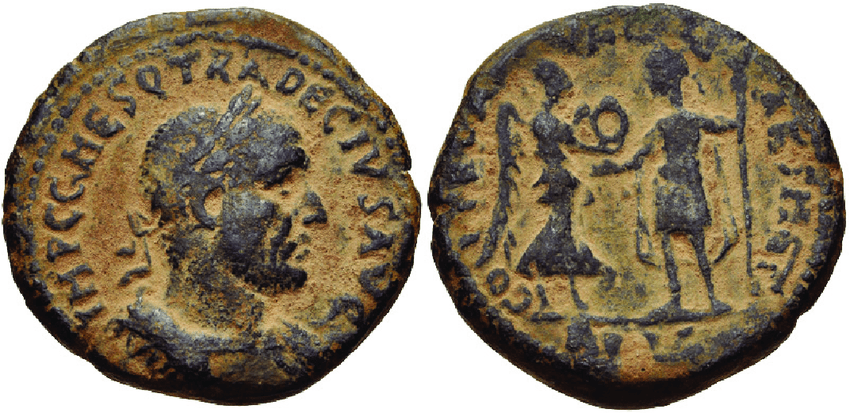
SideInscription (Latin)Expanded FormTranslation (English)Description / Symbolism
Obverse (Front)IMP C M Q TRA DECIVS AVGImperator Caesar Marcus Quintus Traianus Decius Augustus“Emperor Caesar Marcus Quintus Trajan Decius Augustus”Laureate, draped, and cuirassed bust of Decius facing right. The adoption of the name Trajan links him with Rome’s most admired emperor, emphasizing his mission to restore Roman discipline and piety.
Reverse (Back)VICTORIA AVGVictoria Augusti“Victory of the Emperor”Depicts Victory (Nike) standing left, presenting a wreath to the Emperor Decius, who stands facing her, holding a spear. The wreath symbolizes triumph and divine approval. The scene celebrates Decius’s military success and divine sanction for his rule.

Every coin and inscription declared that the gods were returning—and every Christian knew what that would soon mean.


2. The Edict and the Libelli Certificates

In January AD 250, Decius issued an edict commanding all inhabitants of the empire to perform public sacrifice before local officials and obtain written proof of obedience.
Those who refused faced imprisonment or death.

Dozens of papyri discovered in Egypt record the edict’s enforcement. The best-known, now in the Oxford Bodleian Library, reads:

“To the commissioners of sacrifices of the village of Alexander’s Island, from Aurelia Ammonous, daughter of Mystus, aged forty years, scar on right eyebrow. I have always sacrificed to the gods, and now in your presence, in accordance with the edict, I have sacrificed and poured a libation and tasted the offerings. I request you to certify this below. Farewell.”
(Papyrus Oxyrhynchus 2601, AD 250)

Other libelli from Fayum and Theadelphia bear identical phrasing—kata to prostagma (“according to the edict”)—and carry the red-ink seals of village commissioners.
These fragile papyri, recovered by archaeologists in the 1890s, are the only surviving documents produced in direct obedience to Decius’s decree.

They prove that the policy was systematic and bureaucratic—Rome’s paper war against conscience.
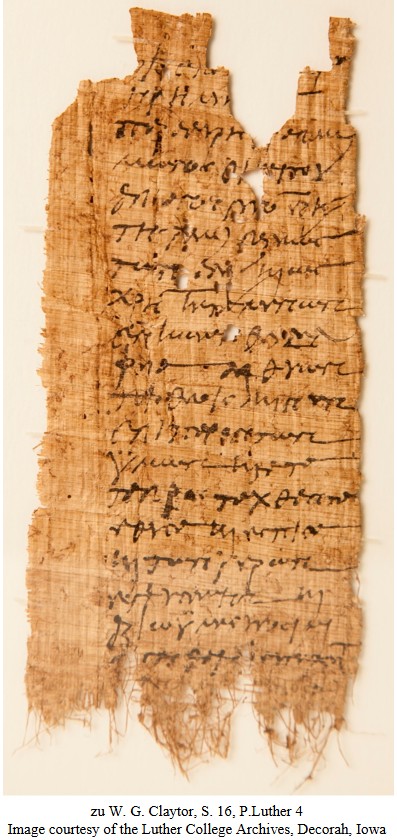
“To those who have been selected to oversee the sacrifices, from Aurelius Sarapammon, servant of Appianus, former exegetes of the most-illustrious city of the Alexandrians, and however he is styled, residing in the village of Theadelphia. Always sacrificing to the gods, now too, in your presence, in accordance with the orders, I sacrificed and poured the libations and tasted the offerings, and I ask that you sign below. Farewell. (2nd hand) We, the Aurelii Serenus and Hermas, saw you sacrificing (?) …”
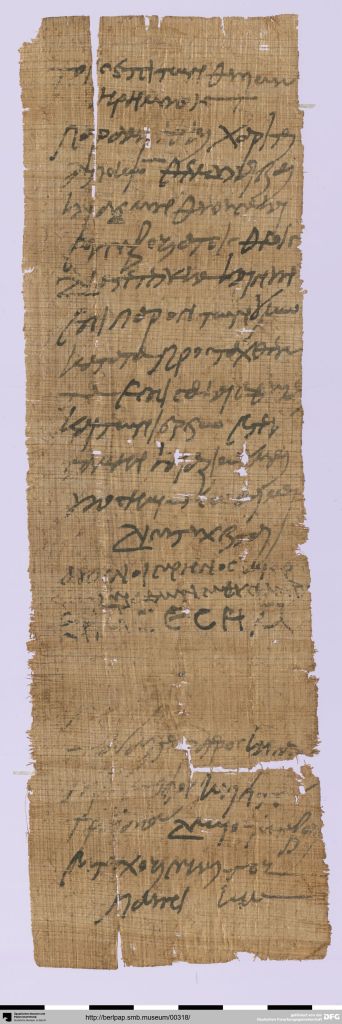
P. 13430

“To the commissioners of sacrifices of the village of Theadelphia:
From Aurelius Syrus, the son of Theodorus, of the village of Theadelphia. I have always sacrificed to the gods, and now, in your presence, I have poured libations, sacrificed, and tasted the sacred offerings, according to the edict. I ask you to certify this for me. Farewell.

We, Aurelius Serenus and Aurelius Hermas, have seen you sacrificing.

Year 1 of the Emperor Decius (AD 250).”

3. The Policy in Motion: Fear and Defiance

Governors such as Sabinus in Egypt and Urbanus in Palestine carried out the edict with zeal.
Eusebius of Caesarea later wrote:

“Decius, who became emperor after Philip, was the first to raise a universal persecution against the Church throughout the inhabited world. There was great persecution against us; the governor Urbanus displayed great zeal in carrying out the imperial commands. Some of the faithful were dragged to the temples and forced to offer sacrifice by tortures.”
(Ecclesiastical History 6.39.1; 6.41.10–12, c. AD 310–325)

Even pagan dedications record the campaign: a marble inscription from Thasos honors local magistrates “for restoring the sacrifices that had fallen into neglect.”
For Decius these were civic triumphs; for Christians, they were death warrants.


4. Voices from the Fire: Martyrdom Across the Empire

Alexandria – Apollonia and the First Flames (AD 249–250)

Bishop Dionysius of Alexandria, an eyewitness, reported:

“The old virgin Apollonia was seized, her teeth broken out, and fire prepared. They threatened to burn her alive if she refused to repeat impious words. She leapt of her own accord into the fire and was consumed.”
(Letter to Fabius of Antioch, in Eusebius 6.41.7–8)

“All Egypt was filled with the noise of those who called upon Christ even in the midst of their tortures.”
(ibid. 6.41.13)

Archaeology corroborates his words: Egyptian sites at Bacchias and Oxyrhynchus reveal temples hastily refurbished and new altars installed in strata dated precisely to AD 250—evidence of an empire suddenly compelled to sacrifice.


Smyrna – Pionius and Companions (AD 250)

The Martyrdom of Pionius preserves an authentic courtroom record:

“On the day of the feast of Saint Polycarp, while we were fasting, the chief of police came suddenly upon us with men bearing chains and bade us sacrifice to the gods. And Pionius said, ‘We are Christians; it is not lawful for us to sacrifice to idols.’”
(Martyrdom of Pionius 2–3)

“They hung him by his wrists, fixing his feet in the stocks. He said, ‘You mistake my torment for your victory; yet it is my freedom, for I rejoice to suffer for the name of Christ.’”
(ibid. 20)

“He breathed out his spirit, and a sweet odor, as of incense, filled the air.”
(ibid. 21)

In Smyrna’s agora, archaeologists have identified a mid-third-century inscription honoring the local strategos who “maintained the sacrifices.” It almost certainly relates to this same enforcement.


Rome – Fabian, Bishop and Martyr (January AD 250)

“Fabian, the bishop of the city of Rome, suffered martyrdom under Decius.”
(Eusebius 6.39.5)

The Depositio Martyrum adds:

“On the twentieth day of January, Fabian, bishop, in the Catacombs.”

His epitaph—FABIAN EPISCOPVS MARTYR—was found in the Catacomb of Callistus.
Soot stains from vigil lamps still darken the marble, showing that Christians visited the site immediately after his death to honor their bishop.


Antioch – Babylas, The Bishop in Chains (AD 250)

“At Antioch, Babylas, bishop of the church there, after glorious bonds and confession, fell asleep in prison.”
(Eusebius 6.39.4)

Archaeological excavations north of Antioch have uncovered the Basilica of Babylas, built atop a repurposed Roman cemetery. Beneath its altar lay a third-century sarcophagus scratched with crosses—widely accepted as the resting place of the Decian bishop who died in chains.


Carthage – Mappalicus and the Imprisoned Confessors (AD 250)

Cyprian wrote from exile:

“Blessed Mappalicus, glorious in his fight, gave witness before the proconsul that he would soon see his Judge in heaven. And when the day came, he was crowned with martyrdom, together with those who stood firm with him.”
(Epistle 37.3)

“The prison has become a church; their bonds are ornaments, their wounds are crowns.”
(Epistle 10.2)

Archaeologists excavating beneath the later Cyprianic Basilica in Carthage found reused Roman blocks incised in red with the names MAPPALICUS VICTOR and FELIX CONFESSOR, strong evidence of a local memorial tradition dating directly to Decius’s time.


Macedonia – Maximus and Companions (AD 250–251)

“In Macedonia, the blessed Maximus and many others gave proof of their faith, being scourged and stoned and finally beheaded.”
(Eusebius 6.43.4–5)

Provincial coinage from Thessalonica of AD 250–251 depicts the goddess Roma receiving sacrifice—a local mirror of the imperial policy that cost these believers their lives.


Sicily – Agatha of Catania (AD 250)

“Quintianus commanded that her breasts be torn with iron hooks, but she said, ‘These torments are my delight, for I have Christ in my heart.’”
(Passio Agathae 6, 3rd-century nucleus)

In Catania’s cathedral crypt, a mid-third-century inscription reading AGATHAE SANCTAE MARTYRI was found in situ, demonstrating that her cult was already established within a generation of her death.


5. The Problem of the Lapsed

Many believers succumbed to fear and sacrificed or bought forged libelli. The Church now had to decide: could such people be restored?

Cyprian’s Pastoral Balance

“Neither do we prejudice God’s mercy, who has promised pardon to the penitent, nor yet do we relax the discipline of the Gospel, which commands confession even unto death.”
(Epistle 55.21, AD 251)

“Let everyone who has been wounded by the devil’s darts, and has fallen in battle, not despair. Let him take up arms again and fight bravely, since he still has a Father and Lord to whom he may return.”
(On the Lapsed 36, AD 251)


Novatian’s Rigorism and Schism

“He who has once denied Christ can never again confess Him; he has denied Him once for all.”
(De Trinitate 29, mid-3rd century)

Bishop Cornelius countered:

“Novatian has separated himself from the Church for which Christ suffered. He says the Church can forgive no sin; yet he himself sins more grievously by dividing the brethren.”
(Eusebius 6.43.10–11)

Fragments of Cornelius’s own epitaph—CORNELIVS EPISCOPVS MARTYR—found near the Callistus catacombs show how quickly the debate over mercy was itself hallowed in stone beside the graves of Decian victims.


Dionysius of Alexandria’s Moderation

“Some of the confessors, being too tender-hearted, desired to welcome all indiscriminately, but we persuaded them to discern, that mercy is good when it is tempered with justice.”
(Eusebius 6.42.4–5)

“Each church dealt with the fallen as it judged best, some treating them harshly, others gently. In this diversity of discipline, yet unity of faith, the Lord was glorified.”
(ibid. 6.42.6*)


6. Pagan Reflection and Christian Memory

Lactantius explained the emperor’s motives:

“Decius, being a man of old-fashioned rigor, desired to restore the ancient religion; and therefore he decreed that sacrifices should be offered to the gods by all. He did evil while intending good.”
(Divine Institutes 5.11, c. AD 310)

Eusebius reflected:

“Those who endured were tried as by fire and found faithful; others, weak through fear, failed the test, yet afterward were restored through tears and repentance.”
(Ecclesiastical History 6.42.2)

Roman catacomb graffiti from this very decade—FELIX MARTYR IN PACE and VICTOR IN CHRISTO—show that Christians carved into the walls the same theology Eusebius would later write: faith tested by fire, rewarded with peace.


7. The End and the Legacy

In AD 251, Decius and his son Herennius Etruscus fell in battle against the Goths near Abrittus. The edict died with them.
But its memory lived on in papyrus and stone—libelli in the desert, epitaphs beneath Rome, and basilicas raised over tombs from Antioch to Carthage.

The Decian persecution produced the earliest empire-wide martyrology, the first letters written from prison, and a theology forged in fire.
It made public what Rome could never suppress:

“We must obey God rather than men.” — Acts 5:29

The empire had demanded a certificate; the Church answered with a confession.
Multiplying by Mission: Session 6 at Mission Lake

40% Growth Then, 5% Growth Now — What We Must Learn Anew

When Nero died by suicide in AD 68, the Roman Empire plunged into chaos.
In a single year four emperors—Galba, Otho, Vitellius, and finally Vespasian—rose and fell.
While Rome fought for power, Judea was already on fire.
The revolt that began under Gessius Florus would end with Jerusalem leveled, the Temple burned, and a turning point for both Jews and Christians.


1. Florus and the Spark of Revolt (AD 66)

Florus, the Roman governor of Judea, stole seventeen talents of silver from the Temple treasury—about 1,200 pounds of consecrated silver, worth roughly ten million U.S. dollars today.
This was not ordinary corruption; it was sacrilege.

When Florus took seventeen talents out of the sacred treasure, and the multitude ran together in the Temple crying out against him, some of the youths went about the city carrying baskets and asking alms for poor Florus.
— Josephus, Jewish War 2.14.5 §306–308 (c. AD 75–79)

His answer was bloodshed.

Florus sent soldiers into Jerusalem and ordered a massacre. They slew about three thousand six hundred persons, women and children as well as men; and among them were citizens of Roman knighthood. Some were scourged and then crucified.
— Josephus, Jewish War 2.14.9 (c. AD 75–79)

The outrage united the city. Rebels stormed the Antonia Fortress, the great Roman garrison on the northwest corner of the Temple Mount. To capture it was to challenge Rome itself.

They compelled the garrison to surrender and then slaughtered them. Thus war was now openly begun.
— Josephus, Jewish War 2.17.9 (c. AD 75–79)

Rome’s patience ended. Nero sent Vespasian, the empire’s most seasoned general, and his son Titus to crush the rebellion.


2. Vespasian in Galilee — Fire and Terror (AD 67)

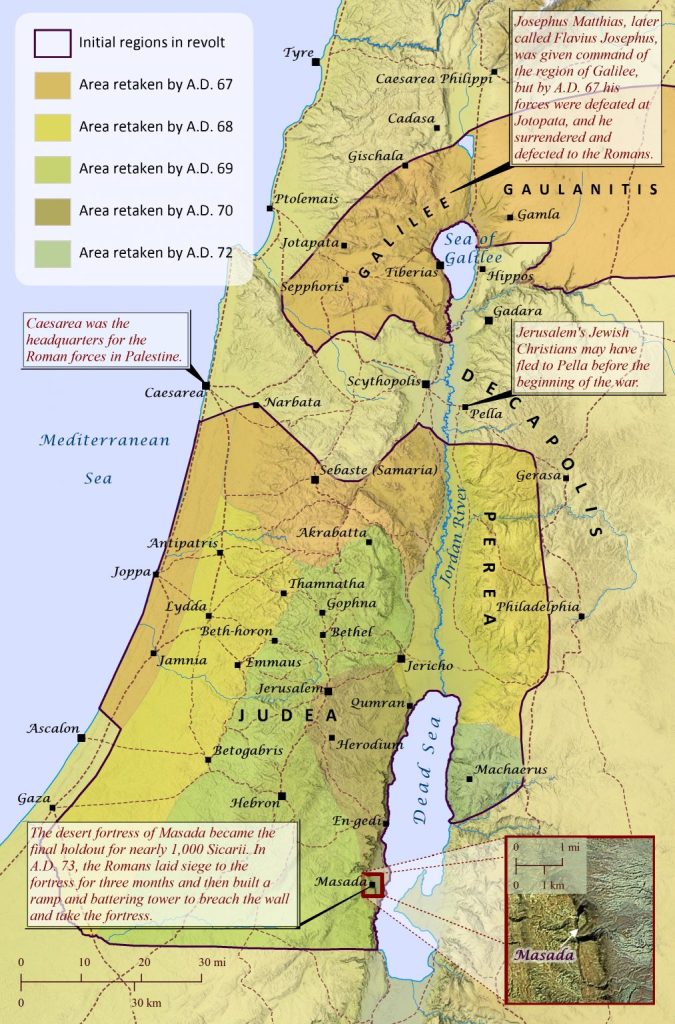
Galilee became Rome’s first target. At Jotapata, a hill fortress commanded by Josephus himself, the walls fell after forty-seven days.

Forty thousand were slain, and the city was utterly demolished; those who had hidden in caves were dragged out and slain.
— Josephus, Jewish War 3.7.36 (c. AD 75–79)

Then came Gamla, a ridge-top city east of the Sea of Galilee. Its name means camel in Aramaic, and its fall was as steep as its slopes.

Men and women alike threw themselves and their children down the precipices; and the whole city was covered with corpses.
— Josephus, Jewish War 4.1.9 (c. AD 75–79)

Josephus summed it simply: “Galilee was filled with fire and blood.”
— Josephus, Jewish War 4.1.9 (c. AD 75–79)

The Roman campaign left the region in ruins, silencing nearly every center of resistance.

It was here that Josephus himself was captured. As commander of Jewish forces in Galilee, he had held out at Jotapata until the city fell. In his own account, he claims that while in captivity he prophesied that Vespasian would soon be emperor:

You, O Vespasian, shall be Caesar and emperor, you and your son. Bind me now still closer, and keep me for yourself; for you, O Caesar, are lord, not only of me, but of the land and sea, and of all mankind.
— Josephus, Jewish War 3.8.9 §401–403 (c. AD 75–79)

When that prophecy appeared to come true the following year, Vespasian spared his life, granted him Roman citizenship, and attached him to his household. From then on Josephus lived in Rome under imperial patronage, taking the family name Flavius from his patrons.

This is how Yosef ben Matityahu, a Jewish priest and rebel general, became Flavius Josephus, historian of the Jewish War. His writings—sometimes defensive, sometimes deferential toward Rome—remain the only detailed eyewitness record of Jerusalem’s destruction.


3. The Siege of Jerusalem (AD 70)

When Nero’s death recalled Vespasian to Rome, Titus took full command.
Inside Jerusalem, zealot factions fought one another while Roman legions built a five-mile siege wall to starve the city into surrender.
This wall—called a circumvallation—completely encircled Jerusalem. Built in only three days by tens of thousands of soldiers, it cut off every road and stopped all supplies. Famine would finish what the legions began.

The famine grew severe and destroyed whole houses and families. The alleys were filled with dead bodies of the aged; children and youths swarmed about the market-places like shadows, and fell wherever famine overtook them. No one buried them; pity was strangers to men; for famine had confounded all natural feeling.
— Josephus, Jewish War 5.12.3–4 (c. AD 75–79)

Then Josephus records one of antiquity’s darkest scenes:

There was a certain woman named Mary, daughter of Eleazar, of the village Bathezor. Driven by famine and rage, she slew her infant son, roasted him, and ate one half, concealing the rest. When the soldiers smelled the roasted meat and rushed in, she said, ‘This is my own son; the deed is mine; eat, for I have eaten. Do not pretend to be more tender-hearted than a woman or more compassionate than a mother.’
— Josephus, Jewish War 6.201–213 (c. AD 75–79)

Titus later claimed he had ordered the Temple spared:

I myself called a council of war and urged that the Temple be saved; but the flame was beyond control, and the sanctuary was burned against my will.
— Josephus, Jewish War 6.4.7 §254 (c. AD 75–79)

Josephus blames undisciplined troops; Tacitus sees deliberate policy:

It was resolved to destroy the Temple that the religion of the Jews might be more completely abolished.
— Tacitus, Histories 5.12 (c. AD 100–110)

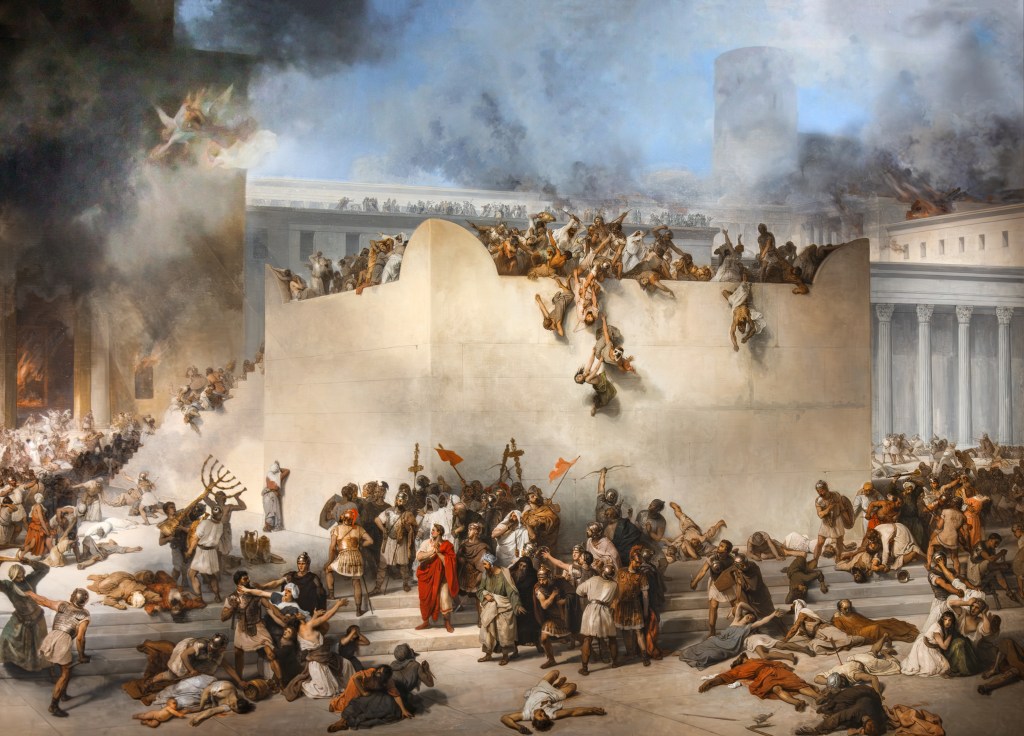
The Destruction of the Temple of Jerusalem – Francesco Hayez, 1867, oil on canvas

Different motives, same outcome: the Temple fell.
For Christians, it confirmed the prophecy of Christ: “Not one stone shall be left upon another.” (Mark 13:2)


4. Crosses Without Number

As for those who had fled from the city and were caught, they were first scourged and then tortured and finally crucified before the walls. In their fury and hatred the soldiers nailed up the prisoners in different postures, by way of jest, and the multitude was so great that room was wanting for the crosses, and crosses for the bodies.
— Josephus, Jewish War 5.11.1 (c. AD 75–79)

Josephus later expands this account:

Those who were taken outside the city he first scourged, and then tormented with all manner of tortures before crucifying them opposite the wall. Titus indeed felt pity for them, but their number was so great that there was no room for the crosses nor crosses for the bodies. About five hundred were crucified each day, and the soldiers, in their rage and hatred, amused themselves by crucifying some one way and some another, until, owing to the multitude, there was no space left for the crosses nor crosses for the bodies.
— Josephus, Jewish War 6.1.1 (c. AD 75–79)

The same empire that boasted of order and civilization turned execution into entertainment.
The hills around Jerusalem stood thick with crosses—not yet symbols of redemption, but monuments of Rome’s rule through fear.


5. Aftermath — Slavery, Spectacle, and Tax

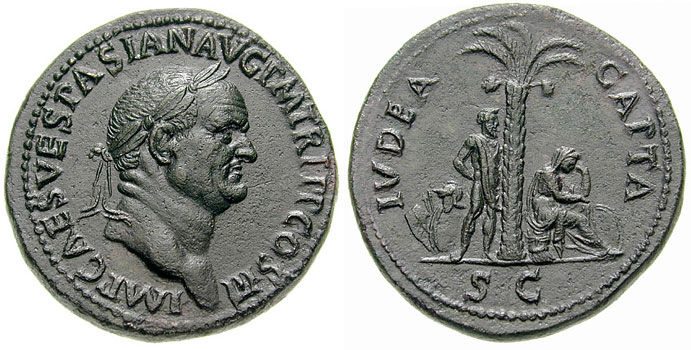
Through Rome’s streets the captives marched, carrying the Menorah and sacred vessels. Coins were struck proclaiming IUDAEA CAPTA—“Judea Captured.” Various versions of these coins were struck and used for 25 years under Vespasian and his two sons Titus and Domitian.

IMP CAES VESPASIAN AUG PM TR P COS III = Commander Caesar Vespasian Augustus, Chief Priest, Holder of Tribunician Power, Consul for the Third Time; IUDEA CAPTA S C = Judea Captured by decree of the Senate

He decreed that all Jews throughout the world should pay each year two drachmas to the Capitol in Rome, as they had previously paid to the Temple in Jerusalem.
— Dio Cassius, Roman History 66.7 (c. AD 200–220)

The fiscus Judaicus turned a holy offering into tribute for pagan gods.
Jewish Christians, still classed as Jews, were forced to pay the same tax of defeat.

Meanwhile, many early believers saw a deeper reason for Jerusalem’s ruin: the death of James the Just, the brother of Jesus and leader of the church in Jerusalem.

Festus was now dead, and Albinus was but upon the road; so Ananus, who had become high priest, assembled the Sanhedrin of judges, and brought before them the brother of Jesus, who was called Christ, whose name was James, and some others; and when he had formed an accusation against them as breakers of the law, he delivered them to be stoned.
— Josephus, Antiquities 20.9.1 §200–203 (c. AD 93)

Hegesippus, a second-century Jewish Christian, adds detail:

They placed James on the pinnacle of the Temple and cried, ‘Tell us, O righteous one, what is the door of Jesus?’ And he answered with a loud voice, ‘Why do you ask me concerning the Son of Man? He sitteth at the right hand of the Great Power, and shall come on the clouds of heaven.’ Then they began to stone him, and a fuller took the club with which he beat clothes and struck the righteous one on the head, and so he suffered martyrdom.
— Hegesippus in Eusebius, Ecclesiastical History 2.23.10–12 (c. AD 170, quoted c. AD 310–325)

Hegesippus concludes that the siege of Jerusalem followed soon after James’s death, calling it divine judgment:

Immediately after this Vespasian began to besiege them; and they remembered the saying of Isaiah the prophet, ‘Let us take away the righteous man, because he is troublesome to us; therefore they shall eat the fruit of their doings.’ Such was their lot, and they suffered these things for the sake of James the Just.
— Hegesippus in Eusebius, Ecclesiastical History 2.23.18 (c. AD 170, quoted c. AD 310–325)

Eusebius agrees, closing his account:

These things happened to the Jews to avenge James the Just, who was the brother of Jesus that is called Christ. For, as Josephus says, these things befell them in accordance with God’s vengeance for the death of James the Just, which they had committed, although he was a most righteous man.
— Eusebius, Ecclesiastical History 2.23.19–20 (c. AD 310–325)

From this moment on, many Christians saw the destruction of Jerusalem not only as Rome’s triumph, but as God’s judgment for rejecting Christ and murdering His righteous servant.


6. The Arch of Titus — The Empire’s Theology in Stone (AD 81)

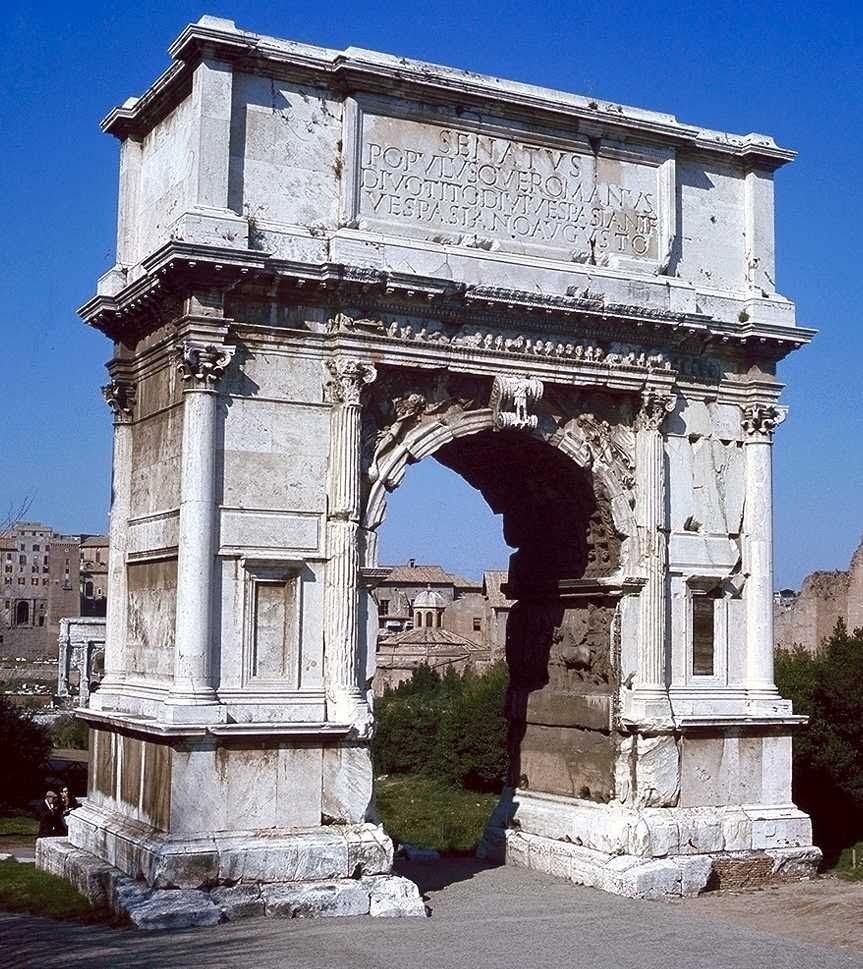
When Titus died, the Senate declared him divine. The arch still standing on the Via Sacra reads:

The Senate and People of Rome [dedicated this] to the deified Titus Vespasian Augustus, son of the deified Vespasian.

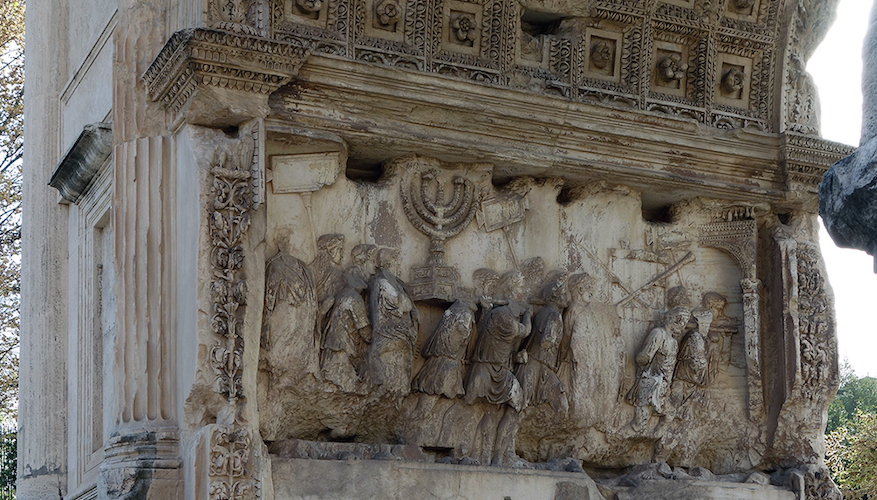
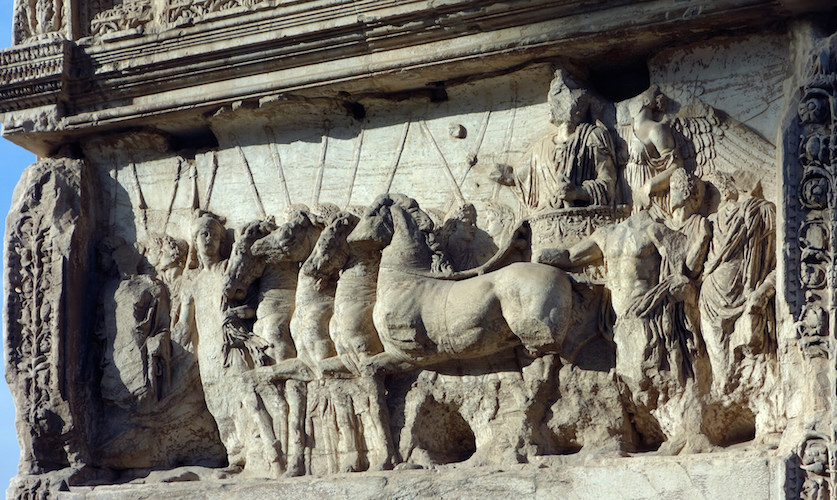
Inside its vault, carvings show Roman soldiers bearing the Temple treasures.

They brought the Menorah and the table of the bread of the Presence, and the last of the spoils was the Law of the Jews; after these, a great number of captives followed.
— Josephus, Jewish War 7.5.5 (c. AD 75–79)

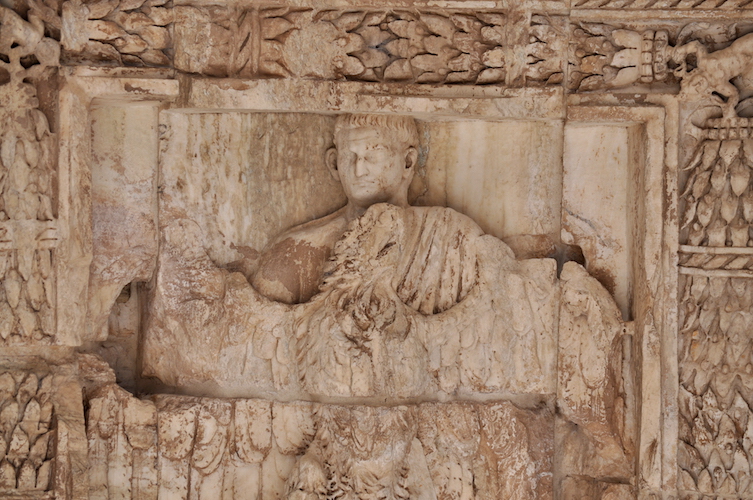
At the top of the arch inside is the depiction of Titus’ ascension to heaven as a god on the wings of an eagle.

For Rome, the arch proclaimed the victory of its gods.
For Christians, it stood as a silent confirmation of prophecy: the Temple of stone was gone, but the Temple of Christ remained.


7. The Flight to Pella — Revelation and Refuge

Amid the ruins of Jerusalem’s revolt, one community escaped—the believers who remembered Christ’s warning to flee.

The people of the church in Jerusalem had been commanded by a revelation, vouchsafed to approved men there before the war, to leave the city and to dwell in a certain town of Perea called Pella. And when those who believed in Christ had come thither from Jerusalem, then, as if the holy men had altogether deserted the royal city of the Jews and the whole land of Judea, the judgment of God at last overtook them for their abominations.
— Eusebius, Ecclesiastical History 3.5.3 (c. AD 310–325)

Eusebius attributes their escape to a divine revelation, while Epiphanius explains it as obedience to Christ’s prophecy:

When all the disciples were settled in Pella because of Christ’s prophecy about the siege, they remained there until the destruction of Jerusalem.
— Epiphanius, Panarion 29.7.7–8 (c. AD 375)

Different explanations—same event. The believers crossed the Jordan to Pella, a Decapolis city about sixty miles northeast of Jerusalem, where they waited out the war.
Their flight fulfilled Jesus’ own words (Luke 21:20–21).
What looked like retreat was obedience.


8. The Nazarenes — Law-Observant, Christ-Confessing

The first branch to emerge from that exile was the Nazarenes—Jewish believers who kept the Mosaic Law yet confessed Jesus as the divine Son of God.
They were the losing party in the Council of Jerusalem (Acts 15).

At that council, certain men from Judea began teaching that Gentile converts must keep the Law of Moses to be saved:

Some men came down from Judea and were teaching the brothers, ‘Unless you are circumcised according to the custom of Moses, you cannot be saved.’
— Acts 15:1

Later Luke identifies who pressed the issue:

But some of the sect of the Pharisees who believed rose up, saying, ‘It is necessary to circumcise them and to command them to keep the law of Moses.’
— Acts 15:5

Peter and James ruled that Gentiles need not bear that yoke:

We should not trouble those of the Gentiles who turn to God, but should write to them to abstain from things polluted by idols, from sexual immorality, from what has been strangled, and from blood.
— Acts 15:19–20

Those Jewish believers who could not release Torah observance continued as a community of Torah-keeping Christians—the Nazarenes.

Two decades later they were still strong. When Paul returned to Jerusalem near the end of his ministry, James the Just, the same leader later martyred near the Temple, recognized their influence:

You see, brother, how many myriads of Jews there are who have believed, and they are all zealous for the Law… Therefore do what we tell you: we have four men who have taken a vow; take them and purify yourself along with them, and pay their expenses, so that all may know that there is nothing in what they have been told about you, but that you yourself also live in observance of the Law.
— Acts 21:20, 23–24

James’s advice shows that the Nazarenes were not fringe but central within the Jerusalem church.

Centuries later, Jerome described them:

“The adherents to this sect are known commonly as Nazarenes; they believe in Christ the Son of God, born of the Virgin Mary; and they say that He who suffered under Pontius Pilate and rose again is the same as the one in whom we believe.”
— Jerome, Letter 75 to Augustine (AD 398–403)

“The Nazarenes accept Messiah in such a way that they do not cease to observe the old Law.”
— Jerome, Commentary on Isaiah 8:14 (AD 398–403)

Even Epiphanius, who condemned most sects, writes:

The Nazarenes are Jews who keep the customs of the Law but also believe in Christ. They say that Jesus was born of the Virgin Mary by the Holy Spirit. They believe that God created all things, that Jesus is His Son, and that the resurrection of the dead has already begun in Him… As for their understanding of Christ, I am not certain—whether they have been misled by false teachers who call Him merely human, or whether, as I think, they confess that He was born of Mary by the Holy Spirit.
— Epiphanius, Panarion 29.7.5–6 (c. AD 375)

Epiphanius lists their beliefs as orthodox and then admits, “I cannot say whether they have been deceived or whether they confess the truth.”
Had they denied Christ’s divinity, he would have said so.
His hesitation confirms that the Nazarenes were orthodox in belief, Jewish in culture—the first generation of Messianic Jews bridging synagogue and church.


9. The Ebionites — The First Denial of Christ’s Divinity

A second group took a different path. Epiphanius places their origin after the flight to Pella:

The Ebionites are later than the Nazoraeans… their sect began after the flight from Jerusalem.
— Epiphanius, Panarion 29.7.7–8 (c. AD 375)

They taught that Jesus was a mere man chosen by God, denied the virgin birth, and altered Scripture to fit their beliefs.

Those who are called Ebionites use the Gospel according to Matthew only, and repudiate the Apostle Paul, maintaining that he was an apostate from the Law.
— Irenaeus, Against Heresies 1.26.2 (c. AD 180)

The Ebionites believe that He was a mere man, born of Joseph and Mary according to the common course of nature, and that He became righteous through the progress of His moral character.
— Origen, Commentary on Matthew 16.12 (c. AD 248)

They falsify the genealogical tables in Matthew’s Gospel, saying that He was begotten of a man and a woman, because they maintain that Jesus is really a man and was justified by His progress in virtue, and that He was called Christ because the Spirit of God descended upon Him at His baptism. They say that this same Spirit, which had come upon Him, was taken away and left Him before the Passion and went back to God; and that then, after His death and resurrection, this same Spirit returned to Him again. Thus they deny that He is God, though they do not deny that He was a man.
— Epiphanius, Panarion 30.14.3–5 (c. AD 375)

They also spread a slander about Paul:

They say that Paul was a Greek who came to Jerusalem and lived there for a time. He desired to marry a daughter of the priests but was refused. Out of anger and disappointment he turned against circumcision, the Sabbath, and the Law. Because of this, they claim, he wrote against these things and founded a new heresy.
— Epiphanius, Panarion 30.16.6–9 (c. AD 375)

For the Ebionites, Jerusalem’s destruction was not punishment for rejecting Christ but for accepting the apostolic Gospel.
They blamed Paul and the church that followed him for turning Israel away from the Law.
Thus they reversed the very lesson of history that Josephus, Hegesippus, and Eusebius had drawn from the death of James the Just.
Where the Nazarenes preserved unity in diversity, the Ebionites cut themselves off from the apostolic faith.


10. Three Waves of Testimony and the Apostolic Standard

When we date the earliest Christian writings, we find three waves of testimony—sources acknowledged even by skeptical historians as genuine first-century evidence.
They give us the historical core around which all later writings revolve.


Three Waves of Early Christian Testimony

Wave of WitnessApproximate DateContent & DescriptionAuthority and Significance
CreedsAD 30s1 Corinthians 15:3–5 — “Christ died, was buried, and rose again according to the Scriptures.”
Philippians 2:6–11 — The Christ-hymn proclaiming His pre-existence, incarnation, humility, and exaltation.
The earliest confessions of faith; already proclaim Jesus as divine and demand worship.
Paul’s EpistlesAD 48–61The seven undisputed letters of PaulRomans, 1 & 2 Corinthians, Galatians, Philippians, 1 Thessalonians, and Philemon.The interpretation of Christ’s work by Paul himself, written within the lifetime of the apostles; Paul quotes and affirms the early creeds as authoritative revelation.
Synoptic GospelsAD 50s–60sMatthew, Mark, and Luke — written within the first generation after Jesus, preserving eyewitness memory of His life, teaching, death, and resurrection.The formal written record of what the earliest witnesses proclaimed; confirms and expands the message already present in the creeds and letters.

This Philippians hymn is not later theology; it is the earliest Christian confession we possess.
It begins with divinity, not humanity.
It declares that the one “existing in the form of God” became man, died on a cross, and was exalted so that every knee should bow and every tongue confess that Jesus Christ is Lord.
It is a proclamation of His divinity and a demand for worship from the very start of the Christian movement.

Modern critics such as Bart Ehrman claim that belief in Jesus’ divinity was a late development, yet their own dating of the evidence proves the opposite.
The earliest sources—the creeds Paul quotes—already worship Him as divine, and Paul treats those creeds as authoritative revelation.
From the beginning, the church bowed to a divine Christ, not a human teacher slowly exalted by legend.

Measured by that apostolic standard, the Nazarenes remained faithful to the original confession, honoring Paul’s letters and the earliest creeds.
The Ebionites, however, altered the Gospels, repudiated Paul, and rejected the Philippians 2 creed, denying Christ’s divinity and placing themselves outside the apostolic faith.


11. Dating the Gospels

Critical scholars commonly date Mark around AD 70, arguing that Jesus’ prophecy of the Temple’s destruction must have been written after it happened.
But this logic assumes that prophecy is impossible—a philosophical bias, not a historical fact.
If prophecy is real, the foundation for late dating collapses.

Even on their own terms, critics face contradictions.
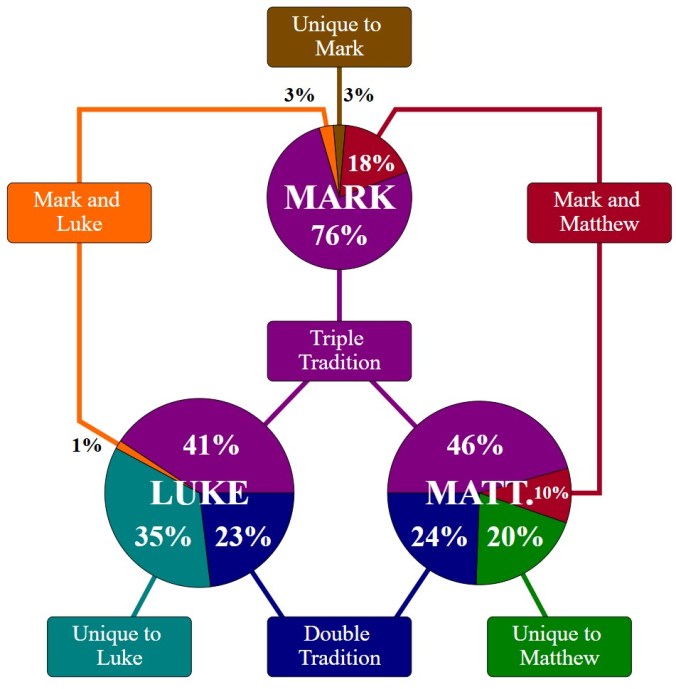
They argue that Matthew copied Mark and therefore must be later, yet the Ebionites were already using and editing Matthew shortly after Jerusalem’s fall.
If Matthew was being altered in the 70s, it had to exist before then—and if Matthew depended on Mark, Mark must be earlier still.
The evidence forces the Synoptic Gospels back into the 60s or even 50s—within the lifetime of eyewitnesses.

Paul’s letters tighten the timeline further.
In 1 Corinthians, written about AD 54–55, Paul quotes Gospel material three times:

  • 1 Corinthians 7:10 echoes Mark 10:11–12 on divorce — “not I, but the Lord.”
  • 1 Corinthians 9:14 recalls Luke 10:7 — “the Lord commanded that those who proclaim the gospel should get their living by the gospel.”
  • 1 Corinthians 11:23–25 recounts the words of institution at the Lord’s Supper, matching Luke 22:19–20 and Matthew 26:26–28.

These parallels show that the Gospel traditions were already written—or at least formally fixed—by the early 50s.
Paul quotes them as Scripture, not rumor, expecting his readers to recognize their authority.
This means the Gospels, or their written sources, predate 1 Corinthians itself—placing them within twenty years of the crucifixion.

Thus the timeline of Christian testimony runs not forward into myth but backward into eyewitness memory:

  • Creeds (AD 30s): the original confession of Christ’s death, resurrection, and divine status.
  • Paul’s Epistles (AD 48–61): the interpretation of those events by Paul himself, written within the lifetime of the apostles.
  • Synoptic Gospels (AD 50s–60s): the written preservation of what the eyewitnesses had proclaimed from the beginning.

When the evidence is allowed to speak for itself, it shows that the worship of Jesus as divine and the written record of His life both originate within living memory of His death and resurrection.
Even those who date the Gospel of John later, around the 90s, acknowledge that the Synoptics—and the faith they record—were already established decades earlier.
Christianity’s foundation is not legend developed over centuries—it is history written by witnesses and verified by worship.