The Gospel of Peter is often presented as one of the most intriguing “lost gospels,” a text that some claim could have stood alongside Matthew, Mark, Luke, and John if history had taken a different course. It is frequently used to suggest that early Christianity contained competing accounts of Jesus and that what we now call the New Testament reflects only one version that eventually prevailed.
But when we turn to the earliest historical evidence and examine what actually happened, the picture becomes much clearer.
The Gospel of Peter does not emerge from the earliest layers of Christianity. It does not appear in the writings of the apostolic fathers. It is not discussed by the major second century theologians. Instead, it enters the historical record late, in a specific location, and when it appears, it is immediately examined and questioned.
The First Appearance: A Local Church in Rhossus
The earliest reference to the Gospel of Peter comes from Serapion of Antioch, writing around AD 190 to 210. His words are preserved by Eusebius of Caesarea in Ecclesiastical History.
Serapion explains that he encountered this gospel in the church at Rhossus, a coastal city in Syria under his oversight. What makes this moment so striking is that he had never encountered the text before. He writes:
“As we had not read the Gospel put forward under Peter’s name, we said: ‘If this is the only thing that causes quarrel among you, let it be read.’”
(Eusebius, Ecclesiastical History 6.12.3–6)
A bishop responsible for multiple churches encounters a gospel he has never seen. This is not a text circulating widely across the Christian world. It appears locally, in one community, and it is already causing disagreement.
A Careful and Measured Response
Serapion’s initial reaction is not immediate rejection. He allows the text temporarily for the sake of unity within the church. But he does not leave the matter unresolved. After examining it carefully, he writes:
“We, brethren, receive both Peter and the other apostles as Christ; but the writings falsely inscribed with their names we reject, as men of experience, knowing that such were not handed down to us.”
(Eusebius, Ecclesiastical History 6.12.3)
The issue is not whether Peter is authoritative. The issue is whether this writing truly belongs to the apostolic tradition.
He then gives his assessment of the content:
“We were able to read it, and we found that most of it was in accordance with the true teaching of the Savior, but some things we found added.”
(Eusebius, Ecclesiastical History 6.12.6)
Eusebius adds one more crucial detail. Serapion had obtained the text from those:
“who are called Docetae”
(Eusebius, Ecclesiastical History 6.12)
This indicates that the Gospel of Peter was not native to the church in Rhossus. It had been introduced from outside, from a group already associated with distinct theological views.
The Silence Before This Moment
Before Serapion, there is no trace of this gospel.
It does not appear in Ignatius of Antioch, writing around AD 110, who strongly emphasizes the real suffering of Christ. It is absent from Polycarp. It is not referenced by Justin Martyr, who frequently quotes from what he calls the “memoirs of the apostles.”
It is also missing from the work of Irenaeus, who directly addresses competing gospels and writes:
“It is not possible that the Gospels can be either more or fewer in number than they are… it is fitting that she should have four pillars.”
(Irenaeus, Against Heresies 3.11.8, c. AD 180)
In a context where alternative texts are named and challenged, the absence of the Gospel of Peter is significant.
Later References Confirm Its Status
After Serapion, later writers show awareness of the text but consistently treat it as secondary or rejected.
Origen, writing around AD 240, refers to it in passing:
“But some say, based on a tradition in the Gospel according to Peter, or the Book of James, that the brothers of Jesus were sons of Joseph by a former wife.”
(Origen, Commentary on Matthew 10.17)
He introduces it as something “some say,” not as an authoritative source.
By the late fourth century, the judgment is more explicit.
Jerome, writing around AD 392, states:
“The books… of which one is called his Gospel… are reckoned among the apocryphal writings.”
(Jerome, On Illustrious Men 1)
And Didymus the Blind, writing in the late fourth century, warns:
“We do not read the apocryphal books, because they are composed under false names, and the simple are led astray.”
(Didymus the Blind, Commentary on Ecclesiastes 8.3)
These are not passing remarks. They reflect a settled judgment.
Manuscripts That Appear at the Same Time
The manuscript evidence aligns with this late appearance.
The earliest likely fragment, P. Oxy. 2949, dates to the late second or early third century, placing it in the same timeframe as Serapion. There is no earlier manuscript evidence.
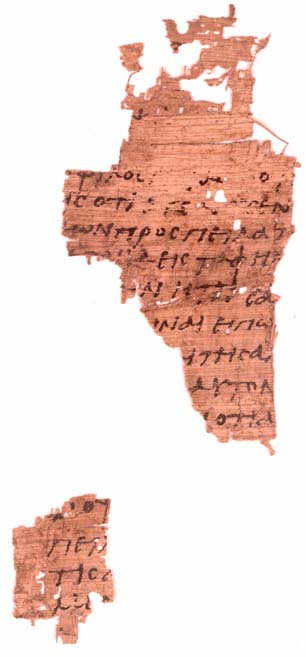
The only continuous text comes from the Akhmîm codex, dated to the sixth or seventh century. This codex contains:
- portions of 1 Enoch
- the Gospel of Peter
- the Apocalypse of Peter
- a martyrdom account
The Gospel of Peter appears among other non-canonical writings, not as a central or authoritative gospel.
The Crucifixion: A Key Docetic Signal
One of the most revealing passages appears during the crucifixion:
“But he remained silent, as though he had no pain.”
(Gospel of Peter 4)
This statement stands in contrast to the canonical Gospels, where Jesus speaks and suffers visibly. Here, the text presents him as if he is untouched by pain.
This is precisely the kind of portrayal that raised concern. It suggests not simply endurance, but a distancing from real physical suffering, a hallmark of docetic thinking.
The following verse deepens the concern:
“My power, my power, you have forsaken me… and he was taken up.”
(Gospel of Peter 5)
This wording differs from the canonical tradition and has often been understood as implying a separation between the divine and human aspects of Christ at the moment of death.
The Resurrection: A Dramatic Expansion
The most striking departure appears in the resurrection narrative.
Unlike the canonical Gospels, which do not describe the moment of resurrection itself, the Gospel of Peter presents it as a visible event:
“They saw the heavens opened, and two men descending… and the stone rolled away of itself.”
(Gospel of Peter 9)
The account continues:
“They saw three men coming out of the tomb, and the two supporting the one, and a cross following them.”
(Gospel of Peter 10)
This alone marks a dramatic shift. The resurrection is no longer hidden. It is witnessed.
But the text goes even further:
“They heard a voice from heaven saying, ‘Have you preached to those who sleep?’ And from the cross there was heard the answer, ‘Yes.’”
(Gospel of Peter 10)
Here, the cross itself speaks.
This is not simply a variation in detail. It reflects a different mode of storytelling, one that introduces symbolic and dramatic elements beyond the earlier tradition.
Conclusion
The Gospel of Peter appears late in the historical record, in a single local church, and is unfamiliar even to the bishop overseeing that region. It is introduced from outside, associated with groups holding distinct theological views, and when examined, it is found to contain additions that do not align with the apostolic message.
Later writers acknowledge it but consistently reject it. The manuscript evidence begins at the same time it first appears in history. Its content reflects a later stage of development.
Taken together, this is not the profile of a lost original gospel. It is the profile of a later composition that was tested and set aside.
 Living the Bible