Multiplying by Mission: Session 9 at Mission Lake

40% Growth Then, 5% Growth Now — What We Must Learn Anew

Our goal in this session is to present the essence of the Christian faith as seen through the earliest and most significant pieces of literature from the ancient church and from the Roman world in which it emerged. We are seeking to understand what is essential for Christianity—those truths that form the common foundation of belief and moral life—as distinguished from what is diverse in local application or interpretation. From the earliest creeds of the 30s AD to the writings of Eusebius in the early 300s, the evidence will show that the rule of faith remained consistent in its core confession of God, Christ, the Spirit, resurrection, judgment, and ethical life, while at the same time the Church celebrated and respected diversity in practice and interpretation among its many communities.


Earliest Christian Creeds and Hymns

PassageApprox. Date (Content)Theme / FocusBroad Scholarly Consensus
1 Cor 15:3-7Early 30s ADDeath, burial, and resurrection of ChristUniversal — accepted by atheist and believing scholars as the earliest Christian tradition
Phil 2:6-11Early 30s ADPre-existence, incarnation, and exaltationUniversal — recognized as a pre-Pauline hymn used in earliest worship
Rom 1:3-4Early 30s ADSon of God declared in power by resurrectionStrong — widely regarded as an early Palestinian creed
1 Thess 4:1440s ADResurrection hope and life to comeStrong — early confessional formula of faith and hope
Gal 3:2840s ADEquality and unity of believers in ChristStrong — baptismal or ethical confession of oneness
Rom 12:9-1340s ADLove and moral conduct among believersModerate–Strong — early ethical summary shaped by creed
Col 1:15-2040s AD (Pauline authorship disputed)Cosmic Christ reconciling all thingsStrong — pre-Pauline hymn emphasizing Christ’s lordship

Romans 1:3-4

Cited by Paul in Romans (AD 57-58); creed from the early 30s AD.

Concerning his Son, who was descended from David according to the flesh,
and was declared to be the Son of God in power according to the Spirit of holiness
by his resurrection from the dead, Jesus Christ our Lord.
(Rom 1:3-4 ESV)


1 Corinthians 15:3-11

Cited by Paul in 1 Corinthians (AD 54-55); creed from the early 30s AD.

For I delivered to you as of first importance what I also received:
that Christ died for our sins in accordance with the Scriptures,
that he was buried,
that he was raised on the third day in accordance with the Scriptures,
and that he appeared to Cephas, then to the twelve.
Then he appeared to more than five hundred brothers at one time, most of whom are still alive, though some have fallen asleep.
Then he appeared to James, then to all the apostles.
Last of all, as to one untimely born, he appeared also to me.
For I am the least of the apostles, unworthy to be called an apostle, because I persecuted the church of God.
But by the grace of God I am what I am, and his grace toward me was not in vain. On the contrary, I worked harder than any of them — though it was not I, but the grace of God that is with me.
Whether then it was I or they, so we preach and so you believed.
(1 Cor 15:3-11 ESV)


Philippians 2:6-11

Cited by Paul in Philippians (AD 55-60); chiastic hymn from the early 30s AD.

Christ Jesus, who, though he was in the form of God,
did not count equality with God a thing to be grasped,
but emptied himself, by taking the form of a servant,
being born in the likeness of men.
And being found in human form, he humbled himself
by becoming obedient to the point of death, even death on a cross.
Therefore God has highly exalted him
and bestowed on him the name that is above every name,
so that at the name of Jesus every knee should bow,
in heaven and on earth and under the earth,
and every tongue confess that Jesus Christ is Lord,
to the glory of God the Father.
(Phil 2:6-11 ESV)


1 Thessalonians 4:14

Cited by Paul in 1 Thessalonians (AD 49-50); confessional line from the 40s AD.

For since we believe that Jesus died and rose again, even so, through Jesus, God will bring with him those who have fallen asleep.
(1 Thess 4:14 ESV)


Galatians 3:28

Cited by Paul in Galatians (AD 48-49); baptismal or ethical formula from the 40s AD.

There is neither Jew nor Greek, there is neither slave nor free, there is no male and female, for you are all one in Christ Jesus.
(Gal 3:28 ESV)


Romans 12:9-13

Cited by Paul in Romans (AD 57-58); early ethical summary reflecting creedal life of the 40s AD.

Let love be genuine. Abhor what is evil; hold fast to what is good.
Love one another with brotherly affection. Outdo one another in showing honor.
Do not be slothful in zeal, be fervent in spirit, serve the Lord.
Rejoice in hope, be patient in tribulation, be constant in prayer.
Contribute to the needs of the saints and seek to show hospitality.
(Rom 12:9-13 ESV)


Colossians 1:15-20

Quoted in the (disputed) Letter to the Colossians (AD 55-60); chiastic hymn originating in the 40s AD.

He is the image of the invisible God, the firstborn of all creation.
For by him all things were created, in heaven and on earth, visible and invisible, whether thrones or dominions or rulers or authorities — all things were created through him and for him.
And he is before all things, and in him all things hold together.
And he is the head of the body, the church. He is the beginning, the firstborn from the dead, that in everything he might be preeminent.
For in him all the fullness of God was pleased to dwell,
and through him to reconcile to himself all things, whether on earth or in heaven, making peace by the blood of his cross.
(Col 1:15-20 ESV)


Ignatius of Antioch

Letter to the Philadelphians 3–4
Written about AD 107 while en route to martyrdom.

Be careful to share in only one Eucharist, for there is one flesh of our Lord Jesus Christ and one cup that brings us together in His blood, one altar just as there is one bishop with the presbyters and deacons who serve with him.
Whatever you do, then, do it as those who serve God.

Do not be misled by strange teachings or by old tales that are useless.
If we still live according to the standards of Judaism, we admit that we have not received grace.
The most divine prophets lived according to Christ Jesus, and for this reason they were persecuted; they were inspired by His grace to convince the unbelieving that there is one God who has revealed Himself through Jesus Christ His Son—His Word, who came forth from silence, and who in every way pleased the One who sent Him.

Therefore, my brothers and sisters, make every effort to share in the one Eucharist; for there is one flesh of our Lord Jesus Christ, and one cup that brings us together in His blood, one altar, as there is one bishop with the presbytery and deacons, my fellow servants.
Whatever you do, do it in harmony with God. Where there is diversity, if there is unity of faith and love, there God is glorified.

Those who repent and come together in the unity of the Church will belong to God, so that they may live according to Jesus Christ.
Do not let anything be done without the bishop; keep your bodies as the temple of God; love unity; avoid divisions; be imitators of Jesus Christ as He is of His Father.
The Lord forgives all who repent, if they turn back to the unity of God and to the council of the bishop.
I trust in the grace of Jesus Christ that He will free you from every chain.

I warn you, then, to stay away from the evil plants that Jesus Christ does not cultivate, because they are not the planting of the Father.
I have not found division among you, but rather a kind of purification.
For all who belong to God and Jesus Christ are with the bishop; and those who repent and return to the unity of the Church will also belong to God, that they may live according to Jesus Christ.

Historical Note

Ignatius is addressing a mixed congregation of Jewish and Gentile believers still learning how to relate the Mosaic law to the grace of Christ. His warning not to “live according to Judaism” meant that Gentile Christians must not treat the law as binding for salvation, yet his comment about diversity within unity shows that he respected those Jewish believers who continued their ancestral customs. Like James and Paul at the Jerusalem Council in Acts 15, Ignatius maintains that grace and unity in Christ are essential, while cultural practices may differ as long as they do not divide the Church.


Pliny the Younger to Emperor Trajan

Letters 10.96–97
Written about AD 112 describing the Christians of Bithynia.

It is my practice, my lord, to refer to you all matters concerning which I am in doubt.
For who can better give guidance to my hesitation or inform my ignorance?
I have never participated in trials of Christians; therefore I do not know what offenses are to be punished or investigated, or to what extent.

Meanwhile, in the case of those who were denounced to me as Christians, I have observed the following procedure.
I interrogated them as to whether they were Christians; those who confessed I interrogated a second and a third time, threatening them with punishment; those who persisted I ordered executed.
For I had no doubt that, whatever the nature of their creed, stubbornness and inflexible obstinacy surely deserve to be punished.

Those who denied that they were or had been Christians, when they invoked the gods in words dictated by me, offered prayer with incense and wine to your image, which I had ordered to be brought for this purpose together with statues of the gods, and moreover cursed Christ—none of which, it is said, those who are really Christians can be forced to do—these I thought should be discharged.
Others named by the informer declared that they were Christians, but then denied it; they said that they had ceased to be so, some three years before, others many years, some as much as twenty years.
They all worshiped your image and the statues of the gods, and cursed Christ.

They asserted, however, that the sum and substance of their fault or error had been that they were accustomed to meet on a fixed day before dawn and sing responsively a hymn to Christ as to a god, and to bind themselves by an oath—not to some crime, but not to commit fraud, theft, or adultery, not to falsify their trust, nor to refuse to return a deposit when called upon to do so.
When this was over, it was their custom to depart and to assemble again to partake of food—but ordinary and innocent food.

Even this, they affirmed, they had ceased to do after my edict, by which, in accordance with your instructions, I had forbidden political associations.

Accordingly, I judged it all the more necessary to find out what the truth was by torturing two female slaves who were called deaconesses.
But I discovered nothing else but depraved, excessive superstition.
I therefore postponed the investigation and hastened to consult you.
For many persons of every age, every rank, and also of both sexes are and will be endangered.
For the contagion of this superstition has spread not only to the cities but also to the villages and farms.

But it seems possible to check and cure it.

Trajan’s Reply

You have followed the right course, my dear Secundus, in investigating the cases of those who were denounced to you as Christians, for it is not possible to lay down any general rule that would apply as a fixed standard.
They are not to be sought out; if they are brought before you and the charge against them is proved, they are to be punished, with this reservation, however, that if anyone denies that he is a Christian and really proves it—that is, by worshiping our gods—he shall be pardoned on the ground of repentance.
Anonymous accusations have no place in any prosecution, for this is both a bad precedent and out of keeping with the spirit of our age.


Aristides of Athens

Apology XV–XVI
Written about AD 125–140 to Emperor Hadrian.

But the Christians, O King, reckon the beginning of their religion from Jesus Christ, who is named the Son of God Most High; and it is said that God came down from heaven, and from a Hebrew virgin took and clothed Himself with flesh, and that the Son of God lived in a daughter of man.
This is taught in the gospel, as it is called, which a short time ago was preached among them; and you also, if you will read therein, may perceive the power which belongs to it.

This Jesus, then, was born of the race of the Hebrews; and He had twelve disciples, in order that a certain dispensation of His might be fulfilled.
He was pierced by the Jews, and He died and was buried; and they say that after three days He rose and ascended to heaven.

Thereupon these twelve disciples went forth into the known parts of the world and taught concerning His greatness with all humility and soberness.
And those then who still observe the righteousness which was enjoined by their preaching are called Christians.

And these are they who more than all the nations of the earth have found the truth.
For they acknowledge God, the Creator and Maker of all things, in the only-begotten Son and in the Holy Spirit; and besides Him they worship no other God.

They have the commandments of the Lord Jesus Christ Himself graven upon their hearts; and they keep them, looking for the resurrection of the dead and the life of the world to come.

They do not commit adultery or fornication; they do not bear false witness; they do not covet the things of others; they honor father and mother; they do good to those who are their neighbors; and they judge uprightly.

They do not worship idols made in the likeness of man.
Whatever they would not wish others to do to them, they do not practice themselves.

They do not eat of the food offered to idols, for they are pure.
They comfort their oppressors and make them their friends; they do good to their enemies.

Their women are pure as virgins, and their daughters are modest.
Their men abstain from all unlawful union and from all uncleanness, in the hope of a recompense to come in another world.

They love one another.
They do not turn away a widow, and they rescue the orphan.
He who has gives ungrudgingly to him who has not.

If they see a stranger, they take him under their roof, and they rejoice over him as over a real brother.
If anyone among them is poor and needy, and they have no spare food, they fast two or three days in order to supply the needy with their necessary food.

They observe scrupulously the commandments of their Messiah.
They live honestly and soberly, as the Lord their God ordered them.
They give thanks to Him every hour, for all meat and drink and other blessings.

If any righteous man among them passes away from the world, they rejoice and thank God, and escort his body with songs and thanksgiving as if he were setting out from one place to another.

When a child has been born to one of them, they give thanks to God; and if it chance to die in childhood, they praise God mightily, as for one who has passed through the world without sins.

If anyone of them be a man of wealth, and he sees that one of their number is in want, he provides for the needy without boasting.

And if they see a stranger, they take him under their roof and rejoice over him as over a brother; for they do not call them brethren after the flesh, but brethren after the Spirit and in God.

Whenever one of their poor passes away from the world, each of them, according to his ability, gives heed to him and carefully sees to his burial.

Such is the law of the Christians, O King, and such is their manner of life.
And verily, this is a new people, and there is something divine in them.


Epistle to Diognetus

Written about AD 150–180 by an unknown Christian author probably from Asia Minor. He refers to himself as a “disciple of the Apostles” and a “teacher of the Gentiles.”

1 – Purpose of Writing

Most excellent Diognetus: I can see that you deeply desire to learn how Christians worship their God. You have so carefully and earnestly asked your questions about them: What is it about the God they believe in, and the form of religion they observe, that lets them look down upon the world and despise death? Why do they reject the Greek gods and the Jewish superstitions alike? What about the affection they all have for each other? And why has this new group and their practices come to life only now, and not long ago?

5 – The Manners of Christians

For the Christians are distinguished from other men neither by country, nor language, nor the customs which they observe. For they neither inhabit cities of their own, nor employ a peculiar form of speech, nor lead a life which is marked out by any singularity. The course of conduct which they follow has not been devised by any speculation or deliberation of inquisitive men; nor do they, like some, proclaim themselves the advocates of any merely human doctrines.

But, inhabiting Greek as well as barbarian cities, according as the lot of each of them has determined, and following the customs of the natives in respect to clothing, food, and the rest of their ordinary conduct, they display to us their wonderful and confessedly striking method of life. They dwell in their own countries, but simply as sojourners. As citizens, they share in all things with others, and yet endure all things as if foreigners. Every foreign land is to them as their native country, and every land of their birth as a land of strangers. They marry, as do all [others]; they beget children; but they do not destroy their offspring. They have a common table, but not a common bed. They are in the flesh, but they do not live after the flesh. They pass their days on earth, but they are citizens of heaven

They obey the prescribed laws, and at the same time surpass the laws by their lives. They love all men and are persecuted by all. They are unknown and condemned; they are put to death, and restored to life. They are poor, yet make many rich; they are in lack of all things, and yet abound in all; they are dishonored, and yet in their very dishonor are glorified. They are evil spoken of, and yet are justified; they are reviled, and bless; they are insulted, and repay the insult with honor; they do good, yet are punished as evil-doers. When punished, they rejoice as if quickened into life; they are assailed by the Jews as foreigners, and are persecuted by the Greeks; yet those who hate them are unable to assign any reason for their hatred.

6 – The Relation of Christians to the World

To sum up all in one word — what the soul is in the body, Christians are in the world. The soul is dispersed through all the members of the body, and Christians are scattered through all the cities of the world. The soul dwells in the body, yet is not of the body; and Christians dwell in the world, yet are not of the world. The invisible soul is guarded by the visible body, and Christians are known indeed to be in the world, but their godliness remains invisible.

The flesh hates the soul, and wars against it, though itself suffering no injury, because it is prevented from enjoying pleasures; the world also hates the Christians, though in nowise injured, because they renounce pleasures. The soul loves the flesh that hates it, and [loves also] the members; Christians likewise love those that hate them. The soul is imprisoned in the body, yet keeps together that very body; and Christians are confined in the world as in a prison, and yet they keep together the world. The immortal soul dwells in a mortal tabernacle; and Christians dwell as sojourners in corruptible [bodies], looking for an incorruptible dwelling in the heavens. The soul, when but ill-provided with food and drink, becomes better; in like manner, the Christians, though subjected day by day to punishment, increase the more in number. God has assigned them this illustrious position, which it were unlawful for them to forsake.

7 – The Manifestation of Christ

For, as I said, this was no mere earthly invention which was delivered to them, nor is it a mere human system of opinion, which they judge it right to preserve so carefully, nor has a dispensation of mere human mysteries been committed to them, but truly God Himself, who is almighty, the Creator of all things, and invisible, has sent from heaven, and placed among men, [Him who is] the truth, and the holy and incomprehensible Word, and has firmly established Him in their hearts. He did not, as one might have imagined, send to men any servant, or angel, or ruler, or any one of those who bear sway over earthly things, or one of those to whom the government of things in the heavens has been entrusted, but the very Creator and Fashioner of all things — by whom He made the heavens — by whom he enclosed the sea within its proper bounds — whose ordinances all the stars faithfully observe — from whom the sun has received the measure of his daily course to be observed — whom the moon obeys, being commanded to shine in the night, and whom the stars also obey, following the moon in her course; by whom all things have been arranged, and placed within their proper limits, and to whom all are subject — the heavens and the things that are therein, the earth and the things that are therein, the sea and the things that are therein — fire, air, and the abyss — the things which are in the heights, the things which are in the depths, and the things which lie between. This [messenger] He sent to them. Was it then, as one might conceive, for the purpose of exercising tyranny, or of inspiring fear and terror? By no means, but under the influence of clemency and meekness. As a king sends his son, who is also a king, so sent He Him; as God He sent Him; as to men He sent Him; as a Savior He sent Him, and as seeking to persuade, not to compel us; for violence has no place in the character of God. As calling us He sent Him, not as vengefully pursuing us; as loving us He sent Him, not as judging us. For He will yet send Him to judge us, and who shall endure His appearing?

– There is a gap in the manuscript evidence that resumes with this below –

Do you not see them exposed to wild beasts, that they may be persuaded to deny the Lord, and yet not overcome? Do you not see that the more of them are punished, the greater becomes the number of the rest? This does not seem to be the work of man: this is the power of God; these are the evidences of His manifestation.

10 – Imitating God

… And if you love Him, you will be an imitator of His kindness. And do not wonder that a man may become an imitator of God. He can, if he is willing. For it is not by ruling over his neighbors, or by seeking to hold the supremacy over those that are weaker, or by being rich, and showing violence towards those that are inferior, that happiness is found; nor can any one by these things become an imitator of God. But these things do not at all constitute His majesty.

On the contrary he who takes upon himself the burden of his neighbor; he who, in whatsoever respect he may be superior, is ready to benefit another who is deficient; he who, whatsoever things he has received from God, by distributing these to the needy, becomes a god to those who receive it: he is an imitator of God. Then you shall see, while still on earth, that God in the heavens rules over all; then you shall begin to speak the mysteries of God; then shall you both love and admire those that suffer punishment because they will not deny God; then shall you condemn the deceit and error of the world when you shall know what it is to live truly in heaven, when you shall despise that which is here esteemed to be death, when you shall fear what is truly death, which is reserved for those who shall be condemned to the eternal fire, which shall afflict those even to the end that are committed to it. Then shall you admire those who for righteousness’ sake endure the fire that is but for a moment, and shall count them happy when you understand the nature of that fire.


Justin Martyr

First Apology 13, 14, 67
Written about AD 155–160 from Rome to Emperor Antoninus Pius.

13 – Confession of Faith

We worship the Creator of this universe, declaring that He has no need of sacrifices and libations. We have learned that He desires those who imitate the excellences which reside in Him—temperance, justice, philanthropy, and all other virtues.

We reasonably worship Jesus Christ, having learned that He is the Son of the true God Himself, and holding Him in the second place, and the prophetic Spirit in the third.
We proclaim Him who was crucified under Pontius Pilate, who died, rose again, ascended into heaven, and will come again to judge the world.
He is the Logos who existed before all things and through whom the Father created and orders the universe.

14 – The Moral Transformation of Christians

We who once delighted in fornication now embrace chastity alone.
We who once used magical arts now dedicate ourselves to the good and unbegotten God.
We who once loved the acquisition of wealth and possessions above all things now bring what we have into a common stock and share with everyone in need.
We who hated and destroyed one another, and would not live with men of another tribe because of different customs, now, since the coming of Christ, live together and pray for our enemies, striving to persuade those who hate us unjustly to live according to the good precepts of Christ, so that they too may share in the same joyful hope of reward from God, the ruler of all.

67 – The Gathering of the Church on Sunday

And on the day called Sunday all who live in cities or in the countryside gather together in one place.
The memoirs of the apostles or the writings of the prophets are read as long as time permits.
When the reader has finished, the president gives an address, urging the imitation of these good things.

Then we all rise together and offer prayers. When our prayers are finished, bread and wine and water are brought, and the president likewise offers prayers and thanksgivings, according to his ability, and the people respond, “Amen.”
There is then distributed to each a portion of the consecrated elements, and those who are absent have it carried to them by the deacons.

Those who are well-to-do, and willing, give what each thinks fit; what is collected is deposited with the president, who aids orphans and widows, those who through sickness or any other cause are in need, those who are in bonds, and strangers who sojourn among us. In a word, he is the protector of all who are in need.

Sunday is the day on which we all hold our common assembly because it is the first day on which God, transforming darkness and matter, made the world, and because Jesus Christ our Saviour rose from the dead on the same day.


Athenagoras of Athens

A Plea for the Christians 4–5, 10, 31
Written about AD 176–180 to Emperors Marcus Aurelius and Commodus.

4 – One God, the Creator and Sustainer of All

We are not atheists, for we acknowledge one God, uncreated, eternal, invisible, impassible, incomprehensible, who comprehends all things and is Himself comprehended by none. He is without beginning and without end, eternal and unchangeable, being the source of all existence and Himself the cause and maker of the universe. We know that He is not contained in space but contains all things; that He is not subject to time but is the author of time; that He is not made but is the maker. We recognize His power and majesty by the order and harmony of the things He has made and by the governance of the universe.

5 – The Son of God and the Holy Spirit

We also acknowledge a Son of God. Let no one think it strange that God should have a Son. The Son is the Word of the Father, in idea and in energy; for by Him and through Him all things were made, the Father and the Son being one. The Son is in the Father and the Father in the Son, in unity and power of the Spirit. The Son is the Father’s mind and Word. If you give close attention to the emanation of the Word, you will perceive that He is the first offspring of the Father, not as created, for God being eternal mind Himself had within Himself His Word, being eternally rational, but as coming forth to give form and order to creation.

We say also that there is a Holy Spirit, who is an effluence of God, flowing from Him and returning to Him like a ray of the sun. Who, then, would not be astonished to hear men who speak of God the Father, and of God the Son, and of the Holy Spirit, who show both their power in unity and their distinction in order, accused of atheism? The Father is the source of all, the Son is the Word through whom all things were made, and the Holy Spirit is the power that brings them into order and sustains them.

10 – The Life and Conduct of Christians

We are persuaded that there will be a life to come. Therefore we restrain ourselves from all wrongdoing, and we keep ourselves from evil deeds, words, and thoughts. We have learned to love even our enemies and to pray for those who persecute us, that all people may be counted worthy of the grace of God.

Among us you will find men and women and children of every age, who, though they may not be trained in letters, demonstrate by their actions the excellence of their lives. We do not commit murder or adultery; we do not practice sorcery; we do not worship idols of gold or silver or stone. We live chastely, we speak truthfully, and we serve one another in love, knowing that we shall give an account to God of both our thoughts and our words. We have renounced everything which is contrary to reason and have embraced everything which accords with reason. Our speech and our lives are ruled by the same law of truth.

31 – The Unity of Faith in the Triune God

Who among you, O emperors, would not be grieved if he were accused of atheism while he worships one God—the Father—and His Son, the Word, and the Holy Spirit, who are one in power: the Father in His being, the Son in His working, and the Spirit in His operation? We confess God and His Son and the Holy Spirit, showing both their unity of power and their distinction in order. We know that the life which follows this one is eternal, and therefore we seek to live purely and justly, so that we may obtain it from the God who is judge of all.


Irenaeus of Lyons

Against Heresies 1.10.1–2
Written about AD 180.

The Church, though dispersed throughout the whole world, even to the ends of the earth, has received from the apostles and their disciples this faith:
One God, the Father Almighty, Maker of heaven and earth and the sea and all things that are in them;
and in one Christ Jesus, the Son of God, who became incarnate for our salvation;
and in the Holy Spirit, who proclaimed through the prophets the dispensations of God and the coming of the birth from a virgin and the passion and the resurrection from the dead, and the ascension into heaven in the flesh of the beloved Christ Jesus our Lord, and His manifestation from heaven in the glory of the Father to gather all things in one, and to raise up anew all flesh of the whole human race, in order that to Christ Jesus, our Lord, and God, and Savior, and King, according to the will of the invisible Father, every knee should bow of things in heaven and things in earth and things under the earth, and that every tongue should confess to Him, and that He should execute just judgment toward all; that He may send spiritual wickedness and the angels who transgressed and became apostates, together with the ungodly and unrighteous and wicked and profane among men, into everlasting fire; but may, in the exercise of His grace, confer immortality on the righteous and holy and those who have kept His commandments and have persevered in His love, some from the beginning and others from the time of their repentance, and may surround them with everlasting glory.

As I have already said, the Church, having received this preaching and this faith, although scattered throughout the whole world, yet, as if occupying but one house, carefully preserves it.
She also believes these points of doctrine just as if she had but one soul and one heart, and she proclaims them and teaches them and hands them down with perfect harmony, as if she possessed only one mouth.
For, although the languages of the world are different, yet the meaning of the tradition is one and the same.
For the churches which have been planted in Germany do not believe or hand down anything different, nor do those in Spain, nor those in Gaul, nor those in the East, nor those in Egypt, nor those in Libya, nor those which have been established in the middle regions of the world.
But as the sun, that creature of God, is one and the same throughout the whole world, so also the preaching of the truth shines everywhere and enlightens all who are willing to come to the knowledge of the truth.
Nor will any one of the rulers in the churches, however eloquent he may be, teach doctrines different from these (for no one is above the Master); nor, on the other hand, will one who is weak in speech diminish the tradition.
For the faith being one and the same, neither does one who can speak at length add to it, nor does one who can say little take away from it.


Irenaeus of Lyons

Letter to Victor of Rome on Easter
(Preserved in Eusebius, Ecclesiastical History 5.24.13–17)

For the controversy is not only about the day, but also about the very manner of fasting.
For some think that they should fast one day, others two, others still more; some count their day as forty hours of day and night together.
And yet all these live in peace with one another, and their disagreement in the fast confirms the agreement in the faith.

The presbyters before Soter, who presided over the Church which you now rule—I mean Anicetus and Pius and Hyginus and Telesphorus and Xystus—did not observe it themselves; and yet they were at peace with those who came to them from the parishes in which it was observed.
For the difference in the observance of the fast had not originated in our time, but long before, in the days of our forefathers; and yet they lived in peace with one another, and the difference in practice confirmed their unity in faith.


Tertullian of Carthage

Prescription Against Heretics 13
Written about AD 200.

Now, with regard to this rule of faith—that we may from this point acknowledge what it is we defend—it is that by which we believe that there is only one God, and no other besides the Creator of the world, who produced all things out of nothing through His own Word, sent forth before all things; that this Word, called His Son, was seen of the patriarchs under various forms, was ever heard in the prophets, and at last was sent by the Father through the Spirit and Power of God the Father into the Virgin Mary, was made flesh in her womb, and, being born of her, went forth as Jesus Christ; thenceforth He preached the new law and the new promise of the kingdom of heaven, worked miracles; having been crucified, He rose again the third day; was received into heaven, and sat at the right hand of the Father.
He sent in His place the Power of the Holy Spirit to lead such as believe.
He will come again in glory to take the saints into the enjoyment of everlasting life and of the heavenly promises, and to condemn the wicked to everlasting fire, after the resurrection of both the good and the evil, together with the restoration of their flesh.
This rule, as it will be proved, was taught by Christ, and admits of no question among us, except as it be raised by those who teach heresy.


Tertullian of Carthage

On Baptism 17
Written about AD 198–200.

There is no difference in the substance of the faith, whether a person be washed in the sea or in a pool, in a river or in a fountain, in a lake or in a trough; nor is there any distinction between those whom John baptized in the Jordan and those whom Peter baptized in the Tiber.
The same God is everywhere, and the same completeness of faith is everywhere the same.
What matters is not the place but the faith; not the element but the name.
In all things the same faith is one.
In matters of discipline and ceremony there is liberty; in the substance of the faith there is unity.


Origen of Alexandria

On First Principles, Preface 3–5
Written about AD 230–240.

All who believe and are assured that grace and truth came by Jesus Christ, and who know Christ to be the truth, agree that there are certain doctrines which are clearly delivered in the teaching of the apostles.
This is that doctrine which preserves the unity of the Church throughout the whole world, as the whole body of believers maintains one and the same faith.
But since there are many who think they believe what the Church teaches and yet differ among themselves in matters not plainly delivered, it seems necessary to set forth what are the main points which are clearly handed down by the apostolic preaching.

First, that there is one God, who created and arranged all things, who, when nothing existed, made the universe to be; this God from whom are all things, and through whom are all things, and in whom are all things.

Secondly, that Jesus Christ Himself, who came into the world, was born of the Father before all creation, being God, and afterwards took flesh and became man, and, having assumed human nature, was both God and man at the same time; that He truly suffered and was crucified, and truly died, and truly rose again, and, having conversed with His disciples, was taken up into heaven, and sits at the right hand of the Father, and shall come again with glory to judge the living and the dead.

Thirdly, that the Holy Spirit was associated in honor and dignity with the Father and the Son; that He inspired the saints, the prophets, and the apostles, and that through Him the gifts of the Spirit are distributed to each believer as God wills.

Next, that the soul, having a substance and life of its own, shall, after departing from this world, be rewarded according to what it deserves, being destined either to obtain an inheritance of eternal life and blessedness, if its deeds have been good, or to be delivered over to eternal fire and punishment, if its crimes have been great and unrepented.

We also hold that the world was created and is governed by divine providence, and that, at its consummation, there will be a resurrection of the dead, when the body, which is now sown in corruption, shall be raised in incorruption, and every soul shall receive, according to what it deserves, either the reward of good deeds or the punishment of evil deeds.

These are the principal points which are clearly taught in the apostolic preaching. It is necessary for everyone who wishes to belong to the Church to know and believe them.
But concerning other matters, which are subjects of inquiry, the holy Scriptures have not spoken clearly; and it is left to those who are skilled in the word of wisdom to exercise their understanding and by investigation to discover the meaning of Scripture.
In such matters, if anyone, after diligent search, thinks differently from another who is also seeking truth, the peace and unity of the Church are not thereby broken.

For the apostles left such questions open for the exercise of those who would come after, that they might show their diligence and their love of wisdom.


Cyprian of Carthage

Letter 72 to Stephen, Bishop of Rome. Written about AD 255 concerning whether Christians need to be rebaptized if they were first baptized by heretical leaders.

Cyprian and his fellow bishops to their brother Stephen, greetings in the Lord.

We have read your letter which you wrote to our colleague Pompeius, concerning those who come to us from heresy, that you do not think it necessary that they should be baptized, but that only by the laying on of hands they should receive the Holy Spirit.
We, however, as far as our humble capacity allows, have judged otherwise, holding fast to the truth of the gospel and the tradition of the apostles.

For when heretics are baptized outside the Church, they have no part in the baptism of the Church, since there is but one baptism, which is in the Catholic Church alone.
Therefore we think that those who come to us must be baptized, so that they may receive within the Church the remission of their sins.
This we have decided in several councils and will continue to maintain; and we leave to each bishop the liberty of his own judgment, knowing that we are all to be judged by our Lord Jesus Christ for our actions.

No one among us sets himself up as a bishop of bishops, or by tyrannical terror compels his colleagues to obedience.
For every bishop, according to the liberty of his own will and power, has his own right of judgment, and can no more be judged by another than he himself can judge another.
But let us all await the judgment of our Lord Jesus Christ, who alone has the power both to appoint us in the government of His Church and to judge our acts.

We therefore pray that you, dear brother, would not think ill of us for maintaining this opinion, which has been established among us by long-standing custom and by many councils of bishops.
We preserve unity with you and with all our brothers in faith and charity, even though in this matter our practice differs.
For diversity of custom does not destroy the bond of peace and concord in the Church.


Eusebius of Caesarea

Ecclesiastical History 6.44.2–3
Written about AD 310, describing the churches after the Decian persecution.

Each of the churches took its own course in the matter: some were more lenient toward the fallen, thinking that they should be received after a reasonable time of repentance; others treated them more strictly.
In this diversity of procedure, unity of faith was preserved throughout, and the Lord was glorified in all.

For the treatment of those who had fallen did not originate with the present bishops, but had been handed down from their predecessors long ago.
So that, even though they differed in judgment about the healing of those who had lapsed, they were all of one mind in the same faith toward our Lord and Savior Jesus Christ.


Eusebius of Caesarea

Ecclesiastical History 10.1–2, 10.4, 10.8
Written about AD 313–314, immediately after the end of the Diocletian persecution.

When the dreadful storm had ceased, then, as after a long and dark night, a bright day shone on the churches.
Their rulers in every place repaired what was destroyed, rebuilding the houses of prayer, enlarging them, and restoring unity by mutual peace.
Each shepherd of the churches acted as seemed best for his own flock, yet the faith was one, and thanksgiving rose from all together to the one God through Jesus Christ.

Thus from city to city and from region to region men assembled with one accord, and great multitudes thronged the restored churches, singing hymns of praise to the God of all, the Author of their deliverance.

There was a perfect fulfillment of the divine word: “Out of the darkness light has shone.”
And the Lord granted to His people peace and joy and the privilege of rebuilding the temples that had been destroyed, raising them larger and more magnificent than before.
They dedicated them to the Lord with one heart and one faith, though the forms of their services varied according to the customs of each place.


Lactantius

On the Deaths of the Persecutors 48–52
Written about AD 315 from Gaul.

When liberty was restored, every man began to worship God according to his own conscience, and the altars of the Lord were rebuilt in every place.
There was one religion again in the world, but many kinds of service, all directed to the same God who had overthrown the impious.

Then the worshipers of false gods were confounded; for when they saw the churches rebuilt and the people gathering together, they knew that the religion they had sought to extinguish was living again and flourishing.
And so they fled, ashamed of their own folly.
Peace was restored, and concord among all who called upon the name of Christ.

At last the Church, which for so long a time had been cast down, arose and spread itself over the whole world.
The altars of the true God were restored, and sacrifices of praise were offered not by a few but by many nations.
The people of God rejoiced, and all differences of manner and custom were reconciled in the unity of the faith.
Thus the worship of the one true God was renewed in purity, and the world, long divided, was brought again into harmony under the name of Christ.


Constantine’s Letter to the Bishops at Arles

Recorded in Eusebius, Life of Constantine 2.64
Written about AD 314.

Since through the favor of Almighty God peace has been granted to the Church, it is fitting that all differences should be resolved, that faith may remain one, while customs may vary according to place and usage.
For the holy doctrine of the faith is everywhere the same, though its outward forms may differ according to time and circumstance.
Therefore let there be no envy or contention among the ministers of God, but let each hold to what he has received, so long as he confesses the one truth of the gospel.


Eusebius of Caesarea

Life of Constantine 2.28–30
Written about AD 325–337.

The emperor permitted each bishop to arrange the affairs of his own community, yet he himself labored unceasingly that all should hold one faith in God.
For he knew that unity of faith, even among diverse customs, brings peace to the whole world.

He sought to heal every division by persuasion rather than by compulsion, reasoning that the worship of God should be voluntary and not forced.
He rejoiced to see the churches filled and the people assembling for prayer; he honored those who differed in practice yet agreed in faith, knowing that the grace of God is not confined to one form of observance.
Multiplying by Mission: Session 8 at Mission Lake

40 % Growth Then, 5 % Growth Now — What We Must Learn Anew

When Hadrian (reigned AD 117 – 138) succeeded Trajan, he inherited an empire stretched thin by conquest. He halted Trajan’s eastern campaigns, fortified the frontiers, and poured his energy into unifying the world through Roman law, architecture, and religion. His adopted son, Antoninus Pius (reigned AD 138 – 161), would later rule in peace and prosperity. Yet Hadrian’s program of cultural uniformity provoked catastrophe in Judea —the Bar Kokhba Revolt—whose scars still mark the land. Out of that ruin the first great Christian writers of defense arose, rebuilding faith with words rather than weapons.


1. The Seeds of Revolt — Why It Began

Aelia Capitolina and the Ban on Circumcision

“At Jerusalem he founded a city called Aelia Capitolina, and on the site of the Temple of God he raised another temple to Jupiter. He ordered that no one be circumcised. This brought on a war of no slight importance nor of brief duration.”
Cassius Dio, Roman History 69.12.1–2 (c. AD 220).

“He forbade castration and circumcision; if anyone committed such an act he was punished. The Jews, being ordered not to mutilate their genitals, revolted against him.”
Historia Augusta, Hadrian 14.2–3 (c. AD 300).

“Hadrian founded in its place a city, naming it Aelia Capitolina, and raised a new temple to Jupiter on the site of the Temple of God. … But when they opposed him for these things, another war broke out.”
Eusebius, Ecclesiastical History 4.6.1–2 (c. AD 310).

Hadrian’s decrees turned covenantal faith into treason and desecrated the holiest ground of Israel.


Messianic Expectation

“You curse in your synagogues those who believe in Christ, and after Him you now choose a man, a leader, and call him the Messiah.”
Justin Martyr, Dialogue with Trypho 31 (c. AD 155)

“A wicked man arose, who decreed evil decrees against Israel. He said to them: ‘You shall not circumcise your sons.’ Bar Koziba arose and said: ‘I am the Messiah.’”
Jerusalem Talmud, Ta’anit 4:5 (c. AD 400–425, preserving 2nd-cent. tradition).

“Rabbi Akiva, when he saw Bar Koziba, said: ‘This is the King Messiah.’ Rabbi Yohanan ben Torta said to him: ‘Akiva, grass will grow on your cheeks and the Son of David will not yet have come.’”
Babylonian Talmud, Sanhedrin 97b (c. AD 500, preserving 2nd-cent. tradition).

Akiva’s hope inspired the revolt; ben Torta’s warning foretold its ruin.


Hope to Rebuild the Temple

“The Jews were in a frenzy, thinking that they could rebuild their temple, and they began war.”
Cassius Dio, Roman History 69.13.1 (c. AD 220).

Faith collided with empire; by AD 132 Judea was in flames.


2. The War Unfolds — Rome and the Wrath of Empire

Bar Kokhba’s Government

Letters from the Judean desert reveal both faith and fear:

“Shimon bar Kosiba to Yehonathan ben Be’ayan: Send the men from you with arms, and hurry them. If you do not send them, you will be punished.”
Bar Kokhba Letter 24, Cave of Letters (c. AD 133).

“I have sent you two donkeys. Send back with them wheat, barley, wine, and oil.”
Bar Kokhba Letter 31 (c. AD 133).

“When the war had been stirred up again in the time of Hadrian, and the Jews were in revolt under Bar Chochebas, their leader, who claimed to be a star that had risen, the Christians in Jerusalem were driven away again from the land of Judea, so that the church of God was composed of Gentiles only.
And the Jewish Christians suffered greatly for not joining in the revolt nor denying Christ.
Eusebius, Ecclesiastical History 4.6.2–3 (c. AD 310)

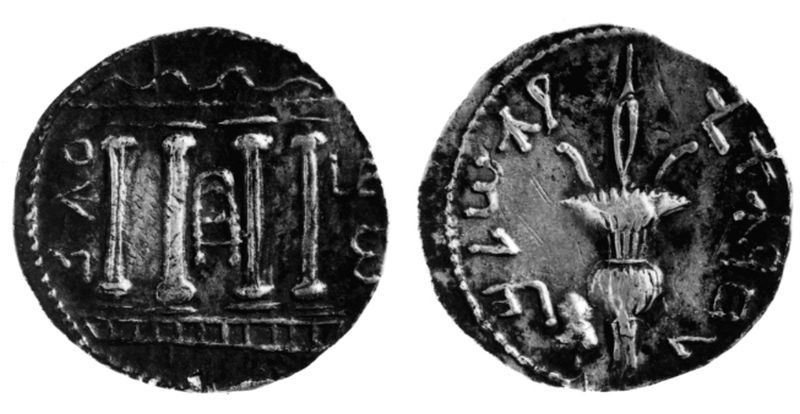
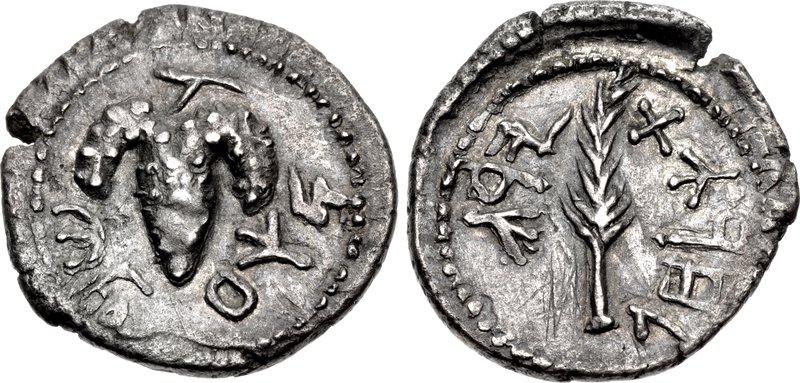
Coinage proclaimed their leader and their purpose.

SideImageInscription (transliteration)Translation
ObverseTemple façade with Arkשמעון (Shim‘on)“Simon [Bar Kokhba]”
ReverseLulav and Etrog (symbols of the Feast of Tabernacles)לחרות ירושלם (Leḥerut Yerushalayim)“For the freedom of Jerusalem”
SideImageInscription (transliteration)Translation
ObverseRamשמעון (Shim‘on)“Simon [Bar Kokhba]”
ReversePalm treeלחרות ישראל (Leḥerut Yisra’el)“For the freedom of Israel”

Bethar — The Last Fortress

The revolt’s final stronghold was Bethar (modern Battir), a hilltop fortress about six miles southwest of Jerusalem guarding the approach to the Shephelah valley. It had served as a Hasmonean citadel generations earlier and was heavily fortified by Bar Kokhba as his capital and final refuge. Jewish sources remembered it as a city of scholars and soldiers, filled with Torah scrolls and defenders who believed the Messiah himself commanded them. When Roman legions closed in, thousands of refugees from surrounding villages crowded within its walls, making Bethar both the military and symbolic heart of the rebellion.


Rome’s Counter-Attack and Cruelty

“At first, Tineius Rufus, who was governor of Judea, and the others who held command there tried to check the outbreak, but they were unable to do so. [Lusius] Severus was sent against them, but he also could not subdue them. Then Hadrian dispatched Julius Severus from Britain with many others from the neighboring provinces, and he crushed the whole of Judea with great difficulty and much bloodshed.”
Cassius Dio, Roman History 69.13.1–2 (c. AD 220).

“Fifty of their most important strongholds and nine hundred and eighty-five of their most famous villages were razed to the ground. Five hundred and eighty thousand men were slain … and the number that perished by famine, disease, and fire was past finding out.”
Cassius Dio, Roman History 69.14.1–2 (c. AD 220).

“Thus the whole of Judea was made desolate, and the few that were left perished by hunger, disease, and fire. The corpses were so many that no one was left to bury them.”
Eusebius, Chronicon (fragment, year of Abraham 2148 = AD 135).

Following the city’s fall, Roman authorities even forbade burial of the dead — a final humiliation intended to erase hope itself. Jewish tradition remembers that years later, permission was finally granted under Antoninus Pius, when the bodies, miraculously undecayed, were interred with honor. The rabbis commemorated this act of mercy by adding a permanent blessing to their prayers: “Blessed is He who is good and does good.”

“The Gentiles slew the people of Bethar until their blood flowed into the Great Sea, and the bodies were not buried. Years later, the corpses did not decay, and when permission was given to bury them, the Sages in Yavneh ordained the blessing, ‘Blessed is He who is good and does good.’”
Jerusalem Talmud, Ta’anit 4.8 (c. AD 400–425, preserving 2nd-cent. tradition).

Bethar’s fall marked the end of the revolt and the last gasp of Jewish independence until modern times. At Bethar the Romans killed without mercy; only later, under a more humane emperor, were the dead finally granted rest. Excavations show burn layers and projectiles matching Roman siege tactics.


3. The Consequences for Jews and Christians

“Thus nearly all Judea was made desolate, and Hadrian, in his anger, ordered that the name of the nation should be changed, so that it might not be remembered.”
Cassius Dio, Roman History 69.14.3 (c. AD 220).

Jerusalem became Aelia Capitolina; Judea became Syria Palaestina. Jews were barred even from viewing their city.

“From that time the whole nation was prohibited by law from entering Judea, and the Christians who were of Hebrew origin then departed and went elsewhere.”
Eusebius, Ecclesiastical History 4.6.3 (c. AD 310).

The Jerusalem church — once Jewish-led — became entirely Gentile.

“Jerusalem has now been laid waste, and none of you are permitted to enter there. Such things have happened, as the prophets foretold, that it might be known that the desolation of Zion would last until the end.”
Justin Martyr, Dialogue with Trypho 16 (c. AD 155).

“Bethar was captured, and Bar Koziba was killed. They brought his head to Hadrian.”
Jerusalem Talmud, Ta’anit 4.8 (c. AD 400–425, preserving 2nd-century memory)

Later Rabbinic Re-evaluation of Bar Kokhba

“Bar Koziba ruled two and a half years and then said to the rabbis, ‘I am the Messiah.’
They answered him, ‘It is written that the Messiah shall smell and judge. Let us see whether you can discern in that way.’
When they saw that he could not, they killed him.”
Lamentations Rabbah 2.4 (compiled c. AD 400, preserving 2nd-century tradition)

This later rabbinic legend reflects how Jewish teachers, looking back on the disastrous revolt, rejected Bar Kokhba’s messianic claim. Ancient Jewish interpretation took the phrase “smell in the fear of the Lord” to mean that the true Messiah would have a supernatural discernment—the ability to “smell” truth and judge rightly.
It stands in striking contrast to Rabbi Akiva’s earlier support and shows that even within Judaism, the revolt came to be remembered as a tragic mistake.


A Day of Mourning Added to the Jewish Calendar

In rabbinic tradition the devastation of Bethar and the final desolation under Hadrian were fixed in collective memory. The Mishnah records that the fall of Bethar occurred on the Ninth of Av (9 Av) — the same date on which both the First and Second Temples had fallen.
On the modern calendar, Tisha B’Av usually falls in late July or early August — for example, in 2025 it fell from sunset on August 2 to nightfall on August 3.
From this time forward, Tisha B’Av became the national fast commemorating all three destructions: the Temple of Solomon, the Temple of Herod, and the last fortress of Bar Kokhba.

“On the Ninth of Av the decree was made that our fathers should not enter the land; the First Temple was destroyed, and the Second Temple, and Bethar the great city was captured, and the city was plowed as with a plowshare.”
Mishnah, Ta’anit 4.6 (c. AD 200, preserving earlier memory).


When Jews Were Allowed to Return

For nearly two centuries after Hadrian, Jews were banned from Jerusalem except on the single day each year — Tisha B’Av — when they were permitted to approach the ruins and weep. The ban remained in force through the reigns of Antoninus Pius and Marcus Aurelius and continued under successive emperors.

After the Christianization of the empire, the prohibition was renewed by Constantine and his successors, who maintained Aelia Capitolina as a Christian city. Only under the early Muslim caliphs in the seventh century AD — after the conquest of Palestine by Caliph ʿUmar ibn al-Khattāb (c. AD 638) — were Jews once again allowed to resettle and live permanently in Jerusalem. Small Jewish communities then re-established themselves in the city and surrounding Judea for the first time since Hadrian’s decree.


4. Aftermath — From Swords to Books

After the fires of Judea were extinguished, Christians across the empire began defining their identity in writing.
What Rome destroyed in stone, the early church rebuilt in testimony.
These were the first defenders of the faith — the Apologists — men who addressed emperors directly, explaining that the followers of Christ were not enemies of the state but citizens of a heavenly kingdom.


Quadratus of Athens (c. AD 125, to Emperor Hadrian)

Quadratus is considered the earliest Christian apologist.
Ancient tradition identifies him as a disciple of the apostles and possibly a leader in Athens or Asia Minor.
His Apology—now preserved only in a fragment quoted by Eusebius—was written directly to Emperor Hadrian around AD 125.
It marks the moment when Christianity first spoke publicly to imperial power in its own defense.

“The works of our Saviour were always present, for they were true: those who were healed and those who were raised from the dead were seen not only when they were healed and when they were raised, but also for a long time afterwards; some of them survived even into our time.”
Quadratus, Apology (fragment in Eusebius, Ecclesiastical History 4.3.2, c. AD 125)

Key Insights

  • Christianity appealed to historical evidence, not mystery.
  • Living eyewitnesses of Jesus’ miracles were still remembered.
  • The faith was not superstition but sober truth confirmed by real people.

Quadratus’s voice rose from the same decades that saw Hadrian rebuild Jerusalem as Aelia Capitolina.
While Rome celebrated new marble temples, Quadratus pointed to a living temple — the memory of the risen Christ in human witnesses.


The Epistle of Barnabas (c. AD 120–130, likely Alexandria or Syria)

Though attributed to “Barnabas,” the companion of Paul, this letter was almost certainly written later by an anonymous Christian teacher, probably in Alexandria.
Its audience was a mixed community of Jewish and Gentile believers struggling to understand whether the Law of Moses still bound Christians.
The author insists that the old covenant has been replaced by a spiritual one, that rituals and sacrifices were misunderstood symbols, and that true circumcision is of the heart.
He writes in the shadow of Hadrian’s decrees banning circumcision and rebuilding Jerusalem as a pagan city.
In this context, his message is unmistakable: Christianity, not Judaism, preserves the true covenant of God.


Opening Exhortation (Chs. 1–2)

“Greetings, sons and daughters, in the name of the Lord who loved us, in peace.
Because the Lord has granted you an abundance of spiritual knowledge, I rejoice greatly and beyond measure in your blessed and glorious spirits.
For this reason I have written to you briefly, that you might be made perfect in your faith and knowledge.
Therefore let us take heed, lest we be found as it is written, ‘Many are called, but few are chosen.’”
Barnabas 1.1–4


The Covenant and the Rejection of the Literal Law

“Take heed to yourselves, and be not like some, heaping up your sins and saying that the covenant is both theirs and ours.
It is ours; but in this way did they finally lose it, after Moses had already received it.
For the Lord has written it again on our hearts.”
Barnabas 4.6–8

The writer insists that covenant privilege passed to those who obey in spirit, not in ritual.
His argument echoes Jeremiah 31’s promise of a “new covenant written on the heart.”


Circumcision and the New Law

“He has abolished these things, that the new law of our Lord Jesus Christ, free from the yoke of constraint, might have its own offering not made by human hands.
So we are they whom He brought into the new law; no longer bound by circumcision.
For He has said that the circumcision with which they trusted is abolished.
He has circumcised our ears that we might hear His word and believe.”
Barnabas 9.4–7


The Path of Light (Chs. 18–20)

“There are two paths of teaching and of power: one of light, and one of darkness.
The path of light is this: you shall love the one who created you; you shall glorify the one who redeemed you from death.
You shall be simple in heart and rich in spirit.
You shall not exalt yourself, you shall not hate anyone; you shall reprove some, you shall pray for others, and you shall love others more than your own life.”
Barnabas 18.1–3, 20.2


Closing Words

“Since, then, you now understand the good things of the Lord, be filled with them.
If you do these things, you will be strong in the faith, and you will be found perfect in the last day.
The God who rules over the universe will give you wisdom, understanding, knowledge, and eternal life, through His Servant, Jesus Christ, to whom be glory forever and ever. Amen.”
Barnabas 21.1–3


Key Insights

  • The writer speaks to a generation caught between Judaism and Christianity, insisting that God’s covenant has moved from the physical to the spiritual.
  • He turns Hadrian’s desecration of Jerusalem into a theological truth: the Temple and its sacrifices were destined to end, giving way to a new and living covenant.
  • The Epistle of Barnabas shows Christianity defining itself not by rebellion, but by a renewed inner faith and moral life.
  • Its tone is pastoral and exhortational — teaching that salvation is found not through outward religion but through obedience of the heart and love of neighbor.

Aristides of Athens (c. AD 125–140, to Antoninus Pius)

Aristides, a philosopher from Athens, presented his Apology to Emperor Antoninus Pius around AD 125–140.
He had converted from philosophy to Christianity and sought to defend it as the truest form of reason and virtue.
The Apology survives in Syriac, Armenian, and Greek fragments.

Dedication

“To the Emperor Caesar Titus Hadrianus Antoninus Augustus Pius, from Marcianus Aristides, a philosopher of Athens.
I, O King, by the inspiration of God, have come to this conclusion, that the universe and all that is in it is moved by the power of another… Wherefore I… have no wish to worship any other than God, the living and true, and I have searched carefully into all the races of men and tested them, and this is what I have found.”
Aristides, Apology 1

Survey of Humanity (Chs. II – XIV)
Barbarians – idol worshippers.
Greeks – immoral gods.
Egyptians – animal worship.
Jews – monotheists yet bound to angels, sabbaths, and rituals.

Christians (Full Text Chs. XV–XVI)

XV

“But the Christians, O King, reckon the beginning of their religion from Jesus Christ, who is named the Son of God Most High; and it is said that God came down from heaven, and from a Hebrew virgin took and clothed Himself with flesh, and that the Son of God lived in a daughter of man.
This is taught in the gospel, as it is called, which a short time ago was preached among them; and you also, if you will read therein, may perceive the power which belongs to it.

This Jesus, then, was born of the race of the Hebrews; and He had twelve disciples, in order that a certain dispensation of His might be fulfilled.
He was pierced by the Jews, and He died and was buried; and they say that after three days He rose and ascended to heaven.

Thereupon these twelve disciples went forth into the known parts of the world, and taught concerning His greatness with all humility and soberness.
And those then who still observe the righteousness which was enjoined by their preaching are called Christians.

And these are they who more than all the nations of the earth have found the truth.
For they acknowledge God, the Creator and Maker of all things, in the only-begotten Son and in the Holy Spirit; and besides Him they worship no other God.

They have the commandments of the Lord Jesus Christ Himself graven upon their hearts; and they keep them, looking for the resurrection of the dead and the life of the world to come.

They do not commit adultery or fornication; they do not bear false witness; they do not covet the things of others; they honor father and mother; they do good to those who are their neighbors; and they judge uprightly.

They do not worship idols made in the likeness of man.
Whatever they would not wish others to do to them, they do not practice themselves.

They do not eat of the food offered to idols, for they are pure.
They comfort their oppressors and make them their friends; they do good to their enemies.

Their women are pure as virgins, and their daughters are modest.
Their men abstain from all unlawful union and from all uncleanness, in the hope of a recompense to come in another world.”

XVI

“They love one another.
They do not turn away a widow, and they rescue the orphan.
He who has gives ungrudgingly to him who has not.

If they see a stranger, they take him under their roof, and they rejoice over him as over a real brother.
If anyone among them is poor and needy, and they have no spare food, they fast two or three days in order to supply the needy with their necessary food.

They observe scrupulously the commandments of their Messiah.
They live honestly and soberly, as the Lord their God ordered them.
They give thanks to Him every hour, for all meat and drink and other blessings.

If any righteous man among them passes away from the world, they rejoice and thank God, and escort his body with songs and thanksgiving as if he were setting out from one place to another.

When a child has been born to one of them, they give thanks to God; and if it chance to die in childhood, they praise God mightily, as for one who has passed through the world without sins.

If anyone of them be a man of wealth, and he sees that one of their number is in want, he provides for the needy without boasting.

And if they see a stranger, they take him under their roof and rejoice over him as over a brother; for they do not call them brethren after the flesh, but brethren after the Spirit and in God.

Whenever one of their poor passes away from the world, each of them, according to his ability, gives heed to him and carefully sees to his burial.

Such is the law of the Christians, O King, and such is their manner of life.

And verily, this is a new people, and there is something divine in them.”

Key Insights

  • Aristides presents the earliest surviving portrait of Christianity as both moral philosophy and divine revelation.
  • His focus is not political defense but moral demonstration: Christians prove their truth by their purity, compassion, and generosity.
  • His final words — “this is a new people, and there is something divine in them” — sum up the astonishment of the pagan world.
  • Written during Antoninus Pius’s peaceful reign, the passage shows the church living out its faith in the shadow of Hadrian’s destruction — rebuilding not cities, but communities of love.

Justin Martyr (c. AD 150–160, to Antoninus Pius)

Background
Justin was born in Samaria, educated in Greek philosophy, and converted to Christianity after discovering in Christ the truth that philosophers sought but never found.
Writing from Rome, he addressed his First Apology to Emperor Antoninus Pius, his sons Verissimus (Marcus Aurelius) and Lucius Verus, and to the Senate and people of Rome.
His goal was to defend Christians from unjust persecution by showing that their faith was the highest expression of reason (logos), morality, and civic virtue.

  • Note how Justin declares that yes Christians are guilty of atheism in Roman eyes and therefore worthy of capital punishment. He is trying to get the emperor to see that Christians are his best citizens and guilty of no ethical crimes. He is trying to get Christians legal religious status.

Introduction of the Apology

“To the Emperor Titus Ælius Hadrian Antoninus Pius Augustus Cæsar,
and to Verissimus his son, philosopher, and to Lucius the philosopher,
the natural son of Cæsar and adopted son of Pius, lover of learning,
and to the sacred Senate, and to the whole people of the Romans—
on behalf of those of all nations who are unjustly hated and persecuted, I, Justin, one of them, have composed this address and petition.

Reason requires that those who are found not living wickedly, nor practicing evil, should not be unjustly accused; nor, when they have been accused, condemned without inquiry and without knowledge of the truth.
For not by the mere name has anyone been proved good or bad, but by the actions which each has done.”
Justin Martyr, Apology 1.1–2 (c. AD 155)


On Unjust Persecution and True Allegiance

“If anyone, when he is examined, is found guilty, let him be punished as an evil-doer; but if he is found guiltless of the charges laid against him, let him be acquitted, since it is unjust to punish the guiltless.
We do not seek to escape punishment if we are convicted as wrongdoers, but we ask that the charges against us be examined.”
Justin Martyr, Apology 1.3–4 (c. AD 155)

“We are accused of being atheists. We confess that we are atheists, so far as gods of this sort are concerned, but not with respect to the most true God, the Father of righteousness and temperance and the other virtues.”
Justin Martyr, Apology 1.6 (c. AD 155)


On the Transformation of the Believers

“We who once delighted in fornication now embrace chastity alone;
we who used magical arts now consecrate ourselves to the good and unbegotten God;
we who valued above all things the acquisition of wealth and possessions now bring what we have into a common stock and share with everyone in need;
we who hated and slew one another, and refused to share our hearth with those of another tribe, now, since the coming of Christ, live together with them and pray for our enemies, and try to persuade those who hate us unjustly to live conformably to the good precepts of Christ, that they may share the same joyful hope as ourselves.”
Justin Martyr, Apology 1.14 (c. AD 155)


On the Mission of Christ

“Christ was not sent forth for the rich or the mighty, but for the poor and the humble.
He chose unlearned men to be His disciples, that thus there might be no pretense of human wisdom.
For through the power of God they proclaimed to every race of men that they were sent by Christ to teach all the Word of God.”
Justin Martyr, Apology 1.39 (c. AD 155)


On the Eucharist

“We do not receive these as common bread and common drink; but as Jesus Christ our Saviour, having been made flesh by the Word of God, had both flesh and blood for our salvation, so likewise have we been taught that the food which is blessed by the prayer of His word … is the flesh and blood of that Jesus who was made flesh.”
Justin Martyr, Apology 1.66 (c. AD 155)


On Christian Worship and the Lord’s Day

“And on the day called Sunday all who live in the cities or in the country gather together in one place, and the memoirs of the apostles or the writings of the prophets are read, as long as time permits.
When the reader has finished, the president verbally instructs and exhorts to the imitation of these good things.

Then we all rise together and offer prayers, and, as we said before, when we have finished the prayer, bread and wine and water are brought, and the president likewise offers prayers and thanksgivings, according to his ability, and the people assent, saying, Amen.

There is a distribution to each, and a participation of that over which thanks have been given; and to those who are absent a portion is sent by the deacons.
Those who are well to do and willing give what each thinks fit, and what is collected is deposited with the president, who succors the orphans and widows and those who, through sickness or any other cause, are in want, and those who are in bonds, and the strangers sojourning among us—in a word, he takes care of all who are in need.

But Sunday is the day on which we all hold our common assembly, because it is the first day on which God, having wrought a change in the darkness and matter, made the world; and Jesus Christ our Saviour on the same day rose from the dead.”
Justin Martyr, Apology 1.67 (c. AD 155)


Key Insights

  • Justin presents Christianity as the rational faith of the Logos—reason fulfilled in divine revelation.
  • His introduction reveals the courage of a believer appealing directly to an emperor for justice rather than privilege.
  • He demonstrates that faith transforms society: from lust to purity, from greed to generosity, from hate to love.
  • His account of Sunday worship provides the earliest written outline of the Christian liturgy — Scripture reading, teaching, prayer, communion, and offerings for the poor.
  • His theology of Christ’s humility and the Eucharist reveals a faith both spiritual and incarnational — rooted in history yet directed toward eternity.
  • Justin’s Apology helped shape how the empire, and later the world, would understand the moral and intellectual integrity of Christianity.

Melito of Sardis (c. AD 160 – 170, to Antoninus Pius)

Melito, bishop of Sardis in Asia Minor, was one of the most eloquent and poetic voices of the second century.
He wrote prolifically—biblical commentaries, treatises on the incarnation, and one of the earliest Christian apologetic petitions addressed to Emperor Antoninus Pius.
A lifelong student of Scripture and Greek philosophy, Melito combined rigorous theology with literary power.
His writings, though only partly preserved, reveal a church confident, reflective, and spiritually mature in the decades following Hadrian’s persecutions.


From the Apology to Antoninus Pius

“Our faith, which men call a philosophy, first arose among peoples outside your civilization—among the ancient Hebrews.
But having spread into your dominions during the great reign of Augustus, it has become a source of blessing and peace.
From that time to your own reign, O Emperor, it has suffered nothing evil; rather, it has shone brightly under emperors who love justice.”
Melito of Sardis, Apology to Antoninus Pius (fragment in Eusebius, Ecclesiastical History 4.26.7, c. AD 160)

Melito’s opening line means that Christianity, though born from Israel’s faith outside the Greco-Roman world, entered the empire under Augustus and brought moral good rather than harm.
He honors Antoninus as the latest in a line of “pious emperors” who have allowed this faith to flourish within Rome’s peace.


From the Passover Homily (Peri Pascha)

Preached around AD 160, Melito’s On the Pascha interprets the Jewish Passover as the prophetic shadow of Christ’s crucifixion.
No early writer expresses so vividly the church’s conviction that redemption fulfills the story of Israel.

“This is He who made the heavens and the earth,
and in the beginning created man;
who was proclaimed through the law and the prophets;
who became human through the Virgin;
who was hanged upon the tree;
who was buried in the earth;
who rose from the dead;
who ascended into the heights of heaven;
who sits at the right hand of the Father;
who has the power to save all things,
through whom the Father made all things
from the beginning of the world to the end of the age.”
Melito of Sardis, On the Pascha 68–69

“He that hung the earth in space is Himself hanged;
He that fixed the heavens in place is fixed with nails;
He that supports the earth is supported upon a tree;
the Master has been outraged;
God has been murdered.
He is lifted up upon a tree, and the earth trembles;
He has died, and creation is shaken.
He has gone down into Hades, and He has raised the dead.”
Melito of Sardis, On the Pascha 96–100

“He is the Lamb slain; He is the silent Lamb;
He is the one born of Mary, the fair ewe-lamb;
He was taken from the flock, and led to slaughter, and at evening slain;
He was buried at night;
by day He rose again.”
Melito of Sardis, On the Pascha 105–106

Melito turns suffering into triumph: the cross becomes the world’s true Passover — deliverance not from Egypt, but from sin and death.


Key Insights

  • Melito embodies the maturing Christian mind of the second century: biblically grounded, philosophically articulate, and artistically profound.
  • His Apology shows Christianity as compatible with the empire’s peace; his Passover Homily reveals the soul of Christian worship — a theology of deliverance through sacrifice.
  • By linking the story of Israel to the suffering of Christ, he gives language to the church’s sense of continuity and fulfillment.
  • His poetry closes this age of apologists on a note of triumph: the same empire that crucified Christ now carries His gospel to the nations.

Conclusion — What We Learn from the Apologists

Antoninus Pius ruled during what later generations called a “reign of peace,” yet the very existence of these Apologies proves that peace was fragile.
Christians were still mistrusted, accused, and sometimes condemned simply for bearing the name of Christ.
There was no imperial campaign against them, but the law itself still made them criminals in principle.
These writings—by Quadratus, Aristides, Justin, and Melito—are therefore appeals for justice in a world that granted none, letters from men who lived in peace only by the patience of their persecutors.

Yet in this tension we see something extraordinary.
Instead of withdrawing in fear or responding in anger, the church of the second century answered misunderstanding with explanation, hostility with holiness, and suspicion with love.
Their pens became their defense; their lives became their argument.


Themes and Insights to Note

1. The Legal and Social Reality

  • “Peace” under Antoninus Pius meant the absence of official persecution, not true liberty.
  • The Apologists write as citizens appealing to reason, asking the emperor to judge Christians by deeds, not rumors.
  • Their tone is respectful yet confident: they believe truth can withstand investigation.

2. The Picture of Christian Life

  • Aristides describes a people marked by chastity, honesty, hospitality, and compassion:
    “They love one another… they rescue the orphan… they fast two or three days that they may feed the needy.”
  • Justin shows a transformed community: former pagans now living in purity, generosity, and reconciliation.
  • This moral beauty was not secondary to their faith—it was their primary evidence that the gospel was true.

3. The Picture of Christian Worship

  • From Justin’s detailed account we learn the pattern of early gatherings: Scripture reading, exhortation, prayer, the Eucharist, and offerings for the poor.
  • Worship was simple but profound—anchored in memory of the risen Christ and in service to the needy.
  • Charity was liturgy; compassion was worship.

4. The Intellectual and Spiritual Emphasis

  • Quadratus grounded faith in eyewitness history.
  • Barnabas re-interpreted the covenant spiritually, showing fulfillment, not rejection, of Israel’s story.
  • Aristides demonstrated that Christian virtue surpasses pagan philosophy.
  • Justin joined faith with reason and made moral transformation the church’s strongest argument.
  • Melito lifted theology into poetry, proclaiming the cross as the true Passover and the world’s redemption.

5. The Continuing Relevance

  • These writers do more than defend—they define what Christianity is.
  • Their emphasis on holiness, community, and service remains the church’s enduring witness.
  • Their courage under a veneer of peace reminds us that faithfulness does not depend on favorable conditions but on steadfast conviction.

Multiplying by Mission: Session 6 at Mission Lake

40% Growth Then, 5% Growth Now — What We Must Learn Anew

When Nero died by suicide in AD 68, the Roman Empire plunged into chaos.
In a single year four emperors—Galba, Otho, Vitellius, and finally Vespasian—rose and fell.
While Rome fought for power, Judea was already on fire.
The revolt that began under Gessius Florus would end with Jerusalem leveled, the Temple burned, and a turning point for both Jews and Christians.


1. Florus and the Spark of Revolt (AD 66)

Florus, the Roman governor of Judea, stole seventeen talents of silver from the Temple treasury—about 1,200 pounds of consecrated silver, worth roughly ten million U.S. dollars today.
This was not ordinary corruption; it was sacrilege.

When Florus took seventeen talents out of the sacred treasure, and the multitude ran together in the Temple crying out against him, some of the youths went about the city carrying baskets and asking alms for poor Florus.
— Josephus, Jewish War 2.14.5 §306–308 (c. AD 75–79)

His answer was bloodshed.

Florus sent soldiers into Jerusalem and ordered a massacre. They slew about three thousand six hundred persons, women and children as well as men; and among them were citizens of Roman knighthood. Some were scourged and then crucified.
— Josephus, Jewish War 2.14.9 (c. AD 75–79)

The outrage united the city. Rebels stormed the Antonia Fortress, the great Roman garrison on the northwest corner of the Temple Mount. To capture it was to challenge Rome itself.

They compelled the garrison to surrender and then slaughtered them. Thus war was now openly begun.
— Josephus, Jewish War 2.17.9 (c. AD 75–79)

Rome’s patience ended. Nero sent Vespasian, the empire’s most seasoned general, and his son Titus to crush the rebellion.


2. Vespasian in Galilee — Fire and Terror (AD 67)

Galilee became Rome’s first target. At Jotapata, a hill fortress commanded by Josephus himself, the walls fell after forty-seven days.

Forty thousand were slain, and the city was utterly demolished; those who had hidden in caves were dragged out and slain.
— Josephus, Jewish War 3.7.36 (c. AD 75–79)

Then came Gamla, a ridge-top city east of the Sea of Galilee. Its name means camel in Aramaic, and its fall was as steep as its slopes.

Men and women alike threw themselves and their children down the precipices; and the whole city was covered with corpses.
— Josephus, Jewish War 4.1.9 (c. AD 75–79)

Josephus summed it simply: “Galilee was filled with fire and blood.”
— Josephus, Jewish War 4.1.9 (c. AD 75–79)

The Roman campaign left the region in ruins, silencing nearly every center of resistance.

It was here that Josephus himself was captured. As commander of Jewish forces in Galilee, he had held out at Jotapata until the city fell. In his own account, he claims that while in captivity he prophesied that Vespasian would soon be emperor:

You, O Vespasian, shall be Caesar and emperor, you and your son. Bind me now still closer, and keep me for yourself; for you, O Caesar, are lord, not only of me, but of the land and sea, and of all mankind.
— Josephus, Jewish War 3.8.9 §401–403 (c. AD 75–79)

When that prophecy appeared to come true the following year, Vespasian spared his life, granted him Roman citizenship, and attached him to his household. From then on Josephus lived in Rome under imperial patronage, taking the family name Flavius from his patrons.

This is how Yosef ben Matityahu, a Jewish priest and rebel general, became Flavius Josephus, historian of the Jewish War. His writings—sometimes defensive, sometimes deferential toward Rome—remain the only detailed eyewitness record of Jerusalem’s destruction.


3. The Siege of Jerusalem (AD 70)

When Nero’s death recalled Vespasian to Rome, Titus took full command.
Inside Jerusalem, zealot factions fought one another while Roman legions built a five-mile siege wall to starve the city into surrender.
This wall—called a circumvallation—completely encircled Jerusalem. Built in only three days by tens of thousands of soldiers, it cut off every road and stopped all supplies. Famine would finish what the legions began.

The famine grew severe and destroyed whole houses and families. The alleys were filled with dead bodies of the aged; children and youths swarmed about the market-places like shadows, and fell wherever famine overtook them. No one buried them; pity was strangers to men; for famine had confounded all natural feeling.
— Josephus, Jewish War 5.12.3–4 (c. AD 75–79)

Then Josephus records one of antiquity’s darkest scenes:

There was a certain woman named Mary, daughter of Eleazar, of the village Bathezor. Driven by famine and rage, she slew her infant son, roasted him, and ate one half, concealing the rest. When the soldiers smelled the roasted meat and rushed in, she said, ‘This is my own son; the deed is mine; eat, for I have eaten. Do not pretend to be more tender-hearted than a woman or more compassionate than a mother.’
— Josephus, Jewish War 6.201–213 (c. AD 75–79)

Titus later claimed he had ordered the Temple spared:

I myself called a council of war and urged that the Temple be saved; but the flame was beyond control, and the sanctuary was burned against my will.
— Josephus, Jewish War 6.4.7 §254 (c. AD 75–79)

Josephus blames undisciplined troops; Tacitus sees deliberate policy:

It was resolved to destroy the Temple that the religion of the Jews might be more completely abolished.
— Tacitus, Histories 5.12 (c. AD 100–110)

The Destruction of the Temple of Jerusalem – Francesco Hayez, 1867, oil on canvas

Different motives, same outcome: the Temple fell.
For Christians, it confirmed the prophecy of Christ: “Not one stone shall be left upon another.” (Mark 13:2)


4. Crosses Without Number

As for those who had fled from the city and were caught, they were first scourged and then tortured and finally crucified before the walls. In their fury and hatred the soldiers nailed up the prisoners in different postures, by way of jest, and the multitude was so great that room was wanting for the crosses, and crosses for the bodies.
— Josephus, Jewish War 5.11.1 (c. AD 75–79)

Josephus later expands this account:

Those who were taken outside the city he first scourged, and then tormented with all manner of tortures before crucifying them opposite the wall. Titus indeed felt pity for them, but their number was so great that there was no room for the crosses nor crosses for the bodies. About five hundred were crucified each day, and the soldiers, in their rage and hatred, amused themselves by crucifying some one way and some another, until, owing to the multitude, there was no space left for the crosses nor crosses for the bodies.
— Josephus, Jewish War 6.1.1 (c. AD 75–79)

The same empire that boasted of order and civilization turned execution into entertainment.
The hills around Jerusalem stood thick with crosses—not yet symbols of redemption, but monuments of Rome’s rule through fear.


5. Aftermath — Slavery, Spectacle, and Tax

Through Rome’s streets the captives marched, carrying the Menorah and sacred vessels. Coins were struck proclaiming IUDAEA CAPTA—“Judea Captured.” Various versions of these coins were struck and used for 25 years under Vespasian and his two sons Titus and Domitian.

IMP CAES VESPASIAN AUG PM TR P COS III = Commander Caesar Vespasian Augustus, Chief Priest, Holder of Tribunician Power, Consul for the Third Time; IUDEA CAPTA S C = Judea Captured by decree of the Senate

He decreed that all Jews throughout the world should pay each year two drachmas to the Capitol in Rome, as they had previously paid to the Temple in Jerusalem.
— Dio Cassius, Roman History 66.7 (c. AD 200–220)

The fiscus Judaicus turned a holy offering into tribute for pagan gods.
Jewish Christians, still classed as Jews, were forced to pay the same tax of defeat.

Meanwhile, many early believers saw a deeper reason for Jerusalem’s ruin: the death of James the Just, the brother of Jesus and leader of the church in Jerusalem.

Festus was now dead, and Albinus was but upon the road; so Ananus, who had become high priest, assembled the Sanhedrin of judges, and brought before them the brother of Jesus, who was called Christ, whose name was James, and some others; and when he had formed an accusation against them as breakers of the law, he delivered them to be stoned.
— Josephus, Antiquities 20.9.1 §200–203 (c. AD 93)

Hegesippus, a second-century Jewish Christian, adds detail:

They placed James on the pinnacle of the Temple and cried, ‘Tell us, O righteous one, what is the door of Jesus?’ And he answered with a loud voice, ‘Why do you ask me concerning the Son of Man? He sitteth at the right hand of the Great Power, and shall come on the clouds of heaven.’ Then they began to stone him, and a fuller took the club with which he beat clothes and struck the righteous one on the head, and so he suffered martyrdom.
— Hegesippus in Eusebius, Ecclesiastical History 2.23.10–12 (c. AD 170, quoted c. AD 310–325)

Hegesippus concludes that the siege of Jerusalem followed soon after James’s death, calling it divine judgment:

Immediately after this Vespasian began to besiege them; and they remembered the saying of Isaiah the prophet, ‘Let us take away the righteous man, because he is troublesome to us; therefore they shall eat the fruit of their doings.’ Such was their lot, and they suffered these things for the sake of James the Just.
— Hegesippus in Eusebius, Ecclesiastical History 2.23.18 (c. AD 170, quoted c. AD 310–325)

Eusebius agrees, closing his account:

These things happened to the Jews to avenge James the Just, who was the brother of Jesus that is called Christ. For, as Josephus says, these things befell them in accordance with God’s vengeance for the death of James the Just, which they had committed, although he was a most righteous man.
— Eusebius, Ecclesiastical History 2.23.19–20 (c. AD 310–325)

From this moment on, many Christians saw the destruction of Jerusalem not only as Rome’s triumph, but as God’s judgment for rejecting Christ and murdering His righteous servant.


6. The Arch of Titus — The Empire’s Theology in Stone (AD 81)

When Titus died, the Senate declared him divine. The arch still standing on the Via Sacra reads:

The Senate and People of Rome [dedicated this] to the deified Titus Vespasian Augustus, son of the deified Vespasian.

Inside its vault, carvings show Roman soldiers bearing the Temple treasures.

They brought the Menorah and the table of the bread of the Presence, and the last of the spoils was the Law of the Jews; after these, a great number of captives followed.
— Josephus, Jewish War 7.5.5 (c. AD 75–79)

At the top of the arch inside is the depiction of Titus’ ascension to heaven as a god on the wings of an eagle.

For Rome, the arch proclaimed the victory of its gods.
For Christians, it stood as a silent confirmation of prophecy: the Temple of stone was gone, but the Temple of Christ remained.


7. The Flight to Pella — Revelation and Refuge

Amid the ruins of Jerusalem’s revolt, one community escaped—the believers who remembered Christ’s warning to flee.

The people of the church in Jerusalem had been commanded by a revelation, vouchsafed to approved men there before the war, to leave the city and to dwell in a certain town of Perea called Pella. And when those who believed in Christ had come thither from Jerusalem, then, as if the holy men had altogether deserted the royal city of the Jews and the whole land of Judea, the judgment of God at last overtook them for their abominations.
— Eusebius, Ecclesiastical History 3.5.3 (c. AD 310–325)

Eusebius attributes their escape to a divine revelation, while Epiphanius explains it as obedience to Christ’s prophecy:

When all the disciples were settled in Pella because of Christ’s prophecy about the siege, they remained there until the destruction of Jerusalem.
— Epiphanius, Panarion 29.7.7–8 (c. AD 375)

Different explanations—same event. The believers crossed the Jordan to Pella, a Decapolis city about sixty miles northeast of Jerusalem, where they waited out the war.
Their flight fulfilled Jesus’ own words (Luke 21:20–21).
What looked like retreat was obedience.


8. The Nazarenes — Law-Observant, Christ-Confessing

The first branch to emerge from that exile was the Nazarenes—Jewish believers who kept the Mosaic Law yet confessed Jesus as the divine Son of God.
They were the losing party in the Council of Jerusalem (Acts 15).

At that council, certain men from Judea began teaching that Gentile converts must keep the Law of Moses to be saved:

Some men came down from Judea and were teaching the brothers, ‘Unless you are circumcised according to the custom of Moses, you cannot be saved.’
— Acts 15:1

Later Luke identifies who pressed the issue:

But some of the sect of the Pharisees who believed rose up, saying, ‘It is necessary to circumcise them and to command them to keep the law of Moses.’
— Acts 15:5

Peter and James ruled that Gentiles need not bear that yoke:

We should not trouble those of the Gentiles who turn to God, but should write to them to abstain from things polluted by idols, from sexual immorality, from what has been strangled, and from blood.
— Acts 15:19–20

Those Jewish believers who could not release Torah observance continued as a community of Torah-keeping Christians—the Nazarenes.

Two decades later they were still strong. When Paul returned to Jerusalem near the end of his ministry, James the Just, the same leader later martyred near the Temple, recognized their influence:

You see, brother, how many myriads of Jews there are who have believed, and they are all zealous for the Law… Therefore do what we tell you: we have four men who have taken a vow; take them and purify yourself along with them, and pay their expenses, so that all may know that there is nothing in what they have been told about you, but that you yourself also live in observance of the Law.
— Acts 21:20, 23–24

James’s advice shows that the Nazarenes were not fringe but central within the Jerusalem church.

Centuries later, Jerome described them:

“The adherents to this sect are known commonly as Nazarenes; they believe in Christ the Son of God, born of the Virgin Mary; and they say that He who suffered under Pontius Pilate and rose again is the same as the one in whom we believe.”
— Jerome, Letter 75 to Augustine (AD 398–403)

“The Nazarenes accept Messiah in such a way that they do not cease to observe the old Law.”
— Jerome, Commentary on Isaiah 8:14 (AD 398–403)

Even Epiphanius, who condemned most sects, writes:

The Nazarenes are Jews who keep the customs of the Law but also believe in Christ. They say that Jesus was born of the Virgin Mary by the Holy Spirit. They believe that God created all things, that Jesus is His Son, and that the resurrection of the dead has already begun in Him… As for their understanding of Christ, I am not certain—whether they have been misled by false teachers who call Him merely human, or whether, as I think, they confess that He was born of Mary by the Holy Spirit.
— Epiphanius, Panarion 29.7.5–6 (c. AD 375)

Epiphanius lists their beliefs as orthodox and then admits, “I cannot say whether they have been deceived or whether they confess the truth.”
Had they denied Christ’s divinity, he would have said so.
His hesitation confirms that the Nazarenes were orthodox in belief, Jewish in culture—the first generation of Messianic Jews bridging synagogue and church.


9. The Ebionites — The First Denial of Christ’s Divinity

A second group took a different path. Epiphanius places their origin after the flight to Pella:

The Ebionites are later than the Nazoraeans… their sect began after the flight from Jerusalem.
— Epiphanius, Panarion 29.7.7–8 (c. AD 375)

They taught that Jesus was a mere man chosen by God, denied the virgin birth, and altered Scripture to fit their beliefs.

Those who are called Ebionites use the Gospel according to Matthew only, and repudiate the Apostle Paul, maintaining that he was an apostate from the Law.
— Irenaeus, Against Heresies 1.26.2 (c. AD 180)

The Ebionites believe that He was a mere man, born of Joseph and Mary according to the common course of nature, and that He became righteous through the progress of His moral character.
— Origen, Commentary on Matthew 16.12 (c. AD 248)

They falsify the genealogical tables in Matthew’s Gospel, saying that He was begotten of a man and a woman, because they maintain that Jesus is really a man and was justified by His progress in virtue, and that He was called Christ because the Spirit of God descended upon Him at His baptism. They say that this same Spirit, which had come upon Him, was taken away and left Him before the Passion and went back to God; and that then, after His death and resurrection, this same Spirit returned to Him again. Thus they deny that He is God, though they do not deny that He was a man.
— Epiphanius, Panarion 30.14.3–5 (c. AD 375)

They also spread a slander about Paul:

They say that Paul was a Greek who came to Jerusalem and lived there for a time. He desired to marry a daughter of the priests but was refused. Out of anger and disappointment he turned against circumcision, the Sabbath, and the Law. Because of this, they claim, he wrote against these things and founded a new heresy.
— Epiphanius, Panarion 30.16.6–9 (c. AD 375)

For the Ebionites, Jerusalem’s destruction was not punishment for rejecting Christ but for accepting the apostolic Gospel.
They blamed Paul and the church that followed him for turning Israel away from the Law.
Thus they reversed the very lesson of history that Josephus, Hegesippus, and Eusebius had drawn from the death of James the Just.
Where the Nazarenes preserved unity in diversity, the Ebionites cut themselves off from the apostolic faith.


10. Three Waves of Testimony and the Apostolic Standard

When we date the earliest Christian writings, we find three waves of testimony—sources acknowledged even by skeptical historians as genuine first-century evidence.
They give us the historical core around which all later writings revolve.


Three Waves of Early Christian Testimony

Wave of WitnessApproximate DateContent & DescriptionAuthority and Significance
CreedsAD 30s1 Corinthians 15:3–5 — “Christ died, was buried, and rose again according to the Scriptures.”
Philippians 2:6–11 — The Christ-hymn proclaiming His pre-existence, incarnation, humility, and exaltation.
The earliest confessions of faith; already proclaim Jesus as divine and demand worship.
Paul’s EpistlesAD 48–61The seven undisputed letters of PaulRomans, 1 & 2 Corinthians, Galatians, Philippians, 1 Thessalonians, and Philemon.The interpretation of Christ’s work by Paul himself, written within the lifetime of the apostles; Paul quotes and affirms the early creeds as authoritative revelation.
Synoptic GospelsAD 50s–60sMatthew, Mark, and Luke — written within the first generation after Jesus, preserving eyewitness memory of His life, teaching, death, and resurrection.The formal written record of what the earliest witnesses proclaimed; confirms and expands the message already present in the creeds and letters.

This Philippians hymn is not later theology; it is the earliest Christian confession we possess.
It begins with divinity, not humanity.
It declares that the one “existing in the form of God” became man, died on a cross, and was exalted so that every knee should bow and every tongue confess that Jesus Christ is Lord.
It is a proclamation of His divinity and a demand for worship from the very start of the Christian movement.

Modern critics such as Bart Ehrman claim that belief in Jesus’ divinity was a late development, yet their own dating of the evidence proves the opposite.
The earliest sources—the creeds Paul quotes—already worship Him as divine, and Paul treats those creeds as authoritative revelation.
From the beginning, the church bowed to a divine Christ, not a human teacher slowly exalted by legend.

Measured by that apostolic standard, the Nazarenes remained faithful to the original confession, honoring Paul’s letters and the earliest creeds.
The Ebionites, however, altered the Gospels, repudiated Paul, and rejected the Philippians 2 creed, denying Christ’s divinity and placing themselves outside the apostolic faith.


11. Dating the Gospels

Critical scholars commonly date Mark around AD 70, arguing that Jesus’ prophecy of the Temple’s destruction must have been written after it happened.
But this logic assumes that prophecy is impossible—a philosophical bias, not a historical fact.
If prophecy is real, the foundation for late dating collapses.

Even on their own terms, critics face contradictions.
They argue that Matthew copied Mark and therefore must be later, yet the Ebionites were already using and editing Matthew shortly after Jerusalem’s fall.
If Matthew was being altered in the 70s, it had to exist before then—and if Matthew depended on Mark, Mark must be earlier still.
The evidence forces the Synoptic Gospels back into the 60s or even 50s—within the lifetime of eyewitnesses.

Paul’s letters tighten the timeline further.
In 1 Corinthians, written about AD 54–55, Paul quotes Gospel material three times:

  • 1 Corinthians 7:10 echoes Mark 10:11–12 on divorce — “not I, but the Lord.”
  • 1 Corinthians 9:14 recalls Luke 10:7 — “the Lord commanded that those who proclaim the gospel should get their living by the gospel.”
  • 1 Corinthians 11:23–25 recounts the words of institution at the Lord’s Supper, matching Luke 22:19–20 and Matthew 26:26–28.

These parallels show that the Gospel traditions were already written—or at least formally fixed—by the early 50s.
Paul quotes them as Scripture, not rumor, expecting his readers to recognize their authority.
This means the Gospels, or their written sources, predate 1 Corinthians itself—placing them within twenty years of the crucifixion.

Thus the timeline of Christian testimony runs not forward into myth but backward into eyewitness memory:

  • Creeds (AD 30s): the original confession of Christ’s death, resurrection, and divine status.
  • Paul’s Epistles (AD 48–61): the interpretation of those events by Paul himself, written within the lifetime of the apostles.
  • Synoptic Gospels (AD 50s–60s): the written preservation of what the eyewitnesses had proclaimed from the beginning.

When the evidence is allowed to speak for itself, it shows that the worship of Jesus as divine and the written record of His life both originate within living memory of His death and resurrection.
Even those who date the Gospel of John later, around the 90s, acknowledge that the Synoptics—and the faith they record—were already established decades earlier.
Christianity’s foundation is not legend developed over centuries—it is history written by witnesses and verified by worship.

Multiplying by Mission: Session 5 at Mission Lake

40% Growth Then, 5% Growth Now — What We Must Learn Anew

When Tiberius died in AD 37, the Roman people rejoiced at the promise of change. Into power stepped Gaius Julius Caesar Germanicus (r. AD 37-41), beloved son of the general Germanicus, great-grandson of Augustus through Agrippina the Elder, and nephew of Tiberius. To the legions, he was known by the childhood nickname Caligula — “little boots.”

At first, he was adored as the heir of Augustus’ line. Yet within months, the empire discovered that Caligula was not content to be Caesar. He demanded to be a god.


A Different Kind of “Son of God”

Augustus (27 BC–AD 14) had styled himself Divi Filius — “Son of the Deified One” — because Julius Caesar had been declared a god after his assassination in 44 BC. Augustus allowed temples to himself in the provinces, but in Rome he restrained such worship and was only deified by the Senate after his death.

Tiberius (AD 14–37) likewise resisted divine honors while alive.

Tacitus, Annals 4.37 §37 (c. AD 115, Loeb):

“The emperor was not to be worshipped as a god; that title, he said, was reserved for the memory of princes.”

But Caligula (AD 37–41) broke with precedent. He did not wait for death or the Senate’s decree. He demanded worship as Jupiter himself.

Suetonius, Caligula 27 §27 (c. AD 121, Loeb):

“He claimed divine honors, set up temples and priests in his name, and placed a golden image of himself in the temple of Jupiter, beside which stood another likeness of the god. Every day he had this dressed in clothes like his own.”

Cassius Dio, Roman History 59.6 §6 (c. AD 229, Loeb):

“Since he was now styling himself a god, he pretended that those who failed to address him as such were guilty of impiety.”


Manipulating the Gods

Caligula’s ambition was not content with prayers and sacrifice. He replaced the very faces of the gods with his own.

Suetonius, Caligula 22 §22 (c. AD 121, Loeb):

“He caused the heads to be removed from several statues of gods and his own to be set on them instead. In such fashion he was even represented as Jove.”

Cassius Dio, Roman History 59.28 §28 (c. AD 229, Loeb):

“He ordered that the statue of Olympian Zeus be brought from Greece, in order that his own statue, which he had made as a copy of it, might be set up in its place, and he wished to be thought to be Zeus.”

By altering the sacred images of Jupiter and Zeus, Caligula declared that the gods themselves must yield to his likeness. If he could replace the greatest gods of Greece and Rome, what god was left to resist him? Inevitably his eyes turned to Jerusalem.

C CAESAR AVG GERMANICVS PON M TR POT = Gaius Caesar Augustus Germanicus, Pontifex Maximus, holder of tribunician power; AGRIPPINA DRVSILLA IVLIA, S C = Agrippina, Drusilla, Julia. By decree of the Senate. Caligula’s three sisters are presented as the three goddesses Securitas (Security), Concordia (Harmony), Fortuna (Fortune). He viewed his whole family as divine and also that the whole senate agreed.

Cruelty Without Bound

Divinity was not the only claim Caligula made. He also made himself the arbiter of life and death, delighting in cruelty.

Suetonius, Caligula 30 §30 (c. AD 121, Loeb):

“He often had men of consular rank scourged with rods and forced to carry heavy loads for miles together. Others he compelled to stand all night long in the rain, in their linen tunics; and he had some killed for mere trifles.”

Suetonius, Caligula 32 §32 (c. AD 121, Loeb):

“He delighted in witnessing the suffering and slaughter of those who were being punished, and would from time to time make their agonies longer by ordering their wounds to be dressed and their bodies rubbed, only that they might be tortured with renewed severity.”

Cassius Dio, Roman History 59.27 §27 (c. AD 229, Loeb):

“He would kill men of the noblest rank and make their wives watch; he would invite them to dinner and suddenly have them seized and put to death before his eyes. He took pleasure in seeing the looks and hearing the cries of those who were perishing.”

This is why ancient historians consistently remember Caligula as one of the most depraved rulers in Roman history.


A Statue in the Holy of Holies

In AD 39–40, Caligula issued his most dangerous order: to set up a colossal statue of himself in the Temple at Jerusalem. To Jews, this was unthinkable. They chose defiance, prepared to die rather than allow their sanctuary to be defiled.

Josephus, Antiquities 18.8.2 §261–262 (c. AD 93, Loeb):

“Petronius was amazed at their determination, and assembling the people of the Jews in a plain, he asked them why they opposed Gaius, their lord, and his proposal to set up the statue. But they threw themselves down on the ground and laid bare their necks, and declared that they were ready to be slain rather than transgress the law.”

Josephus, Antiquities 18.8.4 §278 (c. AD 93, Loeb):

“‘We will neither fight nor flee,’ they said, ‘but we will die with our children and wives; if you desire, kill us; we shall die willingly, since we shall not by living transgress the laws of our worship.’”

Josephus, War 2.10.4 §195 (c. AD 75, Loeb):

“They lay prostrate for forty days together, fasting the while, and besought Petronius that he would not compel them to transgress the law of their fathers.”

The man charged with enforcing this order was Publius Petronius, the Roman governor of Syria. His role made him one of the most powerful men in the East, with direct oversight of Judea. Loyal to Rome yet cautious by temperament, Petronius knew his first duty was to preserve the peace of Rome.

He saw what Caligula could not: forcing this statue into the Temple would ignite rebellion not only in Judea but across Syria.

Josephus, Antiquities 18.8.9 §297–299 (c. AD 93, Loeb):

“Petronius, seeing the determination of the people, took the blame upon himself. He wrote to Gaius saying that all Judaea would be in revolt if he insisted on setting up the statue, and he prepared his wife and children for his own death.”

This was no act of cowardice. It was Roman statecraft. Petronius delayed Caligula’s order to preserve stability in the East. But Caligula’s madness could not endure defiance. He sent a letter commanding Petronius to commit suicide.

Josephus, Antiquities 18.8.9 §302 (c. AD 93, Loeb):

“While the letter commanding Petronius to take his own life was on its way, a message came that Gaius had been slain. So Petronius was saved.”

Thus the Temple was spared, Judea preserved, and Petronius’ life delivered — not because Caligula relented, but because Caligula himself was assassinated in AD 41. For Jews and Christians alike, his death was remembered as a deliverance.


A Philosopher Before a Madman

At the same time in Alexandria, Jewish synagogues were seized and mobs attacked. A delegation was sent to Rome to plead their case before the emperor. It was led by Philo of Alexandria (c. 20 BC – AD 50), a Jewish philosopher who blended Greek philosophy with Jewish faith. In his work Embassy to Gaius, Philo gives us an eyewitness account of standing before Caligula.

Philo, Embassy to Gaius §206 (c. AD 41–42, Loeb):

“He would run off in one direction to some peacocks, and then dart away in another to a grove of trees… We followed him like men in a triumphal procession, prisoners led along.”

Philo, Embassy to Gaius §§351–352 (c. AD 41–42, Loeb):

“‘You are men who refuse to acknowledge that I have been made a god, though I am clearly so.’ And when we tried to tell him about our national customs, he laughed the more and said: ‘You are not defending your own religion, you are accusing mine.’”

Philo, Embassy to Gaius §358 (c. AD 41–42, Loeb):

“No one could predict what he would do. His madness was like the sea, driven now this way, now that, by opposing winds.”

Philo’s description is chilling. The Jews stood as petitioners for their lives, but Caligula mocked them, dismissed their ancestral faith, and insisted on being recognized as divine. For Christians, still indistinguishable from Jews in the eyes of Rome, the fate of the synagogue was their fate as well.

And Philo’s embassy brought no relief. The violence in Alexandria did not stop; persecution of Jews — and by extension Christians — continued in the city. When Claudius became emperor, one of his earliest acts was to issue a decree to Alexandria ordering both Greeks and Jews to cease hostilities. This confirms that the hostility Philo described under Caligula was not resolved by his death.


Herod Agrippa I: A King Like His Friend Caligula

The madness of Caligula did not stop at Rome’s throne. His friend and client king, Herod Agrippa I, was appointed ruler of Judea by Caligula himself. Agrippa, also Herod the Great’s grandson, enjoyed Caligula’s favor and mirrored his arrogance. Like Caligula, he accepted divine honors — and, like Caligula, he met a sudden and humiliating end.

But before his death, Herod Agrippa turned his power against the church.

Acts 12:1–3 (c. AD 62):

“About that time Herod the king laid violent hands on some who belonged to the church. He killed James the brother of John with the sword, and when he saw that it pleased the Jews, he proceeded to arrest Peter also. This was during the days of Unleavened Bread.”

James, son of Zebedee and brother of John, thus became the first apostle to be martyred. Peter was imprisoned, but God intervened.

Acts 12:6–11 (c. AD 62):

“Now when Herod was about to bring him out, on that very night, Peter was sleeping between two soldiers, bound with two chains, and sentries before the door were guarding the prison. And behold, an angel of the Lord stood next to him, and a light shone in the cell. He struck Peter on the side and woke him, saying, ‘Get up quickly.’ And the chains fell off his hands. … Peter said, ‘Now I am sure that the Lord has sent his angel and rescued me from the hand of Herod and from all that the Jewish people were expecting.’”

So in one chapter, Herod Agrippa I presides over both the martyrdom of James and the near-martyrdom of Peter.

Then comes the climactic scene.

Acts 12:21–23 (c. AD 62):

“On the appointed day Herod, wearing his royal robes, sat on his throne and delivered a public address to the people. They shouted, ‘This is the voice of a god, not of a man.’ Immediately, because Herod did not give praise to God, an angel of the Lord struck him down, and he was eaten by worms and died.”

Amazingly, the Jewish historian Josephus (writing c. AD 93) gives an independent account of the same event in Caesarea.

Josephus, Antiquities 19.8.2 §§343–361 (c. AD 93, Loeb):

“On the second day of the shows, clad in a garment woven completely of silver so that its texture was wondrous, he entered the theater at daybreak. There the silver, illumined by the touch of the first rays of the sun, was wondrously radiant and by its glitter inspired fear and awe in those who gazed intently upon him.

Straightway his flatterers raised their voices from various directions—though hardly for his good—addressing him as a god. ‘Be gracious to us!’ they cried. ‘Hitherto we have revered you as a human being, but henceforth we confess you to be more than mortal.’

The king did not rebuke them nor reject their impious flattery. A little later he looked up and saw an owl sitting on a rope above his head, and at once recognized it as a messenger of evil as it had once been a messenger of good to him. A pang of grief pierced his heart. He was also seized with a severe pain in his belly which began with a violent attack.

Accordingly he looked upon his friends and said, ‘I, whom you call a god, am commanded presently to depart this life, while Providence thus reproves the lying words you just now addressed to me. I, who was by you called immortal, am immediately to be hurried away by death.’

And when he had suffered continuously for five days from pain in his belly, he departed this life, in the fifty-fourth year of his age and the seventh year of his reign.”


Comparison: Acts 12 and Josephus

  • Setting: Both place the event at Caesarea, during a public festival.
  • Robes: Acts says Agrippa wore “royal robes.” Josephus specifies a robe woven entirely of silver, dazzling in the sunlight.
  • Acclamation: Both record the crowd shouting that he was more than a man, a god.
  • Judgment: Acts says an angel struck him and he was “eaten by worms.” Josephus says an owl appeared as an omen, he was struck with severe abdominal pain, and died five days later.
  • Theological Frame: Acts interprets the cause as divine judgment for not giving glory to God. Josephus interprets it as ominous fate, but preserves the same sudden, humiliating sequence of events.

Key Insight: The details differ — “worms” versus “abdominal agony,” “angel” versus “owl omen” — but the core story is the same. Herod Agrippa accepted divine honors, was immediately struck with sudden illness, and died a painful death at Caesarea. The agreement between Luke (in Acts) and Josephus on these essentials is one of the most striking convergences between the New Testament and external history.


Conclusion: The Church Under Caligula

Caligula’s reign (AD 37–41) was one of the most dangerous moments in Jewish and Christian history. His demand for divine worship and his order to set up his statue in the Jerusalem Temple threatened to destroy Jewish life altogether. In Alexandria, Jews were attacked in the streets, their synagogues seized, and they were mocked before the emperor himself. Since Rome still regarded Christians as a branch of Judaism, they shared the same precarious fate. Any blow that fell on the synagogue would inevitably fall on the church as well.

And yet — while Jews and Christians alike were under crushing imperial pressure in Judea and Alexandria, the gospel was quietly taking root elsewhere. In the great city of Antioch in Syria, well outside Judea’s geography, a new Christian community grew strong. It became the first great headquarters of the Gentile mission.

Luke records this simple but profound line:

Acts 11:26 (c. AD 62):

“And in Antioch the disciples were first called Christians.”

Notice the phrasing: they were called Christians. It is a passive statement. They did not name themselves; society around them began to recognize that this movement was not simply another form of Judaism. This is the first time in history that the church was publicly marked out as distinct from the synagogue.

So under Caligula, while Jews and Christians together faced threats of extinction in Judea and Alexandria, the church simultaneously broke into new ground. By AD 41, there was not only a thriving congregation in Antioch, but one that was recognized by outsiders as a new kind of community, centered on Christ.

Key Insight: Caligula’s reign shows both the fragility and the resilience of the early church. At the very moment when an emperor demanded worship as a god and threatened the Temple itself, the church expanded beyond its Jewish cradle. From Jerusalem to Samaria to Antioch, it gained a new identity and a new name: Christian.


Claudius (AD 41–54)

When Caligula was assassinated in AD 41, Rome teetered on the edge of chaos. The Senate debated restoring the Republic, but the Praetorian Guard found Caligula’s uncle, Tiberius Claudius Caesar Augustus Germanicus, hiding behind a curtain in the palace. They dragged him out, proclaimed him emperor, and Rome accepted their choice.

Claudius was the younger brother of Germanicus (Caligula’s father), making him Caligula’s uncle. Through his grandmother Livia, he was also the step-grandson of Augustus. Though mocked in his youth for his limp and his stammer, Claudius proved to be a capable administrator. His reign lasted thirteen years (AD 41–54) and brought stability after the madness of Caligula.

For Jews — and for Christians still regarded as Jews in Roman eyes — Claudius’ reign marked an important turning point. He revived the protections first granted by Julius Caesar, reaffirmed by Augustus, and now extended them across the empire. Yet he also ordered the expulsion of Jews from Rome when unrest broke out — an act that swept up Jewish Christians as well.

TI CLAVDIVS CAESAR AVG PM TR P IMP P P = Tiberius Claudius Caesar Augustus, Pontifex Maximus, holder of tribunician power, Imperator, Father of the Fatherland; SPES AVGVSTA S C = The Hope of the Augustan Age, by the senate’s decree. Spes was the goddess of hope and optimism. This early coinage looked forward to Claudius’ restoration of Augustus’ policies and leadership.

Claudius’ Letter to the Alexandrians

One of Claudius’ earliest acts was to settle the unrest in Alexandria, where Jews and Greeks had clashed violently under Caligula. His letter, preserved by Josephus, confirms Jewish rights while commanding peace.

Josephus, Antiquities 19.5.2 §§278–285 (c. AD 93, Loeb):

“Tiberius Claudius Caesar Augustus Germanicus, imperator, consul, tribune of the people, to the city of the Alexandrians, greeting.

I have long been aware of the feuds existing among you with the Jewish community, and now I have learned that seditions and wars are being stirred up afresh by them, against their own advantage and that of the general good.

Therefore I enjoin the Alexandrians to behave peaceably and kindly toward the Jews who have for a long time dwelt in the same city, and not to insult any of their customs in the practice of their worship, but to allow them to keep to their own ways, as they did under the divine Augustus.

As for the Jews, I order them not to seek to extend their settlements any further, but to be content with what they have long possessed, and not to bring in or admit Jews from Syria or Egypt, but only those already resident may remain.

I also forbid them to send out any embassy, or to hold meetings outside their synagogues; and in general I command both parties to stop stirring up further quarrels.

If they obey, I shall also show them all possible goodwill; but if they disobey, I shall proceed against them as disturbers of the peace.”

Here Claudius restored the balance Augustus had maintained: Jews could live by their ancestral customs without harassment, but were forbidden to expand or disturb the peace.


Claudius’ General Decree to the Provinces

Claudius’ policy was not limited to Alexandria. He issued a broader decree protecting Jews throughout the empire.

Josephus, Antiquities 19.5.3 §§286–291 (c. AD 93, Loeb):

“Tiberius Claudius Caesar Augustus Germanicus, imperator and consul for the second time, to the magistrates, senate, and people of the Alexandrians, greeting.

I am convinced that the Jews in all the world are increasing in number, and prospering greatly, and especially that they are loyal to the Empire; and I have therefore decided that they should continue to observe their ancestral customs without hindrance.

I command, accordingly, that they shall not be compelled to violate their traditional mode of life, but shall be permitted to keep the laws of their fathers, as they have been allowed to do by Augustus and after him by my father Drusus and my brother Germanicus.

None shall molest them in any way, particularly in connection with their sacred offerings to Jerusalem, or their keeping of the Sabbath and other rites.

If anyone disobeys this ordinance, I shall proceed against him severely, as one guilty of violating the majesty of the Empire.”

Claudius explicitly grounded his decision in precedent, tying it to Augustus, Drusus, and Germanicus — and ultimately back to Julius Caesar, who had first established legal protections for Jewish worship. For Christians, still legally sheltered under Judaism’s umbrella, these decrees provided a rare window of protection.


Expulsion from Rome

Yet Claudius was not unconditionally favorable to the Jews. Around AD 49–50, disturbances broke out in the Jewish community of Rome, likely over disputes about Jesus as the Messiah. Claudius responded with a sweeping expulsion.

Acts 18:2

“And he found a Jew named Aquila, a native of Pontus, recently come from Italy with his wife Priscilla, because Claudius had commanded all the Jews to leave Rome.”

Suetonius, Claudius 25.4 (c. AD 121, Loeb):

“Since the Jews constantly made disturbances at the instigation of Chrestus, he expelled them from Rome.”

The reference to “Chrestus” is almost certainly a misunderstanding of “Christus” — Christ. The unrest was likely between Jews who accepted Jesus as Messiah and those who rejected him. Among those expelled were Aquila and Priscilla, who soon became Paul’s close partners in ministry (Acts 18:2–3). They appear as mature Christians when they partner with Paul.

For Christians, this episode reveals a turning point. While Claudius’ decrees gave them protection under Judaism’s legal umbrella, their identification with disputes about Christ already made them a flashpoint of unrest — and increasingly distinct from Judaism itself.


The Church Under Claudius

Claudius’ reign coincided with a decisive era in the life of the church:

  • AD 44: Herod Agrippa I (appointed by Caligula) executed James the son of Zebedee and imprisoned Peter (Acts 12).
  • AD 46–48: Paul undertook his First Missionary Journey (Acts 13–14), traveling through Cyprus and Galatia.
  • AD 49: The Jerusalem Council met to decide whether Gentile converts must keep the Mosaic Law (Acts 15).
  • AD 49–52: Paul carried out his Second Missionary Journey (Acts 15:36–18:22), planting churches in Macedonia and Greece, including Philippi, Thessalonica, and Corinth.
  • AD 52–54: Paul began his Third Missionary Journey (Acts 18:23–21:16), centering in Ephesus for nearly three years.

It was also during Claudius’ reign that Paul wrote some of his earliest letters. These were not to individual congregations only, but to entire regions of Christians.

Galatians 1:2 (c. AD 48–49):

“To the churches of Galatia.”

Already by the late 40s, Christianity had spread across a whole region of Asia Minor. Paul’s letter shows how critical this moment was: the debate was not simply about circumcision, but about whether Gentile Christians needed to keep the entire Jewish Law.

Galatians 2:16 (c. AD 48–49):

“We know that a person is not justified by works of the law but through faith in Jesus Christ, so we also have believed in Christ Jesus, in order to be justified by faith in Christ and not by works of the law, because by works of the law no one will be justified.”

This is the very issue resolved at the Jerusalem Council in Acts 15. Together, Galatians and Acts 15 mark a turning point: Christians were deciding that they were not simply part of Judaism, but a distinct people of God under a new covenant in Christ.

Paul’s letters also reflect the wide scope of his mission:

1 Corinthians 1:2 (c. AD 53–54):

“To the church of God that is in Corinth, to those sanctified in Christ Jesus, called to be saints together with all those who in every place call upon the name of our Lord Jesus Christ, both their Lord and ours.”

Even when addressing a single city, Paul wrote with the wider Christian world in mind: “all those in every place.” His letters carried authority not just for one congregation, but for a network of churches spread across the empire.


Conclusion: The Church Under Claudius

Claudius’ reign (AD 41–54) was marked by paradox. On the one hand, his decrees restored the Jewish privileges established by Julius Caesar and Augustus, protecting Christians as long as they were still seen as part of Judaism. On the other hand, his expulsion of Jews from Rome disrupted the lives of Jewish Christians and revealed that disputes about Christ were already pushing the church into a distinct identity.

And yet, this was one of the most formative eras in Christian history. Under Claudius:

  • The gospel spread beyond Antioch into Asia Minor, Macedonia, and Greece.
  • The first great council of the church met in Jerusalem to define Gentile inclusion.
  • Paul completed his first three missionary journeys.
  • The earliest New Testament letters were written, not just to churches, but to regions of believers.

By the time Claudius died in AD 54, Christianity had moved far beyond its Jewish cradle. It was now a trans-Mediterranean faith, with thriving congregations in Galatia, Macedonia, Achaia, and Asia Minor, bound together by letters that still shape the church today. Claudius’ stability gave the church room to expand — setting the stage for its greatest test yet under his successor, Nero.


Nero (AD 54–68)

When Claudius died in AD 54, his stepson Nero — great-great-grandson of Augustus through his mother Agrippina — ascended the throne at the age of sixteen. At first, guided by advisors like Seneca and Burrus, Nero showed promise. But his reign soon descended into extravagance, cruelty, and bloodshed.

The turning point came in July AD 64, when a fire broke out in Rome and destroyed much of the city. Ancient historians disagree on whether Nero himself was responsible, but rumors spread quickly that he had ordered the blaze. To deflect suspicion, Nero sought a scapegoat — and found one in the Christians.


The Great Fire and the First Imperial Persecution

Tacitus, Annals 15.44 §§1–3 (c. AD 116, Loeb):

“To suppress the rumor, Nero fabricated scapegoats and punished with exquisite cruelty the notoriously depraved Christians (as they were popularly called). Their originator, Christ, had been executed in Tiberius’ reign by the procurator of Judea, Pontius Pilatus. Checked for a moment, this pernicious superstition again broke out — not only in Judea, the home of the disease, but even in Rome, where all things horrible or shameful in the world collect and find a vogue.

First, those who confessed were arrested; then, on their information, a vast multitude was convicted, not so much on the charge of arson as for hatred of the human race.

Mockery of every sort was added to their deaths. Dressed in wild animal skins, they were torn to pieces by dogs, or crucified, or made into torches to be ignited after dark as substitutes for daylight. Nero provided his gardens for the spectacle, and exhibited displays in the Circus, at which he mingled with the crowd — dressed as a charioteer or mounted on a chariot.

Hence, in spite of a guilt which had earned the most exemplary punishment, there arose a sentiment of pity, due to the impression that they were being sacrificed not for the welfare of the state but to the ferocity of a single man.”

Key Insights from Tacitus

  1. Scapegoats for Nero. Christians were chosen not because they set the fire, but because they were already despised as “haters of the human race.”
  2. Already notorious. Tacitus calls them “notoriously depraved” and their faith a “pernicious superstition.” By AD 64, Christians were widely recognized in Rome and widely hated.
  3. A vast multitude. His phrase multitudo ingens (“a vast multitude”) shows how large the Christian community in Rome already was, and how severe this persecution was — not dozens but hundreds, possibly thousands.
  4. No real crimes. Their guilt was not arson or sedition, but their view of Christ, their ethics, and their condemnation of Roman life.
  5. Rome thought it was finished. Tacitus says Christianity was “checked for a moment” when Christ was crucified. Rome thought Jesus’ death ended the movement — but it “again broke out,” spreading even to the capital itself.
  6. Confession was enough. “Those who confessed” were arrested. Being a Christian was itself the crime.
  7. “On their information.” The Latin phrase (per indicium eorum) may mean confessors named others, or that confession itself was the evidence. Either way, the name alone condemned them.
Nero’s Torches – Henryk Siemiradzki (1876)
Nero’s Torches: Burning of Christians at Rome – artist unknown (c. 1880), hand-colored wood engraving

Suetonius on Nero’s Persecution

Suetonius, Nero 16.2 (c. AD 121, Loeb):

“Punishments were also inflicted on the Christians, a sect professing a new and mischievous religious belief.”

Key Insights from Suetonius

  1. A distinct sect. By Suetonius’ day, Christianity was clearly recognized as distinct from Judaism.
  2. “New and mischievous.” “New” meant unauthorized and suspicious; “mischievous” (malefica) implied socially harmful.
  3. Punished for belief, not crime. He mentions no crimes like arson or sedition. The offense was the belief itself.

Cassius Dio (via Zonaras) on Nero’s Persecution

Cassius Dio, Roman History 62.16 (via Zonaras, c. AD 229, Loeb):

“Nero was the first to persecute the Christians; and though they were guilty of no crime, they were subjected to the most extraordinary punishments. And in their death they were made the subjects of sport; for they were covered with the hides of wild beasts and torn to pieces by dogs, or they were nailed to crosses, or they were doomed to the flames and burnt, to serve as nightly illumination when daylight had expired. Nero offered his own gardens for the spectacle, and gave a circus show, mingling with the crowd in the dress of a charioteer, or mounted on a car. Hence, even for criminals who deserved extreme and exemplary punishment, there arose a feeling of compassion; for it was felt that they were being destroyed not for the public good, but to gratify the cruelty of a single man.”

Note on Sources: Dio’s Roman History is fragmentary for this period; this passage is preserved in the 12th-century epitome of John Zonaras.

Key Insights from Dio

  1. Innocent of crimes. Dio is explicit: Christians were “guilty of no crime.”
  2. Public spectacle. Executions turned into grotesque entertainment — torn by dogs, crucified, burned alive.
  3. Public pity. Even Romans who despised Christians pitied them, realizing they died for Nero’s cruelty, not Rome’s good.
NERO CAESAR AVGVSTVS = Nero Caesar Augustus; ROMA = The goddess Roma that personified the city, holding a small goddess Nike (Victory). The fleshly portrait of Nero puts this coin probably after the fire of Rome and is used as propaganda to show that Rome was saved under his leadership and arises victorious from the fire.

Old Religions vs. New Religions

Tacitus, Histories 5.5 §5 (c. AD 105, Loeb):

“Whatever is novel in religion is forbidden; but whatever is ancient is respected — even if it be based on error.”

Pliny the Elder, Natural History 30.11 §30.11 (c. AD 77, Loeb):

“Ancient religions win tolerance through their antiquity; new ones are looked on with suspicion, particularly when they refuse to worship the Roman gods.”

Judaism was tolerated as an ancient superstition. Christianity was branded a new superstition (superstitio nova), and thus unlawful. Nero’s persecution formalized this: Christians were no longer sheltered under Judaism but treated as an illicit movement.


The Uniqueness of Nero’s Persecution

Nero’s decision to blame an entire people group for the fire was without precedent in Roman history.

Before this, Rome punished individuals — conspirators, rivals, or outspoken philosophers — but never criminalized a community for its beliefs.

Candida Moss, in The Myth of Persecution: How Early Christians Invented a Story of Martyrdom (2013, pp. 37–38), notes that only one earlier group was treated in a vaguely similar way: the Druids of Britannia.

Tacitus, Annals 14.30 (c. AD 116, Loeb):

“The savage superstitions of the Druids were put down; for they considered it right to make their altars run with the blood of captives and to consult their gods by means of human entrails.”

That campaign, led by Suetonius Paulinus in AD 60, was a military operation, not an urban persecution. Rome destroyed the Druids’ sacred groves as part of conquest, not as a civic punishment for religious identity.

By contrast, Nero’s actions in AD 64 were entirely domestic. He used the Christians as scapegoats inside the capital itself. Tacitus writes that “those who confessed were arrested, and on their information a vast multitude was convicted.” This was not a handful of leaders, but an entire population, criminalized for existing.

Other groups, such as the Stoics, also suffered under Nero — but in a completely different way.

Tacitus, Annals 16.21 (c. AD 116, Loeb):

“Thrasea Paetus was put to death for his independence, Barea Soranus for his friendship with him, and many others for no crime except their virtues.”

These were individual executions within a small circle of senators and philosophers — men admired for their moral independence, not a mass suppression of Stoicism. The philosophy itself continued; it was never outlawed.

Nero’s persecution of Christians, by contrast, targeted a whole people. Their faith, not their conduct, was the crime.

Key Insight

  • The Druids were wiped out as a wartime measure in Britannia, not as an internal religious purge.
  • The Stoics were punished as individuals for political virtue, not as a philosophical school.
  • The Christians were the first group in Roman history to be executed collectively for belief alone.

Candida Moss is right that the Druids are the closest parallel — but Nero’s act went further. It was not conquest or politics. It was religion itself that was put on trial.


Agrippa II and Paul’s Journey to Rome

During Nero’s reign we also encounter Herod Agrippa II, son of Agrippa I. By this time he ruled parts of northern Palestine. When Paul was imprisoned at Caesarea under the procurator Festus, Agrippa II and his sister Bernice were invited to hear his case.

Acts 26:28 (c. AD 62):

“And Agrippa said to Paul, ‘In a short time would you persuade me to be a Christian?’”

Agrippa’s verdict was striking:

Acts 26:31–32 (c. AD 62):

“This man is doing nothing to deserve death or imprisonment. … This man could have been set free if he had not appealed to Caesar.”

Agrippa II did not condemn Paul. Yet because Paul had appealed to Caesar, his case was forwarded to Nero. This set Paul on his journey to Rome (Acts 27–28), where tradition holds he was later executed.


The Martyrdom of Peter and Paul: Early Witnesses

  • Dionysius of Corinth, fragment in Eusebius, Church History 2.25.8 (c. AD 170, Loeb): “Peter and Paul … taught together in Italy, and were martyred at the same time.”
  • Tertullian, Scorpiace 15 (c. AD 200, Loeb): “Where Peter endures a passion like his Lord’s, Paul wins his crown in death like John’s.”
  • Eusebius, Church History 2.25.5–8 (c. AD 325, Loeb): “Paul was beheaded in Rome itself, and Peter likewise was crucified under Nero. Peter was crucified head downwards, for so he had asked to suffer.”

The core tradition is plain: Peter crucified, Paul beheaded, both in Rome under Nero.

Crucifixion of Saint Peter – Caravaggio, 1601

The Apocryphal Acts: Legendary Expansions

By the late 2nd and 3rd centuries, apocryphal Acts circulated widely, retelling the apostles’ deaths with miracles and signs.

  • Acts of Paul 11 (c. AD 160–180, Apocryphal Acts): “And when they had beheaded Paul, milk flowed out upon the ground from his neck, so that the soldiers marveled.”
  • Martyrdom of Paul (c. AD 200–250, Apocryphal Acts): “And Paul, having prayed, said to the executioner, ‘Come, do thy work.’ And the soldier struck off his head, and immediately milk and blood issued forth.”
  • Acts of Peter and Paul 7 (c. AD 200–250, Apocryphal Acts): “And when he had prayed, he gave his neck to the sword without fear. And when the soldier struck off his head, there came forth milk and blood, and a great fragrance filled the place, so that many of those who stood by believed.”
  • Acts of Peter 37–39 (c. AD 180–200, Apocryphal Acts): “Peter, having come to the place, asked to be crucified head downwards. And while he was hanging there, he said: ‘Since my Lord was crucified head upwards, it is fitting for me to be crucified head downwards, so that the difference may be clear between the Lord and his servant.’”

Why Did Christians Embellish?

These miracle stories were not created to erase the truth — they were built on the core memory of Nero’s persecution. They aimed to:

  • Encourage believers in their own sufferings.
  • Show God’s power in weakness and death.
  • Magnify Peter and Paul as models of courage and humility.

Candida Moss’ Critique and a Response

Modern scholar Candida Moss, in The Myth of Persecution (2013), argues that most martyrdom accounts were exaggerated or fabricated, and that the church later built a “myth” of constant persecution. She points to the apocryphal Acts as evidence that Christians mythologized their sufferings with miracles and wonders.

Response:

  • The embellishments are real — milk, blood, heavenly fragrances, sermons from the cross.
  • But that does not erase the historical core.
  • The early witnesses (Dionysius, Tertullian, Eusebius) give us a plain, consistent story: Peter crucified, Paul beheaded, under Nero.
  • The apocryphal Acts show how popular devotion expanded these stories, not how they were invented.
  • The very existence of later embellishments shows there was a real core event to embellish.

Nero’s Lasting Precedent

Nero’s persecution was short, but its effects were lasting. For the first time, Christianity was officially branded a new and unlawful superstition. The charge was not arson, violence, or rebellion. It was the name itself.

From that moment on, this precedent endured:

  • Trajan (rescript to Pliny, c. AD 112): Christians are not to be hunted, but if accused and proven, they must be punished unless they recant and worship the gods.
  • Hadrian (rescript to Minucius Fundanus, c. AD 124): Christians cannot be condemned by mob accusations; formal charges and evidence are required.
  • Apollonius the Senator (c. AD 185, Eusebius, Church History 5.21.2, Loeb): Tried before the Senate, he confessed Christ and was executed “in compliance with an ancient law.”

This shows that Nero’s precedent was remembered and enforced for centuries. Later crackdowns under emperors like Decius or Diocletian were not innovations — they were intensifications of the same ancient law first established under Nero.


Final Key Insight

Candida Moss is wrong to claim that persecution was a myth built around a few exaggerated episodes. The evidence shows that from Nero onward, Christians lived under a standing legal threat.

  • They were not always hunted, but they were never safe.
  • Simply confessing Christ was enough for punishment, even death.
  • Nero’s fire did not burn out the church; it created the conditions under which the church would always exist: fragile in the eyes of Rome, yet resilient in the power of Christ.

The fire that consumed Rome lit a flame of witness that spread across the empire — a fire no emperor could extinguish.

Multiplying by Mission: Session 1 at Mission Lake

40% Growth Then, 5% Growth Now — What We Must Learn Anew

Opening & Welcome

Good evening, everyone, and welcome to our first session of Multiplying by Mission.

My name is Jason Conrad. I live here in South Carolina with my wife Jen and our family. By profession, I serve as a district leader with CVS Health, overseeing nearly twenty stores and hundreds of employees. My background is in healthcare and leadership — I hold both a Doctor of Pharmacy (PharmD) and a Master of Business Administration (MBA) — and I’ve spent many years leading in that field.

But alongside that, my deepest calling is teaching God’s Word and the history of His church. I also hold a Bachelor’s degree in Biblical Studies and a Master of Divinity, with a focus on the New Testament, early Christian history, and how the first believers lived out their faith in the Roman Empire.

Back in 2000, I moved to South Carolina to help start Christ Central Institute. From the very beginning, I’ve believed in the vision of equipping leaders and serving communities through Christ Central. I’ve been teaching for years in the church, and I’ve seen again and again how knowing our history strengthens our faith.

This series has a big title: Multiplying by Mission — 40% Growth Then, 5% Growth Now — What We Must Learn Anew.


The State of Christianity in the World Today

Christianity is still the largest global religion, but the landscape is shifting. According to Pew Research Center (The Future of World Religions: Population Growth Projections, 2017–2021 updates):

MetricChristianityIslamUnaffiliated
2020 Total Share28.8%25.6%24.2%
2010–2020 Growth+5.7%+20.7%+11.4%
Primary Growth AreasAfrica, AsiaAfrica, Asia, MENANorth America, Europe, East Asia

Now compare that with the first three centuries of the church. Sociologist Rodney Stark, in his book The Rise of Christianity (HarperCollins, 1996), famously calculated Christianity’s growth at about 40% per decade. Stark wasn’t writing as a theologian but as a sociologist, showing how a small sect could realistically have expanded to millions within three centuries. His analysis demonstrates that Christianity’s explosive rise is historically plausible, not legendary.

  • AD 40: ~1,000 Christians
  • AD 100: ~7,000–10,000
  • AD 150: ~40,000
  • AD 200: ~200,000
  • AD 250: ~1,000,000
  • AD 300: ~6,000,000
  • AD 350: ~30,000,000 (roughly half the empire)

If today’s church grew at that same rate, 2.3 billion Christians would become nearly the entire global population by AD 2070.

This is why our series is called Multiplying by Mission. The first Christians multiplied by 40% a decade. Today, we grow at 5%. The question before us is: what did they know that we must learn anew?


What Would It Take to Grow Like That Again?

So what would it take for us to recover that kind of momentum? Here’s one way to think about it:

SourceTarget % per DecadeHow to Get There
Retention of Christians+10%Keep 75–80% of all who enter the church — whether raised Christian or converted as adults — through discipleship, mentoring, apologetics, and community
Evangelism of Unaffiliated+15%Reconnect ~20% of “nones” each decade through service, digital outreach, hospitality, and apologetics
Combined Total25% per decadeSignificant growth, but still below the early church’s ~40% per decade

Now, you might be wondering: is 75–80% retention even possible? Today in America, only about half of kids raised Christian stay Christian as adults — and many adults who convert later in life also drift away. Retention is not just about keeping youth; it’s about keeping everyone who enters the church.

In the early church, retention had to be much higher across the board. Why? Because persecution weeded out nominal believers, catechesis trained converts before baptism, and Christian community bound people together in ways far stronger than what we often see today.

And this doesn’t even include conversions from other religions like Islam or Hinduism, or the natural increase from Christian birth rates. When you factor those in, the growth potential could push even higher.


The 18-Year-Old in the Classroom

Picture an 18-year-old. She’s grown up in church her whole life. She’s been told the Bible is true, and she’s never really faced serious doubt.

She graduates high school and heads to university. She signs up for “Introduction to the New Testament” — thinking it’ll be an easy A.

What she doesn’t realize is that the professor is one of the most famous Bible scholars in the world today. He’s written or edited more than 30 books, several bestsellers. He’s the author of the textbook used in universities across the country. He used to be a devout evangelical Christian — but he lost his faith. In his own words: “I no longer go to church, no longer believe, no longer consider myself a Christian.”

Now picture her in a lecture hall with 400+ students. Many grew up in church. Many think this will reinforce what they already know.

Instead, the professor walks in with humor, confidence, and command of the text — and begins by dismantling assumptions: contradictions, manuscript problems, alleged forged letters, the problem of suffering, and arguments against miracles.

By the end of the semester, she isn’t angry. She isn’t hostile. She’s just unsure. On a survey, she checks “unaffiliated.”

That’s the world we live in. Christianity is growing slowly in much of the West, and defections are common. This is why this class matters.


The Seven Tactics of Skeptical Professors

1. The Apollonius of Tyana Comparison

“I sometimes begin my undergraduate classes in New Testament studies by telling my students that I am going to describe a person to them, and they have to tell me who it is. I then talk about a man who lived some time ago, who was said to have been miraculously born, who taught his followers, did miracles to confirm that he was a son of God, convinced many people that he was divine, and then at the end of his life ascended to heaven. When I ask them who this sounds like, they invariably say Jesus. But the person I’m describing is Apollonius of Tyana.”
— Bart D. Ehrman, Did Jesus Exist? (2012), p. 211

2. Textual Variants in the New Testament

“Not only do we not have the originals, we don’t have the first copies of the originals… What we have are copies made later — much later… And these copies all differ from one another, in many thousands of places… there are more variations among our manuscripts than there are words in the New Testament.”
— Bart D. Ehrman, Misquoting Jesus (2005), pp. 10–11

3. Contradictions in the Gospels

“In the Gospel of Mark, Jesus says, ‘Whoever is not against us is for us’ (9:40). In Matthew he says, ‘Whoever is not with me is against me’ (12:30). Did Jesus say both things? Could he really mean both? Isn’t there a contradiction here?”
— Bart D. Ehrman, Jesus Interrupted (2009), p. 41

“In Mark’s account, Jairus comes to Jesus and tells him that his daughter is near death… In Matthew’s version… Jairus comes to Jesus and tells him that his daughter has already died. Which is it?”
Jesus Interrupted, pp. 39–40

4. Authorship and Pseudonymity

“Of the thirteen letters that go under Paul’s name in the New Testament… Six of them are widely regarded as pseudonymous… That leaves seven letters that virtually all scholars agree Paul actually wrote.”
— Bart D. Ehrman, Forged (2011), p. 106

5. The Problem of Suffering

“For me the problem of suffering is the reason I lost my faith… For many people who inhabit this planet, life is a cesspool of misery and suffering. I came to a point where I simply could not believe there is a good and kindly disposed Ruler who is in charge of it. That is why I left the faith.”
— Bart D. Ehrman, God’s Problem (2008), p. 2

6. The Limits of History and Miracles

David Hume, writing in 1748, is often quoted as if he “disproved” miracles. In his Enquiry Concerning Human Understanding (Section 10), he wrote:

“A wise man… proportions his belief to the evidence. A miracle… is a violation of the laws of nature… and the proof against a miracle… is as strong as any argument from experience can be.”

Bart Ehrman echoes the same line:

“Historians, by the very nature of their craft, cannot show whether miracles happened… History can only establish what probably happened in the past. And miracles, by definition, are the least probable events.”
— Bart D. Ehrman, How Jesus Became God (2014), p. 229

But Hume also admitted:

“No testimony is sufficient to establish a miracle, unless the testimony be of such a kind, that its falsehood would be more miraculous than the fact which it endeavors to establish.”

So even Hume acknowledged that miracles are not impossible — if the evidence is strong enough.

7. Student Reactions

“Most of my students have never heard this before… They discover that we don’t have the original copies of any of the biblical books but only copies made centuries later, all of which have been altered.”
— Bart D. Ehrman, Misquoting Jesus (2005), p. 10

“I came into this class a Christian; I don’t know if I can still call myself that.”
Misquoting Jesus, p. 11


Discussion and Reflection

  • Which of these seven tactics strikes you the hardest?
  • Why do you think so many 18-year-olds leave their first semester doubting their faith?

The Seven Undisputed Letters of Paul

Now here’s where things get really important. We’ve just seen how skeptical professors use tactics to shake students. But this is where atheists and Christians agree.

For more than 150 years, across the entire scholarly spectrum, critics and believers alike have affirmed that at least seven letters of Paul are authentic. These are not in dispute. They are the bedrock of New Testament studies.

These seven letters are:

  • Galatians
  • 1 Thessalonians
  • 1 Corinthians
  • 2 Corinthians
  • Romans
  • Philippians
  • Philemon

Bart Ehrman writes:

“There is no doubt that Paul wrote Galatians, Romans, 1 and 2 Corinthians, 1 Thessalonians, Philippians, and Philemon.”
(Forged, 2011, p. 112)

Richard Carrier agrees:

“The seven letters generally agreed upon as authentic… are sufficient to reconstruct the basic outline of Paul’s theology and missionary activity.”
(On the Historicity of Jesus, 2014, p. 510)

And this consensus is not new. In the mid-1800s, the German scholar Ferdinand Christian Baur, founder of the Tübingen School of criticism, argued that only four Pauline letters were authentic: Galatians, 1 & 2 Corinthians, and Romans. Even Baur, one of the most radical critics of his time, accepted those. Over time, scholarship expanded that number to seven. For more than 150 years now, across skeptical and believing scholarship alike, the consensus has held firm at these seven letters.


The Skeptic Consensus of Early Christian Literature

  • AD 30 — Crucifixion of Jesus
  • AD 31–33 (31–35 by skeptical allowance) — Paul’s conversion and the earliest Christian creeds (1 Cor 15; Phil 2)
  • AD 48–50 — Galatians
  • AD 50–51 — 1 Thessalonians
  • AD 53–54 — 1 & 2 Corinthians
  • AD 56–57 — Romans
  • AD 60–61 — Philippians, Philemon
  • AD 70 — Gospel of Mark
  • AD 80 — Matthew, Luke
  • AD 90 — Acts
  • AD 90–95 — John
  • AD 95–100 — Revelation, 1–3 John, 1 Clement, Didache
  • AD 70–110 — All the rest of the New Testament writings

What We Gain from the Seven Letters

1. Resurrection proclaimed almost immediately
“For what I received I passed on to you as of first importance: that Christ died for our sins according to the Scriptures, that he was buried, that he was raised on the third day according to the Scriptures, and that he appeared to Cephas, and then to the Twelve. After that, he appeared to more than five hundred… Then he appeared to James, then to all the apostles, and last of all he appeared to me also.”
1 Corinthians 15:3–7

2. Paul’s conversion shockingly early
“…But when God… was pleased to reveal his Son in me so that I might preach him among the Gentiles, my immediate response was not to consult any human being. I did not go up to Jerusalem to see those who were apostles before I was, but I went into Arabia. Later I returned to Damascus. Then after three years, I went up to Jerusalem to get acquainted with Cephas…”
Galatians 1:15–18

“Then after fourteen years, I went up again to Jerusalem, this time with Barnabas. I took Titus along also.”
Galatians 2:1

Together, these two passages account for 17 years after Paul’s conversion. If Galatians was written by AD 48–50, Paul’s conversion falls between AD 31–33 — skeptics stretch to AD 35 at the latest.

3. Persecution unbroken since AD 30

Persecution runs as an unbroken line from the cross itself, through Paul’s own life before and after conversion, and into the churches he planted.

  • Jesus was crucified under Pontius Pilate (the Roman state itself initiating persecution, AD 30).
  • Paul confesses himself a persecutor:
    “For you have heard of my previous way of life in Judaism, how intensely I persecuted the church of God and tried to destroy it.”Galatians 1:13
    “For I am the least of the apostles and do not even deserve to be called an apostle, because I persecuted the church of God.”1 Corinthians 15:9
    “…as to zeal, persecuting the church; as to righteousness under the law, faultless.”Philippians 3:6
  • Persecution continued after Paul’s conversion:
    “You became imitators of God’s churches in Judea, which are in Christ Jesus: You suffered from your own people the same things those churches suffered from the Jews, who killed the Lord Jesus and the prophets and also drove us out.”1 Thessalonians 2:14–15

This shows that from AD 30 onward, persecution was a constant reality — first in Jesus’ death, then in Paul’s own role as persecutor, and then in the sufferings of the churches themselves.

4. Paul quoting Jesus traditions already circulating

Paul’s letters contain direct echoes of Jesus’ words — traditions that match the Gospels, even though they were written earlier:

  • The Lord’s Supper
    “For I received from the Lord what I also passed on to you: The Lord Jesus, on the night he was betrayed, took bread, and when he had given thanks, he broke it and said, ‘This is my body, which is for you; do this in remembrance of me.’ In the same way, after supper he took the cup, saying, ‘This cup is the new covenant in my blood; do this, whenever you drink it, in remembrance of me.’”
    1 Corinthians 11:23–25
    (Matches Matthew 26:26–28; Mark 14:22–24; Luke 22:19–20)
  • On Divorce
    “To the married I give this command (not I, but the Lord): A wife must not separate from her husband. But if she does, she must remain unmarried or else be reconciled to her husband. And a husband must not divorce his wife.”
    1 Corinthians 7:10–11
    (Matches Mark 10:11–12; Luke 16:18)
  • On Ministry Support
    “In the same way, the Lord has commanded that those who preach the gospel should receive their living from the gospel.”
    1 Corinthians 9:14
    (Matches Luke 10:7: “The worker deserves his wages.”)

These passages show that Jesus’ words were already circulating and authoritative decades before the Gospels were written.

5. Jesus worshiped as divine

The Christ Hymn of Philippians 2:6–11 is structured as a chiasm — a mirror-like pattern where the descent of Christ is matched by his exaltation:

Chiastic Structure (Philippians 2:6–11):

  • A – Divine Lord
    “Being in the form of God… equality with God”
  • B – Loss of all recognition
    “Did not consider equality with God something to hold tightly… emptied himself”
  • C – Common name
    “Taking the form of a servant… born in human likeness”
  • D – Obedient to death
    “He humbled himself… even death on a cross”
  • C′ – Highest name
    “God gave him the name that is above every name”
  • B′ – Universal recognition
    “Every knee will bow… every tongue confess”
  • A′ – Divine Lord
    “Jesus Christ is Lord, to the glory of God the Father”

This hymn shows that within the very first generation, Christians were already worshiping Jesus as divine Lord. The wording echoes Isaiah 45, where every knee bows to Yahweh — now applied to Jesus.

6. Transformed lives
“Do not be deceived: Neither the sexually immoral nor idolaters nor adulterers nor men who have sex with men nor thieves nor the greedy nor drunkards nor slanderers nor swindlers will inherit the kingdom of God. And that is what some of you were. But you were washed, you were sanctified, you were justified in the name of the Lord Jesus Christ and by the Spirit of our God.”
1 Corinthians 6:9–11

7. Missionary movement
“From Jerusalem and all the way around to Illyricum, I have fully proclaimed the gospel of Christ… It has always been my ambition to preach the gospel where Christ was not known, so that I would not be building on someone else’s foundation… But now that there is no more place for me to work in these regions… I plan to do so when I go to Spain.”
Romans 15:19–24


Conclusion

From the seven undisputed letters — writings atheists and Christians alike affirm — we know:

  • Jesus was crucified.
  • The resurrection was proclaimed immediately.
  • Paul converted within just a few years.
  • Persecution has been unbroken since AD 30.
  • Jesus was worshiped as divine.
  • Eyewitnesses were consulted.
  • Lives were transformed.
  • The mission was global from the start.

Even on skeptical terms, the core of Christianity stands firm.


Reinforcement: Blog & Podcast

For further study, students are encouraged to listen to and read supplemental content on Jason’s Living the Bible podcast and blog:

  • Podcast: When Atheists and Christians Agree: The 7 Undisputed Letters of Paul (May 26, 2025).
  • Podcast: Christianity Before Paul: The Traditions He Inherited (May 28, 2025).
  • Blog Post: Christianity’s Unstoppable Growth in the First 300 Years.

These reinforce today’s themes: the growth of Christianity, the consensus on Paul’s letters, and the firm historical core of the faith even on skeptical terms.