Diocletian and the Great Persecution

Nothing in the long history of Roman hostility toward Christians compares to what unfolded under Diocletian. Earlier persecutions were real and often severe, but under Diocletian the empire launched a decade-long, organized effort to dismantle Christianity itself. His political reforms, his religious worldview, and the system he created known as the Tetrarchy all collided with a rapidly growing Christian movement that refused to participate in Rome’s sacrificial life. The result was the largest and most systematic attempt ever made to extinguish the Christian name.

Understanding why the Great Persecution erupts with such force in 303 requires beginning with the political and religious system Diocletian put into place.


The Tetrarchy and the Ideology of Unified Rule

The formal Tetrarchy was established in AD 293, but the divine pairing of Diocletian and Maximian began earlier, when they ruled together as co-emperors. This divine alignment was already well established before Galerius and Constantius were added as Caesars.

A panegyric delivered before the Tetrarchy was formally created makes this divine association unmistakable:

Panegyrici Latini 10.4 (AD 289)
“Diocletian and Maximian, the one associated with Jupiter and the other with Hercules, govern the world with the majesty of the gods and the strength of heroes.”

This does not mean the emperors claimed personal divinity in the manner of Caligula or Domitian. They did not demand that sacrifices be offered to themselves. Instead, they presented themselves as ruling under Jupiter and Hercules, receiving divine legitimacy from these gods.

Under this political theology, unified worship was essential.
Sacrifice maintained the gods’ favor.
Refusal to sacrifice undermined the religious foundation that supported imperial stability.

When the Tetrarchy was formally created in AD 293, this divine framework expanded to include Galerius and Constantius as partners in the same cosmic order.


Diocletian’s Rise and His Vision for Stability

Fourth-century historian Aurelius Victor describes the turbulent origins of Diocletian’s reign:

Aurelius Victor, Epitome 39 (AD 360s)
“Diocletian, a man of low birth but keen mind, was hailed emperor by the army after Numerian had been treacherously slain.”

Diocletian inherited an empire weakened by half a century of civil war, invasion, inflation, and constant leadership changes. For him, restoring Rome required both administrative reconstruction and the renewal of Rome’s relationship with the gods.

His public image reflected this divine partnership. Inscriptions and coins throughout his reign repeatedly invoke the gods who upheld his rule:

IOVI CONSERVATORI
“To Jupiter the Protector”

HERCVLI DEFENSORI
“To Hercules the Defender”

GENIVS POPVLI ROMANI
“To the Guardian Spirit of the Roman People”
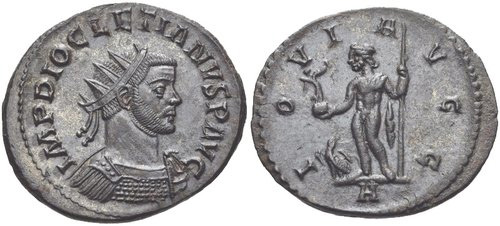
Obverse: IMP DIOCLETIANVS P AVG — “Emperor Diocletian, Dutiful Augustus,” radiate and cuirassed bust right.
Reverse: IOVI AVGG — “To Jupiter of the Emperors,” showing Jupiter standing facing, head left, holding a scepter and Victory on a globe; eagle at his feet to the left

These inscriptions show not emperor worship but emperor alignment. Diocletian ruled under Jupiter’s protection, not as Jupiter himself. Christian refusal to sacrifice therefore struck at the foundation of the very system that legitimized the Tetrarchy.


A Rapidly Expanding Christian Movement

By the early fourth century, Christian communities were thriving. Eusebius describes this moment as a period of remarkable growth and public visibility:

Eusebius, Ecclesiastical History 8.1.1 (AD 311–325)
“Before the persecution, the churches were at peace and multiplied everywhere. Rulers honored the Christians. Crowds assembled in the churches. New buildings rose from their foundations in every city.”

Archaeology confirms this account. Christian buildings became larger and more numerous; clergy gained public recognition; and Christians entered civic roles and even imperial service. A movement that once met quietly in homes now built large structures in major cities.

For an imperial system built upon unified sacrifice, this expanding Christian public life created unavoidable tension.


Galerius and the Push Toward Hostility

Lactantius, an eyewitness to these events, identifies Galerius as the chief instigator behind the coming persecution:

Lactantius, On the Deaths of the Persecutors 11 (AD 313–315)
“Galerius, a man fierce in nature and hostile to the name of the Christians, urged the emperor daily to destroy the churches and to compel all to sacrifice.”

Galerius believed the empire’s troubles stemmed from neglect of the gods. Christian refusal to sacrifice was not private dissent but a direct challenge to Rome’s divine protection and the religious foundation of the Tetrarchy.

Diocletian hesitated for several years, but as pressure increased, he gradually shifted toward Galerius’s position.


Signs, Omens, and the Turning Point

Lactantius records a critical moment in AD 299, when the imperial household sought omens through a traditional sacrifice:

Lactantius, On the Deaths of the Persecutors 10 (AD 313–315)
“When Diocletian and Galerius consulted the oracle, the diviners declared that the presence of Christians had disturbed the sacred rites.”

Christians in the imperial service did not participate in the gestures of reverence. The diviners blamed them for the failure of the ritual. In a political system where divine favor upheld the rulers, this carried enormous weight.

Eusebius describes the resulting shift in Diocletian’s attitude:

Eusebius, Ecclesiastical History 8.2.1 (AD 311–325)
“Diocletian was persuaded that the time had come to wage war against the churches as if against enemies of the state.”

By AD 302, the decision was near.
By early AD 303, it was set.


The Destruction of the Nicomedia Church

The Great Persecution opened with a symbolic act carried out at the political center of the Eastern empire. On February 23, AD 303, Diocletian ordered the destruction of the major church in Nicomedia. Lactantius, writing only a decade later, gives us a vivid description of what happened that morning:

Lactantius, On the Deaths of the Persecutors 12 (AD 313–315)
“On the morning of the day appointed for the celebration of the Terminalia, when the sun had not yet risen, the prefect together with tribunes and officers arrived at the church in Nicomedia, and having broken open the doors, they searched for the image of the god of the Christians, the Scriptures, and all that they used in their worship. When they found the Scriptures, they burned them; everything else they destroyed. The soldiers were allowed to seize whatever was found inside.”

The reference to the Terminalia, a festival dedicated to boundaries, is significant. Diocletian was drawing a line between the old religious order and the presence of Christianity in public life. By choosing this date, he signaled that the empire was redrawing its religious boundaries.

Eusebius, writing from within the Eastern provinces, confirms the same event from a different vantage point:

Eusebius, Ecclesiastical History 8.2.4 (AD 311–325)
“The imperial edict commanded that the church in Nicomedia be leveled to the ground. Those who were present saw the building demolished from its foundations, and the sacred Scriptures committed to the flames.”

The two accounts, one Western and Latin (Lactantius) and one Eastern and Greek (Eusebius), give us the fullest picture we have of this opening blow.


The First Edict of 303

After the church was destroyed, Diocletian issued the first of four imperial laws. Lactantius reproduces the text in summary form, and his account is our primary source for its contents. According to him, the first edict contained four major provisions:

  1. All churches were to be destroyed.
  2. All Scriptures were to be burned.
  3. Christians were to lose legal rights and protections.
  4. Those in government positions were to be removed unless they sacrificed.

Here is the full text as preserved in Lactantius:

Lactantius, On the Deaths of the Persecutors 13 (AD 313–315)
“An edict was published ordering that the assemblies of the Christians should be abolished, that their churches be torn down, that the Scriptures be burned, that those who held places of honor be degraded, that servants who persisted in the Christian faith be made incapable of freedom, and that those under accusation of following Christianity be not allowed to defend themselves in court.”

The brutality of the law becomes clear as Lactantius explains its underlying logic:

Lactantius, On the Deaths of the Persecutors 13 (AD 313–315)
“The emperor believed that if he took away the opportunity of meeting for worship and destroyed their Scriptures, the religion itself could be abolished.”

This is the key sentence.
It shows the intent behind the Great Persecution: not merely to pressure Christians, but to erase the Christian movement by attacking its buildings, its Scriptures, and its legal status.


Refusal and Immediate Violence

Eusebius records the immediate resistance of some Christians in Nicomedia who tore down the imperial edict publicly:

Eusebius, Ecclesiastical History 8.5.1 (AD 311–325)
“One of the Christians, moved with holy zeal, tore down the imperial edict that had been posted in a public place and put it into shreds as something profane and illegal.”

According to Eusebius, this man was arrested, tortured, and executed. His act represents one of the earliest martyrdoms of the Great Persecution.


Impact Across the Empire

The First Edict was carried out differently in East and West. In the East, where Galerius wielded influence, the laws were enforced strictly. Eusebius describes widespread destruction:

Eusebius, Ecclesiastical History 8.2.5 (AD 311–325)
“Churches were torn down from top to bottom, and the sacred Scriptures were cast into the fire in the open marketplaces.”

In the West, Constantius enforced the law only minimally. Churches were destroyed, but he did not pursue Christians or burn Scriptures with the same severity. As Lactantius notes:

Lactantius, On the Deaths of the Persecutors 15 (AD 313–315)
“Constantius, although he destroyed a few buildings, spared the Christians themselves and took no delight in their suffering.”

This divergence becomes much more pronounced in the years that follow. The edicts will be applied ruthlessly in the East and with comparative restraint in the West.


The Second Edict: Imprisonment of the Clergy

The First Edict had targeted buildings, Scriptures, and legal rights. When this failed to break Christian resolve, the imperial court issued a second command. This time, the goal was to dismantle the leadership of the churches.

Lactantius provides the clearest account:

Lactantius, On the Deaths of the Persecutors 15 (AD 313–315)
“Diocletian published another edict, ordering that all the bishops and ministers should be thrown into prison.”

This marked a dramatic escalation. It was not aimed at all Christians, but at the entire structure that led and organized Christian communities.

Eusebius confirms the severity in the Eastern provinces:

Eusebius, Ecclesiastical History 8.6.1 (AD 311–325)
“An edict was issued that all who were called ministers of the Word should be seized and committed to prison. And there was nothing mild in the execution of this command.”

Prisons filled rapidly. Eusebius writes:

Eusebius, Ecclesiastical History 8.6.6 (AD 311–325)
“The prisons, which had previously held murderers and robbers, were now filled with bishops, presbyters, deacons, readers, and exorcists.”

This detail is important.
It shows the scale of the arrests and also how the empire quickly ran out of space to hold so many clergy.


The Third Edict: Forcing the Clergy to Sacrifice

By late 303, the prisons were overflowing. Rather than release the clergy, the imperial court issued a third edict directing that all imprisoned leaders be compelled to sacrifice.

Lactantius writes:

Lactantius, On the Deaths of the Persecutors 16 (AD 313–315)
“A third edict commanded that all those in prison should be forced by every means to sacrifice.”

The phrase “by every means” implies torture, starvation, deprivation, and psychological pressure. Eusebius describes what happened in the East:

Eusebius, Ecclesiastical History 8.6.8 (AD 311–325)
“Some endured every form of punishment in the attempt to force them to sacrifice; they suffered rackings, burnings, and all kinds of torment.”

Some clergy yielded. Many did not.
Those who refused were either kept imprisoned or executed.


The Fourth Edict: Universal Sacrifice

The fourth edict marked the full and final escalation. While the first three focused on property and clergy, the fourth edict extended to every Christian, commanding everyone to sacrifice to the gods or face punishment.

Lactantius states:

Lactantius, On the Deaths of the Persecutors 17 (AD 313–315)
“A fourth edict was issued ordering that all persons, without exception, should sacrifice and taste the offerings.”

This was the heart of the Great Persecution.
For the first time in Roman history, a universal law required every Christian in the empire to sacrifice on pain of imprisonment, torture, or death.

Eusebius describes the impact:

Eusebius, Ecclesiastical History 8.6.9 (AD 311–325)
“The command was given that all the inhabitants of the cities should be compelled to sacrifice and pour libations to the idols. Those who refused were subjected to various punishments.”

This edict brought the entire Christian population into direct conflict with the state.


Diverging Paths: East and West

The edicts applied to the whole empire, but enforcement differed dramatically.

The Western Provinces

Constantius, ruling in Gaul and Britain, enforced only part of the First Edict. He destroyed some church buildings but refused to persecute Christians themselves.

Lactantius remarks on this restraint:

Lactantius, On the Deaths of the Persecutors 15 (AD 313–315)
“Constantius, though he destroyed a few buildings, did not harm the Christians and took no pleasure in their suffering.”

Under Constantine (after 306), persecution ceased entirely in the West.

The Eastern Provinces

The East was ruled first by Diocletian and Galerius, then by Galerius alone, and finally by Maximinus Daia. Here the edicts were enforced with full severity for nearly a decade.

Eusebius records the intense suffering that followed:

Eusebius, Ecclesiastical History 8.9.1 (AD 311–325)
“In the regions under the rule of Maximinus an unbroken series of evils overwhelmed the Christians.”

This distinction between East and West explains why the Great Persecution lasted much longer in some regions. The universal sacrifice edict was enforced fiercely in the East and only lightly in the West.


The Scale of the Persecution

The four edicts created the most comprehensive legal assault Christianity ever faced:

• Churches destroyed
• Scriptures burned
• Legal rights removed
• Clergy imprisoned
• Clergy forced to sacrifice
• All Christians required to sacrifice
• Severe punishments for refusal
• Enforcement lasting nearly a decade in the East

This was not a short moment, like the requirement under Decius.
This was an attempt to eradicate Christian identity, its leadership, its Scripture, and its existence as a public movement.


The Height of the Persecution

After the fourth edict extended the requirement of sacrifice to every Christian in the empire, the persecution entered its most violent phase. This period, stretching from 303 through the early 310s in the East, produced scenes of cruelty unmatched in earlier Roman history. Eusebius and Lactantius, both eyewitnesses to portions of these events, provide detailed accounts of torture, imprisonments, and executions across the provinces.


Torture and Public Punishments

Eusebius describes how the authorities attempted to break Christian resolve with punishments designed to terrify the entire population.

Eusebius, Ecclesiastical History 8.7.1 (AD 311–325)
“Some were scourged with whips, torn by the rack, and stretched out upon instruments of torture; some were burned with fire; others were crucified; some were beheaded; many were condemned to the mines or to the wild beasts.”

He emphasizes that these punishments were not isolated incidents but part of a coordinated effort:

Eusebius, Ecclesiastical History 8.7.2 (AD 311–325)
“The cruelty of the governors was such that no words can adequately describe the variety and severity of their torments.”

Lactantius gives similar testimony, describing how the persecutors operated with deliberate intent to inflict suffering:

Lactantius, On the Deaths of the Persecutors 18 (AD 313–315)
“Those who refused to sacrifice were tortured with every kind of instrument, and the cruelty of the judges seemed to have no end.”

These statements establish the environment of terror that spread through the Eastern provinces.


The Persecution in Egypt

Egypt experienced some of the most intense violence. Eusebius, who lived in Caesarea but had deep ties to Egypt, records the ferocity of the punishments in Alexandria:

Eusebius, Ecclesiastical History 8.9.4 (AD 311–325)
“In Alexandria countless numbers were put to death. Some were beheaded; others burned; others cast into the sea; others given to the sword. The massacre continued day after day.”

He describes the courage of the martyrs:

Eusebius, Ecclesiastical History 8.9.5 (AD 311–325)
“Not even the women were spared; they endured the same tortures as the men, and many met their end with remarkable courage.”

Egypt’s large Christian population meant that resistance was strong, and so was the response of the authorities. The violence continued for years.


The Suffering in Palestine

Eusebius’s Martyrs of Palestine (an appendix to his Ecclesiastical History) is one of the most detailed regional martyr narratives from the ancient world. In Part 4 of the main history, he describes the beginning of the violence:

Eusebius, Ecclesiastical History 8.8.1 (AD 311–325)
“In Palestine, the persecutions were incessant. Every day brought new trials, and the judges devised new forms of torture.”

Some Christians were mutilated:

Eusebius, Ecclesiastical History 8.8.3 (AD 311–325)
“Some had one eye gouged out, others had the joints of their ankles burned or severed, and thereafter were sent to the copper mines.”

Others were executed publicly:

Eusebius, Ecclesiastical History 8.9.6 (AD 311–325)
“Many were beheaded or burned alive, so that the flames and the sword together took their daily victims.”

These passages give a vivid picture of the relentless and creative brutality that characterized the persecution in Palestine.


The Persecution Under Maximinus Daia

When Diocletian and Maximian abdicated in AD 305, the persecution did not end. Instead, it intensified in the East under Maximinus Daia, nephew of Galerius. Eusebius portrays his rule in especially dark terms:

Eusebius, Ecclesiastical History 8.14.1 (AD 311–325)
“Maximinus, more cruel than any before him, inflamed with an unbounded hatred of the Christians, drove all to madness by his tyrannical measures.”

Under Maximinus, local officials were encouraged to compete in displays of cruelty, and mobs were incited to attack Christian communities.

Eusebius writes:

Eusebius, Ecclesiastical History 9.2.1 (AD 311–325)
“The provinces under Maximinus were filled with executions; the tortures were carried out not only in the cities but in every village and district.”

This period saw some of the most gruesome executions in recorded Christian history.


The Attempt to Eradicate Christian Scripture

One of the defining features of the Great Persecution was the attempt to eliminate Christian Scripture. This was a continuation of the First Edict, which targeted the sacred writings. Eusebius describes systematic searches:

Eusebius, Ecclesiastical History 8.2.5 (AD 311–325)
“The sacred Scriptures were sought out with diligence, and when found, they were burned in the open squares.”

Lactantius adds:

Lactantius, On the Deaths of the Persecutors 12 (AD 313–315)
“They burned the Scriptures with fire, believing that if the writings were destroyed the religion itself would perish.”

This attempt to eliminate Christian Scripture sets the Great Persecution apart from all earlier Roman actions.


The Persecution of Bishops and Teachers

Because bishops and teachers played a central role in community identity, the authorities targeted them specifically. Eusebius emphasizes how the persecution dismantled Christian leadership:

Eusebius, Ecclesiastical History 8.6.6 (AD 311–325)
“The prisons, which had previously been filled with criminals, were now crowded with bishops, presbyters, deacons, readers, and exorcists.”

This was not incidental. Destroying the leadership was essential to the imperial plan. Without clergy, the Christian movement would lose cohesion. Without bishops, the sacraments could not be administered. Without teachers, instruction would cease.


Crucifixion, Mutilation, and the Mines

The Great Persecution included punishments that earlier emperors rarely used against Christians, including crucifixion. Eusebius documents instances where believers were nailed to crosses:

Eusebius, Ecclesiastical History 8.7.5 (AD 311–325)
“Some were nailed to crosses, others were stretched out on them while still alive.”

Condemnation to the mines was common:

Eusebius, Ecclesiastical History 8.12.1 (AD 311–325)
“Many were sent to the mines in Lebanon, Cilicia, and Palestine, with one eye mutilated and the joints of the ankles burned.”

These punishments were intended not only to kill but to degrade and terrorize.


The Emotional Weight of the Persecution

Eusebius breaks from his usual historical tone when describing the intensity of the suffering:

Eusebius, Ecclesiastical History 8.12.3 (AD 311–325)
“It is impossible to recount the sufferings of the martyrs one by one, for the cruelty of the tyrants exceeded all bounds.”

This statement from an eyewitness underscores why the Great Persecution stands apart in scale and severity.


Galerius Struck with Illness

For nearly eight years after the first edict, the persecution raged most violently in the Eastern empire under Galerius and, later, Maximinus Daia. But in AD 310–311, Galerius was struck by a sudden and horrifying disease. Lactantius describes the illness in graphic detail, presenting it as divine judgment.

Lactantius, On the Deaths of the Persecutors 33 (AD 313–315)
“A malignant ulcer broke out in the secret parts of Galerius’s body, which gradually spread and ate into his vitals; from it issued a stench so foul that it was impossible for any man to endure it.”

The disease worsened over time:

Lactantius, On the Deaths of the Persecutors 33 (AD 313–315)
“It became a torpid mass of corrupt flesh, breeding worms which no medical skill could remove. The surgeons cut away decayed pieces, but the wound only grew larger.”

Eusebius confirms the same picture:

Eusebius, Ecclesiastical History 8.16.2 (AD 311–325)
“He was reduced to such a condition by an incurable disease that even his physicians could no longer approach him because of the unbearable stench.”

In this agony, Galerius made a decision no one expected.


Galerius Issues the Edict of Toleration (AD 311)

On April 30, AD 311, Galerius issued an imperial proclamation ending the persecution he had driven for a decade. Lactantius preserves the text in full. This is the earliest surviving imperial law granting legal status to Christianity.

Here is the complete edict, without abbreviation:

Lactantius, On the Deaths of the Persecutors 34 (AD 313–315)
“Among the other measures that we have taken for the advantage of the empire, we had desired first of all to set everything right in accordance with the ancient laws and public discipline of the Romans. We therefore sought to restore the worship of the gods who sustain our empire, believing that the Christians had abandoned the religion of their ancestors.

Since, however, many persisted in their purpose, and since we saw that they neither paid reverence to the gods nor worshipped them, we therefore judged it necessary to command that they return to the practices of the ancients.

Yet because many obeyed not our decrees but endured all kinds of suffering, and because they showed that they could in no way be turned from their purpose, we are compelled by our utmost indulgence to extend pardon to them, so that once more they may be Christians and may build the places in which they gather, always provided that they do nothing contrary to good order.

It will be required of them that they pray to their God for our safety and that of the empire, and for their own, so that the state may be preserved in security on every side and that they may live in peace within their own dwellings.”

This is one of the most extraordinary documents in Roman history.
The man who insisted Christianity must be destroyed now publicly acknowledges:

  • the Christians endured suffering,
  • they could not be broken,
  • and the imperial court now permits them to exist again.

After Galerius: Maximinus Daia Continues the Persecution

Although Galerius reversed imperial policy in 311, the violence did not end everywhere. In the Eastern provinces under Maximinus Daia, persecution continued until 313.

Eusebius describes Maximinus’s renewed hostility:

Eusebius, Ecclesiastical History 9.1.2 (AD 311–325)
“Maximinus, inflamed with greater rage than before, would not permit the decree of Galerius to be carried out in his provinces.”

He incited cities to petition for continued persecution:

Eusebius, Ecclesiastical History 9.2.4 (AD 311–325)
“Some of the cities sent formal petitions requesting that the Christians be forbidden to inhabit their lands. Maximinus eagerly granted such requests.”

It is only after Maximinus’s military defeat in 313 that Christianity finally receives full legal protection in the East.


Constantine and Licinius End the Persecution (AD 313)

In early 313, Constantine and Licinius met in Milan and jointly agreed to extend full toleration across the empire. Although the exact text survives in a provincial copy preserved by Lactantius, its purpose is clear: to restore full freedom to Christian communities.

The proclamation states:

Lactantius, On the Deaths of the Persecutors 48 (AD 313–315)
“We resolved to grant both to the Christians and to all others full authority to observe whatever worship they choose, so that whatever divinity resides in heaven may be favorable to us and to all who are under our authority.”

By this point:

  • Constantius had always been mild in the West
  • Constantine ended persecution in 306
  • Galerius ended the persecution in 311 in his realms
  • Maximinus’s defeat in 313 ended the last violent enforcement

Thus, AD 313 marks the end of the Great Persecution, nearly ten years after it began.


The Long Aftermath

Eusebius depicts the rejoicing of Christian communities once the persecution ceased:

Eusebius, Ecclesiastical History 10.2.1 (AD 311–325)
“After the tyrants had been removed, God wiped away every tear from their eyes, and the festival of freedom was celebrated throughout the cities.”

Churches were rebuilt.
Leaders returned from exile.
Scriptures were recopied.
The memory of the martyrs became foundational to Christian identity.

The Great Persecution had failed.
Instead of destroying Christianity, it had purified and strengthened it.


Eyewitness Martyr Testimonies and Christian Voices During the Persecution

To understand the intensity of the Great Persecution, it is necessary to hear the voices of those who lived through it. Beyond the narratives of Lactantius and Eusebius, several eyewitness accounts survive describing the sufferings of Christians across the empire. These texts record the trials, tortures, and executions of believers who endured the decade between 303 and 313. Their voices form one of the richest collections of primary sources from early Christian history.


The Martyrs of Palestine

Eusebius’s Martyrs of Palestine is among the most detailed eyewitness accounts of martyrdom from the ancient world. Written between AD 311 and 313, it describes the executions he witnessed in Caesarea and the surrounding regions.

Apphianus

The story of Apphianus is among the most vivid:

Eusebius, Martyrs of Palestine 4.7–8 (AD 311–313)
“Apphianus was struck repeatedly on the face, yet his courage did not falter. When they wrenched his limbs with instruments of torture, he remained unshaken in his purpose. They wrapped his feet in linen steeped in oil and set them on fire. Then they bound heavy stones to him and cast him into the sea.”

Procopius

Eusebius also records the martyrdom of Procopius, a reader in the church:

Eusebius, Martyrs of Palestine 1.2 (AD 311–313)
“Procopius was brought before the governor. When he refused to sacrifice, he was immediately beheaded, sealing his testimony with the sword.”

Agapius and the Beasts

One of the most dramatic scenes takes place in the amphitheater:

Eusebius, Martyrs of Palestine 6.3 (AD 311–313)
“Agapius was sentenced to the wild beasts. When he confessed Christ boldly, the beasts were let loose upon him, and he met his end with steadfast courage.”

Pamphilus and the Scholars

Eusebius’s own mentor and teacher, Pamphilus of Caesarea, was martyred along with a group of scholars:

Eusebius, Martyrs of Palestine 11.1 (AD 311–313)
“Pamphilus, the most admirable of men, endured imprisonment for two years. After countless tortures, he and his companions were put to death.”


The Alexandrian Martyrs

Alexandria remained one of the largest Christian centers in the empire, and the persecution struck it with unusual violence.

Eusebius writes:

Eusebius, Ecclesiastical History 8.9.6 (AD 311–325)
“Some were burned, some were drowned, some beheaded, some given to the sword, and others cast into the fire. The massacre continued day after day.”

Peter of Alexandria

Peter, bishop of the city, was executed in AD 311:

Eusebius, Ecclesiastical History 8.13.2 (AD 311–325)
“Peter, who presided over the church in Alexandria, was arrested and beheaded, giving a noble example to the flock.”

Phileas of Thmuis

Phileas, another Egyptian bishop, wrote an eyewitness letter describing the prisons and tortures. Eusebius preserves part of it:

Eusebius, Ecclesiastical History 8.10.2–3 (AD 311–325)
“Phileas wrote in detail of the sufferings of the blessed martyrs: how they stood firm under countless torments, how the judges exhausted themselves in devising new forms of cruelty, and how the martyrs endured everything with admirable patience.”


The Egyptian Confessors Sent to the Mines

Among the most horrifying scenes is the mutilation and transportation of Egyptian confessors to the mines of Palestine.

Eusebius, Ecclesiastical History 8.8.3 (AD 311–325)
“Some had the one eye gouged out, others had the joints of their ankles burned or severed. Then they were sent to the mines, bearing in their bodies the marks of Christ’s sufferings.”

These punishments were intended to break morale and terrorize Christian communities.


Martyrdom in Syria and Asia Minor

While Palestine and Egypt preserve the richest martyr narratives, persecution also raged throughout Syria and Asia Minor.

Eusebius, Ecclesiastical History 8.12.1 (AD 311–325)
“Throughout Syria and the regions beyond, countless numbers were sent to the mines after being mutilated in their eyes and feet.”

And in a passage describing Maximinus Daia’s reign:

Eusebius, Ecclesiastical History 9.2.1 (AD 311–325)
“The provinces under Maximinus were filled with executions, both in the cities and in the villages.”


The Martyrdom of Lucian of Antioch

Lucian, a priest and renowned biblical scholar, was executed in AD 312 at Nicomedia.

Eusebius, Ecclesiastical History 9.6.3 (AD 311–325)
“Lucian, a man distinguished for his skill in the divine Scriptures, sealed his testimony at Nicomedia, offering a noble example of endurance.”


Methodius of Olympus

Methodius, an important theological writer, was martyred near the end of Galerius’s reign. Though Eusebius does not describe the details, Jerome preserves the tradition:

Jerome, On Illustrious Men 83 (AD 392)
“Methodius, bishop of Olympus, suffered martyrdom at the end of the reign of Galerius.”

His death represents the loss of one of the era’s great Christian thinkers.


Peter of Alexandria’s Pastoral Letters

Peter, the martyred bishop of Alexandria, wrote pastoral letters during the persecution addressing those who had lapsed under torture.

Peter of Alexandria, Canonical Letter 4 (AD 306–311)
“Those who betrayed the faith under the compulsion of torture must be received with mercy after they have shown due repentance, for they fell under force and not of their own will.”

These letters show how deeply the persecution impacted Christian pastoral life and discipline.


Restoration Inscriptions and Archaeological Witnesses

After the persecution ended, inscriptions commemorated the rebuilding of destroyed churches. One from North Africa reads:

Cirta inscription (Numidia), c. 315
“Restored from the ruins of the persecution.”

Archaeological evidence also preserves burn layers, smashed furnishings, and remnants of hidden Scriptures, confirming the literary accounts of destruction.


Conclusion: The Decade Rome Tried to Erase the Church

The Great Persecution stands alone in the history of the Roman Empire. Earlier persecutions were real and often severe, but none matched the scale, duration, coordination, or intent of the measures launched between AD 303 and 313. Across the Eastern empire especially, Christians faced a comprehensive legal and physical assault designed not merely to punish them but to erase their Scriptures, dismantle their leadership, destroy their churches, and compel all believers to abandon their faith.

The laws progressed step by step until the entire Christian population fell under their weight. Churches were torn down, Scriptures burned, clergy imprisoned, clergy tortured, and finally all Christians forced to sacrifice under threat of death. The edicts touched every element of Christian life.

The purpose is stated clearly in the primary sources. Lactantius records Diocletian’s reasoning with stark precision:

Lactantius, On the Deaths of the Persecutors 13 (AD 313–315)
“He believed that if he took away the opportunity of meeting for worship and destroyed their Scriptures, the religion itself could be abolished.”

No earlier emperor had attempted something so broad, so systematic, or sustained for so many years.


The Witness of the Martyrs

The eyewitness narratives from the period show Christians suffering with extraordinary courage. These testimonies were not written decades later. They are contemporary accounts of real people, recorded by those who saw them.

Apphianus in Caesarea stood firm under repeated blows, brutal torture, and finally death by drowning:

Eusebius, Martyrs of Palestine 4.7–8 (AD 311–313)
“Apphianus was struck repeatedly on the face, yet his courage did not falter. When they wrenched his limbs with instruments of torture, he remained unshaken in his purpose. They wrapped his feet in linen steeped in oil and set them on fire. Then they bound heavy stones to him and cast him into the sea.”

Procopius was executed in a single stroke for refusing to sacrifice.
Agapius went to the beasts and met them with fearless confession.
Pamphilus, mentor of Eusebius, endured two years of imprisonment before being put to death.
Phileas of Thmuis described the judges exhausting themselves in inventing new torments.
The Egyptian confessors bore mutilated bodies as marks of their faith.
Lucian of Antioch sealed his testimony at Nicomedia.
Methodius of Olympus, a profound Christian thinker, was killed late in the persecution.
Peter of Alexandria guided his flock with pastoral letters, then faced martyrdom himself.

These names, and many more whose stories survive only in fragments or inscriptions, represent a generation of Christians who stood firm when Rome sought to destroy their faith at its roots.

Eusebius summarizes their endurance with solemn simplicity:

Eusebius, Ecclesiastical History 8.13.12 (AD 311–325)
“In all these trials the athletes of religion shone with patient endurance, for they held fast to their faith with unshaken resolve.”


The Failure of the Persecution

Despite the severity of the laws and the brutality of their enforcement, the persecution ultimately failed.
It failed because Christians refused to abandon their faith.
It failed because Scripture was recopied even while authorities burned it.
It failed because the bishops and clergy held the communities together under unimaginable pressure.
It failed because Christian identity proved stronger than imperial coercion.

Galerius, the chief architect of the persecution, acknowledged this failure publicly in his Edict of Toleration:

Lactantius, On the Deaths of the Persecutors 34 (AD 313–315)
“Since many obeyed not our decrees but endured all kinds of suffering, and since they showed that they could in no way be turned from their purpose, we are compelled by our utmost indulgence to extend pardon to them.”

The persecutor confessed that he could not break the Christians.
He allowed them once again to gather, rebuild, and worship.


Restoration After the Storm

Once Maximinus Daia was defeated in 313, the last remnants of persecution collapsed. Constantine and Licinius extended full religious freedom to all:

Lactantius, On the Deaths of the Persecutors 48 (AD 313–315)
“We resolved to grant both to the Christians and to all others full authority to observe whatever worship they choose, so that whatever divinity resides in heaven may be favorable to us and to all who are under our authority.”

The rebuilding began immediately. Eusebius describes the rejoicing of Christian communities:

Eusebius, Ecclesiastical History 10.2.1 (AD 311–325)
“After the tyrants had been removed, God wiped away every tear from their eyes, and the festival of freedom was celebrated throughout the cities.”

Inscriptions across the empire testify to this restoration:

Cirta inscription (Numidia), c. 315
“Restored from the ruins of the persecution.”

Churches were rebuilt larger than before. Scriptures were recopied. Clergy returned from exile. Communities gathered openly. The names of the martyrs were honored. The memory of their courage became foundational to Christian identity and theology.


A Final Reflection

The Great Persecution did not destroy Christianity. It revealed its strength.
It did not silence Christian witness. It amplified it.
It did not weaken the church. It purified and deepened it.

The empire had attempted to extinguish the Christian faith by burning its Scriptures, breaking its leadership, and torturing its people. Instead, Christianity emerged from this decade more unified, more resilient, and more firmly rooted in the conviction that no earthly power could overcome the truth of the gospel.

When the persecution ended, Christianity did not merely survive.
It stood on the threshold of transformation.
Within a single generation, emperors who once sought its destruction would support its growth and honor its martyrs.

The Great Persecution remains one of the defining moments in Christian memory:
a testimony to suffering, endurance, and the unwavering faith of those who stood firm when the world pressed hardest against them.
Plague, Persecution, and the Strength of the Early Church: From Decius to Valerian

In AD 249, the Roman emperor Decius looked across an empire in decline and believed he saw the cause clearly. Rome had forgotten the gods. Old discipline had collapsed. Armies rebelled, frontiers failed, provinces grew restless, and a strange new disease was beginning to appear in major cities. His solution was drastic: force every inhabitant of the empire to offer sacrifice to the ancestral gods, renewing the divine favor that had once made Rome strong.

Aurelius Victor, a pagan Roman historian writing around AD 360, explains Decius’s reasoning:

“Decius wished to restore the old discipline, for he thought the state had been corrupted by the neglect of ancestral customs.”
(De Caesaribus 29)

Zosimus, a pagan historian hostile to Christianity writing around AD 500, reports the same motive:

“Decius strove to restore the ancient religion.”
(New History 1.23)

Cyprian of Carthage, a Christian bishop writing in the AD 250s, saw the truth directly:

“Decius wished to compel every man to sacrifice.”
(Letter 55)

Decius believed enforced religious unity would stabilize Rome. Instead, the empire fell into one of the worst crises in its history.


Rome’s Crisis Deepened and the Plague Swept the Empire

Within two years of Decius’s edict:

  • he died in battle against the Goths (AD 251),
  • military rebellions multiplied,
  • pretenders seized the throne,
  • frontier defenses collapsed,
  • and the plague exploded.

Eutropius, a pagan Roman imperial official writing around AD 369, summarizes these years in a single devastating sentence:

“The state was wasted by pestilence, devastated by enemies, and its strength exhausted.”
(Breviarium 9.5)

Aurelius Victor, writing as a secular historian around AD 360, echoes it:

“The State was collapsing under its misfortunes.”
(De Caesaribus 30)

The most severe blow was not military—it was biological.


The Plague of Cyprian (AD 249–262): One of the Deadliest Pandemics of Antiquity

The epidemic we now call the Plague of Cyprian lasted roughly thirteen years (AD 249–262). Evidence suggests it reached nearly every major region of the Roman Empire:

  • North Africa (Cyprian’s home)
  • Egypt (Dionysius’s letters)
  • Rome and Italy
  • Asia Minor (Firmilian of Caesarea)
  • Syria, Judea, and Palestine
  • Greece
  • Gaul
  • The Danube provinces
  • Possibly Britain

Firmilian of Cappadocia, a Christian bishop writing around AD 256, states plainly:

“The pestilence is raging everywhere, and the whole world is devastated.”
(Epistle 74 to Cyprian)

Historians estimate:

  • Urban mortality: 20–30%
  • Some cities: up to 50%
  • Total empire-wide deaths: 5–10 million

No Roman epidemic produced more detailed Christian eyewitness testimony.


Cyprian’s Full Plague Description (On Mortality 14)

Cyprian of Carthage, a Christian bishop writing in the mid-250s, recorded the most vivid medical description of the plague. Here is the complete account:

“This trial, that is now common to all, puts us on equal terms. Whatever is the character of the plague which now ravages the human race, it attacks all without distinction. It lays waste the people equally as it perpetually rages among them; and though it may injure many, still it should improve the discipline of all.

This death, in its devastations, as it attacks the righteous and the unrighteous, does not spare the brave or the peaceful; the man of learning and the unlearned; the strong and the weak.

This trial, that now the bowels loosen into a constant flux; that a fire originated in the marrow boils up in the throat; that the intestines are shaken with continual vomiting; that the eyes are on fire with the injected blood; that in some cases the feet or some parts of the limbs are taken off by the contagion of diseased and corrupted putrefaction; and that from the weakness caused by the failing and loss of the body, either the gait is enfeebled, or the hearing obstructed, or the sight darkened—this devastates countless bodies, and destroys whole families and households…

But nevertheless it profits, in that it searches out the righteousness of each one and examines the minds of the human race: whether one who is in health cares for the sick; whether a relation affectionately loves his kindred; whether masters have compassion on their languishing servants; whether physicians do not desert the afflicted; whether the fierce restrain their violence; whether the rapacious can quench the ever insatiable fire of their furious desires; whether the haughty bend their necks; whether the wicked soften their daring; whether, when their dear ones perish, the rich, even then, give anything.”
(On Mortality 14)


Christian Bravery During the Plague

Dionysius of Alexandria, a Christian bishop writing c. AD 260, preserved by Eusebius:

“Most of our brethren, in their exceeding love and affection for the brotherhood, did not spare themselves. They visited the sick fearlessly, ministered to them continually, tended to them in Christ, and died with them most joyfully.”
(Eusebius, Ecclesiastical History 7.22.7–8)

He adds:

“The heathen thrust aside those who began to be sick and fled from their dearest. They cast the dying into the roads before they were dead.”
(Eusebius, HE 7.22.10)

Christians stayed.
They carried the sick.
They buried the dead.
And they died doing it.


Cyprian’s Theology of Charity During Crisis

Cyprian’s On Works and Alms (c. AD 252–254) shows how Christians understood charity in plague and persecution.

“What a great and honorable thing it is, beloved brethren, to wash away the stains of sin by the works of mercy! What a glorious thing to convert earthly possessions into heavenly treasures!”
(On Works and Alms 2)

“Christ taught that He was hungry in His poor… Whatever is given to these is given to Christ.”
(On Works and Alms 6–7)

“Let no one be hindered from doing good by the fear of death. He cannot fear to die who is already dying to the world.”
(On Works and Alms 20–21)

“Even the widow’s two mites were accepted… He who gives to the poor makes God his debtor.”
(On Works and Alms 18)

“Almsgiving prepares us for the crown. He who shows mercy learns to suffer.”
(On Works and Alms 34)

This ethic shaped Christian identity more deeply than any imperial decree.


Gallus and Aemilian: Crisis Without Coherence

Trebonianus Gallus (AD 251–253) inherited an empire collapsing under plague and war.

Aurelius Victor, a pagan historian around AD 360, writes:

“Gallus possessed neither the authority nor the industry necessary for ruling a state collapsing under its misfortunes.”
(De Caesaribus 30)

Eutropius, a pagan imperial official writing c. AD 369, says:

“Pestilence and war wasted every part of the state.”
(Breviarium 9.5)

Cyprian of Carthage, a Christian bishop writing in the mid-250s, provides direct testimony:

“Gallus, at once hostile and timid, succeeded the empire. He drove Cornelius, the bishop, into exile, and pursued the pastors of the Church with wicked fury.”
(Epistle 55.9)

Aemilian (AD 253) ruled only months.
Zosimus, the pagan historian hostile to Christianity, says:

“Aemilian ruled so briefly that nothing worth remembering could be accomplished.”
(New History 1.24)


Valerian: A Brief Peace and Then a Sharp Persecution

Valerian (AD 253–260) began with unusual favor toward Christians.

Dionysius of Alexandria, writing c. AD 260, recalls:

“In the early days of Valerian, there was not even a whisper of hatred against us. Men of God were in his household.”
(Eusebius, HE 7.10.3–4)

But everything changed dramatically under the influence of Macrianus, his powerful financial officer.


Macrianus: The Architect of Valerian’s Shift

Macrianus was a pagan imperial financial officer—the Rationalis, responsible for taxation, troop pay, and imperial expenditures. With Rome’s finances collapsing under plague, invasion, and mutiny, he wielded enormous bureaucratic power and shaped the emperor’s thinking. Christian writers remembered him as deeply hostile toward Christians, viewing them as destabilizing because they refused state sacrifices.

Lactantius, a Christian historian writing c. AD 310–320, explains Valerian’s reversal:

“He was corrupted by Macrianus, who was long hostile to the Christian name.”
(De Mortibus Persecutorum 5)


Valerian’s First Edict (AD 257)

Lactantius, a Christian historian writing c. AD 310–320, preserves the full legal summary:

“He sent a rescript that bishops, presbyters, and deacons should be punished immediately.

Senators and men of importance who practiced Christianity were to lose their dignities, and if they persisted, be deprived of their property.

Matrons were to be deprived of their goods and banished.

And all members of the imperial household who confessed Christ were to be sent in chains.”
(De Mortibus Persecutorum 5)

Dionysius of Alexandria, Christian bishop writing c. AD 260, adds a key detail:

“It was not permitted for us to assemble, not even in the cemeteries.”
(Eusebius, Ecclesiastical History 7.11.10)

Banning Christian burial gatherings was a direct attack on the most basic expression of the Christian community.


Valerian’s Second Edict (AD 258)

Valerian’s second edict escalated sharply.

Lactantius:

“He ordered that bishops, presbyters, and deacons be executed immediately.

Senators and men of rank who persisted in Christianity were to lose their property and, if they continued, be beheaded.

Matrons were to be deprived of their property and exiled.

And members of the imperial household who confessed Christ were to be sent in chains and assigned to work on the imperial estates.”
(De Mortibus 6)

This was the most targeted persecution since Nero, and the most systematically organized until Diocletian.

It ruthlessly attacked:

  • The clergy (execution)
  • The upper classes (confiscation, then execution)
  • Wealthy Christian women (exile)
  • Christian imperial slaves and staff (forced labor)

By striking at bishops and deacons first, Valerian tried to dismantle Christian leadership.
By attacking Christian senators and matrons, he tried to destroy Christian influence.
By enslaving Christian palace staff, he tried to cleanse the imperial household of the faith.


The Execution of Sixtus II and the Roman Deacons

Eusebius, Christian historian c. AD 310–325, writes:

“Sixtus was seized in the cemetery and put to death with four deacons.”
(Ecclesiastical History 7.14)

The Liber Pontificalis (drawing on much earlier Roman records) gives the names of the deacons:

  • Januarius
  • Magnus
  • Vincent
  • Stephen

Fourth-century bishop Ambrose of Milan, using earlier Roman tradition, expands this event:

“The prefect found Sixtus seated, preaching to the brethren, and said, ‘Are you the bishop?’
Sixtus replied, ‘I am.’
And he was led away to suffer with his deacons.”
(De Officiis 2.28)

Rome remembered that Sixtus and his deacons died during worship, defying Valerian’s ban on assembly in cemeteries, choosing obedience to God over obedience to Rome.


The Full Interrogation of Cyprian of Carthage

This is one of the best-documented martyrdom interrogations from the ancient world.

Eusebius, quoting the official Roman court transcript:

“When Cyprian had been brought before the tribunal, the proconsul said to him:

‘Are you Thascius Cyprian?’

Cyprian replied: ‘I am.’

The proconsul Galerius Maximus said: ‘The most sacred emperors have commanded you to sacrifice.’

Cyprian said: ‘I will not sacrifice.’

Galerius Maximus said: ‘Consider your position.’

Cyprian replied: ‘Do what you are commanded. In so just a cause there is no need of deliberation.’

After conferring with his council, Galerius Maximus reluctantly pronounced the sentence:

‘You have long lived sacrilegiously and have attracted many by your wickedness.
You have shown yourself an enemy to the gods and the laws of Rome.

The sacred emperors have commanded that those who do not sacrifice shall be executed with the sword.

Therefore Thascius Cyprian, you are to be executed with the sword.’

Cyprian responded: ‘Thanks be to God.’”
(Eusebius, Ecclesiastical History 7.11*)

This transcript is extraordinary:
It shows a bishop speaking directly, calmly, and fearlessly to the Roman state.


Eyewitness Account of Cyprian’s Final Moments (Pontius the Deacon)

Pontius of Carthage, Cyprian’s deacon and an eyewitness writing in the AD 260s, describes what happened next:

“When he came to the place appointed for execution, Cyprian prayed on his knees.

He took off his cloak and folded it carefully before kneeling upon it.

He removed his dalmatic and handed it to the deacons, remaining in his linen tunic.

Then he bound his own eyes with his handkerchief.

The faithful spread cloths and napkins before him to catch his blood.

Cyprian himself commanded the executioner to do his duty, and the executioner struck the blow.”
(Pontius, Life of Cyprian 19–20)

Pontius adds one more vivid detail:

“There was a great cry from the brethren, many saying: ‘Let us be slain with him!’
But Cyprian had already received the crown.”
(Life of Cyprian 20)


Additional 3rd-Century Witnesses to Cyprian’s Martyrdom

Early Carthaginian martyr traditions remember:

“He knelt upon the earth and clasped his hands in prayer.
The soldiers marveled at his calmness.”
(Acts of Cyprian, fragment)

And:

“He offered himself willingly, and the people wept as for a father.”
(Acts of Cyprian, fragment)

These traditions formed part of the earliest Christian liturgical memory in North Africa.


Valerian’s Catastrophic End

In AD 260, Valerian marched east to confront the rising Persian king Shapur I.
He was defeated, captured alive, and humiliated—an unprecedented disaster.

Shapur I, Zoroastrian Persian king writing c. AD 260, proudly carved:

“We captured Valerian, the emperor of the Romans, with our own hands.”
(Res Gestae Divi Saporis)

Roman historians—pagan and Christian—agreed that nothing like this had ever happened in Rome’s history.

For Christians, it confirmed the justice of God.
For pagans, it proved the empire was in unprecedented crisis.

Valerian’s son, Gallienus, now ruled alone.


The First Pro-Christian Law in Roman History

Gallienus immediately reversed his father’s policies.
He issued a rescript restoring Christian property and protecting their right to assemble.

Eusebius, Christian historian c. AD 310–325, preserves the text:

“The places which were seized are to be restored to you,
and the governors shall desist from molesting you.”
(Ecclesiastical History 7.13)

This was the first legal recognition of Christianity by a Roman emperor.

It inaugurated what historians call the Little Peace of the Church (AD 260–303)—a 40-year span of relative safety before the Great Persecution under Diocletian.


Why Gallienus Did This

Gallienus reversed the persecution because the empire needed stability, not conflict.
After Valerian’s capture, the Roman world was breaking apart:

  • provinces were rebelling,
  • armies were mutinying,
  • and the plague still ravaged cities.

Christians were:

  • organized,
  • peaceful,
  • widespread,
  • and exceptionally charitable.

Restoring their property strengthened urban life at zero cost to the state.

Another major reason was the downfall of Macrianus, the architect of the persecution.
Macrianus was the empire’s powerful financial officer. After Valerian’s capture, he betrayed the imperial family by attempting to put his own sons on the throne. His rebellion failed, discrediting both his faction and his policies.

Continuing a persecution designed by a traitor would have undermined Gallienus’s legitimacy.
Ending it unified support behind his rule.

Gallienus’s toleration was not theological. It was practical statecraft in the middle of collapse.


Why Christianity Grew Stronger While Rome Collapsed

From Decius to Valerian, Rome tried to save itself through:

  • fear,
  • coercion,
  • forced sacrifice,
  • and violence.

Christians grew through:

  • sacrificial charity,
  • unity across classes,
  • courage in martyrdom,
  • doctrinal clarity,
  • care for the sick,
  • and unshakable resurrection hope.

Where Rome fled the plague, Christians carried the dying.
Where Rome cast out its sick, Christians welcomed them.
Where Rome fractured, Christians unified.
Where Rome enforced loyalty through fear, Christians won loyalty through love.

This is why Christianity endured Rome’s darkest decades—not through power, but through faithful love in the face of death, a way of life no emperor could crush.

The Decian Persecution: When Rome Tested Every Soul

When Emperor Gaius Messius Quintus Decius came to power in AD 249, the Roman Empire was unraveling.
The northern frontiers were collapsing under Gothic pressure.
Civil wars and mutinies had stripped away the sense of divine favor that had long sustained Roman identity.
The economy, ravaged by inflation and plague, staggered beneath decades of crisis.
Decius—an old-fashioned senator from Pannonia—believed that the solution was not merely political or military but spiritual.

He declared that Rome’s troubles stemmed from the neglect of its ancestral gods.
To save the empire, he would restore the ancient religion, the sacrificia publica that had once bound the provinces to the gods of Rome.
He dreamed of a unified empire where all citizens once again poured libations to Jupiter, Juno, and Mars—just as Augustus had revived the temples three centuries earlier.

To Decius, it was not persecution but piety.
To Christians, it was the empire’s first universal test of faith.


1. Rome’s Imperial Revival of Piety

Later Roman historians remembered Decius as a reformer, not a persecutor.
Aurelius Victor recorded:

“Decius wished to restore the ancient discipline and the ceremonies of the Romans, which for a long time had fallen into neglect.”
(De Caesaribus 29.1, c. AD 360)

The Chronographer of 354, a Roman calendar and imperial chronicle compiled under Constantius II from earlier state records, likewise notes:

“Under Decius, sacrifices were ordered throughout the provinces, that all might offer to the gods.”
(Chronographus Anni CCCLIIII, Part XII ‘Liber Generationis’, AD 354)

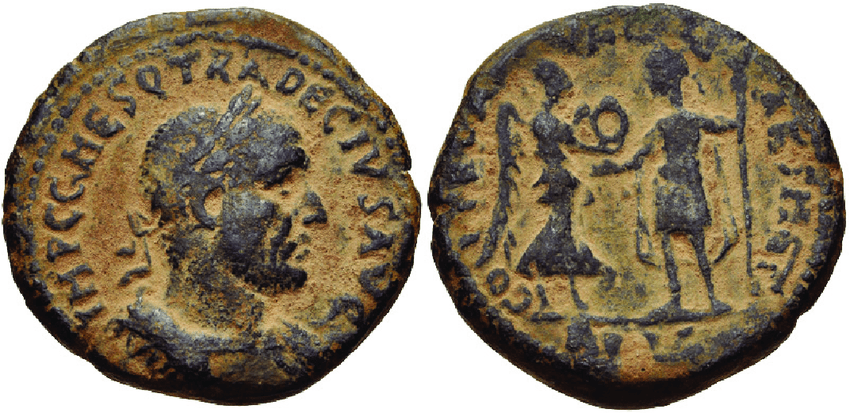
Decian coinage confirms this campaign of religious restoration. Thousands of coins survive showing the emperor pouring a libation at an altar, with legends such as PIETAS AVGG (“The Piety of the Emperors”) and GENIVS SENATVS.

The latter inscription—GENIVS SENATVS—invoked the “Genius of the Senate,” the divine spirit believed to guard and embody the Roman Senate itself.
Every household, legion, and civic body in Rome was thought to possess its own genius, a protective deity who received offerings of wine and incense.
By reviving the Genius Senatus cult, Decius was sacralizing the institutions of Rome themselves—binding political loyalty and divine worship into one act.
These coins, struck in Rome, Antioch, and Viminacium, visually proclaimed that the restoration of the gods meant the restoration of the state.

SideInscription (Latin)Expanded FormTranslation (English)Description / Symbolism
Obverse (Front)IMP C M Q TRA DECIVS AVGImperator Caesar Marcus Quintus Traianus Decius Augustus“Emperor Caesar Marcus Quintus Trajan Decius Augustus”Laureate, draped, and cuirassed bust of Decius facing right. The adoption of the name Trajan links him with Rome’s most admired emperor, emphasizing his mission to restore Roman discipline and piety.
Reverse (Back)VICTORIA AVGVictoria Augusti“Victory of the Emperor”Depicts Victory (Nike) standing left, presenting a wreath to the Emperor Decius, who stands facing her, holding a spear. The wreath symbolizes triumph and divine approval. The scene celebrates Decius’s military success and divine sanction for his rule.

Every coin and inscription declared that the gods were returning—and every Christian knew what that would soon mean.


2. The Edict and the Libelli Certificates

In January AD 250, Decius issued an edict commanding all inhabitants of the empire to perform public sacrifice before local officials and obtain written proof of obedience.
Those who refused faced imprisonment or death.

Dozens of papyri discovered in Egypt record the edict’s enforcement. The best-known, now in the Oxford Bodleian Library, reads:

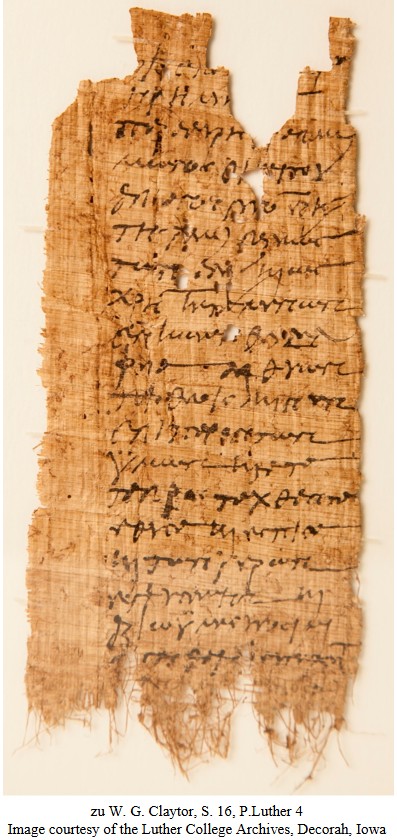
“To the commissioners of sacrifices of the village of Alexander’s Island, from Aurelia Ammonous, daughter of Mystus, aged forty years, scar on right eyebrow. I have always sacrificed to the gods, and now in your presence, in accordance with the edict, I have sacrificed and poured a libation and tasted the offerings. I request you to certify this below. Farewell.”
(Papyrus Oxyrhynchus 2601, AD 250)

Other libelli from Fayum and Theadelphia bear identical phrasing—kata to prostagma (“according to the edict”)—and carry the red-ink seals of village commissioners.
These fragile papyri, recovered by archaeologists in the 1890s, are the only surviving documents produced in direct obedience to Decius’s decree.

They prove that the policy was systematic and bureaucratic—Rome’s paper war against conscience.

“To those who have been selected to oversee the sacrifices, from Aurelius Sarapammon, servant of Appianus, former exegetes of the most-illustrious city of the Alexandrians, and however he is styled, residing in the village of Theadelphia. Always sacrificing to the gods, now too, in your presence, in accordance with the orders, I sacrificed and poured the libations and tasted the offerings, and I ask that you sign below. Farewell. (2nd hand) We, the Aurelii Serenus and Hermas, saw you sacrificing (?) …”

P. 13430

“To the commissioners of sacrifices of the village of Theadelphia:
From Aurelius Syrus, the son of Theodorus, of the village of Theadelphia. I have always sacrificed to the gods, and now, in your presence, I have poured libations, sacrificed, and tasted the sacred offerings, according to the edict. I ask you to certify this for me. Farewell.

We, Aurelius Serenus and Aurelius Hermas, have seen you sacrificing.

Year 1 of the Emperor Decius (AD 250).”

3. The Policy in Motion: Fear and Defiance

Governors such as Sabinus in Egypt and Urbanus in Palestine carried out the edict with zeal.
Eusebius of Caesarea later wrote:

“Decius, who became emperor after Philip, was the first to raise a universal persecution against the Church throughout the inhabited world. There was great persecution against us; the governor Urbanus displayed great zeal in carrying out the imperial commands. Some of the faithful were dragged to the temples and forced to offer sacrifice by tortures.”
(Ecclesiastical History 6.39.1; 6.41.10–12, c. AD 310–325)

Even pagan dedications record the campaign: a marble inscription from Thasos honors local magistrates “for restoring the sacrifices that had fallen into neglect.”
For Decius these were civic triumphs; for Christians, they were death warrants.


4. Voices from the Fire: Martyrdom Across the Empire

Alexandria – Apollonia and the First Flames (AD 249–250)

Bishop Dionysius of Alexandria, an eyewitness, reported:

“The old virgin Apollonia was seized, her teeth broken out, and fire prepared. They threatened to burn her alive if she refused to repeat impious words. She leapt of her own accord into the fire and was consumed.”
(Letter to Fabius of Antioch, in Eusebius 6.41.7–8)

“All Egypt was filled with the noise of those who called upon Christ even in the midst of their tortures.”
(ibid. 6.41.13)

Archaeology corroborates his words: Egyptian sites at Bacchias and Oxyrhynchus reveal temples hastily refurbished and new altars installed in strata dated precisely to AD 250—evidence of an empire suddenly compelled to sacrifice.


Smyrna – Pionius and Companions (AD 250)

The Martyrdom of Pionius preserves an authentic courtroom record:

“On the day of the feast of Saint Polycarp, while we were fasting, the chief of police came suddenly upon us with men bearing chains and bade us sacrifice to the gods. And Pionius said, ‘We are Christians; it is not lawful for us to sacrifice to idols.’”
(Martyrdom of Pionius 2–3)

“They hung him by his wrists, fixing his feet in the stocks. He said, ‘You mistake my torment for your victory; yet it is my freedom, for I rejoice to suffer for the name of Christ.’”
(ibid. 20)

“He breathed out his spirit, and a sweet odor, as of incense, filled the air.”
(ibid. 21)

In Smyrna’s agora, archaeologists have identified a mid-third-century inscription honoring the local strategos who “maintained the sacrifices.” It almost certainly relates to this same enforcement.


Rome – Fabian, Bishop and Martyr (January AD 250)

“Fabian, the bishop of the city of Rome, suffered martyrdom under Decius.”
(Eusebius 6.39.5)

The Depositio Martyrum adds:

“On the twentieth day of January, Fabian, bishop, in the Catacombs.”

His epitaph—FABIAN EPISCOPVS MARTYR—was found in the Catacomb of Callistus.
Soot stains from vigil lamps still darken the marble, showing that Christians visited the site immediately after his death to honor their bishop.


Antioch – Babylas, The Bishop in Chains (AD 250)

“At Antioch, Babylas, bishop of the church there, after glorious bonds and confession, fell asleep in prison.”
(Eusebius 6.39.4)

Archaeological excavations north of Antioch have uncovered the Basilica of Babylas, built atop a repurposed Roman cemetery. Beneath its altar lay a third-century sarcophagus scratched with crosses—widely accepted as the resting place of the Decian bishop who died in chains.


Carthage – Mappalicus and the Imprisoned Confessors (AD 250)

Cyprian wrote from exile:

“Blessed Mappalicus, glorious in his fight, gave witness before the proconsul that he would soon see his Judge in heaven. And when the day came, he was crowned with martyrdom, together with those who stood firm with him.”
(Epistle 37.3)

“The prison has become a church; their bonds are ornaments, their wounds are crowns.”
(Epistle 10.2)

Archaeologists excavating beneath the later Cyprianic Basilica in Carthage found reused Roman blocks incised in red with the names MAPPALICUS VICTOR and FELIX CONFESSOR, strong evidence of a local memorial tradition dating directly to Decius’s time.


Macedonia – Maximus and Companions (AD 250–251)

“In Macedonia, the blessed Maximus and many others gave proof of their faith, being scourged and stoned and finally beheaded.”
(Eusebius 6.43.4–5)

Provincial coinage from Thessalonica of AD 250–251 depicts the goddess Roma receiving sacrifice—a local mirror of the imperial policy that cost these believers their lives.


Sicily – Agatha of Catania (AD 250)

“Quintianus commanded that her breasts be torn with iron hooks, but she said, ‘These torments are my delight, for I have Christ in my heart.’”
(Passio Agathae 6, 3rd-century nucleus)

In Catania’s cathedral crypt, a mid-third-century inscription reading AGATHAE SANCTAE MARTYRI was found in situ, demonstrating that her cult was already established within a generation of her death.


5. The Problem of the Lapsed

Many believers succumbed to fear and sacrificed or bought forged libelli. The Church now had to decide: could such people be restored?

Cyprian’s Pastoral Balance

“Neither do we prejudice God’s mercy, who has promised pardon to the penitent, nor yet do we relax the discipline of the Gospel, which commands confession even unto death.”
(Epistle 55.21, AD 251)

“Let everyone who has been wounded by the devil’s darts, and has fallen in battle, not despair. Let him take up arms again and fight bravely, since he still has a Father and Lord to whom he may return.”
(On the Lapsed 36, AD 251)


Novatian’s Rigorism and Schism

“He who has once denied Christ can never again confess Him; he has denied Him once for all.”
(De Trinitate 29, mid-3rd century)

Bishop Cornelius countered:

“Novatian has separated himself from the Church for which Christ suffered. He says the Church can forgive no sin; yet he himself sins more grievously by dividing the brethren.”
(Eusebius 6.43.10–11)

Fragments of Cornelius’s own epitaph—CORNELIVS EPISCOPVS MARTYR—found near the Callistus catacombs show how quickly the debate over mercy was itself hallowed in stone beside the graves of Decian victims.


Dionysius of Alexandria’s Moderation

“Some of the confessors, being too tender-hearted, desired to welcome all indiscriminately, but we persuaded them to discern, that mercy is good when it is tempered with justice.”
(Eusebius 6.42.4–5)

“Each church dealt with the fallen as it judged best, some treating them harshly, others gently. In this diversity of discipline, yet unity of faith, the Lord was glorified.”
(ibid. 6.42.6*)


6. Pagan Reflection and Christian Memory

Lactantius explained the emperor’s motives:

“Decius, being a man of old-fashioned rigor, desired to restore the ancient religion; and therefore he decreed that sacrifices should be offered to the gods by all. He did evil while intending good.”
(Divine Institutes 5.11, c. AD 310)

Eusebius reflected:

“Those who endured were tried as by fire and found faithful; others, weak through fear, failed the test, yet afterward were restored through tears and repentance.”
(Ecclesiastical History 6.42.2)

Roman catacomb graffiti from this very decade—FELIX MARTYR IN PACE and VICTOR IN CHRISTO—show that Christians carved into the walls the same theology Eusebius would later write: faith tested by fire, rewarded with peace.


7. The End and the Legacy

In AD 251, Decius and his son Herennius Etruscus fell in battle against the Goths near Abrittus. The edict died with them.
But its memory lived on in papyrus and stone—libelli in the desert, epitaphs beneath Rome, and basilicas raised over tombs from Antioch to Carthage.

The Decian persecution produced the earliest empire-wide martyrology, the first letters written from prison, and a theology forged in fire.
It made public what Rome could never suppress:

“We must obey God rather than men.” — Acts 5:29

The empire had demanded a certificate; the Church answered with a confession.

From the Giant to the Wonder-Worker: The Church of Maximinus Thrax to Philip the Arab

For nearly two decades, the Christian movement had lived in relative peace. Under Severus Alexander (AD 222–235), believers were tolerated, even respected. The Historia Augusta claimed he placed images of Christ and Abraham in his private chapel and inscribed the words “Do not do to another what you would not have done to yourself” on the walls of his palace. Whether or not every detail is true, the tone of his reign was unmistakably mild.

That peace ended in blood.


1. Maximinus Thrax (r. 235–238 AD): The Giant Who Hated His Predecessor

When Alexander was murdered by his own troops in 235 AD, the army raised a Thracian soldier of enormous stature—Gaius Julius Verus Maximinus, known to history as Maximinus Thrax. With him began both the Crisis of the Third Century and the first targeted persecution of Christian clergy.

Eusebius of Caesarea, writing around AD 312–324, gives our earliest account:

“Maximinus then ordered that the leaders of the churches should be put to death.
The reason for this persecution was the hatred that he bore toward his predecessor Alexander, whose household was full of believers.”
Eusebius, Ecclesiastical History 6.28 (Loeb)

This was not an empire-wide assault but a surgical strike against the heads of the churches. Maximinus saw in bishops and presbyters a rival network of loyalty. In his eyes, purging them was devotion to the gods of Rome.

The Harsh Provinces: Pontus and Cappadocia

Eusebius continues:

“In some places the persecution was scarcely felt, but in others—especially in Pontus and Cappadocia—it raged fiercely, as the governors there, moved by zeal for idolatry, put to death great numbers of the faithful with various kinds of tortures.
And many of the martyrs of that time were famous, the records of whose martyrdoms are still preserved among the brethren.”
Eusebius, Ecclesiastical History 6.28–29 (Loeb)

Among those caught in the storm were Pontian, bishop of Rome, and Hippolytus, a learned presbyter who had long opposed him.
Eusebius gives the earliest account:

“At this time also Pontianus, who was then bishop of the church of Rome, and Hippolytus, who was distinguished among its presbyters, were exiled to the mines of Sardinia by the decree of Maximinus; and there they were put to death by hardship.”
Eusebius, Ecclesiastical History 6.23 (Loeb)

Their shared suffering and death ended years of division and became one of the church’s earliest examples of reconciliation through martyrdom.


Origen’s Exhortation to Martyrdom (AD 235–238)

At the same time, Origen of Caesarea wrote a remarkable letter to his imprisoned friends Ambrose and Protoctetus, who faced death under Maximinus Thrax.
His Exhortation to Martyrdom is one of the few surviving works written during persecution itself, not after it.

Who Were Ambrose and Protoctetus?

Both men were students and patrons of Origen’s school in Caesarea.
Ambrose—not to be confused with the later bishop of Milan—was a wealthy Alexandrian who had once been drawn to Gnostic philosophy. Origen’s teaching brought him to orthodox faith, and he became one of Origen’s closest allies, financing his commentaries and employing scribes to preserve his work.
Protoctetus was a presbyter of the church in Caesarea, a man of deep integrity and one of Origen’s most loyal companions.

When the persecution of Maximinus reached Palestine, both men were arrested and imprisoned at Caesarea Maritima, the Roman capital on the coast of Judea.
Eusebius writes that their courage made them models for others:

“In these times Origen composed his Exhortation to those suffering persecution, full of encouragement and power, and strengthened many for the contest, among whom were Ambrose and Protoctetus, who were at that time distinguished for their confession of faith.”
Eusebius, Ecclesiastical History 6.28 (Loeb)

Later in his narrative, Eusebius adds:

“Ambrose, who was called Origen’s friend, and Protoctetus, a presbyter of the church at Caesarea, after many trials and noble endurance, were perfected by martyrdom in the persecution under Maximinus.”
Eusebius, Ecclesiastical History 6.39 (Loeb)

Both were executed at Caesarea, probably by beheading around AD 238, remembered as martyrs “distinguished for their confession.”
Origen himself narrowly escaped the same fate; the governor had ordered his arrest, but he hid until the edict was withdrawn.

It was to these two men—waiting in prison for the sentence he expected himself—that Origen wrote his Exhortation to Martyrdom. It was not theory; it was farewell.

“If persecution comes upon us, let us not be disturbed as though something strange had happened.
The Son of God was the first of all martyrs, and He calls us to share His sufferings that we may share His glory.”
Exhortation to Martyrdom 1–2 (Loeb)

He urged them to love even those who condemned them:

“We must love our enemies, bless those who curse us, and pray for those who persecute us.
It is not enough to bear stripes; we must conquer hatred with patience.
The victory of the Christian is not in killing his persecutor but in dying for the truth.”
ibid. 24–25

He described martyrdom as the perfection of baptism:

“Baptism cleanses, but martyrdom enlightens.
Baptism receives the forgiveness of sins; martyrdom obtains the crown of righteousness.
By baptism we are born again; by martyrdom we become perfect.”
ibid. 50–51

He cautioned that believers should never provoke danger but be ready when called:

“We must not throw ourselves into danger, for Scripture says, ‘When they persecute you in one city, flee to another.’
Yet when the hour comes and we are called, we must not deny Christ, even in thought.”
ibid. 34

And he closed with serene strength:

“Do not imagine, friends most beloved, that the soul is conquered when the body is overcome.
The soul conquers when, though the body is slain, it departs unvanquished.
For no iron can pierce faith, no flame consume virtue, no wild beast devour love.”
ibid. 37

Eusebius later said this work “strengthened many for the contest.” (Ecclesiastical History 6.28.)
It shows Origen not as an academic but as a pastor under siege—teaching that victory lay not in survival but in transformation.

Within three years the soldiers who made Maximinus emperor turned on him. He was murdered outside Aquileia in 238 AD, ending the first Christian persecution since Severus.


2. Gordian III (r. 238–244 AD): The Boy Emperor and a Season of Quiet

After the chaos of six emperors in one year, the Senate placed power in the hands of a boy—Gordian III, only thirteen. The brief reign that followed was remarkably calm. No persecutions are recorded, and Christian writers reemerged into view.

“The churches throughout the world enjoyed peace, and the word of salvation was daily increasing.”
Eusebius, Ecclesiastical History 6.39 (Loeb)

During this lull, Origen completed massive scriptural projects—his Hexapla and commentaries on Matthew and John.
His influence also radiated outward through a new generation of leaders—Firmilian of Caesarea and Gregory Thaumaturgus in the East.


Firmilian of Caesarea: The Theologian of Cappadocia

Firmilian, bishop of Caesarea in Cappadocia, was one of the key bridges between Origen’s intellectual world and the organized episcopal networks that later defined the Church.
He invited Origen north to Cappadocia, where theological councils were held during this time of peace.

“Being invited especially by Firmilian, bishop of Caesarea in Cappadocia, Origen stayed with him a considerable time, being of the greatest assistance in the ecclesiastical discussions held there.”
Eusebius, Ecclesiastical History 6.27 (Loeb)

Firmilian’s circle shaped the theological life of Cappadocia decades before Basil or Gregory of Nyssa.
He saw bishops as physicians for wounded souls, not magistrates of punishment.

A generation later Cyprian of Carthage would write directly to him:

“Beloved brother, we have received your letter, which has given us great delight by your faith and wisdom; for you have rightly maintained the truth of the Gospel, and by the vigor of your reasoning strengthened the fellowship of our faith.”
Cyprian, Epistle 74.1 (CSEL 3.2, AD 256)

This East–West friendship was built on Origen’s foundations.
From Firmilian’s school would come his most famous student—Gregory Thaumaturgus.


Gregory Thaumaturgus: The Wonder-Worker of Pontus

Gregory Thaumaturgus—“the Wonder-Worker”—was born around AD 210 in Neocaesarea in Pontus.
He came to Origen as a skeptical philosopher but left as a missionary bishop.

“When I came to him I was enslaved to many false opinions, but he freed me from them all, leading me by the hand to the truth, as from darkness to light.
He opened to us the whole treasure of divine wisdom, showing the harmony of all things and the unity of the Creator.”
Panegyric to Origen 10, 13–14 (Loeb, c. AD 240)

Returning to Pontus, Gregory became bishop of Neocaesarea and composed a Confession of Faith that anticipates the Nicene language:

“There is one God, the Father of the living Word, of wisdom and power and eternal image; perfect begetter of the perfect, Father of the only-begotten Son.
There is one Lord, the only-begotten of the only One, God of God, image and likeness of the Deity, Word through whom all things were made, true Son of the true Father.”
Confession of Faith 1 (Loeb, c. AD 260)

During plague and civil turmoil he guided his church with courage.
His Canonical Epistle—written c. AD 263–265—offers a vivid picture of Christian life under duress.

“Those who were called of Christ rejoiced in the danger; they visited the sick without dread, ministered to their needs, and attended to them in Christ.
Thus they departed this life in gladness, for they were infected by others’ disease, drawing to themselves the affliction of their neighbors and taking their pain upon themselves.”
Canonical Epistle 11 (Loeb)

“Some, being of little faith, abandoned the brethren in distress; others even denied the faith to save their lives.
To such, leniency is to be shown if they repent, yet they shall stand apart for a season, that their penitence may be proven.”
ibid. 12

“Let the widows be honored as the altar of God, for they continually intercede for the Church.
Let virgins keep themselves in purity, knowing that they are the portion of Christ; for the crown of chastity is not gained by words but by life.”
ibid. 24–26

Basil the Great, writing a century later, said:

“The faith which Gregory the Wonder-Worker received from Origen was preserved without spot among us down to our fathers.”
Basil of Caesarea, Letter 28.1 (Loeb, AD 375)

Why He Was Called “The Wonder-Worker”

His title Thaumaturgus (“Wonder-Worker”) came from the miracles remembered by later generations.

“When he came to Neocaesarea he found only seventeen Christians, and when he departed this life there were not more than seventeen unbelievers.
For the signs and wonders which he worked drew the whole people to the faith.”
Gregory of Nyssa, Life of Gregory Thaumaturgus 3 (Loeb, AD 380)

One account tells of a flood stopped by his prayer:

“Gregory, seeing the danger to his flock, took a staff and planted it in the ground, praying that the waters would go no farther.
Immediately the torrent stopped, as if held back by an invisible wall, and from that day the place was called ‘The Boundary of the Wonder.’”
ibid. 4–5 (Loeb)

Another recounts justice revealed by resurrection:

“At his prayer a man slain by his brother arose and named his murderer before returning to death.
The spot is still called ‘The Resurrection Field.’”
ibid. 7 (Loeb)

Whether literal or legendary, these memories portray a man whose faith transformed an entire region.
He turned Pontus from a land of martyrdom into a mission field.


3. Philip the Arab (r. 244–249 AD): A Christian on the Throne?

When Gordian died during the Persian campaign, his Praetorian Prefect Marcus Julius Philippus, later called Philip the Arab, seized power.

“Philip, the Roman Emperor, is said to have been a Christian, and desired to join in the prayers of the Church on the vigil of Easter;
but he was not permitted by the bishop until he had made confession of his sins and taken his place among the penitents.”
Eusebius, Ecclesiastical History 6.34 (Loeb)

Even if legendary, the story shows that by mid-century an emperor could be imagined kneeling with Christians.
Under Philip, churches met openly and owned property; the faith’s visibility was now empire-wide.


4. Cyprian of Carthage: The Western Counterpart

While Origen’s disciples shaped the East, the West produced a new leader from Africa—Thascius Caecilius Cyprianus, or Cyprian of Carthage.

Conversion during Philip’s Peace (c. AD 246–248)

A wealthy teacher of rhetoric, Cyprian was converted in Philip’s later years:

“When I lay in darkness and the gloomy night closed me in, I used to think that what was promised of God’s light was a thing incredible…
But after the stain of my former life had been washed away by the water of rebirth, a light from above poured into my heart.”
Cyprian, Ad Donatum 4–5 (c. AD 246–248)

Bishop of Carthage (AD 248–249)

Soon after baptism he was chosen bishop—about the same year Origen finished Against Celsus and Dionysius took over in Alexandria.

“Under Philip, the churches enjoyed peace, and bishops were freely appointed everywhere. At that time Thascius Cyprian became illustrious at Carthage, a man most skillful in both word and deed.”
Eusebius, Ecclesiastical History 6.43 (Loeb)

Cyprian would soon face what Origen, Firmilian, and Gregory had trained their flocks for—the empire-wide ordeal under Decius.


5. Between Persecution and Peace

The years 235–249 AD formed a fragile hinge in Christian history:

  • Maximinus Thrax tried to sever the Church’s head.
  • Gordian III let it rebuild.
  • Philip the Arab perhaps even prayed with it.
  • Origen taught courage under fire.
  • Firmilian built theological bridges in Cappadocia.
  • Gregory Thaumaturgus turned Origen’s learning into creed, charity, and wonder.
  • Cyprian arose in the West to lead through the coming storm.

The persecution under Thrax was brief but real; the calm under Gordian and Philip allowed the faith to mature in scholarship, discipline, and compassion.
When Decius seized power in 249 AD, that peace—and all it had built—would face the empire’s first universal test.

Multiplying by Mission: Session 6 at Mission Lake

40% Growth Then, 5% Growth Now — What We Must Learn Anew

When Nero died by suicide in AD 68, the Roman Empire plunged into chaos.
In a single year four emperors—Galba, Otho, Vitellius, and finally Vespasian—rose and fell.
While Rome fought for power, Judea was already on fire.
The revolt that began under Gessius Florus would end with Jerusalem leveled, the Temple burned, and a turning point for both Jews and Christians.


1. Florus and the Spark of Revolt (AD 66)

Florus, the Roman governor of Judea, stole seventeen talents of silver from the Temple treasury—about 1,200 pounds of consecrated silver, worth roughly ten million U.S. dollars today.
This was not ordinary corruption; it was sacrilege.

When Florus took seventeen talents out of the sacred treasure, and the multitude ran together in the Temple crying out against him, some of the youths went about the city carrying baskets and asking alms for poor Florus.
— Josephus, Jewish War 2.14.5 §306–308 (c. AD 75–79)

His answer was bloodshed.

Florus sent soldiers into Jerusalem and ordered a massacre. They slew about three thousand six hundred persons, women and children as well as men; and among them were citizens of Roman knighthood. Some were scourged and then crucified.
— Josephus, Jewish War 2.14.9 (c. AD 75–79)

The outrage united the city. Rebels stormed the Antonia Fortress, the great Roman garrison on the northwest corner of the Temple Mount. To capture it was to challenge Rome itself.

They compelled the garrison to surrender and then slaughtered them. Thus war was now openly begun.
— Josephus, Jewish War 2.17.9 (c. AD 75–79)

Rome’s patience ended. Nero sent Vespasian, the empire’s most seasoned general, and his son Titus to crush the rebellion.


2. Vespasian in Galilee — Fire and Terror (AD 67)

Galilee became Rome’s first target. At Jotapata, a hill fortress commanded by Josephus himself, the walls fell after forty-seven days.

Forty thousand were slain, and the city was utterly demolished; those who had hidden in caves were dragged out and slain.
— Josephus, Jewish War 3.7.36 (c. AD 75–79)

Then came Gamla, a ridge-top city east of the Sea of Galilee. Its name means camel in Aramaic, and its fall was as steep as its slopes.

Men and women alike threw themselves and their children down the precipices; and the whole city was covered with corpses.
— Josephus, Jewish War 4.1.9 (c. AD 75–79)

Josephus summed it simply: “Galilee was filled with fire and blood.”
— Josephus, Jewish War 4.1.9 (c. AD 75–79)

The Roman campaign left the region in ruins, silencing nearly every center of resistance.

It was here that Josephus himself was captured. As commander of Jewish forces in Galilee, he had held out at Jotapata until the city fell. In his own account, he claims that while in captivity he prophesied that Vespasian would soon be emperor:

You, O Vespasian, shall be Caesar and emperor, you and your son. Bind me now still closer, and keep me for yourself; for you, O Caesar, are lord, not only of me, but of the land and sea, and of all mankind.
— Josephus, Jewish War 3.8.9 §401–403 (c. AD 75–79)

When that prophecy appeared to come true the following year, Vespasian spared his life, granted him Roman citizenship, and attached him to his household. From then on Josephus lived in Rome under imperial patronage, taking the family name Flavius from his patrons.

This is how Yosef ben Matityahu, a Jewish priest and rebel general, became Flavius Josephus, historian of the Jewish War. His writings—sometimes defensive, sometimes deferential toward Rome—remain the only detailed eyewitness record of Jerusalem’s destruction.


3. The Siege of Jerusalem (AD 70)

When Nero’s death recalled Vespasian to Rome, Titus took full command.
Inside Jerusalem, zealot factions fought one another while Roman legions built a five-mile siege wall to starve the city into surrender.
This wall—called a circumvallation—completely encircled Jerusalem. Built in only three days by tens of thousands of soldiers, it cut off every road and stopped all supplies. Famine would finish what the legions began.

The famine grew severe and destroyed whole houses and families. The alleys were filled with dead bodies of the aged; children and youths swarmed about the market-places like shadows, and fell wherever famine overtook them. No one buried them; pity was strangers to men; for famine had confounded all natural feeling.
— Josephus, Jewish War 5.12.3–4 (c. AD 75–79)

Then Josephus records one of antiquity’s darkest scenes:

There was a certain woman named Mary, daughter of Eleazar, of the village Bathezor. Driven by famine and rage, she slew her infant son, roasted him, and ate one half, concealing the rest. When the soldiers smelled the roasted meat and rushed in, she said, ‘This is my own son; the deed is mine; eat, for I have eaten. Do not pretend to be more tender-hearted than a woman or more compassionate than a mother.’
— Josephus, Jewish War 6.201–213 (c. AD 75–79)

Titus later claimed he had ordered the Temple spared:

I myself called a council of war and urged that the Temple be saved; but the flame was beyond control, and the sanctuary was burned against my will.
— Josephus, Jewish War 6.4.7 §254 (c. AD 75–79)

Josephus blames undisciplined troops; Tacitus sees deliberate policy:

It was resolved to destroy the Temple that the religion of the Jews might be more completely abolished.
— Tacitus, Histories 5.12 (c. AD 100–110)

The Destruction of the Temple of Jerusalem – Francesco Hayez, 1867, oil on canvas

Different motives, same outcome: the Temple fell.
For Christians, it confirmed the prophecy of Christ: “Not one stone shall be left upon another.” (Mark 13:2)


4. Crosses Without Number

As for those who had fled from the city and were caught, they were first scourged and then tortured and finally crucified before the walls. In their fury and hatred the soldiers nailed up the prisoners in different postures, by way of jest, and the multitude was so great that room was wanting for the crosses, and crosses for the bodies.
— Josephus, Jewish War 5.11.1 (c. AD 75–79)

Josephus later expands this account:

Those who were taken outside the city he first scourged, and then tormented with all manner of tortures before crucifying them opposite the wall. Titus indeed felt pity for them, but their number was so great that there was no room for the crosses nor crosses for the bodies. About five hundred were crucified each day, and the soldiers, in their rage and hatred, amused themselves by crucifying some one way and some another, until, owing to the multitude, there was no space left for the crosses nor crosses for the bodies.
— Josephus, Jewish War 6.1.1 (c. AD 75–79)

The same empire that boasted of order and civilization turned execution into entertainment.
The hills around Jerusalem stood thick with crosses—not yet symbols of redemption, but monuments of Rome’s rule through fear.


5. Aftermath — Slavery, Spectacle, and Tax

Through Rome’s streets the captives marched, carrying the Menorah and sacred vessels. Coins were struck proclaiming IUDAEA CAPTA—“Judea Captured.” Various versions of these coins were struck and used for 25 years under Vespasian and his two sons Titus and Domitian.

IMP CAES VESPASIAN AUG PM TR P COS III = Commander Caesar Vespasian Augustus, Chief Priest, Holder of Tribunician Power, Consul for the Third Time; IUDEA CAPTA S C = Judea Captured by decree of the Senate

He decreed that all Jews throughout the world should pay each year two drachmas to the Capitol in Rome, as they had previously paid to the Temple in Jerusalem.
— Dio Cassius, Roman History 66.7 (c. AD 200–220)

The fiscus Judaicus turned a holy offering into tribute for pagan gods.
Jewish Christians, still classed as Jews, were forced to pay the same tax of defeat.

Meanwhile, many early believers saw a deeper reason for Jerusalem’s ruin: the death of James the Just, the brother of Jesus and leader of the church in Jerusalem.

Festus was now dead, and Albinus was but upon the road; so Ananus, who had become high priest, assembled the Sanhedrin of judges, and brought before them the brother of Jesus, who was called Christ, whose name was James, and some others; and when he had formed an accusation against them as breakers of the law, he delivered them to be stoned.
— Josephus, Antiquities 20.9.1 §200–203 (c. AD 93)

Hegesippus, a second-century Jewish Christian, adds detail:

They placed James on the pinnacle of the Temple and cried, ‘Tell us, O righteous one, what is the door of Jesus?’ And he answered with a loud voice, ‘Why do you ask me concerning the Son of Man? He sitteth at the right hand of the Great Power, and shall come on the clouds of heaven.’ Then they began to stone him, and a fuller took the club with which he beat clothes and struck the righteous one on the head, and so he suffered martyrdom.
— Hegesippus in Eusebius, Ecclesiastical History 2.23.10–12 (c. AD 170, quoted c. AD 310–325)

Hegesippus concludes that the siege of Jerusalem followed soon after James’s death, calling it divine judgment:

Immediately after this Vespasian began to besiege them; and they remembered the saying of Isaiah the prophet, ‘Let us take away the righteous man, because he is troublesome to us; therefore they shall eat the fruit of their doings.’ Such was their lot, and they suffered these things for the sake of James the Just.
— Hegesippus in Eusebius, Ecclesiastical History 2.23.18 (c. AD 170, quoted c. AD 310–325)

Eusebius agrees, closing his account:

These things happened to the Jews to avenge James the Just, who was the brother of Jesus that is called Christ. For, as Josephus says, these things befell them in accordance with God’s vengeance for the death of James the Just, which they had committed, although he was a most righteous man.
— Eusebius, Ecclesiastical History 2.23.19–20 (c. AD 310–325)

From this moment on, many Christians saw the destruction of Jerusalem not only as Rome’s triumph, but as God’s judgment for rejecting Christ and murdering His righteous servant.


6. The Arch of Titus — The Empire’s Theology in Stone (AD 81)

When Titus died, the Senate declared him divine. The arch still standing on the Via Sacra reads:

The Senate and People of Rome [dedicated this] to the deified Titus Vespasian Augustus, son of the deified Vespasian.

Inside its vault, carvings show Roman soldiers bearing the Temple treasures.

They brought the Menorah and the table of the bread of the Presence, and the last of the spoils was the Law of the Jews; after these, a great number of captives followed.
— Josephus, Jewish War 7.5.5 (c. AD 75–79)

At the top of the arch inside is the depiction of Titus’ ascension to heaven as a god on the wings of an eagle.

For Rome, the arch proclaimed the victory of its gods.
For Christians, it stood as a silent confirmation of prophecy: the Temple of stone was gone, but the Temple of Christ remained.


7. The Flight to Pella — Revelation and Refuge

Amid the ruins of Jerusalem’s revolt, one community escaped—the believers who remembered Christ’s warning to flee.

The people of the church in Jerusalem had been commanded by a revelation, vouchsafed to approved men there before the war, to leave the city and to dwell in a certain town of Perea called Pella. And when those who believed in Christ had come thither from Jerusalem, then, as if the holy men had altogether deserted the royal city of the Jews and the whole land of Judea, the judgment of God at last overtook them for their abominations.
— Eusebius, Ecclesiastical History 3.5.3 (c. AD 310–325)

Eusebius attributes their escape to a divine revelation, while Epiphanius explains it as obedience to Christ’s prophecy:

When all the disciples were settled in Pella because of Christ’s prophecy about the siege, they remained there until the destruction of Jerusalem.
— Epiphanius, Panarion 29.7.7–8 (c. AD 375)

Different explanations—same event. The believers crossed the Jordan to Pella, a Decapolis city about sixty miles northeast of Jerusalem, where they waited out the war.
Their flight fulfilled Jesus’ own words (Luke 21:20–21).
What looked like retreat was obedience.


8. The Nazarenes — Law-Observant, Christ-Confessing

The first branch to emerge from that exile was the Nazarenes—Jewish believers who kept the Mosaic Law yet confessed Jesus as the divine Son of God.
They were the losing party in the Council of Jerusalem (Acts 15).

At that council, certain men from Judea began teaching that Gentile converts must keep the Law of Moses to be saved:

Some men came down from Judea and were teaching the brothers, ‘Unless you are circumcised according to the custom of Moses, you cannot be saved.’
— Acts 15:1

Later Luke identifies who pressed the issue:

But some of the sect of the Pharisees who believed rose up, saying, ‘It is necessary to circumcise them and to command them to keep the law of Moses.’
— Acts 15:5

Peter and James ruled that Gentiles need not bear that yoke:

We should not trouble those of the Gentiles who turn to God, but should write to them to abstain from things polluted by idols, from sexual immorality, from what has been strangled, and from blood.
— Acts 15:19–20

Those Jewish believers who could not release Torah observance continued as a community of Torah-keeping Christians—the Nazarenes.

Two decades later they were still strong. When Paul returned to Jerusalem near the end of his ministry, James the Just, the same leader later martyred near the Temple, recognized their influence:

You see, brother, how many myriads of Jews there are who have believed, and they are all zealous for the Law… Therefore do what we tell you: we have four men who have taken a vow; take them and purify yourself along with them, and pay their expenses, so that all may know that there is nothing in what they have been told about you, but that you yourself also live in observance of the Law.
— Acts 21:20, 23–24

James’s advice shows that the Nazarenes were not fringe but central within the Jerusalem church.

Centuries later, Jerome described them:

“The adherents to this sect are known commonly as Nazarenes; they believe in Christ the Son of God, born of the Virgin Mary; and they say that He who suffered under Pontius Pilate and rose again is the same as the one in whom we believe.”
— Jerome, Letter 75 to Augustine (AD 398–403)

“The Nazarenes accept Messiah in such a way that they do not cease to observe the old Law.”
— Jerome, Commentary on Isaiah 8:14 (AD 398–403)

Even Epiphanius, who condemned most sects, writes:

The Nazarenes are Jews who keep the customs of the Law but also believe in Christ. They say that Jesus was born of the Virgin Mary by the Holy Spirit. They believe that God created all things, that Jesus is His Son, and that the resurrection of the dead has already begun in Him… As for their understanding of Christ, I am not certain—whether they have been misled by false teachers who call Him merely human, or whether, as I think, they confess that He was born of Mary by the Holy Spirit.
— Epiphanius, Panarion 29.7.5–6 (c. AD 375)

Epiphanius lists their beliefs as orthodox and then admits, “I cannot say whether they have been deceived or whether they confess the truth.”
Had they denied Christ’s divinity, he would have said so.
His hesitation confirms that the Nazarenes were orthodox in belief, Jewish in culture—the first generation of Messianic Jews bridging synagogue and church.


9. The Ebionites — The First Denial of Christ’s Divinity

A second group took a different path. Epiphanius places their origin after the flight to Pella:

The Ebionites are later than the Nazoraeans… their sect began after the flight from Jerusalem.
— Epiphanius, Panarion 29.7.7–8 (c. AD 375)

They taught that Jesus was a mere man chosen by God, denied the virgin birth, and altered Scripture to fit their beliefs.

Those who are called Ebionites use the Gospel according to Matthew only, and repudiate the Apostle Paul, maintaining that he was an apostate from the Law.
— Irenaeus, Against Heresies 1.26.2 (c. AD 180)

The Ebionites believe that He was a mere man, born of Joseph and Mary according to the common course of nature, and that He became righteous through the progress of His moral character.
— Origen, Commentary on Matthew 16.12 (c. AD 248)

They falsify the genealogical tables in Matthew’s Gospel, saying that He was begotten of a man and a woman, because they maintain that Jesus is really a man and was justified by His progress in virtue, and that He was called Christ because the Spirit of God descended upon Him at His baptism. They say that this same Spirit, which had come upon Him, was taken away and left Him before the Passion and went back to God; and that then, after His death and resurrection, this same Spirit returned to Him again. Thus they deny that He is God, though they do not deny that He was a man.
— Epiphanius, Panarion 30.14.3–5 (c. AD 375)

They also spread a slander about Paul:

They say that Paul was a Greek who came to Jerusalem and lived there for a time. He desired to marry a daughter of the priests but was refused. Out of anger and disappointment he turned against circumcision, the Sabbath, and the Law. Because of this, they claim, he wrote against these things and founded a new heresy.
— Epiphanius, Panarion 30.16.6–9 (c. AD 375)

For the Ebionites, Jerusalem’s destruction was not punishment for rejecting Christ but for accepting the apostolic Gospel.
They blamed Paul and the church that followed him for turning Israel away from the Law.
Thus they reversed the very lesson of history that Josephus, Hegesippus, and Eusebius had drawn from the death of James the Just.
Where the Nazarenes preserved unity in diversity, the Ebionites cut themselves off from the apostolic faith.


10. Three Waves of Testimony and the Apostolic Standard

When we date the earliest Christian writings, we find three waves of testimony—sources acknowledged even by skeptical historians as genuine first-century evidence.
They give us the historical core around which all later writings revolve.


Three Waves of Early Christian Testimony

Wave of WitnessApproximate DateContent & DescriptionAuthority and Significance
CreedsAD 30s1 Corinthians 15:3–5 — “Christ died, was buried, and rose again according to the Scriptures.”
Philippians 2:6–11 — The Christ-hymn proclaiming His pre-existence, incarnation, humility, and exaltation.
The earliest confessions of faith; already proclaim Jesus as divine and demand worship.
Paul’s EpistlesAD 48–61The seven undisputed letters of PaulRomans, 1 & 2 Corinthians, Galatians, Philippians, 1 Thessalonians, and Philemon.The interpretation of Christ’s work by Paul himself, written within the lifetime of the apostles; Paul quotes and affirms the early creeds as authoritative revelation.
Synoptic GospelsAD 50s–60sMatthew, Mark, and Luke — written within the first generation after Jesus, preserving eyewitness memory of His life, teaching, death, and resurrection.The formal written record of what the earliest witnesses proclaimed; confirms and expands the message already present in the creeds and letters.

This Philippians hymn is not later theology; it is the earliest Christian confession we possess.
It begins with divinity, not humanity.
It declares that the one “existing in the form of God” became man, died on a cross, and was exalted so that every knee should bow and every tongue confess that Jesus Christ is Lord.
It is a proclamation of His divinity and a demand for worship from the very start of the Christian movement.

Modern critics such as Bart Ehrman claim that belief in Jesus’ divinity was a late development, yet their own dating of the evidence proves the opposite.
The earliest sources—the creeds Paul quotes—already worship Him as divine, and Paul treats those creeds as authoritative revelation.
From the beginning, the church bowed to a divine Christ, not a human teacher slowly exalted by legend.

Measured by that apostolic standard, the Nazarenes remained faithful to the original confession, honoring Paul’s letters and the earliest creeds.
The Ebionites, however, altered the Gospels, repudiated Paul, and rejected the Philippians 2 creed, denying Christ’s divinity and placing themselves outside the apostolic faith.


11. Dating the Gospels

Critical scholars commonly date Mark around AD 70, arguing that Jesus’ prophecy of the Temple’s destruction must have been written after it happened.
But this logic assumes that prophecy is impossible—a philosophical bias, not a historical fact.
If prophecy is real, the foundation for late dating collapses.

Even on their own terms, critics face contradictions.
They argue that Matthew copied Mark and therefore must be later, yet the Ebionites were already using and editing Matthew shortly after Jerusalem’s fall.
If Matthew was being altered in the 70s, it had to exist before then—and if Matthew depended on Mark, Mark must be earlier still.
The evidence forces the Synoptic Gospels back into the 60s or even 50s—within the lifetime of eyewitnesses.

Paul’s letters tighten the timeline further.
In 1 Corinthians, written about AD 54–55, Paul quotes Gospel material three times:

  • 1 Corinthians 7:10 echoes Mark 10:11–12 on divorce — “not I, but the Lord.”
  • 1 Corinthians 9:14 recalls Luke 10:7 — “the Lord commanded that those who proclaim the gospel should get their living by the gospel.”
  • 1 Corinthians 11:23–25 recounts the words of institution at the Lord’s Supper, matching Luke 22:19–20 and Matthew 26:26–28.

These parallels show that the Gospel traditions were already written—or at least formally fixed—by the early 50s.
Paul quotes them as Scripture, not rumor, expecting his readers to recognize their authority.
This means the Gospels, or their written sources, predate 1 Corinthians itself—placing them within twenty years of the crucifixion.

Thus the timeline of Christian testimony runs not forward into myth but backward into eyewitness memory:

  • Creeds (AD 30s): the original confession of Christ’s death, resurrection, and divine status.
  • Paul’s Epistles (AD 48–61): the interpretation of those events by Paul himself, written within the lifetime of the apostles.
  • Synoptic Gospels (AD 50s–60s): the written preservation of what the eyewitnesses had proclaimed from the beginning.

When the evidence is allowed to speak for itself, it shows that the worship of Jesus as divine and the written record of His life both originate within living memory of His death and resurrection.
Even those who date the Gospel of John later, around the 90s, acknowledge that the Synoptics—and the faith they record—were already established decades earlier.
Christianity’s foundation is not legend developed over centuries—it is history written by witnesses and verified by worship.

Multiplying by Mission: Session 3 at Mission Lake

40% Growth Then, 5% Growth Now — What We Must Learn Anew

In our last session, we looked closely at the seven undisputed letters of Paul and asked whether we can trust the words we read today to be the same words Paul originally wrote. We compared Paul’s manuscripts with those of other ancient authors and saw that, despite a gap before our earliest copies, Paul’s writings were treated as sacred from the very beginning. The early church copied and preserved them with great care.

Now we take the next step. Before moving forward with Paul’s journeys and the spread of Christianity, we need to step back and see the world in which Jesus and the first Christians lived. That means looking at the Roman leaders who set the stage — Julius Caesar, Augustus, and the Jewish rulers they empowered. Their decisions shaped the political, cultural, and even religious environment into which Christ was born and the gospel was first proclaimed.


1. Jewish Support for Julius Caesar (47–44 BC)

The Jews were not a marginal group in Caesar’s world — they were a significant presence across the Mediterranean, and their loyalty mattered.

During Caesar’s campaign in Egypt around 47 BC, Antipater, the father of Herod the Great, brought 3,000 Jewish troops to aid him. Antipater, serving as procurator of Judea (Rome’s appointed administrator), was the key power in Jerusalem at this time, and this explains how he could mobilize troops so decisively.

“When Caesar had settled the affairs of Syria, he made his expedition against Egypt. Antipater arrived with three thousand heavy-armed Jewish soldiers, and also managed to get the chiefs of Arabia to come to his assistance…”
—Josephus, Antiquities 14.8.1 §190 (c. AD 93, Loeb)

Not long after, during Caesar’s campaign in Asia against Parthian-aligned forces, another 3,000 Jews under Hyrcanus II, the high priest in Jerusalem, rallied to his side. Hyrcanus was not only the religious head of the Jews but also recognized by Caesar as ethnarch, a civic ruler of the nation. His authority carried both sacred and political weight.

“The Jews in Asia also sent him three thousand men, by the command of Hyrcanus, their high priest, who was then in great friendship with Caesar.”
—Josephus, Antiquities 14.10.22 §295 (c. AD 93, Loeb)

This partnership — Antipater as Rome’s political agent and Hyrcanus as the high priest — tied Jewish fortunes directly to Caesar. It also set the stage for the rise of Antipater’s son, Herod the Great, who would later be crowned King of the Jews under Augustus and rule Judea at the time of Jesus’ birth (Matthew 2:1).


2. Jewish Mourning for Caesar’s Death (44 BC)

When Caesar was assassinated, the Jewish community expressed unusual devotion that astonished Roman observers.

“The Jews also mourned for him, and continued for many nights together to come to the place where his body was burned.”
—Josephus, Antiquities 14.10.1 §213 (c. AD 93, Loeb)

Appian, a Roman historian writing later in the second century, confirms the same remarkable detail:

“At his funeral the Jews alone mourned for him, and they stayed by the pyre for many nights.”
—Appian, Civil Wars 2.148 (c. AD 120, Loeb)

Both Josephus and Appian highlight how the Jews stood apart in their loyalty to Caesar. In a city divided between factions — some celebrating his assassination, others fearing the consequences — the Jews alone kept vigil at his tomb. Their devotion explains why Caesar’s decrees were so generous: he had every reason to bind the Jewish nation tightly to Rome.


3. Size of the Jewish Population (1st century BC–1st century AD)

Caesar’s favor toward the Jews was not simply personal; it was strategic. By the 1st century BC, the Jewish people were numerous, organized, and strategically placed across the empire.

Josephus emphasizes their strength in Rome itself:

“As for the Jews, they had already increased in numbers so greatly that it would have been hard to expel them from the city.”
—Josephus, Antiquities 14.7.2 §110 (c. AD 93, Loeb)

Elsewhere, he insists their influence stretched across the Mediterranean:

“There is not a single city of the Greeks or of the barbarians, nor a single nation, to which our custom of abstaining from work on the seventh day has not spread, and where our fasts and the lighting of lamps and many of our dietary restrictions are not observed.”
—Josephus, Against Apion 2.39 §282 (c. AD 100, Loeb)

Philo of Alexandria, a Jewish philosopher writing in Alexandria under Emperor Caligula, echoes the same picture:

“Countless myriads of Jews are in every region of the inhabited world — in Europe, in Asia, in Libya, on the mainland, in the islands, on the coasts, and in the interior.”
—Philo, Embassy to Gaius §281 (c. AD 41, Loeb)

By some estimates, Jews made up 7–10% of the empire — millions of people. Their greatest concentration lay along the eastern frontier bordering Parthia, Rome’s most dangerous rival. Jewish loyalty meant security on that frontier, which explains why Caesar was so eager to secure their support.


4. Caesar’s Decrees in Favor of the Jews (47–44 BC)

Julius Caesar did not merely thank the Jews with kind words; he issued a series of formal decrees guaranteeing their freedoms across the empire. Josephus preserves these in Antiquities 14, showing just how far Caesar was willing to go to secure Jewish loyalty.

Sabbath protection:

“It is not permitted to bring them before the tribunals on the Sabbath day, nor to require them to bear arms or to march, or to labor, on the Sabbath day.”
—Josephus, Antiquities 14.10.6 §213 (Loeb)

Right of assembly and sacred offerings:

“They shall be permitted to assemble together according to their ancestral laws and ordinances, and to do so unhindered… They shall not be required to pay taxes on the sacred money which they send to Jerusalem, nor on their sacred offerings.”
—Josephus, Antiquities 14.10.8 §§213–216 (Loeb)

Provincial enforcement: Caesar repeated these protections in letters to governors in Asia Minor and Cyrene, instructing them to allow the Jews “to observe their own laws, and to enjoy the sacred money they collect for Jerusalem.”
Antiquities 14.10.8 §§223–225; 14.10.10 §235

Together these decrees formed nothing less than a charter of Jewish privilege under Rome. Judaism was legally recognized, protected from interference, and granted rights unmatched by most other groups in the empire.


5. Rome’s Respect for Ancient Religions

The Roman attitude toward religion explains why Caesar’s decrees carried such weight. Romans admired what was ancient and distrusted what was new.

Pliny the Elder (c. AD 77):

“All true religion belongs to the past; bringing in new gods is an act of impiety.”
Natural History 30.11 (adapted from Loeb)

Tacitus (c. AD 100):

“Whatever their origin, the practices of the Jews are sanctioned by their antiquity.”
Histories 5.5 (Loeb)

Judaism thrived under Rome’s protection precisely because of its antiquity. Christianity, however, was new — and therefore suspect. The seeds of future persecution were already planted.


6. How the Romans Could Call a Man Divine

The Romans were practical in how they thought about the gods. To them, divinity was not about moral perfection but about power and benefaction. A god was one who brought victory in war, prosperity in peace, or protection to a city.

This is why Julius Caesar, after his assassination and cremation, was declared a god by the Senate in 42 BC. From then on he was known as Divus Julius — the Divine Julius.

Several competing stories circulated about how Caesar became divine:

  • The comet sign: “During the games which his heir Augustus gave in honor of Venus, a comet shone for seven successive days, rising about the eleventh hour, and was thought to be the soul of Caesar received among the gods.”
    —Suetonius, Julius Caesar 88.1 (c. AD 120, Loeb)
  • A vision of Caesar’s likeness: “Some men believed that after his death he had risen to the ranks of the gods, not only because a likeness of him was seen by certain men in the Forum a few days later…”
    —Suetonius, Julius Caesar 88.1 (c. AD 120, Loeb)
  • The poetic legend of Venus: “She [Venus] snatched him from the flames of the pyre and bore him up among the stars. … A fiery star shone in the sky and was believed to be the soul of Caesar.”
    —Ovid, Metamorphoses 15.745–851 (c. AD 8, Loeb)

This was not unique to Caesar. Centuries earlier, Rome’s founder Romulus (ruled 753–716 BC) was said to have vanished in a thunderstorm. The traditions conflict: some said he was murdered and torn apart by the jealous senators, others that he was taken up to heaven in the storm, and still others that he appeared to a senator afterwards.

Livy, writing centuries later under Augustus, preserves all these strands:

“The suspicion of the commons was that the senators had murdered Romulus; and in fact that rumor gained ground, darkly and vaguely at first, then even openly, because the king had been torn limb from limb by the hands of the senators. Others thought he had been taken up to heaven. … Then one man, Proculus Julius, declared that Romulus appeared to him at dawn and bade him tell the Romans that he was to be worshiped as a god, Quirinus.”
—Livy, History of Rome 1.16.4–7 (c. 25 BC, Loeb)

Notice the gap: Romulus’ supposed “ascension” was placed in the 8th century BC, but the first surviving detailed narrative comes from Livy in the 1st century BC — over 700 years later. By then, multiple contradictory versions of the story were already circulating.

These examples set a pattern: Roman “ascensions” were tied to political needs, celestial signs, and visionary claims. In sharp contrast, the Christian claim was that Jesus rose bodily from the grave and was seen by many witnesses. The apostles staked their lives on this testimony.


7. Augustus: The Divine Son (27 BC–AD 14)

After Caesar’s death, his adopted son Octavian became Caesar Augustus, the first emperor. He carried forward his father’s legacy of divinity and used it to establish a new political order.

Augustus as “Son of a God”

When Julius Caesar was declared divine, Augustus styled himself as Divi FiliusSon of the Divine Julius.

  • Suetonius (c. AD 120): “He gave orders that he should be called ‘son of a god.’”
    Augustus 94.1 (Loeb)

Coins across the empire bore DIVI F(ILIUS), declaring Augustus as “Son of God.” Coins were not neutral objects — they were deliberate propaganda. Every transaction carried the emperor’s titles and reminded subjects of his divine claims.

Augustus as “Savior” and “Lord”

The Priene Inscription (9 BC) celebrated Augustus in exalted terms:

“Since Providence… has filled Augustus with virtue so that he might benefit mankind, sending him as a Savior (sōtēr) both for us and for our descendants, that he might end war and arrange all things… The birthday of the god Augustus was the beginning for the world of the good tidings (euangelion) that have come through him.”
—OGIS 458

Rome proclaimed Augustus as Savior, Lord, and bringer of good news. The word used here, euangelion, is the very same word our Bibles translate as gospel.

Mark’s Gospel opens with a deliberate counter-claim:

“The beginning of the gospel (euangelion) of Jesus Christ, the Son of God.”
—Mark 1:1

Luke emphasizes the same with the angel’s words to the shepherds:

“I bring you good news (euangelion) of great joy… for unto you is born this day in the city of David a Savior, who is Christ the Lord.”
—Luke 2:10–11

The gospel writers deliberately used the empire’s vocabulary and flipped it: what Caesar claimed, Jesus fulfilled.

Augustus in His Own Words

In his Res Gestae, Augustus reflected on his reign:

“After I had extinguished civil wars… I excelled all in influence… The senate consecrated me as a god.”
Res Gestae §§34–35 (Loeb)

Augustus in the Provinces

Dio Cassius records the spread of emperor worship:

“The Greeks, though they had received many benefits from him, did not at first readily worship him as a god; but when they were commanded to do so they obeyed. In Asia and Bithynia temples were built to him jointly with Rome.”
Roman History 51.20 (c. AD 210, Loeb)

Jesus Under Augustus

Jesus was born while Herod the Great still ruled Judea as Rome’s client king. Since Herod died in 4 BC, most historians date Jesus’ birth to about 6 BC.

That means Jesus’ entire childhood and youth unfolded under Augustus’ reign. When Augustus died in AD 14, Jesus was about twenty years old. He grew up in a world saturated with Augustus’ titles: Son of God, Savior, Lord, and bringer of good news.

The Gospels’ proclamation of Jesus as Lord and Savior was not safe religious talk — it was a direct challenge to Rome’s imperial ideology.


8. Herod the Great and His Cruelties (37–4 BC)

Into this imperial world came Herod the Great, Rome’s client king in Judea from 37 BC until his death in 4 BC. Herod combined ambitious building projects with relentless paranoia and brutality.

Josephus paints Herod as a man who killed to protect his throne:

“He did not spare even his nearest relatives, but slew his wife’s grandfather Hyrcanus, her brother, her mother, and finally his wife herself, and three of his sons.”
—Josephus, Antiquities 17.6.1 §191 (c. AD 93, Loeb)

“His whole life was a continual scene of murder; and while he inflicted unspeakable miseries upon his subjects, he was at the same time the victim of endless terrors and suspicions.”
—Josephus, War 1.33.6 §659 (c. AD 75, Loeb)

Even Augustus, his patron, couldn’t resist a dark joke about Herod’s cruelty:

“Augustus used to say that it was better to be Herod’s pig (hûs) than his son (huios), since he refrained from killing pigs, but he put his sons to death.”
—Suetonius, Tiberius 76.3 (c. AD 120, Loeb)

The Slaughter of the Innocents

Matthew records another act consistent with Herod’s character:

“Then Herod, when he saw that he had been tricked by the wise men, became furious, and he sent and killed all the male children in Bethlehem and in all that region who were two years old or under.”
—Matthew 2:16

Some modern critics question this because Josephus doesn’t mention it. But Josephus focuses on political and military events. Compared to the executions of Herod’s own sons, the killing of children in a small village may not have reached his threshold for inclusion. For Matthew, however, it carried theological weight as a fulfillment of prophecy.

The Death of Hyrcanus II

Among Herod’s victims was Hyrcanus II — the same high priest who had once supplied troops to Julius Caesar and been confirmed by him as ethnarch. His later execution by Herod highlights the irony of Judea’s situation: loyalty to Rome could not guarantee safety under a paranoid client king.


9. The Revolt at Herod’s Death (4 BC)

When Herod died in 4 BC, chaos broke out in Judea and Galilee. For Rome, nothing mattered more than the Pax Romana — the Roman peace. All privileges, decrees, and favors that groups like the Jews had enjoyed could be negated or ignored the moment they violated that peace. Rome’s highest priority was order.

Even before Herod’s death, unrest was simmering. Some young men tore down the golden eagle Herod had placed on the Temple gate, regarding it as idolatrous. Herod had them burned alive:

“Some young men, students of the Law, pulled down the golden eagle which Herod had placed over the great gate of the Temple, supposing it to be against the Law; and they were punished by being burned alive.”
—Josephus, Antiquities 17.6.2 §149 (c. AD 93, Loeb)

When Herod died soon after, disorder broke out on a massive scale:

“There were at this time ten thousand other disorders in Judea. … Many hoped for a change in affairs.”
—Josephus, War 2.2.3 §4 (c. AD 75, Loeb)

During the next Passover, an immense crowd gathered in Jerusalem. Archelaus, Herod’s son and successor, tried to calm them, but when the unrest escalated, he unleashed the army:

“At the feast of unleavened bread, which the Jews call Passover, an immense multitude came together from all Judea. … The people were so inflamed that Archelaus was forced to send in the whole army; and about three thousand of the people were slain.”
—Josephus, War 2.1.3 §§10–13 (c. AD 75, Loeb)

Finally, the Roman governor Publius Quinctilius Varus arrived with legions. His suppression was merciless:

“Varus sent his whole army into the villages of Judea, and when they had taken them, they put them to the torch. … He crucified about two thousand of the rebels.”
—Josephus, War 2.5.2 §§68–75 (c. AD 75, Loeb)

The sight of 2,000 crosses lining the roads of Judea left a lasting memory. Jesus would have been a small child — about two years old — when this revolt broke out. His earliest years were lived in a land marked by bloodshed, fear, and Rome’s determination to preserve its peace at all costs.


10. The Census and Judas the Galilean (AD 6)

After Herod’s son Archelaus was deposed, Judea was placed under direct Roman rule in AD 6. Caesar Augustus ordered a census for taxation, conducted under Quirinius, governor of Syria. This is the same registration Luke mentions in his Gospel account of Jesus’ birth.

Luke records the event (and ties it to Bethlehem):

“In those days a decree went out from Caesar Augustus that all the world should be registered. This was the first registration when Quirinius was governor of Syria. … And Joseph went up to Bethlehem … to be registered with Mary, who was with child. And she gave birth to her firstborn son…
—Luke 2:1–2, 4–7

Josephus describes the AD 6 census in detail:

“Quirinius, a Roman senator … came himself into Judea, with Coponius, a man of the equestrian order, who had the power of life and death put into his hands by Caesar. … Quirinius also came to take an account of their substance.”
—Josephus, Antiquities 18.1.1–2 §§1–2 (c. AD 93, Loeb)

A Galilean named Judas (of Gamala) rose in revolt against the census:

“Judas, a Gaulonite from a city whose name was Gamala … prevailed with his countrymen to revolt, and said they were cowards if they would endure to pay a tax to the Romans and would, after God, submit to mortal men as their lords.”
—Josephus, Antiquities 18.1.6 §23 (c. AD 93, Loeb)

Josephus explains that Judas founded a fourth branch of Jewish philosophy:

“This Judas was the author of a fourth branch of Jewish philosophy … They have an inviolable attachment to liberty and say that God is to be their only Ruler and Lord.”
—Josephus, Antiquities 18.1.6 §23 (c. AD 93, Loeb)

To clarify Josephus’ taxonomy, the three other groups were:

  • Pharisees — the largest group, popular among the people, believed in angels, resurrection, and both fate and free will.
  • Sadducees — the priestly aristocracy, denied resurrection and angels, emphasized free will, rejected oral tradition.
  • Essenes — a separatist group, communal in lifestyle, practicing ritual purity and strict discipline (often celibate).
  • Zealots (Fourth Philosophy) — founded by Judas the Galilean, agreeing with Pharisees in many points but insisting that God alone is ruler and lord, fiercely committed to liberty, and ready to die rather than submit to Rome.

Josephus sums up the significance:

“This was the beginning of great disturbances.”
—Josephus, Antiquities 18.1.8 §27 (c. AD 93, Loeb)

But Rome acted swiftly:

“Quirinius subdued their attempt at innovation immediately, and the nation was at peace.”
—Josephus, Antiquities 18.1.1 §4 (c. AD 93, Loeb)

And Josephus records Judas’ fate:

“Judas the Galilean was the author of this sedition… but he was destroyed, and his followers were dispersed.”
—Josephus, War 2.8.1 §§117–118 (c. AD 75, Loeb)

The uprising was crushed, Judas perished, and his followers scattered.

At this time Jesus was about twelve years old. He grew up in Galilee, the very region where Judas’ revolt began, and the stories of Rome’s crucifixions and suppression would have been seared into local memory.


11. Rome Never Forgets (AD 46–48)

Rome never forgot. Decades later, the long arm of Roman vengeance reached Judas’ family:

“Two of his sons, James and Simon, were captured, and Alexander the governor gave orders for them to be crucified.”
—Josephus, Antiquities 20.5.2 §102 (c. AD 93, Loeb)

That execution took place around AD 46–48, nearly forty years after the census revolt. By that time:

  • Jesus had already been crucified and raised.
  • The church was spreading in Judea.
  • Paul’s First Missionary Journey (AD 47–48; Acts 13–14) was beginning.

Rome’s message was unmistakable: rebellion may be crushed in a day, but the empire’s justice would reach even to the children of rebels. For Rome, the Pax Romana was all that mattered.


12. Other Provinces Resist Rome

It is important to note Judea was not the only province to resist taxation and Roman rule. Tacitus records several examples:

“The Gauls … declared they were being reduced to slavery under the guise of a census and taxation.”
—Tacitus, Annals 3.40 (c. AD 115, Loeb)

And again:

“The Britons, outraged by abuses and tribute, rose in fury to throw off the Roman yoke.”
—Tacitus, Annals 14.31 (c. AD 115, Loeb)

But for the Jews, taxation was not only political slavery; it was also a theological affront. To pay tribute to Caesar was to acknowledge him as lord — something Jews and certain Jewish sects refused to do, which made their resistance both political and religious.


13. The Luke/Acts Contradictions and the Skeptical Critique

In Session 1 we introduced one of the main tactics of skeptical scholars: pointing out contradictions and inconsistencies. Here we face two of the most significant — one between the Gospels themselves, and one between Luke/Acts and Josephus.

Luke vs. Matthew: The Birth of Jesus

Luke 2:1–2, 4–7

“In those days a decree went out from Caesar Augustus that all the world should be registered. This was the first registration when Quirinius was governor of Syria. … And Joseph went up to Bethlehem … to be registered with Mary, who was with child. And she gave birth to her firstborn son…

Matthew 2:1

“Now after Jesus was born in Bethlehem of Judea in the days of Herod the king…”

  • Luke ties Jesus’ birth to the census under Quirinius (AD 6).
  • Matthew ties Jesus’ birth to Herod the Great (d. 4 BC).

This creates about a ten-year gap between the two Gospel accounts.

And remember: Mark and John don’t even mention Jesus’ birth or childhood at all. Two Gospels give nativity accounts — and they differ; two Gospels skip it entirely.


Luke/Acts vs. Josephus: Theudas and Judas

Acts 5:36–37

“For before these days Theudas rose up, claiming to be somebody… After him Judas the Galilean rose up in the days of the census and drew away some of the people after him. He too perished, and all who followed him were scattered.”

  • Acts: Theudas came first; Judas later “in the days of the census.”
  • Josephus: Judas’ revolt was at the census of AD 6 (Antiquities 18.1.6–8). Theudas was much later, under Cuspius Fadus (AD 44–46, Antiquities 20.97–98).

This means Acts and Josephus present opposite orders for Judas and Theudas.


Why This Does Not Threaten Our Faith

Yes — the contradictions are real. But here’s the crucial point: this does not threaten our faith. It actually strengthens it.

  • These differences show that the Gospels, Acts, and Josephus are independent witnesses. If they matched perfectly, skeptics would cry collusion.
  • The biblical authors’ goal was never flawless Roman chronology. Their goal was to place Jesus’ story in the real world of Caesars, governors, and revolts — and to proclaim his death and resurrection.

The Core Message of “First Importance”

Paul tells us what matters most in 1 Corinthians 15:3–10 — a passage every historian, even skeptics, recognizes as one of the earliest Christian creeds:

“For I delivered to you as of first importance what I also received:
that Christ died for our sins in accordance with the Scriptures,
that he was buried,
that he was raised on the third day in accordance with the Scriptures,
and that he appeared to Cephas, then to the Twelve.
Then he appeared to more than five hundred brothers at one time, most of whom are still alive, though some have fallen asleep.
Then he appeared to James, then to all the apostles.
Last of all, as to one untimely born, he appeared also to me.
For I am the least of the apostles, unworthy to be called an apostle, because I persecuted the church of God.
But by the grace of God I am what I am, and his grace toward me was not in vain. On the contrary, I worked harder than any of them, though it was not I, but the grace of God that is with me.

Notice: Paul not only passes on the creed, he adds his personal testimony — he was transformed by seeing the risen Christ, from persecutor to apostle, and he says he “worked harder than all of them” because the grace of God was alive in him.


The Gospels’ Emphasis on the Cross and Resurrection

The gospel writers give the same priority. Just look at how much space they devote to Jesus’ final week and his death:

Gospel% of Book on Last WeekWhere Focus Begins% of Book from That PointNotes
Matthew36% (ch. 21–28)Ch. 16 (“Sign of Jonah,” passion predictions)51% (ch. 16–28)Over one-third on last week; more than half from 16 onward.
Mark34% (ch. 11–16)Ch. 8 (first passion prediction)55% (ch. 8–16)No birth story; jumps straight to Jesus’ ministry.
Luke27% (ch. 19–24)Ch. 9 (Jesus sets his face toward Jerusalem)65% (ch. 9–24)Includes a nativity, but two-thirds is about Jesus’ death.
John39% (ch. 12–21)From the very start (“Lamb of God,” 1:29; “Destroy this temple,” 2:19)100%No nativity story; the entire Gospel is oriented to the cross and resurrection.

Acts: In every major sermon, the focus is on Jesus’ death and resurrection as the heart of the message.


Of First Importance

So yes — the contradictions are real. Luke and Matthew do not line up on Jesus’ birth. Luke/Acts and Josephus do not line up on Theudas and Judas. Even Luke himself doesn’t smooth over every detail between his Gospel and Acts.

But far from undermining our faith, this strengthens it. It proves these are independent witnesses. And despite differences in detail, they all converge on the one testimony Paul calls “of first importance”:

  • Jesus lived.
  • He was crucified under Rome.
  • He was buried.
  • He was raised.
  • He appeared to many.
  • His followers were transformed — Peter the denier, James the skeptic, Paul the persecutor — and they worked, suffered, and even died rather than deny what they had seen.

This is the gospel. This is what matters. This is what still changes lives.


14. Conclusion

From Julius Caesar’s decrees to Augustus’ divine titles, from Herod’s paranoia to Varus’ mass crucifixions, from Judas the Galilean’s revolt to Rome’s long memory — the world into which Jesus was born was dominated by imperial propaganda, oppressive taxation, and violent suppression.

Jesus was a toddler when Varus crucified 2,000 rebels (4 BC). He was twelve years old when Judas the Galilean sparked a revolt over the census (AD 6). Judas’ sons were crucified in AD 46–48, as the church spread and Paul began his first missionary journey.

And through it all, the independent voices of Paul, the Gospels, Acts, and even Josephus converge: Jesus lived, was crucified, was buried, was raised, and appeared. His followers were transformed — Peter, James, Paul above all — and they gave their lives rather than deny what they had seen.

So when the first Christians proclaimed Jesus as Lord and Savior, they were not using safe religious words. They were confronting Caesar’s claims and Rome’s power with the one truth that could never be crucified: Christ is risen.

Conversion Forbidden, Courage Unstoppable: Severus and the Early Church

The assassination of Commodus on December 31, AD 192 plunged Rome into civil war. In what became known as the Year of the Five Emperors (AD 193), power passed rapidly between Pertinax, Didius Julianus, Pescennius Niger, and Clodius Albinus. Finally, Septimius Severus—an African-born general from Leptis Magna—emerged victorious. He would rule for nearly two decades (193–211).

For Christians, nothing new is recorded under these brief emperors—only the continued, by now ancient, tradition that those accused of the name and refusing to deny it could be put to death. This tradition reached back to Nero’s precedent, when Christians were first condemned in Rome.

Once Severus consolidated power, however, a new wave of persecution broke out. By his tenth year (AD 202/203), we find evidence across Africa and Egypt of Christians martyred, catechumens executed, and great teachers forced to reckon with Rome’s hostility. And although only one late source names it directly, the tradition survives that Severus had issued a law forbidding conversions to Judaism and Christianity.


The Edict, Plainly Stated

Historia Augusta, Life of Severus 17.1 (Loeb):

“He forbade anyone to become a Jew, and he enacted severe penalties against those who attempted to convert to Judaism and Christianity.”

This is our sole explicit witness to the edict. The Historia Augusta was written in the 4th century and is often unreliable. But the law it describes explains why, at precisely this time, catechumens and teachers were executed from Carthage to Alexandria.


Eusebius: A Wave of Persecution

Eusebius, Church History 6.1.1–2 (Loeb):

“When Severus had been emperor for ten years, he stirred up persecution against the churches, and illustrious testimonies of martyrdom were given at that time. At Alexandria the great teachers of the faith were most distinguished, and in other regions also a great many received crowns of martyrdom with all kinds of tortures and punishments. At that time Origen, a young man, devoted himself with all earnestness to the divine word, while his father Leonidas received the crown of martyrdom.”

Here Carthage and Alexandria are linked. In North Africa, women and slaves were led to the arena. In Egypt, a father was executed, leaving his son to become the greatest theologian of early Christianity.


The Martyrs of Carthage: Perpetua, Felicitas, and Saturus (North Africa, AD 203)

The most vivid testimony of Severus’ persecution comes from the Passion of Perpetua and Felicitas. Its uniqueness lies in the fact that it is partly autobiographical—the first-person diary of Perpetua herself, later woven together with Saturus’ vision and an eyewitness account of their deaths.

When her father begged her to deny Christ, Perpetua answered with a simplicity Rome could not overcome:

“Father, do you see this little pitcher? Can it be called by any other name than what it is? … So too I cannot call myself anything else than what I am, a Christian.” (Passion 3–4)

She was imprisoned with several other catechumens. Among them was Saturus, a Christian teacher who had not been arrested at first but chose to surrender himself so he could share their chains. His voluntary imprisonment made him a model of pastoral courage, and in Perpetua’s visions he appears as her guide.

At first, Perpetua struggled with the darkness and the crowding of prison, but her greatest fear was for her baby:

“I was horrified, for I had never experienced such darkness. Oh, terrible day! The crowding of the mob, the harsh treatment by the soldiers, the extortion of the jailers. Then I was distressed by anxiety for my baby.” (Passion 3–5)

Eventually she was allowed to nurse her son in prison:

“Then I was allowed to nurse him in prison, and I recovered my strength, and my prison became to me a palace, so that I would rather have been there than anywhere else.” (Passion 5)

Later the baby was given into the care of her family. Though she grieved, she found freedom to face martyrdom without distraction:

“I endured great pain because I saw my infant wasted with hunger … Then I arranged for the child to stay with my mother and brother. For a little while I took care of the child in prison, but later I gave him up. And immediately the prison became a place of refreshment to me, and my anxiety for the child no longer consumed me.” (Passion 6)

That is the last we hear of her son, who survived, raised by his grandmother. The absence of any mention of her husband is striking. Whether she was widowed or separated we do not know; the editor of the Passion was not interested in her social status, but in her confession of Christ.

Perpetua’s visions gave her courage. She saw a narrow bronze ladder stretching to heaven, lined with swords and hooks, with a dragon lurking at its base. Saturus climbed first, and she followed, treading on the dragon’s head and entering a garden where a shepherd gave her milk turned into a cake, and all around said “Amen” (Passion 4).

Her fellow prisoner Felicitas faced her own trial. She was a slave woman, eight months pregnant when arrested. Roman law forbade executing pregnant women, and she feared she might be separated from her companions. She prayed to give birth before the day of the games, and her prayers were answered. When mocked by a jailer for her cries in labor, she replied:

“Now I myself suffer what I suffer, but then another will be in me who will suffer for me, because I am to suffer for him.” (Passion 15)

At last came the day of execution:

“The day of their victory dawned, and they marched from the prison into the amphitheater, as if into heaven, with cheerful looks and graceful bearing. Perpetua followed with shining step as the true spouse of Christ. When the young gladiator trembled to strike her, she guided his hand to her throat, for it was as if such a woman could not be slain unless she herself were willing.” (Passion 18, 21)

Rome called it punishment; the Christians called it victory. The amphitheater was meant to shame them before the crowd, but Perpetua, Felicitas, and Saturus walked into it as though into heaven.


Tertullian of Carthage (North Africa, c. 197–220)

Before the main outbreak of persecution under Severus, another Carthaginian gave voice to the church in Latin: Tertullian. A lawyer by training and a fiery Christian apologist, he addressed his works to Roman officials, governors, and pagan audiences who misunderstood the church. His writings prove that Christians in Africa were already living under suspicion and facing punishment years before Severus’ edict of 202/203.

In his Apology (c. AD 197), addressed to the provincial governors and magistrates of North Africa, Tertullian insists that Christians are everywhere:

Apology 37 (Loeb):

“We are but of yesterday, and we have filled every place among you—cities, islands, fortresses, towns, marketplaces, the very camp, tribes, companies, palace, senate, forum; we have left nothing to you but the temples of your gods.”

Persecution was already a reality. Christians were blamed for every disaster:

Ad Nationes 1.7:

“If the Tiber rises as high as the city walls, if the Nile does not rise into the fields, if the heavens give no rain, if the earth quakes, if there is a famine or a plague, the cry at once is, ‘The Christians to the lion!’”

And yet, persecution only multiplied them:

Apology 50:

“We multiply whenever we are mown down by you: the blood of Christians is seed.”

Later, in To Scapula (written around AD 212 to Scapula, the proconsul of Africa), he warned Rome’s governor directly:

To Scapula 5 (Loeb):

“Kill us, torture us, condemn us, grind us to dust; your injustice is the proof that we are innocent. … The more often you mow us down, the more we grow; the blood of Christians is seed.”

Tertullian’s writings show that persecution was not sudden but constant. By the time Severus issued his edict, the soil had already been watered with blood—and, as Tertullian argued, that blood was the seed of growth.


Clement of Alexandria (Egypt, c. 190–203+)

Meanwhile in Alexandria, the church had established a tradition of Christian teaching known as the catechetical school. Its master was Clement of Alexandria, a philosopher-turned-Christian who wrote in Greek to the city’s educated elite.

Clement’s trilogy of major works shows the breadth of his teaching:

Protrepticus (Exhortation to the Greeks):

“Leave the old delusion, flee from the ancient plague; seek after the new song, the new Logos, who has appeared among us from heaven. He alone is both God and man, the source of all our good.” (Protrepticus 1.5)

Paedagogus (The Instructor):

“The Word is all things to the child: father and mother, tutor and nurse. ‘Eat my flesh,’ He says, ‘and drink my blood.’ Such is suitable food for children, the Lord Himself made nourishment, love, and instruction.” (Paedagogus 1.6)

Stromata (Miscellanies):

“The true gnostic is one who imitates God as far as possible: he rests on faith, is founded on love, is educated by hope, and is perfected by knowledge. He has already attained the likeness of God, being righteous and holy with wisdom.” (Stromata 7.10)

On martyrdom, he wrote plainly:

“Many martyrs are daily burned, confined, or beheaded before our eyes, so that not only in ancient times but also among ourselves may one see such examples, being set forth in their thousands.” (Stromata 4.4)

And on wealth and charity:

Who Is the Rich Man That Shall Be Saved? 27:

“Wealth is not to be thrown away. It is a material for virtue, if it be rightly used. Riches are called good if they are distributed well; for they can become instruments of righteousness. Let the rich man do good, let him give liberally, let him share willingly, and he will be perfect.”

For Clement, charity was not about ascetic rejection but about transformed stewardship. Wealth was a tool, not a curse—its danger was in clinging to it selfishly, its virtue in giving it freely. He presented charity as a spiritual discipline: rational, cheerful, and loving generosity for the good of others.

When Severus’ persecution reached Alexandria around AD 202, Clement fled the city and took refuge in Cappadocia, never to return. Leadership of the Alexandrian school passed to the teenage Origen. But Clement’s writings remained a legacy: in the empire’s intellectual capital, he had given Christianity an intellectual defense, a moral handbook, and a vision of charity rooted not in fear but in love.


Origen and Leonidas (Alexandria, Egypt, AD 202/203)

When Leonidas, Origen’s father, was executed, Origen was only about seventeen years old. He was the eldest of seven children, and his family’s property was confiscated. He suddenly found himself destitute, responsible for his widowed mother and six younger siblings.

Eusebius, Church History 6.2.2–3 (Loeb):

“Leonidas, the father of Origen, was beheaded. Origen was eager to accompany him and to die as a martyr, but his mother prevented him by hiding all his clothes and thus compelled him to remain in the house. And he wrote to his father in prison, saying: ‘Take heed not to change your mind on our account.’”

Eusebius, Church History 6.3.9–11 (Loeb):

“Leonidas would often, when Origen was sleeping, uncover his breast and reverently kiss it, as though it were already sanctified by the divine Spirit within him. He educated his boy not only in general studies but above all in the Holy Scriptures.”

To support his family, Origen opened a school of grammar and literature, teaching pagans by day and catechumens by night. He lived with radical austerity, sleeping on the ground and fasting, so he could provide for his mother and siblings. In time, wealthy patrons like Ambrose of Alexandria also supported him, funding secretaries to copy his works.

When Clement fled, Origen inherited the catechetical school. This “school” (didaskaleion) was not simply a building but a tradition of Christian teaching in Alexandria, begun by Pantaenus, a Stoic philosopher turned Christian. Now, still in his teens, Origen became its master. From there he wrote commentaries on nearly every book of the Bible, debated pagan philosophers, and composed On First Principles, the first systematic theology in Christian history.

The persecution that took his father’s life launched his own.


Hippolytus of Rome (Italy, c. 200–215)

In Rome, the church was codifying its order even under threat. Hippolytus, writing in Greek, preserved the earliest liturgy and church order that has survived.

Apostolic Tradition (On Ordination, ch. 3):

“Let the bishop be ordained after he has been chosen by all the people. … Let all lay hands on him and pray, saying: ‘O God, pour forth the power of your Spirit upon this your servant, whom you have chosen to be shepherd of your people.’”

Apostolic Tradition (On Baptism, ch. 21):

“Do you believe in God the Father Almighty? … Do you believe in Christ Jesus, the Son of God, who was born … crucified … and rose again … and will come to judge the living and the dead? … Do you believe in the Holy Spirit, and the holy Church, and the resurrection of the flesh? … And so he is baptized a third time.”

Apostolic Tradition (On the Eucharist, ch. 4):

“We give you thanks, O God, through your beloved Son Jesus Christ, whom you sent to us as Savior and Redeemer … and when he had given thanks, he said: ‘This is my body, which is for you.’ … Remembering therefore his death and resurrection, we offer to you this bread and this cup, giving thanks to you.”

From the same hand we also have the Refutation of All Heresies, in which he exposed pagan astrology and Gnostic sects:

Refutation 4.37:

“If everything is under the control of fate, then let no one be blamed for sins, nor praised for virtues. But if this is absurd, then their teaching is false. For man has been made free by God.”

Refutation 9.7:

“There are those who, under the name of Christ, corrupt the truth by their deceit. But we have the tradition from the apostles, delivered through the succession of bishops, and we guard it in the Church by the Holy Spirit.”

Hippolytus shows us that in Rome itself—at the empire’s heart—Christians were not retreating underground but continuing to baptize, ordain, and celebrate the Eucharist. At the very time Severus forbade conversions, Rome’s church was still welcoming new converts and defending its doctrine.


Minucius Felix (Rome or North Africa, c. 197–210)

Octavius is the earliest surviving Christian apology written in elegant Latin. It is framed as a dialogue between Caecilius, a pagan, and Octavius, a Christian, with Minucius himself as arbiter.

On slanders against Christians, Caecilius charges:

Octavius 9:

“It is said that in your sacred rites you slay an infant and drink its blood, and that after the banquet you join in incestuous unions in shameless darkness. These are the fables you believe of us—things which you would not even believe of your own enemies.”

Octavius replies with a portrait of Christian life:

Octavius 31–32:

“They love one another before they know one another; they call one another brother and sister, and with reason. They are ready even to die for one another. … We neither keep our religion hidden, for our life is made known by its teachings, nor are we silent, since we are always being accused.”

On worship:

Octavius 33:

“We do not worship the images you make, for we know they are made of stone and wood. … Our sacrifice is a pure prayer proceeding from a pure heart.”

On persecution:

Octavius 35:

“Do you think that we are to be pitied, who are counted as your enemies? When we are slain, we conquer; when we are struck down, we are crowned; when we are condemned, we are acquitted.”

Minucius shows us Christianity in Rome’s own idiom: clear, concise, legal Latin rhetoric. He captures both the accusations Christians faced in Severus’ time and the moral beauty of their reply—love, openness, prayer, courage.


Bardaisan of Edessa (Syria/Mesopotamia, c. 200–222)

Far from Rome and Carthage, in the eastern frontier city of Edessa, the philosopher Bardaisan defended Christianity in Syriac against astrology and fatalism. His Book of the Laws of Countries, preserved by his disciples, is a dialogue on fate, free will, and culture.

On free will:

Laws of Countries 617 (Wright trans.):

“The constellations do not compel a man either to be righteous or to be a sinner, nor does fate constrain him to be rich or poor. But every man, according to his own will, approaches what is right, and departs from what is evil.”

On cultural diversity:

Laws of Countries 619:

“The same stars shine everywhere, yet laws differ among the Parthians, the Romans, and the Syrians. If fate compelled, all would live the same way. But men live according to their laws, and these laws are the fruit of free will.”

On the universality of Christianity:

Laws of Countries 622:

“The new law of our Lord is not written on stone but on the heart. Because of it, men from every nation have renounced their former customs and are ready to suffer and even to die rather than transgress it.”

On martyrdom:

Laws of Countries 623:

“This law has not only been written and spoken, but it is practiced. For in all places and in every land, men and women, young and old, endure persecution for the sake of this law, and they do not deny it.”

Bardaisan’s “law” is not Roman statute or Jewish Torah, but the gospel of Christ written on the heart. He stresses that this law is already global: Romans, Syrians, Parthians alike live by it, and all are ready to suffer for it. From the eastern frontier of the empire, Bardaisan shows us Christianity as a universal faith that conquers fatalism with freedom, and unites nations in one confession.


Conclusion

The reign of Septimius Severus (AD 193–211) was decisive for Christianity.

  • The edict: remembered in the Historia Augusta, forbidding conversion.
  • The martyrs: Perpetua, Felicitas, and Saturus in Carthage; Leonidas in Alexandria.
  • The writers:
    • Tertullian (Carthage) — lawyer turned apologist, addressing governors and magistrates, insisting that persecution was constant and blood was seed.
    • Clement (Alexandria) — philosopher turned teacher, whose writings shaped Christian virtue, charity, and knowledge before he fled persecution.
    • Origen (Alexandria) — teenage prodigy, shaped by his father’s death, who built the greatest Christian school of the ancient world.
    • Hippolytus (Rome) — presbyter preserving baptismal, eucharistic, and ordination rites, proving the church’s order survived in the capital.
    • Minucius Felix (Rome/Africa) — polished Latin lawyer refuting slander and showing Christian innocence and love.
    • Bardaisan (Edessa) — philosopher on the frontier, proclaiming the gospel as the new law written on the heart, freely obeyed in every nation.

By Severus’ reign, Christian voices were speaking from every corner of the empire. Rome tried to choke Christianity at its source—conversion—but instead gave the church martyrs, apologists, and theologians whose words and courage still inspire today.

Caligula, the Jews, and the Birth of the Christian Name

Introduction

When the Emperor Tiberius died in AD 37, the empire — and Judea in particular — was ready for change.
Years of suspicion and repression had left the people weary.

Into that moment stepped Gaius Julius Caesar Germanicus — better known by his childhood nickname, Caligula, “little boots.”
At first, he was welcomed as a breath of fresh air: the beloved son of the popular general Germanicus, a man whose family name still inspired loyalty in the legions.

But within months of taking the throne, Caligula’s rule took a shocking turn.
A serious illness changed him — or perhaps revealed him.
He began to speak and act as if he were not just Rome’s ruler, but Rome’s god.

Caligula’s four-year reign takes us into the early chapters of the book of Acts — roughly Acts 8 through Acts 11, and possibly touching Acts 12. This is the period after Stephen’s martyrdom, when Saul is converted, the gospel spreads to Samaria, and the first Gentiles come to faith.
In Acts 11:26 we read, “The disciples were first called Christians in Antioch.”
That moment, the birth of the Christian name, happens right around the time Caligula is assassinated.

At this stage in history, Christians were still viewed by Rome as part of the Jewish community. There was no legal distinction between them. Because of that, they came under the same imperial pressures as the Jews — but their primary opposition, as the book of Acts records, came from certain Jewish religious leaders, not directly from Rome.


Demanding Worship

Caligula’s early popularity soon gave way to demands for divine honors.

Cassius Dio, Roman History 59.28 (c. AD 200–235):
“He gave orders that the statue of Zeus at Olympia be brought to Rome, in order that he might set up a statue of himself in its place, and be worshipped as Zeus.”

Suetonius, Caligula 22 (c. AD 110–130):
“He demanded that all statues of the gods be brought to Rome and have his image set upon them.
Those who failed to swear by his Genius or sacrifice to him were executed or exiled.”

Cassius Dio, Roman History 59.6:
“He became terribly bloodthirsty, once stained with blood. He killed without trial anyone he suspected.
And because he was now calling himself a god, any slight was counted as sacrilege.”

Cassius Dio, Roman History 59.25:
“In Gaul he executed many nobles who failed to show delight at his arrival.
Some were accused of mocking the temples erected in his honor.”

These weren’t harmless eccentricities. Caligula’s divine pretensions were enforced with political terror. Refusal to participate in his worship could mean exile, confiscation of property, or death — whether you were a senator in Rome or a provincial subject.


Christians Were Still Seen as Jews

In the late 30s AD, the Roman state made no distinction between Jews and Christians.

The followers of Jesus still met in synagogues. They kept many Jewish customs. Their proclamation of a crucified and risen Messiah looked, to outsiders, like one more messianic variation within Judaism.

That meant that when Jews came under threat for refusing emperor worship, Christians came under the same threat — not because Rome recognized them as a separate group, but because they were still identified as Jews.

It’s important to remember: in this period, as Acts records, the primary persecution of Christians came from Jewish religious authorities and their allies, not from the Roman state.


The Temple Statue Order

Caligula’s most infamous act toward the Jews came in AD 39 or 40, when he ordered a colossal statue of himself to be placed in the Jerusalem Temple — the holiest site in Judaism.

Josephus, Antiquities 18.261–262 (c. AD 93):
“Petronius, the governor of Syria, was astonished at the constancy of the Jews… Tens of thousands came to meet him, begging him not to allow the laws of their forefathers to be transgressed. They threw themselves on the ground and exposed their necks, declaring they were ready to be slain rather than see the image set up.”

Josephus, War 2.195 (c. AD 75):
“They continued in this posture for forty days, lying prostrate on the ground and praying with tears that the laws of their forefathers not be violated.”

Josephus, Antiquities 18.278:
“They said they would rather let their land lie untilled than submit to such impiety. ‘We will neither fight nor flee,’ they said, ‘but if you wish, kill us. Slaughter us as sacrifices upon our own soil, and we shall die satisfied if we keep our Law.’”

This was a theological line that could not be crossed. The Jewish resistance was total and nonviolent, but it risked triggering a rebellion that could have spread far beyond Judea.


Philo Stands Before Caligula

In Alexandria, Jews were being attacked. Synagogues were seized. A delegation led by Philo of Alexandria (c. AD 40s) was sent to plead their case before Caligula.

Philo’s description in Embassy to Gaius is striking.

Philo, Embassy to Gaius 206:
“He would run to the peacocks and talk to them, then dart off to a cluster of trees… laughing loudly and pretending to judge the beauty of the statues.
We followed him like prisoners in a triumphal procession.”

Philo, Embassy to Gaius 351–352:
“He ridiculed us without restraint.
He said, ‘You are people who do not believe I have been made a god, although I am clearly one!’
And when we tried to explain our ancestral customs, he laughed louder still and said,
‘You are not defending your religion — you are insulting mine!’”

Philo, Embassy to Gaius 358:
“No one could guess what he would do next.
His madness was like the sea, stirred by contrary winds — always shifting, never at peace.”

The emperor’s mood, not the law, was the deciding factor for the fate of entire communities.


Petronius Risks His Life

In Judea, the man tasked with carrying out the statue order was the governor of Syria, Publius Petronius. He saw the Jewish determination to resist and feared the order would ignite a rebellion that could consume the whole region.

Josephus, Antiquities 18.297–299:
“Petronius took the blame upon himself… He wrote to Caligula saying that if he forced the image into the Temple, all Syria would be in revolt.
He told his wife and children to prepare for his death.”

Caligula sent a letter ordering Petronius to commit suicide. But before it arrived:

Josephus, Antiquities 18.302:
“The letter from Caligula, commanding Petronius to kill himself, was already on its way —
but a messenger arrived first announcing that Gaius was dead. And so Petronius was saved.”


What Was Happening in the Church?

During Caligula’s reign:

  • Jesus had been crucified just a few years earlier, c. AD 30.
  • Paul had been converted, c. AD 31–32.
  • The gospel had spread to Samaria and Antioch.
  • According to Acts 11:26, “The disciples were first called Christians in Antioch.”
  • The events of Acts 8–11 — and possibly into Acts 12 — take place during these years.
  • The primary persecution of Christians recorded in Acts during this period came from certain Jewish authorities (Acts 8:1–3; Acts 9:1–2), not from Rome.

Conclusion

Caligula’s reign ended in AD 41 when members of the Praetorian Guard assassinated him.
For the Jews — and for Christians — his death was seen as a deliverance.

But his four years on the throne left a deep impression: the empire could demand worship from its subjects, and refusal could bring you to the brink of death.

The birth of the Christian name in Antioch happened in this very period, under the shadow of an emperor who claimed to be all the gods.

In the next post, we’ll see how the man who succeeded him — Claudius — brought a surprising period of stability, and how, under that stability, the Christian mission exploded across the empire.

The Sons of God: Augustus and the Christ

What did it mean to call someone “Son of God” in the Roman world—and why would anyone believe it about Jesus?

Before Christianity ever faced persecution, the Jewish people had already gained a remarkable status in the Roman Empire. They were allowed to observe the Sabbath, govern themselves according to their laws, and send offerings to the Jerusalem temple. These rights were not typical for most conquered peoples.

But Rome’s tolerance had limits. The story of how the Jewish people moved from protected status to persecution—how revolts turned into crosses—is crucial for understanding the world Jesus was born into.

And even more striking is this: before anyone called Jesus “Son of God,” those words already belonged to another man—Caesar Augustus.


Julius Caesar and Jewish Privilege

Julius Caesar’s relationship with the Jews was rooted in both politics and pragmatism. During the Roman civil war, the Jewish high priest Hyrcanus II supported Caesar against Pompey. In return, Caesar issued formal decrees protecting Jewish religious customs and governance:

“Gaius Julius Caesar… orders that [the Jews] be permitted to observe their own customs and laws and to gather together according to their ancestral customs.”
—Josephus, Antiquities 14.190–192 (Whiston)

“Gaius Caesar… has granted to Hyrcanus… and to the Jewish nation, exemption from tribute every seventh year… and that they may be governed according to their own laws.”
Antiquities 14.213–216

These were not vague gestures—they were publicly posted and sent to provincial officials for enforcement.

By the first century, Jews made up 7–10% of the Roman Empire, with communities spread across nearly every major city. Their presence was especially concentrated along Rome’s eastern frontier, bordering the Parthian Empire, Rome’s greatest military rival. For Caesar, Jewish loyalty brought stability to a region where stability was hard to come by.

“Countless myriads of Jews are in every region… in Asia and Europe, in the islands and mainland, in the East and the West.”
—Philo, Embassy to Gaius §281, c. AD 41

“There is no city, no nation, no people among whom our custom… has not spread… they have penetrated every city.”
—Josephus, Against Apion 2.282, c. AD 95

When Caesar was assassinated in 44 BC, the Jews stood out in their mourning.

“At Caesar’s funeral, the Jews alone mourned for him publicly and for many nights kept vigil at his tomb.”
—Appian, Civil Wars 2.148, c. AD 120


Rome Respected the Ancient

Rome didn’t simply tolerate the Jews because of politics. Their religion was ancient—and that mattered deeply in Roman culture. New religions were suspicious. Old ones were revered.

“Whatever their origin, their customs are at least ancient, and therefore entitled to respect.”
—Tacitus, Histories 5.5, c. AD 100

“All new kinds of religion are suspect… only ancient worships are worthy of divine status.”
—Pliny the Elder, Natural History 30.11, c. AD 77

This perspective explains why Jews were granted legal protection, while newer movements like Christianity eventually provoked suspicion and hostility. The age of a religion—its antiquity—was a Roman marker of legitimacy.


Augustus and the Gospel of the Empire

Jesus was born during the reign of Caesar Augustus (27 BC – AD 14), the adopted son of Julius Caesar. He didn’t just inherit Caesar’s power—he inherited Caesar’s divinity.

Augustus was declared Divi Filius—“Son of the Divine [Julius].” He was called savior, lord, and bringer of peace. These weren’t just political slogans—they were religious titles, printed on coins, etched in stone, and celebrated in public festivals.

“He added the title ‘Son of a God’ to his name.”
—Suetonius, Divus Augustus 94.1, c. AD 120

“After my death… the Senate decreed that my name should be included in the hymns of the Salii and be consecrated as a god.”
Res Gestae Divi Augusti §35, written by Augustus, AD 14

“To the Divine Augustus Caesar, Son of the Divine Julius.”
—Temple Dedication, Pergamon (1st c. BC)

One famous inscription from Priene (9 BC) declared:

“Since Providence… has filled [Augustus] with virtue so that he might benefit mankind… sending him as a Savior (sōtēr)… The birthday of the god Augustus was the beginning for the world of the good tidings (euangelion) that have come through him.”

Even his titles were spiritual:

“To our lord, Augustus Caesar, savior of the inhabited world…”
—Provincial Dedication, Asia Minor

So when the Gospel of Mark opens with:

“The beginning of the gospel of Jesus Christ, the Son of God.”
—Mark 1:1

—it wasn’t just religious language. It was a counterclaim. A direct confrontation with imperial theology.


Herod the Great and the Mass Crucifixions

Jesus was about two years old when Herod the Great died. Though he expanded the Jerusalem temple and was a Roman ally, Herod was known for ruthless paranoia:

“His whole life was a continual scene of bloodshed… even his own sons were not spared.”
—Josephus, Antiquities 17.191–192

“He gave orders to kill a great number of the most illustrious men of the whole Jewish nation…”
Antiquities 17.204

Among Herod’s victims was Hyrcanus II—the same high priest who had once supported Julius Caesar. His death signaled the end of a political era.

When Herod died in 4 BC, Judea erupted in revolt. The Roman governor Varus responded with overwhelming force:

“Varus… crucified about two thousand of those that had been the authors of the revolt.”
Jewish War 2.5.2

This was the world into which Jesus was born: a land where crosses lined the roads, and loyalty to Rome was enforced by terror.


The Census and the Revolt of Judas the Galilean

By AD 6, Jesus was about 12 years old. Rome had removed Herod’s son Archelaus, annexed Judea, and placed it under direct rule. A census for taxation followed.

“Coponius… had the power of life and death put into his hands by Caesar…”
—Josephus, Antiquities 18.1.1

“In those days a decree went out from Caesar Augustus that all the world should be registered…”
—Luke 2:1

For most provinces, a census was normal. But in Judea, taxation felt like a theological betrayal—a declaration that Caesar, not God, was king.

A Galilean named Judas stirred rebellion:

“Judas… said that this taxation was nothing less than slavery… and exhorted the nation to assert their liberty.”
Antiquities 18.4

“They say that God alone is their ruler and lord… and they do not value dying any more than living…”
Jewish War 2.117–118

“This was the beginning of great disturbances.”
Antiquities 18.27

Jesus grew up in Galilee, where this revolt happened. The trauma of crushed rebellion—arrests, crucifixions, suppression—was not distant history. It was personal memory for many families.


Rome Never Forgets

The revolt of Judas the Galilean may have been suppressed, but Rome remembered. Decades later, during the reign of Claudius, Judas’s sons were crucified:

“Two of his sons, James and Simon, were taken and crucified by order of Tiberius Alexander.”
Antiquities 20.102

Even after Jesus’ own crucifixion, Rome continued to hunt down zealot bloodlines. The cross wasn’t just punishment. It was policy.


Other Revolts, Other Crosses

Judea wasn’t the only place that rebelled.

“The Gauls… declared they were being reduced to slavery under the guise of a census and taxation.”
—Tacitus, Annals 3.40, c. AD 100

“The Britons… outraged by abuses and tribute… rose in fury to throw off the Roman yoke.”
Annals 14.31

But the difference in Judea was theological.

The Britons and Gauls wanted political freedom. The Jews wanted God’s reign restored. That made the conflict with Caesar something more than rebellion. It made it blasphemy versus worship.


The Gospel Against the Empire

Jesus was born during a Roman census, raised where a zealot revolt was crushed, and crucified by the same empire that lined Judean roads with crosses.

His death was not the first.
But his death redefined what the cross meant.

The gospel of Caesar said:

“The emperor is savior, son of god, and lord.”

The gospel of Jesus said:

“No. He is.”