Multiplying by Mission: Session 9 at Mission Lake

40% Growth Then, 5% Growth Now — What We Must Learn Anew

Our goal in this session is to present the essence of the Christian faith as seen through the earliest and most significant pieces of literature from the ancient church and from the Roman world in which it emerged. We are seeking to understand what is essential for Christianity—those truths that form the common foundation of belief and moral life—as distinguished from what is diverse in local application or interpretation. From the earliest creeds of the 30s AD to the writings of Eusebius in the early 300s, the evidence will show that the rule of faith remained consistent in its core confession of God, Christ, the Spirit, resurrection, judgment, and ethical life, while at the same time the Church celebrated and respected diversity in practice and interpretation among its many communities.


Earliest Christian Creeds and Hymns

PassageApprox. Date (Content)Theme / FocusBroad Scholarly Consensus
1 Cor 15:3-7Early 30s ADDeath, burial, and resurrection of ChristUniversal — accepted by atheist and believing scholars as the earliest Christian tradition
Phil 2:6-11Early 30s ADPre-existence, incarnation, and exaltationUniversal — recognized as a pre-Pauline hymn used in earliest worship
Rom 1:3-4Early 30s ADSon of God declared in power by resurrectionStrong — widely regarded as an early Palestinian creed
1 Thess 4:1440s ADResurrection hope and life to comeStrong — early confessional formula of faith and hope
Gal 3:2840s ADEquality and unity of believers in ChristStrong — baptismal or ethical confession of oneness
Rom 12:9-1340s ADLove and moral conduct among believersModerate–Strong — early ethical summary shaped by creed
Col 1:15-2040s AD (Pauline authorship disputed)Cosmic Christ reconciling all thingsStrong — pre-Pauline hymn emphasizing Christ’s lordship

Romans 1:3-4

Cited by Paul in Romans (AD 57-58); creed from the early 30s AD.

Concerning his Son, who was descended from David according to the flesh,
and was declared to be the Son of God in power according to the Spirit of holiness
by his resurrection from the dead, Jesus Christ our Lord.
(Rom 1:3-4 ESV)


1 Corinthians 15:3-11

Cited by Paul in 1 Corinthians (AD 54-55); creed from the early 30s AD.

For I delivered to you as of first importance what I also received:
that Christ died for our sins in accordance with the Scriptures,
that he was buried,
that he was raised on the third day in accordance with the Scriptures,
and that he appeared to Cephas, then to the twelve.
Then he appeared to more than five hundred brothers at one time, most of whom are still alive, though some have fallen asleep.
Then he appeared to James, then to all the apostles.
Last of all, as to one untimely born, he appeared also to me.
For I am the least of the apostles, unworthy to be called an apostle, because I persecuted the church of God.
But by the grace of God I am what I am, and his grace toward me was not in vain. On the contrary, I worked harder than any of them — though it was not I, but the grace of God that is with me.
Whether then it was I or they, so we preach and so you believed.
(1 Cor 15:3-11 ESV)


Philippians 2:6-11

Cited by Paul in Philippians (AD 55-60); chiastic hymn from the early 30s AD.

Christ Jesus, who, though he was in the form of God,
did not count equality with God a thing to be grasped,
but emptied himself, by taking the form of a servant,
being born in the likeness of men.
And being found in human form, he humbled himself
by becoming obedient to the point of death, even death on a cross.
Therefore God has highly exalted him
and bestowed on him the name that is above every name,
so that at the name of Jesus every knee should bow,
in heaven and on earth and under the earth,
and every tongue confess that Jesus Christ is Lord,
to the glory of God the Father.
(Phil 2:6-11 ESV)


1 Thessalonians 4:14

Cited by Paul in 1 Thessalonians (AD 49-50); confessional line from the 40s AD.

For since we believe that Jesus died and rose again, even so, through Jesus, God will bring with him those who have fallen asleep.
(1 Thess 4:14 ESV)


Galatians 3:28

Cited by Paul in Galatians (AD 48-49); baptismal or ethical formula from the 40s AD.

There is neither Jew nor Greek, there is neither slave nor free, there is no male and female, for you are all one in Christ Jesus.
(Gal 3:28 ESV)


Romans 12:9-13

Cited by Paul in Romans (AD 57-58); early ethical summary reflecting creedal life of the 40s AD.

Let love be genuine. Abhor what is evil; hold fast to what is good.
Love one another with brotherly affection. Outdo one another in showing honor.
Do not be slothful in zeal, be fervent in spirit, serve the Lord.
Rejoice in hope, be patient in tribulation, be constant in prayer.
Contribute to the needs of the saints and seek to show hospitality.
(Rom 12:9-13 ESV)


Colossians 1:15-20

Quoted in the (disputed) Letter to the Colossians (AD 55-60); chiastic hymn originating in the 40s AD.

He is the image of the invisible God, the firstborn of all creation.
For by him all things were created, in heaven and on earth, visible and invisible, whether thrones or dominions or rulers or authorities — all things were created through him and for him.
And he is before all things, and in him all things hold together.
And he is the head of the body, the church. He is the beginning, the firstborn from the dead, that in everything he might be preeminent.
For in him all the fullness of God was pleased to dwell,
and through him to reconcile to himself all things, whether on earth or in heaven, making peace by the blood of his cross.
(Col 1:15-20 ESV)


Ignatius of Antioch

Letter to the Philadelphians 3–4
Written about AD 107 while en route to martyrdom.

Be careful to share in only one Eucharist, for there is one flesh of our Lord Jesus Christ and one cup that brings us together in His blood, one altar just as there is one bishop with the presbyters and deacons who serve with him.
Whatever you do, then, do it as those who serve God.

Do not be misled by strange teachings or by old tales that are useless.
If we still live according to the standards of Judaism, we admit that we have not received grace.
The most divine prophets lived according to Christ Jesus, and for this reason they were persecuted; they were inspired by His grace to convince the unbelieving that there is one God who has revealed Himself through Jesus Christ His Son—His Word, who came forth from silence, and who in every way pleased the One who sent Him.

Therefore, my brothers and sisters, make every effort to share in the one Eucharist; for there is one flesh of our Lord Jesus Christ, and one cup that brings us together in His blood, one altar, as there is one bishop with the presbytery and deacons, my fellow servants.
Whatever you do, do it in harmony with God. Where there is diversity, if there is unity of faith and love, there God is glorified.

Those who repent and come together in the unity of the Church will belong to God, so that they may live according to Jesus Christ.
Do not let anything be done without the bishop; keep your bodies as the temple of God; love unity; avoid divisions; be imitators of Jesus Christ as He is of His Father.
The Lord forgives all who repent, if they turn back to the unity of God and to the council of the bishop.
I trust in the grace of Jesus Christ that He will free you from every chain.

I warn you, then, to stay away from the evil plants that Jesus Christ does not cultivate, because they are not the planting of the Father.
I have not found division among you, but rather a kind of purification.
For all who belong to God and Jesus Christ are with the bishop; and those who repent and return to the unity of the Church will also belong to God, that they may live according to Jesus Christ.

Historical Note

Ignatius is addressing a mixed congregation of Jewish and Gentile believers still learning how to relate the Mosaic law to the grace of Christ. His warning not to “live according to Judaism” meant that Gentile Christians must not treat the law as binding for salvation, yet his comment about diversity within unity shows that he respected those Jewish believers who continued their ancestral customs. Like James and Paul at the Jerusalem Council in Acts 15, Ignatius maintains that grace and unity in Christ are essential, while cultural practices may differ as long as they do not divide the Church.


Pliny the Younger to Emperor Trajan

Letters 10.96–97
Written about AD 112 describing the Christians of Bithynia.

It is my practice, my lord, to refer to you all matters concerning which I am in doubt.
For who can better give guidance to my hesitation or inform my ignorance?
I have never participated in trials of Christians; therefore I do not know what offenses are to be punished or investigated, or to what extent.

Meanwhile, in the case of those who were denounced to me as Christians, I have observed the following procedure.
I interrogated them as to whether they were Christians; those who confessed I interrogated a second and a third time, threatening them with punishment; those who persisted I ordered executed.
For I had no doubt that, whatever the nature of their creed, stubbornness and inflexible obstinacy surely deserve to be punished.

Those who denied that they were or had been Christians, when they invoked the gods in words dictated by me, offered prayer with incense and wine to your image, which I had ordered to be brought for this purpose together with statues of the gods, and moreover cursed Christ—none of which, it is said, those who are really Christians can be forced to do—these I thought should be discharged.
Others named by the informer declared that they were Christians, but then denied it; they said that they had ceased to be so, some three years before, others many years, some as much as twenty years.
They all worshiped your image and the statues of the gods, and cursed Christ.

They asserted, however, that the sum and substance of their fault or error had been that they were accustomed to meet on a fixed day before dawn and sing responsively a hymn to Christ as to a god, and to bind themselves by an oath—not to some crime, but not to commit fraud, theft, or adultery, not to falsify their trust, nor to refuse to return a deposit when called upon to do so.
When this was over, it was their custom to depart and to assemble again to partake of food—but ordinary and innocent food.

Even this, they affirmed, they had ceased to do after my edict, by which, in accordance with your instructions, I had forbidden political associations.

Accordingly, I judged it all the more necessary to find out what the truth was by torturing two female slaves who were called deaconesses.
But I discovered nothing else but depraved, excessive superstition.
I therefore postponed the investigation and hastened to consult you.
For many persons of every age, every rank, and also of both sexes are and will be endangered.
For the contagion of this superstition has spread not only to the cities but also to the villages and farms.

But it seems possible to check and cure it.

Trajan’s Reply

You have followed the right course, my dear Secundus, in investigating the cases of those who were denounced to you as Christians, for it is not possible to lay down any general rule that would apply as a fixed standard.
They are not to be sought out; if they are brought before you and the charge against them is proved, they are to be punished, with this reservation, however, that if anyone denies that he is a Christian and really proves it—that is, by worshiping our gods—he shall be pardoned on the ground of repentance.
Anonymous accusations have no place in any prosecution, for this is both a bad precedent and out of keeping with the spirit of our age.


Aristides of Athens

Apology XV–XVI
Written about AD 125–140 to Emperor Hadrian.

But the Christians, O King, reckon the beginning of their religion from Jesus Christ, who is named the Son of God Most High; and it is said that God came down from heaven, and from a Hebrew virgin took and clothed Himself with flesh, and that the Son of God lived in a daughter of man.
This is taught in the gospel, as it is called, which a short time ago was preached among them; and you also, if you will read therein, may perceive the power which belongs to it.

This Jesus, then, was born of the race of the Hebrews; and He had twelve disciples, in order that a certain dispensation of His might be fulfilled.
He was pierced by the Jews, and He died and was buried; and they say that after three days He rose and ascended to heaven.

Thereupon these twelve disciples went forth into the known parts of the world and taught concerning His greatness with all humility and soberness.
And those then who still observe the righteousness which was enjoined by their preaching are called Christians.

And these are they who more than all the nations of the earth have found the truth.
For they acknowledge God, the Creator and Maker of all things, in the only-begotten Son and in the Holy Spirit; and besides Him they worship no other God.

They have the commandments of the Lord Jesus Christ Himself graven upon their hearts; and they keep them, looking for the resurrection of the dead and the life of the world to come.

They do not commit adultery or fornication; they do not bear false witness; they do not covet the things of others; they honor father and mother; they do good to those who are their neighbors; and they judge uprightly.

They do not worship idols made in the likeness of man.
Whatever they would not wish others to do to them, they do not practice themselves.

They do not eat of the food offered to idols, for they are pure.
They comfort their oppressors and make them their friends; they do good to their enemies.

Their women are pure as virgins, and their daughters are modest.
Their men abstain from all unlawful union and from all uncleanness, in the hope of a recompense to come in another world.

They love one another.
They do not turn away a widow, and they rescue the orphan.
He who has gives ungrudgingly to him who has not.

If they see a stranger, they take him under their roof, and they rejoice over him as over a real brother.
If anyone among them is poor and needy, and they have no spare food, they fast two or three days in order to supply the needy with their necessary food.

They observe scrupulously the commandments of their Messiah.
They live honestly and soberly, as the Lord their God ordered them.
They give thanks to Him every hour, for all meat and drink and other blessings.

If any righteous man among them passes away from the world, they rejoice and thank God, and escort his body with songs and thanksgiving as if he were setting out from one place to another.

When a child has been born to one of them, they give thanks to God; and if it chance to die in childhood, they praise God mightily, as for one who has passed through the world without sins.

If anyone of them be a man of wealth, and he sees that one of their number is in want, he provides for the needy without boasting.

And if they see a stranger, they take him under their roof and rejoice over him as over a brother; for they do not call them brethren after the flesh, but brethren after the Spirit and in God.

Whenever one of their poor passes away from the world, each of them, according to his ability, gives heed to him and carefully sees to his burial.

Such is the law of the Christians, O King, and such is their manner of life.
And verily, this is a new people, and there is something divine in them.


Epistle to Diognetus

Written about AD 150–180 by an unknown Christian author probably from Asia Minor. He refers to himself as a “disciple of the Apostles” and a “teacher of the Gentiles.”

1 – Purpose of Writing

Most excellent Diognetus: I can see that you deeply desire to learn how Christians worship their God. You have so carefully and earnestly asked your questions about them: What is it about the God they believe in, and the form of religion they observe, that lets them look down upon the world and despise death? Why do they reject the Greek gods and the Jewish superstitions alike? What about the affection they all have for each other? And why has this new group and their practices come to life only now, and not long ago?

5 – The Manners of Christians

For the Christians are distinguished from other men neither by country, nor language, nor the customs which they observe. For they neither inhabit cities of their own, nor employ a peculiar form of speech, nor lead a life which is marked out by any singularity. The course of conduct which they follow has not been devised by any speculation or deliberation of inquisitive men; nor do they, like some, proclaim themselves the advocates of any merely human doctrines.

But, inhabiting Greek as well as barbarian cities, according as the lot of each of them has determined, and following the customs of the natives in respect to clothing, food, and the rest of their ordinary conduct, they display to us their wonderful and confessedly striking method of life. They dwell in their own countries, but simply as sojourners. As citizens, they share in all things with others, and yet endure all things as if foreigners. Every foreign land is to them as their native country, and every land of their birth as a land of strangers. They marry, as do all [others]; they beget children; but they do not destroy their offspring. They have a common table, but not a common bed. They are in the flesh, but they do not live after the flesh. They pass their days on earth, but they are citizens of heaven

They obey the prescribed laws, and at the same time surpass the laws by their lives. They love all men and are persecuted by all. They are unknown and condemned; they are put to death, and restored to life. They are poor, yet make many rich; they are in lack of all things, and yet abound in all; they are dishonored, and yet in their very dishonor are glorified. They are evil spoken of, and yet are justified; they are reviled, and bless; they are insulted, and repay the insult with honor; they do good, yet are punished as evil-doers. When punished, they rejoice as if quickened into life; they are assailed by the Jews as foreigners, and are persecuted by the Greeks; yet those who hate them are unable to assign any reason for their hatred.

6 – The Relation of Christians to the World

To sum up all in one word — what the soul is in the body, Christians are in the world. The soul is dispersed through all the members of the body, and Christians are scattered through all the cities of the world. The soul dwells in the body, yet is not of the body; and Christians dwell in the world, yet are not of the world. The invisible soul is guarded by the visible body, and Christians are known indeed to be in the world, but their godliness remains invisible.

The flesh hates the soul, and wars against it, though itself suffering no injury, because it is prevented from enjoying pleasures; the world also hates the Christians, though in nowise injured, because they renounce pleasures. The soul loves the flesh that hates it, and [loves also] the members; Christians likewise love those that hate them. The soul is imprisoned in the body, yet keeps together that very body; and Christians are confined in the world as in a prison, and yet they keep together the world. The immortal soul dwells in a mortal tabernacle; and Christians dwell as sojourners in corruptible [bodies], looking for an incorruptible dwelling in the heavens. The soul, when but ill-provided with food and drink, becomes better; in like manner, the Christians, though subjected day by day to punishment, increase the more in number. God has assigned them this illustrious position, which it were unlawful for them to forsake.

7 – The Manifestation of Christ

For, as I said, this was no mere earthly invention which was delivered to them, nor is it a mere human system of opinion, which they judge it right to preserve so carefully, nor has a dispensation of mere human mysteries been committed to them, but truly God Himself, who is almighty, the Creator of all things, and invisible, has sent from heaven, and placed among men, [Him who is] the truth, and the holy and incomprehensible Word, and has firmly established Him in their hearts. He did not, as one might have imagined, send to men any servant, or angel, or ruler, or any one of those who bear sway over earthly things, or one of those to whom the government of things in the heavens has been entrusted, but the very Creator and Fashioner of all things — by whom He made the heavens — by whom he enclosed the sea within its proper bounds — whose ordinances all the stars faithfully observe — from whom the sun has received the measure of his daily course to be observed — whom the moon obeys, being commanded to shine in the night, and whom the stars also obey, following the moon in her course; by whom all things have been arranged, and placed within their proper limits, and to whom all are subject — the heavens and the things that are therein, the earth and the things that are therein, the sea and the things that are therein — fire, air, and the abyss — the things which are in the heights, the things which are in the depths, and the things which lie between. This [messenger] He sent to them. Was it then, as one might conceive, for the purpose of exercising tyranny, or of inspiring fear and terror? By no means, but under the influence of clemency and meekness. As a king sends his son, who is also a king, so sent He Him; as God He sent Him; as to men He sent Him; as a Savior He sent Him, and as seeking to persuade, not to compel us; for violence has no place in the character of God. As calling us He sent Him, not as vengefully pursuing us; as loving us He sent Him, not as judging us. For He will yet send Him to judge us, and who shall endure His appearing?

– There is a gap in the manuscript evidence that resumes with this below –

Do you not see them exposed to wild beasts, that they may be persuaded to deny the Lord, and yet not overcome? Do you not see that the more of them are punished, the greater becomes the number of the rest? This does not seem to be the work of man: this is the power of God; these are the evidences of His manifestation.

10 – Imitating God

… And if you love Him, you will be an imitator of His kindness. And do not wonder that a man may become an imitator of God. He can, if he is willing. For it is not by ruling over his neighbors, or by seeking to hold the supremacy over those that are weaker, or by being rich, and showing violence towards those that are inferior, that happiness is found; nor can any one by these things become an imitator of God. But these things do not at all constitute His majesty.

On the contrary he who takes upon himself the burden of his neighbor; he who, in whatsoever respect he may be superior, is ready to benefit another who is deficient; he who, whatsoever things he has received from God, by distributing these to the needy, becomes a god to those who receive it: he is an imitator of God. Then you shall see, while still on earth, that God in the heavens rules over all; then you shall begin to speak the mysteries of God; then shall you both love and admire those that suffer punishment because they will not deny God; then shall you condemn the deceit and error of the world when you shall know what it is to live truly in heaven, when you shall despise that which is here esteemed to be death, when you shall fear what is truly death, which is reserved for those who shall be condemned to the eternal fire, which shall afflict those even to the end that are committed to it. Then shall you admire those who for righteousness’ sake endure the fire that is but for a moment, and shall count them happy when you understand the nature of that fire.


Justin Martyr

First Apology 13, 14, 67
Written about AD 155–160 from Rome to Emperor Antoninus Pius.

13 – Confession of Faith

We worship the Creator of this universe, declaring that He has no need of sacrifices and libations. We have learned that He desires those who imitate the excellences which reside in Him—temperance, justice, philanthropy, and all other virtues.

We reasonably worship Jesus Christ, having learned that He is the Son of the true God Himself, and holding Him in the second place, and the prophetic Spirit in the third.
We proclaim Him who was crucified under Pontius Pilate, who died, rose again, ascended into heaven, and will come again to judge the world.
He is the Logos who existed before all things and through whom the Father created and orders the universe.

14 – The Moral Transformation of Christians

We who once delighted in fornication now embrace chastity alone.
We who once used magical arts now dedicate ourselves to the good and unbegotten God.
We who once loved the acquisition of wealth and possessions above all things now bring what we have into a common stock and share with everyone in need.
We who hated and destroyed one another, and would not live with men of another tribe because of different customs, now, since the coming of Christ, live together and pray for our enemies, striving to persuade those who hate us unjustly to live according to the good precepts of Christ, so that they too may share in the same joyful hope of reward from God, the ruler of all.

67 – The Gathering of the Church on Sunday

And on the day called Sunday all who live in cities or in the countryside gather together in one place.
The memoirs of the apostles or the writings of the prophets are read as long as time permits.
When the reader has finished, the president gives an address, urging the imitation of these good things.

Then we all rise together and offer prayers. When our prayers are finished, bread and wine and water are brought, and the president likewise offers prayers and thanksgivings, according to his ability, and the people respond, “Amen.”
There is then distributed to each a portion of the consecrated elements, and those who are absent have it carried to them by the deacons.

Those who are well-to-do, and willing, give what each thinks fit; what is collected is deposited with the president, who aids orphans and widows, those who through sickness or any other cause are in need, those who are in bonds, and strangers who sojourn among us. In a word, he is the protector of all who are in need.

Sunday is the day on which we all hold our common assembly because it is the first day on which God, transforming darkness and matter, made the world, and because Jesus Christ our Saviour rose from the dead on the same day.


Athenagoras of Athens

A Plea for the Christians 4–5, 10, 31
Written about AD 176–180 to Emperors Marcus Aurelius and Commodus.

4 – One God, the Creator and Sustainer of All

We are not atheists, for we acknowledge one God, uncreated, eternal, invisible, impassible, incomprehensible, who comprehends all things and is Himself comprehended by none. He is without beginning and without end, eternal and unchangeable, being the source of all existence and Himself the cause and maker of the universe. We know that He is not contained in space but contains all things; that He is not subject to time but is the author of time; that He is not made but is the maker. We recognize His power and majesty by the order and harmony of the things He has made and by the governance of the universe.

5 – The Son of God and the Holy Spirit

We also acknowledge a Son of God. Let no one think it strange that God should have a Son. The Son is the Word of the Father, in idea and in energy; for by Him and through Him all things were made, the Father and the Son being one. The Son is in the Father and the Father in the Son, in unity and power of the Spirit. The Son is the Father’s mind and Word. If you give close attention to the emanation of the Word, you will perceive that He is the first offspring of the Father, not as created, for God being eternal mind Himself had within Himself His Word, being eternally rational, but as coming forth to give form and order to creation.

We say also that there is a Holy Spirit, who is an effluence of God, flowing from Him and returning to Him like a ray of the sun. Who, then, would not be astonished to hear men who speak of God the Father, and of God the Son, and of the Holy Spirit, who show both their power in unity and their distinction in order, accused of atheism? The Father is the source of all, the Son is the Word through whom all things were made, and the Holy Spirit is the power that brings them into order and sustains them.

10 – The Life and Conduct of Christians

We are persuaded that there will be a life to come. Therefore we restrain ourselves from all wrongdoing, and we keep ourselves from evil deeds, words, and thoughts. We have learned to love even our enemies and to pray for those who persecute us, that all people may be counted worthy of the grace of God.

Among us you will find men and women and children of every age, who, though they may not be trained in letters, demonstrate by their actions the excellence of their lives. We do not commit murder or adultery; we do not practice sorcery; we do not worship idols of gold or silver or stone. We live chastely, we speak truthfully, and we serve one another in love, knowing that we shall give an account to God of both our thoughts and our words. We have renounced everything which is contrary to reason and have embraced everything which accords with reason. Our speech and our lives are ruled by the same law of truth.

31 – The Unity of Faith in the Triune God

Who among you, O emperors, would not be grieved if he were accused of atheism while he worships one God—the Father—and His Son, the Word, and the Holy Spirit, who are one in power: the Father in His being, the Son in His working, and the Spirit in His operation? We confess God and His Son and the Holy Spirit, showing both their unity of power and their distinction in order. We know that the life which follows this one is eternal, and therefore we seek to live purely and justly, so that we may obtain it from the God who is judge of all.


Irenaeus of Lyons

Against Heresies 1.10.1–2
Written about AD 180.

The Church, though dispersed throughout the whole world, even to the ends of the earth, has received from the apostles and their disciples this faith:
One God, the Father Almighty, Maker of heaven and earth and the sea and all things that are in them;
and in one Christ Jesus, the Son of God, who became incarnate for our salvation;
and in the Holy Spirit, who proclaimed through the prophets the dispensations of God and the coming of the birth from a virgin and the passion and the resurrection from the dead, and the ascension into heaven in the flesh of the beloved Christ Jesus our Lord, and His manifestation from heaven in the glory of the Father to gather all things in one, and to raise up anew all flesh of the whole human race, in order that to Christ Jesus, our Lord, and God, and Savior, and King, according to the will of the invisible Father, every knee should bow of things in heaven and things in earth and things under the earth, and that every tongue should confess to Him, and that He should execute just judgment toward all; that He may send spiritual wickedness and the angels who transgressed and became apostates, together with the ungodly and unrighteous and wicked and profane among men, into everlasting fire; but may, in the exercise of His grace, confer immortality on the righteous and holy and those who have kept His commandments and have persevered in His love, some from the beginning and others from the time of their repentance, and may surround them with everlasting glory.

As I have already said, the Church, having received this preaching and this faith, although scattered throughout the whole world, yet, as if occupying but one house, carefully preserves it.
She also believes these points of doctrine just as if she had but one soul and one heart, and she proclaims them and teaches them and hands them down with perfect harmony, as if she possessed only one mouth.
For, although the languages of the world are different, yet the meaning of the tradition is one and the same.
For the churches which have been planted in Germany do not believe or hand down anything different, nor do those in Spain, nor those in Gaul, nor those in the East, nor those in Egypt, nor those in Libya, nor those which have been established in the middle regions of the world.
But as the sun, that creature of God, is one and the same throughout the whole world, so also the preaching of the truth shines everywhere and enlightens all who are willing to come to the knowledge of the truth.
Nor will any one of the rulers in the churches, however eloquent he may be, teach doctrines different from these (for no one is above the Master); nor, on the other hand, will one who is weak in speech diminish the tradition.
For the faith being one and the same, neither does one who can speak at length add to it, nor does one who can say little take away from it.


Irenaeus of Lyons

Letter to Victor of Rome on Easter
(Preserved in Eusebius, Ecclesiastical History 5.24.13–17)

For the controversy is not only about the day, but also about the very manner of fasting.
For some think that they should fast one day, others two, others still more; some count their day as forty hours of day and night together.
And yet all these live in peace with one another, and their disagreement in the fast confirms the agreement in the faith.

The presbyters before Soter, who presided over the Church which you now rule—I mean Anicetus and Pius and Hyginus and Telesphorus and Xystus—did not observe it themselves; and yet they were at peace with those who came to them from the parishes in which it was observed.
For the difference in the observance of the fast had not originated in our time, but long before, in the days of our forefathers; and yet they lived in peace with one another, and the difference in practice confirmed their unity in faith.


Tertullian of Carthage

Prescription Against Heretics 13
Written about AD 200.

Now, with regard to this rule of faith—that we may from this point acknowledge what it is we defend—it is that by which we believe that there is only one God, and no other besides the Creator of the world, who produced all things out of nothing through His own Word, sent forth before all things; that this Word, called His Son, was seen of the patriarchs under various forms, was ever heard in the prophets, and at last was sent by the Father through the Spirit and Power of God the Father into the Virgin Mary, was made flesh in her womb, and, being born of her, went forth as Jesus Christ; thenceforth He preached the new law and the new promise of the kingdom of heaven, worked miracles; having been crucified, He rose again the third day; was received into heaven, and sat at the right hand of the Father.
He sent in His place the Power of the Holy Spirit to lead such as believe.
He will come again in glory to take the saints into the enjoyment of everlasting life and of the heavenly promises, and to condemn the wicked to everlasting fire, after the resurrection of both the good and the evil, together with the restoration of their flesh.
This rule, as it will be proved, was taught by Christ, and admits of no question among us, except as it be raised by those who teach heresy.


Tertullian of Carthage

On Baptism 17
Written about AD 198–200.

There is no difference in the substance of the faith, whether a person be washed in the sea or in a pool, in a river or in a fountain, in a lake or in a trough; nor is there any distinction between those whom John baptized in the Jordan and those whom Peter baptized in the Tiber.
The same God is everywhere, and the same completeness of faith is everywhere the same.
What matters is not the place but the faith; not the element but the name.
In all things the same faith is one.
In matters of discipline and ceremony there is liberty; in the substance of the faith there is unity.


Origen of Alexandria

On First Principles, Preface 3–5
Written about AD 230–240.

All who believe and are assured that grace and truth came by Jesus Christ, and who know Christ to be the truth, agree that there are certain doctrines which are clearly delivered in the teaching of the apostles.
This is that doctrine which preserves the unity of the Church throughout the whole world, as the whole body of believers maintains one and the same faith.
But since there are many who think they believe what the Church teaches and yet differ among themselves in matters not plainly delivered, it seems necessary to set forth what are the main points which are clearly handed down by the apostolic preaching.

First, that there is one God, who created and arranged all things, who, when nothing existed, made the universe to be; this God from whom are all things, and through whom are all things, and in whom are all things.

Secondly, that Jesus Christ Himself, who came into the world, was born of the Father before all creation, being God, and afterwards took flesh and became man, and, having assumed human nature, was both God and man at the same time; that He truly suffered and was crucified, and truly died, and truly rose again, and, having conversed with His disciples, was taken up into heaven, and sits at the right hand of the Father, and shall come again with glory to judge the living and the dead.

Thirdly, that the Holy Spirit was associated in honor and dignity with the Father and the Son; that He inspired the saints, the prophets, and the apostles, and that through Him the gifts of the Spirit are distributed to each believer as God wills.

Next, that the soul, having a substance and life of its own, shall, after departing from this world, be rewarded according to what it deserves, being destined either to obtain an inheritance of eternal life and blessedness, if its deeds have been good, or to be delivered over to eternal fire and punishment, if its crimes have been great and unrepented.

We also hold that the world was created and is governed by divine providence, and that, at its consummation, there will be a resurrection of the dead, when the body, which is now sown in corruption, shall be raised in incorruption, and every soul shall receive, according to what it deserves, either the reward of good deeds or the punishment of evil deeds.

These are the principal points which are clearly taught in the apostolic preaching. It is necessary for everyone who wishes to belong to the Church to know and believe them.
But concerning other matters, which are subjects of inquiry, the holy Scriptures have not spoken clearly; and it is left to those who are skilled in the word of wisdom to exercise their understanding and by investigation to discover the meaning of Scripture.
In such matters, if anyone, after diligent search, thinks differently from another who is also seeking truth, the peace and unity of the Church are not thereby broken.

For the apostles left such questions open for the exercise of those who would come after, that they might show their diligence and their love of wisdom.


Cyprian of Carthage

Letter 72 to Stephen, Bishop of Rome. Written about AD 255 concerning whether Christians need to be rebaptized if they were first baptized by heretical leaders.

Cyprian and his fellow bishops to their brother Stephen, greetings in the Lord.

We have read your letter which you wrote to our colleague Pompeius, concerning those who come to us from heresy, that you do not think it necessary that they should be baptized, but that only by the laying on of hands they should receive the Holy Spirit.
We, however, as far as our humble capacity allows, have judged otherwise, holding fast to the truth of the gospel and the tradition of the apostles.

For when heretics are baptized outside the Church, they have no part in the baptism of the Church, since there is but one baptism, which is in the Catholic Church alone.
Therefore we think that those who come to us must be baptized, so that they may receive within the Church the remission of their sins.
This we have decided in several councils and will continue to maintain; and we leave to each bishop the liberty of his own judgment, knowing that we are all to be judged by our Lord Jesus Christ for our actions.

No one among us sets himself up as a bishop of bishops, or by tyrannical terror compels his colleagues to obedience.
For every bishop, according to the liberty of his own will and power, has his own right of judgment, and can no more be judged by another than he himself can judge another.
But let us all await the judgment of our Lord Jesus Christ, who alone has the power both to appoint us in the government of His Church and to judge our acts.

We therefore pray that you, dear brother, would not think ill of us for maintaining this opinion, which has been established among us by long-standing custom and by many councils of bishops.
We preserve unity with you and with all our brothers in faith and charity, even though in this matter our practice differs.
For diversity of custom does not destroy the bond of peace and concord in the Church.


Eusebius of Caesarea

Ecclesiastical History 6.44.2–3
Written about AD 310, describing the churches after the Decian persecution.

Each of the churches took its own course in the matter: some were more lenient toward the fallen, thinking that they should be received after a reasonable time of repentance; others treated them more strictly.
In this diversity of procedure, unity of faith was preserved throughout, and the Lord was glorified in all.

For the treatment of those who had fallen did not originate with the present bishops, but had been handed down from their predecessors long ago.
So that, even though they differed in judgment about the healing of those who had lapsed, they were all of one mind in the same faith toward our Lord and Savior Jesus Christ.


Eusebius of Caesarea

Ecclesiastical History 10.1–2, 10.4, 10.8
Written about AD 313–314, immediately after the end of the Diocletian persecution.

When the dreadful storm had ceased, then, as after a long and dark night, a bright day shone on the churches.
Their rulers in every place repaired what was destroyed, rebuilding the houses of prayer, enlarging them, and restoring unity by mutual peace.
Each shepherd of the churches acted as seemed best for his own flock, yet the faith was one, and thanksgiving rose from all together to the one God through Jesus Christ.

Thus from city to city and from region to region men assembled with one accord, and great multitudes thronged the restored churches, singing hymns of praise to the God of all, the Author of their deliverance.

There was a perfect fulfillment of the divine word: “Out of the darkness light has shone.”
And the Lord granted to His people peace and joy and the privilege of rebuilding the temples that had been destroyed, raising them larger and more magnificent than before.
They dedicated them to the Lord with one heart and one faith, though the forms of their services varied according to the customs of each place.


Lactantius

On the Deaths of the Persecutors 48–52
Written about AD 315 from Gaul.

When liberty was restored, every man began to worship God according to his own conscience, and the altars of the Lord were rebuilt in every place.
There was one religion again in the world, but many kinds of service, all directed to the same God who had overthrown the impious.

Then the worshipers of false gods were confounded; for when they saw the churches rebuilt and the people gathering together, they knew that the religion they had sought to extinguish was living again and flourishing.
And so they fled, ashamed of their own folly.
Peace was restored, and concord among all who called upon the name of Christ.

At last the Church, which for so long a time had been cast down, arose and spread itself over the whole world.
The altars of the true God were restored, and sacrifices of praise were offered not by a few but by many nations.
The people of God rejoiced, and all differences of manner and custom were reconciled in the unity of the faith.
Thus the worship of the one true God was renewed in purity, and the world, long divided, was brought again into harmony under the name of Christ.


Constantine’s Letter to the Bishops at Arles

Recorded in Eusebius, Life of Constantine 2.64
Written about AD 314.

Since through the favor of Almighty God peace has been granted to the Church, it is fitting that all differences should be resolved, that faith may remain one, while customs may vary according to place and usage.
For the holy doctrine of the faith is everywhere the same, though its outward forms may differ according to time and circumstance.
Therefore let there be no envy or contention among the ministers of God, but let each hold to what he has received, so long as he confesses the one truth of the gospel.


Eusebius of Caesarea

Life of Constantine 2.28–30
Written about AD 325–337.

The emperor permitted each bishop to arrange the affairs of his own community, yet he himself labored unceasingly that all should hold one faith in God.
For he knew that unity of faith, even among diverse customs, brings peace to the whole world.

He sought to heal every division by persuasion rather than by compulsion, reasoning that the worship of God should be voluntary and not forced.
He rejoiced to see the churches filled and the people assembling for prayer; he honored those who differed in practice yet agreed in faith, knowing that the grace of God is not confined to one form of observance.
Multiplying by Mission: Session 7 at Mission Lake

40% Growth Then, 5% Growth Now — What We Must Learn Anew

The Flavian dynasty ruled through power, not peace.
Under Vespasian (r. AD 69-79) and Titus (r. AD 79-81), Judea lay in ruins, the fiscus Judaicus taxed every survivor, and coins still proclaimed “Judaea Capta.”
Jewish and Gentile believers alike lived under suspicion — bearing the stigma of rebellion and the memory of a crucified Messiah.
Now Domitian (r. AD 81-96), the younger brother of Titus, revives Caligula’s arrogance by seeking worship in his own lifetime and Nero’s cruelty by punishing believers for their name alone.
The same empire that built the Arch of Titus now builds temples to the living emperor and demands that the churches of Asia call him Lord and God.


Domitian’s Claim: “Our Lord and God”

Suetonius (c. AD 110–120), Life of Domitian 13.2

“He even dictated a circular letter in the name of his procurators, beginning: ‘Our Lord and God commands that this be done.’”

Cassius Dio (c. AD 220), Roman History 67.4.7

“He was not only bold enough to boast of his divinity openly, but compelled everyone to address him as ‘Lord and God.’ Such was the measure of his folly and conceit.”

Cassius Dio 67.13.4–5

“He delighted in being called both God and Lord, and slew those who refused to worship him. He destroyed the noblest of the senators and exiled many others. Finally his cruelty increased to such a degree that he executed his cousin Flavius Clemens and banished his wife Domitilla on the charge of atheism.”

Dio records this practice twice — first as a portrait of Domitian’s vanity and again when listing executions for those who refused his divine titles.
Neither Dio nor Suetonius names “Christians,” but their use of atheism and refusal of worship describes exactly what believers faced.

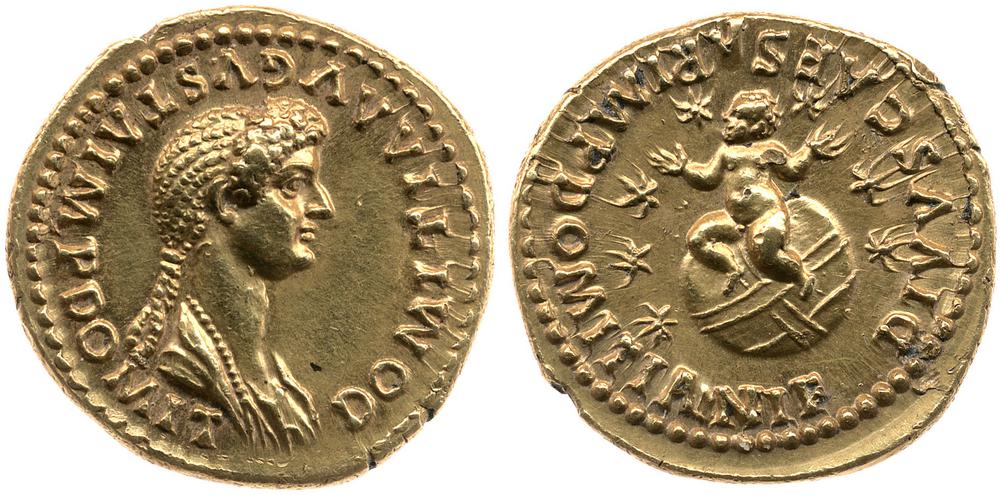
SideInscriptionTranslationMeaning
ObverseDOMITIA AVGVSTA IMP DOMITIANI AVG P P“Domitia Augusta, wife of Emperor Domitian, Father of the Fatherland.”Honors the empress.
ReverseDIVI CAESAR IMP DOMITIANI F“The Divine Caesar, son of Emperor Domitian.”Commemorates their deceased and deified son as a celestial being.

At the same time, John’s Gospel — written in these same years — records the opposite confession:

“Thomas answered and said to Him, ‘My Lord and my God.’” — John 20:28

That exact combination of titles (Lord and God) appears nowhere else in Scripture.
John uses it deliberately, crafting an independent witness to the risen Christ while also confronting the imperial claim of his own day.

What Rome demanded by law, the disciple proclaimed freely to Jesus alone.

Further, Clemens and his wife Domitilla were branded atheists, most likely for being Christians. Very few other people groups were labeled that title, besides Jews and Christians.

Eusebius, Hist. eccl. 3.18.4 (c. 310):

“In Domitian’s time there were many testimonies for Christ, among them Flavia Domitilla, daughter of a sister of Flavius Clemens, one of the consuls of Rome. She was exiled with many others to the island of Pontia because of her testimony to Christ.”

They were the first imperial converts and martyrs we know of. The Domitilla Catacombs in Rome, one of the earliest Christian cemeteries, are traditionally said to have been founded on her estate.


Imperial Worship in the Cities of Revelation

Temples, coins, and inscriptions from Ephesus, Pergamum, Smyrna, and Sardis show how completely the imperial cult surrounded the earliest believers.

Ephesus – Temple of the Flavian Family (c. AD 89–92)

Temple Dedication (IGR IV 1453 = Ephesos Inschriften 302)

“To the Flavian family — the people of Ephesus dedicate [this temple].”

Carved across the marble architrave of the temple at Domitian Square, the inscription identified a sanctuary built for a living ruler.
Fragments of a colossal 23 foot cult statue show the emperor grasping a spear, the symbol of divine authority.
Every citizen walking through the agora looked up at a god in human form.


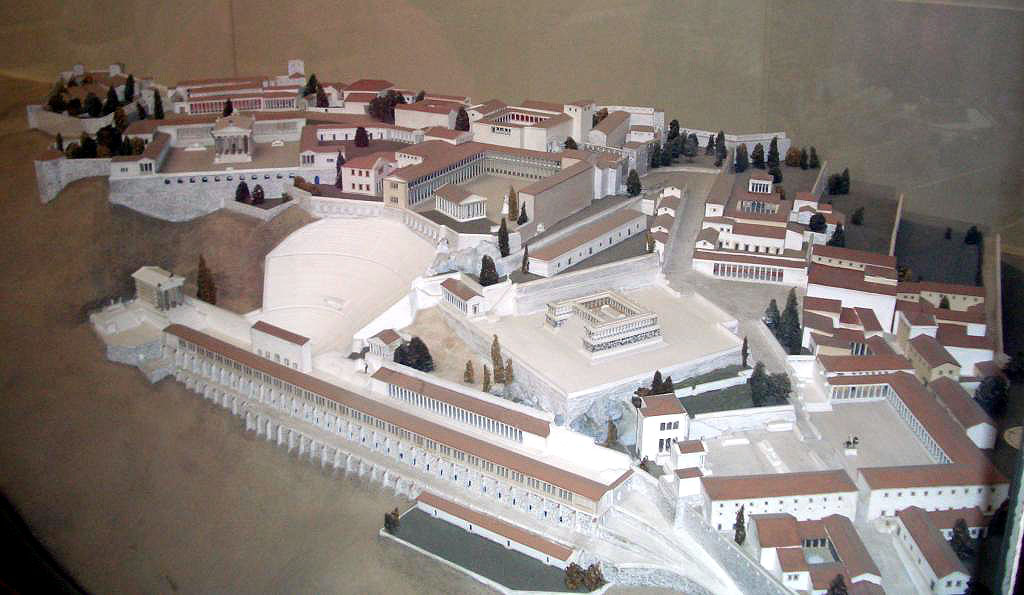
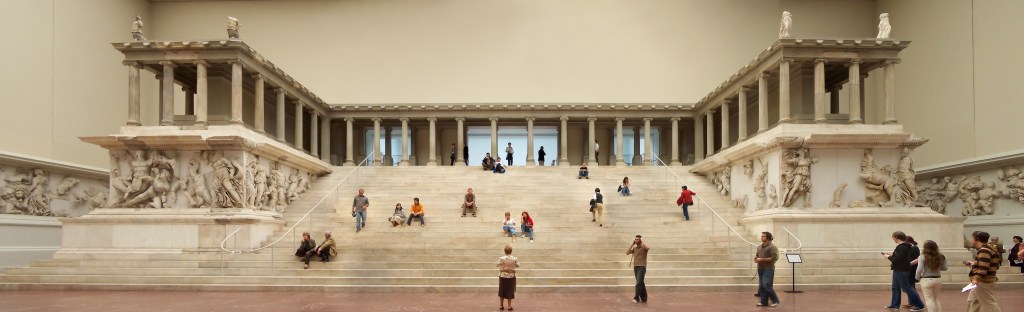
Pergamum – “Where Satan’s Throne Is” (c. AD 90)

Long before Domitian, Pergamum had been the birthplace of imperial worship in Asia.
In 29 BC it won a provincial competition to build the first temple to Rome and Augustus (Tacitus, Annals 4.37), and from then on the city was known as neokoros — guardian of the imperial cult.
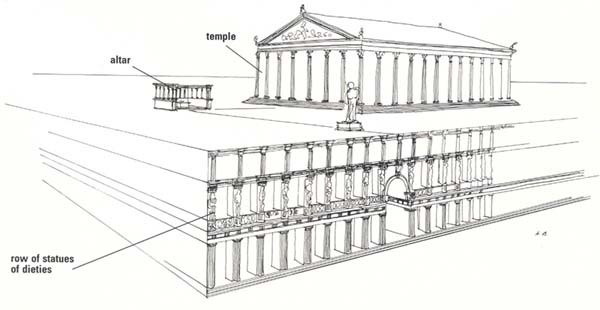
Its acropolis towered above the Caicus Valley, layered with shrines to Athena, Asclepius, Dionysus, and Zeus Soter (“Zeus the Savior”). When the Flavians rose to power, Pergamum naturally added Domitian to its pantheon.

Dedication Inscription (IGR IV 292, c. AD 90)
Marble base found on the upper acropolis, about 50 m from the great altar precinct.

“To the God Domitian Augustus, Conqueror of the Germans.”

The block supported a statue of Domitian in the forecourt of the imperial temple beside the sanctuary of Zeus.

From the lower city the white marble terrace appeared like a colossal seat crowning the hill — a literal throne of stone overlooking the valley.

Provincial Coin Series (RPC II 941–947)

Obverse: “Domitian Caesar Augustus Germanicus.”
Reverse: “The People of Pergamum [to] the August God.”
Design: Domitian radiate — the sun-crowned symbol of divinity.

To citizens, the temple and its gleaming altar celebrated Rome’s salvation; to Christians, it was “Satan’s throne” (Revelation 2:13) — the visible seat of a power demanding the worship that belonged to Christ alone.


Smyrna – Divine Lineage and Public Honors (c. AD 90–95)

Statue Base (IGR IV 1431)

“To the Emperor Caesar Domitian Augustus Germanicus, son of the Divine Vespasian; the Council and People of Smyrna dedicate [this statue], honoring him as Savior and Benefactor.”

Domitian is called both son of the Divine Vespasian and Savior — titles Christians had already learned to reserve for Jesus.


Sardis – “The God, Savior and Benefactor” (c. AD 90–95)

Bilingual Stele (IGR IV 1412, Greek and Latin)

“The Council and People of Sardis dedicate [this to] Domitian Augustus the God, Savior, and Benefactor of the City.”

This inscription was carved on a bilingual marble stele, a rectangular stone slab erected near the Temple of Artemis in Sardis.
Both Greek and Latin texts appear so that local citizens and Roman officials could each read the same dedication — Greek for the provincial population who spoke it daily, Latin for the imperial administrators who governed in Caesar’s name.
The message is identical in both languages: Sardis publicly honored Domitian as God, Savior, and Benefactor.
Such stelae were placed in busy civic spaces and along procession routes where citizens gathered for festivals. They proclaimed the emperor’s divinity in both the religious language of the Greek East (theos sōtēr kai euergetēs) and the political Latin of Rome (Deus Salvator et Benefactor).
It is a literal monument to the union of religion and empire — stone evidence that civic loyalty had become a form of worship.
Every oath, every festival, every public feast reinforced Domitian’s divine status; refusal to take part was treated as disloyalty, even treason.


Economic Pressure and the Mark of the Beast

“No one could buy or sell except the one who had the mark or the name of the beast.” — Revelation 13:17

In John’s day, religion and commerce were one system.
Every trade in Asia belonged to guilds that held banquets in temples, offered sacrifices to the gods, and poured libations to Caesar. Joining meant worship.

Inscriptions from Asia Minor show how this worked:

  • Ephesus: The Silversmiths’ Guild dedicated altars to Artemis and the emperor (Acts 19:23–27).
  • Pergamum: Tanners and dyers sacrificed “for the welfare of the emperor.”
  • Sardis: Merchants funded games “for the safety of Caesar.”
  • Smyrna: Associations built banquet halls “to the August gods.”

One inscription from Ephesus reads:

“To the August gods and to the Genius of the Emperor, the Bakers dedicate this offering.” (CIL III.7089)

Even money was the emperor’s medium. Coins carried his image — often radiate like the sun — and titles such as divus (“divine”) and soter (“savior”).
To buy or sell was to use the emperor’s likeness as a seal of trust.

The word John uses for “mark” — charagma — was the common term for a stamp on a coin or a brand on a slave or soldier. It meant visible ownership or allegiance. In that sense, the “mark of the beast” was the imperial stamp of belonging — the economic and symbolic sign that a person recognized Caesar as lord.

Coins from Domitian’s reign reinforced this imagery: his head encircled with rays, his titles naming him “divine lord and god,” and reverses showing him seated on a globe. These marks of commerce were marks of worship. To refuse them was to lose livelihood and standing. To accept them was to surrender one’s soul.

When Jesus said, “Render to Caesar the things that are Caesar’s, and to God the things that are God’s,” He spoke in a world where tax and worship were separate. By Domitian’s time they were not. In Judea, paying tax acknowledged Roman rule; in Asia, buying and selling itself acknowledged Caesar’s divinity.
What had once been a political payment had become a religious act.
The question was no longer “Should we pay taxes to Caesar?” but “Must we worship Caesar to live?”


The Number of the Beast and the Nero Legend

Revelation 13 ends with one of the most famous verses in the Bible:

“This calls for wisdom: let the one who has understanding calculate the number of the beast, for it is the number of a man, and his number is 666.”
— Revelation 13:18

This is gematria—a system where letters represent numbers. When “Nero Caesar” is written in Hebrew letters (נרון קסר, Neron Qesar), the total is 666. Some manuscripts of Revelation even read 616, which fits the Latin spelling “Nero Caesar” without the final n.

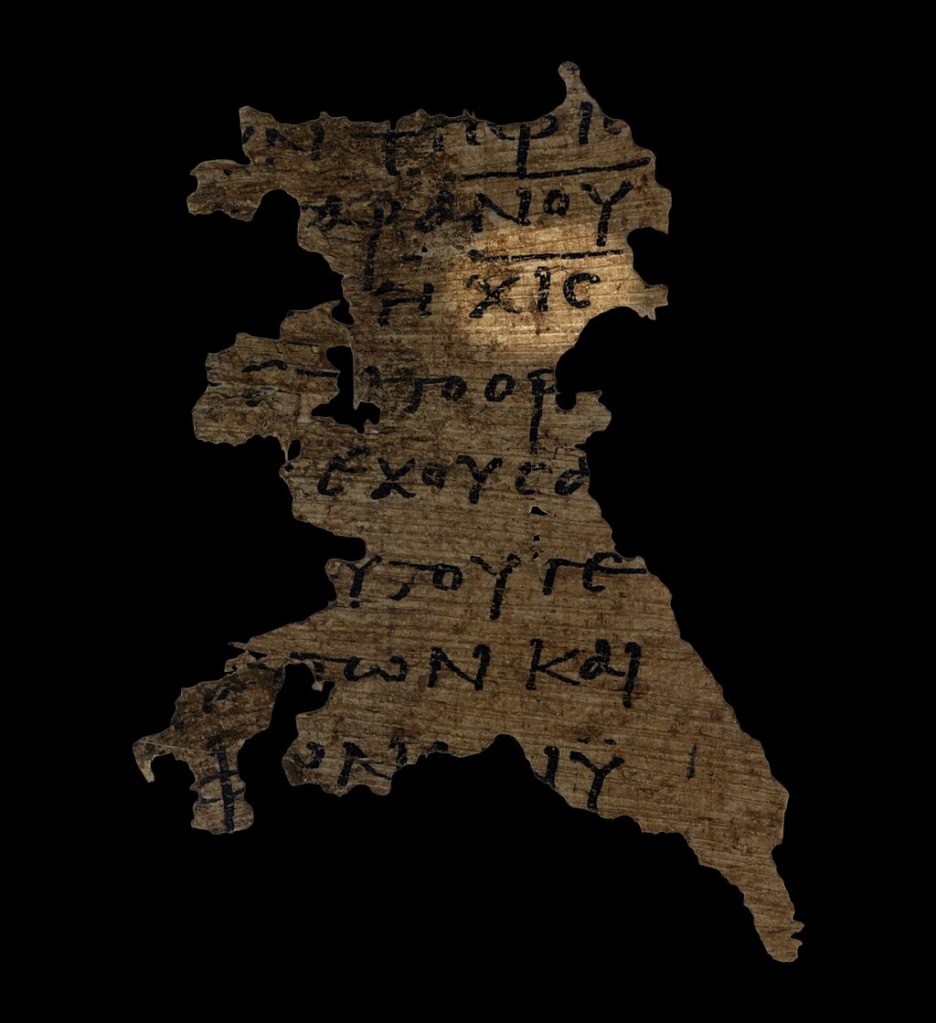
p115 is our oldest manuscript of Rev. 13:18 and has the number as 616.

This shows the beast first pointed to Nero, remembered as the emperor who initiated state persecution of Christians. But why would John use Nero’s name when writing 25–30 years later under Domitian?

Because Romans themselves believed Nero was not really gone.


Dio Chrysostom: “Even Now Everybody Wishes He Were Still Alive”

Dio Chrysostom (writing during the reign of Domitian, c. AD 88–96) gives us the earliest surviving testimony that people still believed Nero was alive:

“For so far as the rest of his subjects were concerned, there was nothing to prevent his continuing to be Emperor for all time, seeing that even now everybody wishes he were still alive, and the great majority do believe that he is, although in a certain sense he has died not once but often along with those who had been firmly convinced that he was still alive.
Dio Chrysostom, Discourses 21.10, On Beauty (c. AD 88–96)

This statement, written less than thirty years after Nero’s death, proves that belief in Nero’s survival was already widespread by Domitian’s day. Dio’s tone suggests that many in the empire—perhaps nostalgically—still longed for Nero’s return.


Tacitus: The First False Nero (AD 69)

Tacitus (writing c. AD 105) records that, scarcely a year after Nero’s death, an impostor appeared in Greece:

“About this time, a man of mean origin appeared, who gave out that he was Nero. By his voice and features he deceived many, and by his appearance revived the delusion which still lingered among the people that Nero was alive. He was, however, soon detected and put to death by order of the governor.”
Tacitus, Histories 2.8 (c. AD 105)

Tacitus shows how quickly the legend took shape. The impostor’s resemblance and musical skill persuaded soldiers and civilians alike that Nero lived on.


Suetonius: The Rumor of Nero’s Return

Suetonius (writing c. AD 121) confirms that belief in Nero’s return persisted for decades and even caused near-war between Rome and Parthia:

“Even after his death there were many who for a long time decorated his tomb with spring and summer flowers, and now again there were others who put up his statues on the Rostra in the toga praetexta and issued edicts in his name as if he were alive. Twenty years later another pretender appeared, supported by the Parthians, and nearly brought on war between them and us before he was handed over.
Suetonius, Life of Nero 57 (c. AD 121)

For Suetonius, the legend was no harmless rumor. It stirred real movements, edicts, and political tension—evidence of how deeply the idea of Nero’s return had entered Roman imagination.


Cassius Dio: Terentius Maximus and the Parthian Refuge

Cassius Dio (writing early 3rd century AD) recounts another impostor—this one named Terentius Maximus—who gained the backing of Rome’s eastern rival:

“In the reign of Titus there arose another man who claimed to be Nero; his name was Terentius Maximus. He resembled Nero in face and voice, and, like him, sang to the lyre. By these means he drew many after him, and, when pursued, fled to the Parthians. There he was treated with great honour, but later he was detected and put to death.”
Cassius Dio, Roman History 66.19.3 (written c. AD 210)

Dio also remarks more generally that “many pretended to be Nero, and this caused great disturbances.” The episode demonstrates how enduring and politically volatile the Nero Redivivus expectation had become.


Domitian as a “New Nero”

Finally, Dio draws a direct moral parallel between Nero and Domitian himself:

“He was a man of Nero’s type, cruel and lustful, but he concealed these vices at the beginning of his reign; later, however, he showed himself the equal of Nero in cruelty.
Cassius Dio, Roman History 67.1–2 (written c. AD 210)

By Dio’s time, Nero had become the enduring archetype of a tyrant—one whose spirit seemed to live again in later emperors, and whose rumored return continued to haunt the Roman world.


The “Synagogue of Satan” and Jewish Tax Pressure

John’s letters to the churches in Smyrna and Philadelphia (Revelation 2–3) reveal that persecution in Asia Minor came not only from Roman authorities but also from certain local Jewish communities that publicly opposed the followers of Jesus.

Revelation 2:9
“I know your tribulation and your poverty (but you are rich) and the slander of those who say they are Jews and are not, but are a synagogue of Satan. Do not fear what you are about to suffer. Behold, the devil is about to throw some of you into prison, that you may be tested, and for ten days you will have tribulation. Be faithful unto death, and I will give you the crown of life.”

Revelation 3:9
“Behold, I will make those of the synagogue of Satan who say that they are Jews and are not, but lie—behold, I will make them come and bow down before your feet, and they will learn that I have loved you.”

In both cases, John’s audience lived under Domitian’s enforcement of the Jewish tax (fiscus Judaicus).
Jewish leaders throughout the empire were required to clarify who qualified as Jewish and owed the tax.
Believers in Jesus—claiming Jewish heritage but refusing to pay—were denounced as impostors and stripped of their legal protection as part of a religio licita (a permitted religion).
Such denunciations easily became “slander” (blasphēmia), leading to arrests, confiscation of property, and martyrdom.

John’s phrase “synagogue of Satan” does not condemn Judaism as a whole.
It identifies a local assembly of accusers—people whose actions aligned with Rome’s efforts to suppress the Church.
In Revelation’s theology, Satan is “the accuser of our brothers” (Rev 12:10).
Thus, anyone who brought legal accusations against Christians became, in John’s language, part of “the synagogue of the accuser.”
Persecution was both earthly and spiritual—a human partnership in the devil’s cosmic war against Christ’s people.

This reality soon reappeared in history.
About sixty years later, John’s prophecy was fulfilled in Smyrna during the martyrdom of Polycarp, the city’s aged bishop and a disciple of the Apostle John.

The Martyrdom of Polycarp 13.1:

“The Jews, as was their custom, were the most eager in bringing wood for the fire.”

The same city where John wrote of “the synagogue of Satan” became the stage for its fulfillment: a righteous man condemned by Roman officials and cheered to his death by his own countrymen.
Yet the words of Revelation endured:

“Be faithful unto death, and I will give you the crown of life.”

Polycarp’s martyrdom stands as living proof that John’s vision described real events, not abstract prophecy.
In Smyrna, the Church triumphed through endurance—refusing fear, sharing in Christ’s suffering, and gaining the crown promised by the risen Lord.


Nerva’s Reforms and the Return of Freedom

Cassius Dio 68.1–2:

“Nerva also released those who had been convicted of impiety under Domitian and forbade any further accusations of that kind. He restored to the exiles their property, recalled those who had been banished, and burned publicly the secret reports of informers.”

Suetonius, Life of Nerva 3.1–2:

“He swore that no one should ever be punished for impiety or insult to the emperor. He forbade the bringing of charges under the laws of treason and recalled all who had been condemned for such offenses.”

Pliny, Panegyricus 58–59 (AD 100):

“This oath first Nerva took, and by it he restored freedom to the Senate.”

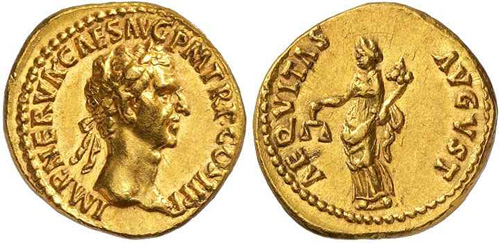
Nerva’s coins proclaimed the same spirit of clemency:

  • FISCI IVDAICI CALVMNIA SVBLATA — “The false accusation of the Jewish tax removed.”
  • LIBERTAS PVBLICA — “Public freedom restored.”
  • IVSTITIA AVGVSTI — “The justice of the emperor.”
SideInscriptionTranslationMeaning
ObverseIMP NERVA CAES AVG PM TR P COS III PP“Emperor Nerva Caesar Augustus, High Priest, holder of tribunician power, Consul for the third time, Father of the Fatherland.”Honors Nerva’s authority and civic leadership.
ReverseAEQVITAS AVGVST“The Equity of the Emperor.”Symbol of fair governance and economic stability under Nerva.

These reversals ended Domitian’s oppressive tax policies that had ensnared Jews and Jewish Christians alike.

Eusebius, Hist. eccl. 3.20.9:

“After the tyrant’s death, John returned from his exile and took up residence again in Ephesus.”

For the first time in decades the Church could breathe. John returned from Patmos, and in that calm the final apostolic writings were completed and the Church clarified its faith against new distortions.


John’s Writings and Their Historical Context

WorkApprox. DatePlaceAncient SourcesSettingPurpose
Gospel of John85–95EphesusIrenaeus 3.1.1 (c. 180)Before exile under DomitianProclaims Jesus as eternal Logos against Greek dualism and emperor worship
1 John90–95EphesusInternal evidencePre-exile warning against DocetismAffirms that Christ came “in the flesh.”
2 & 3 John90–95EphesusEarly traditionLetters to Asia churchesWarns against deceivers.
Revelation95–96PatmosIrenaeus 5.30.3; Eusebius 3.18Exile under DomitianCalls for endurance under imperial idolatry.
Return to Ephesus96EphesusEusebius 3.20.9Released by NervaResumed leadership of Asia churches.
Death of John98–102EphesusIrenaeus 2.22.5; Polycrates in Eusebius 3.31.3Reign of TrajanLast apostle dies in peace.

Why John Had to Write — From Judea to the Greek World

ContextRegionKey FiguresCentral IssueJohn’s Response
Early Jewish-Christian Era (30–70 AD)JudeaNazarenes (orthodox); Ebionites (heretical)Could a Jewish man be divine? Ebionites denied Christ’s pre-existence and rejected Paul.“In the beginning was the Word … and the Word was God.” (1:1)
Greek World (80–100 AD)Asia Minor / EphesusCerinthus and early DocetistsCould the divine truly become flesh and suffer?“The Word became flesh and dwelt among us.” (1:14)

In Judea the debate was whether Jesus could be divine; in Ephesus it was whether He could be truly human. John’s Gospel and letters address both—the eternal God who became man and suffered in the flesh.


The First Christians and the New Distortions

The first denomination within Christianity were the Nazarenes, Jewish Christians who kept the Law yet worshiped Jesus as the divine Son of God. They were essentially the losing party of the Acts 15 church council.

Epiphanius, Panarion 29.7.2–4 (c. 375):

“They use both the Old and New Testaments … They acknowledge that Jesus is the Son of God and that He suffered for the salvation of the world.”

Jerome, Commentary on Isaiah 9.1 (c. 400):

“The Nazarenes accept the Messiah … as the Son of God and say that He was born of the Virgin Mary.”

By contrast, the Ebionites denied Christ’s divinity, rejected Paul, and altered Matthew to remove the virgin birth.


Cerinthus and the First Docetists

Epiphanius, Panarion 28.1–2 (c. 375):

“Cerinthus, trained in the wisdom of the Egyptians, came to Asia and taught that the world was not made by the supreme God but by a certain Power very far removed from Him.”

Hippolytus, Refutation of All Heresies 7.33 (c. 225):

“He was educated in the knowledge of the Egyptians and imbibed their teaching, but he boasted that an angel had appeared to him and revealed these things.”

Irenaeus, Against Heresies 1.26.1 (c. 180):

“He represented Jesus as not born of a virgin, but as the son of Joseph and Mary … The Christ descended upon Him at His baptism and afterward left Him before the Passion.”

Eusebius, Hist. eccl. 3.28.2 (c. 310):

“Cerinthus, by means of revelations which he pretended were written by a great apostle, brought before us fables of his own invention, stating that after the resurrection the kingdom of Christ would be on earth … Being a lover of the body and altogether carnal, he dreamed that the kingdom of Christ would consist of eating and drinking and marrying.”

Caius of Rome (c. 200) and Dionysius of Alexandria (3rd cent.) reported that some believed Cerinthus had written or re-used Revelation to teach a sensual earthly kingdom.
Cerinthus’s teaching (AD 80–100) asserted a lower creator god, a temporary Christ-spirit, and a carnal millennium of pleasure. John’s Gospel answers each point.

Cerinthus’s ClaimJohn’s Counter-Statement
A lesser power made the world.“All things were made through Him.” (1:3)
Jesus was only a man.“The Word became flesh.” (1:14)
The Christ-spirit left before the cross.“When Jesus knew that all was now finished, He said, ‘It is finished.’” (19:30)
The divine cannot touch matter.“He showed them His hands and His side.” (20:20)
The kingdom is earthly pleasure.“My kingdom is not of this world.” (18:36)

The Emerging Docetic Worldview — Primary Sources from the Nag Hammadi Texts

By the end of the first century dualistic ideas spread through Egypt and Syria. The Nag Hammadi Library (copied 4th cent., written 80–150 AD) preserves the teachings John was opposing.

Apocryphon of John (c. 100–120, Egypt/Syria):

“The ruler said, ‘I am God and there is no other beside me,’ for he did not know the source from which he had come. … And the archons created the seven heavens and their angels and made a mold of a man.” (11.18–12.10)

A lesser god creates and rules the world—what John denies when he writes, “All things were made through Him.” (1:3)

Gospel of Thomas (c. 100–120, Syria):

“These are the secret sayings that the living Jesus spoke.… Whoever discovers the interpretation of these sayings will not taste death.” (1)
“The kingdom is inside of you and outside of you.… When you come to know yourselves, then you will be known.” (3)
“When you make the two one … and make the male and the female one and the same, then you will enter the kingdom.” (22)

Thomas borrows many sayings from Matthew, Mark, and Luke but omits the cross and resurrection. Salvation comes through self-knowledge and escaping the material world. John answers: “The Word became flesh and dwelt among us.” (1:14)

Gospel of Truth (c. 120–140, Alexandria/Rome):

“The Word of the Father came into the midst of those who were oblivious, death having taken them captive.… He was nailed to a tree, and He became a fruit of the knowledge of the Father. But He did not suffer as they thought, for His suffering was only in appearance.” (22–23)

Here Christ’s crucifixion is only symbolic, a parable of knowledge. John responds as an eyewitness: “Blood and water came out … He who saw it has borne witness.” (19:34–35)

Second Treatise of the Great Seth (c. 120–160, Egypt):

“It was another, their father, who drank the gall and the vinegar; it was not I.… It was another, Simon, who bore the cross on his shoulder.… For my death, which they think happened, happened to them in their error and blindness.” (55.15–30)

Here Christ denies His own crucifixion and substitutes another in His place—a direct denial of the incarnation and atonement. John writes: “When He had received the sour wine, He said, ‘It is finished.’” (19:30)

Gospel of Judas (c. 130–160, Egypt):

“Often He did not appear to His disciples as Himself, but He was found among them as a child.” (33.10–11)
“Come, that I may teach you about the mysteries no person has ever seen.… From the cloud there appeared an angel … His name was Nebro, which means ‘rebel’; others call him Yaldabaoth.… Nebro created six angels as his assistants.” (47.1–9; 51.1–8)
“And Saklas said to his angels, ‘Let us create a human being after the likeness and the image.’” (52.10–11)
“You will exceed all of them, for you will sacrifice the man that clothes me.” (56.18–20)

In this text Jesus is a shapeshifter whose body is illusory; lower angels rule creation and imitate Genesis by creating humanity; Judas becomes the hero who frees Jesus from His body. John answers: “All things were made through Him … The Word became flesh.” (1:3, 14)

The Church’s Early Defense and the Apostolic View of Christ — The God-Man in the Generation After John

Within a decade of John’s death, the next generation of Christian leaders—men who had known the apostles or their immediate disciples—carried forward the same confession:
Jesus Christ is both fully God and fully man—our Lord and our God.
Their writings show that this was not a later development but the defining belief of the Church from the beginning.


Ignatius of Antioch

(c. AD 110, on his way to martyrdom under Trajan)

Facing execution in Rome, Ignatius wrote seven letters to the churches of Asia, echoing John’s theology and refuting those who denied the incarnation.

Ignatius, Smyrnaeans 2.1:

“He truly suffered, not as certain unbelievers say, that He suffered in appearance only. They themselves exist only in appearance.”

Ignatius, Trallians 10.1:

“Be deaf whenever anyone speaks apart from Jesus Christ, who was of the race of David, who was truly born, and who was truly crucified.”

Ignatius’s faith is emphatically Johannine—insisting that the Word truly became flesh, was truly born, and truly crucified.
To him, salvation depends on the reality of the incarnation, not a symbolic or apparent suffering.

He also confesses the unity of God and Man in Christ with stunning clarity:

Ignatius, Ephesians 7.2:

“There is one Physician, fleshly and spiritual, born and unborn, God in man, true Life in death, both from Mary and from God, first passible and then impassible—Jesus Christ our Lord.”

Ignatius’s phrase “God in man” perfectly captures the apostolic view: the eternal, impassible God entering history through the passible flesh of Jesus.
This was the Church’s defense against both Greek Docetism and Jewish unbelief.


Polycarp of Smyrna

(c. AD 110–115)

Polycarp, To the Philippians 12:

“Now may the God and Father of our Lord Jesus Christ, and the eternal High Priest Himself, the Son of God, Jesus Christ, build you up in faith and truth … to all who shall believe on our Lord and God Jesus Christ and on His Father who raised Him from the dead.”

Polycarp—John’s disciple—echoes Thomas’s confession in John 20:28, directly calling Jesus “our Lord and God.”
He presents Christ as both divine and incarnate: the eternal High Priest who ministers for humanity because He shares humanity, yet who is worshiped as God because He is divine.


Epistle of Barnabas

(c. AD 100–130, Alexandria or Syria)

Barnabas 5.6–9:

“If the Lord endured to suffer for our soul, though He is Lord of the whole earth, to whom God said before the foundation of the world, ‘Let us make man in our image and after our likeness,’ understand how it was that He endured to suffer at the hands of men.… The Son of God came in the flesh that He might abolish death and show forth the resurrection from the dead.”

Barnabas 12.10:

“The Lord submitted Himself to suffer for us, though He is God, and He fulfilled the promises made unto the fathers.”

Barnabas affirms that the Creator Himself—the one who made humanity in His image—entered His own creation to suffer and redeem it.
His words match both Paul’s Christ Hymn (Philippians 2:6–11) and John’s Prologue (John 1:1–14): the same God who made the world became flesh to save it.


Letter to Diognetus

(c. AD 120–150, probably Asia Minor)

Diognetus 7.2–4; 9.2:

“He Himself sent His own Son—as God He sent Him, as to men He sent Him; as Savior He sent Him, as persuader, not as tyrant.… He appeared as God, yet in humility among men.
For what else was able to cover our sins but His righteousness? In whom else could we, lawless and ungodly men, have been made righteous except in the Son of God alone?”

The Letter to Diognetus presents the incarnation as a divine visitation:
God appearing among men, clothed in humility yet possessing full deity.
It summarizes in prose what John had written poetically: “The Word became flesh and dwelt among us.”


Unified Testimony

SourceDateConfession of Christ
Ignatius – Ephesians 7; Smyrnaeans 2105–110“One Physician, fleshly and spiritual… God in man.” / “He truly suffered, not in appearance only.”
Polycarp – Philippians 12110–115“Our Lord and God Jesus Christ.”
Barnabas 5 & 12100–130“The Son of God came in the flesh… though He is God.”
Letter to Diognetus 7 & 9120–150“He appeared as God, yet in humility among men.”

These writings span the first half of the second century—from Antioch to Smyrna, from Alexandria to Asia Minor—and they all speak with one voice.
The earliest post-apostolic Church proclaimed not a developing theology but the same truth John had written on Patmos and in Ephesus:

The Creator Himself became flesh to redeem His creation.
The Word who was with God and was God truly lived, truly suffered, and truly rose as the God-Man Jesus Christ.


Trajan to Pliny: An Old Law, Not a New One

When Trajan became emperor in AD 98, the Church had already suffered under three emperors.
No new law was introduced; Nero’s precedent of AD 64 still governed imperial practice:
to be called a Christian was itself a crime.

Under Nero, believers had been executed “for the name.” (Tacitus, Annals 15.44)
Under Domitian, prosecutions resurfaced under charges of “impiety.”
Under Nerva, there was brief relief.
Under Trajan, the old principle remained.

What changes here is not policy but evidence: for the first time, we possess imperial correspondence showing how the precedent worked in practice.


Pliny’s Letter to Trajan (AD 111–113)

Author: Gaius Plinius Caecilius Secundus (Pliny the Younger), governor of Bithynia-Pontus.
Source: Letters 10.96 (Loeb translation).
Setting: Pliny had newly arrived in the province and discovered that Christian trials were already taking place.
He had never presided over one and sought clarification from the emperor.


Pliny’s Letter (Full Text)

“It is my rule, Sir, to refer to you all matters concerning which I am in doubt.
For who is better able either to direct my hesitation or to instruct my ignorance?
I have never been present at any trials of Christians; therefore I do not know what is the customary subject-matter of investigations and punishments, or how far it is usual to go.
Whether pardon is to be granted on repentance, or if a man has once been a Christian it does him no good to have ceased to be one;
whether the mere name, apart from atrocious crimes associated with it, or only the crimes which adhere to the name, is to be punished—all this I am in great doubt about.

“In the meantime, the course that I have adopted with respect to those who have been brought before me as Christians is as follows:
I asked them whether they were Christians.
If they admitted it, I repeated the question a second and a third time, with a warning of the punishment awaiting them.
If they persisted, I ordered them to be led away for execution; for I could not doubt that, whatever it was that they admitted, that stubbornness and unbending obstinacy ought to be punished.
There were others similarly afflicted; but, as they were Roman citizens, I decided to send them to Rome.

“In the case of those who denied that they were or had been Christians, when they invoked the gods in the words I dictated and offered prayer with incense and wine to your image—which I had ordered to be brought for this purpose together with statues of the gods—and furthermore cursed Christ (none of which things, it is said, those who are really Christians can be forced to do), I thought they ought to be discharged.
Others, who were named by an informer, first said that they were Christians and then denied it; true, they had been of that persuasion, but they had left it, some three years ago, some more, and a few as much as twenty years.
All these also worshiped your image and the statues of the gods, and cursed Christ.

“They maintained, however, that the sum and substance of their fault or error had been that on a fixed day they were accustomed to meet before daylight and to recite by turns a form of words to Christ as to a god,
and that they bound themselves by an oath—not for any crime, but not to commit theft, robbery, or adultery, not to break their word, and not to refuse to return a deposit when called upon to restore it.
After this it was their custom to separate, and then meet again to partake of food—but ordinary and harmless food.
Even this they said they had ceased to do after the publication of my edict, by which, in accordance with your instructions, I had forbidden associations.

“I thought it the more necessary, therefore, to find out what was true from two female slaves, whom they call deaconesses, by means of torture.
I discovered nothing else but depraved, excessive superstition.
Therefore I postponed the investigation and hastened to consult you.
The matter seems to me to justify consultation, especially on account of the number of those in danger;
for many of every age, every rank, and also of both sexes are already and will be brought into danger.
For the contagion of this superstition has spread not only through cities, but also through villages and the countryside;
and yet it seems possible to check and cure it.
It is certain at least that the temples, which had been almost deserted, have begun to be frequented again, and the sacred rites, long suspended, are again being performed, and there is a general demand for the flesh of sacrificial victims, for up till now very few purchasers could be found.
From this it may easily be supposed what a multitude of people can be reclaimed, if only room is granted for repentance.”


Key Insights from Pliny’s Letter

1. Trials Were Already Ongoing
Pliny says, “I have never been present at any trials of Christians,” revealing that such trials preceded him. He is not initiating persecution but ensuring he follows existing imperial practice.

2. The “Forbidden Associations”
Pliny’s comment that he forbade Christian gatherings follows Trajan’s earlier ban on all private associations (collegia).
In a nearby letter (Letters 10.33–34a), Pliny had asked to form a fire brigade in Nicomedia, but Trajan refused, warning that “whatever name we give them, and for whatever purpose they are formed, they will not fail to degenerate into political clubs.”
Because of this standing order, Christian meetings were automatically illegal as unauthorized associations.
Thus, their assemblies were viewed as civic threats, not religious services.

3. “Stubbornness and Unbending Obstinacy” (pertinacia)
Romans considered blind persistence a moral failing—an assault on civic order.
Writers like Cicero and Seneca called pertinacia (stubborn defiance) a kind of madness, the opposite of the Roman virtue of moderation (moderatio).
To confess Christ three times in defiance of a magistrate’s warning was seen as treasonous pride, not conscience.
Hence Pliny’s statement that such obstinacy “ought to be punished” reflects Rome’s moral worldview, where social harmony outweighed individual conviction.

4. The Reputation of True Christians
Pliny records that those who truly belonged to the movement “can never be forced to curse Christ.”
This is an extraordinary pagan admission: even Rome’s officials recognized that real Christians were unfailingly loyal to Christ.
It became, unintentionally, a mark of authenticity: apostates could perform sacrifices, but the faithful could not.
Martyrdom, therefore, was not fanaticism—it was simply consistency with known Christian behavior.

5. Worship of Christ “as to a God”
Pliny confirms that believers “sang a hymn to Christ as to a god.”
This line—written by a pagan witness scarcely 80 years after the crucifixion—proves that the earliest Church universally worshiped Jesus as divine.
It is an unintentional historical echo of Thomas’s words in John 20:28: “My Lord and my God.”

6. Pliny’s Attitude
Pliny is no sadist; he sees Christianity as a “superstition”—a misguided enthusiasm that disrupts civic order.
His tone combines administrative irritation and genuine bewilderment: how could such moral people be so disloyal to the gods?
It is the first documented Roman attempt to rationalize persecution as social hygiene.

7. The Scope of the Faith
Pliny’s line that “the contagion has spread through cities, villages, and the countryside” reveals how pervasive Christianity had become by AD 110.
Even pagan temples, he notes, were deserted because of it.


Trajan’s Reply (Full Text, AD 112)

Source: Letters 10.97 (Loeb Translation)

“You have followed the right course, my dear Secundus, in examining the cases of those who had been denounced to you as Christians;
for it is impossible to lay down any general rule which will apply as a fixed standard.
They are not to be sought out; if they are brought before you and convicted, they must be punished.
With this proviso, however—that if anyone denies that he is a Christian and proves it by worshiping our gods, he is to obtain pardon through repentance, even if he has incurred suspicion in the past.

“As for anonymous accusations, they must not be admitted in any proceedings.
For that would establish a very bad precedent and is not in keeping with the spirit of our age.”


Key Insights from Trajan’s Reply

1. Not a New Law—A Confirmation of Nero’s Precedent
Trajan introduces no new principle. The “right course” Pliny had followed simply enforces the Neronian standard: the name “Christian” is punishable by death.

2. Reactive, Not Proactive Persecution
“They are not to be sought out” sounds lenient but only limits administrative workload.
If accused and proven guilty, Christians were still executed. The persecution was reactive, not abolished.

3. Recantation as Proof of Loyalty
Trajan’s test—offering incense to the gods—measured civic allegiance, not personal belief.
Recantation showed loyalty to Rome; refusal proved treasonous defiance.

4. Imperial “Fairness”
By forbidding anonymous accusations, Trajan presents himself as a just ruler.
Yet the core remains: death for those who confess Christ.

5. Continuity of Hostility
This exchange did not create a new policy.
It merely documents the ongoing enforcement of Nero’s logic—that Christianity was incompatible with Roman religious identity.


Theological Implications — The Empire Meets the God-Man

To the empire, the issue was not theology but loyalty.
To the Church, it was not loyalty but lordship.
The Christians’ refusal to curse Christ or offer incense to Caesar was their confession that the incarnate God alone deserved worship.

Rome saw stubbornness; the Church saw faith.
Rome saw defiance; the Church saw fidelity.
In worshiping the Word made flesh, believers declared that no emperor could demand what belonged to God alone.

“They sang a hymn to Christ as to a god.” — Pliny, Letters 10.96

That one pagan line records the Church’s heart: the same Christ whom John called “Lord and God” was still being worshiped as such, even when worship meant death.


The Church’s Call to Perseverance

The same correspondence that shows Rome’s suspicion of Christians also introduces a chorus of Christian writings calling believers to endurance under trial.
These texts come from every corner of the empire—Rome, Antioch, Smyrna, and Asia Minor—and together they reveal how the early Church met persecution not with revolt, but with perseverance, humility, and hope.


Clement of Rome (AD 95–96, writing from Rome)

1 Clement 5.2–6.1:

“Because of jealousy and strife Paul pointed out the prize of endurance; after he had been seven times in chains, had been driven into exile, had been stoned, had preached both in the East and in the West, he gained the noble renown of his faith.
Having taught righteousness unto the whole world and having reached the furthest bounds of the West, he bore witness before rulers and so departed from the world, leaving behind him an example of endurance.
To these men who lived godly lives was gathered a vast multitude of the elect who, through many indignities and tortures, furnished a brave example among us.”

Clement, writing from the church at Rome to Corinth, recalls Paul’s and Peter’s martyrdoms under Nero and commends their “example of endurance.”
Already, suffering for Christ had become a mark of faithfulness across the empire.


Ignatius of Antioch (AD 110, on his way to execution in Rome)

Ignatius, Romans 4.1–2:

“I am writing to all the Churches and I enjoin all men that I am dying willingly for God’s sake, unless you hinder me.
I beseech you, do not show an unseasonable goodwill towards me.
Suffer me to become food for the wild beasts, through whom it is granted me to attain unto God.
I am God’s wheat, and I am ground by the teeth of wild beasts, that I may be found pure bread of Christ.”

Ignatius, Ephesians 3.1:

“Nothing is hidden from you if you are perfect in your faith and love towards Jesus Christ, for these are the beginning and end of life—faith the beginning, love the end.
The two, in unity, are God Himself, and all things follow upon them.
No man who professes faith sins, and no man who has love hates.
The tree is made manifest by its fruit; so those who profess to belong to Christ shall be known by their actions.”

Ignatius’s letters radiate the same joyful endurance that Pliny had called “obstinacy.”
For him, dying for Christ was not madness but communion with the incarnate God.


Polycarp of Smyrna (AD 155, preserving a first-century memory)

The Martyrdom of Polycarp 8.1–2; 9.3:

“The whole multitude marveled at the nobility and godly fear of Polycarp.
… When he was brought before the proconsul, he was asked to curse Christ and he said, ‘Eighty and six years have I served Him, and He has done me no wrong.
How then can I blaspheme my King who saved me?’
When he had confessed boldly that he was a Christian, the proconsul threatened to burn him with fire.
But he said, ‘You threaten me with a fire that burns for a time and is soon quenched; for you are ignorant of the fire of the coming judgment and of eternal punishment reserved for the ungodly.
But why do you delay? Bring what you will.’”

Polycarp’s calm defiance encapsulates the Church’s understanding of persecution as participation in Christ’s own victory.


The Letter to the Philippians from Polycarp (AD 110–115)

Polycarp 8.2–3:

“Let us then continually persevere in our hope and the earnest of our righteousness, which is Jesus Christ, ‘who bore our sins in His own body on the tree,’
who did no sin, neither was deceit found in His mouth.
Let us therefore become imitators of His endurance, and if we suffer for His name’s sake, let us glorify Him.”

Here, Polycarp explicitly ties Christian endurance to imitation of the crucified God-Man: Christ’s suffering becomes the pattern for His people.


The Epistle of Barnabas (AD 100–130)

Barnabas 7.11:

“He Himself willed to suffer, for it was necessary for Him to suffer on the tree.
For by His suffering He was to redeem us who live under the shadow of death.”

Barnabas emphasizes that Christ’s own endurance sanctified human suffering, turning persecution into fellowship with the Redeemer.


Letter to Diognetus (AD 120–150, Asia Minor)

Diognetus 5.1–5:

“Christians are not distinguished from other men by country or language or customs.…
They dwell in their own countries, but only as sojourners; they share all things as citizens, and suffer all things as foreigners.
Every foreign land is their fatherland, and every fatherland a foreign land.…
They love all men, and are persecuted by all.”

This anonymous writer offers perhaps the most poetic portrait of the persecuted Church—citizens of heaven living under every empire, suffering yet loving, conquered yet unconquerable.


6. The Theology of Endurance — The God-Man as Example

From Clement’s Rome to Ignatius’s Antioch, from Polycarp’s Smyrna to the unknown author of Diognetus, all the earliest Christian writers share one conviction:
the pattern of endurance was set by the incarnate Christ Himself.

AuthorRegionApprox. DateFocus
Clement of RomeRome95–96Martyrs as examples of endurance.
Ignatius of AntiochSyria / Asia110Martyrdom as imitation of “my God.”
Polycarp of SmyrnaAsia Minor110–155Perseverance as faith in the saving King.
BarnabasAlexandria / Syria100–130Christ’s suffering sanctifies human endurance.
Letter to DiognetusAsia Minor120–150Christians as patient citizens of heaven amid persecution.

All of them write under the shadow of Roman hostility.
All of them root endurance not in moral heroism but in the incarnation itself—the belief that the eternal Word took on flesh and endured the cross.
Because Christ suffered truly, His people could suffer faithfully.


7. Closing Reflection

Pliny saw “obstinacy.”
Trajan saw “superstition.”
But the Church saw faithfulness to the God who had become man and suffered for them.

From Nero’s fire to Trajan’s law, the Christians’ hymn remained the same:

“They were accustomed to meet before dawn and to sing a hymn to Christ as to a God.”

And that is the faith Rome could never silence.

Multiplying by Mission: Session 2 at Mission Lake

40% Growth Then, 5% Growth Now — What We Must Learn Anew

1. Review from Session 1

Last week we saw that even atheist and skeptical scholars agree on seven undisputed letters of Paul. These are the earliest Christian writings we possess, and they form the backbone of our historical knowledge of the first generation of the church. But that raises a crucial question: Can we be confident that the words we read in these letters today are the same words Paul actually wrote? Before we move forward in the Roman timeline, we need to look closely at how these letters were preserved.

2. Comparing Paul to Other Ancient Authors

When we compare the manuscript tradition of Paul’s letters with other works from antiquity, the results are striking:

AuthorWorkDate WrittenEarliest CopyTime Gap
JosephusJewish War75–79 AD9th century~800 years
TacitusAnnals~100 AD~850 AD~750 years
Pliny the YoungerLetters~100–112 AD~850 AD~750 years
SuetoniusLives of the Caesars~121 AD9th century~700–800 yrs
Paul the Apostle7 Undisputed Letters48–64 AD~175–200 AD (P46)~125–150 yrs

Historians accept Josephus, Tacitus, Pliny, and Suetonius without hesitation, despite enormous gaps between the originals and our earliest copies. Yet Paul’s letters — with the shortest gap of all — are often treated with suspicion. That double standard says more about modern skepticism than it does about the evidence.

3. What Manuscripts Do We Actually Have?

When we talk about manuscripts here, remember: we are focusing only on the seven undisputed letters of Paul (Romans, 1–2 Corinthians, Galatians, Philippians, 1 Thessalonians, Philemon). If we were counting the entire New Testament, the totals would be much larger.

Approximate counts by language for these seven letters:

  • Greek: ~900 manuscripts.
  • Latin: 3,000–4,000+ manuscripts.
  • Coptic: 200–300 manuscripts.
  • Syriac: 200–300 manuscripts.
  • Other languages (Armenian, Gothic, Ethiopic, etc.): ~500 combined.
    (By comparison, the entire New Testament is supported by over 5,800 Greek manuscripts, 10,000+ Latin, and another 10,000+ in other languages. But here our lens stays on the seven letters.)

Bart Ehrman, an agnostic scholar, concedes:

“We have more manuscripts of the New Testament than any other book from antiquity—many thousands. And many of these manuscripts date from quite early times.” (Misquoting Jesus, 2005, p. 88)

The Earliest Manuscript: P46

Papyrus 46 (P46), dated AD 175–225, is one of the earliest and most important witnesses to the seven undisputed letters. Originally 104 leaves; 86 survive.

Contents include:

  • Romans 5:17–16:27 (Romans 1–5:16 missing)
  • 1 Corinthians 1:1–15:58 (chapter 16 missing)
  • 2 Corinthians 1:1–9:6 (chapters 9:7–13:13 missing)
  • Galatians: fully preserved
  • Philippians: fully preserved
  • 1 Thessalonians: fully preserved
  • Philemon: likely in the missing final leaves
  • Also present: Hebrews, Ephesians, Colossians, 2 Thessalonians.

This shows that by around AD 200, less than 150 years after Paul’s death, his letters were already being circulated as a collection, copied and bound together.

Manuscripts Between 200 and 325 AD

Other papyri confirm copying before the great codices:

  • P30 (c. 225–250): 1 Thessalonians 4:12–5:18.
  • P65 (c. 200–250): 1 Thessalonians 1:3–2:13.
  • P87 (c. 250–300): Philemon 13–15, 24–25.

These show that Paul’s letters were copied across regions before Constantine.

The Great Codices (after 325 AD)

  • Codex Vaticanus (c. 325–350): Preserves nearly the whole NT. Missing are 1–2 Timothy, Titus, Philemon, part of Hebrews, Revelation. Most likely due to physical loss.
  • Codex Sinaiticus (c. 330–360): Contains all 7 undisputed letters.

Though copied in different regions, they strongly agree with earlier papyri like P46.

Earliest Translations

  • Old Latin: The Freisinger Fragment (VL 64, late 2nd or early 3rd c.) preserves Romans 15:3–13.
  • Coptic (Sahidic): Papyrus Bodmer XIX (early 3rd c.) preserves Romans 1:1–2:3; 3:21–4:8; 5:8–13; 6:1–19.
  • Syriac: By the early 4th c., Paul’s letters circulated in Syriac. Aphrahat (c. 280–345) quotes them; the Peshitta included them.

So within 200–300 years of Paul’s life, his letters were available in Greek, Latin, Coptic, and Syriac.

4. What About Textual Variants?

For the seven undisputed letters, scholars count 7,000–8,000 variants. If we included the NT as a whole, the number would be much higher.

Most are trivial.

“Most of the textual changes in our manuscripts are completely insignificant.” (Ehrman, Misquoting Jesus, 2005, p. 208)

Examples of insignificant variants:

  • Romans 12:11 — “Serve the Lord” vs. “Serve the Spirit.”
  • Galatians 1:3 — “God our Father” vs. “God the Father.”

The Five Most Significant Variants in the Undisputed Letters

1. Romans 8:1
Short: “There is therefore now no condemnation for those who are in Christ Jesus.”
Long: “… who walk not according to the flesh but according to the Spirit.”
The longer phrase is almost certainly borrowed from verse 4 — a case of scribal harmonization. Either way, the chapter teaches both truths: freedom from condemnation and Spirit-led living.

2. 1 Thessalonians 2:7
“We were gentle among you” (ēpioi).
“We were like children among you” (nēpioi).
The difference hangs on a single Greek letter (eta vs. nu). Both readings make sense in context: Paul could be stressing either his gentleness or his childlike humility toward the Thessalonians.

3. Galatians 2:12
With the phrase: “… before certain men came from James…”
Without the phrase: “… before certain men came…”
Some manuscripts omit “from James,” likely to soften the perceived conflict between Paul and the Jerusalem leadership. The confrontation with Peter remains central in either reading.

4. 1 Corinthians 14:34–35
“Women should keep silent in the churches. For they are not permitted to speak, but should be in submission, as the Law also says. If there is anything they desire to learn, let them ask their husbands at home. For it is shameful for a woman to speak in church.”

  • In some manuscripts, these verses appear after verse 33.
  • In others, they are moved after verse 40.
  • In several, scribes marked the passage with symbols, signaling doubt about its original location.

This passage also creates tension with 1 Corinthians 11:5, where Paul assumes women are praying and prophesying aloud. Some scholars think the verses were originally a marginal note that later entered the text. Regardless, scribes preserved them — they did not erase what they weren’t sure about.

5. Romans 5:1
“We have peace with God…” (echomen, indicative).
“Let us have peace with God…” (echōmen, subjunctive).
A single vowel changes the sense from statement to exhortation. Both are ancient readings, and both are consistent with Paul’s theology — either declaring peace as a fact or urging believers to live in that peace.

Conclusion on Variants: Variants are real, but they are not a threat. None overturn Paul’s teaching. Our faith does not rest on the exact form of a single word — it rests on the total message Paul delivered about Christ. And that message comes through with clarity across the manuscript tradition.

5. Internal Evidence from Paul’s Own Letters

Even within the NT, Paul’s letters show awareness of being circulated and read widely:

  • 1 Corinthians 1:2 — “…with all those who in every place call on the name of our Lord Jesus Christ, both their Lord and ours.”
  • 2 Corinthians 1:1 — “…with all the saints who are in the whole of Achaia.”
  • Galatians 1:2 — “…to the churches of Galatia.”
  • 2 Corinthians 10:10 — “‘His letters are weighty and strong, but his bodily presence is weak, and his speech of no account.’”
    Even Paul’s opponents recognized his “letters” (plural) as influential.

But the most striking evidence comes from 2 Peter 3:15–16:

“And count the patience of our Lord as salvation, just as our beloved brother Paul also wrote to you according to the wisdom given him, as he does in all his letters when he speaks in them of these matters. There are some things in them that are hard to understand, which the ignorant and unstable twist to their own destruction, as they do the other Scriptures.”

This is extraordinary. The text not only names Paul directly, but refers to “all his letters” — a collection already known to the wider church — and explicitly places them alongside “the other Scriptures.”

The question then becomes: when was 2 Peter written?

  • If it is genuine (written by Peter before his martyrdom in AD 64), then Paul was still alive at the time, and his letters were already being gathered and treated as Scripture while he was still writing them. Notice the Greek verbs: Peter says Paul “wrote” (past tense) but also “he speaks” (present tense) in his letters, suggesting Paul was still actively writing. This would also imply that Peter himself, an Aramaic-speaking Jew, likely worked through a secretary (an amanuensis) to produce a polished Greek letter, as was common. Peter explicitly mentions Silvanus serving this role in 1 Peter 5:12. If Silvanus could serve for 1 Peter, then another amanuensis could easily explain the high-quality Greek of 2 Peter.
  • If it is not genuine but an early 2nd-century pseudepigraphon, it still proves that by that time Paul’s letters were being universally read and revered as Scripture. A forger could not have successfully passed off such a claim unless the churches already accepted Paul’s writings as Scripture and already knew them as a collection.

Either way, the conclusion is the same: 2 Peter 3:15–16 gives us decisive evidence that Paul’s letters were recognized as authoritative Scripture very early — whether during Paul’s own lifetime or within a generation after his death.

6. Early Christian Witness (95–180 AD)

Clement of Rome (c. 95 AD):

“Take up the epistle of the blessed Paul the Apostle. What did he write to you at the time when the Gospel first began to be preached? Truly, he wrote to you in the Spirit concerning himself, and Cephas, and Apollos, because even then you had formed parties.” (1 Clement 47)

Clement writes as if the Corinthians still physically possessed Paul’s letter — either the original or a faithful copy preserved in their church. His command to “take it up” makes no sense otherwise. Clement himself was also clearly familiar with the letter, meaning he too had access to a copy in Rome. Within one generation of Paul, his letters were present in multiple churches, available for reference and correction.

Ignatius of Antioch (c. 110 AD):

“You are associates in the mysteries with Paul, who was sanctified, who gained a good report, who is right blessed, in whose footsteps may I be found when I attain to God, who in every letter makes mention of you in Christ Jesus.” (To the Ephesians 12.2)

Ignatius assumes that the Ephesian Christians knew Paul’s letters well — they had them in their possession, whether in original form or in copies kept in the church. Ignatius himself had also read them, since he confidently appeals to “every letter” Paul wrote. This shows that by the early 2nd century Paul’s writings were already circulating widely and were accessible to multiple communities at the same time.

Polycarp of Smyrna (c. 110–140 AD):

“And when he was absent, he wrote you letters, which, if you study them, you will be able to build yourselves up in the faith that has been given you.” (To the Philippians 3.2)

Polycarp presumes that the Philippians still had Paul’s letters in their possession — originals or faithful copies carefully preserved in the church. And Polycarp himself had clearly read them too, since he urges them to “study” what he also knew. The fact that he treats these writings as ongoing sources of instruction shows they were viewed not as temporary notes but as enduring Scripture.

Theophilus of Antioch (c. 180 AD):

“And in another place, Paul says: ‘If you confess with your mouth that Jesus is Lord, and believe in your heart that God raised Him from the dead, you shall be saved.’” (To Autolycus 3.14, citing Romans 10:9)

Theophilus directly cites Paul’s words and calls them Scripture. This shows that by the late 2nd century Paul’s letters were not only preserved but already recognized as carrying the authority of the Word of God.

Irenaeus of Lyons (c. 180 AD):

“And Paul, too, says: ‘There is one God, the Father, who is above all, and through all, and in us all.’ And again, ‘There is one Lord Jesus Christ, by whom are all things, and we by Him.’” (Against Heresies 3.12.12, citing 1 Corinthians 8:6)

Across Against Heresies, Irenaeus cites all seven undisputed Pauline letters — Romans, 1–2 Corinthians, Galatians, Philippians, 1 Thessalonians, and Philemon. He names Paul explicitly, weaving his words into theological arguments, treating them as binding Scripture. Irenaeus knew them; the churches he wrote to knew them; and he expected his readers to recognize the authority of Paul’s letters immediately.

7. Reconstructing Paul’s Letters from Quotations

Between Clement of Rome (c. 95 AD) and Irenaeus of Lyons (c. 180 AD), every one of Paul’s seven undisputed letters is quoted or referenced. Even if all manuscripts had been lost, the content of Paul’s letters could still be reconstructed from these citations.

It is true that the Fathers sometimes paraphrased or quoted from memory, so not every line would be preserved word-for-word. But the essential message, theology, and teaching of Paul is fully present.

Bart Ehrman’s central challenge is this: since our earliest manuscript of Paul’s letters (P46) comes from around AD 175–225, how can we know the text was copied accurately in the first 100–150 years?

Ehrman himself concedes the point this way:

“Strictly speaking we can never know anything like this with 100% certainty. … we can’t know with absolute complete certainty what was said in each and every passage of the NT. … But that doesn’t mean that we cannot know with relative certainty what is said in most parts of the New Testament.” (The Accuracy of Paul’s Letter to the Galatians, ehrmanblog.org)

We agree: we cannot have mathematical certainty. We do not have the originals. There were surely variants in the earliest copies, maybe even more than in later ones. But the evidence we do have shows the same pattern century after century: variants exist, but they rarely affect meaning, and none change the core of Paul’s message.

And the positive case is strong:

  • The time gap between Paul’s writing and our earliest surviving copies is remarkably short compared to other ancient works that historians accept without hesitation.
  • The number of manuscripts is massive and unparalleled, giving us a wide base of comparison.
  • The variants that do appear rarely affect meaning, and none overturn any core doctrine of the Christian faith.
  • The writings of the Church Fathers confirm stability, since every one of Paul’s letters is quoted by the end of the 2nd century, providing an independent line of evidence alongside the manuscripts.
  • Most importantly, there is no plausible way the text could have been altered wholesale. By the end of the 2nd century, Paul’s letters had been copied and carried across the Roman world — from Rome to Corinth, from Antioch to Alexandria, from Asia Minor to North Africa. They were quoted in Greek, translated into Latin, Coptic, and Syriac, and cited by leaders as far apart as Clement in Rome, Ignatius in Syria, and Irenaeus in Gaul. To change Paul’s words in any significant way, someone would have had to gather up every copy, alter them in exactly the same fashion, and redistribute them across dozens of cities and multiple languages — without leaving any trace of disagreement. That never happened. The geographic spread of manuscripts and quotations itself is evidence of the stability of the text.

Taken together, this evidence shows that what we read in Paul’s letters today is the same message the earliest Christians received, studied, and preserved as Scripture.

8. Canon Lists and Heretical Canons

The Muratorian Fragment (c. 170–200 AD)

“As to the epistles of Paul, they themselves make clear to those desiring to understand which ones they are. First of all, he wrote to the Corinthians, addressing them in two letters. Then to the Ephesians, to the Philippians, to the Colossians, to the Galatians, to the Thessalonians — twice, and to the Romans. It is plain that he wrote these letters for the sake of instruction. There is yet another addressed to Philemon, one to Titus, and two to Timothy in affection and love. These are held sacred in the esteem of the Church and form part of the universal Church’s discipline and teaching.” (Muratorian Canon, lines 47–59)

The Muratorian list is the earliest surviving canon catalog. It carefully names nearly every Pauline letter — including all seven undisputed ones — and defends them as “sacred” and as part of the “universal Church’s discipline.” By around AD 180, Paul’s letters were not only being read but were already being formally recognized and defended as Scripture.

Marcion’s Canon (c. 140 AD)

Marcion, a heretic who rejected the Old Testament and much of Christianity, still accepted Paul as the true apostle. His canon included ten Pauline letters.

Ehrman comments:

“Marcion’s canon shows that the letters of Paul were already being collected and circulated as a group by the early second century.” (Lost Christianities, 2003, p. 104)

Even heresy confirms Paul’s letters were a recognized collection.

9. John’s Long Life

Irenaeus testifies that John lived until the reign of Trajan (Against Heresies 3.1.1). If John was a young man when he followed Jesus, he could have lived well into his 80s or 90s — stretching the apostolic witness into the closing years of the 1st century and the dawn of the 2nd.

Richard Bauckham notes:

“The Beloved Disciple… may well have been quite young during Jesus’ ministry. This possibility makes good sense of the tradition that he lived to extreme old age.” (Jesus and the Eyewitnesses, 2006, p. 390)

Even Bart Ehrman acknowledges:

“It is certainly possible—indeed plausible—that John was very young when he followed Jesus, which would help explain the later traditions about his longevity.” (How Jesus Became God, 2014, p. 124)

John’s long life bridged the gap between the first generation of apostles and the church of the 2nd century, anchoring the transmission of apostolic teaching.

10. Conclusion to Part 1

By the end of the 2nd century, Paul’s letters were:

  • Collected together in manuscripts like P46.
  • Quoted extensively by church leaders across the empire.
  • Preserved faithfully despite persecution.
  • Formally recognized in canon lists.
  • Respected even by heretics who tried to twist them.

The earliest Christians treated Paul’s writings not as casual correspondence but as sacred Scripture. They copied them carefully, spread them across the empire, quoted them as authoritative, and defended them in the face of challenges.

We do not have the originals. We cannot claim 100% certainty on every word. But the evidence — manuscripts, variants, patristic quotations, canon lists, and the geographic spread of witnesses — gives us extraordinary confidence that the letters we read today are the same message the earliest Christians received and preserved: the gospel of Christ through His apostle Paul.


Julius Caesar and the Jews

Now that we have seen why we can trust the preservation of Paul’s letters, we can step back into the wider Roman world where Christianity was born. To understand the setting of Jesus’ life and the early church, we begin with Julius Caesar and the unique place of the Jewish people in the empire.

1. Jewish Support for Julius Caesar (47–44 BC)

The Jews were not a marginal group in Caesar’s world — they were a significant presence across the Mediterranean, and their loyalty mattered.

During Caesar’s campaign in Egypt around 47 BC, Antipater, the father of Herod the Great, brought 3,000 Jewish troops to aid him:

“When Caesar had settled the affairs of Syria, he made his expedition against Egypt… Antipater brought three thousand armed men, partly Jews and partly foreigners. This force was very helpful to Caesar.” (Antiquities 14.8.1 §190)

Not long after, during Caesar’s campaign in Asia against Parthian-aligned forces, another 3,000 Jews under Hyrcanus II, the high priest, rallied to his side:

“The Jews in Asia also came to his assistance, being about three thousand armed men, and joined themselves to him. They did this, not only out of the goodwill they bore him, but also by the command of Hyrcanus the high priest, who at that time was in great friendship with Caesar.” (Antiquities 14.10.22 §295)

And when Caesar was assassinated in 44 BC, the Jews demonstrated their devotion in a way that astonished Roman observers:

“The Jews also mourned for him, and they even crowded about his house for many nights together bewailing their loss.” (Antiquities 14.10.1 §213)

The picture is consistent: the Jews fought for Caesar in Egypt, aided him in Asia against the Parthian threat, and grieved deeply at his assassination. Caesar, in turn, rewarded them richly and secured their privileges in the empire.

2. Size of the Jewish Population (1st century BC–1st century AD)

Why did Caesar value Jewish loyalty so highly? Quite simply, because the Jews were numerous, organized, and strategically placed across the empire.

Josephus emphasizes their strength in Rome itself:

“As for the Jews, they had already increased in numbers so greatly that it would have been hard to expel them from the city.” (Antiquities 14.7.2 §110)

Elsewhere, he insists their influence stretched across the entire Mediterranean world:

“There is not any city of the Grecians, nor any of the barbarians, nor any nation whatsoever, whither our custom of resting on the seventh day hath not come, and by which our fasts and lighting up lamps, and many of our prohibitions as to our food, are not observed.” (Against Apion 2.39 §282)

Philo of Alexandria, writing just after the time of Jesus, painted the same picture of their global dispersion:

“Countless myriads of Jews are in every region… in Asia and Europe, in the islands and mainland, in the East and the West.” (Embassy to Gaius §281, c. AD 41)

By the 1st century AD, Jews made up an estimated 7–10% of the Roman Empire — millions of people. Their largest concentrations were along the eastern frontier near Parthia, Rome’s greatest military rival. For Caesar, Jewish loyalty meant not just local support in Judea, but stability along the empire’s most contested border.

3. Caesar’s Decrees in Favor of the Jews (47–44 BC)

Julius Caesar did not merely thank the Jews with kind words; he issued a series of formal decrees guaranteeing their freedoms across the empire. Josephus preserves several of them in Antiquities 14, showing just how far Caesar was willing to go to secure Jewish loyalty.

Sabbath protection:

“It is not permitted to bring them before the tribunals on the Sabbath day, nor to require them to bear arms or to march, or to labor, on the Sabbath day.” (Antiquities 14.10.6 §213)

Right of assembly:

“They shall be permitted to assemble together according to their ancestral laws and ordinances, and to do so unhindered.” (Antiquities 14.10.8 §216)

Exemption from temple tribute taxes:

“They shall not be required to pay taxes on the sacred money which they send to Jerusalem, nor on their sacred offerings.” (Antiquities 14.10.8 §§213–216)

Provincial enforcement: Caesar repeated these protections in letters to governors in Asia Minor and Cyrene, instructing them to allow the Jews “to observe their own laws, and to enjoy the sacred money they collect for Jerusalem.” (Antiquities 14.10.8 §§223–225; 14.10.10 §235)

Taken together, these decrees amounted to a charter of Jewish privilege under Rome. Judaism was legally recognized, protected from interference, and granted rights unmatched by most other groups in the empire.

This made Judaism unique: an ancient religion formally safeguarded by Caesar’s laws. But it also created a problem for the future — because once Christianity emerged, the question would become: Does this new movement share in Jewish protections, or is it something new and therefore illegal?

4. Rome’s Respect for Ancient Religions

Why was Rome willing to tolerate the Jews? The answer lies in how Romans thought about religion. They admired what was old and distrusted what was new.

Pliny the Elder wrote in the 1st century AD:

“What is ancient is more holy; what is new is suspect.” (Natural History 28.3)

Tacitus, writing around 100 AD, echoed:

“Whatever their origin, the antiquity of their rites gives them credit.” (Histories 5.5)

Judaism, with its ancient laws and Scriptures, commanded a respect that protected it. Christianity, however, was seen as new — and therefore dangerous. Already, the seeds of conflict were planted.

5. Augustus: The Divine Son (27 BC–AD 14)

After Caesar’s assassination, his adopted son Octavian rose to power as Caesar Augustus. He carried his father’s legacy further, presenting himself as divine.

Suetonius records:

“He added the title ‘Son of a God’ to his name.” (Divus Augustus 94.1)

Augustus himself, in his Res Gestae (completed AD 14), boasts:

“After my death… the Senate decreed that my name should be included in the hymns of the Salii and be consecrated as a god.” (§35)

And the Priene Inscription (9 BC) celebrated him in language that should sound familiar to Christians:

“Since Providence… has filled [Augustus] with virtue so that he might benefit mankind… sending him as a Savior (sōtēr)… The birthday of the god Augustus was the beginning for the world of the good tidings (euangelion) that have come through him.” (OGIS 458)

Mark’s Gospel begins deliberately:

“The beginning of the gospel of Jesus Christ, the Son of God.” (Mark 1:1)

This was not just theology. It was a direct counter-claim to Rome’s imperial ideology.

6. Herod the Great and Mass Cruelties (37–4 BC)

Into this Roman world of Caesar’s decrees and Augustus’s divine claims came Herod the Great, Rome’s client king in Judea. He ruled from 37 BC until his death in 4 BC.

Josephus paints Herod as a man driven by paranoia and ruthless violence:

“His whole life was a continual scene of bloodshed; even his own sons were not spared.” (Antiquities 17.6.5 §§191–192)

“He gave orders to kill a great number of the most illustrious men of the whole Jewish nation.” (Antiquities 17.6.5 §204)

Among Herod’s victims was Hyrcanus II, the very same high priest who had once supported Julius Caesar and had brought troops to his aid. The execution of Caesar’s old ally showed that loyalty to Rome did not guarantee survival under a client king’s suspicion.

It is in this context that Matthew records Herod’s order to slaughter the infants in Bethlehem:

“Then Herod, when he saw that he had been tricked by the wise men, became furious, and he sent and killed all the male children in Bethlehem and in all that region who were two years old or under, according to the time that he had ascertained from the wise men.” (Matthew 2:16)

Some modern critics question this account because Josephus does not mention it. But considering what Josephus does report — the executions of Herod’s own sons, the planned massacre of Jerusalem’s leaders, and his general record of bloodshed — the killing of children in a small village is tragically consistent with his character. For Josephus, who focused on political and military events, such an atrocity may not have been considered significant enough to record. For Matthew, it carried theological and prophetic weight.

This also helps us with the dating of Jesus’ birth. Since Herod died in 4 BC, and Matthew describes Jesus as up to two years old at the time of the slaughter, most historians conclude that Jesus was born around 6 BC.

When Herod died, Judea erupted in revolt. The Roman governor Publius Quinctilius Varus marched swiftly from Syria to suppress it. His response was brutal:

“Varus… crucified about two thousand of those that had been the authors of the revolt.” (Jewish War 2.5.2 §75)

The roads around Jerusalem lined with crosses, the infants of Bethlehem slaughtered at a king’s command — these were the realities of the world into which Jesus was born.

7. The Census and Judas the Galilean (AD 6)

In AD 6, Rome removed Archelaus, Herod’s son, and made Judea a Roman province under direct rule. A census for taxation was ordered.

Josephus says:

“Coponius, a man of the equestrian order, was sent by Caesar to govern the Jews, and he had the power of life and death put into his hands by Caesar.” (Antiquities 18.1.1 §2)

A Galilean named Judas stirred rebellion:

“Judas of Galilee… said that this taxation was nothing less than slavery, and exhorted the nation to assert their liberty.” (Antiquities 18.1.6 §4)

Josephus describes their conviction:

“They say that God alone is their ruler and lord… and they do not value dying any more than living.” (Jewish War 2.8.1 §§117–118)

And he marks this moment as the beginning of a movement that would plague Rome for decades:

“This was the beginning of great disturbances.” (Antiquities 18.1.8 §27)

Jesus was about 12 years old at this time. He grew up in Galilee, the very region where Judas had raised his banner of revolt, and where memories of Rome’s response — arrests, crucifixions, suppression — were seared into the minds of families.

8. Rome Never Forgets (AD 46–48)

Rome did not forgive rebellion quickly. Even decades later, the family of Judas was hunted down. During the procuratorship of Tiberius Alexander (AD 46–48), two of Judas’s sons were captured:

“Two of his sons, James and Simon, were taken and crucified.” (Antiquities 20.5.2 §102)

This shows Rome’s long memory. Not only rebels, but their families were targeted. Even after Jesus’ crucifixion, Judas’s line was still being crucified.

9. Other Revolts, Other Crosses (1st century AD)

It is important to remember that Judea was not the only province to resist taxation. Tacitus records that in AD 21, the Gauls protested a census:

“The Gauls… declared they were being reduced to slavery under the guise of a census and taxation.” (Annals 3.40)

And in AD 60–61, the Britons under Boudica rose up violently against Rome’s abuses and tribute demands:

“The Britons… outraged by abuses and tribute, rose in fury to throw off the Roman yoke.” (Annals 14.31)

But there was a difference. For Gauls and Britons, taxation was political slavery. For Jews, taxation was also a theological affront. To pay tribute to Caesar was to confess him as lord, something only God could be. That is why resistance in Judea carried such intensity — it was not just about politics, but about worship.

10. Conclusion to Part 2

From Caesar’s decrees to Augustus’s divine titles, from Herod’s paranoia to Varus’s mass crucifixions, from Judas the Galilean’s revolt to Rome’s relentless vengeance, the Jewish world into which Jesus was born was dominated by imperial propaganda, oppressive taxation, and violent suppression.

The first Christians grew up in this environment. They knew what Rome demanded: loyalty, taxes, sacrifice, even worship. They also knew what Rome did to those who resisted: crosses by the thousands.

So when they proclaimed Jesus as Lord and Savior, they were not speaking safe religious words. They were directly challenging the claims of Caesar himself.

Slaves as Deacons, Christians on Trial: The World of Pliny and Trajan

Christians had already been singled out under Nero in AD 64, when they were executed as scapegoats for the great fire of Rome. Tacitus explained that this was possible because the movement was already “a pernicious superstition” spreading from Judea to Rome itself.

Under Trajan we find something new: the earliest preserved imperial correspondence about Christians. Around AD 111–113, Pliny the Younger wrote to the emperor, uncertain how to judge these people who seemed to be everywhere in his province. His letter, and Trajan’s reply, provide the first official window into how Rome defined the Christian movement: not for crimes committed, but for stubborn loyalty to Christ.


Pliny’s First Provincial Post

Pliny the Younger had served in Rome as a lawyer, senator, and consul, but in AD 111 Trajan appointed him governor of Bithynia-Pontus in Asia Minor. This was his first post outside Rome, and very early in his service he encountered Christians.

Bithynia-Pontus was no small territory. It stretched across the Black Sea coast of northern Asia Minor, covering about 50,000–80,000 square kilometers — comparable to a modern U.S. state like South Carolina or a country like Ireland. Its population likely numbered one to three million people, scattered across major cities such as Nicomedia (the capital), Nicaea, Amisus, and Sinope, as well as countless villages and rural communities.

It was a wealthy and strategically important province, close to Rome’s troubled eastern frontier. Pliny had been sent there with special imperial authority to repair corruption in the local cities and restore order to provincial finances. He wrote dozens of letters to Trajan on everything from aqueduct projects to fire safety. Among them is this extraordinary letter — the earliest Roman testimony we possess about Christians.


Pliny’s Letter to Trajan (Letters 10.96, Loeb)

“It is my rule, Sir, to refer to you all matters concerning which I am in doubt. For who is better able either to direct my hesitation or to instruct my ignorance? I have never been present at any trials of Christians; therefore I do not know what is the customary subject-matter of investigations and punishments, or how far it is usual to go. Whether pardon is to be granted on repentance, or if a man has once been a Christian it does him no good to have ceased to be one; whether the mere name, apart from atrocious crimes associated with it, or only the crimes which adhere to the name, is to be punished—all this I am in great doubt about.

In the meantime, the course that I have adopted with respect to those who have been brought before me as Christians is as follows: I asked them whether they were Christians. If they admitted it, I repeated the question a second and a third time, with a warning of the punishment awaiting them. If they persisted, I ordered them to be led away for execution; for I could not doubt, whatever it was that they admitted, that stubbornness and unbending obstinacy ought to be punished. There were others similarly afflicted; but, as they were Roman citizens, I decided to send them to Rome.

In the case of those who denied that they were or had been Christians, when they invoked the gods in the words I dictated and offered prayer with incense and wine to your image, which I had ordered to be brought for this purpose together with statues of the gods, and furthermore cursed Christ—none of which things, I am told, those who are really Christians can be forced to do—I thought they ought to be discharged.

Others, who were named by an informer, first said that they were Christians and then denied it; true, they had been of that persuasion, but they had left it, some three years ago, some more, and a few as much as twenty years. All these also worshiped your image and the statues of the gods, and cursed Christ.

They maintained, however, that the sum and substance of their fault or error had been that on a fixed day they were accustomed to meet before daylight and to recite by turns a form of words to Christ as to a god, and that they bound themselves by an oath—not for any crime, but not to commit theft, robbery, or adultery, not to break their word, and not to refuse to return a deposit when called upon to restore it. After this it was their custom to separate, and then meet again to partake of food—but ordinary and harmless food. Even this they said they had ceased to do after the publication of my edict, by which, in accordance with your instructions, I had forbidden associations.

I thought it the more necessary, therefore, to find out what was true from two slaves, whom they call deaconesses, by means of torture. I discovered nothing else but depraved, excessive superstition.

I therefore postponed the investigation and hastened to consult you. The matter seems to me to justify consultation, especially on account of the number of those in danger; for many of every age, every rank, and also of both sexes are already and will be brought into danger. For the contagion of this superstition has spread not only through cities, but also through villages and the countryside; and yet it seems possible to check and cure it. It is certain at least that the temples, which had been almost deserted, have begun to be frequented, and the sacred rites, long suspended, are again being performed, and there is a general demand for the flesh of sacrificial victims, for up till now very few purchasers could be found. From this it may easily be supposed what a multitude of people can be reclaimed, if only room is granted for repentance.”


Trajan’s Reply (Letters 10.97, Loeb)

“You have followed the right course, my dear Secundus, in examining the cases of those who had been denounced to you as Christians; for it is impossible to lay down any general rule which will apply as a fixed standard. They are not to be sought out; if they are brought before you and convicted, they must be punished. With this proviso, however—that if anyone denies that he is a Christian and proves it by worshiping our gods, he is to obtain pardon through repentance, even if he has incurred suspicion in the past.

As for anonymous accusations, they must not be admitted in any proceedings. For that would establish a very bad precedent and is not in keeping with the spirit of our age.”


Commentary on the Exchange

Pliny’s confession, “I have never been present at any trials of Christians,” shows both his inexperience and the fact that trials were already happening elsewhere. Christianity was under continual pressure across the empire, and now the problem landed on his desk.

The chilling reality is revealed in his line about “the mere name ….” To bear the name Christian was itself a death sentence. No crimes were needed. Identity alone was enough.

The procedure Pliny used shows just how brutal this was. He explains, “I asked them whether they were Christians. If they admitted it … I repeated the question a second and a third time … If they persisted, I ordered them to be led away for execution.” Imagine the horror of answering three times, knowing each affirmation sealed your fate.

He explains why: “stubbornness and unbending obstinacy ought to be punished.” His uncle, Pliny the Elder, had written:

Pliny the Elder, Natural History 28.3 (Loeb):
“There is no doubt that obstinacy (pertinacia) in every case is a kind of mental disease; and it is certainly detestable.”

Romans believed stubborn refusal to yield was itself madness. For Christians, refusing to recant was not insanity but faith. For Rome, it was intolerable.

Pliny even notes that apostates could prove themselves by worshiping Trajan’s image, since “none of which things … those who are really Christians can be forced to do.” This shows the fame of Christian commitment: even outsiders knew real Christians would never deny Christ.

He describes their worship: “on a fixed day … to Christ as to a god … by an oath … not to commit theft, robbery, or adultery … and then partake of food—but ordinary and harmless food.” This is the earliest pagan testimony to Christian worship of Jesus as divine.

Pliny adds they ceased such gatherings “after the publication of my edict … I had forbidden associations.” Christianity was caught in Rome’s general ban on private clubs. The suspicion of associations is illustrated vividly in another letter. When the city of Nicomedia asked to form a small fire brigade to deal with frequent blazes, Pliny petitioned Trajan for permission:

Pliny to Trajan (10.33): “The city of Nicomedia has been visited by frequent fires, and its narrow streets and the lack of aqueducts make this danger greater. They beg you to permit them to establish a fire brigade of 150 men. I will see to it that none but firemen are admitted into it. But still, it will be easy to keep them under control.”

Trajan flatly refused:

Trajan’s Reply (10.34a): “You are doubtless aware that societies of this sort have greatly disturbed the peace of the provinces, and particularly of your province. Whatever name we give them, and for whatever purpose they may be formed, they will not fail to degenerate into political clubs. Therefore we must not sanction the existence of such a body. It will be sufficient if private individuals bring help, and slaves too, when a fire breaks out.”

If Trajan would not allow even a fire brigade for public safety, how much less would he permit Christians to form weekly gatherings for worship.

Pliny then reports that he tried to get more information “from two slaves, whom they call deaconesses, by means of torture.” The Latin ancillae makes clear these were slaves. Roman law allowed slaves to be tortured for testimony, while free citizens were usually protected from such treatment.

What is remarkable is not only that slaves were tortured — that was routine — but that these enslaved women held the office of deacon (ministrae), functioning as ministers and leaders in their Christian community. To Rome, they were property; to the church, they were shepherds of the flock.

The Didache, written only a decade or two earlier, had instructed Christians to “appoint for yourselves bishops and deacons worthy of the Lord” (Did. 15). Now Pliny, in a completely different province, confirms the same office. This is the earliest Roman testimony that Christians had recognized offices — and it reveals something astonishing: the church entrusted even slaves, even women, with the role of deacon.

This convergence is remarkable. The Didache exhorted churches to choose deacons for their character; Pliny identifies two women who bore that title. To their fellow believers, they were leaders in worship. To Roman law, they were vulnerable bodies fit for torture. This single line in Pliny’s letter accidentally reveals the radical social reversal inside the Christian movement.

It is important to remember, however, that this is only one governor’s correspondence. Pliny was just one official among some forty provincial governors who administered Rome’s empire under Trajan. Their letters on taxation, roads, temples, and law were constant. It is reasonable to assume that similar exchanges about Christians were being carried on elsewhere, even if those letters have been lost. Trajan’s consistent instructions suggest this was not a one-off ruling, but an imperial policy applied across the empire.

Pliny also reports the movement’s scale: “many of every age, every rank, and also of both sexes … the contagion of this superstition has spread not only through cities, but also through villages and the countryside.” For a province the size of Bithynia-Pontus — with millions of inhabitants across urban and rural settings — this meant Christianity was embedded in every layer of society. He calls it a “contagion” to be “checked and cured,” echoing Tacitus who wrote that Christianity had been “checked for the moment” in Judea, but then broke out again in Rome.

Finally, Pliny admits that “the temples, which had been almost deserted, have begun to be frequented … the sacred rites … again being performed.” Christianity had already drained pagan practice. Only persecution revived it.

Trajan’s reply solidified the pattern: Christians were “not to be sought out; if … convicted, they must be punished.” Apostasy and sacrifice to the gods could secure pardon. Anonymous accusations were disallowed, but the danger remained.

And since this correspondence occurred in AD 111–113, it reflects how Christians had been treated from the beginning of Trajan’s reign in 98. For nearly two decades, the policy had been consistent: tolerated in silence, condemned if confessed.


Christian Voices Under Trajan

Ignatius of Antioch (c. 110–117)

Ignatius, Romans 6 (Loeb):
“Permit me to be an imitator of the passion of my God. If anyone has him within himself, let him consider what I long for and let him sympathize with me, knowing the things which constrain me.”

Ignatius explicitly calls Jesus “my God” and embraces death as imitation of his Lord’s passion.

Ignatius, Ephesians 20 (Loeb):
“Come together in common, one and all without exception in grace, in one faith and in one Jesus Christ … breaking one bread, which is the medicine of immortality, the antidote that we should not die but live forever in Jesus Christ.”

Ignatius shows the same worship Pliny described — but where Pliny saw superstition, Ignatius saw immortality.


Polycarp of Smyrna, Letter to the Philippians (c. 110–115)

Polycarp, Philippians 2 (Loeb):
“Stand firm, therefore, in these things and follow the example of the Lord, being strong and unchangeable in the faith, loving the brotherhood, cherishing one another, joined together in the truth, forestalling one another in the gentleness of the Lord, despising no man.”

Here Polycarp echoes the oath Pliny heard — not to crime, but to virtue.

Polycarp, Philippians 2 (Loeb):
“If we please him in this present world, we shall also receive the world to come, as he has promised us that he will raise us from the dead, and that if we live worthily of him we shall also reign with him, if indeed we have faith.”

Moral living is bound to resurrection hope and the lordship of Christ.


The Didache (c. 100–110)

Didache 1.2 (Loeb):
“The way of life, then, is this: First, you shall love God who made you; second, your neighbor as yourself; and all things whatsoever you would not have done to you, do not do to another.”

This is the oath Pliny summarized — binding oneself to moral life.

Didache 10 (Loeb):
“We give you thanks, holy Father, for your holy name which you caused to tabernacle in our hearts, and for the knowledge and faith and immortality which you made known to us through Jesus your servant. To you be the glory forever.”

Here the Eucharist is described in prayer form, matching Pliny’s “ordinary and harmless food,” but revealing its sacred meaning.


The Shepherd of Hermas (Rome, c. 100–117 for earliest layers)

Hermas, Vision 3.2.4 (Loeb):
“Those who endure cheerfully the things that happen, these are the ones who are blessed. It is they who will inherit life.”

This is the Christian redefinition of “stubbornness”: not madness, but blessedness.

Hermas, Mandate 8.6 (Loeb):
“Keep the commandments of the Lord and you will be approved and enrolled among the number of those who keep his commandments. But if you do any other thing, you will not be saved, nor your children, nor your household, since you have despised the commandments of the Lord.”

Hermas shows the seriousness of moral life, binding salvation to obedience.


Papias of Hierapolis (c. 110–130)

Eusebius, Church History 3.39.3–4 (Loeb):
“I shall not hesitate also to set down for you along with my interpretations whatsoever things I learned with care from the presbyters and stored up in memory, guaranteeing their truth. For I did not, like the multitude, take pleasure in those who spoke much, but in those who taught the truth, nor in those who related strange commandments, but in those who rehearsed the commandments given by the Lord to the faith and proceeding from the truth itself. And if by chance anyone who had been a follower of the presbyters should come my way, I inquired into the words of the presbyters, what Andrew or what Peter said, or what Philip or what Thomas or James or what John or Matthew or any other of the Lord’s disciples; and what Aristion and the presbyter John, the disciples of the Lord, say. For I did not think that what was to be gotten from the books would profit me as much as what came from the living and abiding voice.”

Eusebius, Church History 3.39.15–16 (Loeb):
“And this the presbyter used to say: Mark, having become the interpreter of Peter, wrote down accurately whatever he remembered of the things said and done by the Lord, but not however in order. For he had neither heard the Lord nor followed him, but afterward, as I said, he followed Peter, who used to frame his teaching to meet the needs of his hearers, but not as making a connected narrative of the Lord’s discourses. So then Mark committed no error while he thus wrote down some things as he remembered them; for he took thought for one thing not to omit any of the things which he had heard, nor to falsify anything in them.

So then Matthew composed the oracles in the Hebrew language, and each man interpreted them as he was able.”

Papias, bishop of Hierapolis in Asia Minor, was writing during or soon after Trajan’s reign — in the same region Pliny governed. While Pliny dismissed Christianity as a superstition to be cured, Papias was carefully preserving the traditions of the apostles. His testimony shows that Christians of this time were not inventing novelties, but guarding what they believed came from Andrew, Peter, John, Matthew, and others.


Why Rome Considered Christianity a Superstition

Pliny the Elder had explained decades earlier:

Pliny the Elder, Natural History 30.12 (Loeb):
“Among foreign rites, it is only the ancient ones that have gained recognition; the rest are held accursed.”

Judaism was tolerated because it was ancient. Christianity, though born out of Judaism, was treated as new — and therefore dangerous. Rome did not see it as a venerable faith, but as an illegitimate superstition.


Conclusion

Pliny’s letter and Trajan’s reply give us the earliest imperial window into the treatment of Christians. They were punished not for crimes but for their name, not for sedition but for stubborn loyalty.

Rome called it obstinacy; Christians called it faith. Rome called it superstition; Christians called it worship. Rome called it contagion; Christians called it life.

And because this exchange took place late in Trajan’s reign, it shows that from AD 98 to 117 the policy never wavered: Christians were not to be hunted, but if accused and refusing to recant, they must die.

At the very same time, Ignatius longed to die for “my God,” Polycarp exhorted believers to live worthily of Christ, the Didache described the Eucharist as thanksgiving through Jesus, Hermas taught endurance as the path to life, and Papias preserved the sayings of the apostles.

Even Pliny, though hostile, could not deny the truth: Christianity was everywhere — men and women, rich and poor, city and countryside. It had weakened the pagan temples. It could not be forced into silence.

The empire tried to check and cure it. But history shows that the “contagion” of Christ only spread further — carried even by slaves who bore the title of deacon, ministers and leaders in their assemblies, and by all who confessed his name three times, even unto death.

How We Know Paul’s Letters Were Accurately Preserved

How do we know that the Apostle Paul’s original letters—written between 48 and 64 AD—were accurately transmitted before our earliest surviving manuscript copy from around 200 AD?

In this post, we walk through internal evidence from the New Testament, quotes from early Christian leaders, and even comparisons with other ancient writings. The result is a compelling historical case for the reliable preservation of Paul’s seven undisputed letters: Romans, 1–2 Corinthians, Galatians, Philippians, 1 Thessalonians, and Philemon.


Comparing Paul to Other Ancient Authors

Before jumping into Christian sources, let’s compare Paul’s letters with other ancient texts that historians accept without controversy:

AuthorWorkDate WrittenEarliest CopyTime Gap
JosephusJewish War75–79 AD9th century~800 years
TacitusAnnals~100 AD~850 AD~750 years
Pliny the YoungerLetters~100–112 AD~850 AD~750 years
SuetoniusLives of the Caesars~121 AD9th century~700–800 years
Paul the Apostle7 Undisputed Letters48–64 AD~175–200 AD (P46)~125–150 years

Paul’s letters have the shortest gap between composition and manuscript evidence—yet are often treated with far more suspicion. Why?


Internal Evidence from Paul’s Own Letters

Even during Paul’s lifetime, his letters were being circulated and discussed:

1 Corinthians 1:2
“To the church of God which is at Corinth… with all who in every place call on the name of Jesus Christ our Lord.”

2 Corinthians 1:1
“To the church of God which is at Corinth, with all the saints who are in all Achaia.”

Galatians 1:2
“To the churches of Galatia.”

These greetings show that Paul’s letters were meant for entire regions, not just local churches.

2 Corinthians 10:10
“For his letters,” they say, “are weighty and powerful, but his bodily presence is weak, and his speech contemptible.”

Even his opponents knew and discussed his letters, plural—during his lifetime.

2 Peter 3:15–16 (likely early 60s AD):
“…as also in all his epistles… as they do also the rest of the Scriptures.”

Paul’s letters were already being grouped together and treated as Scripture.

Colossians 4:16 (disputed):
“…see that it is read also in the church of the Laodiceans…”

Bart Ehrman, agnostic scholar:
“The passage in Colossians suggests that even by the time of its composition—whoever wrote it—there was a custom of circulating Christian letters.” (Forged, 2011)


Early Christian Witness (95–180 AD)

Clement of Rome (c. 95 AD)
“Take up the epistle of the blessed Paul the Apostle. What did he write to you at the time when the Gospel first began to be preached?” (1 Clement 47)

Clement assumes the Corinthians still had Paul’s letter over 40 years later.

David F. Wright (Christian historian):
“The rhetoric and theological framing of 1 Clement are unmistakably Pauline, using patterns found in Galatians and Romans—even where exact verbal citation is absent.” (Journal of Ecclesiastical History, 2014)

Ignatius of Antioch (c. 110 AD)
“You are associates in the mysteries with Paul… who in every letter makes mention of you in Christ Jesus.” (To the Ephesians 12.2)

Ignatius refers to “every letter” of Paul, indicating a corpus already known to his readers.

Michael Holmes (Christian textual scholar):
“Ignatius’s epistles are built upon the structure and tone of Paul, especially in areas such as ecclesiology and unity.” (The Apostolic Fathers, 2nd ed.)

Polycarp of Smyrna (c. 110–140 AD)
“The blessed Paul wrote letters to you… which, if you study them, you will be able to build yourselves up in the faith.” (To the Philippians 3.2)

Polycarp speaks of “letters” plural—implying either multiple communications or a collection.

Kenneth Berding (Christian professor of New Testament):
“Polycarp’s theology and phraseology… show clear mimēsis of Pauline thought—not mere influence, but conscious imitation.” (Polycarp and Paul, Brill)

Theophilus of Antioch (c. 180 AD)
“Paul says: ‘If you confess with your mouth that Jesus is Lord and believe in your heart that God raised him from the dead, you shall be saved.’” (To Autolycus 3.14, quoting Romans 10:9)

Theophilus refers to Romans as “Scripture.”

Irenaeus of Lyons (c. 180 AD)
“Paul… ‘There is one God… and one Lord Jesus Christ.’” (Against Heresies 3.12.12, quoting 1 Corinthians 8:6)

Irenaeus quotes all seven undisputed letters and explicitly names Paul.


Canon Lists and Heretical Canons

The Muratorian Fragment (c. 170–200 AD)
“As to the epistles of Paul, they themselves make clear to those desiring to understand which ones they are. First of all, he wrote to the Corinthians, addressing them in two letters. Then to the Ephesians, to the Philippians, to the Colossians, to the Galatians, to the Thessalonians—twice, and to the Romans. It is plain that he wrote these letters for the sake of instruction. There is yet another addressed to Philemon, one to Titus, and two to Timothy in affection and love. These are held sacred in the esteem of the Church and form part of the universal Church’s discipline and teaching.”

Marcion’s Canon (c. 140 AD)
The first known Christian canon was created by a heretic—and it included 10 Pauline letters.

Bart Ehrman:
“Marcion’s canon shows that the letters of Paul were already being collected and circulated as a group by the early second century.” (Lost Christianities, 2003)


The Importance of John’s Long Life

Irenaeus (c. 180 AD):
“Then John, the disciple of the Lord… lived on until the times of Trajan.” (Against Heresies 3.1.1)

Polycrates of Ephesus (c. 190 AD):
“John… being a priest, wore the high-priestly plate.”

If John was 20 years old in 30 AD, he would have been about 90 when Trajan’s reign began in 98 AD—allowing him to influence and oversee the preservation of apostolic teaching decades after Paul’s death.

Richard Bauckham:
“The Beloved Disciple… may well have been quite young during Jesus’ ministry. This possibility makes good sense of the tradition that he lived to extreme old age.” (Jesus and the Eyewitnesses, 2006)

Bart Ehrman:
“It is certainly possible—indeed plausible—that John was very young when he followed Jesus, which would help explain the later traditions about his longevity.” (How Jesus Became God, 2014)


Conclusion: Proven by Perseverance

We don’t have Paul’s original letters.
And we don’t have an unbroken chain of manuscripts from 50 to 200 AD.

But what we do have may be even more compelling:
A generation of people who lived and died for Paul’s message.

They didn’t preserve his letters in silence.
They preserved them through suffering.

They weren’t philosophers in libraries—they were men and women who had seen their lives overturned. Enemies became brothers. The immoral became upright. The fearful became fearless. And when persecution came, they didn’t flinch. They held to Paul’s gospel of Christ crucified and risen—because they had seen its power.

They copied Paul’s words because they were living what those words described.
They circulated them because they believed others could encounter the same Spirit they had.
And they called them Scripture because, to them, no other explanation made sense.

Miracles were reported. Communities of mutual love sprang up where none had existed. Even skeptics were forced to admit: something had changed.

If you’re agnostic, this doesn’t demand blind faith.

It invites a hard look at the kind of people who believed Paul’s words—and what happened when they did.

We’re not just trusting that the church preserved his letters.

We’re trusting why they preserved them.

Because those letters changed lives.