Multiplying by Mission: Session 6 at Mission Lake

40% Growth Then, 5% Growth Now — What We Must Learn Anew

When Nero died by suicide in AD 68, the Roman Empire plunged into chaos.
In a single year four emperors—Galba, Otho, Vitellius, and finally Vespasian—rose and fell.
While Rome fought for power, Judea was already on fire.
The revolt that began under Gessius Florus would end with Jerusalem leveled, the Temple burned, and a turning point for both Jews and Christians.


1. Florus and the Spark of Revolt (AD 66)

Florus, the Roman governor of Judea, stole seventeen talents of silver from the Temple treasury—about 1,200 pounds of consecrated silver, worth roughly ten million U.S. dollars today.
This was not ordinary corruption; it was sacrilege.

When Florus took seventeen talents out of the sacred treasure, and the multitude ran together in the Temple crying out against him, some of the youths went about the city carrying baskets and asking alms for poor Florus.
— Josephus, Jewish War 2.14.5 §306–308 (c. AD 75–79)

His answer was bloodshed.

Florus sent soldiers into Jerusalem and ordered a massacre. They slew about three thousand six hundred persons, women and children as well as men; and among them were citizens of Roman knighthood. Some were scourged and then crucified.
— Josephus, Jewish War 2.14.9 (c. AD 75–79)

The outrage united the city. Rebels stormed the Antonia Fortress, the great Roman garrison on the northwest corner of the Temple Mount. To capture it was to challenge Rome itself.

They compelled the garrison to surrender and then slaughtered them. Thus war was now openly begun.
— Josephus, Jewish War 2.17.9 (c. AD 75–79)

Rome’s patience ended. Nero sent Vespasian, the empire’s most seasoned general, and his son Titus to crush the rebellion.


2. Vespasian in Galilee — Fire and Terror (AD 67)

Galilee became Rome’s first target. At Jotapata, a hill fortress commanded by Josephus himself, the walls fell after forty-seven days.

Forty thousand were slain, and the city was utterly demolished; those who had hidden in caves were dragged out and slain.
— Josephus, Jewish War 3.7.36 (c. AD 75–79)

Then came Gamla, a ridge-top city east of the Sea of Galilee. Its name means camel in Aramaic, and its fall was as steep as its slopes.

Men and women alike threw themselves and their children down the precipices; and the whole city was covered with corpses.
— Josephus, Jewish War 4.1.9 (c. AD 75–79)

Josephus summed it simply: “Galilee was filled with fire and blood.”
— Josephus, Jewish War 4.1.9 (c. AD 75–79)

The Roman campaign left the region in ruins, silencing nearly every center of resistance.
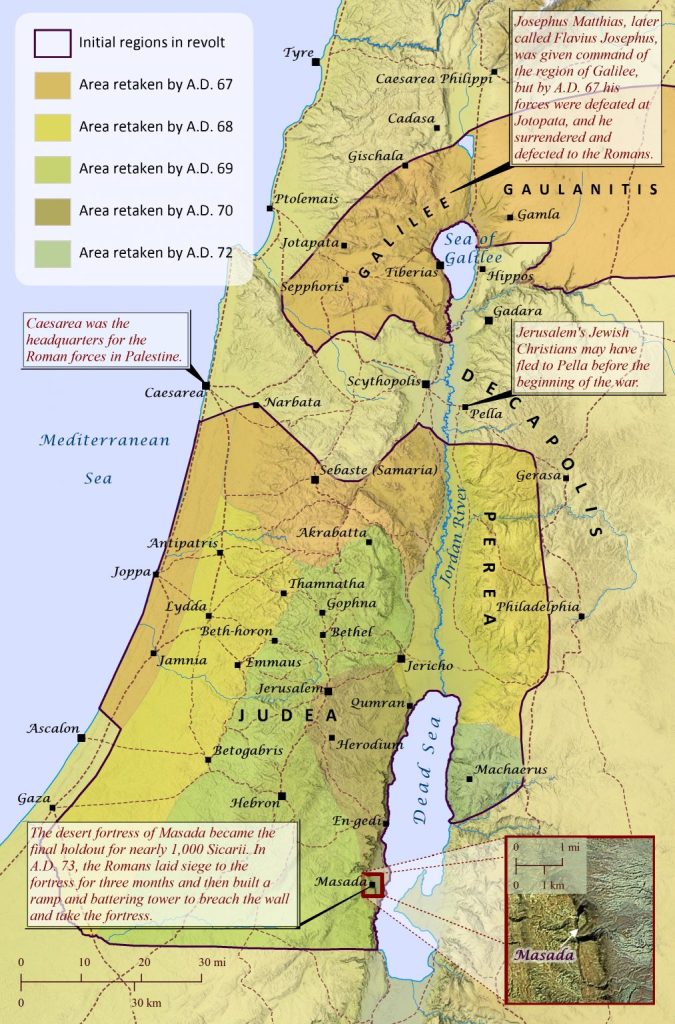
It was here that Josephus himself was captured. As commander of Jewish forces in Galilee, he had held out at Jotapata until the city fell. In his own account, he claims that while in captivity he prophesied that Vespasian would soon be emperor:

You, O Vespasian, shall be Caesar and emperor, you and your son. Bind me now still closer, and keep me for yourself; for you, O Caesar, are lord, not only of me, but of the land and sea, and of all mankind.
— Josephus, Jewish War 3.8.9 §401–403 (c. AD 75–79)

When that prophecy appeared to come true the following year, Vespasian spared his life, granted him Roman citizenship, and attached him to his household. From then on Josephus lived in Rome under imperial patronage, taking the family name Flavius from his patrons.

This is how Yosef ben Matityahu, a Jewish priest and rebel general, became Flavius Josephus, historian of the Jewish War. His writings—sometimes defensive, sometimes deferential toward Rome—remain the only detailed eyewitness record of Jerusalem’s destruction.


3. The Siege of Jerusalem (AD 70)

When Nero’s death recalled Vespasian to Rome, Titus took full command.
Inside Jerusalem, zealot factions fought one another while Roman legions built a five-mile siege wall to starve the city into surrender.
This wall—called a circumvallation—completely encircled Jerusalem. Built in only three days by tens of thousands of soldiers, it cut off every road and stopped all supplies. Famine would finish what the legions began.

The famine grew severe and destroyed whole houses and families. The alleys were filled with dead bodies of the aged; children and youths swarmed about the market-places like shadows, and fell wherever famine overtook them. No one buried them; pity was strangers to men; for famine had confounded all natural feeling.
— Josephus, Jewish War 5.12.3–4 (c. AD 75–79)

Then Josephus records one of antiquity’s darkest scenes:

There was a certain woman named Mary, daughter of Eleazar, of the village Bathezor. Driven by famine and rage, she slew her infant son, roasted him, and ate one half, concealing the rest. When the soldiers smelled the roasted meat and rushed in, she said, ‘This is my own son; the deed is mine; eat, for I have eaten. Do not pretend to be more tender-hearted than a woman or more compassionate than a mother.’
— Josephus, Jewish War 6.201–213 (c. AD 75–79)

Titus later claimed he had ordered the Temple spared:

I myself called a council of war and urged that the Temple be saved; but the flame was beyond control, and the sanctuary was burned against my will.
— Josephus, Jewish War 6.4.7 §254 (c. AD 75–79)

Josephus blames undisciplined troops; Tacitus sees deliberate policy:

It was resolved to destroy the Temple that the religion of the Jews might be more completely abolished.
— Tacitus, Histories 5.12 (c. AD 100–110)
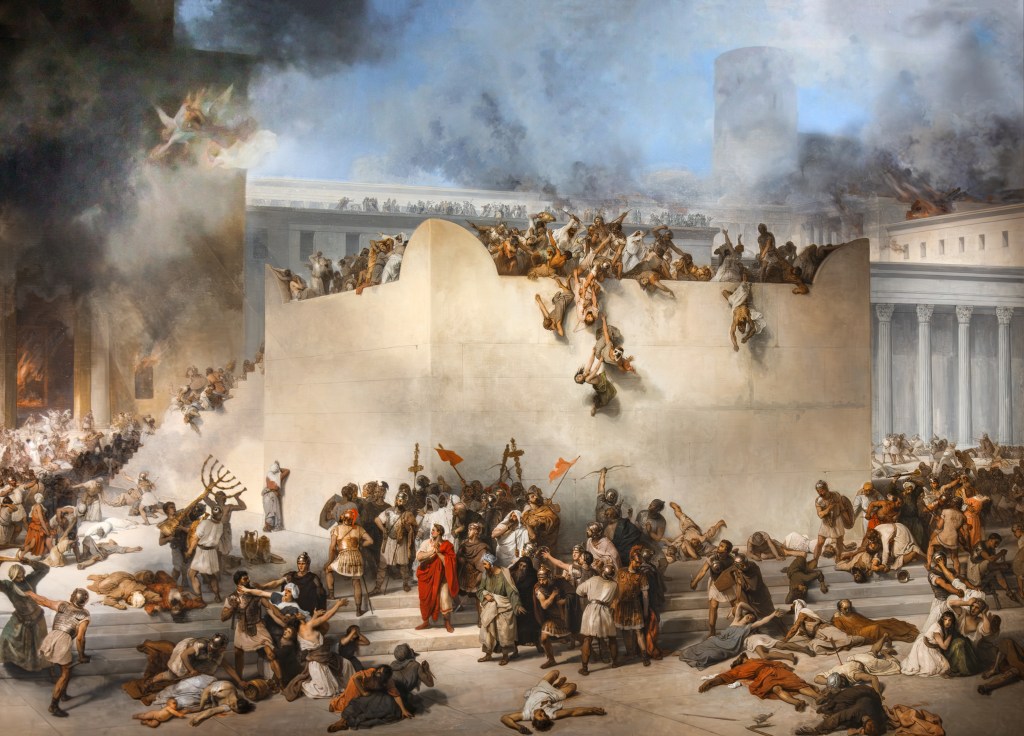
The Destruction of the Temple of Jerusalem – Francesco Hayez, 1867, oil on canvas

Different motives, same outcome: the Temple fell.
For Christians, it confirmed the prophecy of Christ: “Not one stone shall be left upon another.” (Mark 13:2)


4. Crosses Without Number

As for those who had fled from the city and were caught, they were first scourged and then tortured and finally crucified before the walls. In their fury and hatred the soldiers nailed up the prisoners in different postures, by way of jest, and the multitude was so great that room was wanting for the crosses, and crosses for the bodies.
— Josephus, Jewish War 5.11.1 (c. AD 75–79)

Josephus later expands this account:

Those who were taken outside the city he first scourged, and then tormented with all manner of tortures before crucifying them opposite the wall. Titus indeed felt pity for them, but their number was so great that there was no room for the crosses nor crosses for the bodies. About five hundred were crucified each day, and the soldiers, in their rage and hatred, amused themselves by crucifying some one way and some another, until, owing to the multitude, there was no space left for the crosses nor crosses for the bodies.
— Josephus, Jewish War 6.1.1 (c. AD 75–79)

The same empire that boasted of order and civilization turned execution into entertainment.
The hills around Jerusalem stood thick with crosses—not yet symbols of redemption, but monuments of Rome’s rule through fear.


5. Aftermath — Slavery, Spectacle, and Tax

Through Rome’s streets the captives marched, carrying the Menorah and sacred vessels. Coins were struck proclaiming IUDAEA CAPTA—“Judea Captured.” Various versions of these coins were struck and used for 25 years under Vespasian and his two sons Titus and Domitian.
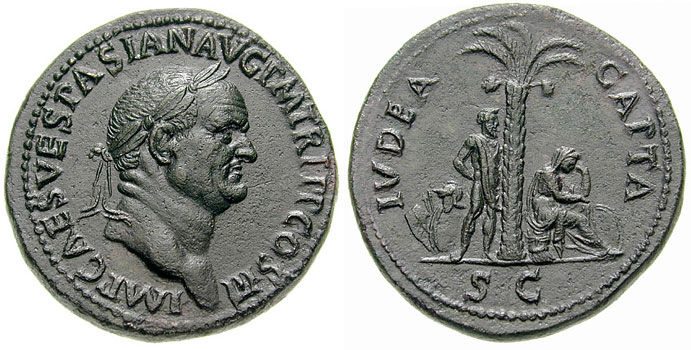
IMP CAES VESPASIAN AUG PM TR P COS III = Commander Caesar Vespasian Augustus, Chief Priest, Holder of Tribunician Power, Consul for the Third Time; IUDEA CAPTA S C = Judea Captured by decree of the Senate

He decreed that all Jews throughout the world should pay each year two drachmas to the Capitol in Rome, as they had previously paid to the Temple in Jerusalem.
— Dio Cassius, Roman History 66.7 (c. AD 200–220)

The fiscus Judaicus turned a holy offering into tribute for pagan gods.
Jewish Christians, still classed as Jews, were forced to pay the same tax of defeat.

Meanwhile, many early believers saw a deeper reason for Jerusalem’s ruin: the death of James the Just, the brother of Jesus and leader of the church in Jerusalem.

Festus was now dead, and Albinus was but upon the road; so Ananus, who had become high priest, assembled the Sanhedrin of judges, and brought before them the brother of Jesus, who was called Christ, whose name was James, and some others; and when he had formed an accusation against them as breakers of the law, he delivered them to be stoned.
— Josephus, Antiquities 20.9.1 §200–203 (c. AD 93)

Hegesippus, a second-century Jewish Christian, adds detail:

They placed James on the pinnacle of the Temple and cried, ‘Tell us, O righteous one, what is the door of Jesus?’ And he answered with a loud voice, ‘Why do you ask me concerning the Son of Man? He sitteth at the right hand of the Great Power, and shall come on the clouds of heaven.’ Then they began to stone him, and a fuller took the club with which he beat clothes and struck the righteous one on the head, and so he suffered martyrdom.
— Hegesippus in Eusebius, Ecclesiastical History 2.23.10–12 (c. AD 170, quoted c. AD 310–325)

Hegesippus concludes that the siege of Jerusalem followed soon after James’s death, calling it divine judgment:

Immediately after this Vespasian began to besiege them; and they remembered the saying of Isaiah the prophet, ‘Let us take away the righteous man, because he is troublesome to us; therefore they shall eat the fruit of their doings.’ Such was their lot, and they suffered these things for the sake of James the Just.
— Hegesippus in Eusebius, Ecclesiastical History 2.23.18 (c. AD 170, quoted c. AD 310–325)

Eusebius agrees, closing his account:

These things happened to the Jews to avenge James the Just, who was the brother of Jesus that is called Christ. For, as Josephus says, these things befell them in accordance with God’s vengeance for the death of James the Just, which they had committed, although he was a most righteous man.
— Eusebius, Ecclesiastical History 2.23.19–20 (c. AD 310–325)

From this moment on, many Christians saw the destruction of Jerusalem not only as Rome’s triumph, but as God’s judgment for rejecting Christ and murdering His righteous servant.


6. The Arch of Titus — The Empire’s Theology in Stone (AD 81)

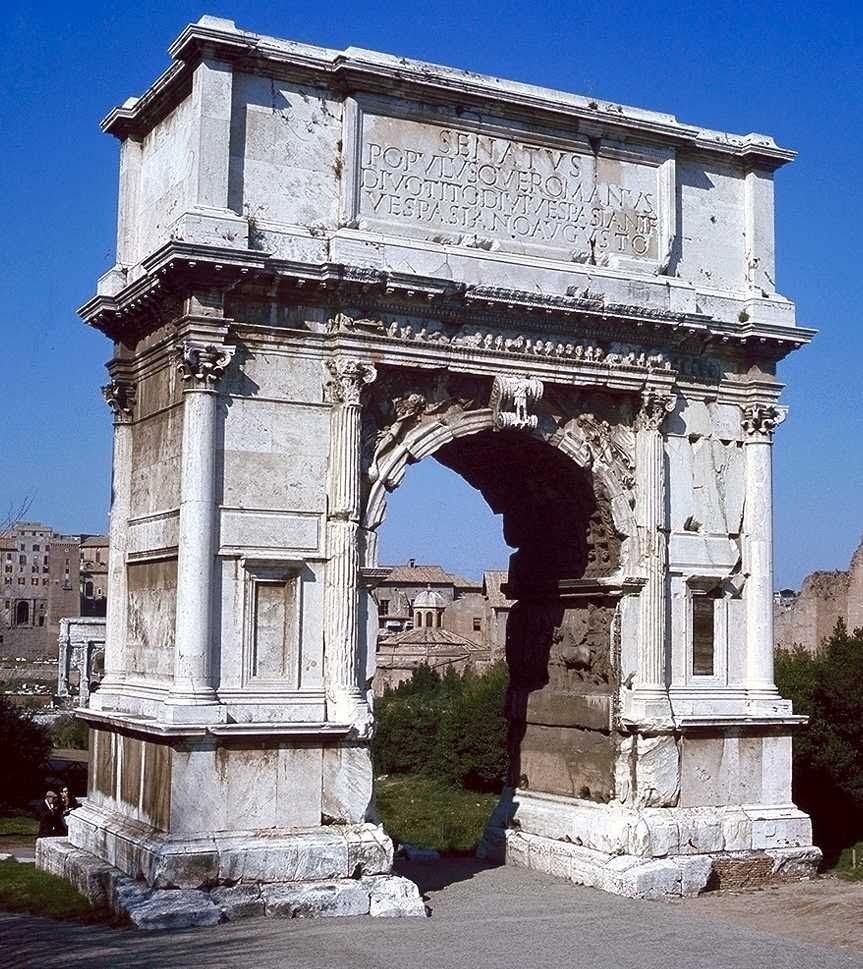
When Titus died, the Senate declared him divine. The arch still standing on the Via Sacra reads:

The Senate and People of Rome [dedicated this] to the deified Titus Vespasian Augustus, son of the deified Vespasian.

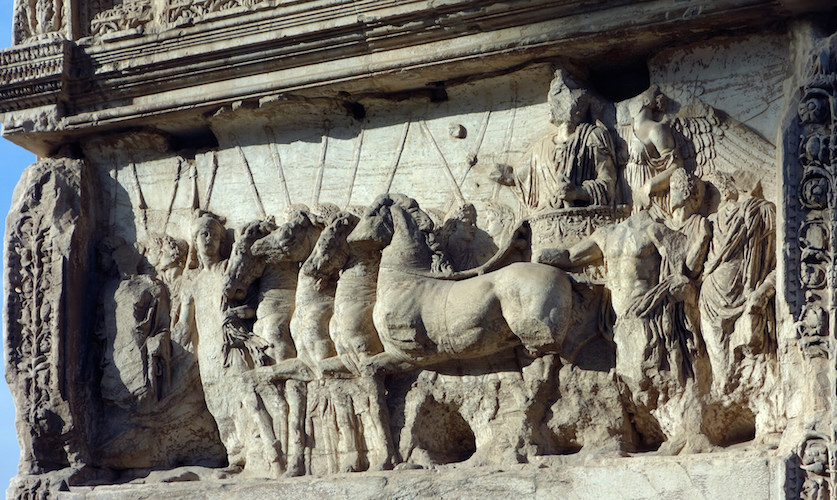
Inside its vault, carvings show Roman soldiers bearing the Temple treasures.

They brought the Menorah and the table of the bread of the Presence, and the last of the spoils was the Law of the Jews; after these, a great number of captives followed.
— Josephus, Jewish War 7.5.5 (c. AD 75–79)
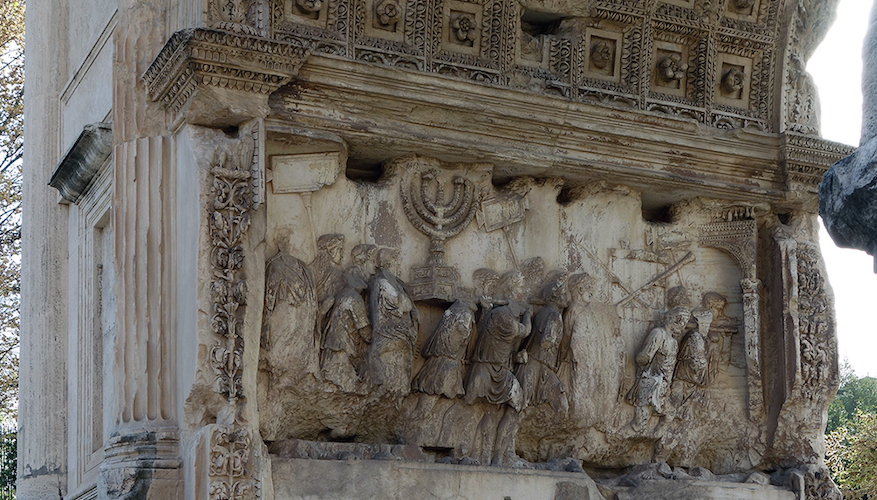
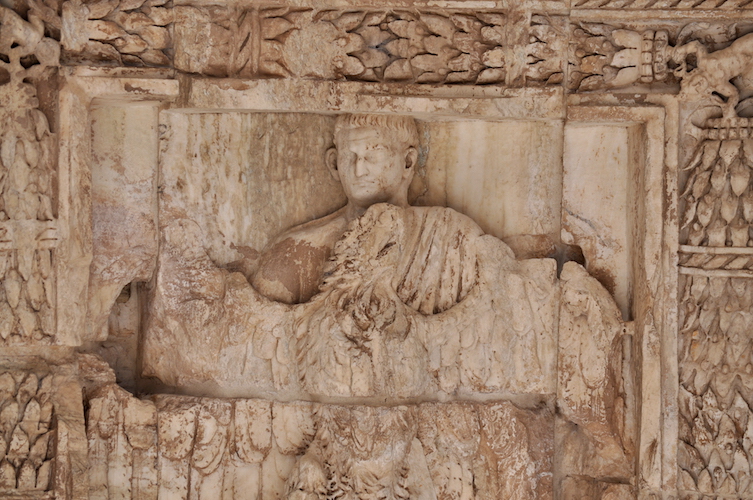
At the top of the arch inside is the depiction of Titus’ ascension to heaven as a god on the wings of an eagle.

For Rome, the arch proclaimed the victory of its gods.
For Christians, it stood as a silent confirmation of prophecy: the Temple of stone was gone, but the Temple of Christ remained.


7. The Flight to Pella — Revelation and Refuge

Amid the ruins of Jerusalem’s revolt, one community escaped—the believers who remembered Christ’s warning to flee.

The people of the church in Jerusalem had been commanded by a revelation, vouchsafed to approved men there before the war, to leave the city and to dwell in a certain town of Perea called Pella. And when those who believed in Christ had come thither from Jerusalem, then, as if the holy men had altogether deserted the royal city of the Jews and the whole land of Judea, the judgment of God at last overtook them for their abominations.
— Eusebius, Ecclesiastical History 3.5.3 (c. AD 310–325)

Eusebius attributes their escape to a divine revelation, while Epiphanius explains it as obedience to Christ’s prophecy:

When all the disciples were settled in Pella because of Christ’s prophecy about the siege, they remained there until the destruction of Jerusalem.
— Epiphanius, Panarion 29.7.7–8 (c. AD 375)

Different explanations—same event. The believers crossed the Jordan to Pella, a Decapolis city about sixty miles northeast of Jerusalem, where they waited out the war.
Their flight fulfilled Jesus’ own words (Luke 21:20–21).
What looked like retreat was obedience.


8. The Nazarenes — Law-Observant, Christ-Confessing

The first branch to emerge from that exile was the Nazarenes—Jewish believers who kept the Mosaic Law yet confessed Jesus as the divine Son of God.
They were the losing party in the Council of Jerusalem (Acts 15).

At that council, certain men from Judea began teaching that Gentile converts must keep the Law of Moses to be saved:

Some men came down from Judea and were teaching the brothers, ‘Unless you are circumcised according to the custom of Moses, you cannot be saved.’
— Acts 15:1

Later Luke identifies who pressed the issue:

But some of the sect of the Pharisees who believed rose up, saying, ‘It is necessary to circumcise them and to command them to keep the law of Moses.’
— Acts 15:5

Peter and James ruled that Gentiles need not bear that yoke:

We should not trouble those of the Gentiles who turn to God, but should write to them to abstain from things polluted by idols, from sexual immorality, from what has been strangled, and from blood.
— Acts 15:19–20

Those Jewish believers who could not release Torah observance continued as a community of Torah-keeping Christians—the Nazarenes.

Two decades later they were still strong. When Paul returned to Jerusalem near the end of his ministry, James the Just, the same leader later martyred near the Temple, recognized their influence:

You see, brother, how many myriads of Jews there are who have believed, and they are all zealous for the Law… Therefore do what we tell you: we have four men who have taken a vow; take them and purify yourself along with them, and pay their expenses, so that all may know that there is nothing in what they have been told about you, but that you yourself also live in observance of the Law.
— Acts 21:20, 23–24

James’s advice shows that the Nazarenes were not fringe but central within the Jerusalem church.

Centuries later, Jerome described them:

“The adherents to this sect are known commonly as Nazarenes; they believe in Christ the Son of God, born of the Virgin Mary; and they say that He who suffered under Pontius Pilate and rose again is the same as the one in whom we believe.”
— Jerome, Letter 75 to Augustine (AD 398–403)

“The Nazarenes accept Messiah in such a way that they do not cease to observe the old Law.”
— Jerome, Commentary on Isaiah 8:14 (AD 398–403)

Even Epiphanius, who condemned most sects, writes:

The Nazarenes are Jews who keep the customs of the Law but also believe in Christ. They say that Jesus was born of the Virgin Mary by the Holy Spirit. They believe that God created all things, that Jesus is His Son, and that the resurrection of the dead has already begun in Him… As for their understanding of Christ, I am not certain—whether they have been misled by false teachers who call Him merely human, or whether, as I think, they confess that He was born of Mary by the Holy Spirit.
— Epiphanius, Panarion 29.7.5–6 (c. AD 375)

Epiphanius lists their beliefs as orthodox and then admits, “I cannot say whether they have been deceived or whether they confess the truth.”
Had they denied Christ’s divinity, he would have said so.
His hesitation confirms that the Nazarenes were orthodox in belief, Jewish in culture—the first generation of Messianic Jews bridging synagogue and church.


9. The Ebionites — The First Denial of Christ’s Divinity

A second group took a different path. Epiphanius places their origin after the flight to Pella:

The Ebionites are later than the Nazoraeans… their sect began after the flight from Jerusalem.
— Epiphanius, Panarion 29.7.7–8 (c. AD 375)

They taught that Jesus was a mere man chosen by God, denied the virgin birth, and altered Scripture to fit their beliefs.

Those who are called Ebionites use the Gospel according to Matthew only, and repudiate the Apostle Paul, maintaining that he was an apostate from the Law.
— Irenaeus, Against Heresies 1.26.2 (c. AD 180)

The Ebionites believe that He was a mere man, born of Joseph and Mary according to the common course of nature, and that He became righteous through the progress of His moral character.
— Origen, Commentary on Matthew 16.12 (c. AD 248)

They falsify the genealogical tables in Matthew’s Gospel, saying that He was begotten of a man and a woman, because they maintain that Jesus is really a man and was justified by His progress in virtue, and that He was called Christ because the Spirit of God descended upon Him at His baptism. They say that this same Spirit, which had come upon Him, was taken away and left Him before the Passion and went back to God; and that then, after His death and resurrection, this same Spirit returned to Him again. Thus they deny that He is God, though they do not deny that He was a man.
— Epiphanius, Panarion 30.14.3–5 (c. AD 375)

They also spread a slander about Paul:

They say that Paul was a Greek who came to Jerusalem and lived there for a time. He desired to marry a daughter of the priests but was refused. Out of anger and disappointment he turned against circumcision, the Sabbath, and the Law. Because of this, they claim, he wrote against these things and founded a new heresy.
— Epiphanius, Panarion 30.16.6–9 (c. AD 375)

For the Ebionites, Jerusalem’s destruction was not punishment for rejecting Christ but for accepting the apostolic Gospel.
They blamed Paul and the church that followed him for turning Israel away from the Law.
Thus they reversed the very lesson of history that Josephus, Hegesippus, and Eusebius had drawn from the death of James the Just.
Where the Nazarenes preserved unity in diversity, the Ebionites cut themselves off from the apostolic faith.


10. Three Waves of Testimony and the Apostolic Standard

When we date the earliest Christian writings, we find three waves of testimony—sources acknowledged even by skeptical historians as genuine first-century evidence.
They give us the historical core around which all later writings revolve.


Three Waves of Early Christian Testimony

Wave of WitnessApproximate DateContent & DescriptionAuthority and Significance
CreedsAD 30s1 Corinthians 15:3–5 — “Christ died, was buried, and rose again according to the Scriptures.”
Philippians 2:6–11 — The Christ-hymn proclaiming His pre-existence, incarnation, humility, and exaltation.
The earliest confessions of faith; already proclaim Jesus as divine and demand worship.
Paul’s EpistlesAD 48–61The seven undisputed letters of PaulRomans, 1 & 2 Corinthians, Galatians, Philippians, 1 Thessalonians, and Philemon.The interpretation of Christ’s work by Paul himself, written within the lifetime of the apostles; Paul quotes and affirms the early creeds as authoritative revelation.
Synoptic GospelsAD 50s–60sMatthew, Mark, and Luke — written within the first generation after Jesus, preserving eyewitness memory of His life, teaching, death, and resurrection.The formal written record of what the earliest witnesses proclaimed; confirms and expands the message already present in the creeds and letters.

This Philippians hymn is not later theology; it is the earliest Christian confession we possess.
It begins with divinity, not humanity.
It declares that the one “existing in the form of God” became man, died on a cross, and was exalted so that every knee should bow and every tongue confess that Jesus Christ is Lord.
It is a proclamation of His divinity and a demand for worship from the very start of the Christian movement.

Modern critics such as Bart Ehrman claim that belief in Jesus’ divinity was a late development, yet their own dating of the evidence proves the opposite.
The earliest sources—the creeds Paul quotes—already worship Him as divine, and Paul treats those creeds as authoritative revelation.
From the beginning, the church bowed to a divine Christ, not a human teacher slowly exalted by legend.

Measured by that apostolic standard, the Nazarenes remained faithful to the original confession, honoring Paul’s letters and the earliest creeds.
The Ebionites, however, altered the Gospels, repudiated Paul, and rejected the Philippians 2 creed, denying Christ’s divinity and placing themselves outside the apostolic faith.


11. Dating the Gospels

Critical scholars commonly date Mark around AD 70, arguing that Jesus’ prophecy of the Temple’s destruction must have been written after it happened.
But this logic assumes that prophecy is impossible—a philosophical bias, not a historical fact.
If prophecy is real, the foundation for late dating collapses.

Even on their own terms, critics face contradictions.
They argue that Matthew copied Mark and therefore must be later, yet the Ebionites were already using and editing Matthew shortly after Jerusalem’s fall.
If Matthew was being altered in the 70s, it had to exist before then—and if Matthew depended on Mark, Mark must be earlier still.
The evidence forces the Synoptic Gospels back into the 60s or even 50s—within the lifetime of eyewitnesses.
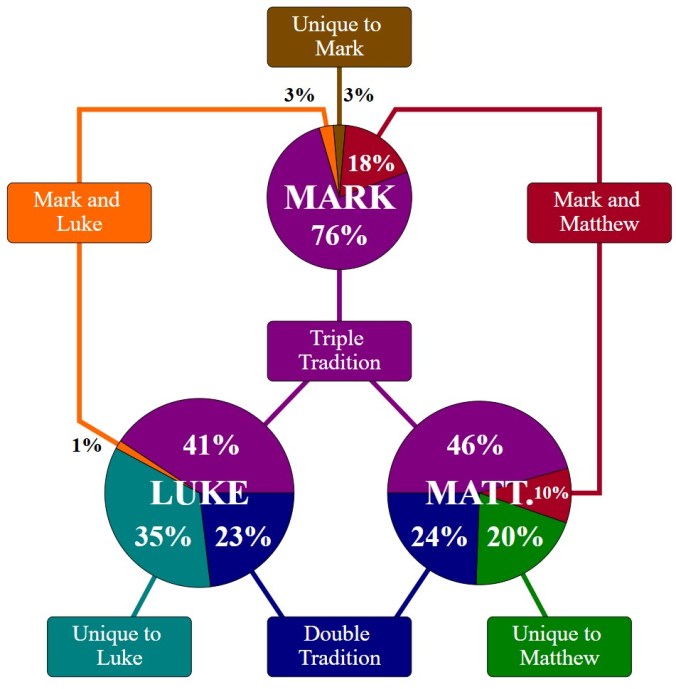
Paul’s letters tighten the timeline further.
In 1 Corinthians, written about AD 54–55, Paul quotes Gospel material three times:

  • 1 Corinthians 7:10 echoes Mark 10:11–12 on divorce — “not I, but the Lord.”
  • 1 Corinthians 9:14 recalls Luke 10:7 — “the Lord commanded that those who proclaim the gospel should get their living by the gospel.”
  • 1 Corinthians 11:23–25 recounts the words of institution at the Lord’s Supper, matching Luke 22:19–20 and Matthew 26:26–28.

These parallels show that the Gospel traditions were already written—or at least formally fixed—by the early 50s.
Paul quotes them as Scripture, not rumor, expecting his readers to recognize their authority.
This means the Gospels, or their written sources, predate 1 Corinthians itself—placing them within twenty years of the crucifixion.

Thus the timeline of Christian testimony runs not forward into myth but backward into eyewitness memory:

  • Creeds (AD 30s): the original confession of Christ’s death, resurrection, and divine status.
  • Paul’s Epistles (AD 48–61): the interpretation of those events by Paul himself, written within the lifetime of the apostles.
  • Synoptic Gospels (AD 50s–60s): the written preservation of what the eyewitnesses had proclaimed from the beginning.

When the evidence is allowed to speak for itself, it shows that the worship of Jesus as divine and the written record of His life both originate within living memory of His death and resurrection.
Even those who date the Gospel of John later, around the 90s, acknowledge that the Synoptics—and the faith they record—were already established decades earlier.
Christianity’s foundation is not legend developed over centuries—it is history written by witnesses and verified by worship.
Teenage Emperors and the Triumph of Christian Purity

1. Introduction

After Macrinus’ fall, the empire turned to Elagabalus (AD 218–222), a teenage priest from Syria whose reign shocked Rome with depravity and religious upheaval. Ancient historians describe him as one of the most corrupt rulers in history. Yet in his chaos, Christians were not singled out for persecution.

When he was assassinated, his cousin Severus Alexander (AD 222–235) rose to power. Under his mother’s guidance, he tolerated and even respected Christianity, creating the first extended season of peace for the church since the reign of Claudius. In this calm, Christian thinkers—above all Origen—flourished, even as the imperial household promoted a rival pagan holy man, Apollonius of Tyana, beside Christ himself.


2. Elagabalus (AD 218–222): Depravity on the Throne

Elagabalus was only 14 years old when he was proclaimed emperor. Raised as a priest of the Syrian sun god, he imported his cult into Rome and shocked the empire with both religious upheaval and sexual depravity.

Cassius Dio records the emperor’s religious madness:

“He carried his madness to such a pitch that he attempted to set up his own god as greater than Jupiter, and even to transfer to that god the sacred fire, the Palladium, the shields, and all that the Romans held sacred from the beginning.”
—Cassius Dio, Roman History 80.11 (c. AD 222–230, Loeb)

On his private conduct, Dio spares no detail:

“He married many women, and even a Vestal Virgin, whom he dragged from her sanctuary, declaring that he was marrying a priestess and so a match worthy of himself.

He carried his lewdness to such a point that he asked doctors to contrive a woman’s vagina in his body by means of an incision, promising them large sums for doing so.”
—Cassius Dio, Roman History 80.13–14 (c. AD 222–230, Loeb)

Dio also makes clear:

“He established a room in the palace as a brothel and there committed his shameful acts, always collecting money as if for his embraces.”
—Cassius Dio, Roman History 80.13 (c. AD 222–230, Loeb)

Herodian echoes the same picture of degradation:

“He considered nothing disgraceful, but thought that by his own conduct he was giving pleasure to the gods. He went about in public in the company of actors and dancers, and he took male partners as husbands, calling himself their wife. He gave himself up to every form of depravity.”
—Herodian, Roman History 5.6 (c. AD 240, Loeb)

The Historia Augusta, though later, preserves the same traditions:

“He would choose out the man who was most celebrated for the size of his organ and couple with him most shamelessly… He set up a house of prostitution in his palace and there collected actors, dancers, and the most notorious of men, so that he might rival the foulest brothels in Rome.”
Historia Augusta, Life of Elagabalus 5.3–4 (4th century, preserving earlier traditions)

Key Insight: The Roman emperor was expected to guard piety and moral order. Elagabalus instead flaunted sacrilege and lust, turning the imperial palace itself into a brothel and humiliating his office before the world.


3. Christian Sexual Ethics in Stark Contrast

While the emperor paraded immorality, Christians proclaimed chastity, fidelity, and holiness. Their ethic touched every sphere of life: marriage, personal purity, entertainment, and even the use of the senses.


1. Marriage and Family Life

Roman culture treated marriage largely as a social and economic contract. Husbands often kept mistresses, and wives were expected to tolerate it. Divorce was easy, and sexual double standards were everywhere. Against that backdrop, the Christian idea of marriage was revolutionary.

For early Christians, chastity in marriage didn’t mean abstaining from intimacy — it meant faithfulness, self-control, and holiness within the union. The sexual bond was exclusive, sacred, and tied to covenant love rather than lust or convenience.

Tertullian (Carthage, c. AD 197–200):

“We are not as your brothel-haunters, nor do we indulge in every form of licentiousness. Each man has his own wife, as the Word of God has allotted him. In the modesty of our marriage, chastity is the rule of life.”
Apology 39

Here “chastity” means fidelity and restraint within marriage — a partnership marked by purity, not indulgence.

“Our women, the more they are distinguished, the more they walk about as if they were unknown. They know nothing of the immodesties which are practiced in public; their beauty is not for the public eye, but for their husbands alone.”
Apology 46

Hippolytus (Rome, c. AD 220–230):

“Christians marry, as do others, but they marry only once; for their marriage is according to God, not for passion but for childbearing. Their women are chaste, their men temperate, their life in the flesh is conducted with holiness.”
Refutation of All Heresies 9.12

Letter to Diognetus (late 2nd century, still read in the 3rd):

“They marry, as do all; they beget children; but they do not destroy their offspring. They have a common table, but not a common bed. They are in the flesh, but they do not live after the flesh.”
—5.6–7

Key Insight: Early Christian marriage emphasized equality before God, mutual faithfulness, and moral discipline. Chastity was not the absence of intimacy but the sanctification of it — turning something physical into an act of covenant love. In a world where sexual pleasure was often detached from virtue, Christian couples viewed their bodies as part of their worship, belonging to one another under the authority of Christ.


2. Personal Purity and Virginity

Tertullian (Carthage, c. AD 200):

“Chastity is the bodyguard of faith, the partner of holiness, the preserver of purity. Without it, no one shall see the Lord.”
On the Apparel of Women 2.9

In this passage, Tertullian is speaking broadly of chastity (castitas) as the moral safeguard of all believers—married or single. It is the virtue that protects faith and holiness by disciplining desire and modesty alike. For the married, it meant faithfulness; for the unmarried, self-restraint and purity of heart.

Origen (Alexandria/Caesarea, c. AD 220–230):

“It is not possible to accept Christ unless we crucify our flesh with its passions and lusts. For the soul that would please God must first be purified of every defilement, especially the defilements of lust.”
Homilies on Leviticus 7.4

“Virginity is practiced among us, not out of contempt for marriage, but for the sake of God. For the virgin looks to the things of the Lord, how she may please Him. We thus train the soul to mastery over the body, that it may rise to contemplate divine things.”
On First Principles 3.1.9

Key Insight: Early Christians saw the body as the instrument of the soul’s worship, not its prison. To “crucify the flesh” meant learning self-control, not despising creation. Virginity, for those called to it, was viewed as a voluntary offering—an imitation of Christ’s single-hearted devotion. For married and unmarried alike, purity was about mastery rather than repression, ordering human desire toward love of God and neighbor.


3. Spectacles and Entertainment

Roman “spectacles” included the circus, the theater, and the gladiatorial arena. But one of the most popular forms of entertainment was pantomime — a stage performance where a solo dancer acted out mythological stories of seduction, rape, and adultery, accompanied by music and chorus. Every gesture was sexually charged.

These shows were notorious for their erotic suggestiveness. Roman satirists like Juvenal mocked women who lusted after pantomime actors. The line between art and pornography was blurred. And emperors like Elagabalus filled their palaces with pantomime dancers and actors.

Tertullian condemned the shows fiercely:

“The show of the theatre stirs up lust. For where the subject is love, there can be no modesty. The language is unchaste, the gesturing unchaste; nothing is more lascivious than the playhouse, nothing more destructive to modesty.”
On the Shows 17

“What of the pantomime, that disgraceful imitation of all things, where every gesture is a corruption, every movement a provocation to lust? Why should we who renounce even the modest pleasures of the eye and ear endure such provocations?”
On the Shows 22

“What is not lawful to say or to do, it is not lawful to see or hear. Why should things that defile a man when spoken defile him less when seen?”
On the Shows 17


4. Guarding the Senses

Origen extended the warning beyond theaters and brothels, to the inner life of the believer:

“If we abstain from fornication and adultery but still fill our eyes with shameful sights and our ears with shameful sounds, how are we different from those who commit them in deed? For what enters through the senses lodges in the heart and produces its fruit in action.”
Homilies on Proverbs 5.1 (c. AD 230)

“It is not only the act of sin that defiles a man, but also the will and intention. For when the eyes are defiled, the whole body is full of darkness. And so the Christian must be chaste not only in body but also in look, word, and thought.”
Commentary on Matthew 14.23 (c. AD 245)

“The eyes and ears are the doors of the soul. If what enters is holy, the soul is illuminated; if what enters is shameful, the soul is darkened. Therefore the Christian must close his eyes and ears against what is evil, as he closes his mouth against unclean food.”
Homilies on Leviticus 7.4

Key Insight: The emperor of Rome turned his palace into a brothel and surrounded himself with pantomime dancers and actors. Christians, by contrast, were told that even watching or listening to such things was defiling. Tertullian condemned the external spectacles; Origen pressed the point inward, warning against corrupting the eyes, ears, and thoughts. Together, they show how Christianity offered a radically different ethic — purity not only in deed, but in sight, sound, and imagination.

Even the pagan physician Galen, writing c. AD 170, admitted:

“For discipline and self-control in sexual matters, Christians are in no way inferior to true philosophers.”
On the Passions and Errors of the Soul (fragment, c. AD 170)


4. Severus Alexander (AD 222–235): A Season of Peace

Severus Alexander was just 13 years old when he became emperor after Elagabalus’ assassination. Unlike his cousin, he was closely guided by his mother, Julia Mamaea, who sought out instruction even from Christian teachers like Origen.

Eusebius records:

“Mamaea, who was especially celebrated for her devotion to religion, sent for Origen and received instruction from him, and honored him greatly.”
Church History 6.21 (c. AD 325, citing events of c. AD 230, Loeb)

And of Alexander himself:

“It is said that Alexander had in his private chapel statues of Abraham, Orpheus, Apollonius, and Christ.”
Church History 6.28 (c. AD 325, citing tradition from Alexander’s reign, Loeb)

Key Insight: This was the first extended peace since Claudius (AD 41–54). Just as Paul had once carried out his missionary journeys under Claudius, Christians now found space for theological and moral development under Alexander.


5. Apollonius Beside Christ: The Witness Question

The inclusion of Apollonius in Alexander’s shrine shows how the empire was beginning to put Christ alongside other sages. Around this time, Philostratus wrote the Life of Apollonius of Tyana (c. AD 217–238), commissioned by Julia Domna. He claimed to use the memoirs of a disciple named Damis — but we do not possess them, and no one else ever mentions them. Whatever Damis may have written has vanished. What survives is Philostratus’ polished literary creation, composed 150 years after Apollonius lived.

Apollonius:

  • Based on one shadowy “witness.”
  • Written long after, by a sophist in the imperial court.
  • Offered nothing new, only a revival of ancient Pythagorean philosophy.
  • Left no enduring movement or transformation of the empire.

Christ:

  • The Gospels (AD 60–90): written within one lifetime, still in living memory.
  • Paul’s letters (AD 50s): written 20–25 years after, already citing earlier traditions.
  • Paul’s autobiography (Gal 1; 1 Cor 15:8): his conversion occurred within a year or two of the crucifixion.
  • The earliest creeds: especially the Resurrection Creed (1 Corinthians 15:3–5) and the Christ Hymn (Philippians 2:6–11), both pre-Pauline and already in circulation within months of the cross.

Together, these creeds show that the proclamation of Christ crucified and risen, and His worship as Lord, began immediately after Easter — not generations later.

Origen, facing critics who compared Christ to Apollonius, drove the point home:

“What has Apollonius left behind as a testimony to his divine mission? Where are those who have been persuaded by him to change their lives? But Jesus has persuaded not only men then living, but also men of all nations today, to accept His doctrine and to live as those who have been transformed by Him.”
Contra Celsum 3.34 (c. AD 248, Loeb)

Key Insight: Even pagans could be fascinated by Apollonius’ story, but fascination is not transformation. Jesus left behind not just tales, but witnesses, creeds, and a movement that reshaped the Roman world.


6. Origen’s Voice in the Calm

This peaceful window allowed Origen to produce the earliest Christian systematics and massive commentaries. His On First Principles (De Principiis) was the first attempt at a comprehensive Christian theology, weaving together Scripture, philosophy, and moral reflection.

God and the Trinity

“God the Father, who holds the universe together, is superior to every being that exists, for He imparts to each one from His own existence that which each one is. The Son, being less than the Father, is superior to rational creatures alone, for He is second to the Father. The Holy Spirit is still less, and dwells within the saints alone.”
On First Principles 1.3.5

Christ as Eternal Wisdom

“There never was a time when He did not exist. For He is called the Wisdom of God; and it is impossible that God should ever have been without wisdom. Thus we must believe that the Savior always existed.”
On First Principles 1.2.2

Sovereignty, Foreknowledge, and Predestination

“God knows all things before they exist, and He knows not only the past and present but also the future. Nothing can happen contrary to what He knows will be. Yet His foreknowledge does not impose necessity upon what is to come; rather each one acts by the freedom of his own will.”
On First Principles 3.1.15

“The saints are said to be predestined by God not according to an arbitrary decree but according to His foreknowledge. For He knew before the foundation of the world who would be conformed to the image of His Son, and for this reason He predestined them to be called and justified.”
On First Principles 3.5.7

“Nothing takes place in the world without God. All is arranged by Him in wonderful order, even what seems contrary is ordered by Him toward the salvation and advantage of the whole universe.”
On First Principles 2.1.1

Free Will

“The liberty of the will is preserved, and the freedom of choice remains, because God has set before every soul life and death, the good and the evil, in order that we may choose life and walk in the way of righteousness, keeping the commandments of God.”
On First Principles 3.1.6

Suffering and Apparent Unfairness

“When we see infants afflicted with grievous sufferings, or souls that seem to be punished beyond their deserts, we must not suppose that chance rules the world, nor that there is injustice with God. There are causes hidden from us, older than the present life, which the divine judgment considers, so that to each is given according to what it has deserved.”
On First Principles 2.9.7

“Even if one cannot at once perceive the reason why the good are afflicted or the innocent seem to suffer, we must believe that God orders all things with justice. For some are corrected in the present, others are reserved for correction in the future; but all are arranged by the providence of Him who alone knows what each one requires.”
On First Principles 3.1.18

“What appears unequal and unjust will be set right in the restitution of all things, when every soul shall be brought to that end which is worthy of God. Then all who suffered undeservedly will find reward, and those who prospered in wickedness will be brought to judgment.”
On First Principles 3.6.6

Origen included his controversial belief in the pre-existence of souls to explain hidden causes of suffering. Later generations rejected that idea, but it shows how earnestly he wrestled with the scandal of pain while defending God’s justice.

The Purpose of Scripture

“The Scriptures were composed by the Spirit of God, and have not only that meaning which is obvious, but also another which is hidden, as it were, beneath the surface. The whole law is spiritual, but the spiritual meaning is not recognized by all, but only by those on whom the grace of the Holy Spirit is bestowed in the word of wisdom and knowledge.”
On First Principles 4.2.4

Final Judgment and Restoration

“The end is always like the beginning. As then we began with God, so in the end we shall be with God, and all enemies being subdued and overcome, God shall be all in all. For we must believe that the goodness of God, through Christ, will recall all His creatures to one end, even His enemies being conquered and subdued.”
On First Principles 1.6.1

Key Insight: On First Principles shows Origen building the first grand map of Christian thought: God and the Son’s eternal Wisdom; God’s sovereign ordering joined to true human freedom; Scripture’s layered meaning; and a final restoration where God’s justice and goodness answer every wrong.


7. Conclusion

  • Elagabalus: depravity and scandal, but no persecution. Crowned at just 14, he degraded the office with sacrilege and lust.
  • Severus Alexander: peace and curiosity, enthroned at 13, guided by his mother, who welcomed Origen.
  • Apollonius: a late literary creation, based on one shadowy source, reviving old ideas, leaving no impact.
  • Christ: proclaimed immediately in the earliest creeds, testified by many witnesses, and transforming the Roman world.

This was the first extended peace since Claudius, but it was fragile. Nero’s precedent still lingered. And within fifteen years of Alexander’s death, Decius would unleash empire-wide persecution.

Key Insight: This era shows the battle lines clearly. Pagan elites tried to honor Christ as just another sage, even inventing rivals like Apollonius. Christians answered with witnesses, creeds, and transformed lives — proclaiming that Christ was not one among many, but the eternal Son of God.

Multiplying by Mission: Session 4 at Mission Lake

40% Growth Then, 5% Growth Now — What We Must Learn Anew

When we talk about Jesus, Paul, and the rise of Christianity, we are not in the realm of myth or timeless stories. The New Testament roots its narrative in the concrete reigns of Roman emperors and the actions of their governors. Luke 3:1–2 names them explicitly. Tonight, we step into the reign of Tiberius Caesar, meet John the Baptist, examine Pontius Pilate, and see how all of this converges in the crucifixion of Jesus — an event so widely attested that even atheist historians treat it as one of the firmest facts of ancient history.


1. Tiberius: The Suspicious Recluse of Capri

Tiberius was Rome’s second emperor, ruling from AD 14 to 37. He was the stepson of Augustus, a capable general, and at first praised for discipline and stability. But over time, he became known for suspicion, cruelty, and retreat from public life.

Luke deliberately grounds the story of John the Baptist and Jesus in his reign:

“In the fifteenth year of the reign of Tiberius Caesar, Pontius Pilate being governor of Judea, and Herod being tetrarch of Galilee… the word of God came to John the son of Zechariah in the wilderness.”
—Luke 3:1–2 (c. AD 70–90, ESV)

The “fifteenth year” of Tiberius corresponds to AD 28 or 29.

Suetonius describes Tiberius’ withdrawal:

“He retired to Capri, and lived there for the most part, leaving the conduct of affairs to others, and only occasionally returning to the mainland.”
—Suetonius, Tiberius 40 (c. AD 110, Loeb)

Tacitus captures the regime’s climate:

Under Tiberius, executions multiplied. Nobles were driven to suicide, men of rank were executed, the prisons were filled, and terror stalked the city.
—Tacitus, Annals 6.19 (c. AD 115, Loeb)

Cassius Dio echoes the cruelty:

He became savage and bloodthirsty, and put to death without trial all who were suspected.
—Cassius Dio, Roman History 58.8 (c. AD 200–220, Loeb)

Suetonius also records the moral depravity remembered at Capri:

He abandoned himself to scandalous and disgraceful excesses… gathering together companies of girls and perverts, and with every device of lewdness defiled the place.
—Suetonius, Tiberius 43 (c. AD 110, Loeb, excerpted)

Ancient reports say this corruption even involved children groomed for him, and that he disposed of people brutally:

Those who fell from favor, he would have thrown into the sea from the cliffs, and watch them perish.
—Suetonius, Tiberius 62 (c. AD 110, Loeb)

This is why later generations called him Capri’s Monster. Roman historians remembered him not just as paranoid and cruel, but as morally depraved and willing to kill even children once he was finished with them.


Tiberius and the Title “Son of God”

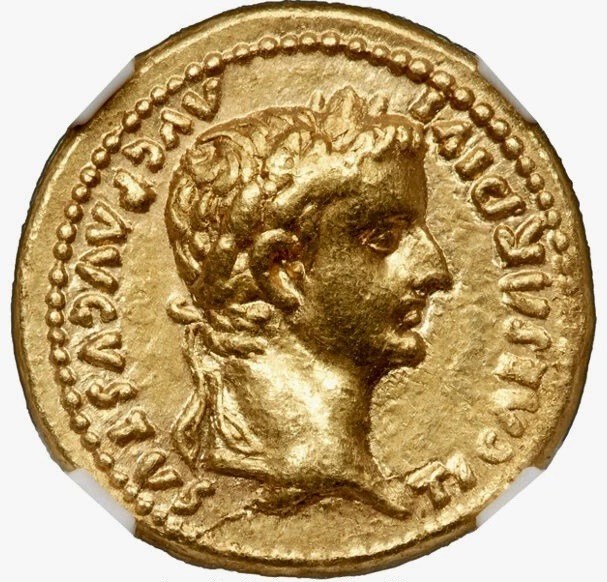
Tiberius allowed — and even promoted — the cult of his adoptive father, Divus Augustus (“the Divine Augustus”). Coins of his reign often feature Augustus as a god.

  • On these coins Augustus appears with the inscription DIVVS AVGVSTVS PATER (“the Divine Augustus, Father”).
  • On the same coin, Tiberius is named TI CAESAR DIVI AVG F AVGVSTVS — which means “Tiberius Caesar Augustus, son of the Divine Augustus.”

This made Tiberius officially the “son of the divine Augustus” — a title printed on currency and circulated throughout the empire. Importantly, Tiberius did not call himself divine during his lifetime, but he claimed sonship of a god.

After his death in AD 37, the Senate debated whether to enroll him among the gods as Divus Tiberius. Suetonius notes that some argued for his deification, but because of his reputation as a cruel and depraved ruler, there was hesitation. Ultimately, he was not formally deified like Augustus.

Key Insight: Under Tiberius, the title “Son of God” was already political language, stamped on coins. Early Christians, when they confessed Jesus as the true “Son of God,” were directly challenging the imperial claims.


2. John the Baptist: A Voice Rome Couldn’t Ignore

Historians across the spectrum — Christian, Jewish, agnostic, and atheist — agree that John the Baptist is one of the most historically secure figures in the New Testament.

Why John’s life is considered historically certain:

  1. Multiple independent sources. John appears in all four Gospels and in Josephus (Antiquities 18.5.2).
  2. Criterion of embarrassment. The baptism of Jesus by John is a classic example. To say that Jesus — whom Christians confessed as sinless and greater than all prophets — nevertheless submitted to John’s baptism could look like John was spiritually superior. Bart Ehrman, an agnostic historian, puts it bluntly: “Jesus’ baptism by John the Baptist is one of the most certain things we know about Jesus.” (Jesus: Apocalyptic Prophet of the New Millennium, Oxford University Press, 1999, p. 106).
  3. Consistency of content. The Gospels and Josephus both describe John calling people to repentance, righteousness, and baptism as an outward sign of an already-transformed life.
  4. Cultural plausibility. Prophets who attracted crowds were viewed as dangerous under Roman rule.
  5. Josephus’ detailed confirmation. Josephus provides a long, independent account of John’s preaching, his imprisonment at Machaerus, and his execution by Herod Antipas, the son of Herod the Great and tetrarch of Galilee and Perea (4 BC–AD 39).

Josephus records:

“Now some of the Jews thought that the destruction of Herod’s army came from God, and that it was a very just punishment for what he had done against John, who was called the Baptist. For Herod had killed this good man, who had exhorted the Jews to lead righteous lives, to practice justice toward their fellows and piety toward God, and so doing join in baptism. In his view this was a necessary preliminary if baptism was to be acceptable to God. They must not employ it to gain pardon for whatever sins they committed, but as a consecration of the body, implying that the soul was already cleansed by right behavior. And when others too joined the crowds about him, because they were aroused to the highest degree by his sermons, Herod became alarmed. Eloquence that had so great an effect on mankind might lead to some form of sedition, for it looked as if they would do everything he counseled. Herod decided, therefore, that it would be much better to strike first and be rid of him before any insurrection might develop, than to wait for an upheaval, get involved in a difficult situation, and see his mistake. And so, because of Herod’s suspicion, John was sent in chains to Machaerus, the stronghold that we have previously mentioned, and there put to death. The Jews, however, were of the opinion that the destruction of his army was sent as a punishment upon Herod, and a mark of God’s displeasure with him.
—Josephus, Antiquities 18.5.2 §116–119 (c. AD 93, Loeb)

Key Insights:

  • The bolded section shows how closely Josephus’ description of John matches the Gospels: baptism was only valid if accompanied by righteous works.
  • The Gospels record John saying the same thing: “Bear fruits worthy of repentance” (Luke 3:8).
  • Both Josephus and the Gospels show John as a preacher whose eloquence stirred the crowds and made rulers nervous.
  • Herod Antipas executed John not for violence but for influence — the people were ready to “do everything he counseled.”
  • Even Josephus, no friend to Christianity, confirms that John’s execution was seen as unjust and provoked divine judgment.

Because of this convergence — Gospel tradition, embarrassing detail, Josephus’ independent testimony, and the cultural setting — John the Baptist is regarded by virtually all historians as one of the most certain figures of Jesus’ world.


3. Pontius Pilate: Rome’s Reckless Governor

Pontius Pilate served as prefect of Judea from AD 26–36, appointed by Tiberius, likely through the influence of Sejanus. Prefects of equestrian rank governed Judea — a small but volatile province where Jewish nationalism, deep piety, and Roman imperial control collided.

Philo of Alexandria, writing within a decade of Pilate’s dismissal (c. AD 41–42), paints him in the harshest terms:

Pilate was a man of inflexible, stubborn, and cruel disposition, and he caused trouble by his venality, his violence, his thefts, his assaults, his abusive behavior, his frequent executions of untried prisoners, and his endless savage ferocity.
—Philo, Embassy to Gaius §301 (c. AD 41–42, Loeb)

His corruption, his acts of insolence, his rapine, his habit of insulting people, his cruelty, his continual murders of people untried and uncondemned, and his never-ending and most grievous brutality.
—Philo, Embassy to Gaius §302 (c. AD 41–42, Loeb)

This matches the Gospels’ picture of Pilate: a man who caves to pressure, indifferent to justice, quick to violence, and willing to condemn an innocent man for expedience.


The Golden Shields Affair (Philo, c. AD 26–27)

“Pilate, who had been appointed prefect of Judaea, displayed the shields in Herod’s palace in the Holy City. They bore no image — only an inscription. But when the people learned what had been done, and realized that their laws had been trampled underfoot, they petitioned Pilate to remove the shields. He steadfastly refused. Then they took the matter to Tiberius, who was indignant that Pilate had dared to offend religious sentiments and ordered him by letter to remove the shields immediately and transfer them to Caesarea.
—Philo, Embassy to Gaius §§299–305 (c. AD 41–42, Loeb)

Key Insight: This was one of Pilate’s first provocations. Even without images, inscriptions in the Temple area were offensive. Pilate refused to compromise until the Jews appealed directly to Tiberius. Rome itself forced Pilate to back down, showing both his arrogance and his weakness.


The Standards Incident (Josephus, c. AD 26–27)

“But now Pilate, the procurator of Judaea, brought into Jerusalem by night and under cover the effigies of Caesar that are called standards. The next day this caused a great uproar among the Jews. Those who were shocked by the incident went in a body to Pilate at Caesarea and for many days begged him to remove the standards from Jerusalem. When he refused, they fell to the ground and remained motionless for five days and nights. On the sixth day Pilate took his seat on the tribunal in the great stadium and summoned the multitude, as if he meant to grant their petition. Instead, he gave a signal to the soldiers to surround the Jews, and threatened to cut them down unless they stopped pressing their petition. But they threw themselves on the ground and bared their necks, shouting that they would welcome death rather than the violation of their laws. Deeply impressed by their religious fervor, Pilate ordered the standards to be removed from Jerusalem.
—Josephus, Antiquities 18.3.1 §55–59 (c. AD 93, Loeb)

Key Insight: Pilate smuggled Caesar’s images into Jerusalem under cover of night. Thousands of Jews protested nonviolently, offering their necks to the sword rather than accept idolatry. Pilate again provoked needlessly, then caved under pressure. This shows both his disregard for Jewish law and his fear of mass unrest.


The Aqueduct Massacre (Josephus, c. AD 30–31)

“Pilate undertook to bring a stream of water to Jerusalem, and did it with the sacred money of the treasury… many ten thousands of the people got together, and made a clamour against him… So he ordered a great number of his soldiers to have their weapons concealed under their garments, and sent them to a place where they might surround them. He bade the Jews himself go away; but they boldly casting reproaches upon him, he gave the soldiers that signal which had been beforehand agreed on; who laid upon them much greater blows than Pilate had commanded them, and equally punished those that were tumultuous, and those that were not. Nor did they spare them in the least; and since the people were unarmed, and were caught by men prepared for what they were about, there were a great number of them slain by this means, and others of them ran away wounded. And thus an end was put to this sedition.
—Josephus, Antiquities 18.3.2 §60–62 (c. AD 93, Loeb); cf. War 2.9.4 §175–177 (c. AD 75, Loeb)

Key Insight: This incident occurred around the same time as Jesus’ crucifixion. Pilate raided the Temple treasury for a building project, outraging the people. When they protested, he ordered disguised soldiers to massacre them. This matches the Pilate of the Gospels: willing to shed innocent blood if he feared disorder.


The Samaritan Slaughter and Recall (Josephus, AD 36)

“But the Samaritan multitude, being hindered from going up by Pilate and having many of them slain, … Vitellius… ordered Pilate to go to Rome, to answer before the emperor to the accusations of the Samaritans. So Pilate, when he had tarried ten years in Judea, made haste to Rome… but before he could get to Rome, Tiberius was dead.**”
—Josephus, Antiquities 18.4.1 §85–89 (c. AD 93, Loeb)

Key Insight: This slaughter ended Pilate’s career. He massacred Samaritans on Mount Gerizim, and the governor of Syria intervened. Pilate was recalled to Rome in disgrace, but Tiberius died before his trial. His decade of rule left a legacy of provocation, violence, and weakness.


Key Insights Summarized:

  • Philo (c. AD 41–42), writing almost immediately after Pilate’s rule, confirms his reputation for brutality and corruption.
  • Josephus (c. AD 75–93) gives multiple episodes that illustrate Pilate’s pattern: provoke → resistance → back down or slaughter.
  • The Gospels’ account of Pilate condemning Jesus out of weakness and expedience fits perfectly with this record.
  • By AD 30, when Jesus was crucified, Pilate was already known for religiously offensive acts and brutal crackdowns.

This is the prefect who presided over the trial of Jesus.


4. Jesus Crucified Under Tiberius

Even non-Christian sources confirm the crucifixion of Jesus. One of the most important comes from the Roman historian Tacitus, writing in the early 2nd century.

Christus, the founder of the name, had undergone the death penalty in the reign of Tiberius, by sentence of the procurator Pontius Pilatus, and the pernicious superstition was checked for a moment, only to break out once more, not merely in Judea, the home of the disease, but in the capital itself, where all things horrible or shameful in the world collect and find a vogue.”
—Tacitus, Annals 15.44 (c. AD 115, Loeb)

Key Insights:

  • Tacitus confirms that Jesus was executed in the reign of Tiberius, by the governor Pontius Pilate.
  • Tacitus calls Christianity a “pernicious superstition,” showing his hostility, yet he still records the fact of Jesus’ death.
  • He says the movement was “checked for a moment” — Rome thought crucifixion had ended it. Instead, it “broke out once more” and even reached Rome itself.
  • For Romans, crucifixion was supposed to erase a man’s memory forever. But in the case of Jesus, it became the foundation of a worldwide movement.

5. Mass Revolts vs. Jesus’ Isolation

In the decades before and after Jesus’ crucifixion, Rome responded to uprisings in Judea with mass crucifixions and bloodshed.

4 BC: After the Death of Herod the Great

“Varus sent part of his army into the country, to seek out the authors of the revolt; and when they were discovered, he punished some of them that were most guilty, and some he dismissed. Now the number who were crucified on this account were two thousand.
—Josephus, War 2.5.2 §75 (c. AD 75, Loeb)

Key Insight: Rome crucified 2,000 Jews at once after Herod’s death, using mass execution to terrify the nation.

AD 6: The Revolt of Judas the Galilean

“Yet was there one Judas, a Gaulonite, of a city whose name was Gamala, who, taking with him Saddok, a Pharisee, became zealous to draw them to a revolt, who both said that this taxation was no better than an introduction to slavery, and exhorted the nation to assert their liberty.This bold attempt at innovation brought the nation to ruin.
—Josephus, Antiquities 18.1.1 §4–6 (c. AD 93, Loeb)

Key Insight: Judas called taxation slavery and stirred revolt. Josephus says this “brought the nation to ruin.” Later, his sons were crucified by Rome, showing the empire’s relentless vengeance against such movements.

AD 30–31: Pilate’s Aqueduct Massacre

“…many ten thousands of the people got together, and made a clamour against him… he gave the soldiers that signal which had been beforehand agreed on… Nor did they spare them in the least… there were a great number of them slain by this means, and others of them ran away wounded.
—Josephus, Antiquities 18.3.2 §60–62 (c. AD 93, Loeb)

Key Insight: Pilate slaughtered crowds of unarmed Jews when they protested his misuse of Temple funds.

AD 36: Pilate’s Samaritan Slaughter

“But the Samaritan multitude, being hindered from going up by Pilate and having many of them slain, … Vitellius… ordered Pilate to go to Rome, to answer before the emperor to the accusations of the Samaritans. So Pilate, when he had tarried ten years in Judea, made haste to Rome… but before he could get to Rome, Tiberius was dead.**”
—Josephus, Antiquities 18.4.1 §85–89 (c. AD 93, Loeb)

Key Insight: Pilate massacred Samaritans on Mount Gerizim in AD 36. The bloodshed was so severe that the governor of Syria removed Pilate from power.

AD 44–46: The Revolt of Theudas

“…a certain magician, whose name was Theudas, persuaded a great part of the people to take their effects with them, and follow him to the river Jordan… However, Fadus… sent a troop of horsemen out against them; who, falling upon them unexpectedly, slew many of them, and took many of them alive. They also took Theudas alive, and cut off his head, and carried it to Jerusalem.
—Josephus, Antiquities 20.5.1 §97–99 (c. AD 93, Loeb)

Key Insight: Theudas and his followers were destroyed. He was beheaded, and many were killed or captured.

AD 66–70: The Jewish War

So the soldiers… nailed those they caught, one after one way, and another after another, to the crosses, by way of jest; when their multitude was so great, that room was wanting for the crosses, and crosses wanting for the bodies.
—Josephus, War 5.11.1 §446 (c. AD 75, Loeb)

Key Insight: During the siege of Jerusalem, crucifixion became a grotesque spectacle. So many were executed that they ran out of wood for crosses.


Jesus’ Crucifixion in Contrast

Against this backdrop, the crucifixion of Jesus in AD 30 stands out as unique.

  • In times of revolt, Rome crucified thousands at once.
  • Yet in Jesus’ case, only he was crucified.
  • His followers were not executed; they were scattered and spared.

The Gospels emphasize how alone he was at the end:

  • And they all left him and fled.” (Mark 14:50, c. AD 70)
  • Then all the disciples left him and fled.” (Matthew 26:56, c. AD 80s)
  • The Lord turned and looked at Peter… And he went out and wept bitterly.” (Luke 22:61–62, c. AD 70–90)
  • My God, my God, why have you forsaken me?” (Mark 15:34, c. AD 70)

How many were there?

  • At minimum: 3–4 named women (Mary Magdalene, Mary the mother of James/Joses, Salome or the mother of Zebedee’s sons), plus the beloved disciple.
  • Likely range: 4–5 people for sure, possibly up to a dozen if Luke’s “all his acquaintances” implies more.

Key Insight: Unlike Judas the Galilean, Theudas, or the rebels in the Jewish War, Jesus died alone, abandoned by nearly everyone. Rome crucified thousands, but on that Friday Pilate crucified one man, and in that one death the movement lived on.


Reflection Questions

  1. Why crucify only Jesus?
    • Rome’s normal practice was to crush movements with mass executions. Why do you think Pilate singled out Jesus but let his followers go free?
  2. What if all the disciples had died with him?
    • How might the early Christian movement have been different if Jesus’ closest followers had been rounded up and killed as well? Would the message have spread? Would we even be talking about it today?

6. Roman Disgust for Crucifixion

For Romans, crucifixion was not only brutal; it was considered the most degrading, shameful punishment possible. It was designed for slaves, rebels, and the lowest criminals — never for Roman citizens.

Cicero on Crucifixion (70 BC)

To bind a Roman citizen is a crime, to scourge him is an abomination, to slay him is almost an act of murder; to crucify him is—what? There is no fitting word that can possibly describe so horrible a deed.
—Cicero, Against Verres 2.5.66 (c. 70 BC, Loeb)

But the very mention of the cross should be far removed not only from a Roman citizen’s body, but from his mind, his eyes, his ears.
—Cicero, Against Verres 2.5.168 (c. 70 BC, Loeb)

Key Insight: Cicero said crucifixion was so vile that it should not even be mentioned in polite Roman society. For a Roman citizen, the cross was unthinkable.

Seneca on Crucifixion (c. AD 65)

Can anyone be found who would prefer wasting away in pain dying limb by limb, or letting out his life drop by drop, rather than expiring once for all? Can any man be found willing to be fastened to the accursed tree, long sickly, already deformed, swelling with ugly weals on shoulders and chest, and drawing the breath of life amid long-drawn-out agony?
—Seneca, Epistle 101.14 (c. AD 65, Loeb)

Key Insight: Seneca captures the drawn-out torture of crucifixion — a slow, humiliating, agonizing death that deformed the body and crushed the spirit.


The Alexamenos Graffito (late 1st-3rd century AD)

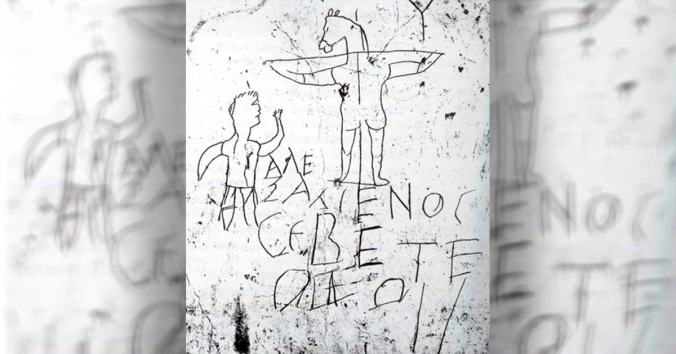
Scratched into the plaster wall of a building on the Palatine Hill in Rome, directly connected with the imperial palace, is the earliest surviving caricature of Christian worship. The structure is usually called the Paedagogium because it may have housed imperial page boys — though some scholars think it functioned as barracks or service quarters. Whatever its exact purpose, it was part of daily life around the emperor’s residence.

The graffito, dated between the late first and third centuries, depicts a man with hands raised in prayer before a crucified figure with a donkey’s head. Beneath it is scrawled:

Alexamenos worships his god.

Key Insight: This is the earliest known depiction of the crucifixion of Jesus. It was meant as mockery: to Romans, worshipping a crucified man was ridiculous, even contemptible. The donkey’s head was a common insult — suggesting stupidity and folly. This graffito shows that Roman ridicule of the cross was alive and well by the early centuries.


Why This Matters for Christianity

  • Crucifixion was meant to erase memory, to obliterate a person’s honor and legacy.
  • Yet Christianity placed the crucifixion of Jesus at the very center of its message.
  • What Romans thought too shameful to speak of, Christians proclaimed as the very power of God.
  • The fact that Christians endured this shame and scorn only strengthens the historical case that they truly believed Jesus was risen and exalted.

7. Modern Skepticism of the Gospel Accounts

Skeptics such as Bart Ehrman argue that the Gospels are filled with contradictions and discrepancies. Ehrman often highlights 30–40 examples, while harsher critics expand the list to 70 or more. These examples are used to shake confidence in Scripture, especially among students encountering them for the first time.

Here are the 10 most significant contradictions skeptics emphasize:

Macro-Level Contradictions (Big Picture)

  1. Birth Narratives & Genealogies (Matthew vs. Luke):
    • Matthew: Jesus born under Herod the Great (d. 4 BC). Wise men visit. Family flees to Egypt. Joseph’s father is Jacob.
    • Luke: Jesus born during the census under Quirinius (AD 6). Shepherds visit. Family returns to Nazareth. Joseph’s father is Heli.
    • This creates both a 10-year difference in dating and a different ancestry for Joseph.
  2. Trips to Jerusalem (Synoptics vs. John):
    • Synoptics: One final climactic trip to Jerusalem → ministry about 1 year.
    • John: At least three Passovers → ministry about 3 years.
  3. Passover Meal & Crucifixion Timing:
    • Synoptics: Jesus eats the Passover meal on Thursday night. Arrested that night. Crucified on Friday — the first day of Passover (15th of Nisan).
    • John: Jesus is crucified on Friday — the Day of Preparation (14th of Nisan), at the hour the lambs were slaughtered. In this account he does not eat the Passover meal.
    • Both agree it was Friday. The disagreement is whether that Friday was Passover itself (Synoptics) or the day before Passover (John).
  4. Cleansing of the Temple:
    • Synoptics: At the end of Jesus’ ministry, sparking his arrest.
    • John: At the beginning of his ministry, right after the wedding at Cana.
  5. Post-Resurrection Instructions:
    • Matthew 28: Jesus directs disciples to Galilee.
    • Luke 24 / Acts 1: Jesus tells them to stay in Jerusalem.
    • John 20–21: Jesus appears in both Jerusalem and Galilee.

Micro-Level Contradictions (Narrative Details)

  1. Jairus’ Daughter (Mark 5:22–23 vs. Matthew 9:18):
    • Mark: Jairus says his daughter is “at the point of death.” She dies later.
    • Matthew: Jairus says she is “already dead.”
  2. Centurion’s Servant (Matthew 8:5–7 vs. Luke 7:1–7):
    • Matthew: The centurion comes personally to Jesus.
    • Luke: The centurion never comes; he sends Jewish elders.
  3. The Call of the First Disciples (Mark 1:16–20 vs. Luke 5:1–11):
    • Mark: Jesus calls fishermen while they cast nets — they follow immediately.
    • Luke: Jesus first performs the miraculous catch of fish.
  4. Blind Men near Jericho (Mark 10:46 vs. Matthew 20:29–30):
    • Mark: Jesus heals one blind man (Bartimaeus).
    • Matthew: Jesus heals two blind men.
  5. The Women at the Tomb (Mark 16:5 vs. Luke 24:4 vs. John 20:12):
  • Mark: One young man (angel).
  • Luke: Two men in dazzling apparel.
  • John: Two angels seated where the body had been.

Key Insights

  • These contradictions are real — we don’t deny them.
  • They demonstrate that the Gospels are independent voices, not colluded copies.
  • They arose in different places and times (Galilee, Jerusalem, Asia Minor, Rome), sometimes decades apart.
  • Despite these differences, they all converge on the same core story:
    • Jesus was baptized by John.
    • He preached and clashed with leaders.
    • He was crucified under Pilate.
    • His followers proclaimed him risen.

8. The Synoptic Problem, Gospel Dating, and the Centrality of the Passion

After hearing the skeptic’s case, it’s important to understand how the Gospels actually came together and why their differences make them stronger as historical witnesses, not weaker.

The Synoptic Problem: How the Gospels Relate

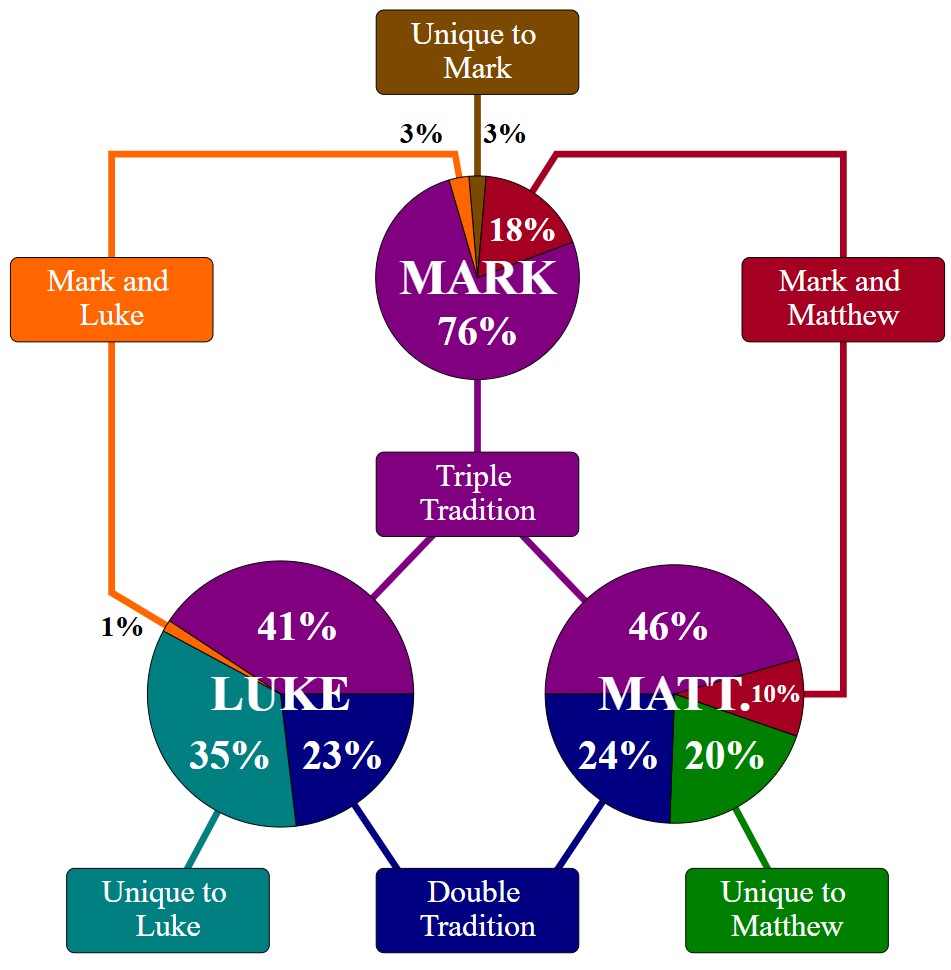
Scholars call Matthew, Mark, and Luke the “Synoptic Gospels” because they share so much in common. Most agree:

  • Mark was written first.
  • Matthew and Luke used Mark plus their own unique material.
  • They also shared a second source (called “Q” by many scholars), a collection of Jesus’ sayings.
  • John is completely independent, with 90% unique content.

This means the story of Jesus rests on at least five independent streams of tradition: Mark, Q (the “double tradition” below), Matthew’s unique material, Luke’s unique material, and John.

Key Insight: The differences skeptics point to show the Gospels did not copy from one master story. They arose independently from multiple witnesses and communities — and yet they converge on the same core events.


Clear Examples of Shared Wording

Even though the Gospels are independent, sometimes the overlap is so close it proves Matthew and Luke had Mark in front of them.

Example 1: Healing of Peter’s Mother-in-Law

  • Mark 1:30–31 – “Simon’s mother-in-law lay ill with a fever… He came and took her by the hand and lifted her up, and the fever left her, and she began to serve them.”
  • Matthew 8:14–15 – “He saw Peter’s mother-in-law lying sick with a fever. He touched her hand, and the fever left her, and she rose and began to serve him.”
  • Luke 4:38–39 – “Simon’s mother-in-law was ill with a high fever… He stood over her and rebuked the fever, and it left her, and immediately she rose and began to serve them.”

Key Insight: Mark and Matthew are almost word-for-word; Luke is close with only slight variation. This is the kind of passage that shows literary dependence.

Example 2: Feeding of the 5,000

  • Mark 6:41kai labōn tous pente artous kai tous duo ichthuas (“and taking the five loaves and the two fish…”)
  • Matthew 14:19kai labōn tous pente artous kai tous duo ichthuas (“and taking the five loaves and the two fish…”)
  • Luke 9:16labōn de tous pente artous kai tous duo ichthuas (“and taking the five loaves and the two fish…”)

Key Insight: Even if you can’t read Greek, you can see the phrase labōn tous pente artous kai tous duo ichthuas — “taking the five loaves and the two fish” — is virtually identical in all three accounts. This shows Matthew and Luke were drawing from Mark (or a common source) directly.


Gospel Dating: Skeptical Assumptions vs. Earlier Evidence

Critical scholars usually date the Synoptics after AD 70. Why? Because Jesus predicts the destruction of Jerusalem, and they assume prophecy is impossible — so the Gospels must have been written after the fact.

But there are strong reasons to believe the Gospels were written earlier:

  1. Paul’s Letters (c. AD 50s): Paul already quotes sayings of Jesus that appear in the Gospels, showing the traditions were circulating decades earlier.
    • 1 Corinthians 7:10–11 – “To the married I give this charge (not I, but the Lord): the wife should not separate from her husband… and the husband should not divorce his wife.”
      • Echoes Mark 10:11–12 / Matthew 19:6: “Whoever divorces his wife and marries another commits adultery… What God has joined together, let not man separate.”
    • 1 Corinthians 9:14 – “In the same way, the Lord commanded that those who proclaim the gospel should get their living by the gospel.”
      • Echoes Luke 10:7 / Matthew 10:10: “The laborer deserves his wages.”
    • 1 Corinthians 11:23–25 – “The Lord Jesus on the night when he was betrayed took bread… ‘This is my body… This cup is the new covenant in my blood.’”
      • Echoes Luke 22:19–20 / Matthew 26:26–28 / Mark 14:22–24: “This is my body, which is given for you… This cup is the new covenant in my blood.”
    Key Insight: Paul is not inventing these sayings. He introduces them as “from the Lord” and assumes his churches already know them. Paul treated these sayings as accurate, authoritative, and widely recognized decades before the written Gospels were finalized.
  2. The 1 Corinthians 15 Creed (early 30s):
    • “Christ died for our sins… he was buried… he was raised on the third day… he appeared to Cephas, then to the Twelve…”
    • Bart Ehrman (agnostic NT scholar): “An early tradition, probably going back to the early 30s CE, just a few years after Jesus’ death.” (Did Jesus Exist?, 2012, p. 132).
    • Gerd Lüdemann (atheist NT scholar): “The elements in the tradition are to be dated to the first two years after the crucifixion of Jesus.” (The Resurrection of Jesus, 1994, p. 38).
    • Key Insight: Even skeptics admit this creed goes back to the early 30s. It confirms the Gospel core: Jesus’ death, burial, resurrection, and appearances.
  3. The Christ Hymn (Philippians 2:6–11, early 30s):
    • “He humbled himself by becoming obedient to the point of death, even death on a cross. Therefore God has highly exalted him and bestowed on him the name that is above every name.”
    • James D.G. Dunn (critical scholar): “A tradition formulated and used in the worship of the earliest church, probably within a few years of the crucifixion.” (Christology in the Making, 1980, p. 114).
    • Key Insight: Like the 1 Cor 15 creed, this hymn dates to the early 30s. Christians were already singing about Jesus’ crucifixion and exaltation as Lord.
  4. The Ebionites (a heretical Christian group):
    • Early church fathers reported that the Ebionites, who fled to Pella around AD 70, were already altering Matthew’s Gospel to suit their theology.
    • That means Matthew had to exist before AD 70 — which also pushes Mark earlier.

Key Insight: The skeptical dating rests on rejecting prophecy, not historical evidence. When we look at Paul’s letters, the early creed in 1 Corinthians 15, the Christ Hymn in Philippians 2, and the Ebionites tampering with Matthew before AD 70 — the evidence shows that the Gospels and their message were already circulating within living memory of Jesus’ death.


Unity Despite Diversity

  • Later, John’s Gospel (c. AD 90s) was written from a different community and geography, with 90% unique material.
  • And yet John confirms the same core truths as the Synoptics: Jesus was crucified, raised, and exalted as Lord.

Key Insight: The diversity of the Gospels is striking, but their agreement on the essentials is even more powerful. Independent voices, written in different decades and places, converge on the same unshakable core.


The Passion as the Center of Every Gospel

Despite their differences, all four Gospels converge on one point: Jesus’ death and resurrection are the heart of the story.

Gospel% of Book on Last WeekWhere Passion Focus Begins% of Book from That Point
Matthew36% (ch. 21–28)Ch. 16 (“Sign of Jonah,” first passion predictions)51% (ch. 16–28)
Mark34% (ch. 11–16)Ch. 8 (first passion prediction)55% (ch. 8–16)
Luke27% (ch. 19–24)Ch. 9 (“sets his face toward Jerusalem”)65% (ch. 9–24)
John39% (ch. 12–21)From the start (“Lamb of God,” 1:29; “Destroy this temple”)100%

Key Insight: Up to two-thirds of the Synoptics, and virtually all of John, is oriented toward Jesus’ death and resurrection. No matter their differences, the cross is central in every Gospel.


9. The Burial Question

Skeptics like Bart Ehrman argue that Jesus’ body was probably left on the cross to rot or thrown into a common grave. They emphasize that part of the shame of crucifixion was being denied burial. But when we examine both the archaeology and the Jewish context, the burial of Jesus becomes historically plausible — even likely.

Archaeological Evidence

Out of hundreds of thousands of crucifixions in the Roman world, four sets of skeletal remains confirm that some victims were buried:

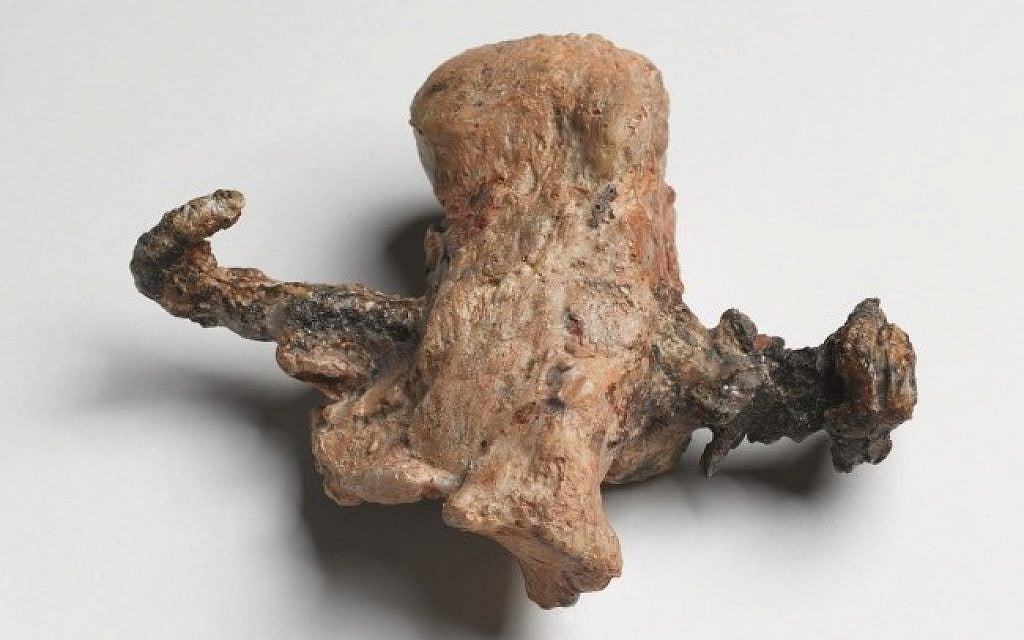
  1. Yehohanan (Jerusalem, before AD 70):
    • Found in 1968 in a family tomb at Giv’at ha-Mivtar, Jerusalem.
    • Heel bone pierced by an iron nail, with legs crushed (crurifragium).
    • Confirms Jewish crucifixion victims could be buried quickly, as Jewish law required, with legs broken to hasten death before sundown.
    • Significance: Matches exactly the Gospel detail in John 19:31–32 — Jewish law demanded burial the same day.
  2. Skeleton 4926 (Fenstanton, England, AD 130–360):
    • Discovered in 2017 in a Roman cemetery.
    • Heel bone pierced by a nail.
    • First confirmed crucifixion victim in Roman Britain.
    • Significance: Shows burial of crucifixion victims also happened outside Judea.
  3. Gavello, Italy (1st–2nd century AD):
    • Heel bone with hole, no nail preserved.
    • Poorer preservation, but consistent with crucifixion.
    • Significance: Suggests burial after crucifixion in northern Italy.
  4. Mendes, Egypt (Roman era):
    • Skeleton with hole in foot bone and above the knee, indicating nails and leg trauma.
    • Legs were crushed.
    • Significance: Confirms practices of nailing and leg-breaking extended beyond Judea.
Heel bone and nail from the ossuary of Yehohanan. Israel Museum
Skeleton 4926 with nail through heel bone. University of Cambridge

Key Insight: Though rare in the archaeological record, these four finds prove crucifixion victims were sometimes buried — including Jews in Jerusalem before AD 70.


Why the Evidence Is Rare

Romans crucified thousands across the empire — Josephus alone records mass crucifixions of 2,000 in 4 BC and so many in AD 70 that there was no room for the crosses or crosses for the bodies. Yet only four skeletons with crucifixion marks have been identified.

Why so few?

  • Most victims were tied with ropes rather than nailed. Rope leaves no trace on bone.
  • Many who were nailed were pierced through soft tissue (hands, wrists, ankles) rather than through bone, so no permanent mark was left.
  • Nails were valuable; Romans often pulled them out and reused them.
  • Bodies of the crucified were often left exposed or thrown into shallow graves where bones did not preserve.

Key Insight: The four skeletons we have are unique cases where the nail pierced bone (creating visible holes). They prove crucifixion victims could be buried — and that some were. The rarity of finds reflects the method of crucifixion, not its improbability.


Jewish Law and Tradition

  • Deuteronomy 21:22–23 — “His body shall not remain all night upon the tree, but you shall bury him the same day.”
  • Dead Sea Scrolls (11Q Temple, 4QpNahum): Apply this law directly to crucifixion.
  • m.Sanhedrin 6:5: “Anyone who delays burial to the next day has transgressed a commandment.”
  • Rabbi Moses ben Nahman (1194–1270): Even the worst criminal deserves burial: “Do not leave his body hanging… someone who is hanged is more accursed and degraded than anyone else.”
  • Targum Pseudo-Jonathan: “It is an affront to God to crucify a man… bury him.”

Key Insight: Burial of executed criminals was a matter of Jewish law. Roman governors in Judea often made concessions to Jewish customs, especially in Jerusalem, to avoid unrest.


Jesus’ Unique Situation

  • In Jewish revolts, Rome crucified thousands at once — no one could be buried properly.
  • In Jesus’ case, he was crucified alone.
  • The Gospels note his disciples had fled, and only a handful of women and “the disciple whom he loved” stood by.
  • With one man to bury, and with Joseph of Arimathea’s intervention (a wealthy, respected figure), a same-day burial was both possible and consistent with Jewish law.

Key Insight: The combination of archaeological finds, Jewish law, and the fact that Jesus was crucified as a lone figure — not in a mass uprising — makes his burial historically credible.


10. Conclusion: The Unshakable Core

Even the most skeptical historians agree that certain facts about Jesus can be known with near certainty. These are not matters of faith, but of historical consensus:

  • Jesus was a Galilean Jew who lived in the early first century.
  • He had siblings, and his primary language was Aramaic.
  • He was baptized by John the Baptist.
  • He became a teacher of an apocalyptic worldview, proclaiming that God’s kingdom was at hand.
  • He gathered disciples.
  • He was handed over to the Roman authorities during the governorship of Pontius Pilate.
  • He was crucified.
  • He died by crucifixion.
  • Afterward, his followers believed they saw him risen from the dead.

Bart Ehrman (agnostic scholar):

One of the most certain facts of history is that Jesus was crucified on orders of the Roman governor of Judea, Pontius Pilate.” (The New Testament: A Historical Introduction, 2011, p. 163).

Gerd Lüdemann (atheist scholar):

It may be taken as historically certain that Peter and the disciples had experiences after Jesus’ death in which he appeared to them as the risen Christ.” (The Resurrection of Jesus, 1994, p. 38).


Why This Matters

  1. Unity across Christian traditions.
    Roman Catholic, Eastern Orthodox, and Protestant Christians may differ in many areas, but all agree on these essentials. The death and resurrection of Jesus are the shared foundation of the faith. This is enough to unite Christians across traditions.
  2. Engagement with the unaffiliated and skeptical.
    Even using only atheist consensus, we have enough to demonstrate that Christianity is rooted in real history. Jesus was crucified under Pilate, and his followers truly believed they saw him alive again. This gives us a credible basis for dialogue with the unaffiliated, agnostics, and atheists.

Key Insight: The earliest Christians did not persuade the world with abstract arguments, but with the visible impact of their faith on their communities. They cared for the poor, rescued abandoned children, tended the sick, and loved one another as family. The greatest apologetic was not simply what they believed about Jesus, but how those beliefs changed their lives.

And the same is true today. The unshakable core — Jesus crucified, buried, risen, and exalted — continues to change lives and communities. It is enough for our faith, enough for Christian unity, and enough to show the world that this faith is historically reliable and still alive.

Multiplying by Mission: Session 1 at Mission Lake

40% Growth Then, 5% Growth Now — What We Must Learn Anew

Opening & Welcome

Good evening, everyone, and welcome to our first session of Multiplying by Mission.

My name is Jason Conrad. I live here in South Carolina with my wife Jen and our family. By profession, I serve as a district leader with CVS Health, overseeing nearly twenty stores and hundreds of employees. My background is in healthcare and leadership — I hold both a Doctor of Pharmacy (PharmD) and a Master of Business Administration (MBA) — and I’ve spent many years leading in that field.

But alongside that, my deepest calling is teaching God’s Word and the history of His church. I also hold a Bachelor’s degree in Biblical Studies and a Master of Divinity, with a focus on the New Testament, early Christian history, and how the first believers lived out their faith in the Roman Empire.

Back in 2000, I moved to South Carolina to help start Christ Central Institute. From the very beginning, I’ve believed in the vision of equipping leaders and serving communities through Christ Central. I’ve been teaching for years in the church, and I’ve seen again and again how knowing our history strengthens our faith.

This series has a big title: Multiplying by Mission — 40% Growth Then, 5% Growth Now — What We Must Learn Anew.


The State of Christianity in the World Today

Christianity is still the largest global religion, but the landscape is shifting. According to Pew Research Center (The Future of World Religions: Population Growth Projections, 2017–2021 updates):

MetricChristianityIslamUnaffiliated
2020 Total Share28.8%25.6%24.2%
2010–2020 Growth+5.7%+20.7%+11.4%
Primary Growth AreasAfrica, AsiaAfrica, Asia, MENANorth America, Europe, East Asia

Now compare that with the first three centuries of the church. Sociologist Rodney Stark, in his book The Rise of Christianity (HarperCollins, 1996), famously calculated Christianity’s growth at about 40% per decade. Stark wasn’t writing as a theologian but as a sociologist, showing how a small sect could realistically have expanded to millions within three centuries. His analysis demonstrates that Christianity’s explosive rise is historically plausible, not legendary.

  • AD 40: ~1,000 Christians
  • AD 100: ~7,000–10,000
  • AD 150: ~40,000
  • AD 200: ~200,000
  • AD 250: ~1,000,000
  • AD 300: ~6,000,000
  • AD 350: ~30,000,000 (roughly half the empire)

If today’s church grew at that same rate, 2.3 billion Christians would become nearly the entire global population by AD 2070.

This is why our series is called Multiplying by Mission. The first Christians multiplied by 40% a decade. Today, we grow at 5%. The question before us is: what did they know that we must learn anew?


What Would It Take to Grow Like That Again?

So what would it take for us to recover that kind of momentum? Here’s one way to think about it:

SourceTarget % per DecadeHow to Get There
Retention of Christians+10%Keep 75–80% of all who enter the church — whether raised Christian or converted as adults — through discipleship, mentoring, apologetics, and community
Evangelism of Unaffiliated+15%Reconnect ~20% of “nones” each decade through service, digital outreach, hospitality, and apologetics
Combined Total25% per decadeSignificant growth, but still below the early church’s ~40% per decade

Now, you might be wondering: is 75–80% retention even possible? Today in America, only about half of kids raised Christian stay Christian as adults — and many adults who convert later in life also drift away. Retention is not just about keeping youth; it’s about keeping everyone who enters the church.

In the early church, retention had to be much higher across the board. Why? Because persecution weeded out nominal believers, catechesis trained converts before baptism, and Christian community bound people together in ways far stronger than what we often see today.

And this doesn’t even include conversions from other religions like Islam or Hinduism, or the natural increase from Christian birth rates. When you factor those in, the growth potential could push even higher.


The 18-Year-Old in the Classroom

Picture an 18-year-old. She’s grown up in church her whole life. She’s been told the Bible is true, and she’s never really faced serious doubt.

She graduates high school and heads to university. She signs up for “Introduction to the New Testament” — thinking it’ll be an easy A.

What she doesn’t realize is that the professor is one of the most famous Bible scholars in the world today. He’s written or edited more than 30 books, several bestsellers. He’s the author of the textbook used in universities across the country. He used to be a devout evangelical Christian — but he lost his faith. In his own words: “I no longer go to church, no longer believe, no longer consider myself a Christian.”

Now picture her in a lecture hall with 400+ students. Many grew up in church. Many think this will reinforce what they already know.

Instead, the professor walks in with humor, confidence, and command of the text — and begins by dismantling assumptions: contradictions, manuscript problems, alleged forged letters, the problem of suffering, and arguments against miracles.

By the end of the semester, she isn’t angry. She isn’t hostile. She’s just unsure. On a survey, she checks “unaffiliated.”

That’s the world we live in. Christianity is growing slowly in much of the West, and defections are common. This is why this class matters.


The Seven Tactics of Skeptical Professors

1. The Apollonius of Tyana Comparison

“I sometimes begin my undergraduate classes in New Testament studies by telling my students that I am going to describe a person to them, and they have to tell me who it is. I then talk about a man who lived some time ago, who was said to have been miraculously born, who taught his followers, did miracles to confirm that he was a son of God, convinced many people that he was divine, and then at the end of his life ascended to heaven. When I ask them who this sounds like, they invariably say Jesus. But the person I’m describing is Apollonius of Tyana.”
— Bart D. Ehrman, Did Jesus Exist? (2012), p. 211

2. Textual Variants in the New Testament

“Not only do we not have the originals, we don’t have the first copies of the originals… What we have are copies made later — much later… And these copies all differ from one another, in many thousands of places… there are more variations among our manuscripts than there are words in the New Testament.”
— Bart D. Ehrman, Misquoting Jesus (2005), pp. 10–11

3. Contradictions in the Gospels

“In the Gospel of Mark, Jesus says, ‘Whoever is not against us is for us’ (9:40). In Matthew he says, ‘Whoever is not with me is against me’ (12:30). Did Jesus say both things? Could he really mean both? Isn’t there a contradiction here?”
— Bart D. Ehrman, Jesus Interrupted (2009), p. 41

“In Mark’s account, Jairus comes to Jesus and tells him that his daughter is near death… In Matthew’s version… Jairus comes to Jesus and tells him that his daughter has already died. Which is it?”
Jesus Interrupted, pp. 39–40

4. Authorship and Pseudonymity

“Of the thirteen letters that go under Paul’s name in the New Testament… Six of them are widely regarded as pseudonymous… That leaves seven letters that virtually all scholars agree Paul actually wrote.”
— Bart D. Ehrman, Forged (2011), p. 106

5. The Problem of Suffering

“For me the problem of suffering is the reason I lost my faith… For many people who inhabit this planet, life is a cesspool of misery and suffering. I came to a point where I simply could not believe there is a good and kindly disposed Ruler who is in charge of it. That is why I left the faith.”
— Bart D. Ehrman, God’s Problem (2008), p. 2

6. The Limits of History and Miracles

David Hume, writing in 1748, is often quoted as if he “disproved” miracles. In his Enquiry Concerning Human Understanding (Section 10), he wrote:

“A wise man… proportions his belief to the evidence. A miracle… is a violation of the laws of nature… and the proof against a miracle… is as strong as any argument from experience can be.”

Bart Ehrman echoes the same line:

“Historians, by the very nature of their craft, cannot show whether miracles happened… History can only establish what probably happened in the past. And miracles, by definition, are the least probable events.”
— Bart D. Ehrman, How Jesus Became God (2014), p. 229

But Hume also admitted:

“No testimony is sufficient to establish a miracle, unless the testimony be of such a kind, that its falsehood would be more miraculous than the fact which it endeavors to establish.”

So even Hume acknowledged that miracles are not impossible — if the evidence is strong enough.

7. Student Reactions

“Most of my students have never heard this before… They discover that we don’t have the original copies of any of the biblical books but only copies made centuries later, all of which have been altered.”
— Bart D. Ehrman, Misquoting Jesus (2005), p. 10

“I came into this class a Christian; I don’t know if I can still call myself that.”
Misquoting Jesus, p. 11


Discussion and Reflection

  • Which of these seven tactics strikes you the hardest?
  • Why do you think so many 18-year-olds leave their first semester doubting their faith?

The Seven Undisputed Letters of Paul

Now here’s where things get really important. We’ve just seen how skeptical professors use tactics to shake students. But this is where atheists and Christians agree.

For more than 150 years, across the entire scholarly spectrum, critics and believers alike have affirmed that at least seven letters of Paul are authentic. These are not in dispute. They are the bedrock of New Testament studies.

These seven letters are:

  • Galatians
  • 1 Thessalonians
  • 1 Corinthians
  • 2 Corinthians
  • Romans
  • Philippians
  • Philemon

Bart Ehrman writes:

“There is no doubt that Paul wrote Galatians, Romans, 1 and 2 Corinthians, 1 Thessalonians, Philippians, and Philemon.”
(Forged, 2011, p. 112)

Richard Carrier agrees:

“The seven letters generally agreed upon as authentic… are sufficient to reconstruct the basic outline of Paul’s theology and missionary activity.”
(On the Historicity of Jesus, 2014, p. 510)

And this consensus is not new. In the mid-1800s, the German scholar Ferdinand Christian Baur, founder of the Tübingen School of criticism, argued that only four Pauline letters were authentic: Galatians, 1 & 2 Corinthians, and Romans. Even Baur, one of the most radical critics of his time, accepted those. Over time, scholarship expanded that number to seven. For more than 150 years now, across skeptical and believing scholarship alike, the consensus has held firm at these seven letters.


The Skeptic Consensus of Early Christian Literature

  • AD 30 — Crucifixion of Jesus
  • AD 31–33 (31–35 by skeptical allowance) — Paul’s conversion and the earliest Christian creeds (1 Cor 15; Phil 2)
  • AD 48–50 — Galatians
  • AD 50–51 — 1 Thessalonians
  • AD 53–54 — 1 & 2 Corinthians
  • AD 56–57 — Romans
  • AD 60–61 — Philippians, Philemon
  • AD 70 — Gospel of Mark
  • AD 80 — Matthew, Luke
  • AD 90 — Acts
  • AD 90–95 — John
  • AD 95–100 — Revelation, 1–3 John, 1 Clement, Didache
  • AD 70–110 — All the rest of the New Testament writings

What We Gain from the Seven Letters

1. Resurrection proclaimed almost immediately
“For what I received I passed on to you as of first importance: that Christ died for our sins according to the Scriptures, that he was buried, that he was raised on the third day according to the Scriptures, and that he appeared to Cephas, and then to the Twelve. After that, he appeared to more than five hundred… Then he appeared to James, then to all the apostles, and last of all he appeared to me also.”
1 Corinthians 15:3–7

2. Paul’s conversion shockingly early
“…But when God… was pleased to reveal his Son in me so that I might preach him among the Gentiles, my immediate response was not to consult any human being. I did not go up to Jerusalem to see those who were apostles before I was, but I went into Arabia. Later I returned to Damascus. Then after three years, I went up to Jerusalem to get acquainted with Cephas…”
Galatians 1:15–18

“Then after fourteen years, I went up again to Jerusalem, this time with Barnabas. I took Titus along also.”
Galatians 2:1

Together, these two passages account for 17 years after Paul’s conversion. If Galatians was written by AD 48–50, Paul’s conversion falls between AD 31–33 — skeptics stretch to AD 35 at the latest.

3. Persecution unbroken since AD 30

Persecution runs as an unbroken line from the cross itself, through Paul’s own life before and after conversion, and into the churches he planted.

  • Jesus was crucified under Pontius Pilate (the Roman state itself initiating persecution, AD 30).
  • Paul confesses himself a persecutor:
    “For you have heard of my previous way of life in Judaism, how intensely I persecuted the church of God and tried to destroy it.”Galatians 1:13
    “For I am the least of the apostles and do not even deserve to be called an apostle, because I persecuted the church of God.”1 Corinthians 15:9
    “…as to zeal, persecuting the church; as to righteousness under the law, faultless.”Philippians 3:6
  • Persecution continued after Paul’s conversion:
    “You became imitators of God’s churches in Judea, which are in Christ Jesus: You suffered from your own people the same things those churches suffered from the Jews, who killed the Lord Jesus and the prophets and also drove us out.”1 Thessalonians 2:14–15

This shows that from AD 30 onward, persecution was a constant reality — first in Jesus’ death, then in Paul’s own role as persecutor, and then in the sufferings of the churches themselves.

4. Paul quoting Jesus traditions already circulating

Paul’s letters contain direct echoes of Jesus’ words — traditions that match the Gospels, even though they were written earlier:

  • The Lord’s Supper
    “For I received from the Lord what I also passed on to you: The Lord Jesus, on the night he was betrayed, took bread, and when he had given thanks, he broke it and said, ‘This is my body, which is for you; do this in remembrance of me.’ In the same way, after supper he took the cup, saying, ‘This cup is the new covenant in my blood; do this, whenever you drink it, in remembrance of me.’”
    1 Corinthians 11:23–25
    (Matches Matthew 26:26–28; Mark 14:22–24; Luke 22:19–20)
  • On Divorce
    “To the married I give this command (not I, but the Lord): A wife must not separate from her husband. But if she does, she must remain unmarried or else be reconciled to her husband. And a husband must not divorce his wife.”
    1 Corinthians 7:10–11
    (Matches Mark 10:11–12; Luke 16:18)
  • On Ministry Support
    “In the same way, the Lord has commanded that those who preach the gospel should receive their living from the gospel.”
    1 Corinthians 9:14
    (Matches Luke 10:7: “The worker deserves his wages.”)

These passages show that Jesus’ words were already circulating and authoritative decades before the Gospels were written.

5. Jesus worshiped as divine

The Christ Hymn of Philippians 2:6–11 is structured as a chiasm — a mirror-like pattern where the descent of Christ is matched by his exaltation:

Chiastic Structure (Philippians 2:6–11):

  • A – Divine Lord
    “Being in the form of God… equality with God”
  • B – Loss of all recognition
    “Did not consider equality with God something to hold tightly… emptied himself”
  • C – Common name
    “Taking the form of a servant… born in human likeness”
  • D – Obedient to death
    “He humbled himself… even death on a cross”
  • C′ – Highest name
    “God gave him the name that is above every name”
  • B′ – Universal recognition
    “Every knee will bow… every tongue confess”
  • A′ – Divine Lord
    “Jesus Christ is Lord, to the glory of God the Father”

This hymn shows that within the very first generation, Christians were already worshiping Jesus as divine Lord. The wording echoes Isaiah 45, where every knee bows to Yahweh — now applied to Jesus.

6. Transformed lives
“Do not be deceived: Neither the sexually immoral nor idolaters nor adulterers nor men who have sex with men nor thieves nor the greedy nor drunkards nor slanderers nor swindlers will inherit the kingdom of God. And that is what some of you were. But you were washed, you were sanctified, you were justified in the name of the Lord Jesus Christ and by the Spirit of our God.”
1 Corinthians 6:9–11

7. Missionary movement
“From Jerusalem and all the way around to Illyricum, I have fully proclaimed the gospel of Christ… It has always been my ambition to preach the gospel where Christ was not known, so that I would not be building on someone else’s foundation… But now that there is no more place for me to work in these regions… I plan to do so when I go to Spain.”
Romans 15:19–24


Conclusion

From the seven undisputed letters — writings atheists and Christians alike affirm — we know:

  • Jesus was crucified.
  • The resurrection was proclaimed immediately.
  • Paul converted within just a few years.
  • Persecution has been unbroken since AD 30.
  • Jesus was worshiped as divine.
  • Eyewitnesses were consulted.
  • Lives were transformed.
  • The mission was global from the start.

Even on skeptical terms, the core of Christianity stands firm.


Reinforcement: Blog & Podcast

For further study, students are encouraged to listen to and read supplemental content on Jason’s Living the Bible podcast and blog:

  • Podcast: When Atheists and Christians Agree: The 7 Undisputed Letters of Paul (May 26, 2025).
  • Podcast: Christianity Before Paul: The Traditions He Inherited (May 28, 2025).
  • Blog Post: Christianity’s Unstoppable Growth in the First 300 Years.

These reinforce today’s themes: the growth of Christianity, the consensus on Paul’s letters, and the firm historical core of the faith even on skeptical terms.