Multiplying by Mission: Session 5 at Mission Lake

40% Growth Then, 5% Growth Now — What We Must Learn Anew

When Tiberius died in AD 37, the Roman people rejoiced at the promise of change. Into power stepped Gaius Julius Caesar Germanicus (r. AD 37-41), beloved son of the general Germanicus, great-grandson of Augustus through Agrippina the Elder, and nephew of Tiberius. To the legions, he was known by the childhood nickname Caligula — “little boots.”

At first, he was adored as the heir of Augustus’ line. Yet within months, the empire discovered that Caligula was not content to be Caesar. He demanded to be a god.


A Different Kind of “Son of God”

Augustus (27 BC–AD 14) had styled himself Divi Filius — “Son of the Deified One” — because Julius Caesar had been declared a god after his assassination in 44 BC. Augustus allowed temples to himself in the provinces, but in Rome he restrained such worship and was only deified by the Senate after his death.

Tiberius (AD 14–37) likewise resisted divine honors while alive.

Tacitus, Annals 4.37 §37 (c. AD 115, Loeb):

“The emperor was not to be worshipped as a god; that title, he said, was reserved for the memory of princes.”

But Caligula (AD 37–41) broke with precedent. He did not wait for death or the Senate’s decree. He demanded worship as Jupiter himself.

Suetonius, Caligula 27 §27 (c. AD 121, Loeb):

“He claimed divine honors, set up temples and priests in his name, and placed a golden image of himself in the temple of Jupiter, beside which stood another likeness of the god. Every day he had this dressed in clothes like his own.”

Cassius Dio, Roman History 59.6 §6 (c. AD 229, Loeb):

“Since he was now styling himself a god, he pretended that those who failed to address him as such were guilty of impiety.”


Manipulating the Gods

Caligula’s ambition was not content with prayers and sacrifice. He replaced the very faces of the gods with his own.

Suetonius, Caligula 22 §22 (c. AD 121, Loeb):

“He caused the heads to be removed from several statues of gods and his own to be set on them instead. In such fashion he was even represented as Jove.”

Cassius Dio, Roman History 59.28 §28 (c. AD 229, Loeb):

“He ordered that the statue of Olympian Zeus be brought from Greece, in order that his own statue, which he had made as a copy of it, might be set up in its place, and he wished to be thought to be Zeus.”

By altering the sacred images of Jupiter and Zeus, Caligula declared that the gods themselves must yield to his likeness. If he could replace the greatest gods of Greece and Rome, what god was left to resist him? Inevitably his eyes turned to Jerusalem.
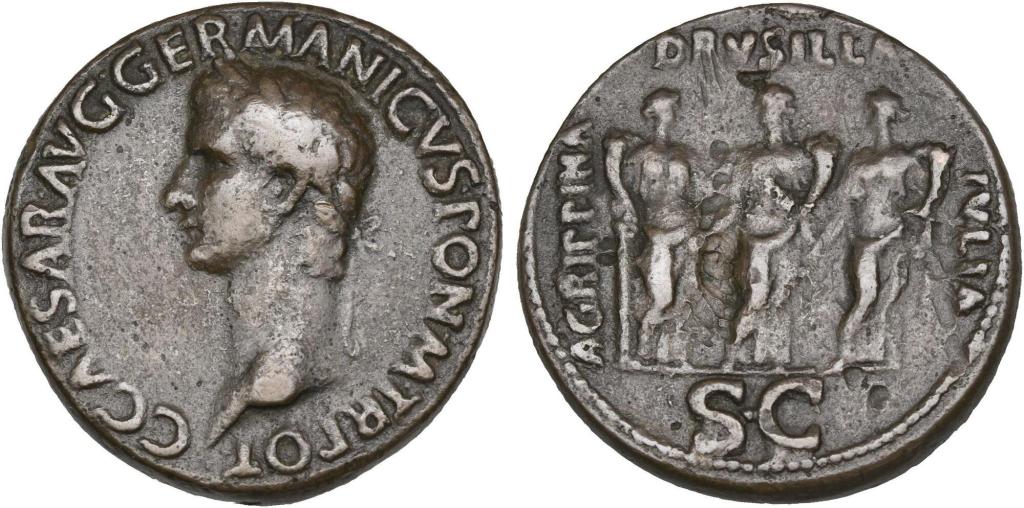
C CAESAR AVG GERMANICVS PON M TR POT = Gaius Caesar Augustus Germanicus, Pontifex Maximus, holder of tribunician power; AGRIPPINA DRVSILLA IVLIA, S C = Agrippina, Drusilla, Julia. By decree of the Senate. Caligula’s three sisters are presented as the three goddesses Securitas (Security), Concordia (Harmony), Fortuna (Fortune). He viewed his whole family as divine and also that the whole senate agreed.

Cruelty Without Bound

Divinity was not the only claim Caligula made. He also made himself the arbiter of life and death, delighting in cruelty.

Suetonius, Caligula 30 §30 (c. AD 121, Loeb):

“He often had men of consular rank scourged with rods and forced to carry heavy loads for miles together. Others he compelled to stand all night long in the rain, in their linen tunics; and he had some killed for mere trifles.”

Suetonius, Caligula 32 §32 (c. AD 121, Loeb):

“He delighted in witnessing the suffering and slaughter of those who were being punished, and would from time to time make their agonies longer by ordering their wounds to be dressed and their bodies rubbed, only that they might be tortured with renewed severity.”

Cassius Dio, Roman History 59.27 §27 (c. AD 229, Loeb):

“He would kill men of the noblest rank and make their wives watch; he would invite them to dinner and suddenly have them seized and put to death before his eyes. He took pleasure in seeing the looks and hearing the cries of those who were perishing.”

This is why ancient historians consistently remember Caligula as one of the most depraved rulers in Roman history.


A Statue in the Holy of Holies

In AD 39–40, Caligula issued his most dangerous order: to set up a colossal statue of himself in the Temple at Jerusalem. To Jews, this was unthinkable. They chose defiance, prepared to die rather than allow their sanctuary to be defiled.

Josephus, Antiquities 18.8.2 §261–262 (c. AD 93, Loeb):

“Petronius was amazed at their determination, and assembling the people of the Jews in a plain, he asked them why they opposed Gaius, their lord, and his proposal to set up the statue. But they threw themselves down on the ground and laid bare their necks, and declared that they were ready to be slain rather than transgress the law.”

Josephus, Antiquities 18.8.4 §278 (c. AD 93, Loeb):

“‘We will neither fight nor flee,’ they said, ‘but we will die with our children and wives; if you desire, kill us; we shall die willingly, since we shall not by living transgress the laws of our worship.’”

Josephus, War 2.10.4 §195 (c. AD 75, Loeb):

“They lay prostrate for forty days together, fasting the while, and besought Petronius that he would not compel them to transgress the law of their fathers.”

The man charged with enforcing this order was Publius Petronius, the Roman governor of Syria. His role made him one of the most powerful men in the East, with direct oversight of Judea. Loyal to Rome yet cautious by temperament, Petronius knew his first duty was to preserve the peace of Rome.

He saw what Caligula could not: forcing this statue into the Temple would ignite rebellion not only in Judea but across Syria.

Josephus, Antiquities 18.8.9 §297–299 (c. AD 93, Loeb):

“Petronius, seeing the determination of the people, took the blame upon himself. He wrote to Gaius saying that all Judaea would be in revolt if he insisted on setting up the statue, and he prepared his wife and children for his own death.”

This was no act of cowardice. It was Roman statecraft. Petronius delayed Caligula’s order to preserve stability in the East. But Caligula’s madness could not endure defiance. He sent a letter commanding Petronius to commit suicide.

Josephus, Antiquities 18.8.9 §302 (c. AD 93, Loeb):

“While the letter commanding Petronius to take his own life was on its way, a message came that Gaius had been slain. So Petronius was saved.”

Thus the Temple was spared, Judea preserved, and Petronius’ life delivered — not because Caligula relented, but because Caligula himself was assassinated in AD 41. For Jews and Christians alike, his death was remembered as a deliverance.


A Philosopher Before a Madman

At the same time in Alexandria, Jewish synagogues were seized and mobs attacked. A delegation was sent to Rome to plead their case before the emperor. It was led by Philo of Alexandria (c. 20 BC – AD 50), a Jewish philosopher who blended Greek philosophy with Jewish faith. In his work Embassy to Gaius, Philo gives us an eyewitness account of standing before Caligula.

Philo, Embassy to Gaius §206 (c. AD 41–42, Loeb):

“He would run off in one direction to some peacocks, and then dart away in another to a grove of trees… We followed him like men in a triumphal procession, prisoners led along.”

Philo, Embassy to Gaius §§351–352 (c. AD 41–42, Loeb):

“‘You are men who refuse to acknowledge that I have been made a god, though I am clearly so.’ And when we tried to tell him about our national customs, he laughed the more and said: ‘You are not defending your own religion, you are accusing mine.’”

Philo, Embassy to Gaius §358 (c. AD 41–42, Loeb):

“No one could predict what he would do. His madness was like the sea, driven now this way, now that, by opposing winds.”

Philo’s description is chilling. The Jews stood as petitioners for their lives, but Caligula mocked them, dismissed their ancestral faith, and insisted on being recognized as divine. For Christians, still indistinguishable from Jews in the eyes of Rome, the fate of the synagogue was their fate as well.

And Philo’s embassy brought no relief. The violence in Alexandria did not stop; persecution of Jews — and by extension Christians — continued in the city. When Claudius became emperor, one of his earliest acts was to issue a decree to Alexandria ordering both Greeks and Jews to cease hostilities. This confirms that the hostility Philo described under Caligula was not resolved by his death.


Herod Agrippa I: A King Like His Friend Caligula

The madness of Caligula did not stop at Rome’s throne. His friend and client king, Herod Agrippa I, was appointed ruler of Judea by Caligula himself. Agrippa, also Herod the Great’s grandson, enjoyed Caligula’s favor and mirrored his arrogance. Like Caligula, he accepted divine honors — and, like Caligula, he met a sudden and humiliating end.

But before his death, Herod Agrippa turned his power against the church.

Acts 12:1–3 (c. AD 62):

“About that time Herod the king laid violent hands on some who belonged to the church. He killed James the brother of John with the sword, and when he saw that it pleased the Jews, he proceeded to arrest Peter also. This was during the days of Unleavened Bread.”

James, son of Zebedee and brother of John, thus became the first apostle to be martyred. Peter was imprisoned, but God intervened.

Acts 12:6–11 (c. AD 62):

“Now when Herod was about to bring him out, on that very night, Peter was sleeping between two soldiers, bound with two chains, and sentries before the door were guarding the prison. And behold, an angel of the Lord stood next to him, and a light shone in the cell. He struck Peter on the side and woke him, saying, ‘Get up quickly.’ And the chains fell off his hands. … Peter said, ‘Now I am sure that the Lord has sent his angel and rescued me from the hand of Herod and from all that the Jewish people were expecting.’”

So in one chapter, Herod Agrippa I presides over both the martyrdom of James and the near-martyrdom of Peter.

Then comes the climactic scene.

Acts 12:21–23 (c. AD 62):

“On the appointed day Herod, wearing his royal robes, sat on his throne and delivered a public address to the people. They shouted, ‘This is the voice of a god, not of a man.’ Immediately, because Herod did not give praise to God, an angel of the Lord struck him down, and he was eaten by worms and died.”

Amazingly, the Jewish historian Josephus (writing c. AD 93) gives an independent account of the same event in Caesarea.

Josephus, Antiquities 19.8.2 §§343–361 (c. AD 93, Loeb):

“On the second day of the shows, clad in a garment woven completely of silver so that its texture was wondrous, he entered the theater at daybreak. There the silver, illumined by the touch of the first rays of the sun, was wondrously radiant and by its glitter inspired fear and awe in those who gazed intently upon him.

Straightway his flatterers raised their voices from various directions—though hardly for his good—addressing him as a god. ‘Be gracious to us!’ they cried. ‘Hitherto we have revered you as a human being, but henceforth we confess you to be more than mortal.’

The king did not rebuke them nor reject their impious flattery. A little later he looked up and saw an owl sitting on a rope above his head, and at once recognized it as a messenger of evil as it had once been a messenger of good to him. A pang of grief pierced his heart. He was also seized with a severe pain in his belly which began with a violent attack.

Accordingly he looked upon his friends and said, ‘I, whom you call a god, am commanded presently to depart this life, while Providence thus reproves the lying words you just now addressed to me. I, who was by you called immortal, am immediately to be hurried away by death.’

And when he had suffered continuously for five days from pain in his belly, he departed this life, in the fifty-fourth year of his age and the seventh year of his reign.”


Comparison: Acts 12 and Josephus

  • Setting: Both place the event at Caesarea, during a public festival.
  • Robes: Acts says Agrippa wore “royal robes.” Josephus specifies a robe woven entirely of silver, dazzling in the sunlight.
  • Acclamation: Both record the crowd shouting that he was more than a man, a god.
  • Judgment: Acts says an angel struck him and he was “eaten by worms.” Josephus says an owl appeared as an omen, he was struck with severe abdominal pain, and died five days later.
  • Theological Frame: Acts interprets the cause as divine judgment for not giving glory to God. Josephus interprets it as ominous fate, but preserves the same sudden, humiliating sequence of events.

Key Insight: The details differ — “worms” versus “abdominal agony,” “angel” versus “owl omen” — but the core story is the same. Herod Agrippa accepted divine honors, was immediately struck with sudden illness, and died a painful death at Caesarea. The agreement between Luke (in Acts) and Josephus on these essentials is one of the most striking convergences between the New Testament and external history.


Conclusion: The Church Under Caligula

Caligula’s reign (AD 37–41) was one of the most dangerous moments in Jewish and Christian history. His demand for divine worship and his order to set up his statue in the Jerusalem Temple threatened to destroy Jewish life altogether. In Alexandria, Jews were attacked in the streets, their synagogues seized, and they were mocked before the emperor himself. Since Rome still regarded Christians as a branch of Judaism, they shared the same precarious fate. Any blow that fell on the synagogue would inevitably fall on the church as well.

And yet — while Jews and Christians alike were under crushing imperial pressure in Judea and Alexandria, the gospel was quietly taking root elsewhere. In the great city of Antioch in Syria, well outside Judea’s geography, a new Christian community grew strong. It became the first great headquarters of the Gentile mission.

Luke records this simple but profound line:

Acts 11:26 (c. AD 62):

“And in Antioch the disciples were first called Christians.”

Notice the phrasing: they were called Christians. It is a passive statement. They did not name themselves; society around them began to recognize that this movement was not simply another form of Judaism. This is the first time in history that the church was publicly marked out as distinct from the synagogue.

So under Caligula, while Jews and Christians together faced threats of extinction in Judea and Alexandria, the church simultaneously broke into new ground. By AD 41, there was not only a thriving congregation in Antioch, but one that was recognized by outsiders as a new kind of community, centered on Christ.

Key Insight: Caligula’s reign shows both the fragility and the resilience of the early church. At the very moment when an emperor demanded worship as a god and threatened the Temple itself, the church expanded beyond its Jewish cradle. From Jerusalem to Samaria to Antioch, it gained a new identity and a new name: Christian.


Claudius (AD 41–54)

When Caligula was assassinated in AD 41, Rome teetered on the edge of chaos. The Senate debated restoring the Republic, but the Praetorian Guard found Caligula’s uncle, Tiberius Claudius Caesar Augustus Germanicus, hiding behind a curtain in the palace. They dragged him out, proclaimed him emperor, and Rome accepted their choice.

Claudius was the younger brother of Germanicus (Caligula’s father), making him Caligula’s uncle. Through his grandmother Livia, he was also the step-grandson of Augustus. Though mocked in his youth for his limp and his stammer, Claudius proved to be a capable administrator. His reign lasted thirteen years (AD 41–54) and brought stability after the madness of Caligula.

For Jews — and for Christians still regarded as Jews in Roman eyes — Claudius’ reign marked an important turning point. He revived the protections first granted by Julius Caesar, reaffirmed by Augustus, and now extended them across the empire. Yet he also ordered the expulsion of Jews from Rome when unrest broke out — an act that swept up Jewish Christians as well.
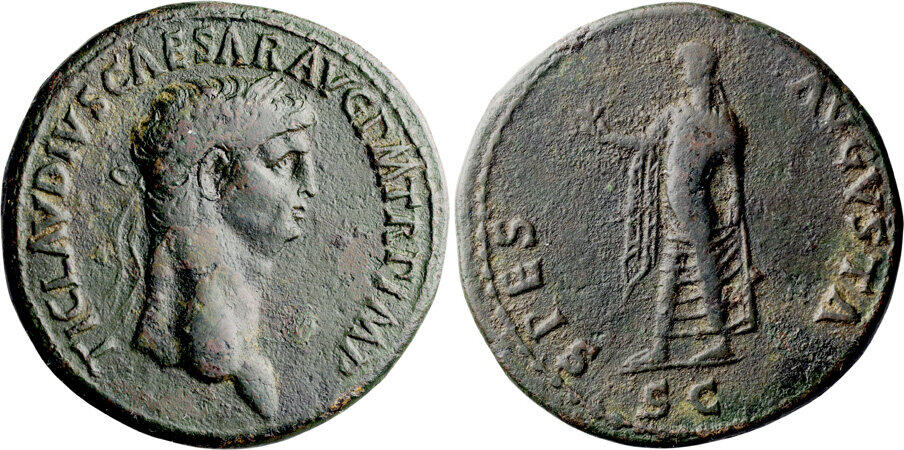
TI CLAVDIVS CAESAR AVG PM TR P IMP P P = Tiberius Claudius Caesar Augustus, Pontifex Maximus, holder of tribunician power, Imperator, Father of the Fatherland; SPES AVGVSTA S C = The Hope of the Augustan Age, by the senate’s decree. Spes was the goddess of hope and optimism. This early coinage looked forward to Claudius’ restoration of Augustus’ policies and leadership.

Claudius’ Letter to the Alexandrians

One of Claudius’ earliest acts was to settle the unrest in Alexandria, where Jews and Greeks had clashed violently under Caligula. His letter, preserved by Josephus, confirms Jewish rights while commanding peace.

Josephus, Antiquities 19.5.2 §§278–285 (c. AD 93, Loeb):

“Tiberius Claudius Caesar Augustus Germanicus, imperator, consul, tribune of the people, to the city of the Alexandrians, greeting.

I have long been aware of the feuds existing among you with the Jewish community, and now I have learned that seditions and wars are being stirred up afresh by them, against their own advantage and that of the general good.

Therefore I enjoin the Alexandrians to behave peaceably and kindly toward the Jews who have for a long time dwelt in the same city, and not to insult any of their customs in the practice of their worship, but to allow them to keep to their own ways, as they did under the divine Augustus.

As for the Jews, I order them not to seek to extend their settlements any further, but to be content with what they have long possessed, and not to bring in or admit Jews from Syria or Egypt, but only those already resident may remain.

I also forbid them to send out any embassy, or to hold meetings outside their synagogues; and in general I command both parties to stop stirring up further quarrels.

If they obey, I shall also show them all possible goodwill; but if they disobey, I shall proceed against them as disturbers of the peace.”

Here Claudius restored the balance Augustus had maintained: Jews could live by their ancestral customs without harassment, but were forbidden to expand or disturb the peace.


Claudius’ General Decree to the Provinces

Claudius’ policy was not limited to Alexandria. He issued a broader decree protecting Jews throughout the empire.

Josephus, Antiquities 19.5.3 §§286–291 (c. AD 93, Loeb):

“Tiberius Claudius Caesar Augustus Germanicus, imperator and consul for the second time, to the magistrates, senate, and people of the Alexandrians, greeting.

I am convinced that the Jews in all the world are increasing in number, and prospering greatly, and especially that they are loyal to the Empire; and I have therefore decided that they should continue to observe their ancestral customs without hindrance.

I command, accordingly, that they shall not be compelled to violate their traditional mode of life, but shall be permitted to keep the laws of their fathers, as they have been allowed to do by Augustus and after him by my father Drusus and my brother Germanicus.

None shall molest them in any way, particularly in connection with their sacred offerings to Jerusalem, or their keeping of the Sabbath and other rites.

If anyone disobeys this ordinance, I shall proceed against him severely, as one guilty of violating the majesty of the Empire.”

Claudius explicitly grounded his decision in precedent, tying it to Augustus, Drusus, and Germanicus — and ultimately back to Julius Caesar, who had first established legal protections for Jewish worship. For Christians, still legally sheltered under Judaism’s umbrella, these decrees provided a rare window of protection.


Expulsion from Rome

Yet Claudius was not unconditionally favorable to the Jews. Around AD 49–50, disturbances broke out in the Jewish community of Rome, likely over disputes about Jesus as the Messiah. Claudius responded with a sweeping expulsion.

Acts 18:2

“And he found a Jew named Aquila, a native of Pontus, recently come from Italy with his wife Priscilla, because Claudius had commanded all the Jews to leave Rome.”

Suetonius, Claudius 25.4 (c. AD 121, Loeb):

“Since the Jews constantly made disturbances at the instigation of Chrestus, he expelled them from Rome.”

The reference to “Chrestus” is almost certainly a misunderstanding of “Christus” — Christ. The unrest was likely between Jews who accepted Jesus as Messiah and those who rejected him. Among those expelled were Aquila and Priscilla, who soon became Paul’s close partners in ministry (Acts 18:2–3). They appear as mature Christians when they partner with Paul.

For Christians, this episode reveals a turning point. While Claudius’ decrees gave them protection under Judaism’s legal umbrella, their identification with disputes about Christ already made them a flashpoint of unrest — and increasingly distinct from Judaism itself.


The Church Under Claudius

Claudius’ reign coincided with a decisive era in the life of the church:

  • AD 44: Herod Agrippa I (appointed by Caligula) executed James the son of Zebedee and imprisoned Peter (Acts 12).
  • AD 46–48: Paul undertook his First Missionary Journey (Acts 13–14), traveling through Cyprus and Galatia.
  • AD 49: The Jerusalem Council met to decide whether Gentile converts must keep the Mosaic Law (Acts 15).
  • AD 49–52: Paul carried out his Second Missionary Journey (Acts 15:36–18:22), planting churches in Macedonia and Greece, including Philippi, Thessalonica, and Corinth.
  • AD 52–54: Paul began his Third Missionary Journey (Acts 18:23–21:16), centering in Ephesus for nearly three years.

It was also during Claudius’ reign that Paul wrote some of his earliest letters. These were not to individual congregations only, but to entire regions of Christians.

Galatians 1:2 (c. AD 48–49):

“To the churches of Galatia.”

Already by the late 40s, Christianity had spread across a whole region of Asia Minor. Paul’s letter shows how critical this moment was: the debate was not simply about circumcision, but about whether Gentile Christians needed to keep the entire Jewish Law.

Galatians 2:16 (c. AD 48–49):

“We know that a person is not justified by works of the law but through faith in Jesus Christ, so we also have believed in Christ Jesus, in order to be justified by faith in Christ and not by works of the law, because by works of the law no one will be justified.”

This is the very issue resolved at the Jerusalem Council in Acts 15. Together, Galatians and Acts 15 mark a turning point: Christians were deciding that they were not simply part of Judaism, but a distinct people of God under a new covenant in Christ.

Paul’s letters also reflect the wide scope of his mission:

1 Corinthians 1:2 (c. AD 53–54):

“To the church of God that is in Corinth, to those sanctified in Christ Jesus, called to be saints together with all those who in every place call upon the name of our Lord Jesus Christ, both their Lord and ours.”

Even when addressing a single city, Paul wrote with the wider Christian world in mind: “all those in every place.” His letters carried authority not just for one congregation, but for a network of churches spread across the empire.


Conclusion: The Church Under Claudius

Claudius’ reign (AD 41–54) was marked by paradox. On the one hand, his decrees restored the Jewish privileges established by Julius Caesar and Augustus, protecting Christians as long as they were still seen as part of Judaism. On the other hand, his expulsion of Jews from Rome disrupted the lives of Jewish Christians and revealed that disputes about Christ were already pushing the church into a distinct identity.

And yet, this was one of the most formative eras in Christian history. Under Claudius:

  • The gospel spread beyond Antioch into Asia Minor, Macedonia, and Greece.
  • The first great council of the church met in Jerusalem to define Gentile inclusion.
  • Paul completed his first three missionary journeys.
  • The earliest New Testament letters were written, not just to churches, but to regions of believers.

By the time Claudius died in AD 54, Christianity had moved far beyond its Jewish cradle. It was now a trans-Mediterranean faith, with thriving congregations in Galatia, Macedonia, Achaia, and Asia Minor, bound together by letters that still shape the church today. Claudius’ stability gave the church room to expand — setting the stage for its greatest test yet under his successor, Nero.


Nero (AD 54–68)

When Claudius died in AD 54, his stepson Nero — great-great-grandson of Augustus through his mother Agrippina — ascended the throne at the age of sixteen. At first, guided by advisors like Seneca and Burrus, Nero showed promise. But his reign soon descended into extravagance, cruelty, and bloodshed.

The turning point came in July AD 64, when a fire broke out in Rome and destroyed much of the city. Ancient historians disagree on whether Nero himself was responsible, but rumors spread quickly that he had ordered the blaze. To deflect suspicion, Nero sought a scapegoat — and found one in the Christians.


The Great Fire and the First Imperial Persecution

Tacitus, Annals 15.44 §§1–3 (c. AD 116, Loeb):

“To suppress the rumor, Nero fabricated scapegoats and punished with exquisite cruelty the notoriously depraved Christians (as they were popularly called). Their originator, Christ, had been executed in Tiberius’ reign by the procurator of Judea, Pontius Pilatus. Checked for a moment, this pernicious superstition again broke out — not only in Judea, the home of the disease, but even in Rome, where all things horrible or shameful in the world collect and find a vogue.

First, those who confessed were arrested; then, on their information, a vast multitude was convicted, not so much on the charge of arson as for hatred of the human race.

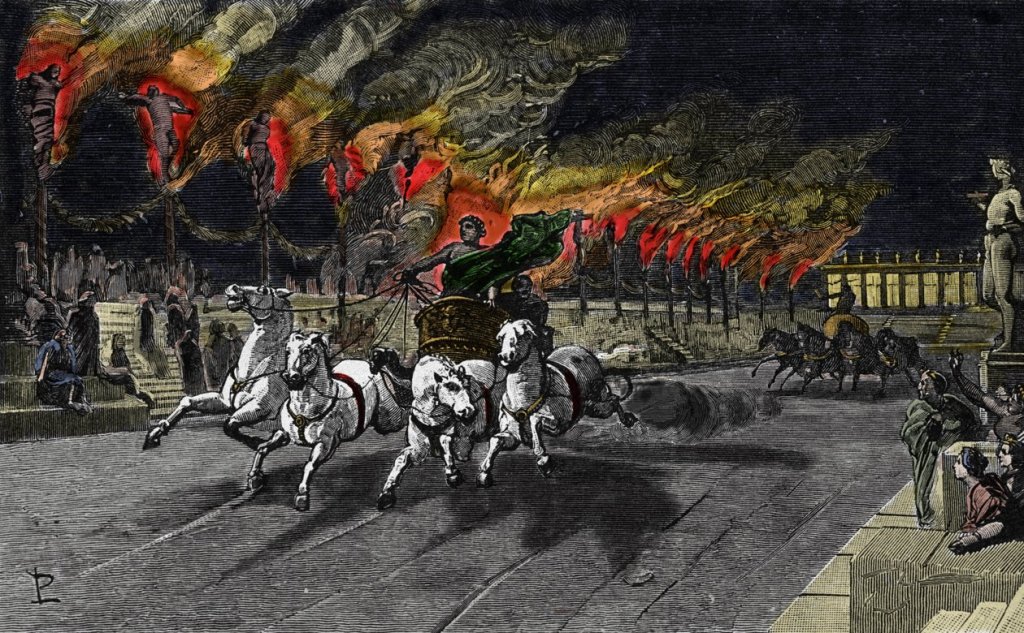
Mockery of every sort was added to their deaths. Dressed in wild animal skins, they were torn to pieces by dogs, or crucified, or made into torches to be ignited after dark as substitutes for daylight. Nero provided his gardens for the spectacle, and exhibited displays in the Circus, at which he mingled with the crowd — dressed as a charioteer or mounted on a chariot.

Hence, in spite of a guilt which had earned the most exemplary punishment, there arose a sentiment of pity, due to the impression that they were being sacrificed not for the welfare of the state but to the ferocity of a single man.”

Key Insights from Tacitus

  1. Scapegoats for Nero. Christians were chosen not because they set the fire, but because they were already despised as “haters of the human race.”
  2. Already notorious. Tacitus calls them “notoriously depraved” and their faith a “pernicious superstition.” By AD 64, Christians were widely recognized in Rome and widely hated.
  3. A vast multitude. His phrase multitudo ingens (“a vast multitude”) shows how large the Christian community in Rome already was, and how severe this persecution was — not dozens but hundreds, possibly thousands.
  4. No real crimes. Their guilt was not arson or sedition, but their view of Christ, their ethics, and their condemnation of Roman life.
  5. Rome thought it was finished. Tacitus says Christianity was “checked for a moment” when Christ was crucified. Rome thought Jesus’ death ended the movement — but it “again broke out,” spreading even to the capital itself.
  6. Confession was enough. “Those who confessed” were arrested. Being a Christian was itself the crime.
  7. “On their information.” The Latin phrase (per indicium eorum) may mean confessors named others, or that confession itself was the evidence. Either way, the name alone condemned them.
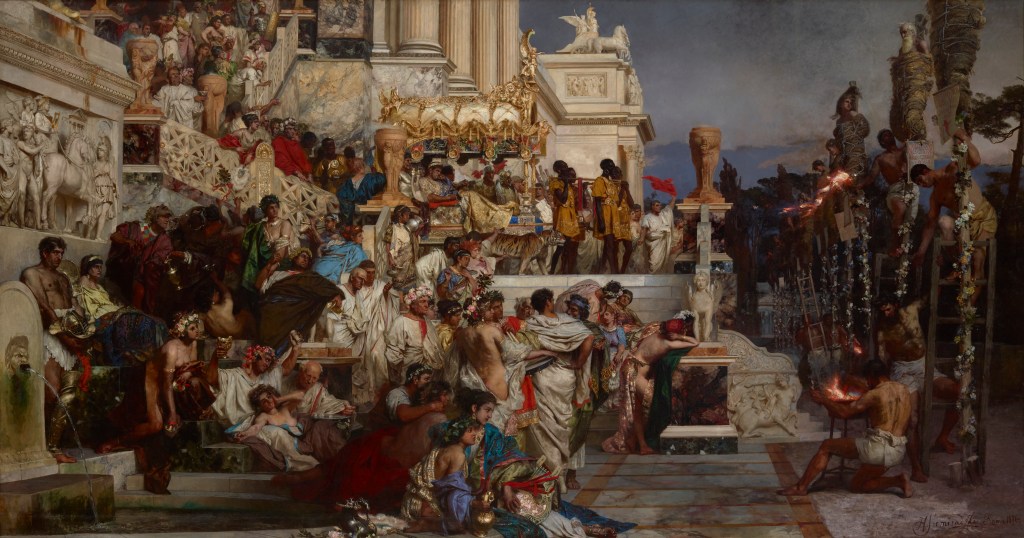
Nero’s Torches – Henryk Siemiradzki (1876)
Nero’s Torches: Burning of Christians at Rome – artist unknown (c. 1880), hand-colored wood engraving

Suetonius on Nero’s Persecution

Suetonius, Nero 16.2 (c. AD 121, Loeb):

“Punishments were also inflicted on the Christians, a sect professing a new and mischievous religious belief.”

Key Insights from Suetonius

  1. A distinct sect. By Suetonius’ day, Christianity was clearly recognized as distinct from Judaism.
  2. “New and mischievous.” “New” meant unauthorized and suspicious; “mischievous” (malefica) implied socially harmful.
  3. Punished for belief, not crime. He mentions no crimes like arson or sedition. The offense was the belief itself.

Cassius Dio (via Zonaras) on Nero’s Persecution

Cassius Dio, Roman History 62.16 (via Zonaras, c. AD 229, Loeb):

“Nero was the first to persecute the Christians; and though they were guilty of no crime, they were subjected to the most extraordinary punishments. And in their death they were made the subjects of sport; for they were covered with the hides of wild beasts and torn to pieces by dogs, or they were nailed to crosses, or they were doomed to the flames and burnt, to serve as nightly illumination when daylight had expired. Nero offered his own gardens for the spectacle, and gave a circus show, mingling with the crowd in the dress of a charioteer, or mounted on a car. Hence, even for criminals who deserved extreme and exemplary punishment, there arose a feeling of compassion; for it was felt that they were being destroyed not for the public good, but to gratify the cruelty of a single man.”

Note on Sources: Dio’s Roman History is fragmentary for this period; this passage is preserved in the 12th-century epitome of John Zonaras.

Key Insights from Dio

  1. Innocent of crimes. Dio is explicit: Christians were “guilty of no crime.”
  2. Public spectacle. Executions turned into grotesque entertainment — torn by dogs, crucified, burned alive.
  3. Public pity. Even Romans who despised Christians pitied them, realizing they died for Nero’s cruelty, not Rome’s good.
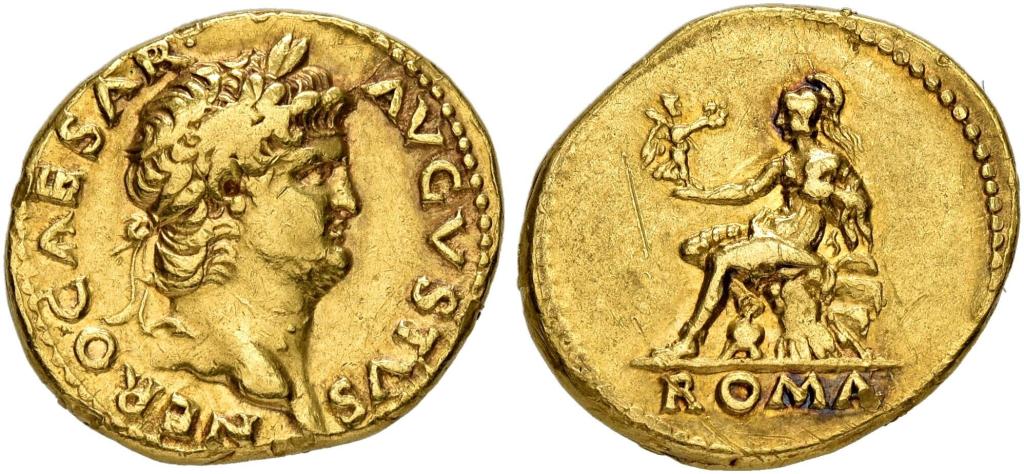
NERO CAESAR AVGVSTVS = Nero Caesar Augustus; ROMA = The goddess Roma that personified the city, holding a small goddess Nike (Victory). The fleshly portrait of Nero puts this coin probably after the fire of Rome and is used as propaganda to show that Rome was saved under his leadership and arises victorious from the fire.

Old Religions vs. New Religions

Tacitus, Histories 5.5 §5 (c. AD 105, Loeb):

“Whatever is novel in religion is forbidden; but whatever is ancient is respected — even if it be based on error.”

Pliny the Elder, Natural History 30.11 §30.11 (c. AD 77, Loeb):

“Ancient religions win tolerance through their antiquity; new ones are looked on with suspicion, particularly when they refuse to worship the Roman gods.”

Judaism was tolerated as an ancient superstition. Christianity was branded a new superstition (superstitio nova), and thus unlawful. Nero’s persecution formalized this: Christians were no longer sheltered under Judaism but treated as an illicit movement.


The Uniqueness of Nero’s Persecution

Nero’s decision to blame an entire people group for the fire was without precedent in Roman history.

Before this, Rome punished individuals — conspirators, rivals, or outspoken philosophers — but never criminalized a community for its beliefs.

Candida Moss, in The Myth of Persecution: How Early Christians Invented a Story of Martyrdom (2013, pp. 37–38), notes that only one earlier group was treated in a vaguely similar way: the Druids of Britannia.

Tacitus, Annals 14.30 (c. AD 116, Loeb):

“The savage superstitions of the Druids were put down; for they considered it right to make their altars run with the blood of captives and to consult their gods by means of human entrails.”

That campaign, led by Suetonius Paulinus in AD 60, was a military operation, not an urban persecution. Rome destroyed the Druids’ sacred groves as part of conquest, not as a civic punishment for religious identity.

By contrast, Nero’s actions in AD 64 were entirely domestic. He used the Christians as scapegoats inside the capital itself. Tacitus writes that “those who confessed were arrested, and on their information a vast multitude was convicted.” This was not a handful of leaders, but an entire population, criminalized for existing.

Other groups, such as the Stoics, also suffered under Nero — but in a completely different way.

Tacitus, Annals 16.21 (c. AD 116, Loeb):

“Thrasea Paetus was put to death for his independence, Barea Soranus for his friendship with him, and many others for no crime except their virtues.”

These were individual executions within a small circle of senators and philosophers — men admired for their moral independence, not a mass suppression of Stoicism. The philosophy itself continued; it was never outlawed.

Nero’s persecution of Christians, by contrast, targeted a whole people. Their faith, not their conduct, was the crime.

Key Insight

  • The Druids were wiped out as a wartime measure in Britannia, not as an internal religious purge.
  • The Stoics were punished as individuals for political virtue, not as a philosophical school.
  • The Christians were the first group in Roman history to be executed collectively for belief alone.

Candida Moss is right that the Druids are the closest parallel — but Nero’s act went further. It was not conquest or politics. It was religion itself that was put on trial.


Agrippa II and Paul’s Journey to Rome

During Nero’s reign we also encounter Herod Agrippa II, son of Agrippa I. By this time he ruled parts of northern Palestine. When Paul was imprisoned at Caesarea under the procurator Festus, Agrippa II and his sister Bernice were invited to hear his case.

Acts 26:28 (c. AD 62):

“And Agrippa said to Paul, ‘In a short time would you persuade me to be a Christian?’”

Agrippa’s verdict was striking:

Acts 26:31–32 (c. AD 62):

“This man is doing nothing to deserve death or imprisonment. … This man could have been set free if he had not appealed to Caesar.”

Agrippa II did not condemn Paul. Yet because Paul had appealed to Caesar, his case was forwarded to Nero. This set Paul on his journey to Rome (Acts 27–28), where tradition holds he was later executed.


The Martyrdom of Peter and Paul: Early Witnesses

  • Dionysius of Corinth, fragment in Eusebius, Church History 2.25.8 (c. AD 170, Loeb): “Peter and Paul … taught together in Italy, and were martyred at the same time.”
  • Tertullian, Scorpiace 15 (c. AD 200, Loeb): “Where Peter endures a passion like his Lord’s, Paul wins his crown in death like John’s.”
  • Eusebius, Church History 2.25.5–8 (c. AD 325, Loeb): “Paul was beheaded in Rome itself, and Peter likewise was crucified under Nero. Peter was crucified head downwards, for so he had asked to suffer.”

The core tradition is plain: Peter crucified, Paul beheaded, both in Rome under Nero.
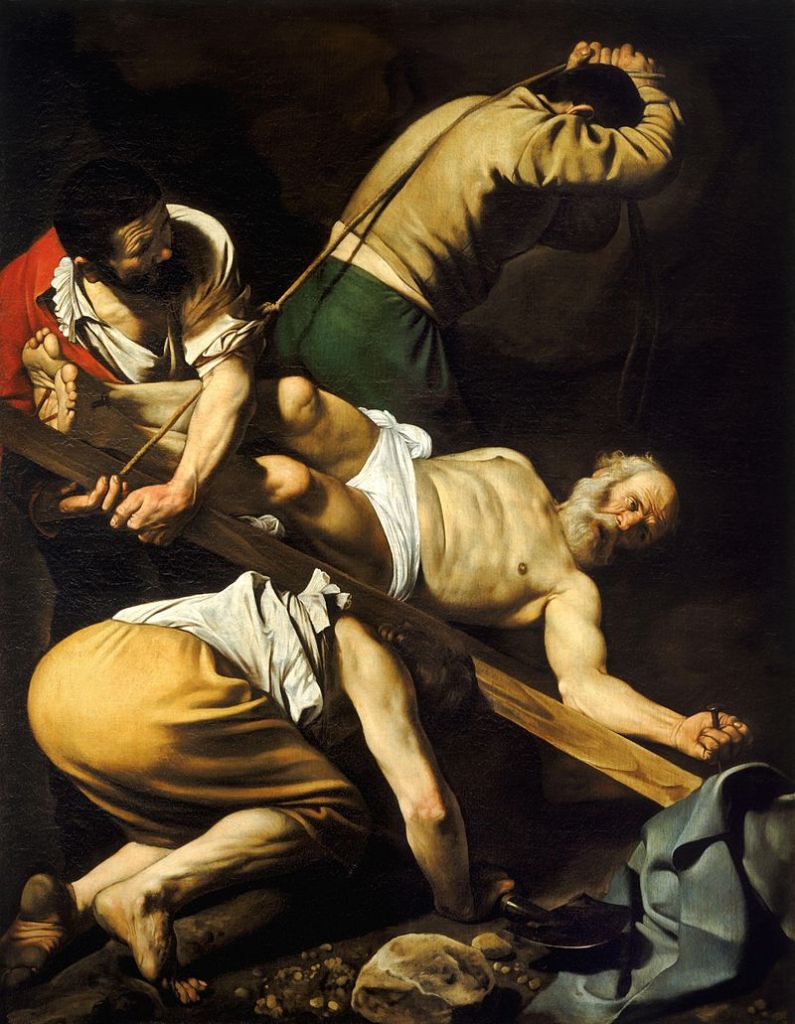
Crucifixion of Saint Peter – Caravaggio, 1601

The Apocryphal Acts: Legendary Expansions

By the late 2nd and 3rd centuries, apocryphal Acts circulated widely, retelling the apostles’ deaths with miracles and signs.

  • Acts of Paul 11 (c. AD 160–180, Apocryphal Acts): “And when they had beheaded Paul, milk flowed out upon the ground from his neck, so that the soldiers marveled.”
  • Martyrdom of Paul (c. AD 200–250, Apocryphal Acts): “And Paul, having prayed, said to the executioner, ‘Come, do thy work.’ And the soldier struck off his head, and immediately milk and blood issued forth.”
  • Acts of Peter and Paul 7 (c. AD 200–250, Apocryphal Acts): “And when he had prayed, he gave his neck to the sword without fear. And when the soldier struck off his head, there came forth milk and blood, and a great fragrance filled the place, so that many of those who stood by believed.”
  • Acts of Peter 37–39 (c. AD 180–200, Apocryphal Acts): “Peter, having come to the place, asked to be crucified head downwards. And while he was hanging there, he said: ‘Since my Lord was crucified head upwards, it is fitting for me to be crucified head downwards, so that the difference may be clear between the Lord and his servant.’”

Why Did Christians Embellish?

These miracle stories were not created to erase the truth — they were built on the core memory of Nero’s persecution. They aimed to:

  • Encourage believers in their own sufferings.
  • Show God’s power in weakness and death.
  • Magnify Peter and Paul as models of courage and humility.

Candida Moss’ Critique and a Response

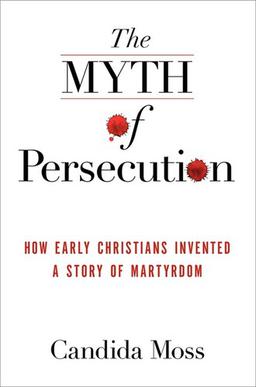
Modern scholar Candida Moss, in The Myth of Persecution (2013), argues that most martyrdom accounts were exaggerated or fabricated, and that the church later built a “myth” of constant persecution. She points to the apocryphal Acts as evidence that Christians mythologized their sufferings with miracles and wonders.
Response:

  • The embellishments are real — milk, blood, heavenly fragrances, sermons from the cross.
  • But that does not erase the historical core.
  • The early witnesses (Dionysius, Tertullian, Eusebius) give us a plain, consistent story: Peter crucified, Paul beheaded, under Nero.
  • The apocryphal Acts show how popular devotion expanded these stories, not how they were invented.
  • The very existence of later embellishments shows there was a real core event to embellish.

Nero’s Lasting Precedent

Nero’s persecution was short, but its effects were lasting. For the first time, Christianity was officially branded a new and unlawful superstition. The charge was not arson, violence, or rebellion. It was the name itself.

From that moment on, this precedent endured:

  • Trajan (rescript to Pliny, c. AD 112): Christians are not to be hunted, but if accused and proven, they must be punished unless they recant and worship the gods.
  • Hadrian (rescript to Minucius Fundanus, c. AD 124): Christians cannot be condemned by mob accusations; formal charges and evidence are required.
  • Apollonius the Senator (c. AD 185, Eusebius, Church History 5.21.2, Loeb): Tried before the Senate, he confessed Christ and was executed “in compliance with an ancient law.”

This shows that Nero’s precedent was remembered and enforced for centuries. Later crackdowns under emperors like Decius or Diocletian were not innovations — they were intensifications of the same ancient law first established under Nero.


Final Key Insight

Candida Moss is wrong to claim that persecution was a myth built around a few exaggerated episodes. The evidence shows that from Nero onward, Christians lived under a standing legal threat.

  • They were not always hunted, but they were never safe.
  • Simply confessing Christ was enough for punishment, even death.
  • Nero’s fire did not burn out the church; it created the conditions under which the church would always exist: fragile in the eyes of Rome, yet resilient in the power of Christ.

The fire that consumed Rome lit a flame of witness that spread across the empire — a fire no emperor could extinguish.

Faith in the Age of Commodus: From Senate Martyrs to Catacomb Worship

When Marcus Aurelius died in AD 180, the Roman world changed. For nearly a century the empire had been governed by what historians often call the “five good emperors”: Nerva, Trajan, Hadrian, Antoninus Pius, and Marcus Aurelius. Each was chosen by adoption, trained for years, and admired for discipline and stability. But Marcus broke the pattern. He left the empire to his son, Commodus — a move that ancient writers say marked the decline of Rome’s golden age.


Executions in the Imperial Household

At the very end of Marcus’ reign, even members of the imperial household were executed. Dio Cassius records:

“Many others, however, who adopted foreign customs were persecuted, and great numbers of them perished. And, in particular, those who were accused of atheism were executed. Among these were several of those who belonged to the imperial household.” (Roman History 72.4, Loeb)

The Romans used the charge of atheism not in our modern sense of denying all gods, but of rejecting the gods of Rome. Jews and Christians were the ones most often branded as atheists, because they refused to sacrifice to the gods and the emperor. The fact that Dio says members of the imperial household were executed strongly suggests that Christianity had already reached into Caesar’s own palace — and that believers there paid with their lives.

This makes what followed under Commodus all the more striking.


The Character of Commodus

Dio Cassius, who lived through Commodus’ reign, offers us a vivid portrait:

“Commodus was not naturally wicked, but, on the contrary, as guileless as any man that ever lived. His great simplicity, however, together with his cowardice, made him the slave of his companions, and it was through them that he at first, out of ignorance, missed the better life and then was led on into lustful and cruel habits, which soon became second nature.” (Roman History 72.1, Loeb)

Herodian likewise describes Commodus as a man given over to entertainment and self-indulgence:

“He showed no interest in military campaigns nor in the hardships of war; he devoted his entire attention to the amusements of the circus and the theater, delighting in gladiatorial spectacles and contests with wild beasts.” (Roman History 1.15.9, Loeb)

This is the emperor who styled himself Hercules, fought in the arena, and renamed Rome after himself. Ancient authors despised him as cruel and debased.

And yet — Christians found unexpected favor in his reign.


A Turning Point for Christians

Eusebius tells us:

“In the time of Commodus, our affairs took an easier turn. By the grace of God the emperor’s concubine, Marcia by name, who was highly honored by him, was friendly to the Christians. She rendered many favors to our brethren, for she requested the emperor to grant the release of those who had been condemned to labor in the mines of Sardinia. And he readily granted her request.” (Church History 5.21, Loeb)

Think of the contrast: under Marcus, Christians in the imperial household were executed; under Commodus, a member of the imperial household — his concubine Marcia — became the protector of Christians, winning freedom for many. The palace went from being a place of death to a place of refuge.

Eusebius’ Perspective

Eusebius interprets Marcia’s intervention as proof that the whole situation of Christians “took an easier turn” under Commodus. But this is the same mistake he had made when describing Hadrian. In Church History 4.9, he claimed that Hadrian’s rescript lessened persecution, when in fact it only required Christians to be executed after formal accusation and trial. The legal status of Christianity never changed.

So too under Commodus: while individual figures like Marcia could grant relief, the “ancient law” still condemned Christians once accused. As the case of Apollonius shows, the empire’s hostility remained intact.


The Case of Apollonius

Eusebius also preserves the case of Apollonius, a Christian senator:

“At this time Apollonius, a senator who was well learned and of great distinction, came forward as a champion of the faith. Accused by one of his servants, he gave an eloquent and philosophical defense of Christianity before the Senate. Yet he was not permitted to go free, but in accordance with an ancient law that no Christian who had once been brought before the tribunal should be dismissed unpunished, he was condemned and executed.” (Church History 5.21, Loeb)

Apollonius was not a slave or artisan, but a senator — a member of Rome’s ruling elite. This alone shows how far Christianity had spread in just 150 years. Yet even his status could not shield him from the law.

What Did “Ancient Law” Mean?

Eusebius says Apollonius died under an “ancient law.” For Romans, a law could be called ancient (vetus or antiqua) if it had been established by earlier emperors or the Senate and had been observed continuously. It did not require centuries of distance. Cicero used vetus in the 1st century BC to describe laws less than a hundred years old. By Apollonius’ time, Nero’s precedent (AD 64) was already more than a century old — plenty of time for it to be viewed as antiqua lex.

This fits perfectly with Trajan’s rescript to Pliny (c. 112). When Pliny asked how to handle Christians, Trajan didn’t invent a new rule; he assumed the principle was already established. His ruling — “They are not to be sought out, but if accused and proven guilty, they must be punished” — shows that the criminality of Christianity itself was a recognized policy across the empire. By Commodus’ day, the Senate could legitimately call this an “ancient law.”

So the martyrdom of Apollonius was not local prejudice. It was the outworking of a Roman legal culture that had, since Nero, considered Christians criminal by definition.


Christianity in High Places — and Under Empire-Wide Law

By Commodus’ reign, Christianity had a paradoxical position. On the one hand, it had entered the palace: Marcia secured the release of prisoners. It had entered the Senate: Apollonius confessed Christ before Rome’s rulers. On the other hand, the very same Senate invoked the ancient law that bound them to execute Christians once accused.

This shows why skeptical historians are mistaken to portray persecution as local and sporadic. The record of Apollonius proves otherwise: Christianity had been treated as a crime throughout the empire since Nero’s precedent. Trajan’s rescript only confirmed what was already assumed to be Roman policy. By calling it an “ancient law,” the Senate in Commodus’ day acknowledged that Christians had been subject to execution for generations.

The stories we possess come from certain places — Lyons, Smyrna, Rome, Bithynia — but the law itself was empire-wide. Every Christian in every province lived under its shadow.

And yet, Christians did not retreat into silence. Even while the empire branded them criminals, they carved out spaces where their hope was made visible. Nowhere is this clearer than in the catacombs of Rome, which became both burial grounds and gathering places for a people who lived under constant threat.


What Are Catacombs?

Catacombs are underground burial galleries dug out of the soft volcanic stone (tufa) beneath Rome and other cities. They began as family tomb networks, but by the late 2nd century Christians began using them extensively. Unlike pagan necropoleis, which were mostly above ground, catacombs gave Christians a way to bury their dead together and to mark their faith with symbols of hope — the fish, the anchor, the Good Shepherd.

They were not secret hideouts (as legend sometimes imagines) but cemeteries that doubled as gathering spaces. Christians would hold memorial meals (refrigeria) on the anniversaries of a martyr’s death, or gather to pray and read Scripture. These underground spaces gave Christianity a physical presence in Rome that was both practical and symbolic.


Who Was Domitilla?

The Catacomb of Domitilla takes its name from Flavia Domitilla, a noblewoman of the Flavian dynasty (the same imperial family as Vespasian, Titus, and Domitian). Ancient sources say she was exiled by Domitian, possibly for sympathy with Jews or Christians.

Her property outside Rome became the site of one of the largest Christian cemeteries. This link to the Flavian family shows that Christianity was not only present among the poor but was also connected, even from the 1st century, with Roman aristocracy.


The Unique Chamber in Domitilla

Within the Catacomb of Domitilla is a chamber unlike any other known space from this early period — the so-called hypogeum of the Flavians:

  • Architectural design: benches carved into the walls on three sides, allowing 30–40 people to recline for meals.
  • Decoration: Christian frescoes on the plastered walls — symbols like the fish, the Good Shepherd, and biblical scenes.
  • Function: communal banquets for the dead (refrigeria), and likely the Eucharist as well.

This is the earliest surviving space adapted for Christian assembly. Before this, house churches left no archaeological trace distinct from other homes. The Domitilla chamber is different: it was carved and decorated in ways that mark it as intentionally Christian.

Here, during the same years Apollonius stood in the Senate and Marcia interceded in the palace, Christians were gathering underground in spaces designed for their worship and remembrance.


Christian Authors and Contested Writings

The reign of Commodus also coincided with one of the richest bursts of Christian literature in the 2nd century. While some believers were dying under law and others were carving chambers in the catacombs, Christian teachers were laying down the intellectual and theological foundations of the faith.

Irenaeus of Lyons

Irenaeus had been born in Asia Minor, most likely in Smyrna, where as a youth he had listened to Polycarp, the disciple of the apostle John. Later he moved west to Gaul, where he served as a presbyter in Lyons. After the persecutions of AD 177 that left his community devastated and their bishop Pothinus martyred, Irenaeus returned from a mission in Rome and was chosen as the new bishop of Lyons.

It was from this place of pain and resilience that he composed one of the most important works in Christian history. Its title was “Detection and Overthrow of Knowledge Falsely So-Called” — what we call Against Heresies. Unlike earlier apologists (Justin Martyr, Athenagoras), who wrote defenses to pagan rulers, Irenaeus aimed his work inward: to protect Christians from the flood of Gnostic sects and rival “gospels” circulating in his day.

He begins by describing the danger:

“They set forth their own compositions, boasting that they have more gospels than there really are. But in truth they have not gospels which are not full of blasphemy. For indeed there can be no more or fewer than the number of the gospels we have declared.” (Against Heresies 3.11.9, Loeb)

On Persecution

“The suffering of the righteous… is not new, but has been foreshown by the prophets, and fulfilled in Christ, and is now being fulfilled in the Church.” (Against Heresies 5.30.1, Loeb)

Here he interprets martyrdom itself — the loss of his own flock — as fulfillment of God’s plan. Persecution was not failure, but continuity with Christ.

On the Unity of the Church

“The Church, though dispersed throughout the whole world, even to the ends of the earth, has received from the apostles and their disciples this faith… She likewise believes these things as if she had but one soul and the same heart, and she proclaims them, and teaches them, and hands them down with perfect harmony, as if she possessed but one mouth. For, although the languages of the world are dissimilar, yet the import of the tradition is one and the same.” (Against Heresies 1.10.2, Loeb)

Even after his own community was ravaged, Irenaeus could insist that the church was one body, one voice, one heart across the world.

On the Fourfold Gospel

“It is not possible that the Gospels can be either more or fewer in number than they are. For, since there are four zones of the world in which we live, and four principal winds, while the Church is scattered throughout all the world… it is fitting that she should have four pillars, breathing out immortality on every side.” (Against Heresies 3.11.8, Loeb)

Against those who produced “more gospels,” Irenaeus anchored the church to the fourfold Gospel.

On Apostolic Continuity

“For it is a matter of necessity that every Church should agree with this Church [Rome], on account of its preeminent authority… The blessed apostles, then, having founded and built up the Church, committed into the hands of Linus the office of the episcopate… and now, in the twelfth place from the apostles, Eleutherus holds the inheritance of the episcopate.” (Against Heresies 3.3.2–3, Loeb)

This list of bishops, written during Commodus’ reign, was a defiant declaration: the church had unbroken succession from the apostles, while heretical sects had none.

On Christian Generosity

“The Jews were constrained to a regular payment of tithes; but Christians, who have received liberty, assign all their possessions to the Lord, bestowing joyfully and freely not the lesser portions of their property, since they have the hope of better things; like that poor widow who cast all her living into the treasury of God.” (Against Heresies 4.18.2)

This illustrates the distinctive spirit of the early church: while Roman officials often accused Christians of atheism or secrecy, their actual way of life was one of generosity, freely giving to the Lord and to the poor.

In Irenaeus we see the Christian mind under Commodus: scarred by persecution, yet confident in Scripture, united across the world, rooted in apostolic succession, and marked by radical generosity.


The Muratorian Fragment

The Muratorian Fragment, written around AD 180 in Rome, is our earliest surviving canonical list. It is preserved in a damaged Latin manuscript, so the very beginning and end are missing, but what remains is invaluable. It shows that by Commodus’ reign, the church already recognized a core New Testament canon.

On the Gospels

The opening lines are broken, but it clearly names Luke and John as the third and fourth Gospels — which implies Matthew and Mark were already listed. It says:

“The third book of the Gospel is that according to Luke… The fourth Gospel is that of John, one of the disciples.”

This affirms what Irenaeus said about the fourfold Gospel: no more, no fewer.

On Acts

“The Acts of all the apostles have been written in one book. Luke so comprised them for the most excellent Theophilus, because the several events took place when he was present.”

Acts was treated as authoritative history, alongside the Gospels.

On Paul’s Letters

“The blessed apostle Paul himself, following the order of his predecessor John, writes only to seven churches by name… But although he writes twice to the Corinthians and Thessalonians for correction, it is yet shown — one Church is recognized as being spread throughout the whole earth.”

Paul’s letters are described in a symbolic sevenfold pattern (like Revelation’s seven churches), but the list also included Philemon, Titus, and Timothy.

On Catholic Epistles and Revelation

The fragment accepts Jude and two letters of John. It recognizes the Apocalypse of John, and even mentions the Apocalypse of Peter — though it notes that some in the church did not want it read publicly.

On Spurious Works

The fragment draws a sharp line against forgeries:

“But the Epistle of Paul to the Laodiceans, and another to the Alexandrians, forged in Paul’s name for the heresy of Marcion, must be rejected… neither may gall be mixed with honey.”

This shows the church was not passively receiving every book that claimed apostolic authorship — it was testing and rejecting fakes.

On the Shepherd of Hermas

“But Hermas wrote the Shepherd quite recently, in our times, in the city of Rome, while his brother Pius was occupying the bishop’s chair. And therefore it ought indeed to be read; but it cannot be read publicly to the people in church, either among the prophets, whose number is complete, or among the apostles.”

This is remarkable. It shows that Roman Christians in Commodus’ day valued Hermas, but they knew it was recent and therefore not apostolic Scripture. It was good for private devotion, not for the public canon.

Why the Muratorian Fragment Matters

The Muratorian Fragment proves that by Commodus’ reign, the church already:

  • Recognized the four Gospels as the only Gospels.
  • Affirmed Acts, Paul’s letters, Revelation, and several Catholic Epistles.
  • Debated a few books (like the Apocalypse of Peter).
  • Rejected outright forgeries tied to heretical groups.
  • Distinguished between useful writings (like Hermas) and canonical Scripture.

Canon formation was not a 4th-century invention; it was already well advanced in the 2nd century.


Theophilus of Antioch

Theophilus, bishop of Antioch until about AD 183, was the earliest Christian writer to use the word “Trinity” (trias). Earlier Christians (like Justin Martyr) had spoken in triadic ways — Father, Son, and Spirit — but Theophilus is the first whose writings explicitly use the term.

On the Trinity

“In like manner also the three days which were before the luminaries are types of the Trinity (trias), of God, and His Word, and His Wisdom… The first is God, the second is the Son, the third is the Spirit of prophecy.” (To Autolycus 2.15)

This is one of the earliest explicit triadic statements: Father, Son, and Spirit named together.

On Scripture

“But if you will give yourself to a more exact study of the Scriptures, you will learn from them more accurately concerning God and His Christ, and concerning all things that are revealed.” (To Autolycus 2.9)

On Creation

“God, having His own Word internal within His own bowels, begat Him, emitting Him along with His own Wisdom before all things. He had this Word as a helper in the things that were created by Him, and by Him He made all things.” (To Autolycus 2.10)

On Idolatry

“Do not wonder if the truth is belabored by the lie; for first the lie is more ancient, but truth appeared later. For the truth always conquers, and falsehood is overcome.” (To Autolycus 1.14)

These words capture the apologetic spirit of Commodus’ era: Christians accused of atheism for rejecting idols, yet proclaiming Christ as the eternal Word, and the Spirit as the Spirit of prophecy.


Gnostic Rivals — The Gospel of Judas and Other Apocrypha

At the same time that orthodox leaders were defending the apostolic faith, rival groups were producing their own “gospels” and “acts.”

Irenaeus described one such group, the Cainites:

“They declare that Judas the traitor was thoroughly acquainted with these things, and that he alone, knowing the truth as no others did, accomplished the mystery of the betrayal. They produce a fictitious history which they style the Gospel of Judas.” (Against Heresies 1.31.1, Loeb)

For centuries this was our only evidence for the Gospel of Judas. Then, in the late 20th century, a Coptic manuscript was discovered in Egypt. Its contents matched Irenaeus’ account exactly.

In the text, Jesus mocks the disciples’ prayers:

“When he came to his disciples … they were gathered together and offering a prayer of thanksgiving over the bread. When he approached, he laughed.” (Gospel of Judas 33)

And to Judas, he offers a shocking commendation:

“You will exceed all of them. For you will sacrifice the man that clothes me.” (Gospel of Judas 56)

This bizarre inversion makes Judas the hero, praised for helping to discard Jesus’ human body. The discovery confirmed Irenaeus was right: the Gnostic “gospel” glorified the betrayer and denied Christ’s true incarnation.

Other apocrypha from this period were equally strange:

Apocryphal Gospels (30+ known by this time)

  • Gospel of Judas — Judas exalted for “sacrificing the man that clothes me.”
  • Gospel of Truth — Valentinian meditation redefining salvation as knowledge.
  • Gospel of the Egyptians — cited by Clement of Alexandria; ascetic in tone.
  • Gospel of Peter — fragment portrays a docetic Christ whose body feels no pain.
  • Gospel of the Hebrews — fragments used among Jewish-Christian groups.
  • Infancy Gospel of Thomas — boy Jesus curses playmates and strikes them dead, then raises them again.
  • Protoevangelium of James — elaborates Mary’s miraculous birth and childhood.
  • Gospel of the Ebionites — fragments depict a vegetarian Jesus, denying his divinity.
  • Gospel of the Nazarenes — fragments cited by Jerome.

Apocryphal Acts

  • Acts of Peter — includes the “Quo Vadis” scene; Peter crucified upside down.
  • Acts of Paul and Thecla — Thecla survives fire and beasts, preaches, baptizes herself.
  • Acts of John — Jesus leaves “no footprints,” appears in shifting forms.
  • Acts of Andrew — legendary missionary journeys and martyrdom of Andrew.
  • Acts of Thomas — missionary work in India, includes the famous “Hymn of the Pearl.”

Apocryphal Apocalypses

  • Apocalypse of Peter — visions of heaven and hell; debated in some churches.
  • Apocalypse of Paul — visionary journeys that became very popular later.
  • Apocalypse of Adam — Gnostic cosmology denying the Creator God.
  • Apocalypse of Zephaniah — Jewish-Christian apocalypse with angelic visions.

Other Gnostic Treatises Already Circulating

  • Gospel of Mary — Mary Magdalene as the revealer of secret knowledge. “Peter said to Mary, ‘Sister, we know that the Savior loved you more than the rest of women. Tell us the words of the Savior which you remember…’” (Gospel of Mary 10)
  • Apocryphon of John — a Gnostic retelling of Genesis, portraying the Creator God as an ignorant “demiurge.” “And he [the demiurge] said, ‘I am a jealous God, and there is no other god beside me.’ But by announcing this, he indicated to the angels who attended him that another God does exist.” (Apocryphon of John)
  • Teachings of Silvanus — wisdom text urging the pursuit of knowledge as the highest good.

By the year 200, at least 50–60 apocryphal works were already circulating — dozens of gospels, multiple acts, several apocalypses, and a growing shelf of Gnostic treatises. Some exalted Judas, others denied Jesus’ humanity, others turned Mary Magdalene into the revealer of hidden truth, and still others recast the Creator God as a blind and ignorant impostor.

Against this avalanche of counterfeits, the defenses of Irenaeus, the canon list of Rome, and the clarity of Theophilus stand out all the more. And archaeology has confirmed that they were not exaggerating. The rediscovery of the Gospel of Judas proved Irenaeus was right: the heretics really did produce “fictitious histories” that glorified the betrayer and denied Christ.


Conclusion

Commodus was assassinated in AD 192, strangled in his bath after twelve years of misrule. His death plunged Rome into the bloody “Year of the Five Emperors.” For the empire, his reign was remembered as a disgrace. But for Christians, Commodus’ years were remembered as a respite — a surprising turn from death in the palace to protection in the palace.

What began as a persecuted movement among the poor now had defenders in Caesar’s own household, a senator willing to declare Christ before Rome’s highest assembly, believers carving out rooms in the catacombs as their first communal spaces, and teachers like Irenaeus and Theophilus shaping the canon of Scripture and even the very word “Trinity” — all while the shadow of an “ancient law” reminded believers that the empire still considered them criminals.

Commodus’ reign thus marks a turning point: the faith of Jesus Christ was no longer hidden at the margins but had reached the heart of the empire, the underground corridors of Rome, and the contested battlefield of competing gospels — with the apostolic church proving itself the reliable guardian of the truth.

The Church’s Voice in an Emperor’s “Peaceful” Reign

Antoninus Pius (AD 138–161) is remembered as one of Rome’s “Five Good Emperors.” His reign lasted twenty-three years and was marked by peace, stability, and prosperity. He earned the title Pius because of his devotion: to his adoptive father Hadrian, whose memory he defended; to Roman religion, which he honored scrupulously; and to his family. Ancient writers portray him as the model of dutifulness and justice.

But beneath this outward calm, Christianity continued to grow. For Christians, Antoninus’ reign was not simply peaceful. It was a season of both intellectual flourishing and enduring danger. Some of the earliest apologies — reasoned defenses of Christianity addressed to emperors — come from this time, as well as one of the most famous martyrdom accounts of the ancient church.


Antoninus and His Reputation

The Historia Augusta reports:

“He was called Pius for the following reason: When the Senate wanted to annul Hadrian’s decrees, he persuaded them not to do so. He supported the father of his wife Faustina, who had been accused, and obtained his pardon. He always treated his stepmother with respect and honor. And he always sacrificed to the gods, showing reverence in every way.” (Life of Antoninus Pius, 6).

This reputation for reverence and stability carried into later Roman memory. He was remembered as a benevolent emperor who avoided war, strengthened the law, and ensured financial security.


Justin Martyr: Pleading Before the Emperors

During Antoninus’ reign, the Christian philosopher Justin Martyr composed his First Apology (c. 155), addressed to Antoninus Pius, Marcus Aurelius, Lucius Verus, and the Roman Senate. Why multiple emperors? Because Antoninus had adopted Marcus and Lucius as his heirs. By addressing all of them, Justin was not only appealing to the reigning emperor but also to those who would succeed him. He wanted Christianity to be judged fairly at the highest level of Rome.

Justin’s central plea was simple: stop condemning Christians for their name alone.

“Reason requires that those who are accused should not be condemned without a trial, nor hated on account of a name. For what is the accusation? That we are called Christians. This is no crime. The charge is only that we bear a name. If any is found guilty of evil, let him be punished as an evildoer; but not on account of the name, if he is found to be guiltless.” (First Apology 4, Loeb).

He exposed the absurdity of condemning someone merely for a title:

“For from a name neither praise nor punishment could reasonably spring, unless something excellent or base in action can be shown about it. Those who accuse us of atheism, because we do not worship the same gods as you, charge us falsely; for we worship the Maker of this universe, declaring that He has no need of streams of blood and libations and incense.” (First Apology 6, Loeb).

Justin also wanted to show that Christians lived morally upright lives:

“We who once delighted in fornication, now embrace chastity alone. We who used magical arts dedicate ourselves to the good and unbegotten God. We who loved gain above all things now bring what we have into a common stock, and share with every needy one. We who hated and destroyed one another, and on account of our different customs would not live with men of a different tribe, now, since the coming of Christ, live familiarly with them, and pray for our enemies.” (First Apology 14, Loeb).

Describing Christian Worship

Before Justin, the Roman governor Pliny the Younger had reported what former Christians told him under interrogation (ca. AD 112 under Trajan):

“They declared that the sum of their fault or error had been that they were accustomed to meet on a fixed day before dawn, and to sing responsively a hymn to Christ as to a god, and to bind themselves by an oath, not to some crime, but not to commit theft, robbery, or adultery, not to break their word, and not to refuse to return a deposit when asked for it. After this it was their custom to depart, and then to assemble again to partake of food — but ordinary and innocent food.” (Pliny, Letters 10.96, Loeb).

But Justin’s First Apology is the first time a Christian himself described worship directly to the Roman emperors. His account is fuller, and deliberately meant to explain Christian practice in detail:

“On the day called Sunday, all who live in cities or in the country gather together in one place, and the memoirs of the apostles or the writings of the prophets are read, as long as time permits. Then, when the reader has finished, the president verbally instructs, and exhorts to the imitation of these good things. Then we all rise together and pray, and, as we said before, when our prayer is ended, bread and wine and water are brought, and the president in like manner offers prayers and thanksgivings, according to his ability, and the people assent, saying Amen; and there is a distribution to each, and a sharing of that over which thanks have been given, and to those who are absent a portion is sent by the deacons.” (First Apology 67, Loeb).

And on the Eucharist:

“This food is called among us the Eucharist, of which no one is allowed to partake but the man who believes that the things which we teach are true, and who has been washed with the washing for the remission of sins, and unto regeneration, and who is so living as Christ has enjoined. For not as common bread and common drink do we receive these; but in like manner as Jesus Christ our Savior, having been made flesh by the Word of God, had both flesh and blood for our salvation, so likewise have we been taught that the food which is blessed by the prayer of His word, and from which our blood and flesh are nourished, is the flesh and blood of that Jesus who was made flesh.” (First Apology 66, Loeb).

Justin left no doubt: Christians worshiped Christ as God, and their meal was not symbolic but sacred — the body and blood of Jesus.

In his Second Apology, Justin gave examples of how Christians were still executed for the name alone:

“When a certain woman, who had been made a disciple of Christ, remained with her husband for a time and tried to persuade him to live in chastity, and when he continued in licentiousness, she left him. Then, when she was about to be married to another, her former husband accused her of being a Christian. She presented a petition to delay the case until she could arrange her affairs, but her instructor in the faith was arrested and punished merely for being called a Christian.” (Second Apology 2, Loeb).

Even under Antoninus, Christians died for their confession of Christ.


Polycarp: Faithful Unto Death

At roughly the same time, Polycarp — bishop of Smyrna and disciple of the apostle John — was brought before the Roman proconsul.

When pressed to deny Christ, he famously replied:

“Eighty-six years I have served him, and he has done me no wrong. How then can I blaspheme my King who saved me?” (Martyrdom of Polycarp 9, Loeb).

The proconsul urged him to swear by Caesar:

“Swear by the fortune of Caesar; repent, and say, Away with the atheists!’ But Polycarp, with solemn countenance, looked upon all the lawless heathen in the arena, and waving his hand toward them, groaned, and looking up to heaven, said: ‘Away with the atheists.’” (Martyrdom of Polycarp 10, Loeb).

As they bound him for the fire, he prayed:

“O Lord God Almighty, Father of Thy beloved and blessed Son Jesus Christ, by whom we have received the knowledge of Thee, the God of angels and powers and every creature, and of all the righteous who live before Thee, I bless Thee that Thou hast counted me worthy of this day and hour, that I may share, among the number of the martyrs, in the cup of Thy Christ, for resurrection to eternal life both of soul and body, in the incorruptibility of the Holy Spirit.” (Martyrdom of Polycarp 14, Loeb).

Polycarp’s death under Antoninus shows that Rome still demanded worship of Caesar — and Christians who refused still died.


The Epistle to Diognetus: Citizens of Another World

From the same period comes the anonymous Epistle to Diognetus. It begins with a fictional inquirer raising the questions that many pagans asked about Christians:

“Since I see, most excellent Diognetus, that you are exceedingly anxious to learn the religion of the Christians, and are searching into it with the most careful and exact inquiry — as to what God they trust, and how they worship Him, that they all despise the world and disregard death, and neither account the acknowledged gods of the Greeks to be gods, nor observe the superstition of the Jews; and what kind of love they have for one another, and why this new race or practice has entered into life now and not before — I welcome this zeal of yours, and I beg of God, who enables both us to speak and you to hear, that it may be granted to both of us to profit by what we learn.” (Epistle to Diognetus 1, Loeb).

After dismissing both idol worship and Jewish ritual sacrifices as unworthy of God, the author explains that Christianity did not come from human speculation, but from revelation:

“When then you have freed yourself from all these things, and laid aside the error of the common talk, and are rid of the deception of the gods, and no longer suppose, like the Jews, that God has need of sacrifices — then shall you learn what is the true mystery of the Christian faith. For neither by curiosity nor by busy inquiry have we learned it, nor did we discover it through the art of men, as in some empty talk; but it has been handed down to us from the very Word of God Himself, who was sent from heaven by God to men.” (Epistle to Diognetus 4, Loeb).

And then comes one of the most moving descriptions of the Christian life in the entire second century — a vision of paradox, resilience, and heavenly citizenship:

“For Christians are not distinguished from the rest of mankind by country or by speech or by customs. For they do not dwell somewhere in their own cities, nor do they use some different language, nor practice a peculiar kind of life. This teaching of theirs has not been discovered by the thought and reflection of inquisitive men, nor do they champion any human doctrine, as some do. But while they dwell in both Greek and barbarian cities, as each has fallen to their lot, and follow the native customs in clothing and food and the other matters of daily life, yet the condition of citizenship which they exhibit is wonderful, and admittedly strange. They live in their own countries, but only as sojourners; they share all things as citizens, and suffer all things as foreigners. Every foreign country is a fatherland to them, and every fatherland is foreign.

They marry like all other men, and they beget children; but they do not cast away their offspring. They have their meals in common, but not their wives. They are found in the flesh, yet they do not live after the flesh. They spend their days upon earth, but their citizenship is in heaven. They obey the established laws, and they surpass the laws in their own lives. They love all men, and are persecuted by all. They are not known, and yet they are condemned. They are put to death, and yet they are quickened into life. They are poor, yet make many rich; they lack all things, and yet abound in all things. They are dishonored, and yet are glorified in their dishonor. They are spoken evil of, and yet are justified. They are reviled, and bless; they are insulted, and repay the insult with honor. They do good, yet are punished as evildoers. Being punished, they rejoice as though they were thereby quickened into life. The Jews make war upon them as foreigners, and the Greeks persecute them; and those who hate them cannot state the cause of their enmity.” (Epistle to Diognetus 5–6, Loeb).

This is how Christians under Antoninus saw themselves: rooted in Roman cities, yet belonging to another world; hated and persecuted, yet bringing life to others; dishonored, yet glorified; punished, yet rejoicing.


Hegesippus: Guarding the Apostolic Tradition

During Antoninus’ reign, the writer Hegesippus began preserving Christian memory in his five books of Memoirs. Sadly the work is lost, but fragments survive in Eusebius:

  • On the uniformity of doctrine:

“And the Church of Corinth continued in the true faith until Primus was bishop in Corinth; and I conversed with them on my voyage to Rome, and we were refreshed together in the true doctrine. And being in Rome I made a succession up to Anicetus, whose deacon was Eleutherus. And after Anicetus, Soter succeeded, and after him Eleutherus. In every succession and in every city things are as the Law and the Prophets and the Lord proclaim.” (Hist. Eccl. 4.22.1–3, Loeb).

  • On the family of Jesus (“desposyni”):

“There still survived of the kindred of the Lord the grandsons of Jude, who had been called his brother according to the flesh. … Domitian asked them how much property they owned; they said they had only thirty-nine plethra of land, and showed their calloused hands from farming. Asked about Christ and his kingdom, they replied that it was not earthly but heavenly and angelic, to appear at the end of the world. At this Domitian let them go, and they became leaders of the churches, both as witnesses and as of the Lord’s family.” (Hist. Eccl. 3.19–20, Loeb).

  • On James the Just:

“James, the brother of the Lord, succeeded to the government of the Church in conjunction with the apostles. … His knees became hard like a camel’s because of his constant worship, kneeling and asking forgiveness for the people. … They threw him down from the temple, stoned him, and finally a fuller’s club struck his head. Thus he bore witness, and they buried him by the temple, and his monument still remains.” (Hist. Eccl. 2.23, Loeb, citing Hegesippus).

  • On heresies after the apostles:

“Until the times of Trajan the Church continued a pure and uncorrupted virgin. But when the sacred band of apostles had closed their lives, and that generation passed away, then the conspiracy of godless error arose through the fraud of false teachers.” (Hist. Eccl. 4.22.4–7, Loeb).

Hegesippus stands as one of the earliest church historians, traveling through cities, checking successions of bishops, and insisting on continuity with the apostles.


The Rescript of Antoninus — and Why It Fails

Eusebius also preserves a decree attributed to Antoninus, which seems to restrain mob violence against Christians:

“If, therefore, the provincials are able to make a clear case against the Christians in court, let them bring charges. But it is unlawful to persecute them merely for the name. If anyone continues to harass them, let the one accused be released, even though he be found to be a Christian, and let the informer be punished.” (Church History IV.13, Loeb).

At first glance, this sounds as if Antoninus protected Christians. But the evidence of the time says otherwise.

  • Justin begged that Christians not be condemned for the name alone — which shows they were.
  • Polycarp was executed for refusing to deny Christ.
  • Justin’s Second Apology explicitly describes Christians punished “merely for being called a Christian.”

For these reasons, most historians conclude that Eusebius was wrong in this instance — either quoting a spurious decree or idealizing Antoninus. Whatever Antoninus may have written, Christians still died for their confession of Christ.


Conclusion

Antoninus Pius is remembered by Roman historians as the calmest, most peaceful emperor of the second century. But for Christians, his reign looked different.

  • Justin Martyr wrote eloquent defenses of Christianity, describing their moral life and Sunday worship — but still had to plead that Christians not be killed for the name alone.
  • Polycarp was executed, proving that even in a so-called peaceful reign, death was the cost of faith.
  • The Epistle to Diognetus portrayed Christians as citizens of heaven, foreigners in every land.
  • Hegesippus preserved the memory of apostolic succession and the purity of the early church.
  • And Eusebius’ rosy decree about Antoninus was almost certainly wrong.

Antoninus’ reign demonstrates a crucial point: even when Rome was at peace, Christians were not safe. Their very identity was enough to condemn them. Yet it was in this climate that Christianity’s first great apologists wrote, its first great martyrdom was recorded, and its distinct self-understanding emerged.

The empire might call Antoninus Pius — dutiful and devout. But for Christians, true piety meant loyalty to a greater King, even unto death.

When Hadrian Erased Jerusalem and Christians Spoke Up

Hadrian (AD 117–138) succeeded Trajan not as a conqueror but as a reformer. He traveled widely, reorganized law and military, and adorned the empire with monuments. Yet his vision of a unified Greco-Roman order brought him into conflict with the Jews.

Dio Cassius (c. AD 211–230) remembered him as tireless:

“He was laborious and vigilant, inasmuch as he neglected nothing, and often prevented many things from going wrong by being on the spot, and he would not accept excuses for any neglect of duty.”
Roman History 69.6 (Loeb)

But Hadrian’s measures in Judea—especially banning circumcision, renaming Jerusalem Aelia Capitolina, and building a temple to Jupiter on the Temple Mount—ignited a war that would devastate the Jewish nation.


The Provocation: Circumcision and Aelia Capitolina

Dio Cassius records:

“At Jerusalem he founded a city in place of the one which had been razed to the ground, naming it Aelia Capitolina, and on the site of the temple of the god he raised a new temple to Jupiter. This brought on a war of no slight importance nor of brief duration. For the Jews deemed it intolerable that foreign races should be settled in their city and foreign religious rites planted there.”
Roman History 69.12.1–2 (Loeb)

He adds:

“At this time the Jews began war because they were forbidden to mutilate their genitals. For Hadrian ordered them to desist from this practice, and thus attempted to abolish their national customs.”
Roman History 69.12 (Loeb)

While Hadrian was still nearby, the Jews prepared in secret:

“They did not dare to fight in the open, but they occupied advantageous positions in the country and strengthened them with mines and walls, so that they might have places of refuge whenever they should be hard pressed, and might meet together under ground unseen; and they pierced these subterranean passages from above at intervals to let in air and light.”
Roman History 69.12.3 (Loeb)


The Bar Kokhba Revolt (AD 132–135)

Once Hadrian departed, open revolt broke out under Simon bar Kosiba (Bar Kokhba), hailed by Rabbi Akiva as Messiah.

“Soon, however, all Judaea was in a ferment, and the Jews everywhere were showing signs of disturbance, gathering together, and giving evidence of great hostility to the Romans, partly by secret and partly by overt acts.”
Roman History 69.13.1 (Loeb)

Rome responded with overwhelming force.

“Fifty of their most important outposts and nine hundred and eighty-five of their most famous villages were razed to the ground. Five hundred and eighty thousand men were slain in the various raids and battles, and the number of those that perished by famine, disease and fire was past finding out. Thus nearly the whole of Judaea was made desolate.”
Roman History 69.14 (Loeb, Xiphilinus epitome)


Bethar: The Last Fortress of Bar Kokhba

Bethar (Betar) was the final stronghold of the revolt. Located about six miles southwest of Jerusalem, it sat high on a ridge above the Valley of Sorek.

  • Strategic Position: Its steep hills made it naturally defensible, and Jewish forces fortified it heavily.
  • Headquarters: Bar Kokhba is said to have commanded from Bethar in the final stage.
  • The Siege: Roman forces encircled the city. Archaeological surveys have found burn layers, ballista stones, and siege trenches.
  • Symbolism: Rabbinic tradition later remembered Bethar as falling on the 9th of Av, the same date both the First and Second Temples were destroyed.

Bethar became the symbol of the revolt’s futility—the last fortress where Jewish resistance was extinguished.


Rabbinic Memory of Bethar

The Jerusalem Talmud (Ta’anit 4:5–6) preserves the devastation:

“The blood flowed until horses were submerged in it up to their nostrils… And the slain of Bethar were not permitted burial until a later emperor gave permission.”

This is not the voice of a Roman chronicler but the lament of a people for whom even death did not bring rest. Bethar was remembered not merely as a defeat, but as a massacre.


Archaeology of Catastrophe

  • Bethar: burn layers, Roman siege trenches, and ballista stones confirm the destruction.
  • Caves of Refuge: in Nahal Hever and the Cave of Letters, archaeologists found skeletons, sandals, knives, jars of food, and scrolls.
  • Babatha Archive: 35 legal documents of a Jewish widow, sealed in leather and buried with her remains. Her last dated record is from August 132 CE—the very month the revolt broke out. After that, silence.
  • Letters of Bar Kokhba: papyrus and wooden tablets signed “Shim‘on ben Kosiba, Prince of Israel,” ordering supplies, threatening deserters, and requesting palm branches for Sukkot.

This was a war remembered in blood, texts, and ash.


Hadrian’s Rescript on Christians

While crushing the Jews, Hadrian issued a rescript on Christians. Preserved by Eusebius:

“If, therefore, the provincials can sustain by evidence their charges against the Christians, let them prosecute the cases, but not by mere clamour and outcry. For it is much more just, if anyone desires to make accusations, that you yourself should pass judgment.”
Ecclesiastical History 4.9 (Loeb)

It offered no protection against charges of impiety—but it restrained mob violence.


Christian Voices in Hadrian’s Reign

This same period saw a burst of Christian literature. These writings are the first direct responses to imperial scrutiny.


Quadratus of Athens (c. 125)

Eusebius introduces him:

“After Trajan had reigned for nineteen years, Aelius Hadrian became his successor in the empire. To him Quadratus addressed a discourse, as an apology for our religion, because certain wicked men were attempting to trouble our people.”
Eusebius, Ecclesiastical History 4.3.1 (Loeb)

Quadratus’ surviving words:

“But the works of our Saviour were always present, for they were genuine: those who were healed, those who were raised from the dead, who were seen not only when they were healed and when they were raised, but were also present continually; not only while the Saviour was living, but also for a considerable time after His departure; and indeed some of them have survived even to our own time.”
Eusebius, Ecclesiastical History 4.3.2 (Loeb)

Why this claim is plausible:

  • Quadratus was writing c. AD 125, less than 100 years after Jesus’ ministry (c. AD 30).
  • People who had been children or teenagers when healed by Jesus could still be alive in their 80s or 90s. Rare, but possible in antiquity (Polycarp, for example, lived to 86).
  • More importantly, many were still alive who had personally known eyewitnesses — family, neighbors, or members of the earliest churches.

Commentary:
Quadratus is not arguing that Christianity is ancient like Judaism. He is arguing that it is true because it is still within memory: the miracles of Jesus left people alive long enough for their authenticity to be checked. His defense to Hadrian is: Christianity is not myth or invention — it happened in history, and its effects are still visible in living witnesses.


Aristides of Athens (c. 125–140)

Dedication:

“To the Emperor Caesar Titus Hadrianus Antoninus Augustus Pius, from Marcianus Aristides, a philosopher of Athens.

I, O King, by the inspiration of God, have come to this conclusion, that the universe and all that is in it is moved by the power of another… Wherefore I… have no wish to worship any other than God, the living and true, and I have searched carefully into all the races of men and tested them, and this is what I have found.”
Aristides, Apology 1 (Loeb Syriac)

Survey of humanity (chs. II–XIV):

  • Barbarians: idol worshippers.
  • Greeks: immoral gods.
  • Egyptians: animal worship.
  • Jews: monotheists, but clinging to angels, sabbaths, and rituals.

Christians (full text, chs. XV–XVI):

XV.
“But the Christians, O King, reckon the beginning of their religion from Jesus Christ, who is named the Son of God most High; and it is said that God came down from heaven, and from a Hebrew virgin took and clad Himself with flesh; and that the Son of God lived in a daughter of man. This is taught in the gospel, as it is called, which a little while ago was preached among them; and you also, if you will read therein, may perceive the power which belongs to it.
This Jesus, then, was born of the race of the Hebrews; and He had twelve disciples in order that a certain dispensation of His might be fulfilled. He was pierced by the Jews, and He died and was buried; and they say that after three days He rose and ascended to heaven.
Thereupon these twelve disciples went forth into the known parts of the world, and taught concerning His greatness with all humility and sobriety. And those then who still observe the righteousness which was enjoined by their preaching are called Christians.
And these are they who more than all the nations of the earth have found the truth. For they acknowledge God, the Creator and Maker of all things, in the only-begotten Son and in the Holy Spirit; and besides Him they worship no other God. They have the commandments of the Lord Jesus Christ Himself graven upon their hearts; and they keep them, looking for the resurrection of the dead and the life of the world to come.
They do not commit adultery or fornication; they do not bear false witness; they do not covet what belongs to others; they honor father and mother; they do good to those who are their neighbors. And they judge uprightly. They do not worship idols in the likeness of man. Whatever they would not wish others to do to them, they do not practice themselves. They do not eat of the food offered to idols, for they are pure. They comfort their oppressors and make them their friends; they do good to their enemies. Their women are pure as virgins, and their daughters are modest. Their men abstain from all unlawful union and from all uncleanness, in the hope of a recompense to come in another world.”

XVI.
“They love one another. They do not turn away a widow, and they rescue the orphan. He who has gives ungrudgingly to him who has not. If they see a stranger, they take him under their roof, and they rejoice over him as over a real brother. If any one among them is poor and needy, and they have no spare food, they fast two or three days, that they may supply the needy with their necessary food.
They observe scrupulously the commandments of their Messiah; they live honestly and soberly, as the Lord their God ordered them. They give thanks to Him every hour, for all meat and drink, and other blessings.
And if any righteous man among them passes away, they rejoice and thank God, and escort his body with songs and thanksgiving as if he were setting out from one place to another.
And when a child has been born to one of them, they give thanks to God; and if it chance to die in childhood, they praise God mightily, as for one who has passed through the world without sins.
But if any one of them be a man of wealth, and he sees that one of their number is in want, he provides for the needy without boasting. And if they see a stranger, they take him under their roof, and they rejoice over him as over a brother; for they do not call them brethren after the flesh, but brethren after the Spirit and in God.
And whenever one of their poor passes away from the world, each of them, according to his ability, gives heed to him and carefully sees to his burial.
Such is the law of the Christians, O King, and such is their manner of life.”
Aristides, Apology 15–16 (Loeb Syriac text)

Commentary:
Notice how Aristides even tells Hadrian: “and you also, if you will read [the Gospel], may perceive the power which belongs to it.” Aristides assumes the emperor could obtain and read a Christian Gospel. This shows both the confidence of Christians in their Scriptures and the public availability of the Gospel writings by Hadrian’s reign.


Epistle of Barnabas (c. 120–130)

On the covenant:

“Take heed to yourselves, and be not like some, heaping up your sins and saying that the covenant is both theirs and ours. It is ours: but in this way did they finally lose it, after Moses had already received it.”
Barnabas 4.6–7 (Loeb)

On circumcision:

“He has abolished these things, that the new law of our Lord Jesus Christ, free from the yoke of constraint, might have its own offering not made by human hands… So we are they whom he brought into the new law… no longer bound by circumcision.”
Barnabas 9.4–7 (Loeb)

On the temple:

“Now we say that their wretched men set their hope on the building, as though it were the house of God, and not on their God who created them. But learn how the Lord speaks, abolishing it: ‘Heaven is my throne, and the earth the footstool of my feet. What manner of house will you build for me? says the Lord.’”
Barnabas 16.1–2 (Loeb)

Commentary:

  • Written at the very moment Hadrian was making Jerusalem into Aelia Capitolina.
  • The letter insists: the true temple is the people of God, not a building or land.
  • Barnabas draws a sharp break with Judaism — aligning with Hadrian’s years when Jewish identity itself was outlawed.

2 Clement (c. 120–140)

On confession and deeds:

“Let us not think it enough to call him Lord; for that will not save us. Not every one that says to me, Lord, Lord, shall be saved, but he that works righteousness. So then, brothers and sisters, let us acknowledge him by our works, by loving one another, by abstaining from slander and envy, by being self-controlled, compassionate, good.”
2 Clement 4.2–5 (Loeb)

On perseverance:

“If we do the will of Christ, we shall find rest; but if not, nothing will deliver us from eternal punishment, if we disobey his commandments. The scripture says: If the righteous scarcely be saved, where shall the ungodly and the sinner appear? So then, brothers and sisters, let us struggle, knowing that the contest is near and that many things are at stake.”
2 Clement 5.4–6 (Loeb)

On endurance in suffering:

“Blessed are they that obey these commands, though they be for a short season afflicted in the world; they shall be gathered into the immortal fruit of the resurrection.”
2 Clement 19.3 (Loeb)

Commentary:

  • 2 Clement reflects the atmosphere of Hadrian’s reign: Christians under scrutiny, exhorted to prove their faith by life, not just words.
  • Where Aristides says to Hadrian, “See how we live,” 2 Clement says to the church, “Live so that the world sees.”

Conclusion: Two Stories

Hadrian tried to erase the Jews: banning circumcision, renaming their land, and slaughtering them by the hundreds of thousands.

Christians, already distinct, were forced out of Jerusalem along with the Jews—but the movement itself was not tied to land or temple.

The earliest imperial-facing defenses came in Hadrian’s reign: Quadratus and Aristides, written directly to emperors. Alongside them, Barnabas and 2 Clement spoke to Christian communities in the same decades, sharpening identity and urging moral seriousness.

And the core claim running through them is not philosophical speculation but a simple one: this faith works.

It changes lives.
It makes a people who fast to feed the poor, who rejoice in death, who call strangers their brothers, who endure under trial.

Rome buried cities. But the church carried forward a witness of lives transformed.

Lord and God: Domitian’s Demand and the Church’s Response

Domitian ruled the Roman Empire from AD 81 to 96. Unlike his predecessors, he didn’t wait for the Senate to deify him after death—he demanded divine honors while still alive. In his reign, we find the clearest clash yet between the Roman emperor’s claim to absolute authority and the growing Christian conviction that Jesus alone is Lord.

We will examine how Domitian reshaped imperial religion, how Jews and Christians were affected, and how John’s Gospel and Revelation responded. Then we’ll look at Nerva, his successor, who briefly reversed these policies and allowed the apostle John to return from exile.


Imperial Title: “Lord and God” — Claimed by Domitian, Confessed by Thomas

Multiple Roman sources record that Domitian required subjects to refer to him with divine titles.

Suetonius (c. AD 69–122), a Roman biographer, writes:

“He even dictated a circular letter in the name of his procurators, beginning: ‘Our Lord and God commands that this be done.’”
Suetonius, Life of Domitian 13.2

Cassius Dio (c. AD 155–235), a Roman senator and historian, adds:

“Domitian was not only bold enough to boast of his divinity openly, but compelled everyone to address him as Lord and God.”
Cassius Dio, Roman History 67.4

At the same time, the Gospel of John (written c. AD 90–95, near the end of Domitian’s reign) records the only place in the New Testament where someone addresses Jesus with both titles:

“Thomas answered and said to Him, ‘My Lord and my God!’”
John 20:28

The Greek, ho Kyrios mou kai ho Theos mou, mirrors the very language demanded of Domitian in the Greek-speaking east. In a world where Caesar was called “Lord and God” by force, John records a disciple saying it freely of Jesus.


Emperor Worship in Asia Minor

Domitian’s divine status was especially prominent in Asia Minor, the region addressed by Revelation (written c. AD 95).

  • Ephesus: A temple was constructed during Domitian’s reign and dedicated to him. Archaeology has recovered fragments of a colossal statue and inscriptions honoring him.
  • Pergamum: Already home to the first imperial cult temple in Asia (to Augustus and Roma, 29 BC), it continued to be a center of emperor worship under Domitian. Revelation 2:13 calls it “where Satan’s throne is.”
  • Smyrna and Sardis: Inscriptions name Domitian with divine epithets like Sebastos Theos (“August and God”). Public festivals and civic life revolved around his cult.

These local realities explain why Revelation portrays emperor worship as unavoidable and coercive.


Economic Pressure and the “Mark of the Beast”

Revelation describes a system where worship and commerce are inseparable:

“No one could buy or sell except the one who had the mark or the name of the beast.”
Revelation 13:17 (written c. AD 95)

Participation in the emperor cult was often required for guilds, festivals, and trade. In Domitian’s Asia Minor, refusing to honor Caesar could mean exclusion from economic life, imprisonment, or worse.


The Number of the Beast and the Nero Legend

Revelation 13 ends with one of the most famous verses in the Bible:

“This calls for wisdom: let the one who has understanding calculate the number of the beast, for it is the number of a man, and his number is 666.”
Revelation 13:18

Most scholars recognize this as gematria—a system where letters represent numbers. When “Nero Caesar” is written in Hebrew letters (נרון קסר, Neron Qesar), the total is 666. Some manuscripts of Revelation even read 616, which fits the Latin spelling “Nero Caesar” without the final n.

This shows the beast first pointed to Nero, remembered as the emperor who initiated state persecution of Christians. But why would John use Nero’s name when writing 25–30 years later under Domitian?

Because Romans themselves believed Nero was not really gone.

Suetonius: The Rumor of Nero’s Return

Suetonius (c. AD 110–120) explains that the rumor of Nero’s return never died:

“Although Nero was now dead and already missed by no one, yet in the course of many years, there were still people who dressed up like him and pretended to be him, and they met with such success that they stirred up serious disorders.”
Suetonius, Life of Nero 57

This wasn’t harmless theater. People believed these impostors. The disturbances Suetonius describes show that Nero’s return was taken seriously enough to cause riots and uprisings.

Cassius Dio: False Neros and Domitian as a New Nero

Cassius Dio (c. AD 220) confirms the same phenomenon:

“In his time and afterward, many pretended to be Nero, and this caused great disturbances.”
Roman History 66.19

And when he describes Domitian, Dio makes the connection explicit:

“He was a man of Nero’s type, cruel and lustful, but he concealed these vices at the beginning of his reign… Later, however, he showed himself the equal of Nero in cruelty.”
Roman History 67.1–2

So the link is clear:

  • The legend of Nero’s return haunted the empire.
  • Domitian’s cruelty made many see him as a “new Nero.”

Why This Matters for Revelation

For John’s audience in Asia Minor, Nero was the archetype of the beast. The rumor of his return kept that fear alive. Under Domitian, those fears became present reality.

Thus, the number of the beast (666) was not a mystical code about the far future. It was a way of saying: the same spirit of persecution that lived in Nero now lives again in Domitian.


John’s Exile to Patmos

Irenaeus (c. AD 130–202), bishop of Lyons, records:

“It [Revelation] was seen no long time ago, but almost in our generation, at the end of Domitian’s reign.”
Against Heresies 5.30.3

Eusebius (c. AD 260–340), the early church historian, confirms:

“John… was banished to the island of Patmos by the tyrant Domitian.”
Ecclesiastical History 3.18

And John himself (c. AD 95) writes:

“I, John… was on the island called Patmos for the word of God and for the testimony of Jesus Christ.”
Revelation 1:9

John’s exile reflects Domitian’s broader repression of religious dissent.


The Jewish Tax and Identity Pressure

Domitian enforced the fiscus Judaicus with severity.

Suetonius (writing c. AD 110–120) records:

“The tax on the Jews was levied with the utmost rigor. Those who lived like Jews without publicly admitting it were prosecuted.”
Suetonius, Life of Domitian 12.2

This created legal confusion. Christians were caught between identities:

  • If they looked Jewish, they were taxed.
  • If they weren’t legally Jewish, they had no protections.
  • If they refused emperor worship, they were called atheists.

Revelation reflects this tension:

“I know the slander of those who say they are Jews and are not, but are a synagogue of Satan.”
Revelation 2:9 (c. AD 95)

This is not anti-Jewish polemic—it’s a real-time response to legal and political accusations in Smyrna, where Jewish communities may have denounced Christians to Roman authorities.


Martyrdom: Clemens and Domitilla

In AD 95, Domitian executed his cousin Flavius Clemens and banished his wife Domitilla.

Suetonius (c. AD 110–120) writes:

“He put to death his cousin Flavius Clemens… and banished his wife Domitilla… on the most trivial of charges.”
Suetonius, Life of Domitian 15.1

Later Christian sources, such as Eusebius (c. AD 260–340), identified them as Christian sympathizers. Whether or not that is precise, their fate shows even Rome’s elite were not spared when religious loyalty was questioned.


Did Domitian Persecute Christians?

There is no formal edict against Christians from Domitian’s reign, but the evidence suggests targeted repression:

  • John exiled to Patmos (c. AD 95)
  • Clemens executed, Domitilla banished (AD 95)
  • Christians accused of atheism or tax evasion

Persecution was not empire-wide, but under Domitian, Christians could be criminalized for their faith.


1 Clement — A Contemporary Voice from Rome

Around the same time, Clement of Rome (c. AD 95–96) wrote to the church in Corinth. His letter, 1 Clement, is the earliest Christian writing outside the New Testament.

Clement begins:

“Because of the sudden and repeated misfortunes and reverses that have happened to us, we have been somewhat tardy in turning our attention to the matters in dispute among you.”
1 Clement 1.1

This likely refers to Domitian’s persecutions in Rome. Clement adds:

“Many are in fear and distress, enduring torments and imprisonment.”
1 Clement 6.1

He recalls the deaths of Peter and Paul:

“Peter… endured many trials, and thus, having given his testimony, went to the place of glory.”
1 Clement 5.4

“Paul… having preached in the East and in the West… was martyred under the prefects.”
1 Clement 5.6–7

And he instructs believers to endure persecution without revolt:

“Let us submit ourselves to every decree of the rulers and authorities… For the rulers are God’s servants, and their judgment is not without purpose.”
1 Clement 61.1

Like Revelation, Clement reflects a church under pressure—calling for endurance, peace, and loyalty to God over Caesar.


Persecution in Revelation’s Own Words

Revelation itself (c. AD 95) bears witness to persecution under Domitian:

  • Smyrna:

“Do not fear what you are about to suffer… The devil is about to throw some of you into prison… Be faithful unto death.” (Rev. 2:10)

  • Pergamum:

“Antipas, my faithful witness… was killed among you.” (Rev. 2:13)

  • Philadelphia:

“You have kept my word about patient endurance… I will keep you from the hour of trial.” (Rev. 3:10)

  • The Martyrs Under the Altar:

“I saw under the altar the souls of those who had been slain for the word of God…” (Rev. 6:9–11)

  • Conquering Through Death:

“They loved not their lives even unto death.” (Rev. 12:11)

  • Beheaded for the Testimony:

“I saw the souls of those who had been beheaded for the testimony of Jesus.” (Rev. 20:4)

These passages are contemporary witnesses, showing the churches in Asia were suffering imprisonment, slander, and even martyrdom under Domitian.


The Broader New Testament Context

Critical and atheist scholars, who reject early Christian tradition about the dating of New Testament writings, place almost all of the New Testament (outside of Paul’s seven undisputed letters) into the very decades between Nero and Domitian (AD 65–96).

  • Mark is usually dated just after the destruction of Jerusalem (c. AD 70).
  • Matthew and Luke-Acts are typically placed in the 80s or 90s.
  • John’s Gospel and letters are often dated to the 90s, during or immediately after Domitian’s reign.
  • 1 Peter, Jude, and other Catholic Epistles are also slotted into this time period.

If that critical dating is correct, then the majority of the New Testament was written in an atmosphere of persecution and repression — either Nero’s violent purges, or Domitian’s pressures on Jews and Christians alike.

And these writings don’t minimize persecution — they emphasize it.

  • 1 Peter explicitly refers to Christians suffering not for crimes, but simply for the name “Christian”: “If anyone suffers as a Christian, let him not be ashamed, but let him glorify God in that name.”
    1 Peter 4:16
  • Hebrews urges perseverance in the face of social rejection and suffering: “Recall the former days when, after you were enlightened, you endured a hard struggle with sufferings, sometimes being publicly exposed to reproach and affliction, and sometimes being partners with those so treated.”
    Hebrews 10:32–33
  • The Gospels repeatedly stress Jesus’ warnings that his followers would be “hated by all nations” and “delivered up to tribulation” (cf. Matt. 24:9; Mark 13:13; Luke 21:17).

Even if one accepts the most skeptical dating, the consensus of critical scholarship places much of the New Testament in a context of Roman suspicion, Jewish-Christian conflict, and persecution.


The Witness of the Didache

The Didache (“Teaching”), one of the earliest non-biblical Christian writings (c. AD 80–100), echoes the same themes of persecution and endurance:

“The world-deceiver will appear as a son of God… and the earth will be delivered into his hands… many will fall away and perish; but those who endure in their faith will be saved.”
Didache 16.4–5

Even outside the New Testament, Christians at the close of the 1st century were being taught to expect tribulation, resist deception, and endure to the end.


Common Themes Across the First-Century Witnesses

From Paul’s letters in the 50s to Revelation, Clement, and the Didache in the 90s, one theme unites the earliest church: faith in Christ expressed through endurance and moral living.

  • Faith in Jesus as Lord:
    Thomas confessed, “My Lord and my God” (John 20:28), words that in John’s Gospel belong to Christ, not Caesar. For Clement of Rome, writing near the end of Domitian’s reign, this same allegiance framed his encouragement to endure faithfully, even as believers in Rome suffered “torments and imprisonment” (1 Clement 6.1).
  • Endurance under persecution:
    Paul praised the Thessalonians for imitating the persecuted churches in Judea (1 Thess. 2:14). Peter told believers not to be ashamed of the name “Christian” (1 Pet. 4:16). Hebrews reminded its readers of their “hard struggle with sufferings” (Heb. 10:32–33). Revelation called the church in Smyrna to be “faithful unto death” (Rev. 2:10). Clement honored Peter and Paul as models who suffered faithfully (1 Clement 5). The Didache urged endurance against the “world-deceiver” in the final trial (Didache 16.4–5).
  • Commitment to moral living:
    Paul urged the churches to “live in a manner worthy of God” (1 Thess. 2:12). Hebrews stressed the “holiness without which no one will see the Lord” (Heb. 12:14). The Gospels and John’s letters call for love, purity, and obedience. Clement rebuked envy, pride, and strife as the causes of disorder, urging humility, peace, and good works (1 Clement 38–39). The Didache contrasted the Way of Life (love, generosity, self-control) with the Way of Death (greed, idolatry, violence).

Across these writings, the earliest Christians are consistent: they were not revolutionaries seeking to overthrow Rome, but a people set apart in loyalty to Christ and in moral living. They endured slander, imprisonment, and death while maintaining their baseline confession:

  • Jesus is Lord, not Caesar.
  • The church must endure suffering.
  • The church must live a holy, distinct life.

Nerva and the Reversal

Domitian was assassinated in AD 96. The Senate chose Nerva (r. AD 96–98) as emperor, who immediately reversed many of Domitian’s harsher policies.

Cassius Dio (writing c. AD 220) records:

“He forbade the accusation of those who were living a Jewish life without admitting it.”
Roman History 68.1

Nerva also released those unjustly banished, likely including John, who then returned to Ephesus and lived out his final years there.

Nerva’s short reign resembles Claudius (r. AD 41–54): both followed unstable emperors, restored legal balance, and unintentionally created space for Christianity to grow.


Conclusion

Domitian demanded worship, punished dissent, and blurred the legal categories that had once sheltered Christians under Judaism. John wrote Revelation from exile in Patmos, Clement wrote from a pressured Rome, and the churches of Asia endured imprisonment, slander, and death. The Didache echoed the same warning: the “world-deceiver” would arise, but those who endured to the end would be saved.

Then came Nerva, who reversed Domitian’s harsh policies, released exiles, and brought a short reprieve. Like Claudius before him, his unexpected moderation gave the Christian movement room to breathe, to write, and to expand.

From Paul’s earliest letters to the Didache, one message ties the first-century church together:

  • Jesus is Lord, not Caesar.
  • The church must endure suffering.
  • The church must live a holy, distinct life.

In the end, Domitian’s title “Lord and God” died with him. But the words recorded by John endure:

“Thomas said to Him, ‘My Lord and my God.’”

The True Temple Rises: Christianity After AD 70

When Nero died by suicide in AD 68, the Roman Empire plunged into chaos. In one year, four emperors—Galba, Otho, Vitellius, and finally Vespasian—rose and fell. While Rome burned and battled for power, Judea was in full revolt.

And in the smoldering ruins of that rebellion, Vespasian and his son Titus would become emperors. Their campaign didn’t just crush a revolt—it destroyed Jerusalem, leveled the Temple, and forever reshaped both Jewish and Christian identity.


The Revolt Begins: Taxes, Desecration, and Massacres

In AD 66, the Roman governor of Judea, Gessius Florus, pushed the people beyond their limits. He looted the Temple treasury—seizing 17 talents, equivalent to about $10 million today.

This wasn’t mere corruption — it was an act of sacrilege and robbery of funds consecrated to God.

The people mocked Florus by passing baskets around as though collecting alms for him. His response was slaughter. Josephus (c. AD 75–79) records:

“Florus sent soldiers into Jerusalem and ordered a massacre. They killed 3,600 men, women, and children—even Roman citizens of equestrian rank. Some were scourged, and then crucified.”
— Josephus, Jewish War 2.14.9 (Loeb)

This atrocity ignited full-scale revolt.


Roman Garrisons Overrun

Jewish Zealots stormed the Antonia Fortress, overran the Roman garrison, and then ambushed Roman forces at Masada. Josephus writes:

“They compelled the Roman garrison to surrender and slaughtered them. The war was now started in earnest.”
— Josephus, Jewish War 2.17.9 (Loeb)

Rome had no choice but to respond.


Vespasian in Galilee: Fire and Terror

Nero sent Vespasian, a seasoned general, to crush the uprising. Accompanied by his son Titus, he swept through Galilee.

At Jotapata, Josephus himself was the Jewish commander. He was captured there and became an eyewitness to everything that followed. His account of these events is not second-hand history; it comes from someone who stood in the middle of the war and later wrote under Roman patronage.

Josephus describes the fall of Jotapata:

“Forty thousand were slain, and the city was utterly demolished. Those hiding in caves were dragged out and killed.”
— Josephus, Jewish War 3.7.36 (Loeb)

In Gamla, the scene was horrific:

“People hurled themselves, wives, and children over the cliffs. The entire city was covered with corpses.”
— Josephus, Jewish War 4.1.9 (Loeb)

He sums it up:

“Galilee was filled with fire and blood.”

Christians in Galilee were not spared this. They lived in the same villages and towns, and the Roman army made no distinction. Alongside their Jewish neighbors, they too were killed, crucified, or driven into slavery. The suffering Josephus describes was shared by all, including those who confessed Christ.


Titus and the Siege of Jerusalem

After Nero’s death, Vespasian left for Rome, leaving the siege of Jerusalem in the hands of Titus.

Jerusalem was already fractured from within. Zealots and moderates fought each other while Roman forces built a five-mile siege wall to starve the city.

Josephus, still an eyewitness from the Roman camp, records the horrors inside:

“The famine was so severe that parents stole food from their own children. Dead bodies lay everywhere. No one had strength to bury them.”
— Josephus, Jewish War 5.12.3–4 (Loeb)

And then, one of the darkest accounts in ancient history:

“A woman named Mary… took her infant son, slew him, roasted him, and ate half, hiding the rest. When soldiers smelled the roasted flesh and stormed in, she said, ‘This is my son… I have eaten my own child.’”
— Josephus, Jewish War 6.201–213 (Loeb)

Titus pressed on. Though he claimed to want to spare the Temple:

“I gave orders to preserve the Temple, but my commands were ignored in the madness of battle.”
— Josephus, Jewish War 6.4.7 (6.254 Loeb)

The Temple burned. The city fell. Josephus claimed over 1.1 million people died in the siege.

For Christians, the destruction of the Temple wasn’t only tragedy — it was fulfillment of Jesus’ prophecy (Mark 13:2). The collapse of the Temple-centered world validated their conviction that Christ himself was the new and greater Temple.


Crucifixions Without Number

Josephus gives us two chilling glimpses of Roman cruelty:

“As for those who had fled from within the city, many were caught; and when they were caught, they were scourged and tortured, then crucified opposite the walls. The Roman soldiers, out of anger and hatred, nailed up those they caught, one after one way, and another after another, to entertain themselves by the variety. And so great was their number that there was not room enough for the crosses, and not crosses enough for the bodies.”
— Josephus, Jewish War 5.11.1 (Loeb)

And again:

“They caught those that had fled out of the city… and when they were caught, they were first scourged, then tormented with all sorts of tortures, and finally crucified before the wall of the city. Titus indeed commiserated their fate; yet he understood that their number was so great that room was lacking for the crosses, and crosses lacking for the bodies. About five hundred were crucified daily.”
— Josephus, Jewish War 6.1.1 (Loeb)

This was the empire’s logic of terror — the same system of crucifixion that had killed Jesus, now repeated on a scale of hundreds per day. Early Christians could never look at the Roman cross as anything but a symbol of cruelty and their Lord’s triumph over it.


Aftermath: Slavery, Spectacle, and the Jewish Tax

Thousands of survivors were:

  • Paraded through Rome in Titus’s triumph, forced to carry sacred items like the Menorah.
  • Sold into slavery across the empire.

Rome minted coins that read:

“Judea Capta” — Judea Captured.

And then came the fiscus Judaicus—the Jewish tax.

“He also decreed that all Jews throughout the world should pay each year two drachmas to the Capitol in Rome, as they had previously paid them to the Temple in Jerusalem.”
— Dio Cassius (c. AD 200–220), Roman History 66.7 (Loeb)

For Jewish Christians, this was especially complex. In Judea, they were still outwardly seen as part of the Jewish community and likely taxed along with them. But in Rome, Nero had already distinguished Christians as a separate group. The destruction of the Temple and the imposition of this tax pushed the divide further: Christians were being forced to decide — were they simply another branch of Judaism, or something distinct?

And the atmosphere in Rome was not one of tolerance. Suetonius (c. AD 120) records:

“He banished from the city the philosophers and the astrologers.”
— Suetonius, Vespasian 15 (Loeb)

This wasn’t aimed at Christians directly, but it reveals the suspicion with which Rome viewed any new teachers or rival authorities. The gospel’s claim that Jesus is Lord would have sounded as threatening to imperial ears as the mutterings of philosophers or astrologers.


The Arch of Titus

The victory was immortalized in stone. After Titus’s death, the Roman Senate and People built the Arch of Titus (c. AD 81), which still stands in Rome today.

The dedicatory inscription reads:

“The Senate and People of Rome [dedicated this] to the deified Titus Vespasian Augustus, son of the deified Vespasian.”

Inside the arch, the reliefs show Roman soldiers carrying the sacred objects of the Jerusalem Temple — the Menorah, the Table of Showbread, and even the Torah scrolls. Josephus describes the same scene in his account of Titus’s triumph:

“They brought the menorah and the table of the bread of the Presence, and the last of the spoils was the Law of the Jews. After these, a great number of captives followed.”
— Josephus, Jewish War 7.5.5 (Loeb, c. AD 75–79)

For Rome, this was not just a military victory. It was theological. In Roman eyes, Titus had defeated the Jewish god himself. That is why the arch presents Titus as a god honored for his conquest: our god overcame your god.

For Jews and Christians alike, the arch became a bitter monument. For Christians especially, it underscored the truth that the Temple was gone, but Christ had already promised: “Not one stone shall be left upon another.”


The Christians Who Fled – and the First Heretical Group

The church in Jerusalem did not perish in the siege.

“The people of the church in Jerusalem had been commanded by a revelation… to dwell in a town of Perea called Pella.”
— Eusebius (c. AD 310–325), Ecclesiastical History 3.5.3 (Loeb)

This flight preserved the core of the church, but not all Christians escaped. Those who stayed in Jerusalem, or who were caught in the countryside during Rome’s advance, would have shared the same fate as their Jewish neighbors — famine, crucifixion, or slavery. The Roman army made no distinction. To them, it was one rebellious people.

But at Pella, Christians regrouped. And in the same city, other Jewish survivors settled. Out of this mixture emerged the Ebionites, the first major heretical group.

  • They rejected Paul as an apostle.
  • They insisted on strict adherence to the Law.
  • They denied the full divinity of Jesus.
  • They used only a corrupted form of Matthew’s Gospel, altered to fit their theology.

Epiphanius (c. AD 375–400) writes:

“They accept the Gospel according to Matthew, but only that which is called ‘according to the Hebrews.’ They call it the Gospel of Matthew, however it is not complete and entire but falsified and mutilated.”
Panarion 30.13.2

Irenaeus (c. AD 180) confirms:

“Those who are called Ebionites… use the Gospel according to Matthew only, and repudiate the Apostle Paul, maintaining that he was an apostate from the law.”
Against Heresies 1.26.2

The fact that the Ebionites were already mutilating Matthew’s Gospel in the 70s AD shows that Matthew must have been written before the destruction of the Temple.

This stands in contrast to the critical scholarly view, which typically places Mark around AD 70 and Matthew and Luke in the 80s or later. Their reasoning? Jesus’ prophecy of the Temple’s destruction. They assume prophecy is impossible, and therefore the Gospels must have been written after the event.

But if Matthew was already available to be twisted by the Ebionites in the 70s, then Mark — the source they say Matthew used — must be earlier still. The Gospels, far from being late inventions, stand close to the events they describe.

For more on the Ebionites and their altered gospel, see my earlier blog post: [The Ebionites]


Rome’s Pride, God’s Judgment

Tacitus (c. AD 100–110) gives us the Roman perspective:

“Their temple was famous beyond all other works of men… it was resolved to raze it to the ground, that the religion of the Jews might be more completely abolished.”
— Tacitus, Histories 5.12 (Loeb)

But Jesus had said long before:

“Do you see these great buildings? Not one stone shall be left upon another that shall not be thrown down.”
— Mark 13:2

To Rome, it was conquest.
To Christians, it was fulfillment.


Conclusion: What This Meant for Christians

The fall of Jerusalem was not only a Jewish tragedy but a Christian turning point.

  • It validated Jesus’ prophecy of the Temple’s destruction.
  • It preserved the church through the flight to Pella — though many Christians were slaughtered along with the Jews.
  • It deepened the separation between Christianity and Judaism.
  • It produced the first major heresy (Ebionites), which ironically confirms the early existence of Matthew’s Gospel.

Tacitus summed up Rome’s perspective:

“It was resolved to raze it to the ground, that the religion of the Jews might be more completely abolished.”
— Tacitus, Histories 5.12 (Loeb, c. AD 100–110)

What Rome thought was the abolition of a religion, Christians understood as the vindication of Christ’s words:

“Not one stone shall be left upon another that shall not be thrown down.” (Mark 13:2)

Vespasian and Titus were hailed as saviors of Rome and later deified as gods. But their triumph was also God’s judgment — and the stage on which Christianity stepped into a new identity as the true temple of the living God.

Hatred of the Human Race: Rome’s First Verdict on Christianity

When Claudius ruled the Roman Empire from AD 41 to 54, the Christian movement was still young. His reign, while not free from hostility, created an unusual window in which the church could grow rapidly across the empire. Claudius’ policies toward Jews — and Christians who were still seen as part of Judaism — meant the faith could spread along the empire’s roads, through its cities, and into its synagogues with relatively less interference from the imperial government.

But this didn’t mean the first Christians were safe. In Judea, Herod Agrippa I executed James the son of Zebedee and imprisoned Peter. Claudius himself expelled Jews from Rome — an act that affected Jewish Christians as well. Persecution was still real, but it was often local and sporadic.

Under Nero, who reigned from AD 54 to 68, everything changed. In the aftermath of the Great Fire of Rome in AD 64, Christians were no longer treated as just another branch of Judaism. For the first time, they were publicly named, legally separated from the Jewish community, and branded as a dangerous new superstition.

During Nero’s reign, Paul wrote several of his most significant letters — 2 Corinthians, Romans, Philippians, and Philemon. In them, he repeatedly testifies to Christian suffering, urging endurance and faithfulness in the face of mounting hostility. These were not abstract warnings. Paul himself was on the road to Rome, knowing he would one day stand before the emperor’s judgment seat — and, by all early accounts, be executed for the gospel he preached.


The Great Fire of Rome and the First Imperial Persecution (AD 64)

In July AD 64, a massive fire swept through Rome. Ancient sources disagree on whether Nero was responsible, but the rumor persisted. To end it, he found a scapegoat.

Tacitus, Annals 15.44 (Loeb Translation)

“To suppress the rumor, Nero fabricated scapegoats and punished with every refinement the notoriously depraved Christians (as they were popularly called). Their originator, Christ, had been executed in Tiberius’ reign by the procurator of Judea, Pontius Pilatus.

Checked for a moment, this pernicious superstition again broke out—not only in Judea, the home of the disease, but even in Rome, where all things horrible or shameful in the world collect and find a vogue.

First, those who confessed were arrested; then, on their information, a vast multitude was convicted, not so much on the charge of arson as for hatred of the human race.

Their deaths were made farcical. Dressed in wild animal skins, they were torn to pieces by dogs, or crucified, or made into torches to be ignited after dark as substitutes for daylight.

Nero provided his gardens for the spectacle, and exhibited displays in the Circus, at which he mingled with the crowd—dressed as a charioteer or mounted on a chariot.

Hence, in spite of a guilt which had earned the most exemplary punishment, there arose a sentiment of pity, due to the impression that they were being sacrificed not for the welfare of the state but to the ferocity of a single man.”
—Tacitus, Annals 15.44, Loeb Classical Library


What Did “Hatred of the Human Race” Mean?

To Roman ears, this charge meant Christians refused the social glue of Roman life.

  • They would not sacrifice to the gods for the welfare of the empire.
  • They avoided festivals, temples, and gladiatorial games.
  • They proclaimed divine judgment on the world, which Romans heard as contempt for humanity itself.

Christians believed they were called to love their neighbors, but their refusal to share in Rome’s civic religion was taken as proof that they despised mankind.


Suetonius, Life of Nero 16.2 (Loeb Translation)

“Punishments were also inflicted on the Christians, a sect professing a new and mischievous religious belief.”


Cassius Dio (via Zonaras, Loeb-based paraphrase)

“Nero was the first to punish the Christians, though they were guilty of no crime. Some were torn by dogs, others crucified, and others burned alive to serve as lamps at night.
The spectacle was held in Nero’s gardens. He mingled with the crowd in a charioteer’s garb. Pity arose, for it was evident they were being put to death not for the public good, but to gratify the cruelty of a single man.”


Why Christians, Not Jews, Were Targeted

Until Nero, Christians often shared in the legal protection Rome afforded to Judaism — a tolerated “ancient superstition.” But after the fire, Nero treated Christianity as a separate, unauthorized cult.

“Punishments were also inflicted on the Christians, a sect professing a new and mischievous religious belief.”
—Suetonius, Nero 16.2

“Checked for a moment, this pernicious superstition again broke out — not only in Judea, the home of the disease, but even in Rome…”
—Tacitus, Annals 15.44


Rome’s Respect for Ancient Religions but Suspicion of New Ones

“Whatever is novel in religion is forbidden; but whatever is ancient is respected — even if it be based on error.”
—Tacitus, Histories 5.5, Loeb

“Religious belief exerts enormous power over the minds of men… Ancient religions win tolerance through their antiquity; new ones are looked on with suspicion, particularly when they refuse to worship the Roman gods.”
—Pliny the Elder, Natural History 30.11, Loeb

GroupRoman ViewLegal Status
JewsAncient superstitionTolerated (licita)
ChristiansNew superstitionUnlawful (illicita)

Modern Skepticism vs. Ancient Testimony

Candida Moss, The Myth of Persecution (2013):

“The earliest Christians were not targeted for being Christians… They were targeted for their refusal to obey the laws of the land.”

Bart Ehrman, The Triumph of Christianity (2018):

“Christians were persecuted not because of their religion per se, but because they were perceived to be antisocial and subversive to Roman unity.”

But the Roman historians describe something different.

  • Tacitus: a pernicious superstition spreading from Judea to Rome.
  • Suetonius: a new and mischievous religious belief.
  • Cassius Dio: Christians guilty of “no crime,” yet publicly humiliated and killed.
  • Pliny the Elder: Rome tolerated ancient faiths, but new ones were inherently suspicious.

This was not simply scapegoating. It was the classification of Christianity as an unlawful religion — a precedent that would echo for decades.


Nero’s Persecution Compared with the Stoics

It is true that Nero also executed Stoic philosophers like Seneca and Thrasea Paetus. But there is a difference. The Stoics were influential individuals silenced for their independence. The Christians were rounded up in “a vast multitude” and condemned as a whole movement.

Nero’s persecution was not just the removal of a few dissidents. It was the criminalization of a religion.


The Precedent That Shaped the Next Half-Century

By defining Christians as a separate, new superstition, Nero set a precedent every emperor from Nero to Trajan would inherit:

  1. Christians could no longer claim Jewish exemptions.
  2. As a superstitio nova, Christianity was inherently unlawful.
  3. Governors had freedom to punish Christians whenever accusations arose.

This principle explains why, fifty years later, the governor Pliny the Younger could interrogate and execute Christians simply for the name — and why Emperor Trajan confirmed that policy. What began in Nero’s gardens would be codified in imperial correspondence.


The Martyrdom of Peter and Paul

Early Christian sources agree that Peter and Paul died in Nero’s persecution.

  • Dionysius of Corinth: “Peter and Paul… were martyred at the same time.”
  • Tertullian: “After having cruelly put to death Peter and Paul…”
  • Eusebius: “Paul was beheaded in Rome itself, and Peter likewise was crucified under Nero.”
  • Acts of Paul (late 2nd c.): Paul told Nero, “You will stand before the judgment seat of God,” before being beheaded outside the city.

Other Traditional Martyrs Under Nero

  • Linus – Peter’s successor; said to be martyred in Rome (Liber Pontificalis).
  • Mark the Evangelist – tradition places his death in Alexandria during Nero’s reign.
  • Trophimus and Eutychus – companions of Paul; later traditions connect them to Nero’s persecution.
  • Processus and Martinian – Roman guards who converted and were executed (Acts of Peter and Paul).

Conclusion

Under Nero (AD 54–68), Christianity became an illegal religion — not because it was violent, but because it was new, exclusive, and refused Rome’s gods.

  • Roman historians confirm the scale and cruelty of the persecution.
  • Christian writers affirm that Peter and Paul were among the victims.
  • Roman law explains why Christians were targeted apart from Jews.

The precedent Nero set would outlive him. For the next half-century, Christians lived under the same vulnerability — a reality spelled out with chilling clarity in the letters of Pliny and Trajan, which we will explore in a future post.

Claudius, the Jews, and the Window for the Gospel (AD 41–54)

Introduction

When Caligula was assassinated in AD 41, the empire teetered between chaos and reform.
The Senate debated restoring the Republic, but the Praetorian Guard made their choice: they found Claudius, uncle to Caligula, hiding behind a curtain in the palace, and proclaimed him emperor.
He would reign from AD 41 to 54 — thirteen years that gave the early church unprecedented space to grow.

Claudius was no outsider to Rome’s first imperial family.
He was the step-grandson of Augustus through Augustus’ marriage to Livia Drusilla, the grandmother who raised him.
This Julio-Claudian lineage tied Claudius directly to the imperial tradition of Julius Caesar and Augustus — and under his rule, he would restore and reaffirm the protections for the Jews that both men had supported.

Roman historians describe Claudius as bookish, awkward, and underestimated — the butt of jokes in his own family. Yet when given the throne, he proved unexpectedly competent, bringing stability after years of volatility.

For the Jewish people — and for the Christians still seen as part of Judaism — this meant an abrupt reversal from Caligula’s threats.
Claudius restored and reaffirmed the privileges and protections for Jewish communities that had first been granted by Julius Caesar and confirmed by Augustus.
This meant legal recognition of their right to keep the Sabbath, follow their food laws, send offerings to the Temple, and live according to their ancestral customs.

It was during these years that Paul completed all three missionary journeys and wrote his earliest letters, as recorded in the book of Acts.


Christians Were Still Seen as Jews

In the early 40s AD, Rome still made no distinction between Jews and Christians.
The followers of Jesus worshiped in synagogues and kept many Jewish customs.
Their legal standing was tied to that of the Jewish people.

That meant that Claudius’ actions to protect Jewish rights automatically extended to Christians as well.
The legal umbrella was still intact.


Claudius’ Letter to the Alexandrians

Shortly after taking power, Claudius addressed a violent conflict between Jews and Greeks in Alexandria — the same city where Philo had once pleaded with Caligula for relief.
Claudius sent a decree restoring order and reaffirming Jewish rights.

Josephus, Antiquities 19.278–285 (c. AD 93):
“Tiberius Claudius Caesar Augustus Germanicus, imperator, consul, tribune of the people, to the city of the Alexandrians, greeting.

I have long been aware of the troubles which have existed in your city between the Jewish and the Greek inhabitants, and of the recent outbreaks that occurred under my predecessor Gaius. Now, having become emperor, and desiring to settle these disturbances, I issue this decree.

I therefore command the Greeks and the Jews who live in the same city not to engage in further unrest or unlawful behavior toward one another.

The Jews shall not again be expelled from Alexandria, nor shall their rights be diminished, but they are to continue to inhabit the city in accordance with their ancestral customs.

They are not to bring in or admit Jews from Syria or Egypt as new settlers in the city, but only those who already reside there may continue in peace.

I strictly forbid them to hold public meetings except in accordance with their ancestral customs and only in those places officially assigned to them — meaning their synagogues.

Furthermore, I order that no one shall insult them or interfere with their observance of the Sabbath, or any of their other traditional rites and customs.

They are to enjoy all the rights and privileges they formerly had under Augustus and the other emperors.

If anyone violates this order — Jew or Greek — I shall take vengeance on them as a disturber of the peace, no matter what nation they belong to.”

This was one of Claudius’ very first acts as emperor — a clear break from Caligula’s religious aggression and a deliberate restoration of the policies of Julius Caesar and Augustus.


Claudius’ General Decree to the Provinces

Claudius didn’t stop with Alexandria. He issued a broader decree to all the provinces, making protection of Jewish customs an imperial policy.

Josephus, Antiquities 19.286–291:
“Tiberius Claudius Caesar Augustus Germanicus, imperator and consul for the second time, issues the following decree:

Since I am fully persuaded that the Jewish people — not only in Alexandria but throughout the entire world — have increased in numbers and are living with prosperity,

and since they have continually demonstrated loyalty to us and to our ancestors, especially in matters of religion and public conduct,

I judge it right that they should be permitted to continue in observance of their ancestral customs without interference.

Therefore I order that the same privileges granted to them from the time of Augustus — and after him by my father Drusus and my brother Germanicus — be fully maintained in all the cities under Roman rule.

I command that no one shall molest them or compel them to abandon their customs, particularly concerning:
— the keeping of the Sabbath,
— their food laws,
— and their sending of offerings to the Temple in Jerusalem.

In these matters, the Jews are not to be harassed or charged with offenses, so long as they continue in their loyalty and orderly conduct.”

This decree explicitly names Augustus as the source of these rights — and Augustus had been continuing what Julius Caesar had already put in place decades earlier. Claudius was not inventing new privileges; he was reinforcing a long-standing imperial policy that gave Jews, and by extension early Christians, freedom to practice their faith.


The Rome Expulsion

Despite his protections for Jewish customs, Claudius would not tolerate unrest in the capital.
Around AD 49 or 50, disturbances among the Jewish population in Rome led to a sweeping expulsion.

Acts 18:2:
“There he met a Jew named Aquila, a native of Pontus, who had recently come from Italy with his wife Priscilla, because Claudius had ordered all the Jews to leave Rome.”

Suetonius, Life of Claudius 25.4 (c. AD 110–130):
“Since the Jews constantly made disturbances at the instigation of Chrestus, he expelled them from Rome.”

“Chrestus” is almost certainly a misunderstanding of “Christus” — Christ. The unrest likely involved disputes within the Jewish community over Jesus as the Messiah.

Among those expelled were Aquila and Priscilla, who were already Christians when Paul met them in Corinth. Acts never records their conversion; they immediately appear as trusted co-laborers in ministry.

Christianity had, by this point, already reached Rome before Paul ever visited. Paul confirms this in Romans 1:8, writing, “Your faith is being reported all over the world.” The church in Rome likely began through Jewish believers who had been in Jerusalem at Pentecost (Acts 2:10) and carried the gospel back home.


What Was Happening in the Church?

Claudius’ reign was one of the most formative in early church history:

  • James the brother of John was martyred c. AD 44
    • Emperor: Claudius
    • Official: Herod Agrippa I (Acts 12:1–2)
  • Peter was arrested, likely to be executed next (Acts 12:3–11)
  • Paul’s First Missionary Journey: AD 46–48 (Acts 13–14)
  • The Jerusalem Council: AD 49 (Acts 15)
  • Paul’s Second Missionary Journey: AD 49–52 (Acts 15:36–18:22)
  • Paul tried before Gallio, Roman proconsul of Achaia (Acts 18:12–17)
  • Paul’s Third Missionary Journey: AD 52–54 (Acts 18:23–21:16)

Paul’s Letters During Claudius’ Reign

Several of Paul’s letters were written under Claudius:

  • Galatians – c. AD 48–49, likely between the first and second journeys, addressing the push to require Gentile Christians to keep the Mosaic Law.
  • 1 Thessalonians – c. AD 50–51, written from Corinth during the second journey to encourage a persecuted young church.
  • 1 Corinthians – c. AD 53–54, written from Ephesus during the third journey to address division, immorality, and doctrinal confusion.

Persecution Continued Under Claudius

Although Claudius’ reign provided legal protection through Judaism’s recognized status, Paul’s own letters from this period show that persecution was an ongoing expectation and reality for the church.

In Galatians, Paul warns against compromising the gospel under pressure from those demanding Gentile believers keep the law (Galatians 1:6–10; 4:29).
In 1 Thessalonians, he commends the believers for standing firm in the face of suffering: “You suffered from your own people the same things those churches of God suffered from the Jews” (1 Thessalonians 2:14).
In 1 Corinthians, he speaks of apostles being “condemned to die in the arena” and “made a spectacle to the whole universe” (1 Corinthians 4:9).

This persecution came from multiple directions —

  • Jewish authorities, as seen in Paul’s repeated synagogue expulsions (Acts 13:45–50; 14:2–6; 17:5–9).
  • Local Gentile opposition, stirred up by economic or religious concerns (Acts 16:19–24; 19:23–41).
  • And from rulers like Herod Agrippa I, who executed James the brother of John and imprisoned Peter in Jerusalem during Claudius’ reign (Acts 12:1–3).

Even in this window of stability, Paul and the churches he planted understood that following Christ meant sharing in his sufferings — a reality they embraced alongside the rapid spread of the gospel.


The Crucial Window: Caligula to Nero

Between Caligula’s threats to desecrate the Temple and Nero’s fire in AD 64 came a rare 13-year window of stability under Claudius.
In that time:

  • Paul completed all three missionary journeys.
  • The gospel spread across Syria, Galatia, Macedonia, and Achaia.
  • The first New Testament letters were written.
  • The church began to define the gospel for both Jew and Gentile.
  • Christianity had already reached Rome before Paul arrived, and the church there was strong enough for him to say their faith was known “all over the world” (Romans 1:8).

Had Claudius ruled like Caligula — or had Nero come to power earlier — the story could have been very different.


Conclusion

Claudius died in AD 54, likely poisoned by his wife Agrippina.
Her son, Nero, became emperor.
And under Nero, the fire would start.

But for just over a decade, the church had room to grow — protected under the legal status of Judaism, traveling freely across the empire, planting congregations, writing the Scriptures that would anchor the Christian faith, and enduring persecution with the expectation that it was part of following Christ.

Caligula, the Jews, and the Birth of the Christian Name

Introduction

When the Emperor Tiberius died in AD 37, the empire — and Judea in particular — was ready for change.
Years of suspicion and repression had left the people weary.

Into that moment stepped Gaius Julius Caesar Germanicus — better known by his childhood nickname, Caligula, “little boots.”
At first, he was welcomed as a breath of fresh air: the beloved son of the popular general Germanicus, a man whose family name still inspired loyalty in the legions.

But within months of taking the throne, Caligula’s rule took a shocking turn.
A serious illness changed him — or perhaps revealed him.
He began to speak and act as if he were not just Rome’s ruler, but Rome’s god.

Caligula’s four-year reign takes us into the early chapters of the book of Acts — roughly Acts 8 through Acts 11, and possibly touching Acts 12. This is the period after Stephen’s martyrdom, when Saul is converted, the gospel spreads to Samaria, and the first Gentiles come to faith.
In Acts 11:26 we read, “The disciples were first called Christians in Antioch.”
That moment, the birth of the Christian name, happens right around the time Caligula is assassinated.

At this stage in history, Christians were still viewed by Rome as part of the Jewish community. There was no legal distinction between them. Because of that, they came under the same imperial pressures as the Jews — but their primary opposition, as the book of Acts records, came from certain Jewish religious leaders, not directly from Rome.


Demanding Worship

Caligula’s early popularity soon gave way to demands for divine honors.

Cassius Dio, Roman History 59.28 (c. AD 200–235):
“He gave orders that the statue of Zeus at Olympia be brought to Rome, in order that he might set up a statue of himself in its place, and be worshipped as Zeus.”

Suetonius, Caligula 22 (c. AD 110–130):
“He demanded that all statues of the gods be brought to Rome and have his image set upon them.
Those who failed to swear by his Genius or sacrifice to him were executed or exiled.”

Cassius Dio, Roman History 59.6:
“He became terribly bloodthirsty, once stained with blood. He killed without trial anyone he suspected.
And because he was now calling himself a god, any slight was counted as sacrilege.”

Cassius Dio, Roman History 59.25:
“In Gaul he executed many nobles who failed to show delight at his arrival.
Some were accused of mocking the temples erected in his honor.”

These weren’t harmless eccentricities. Caligula’s divine pretensions were enforced with political terror. Refusal to participate in his worship could mean exile, confiscation of property, or death — whether you were a senator in Rome or a provincial subject.


Christians Were Still Seen as Jews

In the late 30s AD, the Roman state made no distinction between Jews and Christians.

The followers of Jesus still met in synagogues. They kept many Jewish customs. Their proclamation of a crucified and risen Messiah looked, to outsiders, like one more messianic variation within Judaism.

That meant that when Jews came under threat for refusing emperor worship, Christians came under the same threat — not because Rome recognized them as a separate group, but because they were still identified as Jews.

It’s important to remember: in this period, as Acts records, the primary persecution of Christians came from Jewish religious authorities and their allies, not from the Roman state.


The Temple Statue Order

Caligula’s most infamous act toward the Jews came in AD 39 or 40, when he ordered a colossal statue of himself to be placed in the Jerusalem Temple — the holiest site in Judaism.

Josephus, Antiquities 18.261–262 (c. AD 93):
“Petronius, the governor of Syria, was astonished at the constancy of the Jews… Tens of thousands came to meet him, begging him not to allow the laws of their forefathers to be transgressed. They threw themselves on the ground and exposed their necks, declaring they were ready to be slain rather than see the image set up.”

Josephus, War 2.195 (c. AD 75):
“They continued in this posture for forty days, lying prostrate on the ground and praying with tears that the laws of their forefathers not be violated.”

Josephus, Antiquities 18.278:
“They said they would rather let their land lie untilled than submit to such impiety. ‘We will neither fight nor flee,’ they said, ‘but if you wish, kill us. Slaughter us as sacrifices upon our own soil, and we shall die satisfied if we keep our Law.’”

This was a theological line that could not be crossed. The Jewish resistance was total and nonviolent, but it risked triggering a rebellion that could have spread far beyond Judea.


Philo Stands Before Caligula

In Alexandria, Jews were being attacked. Synagogues were seized. A delegation led by Philo of Alexandria (c. AD 40s) was sent to plead their case before Caligula.

Philo’s description in Embassy to Gaius is striking.

Philo, Embassy to Gaius 206:
“He would run to the peacocks and talk to them, then dart off to a cluster of trees… laughing loudly and pretending to judge the beauty of the statues.
We followed him like prisoners in a triumphal procession.”

Philo, Embassy to Gaius 351–352:
“He ridiculed us without restraint.
He said, ‘You are people who do not believe I have been made a god, although I am clearly one!’
And when we tried to explain our ancestral customs, he laughed louder still and said,
‘You are not defending your religion — you are insulting mine!’”

Philo, Embassy to Gaius 358:
“No one could guess what he would do next.
His madness was like the sea, stirred by contrary winds — always shifting, never at peace.”

The emperor’s mood, not the law, was the deciding factor for the fate of entire communities.


Petronius Risks His Life

In Judea, the man tasked with carrying out the statue order was the governor of Syria, Publius Petronius. He saw the Jewish determination to resist and feared the order would ignite a rebellion that could consume the whole region.

Josephus, Antiquities 18.297–299:
“Petronius took the blame upon himself… He wrote to Caligula saying that if he forced the image into the Temple, all Syria would be in revolt.
He told his wife and children to prepare for his death.”

Caligula sent a letter ordering Petronius to commit suicide. But before it arrived:

Josephus, Antiquities 18.302:
“The letter from Caligula, commanding Petronius to kill himself, was already on its way —
but a messenger arrived first announcing that Gaius was dead. And so Petronius was saved.”


What Was Happening in the Church?

During Caligula’s reign:

  • Jesus had been crucified just a few years earlier, c. AD 30.
  • Paul had been converted, c. AD 31–32.
  • The gospel had spread to Samaria and Antioch.
  • According to Acts 11:26, “The disciples were first called Christians in Antioch.”
  • The events of Acts 8–11 — and possibly into Acts 12 — take place during these years.
  • The primary persecution of Christians recorded in Acts during this period came from certain Jewish authorities (Acts 8:1–3; Acts 9:1–2), not from Rome.

Conclusion

Caligula’s reign ended in AD 41 when members of the Praetorian Guard assassinated him.
For the Jews — and for Christians — his death was seen as a deliverance.

But his four years on the throne left a deep impression: the empire could demand worship from its subjects, and refusal could bring you to the brink of death.

The birth of the Christian name in Antioch happened in this very period, under the shadow of an emperor who claimed to be all the gods.

In the next post, we’ll see how the man who succeeded him — Claudius — brought a surprising period of stability, and how, under that stability, the Christian mission exploded across the empire.