Something Divine Among Them: The Letter to Diognetus and the Life of the First Christians

The Epistle to Diognetus does not begin with a creed, a miracle story, a martyrdom account, or a formal list of Christian doctrines. It begins with the questions of an outsider. That beginning is important because the first paragraph gives us the whole shape of the letter. Before the author explains Christian worship, before he contrasts Christians with pagans and Jews, before he gives one of the most beautiful descriptions of Christian life in the ancient world, he first tells us what Diognetus wants to know.

Diognetus wants to know what kind of people Christians are. He wants to know what God they trust, how they worship Him, why they reject the gods honored by the Greeks, why they do not simply follow Jewish religious practice, why they seem unafraid of death, why they love one another so intensely, and why this new people or practice has appeared now rather than earlier.

In other words, the opening paragraph is not only a polite introduction. It is one of the clearest windows we have into the questions educated outsiders were asking about the Christian Church in the second century.

“I see, most excellent Diognetus, that you are deeply eager to understand the religion of the Christians. You ask carefully and clearly about them: what God they trust in, how they worship Him, why they all look beyond the world and despise death, why they do not acknowledge the gods honored by the Greeks, why they do not observe the superstition of the Jews, what kind of affection they have for one another, and why this new people or practice has entered human life now, and not earlier. I welcome this eagerness in you, and I ask God, who gives both speaking and hearing, to grant me words that will make you better by listening, and to grant you hearing that will not make the speaker regret having spoken.”

Anonymous, Epistle to Diognetus 1.1 to 1.2, c. A.D. 180.

This opening is full of historical value. Diognetus is not asking an internal church question. He is not asking how bishops should be ordained, how Christians should calculate the date of Easter, or how one difficult passage of Scripture should be reconciled with another. He is asking from the outside. He has observed Christians as a social, religious, and historical phenomenon, and now he wants an explanation.

By c. A.D. 180, Christians were still a minority, and in many places they were still vulnerable. Yet they were visible enough that a cultivated outsider could ask serious questions about them. Their refusal of the gods was noticed. Their courage before death was noticed. Their brotherly affection was noticed. Their strange combination of ordinary life and heavenly citizenship was noticed. Their newness was noticed.

The author accepts the questions as an opportunity. He does not treat Diognetus as an enemy to be crushed. He treats him as a serious hearer. He even prays that God would grant both speaking and hearing. The letter begins, then, with a Christian writer receiving the honest questions of a powerful outsider and turning them into a witness to Christ.

That is the key to the whole work. The Epistle to Diognetus is not merely defending Christianity in abstract terms. It is answering the questions people were asking when they looked at the early Church and could not explain what they saw.


Most Excellent Theophilus and Most Excellent Diognetus

The opening address to Diognetus has a significant parallel in the opening of the Gospel traditionally called Luke. Both works are anonymous in the text itself. Both are written in polished Greek. Both address a named recipient. Both seem to be written for someone who is not an ordinary casual reader. Most importantly, both use the same Greek term of address: kratiste, usually translated “most excellent.”

The anonymous author traditionally called Luke opens his Gospel this way:

“Since many have undertaken to arrange an account of the things fulfilled among us, just as those who from the beginning were eyewitnesses and servants of the word handed them down to us, it seemed good to me also, having followed everything carefully from the first, to write to you in an orderly way, most excellent Theophilus, so that you may know the certainty of the things in which you have been instructed.”

Anonymous author traditionally called Luke, Gospel According to Luke 1.1 to 1.4, c. A.D. 80.

The Epistle to Diognetus opens in the same social register:

“I see, most excellent Diognetus, that you are deeply eager to understand the religion of the Christians.”

Anonymous, Epistle to Diognetus 1.1, c. A.D. 180.

The important word is “most excellent.” In Greek, it is kratiste. This is not the tone of casual conversation. It is a title of honor, the kind of address used for someone of dignity, rank, or influence. We can see that clearly because the same anonymous author who wrote Luke also uses this title in Acts for Roman officials.

When Claudius Lysias writes to the governor Felix, the letter begins:

“Claudius Lysias, to the most excellent governor Felix: greetings.”

Anonymous author traditionally called Luke, Acts of the Apostles 23.26, c. A.D. 85.

When the lawyer Tertullus flatters Felix before accusing Paul, he uses the same form of address:

“Since through you we enjoy much peace, and reforms are being made for this nation by your foresight, in every way and everywhere we welcome this with all gratitude, most excellent Felix.”

Anonymous author traditionally called Luke, Acts of the Apostles 24.2 to 24.3, c. A.D. 85.

And when Paul answers Festus, he again uses the same title:

“I am not out of my mind, most excellent Festus, but I am speaking words of truth and sober reason.”

Anonymous author traditionally called Luke, Acts of the Apostles 26.25, c. A.D. 85.

That matters for how we read Theophilus and Diognetus. In Acts, kratiste is used for Roman officials. In Luke, it is used for Theophilus. In Diognetus, it is used for Diognetus. The title does not prove every detail about either man, but it strongly suggests that they are being addressed as persons of standing.

So when the anonymous Christian writer says, “most excellent Diognetus,” we should not picture a random passerby asking a private religious question. We should picture a serious, educated, probably wealthy or influential man who has the means and social position to request an explanation in writing. In the ancient world, literary works often moved through networks of patronage. A named recipient could be the person for whom the work was written, the person who requested it, the person who helped pay for its production, or the person whose status helped it circulate.

That possibility gives the opening paragraph more weight. The Church is not merely explaining itself to a curious neighbor. It is being asked to account for itself before the kind of person whose opinion could matter in public life. Theophilus receives an orderly account of the things fulfilled among the Christians. Diognetus receives an answer to the questions raised by Christian life in the Roman world.

Both openings show the same Christian confidence. The faith can be explained. The story can be told. The questions of influential outsiders need not be feared, because Christianity is not a private superstition hiding from examination. It is a public witness to what God has done.


Anonymous Writers and a Received Witness

Both the Gospel traditionally called Luke and the Epistle to Diognetus are anonymous in the text itself. Luke’s Gospel does not begin, “I, Luke, write this.” The Epistle to Diognetus does not identify its author by personal name either.

That does not mean the writings lack confidence. It simply means the authors do not make their own names the center of the work. Luke’s Gospel points Theophilus to the things fulfilled among the believers and handed down by eyewitnesses and servants of the word. The Epistle to Diognetus points Diognetus to the God who explains the Christian people.

In the received text of Diognetus, the author describes himself not by a personal name, but by his relationship to the apostolic message.

“I do not speak of things strange to me, nor do I chase after unreasonable speculations. Having become a disciple of the apostles, I become a teacher of the nations. I minister what has been handed down to me to those who become worthy disciples of the truth.”

Anonymous, Epistle to Diognetus 11.1, c. A.D. 180.

That is enough for our purposes. The author is anonymous, but he is not rootless. He sees himself as a disciple of the apostles and a minister of what has been handed down. There is a simple Christian humility in that. He does not present Christianity as his own invention, and he does not present himself as the main figure. He is a witness passing on what he has received.

The parallel with Luke matters. The anonymous author of Luke writes so that Theophilus may know the certainty of what he has been taught. The anonymous author of Diognetus writes so that Diognetus may understand the Christians he has observed. In both cases, an unnamed Christian writer addresses a high-status recipient and gives an ordered account of the faith.

The writer’s name recedes, but the witness remains.


The Questions Were Real

The questions in the opening of Diognetus were not imaginary. Other pagan sources from the first and second centuries show that outsiders really did notice the same features of Christian life.

Around A.D. 112, Pliny the Younger wrote to the emperor Trajan because he was uncertain how to handle Christians in his province. Pliny was not sympathetic. He was a Roman official trying to decide what punishment was appropriate. Yet his letter confirms that Christians were known for refusing to deny Christ, even under threat.
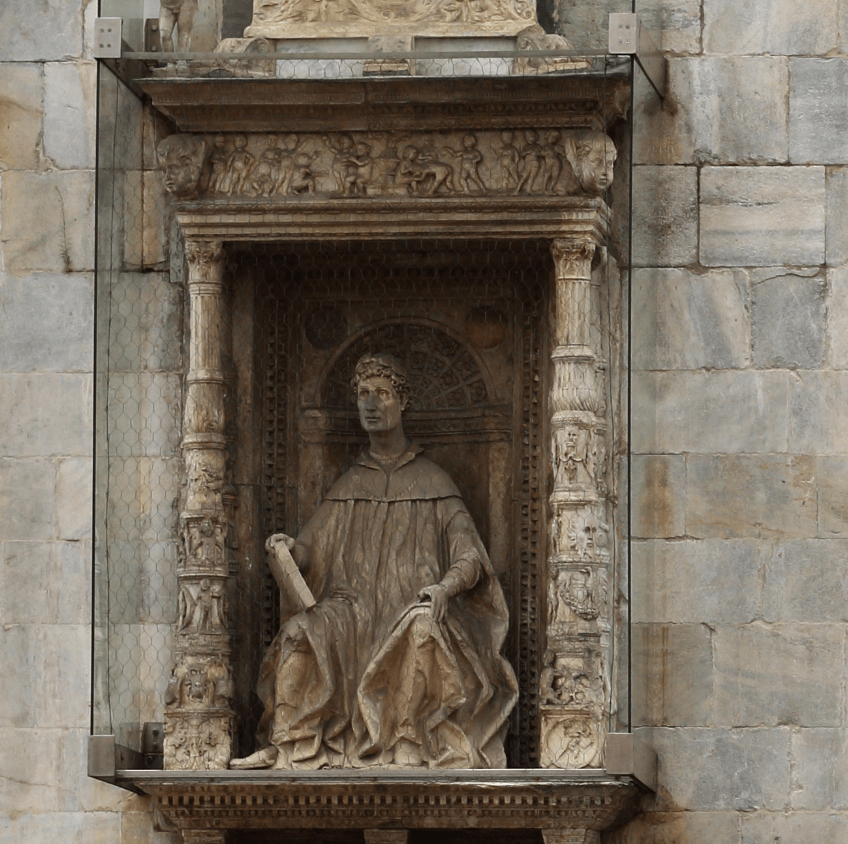
Pliny on the Catholic cathedral of the city of Como, Lombardy, Italy

“I asked them whether they were Christians. Those who confessed, I asked a second and a third time, threatening punishment. Those who persisted, I ordered to be executed. For whatever the nature of their belief, I had no doubt that stubbornness and unyielding obstinacy deserved punishment.”

Pliny the Younger, Letters 10.96, to Trajan, c. A.D. 112.

Pliny calls Christian steadfastness “stubbornness.” Diognetus asks why Christians despise death. They are seeing the same thing from different angles. The Christian refusal to deny Christ was visible enough that Roman officials had to interpret it.

Pliny also describes what he learned about Christian worship.

“They said that the sum of their fault or error was this: they were accustomed to meet on a fixed day before dawn, to sing responsively a hymn to Christ as to a god, and to bind themselves by oath, not to commit crime, but to avoid fraud, theft, adultery, breach of trust, and refusal to return what had been entrusted to them.”

Pliny the Younger, Letters 10.96, to Trajan, c. A.D. 112.

Here we hear, from a Roman perspective, the kind of issue Diognetus raises in the first paragraph: What God do Christians trust, and how do they worship Him? Pliny’s report is brief, but it is revealing. Christians gather before dawn. They sing to Christ as to a god. They bind themselves to moral purity.

A later pagan satirist, Lucian of Samosata, gives another outside witness. He mocks Christians, but even his mockery preserves the public impression they made.

“They have persuaded themselves that they are immortal and will live forever, and because of this they despise death and many of them willingly give themselves up. Their first lawgiver persuaded them that they are all brothers, once they have denied the Greek gods, worshiped that crucified sophist, and lived according to his laws.”

Lucian of Samosata, The Passing of Peregrinus 13, c. A.D. 170.

Lucian intends insult. But he confirms the same basic questions. Christians deny the Greek gods. They worship the crucified one. They call one another brothers. They face death differently.

So when Diognetus asks about Christian worship, Christian love, Christian courage, and Christian newness, he is not asking in isolation. He is voicing questions that belonged to the public reputation of the Church.


Not Monks, but Ordinary Christians

One of the most important things to notice about these sources is that they are describing Christians in general. Pliny is not describing monks. Lucian is not describing a small ascetic faction inside the Church. The author of Diognetus is not describing a spiritual elite that has separated itself from ordinary Christian life. These writers are describing what Christians, as Christians, were known to be like.

That is easy to miss when we read the second century from the far side of later Christian history. By the fourth and fifth centuries, after Christianity became legal, favored, and eventually culturally common in many parts of the Roman world, the more radical features of Christian discipleship could begin to look like the special calling of monks, virgins, hermits, and ascetics. Those movements were deeply important, but they can also tempt later readers to misunderstand the second century. In the world of Pliny, Lucian, and Diognetus, the things being described are not yet the peculiar marks of monastic Christianity. They are the public reputation of normal Christians.

Pliny does not write to Trajan and say that he has discovered an extreme spiritual movement within Christianity. He says that those accused of being Christians gather before dawn, sing to Christ as to a god, and bind themselves to moral obedience.

“They were accustomed to meet on a fixed day before dawn, to sing responsively a hymn to Christ as to a god, and to bind themselves by oath, not to commit crime, but to avoid fraud, theft, adultery, breach of trust, and refusal to return what had been entrusted to them.”

Pliny the Younger, Letters 10.96, to Trajan, c. A.D. 112.

For Pliny, this is what Christians do. They worship Christ, refuse crimes, and order their lives around moral faithfulness. He does not present this as the lifestyle of a spiritual elite. It is the basic pattern he discovers when he investigates the Christian name.

Lucian is similar, even though his tone is mocking. He does not say that a handful of unusually zealous Christians believe they are brothers or despise death. He speaks about Christians as a recognizable people.

“Their first lawgiver persuaded them that they are all brothers, once they have denied the Greek gods, worshiped that crucified sophist, and lived according to his laws.”

Lucian of Samosata, The Passing of Peregrinus 13, c. A.D. 170.

Lucian thinks this is foolish, but he still shows us what outsiders thought they were seeing. Christians denied the Greek gods. Christians worshiped the crucified one. Christians called one another brothers. Christians faced death differently. Again, this is not a description of monks. This is the pagan world trying to explain the normal life of Christians.

That makes the testimony of Diognetus even more powerful. The author does not say, “There are some Christians who live this way.” He simply says, “Christians.” His description is sweeping because he is presenting Christian identity itself.

“Christians are not distinguished from other people by country, language, or customs. They do not live in cities of their own, or use some unusual speech, or practice a strange way of life. Their teaching was not invented by human speculation, nor do they champion a merely human doctrine.”

Anonymous, Epistle to Diognetus 5.1 to 5.3, c. A.D. 180.

He then describes their marriages, their children, their tables, their citizenship, their obedience to laws, their suffering, and their hope.

“Every foreign land is their homeland, and every homeland is foreign. They marry like everyone else and have children, but they do not expose their offspring. They share a common table, but not a common bed. They are in the flesh, but they do not live according to the flesh. They spend their days on earth, but their citizenship is in heaven.”

Anonymous, Epistle to Diognetus 5.5 to 5.9, c. A.D. 180.

This is ordinary Christian life in the second century, at least as the Church wanted to present it and as outsiders often recognized it. Christians married, had children, ate meals, lived in cities, and followed local customs in clothing and food. Yet in the middle of that ordinary life, they refused infant exposure, rejected sexual lawlessness, confessed heavenly citizenship, loved one another, and faced persecution with courage.

This point is easy to lose once Christianity becomes common. In later centuries, costly discipleship could be treated as the work of specially devoted Christians, while ordinary believers lived closer to the assumptions of the surrounding culture. But in these earlier sources, heavenly citizenship, moral distinctness, refusal of idols, brotherly love, care for children, courage before death, and burden-bearing mercy are not advanced electives in the Christian life. They are what Christians were known for.

This is part of why Diognetus asks his questions. He is not asking about a sect within Christianity. He is asking about the Christians themselves.


The Slave Women Pliny Tortured

Pliny’s letter gives us one more detail that belongs in this story. After describing Christian worship, moral discipline, and their ordinary meal together, Pliny says he wanted to discover the truth more fully. So he turned to two enslaved Christian women.

“For this reason I judged it all the more necessary to find out the truth by torture from two female slaves, who were called ministrae. But I discovered nothing else except a depraved and excessive superstition.”

Pliny the Younger, Letters 10.96, to Trajan, c. A.D. 112.

This is a chilling sentence. Pliny writes it almost casually because to a Roman governor the torture of enslaved persons could be treated as an ordinary instrument of investigation. But for our purposes, the sentence reveals something extraordinary about the Christian community.

The two women are enslaved. In Roman society, that places them near the bottom of the social order. They are also women, which in that world often meant limited public authority. Yet Pliny says they were called ministrae. The Latin word can mean female ministers, attendants, or servants, and many English translations render it “deaconesses.” We should be careful not to force a later, fully developed office of deaconess back into this moment too rigidly. But even with that caution, the point remains powerful. These enslaved women were recognized in some kind of ministry or service within the Christian community, and Pliny believed they were significant enough to interrogate for information.

That is a remarkable reversal. The Roman world saw two enslaved women as bodies that could be tortured for evidence. The Church appears to have seen them as servants of Christ with recognized responsibility among the believers.

This fits perfectly with the world described in Diognetus. Christians were not marked off by one social class. They were scattered through cities, villages, households, and ranks of society. Pliny himself says the movement had touched people of every age, every rank, and both sexes.

“Many persons of every age, every rank, and also of both sexes are and will be endangered. For the contagion of this superstition has spread not only to the cities but also to the villages and farms.”

Pliny the Younger, Letters 10.96, to Trajan, c. A.D. 112.

Pliny means this as a warning. But for the historian of the Church, it is evidence. Christianity had entered the lives of men and women, free and enslaved, city dwellers and villagers, people of rank and people without rank. And within that new people, even those whom Roman society placed at the margins could become recognized servants of the Church.

The Church was not a philosophical club for elite men. It was not a mystery society for one social class. It was not an ethnic enclave. It was a new people formed by the Word, and that new people reordered human worth around Christ. The enslaved could become ministers. Women could be recognized as servants of the Church. The poor could make many rich. Those with no standing in the empire could become living witnesses to the kingdom of God.

This does not take us away from Diognetus. It deepens the point. When the author says that Christians are not distinguished by country, language, or ordinary customs, he is describing a people whose identity cuts across the old social markers. In that people, the ancient world’s hierarchies were not erased in a simplistic way, but they were profoundly relativized. The deepest identity was no longer master or slave, male or female, rich or poor, official or peasant. The deepest identity was belonging to Christ.


Why Christians Refused the Gods

The author first answers Diognetus by explaining why Christians cannot worship the gods of the Greeks. He asks Diognetus to look honestly at the objects people call gods. They are made of stone, bronze, wood, silver, iron, and clay. They are shaped by craftsmen, guarded by men, and subject to decay.

“Is not one of them stone, like what is trampled underfoot? Another bronze, no better than the vessels made for our use? Another wood, already rotting? Another silver, needing someone to guard it lest it be stolen? Another iron, eaten away by rust? Another clay, no more honorable than what is made for the most common service?”

Anonymous, Epistle to Diognetus 2.2, c. A.D. 180.

The argument is direct. If the gods are made by human hands, they cannot be the Maker of human hands. If they need to be guarded, they cannot guard the world. If they can decay, they cannot be the source of life.

The author then makes the point sharper.

“These things you call gods. These things you serve. These things you worship. In the end, you become like them. Therefore you hate the Christians, because they do not regard these things as gods.”

Anonymous, Epistle to Diognetus 2.5 to 2.6, c. A.D. 180.

This explains why Christian refusal created hostility. Christians were not merely adding a private devotion to the religious life of the empire. They were refusing the gods everyone else honored. Their refusal exposed the idols as lifeless things.

Pliny’s test for accused Christians makes the same point. A person could prove he was not truly Christian by worshiping the gods and cursing Christ.

“Those who denied that they were or had been Christians invoked the gods in words I dictated, offered incense and wine to your image, which I had ordered brought with statues of the gods, and cursed Christ. It is said that those who are truly Christians cannot be forced to do these things.”

Pliny the Younger, Letters 10.96, to Trajan, c. A.D. 112.

This was the line Christians could not cross. They could live in Roman cities. They could marry, work, buy, sell, and obey the ordinary laws. But they could not call idols gods, and they could not curse Christ.

Again, the point is not that a few unusually zealous Christians refused idolatry while ordinary Christians found ways to blend in. Pliny treats refusal to worship the gods and curse Christ as the mark of a true Christian. The author of Diognetus says Christians are hated because they do not regard these things as gods. The refusal belonged to Christian identity itself.

That refusal made them visible.


Why Christians Were Not Simply Another Jewish Group

Diognetus also asks why Christians do not follow Jewish religious practice. This part of the letter needs careful handling because the author uses sharp polemical language about Jewish observances. It reflects an early Christian argument in the painful separation between Church and synagogue. It should not be turned into contempt for Jewish people.

The author’s theological point is that the Creator does not need to be supplied by the creatures He made.

“The one who made heaven and earth and all that is in them, and who supplies us all with what we need, cannot Himself need the very things that He supplies to those who imagine they are giving them to Him.”

Anonymous, Epistle to Diognetus 3.4, c. A.D. 180.

This helps us see how the author places Christianity. Christians are not pagans because they refuse idols. They are not simply another Jewish sect because they believe the decisive revelation of God has come through the Son. Their worship is not centered on images, and it is not defined by temple sacrifice. It is centered on the living God who has sent His Word.

That is why the question of timing matters so much. If Christians worship the ancient Creator, why does their way of life seem new? If the God of Christians is the Maker of heaven and earth, why has this people appeared now?

The author will answer that question by pointing to Christ as the eternal Word revealed in time.


Christians in the World

After saying what Christians are not, the author describes what they are. This is the most famous passage in Diognetus, and it remains one of the richest descriptions of early Christian identity.

Christians are not marked off by country, language, or clothing. They do not live in separate Christian cities. They do not speak a secret dialect. They do not withdraw from ordinary life into a private civilization.

“Christians are not distinguished from other people by country, language, or customs. They do not live in cities of their own, or use some unusual speech, or practice a strange way of life. Their teaching was not invented by human speculation, nor do they champion a merely human doctrine.”

Anonymous, Epistle to Diognetus 5.1 to 5.3, c. A.D. 180.

This is an important answer to Diognetus. Christians are not a nation in the ordinary sense. They do not belong to one ethnic group or one language. They live among the peoples of the empire, and yet their life reveals a different citizenship.

“They live in Greek and barbarian cities, as each person’s lot has been assigned, and they follow local customs in clothing, food, and the rest of life. Yet they display a wonderful and admittedly astonishing form of citizenship. They live in their own countries, but as sojourners. They share all things as citizens, yet endure all things as foreigners.”

Anonymous, Epistle to Diognetus 5.4 to 5.5, c. A.D. 180.

The author then gives one of the great summaries of Christian life in the ancient world:

“Every foreign land is their homeland, and every homeland is foreign. They marry like everyone else and have children, but they do not expose their offspring. They share a common table, but not a common bed. They are in the flesh, but they do not live according to the flesh. They spend their days on earth, but their citizenship is in heaven.”

Anonymous, Epistle to Diognetus 5.5 to 5.9, c. A.D. 180.

The point is not that Christians are strange because they reject ordinary human life. The point is that they inhabit ordinary life differently. They marry. They have children. They share meals. They live in cities. But they do not expose infants. They do not turn sexual desire into lawlessness. They do not confuse earthly citizenship with ultimate belonging.

Their difference is not chiefly in location, language, or costume. Their difference is in allegiance.

The author continues:

“They obey the established laws, and by their lives they surpass the laws. They love all people, and are persecuted by all. They are unknown and condemned. They are put to death, and restored to life. They are poor, yet make many rich. They lack everything, yet abound in everything.”

Anonymous, Epistle to Diognetus 5.10 to 5.13, c. A.D. 180.

Then comes the famous image. But the image should be heard through its conclusion, because the conclusion tells us that this is not merely how Christians happen to live. It is the place God has assigned them.

“To say it simply: what the soul is in the body, Christians are in the world. The soul is spread through all the members of the body, and Christians are scattered through the cities of the world. The soul dwells in the body, yet is not of the body; Christians dwell in the world, yet are not of the world. The invisible soul is guarded by the visible body, and Christians are known to be in the world, but their godliness remains unseen. The flesh hates the soul and wars against it, though the soul does it no harm, because the soul prevents it from indulging its pleasures. So also the world hates Christians, though they do it no wrong, because they oppose its pleasures. The soul loves the flesh that hates it, and Christians love those who hate them. The soul is enclosed in the body, yet it holds the body together. Christians are held in the world as in a prison, yet they hold the world together. The immortal soul dwells in a mortal tent, and Christians dwell as sojourners among corruptible things while waiting for incorruptibility in heaven. The soul becomes better when treated harshly in food and drink, and Christians increase daily when they are punished. God has assigned them this great post, and they are not permitted to abandon it.”

Anonymous, Epistle to Diognetus 6.1 to 6.10, c. A.D. 180.

That final sentence is crucial. Christians are not merely scattered because history happened to scatter them. They are scattered because God has assigned them this role. They are not merely in the world by accident. They have been placed there as the soul is placed in the body.

This strengthens the whole argument. The author is not describing monastic withdrawal, and he is not describing a private spiritual elite. He is describing the ordinary Christian vocation in the world. Christians marry, raise children, eat at tables, obey laws, live in cities, and work among their neighbors. Yet they do all of this as a people whose citizenship is in heaven and whose presence in the world has been appointed by God.

This is how the author answers an influential outsider. He does not say that Christians are politically dominant or socially impressive. He says that Christians have been assigned a divine post inside the same world everyone else inhabits. They are not permitted to abandon it.


The God Who Sent His Word

The author then turns from Christian life to the divine action that explains it. The Christian way of life did not arise because someone invented a better moral philosophy. It is not a merely human system. It begins with God revealing Himself.

“This was no earthly invention delivered to them. It is no merely human system of opinion that they think worthy of such careful preservation. It is not a stewardship of human mysteries that has been entrusted to them. Rather, the almighty God Himself, the Creator of all things, invisible and sovereign, sent from heaven and planted among human beings the truth, the holy and incomprehensible Word, and fixed Him firmly in their hearts.”

Anonymous, Epistle to Diognetus 7.1 to 7.2, c. A.D. 180.

This passage is crucial. Christians are not different because they discovered God by superior reasoning. They are different because God sent His Word. The Church is not the origin of the message. The Church is the result of God’s revelation.

The author then clarifies who this Word is. God did not send an angel, a servant, or a lower heavenly minister. He sent the one through whom creation itself was made and ordered.

“He did not send, as someone might suppose, a servant, or angel, or ruler, or one who governs earthly things, or one entrusted with the ordering of heaven. He sent the very Creator and Fashioner of all things, by whom He made the heavens, by whom He enclosed the sea within its bounds, whose mysteries all the elements faithfully keep.”

Anonymous, Epistle to Diognetus 7.2, c. A.D. 180.

Here the author begins to answer the deepest question in the opening paragraph. If Christianity seems new, how can it claim to reveal the ancient Creator? The answer is that the one who appeared in time is not a creature of time. He is the Word through whom the heavens were made.

The author then describes the manner of His coming.

“Did He send Him, as one might imagine, to rule by tyranny, fear, and terror? Not at all. He sent Him in gentleness and meekness. As a king sends his son, who is also a king, so He sent Him. He sent Him as God; He sent Him as to human beings; He sent Him as Savior; He sent Him to persuade, not to compel, for violence has no place in the character of God.”

Anonymous, Epistle to Diognetus 7.3 to 7.4, c. A.D. 180.

This tells us not only who Christ is, but what God is like. God does not reveal Himself by crushing the world into submission. He sends His Son in gentleness. He persuades rather than compels. He saves rather than terrifies.

This also explains why Christians are supposed to live the way they do. If the Son comes in meekness, His people cannot make coercion their highest tool. If the Son bears with sinners, His people must learn patience. If the Son gives Himself, His people must become a people of self-giving love.

Christian ethics flow from the character of the God revealed in Christ.


The Word the Gentiles Were Reaching For

There is another layer to the author’s answer that should not be missed. The Christians did not present Christ only as the fulfillment of Jewish Scripture and Jewish expectation, though He certainly was that. They also presented Him as the answer to the deepest questions of the Gentile world.

This matters because Diognetus is not being addressed as a synagogue ruler or a student of the prophets. He is addressed as “most excellent Diognetus,” probably a man of education, status, and influence in the Greek and Roman world. He asks why Christians reject the gods of the Greeks, why they do not simply become Jews, and why this new way of life has appeared now. So the author answers him in a way that speaks to Gentile categories as well. He speaks of the Word, the Creator, the Fashioner of all things, the one by whom the heavens, sea, stars, sun, moon, and all creation are ordered.

“He sent the very Creator and Fashioner of all things, by whom He made the heavens, by whom He enclosed the sea within its bounds, whose mysteries all the elements faithfully keep, from whom the sun has received the measure of the courses of the day, whom the moon obeys as He commands it to shine by night, and whom the stars obey as they follow the course of the moon.”

Anonymous, Epistle to Diognetus 7.2, c. A.D. 180.

That language does more than answer Jewish expectation. It answers Gentile longing for the rational order behind the world. Philosophers had asked what held reality together. They had spoken of reason, nature, providence, order, and the divine principle behind all things. The Christian answer was not that these longings were meaningless. The Christian answer was that the one whom Gentile wisdom sought dimly had now been revealed personally in Christ.

At the same time, Diognetus is careful. The author does not flatter pagan philosophy as though it had already arrived at the truth by itself. He criticizes those who identified God with created elements.

“Do you accept the vain and silly doctrines of those who are considered trustworthy philosophers? Some said that fire was God, calling that God to which they themselves will one day come. Others said water. Others named some other element formed by God. But if any one of these theories is worthy of approval, then every created thing might just as well be declared God.”

Anonymous, Epistle to Diognetus 8.2 to 8.4, c. A.D. 180.

The point is not that Gentile philosophy already knew God clearly. The point is that Gentile philosophy was asking real questions but could not reach the final answer on its own. According to the author, God had to reveal Himself.

“No human being has either seen Him or made Him known, but He revealed Himself. And He revealed Himself through faith, by which alone it is given to behold God.”

Anonymous, Epistle to Diognetus 8.5 to 8.6, c. A.D. 180.

This is where Diognetus fits beautifully alongside Justin Martyr. Justin, writing earlier in the second century, makes the philosophical claim more explicitly. For Justin, Christ is the Logos, the Word, in whom all peoples have shared to some degree. Therefore, whatever the philosophers saw truly, they saw because the Word was already at work.

“We have been taught that Christ is the firstborn of God, and we have declared above that He is the Word of whom every race of human beings has been a partaker. Those who lived according to reason are Christians, even though they have been thought atheists, such as Socrates and Heraclitus among the Greeks, and others like them.”

Justin Martyr, First Apology 46, c. A.D. 155.

Justin says the same thing even more directly in his Second Apology:

“Whatever things were rightly said among all people are the property of us Christians. For next to God, we worship and love the Word who is from the unbegotten and ineffable God, since He also became man for our sake, that by sharing in our sufferings He might bring us healing.”

Justin Martyr, Second Apology 13, c. A.D. 155 to 160.

That helps us understand the broader Christian claim. Christ fulfills Israel’s Scriptures, but He also fulfills the scattered hopes of the nations. He is the answer to the prophets, and He is the answer to the philosophers. The prophets saw more clearly because they received revelation. The philosophers saw partially and often confusedly because they grasped fragments of truth through reason. But both streams find their fullness in the same person: the Word who was from the beginning and appeared in time.

This makes the central line of Diognetus even stronger.

“This is He who was from the beginning, who appeared as new and was found to be ancient, and who is always being born anew in the hearts of the saints.”

Anonymous, Epistle to Diognetus 11.4, c. A.D. 180.

To the Jew, He is ancient because He is the one prepared and promised from the beginning. To the Gentile, He is ancient because He is the Logos, the divine Word, the reason and order behind creation itself. To both, He appears new because He has now come in the flesh.

That is why Christianity could stand before both synagogue and empire, before both Scripture and philosophy, and say: the one you were waiting for, and the one you were reaching for, has appeared.


Why This New People Appeared Now

Diognetus asks why this new people or practice has entered human life now and not earlier. That question is one of the most important in the whole letter.

The author’s answer is not that God only recently began to care about humanity. It is not that humanity finally became wise enough to earn revelation. The answer is that God was patient, allowing human beings to see the poverty of their own works so that His mercy would be revealed as mercy.

“In the former time, He permitted us to be carried along by disorderly impulses, drawn away by pleasures and desires. This was not because He delighted in our sins, but because He was patient with us. It was not because He approved that season of iniquity, but because He was preparing the present season of righteousness, so that, having been shown by our own works to be unworthy of life, we might now be made worthy by the goodness of God.”

Anonymous, Epistle to Diognetus 9.1, c. A.D. 180.

The delay is not indifference. It is patience. The world had to see that it could not save itself. Human beings had to learn that their own works could not make them worthy of life.

Then the author describes the appointed time of God’s mercy:

“When our wickedness had reached its fullness, and it had become clear that punishment and death were its expected reward, then came the time God had appointed to reveal His goodness and power. O the surpassing kindness and love of God! He did not hate us, reject us, or remember our evil against us. He was patient; He bore with us; in mercy He took our sins upon Himself. He gave His own Son as a ransom for us: the holy for the lawless, the innocent for the evil, the righteous for the unrighteous, the incorruptible for the corruptible, the immortal for the mortal.”

Anonymous, Epistle to Diognetus 9.2, c. A.D. 180.

This is the heart of the author’s answer. Christianity appears now because now is the appointed season of mercy. The Son has been given as a ransom. The righteous one has been given for the unrighteous. The incorruptible one has been given for the corruptible. The immortal one has been given for mortals.

Then the author cries out in wonder:

“O sweet exchange! O unsearchable work! O benefits beyond all expectation! The lawlessness of many is hidden in one righteous Man, and the righteousness of one justifies many lawless people.”

Anonymous, Epistle to Diognetus 9.5, c. A.D. 180.

This is not merely explanation. It is worship. The author is overwhelmed by the mercy he is describing.

Diognetus asks why Christians despise death. Here is part of the answer. They have come to believe that death has been answered by the immortal one who gave Himself for mortals. Diognetus asks why this new people appeared now. Here is part of the answer. The appointed time of divine kindness has arrived.

But the author still has one more answer to give. Christianity is new in its historical appearance, but Christ is ancient in His divine identity.


The Ancient Word Appearing New

The central line comes in chapter 11 of the received text. It gathers the force of the letter into one sentence. Diognetus has asked why this new people has appeared now, and the author answers by pointing to the ancient Word who has entered time and now lives in His people.

“This is He who was from the beginning, who appeared as new and was found to be ancient, and who is always being born anew in the hearts of the saints. This is He who is eternal, who today is called Son, through whom the Church is enriched and grace, spread widely, increases among the saints.”

Anonymous, Epistle to Diognetus 11.4 to 11.5, c. A.D. 180.

The author does not deny that Christianity has appeared in history. He does not pretend that the Church has always existed in the same visible form. He says something more profound. The one who appeared new is the one who was from the beginning.

Jesus was born recently in time, yet He is ancient as God. He appeared within history, yet He is not merely a historical founder. He is the eternal Son. He is the Word through whom the world was made. He is the one who seemed new because He was revealed in time, but when He was revealed, He was found to be ancient.

This is the perfect answer to Diognetus’s question. The Christian movement looks new because the incarnation occurred in time. But the Christian faith is not a novelty because the one incarnate is the eternal Word. The Church is historically recent, but Christ is not recently divine. The Son appears in the fullness of time, but He was from the beginning.

The line also says that He is “always being born anew in the hearts of the saints.” That phrase does not mean the incarnation is repeated in the same way over and over. The Word became flesh uniquely in Jesus Christ. But the life of Christ is continually formed in believers. The ancient Word who appeared in time now makes His dwelling in the hearts of the saints.

The author had already prepared us for this idea:

“The almighty God Himself, the Creator of all things, invisible and sovereign, sent from heaven and planted among human beings the truth, the holy and incomprehensible Word, and fixed Him firmly in their hearts.”

Anonymous, Epistle to Diognetus 7.2, c. A.D. 180.

The Word is sent. The Word is planted. The Word is fixed in human hearts. Then chapter 11 says He is ever born anew in the saints.

That is why Christian life itself becomes an answer to Diognetus. The Church is not merely a group of people who admire a teacher from the past. The Church is a people in whom the living Word is at work. Their love, courage, chastity, mercy, and heavenly citizenship are not separate from Christ. They are signs that the ancient Word is making people new.


Born Recently in Time, Ancient as God

The power of the sentence in chapter 11 is that it holds together truths that can easily be separated.

Jesus is born recently in time. From the perspective of c. A.D. 180, the life, death, and resurrection of Jesus belong to recent history. Christianity is not a myth buried in the distant past. It is tied to remembered events, public preaching, apostolic witness, and communities still living in the aftermath of what they claim God has done.

Luke’s Gospel tells the story in exactly this historical register. The anonymous author does not begin with vague mythic time. He writes of a child born during the days of imperial power, in a named place, within the ordinary conditions of human birth.

“While they were there, the days were fulfilled for her to give birth, and she gave birth to her firstborn Son. She wrapped Him in swaddling cloths and laid Him in a manger, because there was no place for them in the lodging place.”

Anonymous author traditionally called Luke, Gospel According to Luke 2.6 to 2.7, c. A.D. 80.

This is the newness of Christianity in its historical form. The Son is born. He enters time. He has a mother. He is wrapped in cloths. He is laid in a manger. The Christian proclamation is not embarrassed by this nearness. It does not hide the humility of the birth.

At the same time, Diognetus insists that the one born in time is ancient as God.

“He sent the very Creator and Fashioner of all things, by whom He made the heavens, by whom He enclosed the sea within its bounds, whose mysteries all the elements faithfully keep.”

Anonymous, Epistle to Diognetus 7.2, c. A.D. 180.

The one born in time is the one through whom time itself exists. The one who appeared in recent history is the one by whom the heavens were made. The Christian claim is not simply that a remarkable man appeared and founded a new movement. The claim is that the Creator’s own Word entered human history.

This is why the author can say He “appeared as new” and “was found to be ancient.” Both are true. He appeared new because He came in the flesh at a particular moment. He was found ancient because He was from the beginning.

Luke writes to Theophilus so that he may know certainty about the things fulfilled among Christians. The author of Diognetus writes to Diognetus so that he may understand the Christian people and the God who explains them. Both works are addressed to “most excellent” recipients. Both are anonymous. Both present Christian truth as something that can be set before serious, influential readers.

But Diognetus presses the question of newness with special force. If Jesus appeared recently, does that make Christianity a recent invention? The author’s answer is no. Christianity is new as revelation, but ancient as divine truth. The one born recently in time is ancient as God.


Something Divine Among Them

The line about the Word being born anew in the hearts of the saints should not be treated as a vague devotional phrase. It is the theological explanation for what outsiders were seeing in Christian life. The author of Diognetus is not merely saying that Christians remember Jesus. He is saying that the living presence of God is active within them.

That is why chapter 7 is so important. After describing Christians thrown to wild beasts and yet not overcome, the author does not say merely that Christians are brave. He says their endurance is evidence that God is present.

“Do you not see them thrown to wild beasts, so that they might be persuaded to deny the Lord, and yet they are not overcome? Do you not see that the more they are punished, the more others increase? These things do not seem to be the works of man. They are the power of God. They are proofs of His presence.”

Anonymous, Epistle to Diognetus 7.7 to 7.9, c. A.D. 180.

That phrase, “proofs of His presence,” belongs beside the central line of chapter 11.

“This is He who was from the beginning, who appeared as new and was found to be ancient, and who is always being born anew in the hearts of the saints.”

Anonymous, Epistle to Diognetus 11.4, c. A.D. 180.

The connection is powerful. Christ has died, risen, and ascended. He is no longer walking the roads of Galilee in the same visible way. Yet the author of Diognetus does not speak as though Christ has simply gone away and left Christians with memories, moral instructions, and institutions. He speaks as though the Word remains actively present in His people.

The Word is planted in their hearts. The Word is born anew in the saints. The courage of the martyrs, the love of the brethren, the refusal of idols, the bearing of burdens, and the growth of the Church under persecution are not merely human achievements. They are “the power of God” and “proofs of His presence.”

This is where Aristides helps us see that Diognetus was not alone. Writing earlier in the second century, Aristides also describes Christian conduct and then concludes that there is something divine in them.

“It is enough for us to have briefly made known to your Majesty the conduct and the truth of the Christians. For great indeed and wonderful is their teaching to the one who is willing to examine and understand it. And truly this people is a new people, and there is something divine mingled with it.”

Aristides, Apology 16, c. A.D. 125.

That phrase says almost exactly what Diognetus is showing. The Christian life is not simply admirable. It bears witness to divine presence. Outsiders can mock it, governors can interrogate it, philosophers can test it, and emperors can be asked to examine it. But the Christian claim is that something more than human discipline is at work in the Church.

The ancient Word is still living in His people.

This also helps us understand why ordinary Christian life appeared so strange. If Christianity were only a set of ideas, then it could be evaluated as one philosophy among others. If it were only a social movement, it could be explained by common loyalty, group identity, or shared pressure. But writers like Aristides and the author of Diognetus see something deeper. They see a new people, and they interpret the life of that people as evidence that God is present among them.


Christ Suffering in the Saints

The same idea appears in another second-century letter, the Letter of the Churches of Vienne and Lyons, written after the persecution in Gaul around A.D. 177 and preserved by Eusebius. This letter is not an apology addressed to an outsider like Diognetus. It is a church letter about martyrs. But it gives us the same theology of Christ’s ongoing presence in believers.

When the letter describes Sanctus enduring torture, it does not interpret his endurance as merely human courage.

“In him Christ suffering wrought great wonders, destroying the adversary, and showing for an example to the rest that there is nothing fearful where there is the Father’s love, and nothing painful where there is Christ’s glory.”

Letter of the Churches of Vienne and Lyons, preserved in Eusebius, Ecclesiastical History 5.1, c. A.D. 177.
That is very close to the logic of Diognetus. The martyr is not simply copying Christ from a distance. Christ is active in him. Christ suffers in him. Christ displays His power through him.

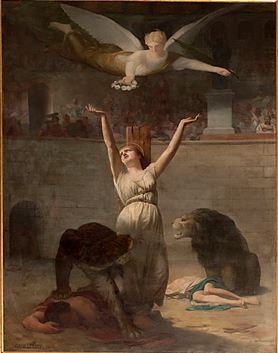
The same letter says something even more vivid about Blandina, an enslaved Christian woman who became one of the great witnesses of the persecution. When she was fastened to a stake, the other Christians saw in her body a living sign of the crucified Christ.

“Through her presenting the spectacle of one suspended on something like a cross, and through her earnest prayers, she inspired the combatants with great eagerness. For in the combat they saw, by means of their sister, with their bodily eyes, Him who was crucified for them.”

Letter of the Churches of Vienne and Lyons, preserved in Eusebius, Ecclesiastical History 5.1, c. A.D. 177.

Guillemet’s 1862 Martyrdom of Saint Blandine

Christ is not absent from the post-ascension Church. He is present in His saints. He is not incarnate again in the same unique way as Bethlehem, but His life is being manifested again and again in His people.
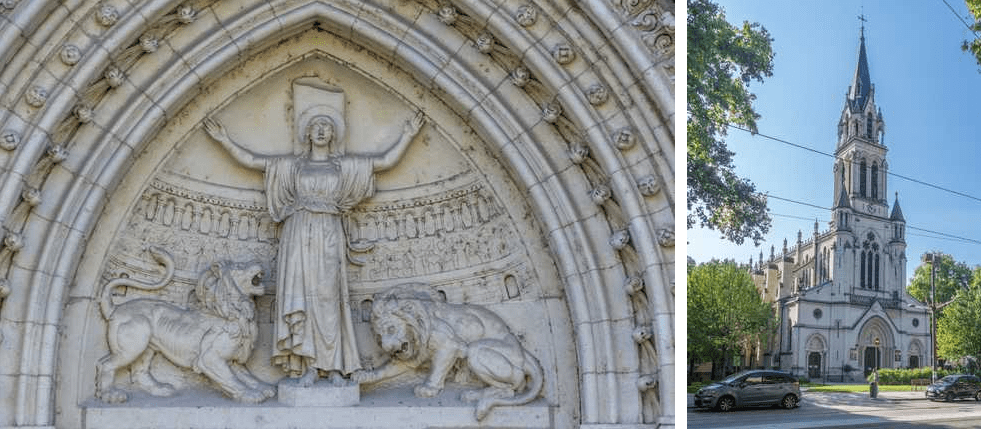
Jules Comparat, The Martyrdom of Saint Blandina, tympanum sculpture, Lyon 1886

That gives more force to Diognetus 11.4. The Word who was from the beginning appeared new in history, and now He is always being born anew in the hearts of the saints. This is not only a mystical phrase. It is how early Christians interpreted the visible transformation of ordinary believers.

The slave woman becomes a witness. The tortured deacon refuses to deny Christ. The poor make many rich. The persecuted bless. The condemned are brought to life. The Church’s life becomes the place where the ascended Christ is still seen.

This also draws Pliny’s tortured slave women into the wider picture. Pliny sees enslaved women as sources of information to be extracted by force. The Church sees women like them as servants of Christ. The Lyons letter shows an enslaved woman, Blandina, becoming a living icon of the crucified Lord before the eyes of the suffering Church. In both cases, the Roman world and the Christian world are looking at the same kind of person but seeing two different realities. Rome sees low status. The Church sees the place where Christ can be made visible.


The Word Born Again in Believers

The line about the Word being “always born anew in the hearts of the saints” becomes clearer when we read it alongside the author’s description of Christian imitation.

In chapter 10, the author turns directly to Diognetus and explains what happens when someone receives the knowledge of the Father. The Christian life begins with God’s love, not with human achievement.

“If you also desire this faith, first receive the knowledge of the Father. For God loved human beings. For their sake He made the world, subjected all things on earth to them, gave them reason and understanding, permitted them alone to look upward to Him, formed them after His own image, sent to them His only-begotten Son, promised them the kingdom in heaven, and will give it to those who love Him.”

Anonymous, Epistle to Diognetus 10.1 to 10.2, c. A.D. 180.

The Christian life is rooted in divine generosity. God made, gave, formed, sent, promised, and will give. Human beings do not climb up to God by their own strength. They receive the love of the Father revealed in the Son.

Then the author describes the result:

“When you have come to know Him, with what joy do you think you will be filled? How will you love Him who first loved you so greatly? And loving Him, you will become an imitator of His goodness. Do not marvel that a human being can become an imitator of God. He can, if God wills it.”

Anonymous, Epistle to Diognetus 10.3 to 10.4, c. A.D. 180.

This is what it means for the Word to be born anew in believers. They become imitators of God’s goodness. That imitation is not domination, force, or worldly greatness. The author is careful about that.

“Happiness is not found in ruling over one’s neighbors, or in wanting to have more than the weak, or in being rich and using force against those beneath you. No one can imitate God in these things. They are foreign to His greatness.”

Anonymous, Epistle to Diognetus 10.5, c. A.D. 180.

This is a direct challenge to ordinary ancient ideas of status. The powerful man rules. The wealthy man gives from above and receives honor. The influential man gathers dependents and clients. But the Christian imitates God by bearing burdens.

“Whoever takes upon himself the burden of his neighbor, whoever is willing to benefit another who lacks what he himself has, whoever supplies to the needy what he has received from God and becomes a gift of God to those who receive it, this person is an imitator of God.”

Anonymous, Epistle to Diognetus 10.6, c. A.D. 180.

This is where the author’s theology becomes visible in ordinary life. The Word born in the heart produces people who bear the burdens of others. The ancient Christ appears newly in acts of mercy. The eternal Son becomes visible in patience, generosity, courage, and love.

So when Diognetus asks what kind of affection Christians have for one another, the answer is not merely that Christians are unusually friendly. The answer is that the Word is living in them. The love of God has taken root in human hearts, and that love has created a new kind of community.

And again, in the second-century sources, this is not presented as an optional higher path for a few unusually serious believers. This is Christian life. To receive the Father’s love is to become an imitator of His goodness. To know the Son is to bear the burdens of the neighbor. To have the Word born in the heart is to become, in some visible way, a gift of God to others.

This also connects back to the divine assignment in chapter 6. Christians are not permitted to abandon their post in the world because the Word is being born in them for the sake of the world. Their holiness is not an escape from the body of humanity. It is the soul-like presence by which God blesses the world that misunderstands them.


Why Christians Face Death Differently

Diognetus also asks why Christians despise death. The author answers that Christians do not fear bodily death as the ultimate evil because they have come to know true life in God.

“Then you will love and admire those who are punished because they will not deny God. Then you will condemn the deceit and error of the world, when you recognize the true life in heaven, when you despise what is only thought to be death here, and when you fear the true death reserved for those condemned to the eternal fire.”

Anonymous, Epistle to Diognetus 10.7, c. A.D. 180.

This is not a hatred of life or a desire for suffering. It is a reordering of fear. Christians can face earthly death because they believe the immortal one has given Himself for mortals. They believe that denying God is worse than dying. They believe that true life is found in heaven.

The author also points to martyrdom as evidence that Christianity is not merely human.

“Do you not see them thrown to wild beasts, so that they might be persuaded to deny the Lord, and yet they are not overcome? Do you not see that the more they are punished, the more others increase? These things do not seem to be the works of man. They are the power of God. They are proofs of His presence.”

Anonymous, Epistle to Diognetus 7.7 to 7.9, c. A.D. 180.

That last sentence is essential. The courage of Christians is not presented as natural bravery. It is a proof of God’s presence. Pliny saw stubbornness. Lucian saw delusion. The author of Diognetus sees the power of God at work.

This brings us back to the central line. If the Word is always being born anew in the hearts of the saints, then the courage of the martyrs is not merely admiration for a past teacher. It is the life of the risen Christ present in His people.

This courage also belongs to the general portrait of Christians. Pliny’s Christians are ordinary accused believers. Lucian’s Christians are the people he thinks he can mock as a group. Diognetus speaks broadly of Christians thrown to beasts and yet not overcome. These sources do not present courage before death as the private achievement of a spiritual elite. They present it as part of the public reputation of the Church.

That is what made the question unavoidable. The world knew how people normally behaved under threat. Christians did not always behave normally. Diognetus wanted to know why.


The Church as the Living Answer

By the end of the letter, we can see that the author answers Diognetus in two ways at once. He gives theological explanations, and he points to the Christian community as evidence.

Diognetus asks what God Christians worship. The author answers: the Creator who sent His Word. But he also points to Christians who refuse idols and worship the living God.

Diognetus asks why Christians love one another. The author answers: because God first loved them. But he also points to Christians who share tables, bear burdens, care for children, and live as brothers and sisters across the ordinary divisions of ancient society.

Diognetus asks why Christians despise death. The author answers: because the immortal one has been given for mortals. But he also points to Christians who endure punishment without denying the Lord.

Diognetus asks why this new people has appeared now. The author answers: because the appointed season of mercy has arrived. But he also points to the Church as the place where the ancient Word is being born anew.

The soul-and-body image helps us understand this. The Church is visible in the world, but the life that animates her is hidden in God. And the end of the image makes clear that this hidden life is not an optional calling. God has assigned Christians this post in the world, and they are not permitted to abandon it.

“Christians are held in the world as in a prison, yet they hold the world together. The immortal soul dwells in a mortal tent, and Christians dwell as sojourners among corruptible things while waiting for incorruptibility in heaven. The soul becomes better when treated harshly in food and drink, and Christians increase daily when they are punished. God has assigned them this great post, and they are not permitted to abandon it.”

Anonymous, Epistle to Diognetus 6.7 to 6.10, c. A.D. 180.

This is a daring claim. Christians appear weak, scattered, and vulnerable. Yet the author says they hold the world together. Not by political command, military strength, or social prestige, but by being the soul within it.

This is another place where the second-century context matters. Before Christianity became culturally common, the Church’s difference was easier to see. Christians were not yet the default religious population of the empire. They were a people whose worship, ethics, courage, family life, and mutual love stood out strongly enough to provoke questions.

And in Diognetus, the Church’s visible life is not merely a moral illustration added after the theology. It is part of the evidence. The author points to Christians and says, in effect, that their life cannot finally be explained by human invention. Their endurance is the power of God. Their courage is proof of His presence. Their love is the Word born anew in their hearts. Their place in the world is not accidental. It has been assigned by God.

That is why Diognetus is so valuable. It shows us Christianity before it became ordinary in the cultural sense. And precisely there, it shows that ordinary Christians were expected to be extraordinary by the standards of the world, not because they had abandoned ordinary life, but because God had placed them within ordinary life as the soul within the body.


Returning to Diognetus’s Opening Questions

By the end of the letter, the opening questions have all been answered.

Diognetus asks what God Christians trust. The author answers: the Creator of all things, invisible and sovereign, who sent His holy and incomprehensible Word.

Diognetus asks how Christians worship. The author answers: not by worshiping idols made of stone, bronze, wood, silver, iron, or clay, but by receiving the Word, living in faith, and becoming imitators of God’s goodness.

Diognetus asks why Christians reject the gods of the Greeks. The author answers: because those gods are lifeless works of human hands.

Diognetus asks why Christians do not simply practice religion like the Jews. The author answers, in his polemical way: because the Creator needs nothing from human hands and has now revealed Himself through His Son.

Diognetus asks what kind of affection Christians have for one another. The author answers: they love because God first loved them, and the Word is being formed in their hearts.

Diognetus asks why Christians despise death. The author answers: because the immortal one has been given for mortals, and Christians have learned to distinguish earthly death from the true death to be feared.

Diognetus asks why this new people has appeared now and not earlier. The author answers: because the appointed season of mercy has arrived, and the one who appeared new was from the beginning.

The whole letter gathers itself into this sentence:

“This is He who was from the beginning, who appeared as new and was found to be ancient, and who is always being born anew in the hearts of the saints.”

Anonymous, Epistle to Diognetus 11.4, c. A.D. 180.

That is the answer to Diognetus. The Church appears new because Christ has appeared in time. The faith is ancient because Christ is from the beginning. The Christian life continues because Christ is born anew in the hearts of the saints.

The author’s answer is not merely, “Here is what Christians believe.” It is, “Here is the one who explains Christians.”


What Later Centuries Could Obscure

The second-century witness matters because later Christian history can change how we hear these texts. Once Christianity became legal, favored, and socially normal, the contrast between Church and world could become harder to see. When large numbers of people became Christian by culture, family inheritance, imperial favor, or social expectation, the older marks of discipleship could seem less like the normal Christian life and more like the special calling of the unusually devout.

This does not mean that later monks, virgins, hermits, and ascetics were wrong. In many cases, they preserved and intensified a seriousness about discipleship that earlier Christians had regarded as basic. The problem comes when later readers project that division back into the second century and imagine that Pliny, Lucian, and Diognetus must be describing spiritual specialists.

They are not.

Pliny describes Christians who gather to worship Christ and bind themselves to moral obedience. Lucian describes Christians who deny the Greek gods, worship the crucified one, call one another brothers, and despise death. The author of Diognetus describes Christians who marry, have children, refuse infant exposure, share tables, live in cities, obey laws, suffer persecution, love all people, and confess heavenly citizenship.

These are not portraits of a monastery. They are portraits of the Church.

That is one reason the Epistle to Diognetus still has such force. It does not allow Christianity to become merely a private belief system held inside an otherwise ordinary pagan life. It presents Christianity as a whole way of being human, visible in worship, family, money, sexuality, courage, citizenship, and love.

The Word who was from the beginning does not merely give Christians new ideas. He makes them a new people.

And according to the author, He does not make them a new people only by giving them memories of something that happened long ago. He makes them new by being present in them. The ancient Word who appeared in history continues to be born anew in the hearts of the saints. That is why their life becomes evidence. That is why Aristides can say there is “something divine” mingled with this new people. That is why the Lyons martyrs can see Christ in Blandina. That is why Diognetus can call Christian endurance the power of God and proof of His presence.

The early Christian claim is not simply that Christ once lived. It is that Christ lives in His people.

And because Christ lives in His people, they are not permitted to abandon their post. The answer to a compromised world is not withdrawal into invisibility, nor surrender into sameness. The answer is the Church living as the soul in the body, scattered through the cities of the world, bearing witness to the Word who was from the beginning.


The Word Still Answers the Outsider

Every age has people like Diognetus. Some are skeptical. Some are sympathetic. Some are powerful. Some are patrons, readers, officials, intellectuals, or neighbors who have watched Christians closely enough to ask real questions.

What God do Christians trust? Why do they worship Jesus? Why do they refuse the idols everyone else accepts? Why do they speak of heaven while living on earth? Why do they call each other brothers and sisters? Why do they care for the weak? Why do they forgive enemies? Why do they face death with hope? Why does this ancient faith keep appearing new?

The Epistle to Diognetus answers those questions by pointing to Christ.

He is the Creator’s Word sent into the world. He is the Son sent not in tyranny but in gentleness. He is the righteous one given for the unrighteous, the incorruptible for the corruptible, the immortal for mortals. He is born in time, yet ancient as God. He appears new, yet He is from the beginning. He is not merely remembered by Christians; He is born anew in the hearts of the saints.

That is why the Christian people cannot be explained only as a social movement, a moral philosophy, or a religious association. The author insists that something more is happening in them. The ancient Word is making human beings new.

And because He is the Word, He answers both worlds addressed in this script. He fulfills the Scriptures of Israel, but He also answers the Gentile search for truth, reason, order, and the divine source of all things. What the prophets awaited and what the philosophers reached toward are fulfilled in the same living person.

The anonymous author does not give Diognetus a slogan. He gives him a vision of the Church as the place where the eternal Son is made visible in ordinary lives. Christians live in the world, but their citizenship is in heaven. They share tables, but not lawless beds. They have children, but do not expose them. They are persecuted, yet they love. They are put to death, yet they live. They lack everything, yet they abound.

And their place in the world is not an accident. It is an assignment.

“God has assigned them this great post, and they are not permitted to abandon it.”

Anonymous, Epistle to Diognetus 6.10, c. A.D. 180.

That line belongs beside the letter’s central confession of Christ.

“This is He who was from the beginning, who appeared as new and was found to be ancient, and who is always being born anew in the hearts of the saints.”

Anonymous, Epistle to Diognetus 11.4, c. A.D. 180.

That is the heart of the Epistle to Diognetus. It begins with the questions of a “most excellent” outsider, probably a man of influence, perhaps even the kind of patron who could request or sponsor such a written defense. It answers him not by hiding the strangeness of Christianity, but by explaining it.

The Church is strange because the Word has come. The Church is new because the eternal Son has appeared in time. The Church endures because that same Word continues to be born anew in the hearts of believers.

And in the second century, that was not supposed to describe only the rarest Christians. It was the life of the Church itself. God had placed them in the world as the soul in the body, and they were not permitted to abandon that post.

Priscillian of Avila: The Execution That Haunted the Church

Priscillian of Avila is one of the most difficult figures in early Christian history because his story was, for a long time, mostly written by his opponents. He was remembered as a heretic, a magician, a deceiver, an ascetic extremist, and the leader of a dangerous movement. But he was also remembered as a learned lay teacher, a bishop, a reformer, a man surrounded by devoted followers, and eventually a martyr in the eyes of his own party.

That tension is the whole story.

If we only read the hostile sources, Priscillian looks like a seducer of souls. If we only read his own defenses, he looks like an orthodox ascetic being persecuted by jealous bishops. The truth is difficult to recover, and any honest script has to admit that. The sources do not give us a clean modern biography. They give us accusations, apologies, councils, appeals, politics, and blood.

Sulpicius Severus gives the most famous ancient portrait. He begins the story by linking Priscillian’s movement to earlier forms of Gnostic and dualist error, especially through a certain Marcus from Egypt. That genealogy may preserve real memory, or it may be a hostile way of placing Priscillian inside a known map of heresy. Either way, when Sulpicius introduces Priscillian himself, the portrait is surprisingly complicated. He does not describe him as a fool.

“Priscillian was of noble birth, rich, bold, restless, eloquent, learned through much reading, and ready in debate. Undoubtedly he had many admirable qualities of mind and body. He could endure long vigils, hunger, and thirst; he had little desire for wealth and used it sparingly. But he was also most vain and puffed up with profane knowledge; indeed, it was believed that from youth he had practiced magical arts.”

Sulpicius Severus, Sacred History, 2.46, c. 403.

That is a hostile source, but it is not a flat caricature. Sulpicius admits Priscillian’s intelligence, endurance, austerity, eloquence, and charisma. This matters because Priscillian’s movement did not grow because he was obviously ridiculous. It grew because he was persuasive. He spoke to people who wanted a more serious Christian life. He appealed to the educated and the ordinary, to ascetics and laypeople, to people frustrated with comfortable religion.

Jerome, writing before Sulpicius’s full narrative, preserves another important clue. He does not clear Priscillian of suspicion, but he does acknowledge that the memory of Priscillian was contested. Some accused him of Gnostic heresy. Others said he was not guilty of the things charged against him.

“Priscillian, bishop of Avila, who by the faction of Hydatius and Ithacius was slain at Trier by the tyrant Maximus, published many little works, some of which have come down to us. He is accused by some even now of the Gnostic heresy of Basilides or Marcus; but others defend him, saying that he did not think as he is accused.”

Jerome, On Illustrious Men, 121, c. 392.

That is the doorway into the script. Priscillian was not simply a name in a heresy catalog. He was a real fourth-century Christian leader whose reputation was fought over almost immediately. Even Jerome knew there were two stories being told.

And that is before we even come to the most shocking fact: Priscillian became the first major Christian figure remembered as being executed for heresy by a Christian imperial court. The formal charges at Trier included accusations of magic and scandalous behavior, not only doctrinal error. But in Christian memory, the event became something larger. A dispute among bishops, ascetics, and churches had crossed into imperial bloodshed.

The question is not only, “Was Priscillian a heretic?” The deeper question is, “What happened when the Church began asking the empire to solve its internal conflicts with the sword?”


A Holy Life—or a Dangerous Circle?

Priscillian’s movement seems to have begun as a call to stricter Christian life. He and his followers emphasized Scripture, fasting, renunciation, moral discipline, and serious devotion. Their critics saw danger in that very intensity. Private meetings, ascetic practices, women participating in religious study, and the use of disputed writings all became suspicious.

Priscillian’s own account presents his circle as people who had been renewed by baptism and had turned away from worldly life. In his appeal to Damasus, bishop of Rome, he describes the movement not as rebellion, but as devotion.

“After we had been renewed by the washing of living regeneration, and after we had rejected the darkness of worldly deeds, we gave ourselves wholly to God, reading that whoever loved anyone more than God could not be His disciple. Some of us were already chosen for God in the churches; others labored in life so that we might be chosen; and we pursued the quiet of Catholic peace.”

Priscillian, Letter to Damasus, Würzburg Tractate 2, c. 381.

That is how Priscillian wants to be seen: baptized, renouncing the world, submitting to God, seeking Catholic peace. He does not present himself as a rebel against the Church. He presents himself as someone whose strictness has been misrepresented.

Sulpicius tells the same story from the other side. To him, Priscillian’s appeal was dangerous precisely because it drew so many kinds of people.

“Gradually he drew many nobles and common people into fellowship with him by the arts of persuasion and flattery. Women also, eager for novelty and of unstable faith, flocked to him in crowds.”

Sulpicius Severus, Sacred History, 2.46, c. 403.

The language about women is hostile and patronizing, but it reveals something important. Priscillian’s circle included women in ways that alarmed his opponents. Late antique bishops often became anxious when lay religious gatherings formed outside ordinary episcopal supervision, and that anxiety intensified when women were prominent. To Priscillian’s followers, this may have looked like serious Bible study and ascetic devotion. To critics, it looked like disorder, secrecy, and a challenge to church authority.

Sulpicius also says that Priscillian cultivated a humble appearance. Again, he means it negatively, as part of a deceptive image. But even hostile testimony suggests that Priscillian’s appeal was ascetic, not luxurious.

“His face and manner had the appearance of humility, and he appeared modest in bearing.”

Sulpicius Severus, Sacred History, 2.46, c. 403.

This is the tension. Asceticism could look like holiness. It could also look like pride. A teacher who gathered laypeople for Scripture could look like a reformer. He could also look like someone undermining bishops. Women studying and praying could look like the Spirit at work. It could also be framed by opponents as suspicious novelty. The same practices could be read in opposite ways depending on whether one stood inside or outside the movement.

Priscillian himself insisted that renunciation was not a crime. He believed Christians should be free to choose a more rigorous life, so long as the faith itself remained sound.

“We have always admonished, and still admonish, that evil morals, indecent patterns of life, and whatever fights against the faith of Christ our God should be condemned by the love of proven Christian life. But we do not forbid someone, having despised parents, children, wealth, dignity, and even his own soul, to choose to love God rather than the world.”

Priscillian, Letter to Damasus, Würzburg Tractate 2, c. 381.

That quote is important because it shows the heart of his self-defense. Priscillian does not deny that some Christians may renounce more than others. He defends that freedom. But he also tries to avoid condemning those who cannot live the strictest life. His argument is not simply, “Everyone must become like us.” He says there are different measures of Christian capacity.

“Nor should hope of pardon be taken from those who cannot reach the first things, but stand in the second and third places; for there are many mansions with God the Father, and if the faith of the creed is kept uncorrupted, the hope set before us in Christ ought to be held.”

Priscillian, Letter to Damasus, Würzburg Tractate 2, c. 381.

That is not how his enemies remembered him. But it is how he wanted Rome to hear him: strict, yes; ascetic, yes; but not outside the creed.


Zaragoza: When Private Devotion Alarmed Public Bishops

In 380, a council met at Caesaraugusta, or Saragossa, in Spain. The surviving canons do not simply give us a clean list saying, “Priscillian is condemned by name.” Instead, they condemn practices that seem closely related to the controversy around his circle. That makes the council especially useful. It shows what bishops feared before the movement reached the imperial court.

The first canon addresses women, readings, and meetings. It shows anxiety about women gathering with men outside approved settings, and about teaching or study that was not clearly under church control.

“All women who are of the Catholic Church and faithful are to be separated from the readings and meetings of strange men; but other women are to meet with those women who read for teaching or learning. Let those who do not observe this judgment of the council be anathema.”

Council of Caesaraugusta, Canon 1, 380.

This canon does not name Priscillian, but it fits the controversy. His circle had drawn women, and opponents were disturbed by religious gatherings outside ordinary structures. The issue was not only doctrine. It was authority, gender, teaching, and control of sacred reading.

The second canon addresses fasting, Sunday observance, withdrawal during Lent, and meetings outside church assemblies. It reads like a response to Christians who were avoiding normal parish life in favor of private ascetic gatherings.

“One is not to fast on Sunday for the sake of the day, belief, or superstition. Those who persist in these opinions are not to be absent from the churches during Lent, nor to hide in cells and mountains; rather, they are to keep the example and precept of the bishops, and they are not to meet on strange estates in order to hold meetings.”

Council of Caesaraugusta, Canon 2, 380.

The canon gives us a picture of what bishops feared: Christians leaving the ordinary church assembly, meeting in villas or private places, adopting unusual fasts, and creating a parallel religious life. In a world where heresies often spread through private circles, that was enough to alarm church leaders.

Another canon shows concern about Eucharistic practice. If someone received the Eucharist in church but did not consume it, the council considered that a grave offense. This may reflect suspicion that some were taking the consecrated elements away for private ritual use.

“If anyone receives the grace of the Eucharist in the church and is proven not to have consumed it, let that person be anathema forever.”

Council of Caesaraugusta, Canon 3, 380.

The council also forbids withdrawal from church during the days before Epiphany. Again, the pattern is the same: do not disappear into houses, villas, mountains, or barefoot ascetic practices; gather with the Church.

“From the seventeenth day before the Kalends of January until the day of Epiphany, no one is permitted to be absent from the church, nor to hide in a house, nor to stay at a villa, nor to go into the mountains, nor to walk barefoot. They must gather at church. Whoever does not observe this is to be anathema forever.”

Council of Caesaraugusta, Canon 4, 380.

The council also speaks against unauthorized teachers. In a movement like Priscillian’s, where lay teaching, scriptural study, and ascetic circles seem to have been central, this canon matters.

“No one is to take for himself the name of teacher, except those persons to whom it has been granted, according to what has been written.”

Council of Caesaraugusta, Canon 7, 380.

Finally, the council regulates consecrated virgins. It insists that women should not take the veil too early, but only after a proven age and with priestly confirmation.

“A virgin dedicated to God is not to be veiled unless she has reached the age of forty years and has been examined and approved by the priest.”

Council of Caesaraugusta, Canon 8, 380.

Taken together, the canons show a church worried about unofficial asceticism. The bishops are not merely asking, “What does Priscillian believe?” They are asking: Who is teaching? Where are Christians meeting? Are women joining private circles? Are people withdrawing from churches? Are they fasting when they should not? Are they handling the Eucharist irregularly? Are they forming a religious movement outside episcopal oversight?

Priscillian later insisted that the council had not judged him properly. In his appeal to Damasus, he says no one from his group was formally accused, heard, convicted, or condemned at Saragossa.

“At the episcopal assembly held at Caesaraugusta, no one of ours was made a defendant, no one was accused, no one convicted, no one condemned. No crime was charged against our name, our vow, or our manner of life; no one had even the anxiety of being summoned.”

Priscillian, Letter to Damasus, Würzburg Tractate 2, c. 381.

He then claims that Damasus himself had already instructed that absent and unheard people should not be condemned.

“Your letter prevailed there against the wicked, for in it, according to the commands of the gospel, you had ordered that nothing be decreed against those absent and unheard.”

Priscillian, Letter to Damasus, Würzburg Tractate 2, c. 381.

Sulpicius tells the story differently. In his narrative, the council condemned Priscillian and his associates, and then the controversy escalated.

“A synod was held at Saragossa, at which neither Instantius nor Salvianus nor Priscillian appeared. Nevertheless, judgment was given against them, and Ithacius was appointed to pursue the sentence against the heretics.”

Sulpicius Severus, Sacred History, 2.47, c. 403.

Already the case is tangled. Priscillian says they were not accused, heard, or condemned. Sulpicius says the synod condemned them despite their absence. The council canons do not give us a simple named condemnation. The result is not a clean courtroom record, but a contested memory.

That contest would soon become deadly.


Priscillian Speaks for Himself

Priscillian’s surviving writings matter because they prevent us from hearing only the prosecution. They do not solve every question. A person’s self-defense is not automatically true. But without it, Priscillian would be only a shadow in hostile reports.

In the Letter to Damasus, he presents himself as a Catholic Christian whose faith is centered on the creed. He is not trying to sound like an outsider. He is trying to convince Rome that he belongs inside the Church.

“The faith, just as we have received it, so we hold and hand down: believing in one God, the Father almighty, and in one Lord Jesus Christ, born of the Virgin Mary by the Holy Spirit, who suffered under Pontius Pilate, was crucified, buried, rose on the third day, ascended into heaven, and will come to judge the living and the dead.”

Priscillian, Letter to Damasus, creed section, c. 381.

He continues with the rest of the confession: the Church, the Spirit, baptism, forgiveness, and bodily resurrection.

“We believe in the holy Church, the Holy Spirit, saving baptism, the remission of sins, and the resurrection of the flesh.”

Priscillian, Letter to Damasus, creed section, c. 381.

This is important because many of the later charges against Priscillian involved dualism, Manichaean tendencies, and suspicion about the body. Yet in his own defense, he explicitly confesses the resurrection of the flesh. That does not prove that all his theology was orthodox by later standards, but it does complicate the picture. His own language is not the language of a man openly rejecting the creed.

He also says that he condemns heresy. Again, this is a self-defense, but it shows the ground on which he wanted the argument to be judged.

“Guarding the path of this creed, with Catholic mouth we condemn all heresies, teachings, institutions, or dogmas that have made quarrels for themselves.”

Priscillian, Letter to Damasus, c. 381.

Priscillian’s defense also reveals how he interpreted the conflict. He did not think he was being opposed because he denied Christ. He thought he was being slandered because private hostilities had been dressed up as zeal for religion.

“Heal what has been wounded by the words of slanderers, for the fruit of life is to be approved by those who seek the faith of truth, not by those who, under the name of religion, pursue private enmities.”

Priscillian, Apology, Würzburg Tractate 1, c. 380–381.

That line captures the heart of his complaint. He believes the controversy is not really about truth, or not only about truth. It is about enemies using the language of orthodoxy to destroy him.

Of course, opponents could answer that heretics often claim to be orthodox. The Church had seen that before. A creed in an appeal letter might not settle the deeper question of what a teacher meant in practice, what books he used, what rituals he encouraged, or what private teachings circulated in his group.

But Priscillian’s own words still matter. They show that he did not present himself as an enemy of the Church. He presented himself as a Christian ascetic, committed to baptism, Scripture, creed, and Catholic peace, asking Rome to hear him before condemning him.

That appeal would not save him.


The Battle Over Books

One of the most serious suspicions surrounding Priscillian’s circle involved books. His opponents accused him and his followers of using apocryphal writings — texts outside the recognized canon of Scripture. In the fourth century, that was not a small matter. Many heretical groups appealed to hidden gospels, secret revelations, or alternative apostolic writings. To bishops already concerned about private meetings and unauthorized teachers, apocryphal books looked dangerous.

Priscillian responded in a tract known as On Faith and the Apocrypha. His argument is not that every apocryphal book should be trusted. His argument is more subtle: Christians should not condemn texts out of ignorance. They should examine, test, read carefully, and remember that even the apostles sometimes referred to writings outside the strict canon.

He turns first to the apostles themselves.

“Let us see, then, whether the apostles of Christ Jesus, the teachers of our conduct and life, read nothing outside the canon.”

Priscillian, On Faith and the Apocrypha, Würzburg Tractate 3, c. 381.

He then points to Jude’s use of Enoch. The argument is clear: if Jude can cite Enoch, then the mere fact that a writing is outside the canon does not mean every use of it is forbidden or useless.

“Jude the apostle says, ‘Enoch, the seventh from Adam, prophesied about these things.’ Who is this Enoch whom the apostle Jude took as a witness of prophecy?”

Priscillian, On Faith and the Apocrypha, Würzburg Tractate 3, c. 381.

This argument would not satisfy everyone. Bishops could still respond that heretics used apocryphal writings deceptively, and that ordinary Christians might not be able to separate useful testimony from corrupt doctrine. But Priscillian’s defense shows that he did not think “apocryphal” automatically meant “never to be read.” He treated the question as one of discernment, not automatic rejection.

In one sharp passage, he mocks those who condemn what they have not examined. He frames the issue as a struggle between lazy ignorance and the command to search.

“On one side, ignorant rage presses us, saying nothing but, ‘Condemn what I do not know; condemn what I do not read; condemn what I do not examine, because I am devoted to idle laziness.’ On the other side, divine eloquence urges us: ‘Search the Scriptures.’”

Priscillian, On Faith and the Apocrypha, Würzburg Tractate 3, c. 381.

That is a dangerous sentence if one’s opponents already think one is too curious about forbidden books. But it is also intellectually serious. Priscillian is saying that condemnation without examination is not faithfulness. It is ignorance with ecclesiastical authority.

Still, this part of his legacy is one reason the controversy never becomes simple. Priscillian’s insistence on reading and testing may sound admirable. But the fourth-century Church had real reasons to worry about alternative writings used in secretive groups. Some apocryphal texts were harmless or edifying. Others carried strange cosmologies, speculative myths, or teachings far from the apostolic rule of faith. Once a movement was already suspected of Gnostic or Manichaean tendencies, its openness to non-canonical writings could easily become evidence against it.

So the battle over books reveals both sides. Priscillian wanted careful reading rather than ignorant condemnation. His opponents feared that unauthorized reading was feeding a movement they could no longer control.


Bishops Against Bishops

The Priscillian controversy was not only a theological dispute. It became a battle among bishops.

Sulpicius names Hydatius and Ithacius as leading opponents. Hydatius first heard reports about the movement and took action. But even Sulpicius, who despises Priscillian’s teaching, says Hydatius made the conflict worse by his severity.

“Hydatius attacked Instantius and the others beyond measure and without moderation. He applied the torch, as it were, to the growing fire, and made bad men worse by exasperating them rather than restraining them.”

Sulpicius Severus, Sacred History, 2.47, c. 403.

That is an extraordinary admission from a hostile narrator. Sulpicius does not say, “Hydatius wisely corrected the danger.” He says Hydatius inflamed it. The conflict was already serious, but bad pastoral handling made it worse.

Then comes Ithacius. He would become Priscillian’s most infamous accuser. Sulpicius’s portrait of him is devastating. Again, this is not a pro-Priscillian writer. This is a writer who thinks Priscillian was a dangerous heretic. Yet he says Ithacius himself was morally compromised.

“Ithacius had no worth and no holiness. He was bold, loquacious, impudent, extravagant, and a slave to his belly. He was so foolish that he charged all holy men who devoted themselves to reading, or who practiced fasting, as companions or disciples of Priscillian.”

Sulpicius Severus, Sacred History, 2.50, c. 403.

That quote may be the most important line in the whole controversy. It shows that anti-Priscillian zeal became so broad that ordinary ascetic holiness could be mistaken for heresy. If a Christian read much, fasted much, or lived austerely, Ithacius might suspect him. In that kind of atmosphere, the boundary between defending orthodoxy and attacking religious seriousness can become dangerously thin.

This is also where Martin of Tours enters the story indirectly. Sulpicius says Ithacius even dared to accuse Martin — the very Martin whom Sulpicius revered as a saint.

“He even dared to reproach Martin, a man plainly like the apostles, as though he too were involved in the heresy.”

Sulpicius Severus, Sacred History, 2.50, c. 403.

That line tells us how far the controversy had gone. The pursuit of Priscillianism was no longer only about Priscillian. It was becoming a net wide enough to catch anyone who looked too ascetic, too intense, too scriptural, too independent, or too inconvenient.

Priscillian, for his part, described the conflict as a religious cover for private hatred. We do not have to accept his account entirely to see why it would have felt plausible.

“Those who, under the name of religion, pursue private enmities should not be allowed to judge the fruit of life.”

Priscillian, Apology, Würzburg Tractate 1, c. 380–381.

The tragedy is that both danger and injustice may have existed at once. Priscillian’s movement may really have contained troubling teachings or practices. His accusers may also have been reckless, proud, politically ambitious, and unjust. Early Christian history often becomes morally difficult exactly there: when a real concern is pursued by the wrong means, in the wrong spirit, by the wrong people.


Rome, Milan, and the Search for Vindication

After the conflict in Spain intensified, Priscillian and his allies sought vindication beyond their local enemies. According to Sulpicius, Instantius, Salvianus, and Priscillian went to Rome to present their case before Damasus, the bishop of Rome. The journey itself tells us how serious the conflict had become. This was no longer a local argument about unusual fasting or private meetings. It had become a transregional struggle for legitimacy.

Sulpicius says their path took them through Aquitaine, where they gained followers and caused further alarm. In Bordeaux, Bishop Delphinus opposed them.

“They set out for Rome to clear themselves before Damasus. On the way, passing through Aquitaine, they spread their errors among some. But when they came to Bordeaux, they were driven away by Delphinus, the bishop of that city.”

Sulpicius Severus, Sacred History, 2.48, c. 403.

Sulpicius then introduces two women, Euchrotia and her daughter Procula, whose names became tangled in the accusations surrounding Priscillian. The language is hostile and scandalous, and it shows how quickly the controversy took on charges involving women, sexuality, and improper religious intimacy.

“They stayed for a time with Euchrotia and her daughter Procula. Of Procula there was a common report that she had been violated by Priscillian and had procured an abortion.”

Sulpicius Severus, Sacred History, 2.48, c. 403.

This is the kind of charge that must be handled carefully. Sulpicius reports it as rumor. We do not have a neutral trial record proving it. But the accusation itself mattered because it helped turn Priscillian from a disputed ascetic teacher into a figure of moral panic. The presence of women in his circle had already alarmed opponents. Accusations of sexual scandal made that alarm explosive.

When Priscillian and his allies reached Rome, Sulpicius says Damasus did not admit them to a hearing. They also tried Ambrose of Milan, but he too opposed them.

“When they reached Rome, they were not admitted to Damasus. Then they went on to Milan, but Ambrose was not more favorable to them.”

Sulpicius Severus, Sacred History, 2.48, c. 403.

This is one of the script’s important connections to earlier figures. Ambrose, who could be so courageous against emperors, also appears here as one of the bishops who refused Priscillian’s appeal. Damasus and Ambrose were not persuaded. Whether because they judged the movement dangerous, distrusted its leaders, or did not want to be entangled in Spanish episcopal conflict, Priscillian did not get the vindication he sought.

But the story did not end there. Sulpicius says Priscillian’s party used bribery and flattery to gain influence with powerful imperial officials, especially Macedonius, and obtained a rescript that allowed them to return.

“By gifts and flattery they won over Macedonius, who was then master of the offices. Through him they obtained a rescript by which they were restored to their churches.”

Sulpicius Severus, Sacred History, 2.48, c. 403.

Again, the source is hostile, but the movement between church and empire is clear. Bishops had condemned. Priscillian appealed. Rome and Milan refused. Imperial officials intervened. Rescripts were issued. Churches were lost and recovered. The machinery of the empire had entered the dispute.

And once imperial power enters an ecclesiastical conflict, it rarely remains a neutral tool.


Bordeaux, Trier, and the Door to the Sword

The next stage of the controversy carried Priscillian toward death.

Ithacius, under pressure, eventually appealed to imperial authority. The political situation had also changed. Magnus Maximus had seized power in the West and ruled from Trier. His court became the place where the Priscillian controversy would move from church discipline to capital prosecution.

Sulpicius says Maximus ordered the case to be heard by a synod at Bordeaux. There Instantius was judged unworthy of the episcopate. Priscillian, seeing what had happened, appealed to the emperor.

“By command of the emperor, the bishops were ordered to assemble at Bordeaux. There Instantius was commanded to plead his cause, and after he was heard, he was judged unworthy of the episcopate. But Priscillian avoided being heard by the bishops and appealed to the emperor.”

Sulpicius Severus, Sacred History, 2.49, c. 403.

Sulpicius pauses here to give his own judgment, and it is crucial. He thinks Priscillian was a heretic. He thinks Priscillian was dangerous. But he also thinks the bishops made a grave mistake by transferring the case to a secular ruler.

“Our bishops should never have brought an ecclesiastical cause before the emperor, for even if Priscillian was worthy of punishment, the judgment should have remained with the bishops.”

Sulpicius Severus, Sacred History, 2.49, c. 403.

This is the turning point. Priscillian had appealed to the emperor, but Sulpicius still blames the bishops for allowing an ecclesiastical matter to become an imperial criminal case. The line between church discipline and state punishment began to collapse.

At Trier, Ithacius pressed the case. Sulpicius says he will not blame the accusers merely for zeal, if they had not pursued victory too fiercely. But their spirit disgusts him.

“I would not blame the accusers for their zeal in overcoming the heretics, if they had not contended more eagerly than was fitting for victory. But Ithacius himself was displeasing to me, for he was a man of no worth and no holiness.”

Sulpicius Severus, Sacred History, 2.50, c. 403.

This is one of the great moral complexities of the story. Sulpicius agrees that Priscillian’s doctrine was evil, but he recoils from the men who pursued him. He believes heresy is dangerous, but he does not trust the spirit of the prosecution. That is why Martin of Tours becomes so important.


Martin of Tours Says No Blood

Martin of Tours stands in this story as one of the clearest moral voices. He did not defend Priscillian’s teaching. He did not say the movement was harmless. But he opposed the shedding of blood.

According to Sulpicius, Martin urged Ithacius to stop prosecuting the case and pleaded with Maximus not to execute the accused. For Martin, excommunication or expulsion from the churches was enough. The state had no business judging an ecclesiastical case with death as its possible outcome.

“Martin did not cease to urge Ithacius to give up his accusations, or to implore Maximus not to shed the blood of those unhappy people. He maintained that it was punishment enough that, after being declared heretics by the sentence of bishops, they should be expelled from the churches; and that it was a foul and unheard-of indignity for a secular ruler to judge an ecclesiastical case.”

Sulpicius Severus, Sacred History, 2.50, c. 403.

That is the moral center of the episode. Martin is not soft on heresy. He is clear about limits. Bishops may judge doctrine. Churches may exclude false teachers. But the sword is another matter.

While Martin remained at Trier, the execution was delayed. Sulpicius says Maximus promised Martin that no cruel measures would be taken.

“As long as Martin remained at Trier, the trial was put off. When he was about to leave, Maximus promised him that nothing bloody would be done against the accused.”

Sulpicius Severus, Sacred History, 2.50, c. 403.

But once Martin left, other voices prevailed. Sulpicius names court figures who persuaded Maximus to proceed more harshly. The emperor’s promise did not hold.

“After Martin left, the emperor was corrupted by the counsels of Magnus and Rufus and handed the case over to the prefect Evodius, a stern and severe man.”

Sulpicius Severus, Sacred History, 2.50, c. 403.

The contrast is stark. Martin pleads for no blood. Ithacius prosecutes. Maximus hesitates, promises restraint, and then yields. The machinery of imperial justice begins to move.

And once it moves, it does not merely correct. It kills.


The Sword Falls

Sulpicius says the prefect Evodius heard Priscillian’s case twice. Here again, the source is hostile, and we should read it as the prosecution’s world rather than a neutral transcript. Sulpicius says Priscillian confessed to shameful doctrines, nocturnal meetings with women, and praying naked. These accusations fit late antique fears about heretical secrecy, sexual disorder, and magic.

“Evodius heard Priscillian twice and convicted him of wickedness. Priscillian did not deny shameful doctrines, nocturnal meetings with women, and the custom of praying naked. Evodius judged him guilty and sent him back to prison until the emperor should decide.”

Sulpicius Severus, Sacred History, 2.50, c. 403.

We have to pause here. This is not Priscillian’s own confession preserved in his words. It is Sulpicius’s report of a trial handled by hostile authorities. It may preserve real admissions. It may also reflect coercive interrogation, hostile interpretation, or the standard accusations attached to suspect ascetic groups. The historian cannot simply erase it. But neither should it be repeated as though it were a clean modern court record.

The sentence came from Maximus. Priscillian was condemned to death. Several followers died with him, including Latronianus and Euchrotia. Others were exiled.

“Priscillian was condemned to death, and with him Felicissimus and Armenius, who had recently turned from the Catholic faith to follow him. Latronianus and Euchrotia were also beheaded. Instantius, whom the bishops had already condemned, was ordered into exile on the island of Sylina.”

Sulpicius Severus, Sacred History, 2.51, c. 403.

This was the event that made Priscillian’s story infamous. A Christian bishop, accused of heresy and related crimes, was executed by a Christian imperial court. Whatever one thinks of Priscillian’s theology, this was a new and ominous moment.

Sulpicius himself has no affection for Priscillian. After describing the executions, he still calls them people unworthy of life. Yet his narrative has already told us that Martin opposed the bloodshed and that Ithacius was morally contemptible. That combination makes the account morally unstable in the best way. Sulpicius cannot let Priscillian off the hook, but he also cannot make the prosecution look holy.

“Thus men unworthy of the light of day were punished by death or exile. Yet the accusers themselves, and especially Ithacius, did not escape the stain of their own disgrace.”

Sulpicius Severus, Sacred History, 2.51, c. 403.

This is why the execution of Priscillian is more than an episode in the history of heresy. It is a mirror held up to the post-Constantinian Church. The empire had become Christian, but the sword had not become pastoral. Bishops could ask the state for help, but once the state entered, it brought prisons, interrogations, confiscations, exile, and death.

Martin saw that danger. Ithacius did not. Or if he saw it, he wanted victory more.


After the Execution: A Martyr Is Made

If Maximus and the accusers thought Priscillian’s death would end the movement, they were wrong. Sulpicius says the execution strengthened it. That detail is one of the most important in the whole story. Killing a teacher does not always destroy a movement. Sometimes it gives the movement a martyr.

“The heresy was not suppressed by the death of Priscillian. Rather, it grew stronger and spread more widely. His followers, who had honored him before as a saint, afterward began to worship him as a martyr.”

Sulpicius Severus, Sacred History, 2.51, c. 403.

The bodies of Priscillian and the others were brought back to Spain. Their funeral became a public act of devotion.

“The bodies of those who had been killed were brought back to Spain, and their funerals were celebrated with great pomp. To swear by Priscillian was considered the highest act of religion among his followers.”

Sulpicius Severus, Sacred History, 2.51, c. 403.

That is the bitter irony. The imperial sword did not purify Spain. It deepened the wound. Priscillian’s enemies had made him more powerful in death than he had been in life. A condemned bishop became a martyr to his followers, and his movement endured.

Sulpicius’s closing reflection on the aftermath is one of the darkest passages in his narrative. He says the controversy corrupted almost everyone involved. Bishops were driven by hatred, fear, envy, ambition, lust for office, pride, and greed. The people of God were exposed to mockery.

“The discord continued for fifteen years, shameful and disgraceful. Through the quarrels of the bishops, everything was disturbed. Hatred, favor, fear, envy, faction, lust, greed, pride, sleepiness, sloth, and many private corruptions were mingled with the cause of religion, and the people of God were exposed to mockery.”

Sulpicius Severus, Sacred History, 2.51, c. 403.

That may be Sulpicius’s most important judgment. He believes Priscillian was wrong. But he also believes the Church’s handling of the matter became a scandal. Once bishops entered the logic of faction, once accusers became worse than pastors, once the state was invited to do the work of discipline, the whole Church suffered.

Years later, Priscillianism remained a concern in Spain. Orosius, a Spanish priest, wrote to Augustine about the errors of the Priscillianists and Origenists. His tone is deeply hostile, but it shows that the movement had not disappeared.

“It was necessary for me, in haste, to gather into one all the trees of perdition with their roots and branches, and to offer them to your fiery spirit, so that, seeing the army and discerning the wickedness, you might determine what medicine of strength you can apply.”

Orosius, Commonitorium to Augustine on the Error of the Priscillianists and Origenists, 1, c. 414.

Orosius even asks Augustine to correct by teaching those whom violence had not healed. His language is revealing: the sword had already fallen, but the wound remained.

“Through you, our Lord God — through you, blessed father — may He correct by the word those whom He chastened by the sword.”

Orosius, Commonitorium to Augustine on the Error of the Priscillianists and Origenists, 1, c. 414.

That sentence unintentionally exposes the failure of the execution. The sword had not settled the matter. It had not healed the Church. A generation later, Spanish clergy still looked for “medicine” against Priscillianism.

The death of Priscillian had not ended the controversy. It had made it unforgettable.


Was Priscillian a Heretic?

The honest answer is that the sources do not let us speak with the same simplicity as his enemies did.

Sulpicius thought he was a heretic. Orosius thought his followers were dangerous. The Council of Saragossa condemned practices associated with his movement. Damasus and Ambrose did not receive his appeal. Later Spanish councils continued to fight Priscillianism. The suspicion was not invented out of nothing.

And yet Priscillian’s own surviving writings sound more orthodox than the hostile summaries would lead us to expect. He confesses the creed. He affirms Christ’s birth, passion, resurrection, ascension, judgment, baptism, remission of sins, and resurrection of the flesh. He condemns heresies with Catholic language. He defends asceticism, but also says not everyone can reach the same measure of renunciation. He argues for reading disputed writings carefully, not simply swallowing every hidden book.

So how should we tell the story?

We should not turn Priscillian into an uncomplicated hero. His movement may well have contained dangerous speculative elements, secretive practices, and a spiritual elitism that worried bishops for understandable reasons. The Church had seen enough Gnostic and Manichaean confusion to be alert.

But we also should not let hostile sources define him without challenge. The accusers were not pure. Sulpicius himself tells us Ithacius was morally unworthy and reckless in accusation. Martin opposed the execution. The council canons reveal anxiety about control as well as doctrine. The imperial process turned an ecclesiastical dispute into a capital case. And after Priscillian died, his followers did not disappear; they honored him as a martyr.

Jerome’s divided summary may still be the fairest ancient doorway into the problem.

“He is accused by some even now of the Gnostic heresy of Basilides or Marcus; but others defend him, saying that he did not think as he is accused.”

Jerome, On Illustrious Men, 121, c. 392.

That is the Priscillian problem in one sentence. Some accuse. Others defend. The historian has to listen to both.

What we can say with confidence is this: Priscillian’s case revealed the dangers of a Christian empire learning to discipline religious error through coercive power. Once heresy becomes a matter for imperial prosecution, bishops may win a case and lose something deeper. They may preserve boundaries while corrupting the spirit of judgment. They may silence a teacher while creating a martyr. They may defend orthodoxy and still fail the gospel’s restraint.


Conclusion

Priscillian’s story matters because it stands at a dangerous turning point in Christian history. Before Constantine, Christians knew what it meant to be judged by imperial power. After Constantine, Christians had to decide what they would do when imperial power seemed available for their own disputes. Priscillian’s death shows how quickly the persecuted Church could become a Church tempted to prosecute.

He was not the easiest figure to defend. His circle was controversial. His use of apocryphal writings alarmed bishops. His ascetic movement disrupted ordinary church structures. His followers included women and laypeople in ways that unsettled episcopal authority. Accusations of magic, secrecy, and immorality clung to his name. But his own writings show a man who claimed the creed, appealed to Catholic peace, defended careful reading, and insisted that he had been condemned unheard.

That is why the story must not be told as simple triumph. If Priscillian was dangerous, the way his enemies pursued him was also dangerous. If his teaching needed correction, the sword was not the medicine of Christ. Martin of Tours understood that. He believed heresy could be judged by bishops and excluded from churches, but he pleaded that no blood be shed. In this story, Martin’s voice sounds like a warning to the whole Christian empire.

The execution did not end the movement. It intensified it. Priscillian’s body returned to Spain, and his followers honored him as a martyr. The empire had killed the man, but the blood created memory. The bishops who wanted victory inherited scandal. The Church inherited a question it would face again and again: when error appears, will the Church trust teaching, discipline, patience, and prayer — or will it reach for the power of the state?

Priscillian of Avila remains difficult. He was ascetic reformer, accused heretic, bishop, defendant, and martyr to his followers. He may have been more orthodox than his enemies claimed, or more dangerous than his own writings reveal. But the deepest lesson of his story does not depend on solving every charge. The deepest lesson is that Christian truth is not served by every weapon used in its name.

At Trier, the Church learned what could happen when bishops brought their quarrels to the imperial court. The sword fell. A bishop died. And Christian history received one of its earliest warnings that even zeal for orthodoxy can become unholy when it forgets mercy.

Augustine of Hippo: The Conversion That Changed Christian History

Augustine was born in 354 in Tagaste, a small town in Roman North Africa. He was not born in Rome, Milan, Antioch, Alexandria, or one of the great imperial centers where the most powerful bishops and philosophers often moved. He came from the provincial world of North African towns, schools, farms, law courts, and churches. And yet from that relatively modest place, Augustine would become one of the most influential Christian thinkers in history.

Possidius, Augustine’s friend and early biographer, begins with the plain facts: Augustine came from Tagaste, from a family of local standing, and from a Christian household as later Christian memory understood it.

“Augustine was born in the province of Africa, in the city of Tagaste, of honorable parents of curial rank.”

Possidius, Life of Augustine, 1, c. 431.

But Augustine’s own memory gives the household more texture. His mother Monica was devout, prayerful, and fiercely committed to Christ. His father Patricius, though connected to the Christian world, was not baptized until near the end of his life. Augustine grew up with Christian signs around him, but not yet with a converted heart. He was marked as a catechumen before he understood what that meant.

“I was signed with the sign of His cross and seasoned with His salt from the womb of my mother, who greatly hoped in You.”

Augustine, Confessions, 1.11.17, c. 397–401.

That sentence matters because Augustine never tells his story as if he discovered God from nothing. Grace was pursuing him before he could name it. Monica’s faith surrounded him before his own faith awakened. He could wander far, but he would later look back and see that God had been present in the prayers, signs, fears, and hopes of his childhood.

At the same time, Augustine does not romanticize his early years. He remembers childhood not as pure innocence, but as the beginning of disordered desire. Even as a boy, he says, he wanted attention, praise, victory in games, and the satisfaction of his own will. He writes about childhood with startling honesty because he believes sin is not merely something adults choose once they understand everything. Sin is the bent shape of the heart when it loves wrongly.

“I was disobedient, not because I had chosen something better, but from love of play. I loved victory in my contests; I loved to have my ears tickled by false stories, so that they might itch more eagerly; and the same curiosity flashed more and more through my eyes toward the shows and games of grown men.”

Augustine, Confessions, 1.10.16, c. 397–401.

This is one of the first things that makes Augustine different from many ancient biographers. He does not tell his life as the story of a naturally great soul rising steadily toward wisdom. He tells it as the story of a restless heart, loved by God, resistant to God, and unable to heal itself.

His father wanted him to succeed. Augustine was sent to school, first in Tagaste, then in nearby Madaura, and later to Carthage. The family invested in his education because rhetoric could open doors. In the Roman world, speech was power. A brilliant student could become a teacher, lawyer, official, or public intellectual. Augustine learned early that words could win admiration, and admiration became one of his first idols.

He later remembered that his father cared deeply about his public advancement but not deeply enough about the moral direction of his soul.

“My father took no care how I was growing before You, or how chaste I was, so long as I was eloquent.”

Augustine, Confessions, 2.3.5, c. 397–401.

That is not a throwaway complaint. It names the world Augustine was entering. He was being trained to speak, to persuade, to win, to rise. But the question of what he loved, what he desired, and what kind of person he was becoming could be neglected as long as his talent promised social success.

Monica saw more. Augustine says she warned him about sexual sin and urged him toward chastity, but he was not ready to listen. Her words seemed to him like the voice of a woman, not the command of God. Only later did he realize that God had been speaking through her.

“These seemed to me womanish warnings, which I would have blushed to obey. But they were Yours, and I did not know it. I thought You were silent, and that she was speaking, though You were speaking to me through her.”

Augustine, Confessions, 2.3.7, c. 397–401.

Already, Augustine’s story is taking its shape. There is ambition, but also grace. There is parental love, but also misplaced priority. There is Christian formation, but also resistance. There is Monica’s prayer, but Augustine does not yet know how much of his future is being carried by it.


The Pear Tree and the Shape of Sin

Augustine’s most famous childhood sin sounds almost absurd when first introduced. He and some friends stole pears from a tree. They did not need them. They were not hungry. They did not even especially enjoy the pears. They stole them, threw them to pigs, and laughed.

Many readers have wondered why Augustine gives so much attention to such a small theft. But that is the point. Augustine is not interested in the market value of the fruit. He is interested in the interior logic of sin. Why do human beings sometimes love what ruins them? Why do we choose evil when the outward reward is almost nothing? Why does companionship make wrongdoing sweeter?

He remembers the scene with painful precision.

“There was a pear tree near our vineyard, loaded with fruit that was attractive neither in appearance nor taste. We wicked boys went out late at night to rob it and carry off its fruit. We took huge loads, not to feast on them ourselves, but to throw them to the pigs. Even if we ate some, our pleasure was in doing what pleased us because it was forbidden.”

Augustine, Confessions, 2.4.9, c. 397–401.

This is classic Augustine. He slows down over something others would dismiss because he knows that small acts can reveal the soul. The theft was not about pears. It was about the will enjoying its own disorder. It was about the thrill of saying no.

Augustine then says something even sharper. He did not merely love the fruit. He loved the theft.

“I loved my own ruin. I loved the fault itself, not the thing for which I committed the fault. I was foul, and I loved it.”

Augustine, Confessions, 2.4.9, c. 397–401.

That line is severe, but it is not self-hatred for its own sake. Augustine is trying to tell the truth about sin without flattering himself. He will not say, “I was only confused,” or, “I merely wanted pleasure,” or, “I was a victim of circumstances.” He sees something darker: he loved the act because it was a departure from God.

But he also knows that sin is social. He doubts he would have done it alone. The group gave courage to the evil. Shared laughter made the wickedness feel lighter. Friendship, which should have been a school of love, became a school of rebellion.

“Alone I would not have done it. I remember my feeling then: alone I certainly would not have done it. Therefore I loved also the companionship of those with whom I did it.”

Augustine, Confessions, 2.8.16, c. 397–401.

This is one reason Augustine remains so powerful. He does not describe sin only as a rule broken on the surface. He describes it as a distorted love, a social force, a false freedom, a counterfeit joy. The pear tree becomes a little Eden in reverse. The fruit is not needed. The act is not rational. The soul reaches out anyway, because forbidden self-will has become sweet.

And yet Augustine is not telling this story to leave the reader in despair. The Confessions are addressed to God. Every descent is told inside a larger ascent. He can remember his shame because he now remembers mercy. He can say, “I loved my ruin,” because God did not leave him in ruin.


Carthage, Cicero, and the Hunger for Wisdom

When Augustine went to Carthage as a young student, he entered a world of ambition, theater, rhetoric, sex, competition, and intellectual hunger. He took a concubine, fathered a son named Adeodatus, pursued public success, and threw himself into the life of a gifted young man who wanted to be admired.

He describes Carthage with one of the most famous lines in the Confessions.

“I came to Carthage, where a cauldron of shameful loves was boiling all around me.”

Augustine, Confessions, 3.1.1, c. 397–401.

This is not merely a young man discovering pleasure. Augustine says he wanted to love and be loved, but his desire was disordered. He was not seeking God as the source of love. He was seeking the experience of being inflamed by love.

“I was not yet in love, but I loved to love. From a hidden hunger, I hated myself for not being more hungry.”

Augustine, Confessions, 3.1.1, c. 397–401.

At Carthage, however, Augustine did not only descend into lust and ambition. He also awakened intellectually. A book by Cicero, now mostly lost, changed him. The book was called Hortensius, and it was an exhortation to philosophy. Augustine was studying rhetoric, but Cicero made him hunger for wisdom.

“That book changed my affections. It turned my prayers toward You, O Lord, and made my desires and wishes different. Every vain hope suddenly became worthless to me, and with an incredible burning of heart I longed for the immortality of wisdom.”

Augustine, Confessions, 3.4.7, c. 397–401.

This is one of the decisive moments in Augustine’s early life. He is still far from orthodox Christianity, but he is no longer satisfied with mere applause. He wants wisdom, permanence, truth. Cicero gives him a philosophical hunger that his career ambition cannot satisfy.

But when Augustine turned to Scripture, he was disappointed. The Bible did not impress him. Compared with Cicero’s polished style, Scripture seemed plain, humble, and unworthy of his refined literary expectations. Augustine admits that his pride kept him from entering its depths.

“I resolved to give attention to the holy Scriptures and to see what they were like. But behold, I saw something not understood by the proud and not uncovered to children, lowly in its entrance, lofty in its heights, and veiled in mysteries. I was not the kind of person who could enter it or bend my neck to its steps.”

Augustine, Confessions, 3.5.9, c. 397–401.

That phrase, “bend my neck,” is crucial. Augustine’s problem was not lack of intelligence. It was pride. Scripture required humility before it yielded its wisdom. Augustine wanted truth, but he wanted truth on terms that honored his taste, his training, and his intellectual superiority.

So he turned elsewhere. He joined the Manicheans, a religious movement that promised rational answers to the problem of evil, criticized the Old Testament, and claimed to explain the world through a cosmic conflict between light and darkness. For a young man embarrassed by Scripture and troubled by evil, Manichaeism seemed sophisticated.

But Augustine later remembered that the Manicheans fed him with words that sounded impressive and left him hungry.

“They cried, ‘Truth, truth,’ and spoke much about it to me, but it was not in them. They spoke false things, not only about You, who truly are the Truth, but also about the elements of this world, Your creation.”

Augustine, Confessions, 3.6.10, c. 397–401.

Augustine’s early journey is not the simple story of a lazy sinner avoiding religion. It is the story of a brilliant, ambitious, morally compromised young man who wanted wisdom but kept mistaking substitutes for the real thing. He wanted love, but not chastity. He wanted truth, but not humility. He wanted God, but not yet the God who would command his whole life.


Manichaean Disillusionment and the Road to Milan

For years Augustine remained connected to the Manicheans. He taught rhetoric, gathered admirers, and moved through the intellectual and social world of North Africa. But doubts grew. The movement had promised answers, and its answers began to seem thin.

One of Augustine’s great hopes was Faustus, a famous Manichaean teacher. Augustine expected him to resolve the difficulties that had been accumulating in his mind. When Faustus finally arrived, Augustine found him charming, eloquent, and ignorant of the deeper questions.

“When I found him ignorant of the liberal arts, except for grammar, and that in an ordinary way, I began to despair of his being able to open and solve the questions that troubled me.”

Augustine, Confessions, 5.6.11, c. 397–401.

This was not yet conversion, but it was disillusionment. Augustine’s confidence in Manichaeism began to crack. He still did not embrace Catholic Christianity, but he no longer believed the Manicheans could give him the truth.

Around this time, Augustine left North Africa for Rome, partly to advance his career and partly to escape disorderly students. He lied to Monica, who wanted either to accompany him or prevent his departure. Augustine slipped away while she prayed and wept near the sea.

“I lied to my mother — and such a mother — and escaped. Yet You mercifully forgave me this also, preserving me from the waters of the sea though I was full of detestable filth, so that You might bring me to the water of Your grace.”

Augustine, Confessions, 5.8.15, c. 397–401.

Rome disappointed him. Students there were less disorderly in one way, but they had another habit: they would attend a teacher’s classes, then disappear before paying fees. Eventually Augustine received an appointment as professor of rhetoric in Milan, one of the most important cities of the western empire.

That move changed everything. In Milan he encountered Ambrose.

At first, Augustine admired Ambrose as a speaker. He did not yet come as a humble seeker of Christian truth. He came as a rhetorician evaluating another rhetorician. But even when he listened for style, substance entered with it.

“I listened carefully to his speech, not with the right intention, but as though testing whether his eloquence matched his reputation. I hung on his words, but neglected the matter. Yet along with the words I loved, the things I neglected entered my mind.”

Augustine, Confessions, 5.13.23–14.24, c. 397–401.

This is one of the quiet wonders of Augustine’s story. He came to judge the preacher; the preaching began to judge him. He came to evaluate Ambrose’s eloquence; Ambrose’s interpretation of Scripture began to loosen his resistance.

Augustine had long mocked or rejected the Old Testament, partly under Manichaean influence. Ambrose showed him that Catholic Christians did not read Scripture in the crude way Augustine had assumed. The Bible had depths. Its difficult passages could be read spiritually, not because the literal sense was meaningless, but because God’s Word carried mystery and fulfillment.

“I heard Ambrose every Lord’s Day rightly dividing the word of truth among the people. I became more and more convinced that all those knots of crafty accusations which my deceivers had tied against the divine books could be untied.”

Augustine, Confessions, 6.3.4, c. 397–401.

Augustine later remembered how Ambrose would often cite Paul’s words, “The letter kills, but the Spirit gives life.” For Augustine, this was not a slogan. It was a doorway.

“I rejoiced that the old Scriptures of the law and the prophets were now set before me to be read with a different eye than before. With delight I heard Ambrose often commend this rule in his sermons to the people: ‘The letter kills, but the Spirit gives life.’ Drawing aside the mystical veil, he spiritually opened things which, taken according to the letter, had seemed to teach perverse doctrines.”

Augustine, Confessions, 6.4.6, c. 397–401.

Ambrose did not solve Augustine’s life all at once. Augustine still struggled with ambition, lust, philosophical confusion, and fear of surrender. But Milan became the place where the intellectual objections began to weaken. The wall did not fall in one blow. Stone by stone, Augustine’s resistance was being dismantled.


The Restless Heart and the Chain of the Will

Augustine’s conversion was not merely an intellectual event. By the time he moved nearer to Catholic faith, he had already come to believe many Christian claims were plausible or true. The deeper problem was not simply that he did not know what to believe. The deeper problem was that he did not want to be changed completely.

He wanted Christ and the world. He wanted chastity and pleasure. He wanted wisdom and the old habits. He famously prayed, in effect, to become pure — but not yet.

“I had prayed to You for chastity and said, ‘Grant me chastity and continence, but not yet.’ For I feared that You would hear me quickly and heal me quickly of the disease of lust, which I wanted satisfied rather than extinguished.”

Augustine, Confessions, 8.7.17, c. 397–401.

Here Augustine becomes one of Christianity’s great diagnosticians of the divided will. He knows what is right, but knowledge alone does not free him. He sees the good, but he is chained by habit. He describes this bondage with extraordinary psychological precision.

“My will was held by the enemy, and from it he had made a chain for me. From a perverse will came lust; when lust was served, it became habit; when habit was not resisted, it became necessity. By these linked rings, as it were, a hard bondage held me fast.”

Augustine, Confessions, 8.5.10, c. 397–401.

This is not an excuse. Augustine is not saying, “I could not help it, so I was innocent.” He is saying that sin becomes a prison precisely because we have loved it. The will makes the chain, then experiences the chain as necessity.

One of the decisive moments came through a visitor named Ponticianus, who told Augustine and his friend Alypius about the life of Antony and the monks of Egypt. Augustine, the brilliant rhetorician, suddenly felt judged by uneducated men who had acted on the gospel while he was still arguing with himself.

“The unlearned rise up and seize heaven, while we, with all our learning but without heart, roll about in flesh and blood.”

Augustine, Confessions, 8.8.19, c. 397–401.

That sentence stung because it exposed the gap between admiration and obedience. Augustine had read, taught, debated, and reflected. Others had heard Christ’s call and followed. His learning had not yet become surrender.

The crisis finally broke in a garden in Milan. Augustine withdrew with Alypius, wept, and cried out to God. Then he heard a childlike voice chanting, “Take up and read.” He interpreted it as a divine command, opened Paul’s letters, and read the first passage his eyes found.

“I heard from a nearby house a voice, as if of a boy or girl, chanting and repeating, ‘Take up and read; take up and read.’ Immediately my face changed, and I began to think carefully whether children used to sing anything like this in some game, but I could not remember ever hearing it.”

Augustine, Confessions, 8.12.29, c. 397–401.

He took up the book and read Romans 13: not in revelry, drunkenness, lust, or rivalry, but putting on the Lord Jesus Christ. Augustine says he needed no more.

“I seized the book, opened it, and read in silence the first passage on which my eyes fell: ‘Not in rioting and drunkenness, not in sexual immorality and lust, not in strife and envy; but put on the Lord Jesus Christ, and make no provision for the flesh in its desires.’ I did not wish to read further, nor was there need. At once, with the end of the sentence, a light of certainty poured into my heart, and all the darkness of doubt fled away.”

Augustine, Confessions, 8.12.29, c. 397–401.

This is the most famous moment in Augustine’s life, but it should not be isolated from everything before it. The garden comes after Monica’s prayers, Cicero’s awakening, Manichaean disappointment, Ambrose’s preaching, philosophical struggle, moral exhaustion, and the witness of the monks. The conversion was sudden when it came, but God had been preparing it for years.

Augustine had spent a lifetime restless. Now he could finally say what he had written at the very beginning of the Confessions:

“You have made us for Yourself, and our heart is restless until it rests in You.”

Augustine, Confessions, 1.1.1, c. 397–401.

The restless heart had not reasoned its way into peace by its own power. It had been found.


Baptism, Monica, and the Window at Ostia

After the garden conversion, Augustine left behind his old career ambitions. He withdrew from public rhetoric and prepared for baptism. In 387, at Easter in Milan, Ambrose baptized Augustine, along with Augustine’s son Adeodatus and his friend Alypius.

Augustine remembers the baptism with quiet joy. The anxiety of his past life fell away.

“We were baptized, and anxiety over our past life fled from us. I could not be satisfied in those days with the wonderful sweetness of considering the depth of Your counsel concerning the salvation of the human race.”

Augustine, Confessions, 9.6.14, c. 397–401.

The hymns of the Milanese church also overwhelmed him. These were not merely songs. For Augustine, they were truth entering through the ear and melting the heart.

“How greatly I wept in Your hymns and canticles, deeply moved by the voices of Your sweet-speaking Church. The voices flowed into my ears, truth was poured into my heart, devotion overflowed, and my tears ran, and I was blessed.”

Augustine, Confessions, 9.6.14, c. 397–401.

Soon afterward, Augustine, Monica, and their companions began the journey back toward North Africa. They stopped at Ostia, the port city of Rome. There Augustine and Monica shared one of the most beautiful scenes in Christian literature. Standing at a window and speaking together of the life of the saints, they rose in contemplation beyond bodily things, beyond created beauty, toward God.

“We were speaking together very sweetly, forgetting the things behind and reaching forward to the things ahead. In the presence of Truth, which is You, we asked what the eternal life of the saints would be like, which eye has not seen, nor ear heard, nor has it entered into the heart of man.”

Augustine, Confessions, 9.10.23, c. 397–401.

Augustine says they ascended through creation in thought, moving beyond earthly things, beyond the heavens, and beyond their own souls, until they touched, for a moment, the eternal Wisdom.

“We rose with a more burning affection toward the Selfsame. We passed step by step through all bodily things, even through the heaven from which the sun and moon and stars shine upon the earth. We went still higher by inward thought, speech, and wonder at Your works, and came to our own minds. We went beyond them, so that we might reach the region of never-failing abundance, where You feed Israel forever with the food of truth.”

Augustine, Confessions, 9.10.24, c. 397–401.

This moment at Ostia is not merely mystical ornament. It is the culmination of Monica’s long grief. She had prayed over Augustine for years, wept over his errors, pursued him across sea and city, watched him baptized, and now spoke with him as a fellow pilgrim longing for God.

A few days later, Monica became ill. She told Augustine and his brother not to trouble themselves about where her body would be buried. Her earlier desire to be buried near her husband had faded before a greater confidence. The only thing she asked was prayer.

“Bury my body wherever you will. Do not let concern for it trouble you. This only I ask: that you remember me at the altar of the Lord, wherever you are.”

Augustine, Confessions, 9.11.27, c. 397–401.

Monica died before Augustine returned to Africa. Her death wounded him deeply, though he struggled at first to hold back tears. The grief eventually broke loose, and Augustine tells it honestly. He did not grieve as one who denied the resurrection, but he did grieve as a son who loved his mother.

“I closed her eyes, and a great sadness flowed into my heart, ready to overflow in tears. Yet by the strong command of my mind, my eyes drew back the fountain dry. In this struggle I suffered greatly.”

Augustine, Confessions, 9.12.29, c. 397–401.

Augustine’s conversion story does not end with triumph untouched by grief. It ends, in the Confessions, with baptism, hymns, contemplation, Monica’s death, and prayer. Grace does not make him less human. It teaches him how to bring human longing, memory, and sorrow before God.


A Priest Against His Will

After Monica’s death, Augustine returned to North Africa. He did not plan to become a public church leader. He wanted a life of prayer, study, and Christian community. He gathered friends, lived in a kind of monastic household, and sought to serve God away from the restless ambitions that had once ruled him.

But in 391, while visiting Hippo, Augustine was recognized by the people and pressed into ordination as a priest. Possidius describes the scene in a way that echoes other late-antique stories of reluctant bishops and priests. The people knew Augustine’s learning and demanded him for the church.

“The servant of God came to Hippo, where the bishop Valerius was then presiding. While he was standing among the people, safe and unsuspecting, the people laid hands on him and, as was the custom in such cases, brought him forward to be ordained. He was ordained priest, though he wept greatly.”

Possidius, Life of Augustine, 4, c. 431.

Augustine wept because he understood the danger. To become a priest was not simply to receive honor. It was to answer for souls. Soon after ordination, he wrote to Bishop Valerius and confessed that he had not understood the burden deeply enough until it fell upon him.

“In this life, and especially at this time, nothing is easier, more pleasant, and more acceptable to people than the office of bishop, priest, or deacon if it is performed carelessly and with flattery. But before God, nothing is more miserable, sorrowful, and worthy of condemnation. Likewise, nothing in this life, and especially at this time, is more difficult, laborious, and dangerous than the office of bishop, priest, or deacon if it is carried out as our Commander commands.”

Augustine, Letter 21 to Valerius, 1, c. 391.

This is Augustine the newly ordained pastor, not Augustine the famous doctor of grace. He is afraid because he knows the ministry can be performed in two ways. It can be performed as a public role, pleasing people and maintaining appearances. Or it can be performed as a dangerous service before God.

Augustine asked Valerius for time to study Scripture. He was already brilliant, but he did not confuse brilliance with pastoral readiness.

“I ask, therefore, that you grant me a little time, perhaps until Easter, to study the divine Scriptures. My ordination has imposed this duty on me, and I must learn what I am to administer to others.”

Augustine, Letter 21 to Valerius, 3, c. 391.

Possidius says that Augustine soon established a monastery within the church at Hippo. His clergy lived with him, sharing a common life. Augustine wanted pastoral ministry to be formed by discipline, simplicity, prayer, and fellowship.

“After he was made priest, he established a monastery within the church and began to live with the servants of God according to the manner and rule established under the holy apostles: no one had anything of his own in that community, but all things were common to them.”

Possidius, Life of Augustine, 5, c. 431.

In 395 or 396 Augustine became bishop of Hippo. He would remain there for the rest of his life. Hippo was not the grandest city in the empire, but Augustine’s study, pulpit, letters, debates, sermons, and pastoral decisions would reach across the Latin West.

Years later, Augustine expressed the tension of episcopal ministry in one of his most famous lines. He was a bishop for the people, but he remained a Christian with them. Office brought danger; grace brought salvation.

“For you I am a bishop; with you I am a Christian. The first is the name of an office received; the second is the name of grace. The first is danger; the second is salvation.”

Augustine, Sermon 340, 1, early 5th century.

That line captures Augustine’s pastoral identity. He never stopped being the restless heart found by grace. But now that heart carried others. The theologian became a shepherd, and the shepherd knew that his office could either serve love or feed pride.


The Poor, the Rich, and the Burden of Love

Augustine’s ministry was not only a ministry of arguments. He was not merely fighting Manicheans, Donatists, Pelagians, and pagan critics of Christianity. He was also preaching week after week to ordinary Christians: merchants, widows, laborers, landowners, slaves, officials, monks, and the poor who waited near the church doors.

That setting matters because Augustine’s theology of grace was never meant to remain abstract. The God who gives grace also teaches mercy. The Christian who has received undeserved mercy must become merciful. Augustine did not think almsgiving purchased salvation as a mechanical transaction. He warned that even giving everything to the poor could be empty if it was done without love. But he also preached that riches were dangerous, that surplus wealth created obligation, and that the poor were not invisible before God.

In one sermon on Matthew’s words, “Ask, and it shall be given you,” Augustine begins by turning the congregation’s attention to prayer. Christians are beggars before God. They ask God for righteousness, forgiveness, and life. But if Christians ask from God, Augustine says, they must also listen when others ask from them.

“If God has made us His beggars by admonishing, exhorting, and commanding us to ask, seek, and knock, then we also must pay attention to those who ask from us.”

Augustine, Sermon 61 on Matthew 7:7, 8, early 5th century.

This is Augustine’s pastoral logic. You cannot honestly pray like a beggar before God while despising the beggar at your gate. Prayer and almsgiving belong together because both expose dependence. The rich man who kneels before God and the poor man who stretches out his hand are not different species of human being. They are both mortal, both needy, both made by God, both on the same road toward judgment.

Augustine presses that point by stripping away social costume. Silk and rags make rich and poor look different in the street. But at birth, they came naked. At death, they will leave with nothing.

“I ask you to look at yourselves when you are stripped. I do not ask what you are now in your clothing, but what you were when you were first born. Both were naked, both weak, both beginning a life of misery, and therefore both beginning it with cries.”

Augustine, Sermon 61 on Matthew 7:7, 8, early 5th century.

This is not sentimental poverty rhetoric. Augustine is trying to destroy pride. Wealth can make people forget their common nature. Clothing, banquets, estates, and servants can create an illusion that the rich are fundamentally different from the poor. Augustine says: remember the beginning. Remember the end. You brought nothing in. You will carry nothing out.

“You brought nothing into this world, and you can carry nothing out. Why then do you lift yourself up against the poor man?”

Augustine, Sermon 61 on Matthew 7:7, 9, early 5th century.

Augustine does not condemn every possession simply because it exists. He is not preaching that gold and silver are evil substances. He says they are good in their own limited way, but they cannot make the owner good. Their spiritual danger lies in pride, greed, and false security. Their proper use is mercy.

“Gold and silver are good, not because they can make you good, but because through them you can do good.”

Augustine, Sermon 61 on Matthew 7:7, 3, early 5th century.

That distinction matters. Wealth cannot sanctify the soul. It cannot heal lust, pride, ambition, or fear. But wealth can become an instrument of love when it is given. Augustine then uses the language of exchange. The merchant who trades lead for gold is considered wise. How much wiser, Augustine says, is the Christian who gives perishable money and gains righteousness?

“Your money is diminished, but your righteousness is increased. That is diminished which you would soon lose; that is increased which you will possess forever.”

Augustine, Sermon 61 on Matthew 7:7, 3, early 5th century.

This could sound like Augustine is turning almsgiving into spiritual investment, and in a sense he is. But he is not reducing the poor to tools. He is trying to teach the rich that the poor are not burdens on the Christian community. They are members of the same human family, and they reveal whether the rich actually believe in eternal treasure.

The strongest part of the sermon comes when Augustine asks the rich what they really gain from all their excess. They can eat more costly food than the poor, but both rich and poor are seeking the same bodily end: to be filled. The difference is not ultimate. It is often vanity dressed as necessity.

“The rich man has nothing from his riches except what the poor man begs from him: food and covering. Necessary food and covering, I say, not useless and superfluous things. What more do you get from all your riches? Whatever you have beyond this is surplus. Let your surplus be the poor man’s necessity.”

Augustine, Sermon 61 on Matthew 7:7, 12, early 5th century.

This is where Augustine begins to sound very close to Ambrose and Basil. Surplus is not morally neutral when others lack necessities. What the rich call extra belongs, in the logic of Christian mercy, to the needs of the poor.

Augustine makes the point even more sharply in his Exposition on Psalm 147. There, he tells Christians to set aside a portion of their income for the poor, not casually, not only when emotion strikes, but as a kind of sacred debt. Then he says that even a tenth is little if the righteousness of Christians is supposed to exceed that of the Pharisees.

“Set aside some fixed amount from your yearly profits or your daily gains — a tenth if you choose, though that is little. For the Pharisees gave a tenth. He whose righteousness you are supposed to exceed gives a tenth; you do not even give a thousandth.”

Augustine, Exposition on Psalm 147, 13, early 5th century.

Then comes Augustine’s severe claim about surplus possessions.

“God does not demand much from you. He asks back what He gave you, and from Him you take what is enough for yourself. The surplus of the rich is the necessity of the poor. When you possess more than you need, you possess what belongs to others.”

Augustine, Exposition on Psalm 147, 12, early 5th century.

That sentence should be allowed to stand with force. Augustine does not deny that people possess goods. But he places possession under divine judgment. The question is not merely, “Is this legally mine?” The deeper question is, “Has God given me more than I need while another lacks what he needs?” If so, Augustine says, Christian charity is not decorative generosity. It is the return of what mercy requires.

In Sermon 61, Augustine uses another image: rich and poor are companions on the road. The poor man has nothing. The rich man is overloaded. The solution is not complicated. The rich man should give from his load to the poor man, and in doing so, both are helped.

“God has set you both on one and the same journey, this present life. You have found yourselves companions; you are walking one road. He is carrying nothing; you are loaded excessively. He carries nothing with him; you carry more than you need. You are overloaded. Give him some of what you have; at once you feed him and lessen your own burden.”

Augustine, Sermon 61 on Matthew 7:7, 12, early 5th century.

This is classic Augustine: the poor need the rich, but the rich also need the poor. The poor need food, clothing, shelter, and relief. The rich need deliverance from pride, heaviness, and attachment. Almsgiving heals the giver as well as the receiver, not because the poor are instruments, but because love restores the broken communion that greed destroys.

Augustine even tells the congregation that the poor had asked him to speak. As bishop, he becomes their voice. This detail is powerful because it shows Augustine’s charity not only as theory, but as pastoral mediation. The poor are at the church doors; they are asking Augustine to ask the congregation.

“As I go to and from the church, the poor press me and beg me to speak to you, so that they may receive something from you. They have urged me to speak to you; and when they receive nothing from you, they suppose that all my labor among you is in vain.”

Augustine, Sermon 61 on Matthew 7:7, 13, early 5th century.

Then he gives one of the most human lines in his preaching. He cannot meet all their needs himself, so he becomes their ambassador.

“I give them all I can. But do I have enough to supply all their needs? Since I do not have enough to supply them all, I am at least their ambassador to you.”

Augustine, Sermon 61 on Matthew 7:7, 13, early 5th century.

That is Augustine the bishop. Not only the theologian of grace, not only the author of The City of God, not only the opponent of Pelagius, but the pastor who walks past the poor, hears their requests, and carries their appeal into the pulpit.

He ends that part of the sermon by warning the congregation that applause is not enough. They have heard him. They have approved. They have perhaps admired the sermon. But Augustine wants fruit, not leaves.

“You have heard and applauded; God be thanked. You have received the seed and returned an answer. But these praises of yours weigh me down and expose me to danger. I bear them and tremble while I bear them. These praises are only the leaves of the tree; I am looking for the fruit.”

Augustine, Sermon 61 on Matthew 7:7, 13, early 5th century.

That line deserves to be remembered alongside Augustine’s most famous theological sentences. The bishop is not satisfied with admiration. He wants repentance in the form of mercy. The poor do not need applause for a sermon. They need bread.

Still, Augustine never lets almsgiving detach itself from love. In a sermon on charity, he reminds hearers that even spectacular acts can be hollow if charity is absent. Giving to the poor is holy only when it is animated by love of God and neighbor.

“Though I distribute all my goods for the use of the poor, and though I give my body to be burned, and have not charity, it profits me nothing. This, then, is the wedding garment.”

Augustine, Sermon 40 on the New Testament, 2, early 5th century.

For Augustine, charity is not a soft virtue added to theology after the real work is done. Charity is the form of the Christian life. Without charity, knowledge puffs up, alms become display, poverty becomes pride, and martyrdom itself can be corrupted by vanity. With charity, possessions become service, prayer becomes honest, and the rich and poor recognize one another as companions before God.

So Augustine’s view of the poor and charity is more than “be generous.” It is a whole spiritual vision. The rich are not condemned merely for having goods, but they are warned that riches breed pride, false security, and indifference. The poor are not merely passive recipients, but members of Christ’s body whose need calls the rich back to love. Surplus is not innocent when necessity goes unmet. And the bishop, standing between the poor at the door and the wealthy in the pews, must become the ambassador of mercy.


The Bishop and the Broken Church

Augustine’s North Africa was not only divided between Christians and pagans. It was divided between Christians and Christians. The Donatist schism had torn the African church for nearly a century. The roots reached back to the Diocletian persecution, when some clergy were accused of handing over Scriptures or sacred vessels to Roman authorities. Donatists claimed that the Catholic communion had been compromised by traitors and that sacraments administered by polluted ministers could not be trusted.

For Augustine, the Donatist controversy was not a minor administrative disagreement. It was a wound in the body of Christ. The question was whether the Church depended on the purity of its ministers or on the holiness of Christ. Were sacraments valid because the minister was morally worthy, or because Christ was the true giver?

Augustine’s answer was clear: Christ baptizes. The minister is an instrument. The holiness of the sacrament does not rise and fall with the hidden condition of the person who administers it.

In his preaching on John, Augustine puts the point memorably.

“If Peter baptizes, Christ baptizes. If Paul baptizes, Christ baptizes. If Judas baptizes, Christ baptizes.”

Augustine, Tractates on the Gospel of John, 5.18, c. 406–414.

That line was aimed directly at the Donatist anxiety. If the sacrament depends on the minister’s purity, no one can ever be certain. What if the minister is secretly corrupt? What if he later falls? What if the community discovers his sins years afterward? Augustine answers that the Church’s confidence is not in the minister’s hidden heart, but in Christ.

He also argued that the Church in this age is a mixed body. The wheat and tares grow together until the harvest. The net contains good and bad fish until the shore. The Church is holy because Christ is holy, not because every person within her visible communion is already pure.

“The Church now has both good and bad within her. She does not lose the good because of the bad, nor should the bad be separated before the time in such a way that the good are torn apart with them.”

Augustine, Sermon on the New Testament parables, early 5th century.

This is Augustine at his best in the Donatist controversy. He defended a Church for sinners without surrendering the call to holiness. He refused to let the failures of ministers destroy confidence in Christ’s gifts. He understood that a purity movement can become a schism when it forgets patience, humility, and the Lord’s own parables.

But Augustine’s Donatist policy also contains one of the most troubling parts of his legacy. Early on, he opposed the use of force to bring Donatists into Catholic unity. He believed argument, teaching, and persuasion should be enough. Over time, he changed his mind. As imperial pressure seemed to bring some Donatists into the Catholic communion, Augustine began defending coercive measures.

In Letter 93, written to a Donatist named Vincentius, Augustine admits the change.

“My first opinion was that no one should be forced into the unity of Christ, but that we should act by words, fight by arguments, and conquer by reason. But this opinion of mine was overcome, not by the words of those who argued against me, but by the examples of those who showed me.”

Augustine, Letter 93 to Vincentius, 5.17, c. 408.

Augustine believed that some people, once compelled away from Donatist structures, came to thank the Church for rescuing them from error. He interpreted coercion as severe medicine. That logic led him into statements that later Christians must read with care and grief.

In a later letter, he distinguished between unjust persecution by the wicked and what he called just correction by the Church.

“There is an unjust persecution which the wicked inflict on the Church of Christ, and there is a just persecution which the Church of Christ inflicts on the wicked. The one persecutes by raging; the other by loving.”

Augustine, Letter 185 to Boniface, 2.11, c. 417.

This is a hard necessary honesty in Augustine’s story. The same bishop who understood grace so deeply also defended coercion in the name of love. The same theologian who knew that God changes hearts by mercy came to believe that imperial pressure could serve the Church’s unity.

We do not need to flatten Augustine into either hero or villain. The Donatist controversy shows both his pastoral genius and his danger. He saw that sacraments rest on Christ, not on the moral perfection of ministers. He saw that the Church must be patient with sinners and not tear itself apart in the name of purity. But he also helped give Christian arguments for religious coercion that would echo far beyond his own time.

Augustine teaches us that even the greatest theologians must be judged by the gospel they preach. His brilliance does not erase his failures. His failures do not erase his brilliance. Christian history is most truthful when it can say both.


Grace, Free Will, and Predestination

If the Donatist controversy forced Augustine to ask what makes the Church one, the Pelagian controversy forced him to ask what makes the Christian life possible.

Pelagius was a British monk or ascetic teacher who became troubled by moral laxity among Christians. He heard people excuse their sins by appealing to human weakness. He wanted Christians to take obedience seriously. In that concern, he was not wrong. The Christian life is not meant to be passive, careless, or hypocritical.

In his Letter to Demetrias, Pelagius begins moral instruction by stressing the strength of human nature and the possibility of virtue.

“Whenever I must speak of moral instruction and the course of holy life, I first try to show the power and quality of human nature, and what it is able to accomplish. Then I stir the mind of the hearer toward different kinds of virtue, lest it be useless to call someone to what he has thought impossible.”

Pelagius, Letter to Demetrias, 2, c. 413.

That sounds, at first, like earnest moral encouragement. Pelagius wanted believers to stop hiding behind excuses. But Augustine heard a deeper danger. If human beings can obey God by the natural power of the will, then grace becomes assistance rather than rescue. The cross becomes less necessary. Prayer becomes less desperate. The command of God becomes something we can fulfill without God first healing us.

Augustine’s most famous prayer in the Confessions struck at the center of the controversy before the controversy had fully unfolded.

“Give what You command, and command what You will.”

Augustine, Confessions, 10.29.40, c. 397–401.

That sentence reportedly offended Pelagius because it seemed to imply that human beings cannot obey God’s commands unless God gives the grace to obey them. For Augustine, that was exactly the point. God’s command reveals what righteousness requires. God’s grace gives what righteousness requires.

In On the Spirit and the Letter, Augustine states the relationship between law and grace in a compact formula.

“The law was given so that grace might be sought; grace was given so that the law might be fulfilled.”

Augustine, On the Spirit and the Letter, 19.34, c. 412.

Augustine was not saying that human will does not matter. This is important, because Augustine is sometimes remembered only as the theologian of grace and predestination, as though he simply erased human willing. But Augustine himself insisted that Scripture reveals human free choice. Commands, warnings, promises, rebukes, and exhortations all assume that human beings truly will and truly act.

“God has revealed to us through the Holy Scriptures that there is in a human being a free choice of will. God’s commands themselves would be of no use unless a person had free choice of will, so that by doing them he might obtain the promised rewards.”

Augustine, On Grace and Free Will, 2.2, c. 426–427.

That sounds strong, and it is. Augustine never wanted to return to the Manichaean idea that human beings are simply helpless fragments caught in a cosmic machine. He had once believed Manichaean myths about light and darkness, and part of his Christian theology was written against that fatalism. Evil is not something we can blame on another substance inside us. Human beings sin by will.

But Augustine’s mature point is that the will itself has been wounded. The will remains real, but it is not healthy. It chooses, but apart from grace it chooses under the pressure of disordered love. Sin is not merely ignorance; it is bondage. Augustine had already described this in the Confessions when he remembered his own slavery to lust and habit.

“My will was held by the enemy, and from it he had made a chain for me. From a perverse will came lust; when lust was served, it became habit; when habit was not resisted, it became necessity. By these linked rings, as it were, a hard bondage held me fast.”

Augustine, Confessions, 8.5.10, c. 397–401.

So Augustine’s question is not, “Does the will exist?” His question is, “What can heal the will?” Pelagius fears that too much emphasis on grace will make people lazy. Augustine fears that too much confidence in natural ability will make people proud. And for Augustine, pride is the deepest disease. The sinner wants to boast that he made himself righteous. Grace says no.

This is where Augustine’s teaching on predestination enters. Yes, Augustine is known for predestination, especially in his later writings against Pelagian and semi-Pelagian arguments. But predestination, for Augustine, is not a cold doctrine meant to make preaching useless or prayer meaningless. It is his way of saying that grace is truly grace from beginning to end. God does not merely reward the first movement of faith after we produce it by ourselves. God gives the beginning of faith too.

In On the Predestination of the Saints, Augustine states that the faith by which we become Christians is itself God’s gift.

“I must first show that the faith by which we are Christians is the gift of God.”

Augustine, On the Predestination of the Saints, 3.7, c. 428–429.

He returns to Paul’s words in Ephesians: “By grace you have been saved through faith, and this is not of yourselves; it is the gift of God.” Augustine takes the “gift” to include faith itself, not merely the salvation that follows faith.

“When the apostle says, ‘By grace you are saved through faith, and this not of yourselves, but it is the gift of God,’ he is saying that even faith itself is not of yourselves, but is God’s gift.”

Augustine, On the Predestination of the Saints, 19, c. 428–429.

This is Augustine’s mature anti-Pelagian insistence: grace does not wait at the end of human effort. Grace begins the Christian life. Grace awakens faith. Grace heals desire. Grace gives love. Grace enables perseverance.

He pushes the point even further. Some Christians were willing to say that God increases faith once we begin it, but they still wanted the beginning to belong to us. Augustine says no. Even the beginning of faith is grace.

“Believers ask that their faith may be increased; they ask on behalf of unbelievers that faith may be given to them. Therefore, both in its increase and in its beginning, faith is the gift of God.”

Augustine, On the Predestination of the Saints, 20, c. 428–429.

This leads Augustine to a striking interpretation of Christ’s words: “You did not choose me, but I chose you.” Augustine knows that believers do choose Christ when they believe. But he says that God’s choice comes first. They do choose, but they choose because mercy has preceded them.

“They themselves certainly chose Him when they believed in Him. Yet He says, ‘You have not chosen me, but I have chosen you,’ because they did not choose Him so that He might choose them; He chose them so that they might choose Him. His mercy preceded them according to grace, not according to debt.”

Augustine, On the Predestination of the Saints, 34, c. 428–429.

This is the heart of Augustine’s predestination. God does not look down the corridors of time, find people who independently make themselves believers, and then choose them because of that prior merit. God chooses in order to make believers. Predestination is not a reward for faith produced apart from grace; it is the hidden mercy by which faith is given.

Augustine says this plainly:

“God chose believers, but He chose them that they might be believers, not because they already were believers.”

Augustine, On the Predestination of the Saints, 34, c. 428–429.

This is why Augustine’s doctrine became so influential and so controversial. It makes salvation radically dependent on God’s mercy. It leaves no room for boasting. If one person believes and another does not, Augustine refuses to say that the believer finally distinguished himself by a better unaided will. He returns again and again to Paul’s question: “What do you have that you did not receive?”

“What do you have that you have not received? This does not allow any believer to say, ‘I have faith which I did not receive.’ Even the beginning of faith is answered by the same words: What do you have that you have not received?”

Augustine, On the Predestination of the Saints, 8, c. 428–429.

But Augustine also knew the danger of misunderstanding predestination. Some might say, “If everything depends on God’s gift, why preach? Why rebuke? Why exhort? Why call people to repent?” Augustine answers that predestination does not silence preaching. God uses preaching, rebuke, prayer, and exhortation as instruments of grace.

In On the Gift of Perseverance, he says that Paul taught both God’s working and human exhortation. The command is not made useless by grace, because grace works through the command.

“Because the apostle said, ‘It is God who works in you both to will and to do for His good pleasure,’ did he therefore not exhort them to will and to do what pleases God? And because the Lord said, ‘No one comes to me unless it has been given him by my Father,’ is the command to believe therefore vain?”

Augustine, On the Gift of Perseverance, 34, c. 428–429.

That is Augustine’s balance. Predestination is not fatalism. It does not mean the preacher stops preaching or the sinner stops repenting. It means that when preaching works, when rebuke heals, when faith begins, when love grows, and when a Christian perseveres, God receives the glory.

Augustine also taught that perseverance to the end is a gift. This was one of his most significant later developments. It was not enough to begin well. Christians must persevere. But Augustine came to see perseverance itself as grace, not merely as unaided human stamina.

“I assert that the perseverance by which we persevere in Christ even to the end is the gift of God.”

Augustine, On the Gift of Perseverance, 1, c. 428–429.

This did not make Augustine careless about rebuke or discipline. In On Rebuke and Grace, he argues that sinners must still be corrected. If grace is real, rebuke can be one of the means by which God awakens repentance. The uncertainty of the result does not excuse silence.

“Let people allow themselves to be rebuked when they sin, and let them not argue against grace from rebuke, or against rebuke from grace. Rebuke must be applied in love, even though its result is unknown, and prayer must be made for the one rebuked, that he may be healed.”

Augustine, On Rebuke and Grace, 43, c. 426–427.

So Augustine’s view is not simple. He affirms free will against fatalism. He insists on grace against Pelagian self-reliance. He teaches predestination against the idea that salvation begins in unaided human merit. He defends preaching and rebuke against the idea that predestination makes action pointless. And he teaches perseverance as a gift, so that even the Christian who remains faithful to the end cannot boast in himself.

The result is one of the most powerful and debated visions of grace in Christian history. Augustine’s God does not merely advise sinners. He rescues them. He does not merely command the will. He heals the will. He does not merely wait for faith. He gives faith. He does not merely reward perseverance. He grants perseverance. And yet Augustine still preaches, commands, warns, rebukes, and pleads, because those too are instruments in the hands of the God who saves.

This doctrine was born from controversy, but it was also born from memory. Augustine had lived the bondage of the will. He had known what it meant to say, “Grant me chastity, but not yet.” He had watched himself desire freedom and cling to slavery. When he finally came to Christ, he did not believe he had rescued himself. He believed mercy had found him.

That is why the theology of predestination, for Augustine, is not primarily a cold map of who is in and who is out. It is a confession of dependence. It is the humbled heart saying: I did not begin this by my own strength. I did not heal myself. I did not make myself faithful. I have nothing that I did not receive.


The City of God After Rome Fell

In 410, Rome was sacked by the Goths under Alaric. The city that had ruled the Mediterranean world, the city that seemed almost eternal in the imagination of empire, had been violated. Pagans blamed Christians. They said Rome had weakened because the old gods had been neglected. The empire had abandoned its ancestral protectors, and now catastrophe had followed.

Augustine’s answer was The City of God, one of the most ambitious works in Christian history. It took him years to write. It is not merely a response to one crisis. It is a Christian interpretation of history, politics, worship, love, and the destiny of humanity.

At the beginning, Augustine names his purpose. He will defend the city of God against those who prefer their gods to the true God.

“The most glorious city of God, whether in this course of time living by faith as a pilgrim among the ungodly, or in the stability of that eternal seat which it now waits for with patience, I have undertaken to defend against those who prefer their gods to its Founder.”

Augustine, The City of God, Preface, c. 413–426.

Augustine’s answer to Rome’s fall is not, “Rome does not matter.” Nor is it, “Christianity will make earthly empires invincible.” His answer is deeper and more unsettling. No earthly city is eternal. No empire, however glorious, can bear the weight of ultimate hope. Rome can fall because Rome was never God.

The heart of the book is Augustine’s contrast between two cities formed by two loves.

“Two loves have made two cities: love of self, even to contempt of God, made the earthly city; love of God, even to contempt of self, made the heavenly city.”

Augustine, The City of God, 14.28, c. 413–426.

This is one of Augustine’s most important sentences. Human communities are not defined merely by borders, armies, languages, or laws. They are defined by love. What do they honor? What do they seek? What do they sacrifice for? What do they call good? A city is shaped by its deepest worship.

Later in The City of God, Augustine gives a political definition that has echoed for centuries. A people is united by what it loves in common.

“A people is an assembled multitude of rational beings bound together by a common agreement about the objects of their love.”

Augustine, The City of God, 19.24, c. 413–426.

That definition lets Augustine judge Rome without denying Rome’s greatness. Rome had discipline, law, courage, administration, and a vast public imagination. But what did Rome love? Glory, domination, honor, victory, and the praise of men. Augustine did not deny that earthly cities can have real goods. He denied that those goods can save.

The heavenly city, meanwhile, lives as a pilgrim people in the world. It does not withdraw from earthly life as though roads, laws, families, markets, and governments are meaningless. It uses earthly peace, but it does not mistake earthly peace for final peace.

“The heavenly city, while it is on pilgrimage, makes use of earthly peace and protects and desires the agreement of human wills concerning mortal things, so far as this can be done without injury to true religion and piety.”

Augustine, The City of God, 19.17, c. 413–426.

That is Augustine’s mature political theology in miniature. Christians can seek the peace of earthly society. They can use courts, laws, language, education, and civic order. They can care about their cities. But they must not confuse the earthly city with the city of God.

This is why The City of God still matters. Augustine does not offer a simple anti-political withdrawal or a simple Christian empire triumphalism. He teaches Christians to live in history without worshiping history. He teaches them to mourn Rome without making Rome eternal. He teaches them to serve earthly peace while longing for heavenly peace.

Rome fell. The city of God did not.


A Reader, Preacher, and Servant of Scripture

Augustine wrote so much that Possidius, who knew him personally, almost seems overwhelmed by the sheer volume of his works. Sermons, letters, treatises, biblical commentaries, anti-heretical works, philosophical dialogues, pastoral instructions — Augustine’s mind served the Church in public and private, in controversy and prayer.

Possidius says Augustine’s writings were too many for one person easily to read and master.

“So many works were dictated and published by him, so many were spoken in the church, written down, and corrected — against various heretics, from the canonical books, and for the building up of holy sons of the Church — that scarcely any student could read and know them all.”

Possidius, Life of Augustine, 18, c. 431.

But Augustine did not treat his own writings as untouchable. Near the end of his life, he wrote the Retractations, reviewing and correcting his earlier works. That act itself reveals something important. Augustine was a towering teacher, but he did not imagine himself above correction.

His humility about authority appears clearly in a letter to Jerome. Augustine says that only Scripture receives his complete confidence.

“I have learned to give this respect and honor only to the canonical books of Scripture: of these alone I most firmly believe that no author has erred. As for all other writings, however great the holiness and learning of their authors, I do not regard anything as true merely because they thought it so.”

Augustine, Letter 82 to Jerome, 1.3, c. 405.

This is Augustine the church teacher placing himself under the Bible. He could argue fiercely. He could write with immense confidence. But in principle, he distinguished the authority of Scripture from the authority of every other Christian writer, including himself.

His approach to interpretation also centered on love. In On Christian Doctrine, Augustine gives a rule that remains one of the most important statements in Christian hermeneutics. If an interpretation does not build love of God and neighbor, it has missed the purpose of Scripture.

“Whoever thinks he has understood the divine Scriptures, or any part of them, but does not build up by that understanding the double love of God and neighbor, has not yet understood them.”

Augustine, On Christian Doctrine, 1.36.40, begun c. 396, completed c. 426.

This does not mean Augustine thought doctrine was unimportant. He spent his life arguing about doctrine. But doctrine’s goal is love. Interpretation’s goal is love. Preaching’s goal is love. The Word of God is not given so that clever people may display cleverness. It is given so that sinners may be turned toward God and neighbor.

Augustine also knew that preaching required humility from the preacher. The pastor must speak the truth, but he must also remember that he is a fellow sinner and fellow pilgrim. In one sermon, he tells his hearers that he shares their condition even while he bears office among them.

“I speak to you as one who feeds you, but I am fed with you. I speak to you as one who is set over you, but I am under Him with you.”

Augustine, Sermon 101, early 5th century.

That pastoral tension defined Augustine’s life. He was brilliant, but brilliance had to become service. He was famous, but fame had to become responsibility. He was a bishop, but he remained a Christian among Christians, a sinner among sinners, a man whose restless heart still depended on mercy.


Dying Under Siege

Augustine’s final years were marked by crisis. The Vandals crossed into North Africa, and the Roman order that had seemed so stable continued to break apart. Cities fell. Refugees fled. Churches suffered. Hippo itself came under siege in 430.

Possidius was there. He tells us that Augustine, near the end of his life, saw the devastation of North Africa and grieved deeply. This was not the death of a philosopher calmly detached from the world. It was the death of a bishop watching his people suffer.

“He saw cities destroyed and overthrown, churches stripped of priests and ministers, holy virgins and monks scattered, some dying under torture, others killed by the sword, still others taken captive. He saw hymns and praises of God perish from the churches.”

Possidius, Life of Augustine, 28, c. 431.

Augustine became ill during the siege. As death approached, he asked that the penitential psalms of David be written out and placed where he could see them. He read them from his bed and wept.

“He ordered the few penitential psalms of David to be written out, and the sheets were placed against the wall where he lay sick. From his bed he looked at them and read them, and he wept freely and continually.”

Possidius, Life of Augustine, 31, c. 431.

This is a fitting image for Augustine’s death: the theologian of grace dying with the psalms of repentance before his eyes. He had written against heretics, answered pagans, taught pastors, interpreted Scripture, and shaped Christian doctrine for centuries to come. But at the end, he was a penitent.

Possidius says Augustine believed that even faithful Christians should not leave this life without repentance.

“He used to say that even Christians and priests, however praiseworthy their lives had been, ought not depart from the body without fitting and sufficient repentance.”

Possidius, Life of Augustine, 31, c. 431.

There is no contradiction here. The theologian of grace is the man of repentance because grace does not make repentance unnecessary. Grace makes repentance possible. Augustine had spent his life saying that human beings are not saved by self-confidence. At death, he did not lean on his books, office, fame, or victories in debate. He leaned on mercy.

Possidius also notes that Augustine left no will because he had nothing to leave. He had lived as a poor servant of God.

“He made no will, because, as a poor man of God, he had nothing from which to make one.”

Possidius, Life of Augustine, 31, c. 431.

Augustine died in 430 as Hippo was under siege. The world around him was changing violently. Roman Africa, the land of his birth, study, ministry, controversy, and prayer, was being shaken. But Augustine had already spent years teaching the Church that no earthly city is eternal. He died inside history’s instability, trusting the city whose builder and founder is God.


Conclusion

Augustine matters because he understood the human heart with almost frightening honesty. He knew ambition, lust, grief, friendship, intellectual pride, fear of surrender, love of praise, and the ache for God. He knew how a person can want truth and resist it at the same time. He knew how the will can make chains for itself and then experience those chains as necessity. He knew that sin is not only breaking rules; it is loving wrongly.

But Augustine also matters because he knew grace. He did not present Christianity as advice for the already strong. He presented it as rescue for the bound, healing for the sick, rest for the restless, and mercy for those who cannot make themselves whole. When he prayed, “Give what You command, and command what You will,” he gave the Church one of its deepest ways of speaking about the Christian life. God commands holiness, and God gives what He commands.

Augustine’s teaching on grace also led him into his famous and difficult doctrine of predestination. He believed the will is real, but wounded; human choice matters, but grace must heal the chooser. He taught that faith itself is God’s gift, that mercy precedes human response, and that perseverance to the end depends on God’s grace. That conviction would shape centuries of Christian debate. It made Augustine one of the great teachers of grace, but also one of the most contested voices in the history of Christian theology.

Augustine was not only a converted sinner or a brilliant author. He was a bishop. His theology was hammered out in sermons, letters, disputes, catechesis, pastoral exhaustion, and the wounds of a divided church. He fought Donatists over the unity of the Church, Pelagians over the necessity of grace, and pagans over the meaning of Rome’s fall. He taught Christians how to read Scripture, how to confess sin, how to think about history, and how to live as pilgrims in the earthly city.

He also preached mercy in concrete form. The theologian of grace became the ambassador of the poor. He told the rich that their surplus was the poor man’s necessity. He warned them that applause for a sermon was only leaves unless it became fruit. He saw charity not as optional decoration, but as the visible form of love in a world where some carried too much and others had nothing.

And yet Augustine’s greatness must be remembered truthfully. His defense of coercion against the Donatists remains a serious moral failure in his legacy. The same man who understood grace so deeply could also defend pressure in the name of unity. That warning matters. Great theologians can see profoundly in one direction and dangerously in another. Christian memory is not strengthened by pretending otherwise.

Still, Augustine’s life remains one of the great testimonies to mercy. A child of Tagaste became a restless student in Carthage. A proud seeker became a disappointed Manichaean. A professor in Milan became a hearer of Ambrose. A divided soul became a baptized Christian. A reluctant priest became a bishop. A bishop became one of the Church’s greatest teachers. And at the end, the teacher of grace died with penitential psalms before his eyes.

Augustine’s story begins and ends with God. That is why the first paragraph of the Confessions still sounds like the key to his whole life:

“You stir us to delight in praising You, because You have made us for Yourself, and our heart is restless until it rests in You.”

Augustine, Confessions, 1.1.1, c. 397–401.

That was Augustine’s testimony. It was his theology. It was his prayer. And it is why his voice still speaks: not because he understood every mystery perfectly, and not because he lived without failure, but because he knew where the restless heart finally finds rest.

Ambrose of Milan: The Bishop Who Taught Emperors to Repent

Ambrose of Milan did not begin as a monk in the desert, a bishop’s son raised for the altar, or a young theologian slowly climbing the steps of church office. He began in the world of Roman administration. That is not a decorative detail in his story. It is the first key to understanding him. Ambrose would become one of the strongest episcopal voices of the fourth century because he already knew how public power worked. He knew courts, officials, imperial procedure, civic order, and the fragile peace of a city where religion and politics could not be separated.

Our main ancient biographical source for Ambrose’s early life is Paulinus of Milan, a deacon connected with Ambrose’s church. Paulinus wrote his Life of Ambrose after Ambrose’s death and at Augustine’s request. He is not a neutral modern historian. He writes as a Christian admirer, and sometimes as a hagiographer. But he is still crucial, because he tells us that his account was based on testimony from people who knew Ambrose, especially Ambrose’s sister Marcellina, and also on things Paulinus himself had seen.

“I will briefly describe what I learned from approved men who stood near him before me, and especially from his venerable sister Marcellina; also what I myself saw while I stood near him, and what I learned from others.”

Paulinus of Milan, Life of Ambrose, 1, c. 422.

That source note matters inside the story itself. When Paulinus tells us about Ambrose’s early life, he is not pretending to write an imperial archive. He is preserving church memory. Some details are framed as signs of providence, but the broad outline is clear: Ambrose was born into a family already tied to Roman authority.

Paulinus begins Ambrose’s life by linking his birth to his father’s service in the prefecture of Gaul. Rather than overstating what the source proves, we should let Paulinus say exactly what he says: Ambrose was born while his father, also named Ambrose, was holding administrative responsibility in the prefecture of Gaul.

“When his father Ambrose had been placed in the administration of the prefecture of the Gauls, Ambrose was born.”

Paulinus of Milan, Life of Ambrose, 3, c. 422.

So before Ambrose ever stood in a pulpit, his life was already connected to the machinery of empire. Paulinus then gives one of those late-antique childhood signs that hagiographers loved: a swarm of bees gathering around the infant’s mouth. We do not have to treat the scene as stenographic biography to see what it meant to later Christians. Ambrose would become a preacher whose words shaped bishops, emperors, catechumens, and ordinary believers. Paulinus remembers even his infancy as a sign of future eloquence.

“While he was an infant lying in his cradle in the courtyard of the praetorium, asleep with his mouth open, suddenly a swarm of bees came and covered his face and mouth, going in and out of his mouth in turn.”

Paulinus of Milan, Life of Ambrose, 3, c. 422.

Paulinus says that Ambrose’s father watched and interpreted the sign.

“His father, terrified by what had happened, said, ‘If this little child lives, he will be something great.’”

Paulinus of Milan, Life of Ambrose, 3, c. 422.

That is how Paulinus wants us to read Ambrose from the beginning: as a man prepared for speech before he knew he was being prepared. But the preparation did not first take the form of formal theological training. It took the form of Roman education, legal argument, and civic office.

After his father’s death, Ambrose grew up in Rome with his widowed mother and his sister Marcellina, who had already embraced the life of consecrated virginity. Paulinus even preserves a childhood memory in which Ambrose, seeing priests receive signs of reverence, playfully offered his own hand as though he too would one day be a bishop. Again, the story is told with providential coloring, but it also locates Ambrose inside a devout Christian household before he ever held church office.

“When he had grown older and was living in the city of Rome with his widowed mother and his sister, who had already professed virginity, he saw priests having their hands kissed by members of the household. Playing, he offered his own right hand, saying that this should also be done to him, since he remembered that he would be a bishop.”

Paulinus of Milan, Life of Ambrose, 4, c. 422.

But Ambrose’s actual path did not move directly from pious childhood to priesthood. Paulinus next shows him stepping into the educated world of Roman public service. Ambrose studied the liberal disciplines, left Rome, practiced as an advocate in the court of the praetorian prefect, and impressed the powerful prefect Probus. This is the primary-source basis for calling Ambrose a trained Roman official, not just a religious leader who happened to know politics.

“After he had been instructed in the liberal disciplines, he left the city and practiced in the court of the praetorian prefecture. He pleaded cases so brilliantly that he was chosen by the illustrious Probus, then praetorian prefect, to give counsel. After this, he received the insignia of consular rank, so that he might govern the provinces of Liguria and Aemilia, and he came to Milan.”

Paulinus of Milan, Life of Ambrose, 5, c. 422.

That sentence carries a tremendous amount of the story. Ambrose was not an obscure cleric unexpectedly discovered by the crowd. He was a public man. He had stood in legal settings. He had spoken persuasively before officials. He had been trusted with counsel. Then he had been sent to govern Liguria and Aemilia, with Milan as the city where his life would change.

Milan was not a quiet provincial town. It was one of the great imperial centers of the western empire. Emperors, soldiers, courtiers, bishops, merchants, pagan senators, Nicene Christians, anti-Nicene Christians, and Jewish communities all belonged to the world Ambrose entered. The city was Christian, but not peacefully Christian. The Council of Nicaea had spoken in 325, declaring the Son to be of one substance with the Father, but imperial politics and local church life had not stopped shifting. A bishop’s death could become a civic crisis.

That is exactly what happened in 374, when Auxentius, the bishop of Milan, died. Paulinus does not present the scene as calm deliberation. He describes a city at risk of sedition because Nicene Christians and Arians each wanted a bishop of their own party. Ambrose went to the church because it was his duty as governor to prevent unrest.

“At that time, Auxentius, bishop of the Arian unbelief, had died. Since the people were rising toward sedition in seeking a bishop, and since Ambrose had responsibility for calming the sedition, lest the people of the city turn to their own danger, he went to the church.”

Paulinus of Milan, Life of Ambrose, 6, c. 422.

This is the moment the whole story turns. Ambrose enters the church as a magistrate. He is there to restore public order. But while he is addressing the crowd, the people hear a cry.

“While he was addressing the people, the voice of an infant is said suddenly to have sounded among the people: ‘Ambrose, bishop!’”

Paulinus of Milan, Life of Ambrose, 6, c. 422.

Paulinus then says the cry spread through the divided crowd. What had been a conflict between factions suddenly became a unified acclamation.

“At the sound of this voice, the mouths of all the people were turned to the same cry, shouting, ‘Ambrose, bishop!’ Those who before had been violently divided — since the Arians wanted one bishop for themselves and the Catholics another for themselves — suddenly agreed on this one man with miraculous and incredible harmony.”

Paulinus of Milan, Life of Ambrose, 6, c. 422.

That is the primary-source basis for the famous scene. Ambrose was not campaigning for the episcopate. He was not even baptized. He was a catechumen, a Christian in formation, not yet sacramentally initiated into the Church. Paulinus makes that point clear when he describes the crowd’s response to Ambrose’s attempts to escape the election.

Ambrose tried to make himself look unworthy. Paulinus says he left the church, set up a tribunal, and even staged harsh judicial behavior contrary to his usual character, hoping the people would reject him. But they kept shouting that the responsibility would fall on them. Paulinus interprets this as the people trusting that baptism would wash away his sins.

“Contrary to his custom, he ordered tortures to be applied to certain persons. Yet while he was doing this, the people kept shouting, ‘Your sin be upon us.’ Since they knew he was a catechumen, they promised him, with a faithful voice, the forgiveness of all sins through the grace of baptism.”

Paulinus of Milan, Life of Ambrose, 7, c. 422.

This detail is important because it shows the strangeness of the election. Ambrose was not merely a layman. He was still unbaptized. The crowd’s answer was not, “That does not matter.” Their answer was, “Baptism will answer it.” In their minds, the urgency of the city, the need for peace, and the grace of baptism came together.

Paulinus then says Ambrose tried to flee. The story has a dramatic, almost comic quality: Ambrose leaves Milan at night, intending to escape to Ticinum, but somehow finds himself the next morning back at the Roman gate of Milan. Paulinus reads this as divine providence preventing his escape.

“When he saw that his plan could accomplish nothing, he prepared to flee. Leaving the city in the middle of the night, thinking he was going to Ticinum, in the morning he was found at the gate of the city of Milan called the Roman Gate.”

Paulinus of Milan, Life of Ambrose, 8, c. 422.

At this point Paulinus brings back Probus, the same official who had advanced Ambrose’s civil career. When Ambrose had been sent to govern Milan, Probus had spoken words that later Christians heard as prophecy.

“Probus the prefect also rejoiced that his word was being fulfilled in Ambrose; for when he was giving him his instructions as he set out, as is customary, he had said: ‘Go, act not as a judge, but as a bishop.’”

Paulinus of Milan, Life of Ambrose, 8, c. 422.

Ambrose hid again, but eventually he was handed over and brought back to Milan. Paulinus says that once Ambrose understood he could no longer resist, he insisted on being baptized by a Catholic bishop, because he was already alert to the danger of Arian control. Then, within eight days, he passed from baptism to episcopal consecration.

“When he was handed over and brought to Milan, and understood the will of God concerning him, and that he could no longer resist, he asked that he be baptized only by a Catholic bishop, for he carefully guarded against the unbelief of the Arians. Having been baptized, he is said to have fulfilled all the ecclesiastical offices, and on the eighth day he was ordained bishop, with the greatest favor and joy of all.”

Paulinus of Milan, Life of Ambrose, 9, c. 422.

That is why Ambrose’s beginning as bishop is so remarkable. He did not simply move from politics into religion. He was pulled from one form of public responsibility into another. The governor who had come to calm a church dispute became the bishop who would soon confront emperors.

Ambrose himself later looked back on that transition without pretending he had been prepared. In On the Duties of the Clergy, written for ministers of the Church, he admits that his entrance into priestly office came so suddenly that he had to learn and teach at the same time.

“I was carried off from the judgment seat and the insignia of administration into the priesthood, and I began to teach you what I myself had not yet learned. So it happened that I began to teach before I began to learn. Therefore I must learn and teach at the same time, since I had no leisure to learn beforehand.”

Ambrose, On the Duties of the Clergy, 1.1.4, c. 391.

Ambrose’s own memory gives the opening of his story its proper weight. He was not a finished theologian stepping into an expected post. He was a governor seized by a calling, forced to become a learner in the same season that he became a teacher. His Roman training gave him discipline, courage, and public presence. But as bishop, he had to become a student of Scripture in public, before a divided city, under the eyes of the imperial court.


Learning the Scriptures in Public

Ambrose became bishop, and then he became a student. This is not just a modern guess from the outside. It is how Ambrose described his own ministry. He had been taken from the judgment seat into the priesthood, and because he had no long season of quiet preparation, he had to learn while teaching.

That makes him different from some of the other great fourth-century theologians. Athanasius had spent a lifetime inside the conflicts of the Alexandrian church. Basil had been formed in ascetic circles and theological debate before becoming bishop of Caesarea. Ambrose, by contrast, was a Roman administrator suddenly standing in the pulpit of one of the empire’s most important churches. He had the tools of an educated Roman — rhetoric, legal instinct, memory, public poise — but he needed the Scriptures to become the grammar of his episcopal life.

Ambrose’s own catechetical works show how seriously he took that task. In On the Mysteries, a work drawn from his instruction to the newly baptized, he describes the pattern of teaching that preceded his explanation of baptism and the Eucharist. Before opening the sacraments to them, he had been forming them morally through the patriarchs and Proverbs.

“Every day we spoke about moral matters, while the deeds of the patriarchs or the precepts of Proverbs were being read, so that, formed and instructed by them, you might learn to enter the ways of the fathers, walk in their paths, and obey the divine commands.”

Ambrose, On the Mysteries, 1.1, c. 387.

This is Ambrose the pastor, not merely Ambrose the public fighter. He was not only arguing with emperors or refusing imperial demands. He was shaping Christians day by day through Scripture. He taught them Abraham, Isaac, Jacob, Joseph, Proverbs, baptism, the Eucharist, and the moral life that belonged to those who had been washed.

And Ambrose’s teaching was not only moral instruction. He believed Scripture had depths that could not be exhausted by surface reading. Augustine, who arrived in Milan as a rhetorician and skeptic, tells us that Ambrose’s preaching helped him reconsider the Old Testament. Augustine had rejected crude readings of Scripture, especially when Christians seemed to imagine God in bodily terms or when Old Testament passages seemed morally strange. Ambrose’s spiritual reading opened a door.

“I heard Ambrose every Lord’s Day rightly dividing the word of truth among the people. I became more and more convinced that all those knots of crafty accusations which my deceivers had tied against the divine books could be untied.”

Augustine, Confessions, 6.3.4, c. 397–401.

Augustine continues by saying that Ambrose’s way of preaching helped him see that the old Scriptures of the law and the prophets could be read with spiritual depth.

“I rejoiced that the old Scriptures of the law and the prophets were now set before me to be read with a different eye than before. With delight I heard Ambrose often commend this rule in his sermons to the people: ‘The letter kills, but the Spirit gives life.’ Drawing aside the mystical veil, he spiritually opened things which, taken according to the letter, had seemed to teach perverse doctrines.”

Augustine, Confessions, 6.4.6, c. 397–401.

That is one of the most important windows into Ambrose’s influence. Augustine did not first come to Ambrose as a humble disciple ready to receive baptism. He came as a proud and brilliant man who had many objections. Ambrose did not answer all of Augustine’s questions in private conversation. Augustine actually says he struggled to get time with him. But Ambrose’s public preaching began to change the way Augustine heard Scripture.

Augustine also gives us a vivid picture of the pressure surrounding Ambrose’s daily life. The bishop was not a scholar in quiet retreat. He was surrounded by people who needed counsel, help, judgment, comfort, and attention. When he was not serving the crowds, he was either eating quickly or reading.

“I was kept from hearing and speaking with him as I wished by crowds of busy people, whose weaknesses he served. When he was not occupied with them — and that was only a little time — he refreshed his body with necessary food, or his mind with reading.”

Augustine, Confessions, 6.3.3, c. 397–401.

Then Augustine gives the famous description of Ambrose reading silently. The point is not merely that Ambrose had an unusual reading habit. The point is that Ambrose had to guard the tiny spaces of attention left to him.

“As he read, his eyes glanced over the pages and his heart searched out the meaning, but his voice and tongue were silent. Often, when we came to him — for no one was forbidden to enter, nor was it his custom that visitors be announced — we saw him reading in this way, silently and never otherwise. After sitting for a long time in silence, for who would dare interrupt one so intent, we would depart.”

Augustine, Confessions, 6.3.3, c. 397–401.

This is the bishop behind the public legend. Ambrose could stand before emperors because he first sat under Scripture. He could teach Milan because he was himself still learning. He could interpret the Church’s faith in public because his private intervals, such as they were, were filled with reading.

Augustine’s witness also keeps us from making Ambrose merely a political figure. Yes, Ambrose was a public bishop in an imperial city. Yes, he knew how to confront rulers. Yes, he had a Roman official’s instinct for procedure and authority. But Augustine saw something else: a bishop serving the weaknesses of the people, guarding fragments of time for study, and preaching Scripture in a way that could unsettle a skeptical mind.

So when Ambrose later says that he had to learn and teach at the same time, we should hear the full weight of that confession. He was not being modest in a decorative way. He was describing the actual burden of his calling. The governor had become a bishop. The public administrator had become an interpreter of Scripture. The man who once pleaded cases before Roman officials now pleaded the mystery of Christ before Milan.


The Argument Over Christ

To understand Ambrose, we have to understand that the fourth century was still arguing over the most basic Christian confession: Who is Jesus Christ?

The Nicene answer was clear. The Son is not a creature, not a lesser divine being, not merely highest among heavenly powers. The Son is true God from true God, begotten of the Father, of one substance with Him. But many powerful figures resisted Nicene language. Some preferred formulas that seemed to honor Christ while avoiding the full force of Nicaea. Others openly rejected the claim that the Son shared the Father’s eternal divine nature.

Ambrose did not see this as an abstract debate for specialists. For him, the identity of Christ stood at the center of worship, baptism, prayer, and salvation. If Christ is not truly God, then the Church’s worship is confused. If Christ is not truly Lord, then baptism into His name is emptied of its power. If Christ is not one with the Father, then the Christian life itself is built on a diminished Savior.

Writing to the emperor Gratian in Exposition of the Christian Faith, Ambrose explained the Nicene confession with the precision of a teacher and the urgency of a pastor.

“Christ says, ‘I and the Father are one.’ He says ‘one,’ so that there may be no separation of power or nature; and He says ‘we are,’ so that you may recognize the Father and the Son, not as one person confused together, but as one divine nature.”

Ambrose, Exposition of the Christian Faith, 1.1.9, c. 378.

Ambrose knew that theological error often comes from demanding the wrong kind of explanation. The Church can confess that the Son is begotten of the Father; it cannot reduce eternal generation to a creaturely mechanism. Some truths are revealed for worship, not dissected for mastery.

“We are permitted to know that the Son is begotten; we are not permitted to quarrel over the manner of His begetting.”

Ambrose, Exposition of the Christian Faith, 1.10.65, c. 378.

Ambrose also insisted that Scripture itself gives the Church the language for worshiping the Son. The Son is Word, Power, Wisdom, and Light — not an assistant creature beneath God, but the eternal Son through whom the Father is known.

“He is called the Word, the Son, the Power of God, the Wisdom of God: the Word, because He is without blemish; the Power, because He is perfect; the Son, because He is begotten of the Father; the Wisdom, because He is one with the Father, one in eternity, one in divinity.”

Ambrose, Exposition of the Christian Faith, 1.2.16, c. 378.

This theological conviction shaped Ambrose’s public life. When he resisted imperial pressure, he was not merely defending church property. He was defending the worship of the true Christ. When he refused to surrender basilicas to the court-backed anti-Nicene party, he believed he was guarding the confession of the Church. Milan’s churches were not neutral halls. They were places where the crucified and risen Lord was worshiped as true God.

For Ambrose, doctrine was not a decorative layer placed on top of church life. Doctrine was the grammar of worship. It was the difference between bending the knee to the eternal Son and honoring a religious symbol useful to the empire.


The Basilica Siege: When Hymns Became Resistance

The most famous conflict of Ambrose’s early episcopate came when the imperial court demanded a basilica for the use of the anti-Nicene party. The young emperor Valentinian II was under the influence of his mother Justina, who favored the Homoian or Arian side. The court wanted space in Milan for worship that Ambrose regarded as false to the faith of Nicaea.

Ambrose’s answer was simple: he could not give away what belonged to God. In a letter to his sister Marcellina, he described the confrontation. The tone is personal and immediate. He is not writing a polished theological treatise from a distance; he is telling his sister what happened when soldiers, officials, and imperial demands pressed against the church.

“First, certain great men and counselors of state begged me to give up the basilica and to make sure the people raised no disturbance. I answered, as was fitting, that the temple of God could not be surrendered by a bishop.”

Ambrose, Letter 20 to Marcellina, 2, Easter c. 385.

Ambrose’s argument was not that bishops owned churches as private property. It was the opposite. The bishop could not surrender the basilica because it was not his possession to trade. The emperor could ask Ambrose for Ambrose’s own goods, and Ambrose would give them. But the things consecrated to God were not at the disposal of imperial command.

“The counts and tribunes came and urged me to cause the basilica to be surrendered quickly, saying that the emperor was exercising his right, since everything was under his power. I answered that if he asked for what is mine — my land, my money, or whatever of that kind belongs to me — I would not refuse, although all that I have belongs to the poor. But the things that are God’s are not subject to imperial power.”

Ambrose, Letter 20 to Marcellina, 8, Easter c. 385.

This is one of Ambrose’s defining lines. The empire had become Christian, but the emperor had not become lord of the altar. The Church prayed for rulers, honored rulers, and taught obedience in civil affairs, but it could not hand over the worship of God as though doctrine were a negotiable asset.

Ambrose made the same point in a sharper form when he recalled his answer to the imperial demand. The emperor had palaces. The bishop guarded churches. Public buildings belonged to imperial administration; sacred buildings belonged to God.

“Do not, O Emperor, burden yourself with the thought that you have any imperial power over the things that belong to God. Do not exalt yourself, but if you desire to reign long, submit yourself to God. It is written: ‘The things that are God’s to God, and the things that are Caesar’s to Caesar.’ Palaces belong to the emperor; churches belong to the bishop. Authority has been given to you over public buildings, not over sacred ones.”

Ambrose, Letter 20 to Marcellina, 19, Easter c. 385.

The confrontation intensified. Ambrose tells Marcellina that he wept and prayed while offering the Eucharist, fearing bloodshed. His resistance was firm, but he did not want a riot. He did not want the Church defended by violence. If blood had to be shed, he wanted it to be his own.

“While offering the oblation, I began to weep bitterly and to implore God that He would come to our aid, and that no one’s blood would be shed in the Church’s cause — or at least that it would be my blood, shed for the benefit not only of my people, but even of the unbelievers.”

Ambrose, Letter 20 to Marcellina, 5, Easter c. 385.

The people stayed with their bishop. They filled the basilica. They kept vigil. Soldiers came, but some came to pray. The congregation sang. According to Augustine, this crisis helped establish in Milan the practice of congregational singing in the style of the Eastern churches. Hymns became a way for frightened believers to endure pressure without collapsing into panic.

“The devout people kept guard in the church, prepared to die with their bishop, Your servant. There my mother, Your handmaid, taking first place in care and watchfulness, lived in prayer. Then it was established that hymns and psalms should be sung after the custom of the Eastern churches, lest the people waste away in sorrow.”

Augustine, Confessions, 9.7.15, c. 397–401.

Paulinus, writing from the memory of Ambrose’s church, confirms the same basic picture. The court’s pressure produced not only resistance, but worship. The Milanese church began to keep vigils and sing hymns in a way that spread widely in the West.

“At that time, antiphons, hymns, and vigils first began to be celebrated in the church of Milan. The devotion of this celebration remains to this day, not only in that church, but through almost all the provinces of the West.”

Paulinus of Milan, Life of Ambrose, 13, c. 422.

This is one of the most vivid pictures of Ambrose’s Milan: a church surrounded by pressure, held together not by swords, but by psalms. The people sang because they needed courage. They sang because doctrine had become public. They sang because worship itself was resistance.

Ambrose later gave the principle behind his action in a sermon against Auxentius, his anti-Nicene rival. His words have echoed for centuries because they state, in compressed form, one of the great claims of Christian political theology.

“The emperor is within the Church, not above the Church. A good emperor seeks the help of the Church and does not refuse it. We say this humbly, but we state it firmly.”

Ambrose, Sermon Against Auxentius on the Giving Up of the Basilicas, 36, c. 386.

Ambrose was not arguing for a modern separation of church and state. He lived in a world where religion and public life were intertwined in ways we do not experience in the same form. But he was arguing for something essential: the baptized ruler is not above the faith into which he has been baptized. Imperial purple does not outrank the lordship of Christ.


The Altar of Victory: Rome Learns It Is Not Eternal

Ambrose’s Milan did not only face conflict inside Christianity. It also stood in the long shadow of Rome’s pagan past. In 384, the distinguished pagan senator Symmachus appealed for the restoration of the Altar of Victory in the Roman Senate house. To many pagan aristocrats, the altar represented more than a ritual object. It was tied to memory, ancestry, public identity, and the old claim that Rome’s greatness had come through the favor of the gods.

Symmachus made the case with elegance. He did not sound like a fool or a cartoon villain. He spoke as a cultured Roman defending inherited religion, civic continuity, and reverence for antiquity. His argument was not simply, “We prefer the old gods.” It was that Rome’s old rites had carried the city through centuries of triumph. If a practice had endured for so long, and if Rome had flourished under it, then surely that antiquity deserved respect.

“If a long period gives authority to religious customs, we ought to keep faith with so many centuries and follow our ancestors, as they happily followed theirs.”

Symmachus, Third Relation to Valentinian II, 8, c. 384.

Then Symmachus does something rhetorically powerful. He lets Rome herself speak. Rome becomes an aged mother pleading with young Christian emperors not to strip away the rites that had accompanied her greatness. The argument is emotional, patriotic, and reverent toward the past.

“Respect my years, to which these sacred rites have brought me. Let me use the ancestral ceremonies, for I do not repent of them. Let me live after my own fashion, for I am free.”

Symmachus, Third Relation to Valentinian II, 9, c. 384.

In Symmachus’s imagined speech, Rome points to her victories. The old worship, he says, repelled Hannibal from the walls and the Senones from the Capitol. It subdued the world to Roman law. Then comes the sharpest form of the age argument: reform may be acceptable for the young, but it is shameful when forced on the old.

“This worship subdued the world to my laws; these sacred rites repelled Hannibal from the walls and the Senones from the Capitol. Have I been preserved for this, that in my old age I should be blamed? I will consider what is thought should be corrected, but reform in old age is late and discreditable.”

Symmachus, Third Relation to Valentinian II, 9, c. 384.

This is the argument Ambrose has to answer. Symmachus is saying that Rome’s age is itself a kind of proof. Her past success gives dignity to her old rites. Her antiquity makes sudden religious correction feel like an insult. Why should the ancient mother of nations be lectured by a newer faith?

Symmachus then widens the argument into one of the most famous statements of late Roman religious pluralism. Since the divine mystery is so great, he says, why should one road be imposed on all? The old rites, the new Christian faith, and the many ways of seeking truth should be allowed to coexist.

“We look on the same stars; the sky is common; the same world surrounds us. What difference does it make by what wisdom each person seeks the truth? So great a mystery cannot be reached by one road.”

Symmachus, Third Relation to Valentinian II, 10, c. 384.

Ambrose understood the force of the argument. He did not answer by pretending Rome had no past. He answered by denying that antiquity itself could sanctify error. First, he takes Symmachus’s personified Rome and gives her different words. Symmachus had made Rome say, “Respect my age.” Ambrose makes Rome say, “Do not stain me with useless sacrifice.”

“Why do you daily stain me with the useless blood of harmless herds? Trophies of victory depend not on the entrails of flocks, but on the strength of those who fight.”

Ambrose, Letter 18 to Valentinian II, 7, c. 384.

That is a brilliant reversal. Ambrose does not let Symmachus own Rome’s voice. He says, in effect: if Rome could truly speak, she would not ask for more blood on pagan altars. She would remember that courage, discipline, and providence — not animal entrails — had carried her through war.

Then Ambrose attacks the word “ancestral.” Not everything old is noble. Rome’s past includes greatness, but it also includes cruelty, tyranny, and shame. If the argument is simply, “Keep the rites of the ancestors,” Ambrose asks which ancestors we are talking about.

“Why do you bring forward the rites of our ancestors? I hate the rites of Neros.”

Ambrose, Letter 18 to Valentinian II, 7, c. 384.

That line cuts through nostalgia. Ambrose is saying that the past is not pure simply because it is past. Ancestry can hand down wisdom, but it can also hand down bloodshed. Antiquity may deserve examination, but it does not deserve automatic obedience.

Then Ambrose answers the old-age argument directly. Symmachus had said reform in old age is shameful. Ambrose says the opposite: the true shame is to be too old to repent.

“I do not blush to be converted with the whole world in my old age. No age is too late to learn. Let that old age blush which cannot amend itself.”

Ambrose, Letter 18 to Valentinian II, 7, c. 384.

This is the heart of Ambrose’s response. Rome’s old age does not make conversion disgraceful. It makes conversion urgent and beautiful. To grow old in error is not dignity. To amend oneself, even late, is wisdom.

Ambrose then gives one of his most memorable formulations. There are two kinds of old age: the old age of years and the old age of character. The first merely counts time. The second measures maturity.

“Not the old age of years is worthy of praise, but the old age of character. There is no shame in passing to better things.”

Ambrose, Letter 18 to Valentinian II, 7, c. 384.

That is the point Ambrose wants Valentinian to hear. The emperor should not be intimidated by the phrase “ancient custom.” The question is not whether a rite is old. The question is whether it is true, whether it is just, whether it leads toward God.

Ambrose also responds to Symmachus’s famous “one road” argument. Symmachus had said that so great a mystery cannot be reached by only one road. Ambrose replies that Christians are not guessing upward through fog. They have received revelation from God.

“What you do not know, we know by the voice of God. What you seek by conjectures, we have found from the Wisdom and Truth of God.”

Ambrose, Letter 18 to Valentinian II, 8, c. 384.

This is where Ambrose’s answer becomes sharply Christian. He does not accept Symmachus’s premise that all religions are equally uncertain attempts to reach an unknowable mystery. Ambrose believes the mystery has spoken. God has revealed Himself in Christ. Therefore Christian faith is not merely one civic tradition among many; it is the truth by which all traditions must be judged.

Later in the letter, Ambrose returns to the age question even more fully. Symmachus had argued that ancestral rites should be retained because they were ancient. Ambrose answers with a theology of progress. The world itself did not remain in its first condition. Creation moved from formlessness to order, from darkness to light, from barrenness to fruitfulness. Why, then, should Rome be ashamed to move from old rites to better worship?

“They say the rites of our ancestors ought to be retained. But what then, since all things have advanced toward what is better?”

Ambrose, Letter 18 to Valentinian II, 23, c. 384.

Ambrose then unfolds the image. The day does not begin at noon. The moon does not begin full. The earth is first wild, then cultivated. The year begins with fragile growth and ends in fruit. Human beings begin in infancy and mature with time. So too, Ambrose says, the world can pass from religious childhood into fuller truth.

“The world itself, which at first was dark with shapeless confusion, afterward received the distinction of sky, sea, and earth. The lands, freed from misty darkness, wondered at the new sun. The day does not shine in the beginning, but as time goes on, it brightens with increasing light.”

Ambrose, Letter 18 to Valentinian II, 23, c. 384.

He continues with the image of the moon, earth, and harvest. Each one becomes a witness that later does not necessarily mean lesser. Some things are most beautiful when they arrive in maturity.

“The moon herself, when first rising again, is hidden from us in darkness; then, filling up her horns little by little, she glows with clear brightness. The earth once had no experience of being worked for fruit; afterward, when the careful farmer began to rule the fields and clothe the shapeless soil with vines, it put off its wild disposition.”

Ambrose, Letter 18 to Valentinian II, 24–25, c. 384.

This is more than a clever analogy. It is Ambrose’s answer to pagan antiquity. The gospel may appear late in history, but lateness does not mean weakness. Harvest comes late. Fruit comes late. Maturity comes late. The final brightness of the day is not inferior to the first darkness of morning.

“Let them say, then, that all things ought to have remained in their first beginnings, and that the world covered with darkness should never have brightened with the shining sun.”

Ambrose, Letter 18 to Valentinian II, 28, c. 384.

Ambrose presses the same point through the image of harvest. Christ’s faith, he says, is like the fruit of the last age. It does not arrive because the world was empty before; it arrives as fulfillment.

“Our harvest is the faith of souls; the grace of the Church is the vintage of merits, which from the beginning of the world flourished in the saints, but in the last age has spread itself over the peoples.”

Ambrose, Letter 18 to Valentinian II, 29, c. 384.

Then Ambrose makes another devastating move. If old rites should be kept simply because they are old and ancestral, why had Rome herself adopted foreign gods? Roman religion had never been as pure, fixed, and ancestral as Symmachus implied. Rome had absorbed conquered gods, imported rites, and foreign cults. The appeal to unbroken ancestral religion was not as simple as it sounded.

“If the old rites pleased, why did Rome also take up foreign ones?”

Ambrose, Letter 18 to Valentinian II, 30, c. 384.

This argument matters because Ambrose is not only saying, “Christianity is true.” He is also saying, “Your own appeal to antiquity is selective.” Rome had changed before. Rome had imported before. Rome had revised its religious life before. The question was not whether Rome would change, but whether she would change toward truth.

Ambrose then turns directly to Victory herself. The altar’s defenders treated Victory as a goddess whose presence secured Rome’s greatness. Ambrose denies the premise. Victory is not a deity to be worshiped. It is an outcome granted by God and achieved through courage, discipline, and providence.

“They believed Victory was a goddess, though victory is certainly a gift, not a power. It is granted; it does not rule.”

Ambrose, Letter 18 to Valentinian II, 30, c. 384.

Finally, Ambrose addresses the practical issue of the altar in the Senate. This was not merely a question of whether pagans could privately worship. The altar stood in a shared political space where Christian senators also had to gather. To restore it would force Christian consciences into the smoke, oaths, and symbols of pagan sacrifice.

“To claim sacrifice on this one altar — what is it but to insult the faith? Is it to be borne that a pagan should sacrifice and a Christian be present?”

Ambrose, Letter 18 to Valentinian II, 31, c. 384.

So Ambrose’s reply to Symmachus is much richer than a simple rejection of paganism. Symmachus says, “Rome is old; respect her years.” Ambrose says, “Old age is honorable only when it can learn.” Symmachus says, “Our rites subdued the world.” Ambrose says, “Rome’s courage, not sacrificial entrails, won her victories.” Symmachus says, “So great a mystery cannot be reached by one road.” Ambrose says, “The mystery has spoken through God’s own truth.” Symmachus says, “Keep the ancestral rites.” Ambrose says, “All things grow toward what is better — day, moon, earth, year, human life, and the history of faith.”

The conflict over the Altar of Victory shows Ambrose standing at a turning point. Christianity was no longer merely asking to be tolerated. It was now shaping the public imagination of the empire. That brought dangers, and Ambrose did not always escape those dangers. But in this controversy, his answer to pagan antiquity was clear: the past is not eternal. Rome is not dishonored by conversion. The shame is not in learning late. The shame is in being too old to repent.


The Poor at the Door

Ambrose’s public courage was not limited to emperors and theological factions. He also preached fiercely about wealth. He had entered the episcopate from a world of privilege, but as bishop he gave away his wealth and spoke of possessions as something held under judgment.

This is one of the reasons Ambrose cannot be reduced to a power bishop. He did not simply protect church prerogatives. He also demanded that the Church remember the poor. For Ambrose, generosity was not optional decoration on the Christian life. It was justice. The poor were not intruders into the Christian imagination; they were the test of whether Christians understood creation, ownership, and mercy.

In On the Duties of the Clergy, a work modeled in part on Cicero but transformed for Christian ministry, Ambrose told clergy that wealth is best understood as a trust for others.

“It is better to be rich for others than for oneself.”

Ambrose, On the Duties of the Clergy, 2.4.14, c. 391.

That line is simple, but it cuts deeply. Ambrose does not say it is better to appear generous. He says the very meaning of riches changes when they become useful to the neighbor. Wealth hoarded for self becomes spiritually dangerous; wealth turned outward becomes an instrument of mercy.

Ambrose developed this theme with special force in On Naboth, his meditation on the Old Testament story of King Ahab, Queen Jezebel, and Naboth’s vineyard. Naboth refuses to surrender his ancestral vineyard. Ahab sulks. Jezebel schemes. False witnesses accuse Naboth, and Naboth is killed so the king can take what he wants. Ambrose read the story not as a distant royal scandal, but as a mirror held up to his own society.

“The story of Naboth is old, but it is repeated every day. It is not one Naboth who was slain; every day Naboth is struck down, every day the poor are killed.”

Ambrose, On Naboth, 1.1, c. 389.

Ambrose saw the violence of greed even when it wore legal clothing. The rich might not always murder with stones. They could murder through pressure, debt, eviction, bribery, and indifference. They could enlarge estates while the poor lost their inheritance. They could call it business, order, or necessity, but Ambrose saw Ahab’s shadow.

“Who among the rich does not daily covet another’s goods? Who among the wealthy does not labor to drive the poor man from his little plot and turn the needy away from the boundaries of his ancestral field?”

Ambrose, On Naboth, 1.2, c. 389.

His most famous statement on almsgiving overturns the way many people think about generosity. The rich man who gives to the poor is not merely being magnanimous with private surplus. He is returning what belongs, in a deeper sense, to the common good of God’s creation.

“You are not giving your own goods to the poor; you are returning what is theirs. What was given for the common use of all, you have taken for yourself alone.”

Ambrose, On Naboth, 12.53, c. 389.

That is not modern economic theory, and it should not be flattened into a slogan. Ambrose still lived within a world that recognized property, inheritance, and social hierarchy. But he placed all ownership under God. Creation was given by God for the good of all, and therefore the poor had a moral claim upon the abundance of the rich.

Ambrose’s concern for the poor also shaped his view of church wealth. Sacred vessels, gold, and ornament had their place, but they were not to be loved more than human beings. When captives needed ransom, Ambrose believed the Church’s treasures existed to serve mercy.

“The Church has gold, not to store it up, but to spend it on necessities and to help the poor.”

Ambrose, On the Duties of the Clergy, 2.28.136, c. 391.

Ambrose defended this practice by appealing to the Lord Himself. If Christ sent the apostles without gold, the Church must not treat gold as its true treasure. The glory of the Church is not metal locked away, but mercy poured out.

“Would not the Lord say, ‘Why did you allow so many helpless people to die of hunger? Surely you had gold. You should have given them food. Why were so many captives sold into death, and why were they not redeemed?’”

Ambrose, On the Duties of the Clergy, 2.28.137, c. 391.

The bishop who told emperors they were not above the Church also told the rich they were not above the poor. Both claims came from the same source. Christ is Lord. Therefore power must repent, wealth must become mercy, and the Church must not measure faithfulness by public splendor while the needy suffer outside its doors.


Callinicum: A Synagogue Burns, and Ambrose Fails the Neighbor

Ambrose’s courage before emperors is one of the reasons Christian history remembers him with admiration. But the same historical honesty that lets us admire him must also let us name his failures. Nowhere is that more necessary than in the Callinicum affair.

Around 388, in Callinicum on the Euphrates, Christians burned a Jewish synagogue. The episode was not a rumor of distant hostility with no consequences. Ambrose himself says that a report reached the emperor that the synagogue had been burned at the instigation of the local bishop. Theodosius responded as a ruler responsible for public order: he ordered punishment and required the synagogue to be rebuilt, apparently at the expense of the bishop. Ambrose intervened.

Paulinus, Ambrose’s biographer, gives the broad outline from the perspective of Ambrose’s later admirers. Even here, with all Paulinus’s admiration for Ambrose, the facts are stark: Christians burned the synagogue; Theodosius ordered rebuilding and punishment; Ambrose intervened to get the order reversed.

“In the East, in a certain fortress, a synagogue of the Jews and a grove of the Valentinians were burned by Christian men. When the count of the East reported this to the emperor, the emperor ordered that the synagogue should be rebuilt by the bishop of the place and that punishment should be inflicted on the monks.”

Paulinus of Milan, Life of Ambrose, 22, c. 422.

Paulinus then says Ambrose wrote to the emperor because he could not come in person. Ambrose argued that the imperial order had to be recalled, and Paulinus even presents Ambrose as ready to die over the matter.

“When the substance of this command reached the ears of the venerable bishop Ambrose, he sent a letter to the emperor, since he could not go quickly at that time, and urged him to revoke what had been decreed.”

Paulinus of Milan, Life of Ambrose, 22, c. 422.

In Letter 40, Ambrose writes directly to Theodosius. He begins with a principle that, in other situations, stands among the noblest parts of his legacy. A bishop must speak truth to power. A ruler should not fear honest counsel. The priest who sees danger and remains silent fails both God and the ruler.

“It is not the part of an emperor to refuse freedom of speech, nor of a priest not to say what he thinks. Good rulers love liberty; bad rulers love slavery.”

Ambrose, Letter 40 to Theodosius, 2, c. 388.

The principle is strong. The problem is the use Ambrose makes of it. In this case, he uses episcopal freedom not to defend the injured Jewish community, but to protect the Christian bishop associated with the burning.

“A report was made by the military count of the East that a synagogue had been burned, and that this had been done at the instigation of the bishop. You ordered that the others should be punished, and that the synagogue should be rebuilt by the bishop himself.”

Ambrose, Letter 40 to Theodosius, 6, c. 388.

Ambrose does not center the question on the Jewish community whose place of worship has been destroyed. He centers it on the Christian bishop who might be forced to pay. If the bishop rebuilds the synagogue, Ambrose argues, the bishop may betray the faith. If he refuses, he may suffer punishment. In Ambrose’s framing, the Christian perpetrator becomes the endangered party.

“Let us suppose that the bishop was too eager in burning the synagogue and too timid before the judgment seat. Are you not afraid, Emperor, that he may obey your sentence? Do you not fear that he may fail in his faith?”

Ambrose, Letter 40 to Theodosius, 7, c. 388.

Then Ambrose sharpens the point. The emperor’s order, meant to restore what was destroyed, becomes in Ambrose’s rhetoric a kind of persecution. Theodosius may force the bishop into apostasy by making him rebuild a Jewish house of worship, or into martyrdom by punishing him if he refuses.

“You are forcing him either into apostasy or into martyrdom. You will have the bishop as a deserter or as a martyr; either result is contrary to your times, and either result is like persecution.”

Ambrose, Letter 40 to Theodosius, 7, c. 388.

This is a revealing move. Ambrose does not deny that Christians burned the synagogue. Instead, he shifts the moral center. The question is no longer, “How shall justice be done for a wronged Jewish community?” The question becomes, “How can a Christian emperor avoid shaming or endangering a Christian bishop?”

Ambrose then imagines the bishop saying that he himself burned the synagogue. His point is not that arson would be wrong and must be confessed. His point is that the bishop might claim responsibility to protect others and gain martyrdom.

“Suppose that the bishop says he himself set the fire, gathered the crowd, and assembled the people, so that he would not lose the opportunity of martyrdom. O happy falsehood, by which one gains acquittal for others and grace for himself!”

Ambrose, Letter 40 to Theodosius, 8, c. 388.

Then Ambrose goes even further. He does not merely imagine the local bishop as the responsible party. He says he himself would accept the guilt if the act is counted a crime. His reason is chilling: that there might not be a place where Christ is denied.

“This is what I also ask, Emperor: if you consider this a crime, lay it on me. I declare that I set fire to the synagogue, or at least that I ordered those who did it, so that there might not be a place where Christ is denied.”

Ambrose, Letter 40 to Theodosius, 8, c. 388.

The rhetoric grows harsher as Ambrose imagines Christian resources being used to rebuild the synagogue. For him, this would not be restitution. It would be a scandalous transfer of Christian goods to Jewish unbelief.

“Shall a place be made for the unbelief of the Jews out of the spoils of the Church? Shall the inheritance gained for Christians by Christ be transferred to the treasuries of unbelievers?”

Ambrose, Letter 40 to Theodosius, 10, c. 388.

Then comes one of the ugliest lines in the affair. Ambrose imagines an inscription over the rebuilt synagogue, not as a house restored after violence, but as a triumph over Christians.

“Shall the Jews write this inscription on the front of their synagogue: ‘The temple of impiety, built from the plunder of Christians’?”

Ambrose, Letter 40 to Theodosius, 10, c. 388.

That phrase, “temple of impiety,” tells us how deeply Ambrose’s theology shapes his political judgment. He does not view the synagogue as the lawful worship space of a protected minority. He views it as a religious enemy. Once he frames it that way, restitution becomes compromise, public justice becomes betrayal, and the Jewish community’s loss becomes a Christian theological embarrassment.

Ambrose even states the principle directly: ordinary legal discipline must yield before his understanding of religion.

“The discipline of public order ought to yield to the claims of religion.”

Ambrose, Letter 40 to Theodosius, 11, c. 388.

But in this case, that sentence does not mean mercy for the weak. It means that the normal claims of justice are suspended when the victims are Jews and the perpetrators are Christians. Ambrose’s anti-Jewish theology becomes a filter through which he interprets the entire event.

He presses the point further by minimizing the seriousness of the burning itself.

“There is no adequate reason for such commotion, that the people should be so severely punished for the burning of a building — and much less since it is the burning of a synagogue, a home of unbelief, a house of impiety, a receptacle of folly, which God Himself has condemned.”

Ambrose, Letter 40 to Theodosius, 14, c. 388.

This is not merely supersessionism in the abstract. It is supersessionism applied to civic justice. Ambrose’s theological judgment on the synagogue becomes part of his argument against punishing those who destroyed it.

He also appeals to recent memory. He claims that under Julian, Jews had burned Christian churches in several cities and that Christians had not received comparable restoration or vengeance. Even if Ambrose believed these claims, the logic remains troubling. Past wrongs against Christians become a reason to deny restitution to Jews in the present.

“The buildings of our churches were burned by the Jews, and nothing was restored, nothing was asked back, nothing demanded. The Church was not avenged; shall the synagogue be?”

Ambrose, Letter 40 to Theodosius, 15, 18, c. 388.

Ambrose then goes further still. He casts the Jewish community’s appeal for redress as a scheme, and he minimizes what they could have lost.

“What could the synagogue have possessed in a distant town? What could the scheming Jews have lost by the fire? These are the artifices of Jews who wish to slander us.”

Ambrose, Letter 40 to Theodosius, 18, c. 388.

That sentence is especially revealing because it interprets the victims’ complaint as slander. Ambrose does not dwell on the communal or religious meaning of a synagogue being destroyed. He asks what they could really have lost, and then accuses them of plotting against Christians.

The climax of the letter comes when Ambrose describes justice for the synagogue as a Jewish triumph over the Church.

“Will you give this triumph over the Church of God to the Jews? This trophy over Christ’s people, this exultation to unbelievers, this rejoicing to the synagogue, this sorrow to the Church?”

Ambrose, Letter 40 to Theodosius, 20, c. 388.

That is the heart of the problem. Ambrose casts restoration for a Jewish community as defeat for Christians. Once the question is framed that way, restitution becomes betrayal, imperial law becomes religious compromise, and the injured community becomes a threatening rival.

Ambrose did not leave the matter with a letter. In Letter 41, written to his sister Marcellina, he describes how he pursued the question in church when Theodosius was present. This second letter is important because it shows Ambrose using not only written counsel, but also the liturgical setting itself to press the emperor.

“When it was reported that a synagogue of the Jews and a meeting-place of the Valentinians had been burned by Christians at the instigation of the bishop, an order was made while I was at Aquileia that the synagogue should be rebuilt and that the monks should be punished. I wrote to the emperor; and when he came to church, I delivered a discourse.”

Ambrose, Letter 41 to Marcellina, 1, c. 388.

Ambrose begins the sermon with another principle that, in itself, is true and admirable. Priests must not speak merely to please rulers. They must say what is useful, even when it is bitter.

“The prophetic or priestly authority ought to be straightforward, advising not what is pleasant, but what is useful.”

Ambrose, Letter 41 to Marcellina, 2, c. 388.

Again, the principle is noble. But the application is morally grave. Ambrose then preaches from the story of the sinful woman who washes Christ’s feet in the house of Simon the Pharisee. In his hands, Simon becomes a figure for Jewish unbelief, while the woman becomes a figure for the Church. The sermon develops a contrast between the synagogue and the Church, and in that contrast Ambrose’s anti-Jewish theology comes clearly into view.

“You hear a Jew praising the discipline of the Church, extolling its true grace, honoring the priests of the Church; but if you exhort him to believe, he refuses.”

Ambrose, Letter 41 to Marcellina, 10, c. 388.

The image of the kiss becomes a symbol of love for Christ. The Church, represented by the forgiven woman, kisses Christ’s feet. The synagogue, in Ambrose’s reading, does not.

“The synagogue has no kiss, but the Church has one; she waited for Him, loved Him, and said, ‘Let Him kiss me with the kisses of His mouth.’”

Ambrose, Letter 41 to Marcellina, 14, c. 388.

Then Ambrose sharpens the contrast.

“Where should the Jew have this kiss from, since he does not believe in the Bridegroom? Where should the Jew have kisses from, since he does not know that the Bridegroom has come?”

Ambrose, Letter 41 to Marcellina, 18, c. 388.

Ambrose also uses the image of oil. The Church has oil for healing; the synagogue, he says, does not.

“The synagogue does not have this oil, because she does not have the olive, and did not understand the dove that brought back the olive branch after the flood.”

Ambrose, Letter 41 to Marcellina, 21, c. 388.

These lines are not a side issue. They show why Ambrose responds as he does. The synagogue is not merely another community in the city. It is, in his theological imagination, the rejected rival of the Church. That belief shapes his response to a real act of violence.

The sermon then turns directly to Theodosius. Ambrose urges the emperor to show mercy to the Christians involved. He describes this mercy through the image of washing Christ’s feet, identifying Christ’s body with the Church.

“In love for His body, that is, the Church, give water for His feet; kiss His feet, so that you may not only pardon those who have been caught in sin, but also by your peacefulness restore them to concord and give them rest.”

Ambrose, Letter 41 to Marcellina, 26, c. 388.

This is powerful preaching, but troubling application. The “body” being defended is the Church. The Christians implicated in the burning are treated as the ones needing pardon and rest. The Jewish community whose synagogue was burned does not receive the same pastoral tenderness.

After the sermon, Ambrose tells Marcellina, Theodosius understood that he was being addressed.

“When I came down from the pulpit, he said to me, ‘You spoke about me.’ I replied, ‘I dealt with matters intended for your benefit.’”

Ambrose, Letter 41 to Marcellina, 27, c. 388.

Then Ambrose pressed the matter further. He did not simply preach and leave. He demanded a promise before proceeding calmly to the altar.

“I said to the emperor, ‘Let me offer for you without anxiety; set my mind at ease.’ He said he would amend the edict. I added that the whole investigation must be ended, lest the count use it to injure the Christians. He promised it would be so.”

Ambrose, Letter 41 to Marcellina, 28, c. 388.

And then Ambrose gives the decisive line.

“I went to the altar, where I would not have gone unless he had given me a clear promise.”

Ambrose, Letter 41 to Marcellina, 28, c. 388.

Here the contrast with Ambrose’s later confrontation over Thessalonica becomes painful. After the massacre at Thessalonica, Ambrose used sacramental discipline to call an emperor to repentance for bloodshed. In the Callinicum affair, he used sacramental pressure to protect Christians after violence against Jews. The same bishop, the same emperor, the same moral courage — but not the same moral clarity.

The wider legal setting makes the episode even more important. Five years later, imperial law stated plainly that Judaism was not prohibited and that Christians who attacked synagogues under cover of religion should be restrained. This does not mean late Roman law treated Jews as equal citizens in any modern sense. It did not. But it does show that Ambrose’s position in Callinicum was not simply what Christian law required. The emperor’s first instinct — punish the perpetrators and restore the synagogue — was not irrational or anti-Christian. Ambrose made it a theological crisis.

“It is sufficiently established that the sect of the Jews is prohibited by no law. Therefore we are gravely disturbed by the restrictions imposed in some places on their assemblies. Repress with proper severity those who presume, under the name of the Christian religion, to commit illegal acts and attempt to destroy and despoil synagogues.”

Emperors Theodosius I, Arcadius, and Honorius, Theodosian Code, 16.8.9, September 29, 393.

This section of Ambrose’s life is essential, not optional. If we only tell the story of Ambrose rebuking Theodosius after Thessalonica, we get the inspiring picture of a bishop telling an emperor that even rulers must repent. But if we also tell Callinicum, we see the danger of Christian power when it defends its own people more fiercely than it defends justice.

Ambrose teaches us that bishops can speak bravely to rulers. Callinicum teaches us that brave speech can still be wrong. It can still be tribal. It can still fail the neighbor. And when Christian leaders speak of Christ while minimizing harm done to Jews, they do not become less responsible because their words are theological. They become more responsible, because they are claiming the authority of God.


Thessalonica: When the Emperor Was Called to Repent

The most famous moment in Ambrose’s life came in 390, after a massacre in Thessalonica. A riot had broken out in the city, and an imperial official was killed. In response, imperial forces carried out a brutal slaughter. The exact numbers were remembered differently, but the moral fact was clear: many had died, and the emperor Theodosius bore responsibility.

Ambrose did not rush into theatrical denunciation. He wrote to Theodosius privately, but with unmistakable firmness. The letter is extraordinary because it combines pastoral grief, moral courage, and spiritual seriousness. Ambrose does not flatter the emperor. He does not treat imperial anger as an unfortunate necessity of rule. He speaks to Theodosius as a Christian man whose soul is in danger.

Ambrose begins by explaining the burden of speech. Silence would be easier. Silence would be safer. But a bishop who remains silent when sin endangers a soul becomes guilty in another way.

“What should I do? Should I not hear? But I could not close my ears. Should I speak? I had to guard my words against what I feared in your commands, lest some bloody deed be done. Should I keep silent? Then my conscience would be bound, and my voice taken away — the most miserable condition of all.”

Ambrose, Letter 51 to Theodosius, 3, c. 390.

Ambrose did not deny Theodosius’s faith. He did not treat him as a pagan tyrant outside the Church. That is exactly why the rebuke mattered. Theodosius was a baptized Christian ruler, and therefore he must be judged by Christian repentance. He could not hide behind office.

“There has been done in the city of the Thessalonians what has no similar record. I was not able to prevent it, though I had often said beforehand that it would be most atrocious. What you yourself now show by revoking it too late, you judge to be grave; and I cannot make light of it after it has been done.”

Ambrose, Letter 51 to Theodosius, 6, c. 390.

Ambrose calls Theodosius to the example of David. David was a king. David sinned grievously. David confessed. Royal power did not exempt him from repentance.

“Are you ashamed, Emperor, to do what the royal prophet David did? He was told of his fault, and he said, ‘I have sinned against the Lord.’ Bear it without impatience, Emperor, if it is said to you: ‘You have done what was spoken to King David.’ If you say, ‘I have sinned against the Lord,’ it will also be said to you: ‘Since you repent, the Lord has put away your sin, and you shall not die.’”

Ambrose, Letter 51 to Theodosius, 7, c. 390.

This is the heart of Ambrose’s confrontation with Theodosius. The emperor is a man. He is not a god, not a sacred exception, not a soul beyond correction. He is a man who has sinned, and because he is a Christian man, he must repent.

Ambrose makes that point directly. Theodosius is powerful, but he is still human. Sin is not conquered by denial or office. It is conquered by tears and repentance.

“You are a man, and temptation has come upon you. Conquer it. Sin is not taken away except by tears and repentance. Neither angel nor archangel can do it. The Lord Himself forgives only those who repent.”

Ambrose, Letter 51 to Theodosius, 11, c. 390.

Ambrose then makes the consequence plain. He cannot offer the Eucharist in the emperor’s presence while the emperor refuses repentance for bloodshed.

“I dare not offer the sacrifice if you intend to be present. What is not allowed after the blood of one innocent person has been shed — shall it be allowed after the blood of many? I do not think so.”

Ambrose, Letter 51 to Theodosius, 13, c. 390.

Later tellings of this event became more dramatic, placing Ambrose at the church door physically barring the emperor from entrance. Whether or not every dramatic detail belongs to the earliest memory, Ambrose’s own letter is powerful enough. He did not merely scold Theodosius. He withheld sacramental fellowship until repentance was made visible.

Paulinus’s later biography preserves the same core memory: Ambrose denied the emperor entrance into ecclesial communion until repentance was made public.

“When the priest learned what had been done, he denied the emperor entrance into the Church, and did not judge him worthy of the assembly of the Church or the communion of the sacraments until he performed public repentance.”

Paulinus of Milan, Life of Ambrose, 24, c. 422.

Paulinus also preserves the famous David comparison in compressed form. Theodosius appealed to David’s sin; Ambrose told him to follow David not only in sin, but in correction.

“The emperor argued that David had committed adultery and murder. The reply came at once: ‘You have followed him in error; follow him also in correction.’”

Paulinus of Milan, Life of Ambrose, 24, c. 422.

This was not the Church humiliating the state for political advantage. It was the Church insisting that even the emperor must come to God by the same road as everyone else: confession, tears, repentance, and mercy. The man who wore purple still needed forgiveness. The ruler who commanded armies still needed a bishop to tell him the truth.

And this is why Callinicum must remain in the story. Ambrose’s rebuke after Thessalonica shows him at his best: courageous, pastoral, sacramental, morally clear. Callinicum shows the same courage misdirected. Together, they reveal not a simple hero and not a simple villain, but a bishop of immense strength whose greatness was real and whose failures were also real.


Augustine in the Audience

While Ambrose was confronting emperors and shepherding Milan, a young North African intellectual was sitting under his preaching. Augustine arrived in Milan restless, ambitious, and spiritually divided. He had left behind the Manichaeans intellectually, but he had not yet embraced Catholic Christianity. He was drawn to Ambrose first by reputation and eloquence. Ambrose was a master speaker, and Augustine was a professional rhetorician. He knew talent when he heard it.

But over time, Augustine heard more than style. Ambrose’s way of reading Scripture began to loosen Augustine’s objections to the Old Testament. The crude readings Augustine had rejected were not the only readings available. Ambrose showed him a deeper Christian interpretation, one that made room for symbol, mystery, prophecy, and spiritual meaning.

Augustine’s mother Monica immediately understood Ambrose’s importance. She loved him because his preaching was helping bring her son nearer to the faith for which she had prayed so long.

“My mother hung upon Ambrose’s words, praying for the fountain of water that springs up to eternal life. She loved him as an angel of God, because she knew that by him I had been brought to that wavering and troubled state through which I would pass from sickness to health.”

Augustine, Confessions, 6.1.1, c. 397–401.

That phrase, a wavering and troubled state, is beautiful. Ambrose did not instantly convert Augustine. He unsettled him. He made unbelief less comfortable. He made Catholic faith intellectually possible. He helped move Augustine from confident rejection into holy instability, and from there toward surrender.

Augustine says that, at first, he listened to Ambrose more for style than substance. But God used the doorway of eloquence to bring in truth.

“I listened carefully to his speech, not with the right intention, but as though testing whether his eloquence matched his reputation. I hung on his words, but neglected the matter. Yet along with the words I loved, the things I neglected entered my mind.”

Augustine, Confessions, 5.13.23–14.24, c. 397–401.

That is the strange mercy of God in Augustine’s story. Augustine came to judge the preacher. The preaching began to judge Augustine. He came to evaluate Ambrose’s rhetoric. He left with his objections to Scripture slowly unraveling.

Ambrose also shaped Augustine through the worship of Milan. Augustine remembered the hymns with deep emotion. The singing that had strengthened the Milanese during the basilica crisis also entered Augustine’s soul.

“How greatly I wept in Your hymns and canticles, deeply moved by the voices of Your sweet-speaking Church. The voices flowed into my ears, truth was poured into my heart, devotion overflowed, and my tears ran, and I was blessed.”

Augustine, Confessions, 9.6.14, c. 397–401.

This is one of the great unseen fruits of Ambrose’s ministry. The bishop of Milan did not become important only because emperors feared his rebuke. He became important because a future doctor of the Church sat in his congregation, heard Scripture opened, heard hymns sung, and found his heart being drawn toward God.

Augustine’s baptism in Milan at Easter in 387 became one of the decisive moments in Christian history. Augustine remembers the sweetness of those days not as a public spectacle, but as the inward joy of receiving grace with his son Adeodatus and his friend Alypius.

“We were baptized, and anxiety over our past life fled from us. I could not be satisfied in those days with the wonderful sweetness of considering the depth of Your counsel concerning the salvation of the human race.”

Augustine, Confessions, 9.6.14, c. 397–401.

Ambrose baptized Augustine, but his influence was not merely sacramental at the final moment. It had been slow, public, scriptural, musical, and pastoral. Ambrose had opened Scripture in such a way that Augustine could hear it. He had guarded the Church in such a way that Augustine could see courage. He had led worship in such a way that Augustine could weep.

The moment connects two of the greatest figures in the Latin Church: Ambrose, the bishop formed in the furnace of imperial Milan, and Augustine, the restless seeker who would become the great theologian of grace.


The Mysteries: Teaching New Christians to See

Ambrose’s public conflicts can be so dramatic that they overshadow his sacramental teaching. But Ambrose was not merely a political bishop. He was a mystagogue, a teacher who led newly baptized Christians into the meaning of what had happened to them.

In On the Mysteries, Ambrose speaks to those who have just passed through baptism. He reminds them that before baptism he taught them morals from the patriarchs and Proverbs. Now, after they have received the sacraments, he can explain the mysteries more openly. This timing mattered. For Ambrose, the sacraments were not merely ideas to be understood in advance; they were realities into which Christians were initiated.

Ambrose says he did not explain everything before baptism because the mysteries are best opened to those who have received them. This was not secrecy for the sake of elitism. It was pastoral timing.

“The season now warns us to speak of the mysteries and to set forth the meaning of the sacraments. If we had thought it best to teach these things before baptism to those not yet initiated, we would have seemed to betray the mysteries rather than portray them.”

Ambrose, On the Mysteries, 1.2, c. 387.

He asks the newly baptized what they saw. The answer, at one level, is simple: water, ministers, a bishop. But Ambrose presses deeper. The visible sign is not empty. God is present and active.

“What did you see? Water, certainly, but not water alone. You saw the deacons ministering and the bishop questioning and consecrating. Believe that the presence of God is there. Do you believe the working and not the presence? From where would the working come, unless the presence came before?”

Ambrose, On the Mysteries, 3.8, c. 387.

Ambrose’s sacramental theology is full of biblical images: creation, the flood, the Red Sea, the waters of Marah, Naaman washing in the Jordan, Christ’s baptism, the Spirit descending. He wants Christians to see that baptism is not an isolated ritual. It is the fulfillment of a long divine pattern. God has always been working through water, judgment, rescue, cleansing, and new life.

“The Spirit moved upon the waters. He who moved upon the waters, was He not working upon the waters? Why should I say working? As regards His presence, He was moving.”

Ambrose, On the Mysteries, 3.9, c. 387.

Ambrose reads the crossing of the Red Sea as a figure of baptism. Pharaoh and his army represent sin and death. The people pass through the waters and come out free.

“You observe that in this crossing of the Hebrews there was already a figure of holy baptism. The Egyptian perished; the Hebrew escaped. What else are we taught daily in this sacrament, except that guilt is drowned and error abolished, while devotion and innocence pass through unharmed?”

Ambrose, On the Mysteries, 3.12, c. 387.

He then turns to the personal reality of baptism. The newly baptized have not merely watched a ceremony. They have died and risen.

“You died to the world and rose again to God. You were buried in that element of the world, dead to sin, and raised to eternal life. Believe, therefore, that these waters are not empty of power.”

Ambrose, On the Mysteries, 4.21, c. 387.

The same sacramental realism appears in Ambrose’s teaching on the Eucharist. The elements are not interpreted merely by what they look like before consecration. They are interpreted by the words of Christ and the action of God.

“Before the blessing of the heavenly words, another nature is named; after the consecration, the Body is signified. He Himself speaks of His Blood. Before the consecration it has another name; after it is called Blood. And you say, Amen — that is, It is true.”

Ambrose, On the Mysteries, 9.54, c. 387.

Ambrose wants the newly baptized to understand that grace is more powerful than nature. If God’s word created the world, then Christ’s word can give the sacrament its reality.

“If the word of Christ was able to make from nothing what did not exist, shall it not be able to change things that already exist into what they were not? It is no less to give new natures to things than to change them.”

Ambrose, On the Mysteries, 9.52, c. 387.

This is the spiritual center from which Ambrose’s courage flowed. He believed the invisible realities of God were more solid than imperial ceremony. He believed baptism remade human beings more deeply than public office exalted them. He believed the Eucharist stood at the center of Christian life, and therefore he could not offer it casually in the presence of unrepentant bloodshed.

Ambrose’s resistance to emperors was not detached from his sacramental theology. It was an expression of it. The emperor must repent because baptism is real. The basilica must not be surrendered because worship is real. The poor must be served because the body of Christ is real. The newly baptized must be taught to see because the world they now inhabit is charged with divine mystery.

And that makes Callinicum even more sobering. The same sacramental seriousness that made Ambrose brave before Theodosius could also become a tool of pressure when he was defending the wrong cause. Ambrose teaches us that theology does not automatically protect us from moral failure. Sometimes theology gives moral failure a sacred vocabulary. That is why Christian memory must be truthful, repentant, and alert.


Dying With a Good Lord

Ambrose died in 397, during Holy Week. By then he had become one of the defining bishops of the western Church. He had guided Milan through doctrinal conflict, resisted imperial demands, rebuked Theodosius, preached the Nicene faith, formed Augustine, instructed catechumens, strengthened congregational song, and left behind writings that would shape Latin Christianity for centuries.

Paulinus gives us the remembered words of Ambrose near the end. They are fitting because they do not sound like the words of a man trusting in his achievements. Ambrose had done much, but at death he placed his confidence in the goodness of the Lord.

“I have not lived among you in such a way that I am ashamed to live; and I do not fear to die, because we have a good Lord.”

Paulinus of Milan, Life of Ambrose, 45, c. 422.

The line holds together humility and confidence. Ambrose is not ashamed to keep serving if God wills it. He is not afraid to die if God calls him. The reason is not that Ambrose has been faultless. The reason is that the Lord is good.

Paulinus also remembers Ambrose’s final moments in a way that feels quiet after so much public struggle. The bishop who had argued before emperors and sung with besieged congregations died with prayer still moving silently across his lips.

“We saw his lips moving, but we could not hear his voice.”

Paulinus of Milan, Life of Ambrose, 47, c. 422.

Paulinus says that Honoratus, bishop of Vercelli, came and gave Ambrose the body of the Lord. After receiving it, Ambrose died.

“Honoratus, bishop of Vercelli, came down and offered him the body of the Lord. After he received it, Ambrose breathed his last.”

Paulinus of Milan, Life of Ambrose, 47, c. 422.

Ambrose’s life began, at least as bishop, with a crowd crying his name. It ended with lips moving in unheard prayer. Between those two moments, he became one of the most consequential Christian leaders of the fourth century.


Conclusion

Ambrose matters because he shows what happens when Christian conviction becomes public without becoming merely political. He was not a private spiritual adviser tucked safely away from power. He was a bishop in an imperial city, and his ministry unfolded in the open. He had to decide what belonged to Caesar and what did not. He had to decide whether a ruler could be corrected. He had to decide whether the poor had a claim on the rich. He had to decide whether doctrine was worth conflict. He had to decide whether worship could become courage.

His answer, again and again, was that Christ is Lord.

That answer made him brave. It also made him dangerous to those who wanted Christianity to become a chaplaincy for imperial convenience. Ambrose could honor emperors, but he would not flatter them as though their souls were exempt from judgment. He could respect public order, but he would not surrender the Church’s confession to preserve official comfort. He could value beauty in worship, but he would melt gold for captives and tell the wealthy that the poor had been robbed by their excess.

And yet Ambrose also matters because his flaws warn us. His conduct in the Callinicum affair reminds us that bold speech is not automatically righteous speech. A bishop can resist imperial overreach and still fail in mercy toward vulnerable neighbors. A Christian leader can be courageous and still need correction from the gospel he preaches.

This does not mean Ambrose should be erased from Christian memory. It means he should be remembered truthfully. He was a great bishop, a defender of Nicene faith, a teacher of Augustine, a pastor of Milan, and a man capable of extraordinary courage. He was also a fourth-century Christian leader whose anti-Jewish rhetoric and political pressure helped deny justice to a Jewish community after its synagogue was burned.

Christian history is not made stronger by pretending the saints were flawless. It is made stronger by telling the truth about grace, sin, courage, blindness, repentance, and the mercy of God.

In Ambrose’s world, the empire had begun to call itself Christian. Ambrose’s task was to remind the empire what that meant. It meant that churches were not imperial property. It meant that emperors must repent. It meant that the poor were not disposable. It meant that songs could hold a frightened congregation together. It meant that doctrine mattered because worship mattered. It meant that the past was not automatically holy merely because it was old. It meant that the Lord who received Ambrose at death was the same Lord before whom governors, bishops, emperors, beggars, Christians, Jews, and all peoples stand.

Ambrose did not fear to die because, as he said, we have a good Lord. That was his final confidence. It was also the foundation of his courage.

John Chrysostom and the Question Paul Already Fought: Must Christians Keep the Law?

John Chrysostom’s sermons against Judaizing Christians are often quoted in fragments. When they are reduced to a few shocking lines, they can sound like simple hatred. When they are read in context, the picture is more complicated.

Chrysostom was not writing a calm treatise on Judaism. He was preaching in Antioch because some Christians in his own church were attending Jewish festivals, observing Jewish fasts, revering synagogues, using synagogue oaths, seeking healing at Jewish sacred places, and following Jewish calculations for sacred time.

He believed those Christians were not merely appreciating Jewish culture. He believed they were being drawn back under the old covenant after Christ had fulfilled it.

That puts him close to Paul in Galatians. The strongest defense of Chrysostom is that his central theological argument is Pauline: Christ has come; the Law has served its purpose; Christians must not return to circumcision, ritual obligation, or calendar observance as though Christ had not fulfilled the old dispensation.

But the controversial part is real. Chrysostom sometimes uses extreme rhetoric about Jews, Jewish worship, and synagogues. A fair defense should not hide those lines. It should show their context and ask what he was trying to do with them.


The Crisis Chrysostom Thought He Saw

Chrysostom begins the first sermon by saying that he had intended to continue a different theological argument. He had been preaching against the Anomoeans, a radical Arian group, and discussing the incomprehensibility of God. But then a more urgent crisis interrupted him.

“Another very serious illness calls for whatever cure my words can bring, an illness planted in the body of the church. We must first root out this sickness among our own people, and only then concern ourselves with those outside.”

John Chrysostom, Discourses Against Judaizing Christians, Homily 1, §4, 386 AD.

Then he names the crisis.

“The festivals of the Jews are about to come upon us one after another: Trumpets, Tabernacles, and the fasts. Many in our own ranks say they think as we do, yet some will go to watch the festivals, and others will join the Jews in keeping their feasts and observing their fasts.”

John Chrysostom, Discourses Against Judaizing Christians, Homily 1, §5, 386 AD.

This is the key to the whole series. Chrysostom is not primarily speaking to Jews. He is speaking to Christians who “say they think as we do” but who are participating in Jewish ritual life.

He wants to stop the practice before the festivals arrive.

“I want to drive this corrupt custom from the church right now.”

John Chrysostom, Discourses Against Judaizing Christians, Homily 1, §5, 386 AD.

Then comes one of the famous phrases.

“If I fail to cure those who are sick with the Judaizing disease, I fear that some Christians may share in these transgressions.”

John Chrysostom, Discourses Against Judaizing Christians, Homily 1, §5, 386 AD.

The language is harsh, but the metaphor matters. Chrysostom sees himself as a physician treating an illness inside the Christian body. In his mind, Judaizing is not an ethnic issue first. It is a pastoral danger inside the church.

A defense of Chrysostom should begin there. He is not addressing Jews in a synagogue. He is addressing Christians who were crossing into Jewish ritual practice.


Paul Behind Chrysostom

The reason Chrysostom sounds forceful is that he thinks Paul was forceful.

For Chrysostom, the issue is not whether the Old Testament is holy. It is. The issue is whether Christians, after Christ, may go back under the ritual obligations of the Law.

Paul had already asked that question in Galatians.

“If you accept circumcision, Christ will be of no benefit to you.”

Paul, Letter to the Galatians, 5:2, c. 49 to 55 AD.

Paul also warned the Galatians about returning to sacred calendars as though the coming of Christ had not changed their covenantal position.

“You observe days and months and seasons and years. I fear that I may have labored over you in vain.”

Paul, Letter to the Galatians, 4:10 to 11, c. 49 to 55 AD.

And Paul describes Peter’s conduct at Antioch with the verb that gives us the later term “Judaize.”

“If you, though a Jew, live like a Gentile and not like a Jew, how can you compel the Gentiles to Judaize?”

Paul, Letter to the Galatians, 2:14, c. 49 to 55 AD.

This is the theological world Chrysostom believes he is inhabiting. He is not trying to invent a new issue. He sees the same danger Paul saw: Christians being drawn into Law observance as though faith in Christ were not sufficient.

Chrysostom explicitly sends Paul after the Judaizers.

“Let us send after them the best of hunters, the blessed Paul, who once cried out, ‘If you are circumcised, Christ will profit you nothing.’”

John Chrysostom, Discourses Against Judaizing Christians, Homily 2, §1.4, 386 AD.

And he explains why Paul is the right witness. Paul knew Jewish life from within.

“Paul was circumcised on the eighth day, an Israelite by birth, a Hebrew of Hebrews, of the tribe of Benjamin, a Pharisee according to the Law.”

John Chrysostom, Discourses Against Judaizing Christians, Homily 2, §2.3, 386 AD.

Then Chrysostom says Paul did not reject Jewish ritual from ignorance or hatred.

“He set down this teaching not from hatred of Jewish things and not from ignorance, but from full knowledge of the surpassing truth of Christ.”

John Chrysostom, Discourses Against Judaizing Christians, Homily 2, §2.3, 386 AD.

This is one of the strongest lines for defending Chrysostom. He is consciously following Paul’s logic. He knows someone could accuse him of simply hating Jewish things. His answer is: no, Paul himself was Jewish, knew the Law, and still taught that Christians must not put themselves back under the yoke after Christ.


Chrysostom Is Not Rejecting the Old Testament

Another essential point: Chrysostom does not reject the Old Testament. He does not treat Moses, the Prophets, or the Psalms as false. He says the opposite.

Some Christians apparently defended synagogue attendance by saying the Law and Prophets were read there.

“They answer, ‘The Law and the books of the prophets are kept there.’”

John Chrysostom, Discourses Against Judaizing Christians, Homily 1, §5, 386 AD.

Chrysostom responds by distinguishing the Scriptures from synagogue practice.

“I am not speaking against the Scriptures. God forbid. It was the Scriptures that took me by the hand and led me to Christ.”

John Chrysostom, Discourses Against Judaizing Christians, Homily 1, §5, 386 AD.

He says the same thing in the second homily.

“We do not say this as an accusation against the Law. God forbid. We say it to show the surpassing riches of the grace of Christ.”

John Chrysostom, Discourses Against Judaizing Christians, Homily 2, §2.5, 386 AD.

Then he makes the point even clearer:

“The Law is not contrary to Christ. How could it be, when Christ gave the Law and the Law leads us to him?”

John Chrysostom, Discourses Against Judaizing Christians, Homily 2, §2.5, 386 AD.

This is the best theological defense of Chrysostom. His argument is not Marcionite. He is not saying the Old Testament is evil. He is saying the Law was good in its time and purpose, and that purpose was to lead to Christ.

Once Christ has come, Christians should not return to Jewish ritual obligation as though the old covenant ceremonies still governed the people of God.


The Legal World: Protected, Restricted, and Watched

To understand why Chrysostom’s sermons landed the way they did, we need the legal background. Jews in the late Roman Empire were not simply treated as ordinary pagans, nor were they simply outlawed. Their status was complicated. They were an ancient religious community with legal recognition, synagogues, internal leaders, courts of arbitration, Sabbath protections, and imperial protection from mob attacks.

But at the same time, the Christian empire increasingly restricted Jewish influence over Christians. The law did not want Christians converting to Judaism. It did not want Jews circumcising Christian slaves. It did not want Christians and Jews intermarrying. Later laws restricted new synagogues, Jewish public office, and Jewish authority over Christians.

So the legal picture was not simple tolerance or simple persecution. It was protected marginality. Jews were allowed to exist, worship, and maintain communal life, but under growing Christian imperial limits.

That is the world in which Chrysostom preached.


Conversion From Christianity to Judaism Was Punished

The empire treated movement from Christianity into Judaism as apostasy. A law of Constantius II ordered confiscation of property for someone who became Jewish after being Christian and joined Jewish assemblies.

“If anyone becomes a Jew after being a Christian and joins their sacrilegious assemblies, once the accusation has been proved, we order his property to be claimed by the imperial treasury.”

Constantius II, Theodosian Code 16.8.7, law issued c. 353 to 357 AD, compiled 438 AD.

This matters for Chrysostom’s sermons because he was preaching in a world where imperial law already treated Christian movement toward Jewish religious life as a serious public offense. Chrysostom’s target was not only theological confusion. It was a kind of religious boundary crossing that the Christian empire itself was beginning to police.


Jews Were Forbidden to Convert Christian Slaves

The law also worried about Jewish influence over Christian slaves. A law under Gratian, Valentinian II, and Theodosius I forbade Jews from buying Christian slaves or converting them to Jewish practice.

“No Jew shall buy a Christian slave, nor shall he contaminate him with Jewish rites and convert him from Christian to Jew.”

Gratian, Valentinian II, and Theodosius I, Theodosian Code 16.9.2, September 384 AD, compiled 438 AD.

The same law required that Christian slaves held by Jews be removed from Jewish ownership.

“If Christian slaves, or slaves who have become Christians, are found in the possession of Jews, they shall be redeemed from shameful slavery by payment of the proper price.”

Gratian, Valentinian II, and Theodosius I, Theodosian Code 16.9.2, September 384 AD, compiled 438 AD.

This shows the empire’s concern clearly. Jewish communal life was legally tolerated, but Jews were not supposed to exercise religious authority over Christians in their households.


Christian and Jewish Intermarriage Was Forbidden

In 388, the law treated intermarriage between Christians and Jews as a criminal matter. The language is severe.

“No Jew shall take a Christian woman in marriage, and no Christian shall marry a Jewish woman. If anyone does such a thing, the crime shall be considered adultery, and the right to accuse shall be open to the general public.”

Valentinian II, Theodosius I, and Arcadius, Theodosian Code 3.7.2, March 14, 388 AD, compiled 438 AD.

This is one of the clearest pieces of evidence that the Christian empire wanted hard social boundaries between Christians and Jews. Marriage was not treated as a private arrangement. It was treated as a place where religious identity had to be protected.


Jewish Assemblies and Synagogues Were Still Legally Protected

At the same time, imperial law did not simply declare Jewish worship illegal. In 393, Theodosius I, Arcadius, and Honorius explicitly protected Jewish assemblies and synagogues from Christian attacks.

“It is sufficiently established that the sect of the Jews is prohibited by no law.”

Theodosius I, Arcadius, and Honorius, Theodosian Code 16.8.9, September 29, 393 AD, compiled 438 AD.

The same law condemns those who attacked synagogues under cover of Christian zeal.

“We are gravely disturbed by the interdiction imposed in some places on their assemblies. You shall repress with due severity the excess of those who presume to commit illegal acts under the name of the Christian religion and attempt to destroy and despoil synagogues.”

Theodosius I, Arcadius, and Honorius, Theodosian Code 16.8.9, September 29, 393 AD, compiled 438 AD.

This is crucial for balance. Chrysostom’s rhetoric against synagogues was fierce, but imperial law could still protect synagogues from destruction. The state did not simply tell Christians they could attack Jewish worship spaces.

A later law in 397 repeats that protection.

“It is necessary to repel the assaults of those who attack Jews, and their synagogues should remain in their accustomed peace.”

Arcadius and Honorius, Theodosian Code 16.8.12, June 17, 397 AD, compiled 438 AD.

This is the “protected” side of protected marginality.


Jewish Sabbath Observance Received Legal Protection

The empire also protected Jewish Sabbath observance in legal proceedings. Jews were not to be forced into court or public obligations on the Sabbath or their holy days.

“On the Sabbath Day, and on all other days when the Jews observe the reverence of their own worship, we command that none of them shall be compelled to do anything or be sued in any way.”

Honorius and Theodosius II, Theodosian Code 2.8.26, July 26, 409 AD, compiled 438 AD.

The interpretation attached to the law makes the point even more plainly.

“No Jew shall be sued on the Sabbath Day, either for any fiscal advantage or for any business transaction, because the day of their religion must not be disturbed by legal action.”

Honorius and Theodosius II, Theodosian Code 2.8.26, Interpretation, July 26, 409 AD, compiled 438 AD.

So Jewish worship was not simply erased. The law recognized the Sabbath as a day requiring protection. But that protection existed beside other laws that restricted Jewish influence over Christians.


Jewish Internal Authority Was Recognized, Then Limited

The empire also recognized Jewish communal authority in some circumstances. In 392, the law allowed Jewish leaders to discipline members of their own community without Roman judges forcing readmission.

“Those who have been cast out by the judgment and will of the leaders of their Law shall not gain aid for improper readmission through the authority of judges or by rescript, against the will of their leaders.”

Theodosius I, Arcadius, and Honorius, Theodosian Code 16.8.8, April 17, 392 AD, compiled 438 AD.

But that internal authority had limits. In 398, the law said Jews should normally go to Roman courts for matters governed by Roman law, while allowing Jewish arbitration by mutual consent in civil matters.

“The Jews, who live under Roman common law, shall address the courts in the usual way in cases that concern courts, laws, and rights. They shall bring actions and defend themselves under Roman laws.”

Arcadius and Honorius, Theodosian Code 16.8.15, February 3, 398 AD, compiled 438 AD.

But the same law still allowed Jewish arbitration when both parties agreed.

“If some choose to litigate before the Jews or the patriarchs by mutual agreement, in the manner of arbitration, with the consent of both parties and in civil matters only, they shall not be prohibited by public law from accepting their verdict.”

Arcadius and Honorius, Theodosian Code 16.8.15, February 3, 398 AD, compiled 438 AD.

This gives us a more complex picture. Jewish authority was not abolished. It was recognized, narrowed, and subordinated to Roman law.


New Synagogues Were Later Restricted

By the early fifth century, laws became more restrictive about synagogue construction. In 415, the Jewish patriarch Gamaliel was punished and ordered not to establish new synagogues.

“The documents of appointment to the honorary prefecture shall be taken from him. He shall remain in the honor he held before that dignity was granted. From now on, he shall cause no synagogues to be founded.”

Honorius and Theodosius II, Theodosian Code 16.8.22, October 20, 415 AD, compiled 438 AD.

The same law limited his authority over Christians.

“He shall have no power to judge Christians. If any dispute arises between them and the Jews, it shall be settled by the governors of the province.”

Honorius and Theodosius II, Theodosian Code 16.8.22, October 20, 415 AD, compiled 438 AD.

Then, in 423, the law protected existing synagogues while banning new ones.

“None of the synagogues of the Jews shall be indiscriminately seized or burned.”

Honorius and Theodosius II, Theodosian Code 16.8.25, February 15, 423 AD, compiled 438 AD.

But in the same law:

“No synagogue shall be constructed from now on, and the old ones shall remain in their present condition.”

Honorius and Theodosius II, Theodosian Code 16.8.25, February 15, 423 AD, compiled 438 AD.

That is the legal tension in one law: do not burn synagogues, do not seize them unlawfully, but also do not build new ones.

Another law from the same year repeats the balance.

“They shall never be permitted to build new synagogues, but they shall not fear that the old ones will be seized from them.”

Honorius and Theodosius II, Theodosian Code 16.8.27, June 8, 423 AD, compiled 438 AD.

And the same law forbids Christians from attacking peaceful Jews.

“Christians, whether truly such or falsely so called, shall not dare to raise their hands, abusing the authority of religion, against peaceful Jews and pagans who are attempting nothing seditious or unlawful.”

Honorius and Theodosius II, Theodosian Code 16.8.27, June 8, 423 AD, compiled 438 AD.

Again, this is not simple persecution and not simple freedom. It is protection with restriction.


Jews Were Restricted From Imperial Service

In 418, Jews were excluded from entering certain forms of state service, though some already serving could finish their term and Jews could still practice as advocates under that law.

“The entrance to State Service shall be closed from now on to those living in the Jewish superstition who attempt to enter it.”

Honorius and Theodosius II, Theodosian Code 16.8.24, March 10, 418 AD, compiled 438 AD.

The same law says Jewish soldiers in imperial military service were to be removed.

“Those who are subject to the perversity of this nation and are proven to have entered Military Service, we decree that their military belt shall be undone without hesitation.”

Honorius and Theodosius II, Theodosian Code 16.8.24, March 10, 418 AD, compiled 438 AD.

But the same law preserves one area of professional life.

“We do not exclude Jews educated in liberal studies from the freedom of practicing as advocates.”

Honorius and Theodosius II, Theodosian Code 16.8.24, March 10, 418 AD, compiled 438 AD.

So even here, the law is not total exclusion. It blocks State Service and military office, but still allows legal advocacy.

That allowance changed in later legislation. In 425, a law denied Jews and pagans both legal practice and State Service.

“We deny to Jews and pagans the right to practice law and to serve in State Service.”

Theodosius II and Valentinian III, Sirmondian Constitution 6, July 9, 425 AD.

The law explains the reason in explicitly Christian terms:

“We do not wish persons of the Christian law to serve them, lest, because of this superior position, they substitute a sect for the venerable religion.”

Theodosius II and Valentinian III, Sirmondian Constitution 6, July 9, 425 AD.

This shows the empire’s concern about authority. It was not merely that Jews were non-Christian. The law worried that Christians might come under Jewish professional, legal, or administrative power.


The 438 Law: Protection, Restriction, and Christian Supremacy Together

By 438, the imperial policy is very clear: Jews and Samaritans could continue some religious life, repair old synagogues, and exist under law, but they were barred from certain public honors and forbidden to convert Christians.

“No Jew and no Samaritan shall attain any honor of State government or administration.”

Theodosius II and Valentinian III, Novella Theodosii 3, January 31, 438 AD.

The law specifically bars offices that could give Jews power over Christians.

“On no account shall they receive the office of Protector or prison guard, lest under the pretext of any office they dare to molest Christians, or even priests.”

Theodosius II and Valentinian III, Novella Theodosii 3, January 31, 438 AD.

It also forbids new synagogues, while allowing repairs.

“They shall not dare to construct any new synagogue. But they are allowed to repair the ruins of their synagogues.”

Theodosius II and Valentinian III, Novella Theodosii 3, January 31, 438 AD.

And it forbids Jewish efforts to convert Christians, with severe penalties.

“No Jew shall dare to transfer to his law a Christian, whether slave or freeborn, by any persuasion whatsoever. If he does so, he shall be punished by death and loss of property.”

Theodosius II and Valentinian III, Novella Theodosii 3, January 31, 438 AD.

This is the mature form of the policy: old synagogues may be repaired, but new ones may not be built; Jews may exist under law, but may not exercise certain public offices; Jewish communal life is recognized, but Jewish influence over Christians is criminalized.


What This Legal World Means for Chrysostom

This legal background helps keep Chrysostom in historical context.

When Chrysostom warned Christians not to attend Jewish festivals, use synagogue oaths, or follow Jewish sacred calendars, he was not speaking in a vacuum. The Christian empire itself was increasingly drawing legal boundaries around Christian identity. The law feared Christians moving toward Judaism. It feared Jewish authority over Christian slaves. It feared intermarriage. It feared Jewish public office when Christians might come under Jewish judgment or command.

At the same time, the empire still protected Jews from mob violence, protected synagogues from burning or seizure, recognized Sabbath observance, and allowed some internal Jewish communal authority. That means the empire’s policy was not simply “destroy Judaism.” It was: Judaism may remain, but subordinated, contained, and prevented from drawing Christians into its religious life.

This is the world behind Chrysostom’s concern. His sermons should be read as part of a broader late antique Christian effort to draw hard boundaries between church and synagogue, especially where Christians were crossing those boundaries.


The Council of Laodicea: Chrysostom Was Not Inventing the Concern

Chrysostom’s concern did not appear from nowhere. A few decades earlier, the regional Council of Laodicea had already forbidden Christians from Judaizing.

Laodicea was not an ecumenical council like Nicaea. It was a regional synod held in Laodicea in Phrygia Pacatiana, probably in the later fourth century, often dated around 363 to 364 AD. We do not know with certainty who called it. The surviving preface describes it as a gathering of bishops from different regions of Asia who issued rules for church discipline, worship, clergy conduct, catechumens, heretical assemblies, amulets, angel-invocation, and boundary issues with Jews.

Its most famous anti-Judaizing canon says:

“Christians must not Judaize by resting on the Sabbath. They should work on that day and honor the Lord’s Day instead. If they can, they should rest then as Christians. If anyone is found Judaizing, let him be anathema from Christ.”

Council of Laodicea, Canon 29, c. 363 to 364 AD.

Other canons show the same concern about shared ritual life.

“It is not permitted to receive festival gifts from Jews or heretics, nor to feast together with them.”

Council of Laodicea, Canon 37, c. 363 to 364 AD.

“It is not permitted to receive unleavened bread from the Jews, nor to take part in their impiety.”

Council of Laodicea, Canon 38, c. 363 to 364 AD.

The council was not only dealing with Jews. Its other canons address a broad world of religious mixture. Canon 35 warns Christians not to leave the church and gather in assemblies invoking angels.

“Christians must not forsake the Church of God and go away and invoke angels and gather assemblies.”

Council of Laodicea, Canon 35, c. 363 to 364 AD.

Canon 36 forbids clergy to practice magic or make amulets.

“Those of the priesthood or clergy must not be magicians, enchanters, mathematicians, or astrologers, nor make what are called amulets.”

Council of Laodicea, Canon 36, c. 363 to 364 AD.

This matters. Laodicea was trying to regulate Christian identity in a region where many believers still moved among overlapping religious practices. The council was concerned about Sabbath observance, Jewish festival foods, shared meals, unleavened bread, amulets, angel cults, astrology, and irregular assemblies.

That is very close to what we see later in Chrysostom. Judaizing was not a fantasy. Christian leaders really were trying to stop overlapping practice.


Constantine and Easter: A Wider Christian Boundary

The issue of Jewish time had already become a major Christian concern at the Council of Nicaea in 325. Eusebius preserves Constantine’s letter after the council, where the emperor argues that Christians should celebrate Easter together and not depend on Jewish reckoning.

“It has been judged by all that the most holy festival of Easter should be celebrated everywhere on one and the same day.”

Eusebius of Caesarea, Life of Constantine, Book III, chapter 19, c. 337 to 339 AD, preserving Constantine’s letter of 325 AD.

Constantine then frames the issue as separation from Jewish authority.

“Let us have nothing in common with the Jewish crowd, for we have received from our Savior a different way.”

Eusebius of Caesarea, Life of Constantine, Book III, chapter 18, c. 337 to 339 AD, preserving Constantine’s letter of 325 AD.

The language is severe, but it shows that Chrysostom’s later Pascha argument was part of a larger fourth-century movement. The Christian calendar itself was becoming a place where church leaders wanted separation from Jewish calculation.

Chrysostom will later make a similar argument, though in a more pastoral way: the exact date matters less than the unity of the church.


Ambrose and the Synagogue at Callinicum

There is another important contemporary example.

In 388, a synagogue at Callinicum was burned by Christians, reportedly at the instigation of a local bishop. Emperor Theodosius ordered punishment and rebuilding. Ambrose of Milan objected and urged the emperor not to force the bishop to rebuild the synagogue.

Ambrose writes:

“A report was made that a synagogue had been burned, and that this was done at the instigation of the bishop. You commanded that the synagogue be rebuilt by the bishop himself.”

Ambrose of Milan, Letter 40 to Theodosius, §6, 388 AD.

Then Ambrose presses the emperor:

“Shall a place be provided from the spoils of the Church for the unbelief of the Jews?”

Ambrose of Milan, Letter 40 to Theodosius, §10, 388 AD.

And he makes the political question explicit:

“Which is more important: a demonstration of discipline, or the cause of religion? Civil order should be secondary to religion.”

Ambrose of Milan, Letter 40 to Theodosius, §10, 388 AD.

This does not make Chrysostom’s rhetoric mild. It shows the broader world. Christian bishops were increasingly willing to see synagogues not simply as civic buildings but as rival religious spaces. The emperor sometimes tried to protect Jewish legal rights; bishops sometimes argued that Christian religious priority should override civil protection.

That is the social background for Chrysostom’s sermons. He is preaching inside a Christianizing empire where the synagogue is still visible, legally protected in some contexts, attractive to some Christians, and increasingly contested as a religious rival.


What Were the Judaizing Christians Thinking?

We do not have a surviving Antiochene Judaizer manifesto. We hear them mostly through hostile Christian sources. So we should be cautious.

Still, Chrysostom’s own sermons tell us enough to reconstruct the attraction.

First, some Christians thought synagogues were holy because Scripture was read there.

“They answer, ‘The Law and the books of the prophets are kept there.’”

John Chrysostom, Discourses Against Judaizing Christians, Homily 1, §5, 386 AD.

That is important. These Christians were not necessarily rejecting the Bible. They may have thought the synagogue was venerable precisely because the Law and Prophets were there.

Second, some believed synagogue oaths had special power. Chrysostom tells a story about a Christian woman being forced to swear in a synagogue.

“Three days ago, I saw a free woman of good standing, modest and a believer, being forced by a brutal man who was reputed to be a Christian to enter the shrine of the Hebrews and swear an oath there.”

John Chrysostom, Discourses Against Judaizing Christians, Homily 1, §4, 386 AD.

The woman came to him for help.

“She came to me and begged me to prevent this unlawful violence, because it was forbidden for her, who had shared in the divine mysteries, to enter that place.”

John Chrysostom, Discourses Against Judaizing Christians, Homily 1, §4, 386 AD.

Chrysostom says he intervened.

“I became angry, rose up, and refused to let her be dragged into that transgression. I snatched her from the hands of the one who was forcing her.”

John Chrysostom, Discourses Against Judaizing Christians, Homily 1, §4, 386 AD.

Then he asked the man why the oath had to be sworn there.

“I asked him why he rejected the church and dragged the woman to the place where the Hebrews assembled. He answered that many people had told him that oaths sworn there were more to be feared.”

John Chrysostom, Discourses Against Judaizing Christians, Homily 1, §4, 386 AD.

That is one of the clearest windows into the Judaizer perspective. Some Christians believed synagogue oaths carried special force. Chrysostom saw this as intolerable because it implied the synagogue had spiritual authority the church lacked.

Third, some Christians were drawn to Jewish festivals.

“Some will go to watch the festivals, and others will join the Jews in keeping their feasts and observing their fasts.”

John Chrysostom, Discourses Against Judaizing Christians, Homily 1, §5, 386 AD.

Fourth, some followed Jewish timing for Pascha, or the paschal fast.

“The untimely stubbornness of those who wish to keep the first paschal fast forces me to devote my entire instruction to their cure.”

John Chrysostom, Discourses Against Judaizing Christians, Homily 3, §1, 387 AD.

Fifth, some sought healing or sacred power at Jewish-associated places. Chrysostom mentions a place at Daphne called Matrona’s, where Christians apparently went and slept near the site, likely seeking healing.

“At Daphne there is a place they call Matrona’s. I have heard that many of the faithful go up there and sleep beside the place.”

John Chrysostom, Discourses Against Judaizing Christians, Homily 1, §6, 386 AD.

So the Judaizers probably did not think, “We are rejecting Christ.” They may have thought, “We honor Christ, but the synagogue preserves biblical holiness, ancient festivals, powerful oaths, sacred time, and healing.”

Chrysostom’s answer was: that is exactly the danger.


The Controversial Lines, With Context

Now we should look directly at the most controversial lines. The defense is not to pretend they are soft. The defense is to show what he is doing in context.


“Fit for Slaughter”

This is one of the harshest lines.

“Although such beasts are unfit for work, they are fit for killing. This is what happened to the Jews: while they made themselves unfit for work, they became fit for slaughter.”

John Chrysostom, Discourses Against Judaizing Christians, Homily 1, §2.6, 386 AD.

Out of context, this can sound like a call to violence.

But in context, Chrysostom is building a biblical argument about rebellion, fasting, and judgment. He has just quoted prophetic imagery about Israel as an untamed animal that rejected the yoke. He uses “yoke” language to mean refusal of divine rule. Then he recalls Christ’s parable in Luke 19: “Bring here those enemies of mine who did not want me to reign over them and slay them.”

The larger context is not: Christians should kill Jews.

The larger context is: those who rejected the kingship of Christ are under divine judgment, and therefore their present fasts are not acceptable to God.

Immediately after the “slaughter” line, he turns to fasting.

“You should have fasted then, when drunkenness was doing those terrible things to you. Now your fasting is untimely and an abomination.”

John Chrysostom, Discourses Against Judaizing Christians, Homily 1, §2.6, 386 AD.

So the controversial line is part of an argument against Jewish fasts after Christ. He is not issuing an instruction for Christians to attack Jews. He is using biblical judgment language to say that fasting after rejection of Christ is not holy.

The phrase is still extreme. But its function in the sermon is theological and rhetorical, not legislative or military.


“The Synagogue Is a Brothel and a Theater”

Another notorious line is his description of the synagogue.

“There is no difference between the theater and the synagogue.”

John Chrysostom, Discourses Against Judaizing Christians, Homily 1, §2.7, 386 AD.

Then he intensifies the comparison.

“Where a harlot has set herself up, that place is a brothel.”

John Chrysostom, Discourses Against Judaizing Christians, Homily 1, §3.1, 386 AD.

And then:

“The synagogue is not only a brothel and a theater. It is also a den of robbers and a lodging place for wild beasts.”

John Chrysostom, Discourses Against Judaizing Christians, Homily 1, §3.1, 386 AD.

This is where Chrysostom clearly goes beyond a calm Pauline argument. He is trying to destroy Christian reverence for the synagogue.

But notice the question he is answering. Some Christians thought the synagogue was holy because the Scriptures were there.

“They answer, ‘The Law and the books of the prophets are kept there.’”

John Chrysostom, Discourses Against Judaizing Christians, Homily 1, §5, 386 AD.

Chrysostom’s answer is: sacred books do not sanctify a place if the place rejects what those books teach.

He gives an analogy.

“If you saw a venerable man dragged into a den of robbers and mistreated there, would you honor the den because the venerable man had been inside it?”

John Chrysostom, Discourses Against Judaizing Christians, Homily 1, §5, 386 AD.

Then he applies it to Scripture.

“They brought Moses and the prophets into the synagogue not to honor them, but to dishonor them.”

John Chrysostom, Discourses Against Judaizing Christians, Homily 1, §5, 386 AD.

This is the context. He is not attacking Moses or the prophets. He is arguing that the synagogue’s possession of the Scriptures makes its rejection of Christ more culpable, not more holy.

The defense is this: Chrysostom is trying to stop Christians from revering the synagogue because the Old Testament is read there. His logic is Christological. His rhetoric is inflammatory.


“No Jew Worships God”

This is perhaps the strongest theological line.

“No Jew worships God.”

John Chrysostom, Discourses Against Judaizing Christians, Homily 1, §3.2, 386 AD.

Again, this sounds shocking. But his context is John’s Gospel. He immediately grounds the claim in Christ’s words.

“If you knew my Father, you would know me also. But you know neither me nor my Father.”

John Chrysostom, Discourses Against Judaizing Christians, Homily 1, §3.2, 386 AD.

Chrysostom’s argument is not ethnic in the sense of bloodline alone. It is Christological. In his view, after Christ, the claim to worship the Father while rejecting the Son is false worship.

That is why he concludes:

“If they do not know the Father, if they crucified the Son, if they thrust away the help of the Spirit, who would not say plainly that the synagogue is a dwelling of demons?”

John Chrysostom, Discourses Against Judaizing Christians, Homily 1, §3.3, 386 AD.

This is where the Christological argument becomes demonizing rhetoric. The defense is not that the language is gentle. The defense is that the claim is rooted in Christian doctrine about the Son: rejecting Christ means not truly knowing the Father.

That resembles the logic of New Testament texts like the Gospel of John and First John. Chrysostom’s added move is to apply it in a sweeping, polemical way to contemporary synagogues.


“Demons Dwell in the Synagogue”

Chrysostom says:

“When God forsakes a place, that place becomes the dwelling of demons.”

John Chrysostom, Discourses Against Judaizing Christians, Homily 1, §3.1, 386 AD.

Later he applies it directly.

“Even if there is no idol there, still demons inhabit the place.”

John Chrysostom, Discourses Against Judaizing Christians, Homily 1, §6.2, 386 AD.

The immediate context is important. Chrysostom is talking about Christians who go to Jewish sacred spaces for healing. He mentions Matrona at Daphne, where some Christians apparently went and slept near the place.

“At Daphne there is a place they call Matrona’s. I have heard that many of the faithful go up there and sleep beside the place.”

John Chrysostom, Discourses Against Judaizing Christians, Homily 1, §6.2, 386 AD.

Then he argues that even if a rival sacred place seems to heal, Christians should not go there.

“If some sign or cure is used to call you away from Christ, do not listen.”

John Chrysostom, Discourses Against Judaizing Christians, Homily 1, §6.8, 386 AD.

He uses Moses’s warning about false prophets who perform signs but lead Israel to other gods.

“If a prophet performs a sign, and then says, ‘Let us serve other gods,’ do not listen to him.”

John Chrysostom, Discourses Against Judaizing Christians, Homily 1, §6.8, 386 AD.

This context helps the defense. Chrysostom is not merely insulting Jewish buildings. He is arguing against Christians seeking supernatural power from a rival religious site. He treats that as equivalent to seeking healing from demons.

Again, the rhetoric is extreme. But the issue is not race. The issue is competing sacred power.


“Dancing With Demons”

In Homily 2, Chrysostom returns to the same idea. Christians who attend Jewish festivals and then return to the Eucharist are, in his view, moving between incompatible tables.

“How do you Judaizers have the boldness, after dancing with demons, to come back to the assembly of the apostles?”

John Chrysostom, Discourses Against Judaizing Christians, Homily 2, §3.5, 386 AD.

Then he says:

“After you have gone off and shared with those who shed the blood of Christ, how do you not tremble to return and share in his sacred banquet?”

John Chrysostom, Discourses Against Judaizing Christians, Homily 2, §3.5, 386 AD.

This is Eucharistic logic. For Chrysostom, the Christian altar and Jewish festival table cannot both be spiritually authoritative for the same believer. The Christian cannot commune with Christ at the Eucharist and then join a feast that Chrysostom believes denies Christ.

This is close in structure to Paul’s warning in First Corinthians about the Lord’s table and the table of demons, though Chrysostom applies it to synagogue festivals in a severe way.

“You cannot drink the cup of the Lord and the cup of demons. You cannot share in the table of the Lord and the table of demons.”

Paul, First Letter to the Corinthians, 10:21, c. 53 to 55 AD.

A defender can say Chrysostom is using Pauline Eucharistic categories. A critic can say his application of those categories to Jewish festivals creates harsh anti-synagogue rhetoric. Both points are true.


“Hunting Dogs” and “Nets”

Chrysostom tells his congregation to go find Judaizing Christians.

“Let us spread out the nets of instruction. Like hunting dogs, let us circle around and surround our quarry.”

John Chrysostom, Discourses Against Judaizing Christians, Homily 2, §1.4, 386 AD.

Out of context, that sounds coercive. In context, he is not telling them to hunt Jews. He is telling Christians to retrieve other Christians who are Judaizing.

He makes this clearer in Homily 1 when he compares the church to an army. If a soldier favors the Persians, the others must report it. Then he clarifies the purpose.

“Make his presence known, not so that we may put him to death, nor that we may punish him or take revenge, but that we may free him from error and make him entirely our own.”

John Chrysostom, Discourses Against Judaizing Christians, Homily 1, §4.9, 386 AD.

That line is essential for a defense. Chrysostom explicitly says the goal is not death, punishment, or vengeance. The goal is recovery.

His metaphor is aggressive, but his stated purpose is pastoral restoration.


Exclusion From the Holy Table

Chrysostom does call for church discipline.

“If a catechumen is sick with this disease, let him be kept outside the church doors. If the sick one is a believer and already initiated, let him be driven from the holy table.”

John Chrysostom, Discourses Against Judaizing Christians, Homily 2, §3.6, 386 AD.

Then he explains with medical imagery.

“Not all sins need exhortation and counsel. Some sins demand cure by a quick and sharp excision.”

John Chrysostom, Discourses Against Judaizing Christians, Homily 2, §3.6, 386 AD.

And:

“Wounds that fester and feed on the rest of the body need cauterization with steel.”

John Chrysostom, Discourses Against Judaizing Christians, Homily 2, §3.6, 386 AD.

This is severe, but it is ecclesiastical discipline, not civil violence. He is saying: do not admit the catechumen to baptismal progress, and do not admit the baptized Judaizer to communion.

That fits his pastoral model. If Judaizing is a spiritual infection, communion discipline is surgery.

A defender can say: Chrysostom is not commanding violence against Jews. He is applying internal church discipline to Christians who participate in Jewish ritual life.


“They Slew Christ”

Chrysostom repeatedly uses the charge that Jews killed Christ.

“You go off and share with those who shed the blood of Christ.”

John Chrysostom, Discourses Against Judaizing Christians, Homily 2, §3.5, 386 AD.

And in Homily 6:

“You did slay Christ. You did lift violent hands against the Master. You did spill his precious blood.”

John Chrysostom, Discourses Against Judaizing Christians, Homily 6, §1.10, 387 AD.

This is one of the hardest points. Chrysostom speaks collectively, as if his contemporary Jewish audience stands within the same rejection of Christ as those involved in the Passion.

But again, his theological context is covenantal and historical. He is arguing that the destruction of Jerusalem and the loss of the temple show that the old ritual order has ended. He compares earlier exiles, where Israel returned to Jerusalem, with the long post-70 AD condition, where the temple has not been restored.

He asks why earlier sins did not permanently end Israel’s temple life, but the present condition did.

“In former days God endured your idolatries and many transgressions. Why has he turned away now?”

John Chrysostom, Discourses Against Judaizing Christians, Homily 6, §1.9, 387 AD.

Then he gives his answer:

“Your rage against Christ left no way for anyone to surpass your sin. This is why the penalty you now pay is greater than that paid by your fathers.”

John Chrysostom, Discourses Against Judaizing Christians, Homily 6, §1.10, 387 AD.

His point is not merely blame. It is a temple argument. Because Christ has come and been rejected, the old sacrificial order has ended. Therefore Christians must not act as if the temple order, calendar order, and ritual order still govern them.

That is the theological context. The problematic part is the sweeping collective rhetoric. The defensive part is that he is not making a bloodline privilege argument. He is making a Christological argument about acceptance or rejection of Christ.


The Temple Will Not Be Restored

Chrysostom argues from the destruction of the temple. For him, the absence of temple, priesthood, sacrifice, and king proves that the old ritual order has ended.

“Once I have proved that the temple will never be restored to its former state, I have also proved that the rest of the ritual worship will not return to its former condition.”

John Chrysostom, Discourses Against Judaizing Christians, Homily 6, §7.2, 387 AD.

He then draws the conclusion:

“There will be no sacrifice, no priesthood, and no king among the Jews.”

John Chrysostom, Discourses Against Judaizing Christians, Homily 6, §7.2, 387 AD.

This is not a random insult. It is part of his larger argument against Judaizing. If the old ritual order depended on temple sacrifice, and the temple is gone, then Christians should not imitate rites that no longer have their proper covenantal center.

This also explains why Chrysostom can honor Moses and the prophets while rejecting Jewish ritual practice after Christ. He thinks the old order was divinely given, but temporary.


Julian’s Failed Temple Rebuilding and Christian Interpretation

Chrysostom was not alone in treating the failure of the temple’s restoration as theologically significant.

The emperor Julian, who ruled from 361 to 363, wanted to reverse Christian dominance and restore older religious traditions. Christian writers remembered his attempt to rebuild the Jerusalem temple as a direct challenge to Christian claims. Even the pagan historian Ammianus Marcellinus reports that the project was stopped after terrifying eruptions from the foundations.

“Julian planned to rebuild at extravagant expense the proud temple at Jerusalem. He committed the task to Alypius of Antioch. But fearful balls of flame, bursting out near the foundations, made the place inaccessible to the workers, and the undertaking came to a stop.”

Ammianus Marcellinus, Res Gestae, Book XXIII, chapter 1, §§2 to 3, c. 380s AD.

Chrysostom uses the same kind of argument. If even an emperor tried to restore the temple and failed, that reinforced his claim that the old sacrificial order had permanently passed.

“The emperor who surpassed all men in impiety tried to rebuild the temple, and he brought Jews together from every place. But the power of God opposed the attempt and stopped the work.”

John Chrysostom, Discourses Against Judaizing Christians, Homily 5, §11, 387 AD.

For Chrysostom, this was not an architectural argument. It was a theological proof. If the temple could not be restored, then the ritual system tied to the temple could not be restored. And if that system had passed, Christians had no business returning to its shadow.


Malachi and the New Sacrifice

Chrysostom also uses the prophet Malachi to argue that the old sacrifices have been replaced by a new, universal offering among the nations.

He points to Malachi’s prophecy of a pure offering from the rising of the sun to its setting.

“Malachi predicted that sacrifice would be offered not in one city, as in the time of the Jewish sacrifice, but from the rising of the sun to its setting.”

John Chrysostom, Discourses Against Judaizing Christians, Homily 5, §7.5, 387 AD.

He emphasizes that the new offering is among the nations.

“He did not say, ‘in Israel,’ but ‘among the nations.’”

John Chrysostom, Discourses Against Judaizing Christians, Homily 5, §7.6, 387 AD.

Then he contrasts the old sacrifice with the new.

“The new sacrifice is not offered by smoke and fat, nor by blood and ransom-price, but by the grace of the Spirit.”

John Chrysostom, Discourses Against Judaizing Christians, Homily 5, §7.7, 387 AD.

This is how Chrysostom ties anti-Judaizing preaching to Eucharistic and ecclesial theology. He believes the church now possesses the universal sacrifice promised by the prophets. Therefore Christians who go back to Jewish ritual practice are not merely adding extra devotion. They are turning away from the fulfillment already given in the church.


Calendar: His Most Moderate Argument

Chrysostom is actually more moderate than expected when discussing the exact date of Pascha. His argument is not, “The date must be perfectly calculated.” It is almost the opposite. He says church unity matters more than exact calendrical precision.

“The best time to approach the mysteries is determined by the purity of conscience, not by the observance of seasons.”

John Chrysostom, Discourses Against Judaizing Christians, Homily 3, §5, 387 AD.

He continues:

“The church does not recognize the exact observance of dates.”

John Chrysostom, Discourses Against Judaizing Christians, Homily 3, §12, 387 AD.

Then he explains what matters more:

“The church respected the harmony of their thinking, loved their oneness of mind, and accepted the date they appointed.”

John Chrysostom, Discourses Against Judaizing Christians, Homily 3, §12, 387 AD.

And then:

“Fasting at this or that time is not what deserves blame. But tearing the church apart, stirring up rivalry, creating division, and robbing oneself of the benefits of the church’s gatherings are unforgivable.”

John Chrysostom, Discourses Against Judaizing Christians, Homily 3, §13, 387 AD.

This is one of the strongest pieces for defending him. Chrysostom’s Pascha argument is not narrow legalism. He says the exact date is less important than church unity. The Judaizer, in his mind, is not simply choosing a different date. He is separating from the church’s common worship in order to follow a rival calendar.

Here Chrysostom sounds like a bishop trying to preserve ecclesial unity more than a man obsessed with attacking Jews.


The Church as One Body

Chrysostom’s final aim, at least in his own stated terms, is reunion.

At the end of Homily 3, he urges prayer for those who have separated from the church’s common observance.

“Let us all pray together that our brothers return to us.”

John Chrysostom, Discourses Against Judaizing Christians, Homily 3, §14, 387 AD.

He wants them freed from calendar rivalry.

“Let us pray that they cling to peace, stand apart from untimely rivalry, and be freed from this observance of days.”

John Chrysostom, Discourses Against Judaizing Christians, Homily 3, §14, 387 AD.

Then he describes the desired result.

“Then all of us, with one heart and one voice, may give glory to God.”

John Chrysostom, Discourses Against Judaizing Christians, Homily 3, §14, 387 AD.

This matters. Chrysostom calls the Judaizers “brothers.” He wants them back. He does not present his goal as civil punishment of Jews. He presents it as restored Christian unity.

The issue is that his method of restoring unity includes severe rhetoric against Jews and synagogues.


Did Chrysostom Call for Violence?

The careful answer is no, not directly.

He does not say, “Go attack Jews.” He does not say, “Burn synagogues.” He does not call Christians to civil violence.

In fact, when he uses the army analogy, he explicitly says the goal is not death, punishment, or vengeance.

“Make his presence known, not so that we may put him to death, nor that we may punish him or take revenge, but that we may free him from error and make him entirely our own.”

John Chrysostom, Discourses Against Judaizing Christians, Homily 1, §4.9, 386 AD.

What he does call for is internal church discipline and aggressive pastoral recovery of Christians who Judaize.

“If the sick one is a believer and already initiated, let him be driven from the holy table.”

John Chrysostom, Discourses Against Judaizing Christians, Homily 2, §3.6, 386 AD.

So the defense is strong on this point: Chrysostom’s practical command is not anti-Jewish violence. It is Christian boundary enforcement.

But the critique is also real: his rhetoric about synagogues and Jews is severe enough that later readers could weaponize it. A defender should not deny that. The better argument is that his own immediate pastoral program was preaching, correction, recovery, and Eucharistic discipline, not mob violence.


How Chrysostom’s View Fits the Empire’s View

When we put Chrysostom beside the imperial laws, we see a shared concern: Christian identity must not be pulled into Jewish religious life.

The law punished Christians who converted to Judaism. Chrysostom preached against Christians who joined Jewish festivals.

The law restricted Jews from converting Christian slaves. Chrysostom warned Christians not to concede spiritual authority to synagogues.

The law forbade Christian-Jewish intermarriage. Chrysostom wanted visible separation between church observance and Jewish ritual observance.

The law protected synagogues from destruction, even as it later restricted new synagogues. Chrysostom attacks synagogue participation rhetorically, but he does not command synagogue destruction.

This is why the phrase “protected marginality” fits. Jews were not treated simply like ordinary pagans, and they were not simply erased from imperial life. They were protected in some ways and increasingly restricted in others. They could have synagogues, Sabbath protections, and communal life. But the Christian empire increasingly limited their capacity to influence Christians, hold authority over Christians, or expand public religious presence.

Chrysostom’s sermons belong to that world. They are not isolated personal anger. They are a preacher’s fierce version of a larger late antique Christian project: drawing a hard boundary between church and synagogue.


The Strongest Defense of Chrysostom

The strongest defense of Chrysostom is not to pretend that his controversial words do not exist. The strongest defense is to read them in the argument where they appear.

He was preaching in Antioch at a time when the boundary between church and synagogue was still porous. Some Christians were attending Jewish festivals, keeping Jewish fasts, revering synagogues because the Scriptures were read there, seeking healing at Jewish sacred sites, and following Jewish calculations for Pascha. Chrysostom believed that if this continued, Christians would be pulled away from the Gospel into a religious system that Christ had already fulfilled.

His central argument was the same basic argument Paul makes in Galatians: if Christians take up circumcision or ritual Law as necessary, they return to the yoke from which Christ has freed them. The Law was good in its time. The prophets are holy. The Scriptures lead to Christ. But Christians must not live as if the old covenant ceremonies still govern the people of God after the coming of Christ.

His most severe lines are best understood as attempts to shatter Christian reverence for the synagogue. When Christians said, “The Law and Prophets are there,” Chrysostom answered, “Yes, but those Scriptures witness to Christ.” When Christians treated synagogue oaths as powerful, he answered that the church must not concede spiritual authority to a place that rejects Christ. When Christians followed Jewish festival time, he answered that the unity of the church matters more than calendar calculation.

He does not appear to call for Christians to attack Jews. His direct practical commands are internal: find the Judaizing Christians, correct them, bring them back, and if necessary exclude them from the Eucharist until they repent. That is severe church discipline, but it is not a program of physical violence.

At the same time, a defender should be honest that his language is not mild. He demonizes the synagogue. He speaks collectively about Jews rejecting Christ. He uses images of beasts, disease, hunting, and surgical excision. Those words are why the sermons have been so controversial. But the context shows what he was trying to do: defend Christian identity, protect the church from mixed ritual practice, and insist that after Christ, no ethnic lineage, sacred calendar, or ancient ceremony gives anyone standing apart from faith in him.

Read that way, Chrysostom is not simply “hating Jews.” He is preaching a hard-edged, late antique, pastoral version of the same question Paul fought over: what does it mean for the people of God now that Christ has come?


Conclusion: What Chrysostom Was Fighting For

Chrysostom’s sermons against Judaizing Christians are difficult because they contain both a defensible theological argument and severe polemical language.

The defensible argument is clear. Christians should not go back under the Law after Christ. They should not treat circumcision, Jewish fasts, Jewish feasts, synagogue oaths, or Jewish calendar authority as binding or spiritually superior. The Law and Prophets are holy because they point to Christ. Once Christ has come, Christians must read Moses and the Prophets through him and remain in the unity of the church.

That is why Chrysostom says the Scriptures led him to Christ. That is why he quotes Paul. That is why he argues from Galatians. That is why he is so concerned about Pascha. He is trying to keep Christians from living as if Christ had not fulfilled the old covenant.

The difficult rhetoric also has to be read carefully. When Chrysostom calls the synagogue demonic, compares it to a theater, speaks of Jews as under judgment, or uses the language of slaughter, he is not giving a civil order for violence. He is trying to destroy the attraction that synagogue life held for Christians in Antioch. He wants Christians to stop thinking of the synagogue as a holier place for oaths, a more ancient place for Scripture, a more biblical place for festivals, or a more powerful place for healing.

His words are severe because he thinks the danger is severe.

The broader imperial context helps explain why this mattered. Jews in the Christian Roman Empire were protected, restricted, and watched. Laws protected synagogues from mob destruction and protected Sabbath observance, but other laws punished conversion from Christianity to Judaism, forbade intermarriage, restricted Jewish ownership or influence over Christian slaves, limited new synagogues, and later barred Jews from certain public offices. The empire did not simply abolish Jewish communal life. It contained it and increasingly tried to prevent Christians from moving into it.

Chrysostom’s sermons belong to that same boundary-making world. He is not acting as a modern pluralist, and he is not speaking in the calm language modern readers might prefer. He is preaching as a fourth-century bishop who believes the church is in danger of being pulled back into the shadows after the substance has come.

So the fairest defense is not to soften his words. It is to put them where he put them: inside a pastoral campaign to stop Christians from Judaizing, inside a Pauline argument about the Law and Christ, inside a church struggling to define itself apart from the synagogue, and inside an empire that was still trying to decide how a legally protected Jewish minority should exist in a Christian political order.

That context does not make every phrase gentle. It does make the purpose clearer. Chrysostom was not trying to erase the Old Testament. He was not telling Christians to attack Jews. He was trying to persuade Christians that the Law, the Prophets, the temple, the sacrifices, the calendar, and the festivals had reached their goal in Christ, and that to go back to them as necessary religious obligations was to misunderstand what Christ had accomplished.

Is Christianity Safe When Favored by Government? A Divide in the Early Church

If you had asked a Christian in AD 300 what they wanted most from the Roman government, the answer would have been simple.

Leave us alone.

Stop imprisoning our leaders. Stop burning our Scriptures. Stop destroying our churches. But within a single generation, that prayer was answered in a way no one had fully imagined.

By AD 324, Constantine ruled the entire Roman Empire. Christianity was no longer illegal. It was protected. It was even favored.

And that is where things get interesting. Because not every Christian looked at that moment and said, “This is exactly what we hoped for.”

Some did. And they said it very clearly. Others stepped back, or walked away, or even warned that something dangerous was happening.

So the question we need to ask is not just what changed politically. It is this. What did Christians think about that change?


Lactantius: “God Has Struck Them Down”

Let’s start with someone who clearly saw this moment as a victory.

Lactantius is not writing from a distance. He ends up inside the imperial world itself, serving as tutor to Constantine’s son Crispus around AD 317.

So when he looks at what just happened, he is not guessing. He is living in the middle of it.

And here is how he interprets the fall of the persecuting emperors:

“God has struck down all those who persecuted His name, so that neither their names nor their race remain.”
(Lactantius, On the Deaths of the Persecutors 1.1, written c. AD 313–315)

That is not cautious language. He then walks through specific emperors. When he describes the death of Galerius, he does not soften it:

“A sore arose in the lower part of his body, which spread and penetrated to the vitals… worms swarmed in his bowels… the smell was intolerable.”
(On the Deaths of the Persecutors 33.6–7, c. AD 313–315)

And when he describes the defeat of Maxentius:

“The bridge broke… and he was carried down by the weight of his armor and drowned in the river.”
(On the Deaths of the Persecutors 44.9, c. AD 313–315)

So what is he saying? He is saying that what just happened in the Roman world is not random. God judged the persecutors. And now, from where Lactantius is sitting inside the imperial household, the conclusion feels obvious.

The empire has changed because God has acted.


Eusebius of Caesarea: “A King Beloved of God”

Now let’s take a step further.

If Lactantius sees judgment, Eusebius sees something even bigger. He is a bishop. He is at the Council of Nicaea in AD 325. He interacts with Constantine personally. He is not on the outside looking in.

And listen to how he talks about Constantine:

“He alone of all those who ever wielded the Roman power was the friend of God… a king beloved of God.”
(Eusebius, Life of Constantine 1.3, written c. AD 335–337)

That is a massive statement.

And then this:

“He governed the world in imitation of God.”
(Life of Constantine 1.2, written c. AD 335–337)

And looking back on the end of persecution:

“Thus, when the impious rulers had been removed, the power of God shone forth… and the whole human race was freed from the oppression of tyrants.”
(Eusebius, Ecclesiastical History 10.9.1, written c. AD 323–325)

So now the claim has grown. It is no longer just that God judged the persecutors. It is that the emperor himself is participating in God’s rule.

Now pause and think about that. For generations, Christians had viewed emperors as threats. Now one of their leading historians is describing the emperor as reflecting God.

That shift is enormous. And it makes sense when you remember where Eusebius is standing. He is close to power. He is seeing Christianity protected, honored, and elevated. From that position, it feels like fulfillment.


Hilary of Poitiers: “The Church Dishonors Christ by Trusting Kings”

Now let’s turn the corner. Because not everyone is standing where Lactantius and Eusebius are standing.

Hilary of Poitiers is a bishop in Gaul. And he ends up in direct conflict with Constantius II, Constantine’s son.

Constantius is not persecuting Christians in the old sense. He is doing something new. He is using imperial power to influence theology, to pressure bishops, and to enforce positions.

Hilary refuses. And around AD 356, he is exiled.

So now listen to him. Not as a theorist, but as someone living this.

“The Church seeks for secular support, and in so doing dishonors Christ by trusting in the protection of kings.”
(Hilary of Poitiers, Ad Constantium Augustum 6, written c. AD 356–360)

That line alone tells you everything has shifted. The problem is no longer just persecution. It is dependence.

And then comes the line that we needed to slow down and really understand:

“She who once conquered the world by enduring suffering now complains that she is persecuted by the rulers of the world.”
(Ad Constantium Augustum 6, c. AD 356–360)

Let me say that in plain language so it lands. Hilary is saying:

There was a time when the Church overcame the Roman world by enduring suffering without relying on political power. That was how it grew. That was how it spread.

Now the Church has learned to rely on rulers. It expects protection. And because it expects that protection, it reacts differently when rulers interfere.

And here is the key. The rulers are now Christian. So the Church is no longer clearly outside the system. It is inside it. And that means the same power that protects the Church can now control it.

Hilary is not confused. He is warning.


Anthony the Great: “He Departed Into the Desert”

Now instead of arguing, some Christians do something else entirely. They leave.

Anthony becomes the most famous example, and we know his life through Athanasius of Alexandria, writing around AD 356.

“He departed into the desert… and devoted himself to the ascetic life.”
(Athanasius, Life of Anthony 3, written c. AD 356)

But the reason matters:

“He saw that many were being drawn into the love of money and the cares of life.”
(Life of Anthony 12, written c. AD 356)

Do you see what’s happening? This is not persecution. This is comfort. This is a Church settling into society. And Anthony looks at that and says, this is dangerous.

And then this line:

“The desert was made a city by monks, who left their own people and registered themselves for the citizenship in heaven.”
(Life of Anthony 14, written c. AD 356)

That is a direct alternative. If the empire is becoming Christian, Anthony builds something outside it.


The Desert Fathers: “Flee From Men”

Now listen to the monks themselves.

From Arsenius, who had served in the imperial court:

“Flee from men and you will be saved.”
(Sayings of the Desert Fathers, Arsenius 1, 4th–5th century tradition)

He knew power. He walked away from it.

And then:

“Often I have spoken and regretted it; but I have never been silent and regretted it.”
(Sayings of the Desert Fathers, Arsenius 5)

And from Moses:

“If you wish to be saved, become as one dead to this world.”
(Sayings of the Desert Fathers, Moses 11, 4th century tradition)

That is not moderation. That is total separation.


Pachomius: Building a Different World

Now here is where this movement becomes even more important.

Pachomius does not just leave society. He builds something else. He was born around AD 292 and had contact with the Roman system through military conscription. He knew structure, authority, and organized life.

And what does he build? Communities that look nothing like the ambition-driven world around them.

In his rule, we see the mindset clearly.

“Do not seek to be known by men, but by God.”
(Rule of Pachomius, early 4th century)

And this is not just about humility. It is about rejecting a whole way of thinking. Because in the world around him, Christianity is becoming visible, honored, and socially advantageous. Pachomius builds communities where none of that matters. Where recognition is a problem, not a goal. Where advancement is not the point. Where identity is not tied to public life at all.

The monastery becomes an alternative society. Not against the empire in a political sense. But completely uninterested in what the empire offers.


The Scale of the Movement: Thousands Leaving Society

At this point, it is important to pause and realize what we are actually looking at. This is not a handful of extreme individuals choosing a more disciplined life.

This is a movement that spreads across regions, fills entire deserts, and reshapes the social landscape of Christianity within a century. And the sources are remarkably consistent in describing just how large it became.

We can start in the mid fourth century with Athanasius of Alexandria, who is writing close to the beginning of the movement’s expansion. In describing the impact of Anthony the Great, he says:

“And so from that time the monasteries began to appear in the mountains, and the desert was populated by monks, who left their own people and registered themselves for the citizenship in heaven.”
(Athanasius, Life of Anthony 14, written c. AD 356)

That line is already describing growth, not beginnings. The desert is no longer empty. It is becoming populated. By the late fourth century, the language becomes even stronger. Jerome reflects on what he sees in his own day:

“What Egypt once was for the philosophers, that it has now become for the monks.”
(Jerome, Letter 22.34, written c. AD 384)

Jerome is making a historical comparison. There was a time when Egypt was known for its philosophical schools. Now it is known for its monks. The intellectual centers of the past have been replaced by ascetic communities. He reinforces the same point elsewhere:

“How many there are in the desert, who day and night serve God.”
(Jerome, Letter 125.7, written c. AD 412)

He does not give a number there, but the emphasis is clear. The desert is full. Around the same period, Rufinus of Aquileia describes the transformation in even more striking terms:

“The desert had been made a city by the multitude of monks.”
(Rufinus, Ecclesiastical History 2.8, written c. AD 402–410)

That is not casual language. A desert is, by definition, empty. Rufinus is saying it now functions like a city because of the sheer number of people living there. By the early fifth century, we begin to get more specific numbers from Palladius of Galatia, who traveled through these regions and reports what he saw:

“In the Thebaid there are many monasteries… some containing two thousand, some three thousand monks.”
(Palladius, Lausiac History 7, written c. AD 419–420)

And even more precisely:

“In Nitria alone there are about five thousand men living in cells.”
(Palladius, Lausiac History 7, written c. AD 419–420)

Five thousand in one region. Thousands in individual communities. At that point, we are no longer dealing with isolated experiments in ascetic life. We are looking at one of the largest organized movements within Christianity.

And when you step back and place these sources in order, the development becomes clear.

Athanasius, writing in the mid 300s, describes the desert beginning to fill with monks. Jerome and Rufinus, writing a few decades later, describe a landscape already transformed. Palladius, writing in the early 400s, gives numbers that confirm just how extensive that transformation had become.

These are not later legends being projected backward. They are descriptions of a movement that began in the generation after Constantine and grew rapidly into a defining feature of Christian life.

Which brings us back to the central question of this entire discussion.

Why did so many Christians leave society at precisely the moment when society had finally become favorable to them?

That is not a coincidence. It is a response.


Conclusion

So now you can see the divide clearly.

Lactantius looks at the empire and says, God has judged the persecutors. Eusebius looks at the emperor and says, he reflects the rule of God.

Hilary looks at the Church and says, it is becoming dependent on power. Anthony walks away. The desert fathers reject society. Pachomius builds something entirely separate. And all of this is happening at the same time.

So is Christianity safe when favored by government?

The early Church did not give one answer. It gave two. And that tension has never gone away.