Arnobius of Sicca (c. AD 295–305): Writing Christianity in a Dangerous World

When Arnobius of Sicca wrote Against the Nations near the end of the third century, Christianity was still an illegal religion within the Roman Empire. The church did not yet possess legal protection, public buildings, or imperial favor. What it possessed instead was memory. Christian communities remembered the systematic, empire-wide enforcement of sacrifice under Emperor Decius (r. AD 249–251), which lasted for roughly eighteen months and forced believers publicly to choose between compliance and punishment. They also remembered the targeted measures that followed under Emperor Valerian (r. AD 253–260), which struck at bishops and clergy and confirmed that Christianity remained vulnerable to state power.

Even in the years when no universal persecution edict was in force, Christianity was not a protected religion. Enforcement depended on local officials. Public identification with the Christian name could still result in interrogation, trial, imprisonment, or execution. The absence of an imperial decree did not mean peace. It meant unpredictability.

This was the historical climate in which Arnobius wrote, and it explains why his work exists at all.

Our only explicit ancient explanation for the origin of Against the Nations comes from Jerome (c. AD 347–420), writing in On Illustrious Men.

“Arnobius, a rhetorician of Africa, wrote books Against the Nations which are extant. He was at first a most bitter opponent of the Christian religion, but afterward, having been converted to the faith, he was compelled by the bishop to write books against the pagans, in order to prove the sincerity of his conversion.”
— Jerome, On Illustrious Men 79

Jerome’s statement is restrained and factual. Arnobius had opposed Christianity. His conversion was recent. His sincerity was questioned. The response required of him was not a private confession or a quiet period of probation, but a public literary defense of the Christian faith.

Arnobius himself confirms both his recent conversion and the defensive purpose of his work.

“We are newly come, it is true, to the belief of this religion, and we defend it not because we are compelled by fear, but because we are convinced by truth.”
— Arnobius, Against the Nations 1.1

This establishes the posture of the entire work. Arnobius does not write as a bishop, not as a representative of imperial favor, and not as a settled authority within the church. He writes as a newcomer whose allegiance is being examined and whose public identification with Christianity is unmistakable.


The Accusations He Answers

Arnobius structures Against the Nations as a sustained response to pagan accusations that were already familiar to Christian communities. He does not begin with Scripture or theological exposition. He begins with blame.

“We are accused of causing public calamities, because we do not worship your gods. Earthquakes, famines, pestilences, wars, and every misfortune are laid at our door.”
Against the Nations 1.1

Arnobius answers this charge historically rather than devotionally. He asks his readers to consider the record of Roman history itself.

“If the gods are angry because of us, why did disasters afflict the human race before the Christian name was ever heard? Why did cities fall, kingdoms perish, and nations suffer when your temples stood full and your sacrifices were unceasing?”
Against the Nations 1.3

This line of argument recurs throughout the work. Arnobius insists that Rome’s own experience undermines the claim that traditional worship preserves social stability or divine favor.

“You cannot show that your gods protected you when you honored them most. Calamities were never absent when their worship was at its height.”
Against the Nations 4.36

Christianity, in Arnobius’ telling, cannot reasonably be blamed for disasters that long predate its existence.


The Gods of Rome Under Scrutiny

A substantial portion of Against the Nations is devoted to examining the moral character of the pagan gods as they are portrayed in traditional stories and cultic practices. Arnobius does not argue from Christian revelation. He works within pagan categories and sources.

“You assign to the gods passions which you punish in men. They commit adultery, practice deceit, rage with anger, and are driven by envy.”
Against the Nations 3.3

He presses the logical difficulty this creates.

“If these actions are shameful in human beings, how can they be honorable in gods? Or if they are honorable in gods, why are they punished in men?”
Against the Nations 3.5

Arnobius also rejects the accusation that Christians are atheists.

“We do not deny the existence of the divine. We deny that your statues, your stories, and your rites represent it.”
Against the Nations 6.1

For Arnobius, the issue is not whether the divine exists, but whether pagan worship accurately understands or honors it.


Idols and the Logic of Worship

Arnobius devotes sustained attention to the practice of image worship. His critique is not aimed at craftsmanship but at coherence.

“You worship things which you yourselves have made. You shape them, you adorn them, you repair them. If they fall, you lift them up. If they decay, you restore them.”
Against the Nations 6.6

He draws the implication directly.

“If they are gods, why do they need protection? If they are helpless, why are they worshiped?”
Against the Nations 6.7

Worship, Arnobius insists, must correspond to the nature of the object worshiped. To treat dependent objects as divine is to misunderstand both divinity and devotion.


Sacrifice and the Nature of the Divine

Arnobius also challenges the assumption that the divine requires material offerings.

“What need has the divine nature of blood, smoke, or the slaughter of animals? Hunger belongs to bodies, not to gods.”
Against the Nations 7.3

He argues that sacrifice diminishes rather than honors the divine.

“To suppose that the gods delight in the death of living creatures is not piety but insult.”
Against the Nations 7.5


Christians and Civic Life

Arnobius addresses directly the claim that Christians are socially destructive.

“We are said to be enemies of the state, despisers of laws, and foes of public order.”
Against the Nations 4.36

His response appeals to observable behavior.

“We obey the laws, honor magistrates, pay taxes, and pray for the emperors, even though we are hated by them.”
Against the Nations 4.36

Christian refusal of sacrifice, in Arnobius’ account, is not rebellion. It is a boundary of worship.


Christianity and Coercion

Arnobius repeatedly insists that Christianity spreads without force.

“We do not conquer by arms, nor do we compel belief by threats. We persuade by speaking.”
Against the Nations 2.64

He reinforces the point.

“No one is forced to join us. We invite. We persuade. If a man is unwilling, he is free to depart.”
Against the Nations 2.65

In a world where Christians possessed no coercive power, this claim functioned as historical observation rather than idealized aspiration.


Moral Transformation as Public Evidence

Arnobius returns frequently to the moral effects of Christian belief.

“Men who were once savage have become gentle. Those who lived for plunder now give freely. Those who were ruled by lust now practice self-control.”
Against the Nations 2.1

He contrasts this with philosophical instruction.

“Philosophers speak nobly of virtue, but they leave men unchanged. We do not merely speak. We live.”
Against the Nations 2.15

These claims are empirical. Arnobius invites evaluation rather than blind assent.


A Theological Limitation in Arnobius’ Thought

While Against the Nations is historically invaluable, it is not theologically complete. Arnobius holds a view of the human soul that later Christian theology would reject.

Arnobius does not assume that the human soul is inherently immortal. Instead, he argues that immortality is something granted through Christ.

“The soul is not immortal by nature, but is capable of receiving immortality if it comes to know God.”
Against the Nations 2.14

Elsewhere he states:

“Souls are not born with the power of living forever, but they may obtain it through the kindness of Christ.”
Against the Nations 2.62

This view reflects Arnobius’ philosophical background more than settled Christian teaching. By the early fourth century, most Christian writers affirmed that the soul continues after death regardless of faith, while insisting that true life and blessed immortality belong to the redeemed.

Arnobius’ position is therefore best understood as a doctrinal weakness in an otherwise powerful apologetic. It also reinforces his status as a recent convert rather than a mature theologian.


Why Arnobius Matters

Arnobius writes before Emperor Constantine (r. AD 306–337) and before legal toleration. He writes as a recent convert. He writes because conversion required demonstration and because public allegiance still carried real consequences.

Against the Nations exists because Christianity was visible enough to be accused and resilient enough to answer.

Arnobius does not explain why Christianity would eventually triumph. He explains why it endured.

That makes his work one of the most revealing documents from the years just before the Great Persecution under Emperor Diocletian (r. AD 284–305).

The Decian Persecution: When Rome Tested Every Soul

When Emperor Gaius Messius Quintus Decius came to power in AD 249, the Roman Empire was unraveling.
The northern frontiers were collapsing under Gothic pressure.
Civil wars and mutinies had stripped away the sense of divine favor that had long sustained Roman identity.
The economy, ravaged by inflation and plague, staggered beneath decades of crisis.
Decius—an old-fashioned senator from Pannonia—believed that the solution was not merely political or military but spiritual.

He declared that Rome’s troubles stemmed from the neglect of its ancestral gods.
To save the empire, he would restore the ancient religion, the sacrificia publica that had once bound the provinces to the gods of Rome.
He dreamed of a unified empire where all citizens once again poured libations to Jupiter, Juno, and Mars—just as Augustus had revived the temples three centuries earlier.

To Decius, it was not persecution but piety.
To Christians, it was the empire’s first universal test of faith.


1. Rome’s Imperial Revival of Piety

Later Roman historians remembered Decius as a reformer, not a persecutor.
Aurelius Victor recorded:

“Decius wished to restore the ancient discipline and the ceremonies of the Romans, which for a long time had fallen into neglect.”
(De Caesaribus 29.1, c. AD 360)

The Chronographer of 354, a Roman calendar and imperial chronicle compiled under Constantius II from earlier state records, likewise notes:

“Under Decius, sacrifices were ordered throughout the provinces, that all might offer to the gods.”
(Chronographus Anni CCCLIIII, Part XII ‘Liber Generationis’, AD 354)

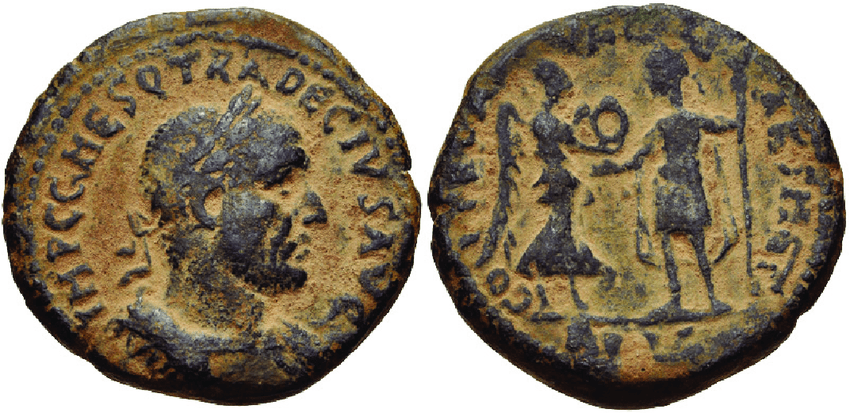
Decian coinage confirms this campaign of religious restoration. Thousands of coins survive showing the emperor pouring a libation at an altar, with legends such as PIETAS AVGG (“The Piety of the Emperors”) and GENIVS SENATVS.

The latter inscription—GENIVS SENATVS—invoked the “Genius of the Senate,” the divine spirit believed to guard and embody the Roman Senate itself.
Every household, legion, and civic body in Rome was thought to possess its own genius, a protective deity who received offerings of wine and incense.
By reviving the Genius Senatus cult, Decius was sacralizing the institutions of Rome themselves—binding political loyalty and divine worship into one act.
These coins, struck in Rome, Antioch, and Viminacium, visually proclaimed that the restoration of the gods meant the restoration of the state.

SideInscription (Latin)Expanded FormTranslation (English)Description / Symbolism
Obverse (Front)IMP C M Q TRA DECIVS AVGImperator Caesar Marcus Quintus Traianus Decius Augustus“Emperor Caesar Marcus Quintus Trajan Decius Augustus”Laureate, draped, and cuirassed bust of Decius facing right. The adoption of the name Trajan links him with Rome’s most admired emperor, emphasizing his mission to restore Roman discipline and piety.
Reverse (Back)VICTORIA AVGVictoria Augusti“Victory of the Emperor”Depicts Victory (Nike) standing left, presenting a wreath to the Emperor Decius, who stands facing her, holding a spear. The wreath symbolizes triumph and divine approval. The scene celebrates Decius’s military success and divine sanction for his rule.

Every coin and inscription declared that the gods were returning—and every Christian knew what that would soon mean.


2. The Edict and the Libelli Certificates

In January AD 250, Decius issued an edict commanding all inhabitants of the empire to perform public sacrifice before local officials and obtain written proof of obedience.
Those who refused faced imprisonment or death.

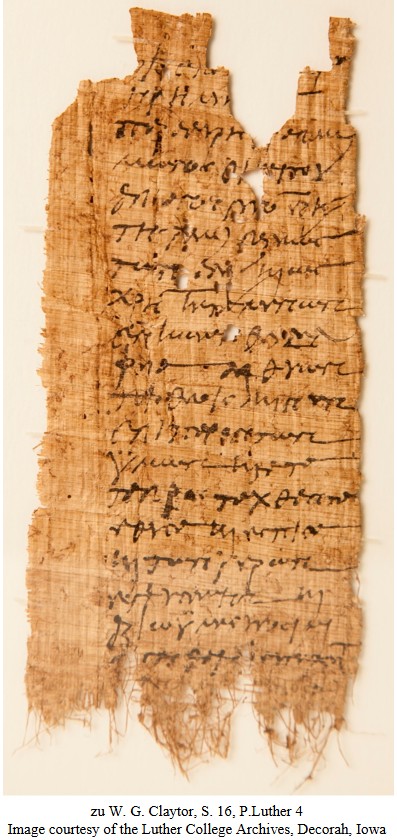
Dozens of papyri discovered in Egypt record the edict’s enforcement. The best-known, now in the Oxford Bodleian Library, reads:

“To the commissioners of sacrifices of the village of Alexander’s Island, from Aurelia Ammonous, daughter of Mystus, aged forty years, scar on right eyebrow. I have always sacrificed to the gods, and now in your presence, in accordance with the edict, I have sacrificed and poured a libation and tasted the offerings. I request you to certify this below. Farewell.”
(Papyrus Oxyrhynchus 2601, AD 250)

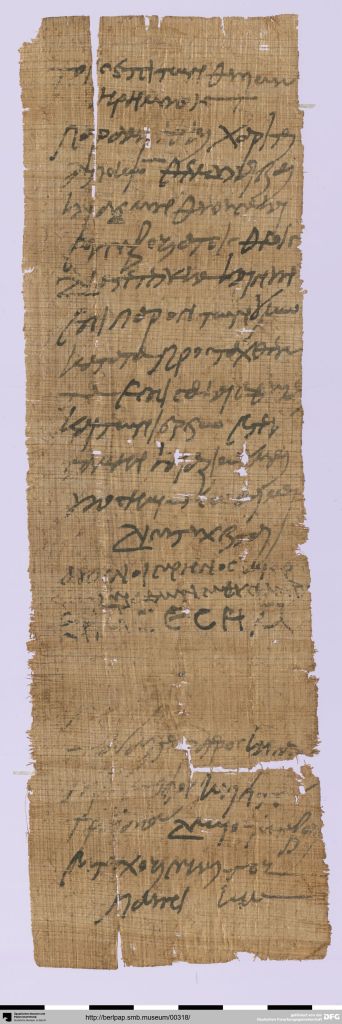
Other libelli from Fayum and Theadelphia bear identical phrasing—kata to prostagma (“according to the edict”)—and carry the red-ink seals of village commissioners.
These fragile papyri, recovered by archaeologists in the 1890s, are the only surviving documents produced in direct obedience to Decius’s decree.

They prove that the policy was systematic and bureaucratic—Rome’s paper war against conscience.

“To those who have been selected to oversee the sacrifices, from Aurelius Sarapammon, servant of Appianus, former exegetes of the most-illustrious city of the Alexandrians, and however he is styled, residing in the village of Theadelphia. Always sacrificing to the gods, now too, in your presence, in accordance with the orders, I sacrificed and poured the libations and tasted the offerings, and I ask that you sign below. Farewell. (2nd hand) We, the Aurelii Serenus and Hermas, saw you sacrificing (?) …”

P. 13430

“To the commissioners of sacrifices of the village of Theadelphia:
From Aurelius Syrus, the son of Theodorus, of the village of Theadelphia. I have always sacrificed to the gods, and now, in your presence, I have poured libations, sacrificed, and tasted the sacred offerings, according to the edict. I ask you to certify this for me. Farewell.

We, Aurelius Serenus and Aurelius Hermas, have seen you sacrificing.

Year 1 of the Emperor Decius (AD 250).”

3. The Policy in Motion: Fear and Defiance

Governors such as Sabinus in Egypt and Urbanus in Palestine carried out the edict with zeal.
Eusebius of Caesarea later wrote:

“Decius, who became emperor after Philip, was the first to raise a universal persecution against the Church throughout the inhabited world. There was great persecution against us; the governor Urbanus displayed great zeal in carrying out the imperial commands. Some of the faithful were dragged to the temples and forced to offer sacrifice by tortures.”
(Ecclesiastical History 6.39.1; 6.41.10–12, c. AD 310–325)

Even pagan dedications record the campaign: a marble inscription from Thasos honors local magistrates “for restoring the sacrifices that had fallen into neglect.”
For Decius these were civic triumphs; for Christians, they were death warrants.


4. Voices from the Fire: Martyrdom Across the Empire

Alexandria – Apollonia and the First Flames (AD 249–250)

Bishop Dionysius of Alexandria, an eyewitness, reported:

“The old virgin Apollonia was seized, her teeth broken out, and fire prepared. They threatened to burn her alive if she refused to repeat impious words. She leapt of her own accord into the fire and was consumed.”
(Letter to Fabius of Antioch, in Eusebius 6.41.7–8)

“All Egypt was filled with the noise of those who called upon Christ even in the midst of their tortures.”
(ibid. 6.41.13)

Archaeology corroborates his words: Egyptian sites at Bacchias and Oxyrhynchus reveal temples hastily refurbished and new altars installed in strata dated precisely to AD 250—evidence of an empire suddenly compelled to sacrifice.


Smyrna – Pionius and Companions (AD 250)

The Martyrdom of Pionius preserves an authentic courtroom record:

“On the day of the feast of Saint Polycarp, while we were fasting, the chief of police came suddenly upon us with men bearing chains and bade us sacrifice to the gods. And Pionius said, ‘We are Christians; it is not lawful for us to sacrifice to idols.’”
(Martyrdom of Pionius 2–3)

“They hung him by his wrists, fixing his feet in the stocks. He said, ‘You mistake my torment for your victory; yet it is my freedom, for I rejoice to suffer for the name of Christ.’”
(ibid. 20)

“He breathed out his spirit, and a sweet odor, as of incense, filled the air.”
(ibid. 21)

In Smyrna’s agora, archaeologists have identified a mid-third-century inscription honoring the local strategos who “maintained the sacrifices.” It almost certainly relates to this same enforcement.


Rome – Fabian, Bishop and Martyr (January AD 250)

“Fabian, the bishop of the city of Rome, suffered martyrdom under Decius.”
(Eusebius 6.39.5)

The Depositio Martyrum adds:

“On the twentieth day of January, Fabian, bishop, in the Catacombs.”

His epitaph—FABIAN EPISCOPVS MARTYR—was found in the Catacomb of Callistus.
Soot stains from vigil lamps still darken the marble, showing that Christians visited the site immediately after his death to honor their bishop.


Antioch – Babylas, The Bishop in Chains (AD 250)

“At Antioch, Babylas, bishop of the church there, after glorious bonds and confession, fell asleep in prison.”
(Eusebius 6.39.4)

Archaeological excavations north of Antioch have uncovered the Basilica of Babylas, built atop a repurposed Roman cemetery. Beneath its altar lay a third-century sarcophagus scratched with crosses—widely accepted as the resting place of the Decian bishop who died in chains.


Carthage – Mappalicus and the Imprisoned Confessors (AD 250)

Cyprian wrote from exile:

“Blessed Mappalicus, glorious in his fight, gave witness before the proconsul that he would soon see his Judge in heaven. And when the day came, he was crowned with martyrdom, together with those who stood firm with him.”
(Epistle 37.3)

“The prison has become a church; their bonds are ornaments, their wounds are crowns.”
(Epistle 10.2)

Archaeologists excavating beneath the later Cyprianic Basilica in Carthage found reused Roman blocks incised in red with the names MAPPALICUS VICTOR and FELIX CONFESSOR, strong evidence of a local memorial tradition dating directly to Decius’s time.


Macedonia – Maximus and Companions (AD 250–251)

“In Macedonia, the blessed Maximus and many others gave proof of their faith, being scourged and stoned and finally beheaded.”
(Eusebius 6.43.4–5)

Provincial coinage from Thessalonica of AD 250–251 depicts the goddess Roma receiving sacrifice—a local mirror of the imperial policy that cost these believers their lives.


Sicily – Agatha of Catania (AD 250)

“Quintianus commanded that her breasts be torn with iron hooks, but she said, ‘These torments are my delight, for I have Christ in my heart.’”
(Passio Agathae 6, 3rd-century nucleus)

In Catania’s cathedral crypt, a mid-third-century inscription reading AGATHAE SANCTAE MARTYRI was found in situ, demonstrating that her cult was already established within a generation of her death.


5. The Problem of the Lapsed

Many believers succumbed to fear and sacrificed or bought forged libelli. The Church now had to decide: could such people be restored?

Cyprian’s Pastoral Balance

“Neither do we prejudice God’s mercy, who has promised pardon to the penitent, nor yet do we relax the discipline of the Gospel, which commands confession even unto death.”
(Epistle 55.21, AD 251)

“Let everyone who has been wounded by the devil’s darts, and has fallen in battle, not despair. Let him take up arms again and fight bravely, since he still has a Father and Lord to whom he may return.”
(On the Lapsed 36, AD 251)


Novatian’s Rigorism and Schism

“He who has once denied Christ can never again confess Him; he has denied Him once for all.”
(De Trinitate 29, mid-3rd century)

Bishop Cornelius countered:

“Novatian has separated himself from the Church for which Christ suffered. He says the Church can forgive no sin; yet he himself sins more grievously by dividing the brethren.”
(Eusebius 6.43.10–11)

Fragments of Cornelius’s own epitaph—CORNELIVS EPISCOPVS MARTYR—found near the Callistus catacombs show how quickly the debate over mercy was itself hallowed in stone beside the graves of Decian victims.


Dionysius of Alexandria’s Moderation

“Some of the confessors, being too tender-hearted, desired to welcome all indiscriminately, but we persuaded them to discern, that mercy is good when it is tempered with justice.”
(Eusebius 6.42.4–5)

“Each church dealt with the fallen as it judged best, some treating them harshly, others gently. In this diversity of discipline, yet unity of faith, the Lord was glorified.”
(ibid. 6.42.6*)


6. Pagan Reflection and Christian Memory

Lactantius explained the emperor’s motives:

“Decius, being a man of old-fashioned rigor, desired to restore the ancient religion; and therefore he decreed that sacrifices should be offered to the gods by all. He did evil while intending good.”
(Divine Institutes 5.11, c. AD 310)

Eusebius reflected:

“Those who endured were tried as by fire and found faithful; others, weak through fear, failed the test, yet afterward were restored through tears and repentance.”
(Ecclesiastical History 6.42.2)

Roman catacomb graffiti from this very decade—FELIX MARTYR IN PACE and VICTOR IN CHRISTO—show that Christians carved into the walls the same theology Eusebius would later write: faith tested by fire, rewarded with peace.


7. The End and the Legacy

In AD 251, Decius and his son Herennius Etruscus fell in battle against the Goths near Abrittus. The edict died with them.
But its memory lived on in papyrus and stone—libelli in the desert, epitaphs beneath Rome, and basilicas raised over tombs from Antioch to Carthage.

The Decian persecution produced the earliest empire-wide martyrology, the first letters written from prison, and a theology forged in fire.
It made public what Rome could never suppress:

“We must obey God rather than men.” — Acts 5:29

The empire had demanded a certificate; the Church answered with a confession.

The First Critics of Christianity: From Donkeys to Satire

In the earliest centuries, Christianity was not first met with philosophical argument or careful analysis. It was mocked. Before the treatises of Celsus or Porphyry, the first criticisms were graffiti, slanders, and satire. These sneers are important because, even in ridicule, they confirm what outsiders saw in Christians — especially that Christians openly worshiped Christ as God.


Josephus and the Donkey-Head Libel (c. AD 93–95)

The Egyptian writer Apion accused the Jews of worshiping a donkey. Josephus, writing under Domitian around AD 93–95, preserved this insult in Against Apion so he could expose its absurdity.

“Apion, however, was bold enough to foist upon us a most shameless calumny about our temple, alleging that the Jews kept in it the head of an ass, an object of worship, and that the priests of the temple used to swear oaths by it. To support this, he pretended that, when Antiochus Epiphanes entered the sanctuary and carried off the treasures, he discovered the head of an ass made of gold and worth a great deal of money.” (Against Apion 2.80, Loeb)

Josephus ridicules the idea:

“This is a most ridiculous invention, for how could any man who had once entered the temple and looked at its construction and fittings have accepted such a lie, or how could any person who knew the temple rites and customs have believed it? For Apion was an Egyptian, and it is the height of impudence for a man who worships dogs and monkeys and goats to reproach us for allegedly reverencing asses.” (Against Apion 2.81, Loeb)

He then appeals to history itself, noting that when Antiochus plundered the temple he found only vessels of gold, never any idols:

“In fact, when Antiochus entered the sanctuary and found no representation of animals at all, but only bare walls, pillars, and a lampstand of gold and a table and libation vessels, and all the offerings required by the law, he carried them off.” (Against Apion 2.82–83, Loeb)

Key insights:

  • The donkey-head charge began as anti-Jewish propaganda, but because Romans often confused Jews and Christians, it easily transferred to Christians.
  • Josephus’s detailed rebuttal shows this accusation was well known across the empire, serious enough to require public correction.
  • This slander would not disappear. In time, it resurfaced in the Alexamenos graffito and in later accusations against Christians themselves.

The Alexamenos Graffito (late 1st–3rd century AD, Palatine Hill, Rome)

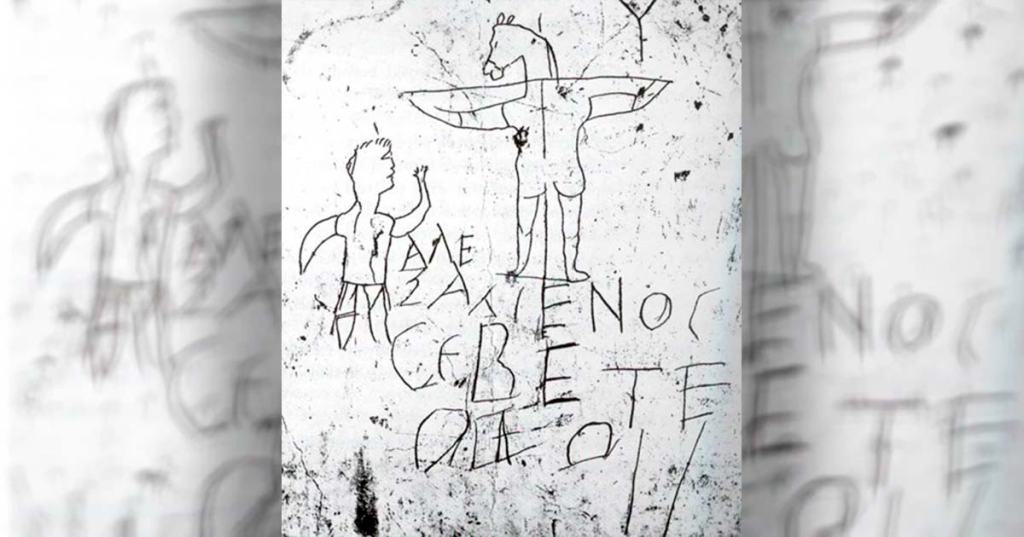
Scratched into the plaster wall of a building on the Palatine Hill in Rome, directly connected with the imperial palace, is the earliest surviving caricature of Christian worship. The structure is usually called the Paedagogium because it may have housed imperial page boys — though some scholars think it functioned as barracks or service quarters. Whatever its exact purpose, it was part of daily life around the emperor’s residence.

The graffito, dated between the late first and third centuries, depicts a man with hands raised in prayer before a crucified figure with a donkey’s head. Beneath it is scrawled:

“Alexamenos worships his god.”

Key insights:

  • This combines the old donkey libel with the shame of the cross — a double insult.
  • But its testimony is even more valuable: it confirms that Christians were recognized not just as followers of a teacher but as people who worshiped Christ as God. The figure of Alexamenos is not admiring Jesus’ teachings — he is worshiping.
  • Outsiders mocked the absurdity of worshiping someone crucified, but in their laughter they preserved one of the most important truths: by the late 1st or early 2nd century, Jesus was already the object of divine worship among Christians.

Lucian of Samosata and The Passing of Peregrinus (c. AD 165–170)

By the mid-2nd century, Christianity was visible enough that it caught the attention of professional satirists. Lucian of Samosata (c. 120–after 180), a Syrian writing in polished Greek, made a career out of ridiculing philosophers, cults, and public figures.

In The Passing of Peregrinus, Lucian lampoons a Cynic philosopher who briefly associated with Christians before turning to Cynicism and later burning himself to death at the Olympic Games. In mocking Peregrinus, Lucian gives us one of the most vivid pagan portraits of Christianity in his own day.


Peregrinus Among the Christians (§11)

“It was then that he [Peregrinus] learned the wondrous lore of the Christians, by associating with their priests and scribes in Palestine. And — how else? — in short order he made them all look like children, for he was prophet, cult-leader, head of the synagogue, and everything, all by himself. They spoke of him as a god, accepted him as a lawgiver, and made him their leader, and took him for a prophet, next after that one whom they still worship, the man who was crucified in Palestine because he introduced this new cult into the world. They were all incredibly attentive to him; he interpreted and explained their books, and wrote many of his own, and they revered him as a lawgiver, a master, and a great man.” (Peregrinus 11, Loeb)

Key insights:

  • The story begins in Palestine. Lucian uses synagogue terms — “priests,” “scribes,” “head of the synagogue” — which Christians themselves did not use in this period. This shows either that Jewish-Christian congregations still retained synagogue-like terminology, or that Lucian, as an outsider, simply described them using Jewish categories he understood. Either way, it reflects the ongoing Jewish roots of Christianity in Palestine.
  • Lucian sneers that Peregrinus made Christians “look like children,” ridiculing them as gullible. But notice the force of his complaint: Christians were a people who listened to teachers, honored leaders, and gave them space to explain the Scriptures.
  • The heart of the satire comes in the line: “They spoke of him as a god, accepted him as a lawgiver, and made him their leader, and took him for a prophet.” Lucian laughs at their naïve devotion, but the passage shows how seriously Christians took spiritual leadership.
  • Yet he adds the crucial qualification: Peregrinus was only “next after that one whom they still worship.” This is powerful. Even in ridicule, Lucian confirms that Jesus was worshiped as God — not simply admired as a wise teacher.
  • Lucian says Peregrinus “interpreted and explained their books.” This is an outsider’s confirmation that Christians had authoritative Scriptures by AD 165, which were read aloud and taught in their assemblies.

Christian Support from Asia Minor (§12)

“Indeed, people came even from the cities of Asia, sent by the Christians at their common expense, to help and defend and encourage the hero. They show incredible speed whenever anything of this sort is undertaken publicly; for in no time they lavish their all. So it was then too: the venerable Peregrinus was in want of nothing, all these things being provided in abundance. Certain of their officials, called presbyters and readers, came from the province, bringing him letters and presenting him with gifts and money. And much was said then also of his dignity and of his extraordinary influence among the Christians.” (Peregrinus 12, Loeb)

Key insights:

  • The geography now shifts to Asia Minor (modern Turkey), the powerhouse of Gentile Christianity. Here the terminology changes: Lucian refers not to “priests and scribes” but to presbyters (elders) and readers (lectors) — technical titles that match what we find in Christian sources. This shows the diversity of Christian leadership structures across regions.
  • Christians supported Peregrinus “at their common expense.” This reveals communal, organized giving: congregations across cities pooled resources as one body.
  • The striking phrase, “for in no time they lavish their all,” is one of the clearest pagan testimonies to Christian generosity. Lucian is mocking, but his words confirm that Christians were known for urgency and sacrificial giving. They did not hesitate; they poured out resources quickly, as though generosity was their reflex.
  • Peregrinus “was in want of nothing.” This confirms the effectiveness of Christian charity. Outsiders may have laughed at their eagerness, but they could not deny that Christians took care of their own.
  • By mentioning presbyters and readers, Lucian accidentally shows us that by the mid-2nd century, Christian churches already had structured leadership and liturgical offices.
  • He notes Peregrinus’s “extraordinary influence.” To Lucian, this made Christians gullible; to us, it shows their deep loyalty and respect for leaders who taught the Scriptures faithfully.

Lucian’s General Description of Christians (§13)

“The poor wretches have convinced themselves, first and foremost, that they are immortal and will live forever. Therefore they despise death, and many of them willingly give themselves up. And then their first lawgiver persuaded them that they are all brothers, the moment that they transgress and deny the Greek gods and begin worshiping that crucified sophist and living by his laws. So they despise all things equally and regard them as common property. And without any clear evidence they receive such doctrines on faith alone. And when once this has been done, they think themselves secure for all eternity. Accordingly, if any charlatan and trickster, able to profit by occasions, comes among them, he soon acquires sudden wealth by imposing upon simple folk.” (Peregrinus 13, Loeb)

Key insights:

  • Lucian now speaks not about Peregrinus but about Christians as a whole. This is his general description of the movement.
  • He says they “despise death, and many of them willingly give themselves up.” This is crucial evidence. It shows that by AD 165 Christians across the empire were famous for their courage in persecution and their willingness to face execution rather than renounce their Lord. It confirms the ongoing empire-wide legal standard: since Trajan’s policy (AD 112), Christians could be executed anywhere if accused and refusing to sacrifice. Lucian’s words confirm both the policy and the Christians’ reputation for meeting it with fearless resolve.
  • He mocks their brotherhood: “they are all brothers.” Yet this testifies to their radical equality, where social divisions of class, ethnicity, and gender were dissolved in Christ.
  • He sneers, “they regard all things as common property.” To him, it was foolishness. But this is one of the most important pagan confirmations that the communal life of Acts 2–4 — “they had all things in common” — was still being practiced more than a century later. Outsiders still saw Christians as people who shared freely with one another.
  • The sharpest ridicule comes when he says, “without any clear evidence they receive such doctrines on faith alone.” This points directly at the heart of Christianity: belief in realities that could not be demonstrated by philosophy — the resurrection of Christ, his divinity, and heaven itself. To Lucian, this was gullibility; to Christians, this was faith.
  • He continues, “they think themselves secure for all eternity.” What he mocks as arrogance is one of the most precious features of early Christianity: the assurance of salvation. Christians lived with confidence that eternal life was guaranteed through Christ.
  • Finally, he says tricksters could profit among them. This confirms their openness and inclusivity. They welcomed outsiders generously, sometimes at the risk of being deceived.

The Prison Scene (§§16–17)

“For after he [Peregrinus] had been apprehended on a charge, which I need not dwell on, he was put in prison. Then it was that he was much in the public eye; and then it was that the Christians, regarding the incident as a disaster for themselves, left nothing undone to rescue him. Then was seen the extraordinary zeal of these people in all that concerns their community; and they showed incredible speed whenever anything of the kind occurred. From the very break of day aged widows and orphan children might be seen waiting about the prison; and their leading men even bribed the guards, and slept inside with him. Then elaborate meals were brought in; and their sacred writings were read aloud; and Peregrinus was called a new Socrates by them. Then there was actually talk of trying to procure his release from the authorities, though this did not succeed. After this, when he had been freed, he again transgressed and was excommunicated from their community.” (Peregrinus 16–17, Loeb)

Key insights:

  • Christians regarded Peregrinus’s imprisonment as “a disaster for themselves.” This shows their communal identity: when one member suffered, the whole body felt the pain.
  • Lucian notes their “extraordinary zeal” and “incredible speed.” Again, Christians are portrayed as people who acted immediately and sacrificially in response to persecution.
  • From dawn, widows and orphans gathered outside the prison. The most vulnerable members were visibly part of the Christian movement, and they joined the community in solidarity with the suffering.
  • “Leading men” bribed guards and even slept inside with Peregrinus. Outsiders laughed at this as naïve, but it reveals Christians’ willingness to risk money, safety, and exposure to protect one another under the empire’s hostile laws.
  • They brought elaborate meals and read aloud from their Scriptures. This detail is striking: even in prison, Christian life revolved around fellowship and the Word. This matches what we see in the New Testament (1 Tim. 4:13) and in Justin Martyr’s description of worship (c. 155), where the Scriptures were always read aloud. Lucian’s sneer confirms this practice was well known.
  • He says they called Peregrinus a “new Socrates.” He exaggerates, but the comparison shows how Christian martyrdom was framed — even by outsiders — as akin to the noble deaths of philosophers who died for truth.
  • Finally, Lucian says Peregrinus was later excommunicated. This confirms that Christians were not endlessly gullible; they had boundaries and mechanisms of discipline to protect their unity.

Conclusion: Mockery that Confirms

From Josephus’s donkey libel (AD 93–95), to the Alexamenos graffito in Rome (late 1st–3rd century), to Lucian’s satire (AD 165–170), we see how Christianity appeared to its earliest critics.

  • They mocked Christians for worshiping Christ as God — especially a crucified man.
  • They sneered at their brotherhood and radical sharing of goods.
  • They ridiculed their faith without proof and their assurance of salvation.
  • They derided their generosity and openness as gullibility.
  • And above all, they laughed at their willingness to face death.

Yet in trying to humiliate them, these critics have given us one of the clearest portraits of the early church: a people marked by Scripture, brotherhood, generosity, courage, and worship of Christ. The very things their enemies thought laughable were the very things that gave the church its strength.

Conversion Forbidden, Courage Unstoppable: Severus and the Early Church

The assassination of Commodus on December 31, AD 192 plunged Rome into civil war. In what became known as the Year of the Five Emperors (AD 193), power passed rapidly between Pertinax, Didius Julianus, Pescennius Niger, and Clodius Albinus. Finally, Septimius Severus—an African-born general from Leptis Magna—emerged victorious. He would rule for nearly two decades (193–211).

For Christians, nothing new is recorded under these brief emperors—only the continued, by now ancient, tradition that those accused of the name and refusing to deny it could be put to death. This tradition reached back to Nero’s precedent, when Christians were first condemned in Rome.

Once Severus consolidated power, however, a new wave of persecution broke out. By his tenth year (AD 202/203), we find evidence across Africa and Egypt of Christians martyred, catechumens executed, and great teachers forced to reckon with Rome’s hostility. And although only one late source names it directly, the tradition survives that Severus had issued a law forbidding conversions to Judaism and Christianity.


The Edict, Plainly Stated

Historia Augusta, Life of Severus 17.1 (Loeb):

“He forbade anyone to become a Jew, and he enacted severe penalties against those who attempted to convert to Judaism and Christianity.”

This is our sole explicit witness to the edict. The Historia Augusta was written in the 4th century and is often unreliable. But the law it describes explains why, at precisely this time, catechumens and teachers were executed from Carthage to Alexandria.


Eusebius: A Wave of Persecution

Eusebius, Church History 6.1.1–2 (Loeb):

“When Severus had been emperor for ten years, he stirred up persecution against the churches, and illustrious testimonies of martyrdom were given at that time. At Alexandria the great teachers of the faith were most distinguished, and in other regions also a great many received crowns of martyrdom with all kinds of tortures and punishments. At that time Origen, a young man, devoted himself with all earnestness to the divine word, while his father Leonidas received the crown of martyrdom.”

Here Carthage and Alexandria are linked. In North Africa, women and slaves were led to the arena. In Egypt, a father was executed, leaving his son to become the greatest theologian of early Christianity.


The Martyrs of Carthage: Perpetua, Felicitas, and Saturus (North Africa, AD 203)

The most vivid testimony of Severus’ persecution comes from the Passion of Perpetua and Felicitas. Its uniqueness lies in the fact that it is partly autobiographical—the first-person diary of Perpetua herself, later woven together with Saturus’ vision and an eyewitness account of their deaths.

When her father begged her to deny Christ, Perpetua answered with a simplicity Rome could not overcome:

“Father, do you see this little pitcher? Can it be called by any other name than what it is? … So too I cannot call myself anything else than what I am, a Christian.” (Passion 3–4)

She was imprisoned with several other catechumens. Among them was Saturus, a Christian teacher who had not been arrested at first but chose to surrender himself so he could share their chains. His voluntary imprisonment made him a model of pastoral courage, and in Perpetua’s visions he appears as her guide.

At first, Perpetua struggled with the darkness and the crowding of prison, but her greatest fear was for her baby:

“I was horrified, for I had never experienced such darkness. Oh, terrible day! The crowding of the mob, the harsh treatment by the soldiers, the extortion of the jailers. Then I was distressed by anxiety for my baby.” (Passion 3–5)

Eventually she was allowed to nurse her son in prison:

“Then I was allowed to nurse him in prison, and I recovered my strength, and my prison became to me a palace, so that I would rather have been there than anywhere else.” (Passion 5)

Later the baby was given into the care of her family. Though she grieved, she found freedom to face martyrdom without distraction:

“I endured great pain because I saw my infant wasted with hunger … Then I arranged for the child to stay with my mother and brother. For a little while I took care of the child in prison, but later I gave him up. And immediately the prison became a place of refreshment to me, and my anxiety for the child no longer consumed me.” (Passion 6)

That is the last we hear of her son, who survived, raised by his grandmother. The absence of any mention of her husband is striking. Whether she was widowed or separated we do not know; the editor of the Passion was not interested in her social status, but in her confession of Christ.

Perpetua’s visions gave her courage. She saw a narrow bronze ladder stretching to heaven, lined with swords and hooks, with a dragon lurking at its base. Saturus climbed first, and she followed, treading on the dragon’s head and entering a garden where a shepherd gave her milk turned into a cake, and all around said “Amen” (Passion 4).

Her fellow prisoner Felicitas faced her own trial. She was a slave woman, eight months pregnant when arrested. Roman law forbade executing pregnant women, and she feared she might be separated from her companions. She prayed to give birth before the day of the games, and her prayers were answered. When mocked by a jailer for her cries in labor, she replied:

“Now I myself suffer what I suffer, but then another will be in me who will suffer for me, because I am to suffer for him.” (Passion 15)

At last came the day of execution:

“The day of their victory dawned, and they marched from the prison into the amphitheater, as if into heaven, with cheerful looks and graceful bearing. Perpetua followed with shining step as the true spouse of Christ. When the young gladiator trembled to strike her, she guided his hand to her throat, for it was as if such a woman could not be slain unless she herself were willing.” (Passion 18, 21)

Rome called it punishment; the Christians called it victory. The amphitheater was meant to shame them before the crowd, but Perpetua, Felicitas, and Saturus walked into it as though into heaven.


Tertullian of Carthage (North Africa, c. 197–220)

Before the main outbreak of persecution under Severus, another Carthaginian gave voice to the church in Latin: Tertullian. A lawyer by training and a fiery Christian apologist, he addressed his works to Roman officials, governors, and pagan audiences who misunderstood the church. His writings prove that Christians in Africa were already living under suspicion and facing punishment years before Severus’ edict of 202/203.

In his Apology (c. AD 197), addressed to the provincial governors and magistrates of North Africa, Tertullian insists that Christians are everywhere:

Apology 37 (Loeb):

“We are but of yesterday, and we have filled every place among you—cities, islands, fortresses, towns, marketplaces, the very camp, tribes, companies, palace, senate, forum; we have left nothing to you but the temples of your gods.”

Persecution was already a reality. Christians were blamed for every disaster:

Ad Nationes 1.7:

“If the Tiber rises as high as the city walls, if the Nile does not rise into the fields, if the heavens give no rain, if the earth quakes, if there is a famine or a plague, the cry at once is, ‘The Christians to the lion!’”

And yet, persecution only multiplied them:

Apology 50:

“We multiply whenever we are mown down by you: the blood of Christians is seed.”

Later, in To Scapula (written around AD 212 to Scapula, the proconsul of Africa), he warned Rome’s governor directly:

To Scapula 5 (Loeb):

“Kill us, torture us, condemn us, grind us to dust; your injustice is the proof that we are innocent. … The more often you mow us down, the more we grow; the blood of Christians is seed.”

Tertullian’s writings show that persecution was not sudden but constant. By the time Severus issued his edict, the soil had already been watered with blood—and, as Tertullian argued, that blood was the seed of growth.


Clement of Alexandria (Egypt, c. 190–203+)

Meanwhile in Alexandria, the church had established a tradition of Christian teaching known as the catechetical school. Its master was Clement of Alexandria, a philosopher-turned-Christian who wrote in Greek to the city’s educated elite.

Clement’s trilogy of major works shows the breadth of his teaching:

Protrepticus (Exhortation to the Greeks):

“Leave the old delusion, flee from the ancient plague; seek after the new song, the new Logos, who has appeared among us from heaven. He alone is both God and man, the source of all our good.” (Protrepticus 1.5)

Paedagogus (The Instructor):

“The Word is all things to the child: father and mother, tutor and nurse. ‘Eat my flesh,’ He says, ‘and drink my blood.’ Such is suitable food for children, the Lord Himself made nourishment, love, and instruction.” (Paedagogus 1.6)

Stromata (Miscellanies):

“The true gnostic is one who imitates God as far as possible: he rests on faith, is founded on love, is educated by hope, and is perfected by knowledge. He has already attained the likeness of God, being righteous and holy with wisdom.” (Stromata 7.10)

On martyrdom, he wrote plainly:

“Many martyrs are daily burned, confined, or beheaded before our eyes, so that not only in ancient times but also among ourselves may one see such examples, being set forth in their thousands.” (Stromata 4.4)

And on wealth and charity:

Who Is the Rich Man That Shall Be Saved? 27:

“Wealth is not to be thrown away. It is a material for virtue, if it be rightly used. Riches are called good if they are distributed well; for they can become instruments of righteousness. Let the rich man do good, let him give liberally, let him share willingly, and he will be perfect.”

For Clement, charity was not about ascetic rejection but about transformed stewardship. Wealth was a tool, not a curse—its danger was in clinging to it selfishly, its virtue in giving it freely. He presented charity as a spiritual discipline: rational, cheerful, and loving generosity for the good of others.

When Severus’ persecution reached Alexandria around AD 202, Clement fled the city and took refuge in Cappadocia, never to return. Leadership of the Alexandrian school passed to the teenage Origen. But Clement’s writings remained a legacy: in the empire’s intellectual capital, he had given Christianity an intellectual defense, a moral handbook, and a vision of charity rooted not in fear but in love.


Origen and Leonidas (Alexandria, Egypt, AD 202/203)

When Leonidas, Origen’s father, was executed, Origen was only about seventeen years old. He was the eldest of seven children, and his family’s property was confiscated. He suddenly found himself destitute, responsible for his widowed mother and six younger siblings.

Eusebius, Church History 6.2.2–3 (Loeb):

“Leonidas, the father of Origen, was beheaded. Origen was eager to accompany him and to die as a martyr, but his mother prevented him by hiding all his clothes and thus compelled him to remain in the house. And he wrote to his father in prison, saying: ‘Take heed not to change your mind on our account.’”

Eusebius, Church History 6.3.9–11 (Loeb):

“Leonidas would often, when Origen was sleeping, uncover his breast and reverently kiss it, as though it were already sanctified by the divine Spirit within him. He educated his boy not only in general studies but above all in the Holy Scriptures.”

To support his family, Origen opened a school of grammar and literature, teaching pagans by day and catechumens by night. He lived with radical austerity, sleeping on the ground and fasting, so he could provide for his mother and siblings. In time, wealthy patrons like Ambrose of Alexandria also supported him, funding secretaries to copy his works.

When Clement fled, Origen inherited the catechetical school. This “school” (didaskaleion) was not simply a building but a tradition of Christian teaching in Alexandria, begun by Pantaenus, a Stoic philosopher turned Christian. Now, still in his teens, Origen became its master. From there he wrote commentaries on nearly every book of the Bible, debated pagan philosophers, and composed On First Principles, the first systematic theology in Christian history.

The persecution that took his father’s life launched his own.


Hippolytus of Rome (Italy, c. 200–215)

In Rome, the church was codifying its order even under threat. Hippolytus, writing in Greek, preserved the earliest liturgy and church order that has survived.

Apostolic Tradition (On Ordination, ch. 3):

“Let the bishop be ordained after he has been chosen by all the people. … Let all lay hands on him and pray, saying: ‘O God, pour forth the power of your Spirit upon this your servant, whom you have chosen to be shepherd of your people.’”

Apostolic Tradition (On Baptism, ch. 21):

“Do you believe in God the Father Almighty? … Do you believe in Christ Jesus, the Son of God, who was born … crucified … and rose again … and will come to judge the living and the dead? … Do you believe in the Holy Spirit, and the holy Church, and the resurrection of the flesh? … And so he is baptized a third time.”

Apostolic Tradition (On the Eucharist, ch. 4):

“We give you thanks, O God, through your beloved Son Jesus Christ, whom you sent to us as Savior and Redeemer … and when he had given thanks, he said: ‘This is my body, which is for you.’ … Remembering therefore his death and resurrection, we offer to you this bread and this cup, giving thanks to you.”

From the same hand we also have the Refutation of All Heresies, in which he exposed pagan astrology and Gnostic sects:

Refutation 4.37:

“If everything is under the control of fate, then let no one be blamed for sins, nor praised for virtues. But if this is absurd, then their teaching is false. For man has been made free by God.”

Refutation 9.7:

“There are those who, under the name of Christ, corrupt the truth by their deceit. But we have the tradition from the apostles, delivered through the succession of bishops, and we guard it in the Church by the Holy Spirit.”

Hippolytus shows us that in Rome itself—at the empire’s heart—Christians were not retreating underground but continuing to baptize, ordain, and celebrate the Eucharist. At the very time Severus forbade conversions, Rome’s church was still welcoming new converts and defending its doctrine.


Minucius Felix (Rome or North Africa, c. 197–210)

Octavius is the earliest surviving Christian apology written in elegant Latin. It is framed as a dialogue between Caecilius, a pagan, and Octavius, a Christian, with Minucius himself as arbiter.

On slanders against Christians, Caecilius charges:

Octavius 9:

“It is said that in your sacred rites you slay an infant and drink its blood, and that after the banquet you join in incestuous unions in shameless darkness. These are the fables you believe of us—things which you would not even believe of your own enemies.”

Octavius replies with a portrait of Christian life:

Octavius 31–32:

“They love one another before they know one another; they call one another brother and sister, and with reason. They are ready even to die for one another. … We neither keep our religion hidden, for our life is made known by its teachings, nor are we silent, since we are always being accused.”

On worship:

Octavius 33:

“We do not worship the images you make, for we know they are made of stone and wood. … Our sacrifice is a pure prayer proceeding from a pure heart.”

On persecution:

Octavius 35:

“Do you think that we are to be pitied, who are counted as your enemies? When we are slain, we conquer; when we are struck down, we are crowned; when we are condemned, we are acquitted.”

Minucius shows us Christianity in Rome’s own idiom: clear, concise, legal Latin rhetoric. He captures both the accusations Christians faced in Severus’ time and the moral beauty of their reply—love, openness, prayer, courage.


Bardaisan of Edessa (Syria/Mesopotamia, c. 200–222)

Far from Rome and Carthage, in the eastern frontier city of Edessa, the philosopher Bardaisan defended Christianity in Syriac against astrology and fatalism. His Book of the Laws of Countries, preserved by his disciples, is a dialogue on fate, free will, and culture.

On free will:

Laws of Countries 617 (Wright trans.):

“The constellations do not compel a man either to be righteous or to be a sinner, nor does fate constrain him to be rich or poor. But every man, according to his own will, approaches what is right, and departs from what is evil.”

On cultural diversity:

Laws of Countries 619:

“The same stars shine everywhere, yet laws differ among the Parthians, the Romans, and the Syrians. If fate compelled, all would live the same way. But men live according to their laws, and these laws are the fruit of free will.”

On the universality of Christianity:

Laws of Countries 622:

“The new law of our Lord is not written on stone but on the heart. Because of it, men from every nation have renounced their former customs and are ready to suffer and even to die rather than transgress it.”

On martyrdom:

Laws of Countries 623:

“This law has not only been written and spoken, but it is practiced. For in all places and in every land, men and women, young and old, endure persecution for the sake of this law, and they do not deny it.”

Bardaisan’s “law” is not Roman statute or Jewish Torah, but the gospel of Christ written on the heart. He stresses that this law is already global: Romans, Syrians, Parthians alike live by it, and all are ready to suffer for it. From the eastern frontier of the empire, Bardaisan shows us Christianity as a universal faith that conquers fatalism with freedom, and unites nations in one confession.


Conclusion

The reign of Septimius Severus (AD 193–211) was decisive for Christianity.

  • The edict: remembered in the Historia Augusta, forbidding conversion.
  • The martyrs: Perpetua, Felicitas, and Saturus in Carthage; Leonidas in Alexandria.
  • The writers:
    • Tertullian (Carthage) — lawyer turned apologist, addressing governors and magistrates, insisting that persecution was constant and blood was seed.
    • Clement (Alexandria) — philosopher turned teacher, whose writings shaped Christian virtue, charity, and knowledge before he fled persecution.
    • Origen (Alexandria) — teenage prodigy, shaped by his father’s death, who built the greatest Christian school of the ancient world.
    • Hippolytus (Rome) — presbyter preserving baptismal, eucharistic, and ordination rites, proving the church’s order survived in the capital.
    • Minucius Felix (Rome/Africa) — polished Latin lawyer refuting slander and showing Christian innocence and love.
    • Bardaisan (Edessa) — philosopher on the frontier, proclaiming the gospel as the new law written on the heart, freely obeyed in every nation.

By Severus’ reign, Christian voices were speaking from every corner of the empire. Rome tried to choke Christianity at its source—conversion—but instead gave the church martyrs, apologists, and theologians whose words and courage still inspire today.