In October of AD 312 the Roman Empire stood in the middle of another civil war.
Several emperors claimed authority across the empire, but the most decisive struggle for power in the western empire lay between two men. One ruled Rome itself. The other marched toward it with an army from Gaul.
The challenger was Constantine the Great. The ruler of Rome was Maxentius.
The battle that followed near the Milvian Bridge would decide control of the western empire. It would also become one of the most famous turning points in Christian history.
Ancient sources tell us that shortly before the battle Constantine experienced a remarkable sign connected with the God of the Christians.
Constantine’s March Toward Rome
In AD 312 Constantine marched south from Gaul into northern Italy with an army that may have numbered around forty thousand soldiers. Maxentius commanded a larger force and controlled the city of Rome itself.
The pagan historian Zosimus describes the campaign in New History 2.15:
“Constantine set out against Maxentius and advanced through Italy with his army.”
Several northern Italian cities surrendered to Constantine as he advanced. Another Roman historian, Aurelius Victor records the panic spreading through Maxentius’ regime. In De Caesaribus 40 he writes:
“When Constantine approached, the cities readily surrendered to him.”
Maxentius initially remained inside Rome behind the city’s massive defensive walls. Eventually he marched out to confront Constantine north of the city near the Milvian Bridge, which crossed the Tiber River along the northern approach to Rome.
The decision would prove fatal.
The Vision Before the Battle
Two early Christian writers describe a remarkable experience Constantine had shortly before the battle.
The earliest account comes from Lactantius, writing only a few years after the event. In On the Deaths of the Persecutors 44 he writes:
“Constantine was directed in a dream to mark the heavenly sign of God upon the shields of his soldiers and so to proceed to battle.”
Lactantius then describes the symbol itself:
“He marked on their shields the letter X with a perpendicular line drawn through it and turned round at the top, being the cipher of Christ.”
This symbol combines the first two Greek letters of Christ’s name, Χ and Ρ, and is now known as the Chi-Rho.
A second and fuller description appears in the writings of Eusebius of Caesarea. Eusebius claims Constantine personally told him the story later in life and confirmed it with an oath. In Life of Constantine 1.28 he writes:
“About noon, when the day was already declining, he saw with his own eyes the trophy of a cross of light in the heavens above the sun, and bearing the inscription, ‘By this conquer.’”
Eusebius continues:
“At this sight he himself was struck with amazement, and his whole army also which followed him on this expedition.”
According to Eusebius the sign appeared above the sun in the sky during daylight. Later that night Constantine reportedly experienced a dream explaining the meaning of the sign.
Eusebius writes:
“Christ of God appeared to him with the sign which he had seen in the heavens and commanded him to make a likeness of that sign and to use it as a safeguard in all engagements with his enemies.”
The following day Constantine ordered the symbol to be placed on military standards.
The Labarum
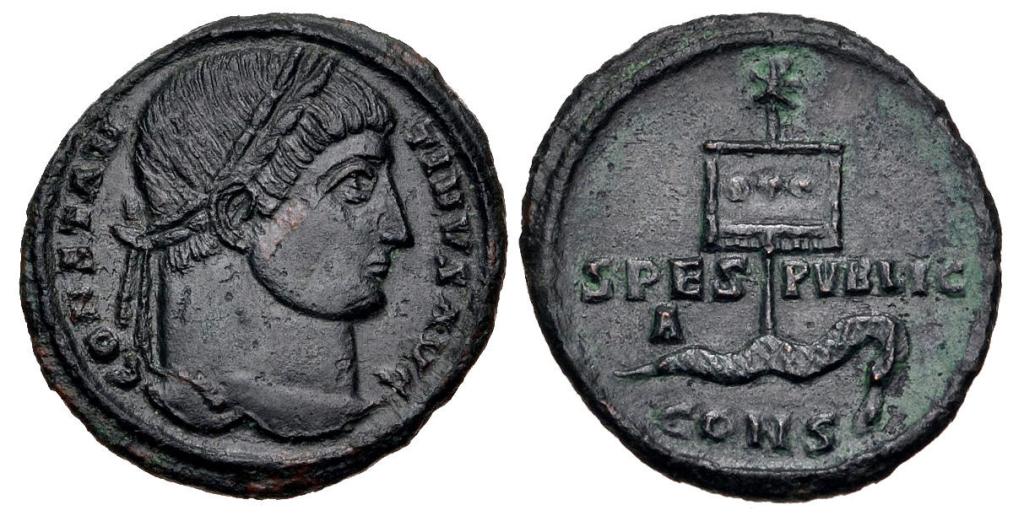
Eusebius provides a detailed description of the imperial standard created after the vision.
In Life of Constantine 1.31 he writes:
“A long spear overlaid with gold formed the figure of the cross by means of a transverse bar laid over it. On the top of the whole was fixed a wreath of gold and precious stones.”
Inside the wreath appeared the Chi Rho symbol representing Christ.
Eusebius continues:
“This symbol was composed of the first two letters of the name of Christ.”
Beneath the cross hung a richly decorated purple cloth.
“From the cross bar hung a cloth, a royal piece covered with precious stones and gold.”
This imperial standard became known as the labarum and was carried before Constantine’s army in battle.
The Battle at the Milvian Bridge
The confrontation took place on 28 October AD 312.
Maxentius positioned his army with the Tiber River behind them. A temporary bridge of boats had been constructed alongside the permanent stone bridge.
The Christian historian Eusebius describes the outcome in Ecclesiastical History 9.9:
“The tyrant himself fled before the forces of Constantine and perished in the river.”
The Roman historian Aurelius Victor records the same event.
In De Caesaribus 40 he writes:
“Maxentius was driven toward the bridge and fell into the Tiber weighed down by the armor he wore.”
Zosimus confirms the event from a pagan perspective.
In New History 2.16 he writes:
“The bridge broke and Maxentius fell into the river and was drowned.”
Maxentius’ army collapsed. Constantine had won control of Rome.
Constantine Explains the Victory
Later sources record Constantine himself connecting the victory with Christ. Eusebius records Constantine saying in Life of Constantine 2.12:
“My friends, it was through the assistance of God and of our Savior that I obtained the victory.”
In another passage Constantine describes the Christian symbol used in battle. Life of Constantine 1.39 records him saying:
“By this salutary sign, the true proof of valor, I have saved and liberated your city from the yoke of the tyrant.”
The “salutary sign” refers to the symbol of Christ carried before his army.
In a letter preserved by Eusebius, Constantine writes:
“I call God, the Supreme Ruler of all, to witness that by divine guidance I have been led.”
(Life of Constantine 2.28)
These statements show that Constantine publicly credited his victory to the God worshiped by Christians.
Three years after the battle the Roman Senate erected a monumental arch celebrating Constantine’s victory.
Arch of Constantine
The arch stands beside the Colosseum along the route traditionally used by Roman triumphal processions.
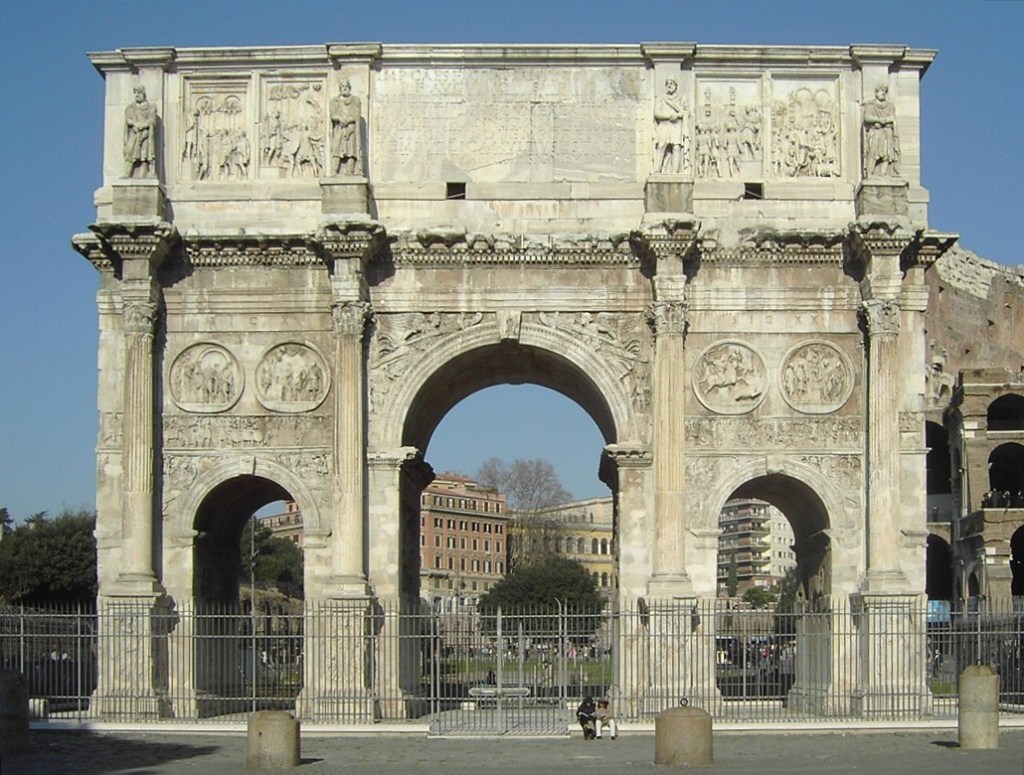
The central inscription explains the victory. It reads:
“To the Emperor Caesar Flavius Constantinus, the greatest, pious, and blessed Augustus: because he, inspired by the divine, and by the greatness of his mind, has delivered the state from the tyrant and all of his followers at the same time, with his army and just force of arms, The Senate and Roman People have dedicated this arch, decorated with triumphs.”
The Latin phrase instinctu divinitatis means “by the inspiration of divinity.” The inscription attributes Constantine’s victory to divine inspiration but avoids naming a specific god.
The monument also reused sculptures from earlier imperial monuments honoring the emperors Trajan, Hadrian, and Marcus Aurelius. By incorporating these earlier works the monument visually associated Constantine with Rome’s greatest rulers.
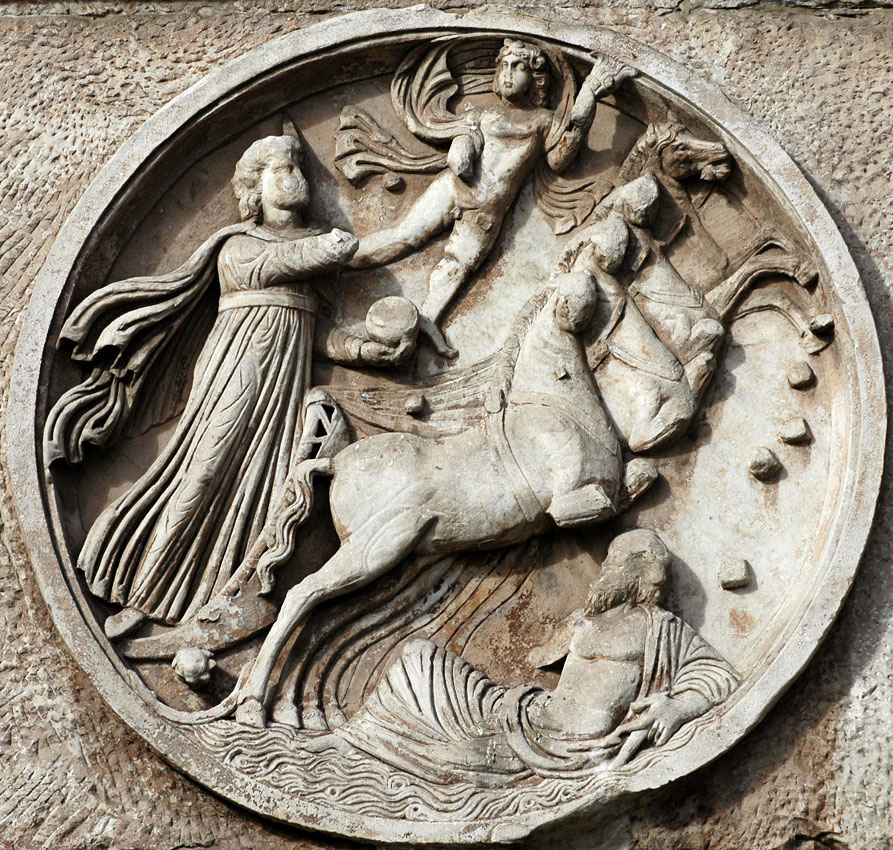
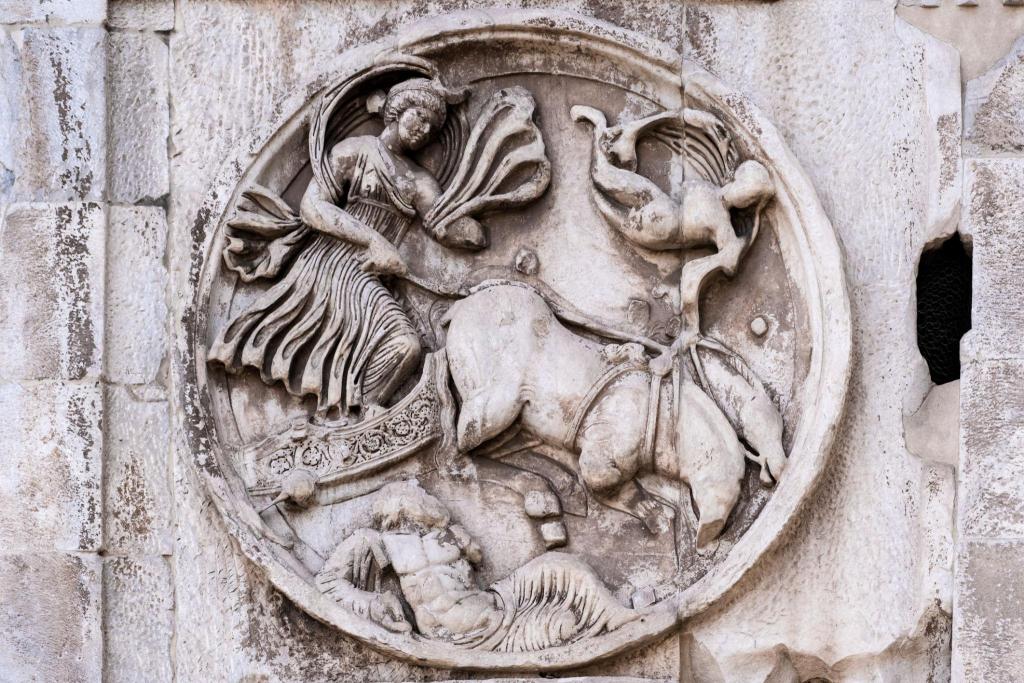
Panels on the arch also depict the sun god Sol driving his chariot across the sky and moon god Luna driving her chariot on the opposite side, reflecting the religious imagery familiar throughout the Roman world.
A Dramatic Shift in the Use of Christ’s Name
Constantine’s vision before the battle marks one of the most dramatic changes in Christian history. For nearly three centuries Christians had proclaimed Christ while refusing violence against their persecutors.
The Christian writer Tertullian wrote in Apology 37:
“If we wished to act as open enemies, we should not lack numbers or strength. But we would rather be slain than slay.”
Another Christian author writing shortly before Constantine made the same point. Lactantius writes in Divine Institutes 6.20:
“It is not permitted for a just man to engage in warfare, since his warfare is justice itself.”
For him, the struggle of the Christian is not fought with weapons. The Christian’s “warfare” is the practice of justice, virtue, and obedience to God.
In the same discussion Lactantius expands the point and makes his meaning even clearer:
“When God forbids killing, he not only prohibits us from open violence, but also from those acts which are considered lawful among men.”
(Divine Institutes 6.20)
He then draws the logical conclusion:
“Therefore it will not be lawful for a just man to engage in warfare.”
For Lactantius, the commandment against killing applies even in situations that Roman society considered legitimate, such as military service.
For early Christians the cross symbolized suffering and martyrdom.
The bishop Ignatius of Antioch wrote while on his way to execution in Rome.
In Letter to the Romans 5 he said:
“Allow me to be food for the wild beasts, through whom it will be granted me to reach God.”
Christians followed Christ by dying for him.
At the Milvian Bridge something new happened. The symbol of Christ appeared on the shields of soldiers and on the standard of a Roman army. According to Eusebius the sign of Christ was carried before troops in battle. He writes:
“This symbol was composed of the first two letters of the name of Christ.”
(Life of Constantine 1.31)
The name of Christ was now associated not only with martyrdom but also with imperial victory.
The Beginning of a New Era
The Battle of the Milvian Bridge did not immediately transform the Roman Empire into a Christian state. But it changed the political environment of Christianity forever. Only a decade earlier the Great Persecution under Diocletian had attempted to destroy the church. Now the ruler of the western empire publicly credited his victory to the God of the Christians.
Within a year Constantine and Licinius would issue a decree restoring Christian property and granting full legal freedom to Christian worship. That decree, known as the Edict of Milan, would permanently reshape the relationship between the Roman state and the Christian church.
The age of persecution was ending. A new chapter in Christian history had begun.
 Living the Bible