Was Jesus Worshiped as God From the Beginning?

In this investigation, we have deliberately begun without the Gospels.

We are asking what can be established from the seven letters of Paul whose authenticity is accepted across nearly the entire range of critical scholarship. These are the earliest Christian writings that survive. They take us inside the movement while Peter, James, John, Paul, and other members of the first generation were still alive.

Within Philippians, written around AD 60–61 according to the chronology used in this series, we find one of the oldest surviving literary portraits of the person of Jesus:

“Let this way of thinking be among you that was also in Christ Jesus:

Who, existing in the form of God,
did not regard equality with God
as something to seize or exploit,

but emptied himself,
taking the form of a slave,
becoming in human likeness.

And being found in human form,
he humbled himself,
becoming obedient to the point of death—
even death on a cross.

Therefore God highly exalted him
and graciously gave him
the name above every name,

so that at the name of Jesus
every knee should bow—
in heaven, on earth, and under the earth—

and every tongue confess
that Jesus Christ is Lord,
to the glory of God the Father.”

Philippians 2:5–11, my translation

The poem traces one great movement.

Christ exists in the form of God. He descends into the form of a slave and accepts death on a cross. God then raises him to the highest place, and the entire creation confesses that Jesus Christ is Lord.

If we want to know how the earliest Christians understood Jesus, we cannot begin only with the Gospel of John or the Council of Nicaea.

We must begin here.


Is the Poem Older Than Philippians?

The passage is traditionally called the Christ Hymn, although we cannot prove it was sung. “Christ poem” is the safer description.

Its balanced lines, concentrated movement, unusual vocabulary, and change in style have convinced many scholars that Paul is quoting or adapting material already known to the Philippians. If so, its portrait of Jesus existed before Paul wrote the letter and may reach considerably earlier into the first Christian generation.

This is not merely a Christian confessional claim. Bart Ehrman, who does not accept the Christian claims about Jesus, writes:

“It appears to be a passage Paul is quoting … In other words, it is another pre-Pauline tradition.”

Bart D. Ehrman, How Jesus Became God, p. 253

Ehrman further concludes that this incarnation Christology emerged remarkably early, possibly during the movement’s first years, although he does not claim that a date before the early 50s can be proved (Bart D. Ehrman, How Jesus Became God, p. 276).

That does not give us an exact year. “Pre-Pauline” means that the material existed before Paul incorporated it into Philippians; it does not automatically mean it was composed before Paul became a Christian. A date in the 30s is possible, especially if the poem emerged during the first years of the movement, but the surviving evidence cannot prove that date.

We should not present that as a certainty. Paul does not introduce the passage with a reception formula, as he does with the resurrection tradition in 1 Corinthians 15:3. No separate copy survives, and some scholars believe Paul composed it himself.

Either conclusion remains historically significant. If Paul inherited the poem, it preserves an understanding of Jesus from before AD 60–61 and may push the evidence considerably earlier. If Paul wrote it, an uncontested first-century letter still shows him presenting this understanding to an established church as shared Christian truth. Pauline authorship would not make the passage late; either way, it remains among the oldest surviving descriptions of who Christians believed Jesus to be.


The Confession Is Older Than the Letter

The poem ends with the confession “Jesus Christ is Lord,” but Paul did not introduce that confession in Philippians. Several years earlier he had already treated Kyrios Iēsous—“Jesus is Lord”—as the identifying confession of Christian faith:

“No one can say, ‘Jesus is Lord,’ except by the Holy Spirit.”

1 Corinthians 12:3

Philippians 2:11 repeats the same Greek confession with “Christ” added: Kyrios Iēsous Christos.

At the end of 1 Corinthians, Paul also preserves an untranslated Aramaic prayer:

Marana tha—“Our Lord, come!”

1 Corinthians 16:22

The Aramaic letters can also be divided maran atha—“our Lord has come”; either reading calls Jesus “our Lord.” Their appearance in a Greek letter to Corinth points behind Paul’s Greek-speaking churches toward Aramaic-speaking Christian worship. The atheist New Testament historian Gerd Lüdemann, reconstructing Christianity’s first three years from the seven undisputed letters, therefore concluded:

“Christians in Jerusalem venerated Jesus as their Lord: witness the Aramaic acclamation and prayer marana tha (our Lord come).”

Gerd Lüdemann, “The First Three Years of Christianity,” p. 35

Lüdemann did not claim that the Jerusalem church had already developed the later language of the Nicene Creed. His conclusion is narrower and historically important: even a thoroughly skeptical reconstruction places the invocation of Jesus as “our Lord” within the movement’s earliest years. The debate concerns the title’s precise divine significance, not whether Christians began using it early.

This does not prove that every line of Philippians 2 predates Paul; an older confession could have been expanded into a poem later. It does establish that the confession at the poem’s climax is older than the letter. The poem did not invent the confession “Jesus is Lord.” It took the church’s existing confession and unfolded its meaning.

Why did Christians call the crucified Jesus Lord? Philippians 2 answers by telling the whole story: the one in God’s form accepted a slave’s form and death on a cross; God therefore exalted him and gave him the supreme name; and the homage Isaiah directed toward YHWH was offered to Jesus as Kyrios. What Christians were already confessing in their assemblies, the poem projects onto every tongue in the cosmos.

The early confession therefore supplies the natural historical setting for the poem and strengthens—without by itself proving—the cumulative case that Paul inherited it. It also removes a common reason for resisting an early date: the assumption that the first Christians could not yet have spoken about Jesus this way. The evidence shows that they already called him Lord.


The Chiasm Reveals the Movement

The poem can be expressed through a simple mirror-like pattern:

A — Divine Lord
“Existing in the form of God … equality with God”

B — Loss of recognition
“He did not consider equality with God something to use for himself … but emptied himself”

C — Common name and human status
“Taking the form of a slave … becoming in human likeness”

D — Obedient death on a cross
“He humbled himself … even death on a cross”

C′ — The highest name and status
“God highly exalted him and gave him the name above every name”

B′ — Universal recognition
“Every knee should bow … every tongue confess”

A′ — Divine Lord
“Jesus Christ is Lord, to the glory of God the Father”

All quotations in this structure are from Philippians 2:6–11, my translation.

The first half is Christ’s voluntary descent. The second is God’s act of exaltation. At the center stands the cross.

That matters historically. The crucifixion was not an embarrassment that Christians gradually concealed beneath claims of divinity. One of their earliest portraits placed the cross directly between the form of God and the name above every name.


“Existing in the Form of God”

The poem begins before Jesus’ ordinary human life:

“Who, existing in the form of God …”

Philippians 2:6, my translation

The Greek expression is en morphē theou hyparchōn.

The word morphē can refer to form, appearance, condition, or mode of existence. It does not by itself provide the later philosophical language of “divine essence.” The stronger evidence comes from the poem’s own contrast:

morphē theou — form of God
morphē doulou — form of a slave

Philippians 2:6–7

The same word appears on both sides. The form of a slave is not a costume: Christ actually enters human life and assumes the slave’s condition. The parallel therefore suggests that the form of God is likewise more than a passing outward resemblance; it describes the condition from which his movement begins. The poem does not begin with an ordinary man rising toward divinity, but with Christ in the form of God moving downward into human likeness.

Even a skeptical interpretation must recognize this. Bart Ehrman likewise concludes that the passage depicts Christ as a preexistent divine being and that Paul presumably believed what he quoted (Bart D. Ehrman, How Jesus Became God, p. 260).

That concession is historically important. Within our earliest Christian literature, a preexistent divine or heavenly figure has already entered human life.


Did Christ Possess Equality or Refuse to Seize It?

The most difficult line says:

“Existing in the form of God, he did not regard being equal with God as harpagmos.”

Philippians 2:6, my translation

Because harpagmos appears nowhere else in the New Testament, the line has produced two major interpretations.

On one reading, equality with God is something Christ already possesses but refuses to exploit for himself. He does not use divine status to protect or advance himself. Instead, he descends into the condition of a slave.

On the other reading, equality with God is something he refuses to seize. Christ begins as God’s supreme heavenly representative but does not grasp for God’s position. Some understand this as a contrast with Adam: Adam reached upward toward becoming like God, while Christ refused self-exaltation and moved downward in obedience.

Both readings preserve Christ’s preexistence. They differ over whether the divine condition expressed by “the form of God” already included complete equality with God.

The Greek word itself cannot settle that question. A major philological reassessment concluded that the expression means something like “something to seize upon for advantage,” but that it does not tell us whether the object was already possessed (Michael Wade Martin, “Ἁρπαγμός Revisited,” p. 194). “Form of God” and “being equal with God” may describe the same status, but the grammar does not require them to be identical.

That leaves room for an important middle possibility. Christ could exist in God’s form as God’s unique image and heavenly self-manifestation while remaining ordered beneath the Father as his source and supreme authority. In that case, “being in the form of God” would place Christ above ordinary creation without necessarily saying that he already possessed the Father’s own rank.

Paul’s other undisputed letters contain precisely this kind of order. He calls Christ “the image of God” and says that the knowledge of God’s glory is found “in the face of Jesus Christ” (2 Corinthians 4:4, 6). The Father is not unknowable, but he is made known through Christ. Paul says that all things are “from” the Father but “through” Jesus Christ (1 Corinthians 8:6), that “the head of Christ is God” (1 Corinthians 11:3), and that at the end “the Son himself will also be subjected” to God (1 Corinthians 15:28).

There is therefore real asymmetry in Paul. The Father is the source, sender, exalter, and ultimate end; Christ is the image, mediator, obedient Son, and universal Lord. That establishes subordination in relation and role. It does not by itself tell us, in later metaphysical language, that Christ possesses an inferior nature.

Against that background, the seizure reading becomes coherent. Christ may be portrayed as the preexistent image who reveals God but refuses to grasp equality with the God he reveals. He chooses the obedience of a slave rather than independent sovereignty. God then exalts him and bestows the universal Lordship that Christ did not seize for himself.

This possibility also makes the angelic interpretation worth considering. Bart Ehrman finds support for it in Galatians 4:14, where Paul tells the Galatians:

“You received me as an angel of God, as Christ Jesus.”

Galatians 4:14, my translation

Ehrman reads the second “as” appositionally: “as God’s Angel—namely, Christ Jesus.” He argues that two similar constructions elsewhere in Paul show that the descriptions identify the same thing (Bart D. Ehrman, How Jesus Became God, pp. 252–53).

Those parallels deserve consideration, but the Greek is not exactly the same.

In 1 Corinthians 3:1, Paul says that he addressed the Corinthians “as fleshly people, as infants in Christ.” The two descriptions stand together after the verb. In 2 Corinthians 2:17, Paul says that he speaks “but as from sincerity, but as from God,” repeating “but as” before the second phrase and placing the verb after both.

Galatians has a different order:

“As an angel of God—you received me—as Christ Jesus.”

Galatians 4:14, Greek word order represented

The verb and its object—“you received me”—stand between the two comparisons.

More importantly, compatible descriptions do not have to be identical. “Fleshly people” and “infants in Christ” describe the same Corinthians, but the expressions are not synonyms. “From sincerity” and “from God” characterize the same preaching, but sincerity is not identical with God.

The parallels therefore show that Paul can accumulate descriptions of the same person or action. They do not prove that the things named by those descriptions are the same being.

The appositional reading remains grammatically possible: “You received me as God’s Angel—namely, Christ Jesus.” But the word order makes a rising comparison at least as natural: “You received me as an angel of God—indeed, as you would have received Christ Jesus himself.”

One further correction matters. Charles Gieschen, whose work Ehrman cited, later objected to the conclusion that Paul regarded Christ as one created angel among others. His own conclusion was:

“Paul understood Christ Jesus as God’s Angel (i.e., the Angel of YHWH).”

Charles A. Gieschen, “Misquoting Gieschen,” p. 140

In that reading, “Angel” describes the visible manifestation of the invisible God—the divine figure who bears God’s name, speaks as God, and makes the unseen Father known. It does not reduce Christ to one created angel among others.

Galatians 4:14 therefore preserves an interesting possibility, but its grammar cannot settle the question. If the progressive reading is correct, Paul does not call Christ an angel there. If the appositional reading is correct, Christ may be identified with God’s unique Angel rather than with the created angelic ranks.

The alternative reading nevertheless remains strong. Christ begins in the form of God, and the poem then uses the same word for the real condition of the slave he assumes. His emptying is explained not as abandoning an ambition but as taking that slave’s form. Within Paul’s appeal to humility, refusing to exploit a status already possessed also provides a direct example for Christians who were tempted to use their own position for advantage.

We should therefore resist making either translation carry more than the Greek can bear. The poem clearly presents Christ as preexistent and divine. What remains open is whether that divine status already included complete equality with the Father or whether Christ, as the Father’s unique image and manifestation, remained beneath him in rank and refused to seize equality.

What is unmistakable is the ordered relationship. Christ does not exalt himself. He obeys, and God exalts him. The universal Lordship he receives is bestowed rather than grasped, and even the final confession occurs “to the glory of God the Father.” Yet the exalted Christ is not left among ordinary heavenly agents: the entire creation bows before him, and Isaiah’s homage to YHWH is offered at his name.


The Form of a Slave

The poem says:

heauton ekenōsen — “he emptied himself.”

Philippians 2:7

The poem does not say that Christ stopped being divine or identify divine attributes he surrendered. Instead, it explains the emptying through the words that follow:

“Taking the form of a slave, becoming in human likeness.”

Philippians 2:7, my translation

The Greek word doulos normally means “slave,” not merely a helpful servant. Yet no surviving source suggests that Jesus was legally owned as a slave. Paul is not inserting an otherwise unknown fact into Jesus’ biography; he is describing the real condition and role Christ freely accepted. The one who existed in God’s form entered mortal human life at its lowest level of status and placed himself entirely at the Father’s disposal.

The connection becomes clear in the next line:

“He humbled himself, becoming obedient to the point of death.”

Philippians 2:8, my translation

The slave’s condition is explained through obedience. A doulos lived under the authority of a kyrios, and Christ accepts that position in relation to the Father. This does not mean that Christ lacked a will of his own. The repeated reflexive language—“he emptied himself” and “he humbled himself”—emphasizes that his action was voluntary. He freely aligned his will with the Father’s purpose, and his obedience continued even when it led to death.

The wording is also precise. Christ was not obedient to death, as though death were his master. He was obedient to the point of death. The Father is the one he obeys; death is the measure of how far that obedience goes.

Paul describes the same movement elsewhere:

“Although he was rich, for your sake he became poor, so that through his poverty you might become rich.”

2 Corinthians 8:9

The one in God’s form takes a slave’s form; the one who was rich becomes poor; and the preexistent heavenly Christ enters the lowest human condition for the sake of others.

Even his human name belonged to the ordinary life he accepted. Yeshua—Jesus—was among the most common Jewish male names of the period. Josephus repeatedly distinguishes different men named Jesus by adding “son of Damneus,” “son of Gamaliel,” or “who was called Christ” (Jewish Antiquities 20.200, 203, 213).

The one who existed in the form of God therefore entered history bearing a name heard throughout Judea, and he ultimately accepted the death Rome used to erase a person’s dignity. Crucifixion was particularly associated with slaves, rebels, and people denied ordinary social honor. The poem’s movement into the slave’s condition thus reaches its dreadful completion at the cross.

Cicero described a Roman citizen hanging on a cross as suffering:

“The worst extreme of the tortures inflicted upon slaves.”

Cicero, Against Verres 2.5.169

The poem joins realities that the ancient world believed should never meet: the form of God, the form of a slave, a common human name, and death on a cross. Christianity’s earliest literature does not hide that collision; it makes the collision the point.


The Name Above Every Name

After the cross, the direction reverses:

“Therefore God highly exalted him and graciously gave him the name above every name.”

Philippians 2:9, my translation

The word translated “highly exalted” is hyperypsōsen, an intensified form of “exalt.” God raises Jesus to the highest place.

The name he receives is probably not simply Jesus. He possessed that human name before his crucifixion. The supreme name is revealed in the final confession:

“Jesus Christ is Lord.”

Philippians 2:11

The Greek word is Kyrios.

In ordinary Greek, kyrios could mean master or owner. In the Greek translation of Israel’s Scriptures, however, it was also the word regularly used in place of the divine name YHWH.

The common name is not discarded but joined permanently to the divine title: Yeshua is Kyrios.

This produces another remarkable reversal within the poem. Christ takes the form of a doulos, a slave, but God gives him the name Kyrios, Lord. A slave and a lord stood at opposite ends of the same social relationship. Christ does not seize lordship for himself; he accepts the slave’s position in obedience, and God exalts him as the Lord before whom the entire creation bows. The world knew many men named Jesus, but the earliest Christians proclaimed that this Jesus bears the name above every name.


Isaiah’s Worship of YHWH Is Directed Toward Jesus

The poem’s climax draws upon one of Israel’s strongest declarations about the uniqueness of God.

YHWH says through Isaiah:

“I am YHWH, and there is no other; apart from me there is no God.”

Isaiah 45:5

Later in the same chapter:

“To me every knee will bow, and every tongue will swear allegiance.”

Isaiah 45:23

Philippians applies that universal homage to Jesus:

“At the name of Jesus every knee should bow—in heaven, on earth, and under the earth—and every tongue confess that Jesus Christ is Lord.”

Philippians 2:10–11, my translation

The poem does not use the ordinary Greek verb proskyneō, often translated “worship.” It does something more specific: it takes the bending of every knee and confession of every tongue that Isaiah directed toward YHWH and centers them upon Jesus.

The scope is cosmic. Heavenly beings bow. Earthly beings bow. Those beneath the earth bow.

Jesus does not replace God the Father. God exalts him, and the confession occurs “to the glory of God the Father.” Jesus and the Father remain distinguishable.

Yet Jesus is not left outside God’s identity. The title used for YHWH is bestowed upon him, and the universal homage reserved for YHWH is offered at his name.

This is the poem’s strongest evidence that the earliest Christians understood Jesus as divine.


The Church’s Worship Interprets the Poem

We can debate the possible meanings of morphē and harpagmos. We can ask whether the Angel of YHWH, divine Wisdom, Daniel’s Son of Man, or Philo’s Logos provides the closest background.

But the earliest Christians did not leave us only possible definitions.

They showed us how they understood Jesus by the way they treated him.

They worshiped him.

Bowing by itself could sometimes express homage to a king or heavenly messenger. The complete Pauline pattern goes far beyond one act of respect.

Paul addresses the Corinthians together with:

“All those who in every place call upon the name of our Lord Jesus Christ.”

1 Corinthians 1:2

In Israel’s Scriptures, calling upon the name of YHWH is the language of prayer and worship. Paul now identifies Christians everywhere as people who call upon Jesus’ name. As we have already seen, the Aramaic prayer Marana tha shows the earliest believers addressing Jesus as “our Lord” and praying for his return.

They also gathered for a sacred meal centered upon his body and blood, proclaimed his death, and awaited his return.

Paul writes:

“For us there is one God, the Father, from whom are all things and for whom we exist, and one Lord, Jesus Christ, through whom are all things and through whom we exist.”

1 Corinthians 8:6

Paul does not present the Father and Jesus as competing gods. He distinguishes them while including Jesus within the divine work and identity: all things come from the Father, and all things exist through Jesus Christ.

Romans contains the same pattern:

“If you confess with your mouth, ‘Jesus is Lord,’ and believe in your heart that God raised him from the dead, you will be saved.”

Romans 10:9

Paul then quotes Joel:

“Everyone who calls upon the name of the Lord will be saved.”

Romans 10:13, quoting Joel 2:32

In Joel, “the Lord” is YHWH. Paul applies that promise within a proclamation centered upon calling Jesus Lord.

The churches therefore did not merely regard Jesus as an honored teacher or one heavenly messenger among others. They called upon his name, prayed for his return, gathered around his body and blood, confessed him as Lord, believed that all things existed through him, and applied YHWH texts to him. In Philippians 2, that pattern reaches its cosmic expression as every knee bows and every tongue confesses his Lordship.

Their practice tells us how they understood the poem. They distinguished Jesus from God the Father while including him within the identity, activity, name, and worship of Israel’s God.

In ordinary Christian language, they understood Jesus as God. The later councils did not create this worship; they attempted to explain how Christians could worship Jesus without believing in two gods. The worship came before the definitions.


The Worship Extends Beyond Paul

Philippians 2 does not stand alone. Even if someone disputes the traditional authorship of other New Testament books, the documents still preserve the beliefs and worship of first-century Christian communities.

Matthew ends with the disciples encountering the risen Jesus:

“When they saw him, they worshiped him.”

Matthew 28:17

In Acts, Stephen directs his final prayer to Jesus:

“Lord Jesus, receive my spirit.”

Acts 7:59

The Gospel of John reaches its confessional climax when Thomas addresses Jesus:

“My Lord and my God!”

John 20:28

Hebrews describes the Son as the radiance of God’s glory and the exact representation of God’s being. It then places him above every angel and says:

“Let all God’s angels worship him.”

Hebrews 1:6

Revelation presents the most expansive scene. Every creature in the cosmos joins in one act of praise directed toward God and the Lamb:

“To the one seated on the throne and to the Lamb be blessing and honor and glory and power forever and ever.”

Revelation 5:13

The scene is the worshiping fulfillment of Philippians 2. Beings in heaven, on earth, and beneath the earth confess the divine Lordship of Jesus.

These writings differ in style, setting, and theological emphasis, but together they show that the worship visible in Paul’s undisputed letters continued across the wider first-century church. Jesus is worshiped after his resurrection, prayer is directed to him, he is addressed as Lord and God, angels are commanded to worship him, and every creature praises God and the Lamb together. That is the first-century pattern of belief and worship within which claims such as “the form of God” and “the name above every name” were heard.


The Church at Philippi After Paul

One early witness brings us especially close to the reception of Paul’s letter.

During the first half of the second century, Polycarp, the bishop of Smyrna, wrote directly to the church at Philippi. Scholars debate the letter’s exact date and whether it combines material written on two occasions. Its connection to Paul’s congregation, however, is explicit.

Polycarp reminded the Philippians that Paul had taught among them and afterward:

“When he was absent he wrote you letters; if you study them carefully, you will be able to build yourselves up in the faith given to you.”

Polycarp, Letter to the Philippians 3.2, my translation

Polycarp therefore knew that the Philippian Christians possessed Pauline correspondence and expected them to study it.

He then described the exalted Christ:

“To him all things in heaven and on earth have been subjected; him every breathing creature worships; he comes as judge of the living and the dead.”

Polycarp, Letter to the Philippians 2.1, my translation

The Greek verb translated “worships” is latreuei. It can mean “serves,” but in religious contexts it denotes cultic service or worship. Polycarp portrays every living creature rendering that worshipful service to Jesus.

This is not a word-for-word quotation of Philippians 2. The language also resembles Philippians 3:21, 1 Peter 3:22, and Psalm 150:6. We should therefore call it a strong echo or continuation of the poem’s vision, not claim direct literary dependence where it cannot be proved.

The connection is nevertheless striking. A bishop writes to the same congregation that received Paul’s letter, tells them to study Paul’s correspondence, and describes the cosmic submission of all creation to Christ in the language of worshipful service.

Polycarp also follows the ethical movement of Paul’s poem. Christ endured death for others, became the servant of all, and provided an example that Christians were expected to imitate.

His knowledge of this portion of Philippians is even clearer in chapter 9, where he says that Paul and the other apostles “did not run in vain”—an almost exact echo of Philippians 2:16 (Letter to the Philippians 9.1).

The Philippians had not preserved Paul’s theology as an abstract statement about Christ.

They received it as a confession that shaped both worship and life.

A later account of Polycarp’s martyrdom makes the distinction unmistakable. Explaining why Christians honored martyrs but did not worship them, the church at Smyrna declared:

“For him we worship as the Son of God, but the martyrs we love as disciples and imitators of the Lord.”

Martyrdom of Polycarp 17.3, my translation

The account was not written by Polycarp himself, and its precise date remains debated. Its statement is still important: Christians knew the difference between honoring a saint and worshiping Christ. Worship belonged to Jesus because he was the Son of God.


What Outsiders Saw

The evidence then moves outside Christian literature.

The earliest and clearest outside description comes from Pliny the Younger. While governing Bithynia around AD 112, Pliny interrogated people accused of being Christians and reported their practices to the emperor Trajan:

“They were accustomed to meet on a fixed day before dawn and sing responsively a hymn to Christ as to a god.”

Pliny the Younger, Letters 10.96.7, my translation

Pliny was not repeating Christian theology in order to promote it; he was a Roman governor explaining why this movement had become a legal problem. His language is therefore unusually valuable. The Christians met before dawn and sang responsively as a community, and Pliny understood their song as worship offered to Christ “as to a god”—Christo quasi deo.

Several decades later, the pagan satirist Lucian of Samosata mocked Christians for abandoning the Greek gods and:

“Worshiping that crucified sophist himself and living under his laws.”

Lucian of Samosata, The Passing of Peregrinus 13

“Sophist” is Lucian’s insult. The practice he describes is unmistakable. Christians worshiped the man who had been crucified and ordered their lives around his teaching.

Near the end of the second century, Celsus attacked Christianity for compromising the worship of one God. He complained:

“They pay excessive reverence to one who has but lately appeared among men … they worship also his servant.”

Celsus, True Doctrine, in Origen, Against Celsus 8.12

Celsus’s work no longer survives independently, so his words come to us through the Christian writer Origen. But Origen does not deny the central charge. He answers by explaining that Christians worship the Father and the Son without believing they worship two competing gods.

Even mockery preserved the same memory. The Alexamenos graffito, probably dating from around AD 200, depicts a man raising his hand toward a crucified figure with a donkey’s head. Its mocking inscription reads:

“Alexamenos worships [his] god.”

Alexamenos graffito, Graf. Pal. 1.246, my translation

The image was meant as ridicule. Yet the ridicule depended upon something everyone involved understood: Christians worshiped the crucified Jesus as God.

None of these outsiders tells us that Christians consciously based their worship upon Philippians 2. They establish something more basic: interpreting the poem’s universal bowing and confession as divine worship agrees with what Christians actually did.

Paul’s churches called upon Jesus’ name and prayed for his return. The wider New Testament depicts humans, angels, and the entire creation worshiping him, while Polycarp tells the Philippian congregation that every breathing creature renders Christ worshipful service. Pliny observes Christians singing to Christ as to a god; Lucian mocks them for worshiping the crucified sophist; Celsus accuses them of worshiping Jesus alongside God; and a Roman graffito ridicules a Christian for worshiping his crucified God. The language changes from witness to witness, but the central fact does not: the early church did not merely believe propositions about Christ. It worshiped him.


How Could Jewish Monotheists Worship Jesus?

The first Christians did not invent their language from nothing. Israel’s Scriptures already contained categories through which the invisible God could make himself known.

At the burning bush, “the Angel of YHWH” appears, but the one speaking from the fire says:

“I am the God of Abraham, the God of Isaac, and the God of Jacob.”

Exodus 3:6

Elsewhere God says of his angel:

“My name is in him.”

Exodus 23:21

The Angel is distinguishable from God yet bears God’s name, presence, speech, and authority. This is not merely one created angel speaking on God’s behalf. The figure provides a scriptural category for the visible self-manifestation of the invisible God—the one through whom the unseen Father makes himself known.

Jewish Wisdom supplied another. The Wisdom of Solomon describes Wisdom as:

“A breath of the power of God … the reflection of eternal light … and the image of his goodness.”

Wisdom of Solomon 7:25–26

Paul later calls Christ “the power of God and the wisdom of God” and “the image of God” (1 Corinthians 1:24; 2 Corinthians 4:4).

Daniel describes “one like a son of man” coming with heaven’s clouds and receiving dominion, glory, an everlasting kingdom, and the service of every nation (Daniel 7:13–14). Jewish Scripture could therefore envision a humanlike heavenly figure sharing God’s universal rule.

The closest contemporary parallel comes from Philo of Alexandria, a Jewish philosopher living at approximately the same time as Jesus and Paul. Philo describes God’s Logos:

“God’s First-born, the Word, who holds the eldership among the angels, their ruler as it were.”

Philo, On the Confusion of Tongues 146

Philo continues by naming this figure the Beginning, the Name of God, God’s Word, and the Man after God’s image.

He then writes:

“For the Word is the eldest-born image of God.”

Philo, On the Confusion of Tongues 147

Philo reaches this distinction by examining the wording of Genesis 1:27. In the Greek text, the verse says that “God made the human being according to the image of God,” rather than simply saying, “according to his own image.” Philo argues that mortal humanity could not be modeled directly upon the supreme and invisible God. Instead, humanity was made according to the Logos, whom Philo understood to be God’s image and subordinate representative. It is in this carefully qualified sense that he calls the Logos:

“The second God, who is His Logos.”

Philo, Questions and Answers on Genesis 2.62

In the same passage, Philo says that the God who exists before the Logos is superior to every rational nature and stands above the Logos. Elsewhere he places the Word on the boundary between God and creation:

“Neither uncreated as God, nor created as you, but midway between the two extremes.”

Philo, Who Is the Heir of Divine Things? 205–206

This hierarchy did not prevent the Logos from functioning as God’s own manifestation. Philo says that people unable to perceive the true God may:

“Regard the image of God, His angel the Word, as His very self.”

Philo, On Dreams 1.239

Here we find something close to the middle possibility raised by Philippians 2. The highest God remains the invisible source. His Logos is distinguishable from him and ordered beneath him, yet bears his image, Name, presence, and revelatory authority. The Logos is not merely one creature within the world, but neither does Philo erase the hierarchy between the Logos and the supreme Father.

Philo was not describing Jesus. That is precisely why his testimony matters. Before Paul wrote Philippians, a Jewish thinker could call one figure God’s firstborn Word, image, Name, ruler among the angels, and even “second God,” while still placing the Father above him.

These categories help us understand how Jewish Christians could distinguish Jesus from the Father while treating him as God’s visible manifestation. They also show why “form of God” need not automatically settle the question of complete equality with God: a heavenly image could share God’s form and authority while remaining ordered toward God as its source. But the backgrounds do not explain the Christian claim itself. Philo never identified his Logos as a crucified man named Jesus; Daniel never required anyone to identify its heavenly figure with Jesus of Nazareth; and the Angel and Wisdom traditions did not require the worship of a Galilean who had died on a Roman cross. The categories supplied the vocabulary, but something else caused the first Christians to apply that vocabulary to Jesus.


The Resurrection Explains the Identification

Paul preserves an earlier tradition in 1 Corinthians 15:

“Christ died for our sins according to the Scriptures, he was buried, he was raised on the third day according to the Scriptures, and he appeared to Cephas … then to James … and last of all he appeared also to me.”

1 Corinthians 15:3–8

The first Christians believed that God had raised Jesus and that he had appeared to Peter, James, Paul, and others. Those experiences forced them to reconsider who the crucified man must have been. Jewish and Greek categories supplied their vocabulary, while the resurrection appearances supplied the reason to apply that vocabulary to Jesus. Philippians 2 preserves the result: the crucified man was the preexistent one who entered human life, accepted the form of a slave, and now received the universal worship belonging to the divine Lord.


What the Skeptic Can Still Say

The poem establishes what early Christians believed. It does not independently prove that Jesus actually existed in God’s form before his human life.

A skeptic can argue that Jesus’ followers experienced visions, interpreted them as resurrection appearances, and then applied Jewish divine-agent traditions to him. Belief in his exaltation could have developed rapidly into belief in his preexistence.

That is a serious skeptical explanation, and it is much stronger than saying Christians invented a divine Jesus centuries later. It nevertheless requires an important concession: the development occurred extraordinarily early, while Peter, James, John, Paul, and other members of the first generation were still alive.

If Paul inherited the poem, this understanding had already become structured tradition before AD 60–61. If Paul composed it, he still presented it as shared truth to an established church.

The skeptic may argue that the earliest Christians were mistaken, but cannot reasonably argue that belief in a divine Jesus first appeared after the apostles disappeared. The question is no longer whether the belief was early; it is why they believed it and whether they were right.


Why Paul Uses the Poem

Paul does not include this portrait merely to answer a metaphysical question. He is confronting selfish ambition within the church:

“Do nothing from selfish ambition or empty pride, but in humility consider others more important than yourselves.”

Philippians 2:3

The Christ who begins in God’s form does not advance himself through seizure or use divine status for his own benefit. He takes the lowest position and accepts death for others. The theology and moral demand belong together: the earliest Christians did not merely worship Jesus as divine; they believed his self-emptying revealed what divine greatness looks like, and those who worshiped him were expected to become like him.


Conclusion: The Earliest Portrait of Jesus

Philippians 2 does not use the word Trinity. It does not explain precisely how Jesus and the Father relate within the being of God. It does not settle every possible meaning of morphē or harpagmos. It does not prove that Paul inherited the poem.

It establishes something historically remarkable.

By AD 60–61 at the latest—and possibly earlier—Christians could describe Jesus this way:

He existed in the form of God.

He did not treat equality with God as something to seize upon for himself.

He entered human life.

He took the form of a slave.

He bore the common name Yeshua.

He accepted death on a Roman cross.

God highly exalted him.

God gave him the name above every name.

The entire cosmos bowed before him.

And every tongue confessed that Jesus Christ is Lord.

The surrounding Jewish world helps us understand how such language was possible. The Angel of YHWH made the invisible God present. Wisdom reflected God’s eternal light. Daniel’s heavenly human received everlasting dominion. Philo called the Logos God’s firstborn Word, image, Name, ruler among the angels, and even “second God,” while placing the supreme Father above him.

That background helps us recognize the genuine order within Paul’s language. The Father is the source, sender, and exalter; Christ is his image, mediator, obedient Son, and Lord. Philippians may therefore portray God’s unique heavenly image refusing to seize equality with the One he reveals. The other reading remains possible: equality was already Christ’s, but he refused to exploit it. The word harpagmos cannot settle which status was already possessed.

What the poem does settle is the direction of Christ’s action and the result. He does not exalt himself; God exalts him. He does not seize lordship; God bestows the supreme name. Yet the resulting Lordship is not that of an ordinary heavenly messenger. The homage Isaiah directed toward YHWH is offered to Jesus, and the entire creation confesses him as Lord to the glory of God the Father.

The early Christian worship of Jesus tells us what the poem meant to the communities that preserved it. They did not merely honor Jesus as God’s representative; they called upon his name, prayed for his return, gathered around his body and blood, confessed him as Lord, and applied to him the worship and scriptural language of YHWH. They distinguished Jesus from God the Father while including him within the identity and worship of the one God. In ordinary Christian language, they understood Jesus as God.

The confession at the poem’s climax was therefore not a new title coined for the Philippians. “Jesus is Lord” already belonged to the church’s Greek confession and its Aramaic prayer. The poem takes that primitive confession and gives it a cosmic explanation: the Jesus whom the first believers already addressed as their Lord is the one before whom every knee will bow.

The later councils supplied philosophical definitions, but the worship was already present in our earliest evidence.

The doctrine did not create the worship.

The worship created the need for the doctrine.

From the seven undisputed letters alone, we already possess the resurrection proclamation, named witnesses, prayer to Jesus, and one of Christianity’s oldest poems about his identity. In that poem, the man who bore one of Judea’s most common names is already the Lord before whom every knee bows.

The Gospels and the wider first-century literature confirm and enlarge that picture, but they were not needed to create it. Paul’s undisputed letters had already established the central claim.

The seven letters remain the floor of the Christian case, not its ceiling.

Yet even at that floor, every knee is already bending and every tongue is already confessing:

Jesus Christ is Lord.
Multiplying by Mission: Session 7 at Mission Lake

40% Growth Then, 5% Growth Now — What We Must Learn Anew

The Flavian dynasty ruled through power, not peace.
Under Vespasian (r. AD 69-79) and Titus (r. AD 79-81), Judea lay in ruins, the fiscus Judaicus taxed every survivor, and coins still proclaimed “Judaea Capta.”
Jewish and Gentile believers alike lived under suspicion — bearing the stigma of rebellion and the memory of a crucified Messiah.
Now Domitian (r. AD 81-96), the younger brother of Titus, revives Caligula’s arrogance by seeking worship in his own lifetime and Nero’s cruelty by punishing believers for their name alone.
The same empire that built the Arch of Titus now builds temples to the living emperor and demands that the churches of Asia call him Lord and God.


Domitian’s Claim: “Our Lord and God”

Suetonius (c. AD 110–120), Life of Domitian 13.2

“He even dictated a circular letter in the name of his procurators, beginning: ‘Our Lord and God commands that this be done.’”

Cassius Dio (c. AD 220), Roman History 67.4.7

“He was not only bold enough to boast of his divinity openly, but compelled everyone to address him as ‘Lord and God.’ Such was the measure of his folly and conceit.”

Cassius Dio 67.13.4–5

“He delighted in being called both God and Lord, and slew those who refused to worship him. He destroyed the noblest of the senators and exiled many others. Finally his cruelty increased to such a degree that he executed his cousin Flavius Clemens and banished his wife Domitilla on the charge of atheism.”

Dio records this practice twice — first as a portrait of Domitian’s vanity and again when listing executions for those who refused his divine titles.
Neither Dio nor Suetonius names “Christians,” but their use of atheism and refusal of worship describes exactly what believers faced.

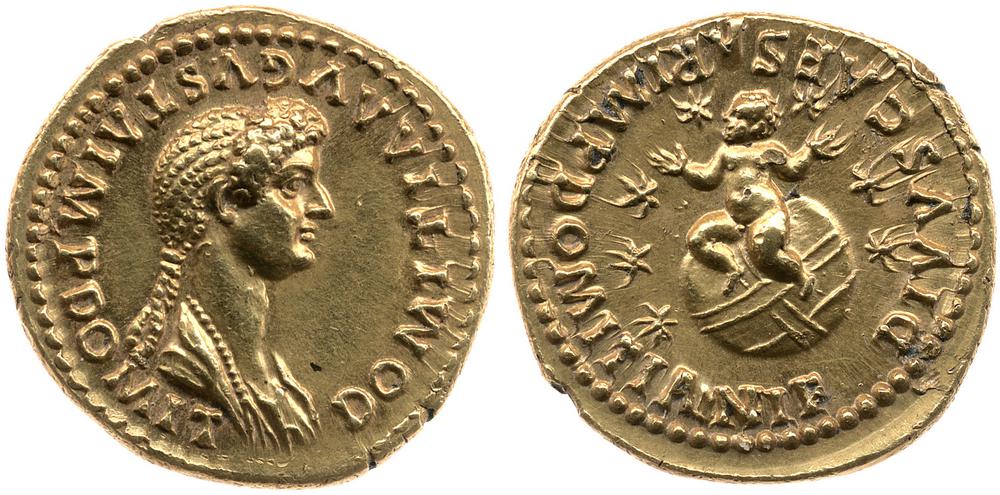
SideInscriptionTranslationMeaning
ObverseDOMITIA AVGVSTA IMP DOMITIANI AVG P P“Domitia Augusta, wife of Emperor Domitian, Father of the Fatherland.”Honors the empress.
ReverseDIVI CAESAR IMP DOMITIANI F“The Divine Caesar, son of Emperor Domitian.”Commemorates their deceased and deified son as a celestial being.

At the same time, John’s Gospel — written in these same years — records the opposite confession:

“Thomas answered and said to Him, ‘My Lord and my God.’” — John 20:28

That exact combination of titles (Lord and God) appears nowhere else in Scripture.
John uses it deliberately, crafting an independent witness to the risen Christ while also confronting the imperial claim of his own day.

What Rome demanded by law, the disciple proclaimed freely to Jesus alone.

Further, Clemens and his wife Domitilla were branded atheists, most likely for being Christians. Very few other people groups were labeled that title, besides Jews and Christians.

Eusebius, Hist. eccl. 3.18.4 (c. 310):

“In Domitian’s time there were many testimonies for Christ, among them Flavia Domitilla, daughter of a sister of Flavius Clemens, one of the consuls of Rome. She was exiled with many others to the island of Pontia because of her testimony to Christ.”

They were the first imperial converts and martyrs we know of. The Domitilla Catacombs in Rome, one of the earliest Christian cemeteries, are traditionally said to have been founded on her estate.


Imperial Worship in the Cities of Revelation

Temples, coins, and inscriptions from Ephesus, Pergamum, Smyrna, and Sardis show how completely the imperial cult surrounded the earliest believers.

Ephesus – Temple of the Flavian Family (c. AD 89–92)

Temple Dedication (IGR IV 1453 = Ephesos Inschriften 302)

“To the Flavian family — the people of Ephesus dedicate [this temple].”

Carved across the marble architrave of the temple at Domitian Square, the inscription identified a sanctuary built for a living ruler.
Fragments of a colossal 23 foot cult statue show the emperor grasping a spear, the symbol of divine authority.
Every citizen walking through the agora looked up at a god in human form.


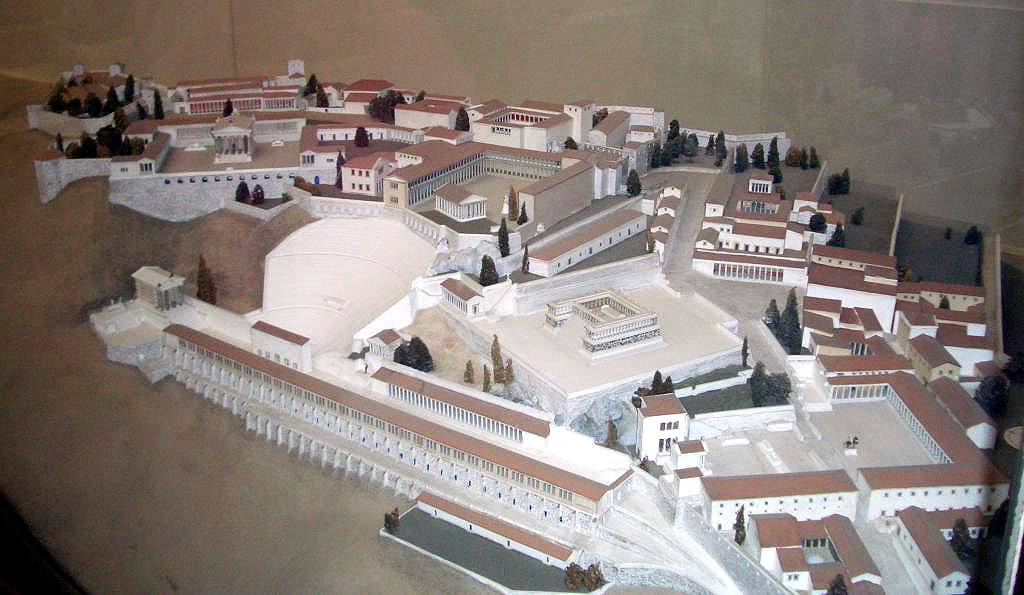
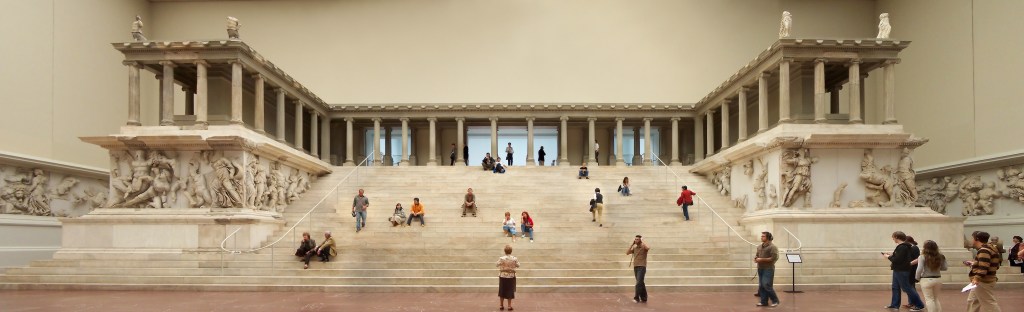
Pergamum – “Where Satan’s Throne Is” (c. AD 90)

Long before Domitian, Pergamum had been the birthplace of imperial worship in Asia.
In 29 BC it won a provincial competition to build the first temple to Rome and Augustus (Tacitus, Annals 4.37), and from then on the city was known as neokoros — guardian of the imperial cult.
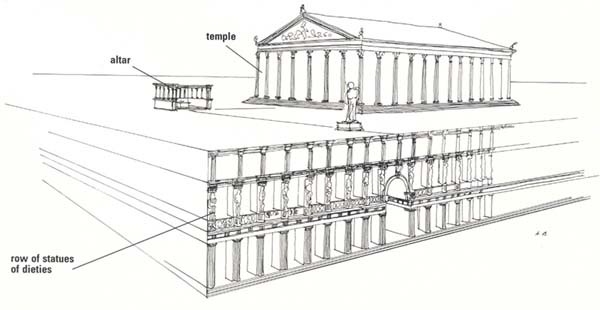
Its acropolis towered above the Caicus Valley, layered with shrines to Athena, Asclepius, Dionysus, and Zeus Soter (“Zeus the Savior”). When the Flavians rose to power, Pergamum naturally added Domitian to its pantheon.

Dedication Inscription (IGR IV 292, c. AD 90)
Marble base found on the upper acropolis, about 50 m from the great altar precinct.

“To the God Domitian Augustus, Conqueror of the Germans.”

The block supported a statue of Domitian in the forecourt of the imperial temple beside the sanctuary of Zeus.

From the lower city the white marble terrace appeared like a colossal seat crowning the hill — a literal throne of stone overlooking the valley.

Provincial Coin Series (RPC II 941–947)

Obverse: “Domitian Caesar Augustus Germanicus.”
Reverse: “The People of Pergamum [to] the August God.”
Design: Domitian radiate — the sun-crowned symbol of divinity.

To citizens, the temple and its gleaming altar celebrated Rome’s salvation; to Christians, it was “Satan’s throne” (Revelation 2:13) — the visible seat of a power demanding the worship that belonged to Christ alone.


Smyrna – Divine Lineage and Public Honors (c. AD 90–95)

Statue Base (IGR IV 1431)

“To the Emperor Caesar Domitian Augustus Germanicus, son of the Divine Vespasian; the Council and People of Smyrna dedicate [this statue], honoring him as Savior and Benefactor.”

Domitian is called both son of the Divine Vespasian and Savior — titles Christians had already learned to reserve for Jesus.


Sardis – “The God, Savior and Benefactor” (c. AD 90–95)

Bilingual Stele (IGR IV 1412, Greek and Latin)

“The Council and People of Sardis dedicate [this to] Domitian Augustus the God, Savior, and Benefactor of the City.”

This inscription was carved on a bilingual marble stele, a rectangular stone slab erected near the Temple of Artemis in Sardis.
Both Greek and Latin texts appear so that local citizens and Roman officials could each read the same dedication — Greek for the provincial population who spoke it daily, Latin for the imperial administrators who governed in Caesar’s name.
The message is identical in both languages: Sardis publicly honored Domitian as God, Savior, and Benefactor.
Such stelae were placed in busy civic spaces and along procession routes where citizens gathered for festivals. They proclaimed the emperor’s divinity in both the religious language of the Greek East (theos sōtēr kai euergetēs) and the political Latin of Rome (Deus Salvator et Benefactor).
It is a literal monument to the union of religion and empire — stone evidence that civic loyalty had become a form of worship.
Every oath, every festival, every public feast reinforced Domitian’s divine status; refusal to take part was treated as disloyalty, even treason.


Economic Pressure and the Mark of the Beast

“No one could buy or sell except the one who had the mark or the name of the beast.” — Revelation 13:17

In John’s day, religion and commerce were one system.
Every trade in Asia belonged to guilds that held banquets in temples, offered sacrifices to the gods, and poured libations to Caesar. Joining meant worship.

Inscriptions from Asia Minor show how this worked:

  • Ephesus: The Silversmiths’ Guild dedicated altars to Artemis and the emperor (Acts 19:23–27).
  • Pergamum: Tanners and dyers sacrificed “for the welfare of the emperor.”
  • Sardis: Merchants funded games “for the safety of Caesar.”
  • Smyrna: Associations built banquet halls “to the August gods.”

One inscription from Ephesus reads:

“To the August gods and to the Genius of the Emperor, the Bakers dedicate this offering.” (CIL III.7089)

Even money was the emperor’s medium. Coins carried his image — often radiate like the sun — and titles such as divus (“divine”) and soter (“savior”).
To buy or sell was to use the emperor’s likeness as a seal of trust.

The word John uses for “mark” — charagma — was the common term for a stamp on a coin or a brand on a slave or soldier. It meant visible ownership or allegiance. In that sense, the “mark of the beast” was the imperial stamp of belonging — the economic and symbolic sign that a person recognized Caesar as lord.

Coins from Domitian’s reign reinforced this imagery: his head encircled with rays, his titles naming him “divine lord and god,” and reverses showing him seated on a globe. These marks of commerce were marks of worship. To refuse them was to lose livelihood and standing. To accept them was to surrender one’s soul.

When Jesus said, “Render to Caesar the things that are Caesar’s, and to God the things that are God’s,” He spoke in a world where tax and worship were separate. By Domitian’s time they were not. In Judea, paying tax acknowledged Roman rule; in Asia, buying and selling itself acknowledged Caesar’s divinity.
What had once been a political payment had become a religious act.
The question was no longer “Should we pay taxes to Caesar?” but “Must we worship Caesar to live?”


The Number of the Beast and the Nero Legend

Revelation 13 ends with one of the most famous verses in the Bible:

“This calls for wisdom: let the one who has understanding calculate the number of the beast, for it is the number of a man, and his number is 666.”
— Revelation 13:18

This is gematria—a system where letters represent numbers. When “Nero Caesar” is written in Hebrew letters (נרון קסר, Neron Qesar), the total is 666. Some manuscripts of Revelation even read 616, which fits the Latin spelling “Nero Caesar” without the final n.

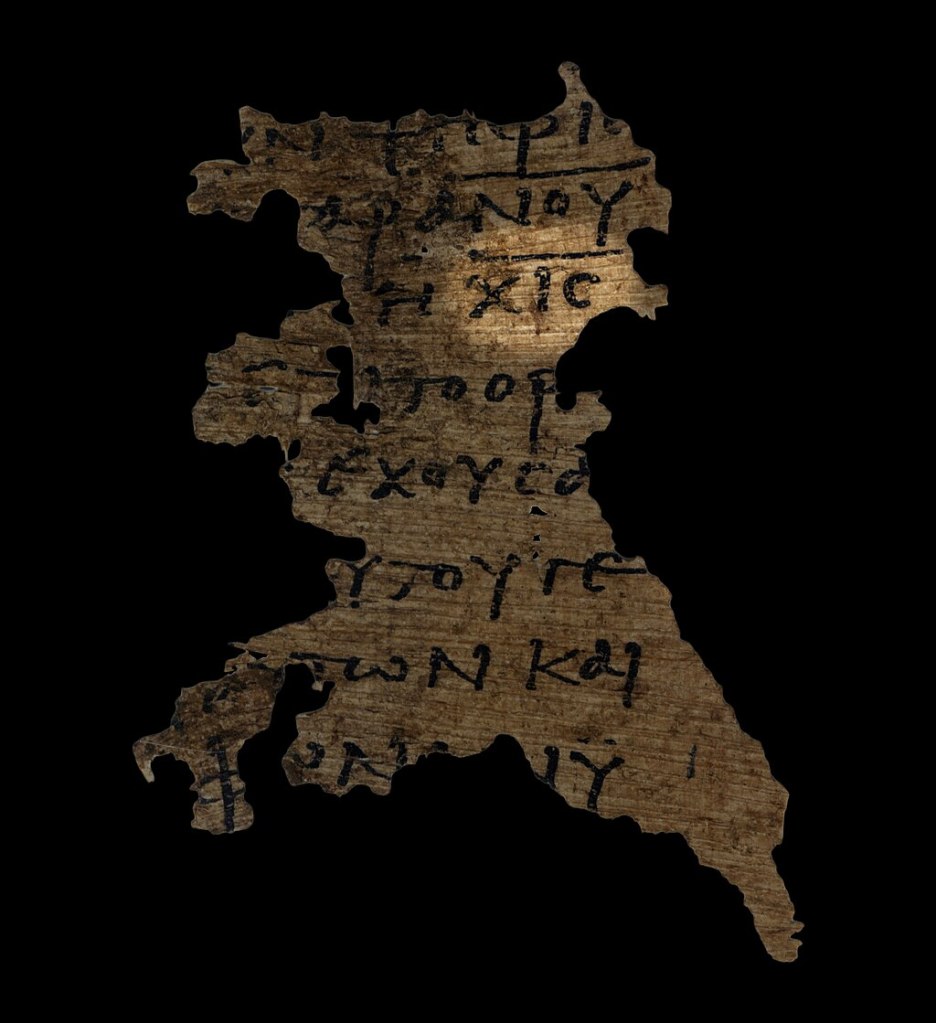
p115 is our oldest manuscript of Rev. 13:18 and has the number as 616.

This shows the beast first pointed to Nero, remembered as the emperor who initiated state persecution of Christians. But why would John use Nero’s name when writing 25–30 years later under Domitian?

Because Romans themselves believed Nero was not really gone.


Dio Chrysostom: “Even Now Everybody Wishes He Were Still Alive”

Dio Chrysostom (writing during the reign of Domitian, c. AD 88–96) gives us the earliest surviving testimony that people still believed Nero was alive:

“For so far as the rest of his subjects were concerned, there was nothing to prevent his continuing to be Emperor for all time, seeing that even now everybody wishes he were still alive, and the great majority do believe that he is, although in a certain sense he has died not once but often along with those who had been firmly convinced that he was still alive.”
— Dio Chrysostom, Discourses 21.10, On Beauty (c. AD 88–96)

This statement, written less than thirty years after Nero’s death, proves that belief in Nero’s survival was already widespread by Domitian’s day. Dio’s tone suggests that many in the empire—perhaps nostalgically—still longed for Nero’s return.


Tacitus: The First False Nero (AD 69)

Tacitus (writing c. AD 105) records that, scarcely a year after Nero’s death, an impostor appeared in Greece:

“About this time, a man of mean origin appeared, who gave out that he was Nero. By his voice and features he deceived many, and by his appearance revived the delusion which still lingered among the people that Nero was alive. He was, however, soon detected and put to death by order of the governor.”
— Tacitus, Histories 2.8 (c. AD 105)

Tacitus shows how quickly the legend took shape. The impostor’s resemblance and musical skill persuaded soldiers and civilians alike that Nero lived on.


Suetonius: The Rumor of Nero’s Return

Suetonius (writing c. AD 121) confirms that belief in Nero’s return persisted for decades and even caused near-war between Rome and Parthia:

“Even after his death there were many who for a long time decorated his tomb with spring and summer flowers, and now again there were others who put up his statues on the Rostra in the toga praetexta and issued edicts in his name as if he were alive. Twenty years later another pretender appeared, supported by the Parthians, and nearly brought on war between them and us before he was handed over.”
— Suetonius, Life of Nero 57 (c. AD 121)

For Suetonius, the legend was no harmless rumor. It stirred real movements, edicts, and political tension—evidence of how deeply the idea of Nero’s return had entered Roman imagination.


Cassius Dio: Terentius Maximus and the Parthian Refuge

Cassius Dio (writing early 3rd century AD) recounts another impostor—this one named Terentius Maximus—who gained the backing of Rome’s eastern rival:

“In the reign of Titus there arose another man who claimed to be Nero; his name was Terentius Maximus. He resembled Nero in face and voice, and, like him, sang to the lyre. By these means he drew many after him, and, when pursued, fled to the Parthians. There he was treated with great honour, but later he was detected and put to death.”
— Cassius Dio, Roman History 66.19.3 (written c. AD 210)

Dio also remarks more generally that “many pretended to be Nero, and this caused great disturbances.” The episode demonstrates how enduring and politically volatile the Nero Redivivus expectation had become.


Domitian as a “New Nero”

Finally, Dio draws a direct moral parallel between Nero and Domitian himself:

“He was a man of Nero’s type, cruel and lustful, but he concealed these vices at the beginning of his reign; later, however, he showed himself the equal of Nero in cruelty.”
— Cassius Dio, Roman History 67.1–2 (written c. AD 210)

By Dio’s time, Nero had become the enduring archetype of a tyrant—one whose spirit seemed to live again in later emperors, and whose rumored return continued to haunt the Roman world.


The “Synagogue of Satan” and Jewish Tax Pressure

John’s letters to the churches in Smyrna and Philadelphia (Revelation 2–3) reveal that persecution in Asia Minor came not only from Roman authorities but also from certain local Jewish communities that publicly opposed the followers of Jesus.

Revelation 2:9
“I know your tribulation and your poverty (but you are rich) and the slander of those who say they are Jews and are not, but are a synagogue of Satan. Do not fear what you are about to suffer. Behold, the devil is about to throw some of you into prison, that you may be tested, and for ten days you will have tribulation. Be faithful unto death, and I will give you the crown of life.”

Revelation 3:9
“Behold, I will make those of the synagogue of Satan who say that they are Jews and are not, but lie—behold, I will make them come and bow down before your feet, and they will learn that I have loved you.”

In both cases, John’s audience lived under Domitian’s enforcement of the Jewish tax (fiscus Judaicus).
Jewish leaders throughout the empire were required to clarify who qualified as Jewish and owed the tax.
Believers in Jesus—claiming Jewish heritage but refusing to pay—were denounced as impostors and stripped of their legal protection as part of a religio licita (a permitted religion).
Such denunciations easily became “slander” (blasphēmia), leading to arrests, confiscation of property, and martyrdom.

John’s phrase “synagogue of Satan” does not condemn Judaism as a whole.
It identifies a local assembly of accusers—people whose actions aligned with Rome’s efforts to suppress the Church.
In Revelation’s theology, Satan is “the accuser of our brothers” (Rev 12:10).
Thus, anyone who brought legal accusations against Christians became, in John’s language, part of “the synagogue of the accuser.”
Persecution was both earthly and spiritual—a human partnership in the devil’s cosmic war against Christ’s people.

This reality soon reappeared in history.
About sixty years later, John’s prophecy was fulfilled in Smyrna during the martyrdom of Polycarp, the city’s aged bishop and a disciple of the Apostle John.

The Martyrdom of Polycarp 13.1:

“The Jews, as was their custom, were the most eager in bringing wood for the fire.”

The same city where John wrote of “the synagogue of Satan” became the stage for its fulfillment: a righteous man condemned by Roman officials and cheered to his death by his own countrymen.
Yet the words of Revelation endured:

“Be faithful unto death, and I will give you the crown of life.”

Polycarp’s martyrdom stands as living proof that John’s vision described real events, not abstract prophecy.
In Smyrna, the Church triumphed through endurance—refusing fear, sharing in Christ’s suffering, and gaining the crown promised by the risen Lord.


Nerva’s Reforms and the Return of Freedom

Cassius Dio 68.1–2:

“Nerva also released those who had been convicted of impiety under Domitian and forbade any further accusations of that kind. He restored to the exiles their property, recalled those who had been banished, and burned publicly the secret reports of informers.”

Suetonius, Life of Nerva 3.1–2:

“He swore that no one should ever be punished for impiety or insult to the emperor. He forbade the bringing of charges under the laws of treason and recalled all who had been condemned for such offenses.”

Pliny, Panegyricus 58–59 (AD 100):

“This oath first Nerva took, and by it he restored freedom to the Senate.”

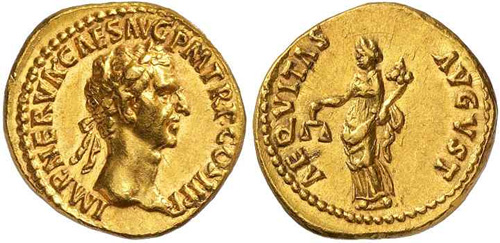
Nerva’s coins proclaimed the same spirit of clemency:

  • FISCI IVDAICI CALVMNIA SVBLATA — “The false accusation of the Jewish tax removed.”
  • LIBERTAS PVBLICA — “Public freedom restored.”
  • IVSTITIA AVGVSTI — “The justice of the emperor.”
SideInscriptionTranslationMeaning
ObverseIMP NERVA CAES AVG PM TR P COS III PP“Emperor Nerva Caesar Augustus, High Priest, holder of tribunician power, Consul for the third time, Father of the Fatherland.”Honors Nerva’s authority and civic leadership.
ReverseAEQVITAS AVGVST“The Equity of the Emperor.”Symbol of fair governance and economic stability under Nerva.

These reversals ended Domitian’s oppressive tax policies that had ensnared Jews and Jewish Christians alike.

Eusebius, Hist. eccl. 3.20.9:

“After the tyrant’s death, John returned from his exile and took up residence again in Ephesus.”

For the first time in decades the Church could breathe. John returned from Patmos, and in that calm the final apostolic writings were completed and the Church clarified its faith against new distortions.


John’s Writings and Their Historical Context

WorkApprox. DatePlaceAncient SourcesSettingPurpose
Gospel of John85–95EphesusIrenaeus 3.1.1 (c. 180)Before exile under DomitianProclaims Jesus as eternal Logos against Greek dualism and emperor worship
1 John90–95EphesusInternal evidencePre-exile warning against DocetismAffirms that Christ came “in the flesh.”
2 & 3 John90–95EphesusEarly traditionLetters to Asia churchesWarns against deceivers.
Revelation95–96PatmosIrenaeus 5.30.3; Eusebius 3.18Exile under DomitianCalls for endurance under imperial idolatry.
Return to Ephesus96EphesusEusebius 3.20.9Released by NervaResumed leadership of Asia churches.
Death of John98–102EphesusIrenaeus 2.22.5; Polycrates in Eusebius 3.31.3Reign of TrajanLast apostle dies in peace.

Why John Had to Write — From Judea to the Greek World

ContextRegionKey FiguresCentral IssueJohn’s Response
Early Jewish-Christian Era (30–70 AD)JudeaNazarenes (orthodox); Ebionites (heretical)Could a Jewish man be divine? Ebionites denied Christ’s pre-existence and rejected Paul.“In the beginning was the Word … and the Word was God.” (1:1)
Greek World (80–100 AD)Asia Minor / EphesusCerinthus and early DocetistsCould the divine truly become flesh and suffer?“The Word became flesh and dwelt among us.” (1:14)

In Judea the debate was whether Jesus could be divine; in Ephesus it was whether He could be truly human. John’s Gospel and letters address both—the eternal God who became man and suffered in the flesh.


The First Christians and the New Distortions

The first denomination within Christianity were the Nazarenes, Jewish Christians who kept the Law yet worshiped Jesus as the divine Son of God. They were essentially the losing party of the Acts 15 church council.

Epiphanius, Panarion 29.7.2–4 (c. 375):

“They use both the Old and New Testaments … They acknowledge that Jesus is the Son of God and that He suffered for the salvation of the world.”

Jerome, Commentary on Isaiah 9.1 (c. 400):

“The Nazarenes accept the Messiah … as the Son of God and say that He was born of the Virgin Mary.”

By contrast, the Ebionites denied Christ’s divinity, rejected Paul, and altered Matthew to remove the virgin birth.


Cerinthus and the First Docetists

Epiphanius, Panarion 28.1–2 (c. 375):

“Cerinthus, trained in the wisdom of the Egyptians, came to Asia and taught that the world was not made by the supreme God but by a certain Power very far removed from Him.”

Hippolytus, Refutation of All Heresies 7.33 (c. 225):

“He was educated in the knowledge of the Egyptians and imbibed their teaching, but he boasted that an angel had appeared to him and revealed these things.”

Irenaeus, Against Heresies 1.26.1 (c. 180):

“He represented Jesus as not born of a virgin, but as the son of Joseph and Mary … The Christ descended upon Him at His baptism and afterward left Him before the Passion.”

Eusebius, Hist. eccl. 3.28.2 (c. 310):

“Cerinthus, by means of revelations which he pretended were written by a great apostle, brought before us fables of his own invention, stating that after the resurrection the kingdom of Christ would be on earth … Being a lover of the body and altogether carnal, he dreamed that the kingdom of Christ would consist of eating and drinking and marrying.”

Caius of Rome (c. 200) and Dionysius of Alexandria (3rd cent.) reported that some believed Cerinthus had written or re-used Revelation to teach a sensual earthly kingdom.
Cerinthus’s teaching (AD 80–100) asserted a lower creator god, a temporary Christ-spirit, and a carnal millennium of pleasure. John’s Gospel answers each point.

Cerinthus’s ClaimJohn’s Counter-Statement
A lesser power made the world.“All things were made through Him.” (1:3)
Jesus was only a man.“The Word became flesh.” (1:14)
The Christ-spirit left before the cross.“When Jesus knew that all was now finished, He said, ‘It is finished.’” (19:30)
The divine cannot touch matter.“He showed them His hands and His side.” (20:20)
The kingdom is earthly pleasure.“My kingdom is not of this world.” (18:36)

The Emerging Docetic Worldview — Primary Sources from the Nag Hammadi Texts

By the end of the first century dualistic ideas spread through Egypt and Syria. The Nag Hammadi Library (copied 4th cent., written 80–150 AD) preserves the teachings John was opposing.

Apocryphon of John (c. 100–120, Egypt/Syria):

“The ruler said, ‘I am God and there is no other beside me,’ for he did not know the source from which he had come. … And the archons created the seven heavens and their angels and made a mold of a man.” (11.18–12.10)

A lesser god creates and rules the world—what John denies when he writes, “All things were made through Him.” (1:3)

Gospel of Thomas (c. 100–120, Syria):

“These are the secret sayings that the living Jesus spoke.… Whoever discovers the interpretation of these sayings will not taste death.” (1)
“The kingdom is inside of you and outside of you.… When you come to know yourselves, then you will be known.” (3)
“When you make the two one … and make the male and the female one and the same, then you will enter the kingdom.” (22)

Thomas borrows many sayings from Matthew, Mark, and Luke but omits the cross and resurrection. Salvation comes through self-knowledge and escaping the material world. John answers: “The Word became flesh and dwelt among us.” (1:14)

Gospel of Truth (c. 120–140, Alexandria/Rome):

“The Word of the Father came into the midst of those who were oblivious, death having taken them captive.… He was nailed to a tree, and He became a fruit of the knowledge of the Father. But He did not suffer as they thought, for His suffering was only in appearance.” (22–23)

Here Christ’s crucifixion is only symbolic, a parable of knowledge. John responds as an eyewitness: “Blood and water came out … He who saw it has borne witness.” (19:34–35)

Second Treatise of the Great Seth (c. 120–160, Egypt):

“It was another, their father, who drank the gall and the vinegar; it was not I.… It was another, Simon, who bore the cross on his shoulder.… For my death, which they think happened, happened to them in their error and blindness.” (55.15–30)

Here Christ denies His own crucifixion and substitutes another in His place—a direct denial of the incarnation and atonement. John writes: “When He had received the sour wine, He said, ‘It is finished.’” (19:30)

Gospel of Judas (c. 130–160, Egypt):

“Often He did not appear to His disciples as Himself, but He was found among them as a child.” (33.10–11)
“Come, that I may teach you about the mysteries no person has ever seen.… From the cloud there appeared an angel … His name was Nebro, which means ‘rebel’; others call him Yaldabaoth.… Nebro created six angels as his assistants.” (47.1–9; 51.1–8)
“And Saklas said to his angels, ‘Let us create a human being after the likeness and the image.’” (52.10–11)
“You will exceed all of them, for you will sacrifice the man that clothes me.” (56.18–20)

In this text Jesus is a shapeshifter whose body is illusory; lower angels rule creation and imitate Genesis by creating humanity; Judas becomes the hero who frees Jesus from His body. John answers: “All things were made through Him … The Word became flesh.” (1:3, 14)

The Church’s Early Defense and the Apostolic View of Christ — The God-Man in the Generation After John

Within a decade of John’s death, the next generation of Christian leaders—men who had known the apostles or their immediate disciples—carried forward the same confession:
Jesus Christ is both fully God and fully man—our Lord and our God.
Their writings show that this was not a later development but the defining belief of the Church from the beginning.


Ignatius of Antioch

(c. AD 110, on his way to martyrdom under Trajan)

Facing execution in Rome, Ignatius wrote seven letters to the churches of Asia, echoing John’s theology and refuting those who denied the incarnation.

Ignatius, Smyrnaeans 2.1:

“He truly suffered, not as certain unbelievers say, that He suffered in appearance only. They themselves exist only in appearance.”

Ignatius, Trallians 10.1:

“Be deaf whenever anyone speaks apart from Jesus Christ, who was of the race of David, who was truly born, and who was truly crucified.”

Ignatius’s faith is emphatically Johannine—insisting that the Word truly became flesh, was truly born, and truly crucified.
To him, salvation depends on the reality of the incarnation, not a symbolic or apparent suffering.

He also confesses the unity of God and Man in Christ with stunning clarity:

Ignatius, Ephesians 7.2:

“There is one Physician, fleshly and spiritual, born and unborn, God in man, true Life in death, both from Mary and from God, first passible and then impassible—Jesus Christ our Lord.”

Ignatius’s phrase “God in man” perfectly captures the apostolic view: the eternal, impassible God entering history through the passible flesh of Jesus.
This was the Church’s defense against both Greek Docetism and Jewish unbelief.


Polycarp of Smyrna

(c. AD 110–115)

Polycarp, To the Philippians 12:

“Now may the God and Father of our Lord Jesus Christ, and the eternal High Priest Himself, the Son of God, Jesus Christ, build you up in faith and truth … to all who shall believe on our Lord and God Jesus Christ and on His Father who raised Him from the dead.”

Polycarp—John’s disciple—echoes Thomas’s confession in John 20:28, directly calling Jesus “our Lord and God.”
He presents Christ as both divine and incarnate: the eternal High Priest who ministers for humanity because He shares humanity, yet who is worshiped as God because He is divine.


Epistle of Barnabas

(c. AD 100–130, Alexandria or Syria)

Barnabas 5.6–9:

“If the Lord endured to suffer for our soul, though He is Lord of the whole earth, to whom God said before the foundation of the world, ‘Let us make man in our image and after our likeness,’ understand how it was that He endured to suffer at the hands of men.… The Son of God came in the flesh that He might abolish death and show forth the resurrection from the dead.”

Barnabas 12.10:

“The Lord submitted Himself to suffer for us, though He is God, and He fulfilled the promises made unto the fathers.”

Barnabas affirms that the Creator Himself—the one who made humanity in His image—entered His own creation to suffer and redeem it.
His words match both Paul’s Christ Hymn (Philippians 2:6–11) and John’s Prologue (John 1:1–14): the same God who made the world became flesh to save it.


Letter to Diognetus

(c. AD 120–150, probably Asia Minor)

Diognetus 7.2–4; 9.2:

“He Himself sent His own Son—as God He sent Him, as to men He sent Him; as Savior He sent Him, as persuader, not as tyrant.… He appeared as God, yet in humility among men.
For what else was able to cover our sins but His righteousness? In whom else could we, lawless and ungodly men, have been made righteous except in the Son of God alone?”

The Letter to Diognetus presents the incarnation as a divine visitation:
God appearing among men, clothed in humility yet possessing full deity.
It summarizes in prose what John had written poetically: “The Word became flesh and dwelt among us.”


Unified Testimony

SourceDateConfession of Christ
Ignatius – Ephesians 7; Smyrnaeans 2105–110“One Physician, fleshly and spiritual… God in man.” / “He truly suffered, not in appearance only.”
Polycarp – Philippians 12110–115“Our Lord and God Jesus Christ.”
Barnabas 5 & 12100–130“The Son of God came in the flesh… though He is God.”
Letter to Diognetus 7 & 9120–150“He appeared as God, yet in humility among men.”

These writings span the first half of the second century—from Antioch to Smyrna, from Alexandria to Asia Minor—and they all speak with one voice.
The earliest post-apostolic Church proclaimed not a developing theology but the same truth John had written on Patmos and in Ephesus:

The Creator Himself became flesh to redeem His creation.
The Word who was with God and was God truly lived, truly suffered, and truly rose as the God-Man Jesus Christ.


Trajan to Pliny: An Old Law, Not a New One

When Trajan became emperor in AD 98, the Church had already suffered under three emperors.
No new law was introduced; Nero’s precedent of AD 64 still governed imperial practice:
to be called a Christian was itself a crime.

Under Nero, believers had been executed “for the name.” (Tacitus, Annals 15.44)
Under Domitian, prosecutions resurfaced under charges of “impiety.”
Under Nerva, there was brief relief.
Under Trajan, the old principle remained.

What changes here is not policy but evidence: for the first time, we possess imperial correspondence showing how the precedent worked in practice.


Pliny’s Letter to Trajan (AD 111–113)

Author: Gaius Plinius Caecilius Secundus (Pliny the Younger), governor of Bithynia-Pontus.
Source: Letters 10.96 (Loeb translation).
Setting: Pliny had newly arrived in the province and discovered that Christian trials were already taking place.
He had never presided over one and sought clarification from the emperor.


Pliny’s Letter (Full Text)

“It is my rule, Sir, to refer to you all matters concerning which I am in doubt.
For who is better able either to direct my hesitation or to instruct my ignorance?
I have never been present at any trials of Christians; therefore I do not know what is the customary subject-matter of investigations and punishments, or how far it is usual to go.
Whether pardon is to be granted on repentance, or if a man has once been a Christian it does him no good to have ceased to be one;
whether the mere name, apart from atrocious crimes associated with it, or only the crimes which adhere to the name, is to be punished—all this I am in great doubt about.

“In the meantime, the course that I have adopted with respect to those who have been brought before me as Christians is as follows:
I asked them whether they were Christians.
If they admitted it, I repeated the question a second and a third time, with a warning of the punishment awaiting them.
If they persisted, I ordered them to be led away for execution; for I could not doubt that, whatever it was that they admitted, that stubbornness and unbending obstinacy ought to be punished.
There were others similarly afflicted; but, as they were Roman citizens, I decided to send them to Rome.

“In the case of those who denied that they were or had been Christians, when they invoked the gods in the words I dictated and offered prayer with incense and wine to your image—which I had ordered to be brought for this purpose together with statues of the gods—and furthermore cursed Christ (none of which things, it is said, those who are really Christians can be forced to do), I thought they ought to be discharged.
Others, who were named by an informer, first said that they were Christians and then denied it; true, they had been of that persuasion, but they had left it, some three years ago, some more, and a few as much as twenty years.
All these also worshiped your image and the statues of the gods, and cursed Christ.

“They maintained, however, that the sum and substance of their fault or error had been that on a fixed day they were accustomed to meet before daylight and to recite by turns a form of words to Christ as to a god,
and that they bound themselves by an oath—not for any crime, but not to commit theft, robbery, or adultery, not to break their word, and not to refuse to return a deposit when called upon to restore it.
After this it was their custom to separate, and then meet again to partake of food—but ordinary and harmless food.
Even this they said they had ceased to do after the publication of my edict, by which, in accordance with your instructions, I had forbidden associations.

“I thought it the more necessary, therefore, to find out what was true from two female slaves, whom they call deaconesses, by means of torture.
I discovered nothing else but depraved, excessive superstition.
Therefore I postponed the investigation and hastened to consult you.
The matter seems to me to justify consultation, especially on account of the number of those in danger;
for many of every age, every rank, and also of both sexes are already and will be brought into danger.
For the contagion of this superstition has spread not only through cities, but also through villages and the countryside;
and yet it seems possible to check and cure it.
It is certain at least that the temples, which had been almost deserted, have begun to be frequented again, and the sacred rites, long suspended, are again being performed, and there is a general demand for the flesh of sacrificial victims, for up till now very few purchasers could be found.
From this it may easily be supposed what a multitude of people can be reclaimed, if only room is granted for repentance.”


Key Insights from Pliny’s Letter

1. Trials Were Already Ongoing
Pliny says, “I have never been present at any trials of Christians,” revealing that such trials preceded him. He is not initiating persecution but ensuring he follows existing imperial practice.

2. The “Forbidden Associations”
Pliny’s comment that he forbade Christian gatherings follows Trajan’s earlier ban on all private associations (collegia).
In a nearby letter (Letters 10.33–34a), Pliny had asked to form a fire brigade in Nicomedia, but Trajan refused, warning that “whatever name we give them, and for whatever purpose they are formed, they will not fail to degenerate into political clubs.”
Because of this standing order, Christian meetings were automatically illegal as unauthorized associations.
Thus, their assemblies were viewed as civic threats, not religious services.

3. “Stubbornness and Unbending Obstinacy” (pertinacia)
Romans considered blind persistence a moral failing—an assault on civic order.
Writers like Cicero and Seneca called pertinacia (stubborn defiance) a kind of madness, the opposite of the Roman virtue of moderation (moderatio).
To confess Christ three times in defiance of a magistrate’s warning was seen as treasonous pride, not conscience.
Hence Pliny’s statement that such obstinacy “ought to be punished” reflects Rome’s moral worldview, where social harmony outweighed individual conviction.

4. The Reputation of True Christians
Pliny records that those who truly belonged to the movement “can never be forced to curse Christ.”
This is an extraordinary pagan admission: even Rome’s officials recognized that real Christians were unfailingly loyal to Christ.
It became, unintentionally, a mark of authenticity: apostates could perform sacrifices, but the faithful could not.
Martyrdom, therefore, was not fanaticism—it was simply consistency with known Christian behavior.

5. Worship of Christ “as to a God”
Pliny confirms that believers “sang a hymn to Christ as to a god.”
This line—written by a pagan witness scarcely 80 years after the crucifixion—proves that the earliest Church universally worshiped Jesus as divine.
It is an unintentional historical echo of Thomas’s words in John 20:28: “My Lord and my God.”

6. Pliny’s Attitude
Pliny is no sadist; he sees Christianity as a “superstition”—a misguided enthusiasm that disrupts civic order.
His tone combines administrative irritation and genuine bewilderment: how could such moral people be so disloyal to the gods?
It is the first documented Roman attempt to rationalize persecution as social hygiene.

7. The Scope of the Faith
Pliny’s line that “the contagion has spread through cities, villages, and the countryside” reveals how pervasive Christianity had become by AD 110.
Even pagan temples, he notes, were deserted because of it.


Trajan’s Reply (Full Text, AD 112)

Source: Letters 10.97 (Loeb Translation)

“You have followed the right course, my dear Secundus, in examining the cases of those who had been denounced to you as Christians;
for it is impossible to lay down any general rule which will apply as a fixed standard.
They are not to be sought out; if they are brought before you and convicted, they must be punished.
With this proviso, however—that if anyone denies that he is a Christian and proves it by worshiping our gods, he is to obtain pardon through repentance, even if he has incurred suspicion in the past.

“As for anonymous accusations, they must not be admitted in any proceedings.
For that would establish a very bad precedent and is not in keeping with the spirit of our age.”


Key Insights from Trajan’s Reply

1. Not a New Law—A Confirmation of Nero’s Precedent
Trajan introduces no new principle. The “right course” Pliny had followed simply enforces the Neronian standard: the name “Christian” is punishable by death.

2. Reactive, Not Proactive Persecution
“They are not to be sought out” sounds lenient but only limits administrative workload.
If accused and proven guilty, Christians were still executed. The persecution was reactive, not abolished.

3. Recantation as Proof of Loyalty
Trajan’s test—offering incense to the gods—measured civic allegiance, not personal belief.
Recantation showed loyalty to Rome; refusal proved treasonous defiance.

4. Imperial “Fairness”
By forbidding anonymous accusations, Trajan presents himself as a just ruler.
Yet the core remains: death for those who confess Christ.

5. Continuity of Hostility
This exchange did not create a new policy.
It merely documents the ongoing enforcement of Nero’s logic—that Christianity was incompatible with Roman religious identity.


Theological Implications — The Empire Meets the God-Man

To the empire, the issue was not theology but loyalty.
To the Church, it was not loyalty but lordship.
The Christians’ refusal to curse Christ or offer incense to Caesar was their confession that the incarnate God alone deserved worship.

Rome saw stubbornness; the Church saw faith.
Rome saw defiance; the Church saw fidelity.
In worshiping the Word made flesh, believers declared that no emperor could demand what belonged to God alone.

“They sang a hymn to Christ as to a god.” — Pliny, Letters 10.96

That one pagan line records the Church’s heart: the same Christ whom John called “Lord and God” was still being worshiped as such, even when worship meant death.


The Church’s Call to Perseverance

The same correspondence that shows Rome’s suspicion of Christians also introduces a chorus of Christian writings calling believers to endurance under trial.
These texts come from every corner of the empire—Rome, Antioch, Smyrna, and Asia Minor—and together they reveal how the early Church met persecution not with revolt, but with perseverance, humility, and hope.


Clement of Rome (AD 95–96, writing from Rome)

1 Clement 5.2–6.1:

“Because of jealousy and strife Paul pointed out the prize of endurance; after he had been seven times in chains, had been driven into exile, had been stoned, had preached both in the East and in the West, he gained the noble renown of his faith.
Having taught righteousness unto the whole world and having reached the furthest bounds of the West, he bore witness before rulers and so departed from the world, leaving behind him an example of endurance.
To these men who lived godly lives was gathered a vast multitude of the elect who, through many indignities and tortures, furnished a brave example among us.”

Clement, writing from the church at Rome to Corinth, recalls Paul’s and Peter’s martyrdoms under Nero and commends their “example of endurance.”
Already, suffering for Christ had become a mark of faithfulness across the empire.


Ignatius of Antioch (AD 110, on his way to execution in Rome)

Ignatius, Romans 4.1–2:

“I am writing to all the Churches and I enjoin all men that I am dying willingly for God’s sake, unless you hinder me.
I beseech you, do not show an unseasonable goodwill towards me.
Suffer me to become food for the wild beasts, through whom it is granted me to attain unto God.
I am God’s wheat, and I am ground by the teeth of wild beasts, that I may be found pure bread of Christ.”

Ignatius, Ephesians 3.1:

“Nothing is hidden from you if you are perfect in your faith and love towards Jesus Christ, for these are the beginning and end of life—faith the beginning, love the end.
The two, in unity, are God Himself, and all things follow upon them.
No man who professes faith sins, and no man who has love hates.
The tree is made manifest by its fruit; so those who profess to belong to Christ shall be known by their actions.”

Ignatius’s letters radiate the same joyful endurance that Pliny had called “obstinacy.”
For him, dying for Christ was not madness but communion with the incarnate God.


Polycarp of Smyrna (AD 155, preserving a first-century memory)

The Martyrdom of Polycarp 8.1–2; 9.3:

“The whole multitude marveled at the nobility and godly fear of Polycarp.
… When he was brought before the proconsul, he was asked to curse Christ and he said, ‘Eighty and six years have I served Him, and He has done me no wrong.
How then can I blaspheme my King who saved me?’
When he had confessed boldly that he was a Christian, the proconsul threatened to burn him with fire.
But he said, ‘You threaten me with a fire that burns for a time and is soon quenched; for you are ignorant of the fire of the coming judgment and of eternal punishment reserved for the ungodly.
But why do you delay? Bring what you will.’”

Polycarp’s calm defiance encapsulates the Church’s understanding of persecution as participation in Christ’s own victory.


The Letter to the Philippians from Polycarp (AD 110–115)

Polycarp 8.2–3:

“Let us then continually persevere in our hope and the earnest of our righteousness, which is Jesus Christ, ‘who bore our sins in His own body on the tree,’
who did no sin, neither was deceit found in His mouth.
Let us therefore become imitators of His endurance, and if we suffer for His name’s sake, let us glorify Him.”

Here, Polycarp explicitly ties Christian endurance to imitation of the crucified God-Man: Christ’s suffering becomes the pattern for His people.


The Epistle of Barnabas (AD 100–130)

Barnabas 7.11:

“He Himself willed to suffer, for it was necessary for Him to suffer on the tree.
For by His suffering He was to redeem us who live under the shadow of death.”

Barnabas emphasizes that Christ’s own endurance sanctified human suffering, turning persecution into fellowship with the Redeemer.


Letter to Diognetus (AD 120–150, Asia Minor)

Diognetus 5.1–5:

“Christians are not distinguished from other men by country or language or customs.…
They dwell in their own countries, but only as sojourners; they share all things as citizens, and suffer all things as foreigners.
Every foreign land is their fatherland, and every fatherland a foreign land.…
They love all men, and are persecuted by all.”

This anonymous writer offers perhaps the most poetic portrait of the persecuted Church—citizens of heaven living under every empire, suffering yet loving, conquered yet unconquerable.


6. The Theology of Endurance — The God-Man as Example

From Clement’s Rome to Ignatius’s Antioch, from Polycarp’s Smyrna to the unknown author of Diognetus, all the earliest Christian writers share one conviction:
the pattern of endurance was set by the incarnate Christ Himself.

AuthorRegionApprox. DateFocus
Clement of RomeRome95–96Martyrs as examples of endurance.
Ignatius of AntiochSyria / Asia110Martyrdom as imitation of “my God.”
Polycarp of SmyrnaAsia Minor110–155Perseverance as faith in the saving King.
BarnabasAlexandria / Syria100–130Christ’s suffering sanctifies human endurance.
Letter to DiognetusAsia Minor120–150Christians as patient citizens of heaven amid persecution.

All of them write under the shadow of Roman hostility.
All of them root endurance not in moral heroism but in the incarnation itself—the belief that the eternal Word took on flesh and endured the cross.
Because Christ suffered truly, His people could suffer faithfully.


7. Closing Reflection

Pliny saw “obstinacy.”
Trajan saw “superstition.”
But the Church saw faithfulness to the God who had become man and suffered for them.

From Nero’s fire to Trajan’s law, the Christians’ hymn remained the same:

“They were accustomed to meet before dawn and to sing a hymn to Christ as to a God.”

And that is the faith Rome could never silence.