Few individuals altered the conditions of Christianity more dramatically than Constantine the Great.
By the time Constantine died in AD 337, Christianity had moved from persecuted minority to legally protected religion across the Roman Empire. Churches were publicly constructed, bishops were consulted by emperors, and Christian worship was openly practiced.
Yet none of this was guaranteed when Constantine first entered Roman politics. Before the Edict of Milan. Before the Council of Nicaea. Before the famous vision of the cross. Constantine was simply the son of a Roman officer navigating one of the most violent political systems in history.
To understand how he eventually conquered Rome, we must begin with his early life and the influences that surrounded him.
Constantine’s Family and Early Environment
Constantine was born around AD 272 in Naissus, a city in the Balkan provinces of the Roman Empire.
His father, Constantius Chlorus, rose through the Roman military ranks and eventually became Caesar under the imperial system established by Diocletian. This system divided rule among several emperors in order to stabilize the empire after decades of civil war.
The fourth century historian Eusebius of Caesarea claims that Constantius showed unusual restraint toward Christians during the Great Persecution. In Life of Constantine 1.13 Eusebius writes:
“Constantius alone among those who then held the chief power preserved his hands unstained by the impious edicts against the Christians.”
Eusebius continues by contrasting Constantius with other rulers who destroyed churches and persecuted believers. According to him, Constantius limited enforcement of the anti Christian laws in the territories under his control.
Another early Christian writer, Lactantius, confirms that Constantius behaved differently from other rulers during the persecution. In On the Deaths of the Persecutors 15 he writes:
“Constantius, although he was commanded to overthrow the churches, only permitted their walls to be demolished while preserving the true temple of God, which is in men.”
Lactantius portrays Constantius as outwardly complying with imperial policy while avoiding violence against Christians themselves. This meant that Constantine grew up in a household where Christians were not treated as enemies of the state.
Constantine at the Imperial Court
As a young man Constantine spent years in the eastern imperial court under Diocletian and his powerful colleague Galerius. This was both an education and a political safeguard. Roman rulers frequently kept the sons of other emperors close at hand to prevent rebellion.
Eusebius describes Constantine’s time in this environment as dangerous. Life of Constantine 1.19 states:
“Galerius devised many plots against him and sought to remove him secretly from the court. Yet the young man escaped all these dangers.”
Although Eusebius attributes Constantine’s survival to divine protection, the historical context explains the risk. The late third century Roman Empire was filled with coups, assassinations, and political purges.
Constantine therefore gained firsthand experience of imperial politics at the highest level. At the same time he witnessed the early stages of the Great Persecution.
Constantine and the Great Persecution
In AD 303 the emperors Diocletian and Galerius launched the most systematic persecution Christians had yet experienced.
Lactantius describes the opening stage of this campaign in vivid terms. On the Deaths of the Persecutors 12 records:
“The churches were razed to their foundations and the sacred Scriptures were delivered to the flames. Those who held offices lost their rank, and those who persisted in the faith were deprived of their liberty.”
He continues with further details of the imperial orders:
“An edict was published commanding that the churches should be demolished, that the Scriptures should be burned, and that those who held offices should be deprived of dignity.”
Another contemporary witness, Eusebius, records similar events. In Ecclesiastical History 8.2 he writes:
“The rulers everywhere began to demolish the houses of prayer and to destroy the sacred Scriptures by fire.”
Eusebius then describes how Christian leaders were arrested across the empire. “The prisons were filled with bishops and presbyters and deacons.”
Constantine observed these events while living within the imperial system itself. This experience exposed him directly to both the brutality of imperial policy and the resilience of the Christian movement.
Christian Intellectual Influence
Another important figure in Constantine’s life was Lactantius.
Lactantius was a Christian apologist trained in classical rhetoric who had taught in the imperial schools before converting to Christianity. Later, Constantine appointed him tutor to his son Crispus.
The Christian scholar Jerome records this in On Illustrious Men 80:
“Lactantius was appointed by Constantine to teach his son Crispus.”
This fact is significant. It shows that Christian intellectuals were welcomed inside Constantine’s household even before Christianity became favored by the state. Lactantius himself wrote a defense of Christianity titled Divine Institutes. In that work he contrasts the morality of Christians with the cruelty of pagan religion.
In Divine Institutes 5.20 he writes:
“The religion of God is mild and gentle. It does not compel but invites.”
This kind of moral argument about Christianity circulated widely in the early fourth century and may well have influenced Constantine’s thinking.
Constantine’s Religious Language
Even after Constantine’s later victory at the Milvian Bridge, his religious language developed gradually. Many of his early coins display the image of Sol Invictus, the Unconquered Sun.
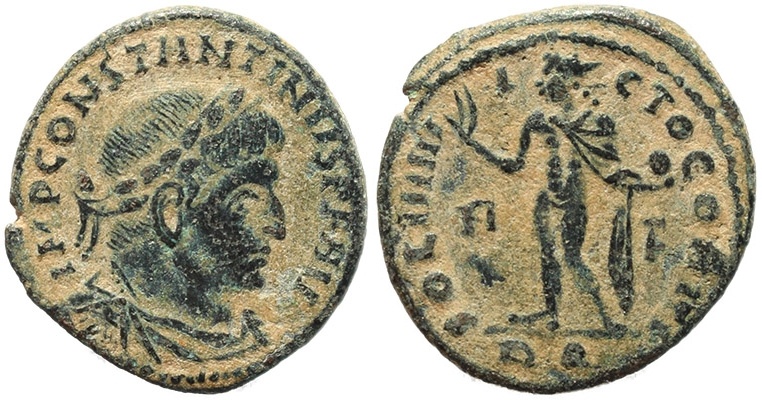
Reverse: SOLI INVICTO COMITI – “To the Unconquered Sun, companion of the emperor.” Sol, standing facing, radiate head left, chlamys across left shoulder, right hand raised, globe in left
But over time Constantine increasingly referred to a single supreme deity guiding his actions.
In a letter preserved by Eusebius in Life of Constantine 2.28 he writes:
“I call God, the Supreme Ruler of all, to witness that I have not undertaken this enterprise from any desire of human glory, but that by divine guidance I have been led.”
This statement suggests that Constantine already interpreted his rise to power as the work of divine providence. Later in the same work Eusebius records Constantine describing his desire to promote true worship throughout the empire.
“It is my desire that the worship of God should flourish.”
Whether this language reflects political calculation, personal belief, or both, it shows that Constantine increasingly associated his rule with the God worshiped by Christians.
The Political Crisis Leading to the March on Rome
By AD 306 Constantine’s father Constantius died while campaigning in Britain. The Roman army immediately proclaimed Constantine emperor.
Eusebius records the moment in Life of Constantine 1.22:
“The soldiers with one voice declared Constantine Augustus.”
However, the Roman Empire at that time had multiple rival rulers. One of them was Maxentius, who controlled the city of Rome. Constantine decided to march south toward the capital in AD 312.
The historian Zosimus, writing from a pagan perspective in the early sixth century, describes Constantine’s military advance in New History 2.15:
“Constantine set out with his army against Maxentius.”
The confrontation would culminate at the Milvian Bridge just outside Rome. This battle would determine control of the western empire and set the stage for one of the most famous stories in Christian history.
According to both Lactantius and Eusebius, Constantine experienced a remarkable sign connected with the Christian God shortly before the battle.
That event will be the focus of the next post in this series.
Discover more from Living the Bible
Subscribe to get the latest posts sent to your email.
 Living the Bible