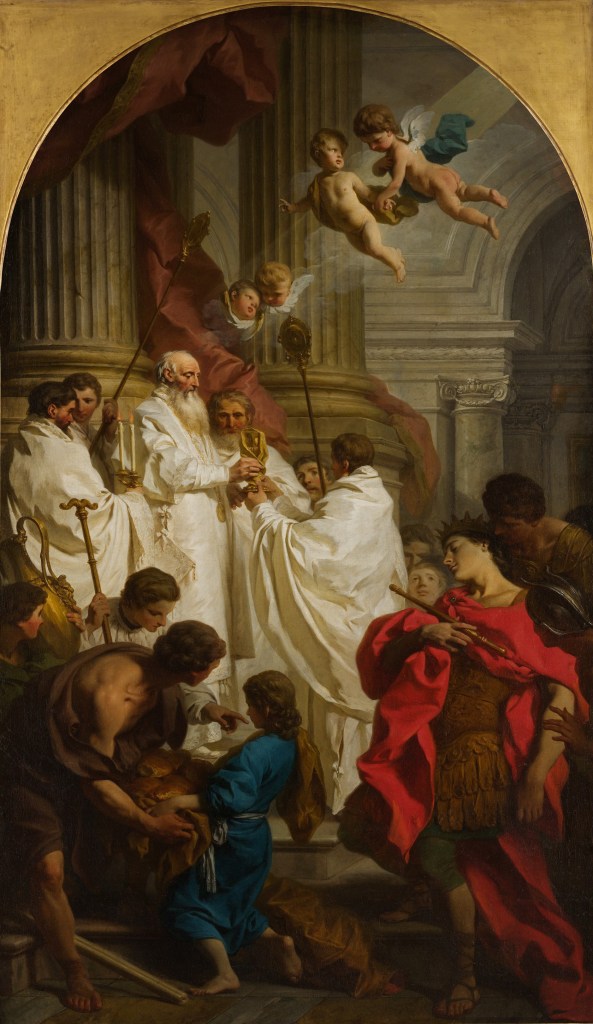
Gregory of Nyssa was not the most famous Cappadocian in his own lifetime. His older brother Basil was the public force: bishop of Caesarea, organizer of monastic life, builder of the Basileias, defender of Nicene orthodoxy, and opponent of imperial pressure. Gregory of Nazianzus was the great preacher of Constantinople, the theologian whose orations gave the church some of its most precise language about the Trinity.
Gregory of Nyssa was different. He was quieter, more speculative, more philosophical, and more mystical. He was not as administratively powerful as Basil or as rhetorically celebrated as Gregory Nazianzen. But over time, his writings became some of the most daring and profound in early Christian theology.
He wrote about the soul as a journey into God. He described spiritual perfection not as a plateau, but as endless growth. He said the true vision of God means realizing that God is beyond every concept we can master. He defended the Trinity by arguing that Father, Son, and Spirit share one divine nature and one divine operation. He reflected on resurrection, purification, baptism, Eucharist, and the restoration of humanity.
And in one of the most remarkable passages from the ancient church, he attacked slavery itself.
Gregory’s greatness lies in the way he connects theology, anthropology, and spiritual desire. For him, God is inexhaustible, and the human person bears the divine image. That means the soul’s journey into God can never be finished, and no human being can be reduced to property, price, or social usefulness.
Gregory of Nyssa made Christianity feel infinite.
A Family Already Marked by Holiness
Gregory was born into one of the most important Christian families of the fourth century. His grandmother Macrina the Elder had suffered during persecution. His mother Emmelia helped form a household of saints. His sister Macrina the Younger became the spiritual center of the family. His brother Basil became Basil the Great. His brother Peter became bishop of Sebaste.
Gregory himself tells us in the Life of Macrina that the family’s Christian memory went back to persecution.
“She was named Macrina after the famous woman in our family, our father’s mother, who had confessed Christ like a noble athlete in the time of persecution.”
Gregory of Nyssa, Life of Macrina, PG 46.962A, c. 380 to 383 AD.
This family did not treat Christianity as a social accessory. It had been tested by suffering, exile, loss, and confiscation. Gregory later has Macrina recall that their ancestors had paid dearly for confessing Christ.
“Our father’s parents had their property confiscated because they confessed Christ. Our maternal grandfather was killed by imperial wrath, and all his possessions were handed over to others.”
Gregory of Nyssa, Life of Macrina, PG 46.980D, c. 380 to 383 AD.
That background matters because Gregory’s theology is never merely abstract. He writes about the soul, resurrection, freedom, and divine life as someone formed by a family that knew what it meant for earthly security to collapse. Property could be confiscated, bodies could die, and political favor could change. But the image of God in the human person remained. The life of the soul remained. The hope of resurrection remained.
That is the world that formed Gregory of Nyssa.
The Younger Brother in Basil’s Shadow
Gregory lived much of his life in Basil’s shadow. Basil was older, stronger, more publicly forceful, and more obviously suited to leadership. Gregory does not seem to have been the natural administrator that Basil was. But Basil clearly trusted Gregory enough to draw him into the church’s work.
Gregory became bishop of Nyssa in the 370s. The office placed him in the middle of the Nicene struggle, especially under the emperor Valens, who favored anti-Nicene theology. Gregory suffered for that position. In the Life of Macrina, when he describes why he had not seen his sister for many years, he gives us a glimpse of the turmoil.
“For a long time visits had been prevented by the troubles I underwent, since I was constantly being driven out from my own country by the leaders of heresy.”
Gregory of Nyssa, Life of Macrina, PG 46.976A, c. 380 to 383 AD.
That line is easy to miss, but it matters. Gregory’s theology did not grow in a quiet academic environment. He wrote amid exile, doctrinal conflict, family grief, ecclesiastical pressure, and political instability. When he later writes about spiritual ascent, divine darkness, and the soul reaching beyond what it can comprehend, he is not writing as someone untouched by struggle. He is writing as someone who had been displaced, challenged, corrected, and humbled.
Gregory’s path to theological depth was not smooth. It passed through family loss, controversy, and exile.
Macrina, the Teacher Behind the Theologian
No account of Gregory of Nyssa makes sense without Macrina.
Gregory’s On the Soul and the Resurrection opens after Basil’s death. Gregory is grieving deeply. He goes to visit Macrina, hoping to share sorrow over their brother. But when he arrives, he finds that Macrina herself is near death.
“Basil, great among the saints, had departed from this life to God, and grief for him was shared by all the churches.”
Gregory of Nyssa, On the Soul and the Resurrection, opening frame, PG 46.12, c. 380 AD.
Then Gregory identifies Macrina by the title that matters most.
“His sister, the Teacher, was still living. So I went to her, longing to share grief over the loss of her brother.”
Gregory of Nyssa, On the Soul and the Resurrection, opening frame, PG 46.12, c. 380 AD.
Gregory calls her “the Teacher.” That is not casual. In the dialogue, Gregory is not the master instructing his dying sister. He is the grieving student. Macrina is the one who steadies him, corrects his grief, defines the soul, explains resurrection, and teaches him to interpret death through Christian hope.
He says she allowed his grief to run for a moment, and then she began to restrain it.
“She yielded to me for a short time, like a skillful driver allowing the uncontrolled violence of my grief. Then she checked me by speaking and corrected the disorder of my soul with the bridle of her reasoning.”
Gregory of Nyssa, On the Soul and the Resurrection, opening frame, PG 46.12, c. 380 AD.
This image tells us something important about Gregory himself. He was not embarrassed to show his own weakness. He lets the reader see him overwhelmed, while his dying sister becomes the one who teaches him. Macrina’s influence matters because many of Gregory’s deepest themes are already present in that dialogue: the soul, death, purification, resurrection, and restoration. Gregory’s later theology did not come only from books. It came from a holy woman dying in front of him, teaching him that death was not the end.
The Human Person Bears the Image of God
One of Gregory’s most important works is On the Making of Man, written as a kind of continuation of Basil’s work on creation. Basil had preached on the six days of creation, but had not fully treated the creation of humanity. Gregory takes up that task.
His central conviction is that the human being is made in the image of God. But he does not treat the image of God as belonging only to a few people. It belongs to the whole human race.
“The image is not in part of our nature, nor is the grace in only one thing found in that nature. This power extends equally to all the race. A sign of this is that mind is implanted alike in all. All have the power of understanding and deliberation, and all those things by which the divine nature finds its image in what was made according to it.”
Gregory of Nyssa, On the Making of Man, chapter 16, c. 379 AD.
Then Gregory makes the point even more expansive.
“The human being first manifested at the creation of the world and the human being who shall appear after the completion of all things equally bear in themselves the divine image.”
Gregory of Nyssa, On the Making of Man, chapter 16, c. 379 AD.
This is a major foundation for Gregory’s moral vision. Human dignity is not created by status, wealth, ethnicity, gender, office, or usefulness. It is rooted in creation. The whole human race bears the divine image.
That conviction later becomes decisive in Gregory’s attack on slavery. If every human person bears the image of God, then no human being can rightly be treated as a possession. No human being can be reduced to a price. No human being can be classified as though the human race were divided into masters and slaves by nature.
Gregory’s anthropology is not decorative. It has consequences.
Freedom Is Part of the Image
Gregory also connects the image of God with freedom. Since virtue must be voluntary, the human person cannot be understood as a creature meant for bondage.
In On the Making of Man, he says:
“Pre-eminent among the good things in us is this: that we are free from necessity, not enslaved to any natural power, but possessing decision in our own control as we choose. For virtue is voluntary and subject to no master. What comes by compulsion and force cannot be virtue.”
Gregory of Nyssa, On the Making of Man, chapter 16, c. 379 AD.
That is one of Gregory’s most important statements about human nature. Freedom is not a minor feature. It is tied to virtue. If virtue must be freely chosen, then coercion cannot produce holiness. This also means that slavery is not merely socially unpleasant. It contradicts the moral structure of the human person.
The human being was made for communion with God, and that communion requires freedom. The soul cannot be forced into virtue as though holiness were mechanical. The human person must choose, love, desire, turn, repent, and grow.
This is why Gregory’s spiritual theology and his moral theology belong together. The same man who teaches endless ascent into God also teaches that human beings cannot be owned. The soul’s freedom is not incidental. It is the ground of the journey.
The World Around Gregory Took Slavery for Granted
To feel the force of Gregory’s attack on slavery, we have to see the world around him. Slavery was not a marginal institution in the ancient Mediterranean. It was woven into households, agriculture, mines, workshops, education, domestic service, law, war, inheritance, and social status. Many people criticized cruelty toward slaves. Some urged masters to be humane. Some philosophers insisted that a slave could possess inner freedom. Roman law developed limits on extreme abuse.
But very few voices attacked the institution at the root.
That is what makes Gregory’s language so striking. He does not merely say, “Do not abuse your slaves.” He does not merely say, “Remember that slaves have souls.” He does not merely say, “A slave can still be spiritually free.” He asks the more dangerous question: who gave you the right to own another human being at all?
Greek Philosophy Could Call a Slave a Living Tool
One of the most influential voices in the Greek intellectual tradition was Aristotle. His Politics does not simply accept slavery as a social fact. It tries to explain why slavery might be natural for some people.
Aristotle describes household property in terms of tools, then places the slave inside that category.
“An article of property is a tool for the purpose of life, and property generally is a collection of tools. A slave is a living article of property.”
Aristotle, Politics, Book I, chapter 4, c. 350 BC.
Then he argues that some people are naturally suited to slavery.
“Those whose function is the use of the body, and from whom this is the best that can come from them, are by nature slaves. For them it is better to be ruled by this kind of authority.”
Aristotle, Politics, Book I, chapter 5, c. 350 BC.
That is the philosophical background Gregory is rejecting. Aristotle can speak of the slave as a living tool, while Gregory will speak of the enslaved person as the image of God. Aristotle can ask whether some people are naturally slaves, while Gregory will say human nature is free. Aristotle can place the slave close to the category of property, while Gregory will ask what price could possibly be placed on rationality, freedom, and the likeness of God.
The contrast could hardly be sharper.
Roman Law Put the Slave Under Another’s Power
Roman law also treated slavery as a basic legal category. The jurist Gaius, writing in the second century, divides people according to whether they are free or enslaved, and then describes the master’s legal power.
“Slaves are in the power of their masters, and this power is acknowledged by the law of nations. Among all nations alike, the master has the power of life and death over his slaves, and whatever property is acquired by a slave is acquired by his master.”
Gaius, Institutes, Book I, §52, c. 161 AD.
Gaius also notes that imperial law had begun restraining extreme cruelty.
“At present, neither Roman citizens nor any other persons under Roman rule are permitted to employ excessive or causeless severity against their slaves.”
Gaius, Institutes, Book I, §53, c. 161 AD.
That legal development matters. Rome could limit cruelty. Rome could punish certain abuses. Rome could regulate manumission. Rome could acknowledge that a master should not make bad use of his rights. But the ownership claim remained. The slave was still under the master’s power. What the slave acquired belonged to the master. The law could restrain excess, but it did not deny the master’s basic claim.
Gregory does deny it. He is not merely asking masters to use their rights more gently. He is asking whether such a right can exist at all.
Humane Masters Were Still Masters
Some ancient moralists did urge better treatment of slaves. Seneca, the Stoic philosopher, gives one of the most famous examples in Letter 47. He rebukes those who treat slaves as less than human.
“‘They are slaves,’ people say. No, they are human beings. ‘Slaves!’ No, they are comrades. ‘Slaves!’ No, they are humble friends. ‘Slaves!’ No, they are our fellow slaves, if one remembers that Fortune has the same rights over slaves and free people alike.”
Seneca, Moral Letters, Letter 47, §1, c. 64 AD.
He also attacks the cruelty of elite dining culture, where slaves are forced to stand hungry and silent while their masters feast.
“All this time the poor slaves may not move their lips, even to speak. The slightest murmur is repressed by the rod. Even a cough, sneeze, or hiccup is punished with the lash.”
Seneca, Moral Letters, Letter 47, §3, c. 64 AD.
Then Seneca gives his moral rule.
“Treat your inferiors as you would be treated by your superiors. As often as you reflect how much power you have over a slave, remember that your master has just as much power over you.”
Seneca, Moral Letters, Letter 47, §11, c. 64 AD.
This is humane, but it is not Gregory’s argument. Seneca tells the master to treat the slave kindly. Gregory asks why the master is a master at all. Seneca says slaves are human beings and should not be treated like beasts. Gregory says enslaving a human being is a direct challenge to the law of God. Seneca asks for mercy inside the master-slave structure. Gregory attacks the structure by asking how one person can claim ownership over another person made in the image of God.
Even Christian Preachers Often Spiritualized Slavery
Even Christian preachers who cared about slaves often did not speak like Gregory.
John Chrysostom, for example, could preach powerfully about the dignity of slaves and the danger of spiritual slavery. But when he comments on Paul’s words in First Corinthians, he often turns the focus from legal slavery to slavery to sin.
“It is possible for one who is a slave not to be a slave, and for one who is free to be a slave.”
John Chrysostom, Homily 19 on First Corinthians, on 1 Corinthians 7:23, c. 390s AD.
Then he explains what he means.
“How can one be a slave and not a slave? When he does everything for God, when he does nothing out of eye-service toward men. That is how one who is a slave to men can be free.”
John Chrysostom, Homily 19 on First Corinthians, on 1 Corinthians 7:23, c. 390s AD.
Later he makes the point even more directly.
“It is not slavery itself, beloved, that hurts. The real slavery is that of sin.”
John Chrysostom, Homily 19 on First Corinthians, on 1 Corinthians 7:23, c. 390s AD.
There is truth in what Chrysostom is saying. A person can be legally enslaved and still possess spiritual courage. A person can be legally free and still be enslaved to greed, lust, vanity, or fear.
But Gregory’s sermon goes somewhere else. Gregory does not only comfort the enslaved person by saying, “You can still be inwardly free.” He confronts the owner and says, “Your claim to own this person is a violation of creation.” That is why Gregory’s passage is so unusual. He does not leave slavery as a regrettable but manageable social reality. He treats it as a theological contradiction.
Even Christian Imperial Law Preserved Slavery
Justinian makes the contrast even stronger.
He was not Gregory’s contemporary. He ruled the Eastern Roman Empire in the sixth century, roughly 150 years after Gregory. But that is exactly why he matters for this script. Justinian was a Christian emperor, a ruler who built churches, legislated on religious matters, and sponsored the great codification of Roman law. Yet even his Christian imperial law code still preserved slavery.
The Institutes of Justinian begins its discussion of persons by dividing human beings into free people and slaves.
“The chief division in the law of persons is this: all human beings are either free or slaves.”
Justinian, Institutes, Book I, Title III, c. 533 AD.
Then it defines freedom.
“Freedom is the natural power of doing what each person pleases, unless prevented by force or law.”
Justinian, Institutes, Book I, Title III, §1, c. 533 AD.
Then comes the striking admission.
“Slavery is an institution of the law of nations, by which one person is made the property of another, contrary to natural right.”
Justinian, Institutes, Book I, Title III, §2, c. 533 AD.
That is an astonishing tension. The law says freedom belongs to nature. The law says slavery is contrary to natural right. But the law still preserves slavery as an institution.
That means Gregory is not merely more radical than Aristotle or Roman jurists. He is more radical than later Christian imperial law. Justinian’s law can name the contradiction and still keep the structure. Gregory will not live inside that compromise.
If human nature is free, Gregory says, then slavery is not merely unfortunate. It is rebellion against what the human being is. If the human being bears the image of God, then the slave market is not merely a legal arrangement. It is a theological outrage.
Then Gregory Attacked the Ownership Itself
Against that background, Gregory’s words become explosive.
Greek philosophy could call the slave a living tool. Roman law could place the slave under the master’s power. Humane moralists could tell masters to treat slaves kindly. Christian preachers could say that spiritual slavery to sin was worse than legal slavery. A later Christian emperor’s law code could admit that slavery was contrary to natural right and still preserve it.
Gregory attacks the master’s claim at the root. He says the human being is free by nature. He says slavery competes with God’s law. He says the owner has forgotten the limits of human authority. He says dominion was given over irrational creatures, not over the image of God.
So when Gregory reads Ecclesiastes 2:7, “I got male and female slaves,” he does not treat it as a harmless detail of ancient wealth. He treats it as the climax of human arrogance.
“You Condemn Human Beings to Slavery”
The most shocking moral passage in Gregory’s writings comes in his Homilies on Ecclesiastes. He is commenting on Ecclesiastes 2:7, where the speaker says, “I got male and female slaves.”
Many ancient Christian writers urged masters to be kind to slaves. Gregory does something stronger. He attacks the act of owning another human being.
He begins with outrage.
“I got me slaves and slave-girls. What do you mean? You condemn human beings to slavery, when their nature is free and possesses free will. You legislate against God, overturning his law for the human species.”
Gregory of Nyssa, Homilies on Ecclesiastes, Homily 4, on Ecclesiastes 2:7, c. 380s AD.
That is one of the clearest anti-slavery statements in the ancient world. Gregory does not merely say, “Treat slaves well.” He says slaveholding violates human nature and competes with God’s law. To enslave someone is to legislate against the Creator.
Then he connects the argument to Genesis.
“The one made to be lord of the earth, appointed to rule by the Creator, you bring under the yoke of slavery, as though defying and fighting against the divine decree.”
Gregory of Nyssa, Homilies on Ecclesiastes, Homily 4, on Ecclesiastes 2:7, c. 380s AD.
Gregory’s point is simple and devastating. God gave humanity dominion over animals and the earth, not over the image of God in another human being. When one human claims ownership over another, the slave owner is not merely organizing labor. He is overturning the order of creation.
For Gregory, slavery is an assault on the divine image.
“Have You Forgotten the Limits of Your Authority?”
Gregory then presses the owner with Scripture. In Genesis, human beings are given dominion over birds, fish, and animals. Gregory asks how anyone dares to extend that dominion over another human being.
“Have you forgotten the limits of your authority? Your rule is limited to irrational creatures. Scripture says, ‘Let them rule over birds and fish and four-footed creatures.’ How then do you go beyond what is subject to you and exalt yourself against a nature which is free?”
Gregory of Nyssa, Homilies on Ecclesiastes, Homily 4, on Ecclesiastes 2:7, c. 380s AD.
Then he exposes the absurdity.
“Surely human beings have not been born to you from domestic animals. Surely cattle have not given birth to human offspring. Irrational creatures alone are subject to humankind.”
Gregory of Nyssa, Homilies on Ecclesiastes, Homily 4, on Ecclesiastes 2:7, c. 380s AD.
This is Gregory’s theological anthropology turned into accusation. If human beings are made in God’s image, then they cannot be grouped with cattle. If dominion was given over animals, then the master has overreached. If the enslaved person is human, then the owner’s claim is not simply excessive. It is a confusion of creation itself.
Gregory is saying that the slaveholder has treated his brother as though he were livestock, and Scripture gives him no such right.
“What Price Did You Put on the Image of God?”
Gregory then moves from law to money. Slaveholding involves buying and selling human beings. So Gregory asks what price could possibly be placed on a person made in God’s image.
“What price did you put on reason? How many coins did you pay for the image of God? How much money did you count out for the nature formed by God?”
Gregory of Nyssa, Homilies on Ecclesiastes, Homily 4, on Ecclesiastes 2:7, c. 380s AD.
That question exposes the absurdity of the market. A slave sale pretends that a human life can be priced. Gregory says the thing being priced is reason, freedom, and the image of God. No amount of money can equal that.
He continues:
“God said, ‘Let us make the human being in our image and likeness.’ If the human being is in the likeness of God, rules the whole earth, and has received authority over all things from God, who is his buyer? Tell me, who is his seller?”
Gregory of Nyssa, Homilies on Ecclesiastes, Homily 4, on Ecclesiastes 2:7, c. 380s AD.
The slave market says that this person has a buyer and a seller. Gregory says that is impossible, because the human being belongs to God. The slave market says this body has a price. Gregory says that is impossible, because the image of God cannot be priced. The slave market says this person is property. Gregory says that is impossible, because the person was made free.
The World Is Not Worth One Human Soul
Gregory keeps pushing. If the human being has dominion over the earth, then the whole world would have to be included in the sale of the human person. But even the whole world is not enough.
“How can people be sold who have dominion over the earth and everything on the earth? If you said, ‘the world in its entirety,’ even then you would not have found anything approximating to the value.”
Gregory of Nyssa, Homilies on Ecclesiastes, Homily 4, on Ecclesiastes 2:7, c. 380s AD.
Then he applies Christ’s teaching about the value of the soul.
“Someone knowing the true value of human nature said that not even the whole world is worth enough to be given in exchange for the human soul.”
Gregory of Nyssa, Homilies on Ecclesiastes, Homily 4, on Ecclesiastes 2:7, c. 380s AD.
The slave market works by pretending that a human being can be converted into money. Gregory says the conversion rate does not exist. Not a handful of coins, not a legal contract, not even the world can equal the value of a person made in the image of the priceless God.
Slavery Divides What God Made One
Gregory’s attack continues by pointing out that slavery divides human nature into categories that God did not create.
“You have divided human nature into slavery and mastery, making it at once slave to itself and master over itself.”
Gregory of Nyssa, Homilies on Ecclesiastes, Homily 4, on Ecclesiastes 2:7, c. 380s AD.
That sentence goes to the heart of the issue. Slavery does not merely place one individual beneath another. It fractures humanity. It treats one part of the human race as if it were a different kind of thing from another part.
Gregory will not allow that. Human nature is one. The image of God is shared. Freedom belongs to the human person as human.
Then he asks what document could possibly authorize such ownership.
“Did the little notebook, the written agreement, and the calculation in coins trick you into thinking that you could be master of the image of God?”
Gregory of Nyssa, Homilies on Ecclesiastes, Homily 4, on Ecclesiastes 2:7, c. 380s AD.
Then he imagines the contract destroyed.
“If the contract were lost, if the writing were eaten by moths, if a drop of water fell on it and washed it away, where is there any proof that you have a slave? Where is there anything that supports you in being a master?”
Gregory of Nyssa, Homilies on Ecclesiastes, Homily 4, on Ecclesiastes 2:7, c. 380s AD.
This is Gregory at his most morally forceful. He takes the legal language of ownership and makes it look ridiculous. A deed may transfer land. A receipt may record the sale of an animal. But what document can transfer the image of God?
No paper can make a human being property. No price can purchase freedom from the Creator. No human law can overturn the divine image.
The Same Air, the Same Death, the Same Judgment
Gregory then strips away the social illusion of superiority. The master and the slave are the same kind of being. They breathe the same air, see the same sun, suffer the same griefs, and return to the same dust.
“Your lineage is still human, your life is similar, and the sufferings of soul and body prevail upon you both in the same way, with one as master and another in subjugation.”
Gregory of Nyssa, Homilies on Ecclesiastes, Homily 4, on Ecclesiastes 2:7, c. 380s AD.
Then he asks:
“Do they not draw in the same air when they breathe? Do they not see the sun in a similar way? Do they not both sustain their life by taking in nourishment? Is not the structure of their bodily organs the same?”
Gregory of Nyssa, Homilies on Ecclesiastes, Homily 4, on Ecclesiastes 2:7, c. 380s AD.
And then the final equalizer:
“Do they not both return to the same dust after death? Do they not both face one and the same judgment? Is not the prospect of heaven and hell the same for them both?”
Gregory of Nyssa, Homilies on Ecclesiastes, Homily 4, on Ecclesiastes 2:7, c. 380s AD.
This is one of the most powerful parts of Gregory’s argument because it attacks slavery from below and above. From below, master and slave share the same body, same breath, and same death. From above, master and slave face the same God, same judgment, and same eternity.
No human hierarchy survives those facts. The master may have a contract, but he does not have a different nature. He may have power, but he does not have a different destiny. He may call the other person a slave, but before God they both stand as human beings.
Gregory makes the slave owner look absurd: one mortal body trying to own another mortal body, one dying soul trying to possess another soul that belongs to God.
The Poor as a Test of the Soul
Gregory’s concern for human dignity also appears in his preaching about the poor. Like Basil and Gregory Nazianzen, Gregory of Nyssa believed Christian theology had to change the way Christians saw the suffering body.
In his sermons on love for the poor, he urges practical giving, not vague sympathy.
“Give what you can. God asks nothing beyond your strength. You can give a loaf; another can give a cup of wine; another can give clothing. By your joined help, one person’s hardship may be relieved.”
Gregory of Nyssa, On the Love of the Poor, c. 380s AD.
This is not as dramatic as his attack on slavery, but it belongs to the same moral world. Human need is not theoretical. It is answered by bread, wine, clothing, and shared effort.
Gregory’s vision of the human person is lofty, but it does not float above ordinary life. If the poor bear the image of God, then their hunger matters. If the sick bear the image of God, then their wounds matter. If the enslaved bear the image of God, then their freedom matters.
Gregory’s theology is mystical, but not escapist. The soul may journey into divine darkness, but the journey does not excuse ignoring the suffering person at the door.
The Trinity Is Not Three Gods
Gregory was also one of the great defenders of Nicene Trinitarian theology. In On “Not Three Gods,” written to Ablabius, he answers the charge that Christians worship three gods when they confess Father, Son, and Holy Spirit.
Gregory’s answer depends on the unity of divine nature and operation.
“The Father is God. The Son is God. Yet by the same proclamation God is one, because no difference either of nature or of operation is contemplated in the Godhead.”
Gregory of Nyssa, On “Not Three Gods,” to Ablabius, c. 380s AD.
He continues:
“If the nature of the Holy Trinity were diverse, the number would consequently extend to a plurality of gods. But since the divine, single, and unchanging nature rejects all diversity in essence, it does not admit the meaning of multitude.”
Gregory of Nyssa, On “Not Three Gods,” to Ablabius, c. 380s AD.
Gregory is trying to preserve two truths at once. The Father is not the Son. The Son is not the Spirit. The Spirit is not the Father. And yet the divine nature is one. Christians do not worship three different beings with three different divine powers. They worship one God: Father, Son, and Holy Spirit.
Gregory’s theology is subtle because he refuses to solve the mystery by flattening it. He will not collapse the persons into one person. But he will not divide the divine nature into three gods.
The Spirit Shares the Work of God
Gregory also defends the divinity of the Holy Spirit by arguing from the Spirit’s work. If the Spirit gives sanctification, life, light, comfort, freedom, and immortality, then the Spirit is not a creature.
In On the Holy Trinity, he writes:
“If we understand that the operation of the Father, the Son, and the Holy Spirit is one, differing or varying in nothing, then the oneness of their nature must be inferred from the identity of their operation.”
Gregory of Nyssa, On the Holy Trinity, to Eustathius, c. 380s AD.
Then he becomes specific.
“The Father, the Son, and the Holy Spirit alike give sanctification, life, light, comfort, and all similar graces.”
Gregory of Nyssa, On the Holy Trinity, to Eustathius, c. 380s AD.
This is classic Cappadocian reasoning. The Spirit does what only God does. Therefore, the Spirit shares in the divine nature.
Gregory continues by saying that every grace given to the worthy comes from the Father, Son, and Spirit together.
“Every grace and power, guidance, life, comfort, the change to immortality, the passage to liberty, and every other blessing that exists descends to us through the Father, the Son, and the Holy Spirit.”
Gregory of Nyssa, On the Holy Trinity, to Eustathius, c. 380s AD.
For Gregory, the doctrine of the Trinity is not abstract arithmetic. It is about salvation. If the Spirit is the one who sanctifies the soul, illumines the mind, grants life, and brings us into freedom, then the Spirit must not be treated as a lesser power.
The Christian life itself bears witness to the Trinity.
The Great Catechism Was Gregory’s Map of the Faith
Gregory’s Great Catechism, also called the Great Catechetical Oration, is one of his most important works because it shows him trying to organize the whole Christian faith for teaching. This is not a casual devotional text or a sermon on one passage of Scripture. It is Gregory stepping back and asking how the church should explain Christianity to those preparing to receive the faith.
He writes for teachers, pastors, and catechists, the people responsible for instructing outsiders, converts, and those confused by rival teachings. He opens the work by saying that teachers of the faith need order, structure, and method.
“The ministers who preside over the mystery of godliness need a system in their instruction, so that the church may be increased by those being saved, as the word of faith is brought to the hearing of unbelievers.”
Gregory of Nyssa, The Great Catechism, Prologue, c. 383 to 386 AD.
That line matters because Gregory is not only giving doctrines. He is giving a method of teaching doctrine. He wants Christian instruction to be coherent enough to guide a hearer from confusion into faith.
But he also knows that not every person needs the same argument. A pagan polytheist, a Jew, a Manichee, an Anomoean, and a follower of Marcion do not begin from the same assumptions. So Gregory says the catechist must know the wound before applying the medicine.
“The same method of instruction will not be suitable for everyone who approaches the word. The catechism must be adapted to the differences in their religious views, aiming at one goal, but not using the same preparation in every case.”
Gregory of Nyssa, The Great Catechism, Prologue, c. 383 to 386 AD.
Then he gives the key pastoral image.
“The method of recovery must be adapted to the form of the disease. You will not cure the Greek’s polytheism and the Jew’s unbelief about the Only-begotten God by the same means.”
Gregory of Nyssa, The Great Catechism, Prologue, c. 383 to 386 AD.
This gives us a crucial window into Gregory’s mind. Theology is not just information. It is medicine. Teaching is not just repeating correct words. It is diagnosis and cure.
Gregory’s Great Catechism is his attempt to give the church a theological medicine chest.
One Goal, Different Wounds
Gregory’s method is both flexible and firm. It is flexible because he adapts his arguments to the person in front of him. The Greek must be moved away from many gods. The Jew must be brought to recognize the Word and Spirit. The heretic must be corrected according to the particular distortion he has accepted.
But Gregory’s method is firm because all these paths lead toward the same goal: the confession of the Triune God, the incarnation of the Word, the healing of human nature, and the transformation of life.
He explains this clearly in the prologue.
“It is necessary to consider the opinions each person has taken up and to frame the argument according to the error into which each has fallen, advancing principles and reasonable arguments so that, from what is agreed upon by both sides, the truth may be brought to light.”
Gregory of Nyssa, The Great Catechism, Prologue, c. 383 to 386 AD.
This is Gregory as theologian and pastor at the same time. He does not simply shout conclusions. He starts where the hearer is. He looks for shared ground. Then he leads the hearer step by step toward the mystery of the faith.
That is why the Great Catechism is so important for understanding him. It shows Gregory building Christianity as an argument, not because he thinks faith is reducible to logic, but because he believes Christian truth is coherent. The gospel is not a pile of disconnected doctrines. It is one great healing story: God creates, humanity falls, the Word descends, the sick nature is touched, death is conquered, the soul is purified, baptism begins resurrection, the Eucharist gives the antidote, and the regenerate life must become visibly changed.
Gregory Begins With the Trinity
Gregory does not begin the Great Catechism with ethics or church practice. He begins with God. For Gregory, Christianity is not first a moral system, not first a political program, and not first a set of rituals. It begins with the nature of God: Father, Son, and Holy Spirit.
He argues first against pagan polytheism and Jewish objections. Against polytheism, he insists on the unity of God. Against a view of God that leaves no room for the Son and Spirit, he argues that God is not without Word and Spirit.
He says that if God has a Word, that Word cannot be a weak and vanishing sound like human speech. God’s Word must be living, eternal, powerful, and good.
“Our word is unstable because our nature is liable to corruption. But in that transcendent nature, everything said of God is elevated with the greatness of the subject. Therefore, when we speak of God’s Word, we must not think of something that vanishes away like our speech.”
Gregory of Nyssa, The Great Catechism, chapter 1, c. 383 to 386 AD.
Then he says:
“The Word of God is living, subsisting, willing, powerful, and able to accomplish what is good.”
Gregory of Nyssa, The Great Catechism, chapter 1, c. 383 to 386 AD.
Gregory is reasoning toward the Trinity. God is not mute. God has a Word. God is not breathless. God has a Spirit. But the Word and Spirit are not creatures or disposable functions. They share the divine life.
Then Gregory gives a striking summary of how Christian faith avoids two opposite errors.
“The truth passes between these two conceptions. It destroys each heresy while accepting what is useful from each. From the Jewish understanding, let the unity of nature stand. From the Greek understanding, let the distinction of persons stand.”
Gregory of Nyssa, The Great Catechism, chapter 3, c. 383 to 386 AD.
That is Gregory’s Trinitarian method in miniature. Christianity does not become pagan polytheism because it confesses one divine nature. Christianity does not become a flattened monotheism because it confesses Father, Son, and Spirit. The faith holds together unity and distinction.
The Human Being Was Made to Participate in God
After Gregory begins with God, he turns to humanity.
Why did God create the human being? Gregory’s answer is not necessity. God did not need humanity. God created from overflowing goodness, so that there would be a creature capable of participating in divine beauty, goodness, and life.
“The Maker of human nature was not driven by any necessity to form humanity, but in the superabundance of love he produced such a creature.”
Gregory of Nyssa, The Great Catechism, chapter 5, c. 383 to 386 AD.
Then he explains why the human person had to bear something akin to God.
“If the human being was to be a partaker of the good things in God, it was necessary that human nature be made capable of participating in that good.”
Gregory of Nyssa, The Great Catechism, chapter 5, c. 383 to 386 AD.
Gregory gives the image of the eye and light. The eye can receive light because something in it is fitted for light. In the same way, the human being can desire God because something in human nature is made for God.
“As the eye, by the bright ray naturally wrapped up in it, has fellowship with light and draws to itself what is akin to it, so it was necessary that a certain affinity with the divine be mingled with human nature, so that by this correspondence it might aim at what is native to it.”
Gregory of Nyssa, The Great Catechism, chapter 5, c. 383 to 386 AD.
That passage is essential for Gregory. The human person is not merely an animal with religious interests. The human person is created with an affinity for God. The soul desires God because it was made for God. The image of God is not decorative language. It means human nature is structured for participation in divine life.
This also connects directly to Gregory’s attack on slavery. If the human person was made to participate in God, then no human being can be reduced to a tool, price, or possession.
Freedom Explains Both Greatness and Ruin
Gregory then faces the obvious objection. If humanity was made for divine good, why is human life filled with suffering, corruption, passion, sin, and death?
His answer begins with freedom. The human being was made in the image of God. Therefore, human nature had to include self-direction, freedom, and the ability to choose. Without freedom, virtue would not be virtue.
“God would never have deprived humanity of the most excellent and precious of all goods: being one’s own master and having free will.”
Gregory of Nyssa, The Great Catechism, chapter 5, c. 383 to 386 AD.
Then he adds:
“If necessity were the master of human life, the image would be falsified in that very part, being made unlike its archetype.”
Gregory of Nyssa, The Great Catechism, chapter 5, c. 383 to 386 AD.
This is important because Gregory does not explain evil by blaming God. Evil is not a second divine power. It is not something God created as a substance. Evil arises when the free soul turns away from the good.
“No growth of evil had its beginning in the divine will. Evil is born from within, springing up in the will when there is a turning back of the soul from the beautiful.”
Gregory of Nyssa, The Great Catechism, chapter 5, c. 383 to 386 AD.
Then he gives one of his favorite ways of describing evil.
“As sight is a natural activity and blindness is the deprivation of that activity, so also vice is opposed to virtue, not as a thing existing in itself, but as the absence of the better.”
Gregory of Nyssa, The Great Catechism, chapter 5, c. 383 to 386 AD.
This is the foundation of Gregory’s healing theology. Evil is real in its effects, but it is not ultimate. It is a privation, a wound, a deformation, a failure of the good. That means salvation is not God destroying human nature. Salvation is God healing human nature, restoring what sin has damaged, and bringing the soul back toward the good for which it was made.
The Incarnation Is the Answer to the Human Wound
Once Gregory has explained God, human nature, freedom, and the fall into evil, he turns to the incarnation.
Why did the Word become flesh?
For Gregory, the answer is healing. The human being had been made for divine life, but had fallen into sin, corruption, and death. Therefore, the divine healer had to enter the human condition.
Gregory says the incarnation is not beneath God’s dignity. Only evil is truly degrading. Birth, bodily life, weakness, and death are not evil in themselves. They are the places where wounded humanity needed to be touched.
“That God should be born in our nature ought not seem strange to those who do not take too narrow a view of things. For who, surveying the universe, does not believe that God is in all things, penetrating, embracing, and sustaining them?”
Gregory of Nyssa, The Great Catechism, chapter 25, c. 383 to 386 AD.
Then he says the incarnation is the way human nature becomes healed from within.
“At that time he was mingled with our nature, so that our nature, by this mingling with the divine, might itself become divine, rescued from death and placed beyond the reach of the enemy.”
Gregory of Nyssa, The Great Catechism, chapter 25, c. 383 to 386 AD.
That is Gregory’s incarnational theology in one sentence. The Word does not merely visit humanity. He mingles himself with human nature. He enters birth, growth, suffering, and death so that humanity can be rescued from death and restored to divine life.
This is not salvation from a distance. It is salvation by contact.
Incarnation as the Descent of Divine Power
Gregory knows that some people think the incarnation makes God look weak. How can divine power enter human lowliness? How can the infinite God be joined to flesh?
Gregory turns the objection upside down. The descent of God is not a denial of divine power. It is the most astonishing display of divine power.
“The power of God is shown more clearly in descending to the lowliness of humanity than in the greatness and supernatural character of the miracles.”
Gregory of Nyssa, The Great Catechism, chapter 24, c. 383 to 386 AD.
Then he gives a striking image.
“If flame were seen streaming downward like a heavy body, while still remaining fire, this would be regarded as a miracle. In the same way, the condescension of God to the weakness of our nature displays the transcendent power of the Deity.”
Gregory of Nyssa, The Great Catechism, chapter 24, c. 383 to 386 AD.
For Gregory, divine greatness is not fragile. God is not made less divine by mercy. God’s power is not only the power to rule from above. It is the power to descend without ceasing to be God.
The image is important because it shows how Gregory thinks about Christ. The flame streams downward, but remains fire. The Word becomes flesh, but remains God. Divinity enters lowliness, but does not lose its height.
This is one of Gregory’s most important theological instincts: mercy does not weaken God. Mercy reveals God.
The Healer Had to Touch the Sick Place
Gregory’s account of the incarnation is also medical. Humanity is sick, and the sick part must receive the healer.
He says:
“It is impossible for the sick person to be healed unless the suffering member receives the healing.”
Gregory of Nyssa, The Great Catechism, chapter 27, c. 383 to 386 AD.
Then he applies the image directly to Christ.
“If the sick part was on earth, and omnipotence had not touched it, but had regarded only its own dignity, this concern with things with which we had nothing in common would have been of no benefit to humanity.”
Gregory of Nyssa, The Great Catechism, chapter 27, c. 383 to 386 AD.
This is one of Gregory’s clearest statements of why the Word became flesh. God does not heal humanity from a distance. God touches the wounded place. If the disease is in human life, then the cure must enter human life. If the wound is in the body, the soul, birth, death, and the whole condition of human existence, then the divine medicine must reach all of it.
Gregory gives another image: washing a dirty garment.
“Those who wash clothes do not pass over some of the dirt and cleanse the rest, but clear the whole cloth from all its stains. In the same way, since human life was defiled by sin from beginning to end and in all that lies between, a cleansing power had to penetrate the whole.”
Gregory of Nyssa, The Great Catechism, chapter 27, c. 383 to 386 AD.
That image helps explain the incarnation. Christ does not cleanse one corner of human life and leave the rest untouched. He enters the whole cloth. Birth, growth, hunger, suffering, death, burial, and resurrection all become part of the cure.
For Gregory, salvation is total because the wound is total.
Why God Waited
Gregory also answers a difficult question: if God intended to save humanity, why did the incarnation come so late?
His answer again uses a medical image. Sometimes a physician waits until the disease has fully appeared before applying the remedy. The point is not indifference, but complete healing.
“In bodily diseases, when some corrupt humor spreads unseen beneath the pores, physicians do not apply medicines that would harden the flesh before all the unhealthy secretion has appeared. They wait until what lurks within comes to the surface, and then, when the disease is unmasked, they apply the remedies.”
Gregory of Nyssa, The Great Catechism, chapter 29, c. 383 to 386 AD.
Then he applies it to salvation history.
“When wickedness had reached its height, and there was no form of evil that human beings had not dared to do, then the healing remedy entered the disease, not at its beginning, but when it had been completely developed.”
Gregory of Nyssa, The Great Catechism, chapter 29, c. 383 to 386 AD.
This is a bold way of reading history. Gregory is saying that God’s delay was not neglect. It was surgical timing. Evil had to reveal itself fully. The disease had to come to the surface. Then the remedy could enter and reach the whole sickness.
Whether a modern reader finds this explanation persuasive or not, it shows Gregory’s deep pattern of thought. He is always thinking in terms of healing. Sin is disease. Christ is medicine. The incarnation is treatment. History becomes the long exposure of the wound so that the cure can penetrate fully.
Purification as the Healing of Gold
Gregory’s vision of purification appears throughout his writings, but The Great Catechism gives one of the clearest versions. He uses the image of gold mixed with worthless material.
“When some worthless material has been mixed with gold, the refiners burn up the foreign and refuse part in the consuming fire and restore the more precious substance to its natural brightness.”
Gregory of Nyssa, The Great Catechism, chapter 26, c. 383 to 386 AD.
Then he applies the image to evil.
“In the same way, when death, corruption, darkness, and every offshoot of evil have grown into nature, the approach of divine power acts like fire, making the unnatural addition disappear. The purgation of evil becomes a blessing, though the separation is agonizing.”
Gregory of Nyssa, The Great Catechism, chapter 26, c. 383 to 386 AD.
This image is important because it shows how Gregory thinks about sin and judgment. Sin is not the true essence of the person. It is a foreign mixture. It damages the soul’s beauty, but it does not become the soul’s deepest identity. The fire hurts because the soul has become attached to what harms it. But the purpose of the fire is not destruction. The purpose is restoration.
Gregory then gives another medical comparison.
“Those who are treated by knife and cautery are angry with the doctors and wince at the pain of the incision. But if recovery of health results, and the pain passes away, they are grateful to those who worked the cure.”
Gregory of Nyssa, The Great Catechism, chapter 26, c. 383 to 386 AD.
That is one of the reasons Gregory’s theology is so distinctive. Punishment becomes surgery. Fire becomes refinement. Pain becomes part of healing. Judgment is not separated from restoration.
For Gregory, God’s aim is not to destroy the gold. God’s aim is to remove the dross.
The Broad Hope of Restoration
Gregory’s language about restoration can be remarkably expansive. Interpreters debate exactly how systematically to read his teaching, and Christians have disagreed about whether Gregory should be called a universalist in a strict doctrinal sense. But the breadth of his language is undeniable.
In The Great Catechism, he says:
“After long periods of time, when the evil now mixed with our nature has been expelled, and when those now lying in sin have been restored to their primal state, a harmony of thanksgiving will arise from all creation.”
Gregory of Nyssa, The Great Catechism, chapter 26, c. 383 to 386 AD.
Then he says:
“The chastisement, however painful, of moral disease is a healing of its weakness.”
Gregory of Nyssa, The Great Catechism, chapter 26, c. 383 to 386 AD.
This is one of Gregory’s most hopeful theological instincts. Evil is parasitic, not ultimate. Purification is painful, but ordered toward healing. Creation’s final movement is not chaos, but thanksgiving.
This does not make Gregory casual about sin. He does not treat evil as harmless. The fire burns. The knife cuts. The separation is agonizing. The disease is real. But evil does not get the last word. God’s goodness is deeper than evil’s damage.
In Gregory’s theology, restoration is not sentimental optimism. It is confidence that God’s creative and healing power is greater than corruption.
Baptism as Resurrection Rehearsed in Water
After explaining the incarnation and purification, Gregory turns to the sacraments. This is important because the Great Catechism does not leave salvation as an idea. Salvation becomes something enacted in the church.
Gregory first treats baptism. For him, baptism is not bare symbolism. It is participation in the pattern of Christ’s death and resurrection. The baptized person enters the water as a sign of burial and rises from the water as a sign of resurrection.
“The descent into the water and the threefold immersion involve another mystery.”
Gregory of Nyssa, The Great Catechism, chapter 35, c. 383 to 386 AD.
Then he explains the logic.
“As Christ, after taking deadness upon himself and being deposited in the earth, returned to life on the third day, so everyone joined to him looks toward the same successful end, arriving at life by having water poured over him instead of earth.”
Gregory of Nyssa, The Great Catechism, chapter 35, c. 383 to 386 AD.
Then comes one of the key lines.
“It is necessary for us to rehearse beforehand in the water the grace of the resurrection, so that we may understand that, as far as ease is concerned, it is the same thing for us to be baptized with water and to rise again from death.”
Gregory of Nyssa, The Great Catechism, chapter 35, c. 383 to 386 AD.
That phrase is powerful: baptism rehearses resurrection. The Christian life begins by acting out the final hope. The believer enters the water as one entering death and comes out as one already marked by resurrection. Baptism does not merely look backward to Christ’s death. It also looks forward to the resurrection of the body and the restoration of the human person.
For Gregory, the sacrament is the future placed at the beginning.
Baptism Is Small in Appearance, Vast in Meaning
Gregory knows that baptism can look unimpressive from the outside. It involves water, prayer, and faith. The visible action seems simple. But Gregory says the visible simplicity hides an immense divine work.
“You see how small a thing it is in its beginning and how easily effected: faith and water. The first lies within the will, and the second is the companion of human life. But the blessing that springs from these two things is great and wonderful, for it implies relationship with Deity itself.”
Gregory of Nyssa, The Great Catechism, chapter 36, c. 383 to 386 AD.
That contrast is very Gregory. Water is ordinary. Faith is inward. Prayer is spoken. But through them, the person is drawn into relation with God.
This is why Gregory’s sacramental theology belongs with his larger theology of the body. God uses material things. Water becomes the place where resurrection is rehearsed. Bread and wine become the means by which immortal life enters mortal bodies. The body is not bypassed. It is included in salvation.
The Eucharist as Antidote
Gregory’s account of the Eucharist is one of the most vivid sections of The Great Catechism. Humanity has taken poison. Death has entered the body. Therefore the body needs an antidote, and that antidote must enter through eating and drinking.
“We who have tasted what dissolves our nature necessarily need something that may combine what has been dissolved. This antidote enters within us and undoes the mischief introduced into the body by the poison.”
Gregory of Nyssa, The Great Catechism, chapter 37, c. 383 to 386 AD.
Then he identifies the remedy.
“What is this remedy? Nothing other than that very body which has been shown to be superior to death and has become the first-fruits of our life.”
Gregory of Nyssa, The Great Catechism, chapter 37, c. 383 to 386 AD.
This is Gregory’s medical imagination again. Sin and death are poison. Christ’s body is antidote. The Eucharist is not a bare memorial. It is medicine. It is life entering the body in order to undo death from within.
Gregory continues:
“By this communion with Deity, humanity may also be deified. For this reason, by the dispensation of his grace, he disseminates himself in every believer through that flesh whose substance comes from bread and wine, blending himself with the bodies of believers, so that by union with the immortal, the human being may share in incorruption.”
Gregory of Nyssa, The Great Catechism, chapter 37, c. 383 to 386 AD.
That is one of the most important Eucharistic passages in Gregory. The Word entered flesh once in the incarnation. Now, through the Eucharist, the immortal life of Christ is shared with believers. The body that conquered death becomes the medicine by which death is overcome in us.
This is why Gregory can sound both physical and mystical at the same time. Bread, wine, body, blood, poison, medicine, immortality, and deification all belong together. The soul ascends toward God, but God also enters the body.
The Sacraments Must Become a Changed Life
Gregory ends the Great Catechism with a warning. Baptism is not magic if the life remains unchanged.
This is an important section because it prevents Gregory’s theology from sounding as though ritual alone automatically transforms a person without repentance, purification, and moral change. Gregory says that if regeneration is real, it must show itself in a changed life.
“The change in our life that takes place through regeneration will not be change if we continue in the state in which we were.”
Gregory of Nyssa, The Great Catechism, chapter 40, c. 383 to 386 AD.
Then he presses the point.
“If the bath has been applied to the body, but the soul has not cleansed itself from the stains of its passions, and the life after initiation remains on the same level as the uninitiated life, then, though it is bold to say it, I will say it and will not shrink: in these cases the water is only water.”
Gregory of Nyssa, The Great Catechism, chapter 40, c. 383 to 386 AD.
That is a striking line. The water is only water if the life remains unchanged.
Then Gregory becomes concrete. He names anger, greed, pride, envy, arrogance, injustice, false accusation, and theft. If these remain, then the person’s neighbors can see that nothing has changed.
“The person he has unjustly treated, the person he has falsely accused, the person he has forcibly deprived of property — these see no change in him, though he has been washed in the laver of baptism.”
Gregory of Nyssa, The Great Catechism, chapter 40, c. 383 to 386 AD.
This is the ethical conclusion of Gregory’s catechesis. The Trinity must become worship. The incarnation must become healing. Baptism must become transformation. The Eucharist must become incorruption. The image of God must become visible again in the life of the believer.
Gregory then states the positive version:
“If you have received God, if you have become a child of God, make visible in your disposition the God who is in you. Show in yourself the one who has begotten you.”
Gregory of Nyssa, The Great Catechism, chapter 40, c. 383 to 386 AD.
That is where the Great Catechism lands. It does not end with theory alone, ritual alone, or mystical language alone. It ends with a changed person. The one born of God must show the marks of God.
Why the Great Catechism Matters
The Great Catechism matters because it shows Gregory’s theology as a complete healing system.
He begins with the teacher’s task: know the hearer, diagnose the wound, and adapt the medicine. Then he moves to the Triune God, because the Christian life begins with who God is. Then he turns to humanity, created in the image of God, made for participation in divine life, and endowed with freedom. Then he explains evil, not as a substance God created, but as a turning away from the good. Then he presents the incarnation as the divine healer entering the sick place. Then he explains purification as fire, medicine, surgery, and restoration. Then he turns to baptism and Eucharist, where resurrection and immortal life are given sacramentally. Finally, he insists that regeneration must become visible in moral transformation.
That is the whole arc. Gregory does not treat Christian doctrine as a list of topics. He treats it as the story of divine healing from beginning to end. The human person was made for God, freedom was misused, evil wounded the soul, the Word descended, the sick part was touched, the disease began to be purified, the body was joined to resurrection, the Eucharist became antidote, and the baptized person was called to become visibly changed.
This is why Gregory is so powerful. He gives doctrine a structure, but he also gives it movement. Christian teaching is not static information. It is the story of God healing the creature made in his image.
Seeing God Means Knowing That God Cannot Be Possessed
Gregory’s mystical theology is most famously expressed in Life of Moses. This later work presents Moses as the pattern of the spiritual life. Gregory reads Moses’ life not merely as history, but as a map of the soul’s ascent toward God.
At first, Moses encounters God in light at the burning bush. Then he meets God in the cloud. Finally, he enters the darkness.
Gregory says this pattern shows the soul’s progress.
“Moses’ vision of God began with light. Afterwards God spoke to him in the cloud. But when Moses rose higher and became more perfect, he saw God in the darkness.”
Gregory of Nyssa, Life of Moses, Book II, §162, c. 390 AD.
This is one of Gregory’s central insights. Immature knowledge may think God is easily seen, easily named, easily contained. But as the soul grows, it discovers that God exceeds the mind.
Gregory continues:
“The true knowledge of what we seek is this: seeing that consists in not seeing, because what is sought transcends all knowledge, separated on every side by incomprehensibility as by a kind of darkness.”
Gregory of Nyssa, Life of Moses, Book II, §163, c. 390 AD.
This does not mean God is unreal. It means God cannot be possessed by the mind. Gregory is not rejecting knowledge. He is rejecting mastery.
The closer the soul comes to God, the more it realizes that God is beyond its concepts. The darkness is not ignorance in the ordinary sense. It is reverent awareness that God is infinite.
This is why Gregory’s theology feels so different from theological systems that try to make God manageable. Gregory does not want to reduce God to a definition. He wants the soul to keep moving into wonder.
The Soul Is Never Finished
Gregory’s most famous spiritual idea is often called endless progress or epektasis. The soul’s growth in God does not come to an end because God is infinite. There is always more of God to know, more goodness to receive, more beauty to desire.
In Life of Moses, Gregory says:
“This is true perfection: never to stop growing toward what is better, and never to set any boundary to perfection.”
Gregory of Nyssa, Life of Moses, Book I, §10, c. 390 AD.
That sentence is one of Gregory’s most important contributions to Christian spirituality. For Gregory, perfection is not static. It is movement. The soul does not reach a point where desire dies because there is nothing more to seek. Instead, the soul’s desire is purified and enlarged forever.
He returns to this near the end of Life of Moses.
“This truly is the vision of God: never to be satisfied in the desire to see him. By looking at what can be seen, one must always rekindle the desire to see more.”
Gregory of Nyssa, Life of Moses, Book II, §239, c. 390 AD.
Then he explains why.
“No limit interrupts growth in the ascent to God, since no limit to the Good can be found, and the increasing desire for the Good is not brought to an end by satisfaction.”
Gregory of Nyssa, Life of Moses, Book II, §239, c. 390 AD.
This is Gregory’s spiritual genius. He takes desire, which can be dangerous when turned toward lesser things, and shows what happens when desire is turned toward the infinite God. It does not burn out. It grows.
To know God is to want more of God. To see God is to discover that God remains beyond sight. To ascend is to find that the mountain has no summit where the soul stops loving.
The Back of God and the Path Forward
Gregory also reflects on Moses seeing God’s “back” in Exodus 33. God tells Moses that no one can see his face and live, but Moses is placed in the cleft of the rock and sees God’s back as God passes by.
Gregory interprets this as a lesson in following.
“The one who follows does not turn aside from the right way if he always keeps the back of his guide in view. But whoever turns to face the guide moves in the opposite direction.”
Gregory of Nyssa, Life of Moses, Book II, on Exodus 33, c. 390 AD.
This is a strange and beautiful idea. We do not possess God by facing him as an object under our control. We follow God. The vision of God is not ownership. It is discipleship.
Gregory’s point is that the soul must keep moving after God. The human person cannot stand still, define God, and call that possession “knowledge.” The path is forward. The vision is following. The life of faith is not a frozen conclusion.
This is why Moses remains Gregory’s model. Moses keeps ascending. He receives light, enters cloud, walks into darkness, asks for more, and continues following. The holiest person is not the one who stops seeking. The holiest person is the one whose desire for God keeps growing.
Jerusalem Is Not Magic
Gregory also had a practical side. In On Pilgrimages, written after he had visited Jerusalem, he warns Christians not to think holiness is produced by travel to holy places.
He does not deny that the places associated with Christ are meaningful. But he insists that going to Jerusalem is not one of Christ’s commands and does not automatically make a person holy.
“When the Lord invites the blessed to their inheritance in the kingdom of heaven, he does not include a pilgrimage to Jerusalem among their good deeds. When he announces the Beatitudes, he does not name that kind of devotion.”
Gregory of Nyssa, On Pilgrimages, c. 380s AD.
Then he says:
“We confessed that Christ who was manifested is very God as much before as after our sojourn at Jerusalem. Our faith in him was not increased afterwards any more than it was diminished.”
Gregory of Nyssa, On Pilgrimages, c. 380s AD.
That is very Gregory. He refuses to let geography replace transformation. A person can stand near Golgotha and still be far from Christ if the soul is filled with evil.
Then he gives the line that makes the whole argument clear.
“Change of place does not bring anyone nearer to God. Wherever you may be, God will come to you, if the chambers of your soul are found fit for him to dwell in you and walk in you.”
Gregory of Nyssa, On Pilgrimages, c. 380s AD.
Then the warning:
“But if you keep your inner person full of wicked thoughts, even if you were on Golgotha, even if you stood on the Mount of Olives, even if you stood at the memorial rock of the Resurrection, you would be as far from receiving Christ as one who had not even begun to confess him.”
Gregory of Nyssa, On Pilgrimages, c. 380s AD.
This fits perfectly with Gregory’s larger theology. The real journey is not from Cappadocia to Jerusalem. The real journey is from passion to purity, from ignorance to wonder, from slavery to freedom, from death to life, from the visible to the invisible God.
Holiness is not travel. Holiness is transformation.
The Pure in Heart See God Within
In his homilies on the Beatitudes, Gregory reflects on Christ’s promise: “Blessed are the pure in heart, for they shall see God.”
The promise creates a problem. Scripture says no one has seen God. Yet Jesus promises the vision of God to the pure in heart. Gregory answers by distinguishing between grasping God’s essence and encountering God through a purified life.
“There are two meanings in the promise of seeing God. One is to know the nature of the One who is above us, and this the saints declare impossible. The other is to be mingled with him through the purity of life. This is what the Lord promises when he says, ‘Blessed are the pure in heart, for they shall see God.’”
Gregory of Nyssa, On the Beatitudes, Homily 6, on Matthew 5:8, c. 380s AD.
Then Gregory gives one of his most beautiful ideas: the heart can become a mirror.
“The kingdom of God is within us. Whoever cleanses the heart from every passionate disposition perceives in his own inner beauty the image of the divine nature.”
Gregory of Nyssa, On the Beatitudes, Homily 6, on Matthew 5:8, c. 380s AD.
This is not narcissism. Gregory is not saying the soul sees itself instead of God. He is saying that when the heart is cleansed, the image of God shines again within the person.
Sin clouds the mirror. Purity clears it. The person made in God’s image begins to reflect divine beauty.
This connects Gregory’s anthropology, morality, and mysticism. The image of God is given in creation. Sin defaces it. Purification restores it. Contemplation beholds it. The soul sees God by becoming transparent to God’s beauty.
The Body Is Not Beneath God
Gregory’s theology of the body is complicated, and at times it reflects ancient assumptions that modern readers will not share. But he is clear on one essential point: the body is not beneath God’s concern.
In The Great Catechism, he defends the incarnation against those who think bodily birth is unworthy of God. Gregory replies that only evil is truly degrading. The natural processes of human life are not evil simply because they are bodily.
“The only thing essentially degraded is moral evil, or whatever has affinity with evil. The orderly process of nature, arranged by the divine will and law, is beyond misrepresentation on the charge of wickedness.”
Gregory of Nyssa, The Great Catechism, chapter 28, c. 383 to 386 AD.
That matters because Gregory’s Christianity does not despise the created body. Christ entered bodily life to heal bodily life. Baptism uses water. Eucharist uses food and drink. Resurrection restores the human person.
Gregory’s spiritual ascent is not a rejection of matter as evil. It is the healing and transfiguration of the whole person. The body is involved in sin, but the body is also involved in salvation. The body can be baptized. The body can receive the antidote. The body can be raised.
This is why Gregory’s theology of resurrection matters. Death does not have the final claim on the body. God does.
Gregory’s Moral Imagination
Gregory’s moral imagination is powerful because he sees human beings through creation, incarnation, and resurrection.
A slave is not property, because he is the image of God. A poor person is not a burden, because need calls forth the neighbor’s love. A body is not trash, because it is the place Christ entered and the matter God will restore. A sinner is not defined finally by evil, because evil is a foreign growth that must be burned away. A soul is not static, because it is a traveler whose desire for God grows without end.
This is what makes Gregory so compelling. He can be deeply philosophical, but his philosophy does not remain abstract. It changes how people are seen. It changes how bodies are valued. It changes how suffering is interpreted. It changes how God is approached.
Gregory does not merely ask whether Christians can define God correctly. He asks whether they can live before an infinite God without reducing God, the soul, or the neighbor.
Why Gregory Matters
Gregory of Nyssa matters because he gives us one of the most expansive visions in early Christianity.
He teaches that God is not exhausted by human concepts. The deeper the soul goes, the more it discovers God’s incomprehensibility. He teaches that perfection is not the end of movement, but endless growth into the Good. He teaches that human nature bears the image of God equally across the whole race. He teaches that freedom belongs to the human person so deeply that slavery becomes a rebellion against the Creator. He teaches that the Trinity is one divine nature, not three gods. He teaches that the incarnation is not a humiliation of divine power, but its most astonishing display. He teaches that purification may be painful, but its goal is healing. He teaches that sacraments are not bare symbols, but participation in resurrection life. He teaches that holy places cannot replace a holy soul.
Gregory is difficult because he is not small. He moves easily from Exodus to metaphysics, from slavery to the image of God, from baptism to resurrection, from the Eucharist to medicine, from Moses to divine darkness, from the poor to the infinite Good. But the center holds together: God is infinite, humanity bears God’s image, the soul is called into endless growth, and because of that, no human person is disposable.
Conclusion: The Theologian of the Endless Ascent
Gregory of Nyssa was not the loudest Cappadocian. He was not the obvious organizer like Basil or the dazzling public preacher like Gregory Nazianzen. But he may have been the deepest.
He took the family holiness of Macrina, the Nicene courage of Basil, the philosophical inheritance of Greek culture, the mystical reading of Moses, and the Christian hope of resurrection, and drew them into a theology of astonishing range.
He taught that God is seen in darkness because God cannot be mastered by sight. He taught that the soul’s desire for God is satisfied by being made hungry for more. He taught that perfection means never ceasing to grow toward the Good. He taught that the image of God extends equally to the whole human race.
And then he looked at slavery and saw what many others did not.
Aristotle could call the slave a living tool. Roman law could put the slave under a master’s power. Seneca could urge kindness while leaving mastery intact. Christian preachers could spiritualize the issue. Justinian’s later Christian law code could admit that slavery was contrary to natural right and still preserve the institution.
But Gregory asked what price could be put on the image of God.
He looked at a slave contract and saw a scrap of paper pretending to own what belongs only to the Creator. He looked at the slave market and saw the lord of the earth being brought to auction. He looked at the master and the slave and saw the same breath, the same body, the same death, the same judgment, and the same human nature.
He looked at sin and saw foreign matter clinging to gold. He looked at punishment and saw surgery. He looked at baptism and saw resurrection rehearsed in water. He looked at the Eucharist and saw the antidote to death. He looked at pilgrimage and said holiness is not a change of place, but a purified soul.
Gregory made the Christian life a journey without a final earthly boundary. The soul moves from light to cloud to darkness, from knowledge to wonder, from desire to deeper desire, from the visible to the invisible, from slavery to freedom, from corruption to incorruption, and from death to resurrection.
For Gregory of Nyssa, God is not a possession at the end of the road.
God is the infinite Good who keeps drawing the soul onward.