Basil of Caesarea was not called “the Great” because he did one impressive thing. He was called great because his life gathered many kinds of greatness into one person.
He was a rhetorician trained in the best schools of the empire. He was a monk who believed solitude could heal the soul. He was a bishop who stood against imperial pressure. He was a preacher who told the rich that their unused wealth belonged to the poor. He was a theologian who defended the Holy Spirit without turning doctrine into abstraction. He was a pastor who fed the hungry during famine and helped build what Gregory Nazianzen called a “new city” of mercy for the sick, poor, stranger, and outcast.
Basil’s greatness is hard to reduce because he did not separate theology from life. For him, doctrine had to become worship. Worship had to become charity. Charity had to become visible in the city. Wealth had to become food, clothing, medicine, shelter, and mercy.
Gregory Nazianzen, who knew Basil personally, said his friend’s life was so large that it could not be praised properly by ordinary speech.
“The praise of Basil is beyond my power. Yet I must not remain silent, for silence would be a wrong to friendship, to truth, and to the example of virtue.”
Gregory of Nazianzus, Oration 43: Funeral Oration on Basil, opening sections, c. 381 to 382 AD.
That is the challenge with Basil. He is too large for one category. If you tell only the doctrinal story, you miss the soup lines. If you tell only the charity story, you miss the battle over the Holy Spirit. If you tell only the monastic story, you miss the bishop who faced emperors. If you tell only the political story, you miss the man whose heart was first reshaped in Scripture, family, and prayer.
Basil’s life asks a simple question with enormous consequences: what happens when Christian theology becomes public mercy?
A Family Where Women Handed Down Doctrine
Basil was born around 329 or 330 AD into a remarkable Christian family in Cappadocia. The family had wealth, education, and social rank, but the early Christian sources do not treat those as the family’s true greatness. Gregory Nazianzen says the family’s real distinction was piety.
“The distinction of his family on both sides was piety.”
Gregory of Nazianzus, Oration 43: Funeral Oration on Basil, §5, c. 381 to 382 AD.
This family also carried memories of persecution. Gregory Nazianzen says Basil’s paternal ancestors had suffered for Christ and had been driven into the mountains during persecution.
“His father’s ancestors were among those whom persecution crowned with many garlands, for they were ready to bear whatever Christ gives to those who imitate his struggle.”
Gregory of Nazianzus, Oration 43: Funeral Oration on Basil, §§5–6, c. 381 to 382 AD.
Basil himself later testified that his faith had been formed in childhood by his mother Emmelia and his grandmother Macrina the Elder.
“The teaching about God which I received as a boy from my blessed mother and from my grandmother Macrina I have held ever since with growing conviction.”
Basil of Caesarea, Letter 223, §3, c. 375 AD.
That line matters because Basil did not emerge from nowhere. Before he became a public theologian, he was formed by a household where women transmitted doctrine, memory, discipline, and reverence. His grandmother Macrina the Elder had preserved the teaching she received from earlier Christian witnesses. His mother Emmelia raised children whose names would become central in fourth-century Christianity. His sister Macrina the Younger would later confront Basil’s pride and help redirect his life.
Basil’s story begins before Basil. It begins in a family where persecution had not been forgotten and where Christian teaching had been handed down through mothers and grandmothers before sons became bishops.
The Student Who Woke From Sleep
Basil received an elite education. He studied in Caesarea, Constantinople, and Athens. He learned rhetoric, philosophy, and classical literature. He knew how to speak in public, how to argue, and how to move an audience. Gregory Nazianzen, who studied with him, remembered their time in Athens as a friendship built around a shared pursuit of virtue.
“We seemed to have one soul inhabiting two bodies. The sole business of both of us was virtue, and to live for future hopes before we departed from this world.”
Gregory of Nazianzus, Oration 43: Funeral Oration on Basil, §20, c. 381 to 382 AD.
Gregory says that in Athens, he and Basil knew two roads above all others: one to church and holy teachers, the other to secular instruction. The point is not that education was evil. The point is that education had to be ruled by Christian purpose.
“We had but one great business and name: to be and to be called Christians.”
Gregory of Nazianzus, Oration 43: Funeral Oration on Basil, §21, c. 381 to 382 AD.
But Basil later looked back on his youthful pursuit of worldly wisdom with regret. In Letter 223, he describes his early education as a kind of sleep from which the gospel awakened him.
“I had spent much time in vanity and had wasted almost all my youth in the vain labor of acquiring the wisdom made foolish by God. Then, like a man roused from deep sleep, I turned my eyes to the marvelous light of the truth of the Gospel.”
Basil of Caesarea, Letter 223, §2, c. 375 AD.
This is not Basil rejecting learning itself. He never became anti-intellectual. He remained one of the most educated Christians of his age. But he came to believe that education without conversion could become vanity. Rhetoric could inflate pride. Philosophy could become performance. Brilliance could become a spiritual danger if it was not bent toward God.
Basil did not need to become less intelligent. He needed to become less proud.
Macrina Took Him in Hand
Gregory of Nyssa gives us the family version of Basil’s conversion from worldly ambition to ascetic discipline. According to Gregory, Basil returned from his education already trained in rhetoric and already in danger of becoming vain.
“Basil returned after his long education, already trained in rhetoric. He was puffed up beyond measure with pride in his speaking ability, and he looked down on the local dignitaries as though he were superior to the leading men of the province.”
Gregory of Nyssa, Life of Macrina, PG 46.966C, c. 380 to 383 AD.
Then Gregory gives the turning point.
“Macrina took him in hand, and with great speed she drew him toward the goal of philosophy. He abandoned worldly glory, despised fame won by speech, and chose the laborious life of discipline.”
Gregory of Nyssa, Life of Macrina, PG 46.966C to 966D, c. 380 to 383 AD.
This is one of the most human moments in Basil’s story. Before Basil became “the Great,” he had to be corrected by his sister. Gregory does not hide the embarrassment. Basil had talent, training, and ambition. Macrina had spiritual clarity.
Her correction did not erase Basil’s education. It redirected it. The gifts that could have made him a celebrated rhetorician became tools for preaching, theology, pastoral care, and public resistance. Macrina did not make Basil smaller. She helped make him useful.
This matters because Basil’s greatness was not natural brilliance alone. It was brilliance disciplined by repentance.
Learning Without Surrendering the Soul
Basil’s conversion did not mean that Christians should reject all classical learning. In his address to young men on the use of Greek literature, he teaches a careful approach. Christians, he says, should not hand their minds over to pagan writers without judgment. But neither should they refuse to learn from them where they speak truly or train the soul toward virtue.
“We must not surrender the guidance of our minds to these men once for all, as sailors surrender a ship to the rudder. We should receive from them whatever is useful, and know what must be passed over.”
Basil of Caesarea, Address to Young Men on the Right Use of Greek Literature, §1, date uncertain, fourth century.
Then Basil gives one of his best images. Christians should imitate bees.
“Just as bees do not go equally to all flowers, nor try to carry away everything from those they visit, but take what is suitable for their work and leave the rest behind, so we, if we are wise, will gather from these writings whatever is fitting and allied to the truth, and pass over the rest.”
Basil of Caesarea, Address to Young Men on the Right Use of Greek Literature, §4, date uncertain, fourth century.
This shows Basil’s balance. He did not think Christian young people needed to be intellectually afraid. But he did think they needed spiritual judgment. Classical literature could train the mind, sharpen speech, and offer examples of courage, self-control, and contempt for vice. But it could also seduce the soul if received without discernment.
Basil’s own life gave the lesson force. He had tasted the danger of vanity in education. He knew learning could polish pride. But he also knew that truth belongs to God wherever it appears. So he taught Christians to gather what was useful without surrendering the soul to what was false.
Solitude as Surgery for the Soul
After his conversion, Basil withdrew into a life of ascetic discipline. In Letter 2, written to Gregory of Nazianzus, Basil explains why solitude matters. The soul, he says, is constantly disturbed by daily anxieties. Solitude gives reason room to work against the passions.
“When daily anxieties produce a darkness in the soul, solitude is most useful. It quiets our passions and gives reason room to cut them completely out of the soul.”
Basil of Caesarea, Letter 2, §2, c. 358 to 360 AD.
Basil does not describe solitude as escape from responsibility. He describes it as spiritual surgery. The passions have to be seen, named, and cut out. Noise makes that hard. Constant business distracts the mind. Solitude lets the soul become attentive enough to be healed.
He then describes the rhythm of the ascetic life: prayer, hymns, work, Scripture, and the contemplation of God.
“Prayer begins the day. Hymns and psalms accompany the work. The quiet life is the beginning of the soul’s purification. It gives the tongue rest from useless words, the eyes rest from wandering, and the ears rest from sounds that soften the soul.”
Basil of Caesarea, Letter 2, §§2–3, c. 358 to 360 AD.
This is Basil before the episcopal battles, before the imperial confrontations, before the great doctrinal treatises. He is learning that the soul must be governed. The tongue, eyes, ears, imagination, and desires must be trained.
For Basil, the Christian life was not only having correct ideas. It was the disciplined reordering of the whole person.
Community as the Cure for Self-Deception
Basil valued solitude, but he did not think the solitary life was complete by itself. In his Longer Rules, he argues that life together is more useful for fulfilling the commandments of Christ. The person who lives alone may imagine himself holy, but he lacks the daily test of love.
“The life of several in the same place is much more profitable. For even the bodily needs of life show that no one is sufficient for himself.”
Basil of Caesarea, Longer Rules, Question 7, c. 360s to 370s AD.
Then Basil turns to love.
“Love does not seek its own. But the solitary life has one goal: the service of its own needs. This is plainly opposed to the law of love.”
Basil of Caesarea, Longer Rules, Question 7, c. 360s to 370s AD.
That is a strong argument. Basil is not saying every hermit is selfish. He is saying that community reveals whether love is real. Alone, a person may avoid irritation, correction, and inconvenience. In community, patience is tested. Humility is tested. Generosity is tested. Obedience is tested.
Basil then asks a practical question. If someone lives entirely alone, how can he fulfill Christ’s commands to serve others?
“Whose feet will you wash? Whom will you care for? In comparison with whom will you be last, if you live by yourself?”
Basil of Caesarea, Longer Rules, Question 7, c. 360s to 370s AD.
That line explains much of Basil’s life. He did not want holiness that could not wash feet. He did not want discipline that avoided the sick, the stranger, the hungry, and the difficult brother. The Christian life needed prayer, but it also needed other people. Community became an arena where the commandments could actually be practiced.
Basil’s monastic vision was not withdrawal from love. It was training in love.
The Rich Man’s Problem
Basil’s preaching on wealth is some of the most direct in early Christianity. Like Chrysostom after him, Basil did not treat wealth as morally neutral simply because it was legally owned. He believed wealth was a stewardship from God, and that surplus wealth carried obligations to those in need.
In his homily To the Rich, Basil addresses the wealthy Christian who claims to be virtuous but refuses to give generously.
“As much as you abound in wealth, by that much you lack love.”
Basil of Caesarea, Homily to the Rich, §2, c. 368 AD.
Then Basil imagines what true love would do with surplus wealth.
“If you had loved your neighbor, you would long ago have considered giving away your money. If you had clothed the naked, given your bread to the hungry, opened your door to every stranger, become a father to orphans, and suffered with every person in need, what money would you now grieve over losing?”
Basil of Caesarea, Homily to the Rich, §2, c. 368 AD.
For Basil, the issue is not merely that the rich person has many possessions. The deeper issue is that possessions have become attached to the heart. Money has become something more than a tool. It has become a second body, almost an extra set of limbs, so that parting with it feels like mutilation.
That is why Basil tells the rich that keeping wealth is not true possession.
“Wealth, when scattered according to the Lord’s command, naturally remains. But when it is held back, it becomes alienated. If you guard it, you do not have it. If you scatter it, you will not lose it.”
Basil of Caesarea, Homily to the Rich, §3, c. 368 AD.
This is one of Basil’s major reversals. The rich man thinks he keeps wealth by storing it. Basil says he loses it that way. The only wealth that remains is wealth turned into mercy.
The Barns That Accused Their Owner
Basil’s homily I Will Pull Down My Barns is based on Jesus’s parable of the rich fool in Luke 12. The land produces abundantly. The rich man has no room for his crops. He decides to tear down his barns and build bigger ones. Basil slows the story down and asks why God allowed the land to produce so much in the first place.
“Why did the land of this rich man produce so abundantly, when the owner had no intention of doing good with the abundance? So that God’s patience might be made even more visible, and so that the man’s wickedness might be fully exposed.”
Basil of Caesarea, I Will Pull Down My Barns, §1, c. 368 to 370 AD.
Basil’s point is severe. Abundance is a test. The harvest does not prove the rich man’s virtue. It reveals his heart. When the barns are full, the question becomes whether the owner sees the hungry.
Basil imagines what the rich man could have said.
“How easily you might have said, ‘I will satisfy the souls of the hungry. I will throw open the gates of my barns. I will invite all who are poor. Whoever lacks bread, come to me. Let each of you take a sufficient share from the gifts God has given.’”
Basil of Caesarea, I Will Pull Down My Barns, §3, c. 368 to 370 AD.
Instead, the rich man talks only to himself. He sees abundance, but not neighbors. He sees storage problems, but not hungry bodies. He sees barns, but not souls.
Then Basil gives one of his sharpest commands:
“Imitate the earth, O mortal. Bear fruit as it does. Do not show yourself worse than the earth that has no soul. The earth bears fruit not for its own enjoyment, but for your service.”
Basil of Caesarea, I Will Pull Down My Barns, §3, c. 368 to 370 AD.
That is Basil’s moral imagination at work. The earth itself becomes a teacher of generosity. A field does not eat its own harvest. Trees do not consume their own fruit. The created world gives. The rich man, who has reason and Scripture, should not be less generous than soil.
The Bread in Your Cupboard Belongs to the Hungry
Basil’s most famous teaching on wealth comes near the end of I Will Pull Down My Barns. He changes the moral category. Failure to share is not merely stinginess. It is injustice.
“The bread you keep belongs to the hungry. The cloak in your chest belongs to the naked. The shoes rotting in your possession belong to the barefoot. The silver you have buried belongs to the needy.”
Basil of Caesarea, I Will Pull Down My Barns, §7, c. 368 to 370 AD.
Then he states the conclusion:
“You wrong as many people as you could have helped.”
Basil of Caesarea, I Will Pull Down My Barns, §7, c. 368 to 370 AD.
This is one of Basil’s most powerful lines because it removes the rich person’s favorite defense. The wealthy man says, “I have not stolen from anyone.” Basil says the goods you do not need have already been assigned by God to those who lack necessities. You may not have broken into a house, but you have kept bread from the hungry, clothing from the naked, shoes from the barefoot, and money from the needy.
Basil does not ask the rich to despise creation. He asks them to understand creation correctly. Goods are good when they serve love. They become dangerous when they are buried, hoarded, displayed, or used to separate the rich from the suffering.
For Basil, surplus is not simply personal success. It is a summons.
A Famine That Exposed the City
Basil’s preaching on wealth was not theoretical. Around the late 360s, Cappadocia suffered famine and drought. Basil preached into a city where harvests had failed and hunger was visible.
In his homily delivered during famine and drought, he describes the natural disaster in painful detail.
“The sky is sealed, bare, and cloudless. The earth is parched and sterile, split open by cracks. The springs have failed, the rivers are spent, and farmers weep over the death of their hopes.”
Basil of Caesarea, Homily Delivered in a Time of Famine and Drought, §§1–2, c. 368 to 369 AD.
But Basil does not treat drought as merely a weather event. He treats it as a moral crisis. The land is dry, but so are human hearts. The fields are barren, but so is compassion.
“We receive, but we do not give. We praise generosity, but we deprive the needy of it. Our sheep multiply, but the naked are more numerous than the sheep. Our storehouses are full, but we do not pity those in distress.”
Basil of Caesarea, Homily Delivered in a Time of Famine and Drought, §3, c. 368 to 369 AD.
Then Basil gives the theological diagnosis:
“The fields are dry because love has grown cold.”
Basil of Caesarea, Homily Delivered in a Time of Famine and Drought, §3, c. 368 to 369 AD.
This is Basil’s preaching at its most direct. A famine reveals not only hunger, but the structure of a city’s conscience. Who has grain? Who sets prices? Who hoards? Who opens barns? Who profits from scarcity? Who becomes generous when the poor become desperate?
Basil believed crisis had a way of showing what ordinary life had concealed.
Who Has Cared for the Widow and Orphan?
In the famine homily, Basil forces his hearers to examine what their wealth has actually done. He does not let them hide behind general religious feeling. He asks about concrete people.
“Who has nourished the child bereft of a father? Who has cared for the widow? Who has brought joy into the house of the poor?”
Basil of Caesarea, Homily Delivered in a Time of Famine and Drought, §3, c. 368 to 369 AD.
Those questions cut through pious language. Basil does not ask whether the rich have admired charity. He asks whether a fatherless child has eaten because of them. He does not ask whether they feel sympathy for widows. He asks whether a widow has actually been cared for. He does not ask whether they approve of mercy. He asks whether a poor household has been made glad.
That is why Basil’s social preaching still feels forceful. He keeps moving from ideas to bodies, from virtues to meals, from faith to actual relief. A city full of Christians should be able to answer where the hungry were fed, where the widow was protected, where the orphan was nourished, and where wealth became mercy.
Basil’s Soup Tables
Gregory Nazianzen tells us that Basil did not only preach during famine. He acted. He used words, influence, and organization to gather food and feed the hungry.
“When famine came, Basil did not make speeches only. He opened the stores of those who possessed grain by his words and advice. He gathered together the victims of famine, men and women, infants, old men, every age that suffers hunger.”
Gregory of Nazianzus, Oration 43: Funeral Oration on Basil, §34, c. 381 to 382 AD.
Then Gregory gives the unforgettable picture.
“He collected every kind of food that relieves famine and set before them basins of soup and such food as could be provided.”
Gregory of Nazianzus, Oration 43: Funeral Oration on Basil, §34, c. 381 to 382 AD.
This is one of the most important scenes in Basil’s life. The theologian becomes an organizer of soup. The rhetorician uses speech to unlock grain stores. The ascetic bishop gathers infants, elderly people, men, women, and the starving into a public act of mercy.
Gregory says Basil imitated Christ not only by feeding, but by serving.
“He imitated the ministry of Christ, who, girded with a towel, washed the feet of his disciples. Basil cared for the bodies and souls of those in need.”
Gregory of Nazianzus, Oration 43: Funeral Oration on Basil, §34, c. 381 to 382 AD.
This is Basil’s Christianity in public form. Sermons became soup. Doctrine became service. Authority became foot-washing.
Basil Sold His Own Possessions to Feed the Hungry
Gregory Nazianzen shows Basil organizing public famine relief. Gregory of Nyssa, Basil’s younger brother, adds another powerful detail: Basil sold his own possessions and turned the money into food.
Gregory of Nyssa compares Basil to Elijah, because both gave relief during famine. But Basil’s relief, Gregory says, was not limited to one household. It reached the wider city.
“When a severe famine once afflicted both the city where he was living and the whole country around it, he sold his own possessions and exchanged the money for food. At a time when even the well-prepared could hardly set a table for themselves, he endured through the whole famine, feeding those who came from every direction and the young people of the whole city.”
Gregory of Nyssa, Encomium on His Brother Basil, §7, c. 380s AD.
Then Gregory adds a striking detail. Basil’s charity was not limited only to Christians.
“He offered a share of this philanthropy equally even to the children of the Jews.”
Gregory of Nyssa, Encomium on His Brother Basil, §7, c. 380s AD.
That line makes Basil’s famine relief feel broader and more concrete. This was not charity used as tribal favoritism. The children of the city were hungry, and Basil fed them. Even those outside the Christian community received a share in his mercy.
This strengthens the picture we already get from Gregory Nazianzen. Basil was not merely preaching about generosity. He was selling, gathering, organizing, feeding, and making mercy visible in a public crisis. Gregory Nazianzen describes Basil gathering men, women, infants, old people, and every age suffering from hunger. Gregory of Nyssa adds that Basil’s own possessions became food and that even Jewish children shared in the relief.
The point is not only that Basil believed in charity. The point is that he made charity concrete enough to be seen by an entire city.
The Charity Was Big Enough to Draw Accusations
Basil’s great charitable institution was not only remembered by others after his death. Basil himself refers to it in Letter 94, written to Elias, the governor of the province. This is one of the most important primary sources because Basil is defending the project against critics.
His enemies seem to have accused him of interfering with public affairs or building too ambitiously. Basil answers by describing what he has actually built.
“Perhaps it may be said that I have damaged the government by erecting a beautifully appointed church for God, and around it a house assigned to the bishop, with other buildings below assigned to the officers of the church, the use of which is open also to you magistrates and your escort.”
Basil of Caesarea, Letter 94: To Elias, Governor of the Province, c. 372 to 373 AD.
That is already more than a private act of charity. Basil is describing a church complex, an episcopal residence, housing for church workers, and facilities open even to officials. Then he describes the charitable side of the project.
“But whom do we harm by building a place of hospitality for strangers, both for those on a journey and for those who require medical treatment because of sickness?”
Basil of Caesarea, Letter 94: To Elias, Governor of the Province, c. 372 to 373 AD.
Then he gets more specific.
“We are establishing the means to give these people the comfort they need: physicians, medical attendants, means of transport, and escorts.”
Basil of Caesarea, Letter 94: To Elias, Governor of the Province, c. 372 to 373 AD.
And then Basil adds that the institution required workers and buildings for their work.
“All these people must learn the occupations necessary for life and honorable employment. They must also have buildings suited to their work.”
Basil of Caesarea, Letter 94: To Elias, Governor of the Province, c. 372 to 373 AD.
This is the clearest evidence from Basil himself that his charity had become an institution. It was not only a soup line. It included hospitality for travelers, care for the sick, medical treatment, attendants, transportation, escorts, workers, and buildings. Basil’s critics apparently thought the project was large enough to complain about. Basil’s defense is direct: whom are we harming by caring for strangers and the sick?
That tells us something important about Basil’s public Christianity. His mercy had become visible enough to be political. It had land, buildings, workers, medical care, and opponents.
A Hospital for the Poor Needed Tax Protection
Basil’s letters also show that this kind of charity required administration. He was not only preaching generosity from the pulpit. He was advocating for hospitals or poorhouses, asking officials to protect their limited resources.
In Letter 142, Basil writes to a prefect’s accountant and asks for tax exemption for a hospital of the poor.
“As to the matters on behalf of the poor, give the afflicted all the aid in your power. I am sure you will look favorably upon the hospital of the poor in his district and exempt it altogether from taxation.”
Basil of Caesarea, Letter 142: To the Prefects’ Accountant, c. 373 AD.
Then he adds:
“It has already seemed good to your colleague to make the little property of the poor not liable to be rated.”
Basil of Caesarea, Letter 142: To the Prefects’ Accountant, c. 373 AD.
In Letter 143, Basil writes to another official on a similar matter. Again, the concern is concrete: a hospital for the poor, managed by one of Basil’s churchmen, needs support.
“If you are so good as to inspect the hospital for the poor, which is managed by him, I am confident that after seeing it, you will give him all he asks.”
Basil of Caesarea, Letter 143: To Another Accountant, c. 373 AD.
Then Basil adds:
“Your colleague has already promised me some help toward the hospitals.”
Basil of Caesarea, Letter 143: To Another Accountant, c. 373 AD.
These letters show Basil acting not only as preacher and theologian, but as administrator. He is asking officials for tax relief, defending the property of the poor, commending managers, and trying to keep charitable institutions from being crushed by civic burdens.
This matters because it makes Basil’s charity feel less romantic and more real. Real mercy needs buildings, workers, supplies, administrators, permissions, tax protection, and advocates. Basil’s charity had become concrete enough to need all of that.
The New City Outside Caesarea
Gregory Nazianzen gives the most famous description of Basil’s charitable institution. He does not describe it as a small shelter or a private relief project. He calls it a “new city.”
“Go a little way outside the city and behold the new city, the storehouse of piety, the common treasury of the wealthy.”
Gregory of Nazianzus, Oration 43: Funeral Oration on Basil, §63, c. 381 to 382 AD.
Then Gregory explains what happened there.
“There the excess wealth of the rich, and sometimes even what they thought necessary, was stored up because of Basil’s exhortations. It was freed from the power of moths, no longer delighted the eyes of thieves, escaped the rivalry of envy, and was rescued from the corruption of time.”
Gregory of Nazianzus, Oration 43: Funeral Oration on Basil, §63, c. 381 to 382 AD.
That image is important. Basil’s institution became the place where unused wealth was converted into mercy. Money that might have been hoarded, displayed, stolen, envied, or wasted was redirected toward human suffering.
Gregory then describes the spiritual atmosphere of the place.
“There disease is regarded in a religious light, disaster is thought a blessing, and sympathy is put to the test.”
Gregory of Nazianzus, Oration 43: Funeral Oration on Basil, §63, c. 381 to 382 AD.
This was Basil’s theology in physical form. The city had its normal structures of status, wealth, and exclusion. Basil built a counter-city beside it, where the sick, poor, stranger, and unwanted could be received as bearers of Christ.
Basil’s own Letter 94 gives the components: church, episcopal residence, buildings for clergy and workers, hospitality for travelers, medical care for the sick, physicians, attendants, transportation, escorts, and useful trades. Gregory Nazianzen gives the scale and public meaning. It was not merely a building. It was a new city.
Greater Than the Wonders of the World
Gregory Nazianzen then does something even more dramatic. He compares Basil’s charitable institution to the famous wonders and monuments of the ancient world.
“Why should I compare this work with Thebes of the seven gates, Egyptian Thebes, the walls of Babylon, the Carian tomb of Mausolus, the pyramids, the bronze Colossus, or the size and beauty of temples that are no more?”
Gregory of Nazianzus, Oration 43: Funeral Oration on Basil, §63, c. 381 to 382 AD.
Then he says why Basil’s work is greater.
“Those monuments brought their builders no advantage except a little fame. My subject is the most wonderful of all: the short road to salvation, the easiest ascent to heaven.”
Gregory of Nazianzus, Oration 43: Funeral Oration on Basil, §63, c. 381 to 382 AD.
That comparison gives Basil’s charity architectural and symbolic scale. Gregory is saying: do not compare Basil’s work with pyramids, walls, tombs, bronze statues, or temples. Those things preserved fame. Basil’s new city preserved people.
This is what makes the Basileias so important. It was not impressive because it was beautiful in the way imperial monuments were beautiful. It was impressive because it made mercy into architecture.
The ancient world built monuments to victory, kings, dynasties, gods, and civic pride. Basil built a monument to the poor. He created a place where the sick could be treated, strangers could be received, wealth could be redistributed, and Christian mercy could be practiced in public.
The Outcasts Were Brought Back Into Human Society
The most powerful part of Gregory’s description concerns those suffering from severe disease, often identified with leprosy or similarly disfiguring conditions. Gregory says these people had been treated as living corpses, driven away from cities, homes, public places, fountains, and even their own families.
“No longer before our eyes is that terrible and pitiable spectacle of people who are living corpses, whose limbs are mostly dead, driven away from cities, homes, public places, fountains, and even from their dearest ones, recognized by their names rather than by their faces.”
Gregory of Nazianzus, Oration 43: Funeral Oration on Basil, §63, c. 381 to 382 AD.
This is one of the strongest pieces of primary evidence for the social meaning of Basil’s charity. Basil was not merely feeding the respectable poor. He was changing the treatment of people whom society had pushed outside ordinary human contact.
Gregory says Basil taught people not to despise them.
“Basil took the lead in pressing upon those who were human beings that they must not despise their fellow human beings, nor dishonor Christ, the one Head of all, by their inhuman treatment of others.”
Gregory of Nazianzus, Oration 43: Funeral Oration on Basil, §63, c. 381 to 382 AD.
Then Gregory describes Basil’s personal involvement.
“He did not disdain to honor this disease with his lips, noble and brilliant though he was, but greeted them as brothers and went first in approaching to tend them.”
Gregory of Nazianzus, Oration 43: Funeral Oration on Basil, §63, c. 381 to 382 AD.
And then the key contrast:
“Others had their cooks, splendid tables, delicacies, elegant carriages, and soft flowing robes. Basil’s care was for the sick, the relief of their wounds, and the imitation of Christ, cleansing leprosy not by word but in deed.”
Gregory of Nazianzus, Oration 43: Funeral Oration on Basil, §63, c. 381 to 382 AD.
This is the clearest moral picture of Basil’s new city. The diseased were no longer merely spectacles of horror. They were brothers. Their wounds were no longer reasons for exclusion. They became places where Christians could imitate Christ.
Gregory’s contrast is sharp. Others showed greatness through tables, clothes, carriages, and servants. Basil showed greatness by approaching the sick. Others surrounded themselves with signs of status. Basil surrounded the unwanted with care.
That is what made the charity massive in a moral sense, not only an architectural one. It did not merely help many people. It changed what kind of people were allowed to be seen, touched, housed, and honored.
Even the Emperor Gave Land for Basil’s Poor
Theodoret, writing in the fifth century, preserves a later account of Basil’s confrontation with Emperor Valens. The story is hagiographic in tone, so it should be used carefully, but it gives another ancient witness to Basil’s care for the poor and sick.
According to Theodoret, after Basil resisted imperial pressure, Valens was impressed and gave land for the poor under Basil’s care.
“The emperor was so delighted that he gave Basil some fine lands which he had there for the poor under his care, for they were in grievous bodily affliction and specially needed care and cure.”
Theodoret of Cyrrhus, Ecclesiastical History, Book IV, chapter 16, c. 440s AD.
This is later than Gregory Nazianzen and Basil’s own letters, but it is still useful. It shows that the memory of Basil’s care for the sick poor had become part of the story of his resistance to imperial power.
The point is not only that Basil stood up to Valens. The point is that even in stories about emperors and theology, Basil’s poor are still present. The bishop’s conflict with empire and his care for the afflicted belong in the same memory.
That is one reason Basil is difficult to reduce. His theological courage, personal poverty, and institutional mercy are not separate stories. They reinforce each other. A man who could not be bought by wealth could build a place where wealth served the poor. A man who did not fear imperial displeasure could ask officials to protect hospitals. A man who defended the dignity of the Holy Spirit could also defend the dignity of bodies that others avoided.
Later Historians Still Remembered the Basileias
Sozomen, writing in the fifth century, shows that Basil’s charitable foundation was still famous long after Basil died. He refers to it by the name that came from Basil himself: the Basileias.
“The most celebrated hospice for the poor at Caesarea was called the Basileias. It was founded by Basil, bishop of that city, and from him received its name, which it still retains.”
Sozomen, Ecclesiastical History, Book VI, chapter 34, c. 440s AD.
This is a strong piece of evidence for the lasting memory of Basil’s charity. Basil’s institution did not disappear as a small local project. A fifth-century church historian could still identify it as the Basileias, still call it a celebrated hospice for the poor, and still say it bore Basil’s name.
The sequence of sources matters. Basil’s own letters show the institution being defended, administered, and protected. Gregory Nazianzen shows its symbolic scale and moral power. Gregory of Nyssa shows Basil feeding the city during famine. Theodoret remembers imperial support for the poor under Basil’s care. Sozomen shows that the foundation was still famous generations later.
Together, these sources make the point clear: Basil did not merely encourage private generosity. He helped create a major public Christian charity in his own lifetime, one large enough to require buildings, workers, medical support, tax protection, public defense, and later historical memory.
A Bishop Under Pressure
Basil became bishop of Caesarea in 370 AD, during a period of intense theological conflict. The Council of Nicaea had affirmed the Son’s full divinity in 325, but the decades after Nicaea were filled with dispute, imperial pressure, shifting alliances, and attempts to soften or replace Nicene language. Basil entered office not merely as a local pastor, but as a bishop in the middle of a church-wide struggle over the doctrine of God.
The emperor Valens favored the anti-Nicene side and pressured bishops who resisted. Gregory Nazianzen presents Basil as one of the rare men who could stand firm when imperial officials tried to intimidate him.
The prefect Modestus confronted Basil and threatened him with confiscation, exile, torture, and death. Basil’s answer is one of the most famous scenes in Gregory’s funeral oration.
“Confiscation? What can you take from a man who owns nothing except a few worn garments and some books? Exile? I know no exile, for I am bound to no place. The whole earth is God’s. Torture? My body is so weak that the first blow will be the only one. Death? Death would be a kindness, for it will bring me sooner to God.”
Gregory of Nazianzus, Oration 43: Funeral Oration on Basil, §49, c. 381 to 382 AD.
The prefect was astonished. Gregory says Modestus told Basil that no one had ever spoken to him that way.
“Perhaps you have never met a bishop before.”
Gregory of Nazianzus, Oration 43: Funeral Oration on Basil, §49, c. 381 to 382 AD.
That line is almost too perfect, but it captures Gregory’s portrait of Basil: poor enough not to fear confiscation, detached enough not to fear exile, sick enough not to fear torture, and hopeful enough not to fear death.
Basil’s courage came from the same discipline that shaped his charity. A bishop who owns little is harder to threaten. A bishop who has already turned wealth into mercy cannot be easily controlled by the promise of possessions or the fear of losing them.
The Emperor Enters the Church
Gregory Nazianzen also describes the moment when Emperor Valens entered Basil’s church. Basil was presiding at worship. The psalms were thundering. The people were gathered like a sea. Basil stood at the altar unmoved.
“The emperor entered the church. His ears were struck by the thunder of the psalmody, and he saw the sea of people. He saw Basil standing before the people, body, eyes, and soul unmoved, as though nothing new had happened, fixed entirely on God and the altar.”
Gregory of Nazianzus, Oration 43: Funeral Oration on Basil, §52, c. 381 to 382 AD.
This scene matters because Basil does not resist the emperor by theatrics. He simply worships. His steadiness becomes resistance. He does not flatter the imperial visitor. He does not panic. He does not adjust the liturgy to impress power. He stands before God.
Gregory says the emperor was shaken by the sight.
“He was overcome by the order of the church and the firmness of Basil. His eyes grew dim, his mind reeled, and he became dizzy.”
Gregory of Nazianzus, Oration 43: Funeral Oration on Basil, §52, c. 381 to 382 AD.
The details may be shaped by Gregory’s rhetorical memory, but the theological point is clear. Basil’s greatest act of defiance was not rage. It was stability. He had already given wealth away, disciplined his body, trained his soul, and fixed worship on God. When imperial power entered the church, Basil did not move.
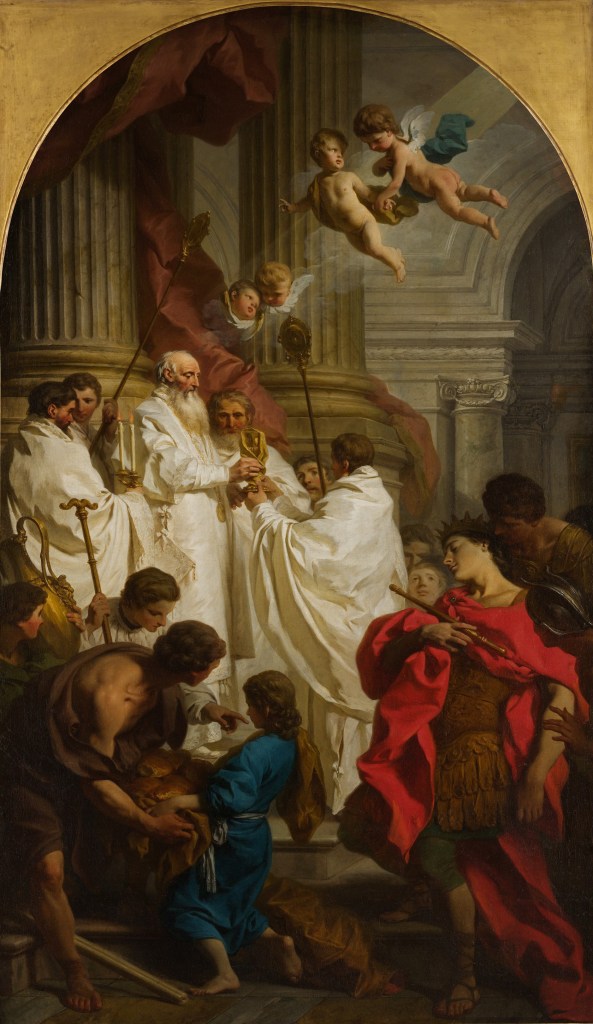
The Holy Spirit Was Not a Creature
Basil’s most important doctrinal work is On the Holy Spirit, written around 375 AD. The controversy was not merely academic. Christians were arguing about how to speak of the Spirit in worship, baptism, prayer, and doctrine. Was the Spirit a creature, a ministering power, or fully divine with the Father and the Son?
Basil argues that the Spirit’s work reveals the Spirit’s dignity. The Spirit sanctifies, illumines, gives life, dwells in believers, and brings them into communion with God. These are not the works of a creature.
“The proper name by which he is known is Holy Spirit. He is not easy to define by nature, but he is recognized by his operations. He is the source of sanctification, light perceptible to the mind, giving illumination to every rational power.”
Basil of Caesarea, On the Holy Spirit, chapter 9, c. 375 AD.
Then Basil uses the image of sunlight.
“Like a sunbeam, he gives help to each as though present to that one alone, yet he pours out sufficient grace to all.”
Basil of Caesarea, On the Holy Spirit, chapter 9, c. 375 AD.
This is Basil’s theology at its best. He does not treat the Spirit as a topic for speculation detached from Christian life. The Spirit is the one by whom souls are sanctified, illumined, strengthened, renewed, and brought into fellowship with God. If the Spirit gives divine life, Basil argues, Christians must not speak of him as a lower being.
Then Basil gives the broader rule:
“There is no sanctification without the Spirit.”
Basil of Caesarea, On the Holy Spirit, chapter 16, c. 375 AD.
That sentence is central. If holiness itself depends on the Spirit, then the Spirit cannot be treated as an optional doctrine. The whole Christian life depends on him.
Through the Son, in the Spirit, to the Father
Basil’s doctrine of the Spirit is also rooted in worship. He argues that Christian prayer and baptism already reveal the shape of the Trinity. Christians are baptized in the name of the Father, Son, and Holy Spirit. They glorify the Father with the Son and together with the Holy Spirit. Worship confesses what theology must explain.
Basil summarizes the movement of Christian knowledge of God this way:
“The knowledge of God comes through one Spirit, through one Son, to one Father.”
Basil of Caesarea, On the Holy Spirit, chapter 18, c. 375 AD.
This is not just a formula. It is the pattern of Christian life. The Spirit brings us to the Son. The Son brings us to the Father. The Father is known through the Son in the Spirit.
Basil also says the Spirit is present throughout Christ’s saving work and continues to give life after the resurrection.
“The Spirit is the dispenser of life after the resurrection. He attunes souls to the spiritual life.”
Basil of Caesarea, On the Holy Spirit, chapter 19, c. 375 AD.
For Basil, this means the doctrine of the Spirit is not decorative. Without the Spirit, there is no sanctification, no true knowledge of God, no participation in Christ’s life, no transformation of the soul, and no worship rightly directed to the Father.
The Spirit is not a theological footnote. The Spirit is the life of the church.
Tradition Written Into Worship
In On the Holy Spirit, Basil also defends practices Christians received through the church’s living tradition. He argues that not everything essential to Christian worship is preserved only by explicit written command. Some practices are handed down in the life of the church.
He gives examples from baptism, prayer, and the sign of the cross.
“What written authority teaches us to sign with the cross those who have trusted in the name of our Lord Jesus Christ? What Scripture teaches us to turn toward the east in prayer? What written command gives us the words used in the consecration of the Eucharistic bread and cup?”
Basil of Caesarea, On the Holy Spirit, chapter 27, c. 375 AD.
Then Basil explains the principle.
“Some teachings we have from written doctrine, and others we have received from the apostolic tradition handed down to us in mystery. Both have the same force for true religion.”
Basil of Caesarea, On the Holy Spirit, chapter 27, c. 375 AD.
This is important because Basil’s doctrine of the Spirit is connected to the church’s actual worship. He is not inventing theology in isolation. He is saying: look at what Christians do when they pray, baptize, bless, confess, and worship. The church’s life already witnesses to the dignity of the Spirit.
Basil’s theology was not only written in books. It was sung in doxologies, confessed in baptism, enacted in prayer, and carried in the habits of worship.
The Bishop Who Would Not Separate Doctrine and Mercy
It would be easy to divide Basil into separate categories: Basil the theologian, Basil the monk, Basil the preacher, Basil the organizer of charity, Basil the bishop under pressure. But Basil himself resists that division.
His doctrine of the Spirit says holiness comes from the Spirit. His monastic rules say holiness must be practiced in community. His sermons on wealth say community requires the rich to feed the hungry. His famine relief shows preaching must become organized mercy. His stand against Valens shows doctrine must be defended when political power tries to bend worship.
The pieces belong together.
Basil did not defend the Trinity so Christians could win arguments while ignoring the poor. He did not feed the poor as a substitute for doctrinal clarity. He did not retreat into asceticism because he hated the city. He did not build institutions of mercy because he had abandoned contemplation.
For Basil, the Christian life was one whole thing. God is worshiped truly. The soul is disciplined seriously. The poor are served concretely. The church resists falsehood courageously. The Spirit sanctifies the whole body of believers.
This is why Basil’s life has such force. He made theology visible in worship, poverty, soup, medical care, buildings, letters to officials, resistance to emperors, and the public treatment of the unwanted.
The Ascetic Bishop
Gregory Nazianzen describes Basil’s personal life as severe, poor, and disciplined. Even as bishop, Basil did not live like a religious aristocrat. Gregory says his food, clothing, and possessions were simple.
“His coat was one, his cloak was worn, his food was bread and salt, his drink was water. His sick body was cared for only as much as necessity required.”
Gregory of Nazianzus, Oration 43: Funeral Oration on Basil, §§60–61, c. 381 to 382 AD.
This matters because Basil’s preaching against wealth would have sounded very different if he had lived luxuriously. He could rebuke hoarding because he was not hoarding. He could tell the rich to let go because he had let go. He could face threats of confiscation because there was little to confiscate.
Gregory also describes the range of people who mourned Basil after his death.
“Widows praised their protector. Orphans praised their father. The poor praised their friend. Strangers praised their host. The sick praised their physician. The healthy praised the guardian of their health.”
Gregory of Nazianzus, Oration 43: Funeral Oration on Basil, closing sections, c. 381 to 382 AD.
That list tells us what kind of bishop Basil had become. He was not only admired by theologians. He was mourned by widows, orphans, strangers, poor people, and the sick. His ministry had touched the vulnerable directly enough that they knew what they had lost.
A bishop’s greatness, in Gregory’s portrait, is measured not only by doctrine defended but by lives protected.
The Death of Basil
Basil died on January 1, 379 AD, worn down by illness, conflict, ascetic discipline, and the burdens of office. Gregory Nazianzen’s funeral oration presents his death not as defeat, but as the completion of a life poured out for God and the church.
Gregory says Basil’s body was weak, but his soul remained strong. He had lived with the fragility of illness for years, yet he continued to preach, govern, write, organize, resist, and serve.
“His body was weak, but his spirit was powerful. His frame was worn by illness, but his mind was fixed on God.”
Gregory of Nazianzus, Oration 43: Funeral Oration on Basil, closing sections, c. 381 to 382 AD.
When Gregory describes the grief after Basil’s death, the scene is not limited to clergy or theologians. The whole city seems to mourn.
“The people poured out in grief. The city was filled with lamentation. All classes, all ages, every condition of life joined in sorrow, because each had lost something different in him.”
Gregory of Nazianzus, Oration 43: Funeral Oration on Basil, closing sections, c. 381 to 382 AD.
That is a fitting end to Basil’s public life. The poor mourned him because he had fed them. The sick mourned him because he had cared for them. The monks mourned him because he had organized them. The orthodox mourned him because he had defended the faith. His friends mourned him because they had loved him. His enemies had to reckon with the fact that he had not been easy to bend.
Basil died before the Council of Constantinople in 381, where the Nicene cause he had served would be vindicated more fully. He did not live to see the full public triumph of the theology he defended. But he helped make that triumph possible.
Why Basil Matters
Basil matters because he shows what happens when Christian conviction becomes organized life.
He believed the rich had obligations to the poor, so he preached against hoarding and opened paths for wealth to become mercy. He believed famine exposed the soul of a city, so he spoke to grain owners, sold possessions, fed the starving, and made sure even children outside the Christian community received help. He believed the sick and disfigured bore the image of Christ, so he helped create a place where they could be treated with reverence rather than shame. He believed solitude healed the soul, but he also believed community tested love. He believed education could be useful, but only when the soul gathered what was true and rejected what was poisonous. He believed the Holy Spirit sanctifies the church, so he refused to let the Spirit be treated as a creature. He believed imperial pressure could not govern the worship of God, so he stood firm when threatened.
Basil was great because his theology had consequences.
It affected his wallet, his table, his body, his friendships, his buildings, his sermons, his politics, his worship, and his treatment of the poor. He did not preach a Christianity that could remain invisible. He wanted the gospel to shape a household, a monastery, a city, a hospital, a bishop’s courage, and a rich person’s barns.
The Basileias makes that especially clear. Basil’s mercy was not only emotional sympathy or occasional generosity. It became institutional. It required buildings, doctors, attendants, transportation, workers, tax protection, official correspondence, and public defense. It was remembered by Gregory Nazianzen as a new city and by Sozomen as a celebrated hospice for the poor still bearing Basil’s name generations later.
That is why his name endured.
Conclusion: The Bishop Who Turned Wealth Into Mercy
Basil the Great was not only a defender of doctrine, though he defended doctrine with courage. He was not only an organizer of monasticism, though his rules shaped Christian communal life for centuries. He was not only a preacher against wealth, though his words against hoarding still sting. He was not only a builder of mercy, though Gregory Nazianzen could point outside Caesarea and say, “Behold the new city.”
Basil’s greatness was the union of all these things.
He took elite education and bent it toward the gospel. He took family formation and turned it into public service. He took ascetic discipline and made it serve community. He took wealth and demanded that it become bread, clothing, shelter, medicine, and hospitality. He took doctrine and rooted it in worship. He took episcopal authority and used it to protect the poor, resist imperial pressure, defend the dignity of the Holy Spirit, and build a public institution where the sick and unwanted could be treated as brothers.
The Spirit’s sanctifying power became holiness. Holiness became community. Community became mercy. Mercy became a city. And in that city, the poor, sick, hungry, widowed, orphaned, stranger, and abandoned could see what Basil believed.
For Basil, theology was never meant to stay on the page.
It was meant to become a life.
Discover more from Living the Bible
Subscribe to get the latest posts sent to your email.

