Ambrose of Milan: The Bishop Who Taught Emperors to Repent

Ambrose of Milan did not begin as a monk in the desert, a bishop’s son raised for the altar, or a young theologian slowly climbing the steps of church office. He began in the world of Roman administration. That is not a decorative detail in his story. It is the first key to understanding him. Ambrose would become one of the strongest episcopal voices of the fourth century because he already knew how public power worked. He knew courts, officials, imperial procedure, civic order, and the fragile peace of a city where religion and politics could not be separated.

Our main ancient biographical source for Ambrose’s early life is Paulinus of Milan, a deacon connected with Ambrose’s church. Paulinus wrote his Life of Ambrose after Ambrose’s death and at Augustine’s request. He is not a neutral modern historian. He writes as a Christian admirer, and sometimes as a hagiographer. But he is still crucial, because he tells us that his account was based on testimony from people who knew Ambrose, especially Ambrose’s sister Marcellina, and also on things Paulinus himself had seen.

“I will briefly describe what I learned from approved men who stood near him before me, and especially from his venerable sister Marcellina; also what I myself saw while I stood near him, and what I learned from others.”

Paulinus of Milan, Life of Ambrose, 1, c. 422.

That source note matters inside the story itself. When Paulinus tells us about Ambrose’s early life, he is not pretending to write an imperial archive. He is preserving church memory. Some details are framed as signs of providence, but the broad outline is clear: Ambrose was born into a family already tied to Roman authority.

Paulinus begins Ambrose’s life by linking his birth to his father’s service in the prefecture of Gaul. Rather than overstating what the source proves, we should let Paulinus say exactly what he says: Ambrose was born while his father, also named Ambrose, was holding administrative responsibility in the prefecture of Gaul.

“When his father Ambrose had been placed in the administration of the prefecture of the Gauls, Ambrose was born.”

Paulinus of Milan, Life of Ambrose, 3, c. 422.

So before Ambrose ever stood in a pulpit, his life was already connected to the machinery of empire. Paulinus then gives one of those late-antique childhood signs that hagiographers loved: a swarm of bees gathering around the infant’s mouth. We do not have to treat the scene as stenographic biography to see what it meant to later Christians. Ambrose would become a preacher whose words shaped bishops, emperors, catechumens, and ordinary believers. Paulinus remembers even his infancy as a sign of future eloquence.

“While he was an infant lying in his cradle in the courtyard of the praetorium, asleep with his mouth open, suddenly a swarm of bees came and covered his face and mouth, going in and out of his mouth in turn.”

Paulinus of Milan, Life of Ambrose, 3, c. 422.

Paulinus says that Ambrose’s father watched and interpreted the sign.

“His father, terrified by what had happened, said, ‘If this little child lives, he will be something great.’”

Paulinus of Milan, Life of Ambrose, 3, c. 422.

That is how Paulinus wants us to read Ambrose from the beginning: as a man prepared for speech before he knew he was being prepared. But the preparation did not first take the form of formal theological training. It took the form of Roman education, legal argument, and civic office.

After his father’s death, Ambrose grew up in Rome with his widowed mother and his sister Marcellina, who had already embraced the life of consecrated virginity. Paulinus even preserves a childhood memory in which Ambrose, seeing priests receive signs of reverence, playfully offered his own hand as though he too would one day be a bishop. Again, the story is told with providential coloring, but it also locates Ambrose inside a devout Christian household before he ever held church office.

“When he had grown older and was living in the city of Rome with his widowed mother and his sister, who had already professed virginity, he saw priests having their hands kissed by members of the household. Playing, he offered his own right hand, saying that this should also be done to him, since he remembered that he would be a bishop.”

Paulinus of Milan, Life of Ambrose, 4, c. 422.

But Ambrose’s actual path did not move directly from pious childhood to priesthood. Paulinus next shows him stepping into the educated world of Roman public service. Ambrose studied the liberal disciplines, left Rome, practiced as an advocate in the court of the praetorian prefect, and impressed the powerful prefect Probus. This is the primary-source basis for calling Ambrose a trained Roman official, not just a religious leader who happened to know politics.

“After he had been instructed in the liberal disciplines, he left the city and practiced in the court of the praetorian prefecture. He pleaded cases so brilliantly that he was chosen by the illustrious Probus, then praetorian prefect, to give counsel. After this, he received the insignia of consular rank, so that he might govern the provinces of Liguria and Aemilia, and he came to Milan.”

Paulinus of Milan, Life of Ambrose, 5, c. 422.

That sentence carries a tremendous amount of the story. Ambrose was not an obscure cleric unexpectedly discovered by the crowd. He was a public man. He had stood in legal settings. He had spoken persuasively before officials. He had been trusted with counsel. Then he had been sent to govern Liguria and Aemilia, with Milan as the city where his life would change.

Milan was not a quiet provincial town. It was one of the great imperial centers of the western empire. Emperors, soldiers, courtiers, bishops, merchants, pagan senators, Nicene Christians, anti-Nicene Christians, and Jewish communities all belonged to the world Ambrose entered. The city was Christian, but not peacefully Christian. The Council of Nicaea had spoken in 325, declaring the Son to be of one substance with the Father, but imperial politics and local church life had not stopped shifting. A bishop’s death could become a civic crisis.

That is exactly what happened in 374, when Auxentius, the bishop of Milan, died. Paulinus does not present the scene as calm deliberation. He describes a city at risk of sedition because Nicene Christians and Arians each wanted a bishop of their own party. Ambrose went to the church because it was his duty as governor to prevent unrest.

“At that time, Auxentius, bishop of the Arian unbelief, had died. Since the people were rising toward sedition in seeking a bishop, and since Ambrose had responsibility for calming the sedition, lest the people of the city turn to their own danger, he went to the church.”

Paulinus of Milan, Life of Ambrose, 6, c. 422.

This is the moment the whole story turns. Ambrose enters the church as a magistrate. He is there to restore public order. But while he is addressing the crowd, the people hear a cry.

“While he was addressing the people, the voice of an infant is said suddenly to have sounded among the people: ‘Ambrose, bishop!’”

Paulinus of Milan, Life of Ambrose, 6, c. 422.

Paulinus then says the cry spread through the divided crowd. What had been a conflict between factions suddenly became a unified acclamation.

“At the sound of this voice, the mouths of all the people were turned to the same cry, shouting, ‘Ambrose, bishop!’ Those who before had been violently divided — since the Arians wanted one bishop for themselves and the Catholics another for themselves — suddenly agreed on this one man with miraculous and incredible harmony.”

Paulinus of Milan, Life of Ambrose, 6, c. 422.

That is the primary-source basis for the famous scene. Ambrose was not campaigning for the episcopate. He was not even baptized. He was a catechumen, a Christian in formation, not yet sacramentally initiated into the Church. Paulinus makes that point clear when he describes the crowd’s response to Ambrose’s attempts to escape the election.

Ambrose tried to make himself look unworthy. Paulinus says he left the church, set up a tribunal, and even staged harsh judicial behavior contrary to his usual character, hoping the people would reject him. But they kept shouting that the responsibility would fall on them. Paulinus interprets this as the people trusting that baptism would wash away his sins.

“Contrary to his custom, he ordered tortures to be applied to certain persons. Yet while he was doing this, the people kept shouting, ‘Your sin be upon us.’ Since they knew he was a catechumen, they promised him, with a faithful voice, the forgiveness of all sins through the grace of baptism.”

Paulinus of Milan, Life of Ambrose, 7, c. 422.

This detail is important because it shows the strangeness of the election. Ambrose was not merely a layman. He was still unbaptized. The crowd’s answer was not, “That does not matter.” Their answer was, “Baptism will answer it.” In their minds, the urgency of the city, the need for peace, and the grace of baptism came together.

Paulinus then says Ambrose tried to flee. The story has a dramatic, almost comic quality: Ambrose leaves Milan at night, intending to escape to Ticinum, but somehow finds himself the next morning back at the Roman gate of Milan. Paulinus reads this as divine providence preventing his escape.

“When he saw that his plan could accomplish nothing, he prepared to flee. Leaving the city in the middle of the night, thinking he was going to Ticinum, in the morning he was found at the gate of the city of Milan called the Roman Gate.”

Paulinus of Milan, Life of Ambrose, 8, c. 422.

At this point Paulinus brings back Probus, the same official who had advanced Ambrose’s civil career. When Ambrose had been sent to govern Milan, Probus had spoken words that later Christians heard as prophecy.

“Probus the prefect also rejoiced that his word was being fulfilled in Ambrose; for when he was giving him his instructions as he set out, as is customary, he had said: ‘Go, act not as a judge, but as a bishop.’”

Paulinus of Milan, Life of Ambrose, 8, c. 422.

Ambrose hid again, but eventually he was handed over and brought back to Milan. Paulinus says that once Ambrose understood he could no longer resist, he insisted on being baptized by a Catholic bishop, because he was already alert to the danger of Arian control. Then, within eight days, he passed from baptism to episcopal consecration.

“When he was handed over and brought to Milan, and understood the will of God concerning him, and that he could no longer resist, he asked that he be baptized only by a Catholic bishop, for he carefully guarded against the unbelief of the Arians. Having been baptized, he is said to have fulfilled all the ecclesiastical offices, and on the eighth day he was ordained bishop, with the greatest favor and joy of all.”

Paulinus of Milan, Life of Ambrose, 9, c. 422.

That is why Ambrose’s beginning as bishop is so remarkable. He did not simply move from politics into religion. He was pulled from one form of public responsibility into another. The governor who had come to calm a church dispute became the bishop who would soon confront emperors.

Ambrose himself later looked back on that transition without pretending he had been prepared. In On the Duties of the Clergy, written for ministers of the Church, he admits that his entrance into priestly office came so suddenly that he had to learn and teach at the same time.

“I was carried off from the judgment seat and the insignia of administration into the priesthood, and I began to teach you what I myself had not yet learned. So it happened that I began to teach before I began to learn. Therefore I must learn and teach at the same time, since I had no leisure to learn beforehand.”

Ambrose, On the Duties of the Clergy, 1.1.4, c. 391.

Ambrose’s own memory gives the opening of his story its proper weight. He was not a finished theologian stepping into an expected post. He was a governor seized by a calling, forced to become a learner in the same season that he became a teacher. His Roman training gave him discipline, courage, and public presence. But as bishop, he had to become a student of Scripture in public, before a divided city, under the eyes of the imperial court.


Learning the Scriptures in Public

Ambrose became bishop, and then he became a student. This is not just a modern guess from the outside. It is how Ambrose described his own ministry. He had been taken from the judgment seat into the priesthood, and because he had no long season of quiet preparation, he had to learn while teaching.

That makes him different from some of the other great fourth-century theologians. Athanasius had spent a lifetime inside the conflicts of the Alexandrian church. Basil had been formed in ascetic circles and theological debate before becoming bishop of Caesarea. Ambrose, by contrast, was a Roman administrator suddenly standing in the pulpit of one of the empire’s most important churches. He had the tools of an educated Roman — rhetoric, legal instinct, memory, public poise — but he needed the Scriptures to become the grammar of his episcopal life.

Ambrose’s own catechetical works show how seriously he took that task. In On the Mysteries, a work drawn from his instruction to the newly baptized, he describes the pattern of teaching that preceded his explanation of baptism and the Eucharist. Before opening the sacraments to them, he had been forming them morally through the patriarchs and Proverbs.

“Every day we spoke about moral matters, while the deeds of the patriarchs or the precepts of Proverbs were being read, so that, formed and instructed by them, you might learn to enter the ways of the fathers, walk in their paths, and obey the divine commands.”

Ambrose, On the Mysteries, 1.1, c. 387.

This is Ambrose the pastor, not merely Ambrose the public fighter. He was not only arguing with emperors or refusing imperial demands. He was shaping Christians day by day through Scripture. He taught them Abraham, Isaac, Jacob, Joseph, Proverbs, baptism, the Eucharist, and the moral life that belonged to those who had been washed.

And Ambrose’s teaching was not only moral instruction. He believed Scripture had depths that could not be exhausted by surface reading. Augustine, who arrived in Milan as a rhetorician and skeptic, tells us that Ambrose’s preaching helped him reconsider the Old Testament. Augustine had rejected crude readings of Scripture, especially when Christians seemed to imagine God in bodily terms or when Old Testament passages seemed morally strange. Ambrose’s spiritual reading opened a door.

“I heard Ambrose every Lord’s Day rightly dividing the word of truth among the people. I became more and more convinced that all those knots of crafty accusations which my deceivers had tied against the divine books could be untied.”

Augustine, Confessions, 6.3.4, c. 397–401.

Augustine continues by saying that Ambrose’s way of preaching helped him see that the old Scriptures of the law and the prophets could be read with spiritual depth.

“I rejoiced that the old Scriptures of the law and the prophets were now set before me to be read with a different eye than before. With delight I heard Ambrose often commend this rule in his sermons to the people: ‘The letter kills, but the Spirit gives life.’ Drawing aside the mystical veil, he spiritually opened things which, taken according to the letter, had seemed to teach perverse doctrines.”

Augustine, Confessions, 6.4.6, c. 397–401.

That is one of the most important windows into Ambrose’s influence. Augustine did not first come to Ambrose as a humble disciple ready to receive baptism. He came as a proud and brilliant man who had many objections. Ambrose did not answer all of Augustine’s questions in private conversation. Augustine actually says he struggled to get time with him. But Ambrose’s public preaching began to change the way Augustine heard Scripture.

Augustine also gives us a vivid picture of the pressure surrounding Ambrose’s daily life. The bishop was not a scholar in quiet retreat. He was surrounded by people who needed counsel, help, judgment, comfort, and attention. When he was not serving the crowds, he was either eating quickly or reading.

“I was kept from hearing and speaking with him as I wished by crowds of busy people, whose weaknesses he served. When he was not occupied with them — and that was only a little time — he refreshed his body with necessary food, or his mind with reading.”

Augustine, Confessions, 6.3.3, c. 397–401.

Then Augustine gives the famous description of Ambrose reading silently. The point is not merely that Ambrose had an unusual reading habit. The point is that Ambrose had to guard the tiny spaces of attention left to him.

“As he read, his eyes glanced over the pages and his heart searched out the meaning, but his voice and tongue were silent. Often, when we came to him — for no one was forbidden to enter, nor was it his custom that visitors be announced — we saw him reading in this way, silently and never otherwise. After sitting for a long time in silence, for who would dare interrupt one so intent, we would depart.”

Augustine, Confessions, 6.3.3, c. 397–401.

This is the bishop behind the public legend. Ambrose could stand before emperors because he first sat under Scripture. He could teach Milan because he was himself still learning. He could interpret the Church’s faith in public because his private intervals, such as they were, were filled with reading.

Augustine’s witness also keeps us from making Ambrose merely a political figure. Yes, Ambrose was a public bishop in an imperial city. Yes, he knew how to confront rulers. Yes, he had a Roman official’s instinct for procedure and authority. But Augustine saw something else: a bishop serving the weaknesses of the people, guarding fragments of time for study, and preaching Scripture in a way that could unsettle a skeptical mind.

So when Ambrose later says that he had to learn and teach at the same time, we should hear the full weight of that confession. He was not being modest in a decorative way. He was describing the actual burden of his calling. The governor had become a bishop. The public administrator had become an interpreter of Scripture. The man who once pleaded cases before Roman officials now pleaded the mystery of Christ before Milan.


The Argument Over Christ

To understand Ambrose, we have to understand that the fourth century was still arguing over the most basic Christian confession: Who is Jesus Christ?

The Nicene answer was clear. The Son is not a creature, not a lesser divine being, not merely highest among heavenly powers. The Son is true God from true God, begotten of the Father, of one substance with Him. But many powerful figures resisted Nicene language. Some preferred formulas that seemed to honor Christ while avoiding the full force of Nicaea. Others openly rejected the claim that the Son shared the Father’s eternal divine nature.

Ambrose did not see this as an abstract debate for specialists. For him, the identity of Christ stood at the center of worship, baptism, prayer, and salvation. If Christ is not truly God, then the Church’s worship is confused. If Christ is not truly Lord, then baptism into His name is emptied of its power. If Christ is not one with the Father, then the Christian life itself is built on a diminished Savior.

Writing to the emperor Gratian in Exposition of the Christian Faith, Ambrose explained the Nicene confession with the precision of a teacher and the urgency of a pastor.

“Christ says, ‘I and the Father are one.’ He says ‘one,’ so that there may be no separation of power or nature; and He says ‘we are,’ so that you may recognize the Father and the Son, not as one person confused together, but as one divine nature.”

Ambrose, Exposition of the Christian Faith, 1.1.9, c. 378.

Ambrose knew that theological error often comes from demanding the wrong kind of explanation. The Church can confess that the Son is begotten of the Father; it cannot reduce eternal generation to a creaturely mechanism. Some truths are revealed for worship, not dissected for mastery.

“We are permitted to know that the Son is begotten; we are not permitted to quarrel over the manner of His begetting.”

Ambrose, Exposition of the Christian Faith, 1.10.65, c. 378.

Ambrose also insisted that Scripture itself gives the Church the language for worshiping the Son. The Son is Word, Power, Wisdom, and Light — not an assistant creature beneath God, but the eternal Son through whom the Father is known.

“He is called the Word, the Son, the Power of God, the Wisdom of God: the Word, because He is without blemish; the Power, because He is perfect; the Son, because He is begotten of the Father; the Wisdom, because He is one with the Father, one in eternity, one in divinity.”

Ambrose, Exposition of the Christian Faith, 1.2.16, c. 378.

This theological conviction shaped Ambrose’s public life. When he resisted imperial pressure, he was not merely defending church property. He was defending the worship of the true Christ. When he refused to surrender basilicas to the court-backed anti-Nicene party, he believed he was guarding the confession of the Church. Milan’s churches were not neutral halls. They were places where the crucified and risen Lord was worshiped as true God.

For Ambrose, doctrine was not a decorative layer placed on top of church life. Doctrine was the grammar of worship. It was the difference between bending the knee to the eternal Son and honoring a religious symbol useful to the empire.


The Basilica Siege: When Hymns Became Resistance

The most famous conflict of Ambrose’s early episcopate came when the imperial court demanded a basilica for the use of the anti-Nicene party. The young emperor Valentinian II was under the influence of his mother Justina, who favored the Homoian or Arian side. The court wanted space in Milan for worship that Ambrose regarded as false to the faith of Nicaea.

Ambrose’s answer was simple: he could not give away what belonged to God. In a letter to his sister Marcellina, he described the confrontation. The tone is personal and immediate. He is not writing a polished theological treatise from a distance; he is telling his sister what happened when soldiers, officials, and imperial demands pressed against the church.

“First, certain great men and counselors of state begged me to give up the basilica and to make sure the people raised no disturbance. I answered, as was fitting, that the temple of God could not be surrendered by a bishop.”

Ambrose, Letter 20 to Marcellina, 2, Easter c. 385.

Ambrose’s argument was not that bishops owned churches as private property. It was the opposite. The bishop could not surrender the basilica because it was not his possession to trade. The emperor could ask Ambrose for Ambrose’s own goods, and Ambrose would give them. But the things consecrated to God were not at the disposal of imperial command.

“The counts and tribunes came and urged me to cause the basilica to be surrendered quickly, saying that the emperor was exercising his right, since everything was under his power. I answered that if he asked for what is mine — my land, my money, or whatever of that kind belongs to me — I would not refuse, although all that I have belongs to the poor. But the things that are God’s are not subject to imperial power.”

Ambrose, Letter 20 to Marcellina, 8, Easter c. 385.

This is one of Ambrose’s defining lines. The empire had become Christian, but the emperor had not become lord of the altar. The Church prayed for rulers, honored rulers, and taught obedience in civil affairs, but it could not hand over the worship of God as though doctrine were a negotiable asset.

Ambrose made the same point in a sharper form when he recalled his answer to the imperial demand. The emperor had palaces. The bishop guarded churches. Public buildings belonged to imperial administration; sacred buildings belonged to God.

“Do not, O Emperor, burden yourself with the thought that you have any imperial power over the things that belong to God. Do not exalt yourself, but if you desire to reign long, submit yourself to God. It is written: ‘The things that are God’s to God, and the things that are Caesar’s to Caesar.’ Palaces belong to the emperor; churches belong to the bishop. Authority has been given to you over public buildings, not over sacred ones.”

Ambrose, Letter 20 to Marcellina, 19, Easter c. 385.

The confrontation intensified. Ambrose tells Marcellina that he wept and prayed while offering the Eucharist, fearing bloodshed. His resistance was firm, but he did not want a riot. He did not want the Church defended by violence. If blood had to be shed, he wanted it to be his own.

“While offering the oblation, I began to weep bitterly and to implore God that He would come to our aid, and that no one’s blood would be shed in the Church’s cause — or at least that it would be my blood, shed for the benefit not only of my people, but even of the unbelievers.”

Ambrose, Letter 20 to Marcellina, 5, Easter c. 385.

The people stayed with their bishop. They filled the basilica. They kept vigil. Soldiers came, but some came to pray. The congregation sang. According to Augustine, this crisis helped establish in Milan the practice of congregational singing in the style of the Eastern churches. Hymns became a way for frightened believers to endure pressure without collapsing into panic.

“The devout people kept guard in the church, prepared to die with their bishop, Your servant. There my mother, Your handmaid, taking first place in care and watchfulness, lived in prayer. Then it was established that hymns and psalms should be sung after the custom of the Eastern churches, lest the people waste away in sorrow.”

Augustine, Confessions, 9.7.15, c. 397–401.

Paulinus, writing from the memory of Ambrose’s church, confirms the same basic picture. The court’s pressure produced not only resistance, but worship. The Milanese church began to keep vigils and sing hymns in a way that spread widely in the West.

“At that time, antiphons, hymns, and vigils first began to be celebrated in the church of Milan. The devotion of this celebration remains to this day, not only in that church, but through almost all the provinces of the West.”

Paulinus of Milan, Life of Ambrose, 13, c. 422.

This is one of the most vivid pictures of Ambrose’s Milan: a church surrounded by pressure, held together not by swords, but by psalms. The people sang because they needed courage. They sang because doctrine had become public. They sang because worship itself was resistance.

Ambrose later gave the principle behind his action in a sermon against Auxentius, his anti-Nicene rival. His words have echoed for centuries because they state, in compressed form, one of the great claims of Christian political theology.

“The emperor is within the Church, not above the Church. A good emperor seeks the help of the Church and does not refuse it. We say this humbly, but we state it firmly.”

Ambrose, Sermon Against Auxentius on the Giving Up of the Basilicas, 36, c. 386.

Ambrose was not arguing for a modern separation of church and state. He lived in a world where religion and public life were intertwined in ways we do not experience in the same form. But he was arguing for something essential: the baptized ruler is not above the faith into which he has been baptized. Imperial purple does not outrank the lordship of Christ.


The Altar of Victory: Rome Learns It Is Not Eternal

Ambrose’s Milan did not only face conflict inside Christianity. It also stood in the long shadow of Rome’s pagan past. In 384, the distinguished pagan senator Symmachus appealed for the restoration of the Altar of Victory in the Roman Senate house. To many pagan aristocrats, the altar represented more than a ritual object. It was tied to memory, ancestry, public identity, and the old claim that Rome’s greatness had come through the favor of the gods.

Symmachus made the case with elegance. He did not sound like a fool or a cartoon villain. He spoke as a cultured Roman defending inherited religion, civic continuity, and reverence for antiquity. His argument was not simply, “We prefer the old gods.” It was that Rome’s old rites had carried the city through centuries of triumph. If a practice had endured for so long, and if Rome had flourished under it, then surely that antiquity deserved respect.

“If a long period gives authority to religious customs, we ought to keep faith with so many centuries and follow our ancestors, as they happily followed theirs.”

Symmachus, Third Relation to Valentinian II, 8, c. 384.

Then Symmachus does something rhetorically powerful. He lets Rome herself speak. Rome becomes an aged mother pleading with young Christian emperors not to strip away the rites that had accompanied her greatness. The argument is emotional, patriotic, and reverent toward the past.

“Respect my years, to which these sacred rites have brought me. Let me use the ancestral ceremonies, for I do not repent of them. Let me live after my own fashion, for I am free.”

Symmachus, Third Relation to Valentinian II, 9, c. 384.

In Symmachus’s imagined speech, Rome points to her victories. The old worship, he says, repelled Hannibal from the walls and the Senones from the Capitol. It subdued the world to Roman law. Then comes the sharpest form of the age argument: reform may be acceptable for the young, but it is shameful when forced on the old.

“This worship subdued the world to my laws; these sacred rites repelled Hannibal from the walls and the Senones from the Capitol. Have I been preserved for this, that in my old age I should be blamed? I will consider what is thought should be corrected, but reform in old age is late and discreditable.”

Symmachus, Third Relation to Valentinian II, 9, c. 384.

This is the argument Ambrose has to answer. Symmachus is saying that Rome’s age is itself a kind of proof. Her past success gives dignity to her old rites. Her antiquity makes sudden religious correction feel like an insult. Why should the ancient mother of nations be lectured by a newer faith?

Symmachus then widens the argument into one of the most famous statements of late Roman religious pluralism. Since the divine mystery is so great, he says, why should one road be imposed on all? The old rites, the new Christian faith, and the many ways of seeking truth should be allowed to coexist.

“We look on the same stars; the sky is common; the same world surrounds us. What difference does it make by what wisdom each person seeks the truth? So great a mystery cannot be reached by one road.”

Symmachus, Third Relation to Valentinian II, 10, c. 384.

Ambrose understood the force of the argument. He did not answer by pretending Rome had no past. He answered by denying that antiquity itself could sanctify error. First, he takes Symmachus’s personified Rome and gives her different words. Symmachus had made Rome say, “Respect my age.” Ambrose makes Rome say, “Do not stain me with useless sacrifice.”

“Why do you daily stain me with the useless blood of harmless herds? Trophies of victory depend not on the entrails of flocks, but on the strength of those who fight.”

Ambrose, Letter 18 to Valentinian II, 7, c. 384.

That is a brilliant reversal. Ambrose does not let Symmachus own Rome’s voice. He says, in effect: if Rome could truly speak, she would not ask for more blood on pagan altars. She would remember that courage, discipline, and providence — not animal entrails — had carried her through war.

Then Ambrose attacks the word “ancestral.” Not everything old is noble. Rome’s past includes greatness, but it also includes cruelty, tyranny, and shame. If the argument is simply, “Keep the rites of the ancestors,” Ambrose asks which ancestors we are talking about.

“Why do you bring forward the rites of our ancestors? I hate the rites of Neros.”

Ambrose, Letter 18 to Valentinian II, 7, c. 384.

That line cuts through nostalgia. Ambrose is saying that the past is not pure simply because it is past. Ancestry can hand down wisdom, but it can also hand down bloodshed. Antiquity may deserve examination, but it does not deserve automatic obedience.

Then Ambrose answers the old-age argument directly. Symmachus had said reform in old age is shameful. Ambrose says the opposite: the true shame is to be too old to repent.

“I do not blush to be converted with the whole world in my old age. No age is too late to learn. Let that old age blush which cannot amend itself.”

Ambrose, Letter 18 to Valentinian II, 7, c. 384.

This is the heart of Ambrose’s response. Rome’s old age does not make conversion disgraceful. It makes conversion urgent and beautiful. To grow old in error is not dignity. To amend oneself, even late, is wisdom.

Ambrose then gives one of his most memorable formulations. There are two kinds of old age: the old age of years and the old age of character. The first merely counts time. The second measures maturity.

“Not the old age of years is worthy of praise, but the old age of character. There is no shame in passing to better things.”

Ambrose, Letter 18 to Valentinian II, 7, c. 384.

That is the point Ambrose wants Valentinian to hear. The emperor should not be intimidated by the phrase “ancient custom.” The question is not whether a rite is old. The question is whether it is true, whether it is just, whether it leads toward God.

Ambrose also responds to Symmachus’s famous “one road” argument. Symmachus had said that so great a mystery cannot be reached by only one road. Ambrose replies that Christians are not guessing upward through fog. They have received revelation from God.

“What you do not know, we know by the voice of God. What you seek by conjectures, we have found from the Wisdom and Truth of God.”

Ambrose, Letter 18 to Valentinian II, 8, c. 384.

This is where Ambrose’s answer becomes sharply Christian. He does not accept Symmachus’s premise that all religions are equally uncertain attempts to reach an unknowable mystery. Ambrose believes the mystery has spoken. God has revealed Himself in Christ. Therefore Christian faith is not merely one civic tradition among many; it is the truth by which all traditions must be judged.

Later in the letter, Ambrose returns to the age question even more fully. Symmachus had argued that ancestral rites should be retained because they were ancient. Ambrose answers with a theology of progress. The world itself did not remain in its first condition. Creation moved from formlessness to order, from darkness to light, from barrenness to fruitfulness. Why, then, should Rome be ashamed to move from old rites to better worship?

“They say the rites of our ancestors ought to be retained. But what then, since all things have advanced toward what is better?”

Ambrose, Letter 18 to Valentinian II, 23, c. 384.

Ambrose then unfolds the image. The day does not begin at noon. The moon does not begin full. The earth is first wild, then cultivated. The year begins with fragile growth and ends in fruit. Human beings begin in infancy and mature with time. So too, Ambrose says, the world can pass from religious childhood into fuller truth.

“The world itself, which at first was dark with shapeless confusion, afterward received the distinction of sky, sea, and earth. The lands, freed from misty darkness, wondered at the new sun. The day does not shine in the beginning, but as time goes on, it brightens with increasing light.”

Ambrose, Letter 18 to Valentinian II, 23, c. 384.

He continues with the image of the moon, earth, and harvest. Each one becomes a witness that later does not necessarily mean lesser. Some things are most beautiful when they arrive in maturity.

“The moon herself, when first rising again, is hidden from us in darkness; then, filling up her horns little by little, she glows with clear brightness. The earth once had no experience of being worked for fruit; afterward, when the careful farmer began to rule the fields and clothe the shapeless soil with vines, it put off its wild disposition.”

Ambrose, Letter 18 to Valentinian II, 24–25, c. 384.

This is more than a clever analogy. It is Ambrose’s answer to pagan antiquity. The gospel may appear late in history, but lateness does not mean weakness. Harvest comes late. Fruit comes late. Maturity comes late. The final brightness of the day is not inferior to the first darkness of morning.

“Let them say, then, that all things ought to have remained in their first beginnings, and that the world covered with darkness should never have brightened with the shining sun.”

Ambrose, Letter 18 to Valentinian II, 28, c. 384.

Ambrose presses the same point through the image of harvest. Christ’s faith, he says, is like the fruit of the last age. It does not arrive because the world was empty before; it arrives as fulfillment.

“Our harvest is the faith of souls; the grace of the Church is the vintage of merits, which from the beginning of the world flourished in the saints, but in the last age has spread itself over the peoples.”

Ambrose, Letter 18 to Valentinian II, 29, c. 384.

Then Ambrose makes another devastating move. If old rites should be kept simply because they are old and ancestral, why had Rome herself adopted foreign gods? Roman religion had never been as pure, fixed, and ancestral as Symmachus implied. Rome had absorbed conquered gods, imported rites, and foreign cults. The appeal to unbroken ancestral religion was not as simple as it sounded.

“If the old rites pleased, why did Rome also take up foreign ones?”

Ambrose, Letter 18 to Valentinian II, 30, c. 384.

This argument matters because Ambrose is not only saying, “Christianity is true.” He is also saying, “Your own appeal to antiquity is selective.” Rome had changed before. Rome had imported before. Rome had revised its religious life before. The question was not whether Rome would change, but whether she would change toward truth.

Ambrose then turns directly to Victory herself. The altar’s defenders treated Victory as a goddess whose presence secured Rome’s greatness. Ambrose denies the premise. Victory is not a deity to be worshiped. It is an outcome granted by God and achieved through courage, discipline, and providence.

“They believed Victory was a goddess, though victory is certainly a gift, not a power. It is granted; it does not rule.”

Ambrose, Letter 18 to Valentinian II, 30, c. 384.

Finally, Ambrose addresses the practical issue of the altar in the Senate. This was not merely a question of whether pagans could privately worship. The altar stood in a shared political space where Christian senators also had to gather. To restore it would force Christian consciences into the smoke, oaths, and symbols of pagan sacrifice.

“To claim sacrifice on this one altar — what is it but to insult the faith? Is it to be borne that a pagan should sacrifice and a Christian be present?”

Ambrose, Letter 18 to Valentinian II, 31, c. 384.

So Ambrose’s reply to Symmachus is much richer than a simple rejection of paganism. Symmachus says, “Rome is old; respect her years.” Ambrose says, “Old age is honorable only when it can learn.” Symmachus says, “Our rites subdued the world.” Ambrose says, “Rome’s courage, not sacrificial entrails, won her victories.” Symmachus says, “So great a mystery cannot be reached by one road.” Ambrose says, “The mystery has spoken through God’s own truth.” Symmachus says, “Keep the ancestral rites.” Ambrose says, “All things grow toward what is better — day, moon, earth, year, human life, and the history of faith.”

The conflict over the Altar of Victory shows Ambrose standing at a turning point. Christianity was no longer merely asking to be tolerated. It was now shaping the public imagination of the empire. That brought dangers, and Ambrose did not always escape those dangers. But in this controversy, his answer to pagan antiquity was clear: the past is not eternal. Rome is not dishonored by conversion. The shame is not in learning late. The shame is in being too old to repent.


The Poor at the Door

Ambrose’s public courage was not limited to emperors and theological factions. He also preached fiercely about wealth. He had entered the episcopate from a world of privilege, but as bishop he gave away his wealth and spoke of possessions as something held under judgment.

This is one of the reasons Ambrose cannot be reduced to a power bishop. He did not simply protect church prerogatives. He also demanded that the Church remember the poor. For Ambrose, generosity was not optional decoration on the Christian life. It was justice. The poor were not intruders into the Christian imagination; they were the test of whether Christians understood creation, ownership, and mercy.

In On the Duties of the Clergy, a work modeled in part on Cicero but transformed for Christian ministry, Ambrose told clergy that wealth is best understood as a trust for others.

“It is better to be rich for others than for oneself.”

Ambrose, On the Duties of the Clergy, 2.4.14, c. 391.

That line is simple, but it cuts deeply. Ambrose does not say it is better to appear generous. He says the very meaning of riches changes when they become useful to the neighbor. Wealth hoarded for self becomes spiritually dangerous; wealth turned outward becomes an instrument of mercy.

Ambrose developed this theme with special force in On Naboth, his meditation on the Old Testament story of King Ahab, Queen Jezebel, and Naboth’s vineyard. Naboth refuses to surrender his ancestral vineyard. Ahab sulks. Jezebel schemes. False witnesses accuse Naboth, and Naboth is killed so the king can take what he wants. Ambrose read the story not as a distant royal scandal, but as a mirror held up to his own society.

“The story of Naboth is old, but it is repeated every day. It is not one Naboth who was slain; every day Naboth is struck down, every day the poor are killed.”

Ambrose, On Naboth, 1.1, c. 389.

Ambrose saw the violence of greed even when it wore legal clothing. The rich might not always murder with stones. They could murder through pressure, debt, eviction, bribery, and indifference. They could enlarge estates while the poor lost their inheritance. They could call it business, order, or necessity, but Ambrose saw Ahab’s shadow.

“Who among the rich does not daily covet another’s goods? Who among the wealthy does not labor to drive the poor man from his little plot and turn the needy away from the boundaries of his ancestral field?”

Ambrose, On Naboth, 1.2, c. 389.

His most famous statement on almsgiving overturns the way many people think about generosity. The rich man who gives to the poor is not merely being magnanimous with private surplus. He is returning what belongs, in a deeper sense, to the common good of God’s creation.

“You are not giving your own goods to the poor; you are returning what is theirs. What was given for the common use of all, you have taken for yourself alone.”

Ambrose, On Naboth, 12.53, c. 389.

That is not modern economic theory, and it should not be flattened into a slogan. Ambrose still lived within a world that recognized property, inheritance, and social hierarchy. But he placed all ownership under God. Creation was given by God for the good of all, and therefore the poor had a moral claim upon the abundance of the rich.

Ambrose’s concern for the poor also shaped his view of church wealth. Sacred vessels, gold, and ornament had their place, but they were not to be loved more than human beings. When captives needed ransom, Ambrose believed the Church’s treasures existed to serve mercy.

“The Church has gold, not to store it up, but to spend it on necessities and to help the poor.”

Ambrose, On the Duties of the Clergy, 2.28.136, c. 391.

Ambrose defended this practice by appealing to the Lord Himself. If Christ sent the apostles without gold, the Church must not treat gold as its true treasure. The glory of the Church is not metal locked away, but mercy poured out.

“Would not the Lord say, ‘Why did you allow so many helpless people to die of hunger? Surely you had gold. You should have given them food. Why were so many captives sold into death, and why were they not redeemed?’”

Ambrose, On the Duties of the Clergy, 2.28.137, c. 391.

The bishop who told emperors they were not above the Church also told the rich they were not above the poor. Both claims came from the same source. Christ is Lord. Therefore power must repent, wealth must become mercy, and the Church must not measure faithfulness by public splendor while the needy suffer outside its doors.


Callinicum: A Synagogue Burns, and Ambrose Fails the Neighbor

Ambrose’s courage before emperors is one of the reasons Christian history remembers him with admiration. But the same historical honesty that lets us admire him must also let us name his failures. Nowhere is that more necessary than in the Callinicum affair.

Around 388, in Callinicum on the Euphrates, Christians burned a Jewish synagogue. The episode was not a rumor of distant hostility with no consequences. Ambrose himself says that a report reached the emperor that the synagogue had been burned at the instigation of the local bishop. Theodosius responded as a ruler responsible for public order: he ordered punishment and required the synagogue to be rebuilt, apparently at the expense of the bishop. Ambrose intervened.

Paulinus, Ambrose’s biographer, gives the broad outline from the perspective of Ambrose’s later admirers. Even here, with all Paulinus’s admiration for Ambrose, the facts are stark: Christians burned the synagogue; Theodosius ordered rebuilding and punishment; Ambrose intervened to get the order reversed.

“In the East, in a certain fortress, a synagogue of the Jews and a grove of the Valentinians were burned by Christian men. When the count of the East reported this to the emperor, the emperor ordered that the synagogue should be rebuilt by the bishop of the place and that punishment should be inflicted on the monks.”

Paulinus of Milan, Life of Ambrose, 22, c. 422.

Paulinus then says Ambrose wrote to the emperor because he could not come in person. Ambrose argued that the imperial order had to be recalled, and Paulinus even presents Ambrose as ready to die over the matter.

“When the substance of this command reached the ears of the venerable bishop Ambrose, he sent a letter to the emperor, since he could not go quickly at that time, and urged him to revoke what had been decreed.”

Paulinus of Milan, Life of Ambrose, 22, c. 422.

In Letter 40, Ambrose writes directly to Theodosius. He begins with a principle that, in other situations, stands among the noblest parts of his legacy. A bishop must speak truth to power. A ruler should not fear honest counsel. The priest who sees danger and remains silent fails both God and the ruler.

“It is not the part of an emperor to refuse freedom of speech, nor of a priest not to say what he thinks. Good rulers love liberty; bad rulers love slavery.”

Ambrose, Letter 40 to Theodosius, 2, c. 388.

The principle is strong. The problem is the use Ambrose makes of it. In this case, he uses episcopal freedom not to defend the injured Jewish community, but to protect the Christian bishop associated with the burning.

“A report was made by the military count of the East that a synagogue had been burned, and that this had been done at the instigation of the bishop. You ordered that the others should be punished, and that the synagogue should be rebuilt by the bishop himself.”

Ambrose, Letter 40 to Theodosius, 6, c. 388.

Ambrose does not center the question on the Jewish community whose place of worship has been destroyed. He centers it on the Christian bishop who might be forced to pay. If the bishop rebuilds the synagogue, Ambrose argues, the bishop may betray the faith. If he refuses, he may suffer punishment. In Ambrose’s framing, the Christian perpetrator becomes the endangered party.

“Let us suppose that the bishop was too eager in burning the synagogue and too timid before the judgment seat. Are you not afraid, Emperor, that he may obey your sentence? Do you not fear that he may fail in his faith?”

Ambrose, Letter 40 to Theodosius, 7, c. 388.

Then Ambrose sharpens the point. The emperor’s order, meant to restore what was destroyed, becomes in Ambrose’s rhetoric a kind of persecution. Theodosius may force the bishop into apostasy by making him rebuild a Jewish house of worship, or into martyrdom by punishing him if he refuses.

“You are forcing him either into apostasy or into martyrdom. You will have the bishop as a deserter or as a martyr; either result is contrary to your times, and either result is like persecution.”

Ambrose, Letter 40 to Theodosius, 7, c. 388.

This is a revealing move. Ambrose does not deny that Christians burned the synagogue. Instead, he shifts the moral center. The question is no longer, “How shall justice be done for a wronged Jewish community?” The question becomes, “How can a Christian emperor avoid shaming or endangering a Christian bishop?”

Ambrose then imagines the bishop saying that he himself burned the synagogue. His point is not that arson would be wrong and must be confessed. His point is that the bishop might claim responsibility to protect others and gain martyrdom.

“Suppose that the bishop says he himself set the fire, gathered the crowd, and assembled the people, so that he would not lose the opportunity of martyrdom. O happy falsehood, by which one gains acquittal for others and grace for himself!”

Ambrose, Letter 40 to Theodosius, 8, c. 388.

Then Ambrose goes even further. He does not merely imagine the local bishop as the responsible party. He says he himself would accept the guilt if the act is counted a crime. His reason is chilling: that there might not be a place where Christ is denied.

“This is what I also ask, Emperor: if you consider this a crime, lay it on me. I declare that I set fire to the synagogue, or at least that I ordered those who did it, so that there might not be a place where Christ is denied.”

Ambrose, Letter 40 to Theodosius, 8, c. 388.

The rhetoric grows harsher as Ambrose imagines Christian resources being used to rebuild the synagogue. For him, this would not be restitution. It would be a scandalous transfer of Christian goods to Jewish unbelief.

“Shall a place be made for the unbelief of the Jews out of the spoils of the Church? Shall the inheritance gained for Christians by Christ be transferred to the treasuries of unbelievers?”

Ambrose, Letter 40 to Theodosius, 10, c. 388.

Then comes one of the ugliest lines in the affair. Ambrose imagines an inscription over the rebuilt synagogue, not as a house restored after violence, but as a triumph over Christians.

“Shall the Jews write this inscription on the front of their synagogue: ‘The temple of impiety, built from the plunder of Christians’?”

Ambrose, Letter 40 to Theodosius, 10, c. 388.

That phrase, “temple of impiety,” tells us how deeply Ambrose’s theology shapes his political judgment. He does not view the synagogue as the lawful worship space of a protected minority. He views it as a religious enemy. Once he frames it that way, restitution becomes compromise, public justice becomes betrayal, and the Jewish community’s loss becomes a Christian theological embarrassment.

Ambrose even states the principle directly: ordinary legal discipline must yield before his understanding of religion.

“The discipline of public order ought to yield to the claims of religion.”

Ambrose, Letter 40 to Theodosius, 11, c. 388.

But in this case, that sentence does not mean mercy for the weak. It means that the normal claims of justice are suspended when the victims are Jews and the perpetrators are Christians. Ambrose’s anti-Jewish theology becomes a filter through which he interprets the entire event.

He presses the point further by minimizing the seriousness of the burning itself.

“There is no adequate reason for such commotion, that the people should be so severely punished for the burning of a building — and much less since it is the burning of a synagogue, a home of unbelief, a house of impiety, a receptacle of folly, which God Himself has condemned.”

Ambrose, Letter 40 to Theodosius, 14, c. 388.

This is not merely supersessionism in the abstract. It is supersessionism applied to civic justice. Ambrose’s theological judgment on the synagogue becomes part of his argument against punishing those who destroyed it.

He also appeals to recent memory. He claims that under Julian, Jews had burned Christian churches in several cities and that Christians had not received comparable restoration or vengeance. Even if Ambrose believed these claims, the logic remains troubling. Past wrongs against Christians become a reason to deny restitution to Jews in the present.

“The buildings of our churches were burned by the Jews, and nothing was restored, nothing was asked back, nothing demanded. The Church was not avenged; shall the synagogue be?”

Ambrose, Letter 40 to Theodosius, 15, 18, c. 388.

Ambrose then goes further still. He casts the Jewish community’s appeal for redress as a scheme, and he minimizes what they could have lost.

“What could the synagogue have possessed in a distant town? What could the scheming Jews have lost by the fire? These are the artifices of Jews who wish to slander us.”

Ambrose, Letter 40 to Theodosius, 18, c. 388.

That sentence is especially revealing because it interprets the victims’ complaint as slander. Ambrose does not dwell on the communal or religious meaning of a synagogue being destroyed. He asks what they could really have lost, and then accuses them of plotting against Christians.

The climax of the letter comes when Ambrose describes justice for the synagogue as a Jewish triumph over the Church.

“Will you give this triumph over the Church of God to the Jews? This trophy over Christ’s people, this exultation to unbelievers, this rejoicing to the synagogue, this sorrow to the Church?”

Ambrose, Letter 40 to Theodosius, 20, c. 388.

That is the heart of the problem. Ambrose casts restoration for a Jewish community as defeat for Christians. Once the question is framed that way, restitution becomes betrayal, imperial law becomes religious compromise, and the injured community becomes a threatening rival.

Ambrose did not leave the matter with a letter. In Letter 41, written to his sister Marcellina, he describes how he pursued the question in church when Theodosius was present. This second letter is important because it shows Ambrose using not only written counsel, but also the liturgical setting itself to press the emperor.

“When it was reported that a synagogue of the Jews and a meeting-place of the Valentinians had been burned by Christians at the instigation of the bishop, an order was made while I was at Aquileia that the synagogue should be rebuilt and that the monks should be punished. I wrote to the emperor; and when he came to church, I delivered a discourse.”

Ambrose, Letter 41 to Marcellina, 1, c. 388.

Ambrose begins the sermon with another principle that, in itself, is true and admirable. Priests must not speak merely to please rulers. They must say what is useful, even when it is bitter.

“The prophetic or priestly authority ought to be straightforward, advising not what is pleasant, but what is useful.”

Ambrose, Letter 41 to Marcellina, 2, c. 388.

Again, the principle is noble. But the application is morally grave. Ambrose then preaches from the story of the sinful woman who washes Christ’s feet in the house of Simon the Pharisee. In his hands, Simon becomes a figure for Jewish unbelief, while the woman becomes a figure for the Church. The sermon develops a contrast between the synagogue and the Church, and in that contrast Ambrose’s anti-Jewish theology comes clearly into view.

“You hear a Jew praising the discipline of the Church, extolling its true grace, honoring the priests of the Church; but if you exhort him to believe, he refuses.”

Ambrose, Letter 41 to Marcellina, 10, c. 388.

The image of the kiss becomes a symbol of love for Christ. The Church, represented by the forgiven woman, kisses Christ’s feet. The synagogue, in Ambrose’s reading, does not.

“The synagogue has no kiss, but the Church has one; she waited for Him, loved Him, and said, ‘Let Him kiss me with the kisses of His mouth.’”

Ambrose, Letter 41 to Marcellina, 14, c. 388.

Then Ambrose sharpens the contrast.

“Where should the Jew have this kiss from, since he does not believe in the Bridegroom? Where should the Jew have kisses from, since he does not know that the Bridegroom has come?”

Ambrose, Letter 41 to Marcellina, 18, c. 388.

Ambrose also uses the image of oil. The Church has oil for healing; the synagogue, he says, does not.

“The synagogue does not have this oil, because she does not have the olive, and did not understand the dove that brought back the olive branch after the flood.”

Ambrose, Letter 41 to Marcellina, 21, c. 388.

These lines are not a side issue. They show why Ambrose responds as he does. The synagogue is not merely another community in the city. It is, in his theological imagination, the rejected rival of the Church. That belief shapes his response to a real act of violence.

The sermon then turns directly to Theodosius. Ambrose urges the emperor to show mercy to the Christians involved. He describes this mercy through the image of washing Christ’s feet, identifying Christ’s body with the Church.

“In love for His body, that is, the Church, give water for His feet; kiss His feet, so that you may not only pardon those who have been caught in sin, but also by your peacefulness restore them to concord and give them rest.”

Ambrose, Letter 41 to Marcellina, 26, c. 388.

This is powerful preaching, but troubling application. The “body” being defended is the Church. The Christians implicated in the burning are treated as the ones needing pardon and rest. The Jewish community whose synagogue was burned does not receive the same pastoral tenderness.

After the sermon, Ambrose tells Marcellina, Theodosius understood that he was being addressed.

“When I came down from the pulpit, he said to me, ‘You spoke about me.’ I replied, ‘I dealt with matters intended for your benefit.’”

Ambrose, Letter 41 to Marcellina, 27, c. 388.

Then Ambrose pressed the matter further. He did not simply preach and leave. He demanded a promise before proceeding calmly to the altar.

“I said to the emperor, ‘Let me offer for you without anxiety; set my mind at ease.’ He said he would amend the edict. I added that the whole investigation must be ended, lest the count use it to injure the Christians. He promised it would be so.”

Ambrose, Letter 41 to Marcellina, 28, c. 388.

And then Ambrose gives the decisive line.

“I went to the altar, where I would not have gone unless he had given me a clear promise.”

Ambrose, Letter 41 to Marcellina, 28, c. 388.

Here the contrast with Ambrose’s later confrontation over Thessalonica becomes painful. After the massacre at Thessalonica, Ambrose used sacramental discipline to call an emperor to repentance for bloodshed. In the Callinicum affair, he used sacramental pressure to protect Christians after violence against Jews. The same bishop, the same emperor, the same moral courage — but not the same moral clarity.

The wider legal setting makes the episode even more important. Five years later, imperial law stated plainly that Judaism was not prohibited and that Christians who attacked synagogues under cover of religion should be restrained. This does not mean late Roman law treated Jews as equal citizens in any modern sense. It did not. But it does show that Ambrose’s position in Callinicum was not simply what Christian law required. The emperor’s first instinct — punish the perpetrators and restore the synagogue — was not irrational or anti-Christian. Ambrose made it a theological crisis.

“It is sufficiently established that the sect of the Jews is prohibited by no law. Therefore we are gravely disturbed by the restrictions imposed in some places on their assemblies. Repress with proper severity those who presume, under the name of the Christian religion, to commit illegal acts and attempt to destroy and despoil synagogues.”

Emperors Theodosius I, Arcadius, and Honorius, Theodosian Code, 16.8.9, September 29, 393.

This section of Ambrose’s life is essential, not optional. If we only tell the story of Ambrose rebuking Theodosius after Thessalonica, we get the inspiring picture of a bishop telling an emperor that even rulers must repent. But if we also tell Callinicum, we see the danger of Christian power when it defends its own people more fiercely than it defends justice.

Ambrose teaches us that bishops can speak bravely to rulers. Callinicum teaches us that brave speech can still be wrong. It can still be tribal. It can still fail the neighbor. And when Christian leaders speak of Christ while minimizing harm done to Jews, they do not become less responsible because their words are theological. They become more responsible, because they are claiming the authority of God.


Thessalonica: When the Emperor Was Called to Repent

The most famous moment in Ambrose’s life came in 390, after a massacre in Thessalonica. A riot had broken out in the city, and an imperial official was killed. In response, imperial forces carried out a brutal slaughter. The exact numbers were remembered differently, but the moral fact was clear: many had died, and the emperor Theodosius bore responsibility.

Ambrose did not rush into theatrical denunciation. He wrote to Theodosius privately, but with unmistakable firmness. The letter is extraordinary because it combines pastoral grief, moral courage, and spiritual seriousness. Ambrose does not flatter the emperor. He does not treat imperial anger as an unfortunate necessity of rule. He speaks to Theodosius as a Christian man whose soul is in danger.

Ambrose begins by explaining the burden of speech. Silence would be easier. Silence would be safer. But a bishop who remains silent when sin endangers a soul becomes guilty in another way.

“What should I do? Should I not hear? But I could not close my ears. Should I speak? I had to guard my words against what I feared in your commands, lest some bloody deed be done. Should I keep silent? Then my conscience would be bound, and my voice taken away — the most miserable condition of all.”

Ambrose, Letter 51 to Theodosius, 3, c. 390.

Ambrose did not deny Theodosius’s faith. He did not treat him as a pagan tyrant outside the Church. That is exactly why the rebuke mattered. Theodosius was a baptized Christian ruler, and therefore he must be judged by Christian repentance. He could not hide behind office.

“There has been done in the city of the Thessalonians what has no similar record. I was not able to prevent it, though I had often said beforehand that it would be most atrocious. What you yourself now show by revoking it too late, you judge to be grave; and I cannot make light of it after it has been done.”

Ambrose, Letter 51 to Theodosius, 6, c. 390.

Ambrose calls Theodosius to the example of David. David was a king. David sinned grievously. David confessed. Royal power did not exempt him from repentance.

“Are you ashamed, Emperor, to do what the royal prophet David did? He was told of his fault, and he said, ‘I have sinned against the Lord.’ Bear it without impatience, Emperor, if it is said to you: ‘You have done what was spoken to King David.’ If you say, ‘I have sinned against the Lord,’ it will also be said to you: ‘Since you repent, the Lord has put away your sin, and you shall not die.’”

Ambrose, Letter 51 to Theodosius, 7, c. 390.

This is the heart of Ambrose’s confrontation with Theodosius. The emperor is a man. He is not a god, not a sacred exception, not a soul beyond correction. He is a man who has sinned, and because he is a Christian man, he must repent.

Ambrose makes that point directly. Theodosius is powerful, but he is still human. Sin is not conquered by denial or office. It is conquered by tears and repentance.

“You are a man, and temptation has come upon you. Conquer it. Sin is not taken away except by tears and repentance. Neither angel nor archangel can do it. The Lord Himself forgives only those who repent.”

Ambrose, Letter 51 to Theodosius, 11, c. 390.

Ambrose then makes the consequence plain. He cannot offer the Eucharist in the emperor’s presence while the emperor refuses repentance for bloodshed.

“I dare not offer the sacrifice if you intend to be present. What is not allowed after the blood of one innocent person has been shed — shall it be allowed after the blood of many? I do not think so.”

Ambrose, Letter 51 to Theodosius, 13, c. 390.

Later tellings of this event became more dramatic, placing Ambrose at the church door physically barring the emperor from entrance. Whether or not every dramatic detail belongs to the earliest memory, Ambrose’s own letter is powerful enough. He did not merely scold Theodosius. He withheld sacramental fellowship until repentance was made visible.

Paulinus’s later biography preserves the same core memory: Ambrose denied the emperor entrance into ecclesial communion until repentance was made public.

“When the priest learned what had been done, he denied the emperor entrance into the Church, and did not judge him worthy of the assembly of the Church or the communion of the sacraments until he performed public repentance.”

Paulinus of Milan, Life of Ambrose, 24, c. 422.

Paulinus also preserves the famous David comparison in compressed form. Theodosius appealed to David’s sin; Ambrose told him to follow David not only in sin, but in correction.

“The emperor argued that David had committed adultery and murder. The reply came at once: ‘You have followed him in error; follow him also in correction.’”

Paulinus of Milan, Life of Ambrose, 24, c. 422.

This was not the Church humiliating the state for political advantage. It was the Church insisting that even the emperor must come to God by the same road as everyone else: confession, tears, repentance, and mercy. The man who wore purple still needed forgiveness. The ruler who commanded armies still needed a bishop to tell him the truth.

And this is why Callinicum must remain in the story. Ambrose’s rebuke after Thessalonica shows him at his best: courageous, pastoral, sacramental, morally clear. Callinicum shows the same courage misdirected. Together, they reveal not a simple hero and not a simple villain, but a bishop of immense strength whose greatness was real and whose failures were also real.


Augustine in the Audience

While Ambrose was confronting emperors and shepherding Milan, a young North African intellectual was sitting under his preaching. Augustine arrived in Milan restless, ambitious, and spiritually divided. He had left behind the Manichaeans intellectually, but he had not yet embraced Catholic Christianity. He was drawn to Ambrose first by reputation and eloquence. Ambrose was a master speaker, and Augustine was a professional rhetorician. He knew talent when he heard it.

But over time, Augustine heard more than style. Ambrose’s way of reading Scripture began to loosen Augustine’s objections to the Old Testament. The crude readings Augustine had rejected were not the only readings available. Ambrose showed him a deeper Christian interpretation, one that made room for symbol, mystery, prophecy, and spiritual meaning.

Augustine’s mother Monica immediately understood Ambrose’s importance. She loved him because his preaching was helping bring her son nearer to the faith for which she had prayed so long.

“My mother hung upon Ambrose’s words, praying for the fountain of water that springs up to eternal life. She loved him as an angel of God, because she knew that by him I had been brought to that wavering and troubled state through which I would pass from sickness to health.”

Augustine, Confessions, 6.1.1, c. 397–401.

That phrase, a wavering and troubled state, is beautiful. Ambrose did not instantly convert Augustine. He unsettled him. He made unbelief less comfortable. He made Catholic faith intellectually possible. He helped move Augustine from confident rejection into holy instability, and from there toward surrender.

Augustine says that, at first, he listened to Ambrose more for style than substance. But God used the doorway of eloquence to bring in truth.

“I listened carefully to his speech, not with the right intention, but as though testing whether his eloquence matched his reputation. I hung on his words, but neglected the matter. Yet along with the words I loved, the things I neglected entered my mind.”

Augustine, Confessions, 5.13.23–14.24, c. 397–401.

That is the strange mercy of God in Augustine’s story. Augustine came to judge the preacher. The preaching began to judge Augustine. He came to evaluate Ambrose’s rhetoric. He left with his objections to Scripture slowly unraveling.

Ambrose also shaped Augustine through the worship of Milan. Augustine remembered the hymns with deep emotion. The singing that had strengthened the Milanese during the basilica crisis also entered Augustine’s soul.

“How greatly I wept in Your hymns and canticles, deeply moved by the voices of Your sweet-speaking Church. The voices flowed into my ears, truth was poured into my heart, devotion overflowed, and my tears ran, and I was blessed.”

Augustine, Confessions, 9.6.14, c. 397–401.

This is one of the great unseen fruits of Ambrose’s ministry. The bishop of Milan did not become important only because emperors feared his rebuke. He became important because a future doctor of the Church sat in his congregation, heard Scripture opened, heard hymns sung, and found his heart being drawn toward God.

Augustine’s baptism in Milan at Easter in 387 became one of the decisive moments in Christian history. Augustine remembers the sweetness of those days not as a public spectacle, but as the inward joy of receiving grace with his son Adeodatus and his friend Alypius.

“We were baptized, and anxiety over our past life fled from us. I could not be satisfied in those days with the wonderful sweetness of considering the depth of Your counsel concerning the salvation of the human race.”

Augustine, Confessions, 9.6.14, c. 397–401.

Ambrose baptized Augustine, but his influence was not merely sacramental at the final moment. It had been slow, public, scriptural, musical, and pastoral. Ambrose had opened Scripture in such a way that Augustine could hear it. He had guarded the Church in such a way that Augustine could see courage. He had led worship in such a way that Augustine could weep.

The moment connects two of the greatest figures in the Latin Church: Ambrose, the bishop formed in the furnace of imperial Milan, and Augustine, the restless seeker who would become the great theologian of grace.


The Mysteries: Teaching New Christians to See

Ambrose’s public conflicts can be so dramatic that they overshadow his sacramental teaching. But Ambrose was not merely a political bishop. He was a mystagogue, a teacher who led newly baptized Christians into the meaning of what had happened to them.

In On the Mysteries, Ambrose speaks to those who have just passed through baptism. He reminds them that before baptism he taught them morals from the patriarchs and Proverbs. Now, after they have received the sacraments, he can explain the mysteries more openly. This timing mattered. For Ambrose, the sacraments were not merely ideas to be understood in advance; they were realities into which Christians were initiated.

Ambrose says he did not explain everything before baptism because the mysteries are best opened to those who have received them. This was not secrecy for the sake of elitism. It was pastoral timing.

“The season now warns us to speak of the mysteries and to set forth the meaning of the sacraments. If we had thought it best to teach these things before baptism to those not yet initiated, we would have seemed to betray the mysteries rather than portray them.”

Ambrose, On the Mysteries, 1.2, c. 387.

He asks the newly baptized what they saw. The answer, at one level, is simple: water, ministers, a bishop. But Ambrose presses deeper. The visible sign is not empty. God is present and active.

“What did you see? Water, certainly, but not water alone. You saw the deacons ministering and the bishop questioning and consecrating. Believe that the presence of God is there. Do you believe the working and not the presence? From where would the working come, unless the presence came before?”

Ambrose, On the Mysteries, 3.8, c. 387.

Ambrose’s sacramental theology is full of biblical images: creation, the flood, the Red Sea, the waters of Marah, Naaman washing in the Jordan, Christ’s baptism, the Spirit descending. He wants Christians to see that baptism is not an isolated ritual. It is the fulfillment of a long divine pattern. God has always been working through water, judgment, rescue, cleansing, and new life.

“The Spirit moved upon the waters. He who moved upon the waters, was He not working upon the waters? Why should I say working? As regards His presence, He was moving.”

Ambrose, On the Mysteries, 3.9, c. 387.

Ambrose reads the crossing of the Red Sea as a figure of baptism. Pharaoh and his army represent sin and death. The people pass through the waters and come out free.

“You observe that in this crossing of the Hebrews there was already a figure of holy baptism. The Egyptian perished; the Hebrew escaped. What else are we taught daily in this sacrament, except that guilt is drowned and error abolished, while devotion and innocence pass through unharmed?”

Ambrose, On the Mysteries, 3.12, c. 387.

He then turns to the personal reality of baptism. The newly baptized have not merely watched a ceremony. They have died and risen.

“You died to the world and rose again to God. You were buried in that element of the world, dead to sin, and raised to eternal life. Believe, therefore, that these waters are not empty of power.”

Ambrose, On the Mysteries, 4.21, c. 387.

The same sacramental realism appears in Ambrose’s teaching on the Eucharist. The elements are not interpreted merely by what they look like before consecration. They are interpreted by the words of Christ and the action of God.

“Before the blessing of the heavenly words, another nature is named; after the consecration, the Body is signified. He Himself speaks of His Blood. Before the consecration it has another name; after it is called Blood. And you say, Amen — that is, It is true.”

Ambrose, On the Mysteries, 9.54, c. 387.

Ambrose wants the newly baptized to understand that grace is more powerful than nature. If God’s word created the world, then Christ’s word can give the sacrament its reality.

“If the word of Christ was able to make from nothing what did not exist, shall it not be able to change things that already exist into what they were not? It is no less to give new natures to things than to change them.”

Ambrose, On the Mysteries, 9.52, c. 387.

This is the spiritual center from which Ambrose’s courage flowed. He believed the invisible realities of God were more solid than imperial ceremony. He believed baptism remade human beings more deeply than public office exalted them. He believed the Eucharist stood at the center of Christian life, and therefore he could not offer it casually in the presence of unrepentant bloodshed.

Ambrose’s resistance to emperors was not detached from his sacramental theology. It was an expression of it. The emperor must repent because baptism is real. The basilica must not be surrendered because worship is real. The poor must be served because the body of Christ is real. The newly baptized must be taught to see because the world they now inhabit is charged with divine mystery.

And that makes Callinicum even more sobering. The same sacramental seriousness that made Ambrose brave before Theodosius could also become a tool of pressure when he was defending the wrong cause. Ambrose teaches us that theology does not automatically protect us from moral failure. Sometimes theology gives moral failure a sacred vocabulary. That is why Christian memory must be truthful, repentant, and alert.


Dying With a Good Lord

Ambrose died in 397, during Holy Week. By then he had become one of the defining bishops of the western Church. He had guided Milan through doctrinal conflict, resisted imperial demands, rebuked Theodosius, preached the Nicene faith, formed Augustine, instructed catechumens, strengthened congregational song, and left behind writings that would shape Latin Christianity for centuries.

Paulinus gives us the remembered words of Ambrose near the end. They are fitting because they do not sound like the words of a man trusting in his achievements. Ambrose had done much, but at death he placed his confidence in the goodness of the Lord.

“I have not lived among you in such a way that I am ashamed to live; and I do not fear to die, because we have a good Lord.”

Paulinus of Milan, Life of Ambrose, 45, c. 422.

The line holds together humility and confidence. Ambrose is not ashamed to keep serving if God wills it. He is not afraid to die if God calls him. The reason is not that Ambrose has been faultless. The reason is that the Lord is good.

Paulinus also remembers Ambrose’s final moments in a way that feels quiet after so much public struggle. The bishop who had argued before emperors and sung with besieged congregations died with prayer still moving silently across his lips.

“We saw his lips moving, but we could not hear his voice.”

Paulinus of Milan, Life of Ambrose, 47, c. 422.

Paulinus says that Honoratus, bishop of Vercelli, came and gave Ambrose the body of the Lord. After receiving it, Ambrose died.

“Honoratus, bishop of Vercelli, came down and offered him the body of the Lord. After he received it, Ambrose breathed his last.”

Paulinus of Milan, Life of Ambrose, 47, c. 422.

Ambrose’s life began, at least as bishop, with a crowd crying his name. It ended with lips moving in unheard prayer. Between those two moments, he became one of the most consequential Christian leaders of the fourth century.


Conclusion

Ambrose matters because he shows what happens when Christian conviction becomes public without becoming merely political. He was not a private spiritual adviser tucked safely away from power. He was a bishop in an imperial city, and his ministry unfolded in the open. He had to decide what belonged to Caesar and what did not. He had to decide whether a ruler could be corrected. He had to decide whether the poor had a claim on the rich. He had to decide whether doctrine was worth conflict. He had to decide whether worship could become courage.

His answer, again and again, was that Christ is Lord.

That answer made him brave. It also made him dangerous to those who wanted Christianity to become a chaplaincy for imperial convenience. Ambrose could honor emperors, but he would not flatter them as though their souls were exempt from judgment. He could respect public order, but he would not surrender the Church’s confession to preserve official comfort. He could value beauty in worship, but he would melt gold for captives and tell the wealthy that the poor had been robbed by their excess.

And yet Ambrose also matters because his flaws warn us. His conduct in the Callinicum affair reminds us that bold speech is not automatically righteous speech. A bishop can resist imperial overreach and still fail in mercy toward vulnerable neighbors. A Christian leader can be courageous and still need correction from the gospel he preaches.

This does not mean Ambrose should be erased from Christian memory. It means he should be remembered truthfully. He was a great bishop, a defender of Nicene faith, a teacher of Augustine, a pastor of Milan, and a man capable of extraordinary courage. He was also a fourth-century Christian leader whose anti-Jewish rhetoric and political pressure helped deny justice to a Jewish community after its synagogue was burned.

Christian history is not made stronger by pretending the saints were flawless. It is made stronger by telling the truth about grace, sin, courage, blindness, repentance, and the mercy of God.

In Ambrose’s world, the empire had begun to call itself Christian. Ambrose’s task was to remind the empire what that meant. It meant that churches were not imperial property. It meant that emperors must repent. It meant that the poor were not disposable. It meant that songs could hold a frightened congregation together. It meant that doctrine mattered because worship mattered. It meant that the past was not automatically holy merely because it was old. It meant that the Lord who received Ambrose at death was the same Lord before whom governors, bishops, emperors, beggars, Christians, Jews, and all peoples stand.

Ambrose did not fear to die because, as he said, we have a good Lord. That was his final confidence. It was also the foundation of his courage.
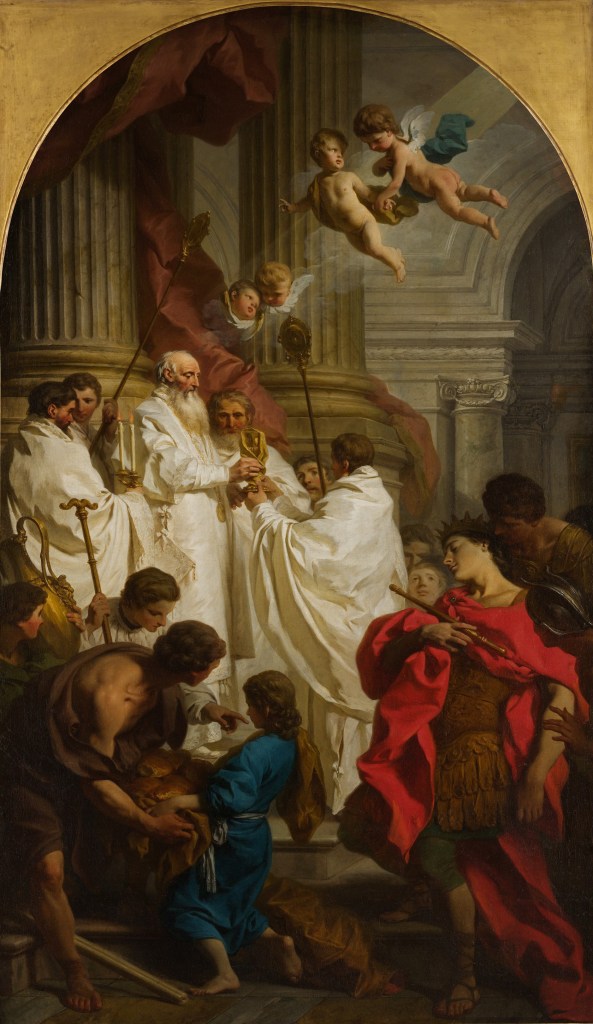
Gregory of Nazianzus: The Reluctant Bishop Who Gave the Trinity Its Voice

Gregory of Nazianzus was one of the greatest theologians in Christian history, but he did not move through life like a man chasing power.

He fled ordination. He resisted office. He complained bitterly when Basil forced him toward the obscure bishopric of Sasima. He entered Constantinople reluctantly. He left Constantinople wounded. He gave the church some of its most precise language about the Trinity, and then he walked away from the most important episcopal throne in the East.

That tension is what makes him so compelling.

Gregory was brilliant enough to speak before emperors and councils, but inwardly he longed for quiet. He had the training of a rhetorician, the imagination of a poet, the instincts of a monk, the duties of a bishop, and the burdens of a man who kept being pushed into public conflict.

He did not become “the Theologian” because he enjoyed religious argument. In fact, one of his strongest warnings is that theology becomes dangerous when it becomes entertainment, ambition, or verbal sport. He believed speech about God required purification, reverence, restraint, and fear.

His whole life can almost be read as a struggle between two callings: the desire to withdraw and the obligation to speak. And when he finally spoke, he gave the church language it never forgot.


A Child Given to God

Gregory was born around 329 or 330 AD near Nazianzus in Cappadocia. His father, Gregory the Elder, became bishop of Nazianzus. His mother, Nonna, was remembered as deeply pious and as a decisive influence in the family’s Christian life.

In his autobiographical poem, Gregory says his mother had prayed for a son and then offered that son back to God.

“She asked God to give her a son, and then she gave as a gift the very one she had asked to receive, her eagerness outrunning the gift.”

Gregory of Nazianzus, De vita sua, opening autobiographical section, c. 381 to 390 AD.

Gregory understood his life as something vowed before he could choose it. That does not mean his vocation was simple or easy. In fact, much of his writing shows how painful that vocation became. But from the beginning, he saw himself as someone whose life had been claimed.

That helps explain why he could never fully become just a rhetorician, just a scholar, or just a private ascetic. He wanted solitude, but he could not forget obligation. He wanted silence, but he believed the church needed speech. He wanted freedom from office, but he repeatedly found himself drawn back into service.

His life was not the story of a man who never resisted God’s call. It was the story of a man who resisted, suffered, returned, and spoke.


Gregory and Basil: One Soul in Two Bodies

Gregory received an elite education. He studied in Cappadocia, Caesarea, Alexandria, and Athens. In Athens, he formed one of the most famous friendships in Christian history with Basil of Caesarea.

In his funeral oration for Basil, Gregory describes their friendship with extraordinary affection.

“We seemed to have one soul inhabiting two bodies.”

Gregory of Nazianzus, Oration 43: Funeral Oration on Basil, §20, c. 381 to 382 AD.

That line is famous because it captures the ideal Gregory wanted to remember: two young men, united by study, prayer, discipline, and a shared desire for virtue. Athens was full of ambition, rhetoric, pagan religion, and social competition, but Gregory says he and Basil tried to live differently.

“We had one great business and name: to be and to be called Christians.”

Gregory of Nazianzus, Oration 43: Funeral Oration on Basil, §21, c. 381 to 382 AD.

He says they knew two roads especially well: the road to sacred teachers and the road to secular learning. Other roads, he suggests, were less important to them. The point is not that Gregory despised education. He was one of the most highly educated Christian writers of his century. The point is that learning had to be governed by Christian purpose.

For Gregory, rhetoric was not enough. Brilliance was not enough. Public success was not enough. The true goal was virtue, and education was valuable only if it served the soul.

This friendship with Basil would later become complicated, painful, and strained. But Gregory never forgot the ideal that first bound them together: Christian learning, disciplined friendship, and the pursuit of God.


The Man Who Loved Solitude

Gregory’s longing for solitude appears throughout his writings. When he later explained why he fled after ordination, he described the contemplative life he had hoped to preserve.

“Nothing seemed to me so desirable as to close the doors of my senses, escape from the flesh and the world, gather myself within myself, and speak to myself and to God.”

Gregory of Nazianzus, Oration 2: In Defense of His Flight to Pontus, §7, c. 362 AD.

Then he describes the inner goal of that life.

“I wanted to live above visible things, preserving in myself the divine impressions pure and unmixed, becoming and always growing more and more into a real, spotless mirror of God and divine things.”

Gregory of Nazianzus, Oration 2: In Defense of His Flight to Pontus, §7, c. 362 AD.

That image matters. Gregory did not want solitude because he hated people. He wanted solitude because he wanted the soul to become clear enough to reflect God. He wanted quiet because noise could distort the divine image. He wanted withdrawal because public life could pull the soul into vanity, anger, ambition, and distraction.

But Gregory’s vocation kept calling him out of the quiet. His father needed him. Basil needed him. The Nicene cause needed him. Constantinople needed him. The council needed him. Each time, Gregory felt the wound of being dragged away from the life he wanted.

That tension gives his theology its particular tone. When Gregory warns that speech about God must be purified, he is not speaking as a comfortable academic. He is speaking as a man who feared what public speech could do to the speaker’s soul.


He Feared the Priesthood

Gregory was ordained to the priesthood by his father, Gregory the Elder, around 361 or 362 AD. He did not respond with immediate joy. He fled.

When he returned, he preached Oration 2, one of the most important early Christian texts on pastoral ministry. The sermon is partly an apology for his flight and partly a theology of the priestly office.

He opens by admitting defeat.

“I have been defeated, and I confess my defeat. I have submitted myself to the Lord.”

Gregory of Nazianzus, Oration 2: In Defense of His Flight to Pontus, §1, c. 362 AD.

Gregory explains that he fled partly because he longed for the quiet life, but also because he feared the sacred office had become too easy for unprepared men to seize.

“I was ashamed of those who, with unwashen hands and uninitiated souls, intrude into the most sacred offices, and before becoming worthy to approach the sanctuary, push themselves around the holy table as though the order were a livelihood instead of a pattern of virtue, an authority instead of a ministry for which we must give account.”

Gregory of Nazianzus, Oration 2: In Defense of His Flight to Pontus, §8, c. 362 AD.

That is not false humility. Gregory really believed the office was dangerous. The priest was not merely a religious functionary. He was a physician of souls, a teacher, a mediator, a public example, and a person whose own spiritual sickness could harm others.

He feared becoming one more unhealed man pretending to heal.


The Physician of Souls

One of Gregory’s strongest images for pastoral ministry is medicine. The pastor is a physician, but the work is more difficult than bodily medicine because the soul is more complex than the body.

“The guiding of humanity, the most variable and manifold of creatures, seems to me truly the art of arts and the science of sciences.”

Gregory of Nazianzus, Oration 2: In Defense of His Flight to Pontus, §16, c. 362 AD.

Then he compares the pastor with the physician.

“Anyone may recognize this by comparing the physician of souls with the treatment of the body, and noticing that, laborious as bodily medicine is, ours is more laborious and more consequential.”

Gregory of Nazianzus, Oration 2: In Defense of His Flight to Pontus, §§16–17, c. 362 AD.

The physician of the body studies diet, disease, medicines, timing, age, temperament, and treatment. Gregory says the physician of souls must do something even harder. He must diagnose habits, passions, wounds, desires, fears, and wills.

“Nothing is so difficult as the diagnosis and cure of our habits, passions, lives, wills, and whatever else is within us.”

Gregory of Nazianzus, Oration 2: In Defense of His Flight to Pontus, §18, c. 362 AD.

This is why Gregory feared the priesthood. He did not think ministry was mainly public honor. He thought it was spiritual surgery. The pastor had to know when to encourage and when to rebuke, when to be gentle and when to be severe, when to speak publicly and when to correct privately.

“Some are led by doctrine, others trained by example; some need the spur, others the curb. Some are benefited by praise, others by blame, both being applied in season.”

Gregory of Nazianzus, Oration 2: In Defense of His Flight to Pontus, §§30–31, c. 362 AD.

That is a remarkable pastoral vision. Gregory does not imagine one method for every soul. The wise pastor adapts the medicine to the person. He must know the wound before applying the cure.

This also explains Gregory’s approach to theology. Doctrine was not a verbal game. It was medicine for the church.


The Pastor Must First Be Purified

Gregory’s fear of ministry was also rooted in his belief that the pastor’s own life must be purified before he presumes to guide others.

“We must guard against being bad painters of the charms of virtue, or poor models for the people, undertaking to heal others while we ourselves are full of sores.”

Gregory of Nazianzus, Oration 2: In Defense of His Flight to Pontus, §13, c. 362 AD.

That line belongs near the center of Gregory’s life. He was terrified of hypocrisy in holy office. A pastor who cannot govern himself may damage those he teaches. A theologian whose own soul is disordered may speak true words in a spiritually dangerous way.

He says the leader must not merely be free from obvious evil. He must be advanced in goodness.

“He must not only wipe out the traces of vice from his soul, but inscribe better ones, so as to surpass others in virtue more than he surpasses them in dignity.”

Gregory of Nazianzus, Oration 2: In Defense of His Flight to Pontus, §14, c. 362 AD.

Then he gives the standard for spiritual leadership.

“Before a man has sufficiently purified his mind and far surpassed others in nearness to God, I do not think it safe for him to be entrusted with the rule over souls, or the office of mediator between God and humanity.”

Gregory of Nazianzus, Oration 2: In Defense of His Flight to Pontus, §91, c. 362 AD.

This is why Gregory’s reluctance is so important. He does not flee because he thinks the church is unimportant. He flees because he thinks it is too important. He does not fear ministry because he is indifferent to souls. He fears ministry because souls are precious.

Gregory’s ideal pastor is not the most ambitious man in the room. He is the man most aware that he is not yet holy enough for the task.


Basil, Sasima, and the Friendship That Never Fully Recovered

Gregory’s friendship with Basil was one of the deepest relationships of his life, but it was also one of the most painful.

In his funeral oration for Basil, Gregory remembered their youth in Athens almost as an ideal Christian friendship. They studied together, prayed together, pursued virtue together, and imagined a common life directed toward God.

“We seemed to have one soul inhabiting two bodies.”

Gregory of Nazianzus, Oration 43: Funeral Oration on Basil, §20, c. 381 to 382 AD.

In his autobiographical poem, Gregory remembers the same early friendship with longing.

“Such were Athens and our common labors in learning, a life under the same roof and at the same table, one mind in two bodies, not two, a marvel of Greece. Our right hands were pledged to cast the world far away, to live a common life for God, and to give our reasonings to the only wise Reason.”

Gregory of Nazianzus, De vita sua, Sasima and Nazianzus section, c. 381 to 390 AD.

But then he immediately says what happened to those hopes.

“All has been scattered, cast to the ground. Breezes carry away the old hopes.”

Gregory of Nazianzus, De vita sua, Sasima and Nazianzus section, c. 381 to 390 AD.

The wound came from Sasima.

In the early 370s, Emperor Valens divided Cappadocia into two civil provinces. That created an ecclesiastical conflict between Basil of Caesarea and Anthimus of Tyana. Basil responded by creating new bishoprics in disputed territory, strengthening his own position by placing loyal bishops in strategic places. One of those places was Sasima, and Basil wanted Gregory there.

Gregory did not see this as a noble assignment. He felt used.

In Letter 48 to Basil, Gregory speaks with unusual sharpness. He says he has realized too late what happened.

“I only know that I saw that I had been deceived — too late indeed, but I saw it — and I throw the blame on your throne, as having on a sudden lifted you above yourself.”

Gregory of Nazianzus, Letter 48: To Basil, c. 372 AD.

Then he describes the humiliation of feeling used and discarded.

“The same person has both to suffer the wrong and to bear the blame, and this is my present case.”

Gregory of Nazianzus, Letter 48: To Basil, c. 372 AD.

And then:

“They throw me on one side after making use of me, like the most valueless vessels, or like the frames upon which arches are built, which after the building is complete are taken down and cast aside.”

Gregory of Nazianzus, Letter 48: To Basil, c. 372 AD.

That is not mild irritation. Gregory feels that Basil has treated him like scaffolding: useful during construction, disposable afterward.

The appointment also placed Gregory in the middle of Basil’s struggle with Anthimus. Gregory had no appetite for that kind of ecclesiastical combat.

“I will not take up arms, nor will I learn tactics which I did not learn in former times, when the occasion seemed more suitable, as everyone was arming and in frenzy.”

Gregory of Nazianzus, Letter 48: To Basil, c. 372 AD.

Then he says exactly what he does not want to do.

“I will not face the martial Anthimus, though he be an untimely warrior, being myself unarmed and unwarlike, and thus the more exposed to wounds.”

Gregory of Nazianzus, Letter 48: To Basil, c. 372 AD.

Then comes one of the most revealing lines in the whole exchange.

“Why should I fight for sucking pigs and fowls, and those not my own, as though for souls and canons?”

Gregory of Nazianzus, Letter 48: To Basil, c. 372 AD.

That line shows how Gregory saw the dispute. Basil may have seen jurisdiction, strategy, and ecclesiastical necessity. Gregory saw a fight over local goods, territorial pride, and church politics dressed up as spiritual urgency.

His final line in that letter is devastating.

“I shall gain this only from your friendship, that I shall learn not to trust in friends, or to esteem anything more valuable than God.”

Gregory of Nazianzus, Letter 48: To Basil, c. 372 AD.

In Letter 49, Gregory responds to Basil’s accusation that he was lazy or idle for refusing Sasima.

“You accuse me of laziness and idleness, because I did not accept your Sasima, and because I have not bestirred myself like a bishop, and do not arm you against each other like a bone thrown into the midst of dogs.”

Gregory of Nazianzus, Letter 49: To Basil, c. 372 AD.

Then Gregory defines his own calling in the opposite direction.

“My greatest business always is to keep free from business.”

Gregory of Nazianzus, Letter 49: To Basil, c. 372 AD.

And he adds:

“If only all men would imitate me, the churches would have no troubles; nor would the faith, which everyone uses as a weapon in his private quarrels, be pulled in pieces.”

Gregory of Nazianzus, Letter 49: To Basil, c. 372 AD.

This is the strain between the two friends. Basil was a strategist. Gregory was a contemplative. Basil was trying to defend Nicene order by building episcopal networks. Gregory felt dragged into the machinery of ecclesiastical conflict.

The friendship did not simply end. Gregory later praised Basil magnificently. He called him great, honored his theology, remembered their youth, and preached his funeral oration. But Sasima left a wound that never entirely disappeared.

That makes Gregory more human. He could love Basil and still feel injured by him. He could honor Basil’s greatness and still remember the cost of being used in Basil’s strategy.


Theology Was Not for Verbal Acrobats

Gregory’s most famous works are the five Theological Orations, delivered in Constantinople around 379 to 380 AD. They were preached in a city where Nicene Christians had been marginalized and where debates over the Trinity had become public, aggressive, and often careless.

The first of the five, Oration 27, does not begin by defining the Trinity. It begins by warning people about how not to talk about God.

Gregory complains that some people treat theology like a game. Every marketplace, dinner party, festival, and gathering becomes an occasion for argument. Sacred mysteries are turned into entertainment.

“Not to everyone, my friends, does it belong to philosophize about God. Not to everyone. The subject is not so cheap and low.”

Gregory of Nazianzus, Oration 27: First Theological Oration, §3, c. 379 to 380 AD.

Then he gives the conditions for theological speech.

“It is permitted only to those who have been examined, who are masters in contemplation, and who have first been purified in soul and body, or at least are being purified.”

Gregory of Nazianzus, Oration 27: First Theological Oration, §3, c. 379 to 380 AD.

That is one of Gregory’s defining convictions. Theology is not merely the ability to win arguments about God. It requires purification. The speaker’s soul matters. The timing matters. The audience matters. The manner of speech matters.

He is not forbidding Christians to remember God. In fact, he says the opposite.

“We ought to think of God even more often than we breathe.”

Gregory of Nazianzus, Oration 27: First Theological Oration, §5, c. 379 to 380 AD.

But he distinguishes remembrance from reckless speech.

“It is not continual remembrance of God that I would hinder, but only talking about God when it is unseasonable; not teaching itself, but lack of moderation.”

Gregory of Nazianzus, Oration 27: First Theological Oration, §5, c. 379 to 380 AD.

This is classic Gregory. He wants both devotion and restraint. Think of God always. Speak of God carefully.


The Mystery Must Be Spoken in a Holy Manner

Gregory’s warning continues. He says theological argument without reverence can damage the church and arm its enemies.

“Let us utter mysteries under our breath, and holy things in a holy manner. Let us not cast to profane ears what may not be uttered.”

Gregory of Nazianzus, Oration 27: First Theological Oration, §5, c. 379 to 380 AD.

He even says there is a proper decorum in speech and silence.

“Let us recognize that as in dress, diet, laughter, and conduct there is a certain decorum, so there is also in speech and silence.”

Gregory of Nazianzus, Oration 27: First Theological Oration, §5, c. 379 to 380 AD.

This matters because Gregory is not anti-theology. He is one of the greatest theologians the church ever produced. His warning is not against doctrine, but against careless doctrine. He does not want the Trinity reduced to a verbal contest, or the mystery of God handled as though cleverness were the same as holiness.

He says the church had become obsessed with speaking while neglecting spiritual practice.

“We do not praise hospitality, brotherly love, marriage, virginity, generosity to the poor, psalmody, vigils, or tears. We do not discipline the body by fasting or go forth to God by prayer.”

Gregory of Nazianzus, Oration 27: First Theological Oration, §7, c. 379 to 380 AD.

The point is not that doctrinal precision is unimportant. Gregory fought fiercely for doctrinal precision. The point is that speech about God must be joined to life before God. Theology without purification becomes noise.

For Gregory, the theologian must be more than a mouth.


God Cannot Be Captured by Words

In the second Theological Oration, Gregory turns to the incomprehensibility of God. He is not saying we know nothing about God. He is saying that God cannot be mastered by human concepts or exhausted by human language.

He gives one of his most famous statements:

“It is difficult to conceive God, but to define him in words is impossible.”

Gregory of Nazianzus, Oration 28: Second Theological Oration, §4, c. 379 to 380 AD.

Then he sharpens it.

“In my opinion, it is impossible to express him, and still more impossible to conceive him fully.”

Gregory of Nazianzus, Oration 28: Second Theological Oration, §4, c. 379 to 380 AD.

Gregory does not mean that Christian faith is empty. He explicitly rejects that conclusion. Christians can know that God exists. They can know God through creation, Scripture, worship, and revelation. But to know that God is, and to comprehend what God is in himself, are not the same thing.

“It is one thing to be persuaded that a thing exists, and quite another to know what it is.”

Gregory of Nazianzus, Oration 28: Second Theological Oration, §5, c. 379 to 380 AD.

This distinction is crucial. Gregory is defending both knowledge and humility. The Christian does not worship an unknown nothing. But neither does the theologian place God inside a definition and call that mastery.

He uses the image of Moses seeing only the “back parts” of God.

“I was running to lay hold of God, and I went up the mountain, drew aside the curtain of the cloud, and withdrew within myself. But when I looked, I scarcely saw the back parts of God, though I was sheltered by the Rock, the Word made flesh for us.”

Gregory of Nazianzus, Oration 28: Second Theological Oration, §3, c. 379 to 380 AD.

That passage reveals Gregory’s theology of humility. The Word made flesh shelters us. God reveals himself. But the divine nature still exceeds us.

For Gregory, the best theologian is not the person who pretends to see everything. It is the person who sees enough to know that God is greater than sight.


Creation Leads Us Toward God, But Not Into Mastery

Gregory argues that the visible world points toward God. The beauty, order, and movement of creation lead the mind toward its maker.

“Our eyes and the law of nature teach us that God exists and that he is the efficient and sustaining cause of all things.”

Gregory of Nazianzus, Oration 28: Second Theological Oration, §6, c. 379 to 380 AD.

He uses the image of a musical instrument.

“Whoever sees a beautifully made lute, or hears its melody, thinks of the maker or player of the lute, even if he does not know him by sight.”

Gregory of Nazianzus, Oration 28: Second Theological Oration, §6, c. 379 to 380 AD.

In the same way, the world leads the mind toward God. But Gregory will not let natural reasoning become pride.

“What God is in nature and essence, no one has ever discovered or can discover.”

Gregory of Nazianzus, Oration 28: Second Theological Oration, §17, c. 379 to 380 AD.

Then he says what we possess now is partial.

“In the present life, all that comes to us is a small outpouring, a faint brightness from a great light.”

Gregory of Nazianzus, Oration 28: Second Theological Oration, §17, c. 379 to 380 AD.

This is why Gregory’s theology is so powerful. He can reason from creation, argue from Scripture, defend Nicene doctrine, and still insist that God is beyond possession. He does not use mystery to avoid thought. He uses thought until it reaches reverence.


The Son Is Not a Lesser God

Gregory’s third and fourth Theological Orations focus especially on the Son. His opponents used biblical passages where Christ is called servant, created, subject, obedient, ignorant, or less than the Father. Gregory’s task is to show that these passages must be read in light of the incarnation.

The Son is fully divine. But the Son also assumed human nature. Therefore some biblical statements refer to his divinity, and others to the humanity he took for our salvation.

In Oration 30, Gregory explains that when Christ is called servant, this refers to his taking our condition in order to liberate us.

“He was in servitude to flesh, birth, and the conditions of our life for our liberation, and for the liberation of all whom he saved, who were in bondage under sin.”

Gregory of Nazianzus, Oration 30: Fourth Theological Oration, §3, c. 379 to 380 AD.

Then he gives one of his most beautiful statements about the incarnation.

“What greater destiny can befall human lowliness than that it should be mingled with God, and by this mingling be deified?”

Gregory of Nazianzus, Oration 30: Fourth Theological Oration, §3, c. 379 to 380 AD.

Gregory’s Christology is not a dry exercise in categories. It is about salvation. Christ becomes what we are so that we may become what he gives. He enters human lowliness to raise it. He takes the form of a servant without ceasing to be God.

Gregory insists that the lower statements about Christ do not reduce his divinity. They reveal the depth of his saving condescension.

“He makes my disobedience his own as Head of the whole body. As long as I am disobedient and rebellious, Christ also is called disobedient on my account.”

Gregory of Nazianzus, Oration 30: Fourth Theological Oration, §5, c. 379 to 380 AD.

This is Gregory’s way of reading the incarnate Christ. The Son does not become less than God. He takes our condition, our weakness, our shame, our curse, our death, and our disobedience into himself in order to heal and restore us.


“What He Has Not Assumed, He Has Not Healed”

Gregory’s most famous Christological line appears not in the Theological Orations, but in Letter 101 to Cledonius, written against Apollinarius.

Apollinarius taught, in effect, that Christ did not assume a complete human mind or rational soul. Gregory saw the danger immediately. If Christ did not assume the full human person, then the full human person was not healed.

“If anyone has put his trust in Christ as a human being without a human mind, he is himself bereft of mind and unworthy of salvation.”

Gregory of Nazianzus, Letter 101: To Cledonius Against Apollinarius, c. 382 AD.

Then comes the famous principle.

“What he has not assumed, he has not healed. But what is united to his Godhead is also saved.”

Gregory of Nazianzus, Letter 101: To Cledonius Against Apollinarius, c. 382 AD.

Gregory presses the logic further.

“If only half of Adam fell, then what Christ assumes and saves may be half also. But if the whole of human nature fell, it must be united to the whole nature of the one begotten, and so be saved as a whole.”

Gregory of Nazianzus, Letter 101: To Cledonius Against Apollinarius, c. 382 AD.

This is one of the most important statements in the history of Christian theology. Gregory is saying that salvation depends on the completeness of the incarnation. Christ does not merely wear a human body. He assumes the whole human reality: body, soul, mind, and will, everything except sin.

The logic is pastoral as much as doctrinal. If the human mind is wounded, Christ must assume a human mind. If the human soul is wounded, Christ must assume a human soul. If the whole human person fell, the whole human person must be united to God in Christ.

Gregory’s Christology is healing theology. The incarnation is not an appearance. It is the medicine of the whole human being.


Christ Assumed Poverty So Humanity Might Be Enriched

Gregory’s theological imagination was not limited to abstract argument. In his festal orations, especially Oration 38 on the Nativity, he speaks of the incarnation with poetic force.

He describes the paradox of the Word becoming flesh.

“The Self-Existent comes into being. The Uncreated is created. The Uncontained is contained.”

Gregory of Nazianzus, Oration 38: On the Theophany, or Birthday of Christ, §13, c. 380 AD.

Then he explains the saving exchange.

“He who gives riches becomes poor, for he assumes the poverty of my flesh, that I may assume the richness of his Godhead.”

Gregory of Nazianzus, Oration 38: On the Theophany, or Birthday of Christ, §13, c. 380 AD.

Then Gregory connects the incarnation to the restoration of the image.

“I had a share in the image, but I did not keep it. He shares in my flesh, both to save the image and to make the flesh immortal.”

Gregory of Nazianzus, Oration 38: On the Theophany, or Birthday of Christ, §13, c. 380 AD.

This is the same theology as Letter 101, but in poetic form. Christ takes what is ours in order to give what is his. He assumes poverty to make us rich. He assumes flesh to make flesh immortal. He takes the fallen image in order to restore it.

For Gregory, the incarnation is not merely that God came near. It is that God entered the full depth of human lowliness so that humanity could be lifted into divine life.


The Paradoxes of Christ

Gregory loved paradox because the incarnation itself is paradoxical. Christ is weak and strong, visible and invisible, passible and impassible, human and divine.

In Oration 29, he strings these contrasts together in a way that became one of the great passages of patristic preaching.

“He hungered, but he fed thousands. He thirsted, but he cried, ‘If anyone thirsts, let him come to me and drink.’ He was weary, but he is the rest of those who are weary and burdened.”

Gregory of Nazianzus, Oration 29: Third Theological Oration, §§19–20, c. 379 to 380 AD.

He continues:

“He was sold, and very cheaply, for only thirty pieces of silver. But he redeemed the world, and at a great price, for the price was his own blood.”

Gregory of Nazianzus, Oration 29: Third Theological Oration, §§19–20, c. 379 to 380 AD.

Then the climax:

“He dies, but he gives life, and by his death destroys death. He is buried, but he rises again. He goes down into hell, but he brings up souls.”

Gregory of Nazianzus, Oration 29: Third Theological Oration, §20, c. 379 to 380 AD.

This is not decorative rhetoric. Gregory is teaching his hearers how to read the Gospels. The lowly things belong to Christ’s assumed humanity. The glorious things reveal his divinity. Both belong to the one Christ.

If you see only the hunger, you miss God. If you see only the glory, you miss the incarnation. Gregory insists on both.

The Word became flesh, and the flesh was not a disguise. It was the means of salvation.


The Spirit Is Not a Creature

The fifth Theological Oration, Oration 31, is Gregory’s great defense of the Holy Spirit.

The controversy was intense. Some Christians who confessed the Son’s divinity still hesitated over the Spirit. They asked where Scripture explicitly calls the Spirit God. They treated the Spirit as a lesser power, a creature, or something below the full divine dignity.

Gregory begins boldly.

“We have so much confidence in the deity of the Spirit whom we adore that we will begin our teaching about his Godhead by fitting to him the names that belong to the Trinity.”

Gregory of Nazianzus, Oration 31: Fifth Theological Oration, §3, c. 379 to 380 AD.

Then he gives the luminous formula.

“The Father was the true Light. The Son was the true Light. The other Comforter was the true Light. Was, and was, and was, but one thing. Light thrice repeated, but one Light and one God.”

Gregory of Nazianzus, Oration 31: Fifth Theological Oration, §3, c. 379 to 380 AD.

This is Gregory at his best: precise, poetic, and doctrinally forceful. The Spirit is not an accessory to God. The Spirit shares the divine light.

Then Gregory says:

“We will exalt the Spirit. We will not be afraid. Or if we are afraid, it will be of keeping silence, not of proclaiming.”

Gregory of Nazianzus, Oration 31: Fifth Theological Oration, §3, c. 379 to 380 AD.

That is the courage of the Theologian. Gregory is not reckless with mystery, but when silence would betray the truth, he speaks.


“Is the Spirit God? Most Certainly.”

Gregory’s argument for the Spirit includes Scripture, worship, baptism, and the Spirit’s divine works. He refuses to let the Spirit be numbered among creatures.

At one point he asks the question plainly.

“Is the Spirit God? Most certainly. Is he consubstantial? Yes, if he is God.”

Gregory of Nazianzus, Oration 31: Fifth Theological Oration, §10, c. 379 to 380 AD.

Then he explains the distinction of the persons without diminishing their shared divine nature.

“The Father is not the Son, yet this is not because of deficiency. The Son is not the Father, yet Sonship is no deficiency. The Spirit is not the Son, yet he is of God. The distinction of the three persons is preserved in the one nature and dignity of the Godhead.”

Gregory of Nazianzus, Oration 31: Fifth Theological Oration, §9, c. 379 to 380 AD.

He summarizes the Trinity in one of his strongest formulas.

“The Three are one in Godhead, and the One is three in properties.”

Gregory of Nazianzus, Oration 31: Fifth Theological Oration, §9, c. 379 to 380 AD.

Gregory also warns against ranking the Spirit with creatures.

“Rank no part of the Trinity with yourself, lest you fall away from the Trinity.”

Gregory of Nazianzus, Oration 31: Fifth Theological Oration, §12, c. 379 to 380 AD.

For Gregory, the doctrine of the Spirit is not optional. The Spirit gives new birth, sanctifies, illuminates, deifies, and perfects. If the Spirit does what God does, the Spirit must not be treated as a servant beneath God.


One God, Three Persons

Gregory’s Trinitarian theology holds together unity and distinction.

He rejects the idea that Father, Son, and Spirit are three unrelated divine beings. But he also rejects the idea that the three persons are merely masks or names for one person. He wants neither a divided God nor a collapsed Trinity.

“To us there is one God, for the Godhead is one, and all that proceeds from him is referred to one, though we believe in three persons.”

Gregory of Nazianzus, Oration 31: Fifth Theological Oration, §14, c. 379 to 380 AD.

Then he explains:

“One is not more and another less God. One is not before and another after. They are not divided in will or parted in power.”

Gregory of Nazianzus, Oration 31: Fifth Theological Oration, §14, c. 379 to 380 AD.

The unity is not numerical flattening. The distinction is not division.

“When we look at the Godhead, or the first cause, we conceive one. But when we look at the persons in whom the Godhead dwells, and those who timelessly and with equal glory have their being from the first cause, there are three whom we worship.”

Gregory of Nazianzus, Oration 31: Fifth Theological Oration, §14, c. 379 to 380 AD.

This is why Gregory became so important. He gave the church language that could protect both realities: the one Godhead and the three persons. The Father is Father. The Son is Son. The Spirit is Spirit. But the divine nature is one, the glory is equal, the worship is undivided.

For Gregory, the doctrine of the Trinity is not arithmetic. It is the grammar of Christian worship.


Revelation Comes Gradually

One of Gregory’s most interesting arguments about the Holy Spirit is that revelation unfolds gradually.

His opponents asked why Scripture did not speak of the Spirit’s deity with the same explicitness they demanded. Gregory answers by describing salvation history as a wise divine pedagogy. God teaches in stages, not because the truth changes, but because human beings need to be led gradually.

“The Old Testament proclaimed the Father openly and the Son more obscurely. The New manifested the Son and suggested the deity of the Spirit. Now the Spirit himself dwells among us and supplies a clearer demonstration of himself.”

Gregory of Nazianzus, Oration 31: Fifth Theological Oration, §26, c. 379 to 380 AD.

Then he explains why God does not force everything at once.

“The change was not made suddenly, nor at the first movement, so that no violence might be done to us, but that we might be moved by persuasion. Nothing involuntary is durable.”

Gregory of Nazianzus, Oration 31: Fifth Theological Oration, §25, c. 379 to 380 AD.

This passage matters because it shows Gregory’s pastoral intelligence. He does not imagine doctrine as a dropped package of propositions. God teaches the human race. Revelation has timing. The truth is one, but human reception has to be healed, prepared, and enlarged.

For Gregory, the Spirit’s divinity is not an innovation. It is the fullness of what God has been revealing.


Constantinople and the Little Church Called Anastasia

Gregory came to Constantinople around 379 AD to strengthen the Nicene community in a city long dominated by anti-Nicene forces. He did not begin with a cathedral. He began with a small house church that came to be called Anastasia, meaning resurrection.

That name mattered. Gregory believed the Nicene faith was being raised again in the imperial city.

In his farewell address, he remembers Anastasia with deep affection.

“Farewell, my Anastasia, whose name is fragrant with piety. You raised up for us the doctrine that had been in contempt. Farewell, scene of our common victory, modern Shiloh.”

Gregory of Nazianzus, Oration 42: The Last Farewell, §26, 381 AD.

That small church became the place where Gregory delivered the theological orations that made his name. He preached the Trinity in a city where the doctrine had been contested, mocked, politicized, and distorted.

Gregory knew that numbers did not prove truth. In the same farewell speech, he says:

“Better is faith with no roof but the sky than impiety rolling in wealth. Three gathered in the name of the Lord count for more with God than tens of thousands who deny the Godhead.”

Gregory of Nazianzus, Oration 42: The Last Farewell, §7, 381 AD.

This is how Gregory understood Anastasia. It was not impressive because of its size. It was important because truth was being confessed there. The doctrine that had been despised was rising.

In that little church, Gregory gave the Trinity a voice in Constantinople.


Constantinople Was Not a Quiet Appointment

Gregory did not come to Constantinople as a comfortable churchman taking over an established Nicene cathedral. He came to a city where Nicene Christians had been reduced to a fragile minority. The great churches were controlled by opponents of Nicene theology. Gregory began not in Hagia Sophia, but in Anastasia.

His own farewell speech confirms how small and fragile the beginning felt. Anastasia “raised up” a doctrine that had been despised.

“Farewell, my Anastasia, whose name is fragrant with piety. You raised up for us the doctrine that had been in contempt.”

Gregory of Nazianzus, Oration 42: The Last Farewell, §26, 381 AD.

In Oration 33, delivered in Constantinople, Gregory speaks as a man facing a hostile majority. He directly addresses opponents who mocked the poverty and smallness of his community.

“Where are they who reproach us with our poverty, and boast themselves of their own riches; who define the church by numbers and scorn the little flock?”

Gregory of Nazianzus, Oration 33: Against the Arians and Concerning Himself, §1, c. 380 AD.

Then he turns to the threats themselves.

“Are you again indignant? Do you again arm yourselves? Do you again insult us? Is this a new faith? Restrain your threats a little while, that I may speak.”

Gregory of Nazianzus, Oration 33: Against the Arians and Concerning Himself, §1, c. 380 AD.

This matters because Gregory’s theological orations were not delivered in a quiet academic setting. They were preached in a city where theological disagreement could turn into street hostility. He was not merely explaining the Trinity. He was trying to revive a persecuted Nicene community in an imperial capital where his opponents had buildings, numbers, and political memory on their side.

Gregory makes that contrast explicit.

“They have the houses, but we have the Dweller in the house. They have the temples, but we have God. They have the people, but we have the angels. They have rash boldness, but we have faith. They have threats, but we have prayer. They have smiting, but we have endurance. They have gold and silver, but we have the pure word.”

Gregory of Nazianzus, Oration 33: Against the Arians and Concerning Himself, §15, c. 380 AD.

That is the Constantinople Gregory entered: a city where the opposing party had buildings, crowds, wealth, and force, while Gregory’s strength was preaching, prayer, and endurance.


What Persecution Looked Like in Constantinople

Gregory’s descriptions of persecution are not vague. He speaks of mobs, armed violence, churches invaded during prayer, psalmody interrupted, sacred spaces profaned, bishops attacked, priests burned, believers exiled, and Christians driven from churches and houses.

Some of this language recalls the wider history of Nicene suffering under Arian dominance. Some of it reflects the hostility Gregory and his people faced in Constantinople itself. In either case, Gregory wants his hearers to know that the argument over the Trinity was not merely a debate over words. It had bodies behind it.

In Oration 33, he asks his opponents what he has done to them, and then he contrasts his behavior with the violence Nicene Christians had endured.

“Whom have I besieged while they were engaged in prayer and lifting up their hands to God? When have I put a stop to psalmody with trumpets? Or mingled the sacramental blood with the blood of massacre?”

Gregory of Nazianzus, Oration 33: Against the Arians and Concerning Himself, §3, c. 380 AD.

Then he asks:

“What house of prayer have I made a burial place? What liturgical vessels have I given over to the hands of the wicked?”

Gregory of Nazianzus, Oration 33: Against the Arians and Concerning Himself, §3, c. 380 AD.

He also speaks of attacks against virgins, bishops, priests, and the faithful.

“What bishop’s aged flesh have we torn with hooks in the presence of his disciples, who could help him only by tears? What priests have fire and water divided, setting a strange beacon over the sea and burning them together with the ship in which they put to sea?”

Gregory of Nazianzus, Oration 33: Against the Arians and Concerning Himself, §§4–5, c. 380 AD.

Then he describes believers treated like animals in confinement.

“Which of the faithful have I exiled from their country and given over to lawless men, that they might be kept like wild beasts in rooms without light, separated from one another, enduring hunger and thirst, with food measured out through narrow openings?”

Gregory of Nazianzus, Oration 33: Against the Arians and Concerning Himself, §5, c. 380 AD.

In his farewell address, Gregory also speaks of his own experience and the experience of his community.

“Have we not been persecuted, maltreated, driven from churches, houses, and, most terrible of all, even from the deserts? Have we not had to endure an enraged people, insolent governors, and the disregard of emperors and their decrees?”

Gregory of Nazianzus, Oration 42: The Last Farewell, §23, 381 AD.

And at the very end of the farewell, he tells his people:

“My children, keep what has been entrusted to you. Remember my stonings.”

Gregory of Nazianzus, Oration 42: The Last Farewell, §27, 381 AD.

That final line is crucial. Gregory did not leave Constantinople remembering only theological arguments. He remembered stones.

The doctrine of the Trinity had been preached in a city where words could provoke violence. Gregory’s opponents did not merely disagree with him. They armed themselves, threatened him, mocked the poverty of his congregation, and treated his small Nicene community as an intrusion into a city they believed belonged to them.


Maximus and the Betrayal Inside the Nicene Camp

Gregory’s troubles in Constantinople did not come only from open opponents. One of the most humiliating episodes came from a man who had first appeared as a friend.

Maximus the Cynic attached himself to Gregory and gained his trust. Gregory says in De vita sua that Maximus shared his house, table, doctrine, and counsels.

“Who was such a sharer as Maximus was for me in roof, table, doctrines, and counsels?”

Gregory of Nazianzus, De vita sua, Maximus section, c. 381 to 390 AD.

Gregory says Maximus presented himself as loyal, orthodox, and zealous.

“He becomes one of the well-disposed and of the very faithful.”

Gregory of Nazianzus, De vita sua, Maximus section, c. 381 to 390 AD.

But Gregory later saw the whole thing as a plot. Maximus, he says, had a sharp eye for opportunity and a talent for deceit.

“He weaves the whole drama not through strangers, but from among ourselves, as a sophist and composer of evils, against those unused to these things and wholly strange to plotting.”

Gregory of Nazianzus, De vita sua, Maximus section, c. 381 to 390 AD.

Then Gregory describes the deeper wound: goodness is often slow to suspect evil, and that makes good people easy prey.

“The one quick to wickedness watches everything and sees the vital points; but the one ready for virtue is by nature slow and dull to suspect the worse. Thus goodness is easily caught.”

Gregory of Nazianzus, De vita sua, Maximus section, c. 381 to 390 AD.

Maximus eventually arranged to have himself consecrated as bishop of Constantinople by Egyptian bishops while Gregory was ill. Later summaries say the attempted consecration happened secretly at night in Gregory’s own church. The people rejected Maximus and drove him out, but the damage was done. Gregory had been betrayed by someone he had publicly trusted.

This episode matters because it helps explain Gregory’s weariness. Constantinople was not only doctrinally hostile. It was politically treacherous. Gregory had to deal with Arian opposition, Nicene factionalism, imperial politics, rival bishops, and men who turned friendship into ambition.

By the time the Council of Constantinople met in 381, Gregory had already been wounded by enemies outside and betrayal inside.


Why Gregory Left Constantinople

Gregory did not leave Constantinople because the doctrine he preached had failed. In fact, the Council of Constantinople in 381 would endorse the Nicene faith he had helped restore in the city. He left because the politics around the episcopal throne had become unbearable.

Several pressures came together.

First, there was the old problem of Sasima. Gregory had technically been consecrated bishop of Sasima years earlier, even though he never truly took possession of that see. When he became bishop of Constantinople, opponents argued that his transfer from Sasima to Constantinople violated church canons. Second, the Maximus affair had poisoned the situation. Egyptian bishops had supported Maximus’s attempted claim, and that controversy did not disappear. Third, Gregory was physically worn down and spiritually exhausted. Fourth, he believed his continued presence might damage the unity of the church more than help it.

But the most important explanation comes from Gregory himself.

In Oration 42, he asks the council to release him for the sake of unity.

“By the Trinity whom you and I alike worship, by our common hope, and for the sake of the unity of this people, grant me this favor: dismiss me with your prayers.”

Gregory of Nazianzus, Oration 42: The Last Farewell, §25, 381 AD.

He compares his resignation to a soldier receiving a certificate of retirement.

“Let this be the proclamation of my contest; give me my certificate of retirement, as sovereigns do to their soldiers.”

Gregory of Nazianzus, Oration 42: The Last Farewell, §25, 381 AD.

This is not the language of a man who sees himself as abandoning the faith. It is the language of a man who believes he has fought his contest and now needs to be released.

He asks them to choose a successor who will be strong, not merely agreeable.

“Let him be one who is the object of envy, not pity; not one who yields everything to all, but one who can on some points offer resistance for the sake of what is best.”

Gregory of Nazianzus, Oration 42: The Last Farewell, §25, 381 AD.

Then, in the farewell, he says goodbye to the throne itself.

“Farewell, my throne, envied and perilous height.”

Gregory of Nazianzus, Oration 42: The Last Farewell, §26, 381 AD.

That phrase explains the whole experience. The throne of Constantinople was not simply a position of honor. It was a height exposed to envy, danger, rivalry, and spiritual risk.

Gregory also makes clear that resigning a throne does not mean losing God.

“Those who resign their thrones will not also lose God, but will have the seat on high, which is far more exalted and secure.”

Gregory of Nazianzus, Oration 42: The Last Farewell, §27, 381 AD.

That is the heart of his resignation. Gregory would rather lose the throne than lose peace. He would rather leave office than become another cause of division. He would rather be judged weak by church politicians than keep power at the expense of unity.

He had come to Constantinople to preach the Trinity. Once the faith had been restored, he refused to let his own position become the next idol.


His Farewell to the People

Gregory’s farewell to Constantinople is one of the most moving passages in his writings. He says goodbye not only to buildings and bishops, but to the people who had gathered around his preaching.

“Farewell, choirs of Nazarites, harmonies of the Psalter, night-long stations, venerable virgins, decorous matrons, gatherings of widows and orphans, and you eyes of the poor, turned toward God and toward me.”

Gregory of Nazianzus, Oration 42: The Last Farewell, §26, 381 AD.

This is not a man leaving an abstract office. He is leaving people: virgins, widows, orphans, the poor, worshipers, hearers, friends, and spiritual children. He remembers their eagerness to hear him.

“Farewell, you lovers of my discourses, in your eagerness and concourse; farewell, the railing pressed by those who pushed forward to hear the word.”

Gregory of Nazianzus, Oration 42: The Last Farewell, §26, 381 AD.

Then he says his tongue has stopped speaking to them, but not forever.

“This troublesome and talkative tongue has ceased to speak to you. Yet it will not utterly cease to speak, for it will fight with hand and ink.”

Gregory of Nazianzus, Oration 42: The Last Farewell, §26, 381 AD.

That sentence is poignant. Gregory leaves the pulpit, but not the work. If he cannot remain as bishop, he will write. If his voice is silenced in the city, his hand and ink will continue.

That is exactly what happened. Gregory’s public career was painful and brief, but his writings endured.


“Farewell, O Trinity”

At the end of his farewell, Gregory turns to the doctrine that had defined his work.

“Farewell, O Trinity, my meditation and my glory.”

Gregory of Nazianzus, Oration 42: The Last Farewell, §27, 381 AD.

Then he prays that the people will preserve the faith.

“May you be preserved by those who are here, and preserve them, my people; for they are mine, even if my place is assigned elsewhere.”

Gregory of Nazianzus, Oration 42: The Last Farewell, §27, 381 AD.

And then he gives one of the most personal lines in the speech.

“My children, keep what has been entrusted to you. Remember my stonings.”

Gregory of Nazianzus, Oration 42: The Last Farewell, §27, 381 AD.

That line compresses the whole Constantinople period. He had preached the Trinity, suffered opposition, endured violence, gathered a people, and then left them with the faith entrusted to them.

Gregory does not ask them to remember his status. He asks them to remember the cost.

His theology was not written in comfort. It came through conflict, illness, loneliness, and opposition. The doctrine of the Trinity was his meditation and glory, but also the cause of his wounds.


The Poor Were Not an Ornament to His Theology

Gregory of Nazianzus is remembered above all as a theologian of the Trinity, but he was not indifferent to the poor. His theology of God was joined to a theology of mercy.

His most important text on this theme is Oration 14, usually called On Love for the Poor. It is one of the great fourth-century sermons on Christian philanthropy. Gregory’s argument is simple: the poor are not an interruption to Christian life. They are one of the places where Christian life is tested.

He tells his hearers to use unstable earthly wealth to seek what lasts.

“Let us now follow the Word. Let us seek the rest that is there. Let us cast away the abundance that is here. Let us possess our own souls in almsgiving. Let us share our possessions with the poor, that we may be rich in the things there.”

Gregory of Nazianzus, Oration 14: On Love for the Poor, §22, c. 370s AD.

Then he presses the point:

“Give a portion also to the soul, not to the flesh alone. Give a portion also to God, not to the world alone. Take something from the belly and dedicate it to the spirit.”

Gregory of Nazianzus, Oration 14: On Love for the Poor, §22, c. 370s AD.

Gregory’s logic is not merely that charity is nice. Charity reveals whether a person understands creation, judgment, and God. To dishonor the poor is to dishonor the one who made them.

“If he who dishonors a poor man provokes the one who made him, then he who cares for the creation honors the maker.”

Gregory of Nazianzus, Oration 14: On Love for the Poor, §36, c. 370s AD.

Then he uses Proverbs to undermine social pride.

“When you hear, ‘The poor and the rich have met one another, and the Lord made them both,’ do not suppose he made the one poor and the other rich so that you might rise up more against the poor man. Both are equally the creation of God, even if their outward circumstances are unequal.”

Gregory of Nazianzus, Oration 14: On Love for the Poor, §36, c. 370s AD.

That line belongs with the Cappadocian moral world. Basil says the bread in your cupboard belongs to the hungry. Gregory of Nyssa says no human being can be owned because every human being bears the image of God. Gregory Nazianzen says the poor and rich are both equally God’s creation, and mercy is one way the soul is cleansed.

“Let us then be cleansed by showing mercy. Let us wash away with the good herb the filth and defilements of our souls.”

Gregory of Nazianzus, Oration 14: On Love for the Poor, §37, c. 370s AD.

Then he connects mercy to Christ himself.

“Reverence him who was wounded and bruised for us; and you will reverence him if you show yourself kind and philanthropic to Christ’s member.”

Gregory of Nazianzus, Oration 14: On Love for the Poor, §37, c. 370s AD.

Gregory did not build a Basileias like Basil. His charity was not as institutionally dramatic as Basil’s hospital-city outside Caesarea. But his preaching on mercy belongs in the same Christian imagination. Theology must become conduct. The Trinity must be glorified not only in words, but in a life that honors the poor as God’s own creation and Christ’s own members.


The Instability of Wealth

Gregory’s concern for the poor was not only rhetorical. After the deaths of his parents, he inherited family wealth, and later tradition says he gave most of it away, keeping only a small piece of land at Arianzus for himself. Whether stated in later biographical summary or in his own preaching, the logic fits the man we meet in his writings. Gregory did not want wealth to become a chain on the soul.

In On Love for the Poor, he says that visible things are unstable by design, so that Christians will learn to move toward the future.

“None of the goods here are trustworthy for human beings or long-lasting. We are made sport of in things seen, which change and are changed in different ways, and flee before they can be grasped, so that, having observed their instability, we may set out for the future.”

Gregory of Nazianzus, Oration 14: On Love for the Poor, §20, c. 370s AD.

This does not mean Gregory despised creation. It means he thought possessions were dangerous when treated as permanent. Wealth could either trap the soul in passing things or be converted into mercy.

That is why his sermon tells Christians to share possessions with the poor. Charity was not only for the sake of the recipient. It was also medicine for the giver. Almsgiving trained the soul to loosen its grip on what could not last.

Gregory’s own life seems to have followed that logic. He did not turn inherited wealth into a public institution like Basil did, but he did turn wealth away from himself and toward the poor.


He Could Rebuke the Ambitious Church

Gregory’s writings often criticize the church’s hunger for status. He had seen what ambition did to bishops. He had watched doctrine become entangled with rivalry. He had lived through councils where truth and politics were not easy to separate.

In Oration 42, he gives a sharp criticism of what people often wanted from church leaders.

“They seek not priests, but orators; not stewards of souls, but treasurers of money; not pure offerers of the sacrifice, but powerful patrons.”

Gregory of Nazianzus, Oration 42: The Last Farewell, §24, 381 AD.

Then he admits that leaders themselves helped train the people this way.

“I will say a word in their defense: we have trained them so.”

Gregory of Nazianzus, Oration 42: The Last Farewell, §24, 381 AD.

That is a strong confession. Gregory is not merely blaming the crowd. He is saying church leaders had helped create distorted expectations. If bishops act like patrons, people will seek patrons. If preachers chase applause, people will seek performers. If clergy become political operators, people will judge them by political usefulness.

Gregory wanted something different. He wanted pastors to be purified physicians of souls. He wanted theologians to speak with reverence. He wanted the Trinity confessed in word and conduct.

That is why he could leave the throne. He was not indifferent to the office. He was trying to refuse what the office could become.


Theology Must Become Conduct

Gregory never thought doctrine was merely verbal. In his farewell, after laying out the faith, he prays that the Trinity will be glorified not only in words, but in conduct.

“May I learn that you ever extol and glorify the Trinity in word and conduct.”

Gregory of Nazianzus, Oration 42: The Last Farewell, §27, 381 AD.

That little phrase is important.

Word and conduct.

Gregory had spent his life defending words: Father, Son, Spirit, essence, person, procession, generation, consubstantiality, Godhead. But the words had to become conduct. If the doctrine of the Trinity did not produce worship, humility, holiness, and love, then the words were being mishandled.

This connects back to his first Theological Oration. The problem was never theology itself. The problem was theology without purification. Theology without restraint. Theology without prayer. Theology without moral transformation.

Gregory gave the church language for the Trinity, but he also warned the church that language alone was not enough.

The doctrine had to become life.


Why Gregory Matters

Gregory of Nazianzus matters because he taught the church how to speak of God without pretending to master God.

He insisted that theology requires purification. He warned that sacred mysteries should not be turned into entertainment. He taught that God can be known, but not comprehended. He defended the Son’s full divinity while preserving the reality of Christ’s human life. He gave the church the principle that what Christ did not assume, he did not heal. He defended the Holy Spirit as true God, not a creature. He gave the church some of its most beautiful language for the Trinity: one Light, one God, three persons, undivided in glory.

But Gregory also matters because his life embodied the cost of theology.

He did not speak from a safe distance. He was pulled between solitude and duty. He fled ordination and then returned. He was wounded by Basil over Sasima and still praised Basil as a great friend and saint. He preached in a city that resisted him. He gathered a Nicene community around a small church called Anastasia. He endured threats, stones, betrayal, and ecclesiastical intrigue. He became bishop of Constantinople and then resigned rather than let his position become another cause of division.

He was not the easiest personality among the Cappadocians. He was sensitive, poetic, wounded, brilliant, reluctant, and sometimes sharp. But those qualities made him the right kind of theologian for a dangerous age. He knew words could heal or harm. He knew theology could become pride. He knew office could become ambition. He knew silence could become cowardice. He knew speech could become vanity.

So he tried to speak only when speech had become necessary.

And when he spoke, the church listened.


Conclusion: The Theologian Who Spoke With Fear

Gregory of Nazianzus did not give the church its doctrine of the Trinity because he loved argument. He gave the church that language because careless argument was endangering the faith.

He saw people turn theology into marketplace chatter, and he answered that not everyone should rush to speak of God. He saw the Son treated as less than God, and he answered that the one who hungered also fed thousands, the one who died also destroyed death, and the one who took the form of a servant remained Lord. He saw the Spirit treated as a creature, and he answered that the Spirit is true Light, that the Spirit is God, and that the Three are one in Godhead. He saw Apollinarius shrink Christ’s humanity, and he answered that what was not assumed was not healed.

Gregory’s theology was careful because he believed salvation was at stake.

If the Son is not fully God, he cannot bring us to God. If Christ is not fully human, he cannot heal the full human person. If the Spirit is not God, baptism, sanctification, and worship lose their foundation. If theology is spoken without purification, the mystery becomes a weapon in unclean hands.

That is why Gregory deserves the name “Theologian.”

Not because he made God easy to define. Not because he loved controversy. Not because he wanted the throne.

He deserves the name because he taught the church to speak of God with precision, poetry, humility, and fear. He gave the Trinity a voice, and then he reminded the church that holy words must be spoken by holy lives.

Gregory of Nyssa: The Theologian Who Made Slavery Look Absurd

Gregory of Nyssa was not the most famous Cappadocian in his own lifetime. His older brother Basil was the public force: bishop of Caesarea, organizer of monastic life, builder of the Basileias, defender of Nicene orthodoxy, and opponent of imperial pressure. Gregory of Nazianzus was the great preacher of Constantinople, the theologian whose orations gave the church some of its most precise language about the Trinity.

Gregory of Nyssa was different. He was quieter, more speculative, more philosophical, and more mystical. He was not as administratively powerful as Basil or as rhetorically celebrated as Gregory Nazianzen. But over time, his writings became some of the most daring and profound in early Christian theology.

He wrote about the soul as a journey into God. He described spiritual perfection not as a plateau, but as endless growth. He said the true vision of God means realizing that God is beyond every concept we can master. He defended the Trinity by arguing that Father, Son, and Spirit share one divine nature and one divine operation. He reflected on resurrection, purification, baptism, Eucharist, and the restoration of humanity.

And in one of the most remarkable passages from the ancient church, he attacked slavery itself.

Gregory’s greatness lies in the way he connects theology, anthropology, and spiritual desire. For him, God is inexhaustible, and the human person bears the divine image. That means the soul’s journey into God can never be finished, and no human being can be reduced to property, price, or social usefulness.

Gregory of Nyssa made Christianity feel infinite.


A Family Already Marked by Holiness

Gregory was born into one of the most important Christian families of the fourth century. His grandmother Macrina the Elder had suffered during persecution. His mother Emmelia helped form a household of saints. His sister Macrina the Younger became the spiritual center of the family. His brother Basil became Basil the Great. His brother Peter became bishop of Sebaste.

Gregory himself tells us in the Life of Macrina that the family’s Christian memory went back to persecution.

“She was named Macrina after the famous woman in our family, our father’s mother, who had confessed Christ like a noble athlete in the time of persecution.”

Gregory of Nyssa, Life of Macrina, PG 46.962A, c. 380 to 383 AD.

This family did not treat Christianity as a social accessory. It had been tested by suffering, exile, loss, and confiscation. Gregory later has Macrina recall that their ancestors had paid dearly for confessing Christ.

“Our father’s parents had their property confiscated because they confessed Christ. Our maternal grandfather was killed by imperial wrath, and all his possessions were handed over to others.”

Gregory of Nyssa, Life of Macrina, PG 46.980D, c. 380 to 383 AD.

That background matters because Gregory’s theology is never merely abstract. He writes about the soul, resurrection, freedom, and divine life as someone formed by a family that knew what it meant for earthly security to collapse. Property could be confiscated, bodies could die, and political favor could change. But the image of God in the human person remained. The life of the soul remained. The hope of resurrection remained.

That is the world that formed Gregory of Nyssa.


The Younger Brother in Basil’s Shadow

Gregory lived much of his life in Basil’s shadow. Basil was older, stronger, more publicly forceful, and more obviously suited to leadership. Gregory does not seem to have been the natural administrator that Basil was. But Basil clearly trusted Gregory enough to draw him into the church’s work.

Gregory became bishop of Nyssa in the 370s. The office placed him in the middle of the Nicene struggle, especially under the emperor Valens, who favored anti-Nicene theology. Gregory suffered for that position. In the Life of Macrina, when he describes why he had not seen his sister for many years, he gives us a glimpse of the turmoil.

“For a long time visits had been prevented by the troubles I underwent, since I was constantly being driven out from my own country by the leaders of heresy.”

Gregory of Nyssa, Life of Macrina, PG 46.976A, c. 380 to 383 AD.

That line is easy to miss, but it matters. Gregory’s theology did not grow in a quiet academic environment. He wrote amid exile, doctrinal conflict, family grief, ecclesiastical pressure, and political instability. When he later writes about spiritual ascent, divine darkness, and the soul reaching beyond what it can comprehend, he is not writing as someone untouched by struggle. He is writing as someone who had been displaced, challenged, corrected, and humbled.

Gregory’s path to theological depth was not smooth. It passed through family loss, controversy, and exile.


Macrina, the Teacher Behind the Theologian

No account of Gregory of Nyssa makes sense without Macrina.

Gregory’s On the Soul and the Resurrection opens after Basil’s death. Gregory is grieving deeply. He goes to visit Macrina, hoping to share sorrow over their brother. But when he arrives, he finds that Macrina herself is near death.

“Basil, great among the saints, had departed from this life to God, and grief for him was shared by all the churches.”

Gregory of Nyssa, On the Soul and the Resurrection, opening frame, PG 46.12, c. 380 AD.

Then Gregory identifies Macrina by the title that matters most.

“His sister, the Teacher, was still living. So I went to her, longing to share grief over the loss of her brother.”

Gregory of Nyssa, On the Soul and the Resurrection, opening frame, PG 46.12, c. 380 AD.

Gregory calls her “the Teacher.” That is not casual. In the dialogue, Gregory is not the master instructing his dying sister. He is the grieving student. Macrina is the one who steadies him, corrects his grief, defines the soul, explains resurrection, and teaches him to interpret death through Christian hope.

He says she allowed his grief to run for a moment, and then she began to restrain it.

“She yielded to me for a short time, like a skillful driver allowing the uncontrolled violence of my grief. Then she checked me by speaking and corrected the disorder of my soul with the bridle of her reasoning.”

Gregory of Nyssa, On the Soul and the Resurrection, opening frame, PG 46.12, c. 380 AD.

This image tells us something important about Gregory himself. He was not embarrassed to show his own weakness. He lets the reader see him overwhelmed, while his dying sister becomes the one who teaches him. Macrina’s influence matters because many of Gregory’s deepest themes are already present in that dialogue: the soul, death, purification, resurrection, and restoration. Gregory’s later theology did not come only from books. It came from a holy woman dying in front of him, teaching him that death was not the end.


The Human Person Bears the Image of God

One of Gregory’s most important works is On the Making of Man, written as a kind of continuation of Basil’s work on creation. Basil had preached on the six days of creation, but had not fully treated the creation of humanity. Gregory takes up that task.

His central conviction is that the human being is made in the image of God. But he does not treat the image of God as belonging only to a few people. It belongs to the whole human race.

“The image is not in part of our nature, nor is the grace in only one thing found in that nature. This power extends equally to all the race. A sign of this is that mind is implanted alike in all. All have the power of understanding and deliberation, and all those things by which the divine nature finds its image in what was made according to it.”

Gregory of Nyssa, On the Making of Man, chapter 16, c. 379 AD.

Then Gregory makes the point even more expansive.

“The human being first manifested at the creation of the world and the human being who shall appear after the completion of all things equally bear in themselves the divine image.”

Gregory of Nyssa, On the Making of Man, chapter 16, c. 379 AD.

This is a major foundation for Gregory’s moral vision. Human dignity is not created by status, wealth, ethnicity, gender, office, or usefulness. It is rooted in creation. The whole human race bears the divine image.

That conviction later becomes decisive in Gregory’s attack on slavery. If every human person bears the image of God, then no human being can rightly be treated as a possession. No human being can be reduced to a price. No human being can be classified as though the human race were divided into masters and slaves by nature.

Gregory’s anthropology is not decorative. It has consequences.


Freedom Is Part of the Image

Gregory also connects the image of God with freedom. Since virtue must be voluntary, the human person cannot be understood as a creature meant for bondage.

In On the Making of Man, he says:

“Pre-eminent among the good things in us is this: that we are free from necessity, not enslaved to any natural power, but possessing decision in our own control as we choose. For virtue is voluntary and subject to no master. What comes by compulsion and force cannot be virtue.”

Gregory of Nyssa, On the Making of Man, chapter 16, c. 379 AD.

That is one of Gregory’s most important statements about human nature. Freedom is not a minor feature. It is tied to virtue. If virtue must be freely chosen, then coercion cannot produce holiness. This also means that slavery is not merely socially unpleasant. It contradicts the moral structure of the human person.

The human being was made for communion with God, and that communion requires freedom. The soul cannot be forced into virtue as though holiness were mechanical. The human person must choose, love, desire, turn, repent, and grow.

This is why Gregory’s spiritual theology and his moral theology belong together. The same man who teaches endless ascent into God also teaches that human beings cannot be owned. The soul’s freedom is not incidental. It is the ground of the journey.


The World Around Gregory Took Slavery for Granted

To feel the force of Gregory’s attack on slavery, we have to see the world around him. Slavery was not a marginal institution in the ancient Mediterranean. It was woven into households, agriculture, mines, workshops, education, domestic service, law, war, inheritance, and social status. Many people criticized cruelty toward slaves. Some urged masters to be humane. Some philosophers insisted that a slave could possess inner freedom. Roman law developed limits on extreme abuse.

But very few voices attacked the institution at the root.

That is what makes Gregory’s language so striking. He does not merely say, “Do not abuse your slaves.” He does not merely say, “Remember that slaves have souls.” He does not merely say, “A slave can still be spiritually free.” He asks the more dangerous question: who gave you the right to own another human being at all?


Greek Philosophy Could Call a Slave a Living Tool

One of the most influential voices in the Greek intellectual tradition was Aristotle. His Politics does not simply accept slavery as a social fact. It tries to explain why slavery might be natural for some people.

Aristotle describes household property in terms of tools, then places the slave inside that category.

“An article of property is a tool for the purpose of life, and property generally is a collection of tools. A slave is a living article of property.”

Aristotle, Politics, Book I, chapter 4, c. 350 BC.

Then he argues that some people are naturally suited to slavery.

“Those whose function is the use of the body, and from whom this is the best that can come from them, are by nature slaves. For them it is better to be ruled by this kind of authority.”

Aristotle, Politics, Book I, chapter 5, c. 350 BC.

That is the philosophical background Gregory is rejecting. Aristotle can speak of the slave as a living tool, while Gregory will speak of the enslaved person as the image of God. Aristotle can ask whether some people are naturally slaves, while Gregory will say human nature is free. Aristotle can place the slave close to the category of property, while Gregory will ask what price could possibly be placed on rationality, freedom, and the likeness of God.

The contrast could hardly be sharper.


Roman Law Put the Slave Under Another’s Power

Roman law also treated slavery as a basic legal category. The jurist Gaius, writing in the second century, divides people according to whether they are free or enslaved, and then describes the master’s legal power.

“Slaves are in the power of their masters, and this power is acknowledged by the law of nations. Among all nations alike, the master has the power of life and death over his slaves, and whatever property is acquired by a slave is acquired by his master.”

Gaius, Institutes, Book I, §52, c. 161 AD.

Gaius also notes that imperial law had begun restraining extreme cruelty.

“At present, neither Roman citizens nor any other persons under Roman rule are permitted to employ excessive or causeless severity against their slaves.”

Gaius, Institutes, Book I, §53, c. 161 AD.

That legal development matters. Rome could limit cruelty. Rome could punish certain abuses. Rome could regulate manumission. Rome could acknowledge that a master should not make bad use of his rights. But the ownership claim remained. The slave was still under the master’s power. What the slave acquired belonged to the master. The law could restrain excess, but it did not deny the master’s basic claim.

Gregory does deny it. He is not merely asking masters to use their rights more gently. He is asking whether such a right can exist at all.


Humane Masters Were Still Masters

Some ancient moralists did urge better treatment of slaves. Seneca, the Stoic philosopher, gives one of the most famous examples in Letter 47. He rebukes those who treat slaves as less than human.

“‘They are slaves,’ people say. No, they are human beings. ‘Slaves!’ No, they are comrades. ‘Slaves!’ No, they are humble friends. ‘Slaves!’ No, they are our fellow slaves, if one remembers that Fortune has the same rights over slaves and free people alike.”

Seneca, Moral Letters, Letter 47, §1, c. 64 AD.

He also attacks the cruelty of elite dining culture, where slaves are forced to stand hungry and silent while their masters feast.

“All this time the poor slaves may not move their lips, even to speak. The slightest murmur is repressed by the rod. Even a cough, sneeze, or hiccup is punished with the lash.”

Seneca, Moral Letters, Letter 47, §3, c. 64 AD.

Then Seneca gives his moral rule.

“Treat your inferiors as you would be treated by your superiors. As often as you reflect how much power you have over a slave, remember that your master has just as much power over you.”

Seneca, Moral Letters, Letter 47, §11, c. 64 AD.

This is humane, but it is not Gregory’s argument. Seneca tells the master to treat the slave kindly. Gregory asks why the master is a master at all. Seneca says slaves are human beings and should not be treated like beasts. Gregory says enslaving a human being is a direct challenge to the law of God. Seneca asks for mercy inside the master-slave structure. Gregory attacks the structure by asking how one person can claim ownership over another person made in the image of God.


Even Christian Preachers Often Spiritualized Slavery

Even Christian preachers who cared about slaves often did not speak like Gregory.

John Chrysostom, for example, could preach powerfully about the dignity of slaves and the danger of spiritual slavery. But when he comments on Paul’s words in First Corinthians, he often turns the focus from legal slavery to slavery to sin.

“It is possible for one who is a slave not to be a slave, and for one who is free to be a slave.”

John Chrysostom, Homily 19 on First Corinthians, on 1 Corinthians 7:23, c. 390s AD.

Then he explains what he means.

“How can one be a slave and not a slave? When he does everything for God, when he does nothing out of eye-service toward men. That is how one who is a slave to men can be free.”

John Chrysostom, Homily 19 on First Corinthians, on 1 Corinthians 7:23, c. 390s AD.

Later he makes the point even more directly.

“It is not slavery itself, beloved, that hurts. The real slavery is that of sin.”

John Chrysostom, Homily 19 on First Corinthians, on 1 Corinthians 7:23, c. 390s AD.

There is truth in what Chrysostom is saying. A person can be legally enslaved and still possess spiritual courage. A person can be legally free and still be enslaved to greed, lust, vanity, or fear.

But Gregory’s sermon goes somewhere else. Gregory does not only comfort the enslaved person by saying, “You can still be inwardly free.” He confronts the owner and says, “Your claim to own this person is a violation of creation.” That is why Gregory’s passage is so unusual. He does not leave slavery as a regrettable but manageable social reality. He treats it as a theological contradiction.


Even Christian Imperial Law Preserved Slavery

Justinian makes the contrast even stronger.

He was not Gregory’s contemporary. He ruled the Eastern Roman Empire in the sixth century, roughly 150 years after Gregory. But that is exactly why he matters for this script. Justinian was a Christian emperor, a ruler who built churches, legislated on religious matters, and sponsored the great codification of Roman law. Yet even his Christian imperial law code still preserved slavery.

The Institutes of Justinian begins its discussion of persons by dividing human beings into free people and slaves.

“The chief division in the law of persons is this: all human beings are either free or slaves.”

Justinian, Institutes, Book I, Title III, c. 533 AD.

Then it defines freedom.

“Freedom is the natural power of doing what each person pleases, unless prevented by force or law.”

Justinian, Institutes, Book I, Title III, §1, c. 533 AD.

Then comes the striking admission.

“Slavery is an institution of the law of nations, by which one person is made the property of another, contrary to natural right.”

Justinian, Institutes, Book I, Title III, §2, c. 533 AD.

That is an astonishing tension. The law says freedom belongs to nature. The law says slavery is contrary to natural right. But the law still preserves slavery as an institution.

That means Gregory is not merely more radical than Aristotle or Roman jurists. He is more radical than later Christian imperial law. Justinian’s law can name the contradiction and still keep the structure. Gregory will not live inside that compromise.

If human nature is free, Gregory says, then slavery is not merely unfortunate. It is rebellion against what the human being is. If the human being bears the image of God, then the slave market is not merely a legal arrangement. It is a theological outrage.


Then Gregory Attacked the Ownership Itself

Against that background, Gregory’s words become explosive.

Greek philosophy could call the slave a living tool. Roman law could place the slave under the master’s power. Humane moralists could tell masters to treat slaves kindly. Christian preachers could say that spiritual slavery to sin was worse than legal slavery. A later Christian emperor’s law code could admit that slavery was contrary to natural right and still preserve it.

Gregory attacks the master’s claim at the root. He says the human being is free by nature. He says slavery competes with God’s law. He says the owner has forgotten the limits of human authority. He says dominion was given over irrational creatures, not over the image of God.

So when Gregory reads Ecclesiastes 2:7, “I got male and female slaves,” he does not treat it as a harmless detail of ancient wealth. He treats it as the climax of human arrogance.


“You Condemn Human Beings to Slavery”

The most shocking moral passage in Gregory’s writings comes in his Homilies on Ecclesiastes. He is commenting on Ecclesiastes 2:7, where the speaker says, “I got male and female slaves.”

Many ancient Christian writers urged masters to be kind to slaves. Gregory does something stronger. He attacks the act of owning another human being.

He begins with outrage.

“I got me slaves and slave-girls. What do you mean? You condemn human beings to slavery, when their nature is free and possesses free will. You legislate against God, overturning his law for the human species.”

Gregory of Nyssa, Homilies on Ecclesiastes, Homily 4, on Ecclesiastes 2:7, c. 380s AD.

That is one of the clearest anti-slavery statements in the ancient world. Gregory does not merely say, “Treat slaves well.” He says slaveholding violates human nature and competes with God’s law. To enslave someone is to legislate against the Creator.

Then he connects the argument to Genesis.

“The one made to be lord of the earth, appointed to rule by the Creator, you bring under the yoke of slavery, as though defying and fighting against the divine decree.”

Gregory of Nyssa, Homilies on Ecclesiastes, Homily 4, on Ecclesiastes 2:7, c. 380s AD.

Gregory’s point is simple and devastating. God gave humanity dominion over animals and the earth, not over the image of God in another human being. When one human claims ownership over another, the slave owner is not merely organizing labor. He is overturning the order of creation.

For Gregory, slavery is an assault on the divine image.


“Have You Forgotten the Limits of Your Authority?”

Gregory then presses the owner with Scripture. In Genesis, human beings are given dominion over birds, fish, and animals. Gregory asks how anyone dares to extend that dominion over another human being.

“Have you forgotten the limits of your authority? Your rule is limited to irrational creatures. Scripture says, ‘Let them rule over birds and fish and four-footed creatures.’ How then do you go beyond what is subject to you and exalt yourself against a nature which is free?”

Gregory of Nyssa, Homilies on Ecclesiastes, Homily 4, on Ecclesiastes 2:7, c. 380s AD.

Then he exposes the absurdity.

“Surely human beings have not been born to you from domestic animals. Surely cattle have not given birth to human offspring. Irrational creatures alone are subject to humankind.”

Gregory of Nyssa, Homilies on Ecclesiastes, Homily 4, on Ecclesiastes 2:7, c. 380s AD.

This is Gregory’s theological anthropology turned into accusation. If human beings are made in God’s image, then they cannot be grouped with cattle. If dominion was given over animals, then the master has overreached. If the enslaved person is human, then the owner’s claim is not simply excessive. It is a confusion of creation itself.

Gregory is saying that the slaveholder has treated his brother as though he were livestock, and Scripture gives him no such right.


“What Price Did You Put on the Image of God?”

Gregory then moves from law to money. Slaveholding involves buying and selling human beings. So Gregory asks what price could possibly be placed on a person made in God’s image.

“What price did you put on reason? How many coins did you pay for the image of God? How much money did you count out for the nature formed by God?”

Gregory of Nyssa, Homilies on Ecclesiastes, Homily 4, on Ecclesiastes 2:7, c. 380s AD.

That question exposes the absurdity of the market. A slave sale pretends that a human life can be priced. Gregory says the thing being priced is reason, freedom, and the image of God. No amount of money can equal that.

He continues:

“God said, ‘Let us make the human being in our image and likeness.’ If the human being is in the likeness of God, rules the whole earth, and has received authority over all things from God, who is his buyer? Tell me, who is his seller?”

Gregory of Nyssa, Homilies on Ecclesiastes, Homily 4, on Ecclesiastes 2:7, c. 380s AD.

The slave market says that this person has a buyer and a seller. Gregory says that is impossible, because the human being belongs to God. The slave market says this body has a price. Gregory says that is impossible, because the image of God cannot be priced. The slave market says this person is property. Gregory says that is impossible, because the person was made free.


The World Is Not Worth One Human Soul

Gregory keeps pushing. If the human being has dominion over the earth, then the whole world would have to be included in the sale of the human person. But even the whole world is not enough.

“How can people be sold who have dominion over the earth and everything on the earth? If you said, ‘the world in its entirety,’ even then you would not have found anything approximating to the value.”

Gregory of Nyssa, Homilies on Ecclesiastes, Homily 4, on Ecclesiastes 2:7, c. 380s AD.

Then he applies Christ’s teaching about the value of the soul.

“Someone knowing the true value of human nature said that not even the whole world is worth enough to be given in exchange for the human soul.”

Gregory of Nyssa, Homilies on Ecclesiastes, Homily 4, on Ecclesiastes 2:7, c. 380s AD.

The slave market works by pretending that a human being can be converted into money. Gregory says the conversion rate does not exist. Not a handful of coins, not a legal contract, not even the world can equal the value of a person made in the image of the priceless God.


Slavery Divides What God Made One

Gregory’s attack continues by pointing out that slavery divides human nature into categories that God did not create.

“You have divided human nature into slavery and mastery, making it at once slave to itself and master over itself.”

Gregory of Nyssa, Homilies on Ecclesiastes, Homily 4, on Ecclesiastes 2:7, c. 380s AD.

That sentence goes to the heart of the issue. Slavery does not merely place one individual beneath another. It fractures humanity. It treats one part of the human race as if it were a different kind of thing from another part.

Gregory will not allow that. Human nature is one. The image of God is shared. Freedom belongs to the human person as human.

Then he asks what document could possibly authorize such ownership.

“Did the little notebook, the written agreement, and the calculation in coins trick you into thinking that you could be master of the image of God?”

Gregory of Nyssa, Homilies on Ecclesiastes, Homily 4, on Ecclesiastes 2:7, c. 380s AD.

Then he imagines the contract destroyed.

“If the contract were lost, if the writing were eaten by moths, if a drop of water fell on it and washed it away, where is there any proof that you have a slave? Where is there anything that supports you in being a master?”

Gregory of Nyssa, Homilies on Ecclesiastes, Homily 4, on Ecclesiastes 2:7, c. 380s AD.

This is Gregory at his most morally forceful. He takes the legal language of ownership and makes it look ridiculous. A deed may transfer land. A receipt may record the sale of an animal. But what document can transfer the image of God?

No paper can make a human being property. No price can purchase freedom from the Creator. No human law can overturn the divine image.


The Same Air, the Same Death, the Same Judgment

Gregory then strips away the social illusion of superiority. The master and the slave are the same kind of being. They breathe the same air, see the same sun, suffer the same griefs, and return to the same dust.

“Your lineage is still human, your life is similar, and the sufferings of soul and body prevail upon you both in the same way, with one as master and another in subjugation.”

Gregory of Nyssa, Homilies on Ecclesiastes, Homily 4, on Ecclesiastes 2:7, c. 380s AD.

Then he asks:

“Do they not draw in the same air when they breathe? Do they not see the sun in a similar way? Do they not both sustain their life by taking in nourishment? Is not the structure of their bodily organs the same?”

Gregory of Nyssa, Homilies on Ecclesiastes, Homily 4, on Ecclesiastes 2:7, c. 380s AD.

And then the final equalizer:

“Do they not both return to the same dust after death? Do they not both face one and the same judgment? Is not the prospect of heaven and hell the same for them both?”

Gregory of Nyssa, Homilies on Ecclesiastes, Homily 4, on Ecclesiastes 2:7, c. 380s AD.

This is one of the most powerful parts of Gregory’s argument because it attacks slavery from below and above. From below, master and slave share the same body, same breath, and same death. From above, master and slave face the same God, same judgment, and same eternity.

No human hierarchy survives those facts. The master may have a contract, but he does not have a different nature. He may have power, but he does not have a different destiny. He may call the other person a slave, but before God they both stand as human beings.

Gregory makes the slave owner look absurd: one mortal body trying to own another mortal body, one dying soul trying to possess another soul that belongs to God.


The Poor as a Test of the Soul

Gregory’s concern for human dignity also appears in his preaching about the poor. Like Basil and Gregory Nazianzen, Gregory of Nyssa believed Christian theology had to change the way Christians saw the suffering body.

In his sermons on love for the poor, he urges practical giving, not vague sympathy.

“Give what you can. God asks nothing beyond your strength. You can give a loaf; another can give a cup of wine; another can give clothing. By your joined help, one person’s hardship may be relieved.”

Gregory of Nyssa, On the Love of the Poor, c. 380s AD.

This is not as dramatic as his attack on slavery, but it belongs to the same moral world. Human need is not theoretical. It is answered by bread, wine, clothing, and shared effort.

Gregory’s vision of the human person is lofty, but it does not float above ordinary life. If the poor bear the image of God, then their hunger matters. If the sick bear the image of God, then their wounds matter. If the enslaved bear the image of God, then their freedom matters.

Gregory’s theology is mystical, but not escapist. The soul may journey into divine darkness, but the journey does not excuse ignoring the suffering person at the door.


The Trinity Is Not Three Gods

Gregory was also one of the great defenders of Nicene Trinitarian theology. In On “Not Three Gods,” written to Ablabius, he answers the charge that Christians worship three gods when they confess Father, Son, and Holy Spirit.

Gregory’s answer depends on the unity of divine nature and operation.

“The Father is God. The Son is God. Yet by the same proclamation God is one, because no difference either of nature or of operation is contemplated in the Godhead.”

Gregory of Nyssa, On “Not Three Gods,” to Ablabius, c. 380s AD.

He continues:

“If the nature of the Holy Trinity were diverse, the number would consequently extend to a plurality of gods. But since the divine, single, and unchanging nature rejects all diversity in essence, it does not admit the meaning of multitude.”

Gregory of Nyssa, On “Not Three Gods,” to Ablabius, c. 380s AD.

Gregory is trying to preserve two truths at once. The Father is not the Son. The Son is not the Spirit. The Spirit is not the Father. And yet the divine nature is one. Christians do not worship three different beings with three different divine powers. They worship one God: Father, Son, and Holy Spirit.

Gregory’s theology is subtle because he refuses to solve the mystery by flattening it. He will not collapse the persons into one person. But he will not divide the divine nature into three gods.


The Spirit Shares the Work of God

Gregory also defends the divinity of the Holy Spirit by arguing from the Spirit’s work. If the Spirit gives sanctification, life, light, comfort, freedom, and immortality, then the Spirit is not a creature.

In On the Holy Trinity, he writes:

“If we understand that the operation of the Father, the Son, and the Holy Spirit is one, differing or varying in nothing, then the oneness of their nature must be inferred from the identity of their operation.”

Gregory of Nyssa, On the Holy Trinity, to Eustathius, c. 380s AD.

Then he becomes specific.

“The Father, the Son, and the Holy Spirit alike give sanctification, life, light, comfort, and all similar graces.”

Gregory of Nyssa, On the Holy Trinity, to Eustathius, c. 380s AD.

This is classic Cappadocian reasoning. The Spirit does what only God does. Therefore, the Spirit shares in the divine nature.

Gregory continues by saying that every grace given to the worthy comes from the Father, Son, and Spirit together.

“Every grace and power, guidance, life, comfort, the change to immortality, the passage to liberty, and every other blessing that exists descends to us through the Father, the Son, and the Holy Spirit.”

Gregory of Nyssa, On the Holy Trinity, to Eustathius, c. 380s AD.

For Gregory, the doctrine of the Trinity is not abstract arithmetic. It is about salvation. If the Spirit is the one who sanctifies the soul, illumines the mind, grants life, and brings us into freedom, then the Spirit must not be treated as a lesser power.

The Christian life itself bears witness to the Trinity.


The Great Catechism Was Gregory’s Map of the Faith

Gregory’s Great Catechism, also called the Great Catechetical Oration, is one of his most important works because it shows him trying to organize the whole Christian faith for teaching. This is not a casual devotional text or a sermon on one passage of Scripture. It is Gregory stepping back and asking how the church should explain Christianity to those preparing to receive the faith.

He writes for teachers, pastors, and catechists, the people responsible for instructing outsiders, converts, and those confused by rival teachings. He opens the work by saying that teachers of the faith need order, structure, and method.

“The ministers who preside over the mystery of godliness need a system in their instruction, so that the church may be increased by those being saved, as the word of faith is brought to the hearing of unbelievers.”

Gregory of Nyssa, The Great Catechism, Prologue, c. 383 to 386 AD.

That line matters because Gregory is not only giving doctrines. He is giving a method of teaching doctrine. He wants Christian instruction to be coherent enough to guide a hearer from confusion into faith.

But he also knows that not every person needs the same argument. A pagan polytheist, a Jew, a Manichee, an Anomoean, and a follower of Marcion do not begin from the same assumptions. So Gregory says the catechist must know the wound before applying the medicine.

“The same method of instruction will not be suitable for everyone who approaches the word. The catechism must be adapted to the differences in their religious views, aiming at one goal, but not using the same preparation in every case.”

Gregory of Nyssa, The Great Catechism, Prologue, c. 383 to 386 AD.

Then he gives the key pastoral image.

“The method of recovery must be adapted to the form of the disease. You will not cure the Greek’s polytheism and the Jew’s unbelief about the Only-begotten God by the same means.”

Gregory of Nyssa, The Great Catechism, Prologue, c. 383 to 386 AD.

This gives us a crucial window into Gregory’s mind. Theology is not just information. It is medicine. Teaching is not just repeating correct words. It is diagnosis and cure.

Gregory’s Great Catechism is his attempt to give the church a theological medicine chest.


One Goal, Different Wounds

Gregory’s method is both flexible and firm. It is flexible because he adapts his arguments to the person in front of him. The Greek must be moved away from many gods. The Jew must be brought to recognize the Word and Spirit. The heretic must be corrected according to the particular distortion he has accepted.

But Gregory’s method is firm because all these paths lead toward the same goal: the confession of the Triune God, the incarnation of the Word, the healing of human nature, and the transformation of life.

He explains this clearly in the prologue.

“It is necessary to consider the opinions each person has taken up and to frame the argument according to the error into which each has fallen, advancing principles and reasonable arguments so that, from what is agreed upon by both sides, the truth may be brought to light.”

Gregory of Nyssa, The Great Catechism, Prologue, c. 383 to 386 AD.

This is Gregory as theologian and pastor at the same time. He does not simply shout conclusions. He starts where the hearer is. He looks for shared ground. Then he leads the hearer step by step toward the mystery of the faith.

That is why the Great Catechism is so important for understanding him. It shows Gregory building Christianity as an argument, not because he thinks faith is reducible to logic, but because he believes Christian truth is coherent. The gospel is not a pile of disconnected doctrines. It is one great healing story: God creates, humanity falls, the Word descends, the sick nature is touched, death is conquered, the soul is purified, baptism begins resurrection, the Eucharist gives the antidote, and the regenerate life must become visibly changed.


Gregory Begins With the Trinity

Gregory does not begin the Great Catechism with ethics or church practice. He begins with God. For Gregory, Christianity is not first a moral system, not first a political program, and not first a set of rituals. It begins with the nature of God: Father, Son, and Holy Spirit.

He argues first against pagan polytheism and Jewish objections. Against polytheism, he insists on the unity of God. Against a view of God that leaves no room for the Son and Spirit, he argues that God is not without Word and Spirit.

He says that if God has a Word, that Word cannot be a weak and vanishing sound like human speech. God’s Word must be living, eternal, powerful, and good.

“Our word is unstable because our nature is liable to corruption. But in that transcendent nature, everything said of God is elevated with the greatness of the subject. Therefore, when we speak of God’s Word, we must not think of something that vanishes away like our speech.”

Gregory of Nyssa, The Great Catechism, chapter 1, c. 383 to 386 AD.

Then he says:

“The Word of God is living, subsisting, willing, powerful, and able to accomplish what is good.”

Gregory of Nyssa, The Great Catechism, chapter 1, c. 383 to 386 AD.

Gregory is reasoning toward the Trinity. God is not mute. God has a Word. God is not breathless. God has a Spirit. But the Word and Spirit are not creatures or disposable functions. They share the divine life.

Then Gregory gives a striking summary of how Christian faith avoids two opposite errors.

“The truth passes between these two conceptions. It destroys each heresy while accepting what is useful from each. From the Jewish understanding, let the unity of nature stand. From the Greek understanding, let the distinction of persons stand.”

Gregory of Nyssa, The Great Catechism, chapter 3, c. 383 to 386 AD.

That is Gregory’s Trinitarian method in miniature. Christianity does not become pagan polytheism because it confesses one divine nature. Christianity does not become a flattened monotheism because it confesses Father, Son, and Spirit. The faith holds together unity and distinction.


The Human Being Was Made to Participate in God

After Gregory begins with God, he turns to humanity.

Why did God create the human being? Gregory’s answer is not necessity. God did not need humanity. God created from overflowing goodness, so that there would be a creature capable of participating in divine beauty, goodness, and life.

“The Maker of human nature was not driven by any necessity to form humanity, but in the superabundance of love he produced such a creature.”

Gregory of Nyssa, The Great Catechism, chapter 5, c. 383 to 386 AD.

Then he explains why the human person had to bear something akin to God.

“If the human being was to be a partaker of the good things in God, it was necessary that human nature be made capable of participating in that good.”

Gregory of Nyssa, The Great Catechism, chapter 5, c. 383 to 386 AD.

Gregory gives the image of the eye and light. The eye can receive light because something in it is fitted for light. In the same way, the human being can desire God because something in human nature is made for God.

“As the eye, by the bright ray naturally wrapped up in it, has fellowship with light and draws to itself what is akin to it, so it was necessary that a certain affinity with the divine be mingled with human nature, so that by this correspondence it might aim at what is native to it.”

Gregory of Nyssa, The Great Catechism, chapter 5, c. 383 to 386 AD.

That passage is essential for Gregory. The human person is not merely an animal with religious interests. The human person is created with an affinity for God. The soul desires God because it was made for God. The image of God is not decorative language. It means human nature is structured for participation in divine life.

This also connects directly to Gregory’s attack on slavery. If the human person was made to participate in God, then no human being can be reduced to a tool, price, or possession.


Freedom Explains Both Greatness and Ruin

Gregory then faces the obvious objection. If humanity was made for divine good, why is human life filled with suffering, corruption, passion, sin, and death?

His answer begins with freedom. The human being was made in the image of God. Therefore, human nature had to include self-direction, freedom, and the ability to choose. Without freedom, virtue would not be virtue.

“God would never have deprived humanity of the most excellent and precious of all goods: being one’s own master and having free will.”

Gregory of Nyssa, The Great Catechism, chapter 5, c. 383 to 386 AD.

Then he adds:

“If necessity were the master of human life, the image would be falsified in that very part, being made unlike its archetype.”

Gregory of Nyssa, The Great Catechism, chapter 5, c. 383 to 386 AD.

This is important because Gregory does not explain evil by blaming God. Evil is not a second divine power. It is not something God created as a substance. Evil arises when the free soul turns away from the good.

“No growth of evil had its beginning in the divine will. Evil is born from within, springing up in the will when there is a turning back of the soul from the beautiful.”

Gregory of Nyssa, The Great Catechism, chapter 5, c. 383 to 386 AD.

Then he gives one of his favorite ways of describing evil.

“As sight is a natural activity and blindness is the deprivation of that activity, so also vice is opposed to virtue, not as a thing existing in itself, but as the absence of the better.”

Gregory of Nyssa, The Great Catechism, chapter 5, c. 383 to 386 AD.

This is the foundation of Gregory’s healing theology. Evil is real in its effects, but it is not ultimate. It is a privation, a wound, a deformation, a failure of the good. That means salvation is not God destroying human nature. Salvation is God healing human nature, restoring what sin has damaged, and bringing the soul back toward the good for which it was made.


The Incarnation Is the Answer to the Human Wound

Once Gregory has explained God, human nature, freedom, and the fall into evil, he turns to the incarnation.

Why did the Word become flesh?

For Gregory, the answer is healing. The human being had been made for divine life, but had fallen into sin, corruption, and death. Therefore, the divine healer had to enter the human condition.

Gregory says the incarnation is not beneath God’s dignity. Only evil is truly degrading. Birth, bodily life, weakness, and death are not evil in themselves. They are the places where wounded humanity needed to be touched.

“That God should be born in our nature ought not seem strange to those who do not take too narrow a view of things. For who, surveying the universe, does not believe that God is in all things, penetrating, embracing, and sustaining them?”

Gregory of Nyssa, The Great Catechism, chapter 25, c. 383 to 386 AD.

Then he says the incarnation is the way human nature becomes healed from within.

“At that time he was mingled with our nature, so that our nature, by this mingling with the divine, might itself become divine, rescued from death and placed beyond the reach of the enemy.”

Gregory of Nyssa, The Great Catechism, chapter 25, c. 383 to 386 AD.

That is Gregory’s incarnational theology in one sentence. The Word does not merely visit humanity. He mingles himself with human nature. He enters birth, growth, suffering, and death so that humanity can be rescued from death and restored to divine life.

This is not salvation from a distance. It is salvation by contact.


Incarnation as the Descent of Divine Power

Gregory knows that some people think the incarnation makes God look weak. How can divine power enter human lowliness? How can the infinite God be joined to flesh?

Gregory turns the objection upside down. The descent of God is not a denial of divine power. It is the most astonishing display of divine power.

“The power of God is shown more clearly in descending to the lowliness of humanity than in the greatness and supernatural character of the miracles.”

Gregory of Nyssa, The Great Catechism, chapter 24, c. 383 to 386 AD.

Then he gives a striking image.

“If flame were seen streaming downward like a heavy body, while still remaining fire, this would be regarded as a miracle. In the same way, the condescension of God to the weakness of our nature displays the transcendent power of the Deity.”

Gregory of Nyssa, The Great Catechism, chapter 24, c. 383 to 386 AD.

For Gregory, divine greatness is not fragile. God is not made less divine by mercy. God’s power is not only the power to rule from above. It is the power to descend without ceasing to be God.

The image is important because it shows how Gregory thinks about Christ. The flame streams downward, but remains fire. The Word becomes flesh, but remains God. Divinity enters lowliness, but does not lose its height.

This is one of Gregory’s most important theological instincts: mercy does not weaken God. Mercy reveals God.


The Healer Had to Touch the Sick Place

Gregory’s account of the incarnation is also medical. Humanity is sick, and the sick part must receive the healer.

He says:

“It is impossible for the sick person to be healed unless the suffering member receives the healing.”

Gregory of Nyssa, The Great Catechism, chapter 27, c. 383 to 386 AD.

Then he applies the image directly to Christ.

“If the sick part was on earth, and omnipotence had not touched it, but had regarded only its own dignity, this concern with things with which we had nothing in common would have been of no benefit to humanity.”

Gregory of Nyssa, The Great Catechism, chapter 27, c. 383 to 386 AD.

This is one of Gregory’s clearest statements of why the Word became flesh. God does not heal humanity from a distance. God touches the wounded place. If the disease is in human life, then the cure must enter human life. If the wound is in the body, the soul, birth, death, and the whole condition of human existence, then the divine medicine must reach all of it.

Gregory gives another image: washing a dirty garment.

“Those who wash clothes do not pass over some of the dirt and cleanse the rest, but clear the whole cloth from all its stains. In the same way, since human life was defiled by sin from beginning to end and in all that lies between, a cleansing power had to penetrate the whole.”

Gregory of Nyssa, The Great Catechism, chapter 27, c. 383 to 386 AD.

That image helps explain the incarnation. Christ does not cleanse one corner of human life and leave the rest untouched. He enters the whole cloth. Birth, growth, hunger, suffering, death, burial, and resurrection all become part of the cure.

For Gregory, salvation is total because the wound is total.


Why God Waited

Gregory also answers a difficult question: if God intended to save humanity, why did the incarnation come so late?

His answer again uses a medical image. Sometimes a physician waits until the disease has fully appeared before applying the remedy. The point is not indifference, but complete healing.

“In bodily diseases, when some corrupt humor spreads unseen beneath the pores, physicians do not apply medicines that would harden the flesh before all the unhealthy secretion has appeared. They wait until what lurks within comes to the surface, and then, when the disease is unmasked, they apply the remedies.”

Gregory of Nyssa, The Great Catechism, chapter 29, c. 383 to 386 AD.

Then he applies it to salvation history.

“When wickedness had reached its height, and there was no form of evil that human beings had not dared to do, then the healing remedy entered the disease, not at its beginning, but when it had been completely developed.”

Gregory of Nyssa, The Great Catechism, chapter 29, c. 383 to 386 AD.

This is a bold way of reading history. Gregory is saying that God’s delay was not neglect. It was surgical timing. Evil had to reveal itself fully. The disease had to come to the surface. Then the remedy could enter and reach the whole sickness.

Whether a modern reader finds this explanation persuasive or not, it shows Gregory’s deep pattern of thought. He is always thinking in terms of healing. Sin is disease. Christ is medicine. The incarnation is treatment. History becomes the long exposure of the wound so that the cure can penetrate fully.


Purification as the Healing of Gold

Gregory’s vision of purification appears throughout his writings, but The Great Catechism gives one of the clearest versions. He uses the image of gold mixed with worthless material.

“When some worthless material has been mixed with gold, the refiners burn up the foreign and refuse part in the consuming fire and restore the more precious substance to its natural brightness.”

Gregory of Nyssa, The Great Catechism, chapter 26, c. 383 to 386 AD.

Then he applies the image to evil.

“In the same way, when death, corruption, darkness, and every offshoot of evil have grown into nature, the approach of divine power acts like fire, making the unnatural addition disappear. The purgation of evil becomes a blessing, though the separation is agonizing.”

Gregory of Nyssa, The Great Catechism, chapter 26, c. 383 to 386 AD.

This image is important because it shows how Gregory thinks about sin and judgment. Sin is not the true essence of the person. It is a foreign mixture. It damages the soul’s beauty, but it does not become the soul’s deepest identity. The fire hurts because the soul has become attached to what harms it. But the purpose of the fire is not destruction. The purpose is restoration.

Gregory then gives another medical comparison.

“Those who are treated by knife and cautery are angry with the doctors and wince at the pain of the incision. But if recovery of health results, and the pain passes away, they are grateful to those who worked the cure.”

Gregory of Nyssa, The Great Catechism, chapter 26, c. 383 to 386 AD.

That is one of the reasons Gregory’s theology is so distinctive. Punishment becomes surgery. Fire becomes refinement. Pain becomes part of healing. Judgment is not separated from restoration.

For Gregory, God’s aim is not to destroy the gold. God’s aim is to remove the dross.


The Broad Hope of Restoration

Gregory’s language about restoration can be remarkably expansive. Interpreters debate exactly how systematically to read his teaching, and Christians have disagreed about whether Gregory should be called a universalist in a strict doctrinal sense. But the breadth of his language is undeniable.

In The Great Catechism, he says:

“After long periods of time, when the evil now mixed with our nature has been expelled, and when those now lying in sin have been restored to their primal state, a harmony of thanksgiving will arise from all creation.”

Gregory of Nyssa, The Great Catechism, chapter 26, c. 383 to 386 AD.

Then he says:

“The chastisement, however painful, of moral disease is a healing of its weakness.”

Gregory of Nyssa, The Great Catechism, chapter 26, c. 383 to 386 AD.

This is one of Gregory’s most hopeful theological instincts. Evil is parasitic, not ultimate. Purification is painful, but ordered toward healing. Creation’s final movement is not chaos, but thanksgiving.

This does not make Gregory casual about sin. He does not treat evil as harmless. The fire burns. The knife cuts. The separation is agonizing. The disease is real. But evil does not get the last word. God’s goodness is deeper than evil’s damage.

In Gregory’s theology, restoration is not sentimental optimism. It is confidence that God’s creative and healing power is greater than corruption.


Baptism as Resurrection Rehearsed in Water

After explaining the incarnation and purification, Gregory turns to the sacraments. This is important because the Great Catechism does not leave salvation as an idea. Salvation becomes something enacted in the church.

Gregory first treats baptism. For him, baptism is not bare symbolism. It is participation in the pattern of Christ’s death and resurrection. The baptized person enters the water as a sign of burial and rises from the water as a sign of resurrection.

“The descent into the water and the threefold immersion involve another mystery.”

Gregory of Nyssa, The Great Catechism, chapter 35, c. 383 to 386 AD.

Then he explains the logic.

“As Christ, after taking deadness upon himself and being deposited in the earth, returned to life on the third day, so everyone joined to him looks toward the same successful end, arriving at life by having water poured over him instead of earth.”

Gregory of Nyssa, The Great Catechism, chapter 35, c. 383 to 386 AD.

Then comes one of the key lines.

“It is necessary for us to rehearse beforehand in the water the grace of the resurrection, so that we may understand that, as far as ease is concerned, it is the same thing for us to be baptized with water and to rise again from death.”

Gregory of Nyssa, The Great Catechism, chapter 35, c. 383 to 386 AD.

That phrase is powerful: baptism rehearses resurrection. The Christian life begins by acting out the final hope. The believer enters the water as one entering death and comes out as one already marked by resurrection. Baptism does not merely look backward to Christ’s death. It also looks forward to the resurrection of the body and the restoration of the human person.

For Gregory, the sacrament is the future placed at the beginning.


Baptism Is Small in Appearance, Vast in Meaning

Gregory knows that baptism can look unimpressive from the outside. It involves water, prayer, and faith. The visible action seems simple. But Gregory says the visible simplicity hides an immense divine work.

“You see how small a thing it is in its beginning and how easily effected: faith and water. The first lies within the will, and the second is the companion of human life. But the blessing that springs from these two things is great and wonderful, for it implies relationship with Deity itself.”

Gregory of Nyssa, The Great Catechism, chapter 36, c. 383 to 386 AD.

That contrast is very Gregory. Water is ordinary. Faith is inward. Prayer is spoken. But through them, the person is drawn into relation with God.

This is why Gregory’s sacramental theology belongs with his larger theology of the body. God uses material things. Water becomes the place where resurrection is rehearsed. Bread and wine become the means by which immortal life enters mortal bodies. The body is not bypassed. It is included in salvation.


The Eucharist as Antidote

Gregory’s account of the Eucharist is one of the most vivid sections of The Great Catechism. Humanity has taken poison. Death has entered the body. Therefore the body needs an antidote, and that antidote must enter through eating and drinking.

“We who have tasted what dissolves our nature necessarily need something that may combine what has been dissolved. This antidote enters within us and undoes the mischief introduced into the body by the poison.”

Gregory of Nyssa, The Great Catechism, chapter 37, c. 383 to 386 AD.

Then he identifies the remedy.

“What is this remedy? Nothing other than that very body which has been shown to be superior to death and has become the first-fruits of our life.”

Gregory of Nyssa, The Great Catechism, chapter 37, c. 383 to 386 AD.

This is Gregory’s medical imagination again. Sin and death are poison. Christ’s body is antidote. The Eucharist is not a bare memorial. It is medicine. It is life entering the body in order to undo death from within.

Gregory continues:

“By this communion with Deity, humanity may also be deified. For this reason, by the dispensation of his grace, he disseminates himself in every believer through that flesh whose substance comes from bread and wine, blending himself with the bodies of believers, so that by union with the immortal, the human being may share in incorruption.”

Gregory of Nyssa, The Great Catechism, chapter 37, c. 383 to 386 AD.

That is one of the most important Eucharistic passages in Gregory. The Word entered flesh once in the incarnation. Now, through the Eucharist, the immortal life of Christ is shared with believers. The body that conquered death becomes the medicine by which death is overcome in us.

This is why Gregory can sound both physical and mystical at the same time. Bread, wine, body, blood, poison, medicine, immortality, and deification all belong together. The soul ascends toward God, but God also enters the body.


The Sacraments Must Become a Changed Life

Gregory ends the Great Catechism with a warning. Baptism is not magic if the life remains unchanged.

This is an important section because it prevents Gregory’s theology from sounding as though ritual alone automatically transforms a person without repentance, purification, and moral change. Gregory says that if regeneration is real, it must show itself in a changed life.

“The change in our life that takes place through regeneration will not be change if we continue in the state in which we were.”

Gregory of Nyssa, The Great Catechism, chapter 40, c. 383 to 386 AD.

Then he presses the point.

“If the bath has been applied to the body, but the soul has not cleansed itself from the stains of its passions, and the life after initiation remains on the same level as the uninitiated life, then, though it is bold to say it, I will say it and will not shrink: in these cases the water is only water.”

Gregory of Nyssa, The Great Catechism, chapter 40, c. 383 to 386 AD.

That is a striking line. The water is only water if the life remains unchanged.

Then Gregory becomes concrete. He names anger, greed, pride, envy, arrogance, injustice, false accusation, and theft. If these remain, then the person’s neighbors can see that nothing has changed.

“The person he has unjustly treated, the person he has falsely accused, the person he has forcibly deprived of property — these see no change in him, though he has been washed in the laver of baptism.”

Gregory of Nyssa, The Great Catechism, chapter 40, c. 383 to 386 AD.

This is the ethical conclusion of Gregory’s catechesis. The Trinity must become worship. The incarnation must become healing. Baptism must become transformation. The Eucharist must become incorruption. The image of God must become visible again in the life of the believer.

Gregory then states the positive version:

“If you have received God, if you have become a child of God, make visible in your disposition the God who is in you. Show in yourself the one who has begotten you.”

Gregory of Nyssa, The Great Catechism, chapter 40, c. 383 to 386 AD.

That is where the Great Catechism lands. It does not end with theory alone, ritual alone, or mystical language alone. It ends with a changed person. The one born of God must show the marks of God.


Why the Great Catechism Matters

The Great Catechism matters because it shows Gregory’s theology as a complete healing system.

He begins with the teacher’s task: know the hearer, diagnose the wound, and adapt the medicine. Then he moves to the Triune God, because the Christian life begins with who God is. Then he turns to humanity, created in the image of God, made for participation in divine life, and endowed with freedom. Then he explains evil, not as a substance God created, but as a turning away from the good. Then he presents the incarnation as the divine healer entering the sick place. Then he explains purification as fire, medicine, surgery, and restoration. Then he turns to baptism and Eucharist, where resurrection and immortal life are given sacramentally. Finally, he insists that regeneration must become visible in moral transformation.

That is the whole arc. Gregory does not treat Christian doctrine as a list of topics. He treats it as the story of divine healing from beginning to end. The human person was made for God, freedom was misused, evil wounded the soul, the Word descended, the sick part was touched, the disease began to be purified, the body was joined to resurrection, the Eucharist became antidote, and the baptized person was called to become visibly changed.

This is why Gregory is so powerful. He gives doctrine a structure, but he also gives it movement. Christian teaching is not static information. It is the story of God healing the creature made in his image.


Seeing God Means Knowing That God Cannot Be Possessed

Gregory’s mystical theology is most famously expressed in Life of Moses. This later work presents Moses as the pattern of the spiritual life. Gregory reads Moses’ life not merely as history, but as a map of the soul’s ascent toward God.

At first, Moses encounters God in light at the burning bush. Then he meets God in the cloud. Finally, he enters the darkness.

Gregory says this pattern shows the soul’s progress.

“Moses’ vision of God began with light. Afterwards God spoke to him in the cloud. But when Moses rose higher and became more perfect, he saw God in the darkness.”

Gregory of Nyssa, Life of Moses, Book II, §162, c. 390 AD.

This is one of Gregory’s central insights. Immature knowledge may think God is easily seen, easily named, easily contained. But as the soul grows, it discovers that God exceeds the mind.

Gregory continues:

“The true knowledge of what we seek is this: seeing that consists in not seeing, because what is sought transcends all knowledge, separated on every side by incomprehensibility as by a kind of darkness.”

Gregory of Nyssa, Life of Moses, Book II, §163, c. 390 AD.

This does not mean God is unreal. It means God cannot be possessed by the mind. Gregory is not rejecting knowledge. He is rejecting mastery.

The closer the soul comes to God, the more it realizes that God is beyond its concepts. The darkness is not ignorance in the ordinary sense. It is reverent awareness that God is infinite.

This is why Gregory’s theology feels so different from theological systems that try to make God manageable. Gregory does not want to reduce God to a definition. He wants the soul to keep moving into wonder.


The Soul Is Never Finished

Gregory’s most famous spiritual idea is often called endless progress or epektasis. The soul’s growth in God does not come to an end because God is infinite. There is always more of God to know, more goodness to receive, more beauty to desire.

In Life of Moses, Gregory says:

“This is true perfection: never to stop growing toward what is better, and never to set any boundary to perfection.”

Gregory of Nyssa, Life of Moses, Book I, §10, c. 390 AD.

That sentence is one of Gregory’s most important contributions to Christian spirituality. For Gregory, perfection is not static. It is movement. The soul does not reach a point where desire dies because there is nothing more to seek. Instead, the soul’s desire is purified and enlarged forever.

He returns to this near the end of Life of Moses.

“This truly is the vision of God: never to be satisfied in the desire to see him. By looking at what can be seen, one must always rekindle the desire to see more.”

Gregory of Nyssa, Life of Moses, Book II, §239, c. 390 AD.

Then he explains why.

“No limit interrupts growth in the ascent to God, since no limit to the Good can be found, and the increasing desire for the Good is not brought to an end by satisfaction.”

Gregory of Nyssa, Life of Moses, Book II, §239, c. 390 AD.

This is Gregory’s spiritual genius. He takes desire, which can be dangerous when turned toward lesser things, and shows what happens when desire is turned toward the infinite God. It does not burn out. It grows.

To know God is to want more of God. To see God is to discover that God remains beyond sight. To ascend is to find that the mountain has no summit where the soul stops loving.


The Back of God and the Path Forward

Gregory also reflects on Moses seeing God’s “back” in Exodus 33. God tells Moses that no one can see his face and live, but Moses is placed in the cleft of the rock and sees God’s back as God passes by.

Gregory interprets this as a lesson in following.

“The one who follows does not turn aside from the right way if he always keeps the back of his guide in view. But whoever turns to face the guide moves in the opposite direction.”

Gregory of Nyssa, Life of Moses, Book II, on Exodus 33, c. 390 AD.

This is a strange and beautiful idea. We do not possess God by facing him as an object under our control. We follow God. The vision of God is not ownership. It is discipleship.

Gregory’s point is that the soul must keep moving after God. The human person cannot stand still, define God, and call that possession “knowledge.” The path is forward. The vision is following. The life of faith is not a frozen conclusion.

This is why Moses remains Gregory’s model. Moses keeps ascending. He receives light, enters cloud, walks into darkness, asks for more, and continues following. The holiest person is not the one who stops seeking. The holiest person is the one whose desire for God keeps growing.


Jerusalem Is Not Magic

Gregory also had a practical side. In On Pilgrimages, written after he had visited Jerusalem, he warns Christians not to think holiness is produced by travel to holy places.

He does not deny that the places associated with Christ are meaningful. But he insists that going to Jerusalem is not one of Christ’s commands and does not automatically make a person holy.

“When the Lord invites the blessed to their inheritance in the kingdom of heaven, he does not include a pilgrimage to Jerusalem among their good deeds. When he announces the Beatitudes, he does not name that kind of devotion.”

Gregory of Nyssa, On Pilgrimages, c. 380s AD.

Then he says:

“We confessed that Christ who was manifested is very God as much before as after our sojourn at Jerusalem. Our faith in him was not increased afterwards any more than it was diminished.”

Gregory of Nyssa, On Pilgrimages, c. 380s AD.

That is very Gregory. He refuses to let geography replace transformation. A person can stand near Golgotha and still be far from Christ if the soul is filled with evil.

Then he gives the line that makes the whole argument clear.

“Change of place does not bring anyone nearer to God. Wherever you may be, God will come to you, if the chambers of your soul are found fit for him to dwell in you and walk in you.”

Gregory of Nyssa, On Pilgrimages, c. 380s AD.

Then the warning:

“But if you keep your inner person full of wicked thoughts, even if you were on Golgotha, even if you stood on the Mount of Olives, even if you stood at the memorial rock of the Resurrection, you would be as far from receiving Christ as one who had not even begun to confess him.”

Gregory of Nyssa, On Pilgrimages, c. 380s AD.

This fits perfectly with Gregory’s larger theology. The real journey is not from Cappadocia to Jerusalem. The real journey is from passion to purity, from ignorance to wonder, from slavery to freedom, from death to life, from the visible to the invisible God.

Holiness is not travel. Holiness is transformation.


The Pure in Heart See God Within

In his homilies on the Beatitudes, Gregory reflects on Christ’s promise: “Blessed are the pure in heart, for they shall see God.”

The promise creates a problem. Scripture says no one has seen God. Yet Jesus promises the vision of God to the pure in heart. Gregory answers by distinguishing between grasping God’s essence and encountering God through a purified life.

“There are two meanings in the promise of seeing God. One is to know the nature of the One who is above us, and this the saints declare impossible. The other is to be mingled with him through the purity of life. This is what the Lord promises when he says, ‘Blessed are the pure in heart, for they shall see God.’”

Gregory of Nyssa, On the Beatitudes, Homily 6, on Matthew 5:8, c. 380s AD.

Then Gregory gives one of his most beautiful ideas: the heart can become a mirror.

“The kingdom of God is within us. Whoever cleanses the heart from every passionate disposition perceives in his own inner beauty the image of the divine nature.”

Gregory of Nyssa, On the Beatitudes, Homily 6, on Matthew 5:8, c. 380s AD.

This is not narcissism. Gregory is not saying the soul sees itself instead of God. He is saying that when the heart is cleansed, the image of God shines again within the person.

Sin clouds the mirror. Purity clears it. The person made in God’s image begins to reflect divine beauty.

This connects Gregory’s anthropology, morality, and mysticism. The image of God is given in creation. Sin defaces it. Purification restores it. Contemplation beholds it. The soul sees God by becoming transparent to God’s beauty.


The Body Is Not Beneath God

Gregory’s theology of the body is complicated, and at times it reflects ancient assumptions that modern readers will not share. But he is clear on one essential point: the body is not beneath God’s concern.

In The Great Catechism, he defends the incarnation against those who think bodily birth is unworthy of God. Gregory replies that only evil is truly degrading. The natural processes of human life are not evil simply because they are bodily.

“The only thing essentially degraded is moral evil, or whatever has affinity with evil. The orderly process of nature, arranged by the divine will and law, is beyond misrepresentation on the charge of wickedness.”

Gregory of Nyssa, The Great Catechism, chapter 28, c. 383 to 386 AD.

That matters because Gregory’s Christianity does not despise the created body. Christ entered bodily life to heal bodily life. Baptism uses water. Eucharist uses food and drink. Resurrection restores the human person.

Gregory’s spiritual ascent is not a rejection of matter as evil. It is the healing and transfiguration of the whole person. The body is involved in sin, but the body is also involved in salvation. The body can be baptized. The body can receive the antidote. The body can be raised.

This is why Gregory’s theology of resurrection matters. Death does not have the final claim on the body. God does.


Gregory’s Moral Imagination

Gregory’s moral imagination is powerful because he sees human beings through creation, incarnation, and resurrection.

A slave is not property, because he is the image of God. A poor person is not a burden, because need calls forth the neighbor’s love. A body is not trash, because it is the place Christ entered and the matter God will restore. A sinner is not defined finally by evil, because evil is a foreign growth that must be burned away. A soul is not static, because it is a traveler whose desire for God grows without end.

This is what makes Gregory so compelling. He can be deeply philosophical, but his philosophy does not remain abstract. It changes how people are seen. It changes how bodies are valued. It changes how suffering is interpreted. It changes how God is approached.

Gregory does not merely ask whether Christians can define God correctly. He asks whether they can live before an infinite God without reducing God, the soul, or the neighbor.


Why Gregory Matters

Gregory of Nyssa matters because he gives us one of the most expansive visions in early Christianity.

He teaches that God is not exhausted by human concepts. The deeper the soul goes, the more it discovers God’s incomprehensibility. He teaches that perfection is not the end of movement, but endless growth into the Good. He teaches that human nature bears the image of God equally across the whole race. He teaches that freedom belongs to the human person so deeply that slavery becomes a rebellion against the Creator. He teaches that the Trinity is one divine nature, not three gods. He teaches that the incarnation is not a humiliation of divine power, but its most astonishing display. He teaches that purification may be painful, but its goal is healing. He teaches that sacraments are not bare symbols, but participation in resurrection life. He teaches that holy places cannot replace a holy soul.

Gregory is difficult because he is not small. He moves easily from Exodus to metaphysics, from slavery to the image of God, from baptism to resurrection, from the Eucharist to medicine, from Moses to divine darkness, from the poor to the infinite Good. But the center holds together: God is infinite, humanity bears God’s image, the soul is called into endless growth, and because of that, no human person is disposable.


Conclusion: The Theologian of the Endless Ascent

Gregory of Nyssa was not the loudest Cappadocian. He was not the obvious organizer like Basil or the dazzling public preacher like Gregory Nazianzen. But he may have been the deepest.

He took the family holiness of Macrina, the Nicene courage of Basil, the philosophical inheritance of Greek culture, the mystical reading of Moses, and the Christian hope of resurrection, and drew them into a theology of astonishing range.

He taught that God is seen in darkness because God cannot be mastered by sight. He taught that the soul’s desire for God is satisfied by being made hungry for more. He taught that perfection means never ceasing to grow toward the Good. He taught that the image of God extends equally to the whole human race.

And then he looked at slavery and saw what many others did not.

Aristotle could call the slave a living tool. Roman law could put the slave under a master’s power. Seneca could urge kindness while leaving mastery intact. Christian preachers could spiritualize the issue. Justinian’s later Christian law code could admit that slavery was contrary to natural right and still preserve the institution.

But Gregory asked what price could be put on the image of God.

He looked at a slave contract and saw a scrap of paper pretending to own what belongs only to the Creator. He looked at the slave market and saw the lord of the earth being brought to auction. He looked at the master and the slave and saw the same breath, the same body, the same death, the same judgment, and the same human nature.

He looked at sin and saw foreign matter clinging to gold. He looked at punishment and saw surgery. He looked at baptism and saw resurrection rehearsed in water. He looked at the Eucharist and saw the antidote to death. He looked at pilgrimage and said holiness is not a change of place, but a purified soul.

Gregory made the Christian life a journey without a final earthly boundary. The soul moves from light to cloud to darkness, from knowledge to wonder, from desire to deeper desire, from the visible to the invisible, from slavery to freedom, from corruption to incorruption, and from death to resurrection.

For Gregory of Nyssa, God is not a possession at the end of the road.

God is the infinite Good who keeps drawing the soul onward.

Basil the Great: The Bishop Who Built a City of Mercy

Basil of Caesarea was not called “the Great” because he did one impressive thing. He was called great because his life gathered many kinds of greatness into one person.

He was a rhetorician trained in the best schools of the empire. He was a monk who believed solitude could heal the soul. He was a bishop who stood against imperial pressure. He was a preacher who told the rich that their unused wealth belonged to the poor. He was a theologian who defended the Holy Spirit without turning doctrine into abstraction. He was a pastor who fed the hungry during famine and helped build what Gregory Nazianzen called a “new city” of mercy for the sick, poor, stranger, and outcast.

Basil’s greatness is hard to reduce because he did not separate theology from life. For him, doctrine had to become worship. Worship had to become charity. Charity had to become visible in the city. Wealth had to become food, clothing, medicine, shelter, and mercy.

Gregory Nazianzen, who knew Basil personally, said his friend’s life was so large that it could not be praised properly by ordinary speech.

“The praise of Basil is beyond my power. Yet I must not remain silent, for silence would be a wrong to friendship, to truth, and to the example of virtue.”

Gregory of Nazianzus, Oration 43: Funeral Oration on Basil, opening sections, c. 381 to 382 AD.

That is the challenge with Basil. He is too large for one category. If you tell only the doctrinal story, you miss the soup lines. If you tell only the charity story, you miss the battle over the Holy Spirit. If you tell only the monastic story, you miss the bishop who faced emperors. If you tell only the political story, you miss the man whose heart was first reshaped in Scripture, family, and prayer.

Basil’s life asks a simple question with enormous consequences: what happens when Christian theology becomes public mercy?


A Family Where Women Handed Down Doctrine

Basil was born around 329 or 330 AD into a remarkable Christian family in Cappadocia. The family had wealth, education, and social rank, but the early Christian sources do not treat those as the family’s true greatness. Gregory Nazianzen says the family’s real distinction was piety.

“The distinction of his family on both sides was piety.”

Gregory of Nazianzus, Oration 43: Funeral Oration on Basil, §5, c. 381 to 382 AD.

This family also carried memories of persecution. Gregory Nazianzen says Basil’s paternal ancestors had suffered for Christ and had been driven into the mountains during persecution.

“His father’s ancestors were among those whom persecution crowned with many garlands, for they were ready to bear whatever Christ gives to those who imitate his struggle.”

Gregory of Nazianzus, Oration 43: Funeral Oration on Basil, §§5–6, c. 381 to 382 AD.

Basil himself later testified that his faith had been formed in childhood by his mother Emmelia and his grandmother Macrina the Elder.

“The teaching about God which I received as a boy from my blessed mother and from my grandmother Macrina I have held ever since with growing conviction.”

Basil of Caesarea, Letter 223, §3, c. 375 AD.

That line matters because Basil did not emerge from nowhere. Before he became a public theologian, he was formed by a household where women transmitted doctrine, memory, discipline, and reverence. His grandmother Macrina the Elder had preserved the teaching she received from earlier Christian witnesses. His mother Emmelia raised children whose names would become central in fourth-century Christianity. His sister Macrina the Younger would later confront Basil’s pride and help redirect his life.

Basil’s story begins before Basil. It begins in a family where persecution had not been forgotten and where Christian teaching had been handed down through mothers and grandmothers before sons became bishops.


The Student Who Woke From Sleep

Basil received an elite education. He studied in Caesarea, Constantinople, and Athens. He learned rhetoric, philosophy, and classical literature. He knew how to speak in public, how to argue, and how to move an audience. Gregory Nazianzen, who studied with him, remembered their time in Athens as a friendship built around a shared pursuit of virtue.

“We seemed to have one soul inhabiting two bodies. The sole business of both of us was virtue, and to live for future hopes before we departed from this world.”

Gregory of Nazianzus, Oration 43: Funeral Oration on Basil, §20, c. 381 to 382 AD.

Gregory says that in Athens, he and Basil knew two roads above all others: one to church and holy teachers, the other to secular instruction. The point is not that education was evil. The point is that education had to be ruled by Christian purpose.

“We had but one great business and name: to be and to be called Christians.”

Gregory of Nazianzus, Oration 43: Funeral Oration on Basil, §21, c. 381 to 382 AD.

But Basil later looked back on his youthful pursuit of worldly wisdom with regret. In Letter 223, he describes his early education as a kind of sleep from which the gospel awakened him.

“I had spent much time in vanity and had wasted almost all my youth in the vain labor of acquiring the wisdom made foolish by God. Then, like a man roused from deep sleep, I turned my eyes to the marvelous light of the truth of the Gospel.”

Basil of Caesarea, Letter 223, §2, c. 375 AD.

This is not Basil rejecting learning itself. He never became anti-intellectual. He remained one of the most educated Christians of his age. But he came to believe that education without conversion could become vanity. Rhetoric could inflate pride. Philosophy could become performance. Brilliance could become a spiritual danger if it was not bent toward God.

Basil did not need to become less intelligent. He needed to become less proud.


Macrina Took Him in Hand

Gregory of Nyssa gives us the family version of Basil’s conversion from worldly ambition to ascetic discipline. According to Gregory, Basil returned from his education already trained in rhetoric and already in danger of becoming vain.

“Basil returned after his long education, already trained in rhetoric. He was puffed up beyond measure with pride in his speaking ability, and he looked down on the local dignitaries as though he were superior to the leading men of the province.”

Gregory of Nyssa, Life of Macrina, PG 46.966C, c. 380 to 383 AD.

Then Gregory gives the turning point.

“Macrina took him in hand, and with great speed she drew him toward the goal of philosophy. He abandoned worldly glory, despised fame won by speech, and chose the laborious life of discipline.”

Gregory of Nyssa, Life of Macrina, PG 46.966C to 966D, c. 380 to 383 AD.

This is one of the most human moments in Basil’s story. Before Basil became “the Great,” he had to be corrected by his sister. Gregory does not hide the embarrassment. Basil had talent, training, and ambition. Macrina had spiritual clarity.

Her correction did not erase Basil’s education. It redirected it. The gifts that could have made him a celebrated rhetorician became tools for preaching, theology, pastoral care, and public resistance. Macrina did not make Basil smaller. She helped make him useful.

This matters because Basil’s greatness was not natural brilliance alone. It was brilliance disciplined by repentance.


Learning Without Surrendering the Soul

Basil’s conversion did not mean that Christians should reject all classical learning. In his address to young men on the use of Greek literature, he teaches a careful approach. Christians, he says, should not hand their minds over to pagan writers without judgment. But neither should they refuse to learn from them where they speak truly or train the soul toward virtue.

“We must not surrender the guidance of our minds to these men once for all, as sailors surrender a ship to the rudder. We should receive from them whatever is useful, and know what must be passed over.”

Basil of Caesarea, Address to Young Men on the Right Use of Greek Literature, §1, date uncertain, fourth century.

Then Basil gives one of his best images. Christians should imitate bees.

“Just as bees do not go equally to all flowers, nor try to carry away everything from those they visit, but take what is suitable for their work and leave the rest behind, so we, if we are wise, will gather from these writings whatever is fitting and allied to the truth, and pass over the rest.”

Basil of Caesarea, Address to Young Men on the Right Use of Greek Literature, §4, date uncertain, fourth century.

This shows Basil’s balance. He did not think Christian young people needed to be intellectually afraid. But he did think they needed spiritual judgment. Classical literature could train the mind, sharpen speech, and offer examples of courage, self-control, and contempt for vice. But it could also seduce the soul if received without discernment.

Basil’s own life gave the lesson force. He had tasted the danger of vanity in education. He knew learning could polish pride. But he also knew that truth belongs to God wherever it appears. So he taught Christians to gather what was useful without surrendering the soul to what was false.


Solitude as Surgery for the Soul

After his conversion, Basil withdrew into a life of ascetic discipline. In Letter 2, written to Gregory of Nazianzus, Basil explains why solitude matters. The soul, he says, is constantly disturbed by daily anxieties. Solitude gives reason room to work against the passions.

“When daily anxieties produce a darkness in the soul, solitude is most useful. It quiets our passions and gives reason room to cut them completely out of the soul.”

Basil of Caesarea, Letter 2, §2, c. 358 to 360 AD.

Basil does not describe solitude as escape from responsibility. He describes it as spiritual surgery. The passions have to be seen, named, and cut out. Noise makes that hard. Constant business distracts the mind. Solitude lets the soul become attentive enough to be healed.

He then describes the rhythm of the ascetic life: prayer, hymns, work, Scripture, and the contemplation of God.

“Prayer begins the day. Hymns and psalms accompany the work. The quiet life is the beginning of the soul’s purification. It gives the tongue rest from useless words, the eyes rest from wandering, and the ears rest from sounds that soften the soul.”

Basil of Caesarea, Letter 2, §§2–3, c. 358 to 360 AD.

This is Basil before the episcopal battles, before the imperial confrontations, before the great doctrinal treatises. He is learning that the soul must be governed. The tongue, eyes, ears, imagination, and desires must be trained.

For Basil, the Christian life was not only having correct ideas. It was the disciplined reordering of the whole person.


Community as the Cure for Self-Deception

Basil valued solitude, but he did not think the solitary life was complete by itself. In his Longer Rules, he argues that life together is more useful for fulfilling the commandments of Christ. The person who lives alone may imagine himself holy, but he lacks the daily test of love.

“The life of several in the same place is much more profitable. For even the bodily needs of life show that no one is sufficient for himself.”

Basil of Caesarea, Longer Rules, Question 7, c. 360s to 370s AD.

Then Basil turns to love.

“Love does not seek its own. But the solitary life has one goal: the service of its own needs. This is plainly opposed to the law of love.”

Basil of Caesarea, Longer Rules, Question 7, c. 360s to 370s AD.

That is a strong argument. Basil is not saying every hermit is selfish. He is saying that community reveals whether love is real. Alone, a person may avoid irritation, correction, and inconvenience. In community, patience is tested. Humility is tested. Generosity is tested. Obedience is tested.

Basil then asks a practical question. If someone lives entirely alone, how can he fulfill Christ’s commands to serve others?

“Whose feet will you wash? Whom will you care for? In comparison with whom will you be last, if you live by yourself?”

Basil of Caesarea, Longer Rules, Question 7, c. 360s to 370s AD.

That line explains much of Basil’s life. He did not want holiness that could not wash feet. He did not want discipline that avoided the sick, the stranger, the hungry, and the difficult brother. The Christian life needed prayer, but it also needed other people. Community became an arena where the commandments could actually be practiced.

Basil’s monastic vision was not withdrawal from love. It was training in love.


The Rich Man’s Problem

Basil’s preaching on wealth is some of the most direct in early Christianity. Like Chrysostom after him, Basil did not treat wealth as morally neutral simply because it was legally owned. He believed wealth was a stewardship from God, and that surplus wealth carried obligations to those in need.

In his homily To the Rich, Basil addresses the wealthy Christian who claims to be virtuous but refuses to give generously.

“As much as you abound in wealth, by that much you lack love.”

Basil of Caesarea, Homily to the Rich, §2, c. 368 AD.

Then Basil imagines what true love would do with surplus wealth.

“If you had loved your neighbor, you would long ago have considered giving away your money. If you had clothed the naked, given your bread to the hungry, opened your door to every stranger, become a father to orphans, and suffered with every person in need, what money would you now grieve over losing?”

Basil of Caesarea, Homily to the Rich, §2, c. 368 AD.

For Basil, the issue is not merely that the rich person has many possessions. The deeper issue is that possessions have become attached to the heart. Money has become something more than a tool. It has become a second body, almost an extra set of limbs, so that parting with it feels like mutilation.

That is why Basil tells the rich that keeping wealth is not true possession.

“Wealth, when scattered according to the Lord’s command, naturally remains. But when it is held back, it becomes alienated. If you guard it, you do not have it. If you scatter it, you will not lose it.”

Basil of Caesarea, Homily to the Rich, §3, c. 368 AD.

This is one of Basil’s major reversals. The rich man thinks he keeps wealth by storing it. Basil says he loses it that way. The only wealth that remains is wealth turned into mercy.


The Barns That Accused Their Owner

Basil’s homily I Will Pull Down My Barns is based on Jesus’s parable of the rich fool in Luke 12. The land produces abundantly. The rich man has no room for his crops. He decides to tear down his barns and build bigger ones. Basil slows the story down and asks why God allowed the land to produce so much in the first place.

“Why did the land of this rich man produce so abundantly, when the owner had no intention of doing good with the abundance? So that God’s patience might be made even more visible, and so that the man’s wickedness might be fully exposed.”

Basil of Caesarea, I Will Pull Down My Barns, §1, c. 368 to 370 AD.

Basil’s point is severe. Abundance is a test. The harvest does not prove the rich man’s virtue. It reveals his heart. When the barns are full, the question becomes whether the owner sees the hungry.

Basil imagines what the rich man could have said.

“How easily you might have said, ‘I will satisfy the souls of the hungry. I will throw open the gates of my barns. I will invite all who are poor. Whoever lacks bread, come to me. Let each of you take a sufficient share from the gifts God has given.’”

Basil of Caesarea, I Will Pull Down My Barns, §3, c. 368 to 370 AD.

Instead, the rich man talks only to himself. He sees abundance, but not neighbors. He sees storage problems, but not hungry bodies. He sees barns, but not souls.

Then Basil gives one of his sharpest commands:

“Imitate the earth, O mortal. Bear fruit as it does. Do not show yourself worse than the earth that has no soul. The earth bears fruit not for its own enjoyment, but for your service.”

Basil of Caesarea, I Will Pull Down My Barns, §3, c. 368 to 370 AD.

That is Basil’s moral imagination at work. The earth itself becomes a teacher of generosity. A field does not eat its own harvest. Trees do not consume their own fruit. The created world gives. The rich man, who has reason and Scripture, should not be less generous than soil.


The Bread in Your Cupboard Belongs to the Hungry

Basil’s most famous teaching on wealth comes near the end of I Will Pull Down My Barns. He changes the moral category. Failure to share is not merely stinginess. It is injustice.

“The bread you keep belongs to the hungry. The cloak in your chest belongs to the naked. The shoes rotting in your possession belong to the barefoot. The silver you have buried belongs to the needy.”

Basil of Caesarea, I Will Pull Down My Barns, §7, c. 368 to 370 AD.

Then he states the conclusion:

“You wrong as many people as you could have helped.”

Basil of Caesarea, I Will Pull Down My Barns, §7, c. 368 to 370 AD.

This is one of Basil’s most powerful lines because it removes the rich person’s favorite defense. The wealthy man says, “I have not stolen from anyone.” Basil says the goods you do not need have already been assigned by God to those who lack necessities. You may not have broken into a house, but you have kept bread from the hungry, clothing from the naked, shoes from the barefoot, and money from the needy.

Basil does not ask the rich to despise creation. He asks them to understand creation correctly. Goods are good when they serve love. They become dangerous when they are buried, hoarded, displayed, or used to separate the rich from the suffering.

For Basil, surplus is not simply personal success. It is a summons.


A Famine That Exposed the City

Basil’s preaching on wealth was not theoretical. Around the late 360s, Cappadocia suffered famine and drought. Basil preached into a city where harvests had failed and hunger was visible.

In his homily delivered during famine and drought, he describes the natural disaster in painful detail.

“The sky is sealed, bare, and cloudless. The earth is parched and sterile, split open by cracks. The springs have failed, the rivers are spent, and farmers weep over the death of their hopes.”

Basil of Caesarea, Homily Delivered in a Time of Famine and Drought, §§1–2, c. 368 to 369 AD.

But Basil does not treat drought as merely a weather event. He treats it as a moral crisis. The land is dry, but so are human hearts. The fields are barren, but so is compassion.

“We receive, but we do not give. We praise generosity, but we deprive the needy of it. Our sheep multiply, but the naked are more numerous than the sheep. Our storehouses are full, but we do not pity those in distress.”

Basil of Caesarea, Homily Delivered in a Time of Famine and Drought, §3, c. 368 to 369 AD.

Then Basil gives the theological diagnosis:

“The fields are dry because love has grown cold.”

Basil of Caesarea, Homily Delivered in a Time of Famine and Drought, §3, c. 368 to 369 AD.

This is Basil’s preaching at its most direct. A famine reveals not only hunger, but the structure of a city’s conscience. Who has grain? Who sets prices? Who hoards? Who opens barns? Who profits from scarcity? Who becomes generous when the poor become desperate?

Basil believed crisis had a way of showing what ordinary life had concealed.


Who Has Cared for the Widow and Orphan?

In the famine homily, Basil forces his hearers to examine what their wealth has actually done. He does not let them hide behind general religious feeling. He asks about concrete people.

“Who has nourished the child bereft of a father? Who has cared for the widow? Who has brought joy into the house of the poor?”

Basil of Caesarea, Homily Delivered in a Time of Famine and Drought, §3, c. 368 to 369 AD.

Those questions cut through pious language. Basil does not ask whether the rich have admired charity. He asks whether a fatherless child has eaten because of them. He does not ask whether they feel sympathy for widows. He asks whether a widow has actually been cared for. He does not ask whether they approve of mercy. He asks whether a poor household has been made glad.

That is why Basil’s social preaching still feels forceful. He keeps moving from ideas to bodies, from virtues to meals, from faith to actual relief. A city full of Christians should be able to answer where the hungry were fed, where the widow was protected, where the orphan was nourished, and where wealth became mercy.


Basil’s Soup Tables

Gregory Nazianzen tells us that Basil did not only preach during famine. He acted. He used words, influence, and organization to gather food and feed the hungry.

“When famine came, Basil did not make speeches only. He opened the stores of those who possessed grain by his words and advice. He gathered together the victims of famine, men and women, infants, old men, every age that suffers hunger.”

Gregory of Nazianzus, Oration 43: Funeral Oration on Basil, §34, c. 381 to 382 AD.

Then Gregory gives the unforgettable picture.

“He collected every kind of food that relieves famine and set before them basins of soup and such food as could be provided.”

Gregory of Nazianzus, Oration 43: Funeral Oration on Basil, §34, c. 381 to 382 AD.

This is one of the most important scenes in Basil’s life. The theologian becomes an organizer of soup. The rhetorician uses speech to unlock grain stores. The ascetic bishop gathers infants, elderly people, men, women, and the starving into a public act of mercy.

Gregory says Basil imitated Christ not only by feeding, but by serving.

“He imitated the ministry of Christ, who, girded with a towel, washed the feet of his disciples. Basil cared for the bodies and souls of those in need.”

Gregory of Nazianzus, Oration 43: Funeral Oration on Basil, §34, c. 381 to 382 AD.

This is Basil’s Christianity in public form. Sermons became soup. Doctrine became service. Authority became foot-washing.


Basil Sold His Own Possessions to Feed the Hungry

Gregory Nazianzen shows Basil organizing public famine relief. Gregory of Nyssa, Basil’s younger brother, adds another powerful detail: Basil sold his own possessions and turned the money into food.

Gregory of Nyssa compares Basil to Elijah, because both gave relief during famine. But Basil’s relief, Gregory says, was not limited to one household. It reached the wider city.

“When a severe famine once afflicted both the city where he was living and the whole country around it, he sold his own possessions and exchanged the money for food. At a time when even the well-prepared could hardly set a table for themselves, he endured through the whole famine, feeding those who came from every direction and the young people of the whole city.”

Gregory of Nyssa, Encomium on His Brother Basil, §7, c. 380s AD.

Then Gregory adds a striking detail. Basil’s charity was not limited only to Christians.

“He offered a share of this philanthropy equally even to the children of the Jews.”

Gregory of Nyssa, Encomium on His Brother Basil, §7, c. 380s AD.

That line makes Basil’s famine relief feel broader and more concrete. This was not charity used as tribal favoritism. The children of the city were hungry, and Basil fed them. Even those outside the Christian community received a share in his mercy.

This strengthens the picture we already get from Gregory Nazianzen. Basil was not merely preaching about generosity. He was selling, gathering, organizing, feeding, and making mercy visible in a public crisis. Gregory Nazianzen describes Basil gathering men, women, infants, old people, and every age suffering from hunger. Gregory of Nyssa adds that Basil’s own possessions became food and that even Jewish children shared in the relief.

The point is not only that Basil believed in charity. The point is that he made charity concrete enough to be seen by an entire city.


The Charity Was Big Enough to Draw Accusations

Basil’s great charitable institution was not only remembered by others after his death. Basil himself refers to it in Letter 94, written to Elias, the governor of the province. This is one of the most important primary sources because Basil is defending the project against critics.

His enemies seem to have accused him of interfering with public affairs or building too ambitiously. Basil answers by describing what he has actually built.

“Perhaps it may be said that I have damaged the government by erecting a beautifully appointed church for God, and around it a house assigned to the bishop, with other buildings below assigned to the officers of the church, the use of which is open also to you magistrates and your escort.”

Basil of Caesarea, Letter 94: To Elias, Governor of the Province, c. 372 to 373 AD.

That is already more than a private act of charity. Basil is describing a church complex, an episcopal residence, housing for church workers, and facilities open even to officials. Then he describes the charitable side of the project.

“But whom do we harm by building a place of hospitality for strangers, both for those on a journey and for those who require medical treatment because of sickness?”

Basil of Caesarea, Letter 94: To Elias, Governor of the Province, c. 372 to 373 AD.

Then he gets more specific.

“We are establishing the means to give these people the comfort they need: physicians, medical attendants, means of transport, and escorts.”

Basil of Caesarea, Letter 94: To Elias, Governor of the Province, c. 372 to 373 AD.

And then Basil adds that the institution required workers and buildings for their work.

“All these people must learn the occupations necessary for life and honorable employment. They must also have buildings suited to their work.”

Basil of Caesarea, Letter 94: To Elias, Governor of the Province, c. 372 to 373 AD.

This is the clearest evidence from Basil himself that his charity had become an institution. It was not only a soup line. It included hospitality for travelers, care for the sick, medical treatment, attendants, transportation, escorts, workers, and buildings. Basil’s critics apparently thought the project was large enough to complain about. Basil’s defense is direct: whom are we harming by caring for strangers and the sick?

That tells us something important about Basil’s public Christianity. His mercy had become visible enough to be political. It had land, buildings, workers, medical care, and opponents.


A Hospital for the Poor Needed Tax Protection

Basil’s letters also show that this kind of charity required administration. He was not only preaching generosity from the pulpit. He was advocating for hospitals or poorhouses, asking officials to protect their limited resources.

In Letter 142, Basil writes to a prefect’s accountant and asks for tax exemption for a hospital of the poor.

“As to the matters on behalf of the poor, give the afflicted all the aid in your power. I am sure you will look favorably upon the hospital of the poor in his district and exempt it altogether from taxation.”

Basil of Caesarea, Letter 142: To the Prefects’ Accountant, c. 373 AD.

Then he adds:

“It has already seemed good to your colleague to make the little property of the poor not liable to be rated.”

Basil of Caesarea, Letter 142: To the Prefects’ Accountant, c. 373 AD.

In Letter 143, Basil writes to another official on a similar matter. Again, the concern is concrete: a hospital for the poor, managed by one of Basil’s churchmen, needs support.

“If you are so good as to inspect the hospital for the poor, which is managed by him, I am confident that after seeing it, you will give him all he asks.”

Basil of Caesarea, Letter 143: To Another Accountant, c. 373 AD.

Then Basil adds:

“Your colleague has already promised me some help toward the hospitals.”

Basil of Caesarea, Letter 143: To Another Accountant, c. 373 AD.

These letters show Basil acting not only as preacher and theologian, but as administrator. He is asking officials for tax relief, defending the property of the poor, commending managers, and trying to keep charitable institutions from being crushed by civic burdens.

This matters because it makes Basil’s charity feel less romantic and more real. Real mercy needs buildings, workers, supplies, administrators, permissions, tax protection, and advocates. Basil’s charity had become concrete enough to need all of that.


The New City Outside Caesarea

Gregory Nazianzen gives the most famous description of Basil’s charitable institution. He does not describe it as a small shelter or a private relief project. He calls it a “new city.”

“Go a little way outside the city and behold the new city, the storehouse of piety, the common treasury of the wealthy.”

Gregory of Nazianzus, Oration 43: Funeral Oration on Basil, §63, c. 381 to 382 AD.

Then Gregory explains what happened there.

“There the excess wealth of the rich, and sometimes even what they thought necessary, was stored up because of Basil’s exhortations. It was freed from the power of moths, no longer delighted the eyes of thieves, escaped the rivalry of envy, and was rescued from the corruption of time.”

Gregory of Nazianzus, Oration 43: Funeral Oration on Basil, §63, c. 381 to 382 AD.

That image is important. Basil’s institution became the place where unused wealth was converted into mercy. Money that might have been hoarded, displayed, stolen, envied, or wasted was redirected toward human suffering.

Gregory then describes the spiritual atmosphere of the place.

“There disease is regarded in a religious light, disaster is thought a blessing, and sympathy is put to the test.”

Gregory of Nazianzus, Oration 43: Funeral Oration on Basil, §63, c. 381 to 382 AD.

This was Basil’s theology in physical form. The city had its normal structures of status, wealth, and exclusion. Basil built a counter-city beside it, where the sick, poor, stranger, and unwanted could be received as bearers of Christ.

Basil’s own Letter 94 gives the components: church, episcopal residence, buildings for clergy and workers, hospitality for travelers, medical care for the sick, physicians, attendants, transportation, escorts, and useful trades. Gregory Nazianzen gives the scale and public meaning. It was not merely a building. It was a new city.


Greater Than the Wonders of the World

Gregory Nazianzen then does something even more dramatic. He compares Basil’s charitable institution to the famous wonders and monuments of the ancient world.

“Why should I compare this work with Thebes of the seven gates, Egyptian Thebes, the walls of Babylon, the Carian tomb of Mausolus, the pyramids, the bronze Colossus, or the size and beauty of temples that are no more?”

Gregory of Nazianzus, Oration 43: Funeral Oration on Basil, §63, c. 381 to 382 AD.

Then he says why Basil’s work is greater.

“Those monuments brought their builders no advantage except a little fame. My subject is the most wonderful of all: the short road to salvation, the easiest ascent to heaven.”

Gregory of Nazianzus, Oration 43: Funeral Oration on Basil, §63, c. 381 to 382 AD.

That comparison gives Basil’s charity architectural and symbolic scale. Gregory is saying: do not compare Basil’s work with pyramids, walls, tombs, bronze statues, or temples. Those things preserved fame. Basil’s new city preserved people.

This is what makes the Basileias so important. It was not impressive because it was beautiful in the way imperial monuments were beautiful. It was impressive because it made mercy into architecture.

The ancient world built monuments to victory, kings, dynasties, gods, and civic pride. Basil built a monument to the poor. He created a place where the sick could be treated, strangers could be received, wealth could be redistributed, and Christian mercy could be practiced in public.


The Outcasts Were Brought Back Into Human Society

The most powerful part of Gregory’s description concerns those suffering from severe disease, often identified with leprosy or similarly disfiguring conditions. Gregory says these people had been treated as living corpses, driven away from cities, homes, public places, fountains, and even their own families.

“No longer before our eyes is that terrible and pitiable spectacle of people who are living corpses, whose limbs are mostly dead, driven away from cities, homes, public places, fountains, and even from their dearest ones, recognized by their names rather than by their faces.”

Gregory of Nazianzus, Oration 43: Funeral Oration on Basil, §63, c. 381 to 382 AD.

This is one of the strongest pieces of primary evidence for the social meaning of Basil’s charity. Basil was not merely feeding the respectable poor. He was changing the treatment of people whom society had pushed outside ordinary human contact.

Gregory says Basil taught people not to despise them.

“Basil took the lead in pressing upon those who were human beings that they must not despise their fellow human beings, nor dishonor Christ, the one Head of all, by their inhuman treatment of others.”

Gregory of Nazianzus, Oration 43: Funeral Oration on Basil, §63, c. 381 to 382 AD.

Then Gregory describes Basil’s personal involvement.

“He did not disdain to honor this disease with his lips, noble and brilliant though he was, but greeted them as brothers and went first in approaching to tend them.”

Gregory of Nazianzus, Oration 43: Funeral Oration on Basil, §63, c. 381 to 382 AD.

And then the key contrast:

“Others had their cooks, splendid tables, delicacies, elegant carriages, and soft flowing robes. Basil’s care was for the sick, the relief of their wounds, and the imitation of Christ, cleansing leprosy not by word but in deed.”

Gregory of Nazianzus, Oration 43: Funeral Oration on Basil, §63, c. 381 to 382 AD.

This is the clearest moral picture of Basil’s new city. The diseased were no longer merely spectacles of horror. They were brothers. Their wounds were no longer reasons for exclusion. They became places where Christians could imitate Christ.

Gregory’s contrast is sharp. Others showed greatness through tables, clothes, carriages, and servants. Basil showed greatness by approaching the sick. Others surrounded themselves with signs of status. Basil surrounded the unwanted with care.

That is what made the charity massive in a moral sense, not only an architectural one. It did not merely help many people. It changed what kind of people were allowed to be seen, touched, housed, and honored.


Even the Emperor Gave Land for Basil’s Poor

Theodoret, writing in the fifth century, preserves a later account of Basil’s confrontation with Emperor Valens. The story is hagiographic in tone, so it should be used carefully, but it gives another ancient witness to Basil’s care for the poor and sick.

According to Theodoret, after Basil resisted imperial pressure, Valens was impressed and gave land for the poor under Basil’s care.

“The emperor was so delighted that he gave Basil some fine lands which he had there for the poor under his care, for they were in grievous bodily affliction and specially needed care and cure.”

Theodoret of Cyrrhus, Ecclesiastical History, Book IV, chapter 16, c. 440s AD.

This is later than Gregory Nazianzen and Basil’s own letters, but it is still useful. It shows that the memory of Basil’s care for the sick poor had become part of the story of his resistance to imperial power.

The point is not only that Basil stood up to Valens. The point is that even in stories about emperors and theology, Basil’s poor are still present. The bishop’s conflict with empire and his care for the afflicted belong in the same memory.

That is one reason Basil is difficult to reduce. His theological courage, personal poverty, and institutional mercy are not separate stories. They reinforce each other. A man who could not be bought by wealth could build a place where wealth served the poor. A man who did not fear imperial displeasure could ask officials to protect hospitals. A man who defended the dignity of the Holy Spirit could also defend the dignity of bodies that others avoided.


Later Historians Still Remembered the Basileias

Sozomen, writing in the fifth century, shows that Basil’s charitable foundation was still famous long after Basil died. He refers to it by the name that came from Basil himself: the Basileias.

“The most celebrated hospice for the poor at Caesarea was called the Basileias. It was founded by Basil, bishop of that city, and from him received its name, which it still retains.”

Sozomen, Ecclesiastical History, Book VI, chapter 34, c. 440s AD.

This is a strong piece of evidence for the lasting memory of Basil’s charity. Basil’s institution did not disappear as a small local project. A fifth-century church historian could still identify it as the Basileias, still call it a celebrated hospice for the poor, and still say it bore Basil’s name.

The sequence of sources matters. Basil’s own letters show the institution being defended, administered, and protected. Gregory Nazianzen shows its symbolic scale and moral power. Gregory of Nyssa shows Basil feeding the city during famine. Theodoret remembers imperial support for the poor under Basil’s care. Sozomen shows that the foundation was still famous generations later.

Together, these sources make the point clear: Basil did not merely encourage private generosity. He helped create a major public Christian charity in his own lifetime, one large enough to require buildings, workers, medical support, tax protection, public defense, and later historical memory.


A Bishop Under Pressure

Basil became bishop of Caesarea in 370 AD, during a period of intense theological conflict. The Council of Nicaea had affirmed the Son’s full divinity in 325, but the decades after Nicaea were filled with dispute, imperial pressure, shifting alliances, and attempts to soften or replace Nicene language. Basil entered office not merely as a local pastor, but as a bishop in the middle of a church-wide struggle over the doctrine of God.

The emperor Valens favored the anti-Nicene side and pressured bishops who resisted. Gregory Nazianzen presents Basil as one of the rare men who could stand firm when imperial officials tried to intimidate him.

The prefect Modestus confronted Basil and threatened him with confiscation, exile, torture, and death. Basil’s answer is one of the most famous scenes in Gregory’s funeral oration.

“Confiscation? What can you take from a man who owns nothing except a few worn garments and some books? Exile? I know no exile, for I am bound to no place. The whole earth is God’s. Torture? My body is so weak that the first blow will be the only one. Death? Death would be a kindness, for it will bring me sooner to God.”

Gregory of Nazianzus, Oration 43: Funeral Oration on Basil, §49, c. 381 to 382 AD.

The prefect was astonished. Gregory says Modestus told Basil that no one had ever spoken to him that way.

“Perhaps you have never met a bishop before.”

Gregory of Nazianzus, Oration 43: Funeral Oration on Basil, §49, c. 381 to 382 AD.

That line is almost too perfect, but it captures Gregory’s portrait of Basil: poor enough not to fear confiscation, detached enough not to fear exile, sick enough not to fear torture, and hopeful enough not to fear death.

Basil’s courage came from the same discipline that shaped his charity. A bishop who owns little is harder to threaten. A bishop who has already turned wealth into mercy cannot be easily controlled by the promise of possessions or the fear of losing them.


The Emperor Enters the Church

Gregory Nazianzen also describes the moment when Emperor Valens entered Basil’s church. Basil was presiding at worship. The psalms were thundering. The people were gathered like a sea. Basil stood at the altar unmoved.

“The emperor entered the church. His ears were struck by the thunder of the psalmody, and he saw the sea of people. He saw Basil standing before the people, body, eyes, and soul unmoved, as though nothing new had happened, fixed entirely on God and the altar.”

Gregory of Nazianzus, Oration 43: Funeral Oration on Basil, §52, c. 381 to 382 AD.

This scene matters because Basil does not resist the emperor by theatrics. He simply worships. His steadiness becomes resistance. He does not flatter the imperial visitor. He does not panic. He does not adjust the liturgy to impress power. He stands before God.

Gregory says the emperor was shaken by the sight.

“He was overcome by the order of the church and the firmness of Basil. His eyes grew dim, his mind reeled, and he became dizzy.”

Gregory of Nazianzus, Oration 43: Funeral Oration on Basil, §52, c. 381 to 382 AD.

The details may be shaped by Gregory’s rhetorical memory, but the theological point is clear. Basil’s greatest act of defiance was not rage. It was stability. He had already given wealth away, disciplined his body, trained his soul, and fixed worship on God. When imperial power entered the church, Basil did not move.

The Mass of Saint Basil, 1746 by French artist Pierre Hubert Subleyras. The cherubs above Basil make the invisible visible: heaven itself is attending the liturgy. The emperor may be present, but the true court gathered around Basil is angelic. The boy represents the offering of bread: ordinary material goods brought into worship, the same kind of material reality Basil believed should become mercy for the hungry.

The Holy Spirit Was Not a Creature

Basil’s most important doctrinal work is On the Holy Spirit, written around 375 AD. The controversy was not merely academic. Christians were arguing about how to speak of the Spirit in worship, baptism, prayer, and doctrine. Was the Spirit a creature, a ministering power, or fully divine with the Father and the Son?

Basil argues that the Spirit’s work reveals the Spirit’s dignity. The Spirit sanctifies, illumines, gives life, dwells in believers, and brings them into communion with God. These are not the works of a creature.

“The proper name by which he is known is Holy Spirit. He is not easy to define by nature, but he is recognized by his operations. He is the source of sanctification, light perceptible to the mind, giving illumination to every rational power.”

Basil of Caesarea, On the Holy Spirit, chapter 9, c. 375 AD.

Then Basil uses the image of sunlight.

“Like a sunbeam, he gives help to each as though present to that one alone, yet he pours out sufficient grace to all.”

Basil of Caesarea, On the Holy Spirit, chapter 9, c. 375 AD.

This is Basil’s theology at its best. He does not treat the Spirit as a topic for speculation detached from Christian life. The Spirit is the one by whom souls are sanctified, illumined, strengthened, renewed, and brought into fellowship with God. If the Spirit gives divine life, Basil argues, Christians must not speak of him as a lower being.

Then Basil gives the broader rule:

“There is no sanctification without the Spirit.”

Basil of Caesarea, On the Holy Spirit, chapter 16, c. 375 AD.

That sentence is central. If holiness itself depends on the Spirit, then the Spirit cannot be treated as an optional doctrine. The whole Christian life depends on him.


Through the Son, in the Spirit, to the Father

Basil’s doctrine of the Spirit is also rooted in worship. He argues that Christian prayer and baptism already reveal the shape of the Trinity. Christians are baptized in the name of the Father, Son, and Holy Spirit. They glorify the Father with the Son and together with the Holy Spirit. Worship confesses what theology must explain.

Basil summarizes the movement of Christian knowledge of God this way:

“The knowledge of God comes through one Spirit, through one Son, to one Father.”

Basil of Caesarea, On the Holy Spirit, chapter 18, c. 375 AD.

This is not just a formula. It is the pattern of Christian life. The Spirit brings us to the Son. The Son brings us to the Father. The Father is known through the Son in the Spirit.

Basil also says the Spirit is present throughout Christ’s saving work and continues to give life after the resurrection.

“The Spirit is the dispenser of life after the resurrection. He attunes souls to the spiritual life.”

Basil of Caesarea, On the Holy Spirit, chapter 19, c. 375 AD.

For Basil, this means the doctrine of the Spirit is not decorative. Without the Spirit, there is no sanctification, no true knowledge of God, no participation in Christ’s life, no transformation of the soul, and no worship rightly directed to the Father.

The Spirit is not a theological footnote. The Spirit is the life of the church.


Tradition Written Into Worship

In On the Holy Spirit, Basil also defends practices Christians received through the church’s living tradition. He argues that not everything essential to Christian worship is preserved only by explicit written command. Some practices are handed down in the life of the church.

He gives examples from baptism, prayer, and the sign of the cross.

“What written authority teaches us to sign with the cross those who have trusted in the name of our Lord Jesus Christ? What Scripture teaches us to turn toward the east in prayer? What written command gives us the words used in the consecration of the Eucharistic bread and cup?”

Basil of Caesarea, On the Holy Spirit, chapter 27, c. 375 AD.

Then Basil explains the principle.

“Some teachings we have from written doctrine, and others we have received from the apostolic tradition handed down to us in mystery. Both have the same force for true religion.”

Basil of Caesarea, On the Holy Spirit, chapter 27, c. 375 AD.

This is important because Basil’s doctrine of the Spirit is connected to the church’s actual worship. He is not inventing theology in isolation. He is saying: look at what Christians do when they pray, baptize, bless, confess, and worship. The church’s life already witnesses to the dignity of the Spirit.

Basil’s theology was not only written in books. It was sung in doxologies, confessed in baptism, enacted in prayer, and carried in the habits of worship.


The Bishop Who Would Not Separate Doctrine and Mercy

It would be easy to divide Basil into separate categories: Basil the theologian, Basil the monk, Basil the preacher, Basil the organizer of charity, Basil the bishop under pressure. But Basil himself resists that division.

His doctrine of the Spirit says holiness comes from the Spirit. His monastic rules say holiness must be practiced in community. His sermons on wealth say community requires the rich to feed the hungry. His famine relief shows preaching must become organized mercy. His stand against Valens shows doctrine must be defended when political power tries to bend worship.

The pieces belong together.

Basil did not defend the Trinity so Christians could win arguments while ignoring the poor. He did not feed the poor as a substitute for doctrinal clarity. He did not retreat into asceticism because he hated the city. He did not build institutions of mercy because he had abandoned contemplation.

For Basil, the Christian life was one whole thing. God is worshiped truly. The soul is disciplined seriously. The poor are served concretely. The church resists falsehood courageously. The Spirit sanctifies the whole body of believers.

This is why Basil’s life has such force. He made theology visible in worship, poverty, soup, medical care, buildings, letters to officials, resistance to emperors, and the public treatment of the unwanted.


The Ascetic Bishop

Gregory Nazianzen describes Basil’s personal life as severe, poor, and disciplined. Even as bishop, Basil did not live like a religious aristocrat. Gregory says his food, clothing, and possessions were simple.

“His coat was one, his cloak was worn, his food was bread and salt, his drink was water. His sick body was cared for only as much as necessity required.”

Gregory of Nazianzus, Oration 43: Funeral Oration on Basil, §§60–61, c. 381 to 382 AD.

This matters because Basil’s preaching against wealth would have sounded very different if he had lived luxuriously. He could rebuke hoarding because he was not hoarding. He could tell the rich to let go because he had let go. He could face threats of confiscation because there was little to confiscate.

Gregory also describes the range of people who mourned Basil after his death.

“Widows praised their protector. Orphans praised their father. The poor praised their friend. Strangers praised their host. The sick praised their physician. The healthy praised the guardian of their health.”

Gregory of Nazianzus, Oration 43: Funeral Oration on Basil, closing sections, c. 381 to 382 AD.

That list tells us what kind of bishop Basil had become. He was not only admired by theologians. He was mourned by widows, orphans, strangers, poor people, and the sick. His ministry had touched the vulnerable directly enough that they knew what they had lost.

A bishop’s greatness, in Gregory’s portrait, is measured not only by doctrine defended but by lives protected.


The Death of Basil

Basil died on January 1, 379 AD, worn down by illness, conflict, ascetic discipline, and the burdens of office. Gregory Nazianzen’s funeral oration presents his death not as defeat, but as the completion of a life poured out for God and the church.

Gregory says Basil’s body was weak, but his soul remained strong. He had lived with the fragility of illness for years, yet he continued to preach, govern, write, organize, resist, and serve.

“His body was weak, but his spirit was powerful. His frame was worn by illness, but his mind was fixed on God.”

Gregory of Nazianzus, Oration 43: Funeral Oration on Basil, closing sections, c. 381 to 382 AD.

When Gregory describes the grief after Basil’s death, the scene is not limited to clergy or theologians. The whole city seems to mourn.

“The people poured out in grief. The city was filled with lamentation. All classes, all ages, every condition of life joined in sorrow, because each had lost something different in him.”

Gregory of Nazianzus, Oration 43: Funeral Oration on Basil, closing sections, c. 381 to 382 AD.

That is a fitting end to Basil’s public life. The poor mourned him because he had fed them. The sick mourned him because he had cared for them. The monks mourned him because he had organized them. The orthodox mourned him because he had defended the faith. His friends mourned him because they had loved him. His enemies had to reckon with the fact that he had not been easy to bend.

Basil died before the Council of Constantinople in 381, where the Nicene cause he had served would be vindicated more fully. He did not live to see the full public triumph of the theology he defended. But he helped make that triumph possible.


Why Basil Matters

Basil matters because he shows what happens when Christian conviction becomes organized life.

He believed the rich had obligations to the poor, so he preached against hoarding and opened paths for wealth to become mercy. He believed famine exposed the soul of a city, so he spoke to grain owners, sold possessions, fed the starving, and made sure even children outside the Christian community received help. He believed the sick and disfigured bore the image of Christ, so he helped create a place where they could be treated with reverence rather than shame. He believed solitude healed the soul, but he also believed community tested love. He believed education could be useful, but only when the soul gathered what was true and rejected what was poisonous. He believed the Holy Spirit sanctifies the church, so he refused to let the Spirit be treated as a creature. He believed imperial pressure could not govern the worship of God, so he stood firm when threatened.

Basil was great because his theology had consequences.

It affected his wallet, his table, his body, his friendships, his buildings, his sermons, his politics, his worship, and his treatment of the poor. He did not preach a Christianity that could remain invisible. He wanted the gospel to shape a household, a monastery, a city, a hospital, a bishop’s courage, and a rich person’s barns.

The Basileias makes that especially clear. Basil’s mercy was not only emotional sympathy or occasional generosity. It became institutional. It required buildings, doctors, attendants, transportation, workers, tax protection, official correspondence, and public defense. It was remembered by Gregory Nazianzen as a new city and by Sozomen as a celebrated hospice for the poor still bearing Basil’s name generations later.

That is why his name endured.


Conclusion: The Bishop Who Turned Wealth Into Mercy

Basil the Great was not only a defender of doctrine, though he defended doctrine with courage. He was not only an organizer of monasticism, though his rules shaped Christian communal life for centuries. He was not only a preacher against wealth, though his words against hoarding still sting. He was not only a builder of mercy, though Gregory Nazianzen could point outside Caesarea and say, “Behold the new city.”

Basil’s greatness was the union of all these things.

He took elite education and bent it toward the gospel. He took family formation and turned it into public service. He took ascetic discipline and made it serve community. He took wealth and demanded that it become bread, clothing, shelter, medicine, and hospitality. He took doctrine and rooted it in worship. He took episcopal authority and used it to protect the poor, resist imperial pressure, defend the dignity of the Holy Spirit, and build a public institution where the sick and unwanted could be treated as brothers.

The Spirit’s sanctifying power became holiness. Holiness became community. Community became mercy. Mercy became a city. And in that city, the poor, sick, hungry, widowed, orphaned, stranger, and abandoned could see what Basil believed.

For Basil, theology was never meant to stay on the page.

It was meant to become a life.

Macrina the Younger: The Sister Who Made Saints

Macrina the Younger was not remembered because she held an office, ruled a city, or presided at a council. She was remembered because she formed people who later became some of the most important Christian leaders of the fourth century.

Her brother Basil became Basil the Great, bishop of Caesarea, defender of Nicene theology, organizer of monastic life, preacher to the rich, and builder of one of the most famous charitable institutions of the ancient church. Her brother Gregory became Gregory of Nyssa, one of Christianity’s most profound theologians of the soul, resurrection, spiritual ascent, and divine infinity. Her brother Peter became bishop of Sebaste. And behind this extraordinary family, Gregory of Nyssa points again and again to Macrina.

He does not portray her as a sentimental influence. He portrays her as a teacher, a spiritual athlete, a philosopher, a mother of souls, and the person who helped turn a wealthy Christian household into a disciplined community of prayer, poverty, service, and resurrection hope.

At the beginning of the Life of Macrina, Gregory says the subject almost exceeds the form in which he is writing.

“This work may look like a letter, but the life I am describing is greater than a letter can hold.”

Gregory of Nyssa, Life of Macrina, opening preface, PG 46.960A, c. 380 to 383 AD.

Then he clarifies that he is not passing along rumor.

“I am not giving an account based on other people’s stories. I am describing what I learned from personal experience.”

Gregory of Nyssa, Life of Macrina, opening preface, PG 46.960B, c. 380 to 383 AD.

That matters. Gregory is not writing centuries later. He is not collecting legends about a distant saint. He is writing about his own sister, someone he knew, loved, obeyed, and finally watched die. His goal is explicit: he does not want her life to disappear.

“I thought it wrong that such a life should remain unknown to our time, or that the memory of a woman who rose through philosophy to the highest summit of human virtue should vanish into useless oblivion.”

Gregory of Nyssa, Life of Macrina, opening preface, PG 46.960C, c. 380 to 383 AD.

That is the frame for the whole story. Macrina is not a footnote to Basil and Gregory. Gregory writes because forgetting her would be an injustice.

Saint Macrina on the colonnade of St Peter’s square.

A Family Formed by Confession

Macrina was born into a family that remembered persecution not as ancient history, but as family history. Gregory says she was named after her grandmother, Macrina the Elder, who had suffered for Christ during the persecutions.

“She was named Macrina after the famous woman in our family, our father’s mother, who had confessed Christ like a noble athlete in the time of persecution.”

Gregory of Nyssa, Life of Macrina, PG 46.962A, c. 380 to 383 AD.

This is the first important distinction. The subject of this script is Macrina the Younger, the older sister of Basil and Gregory of Nyssa. But she was named after Macrina the Elder, her grandmother. That earlier Macrina had carried the family’s Christian memory through persecution, and Basil himself later testified that his theology had been shaped by the women of his household.

“The teaching about God which I received as a boy from my blessed mother and from my grandmother Macrina I have held ever since with growing conviction.”

Basil of Caesarea, Letter 223, §3, PG 32.824A, c. 375 AD.

That quote is about the older Macrina, Basil’s grandmother, not Macrina the Younger. But it helps explain the world into which Macrina the Younger was born. This was a family in which women handed down doctrine before the men became bishops.

Gregory Nazianzen gives the same impression when he speaks about Basil’s family. In his funeral oration for Basil, he says the family’s real distinction was not aristocratic blood or public rank, but piety.

“The distinction of his family on both sides was piety.”

Gregory of Nazianzus, Oration 43: Funeral Oration on Basil, §5, c. 382 AD.

He then describes Basil’s paternal ancestors as people who suffered during persecution.

“Basil’s paternal ancestors were among those whom that persecution crowned with many garlands, because they were prepared to bear whatever Christ gives to those who imitate his struggle.”

Gregory of Nazianzus, Oration 43: Funeral Oration on Basil, §§5–6, c. 382 AD.

Gregory Nazianzen says they fled into the mountains of Pontus and endured hardship for years. Gregory of Nyssa later has Macrina herself recall the same family memory near the end of her life.

“Our father’s parents had their property confiscated because they confessed Christ. Our maternal grandfather was killed by imperial wrath, and all his possessions were handed over to others.”

Gregory of Nyssa, Life of Macrina, PG 46.980D, c. 380 to 383 AD.

That memory explains much of Macrina’s life. She belonged to a household that knew property could be seized, rank could collapse, and earthly security could vanish. Her later poverty was not romantic. It was a Christian judgment about what could and could not last.


The Child Raised on Scripture

Gregory says Macrina’s mother, Emmelia, refused to educate her daughter in the usual elite way. In wealthy families, children could be formed through pagan poetry, mythology, rhetoric, and stories drawn from tragedy and comedy. Emmelia chose a different path.

“She did not train the child by the usual worldly method, which uses poetry to form the young.”

Gregory of Nyssa, Life of Macrina, PG 46.962D, c. 380 to 383 AD.

Gregory says Emmelia thought it dangerous for a young soul to be shaped by tragic passions and comic indecencies. Instead, Macrina was trained in Scripture, especially those parts that formed moral judgment.

“The parts of inspired Scripture that teach virtue became the girl’s lessons, especially the Wisdom of Solomon and whatever trained the soul toward moral excellence.”

Gregory of Nyssa, Life of Macrina, PG 46.962D to 964A, c. 380 to 383 AD.

Then Gregory gives one of the most beautiful descriptions of Macrina’s childhood discipline. Her life was organized around the Psalms.

“She knew the Psalter thoroughly. At fixed times she recited it: when she rose from bed, when she worked, when she rested, when she ate, when she left the table, when she went to sleep, and when she rose in the night for prayer. The Psalter was her constant companion, like a faithful fellow traveler who never left her.”

Gregory of Nyssa, Life of Macrina, PG 46.964A, c. 380 to 383 AD.

This is important because Macrina’s later theological strength did not appear from nowhere. Her imagination had been formed by Scripture long before it was tested by death. When she later speaks to Gregory about grief, the soul, resurrection, and purification, she is not improvising. She is drawing from a life that had been trained by prayer since childhood.


The Bridegroom Who Was Absent, Not Dead

Macrina was betrothed while still young. Her father chose a young man from a good family, a man Gregory describes as serious in character and gifted in public speaking. But before the marriage took place, the young man died.

After this, Macrina refused every later proposal. Gregory says many suitors came because of her beauty and family status, but Macrina would not be persuaded. Her reasoning was unusual and deeply theological. She considered her father’s intention to have the moral force of marriage, and she believed the man to whom she had been promised had not ceased to exist.

“She said that the man joined to her by her parents’ arrangement was not dead, but alive to God through the hope of the resurrection. He was absent, not dead.”

Gregory of Nyssa, Life of Macrina, PG 46.964D, c. 380 to 383 AD.

That sentence gives the inner logic of Macrina’s life. Resurrection was not merely a doctrine she would later discuss at the end of her life. It had shaped her choices from youth. She lived as if death was real, but not ultimate; painful, but not final.

Gregory does not present her refusal of marriage as bitterness or emotional withdrawal. He presents it as a disciplined decision rooted in Christian hope. The fiancé was absent, not dead. The body may disappear from sight, but the person is not lost to God.

This is why Macrina’s later deathbed teaching feels so consistent. She had spent her whole life practicing the belief that death does not get the last word.


The Daughter Who Became Her Mother’s Teacher

After her betrothal ended, Macrina attached herself closely to her mother Emmelia. Gregory says she resolved not to be separated from her mother even for a moment, and Emmelia used to say that she had carried her other children in the womb for a short time, but Macrina she carried always.

At first, that sounds like dependence. But Gregory quickly reverses the picture. Macrina’s closeness to her mother becomes a form of spiritual leadership.

“The mother cared for the daughter’s soul, and the daughter cared for the mother’s body.”

Gregory of Nyssa, Life of Macrina, PG 46.966A, c. 380 to 383 AD.

Then Gregory says that Macrina instructed her mother by the example of her own life.

“By her own life she greatly instructed her mother, leading her toward the same goal, the life of philosophy, and gradually drawing her toward the immaterial and more perfect life.”

Gregory of Nyssa, Life of Macrina, PG 46.966B, c. 380 to 383 AD.

In this context, “philosophy” does not mean abstract speculation. In late antique Christian language, the “philosophic life” means disciplined holiness: prayer, self-control, poverty, humility, detachment, and the pursuit of God.

Macrina becomes her mother’s teacher not by rebellion, but by holiness. Emmelia had formed Macrina in Scripture. Now Macrina forms Emmelia in renunciation. The mother raises the daughter, and then the daughter leads the mother deeper into the Christian life.


The Woman Who Took Basil in Hand

One of the most important moments in Macrina’s story is her correction of Basil. Before Basil became “the Great,” he came home from advanced education full of talent and full of himself.

Gregory is surprisingly blunt about it.

“Basil returned after his long education, already trained in rhetoric. He was puffed up beyond measure with pride in his speaking ability, and he looked down on the local dignitaries as though he were superior to the leading men of the province.”

Gregory of Nyssa, Life of Macrina, PG 46.966C, c. 380 to 383 AD.

That is an astonishing description of one of the greatest bishops in Christian history. Gregory does not hide Basil’s immaturity. Basil had education, eloquence, and social promise, but he also had vanity.

Then Gregory gives the turning point.

“Macrina took him in hand, and with great speed she drew him toward the goal of philosophy. He abandoned worldly glory, despised fame won by speech, and chose the laborious life of discipline.”

Gregory of Nyssa, Life of Macrina, PG 46.966C to 966D, c. 380 to 383 AD.

This is one of the clearest reasons Macrina matters. Basil’s later life of monastic discipline, charity, theological seriousness, and pastoral courage did not emerge in isolation. Gregory says his sister helped redirect him.

Macrina did not write Basil’s treatises. She did not preach his sermons. She did not govern his diocese. But Gregory says she helped break the spell of rhetorical vanity over him. Before Basil became a great public teacher, he had to become teachable at home.


The Household That Became a School of Equality

After Basil’s turn toward ascetic life, Macrina continued reshaping the household. Gregory says she persuaded her mother to abandon luxury, social display, and the assumptions of rank that had governed the family estate.

“Macrina persuaded her mother to give up her ordinary way of life, her showy style of living, and the service of domestics to which she had been accustomed.”

Gregory of Nyssa, Life of Macrina, PG 46.966D, c. 380 to 383 AD.

Then Gregory makes the social change explicit.

“She persuaded her to share the life of the servants, treating the slave girls and attendants as sisters and as belonging to the same rank as herself.”

Gregory of Nyssa, Life of Macrina, PG 46.966D, c. 380 to 383 AD.

This is one of the strongest passages in the Life of Macrina. Gregory is not simply saying that Macrina prayed a lot. He is saying that she changed the structure of the household. The estate no longer functioned as a stage for wealth and hierarchy. The women who had served the family were now treated as sisters in a common life.

Later Gregory describes the community’s discipline with a series of reversals.

“Self-control was their luxury. Obscurity was their glory. Poverty, and the casting away of material excess like dust from the body, was their wealth.”

Gregory of Nyssa, Life of Macrina, PG 46.970D, c. 380 to 383 AD.

This is not a private spirituality that leaves ordinary arrangements untouched. Macrina’s holiness changes food, labor, rank, possessions, speech, prayer, and the relationship between mistress and servant.

The household becomes a school of Christian re-formation.


Naucratius and the Poor Old Men

Before Gregory describes the sudden death of Naucratius, he pauses to describe the kind of life Naucratius had chosen.

Naucratius was gifted, handsome, strong, eloquent, and capable of public success. Gregory says that when he was only twenty-one, he had already impressed an audience by his speaking ability. But then he walked away from public ambition and chose a life of solitude and service.

“He was led by divine providence to despise all that was already in his grasp, and drawn by an irresistible impulse, he went off to a life of solitude and poverty.”

Gregory of Nyssa, Life of Macrina, on Naucratius, PG 46.968A, c. 380 to 383 AD.

Naucratius did not leave society in order to become useless. His solitude became a place of mercy. Gregory says he settled near the River Iris in Pontus, away from the noise of the city, the law courts, and public ambition. Then he gives a concrete detail that shows what Christian discipline looked like in this family.

“Having freed himself from the noise of cares that hinder the higher life, he looked after with his own hands some old men who were living in poverty and weakness. He considered it fitting to his way of life to make this work his care.”

Gregory of Nyssa, Life of Macrina, on Naucratius, PG 46.968B, c. 380 to 383 AD.

Then Gregory becomes even more specific.

“The generous youth went on fishing expeditions, and since he was skilled in every form of sport, he provided food by this means for those grateful dependents. At the same time, by these exercises, he was taming his own youth.”

Gregory of Nyssa, Life of Macrina, on Naucratius, PG 46.968B, c. 380 to 383 AD.

That passage matters because it shows that the family’s holiness was practical. Naucratius is not merely escaping the world. He is feeding poor old men. His asceticism has hands, labor, food, and beneficiaries.

The scene also prepares us for Macrina. In this family, renunciation does not mean indifference to the suffering. It means becoming more available to them. Naucratius leaves public ambition and ends up providing food for the poor. Macrina leaves luxury and later receives the hungry, the abandoned, and the vulnerable.


The Death of Naucratius

The death of Naucratius was one of the first great tests of Macrina’s discipline. Gregory says Naucratius died while doing the very work that had defined his ascetic life.

“He set out on one of the expeditions by which he provided necessities for the old men under his care, and he was brought back home dead, together with Chrysapius, who shared his life.”

Gregory of Nyssa, Life of Macrina, death of Naucratius, PG 46.968D, c. 380 to 383 AD.

This makes the grief sharper. Naucratius does not die in a random scene detached from his vocation. He dies while providing for the poor elderly men under his care.

The news devastated Emmelia.

“She collapsed at once and lost breath and speech, as though reason had failed under the disaster. She was thrown to the ground by the news like a noble athlete struck by an unexpected blow.”

Gregory of Nyssa, Life of Macrina, PG 46.968D to 970A, c. 380 to 383 AD.

Macrina grieved too. Gregory does not pretend she was untouched by natural affection. Naucratius was her brother, and he was a brother whose life already reflected the family’s highest ideals: renunciation, labor, service, poverty, and obedience to God.

But Gregory says Macrina became the support that kept her mother from being swallowed by despair.

“Facing the disaster with a rational spirit, she preserved herself from collapse. Becoming the support of her mother’s weakness, she raised her from the abyss of grief.”

Gregory of Nyssa, Life of Macrina, PG 46.970A, c. 380 to 383 AD.

Then he gives the point of the scene.

“By her own steadfastness, she taught her mother’s soul to be brave.”

Gregory of Nyssa, Life of Macrina, PG 46.970A, c. 380 to 383 AD.

This is one of the clearest pictures of Macrina’s strength. Her holiness is not delicate. It is able to stand inside a grieving house. She does not erase sorrow, but she disciplines sorrow by hope.


The Sister Who Raised a Bishop

Macrina also shaped the youngest brother in the family, Peter. Their father died around the time Peter was born, so Gregory says Macrina took responsibility for him almost from infancy.

“She took him from the nurse’s breast and reared him herself, educating him in a lofty training and practicing him from infancy in holy studies, so that his soul would have no leisure for empty things.”

Gregory of Nyssa, Life of Macrina, PG 46.972C, c. 380 to 383 AD.

Then Gregory describes the breadth of her role.

“She became everything to the child: father, teacher, tutor, mother, and giver of every good counsel.”

Gregory of Nyssa, Life of Macrina, PG 46.972C, c. 380 to 383 AD.

Peter later became bishop of Sebaste. Gregory says that throughout his life he looked to Macrina as his model.

“Always looking to his sister as the model of every good thing, he advanced to such a height of virtue that in later life he seemed in no way inferior to the great Basil.”

Gregory of Nyssa, Life of Macrina, PG 46.972D, c. 380 to 383 AD.

That sentence is remarkable. Basil is the great standard of comparison, and Gregory says Peter approached that standard by looking to Macrina. Once again, Macrina is not peripheral. She is forming future church leaders before they step into public office.


The Community That Fed the Hungry

Macrina’s ascetic community was not simply an inward-looking retreat. Gregory says that during a severe famine, people came from many places because the community had become known for mercy.

“When a severe famine occurred, crowds came from everywhere to the retreat where they lived, drawn by the fame of their benevolence.”

Gregory of Nyssa, Life of Macrina, PG 46.972D, c. 380 to 383 AD.

Then he gives a vivid picture of the place.

“The desert seemed like a city because of the number of visitors.”

Gregory of Nyssa, Life of Macrina, PG 46.972D, c. 380 to 383 AD.

That line is worth holding onto. The community withdrew from luxury, but not from human need. Macrina’s household did not turn poverty into isolation. It turned poverty into hospitality.

The same estate that once represented family wealth became a place where the hungry came for help. In Gregory’s account, asceticism and charity belong together. The community gives up excess not because human need is unimportant, but because human need is too important to be ignored.


Petitioners Were Never Turned Away

Gregory later gives another glimpse of Macrina’s practical charity. After describing how the family’s property had been divided among the children, he says that Macrina kept none of her own share for herself.

“When it came to Macrina herself, she kept nothing of the things assigned to her in the equal division between brothers and sisters. All her share was given into the priest’s hands according to the divine command.”

Gregory of Nyssa, Life of Macrina, Macrina recalling her life, PG 46.982A, c. 380 to 383 AD.

Then he describes the pattern of her daily life.

“Her hands never ceased to work according to the commandment. She never even looked for help from any human being, nor did human charity give her the opportunity of a comfortable existence.”

Gregory of Nyssa, Life of Macrina, Macrina recalling her life, PG 46.982A, c. 380 to 383 AD.

Then comes the strongest line.

“Petitioners were never turned away, yet she never appealed for help. God secretly blessed the little seeds of her good works until they grew into a mighty fruit.”

Gregory of Nyssa, Life of Macrina, Macrina recalling her life, PG 46.982A, c. 380 to 383 AD.

That line should shape how we understand Macrina’s poverty. She did not keep wealth for herself, but she also did not become passive or helpless. She worked. She gave. She received those who came in need.

Gregory presents her life as a paradox: she owned almost nothing, yet petitioners were not turned away. Her renunciation did not close her household. It opened it.


The Children She Found by the Roadside

One of the most moving details in the Life of Macrina appears after her death. Gregory says the women in Macrina’s community began to lament, and among the saddest were those who had known her not only as teacher, but as mother and nurse.

“Saddest of all in their grief were those who called on her as mother and nurse.”

Gregory of Nyssa, Life of Macrina, lament of the sisters, PG 46.988B, c. 380 to 383 AD.

Then Gregory explains who these women were.

“These were the ones whom she had picked up, exposed by the roadside in the time of famine. She had nursed and reared them, and led them to the pure and stainless life.”

Gregory of Nyssa, Life of Macrina, lament of the sisters, PG 46.988B, c. 380 to 383 AD.

That one sentence changes the way we see the whole community. Some of the women mourning Macrina had once been abandoned children. They had been exposed by the roadside during famine, left where hunger, weather, animals, disease, or strangers could take them.

Macrina found them, received them, nursed them, raised them, and gave them a life.

This is one of the most concrete acts of mercy in the whole account. Macrina’s household was not only a place for elite renunciation. It became a refuge for the abandoned. The women crying over her body were not merely students losing a teacher. Some were foundlings losing the woman who had saved them.


The Widow Who Chose Macrina as Guardian

Gregory also mentions a woman named Vestiana, a noble widow who had been wealthy, beautiful, and socially prominent. After her husband died, she came under Macrina’s care.

“She had married a man of high rank and lived with him a short time. Then, while her body was still young, she was released from marriage and chose the great Macrina as protector and guardian of her widowhood.”

Gregory of Nyssa, Life of Macrina, on Vestiana, PG 46.988D, c. 380 to 383 AD.

Gregory says Vestiana spent much of her time with the virgins, learning from them the life of virtue.

This is a quieter form of mercy than the exposed children, but it belongs in the same moral world. Macrina’s community sheltered more than one kind of vulnerability. It received abandoned children, poor petitioners, hungry visitors, and widows who needed a holy pattern for life after loss.

The picture becomes broader. Macrina is not only the ascetic who gives up wealth. She is the guardian of others: the grieving mother, the proud brother, the orphaned youngest child, the poor elderly men, the hungry crowds, the exposed children, and the young widow looking for a new way to live.


The Sick Child in Macrina’s Arms

Near the end of the Life of Macrina, Gregory records a story told to him by a soldier. The soldier and his wife once visited Macrina’s community with their little daughter, whose eye had been badly damaged after an illness.

“Our little daughter had been left with an affliction of the eye after an infectious illness. Her appearance was hideous and pitiable, the membrane around the eye being enlarged and whitish from the complaint.”

Gregory of Nyssa, Life of Macrina, the soldier’s story, PG 46.996D, c. 380 to 383 AD.

When the family prepared to leave, Macrina would not let the mother go immediately. Gregory says she held the little girl in her arms.

“The blessed lady would not let my wife go, but holding our little girl in her bosom, said she would not give her up before she had prepared a meal for them and entertained them with the riches of philosophy.”

Gregory of Nyssa, Life of Macrina, the soldier’s story, PG 46.998A, c. 380 to 383 AD.

Then Macrina noticed the child’s eye.

“Kissing the child, as was natural, and putting her lips to her eyes, she saw the complaint of the pupil.”

Gregory of Nyssa, Life of Macrina, the soldier’s story, PG 46.998A, c. 380 to 383 AD.

Macrina promised a remedy, but the parents left without receiving any medicine. On the way home, the mother realized what had happened.

“She has indeed given her the true drug which cures disease. It is the healing that comes from prayer. She has both given it and it has already proved effective, and nothing is left of the affliction of the eye. It is all purged away by that divine drug.”

Gregory of Nyssa, Life of Macrina, the soldier’s story, PG 46.998D, c. 380 to 383 AD.

This story has the hagiographic tone of a miracle account, and Gregory clearly wants the reader to see Macrina’s prayer as healing. But even before the miracle claim, the scene is tender. Macrina holds a sick child, kisses her eyes, feeds the family, and gives prayer as medicine.

That tenderness belongs with the rest of the portrait. Gregory’s Macrina is intellectually formidable, but she is not cold. Her theology of resurrection is joined to a household of mercy. Her philosophy includes meals, nursing, shelter, tears, children, widows, and the poor.


Basil Dies, and Gregory Comes to Macrina

The second major source for Macrina is Gregory’s On the Soul and the Resurrection. This work is different from the Life of Macrina. The Life is a biographical narrative. On the Soul and the Resurrection is a theological dialogue. Gregory presents himself as the grieving student and Macrina as the teacher who leads him through questions about death, the soul, purification, and resurrection.

The dialogue opens after Basil’s death.

“Basil, great among the saints, had departed from this life to God, and grief for him was shared by all the churches.”

Gregory of Nyssa, On the Soul and the Resurrection, opening frame, PG 46.12, c. 380 AD.

Gregory then goes to visit Macrina.

“His sister, the Teacher, was still living. So I went to her, longing to share grief over the loss of her brother.”

Gregory of Nyssa, On the Soul and the Resurrection, opening frame, PG 46.12, c. 380 AD.

The title matters. Gregory calls Macrina “the Teacher.” He does not present her as a passive recipient of his pastoral comfort. He comes to her grieving, and she becomes the one who teaches him how to think like a Christian in the presence of death.

When Gregory arrives, he discovers that Macrina herself is near death.

“When we came into each other’s presence, the sight of the Teacher awakened all my pain, for she too was lying in weakness near death.”

Gregory of Nyssa, On the Soul and the Resurrection, opening frame, PG 46.12, c. 380 AD.

The emotional situation is heavy. Basil is dead. Macrina is dying. Gregory is overwhelmed. And the dying woman becomes the one who steadies the bishop.


The Dying Woman Who Corrected Gregory’s Grief

Gregory says Macrina allowed him to grieve for a little while. Then she began to correct him.

“She yielded to me for a short time, like a skillful driver allowing the uncontrolled violence of my grief. Then she checked me by speaking and corrected the disorder of my soul with the bridle of her reasoning.”

Gregory of Nyssa, On the Soul and the Resurrection, opening frame, PG 46.12, c. 380 AD.

This is one of Gregory’s most powerful images. His grief is like an uncontrolled horse. Macrina is the driver. Her reasoning is the bridle. She is physically weak, but spiritually composed.

She reminds him of Paul’s command that Christians should not grieve like those who have no hope.

“She reminded me of the apostle’s command not to grieve over those who sleep as people do who have no hope.”

Gregory of Nyssa, On the Soul and the Resurrection, opening frame, PG 46.12, c. 380 AD.

Macrina is not saying Christians should feel nothing. Gregory is clearly grieving, and the Life of Macrina shows that Macrina herself felt loss. Her point is that Christian grief must not become hopeless grief. Death is real, but resurrection is also real. Sorrow is permitted, but despair is not allowed to rule the soul.

That becomes one of the central themes of the dialogue. Macrina does not deny the pain of death. She teaches Gregory to interpret death within the larger story of God’s restoration.


The Soul Death Cannot Swallow

In On the Soul and the Resurrection, Macrina discusses the soul with philosophical precision. Gregory asks what the soul is, and Macrina gives a definition.

“The soul is a created, living, intellectual essence. It gives to an organized and perceptive body the power of life and sensation, as long as the body’s natural structure remains together.”

Gregory of Nyssa, On the Soul and the Resurrection, definition of the soul, PG 46.29 to 32, c. 380 AD.

This is not sentimental consolation. Gregory presents Macrina as capable of serious theological and philosophical argument. She reasons about what leaves the body at death, why the body becomes motionless, and why the person is not annihilated when the body dissolves.

She also insists that Christian argument must remain governed by Scripture.

“We make Holy Scripture the rule and measure of every doctrine, and we accept what harmonizes with its intention.”

Gregory of Nyssa, On the Soul and the Resurrection, on Scripture and doctrine, PG 46.49 to 52, c. 380 AD.

This is important for understanding Macrina’s intellectual profile. Gregory does not portray her as merely repeating slogans. She reasons. She defines. She argues. But she reasons as a Christian, with Scripture as the rule.

Her confidence before death is not based on vague spirituality. It rests on the belief that the soul does not vanish when the body collapses, and that God’s creative power is not defeated by bodily dissolution.


The Passions Are Not the Deepest Truth About Us

Macrina also teaches Gregory that the passions are not the soul’s deepest identity. Anger, lust, fear, greed, and disordered desire may live in us, but they are not what the human person was made to be.

She argues that the rational and spiritual part of the human person bears the mark of God.

“The faculty of reason and thought alone, the chosen fruit of our life, bears the stamp of the divine character.”

Gregory of Nyssa, On the Soul and the Resurrection, on reason and the soul, PG 46.61 to 64, c. 380 AD.

Then she explains that anger and desire are conditions that attach themselves to the soul, not the essence of the soul itself.

“If the removal of these conditions does not harm the nature, but actually benefits it, then they must be counted as external additions and affections, not as the essence of the soul.”

Gregory of Nyssa, On the Soul and the Resurrection, on the passions, PG 46.64 to 65, c. 380 AD.

This helps explain Macrina’s ascetic life. She is not trying to destroy human nature. She is trying to free human nature from what deforms it. Her poverty, chastity, prayer, fasting, and simplicity are not hatred of the body or hatred of ordinary life. They are a disciplined attempt to uncover the true human person beneath the foreign growths of passion.

For Macrina, sin is not the deepest truth about us. It is a distortion. The soul was made for God, and whatever pulls it away from God must eventually be healed, burned away, or stripped off.


Purification as Gold in Fire

Macrina’s theology of purification is vivid. She does not describe divine judgment as arbitrary revenge. She describes it as God reclaiming what belongs to him and removing what does not belong to the soul.

“God does not bring correction upon sinners out of hatred or revenge. He is drawing back to himself what belongs to him.”

Gregory of Nyssa, On the Soul and the Resurrection, on purification, PG 46.93 to 96, c. 380 AD.

Then she uses the image of gold being refined.

“When gold is refined from dross, the alloy is melted in fire. The dross is consumed, but the gold remains.”

Gregory of Nyssa, On the Soul and the Resurrection, on purification, PG 46.96, c. 380 AD.

Then she applies the image to the soul.

“While evil is consumed by the purifying fire, the soul that has been joined to evil must also be in the fire until the foreign alloy is consumed and destroyed.”

Gregory of Nyssa, On the Soul and the Resurrection, on purification, PG 46.96, c. 380 AD.

This is one of the strongest theological passages associated with Macrina. Sin is not harmless. It attaches itself to the soul like alloy mixed with gold. Purification hurts because the soul has become attached to what harms it. But the goal is not the destruction of the soul. The goal is the removal of what does not belong to it.

That gives her asceticism a clear theological meaning. Macrina spends her life loosening the soul from earthly attachments before death forces the final separation. Her discipline is not grim self-denial for its own sake. It is preparation for freedom.


The Rope Pulled Through the Narrow Opening

Macrina gives another image for purification. She asks Gregory to imagine a rope covered with hardened clay. If the rope is pulled through a narrow opening, the clay is scraped off. The rope passes through, but the process is painful because what clings to the rope must be torn away.

“So we may picture the soul that has wrapped itself in earthly passions. When God draws what belongs to him back to himself, the foreign matter must be scraped away by force.”

Gregory of Nyssa, On the Soul and the Resurrection, on purification, PG 46.96 to 97, c. 380 AD.

The image is simple but powerful. The soul belongs to God. The mud does not. The pain comes from attachment. What should have remained loose has hardened around the soul.

This image also helps explain why Gregory remembered Macrina as a teacher. She could take a difficult theological idea and make it visible. Purification becomes a rope passing through a narrow place. Sin becomes hardened clay. God’s judgment becomes the removal of what keeps the soul from passing freely into the divine presence.


Resurrection as Restoration

Macrina’s hope is not merely that the soul survives. Her hope is resurrection. She insists that the human person is not complete as a disembodied soul forever. God restores the human being.

In the dialogue, Gregory raises objections about the body. What about old age, sickness, deformity, bodily decay, and the dissolution of the body into the earth? Macrina’s answer is that resurrection is not the endless preservation of our present broken condition. Resurrection is restoration.

“The resurrection is the reconstitution of our nature in its original form.”

Gregory of Nyssa, On the Soul and the Resurrection, on resurrection, PG 46.145, c. 380 AD.

Then she gives the basic principle.

“One thing is required for resurrection: that a human being has once lived.”

Gregory of Nyssa, On the Soul and the Resurrection, on resurrection, PG 46.148, c. 380 AD.

The person who has lived is not lost to God. The body that has dissolved is not beyond God. Death interrupts visible life, but it does not erase the creature from the Creator’s knowledge.

Macrina continues:

“The one who has once begun to live must continue to have lived, after the dissolution of death has been repaired in the resurrection.”

Gregory of Nyssa, On the Soul and the Resurrection, on resurrection, PG 46.148, c. 380 AD.

This is not vague immortality. It is Christian resurrection logic. God does not abandon what he made. The human person is wounded, dissolved, and hidden for a time, but not forgotten.


The Seed That Dies and Rises

Near the end of the dialogue, Macrina turns to the image of seed. A seed is buried. It dissolves. Its first form disappears. But from that buried seed something fuller rises.

“By the wonders performed in seeds, interpret the mystery of the resurrection.”

Gregory of Nyssa, On the Soul and the Resurrection, on resurrection and seed, PG 46.152 to 153, c. 380 AD.

Then she says resurrection is not merely restoration to weakness. It is restoration with glory.

“Divine power does not merely restore the body once dissolved. It adds splendor to it and furnishes the human being in a more magnificent way.”

Gregory of Nyssa, On the Soul and the Resurrection, on resurrection and seed, PG 46.153, c. 380 AD.

This is Macrina’s hope. The body is not trash to be discarded. The body is seed. Burial is not final disposal. It is sowing. Resurrection is not a return to the same frailty, sickness, and decay. It is the human person restored and transfigured.

That is why Macrina can face death without being spiritually conquered by it. Death is still painful. Gregory’s grief proves that. But in Macrina’s teaching, death is not the final interpreter of the body. Resurrection is.


Gregory Watches Her Die

The Life of Macrina returns to the deathbed scene in a more personal way. Gregory says Macrina continued speaking about the resurrection even as her body weakened.

“She found nothing strange in the hope of the resurrection, nor did she shrink from leaving this life. With a lofty mind, she continued until her last breath to discuss the convictions she had held from the beginning.”

Gregory of Nyssa, Life of Macrina, PG 46.982D to 984A, c. 380 to 383 AD.

Gregory is overwhelmed by what he sees.

“It seemed to me more than human.”

Gregory of Nyssa, Life of Macrina, PG 46.984A, c. 380 to 383 AD.

Then he says:

“It was as if an angel had taken human form.”

Gregory of Nyssa, Life of Macrina, PG 46.984A, c. 380 to 383 AD.

This does not mean Macrina is unreal or detached from ordinary human feeling. Gregory has already shown her grieving, serving, working, feeding, teaching, and suffering. The point is that her body is failing, but her mind is fixed on God. Fever is driving her toward death, but her hope remains ordered.

For Gregory, this is the final proof of her life. Macrina had taught resurrection for years by discipline. Now she teaches it by dying.


Her Final Prayer

As evening came, Macrina stopped speaking to the people around her and turned to God. Gregory says her bed had been turned toward the east, and she began to pray in a low voice.

“You, O Lord, have freed us from the fear of death. You have made the end of this life the beginning of true life for us.”

Gregory of Nyssa, Life of Macrina, dying prayer, PG 46.984C, c. 380 to 383 AD.

Then she prayed about the body.

“For a season you give our bodies rest in sleep, and you awaken them again at the last trumpet.”

Gregory of Nyssa, Life of Macrina, dying prayer, PG 46.984C, c. 380 to 383 AD.

That line gathers up the whole script. Death is sleep. Resurrection is awakening. The body is not abandoned. It rests for a time.

She continues:

“You give our earth, which you fashioned with your hands, back to the earth for safekeeping. One day you will take again what you have given, transforming our mortal and unsightly remains with immortality and grace.”

Gregory of Nyssa, Life of Macrina, dying prayer, PG 46.984C, c. 380 to 383 AD.

Then the prayer becomes cosmic and victorious.

“You have broken the heads of the dragon who seized us in his jaws. You have shown us the way of resurrection, broken the gates of hell, and brought to nothing the one who had the power of death.”

Gregory of Nyssa, Life of Macrina, dying prayer, PG 46.984D, c. 380 to 383 AD.

Macrina dies with battle imagery on her lips. Death is not merely a natural event. It is an enemy Christ has defeated. Hell is broken. The dragon’s jaws are shattered. The dying woman prays as someone already standing near victory.


She Closed Her Life and Her Prayer Together

Gregory says Macrina’s voice eventually failed. But even when she could no longer speak clearly, her lips and hands continued the prayer.

“Her voice died away, and only by the movement of her lips and the motion of her hands did we know that she was praying.”

Gregory of Nyssa, Life of Macrina, death scene, PG 46.986A to 986B, c. 380 to 383 AD.

A lamp was brought into the room. Macrina opened her eyes and looked toward the light. Gregory says she wanted to offer the evening thanksgiving, but her voice was gone. So she completed the prayer inwardly and with the motion of her hands.

Then Gregory gives the final moment.

“When she finished the thanksgiving, and her hand made the sign of the cross upon her face, she drew a deep breath and closed her life and her prayer together.”

Gregory of Nyssa, Life of Macrina, death scene, PG 46.986B, c. 380 to 383 AD.

That is one of the most beautiful death scenes in early Christian literature. Macrina does not merely die after praying. Gregory says her life and her prayer close together.

For Macrina, death is not an interruption of worship. It is the last movement of worship in this life.


The Treasure She Left Behind

After Macrina died, Gregory began preparing for her burial. He wanted to know whether there were garments stored away for the funeral. Lampadia, the deaconess who knew Macrina’s wishes, told him that Macrina had made no such preparations.

“The saint resolved that a pure life should be her adornment, both while she lived and when she was buried.”

Gregory of Nyssa, Life of Macrina, burial preparation, PG 46.990A, c. 380 to 383 AD.

Gregory asked whether anything could be found in storage. Lampadia’s answer is unforgettable.

“Storage? You have all her treasure before you. There is the cloak, the head-covering, and the worn shoes on her feet. This is all her wealth. These are her riches.”

Gregory of Nyssa, Life of Macrina, burial preparation, PG 46.990B, c. 380 to 383 AD.

Then she explains where Macrina had stored everything else.

“She knew only one storehouse for her wealth: the treasure in heaven. There she stored everything. Nothing was left on earth.”

Gregory of Nyssa, Life of Macrina, burial preparation, PG 46.990B, c. 380 to 383 AD.

This is Macrina’s whole life in one scene. A cloak. A head-covering. Worn shoes. Nothing else stored away. She had stripped wealth of its power before death could strip it from her.


The Sisters Lament Their Abbess

The women in Macrina’s community had restrained their grief while she was alive, almost as though they feared disobeying her even after her voice had fallen silent. But once she died, the grief broke out.

Gregory says their sorrow was like a fire smoldering inside them.

“Grief like an inward fire smoldered in their hearts, and suddenly a bitter, irrepressible cry broke forth.”

Gregory of Nyssa, Life of Macrina, lament of the sisters, PG 46.986D to 988A, c. 380 to 383 AD.

Their lament shows what Macrina had been to them.

“The light of our eyes has gone out. The lamp that guided our souls has been taken away. The safety of our life is destroyed. The seal of immortality is removed. The support of the weak has been broken. The healing of the sick has been taken away.”

Gregory of Nyssa, Life of Macrina, lament of the sisters, PG 46.988A, c. 380 to 383 AD.

This is not merely grief for a companion. They are grieving a spiritual mother. Gregory says some of them had been rescued as exposed children. Others had been guided through widowhood. Others had been formed by her discipline. The lament tells us that Macrina’s authority had not been theoretical. She had become the light, support, and healing of a whole community.


Her Funeral Became a Procession of Psalms

Gregory says the news of Macrina’s death spread quickly, and people from the surrounding countryside came to the retreat. The funeral became crowded and difficult to move, but it was marked by psalmody.

“The whole thing resembled a mystic procession, and from beginning to end the voices blended in the singing of psalms.”

Gregory of Nyssa, Life of Macrina, funeral procession, PG 46.994C, c. 380 to 383 AD.

That image brings the story full circle. As a child, Macrina had carried the Psalter through the rhythms of daily life. She prayed the Psalms when she rose, worked, rested, ate, slept, and woke in the night. Now, at her burial, the Psalms carry her body to the grave.

The woman who avoided worldly display is honored by a procession, but Gregory keeps the focus on worship. The funeral is not a performance of status. It is a procession of prayer.


The School of Virtue

Near the end of the Life of Macrina, Gregory records a story from a soldier who once visited the community with his wife. The soldier describes Macrina’s retreat with a phrase that captures the whole life she built.

“My wife and I desired to visit the school of virtue, for that is what the place where the blessed soul lived should be called.”

Gregory of Nyssa, Life of Macrina, testimony of the soldier, PG 46.996D, c. 380 to 383 AD.

That is one of the best descriptions of Macrina’s community: a school of virtue.

Not merely a house. Not merely a convent. Not merely a family estate with religious habits added on top. A school, where souls were trained.

Macrina’s poverty taught detachment. Her prayer taught endurance. Her treatment of servants as sisters taught humility. Her famine relief taught mercy. Her correction of Basil taught the danger of pride. Her care for Gregory taught how grief must be governed by hope. Her death taught resurrection.

The whole household became a curriculum.


Why Macrina Matters

Macrina matters because she changes how we tell the story of the fourth century.

That century is often told through councils, emperors, bishops, and doctrinal conflict. We think of Nicaea, Arianism, Basil, Gregory of Nazianzus, Gregory of Nyssa, Theodosius, Constantinople, and the long struggle to articulate the doctrine of the Trinity.

Those things matter. But Gregory’s portrait of Macrina shows another layer beneath the public story. Before Basil became a bishop, someone had to humble his pride. Before Gregory became a theologian of resurrection, someone had to teach him how to grieve. Before Peter became a bishop, someone had to train him as a child. Before the family estate became a place of prayer and mercy, someone had to persuade the wealthy to live simply and treat servants as sisters.

That someone was Macrina.

She did not defeat Arianism from a council chamber. She did not preach in Constantinople. She did not leave behind a body of writings under her own name. But she formed the people and the community from which much of the Cappadocian legacy emerged.

And Gregory knew it. That is why he refused to let her pass into oblivion.


Macrina as the Hidden Teacher

The most important title Gregory gives Macrina is “the Teacher.”

In On the Soul and the Resurrection, he does not present himself as the master and Macrina as the emotional patient. He presents himself as the grieving student. She is the Teacher.

She checks his grief. She defines the soul. She explains purification. She teaches resurrection. She argues from Scripture. She takes difficult ideas and makes them visible through gold, fire, rope, clay, seed, sleep, and awakening.

The dying woman teaches the bishop.

That is the striking reversal at the heart of the story. Macrina had already taught her mother, corrected Basil, raised Peter, guided widows, sheltered abandoned children, fed the hungry, and formed a community. Then, at the end of her life, she teaches Gregory how to face death.

Her theology is not detached from her life. She can speak about resurrection because she has lived as though resurrection were true. She can speak about purification because she has practiced detachment. She can speak about the soul’s freedom because she has refused to let wealth, grief, ambition, or fear rule her.

Macrina’s authority comes from the unity between her words and her life.


Conclusion: The Woman Who Made the Family Holy

Macrina’s life was not dramatic in the way imperial history is dramatic. No armies marched because of her. No emperor feared her vote. No council waited for her signature.

But her influence went into the roots.

She shaped a household before her brothers shaped theological history. She corrected Basil’s pride before he became Basil the Great. She trained Peter before he became bishop of Sebaste. She steadied Emmelia when grief nearly broke her. She received the hungry in famine. She made servants into sisters. She sheltered abandoned children. She guarded widows. She held a sick child in her arms. She turned wealth into poverty, poverty into freedom, and a family estate into a school of virtue.

Then, when Gregory came to her in grief, she became his teacher. She taught him that the soul is not swallowed by death, that sin is not the deepest truth about the human person, that purification is painful because the soul has clung to what does not belong to it, and that resurrection is not escape from the body but the restoration of the human being by God.

At the end, she died praying. Gregory says she closed her life and her prayer together.

That is why Macrina deserves more than a passing mention in the story of the Cappadocians. She is not merely Basil’s sister or Gregory’s sister. She is the teacher who helped make the family holy.

Macrina never needed a pulpit to preach.

Her life was the sermon.

The Theodosian Code: When Christianity Became Imperial Law

The Theodosian Code is one of the most important documents for understanding what happened when Christianity became part of the machinery of Roman government.

It is not a sermon like John Chrysostom’s preaching. It is not a creed like the Nicene Creed. It is not a church council like Nicaea or Constantinople. It is a law code, compiled in the fifth century under Theodosius II, gathering imperial constitutions from Constantine onward.

That distinction matters because people often confuse Theodosius I’s laws of 380 and 381 with the later Theodosian Code. Theodosius I issued the famous laws that defined Catholic Christianity and handed churches to Nicene bishops. Theodosius II, more than a century later, ordered those earlier laws to be gathered into a formal code.

So when we read Book XVI of the Theodosian Code, we are not reading one decree from one year. We are reading a long legal memory. Constantine’s privileges for clergy, Constantius’s laws against sacrifice, Valentinian and Valens’s rules about church disputes, Theodosius I’s Nicene settlement, Honorius’s synagogue laws, and Theodosius II’s later anti-heresy laws all appear together in one imperial collection.

That is what makes the code so revealing. It does not show Christianity entering Roman law all at once. It shows Christianity becoming legal, administrative, institutional, and coercive over time.


A Timeline of the Christian Laws in the Code

Before reading the laws thematically, it helps to see the chronology.

The laws were not all issued by Theodosius II. He compiled them into the code. The actual laws came from many emperors, beginning with Constantine and continuing through Theodosius II and Valentinian III.

DateIssuing emperor or emperorsCode locationWhat the law doesWhy it appears at that moment
Early fourth centuryConstantineCTh. XVI.2.2Exempts clerics from public dutiesAfter Christianity is legalized and favored, clergy become a protected public class.
326ConstantineCTh. XVI.5.1Limits religious privileges to Catholics, not heretics or schismaticsOnce the state gives privileges to the Church, it has to decide who qualifies.
341Constantius II and ConstansCTh. XVI.10.2Condemns sacrifice as superstition and madnessConstantine’s sons begin using Christian imperial authority against traditional sacrifice.
346, in the transmitted datingConstantius II and ConstansCTh. XVI.10.4Orders temples closed and sacrifices forbiddenThe state moves from Christian favor toward direct suppression of public pagan cult.
373Valentinian I, Valens, and GratianCTh. XVI.6.1Condemns illicit repetition of baptismThe empire is drawn into Christian disputes, especially over rebaptism and rival churches.
376Gratian, Valentinian II, and ValensCTh. XVI.2.23Gives church disputes to bishops and synods, while criminal cases remain with judgesChristian institutions now require formal jurisdictional rules.
377Gratian, Valentinian II, and ValensCTh. XVI.6.2Condemns rebaptism and restores churches to CatholicsThe law protects Catholic sacramental boundaries, especially against Donatist practice.
379Gratian, Valentinian II, and Theodosius ICTh. XVI.5.5Orders heresies to be silent and attacks rebaptismTheodosius I has just entered imperial rule in the East, where church conflict is intense.
380Gratian, Valentinian II, and Theodosius ICTh. XVI.1.2Defines the approved faith as Catholic, Trinitarian, and apostolicTheodosius I establishes Nicene Christianity as the official standard for imperial religion.
381Gratian, Valentinian II, and Theodosius ICTh. XVI.5.6Bars heretics from mysteries and defines the Nicene faithThe law reinforces the Nicene settlement around the time of the Council of Constantinople.
381Gratian, Valentinian II, and Theodosius ICTh. XVI.7.1Removes testamentary rights from Christians who become pagansOnce Christianity is the legal norm, abandoning it becomes a civil offense.
381Gratian, Valentinian II, and Theodosius ICTh. XVI.1.3Gives churches to Nicene bishopsAfter defining the faith, the empire decides who controls church property.
381Gratian, Valentinian II, and Theodosius ICTh. XVI.10.7Punishes forbidden sacrifice and divinationNicene consolidation is paired with renewed suppression of pagan ritual.
382Gratian, Valentinian II, and Theodosius ICTh. XVI.10.8Preserves a temple as an art/public building while banning sacrificeThe empire sometimes preserves classical civic culture while stripping it of cultic use.
383Gratian, Valentinian II, and Theodosius ICTh. XVI.7.2Says Christians who enter pagan rites lose the power to make willsApostasy is treated as a loss of Roman legal standing.
388Valentinian II, Theodosius I, and ArcadiusCTh. XVI.4.2Forbids public religious debateReligious controversy is treated as a public-order danger.
390Valentinian II, Theodosius I, and ArcadiusCTh. XVI.3.1Orders monks into deserted placesMonastic movements have become visible enough for the state to regulate.
391Valentinian II, Theodosius I, and ArcadiusCTh. XVI.10.10Forbids sacrifice, temple visitation, and idol worshipTheodosius I intensifies the campaign against pagan cult.
391Valentinian II, Theodosius I, and ArcadiusCTh. XVI.10.11Closes temple access, especially in EgyptThe state targets living centers of pagan worship.
392Theodosius I and ArcadiusCTh. XVI.3.2Restores monks’ access to citiesThe previous restriction on monks is reversed as too broad or impractical.
392Theodosius I and ArcadiusCTh. XVI.4.3Punishes those who disturb the Catholic faith and the peopleCatholic unity is now treated as part of civic order.
392Theodosius I and ArcadiusCTh. XVI.10.12Forbids sacrifice, household rites, incense, lamps, and garlandsThe law reaches beyond public temples into private ritual practice.
393Theodosius I, Arcadius, and HonoriusCTh. XVI.8.9Says Judaism is not prohibited and restrains attacks on synagoguesChristian dominance produces violence that the state tries to control.
399Arcadius and HonoriusCTh. XVI.10.16Orders rural temples destroyed without tumultAfter Theodosius I, enforcement continues under his sons.
399Arcadius and HonoriusCTh. XVI.11.1Gives religious matters to bishops, ordinary cases to judgesThe code clarifies the relationship between church authority and civil jurisdiction.
412Honorius and Theodosius IICTh. XVI.8.20Protects synagogues and Jewish Sabbath observanceThe law restrains Christian seizure of Jewish property while maintaining Christian supremacy.
415Honorius and Theodosius IICTh. XVI.9.3Allows Jews to have Christian slaves only if the slaves keep their religionChristian identity begins to alter the legal meaning of ownership.
417Honorius and Theodosius IICTh. XVI.9.4Forbids Jews from buying or receiving Christian slavesThe earlier compromise becomes a stricter religious boundary.
423Honorius and Theodosius IICTh. XVI.8.25; XVI.8.27Protects old synagogues but forbids new onesJudaism is contained: not abolished, but not allowed to expand publicly.
423Honorius and Theodosius IICTh. XVI.10.24Forbids Christians from attacking peaceful Jews and pagansThe state restrains Christian vigilante violence.
425Theodosius II and Valentinian IIICTh. XVI.2.47Restores church privileges and protects clerics from secular judgmentAfter western political instability, the Christian legal order is reaffirmed.
426Theodosius II and Valentinian IIICTh. XVI.8.28Protects Jewish and Samaritan converts to Christianity from disinheritanceConversion into Christianity is protected through inheritance law.
428Theodosius II and Valentinian IIICTh. XVI.5.65Lists many heretical groups and imposes legal disabilitiesThe age of codification produces a more systematic legal map of heresy.
435Theodosius II and Valentinian IIICTh. XVI.10.25Orders remaining temples and shrines destroyed and marked with Christian signsNear the time of the code’s compilation, the law imagines the final removal of pagan cult space.

This timeline shows the development clearly. Constantine’s laws begin by protecting the Church. His sons begin to attack sacrifice. Valentinian and Valens regulate disputes inside Christian communities. Theodosius I defines the Catholic faith and gives churches to Nicene bishops. Arcadius and Honorius continue the enforcement after Theodosius I’s death. Honorius and Theodosius II regulate Jews, synagogues, slaves, and religious violence. Finally, Theodosius II and Valentinian III inherit this whole legal tradition and place it inside a code.

The code therefore does not represent one sudden decision. It represents more than a century of Christian imperial law arranged into one legal book.


The Code Was Compiled Later, But It Preserved Earlier Imperial Decisions

The first thing to understand is that the Theodosian Code was not issued in 381. The law from 381 is inside the code, but the code itself was compiled later.

Theodosius II ordered the compilation in the fifth century. His commissioners gathered constitutions issued by earlier Christian emperors. When those laws entered the code, they became part of a single legal memory. A reader no longer encountered Constantine, Constantius, Valens, Theodosius I, Honorius, and Theodosius II as disconnected rulers. He encountered them as parts of one Christian Roman legal tradition.

That is why the code matters so much. It does not simply preserve isolated religious decrees. It arranges them into a story of Christian government.

The early laws ask how clergy should be treated. Then the laws ask how heretics should be excluded from privileges. Then they ask how sacrifice should be punished. Then they ask which Christians are Catholic. Then they ask who owns churches. Then they ask how apostates, Jews, pagans, monks, slaves, synagogues, temples, bishops, and public festivals should fit inside the Christian empire.

The code is not only a record of laws. It is a map of what late Roman government thought Christianity required.


Constantine: Once Christianity Was Favored, the Empire Had to Define Who Benefited

The story begins with Constantine because his conversion and patronage changed the legal position of the Church. Once Christianity was no longer persecuted, Christians did not merely receive freedom. Churches received property. Clergy received privileges. Bishops received recognition.

That created an immediate legal problem: if the state gives privileges to the Church, who exactly counts as the Church?

One Constantinian law exempts clerics from public duties.

“Those who devote the ministries of religion to divine worship, that is, those who are called clerics, shall be excused from all public duties, so that they may not be drawn away from divine services by the sacrilegious envy of certain persons.”

Theodosian Code, XVI.2.2, Constantine, early fourth century.

This is one of the earliest signs of Christianity becoming a protected institution. Clergy are not treated simply as private religious men. Their service is valuable enough that the state protects their time. Public burdens are lifted from them so that divine worship may continue undisturbed.

But this privilege raised another question. Could every Christian group claim the same benefits? Could schismatics and heretics claim exemptions meant for Catholic clergy?

A later Constantinian law answers no.

“The privileges that have been granted in consideration of religion ought to benefit only the observers of the Catholic law. We desire that heretics and schismatics not only be alien from these privileges, but also be bound and subjected to various public burdens.”

Theodosian Code, XVI.5.1, Constantine, September 1, 326.

This is the beginning of a pattern that runs through Book XVI. Imperial favor creates legal boundaries. The state does not simply say, “Christians are protected.” It says that the privileges granted for religion belong to those who observe the Catholic law.

That explains why this law appears so early. Constantine’s government had made Christianity legally important. But once Christianity mattered to taxation, public service, property, and status, the state needed to distinguish approved Christians from disapproved Christians.

The code’s later laws against heresy grow out of that first Constantinian problem.


Constantius and Constans: Pagan Sacrifice Becomes a Legal Target

The next stage belongs to Constantine’s sons, especially Constantius II and Constans. Under them, the law turns more directly against traditional sacrifice.

One law says:

“Let superstition cease. Let the madness of sacrifices be abolished. Whoever, contrary to the law of our divine father and this command of our clemency, dares to celebrate sacrifices, let fitting vengeance and present sentence be brought against him.”

Theodosian Code, XVI.10.2, Constantius II and Constans, 341.

The language is important. Sacrifice is not treated as a venerable ancestral rite. It is called superstition. It is called madness. The law presents pagan ritual as something the Christian emperors must abolish.

A later law goes further and orders temples closed.

“It has pleased us that in all places and in all cities the temples be closed immediately, and that access be forbidden to all, so that the opportunity of sinning may be denied to the lost. We also desire that all abstain from sacrifices. If anyone should perhaps perpetrate anything of this kind, let him be struck down by the avenging sword.”

Theodosian Code, XVI.10.4, Constantius II and Constans, 346, according to the transmitted dating.

These laws appear when imperial Christianity is still young. The emperors are not yet producing the full Nicene legal order of Theodosius I, but they are already using Christian moral language against public pagan cult. The target is especially sacrifice, because sacrifice was the visible ritual center of the older Roman religious order.

This is why the anti-sacrifice laws belong so early in the timeline. Once Christian emperors saw themselves as guardians of true worship, traditional sacrifice became not merely old-fashioned but offensive to divine and imperial law.


Valentinian, Valens, and Gratian: The Empire Regulates Church Disputes

The next stage is less dramatic but extremely important. Under Valentinian I, Valens, Gratian, and Valentinian II, the empire increasingly has to manage Christian disputes from the inside.

One of the recurring issues is rebaptism. Some Christian groups, especially in the Donatist controversy, insisted that baptism outside their communion was invalid and therefore had to be repeated. Catholic authorities rejected this and insisted on one baptism.

The code preserves a law against repeating baptism.

“We judge that a bishop who has doubled the sanctity of baptism by illicit usurpation, and has contaminated that grace by repeating it against the institutions of all, is unworthy of the priesthood.”

Theodosian Code, XVI.6.1, Valentinian I, Valens, and Gratian, February 20, 373.

This law shows the empire enforcing a sacramental boundary. Baptism is not left as a matter of local custom or rival ecclesiastical opinion. A bishop who repeats baptism is declared unworthy of office.

Another law condemns rebaptism even more explicitly.

“We condemn the error of those who, trampling on the precepts of the apostles, do not purify but defile those who have received the sacraments of the Christian name by another baptism, polluting them under the name of washing.”

Theodosian Code, XVI.6.2, Gratian, Valentinian II, and Valens, October 17, 377.

Then the same law orders churches restored to the Catholic side.

“Your authority shall command them to cease from their miserable errors, with the churches which they hold against the faith being restored to the Catholic Church. For the institutions of those men are to be followed who have approved the apostolic faith without changing baptism.”

Theodosian Code, XVI.6.2, Gratian, Valentinian II, and Valens, October 17, 377.

The reason these laws appear when they do is that the Christian empire is no longer dealing only with paganism outside the Church. It is dealing with competing Christian claims inside the Church. Rival bishops, rival baptisms, and rival church buildings create legal disputes. The state responds by deciding which sacramental practice is legitimate and which church body is legally Catholic.

The same period also produces rules about ecclesiastical jurisdiction. A law from 376 gives church disputes to bishops and clergy, while preserving criminal matters for imperial judges.

“Whenever disputes arise among clerics from matters pertaining to religious observance, this rule shall be especially observed: when the diocesan presbyters have been summoned by the bishop, the matters that have come into controversy shall be ended by their judgment. But if anything criminal is alleged, it shall be brought to the notice of the judge in the city where the matter is being handled, so that his sentence may punish what is proved to have been criminally committed.”

Theodosian Code, XVI.2.23, Gratian, Valentinian II, and Valens, 376.

This law helps explain the direction of the code. Christian institutions had become large enough and public enough that they needed procedure. Bishops and synods could handle religious disputes among clerics. Criminal matters still belonged to ordinary judges. The empire was learning how to place church authority and civil authority inside the same legal system.


Theodosius I in 380: The Empire Names the Catholic Faith

The most famous law in Book XVI is the Edict of Thessalonica, issued in 380 by Gratian, Valentinian II, and Theodosius I. This is the law people usually mean when they say Theodosius made Nicene Christianity the official faith of the empire.

The law begins by addressing all peoples under imperial rule.

“We desire that all the peoples whom the rule of our clemency governs should live in that religion which the divine apostle Peter delivered to the Romans, as the religion handed down by him declares even now, and which it is clear that Pope Damasus follows, and Peter, bishop of Alexandria, a man of apostolic holiness.”

Theodosian Code, XVI.1.2, Gratian, Valentinian II, and Theodosius I, February 27, 380.

This opening does not describe Christianity in vague terms. It identifies the approved religion by apostolic origin and by communion with named bishops. The faith is linked to Peter, Rome, Damasus, and Peter of Alexandria. The law is therefore both theological and ecclesiastical. It says that true Christianity can be recognized by doctrine and by communion.

Then it defines the doctrine.

“That is, according to apostolic discipline and evangelical teaching, we shall believe in the one deity of the Father, the Son, and the Holy Spirit, under equal majesty and under the holy Trinity.”

Theodosian Code, XVI.1.2, Gratian, Valentinian II, and Theodosius I, February 27, 380.

This is where the law becomes unmistakably Nicene and Trinitarian. The approved faith is not Christianity in general. It is the confession of Father, Son, and Holy Spirit in one deity and equal majesty.

Then the law gives that identity a legal name.

“We command that those who follow this law shall embrace the name of Catholic Christians.”

Theodosian Code, XVI.1.2.1, Gratian, Valentinian II, and Theodosius I, February 27, 380.

The phrase “Catholic Christians” is not merely devotional here. It is a legal classification. The law says who may bear the name.

Then it says what happens to those who do not.

“But the rest, whom we judge demented and insane, shall bear the disgrace of heretical teaching. Their meeting places shall not receive the name of churches. They are to be punished first by divine vengeance, and afterward by the retribution of our own action, which we have taken up from heavenly judgment.”

Theodosian Code, XVI.1.2.1, Gratian, Valentinian II, and Theodosius I, February 27, 380.

The reason this law appears in 380 is that Theodosius I had just become emperor in the East, where church politics were divided and the Nicene position still needed imperial backing. The law provided a standard for the eastern empire: the Catholic faith was Trinitarian, Nicene, apostolic, and connected to approved bishops.

This is not simply a law about private belief. It is a law about public religious order.


Theodosius I in 381: Churches Belong to Nicene Bishops

The law you were thinking of earlier, the one from 381, comes next in the code. It is closely related to the Edict of Thessalonica, but it does something more concrete. It tells the empire who gets the churches.

The law begins with a command about church property.

“We command that all churches be handed over at once to those bishops who confess the Father, the Son, and the Holy Spirit as of one majesty and power, of the same glory and one splendor, making no profane division, but maintaining the order of the Trinity by the assertion of the persons and the unity of the divinity.”

Theodosian Code, XVI.1.3, Gratian, Valentinian II, and Theodosius I, July 30, 381.

The sentence is dense because it is doing several things at once. It defines orthodoxy in Trinitarian language. It requires confession of Father, Son, and Holy Spirit. It rejects “profane division.” It insists on both the distinction of persons and the unity of divinity.

But the legal point is possession. Churches are to be handed over to bishops who confess this faith.

Then the law turns to those outside that communion.

“All who dissent from the communion of faith of those whom this special mention has named shall be expelled from the churches as manifest heretics. From now on, no power or opportunity shall be granted to them for possessing churches, so that the priesthoods of the true and Nicene faith may remain pure.”

Theodosian Code, XVI.1.3, Gratian, Valentinian II, and Theodosius I, July 30, 381.

This law appears in 381 because the empire had moved from defining the faith to enforcing possession. The Council of Constantinople met in the same year and reaffirmed the Nicene faith in the East. The law then gave imperial force to the Nicene settlement by deciding who could lawfully hold churches.

That is why this law matters so much. It is not only about doctrine. It is about buildings, bishops, communion, and legal control. The empire does not merely say what Christians should believe. It determines which Christian leaders may occupy the churches of the empire.


Theodosius I Also Turned Apostasy Into a Civil Disability

Once the empire had legally named Catholic Christianity, it also began to punish those who abandoned it. The title “On Apostates” contains laws aimed especially at Christians who returned to pagan rites or sacrifices.

A law from 381 says:

“From those who have become pagans after being Christians, the ability and right of making a will shall be taken away, and every testament of the deceased, if any exists, shall be rescinded without condition.”

Theodosian Code, XVI.7.1, Gratian, Valentinian II, and Theodosius I, May 2, 381.

Another law from 383 expands the penalty.

“For Christians and believers who have migrated to pagan rites and cults, we forbid every power of making a will in favor of any person whatever, so that they shall be without Roman right.”

Theodosian Code, XVI.7.2, Gratian, Valentinian II, and Theodosius I, May 20, 383.

The phrase “without Roman right” shows how serious apostasy had become in the Christian empire. Religious departure now affected civil standing. A Christian who moved into pagan rites could lose the power to make a will.

The timing is important. These apostasy laws appear immediately after the empire has legally defined Catholic Christianity and assigned churches to Nicene bishops. Once Christian identity becomes a legal norm, leaving that identity is no longer treated as a merely private spiritual failure. It becomes a civil offense with consequences for property, inheritance, and status.

A later law from 426 continues this logic.

“The sacrilegious name of apostates shall be pursued by the continual voice of accusation against each of them, and the investigation of this crime shall be barred by no limits of time.”

Theodosian Code, XVI.7.7, Theodosius II and Valentinian III, April 7, 426.

Then it clarifies the type of apostasy especially being targeted.

“But lest the interpretation of this crime wander too widely through uncertain error, by the present ordinance we pursue those who, after putting on the name of Christianity, have either performed sacrifices or ordered sacrifices to be performed.”

Theodosian Code, XVI.7.7.3, Theodosius II and Valentinian III, April 7, 426.

This later law shows that the issue had not disappeared. The Christian empire continued to worry about baptized people participating in sacrifice. The code treats that as a betrayal not only of religion but of legal identity.


Theodosius I and Pagan Sacrifice: Pure Prayer Against Forbidden Rites

The laws against pagan sacrifice become especially intense under Theodosius I.

A law from December 381 punishes forbidden sacrifices and divination.

“If anyone, by day or night, like a madman and sacrilegious person, has plunged himself into forbidden sacrifices and made himself a consulter of uncertain things, and believes that a shrine or temple should be used for the execution of this kind of crime, let him know that he is to be subjected to confiscation.”

Theodosian Code, XVI.10.7, Gratian, Valentinian II, and Theodosius I, December 21, 381.

Then the law gives the religious principle behind the penalty.

“For by just instruction we warn that God must be worshiped with pure prayers, not profaned with dreadful songs.”

Theodosian Code, XVI.10.7, Gratian, Valentinian II, and Theodosius I, December 21, 381.

This sentence shows the theology of the law. There is true worship, offered to God with pure prayers. There is false worship, associated with sacrifice, divination, and dreadful songs. The code is not neutral. It has a Christian vision of worship, and that vision becomes enforceable law.

A law from 391 goes further.

“No one shall pollute himself with sacrificial victims. No one shall slaughter an innocent victim. No one shall approach shrines, wander through temples, or look up at images formed by mortal work, lest he become guilty under divine and human laws.”

Theodosian Code, XVI.10.10, Valentinian II, Theodosius I, and Arcadius, February 24, 391.

The phrase “divine and human laws” is important. Pagan ritual is now criminal in both registers. It offends God, and it offends the state.

Another law from 392 reaches into household ritual.

“No person at all, of whatever class or order of men, whether placed in power or having completed an honor, whether powerful by birth or humble by family and condition, in no place at all and in no city, shall sacrifice to senseless images, slaughter an innocent victim, or with a more secret guilt venerate the household god with fire, the genius with wine, the household spirits with incense, lighting lamps, placing incense, or hanging garlands.”

Theodosian Code, XVI.10.12, Theodosius I and Arcadius, November 8, 392.

This law appears after the empire has already forbidden public sacrifice and temple worship. The concern now extends into domestic and private ritual. Lamps, incense, garlands, household gods, and the genius of the home all enter the language of prohibition.

The law continues:

“If anyone should dare to sacrifice a victim or consult breathing entrails, he shall be accused by anyone permitted to accuse and receive a fitting sentence as one guilty according to the example of treason, even if he has asked nothing against the safety of the emperors or about their safety.”

Theodosian Code, XVI.10.12.1, Theodosius I and Arcadius, November 8, 392.

That comparison to treason shows how far the legal imagination has moved. Sacrifice is not merely mistaken worship. It is treated as a danger to the order of the empire, even when the person has not asked anything about the emperor’s life or reign.


Temples Could Be Preserved as Art, But Not as Living Cult

The code’s temple policy is more complicated than a simple command to destroy every temple immediately. Some laws preserve temple buildings when they are treated as civic monuments or works of art. Other laws order destruction when temples remain centers of pagan cult.

A law from 382 preserves a temple because of the artistic value of the images inside it.

“We decree by public counsel that a temple once dedicated to public assembly, and now common also to the people, in which images are said to be placed that must be measured by the value of their art rather than by divinity, shall remain continually open.”

Theodosian Code, XVI.10.8, Gratian, Valentinian II, and Theodosius I, November 30, 382.

Then it adds the limit.

“Let the temple be open in such a way that the use of forbidden sacrifices is not believed to have been permitted by the opportunity of this access.”

Theodosian Code, XVI.10.8, Gratian, Valentinian II, and Theodosius I, November 30, 382.

This law appears at a moment when the empire is trying to separate classical civic culture from living pagan worship. The building may remain. The art may remain. Public access may remain. But sacrifice may not return.

That distinction matters because Christianization did not always mean immediate demolition. Sometimes it meant stripping a place of cultic meaning while keeping its civic or artistic value.

But later laws become more destructive, especially against rural temples.

“If there are any temples in the fields, let them be torn down without disturbance and tumult. For when these have been thrown down and removed, all material for superstition will be consumed.”

Theodosian Code, XVI.10.16, Arcadius and Honorius, July 10, 399.

This law appears after Theodosius I’s death, under his sons Arcadius and Honorius. The anti-pagan policy continues, but the phrase “without disturbance and tumult” shows that enforcement itself could produce disorder. The state wants temples removed, but it does not want uncontrolled riot.

By 435, the law speaks as though remaining pagan shrines should finally disappear.

“We forbid all abominable immolations of victims of a pagan and criminal mind, all condemned sacrifices, and all other things prohibited by the authority of earlier sanctions. We command that all their shrines, temples, and sanctuaries, if any still remain intact, be destroyed by order of the magistrates and expiated by the placing of the sign of the venerable Christian religion.”

Theodosian Code, XVI.10.25, Theodosius II and Valentinian III, November 14, 435.

This law belongs close to the era of codification itself. It looks back on earlier sanctions and imagines a final purification of sacred space. Remaining temples and shrines are to be destroyed by magistrates and marked with the Christian sign.

That is a late stage in the timeline. The earliest anti-sacrifice laws attacked ritual. Later laws closed temples. Later still, the law imagined the physical destruction and Christian marking of the remaining sacred landscape.


Heresy Becomes a Legal Disability

The title “On Heretics” is one of the longest and harshest parts of Book XVI. Its development makes sense only when read chronologically.

At first, as under Constantine, the issue is privilege. Heretics and schismatics should not receive benefits intended for the Catholic Church.

But under Theodosius I, the law becomes more aggressive. A law from 379 says:

“Let all heresies forbidden by divine and imperial laws be silent forever. Whoever, by punishable boldness, profanely diminishes the opinion of God shall feel what harms himself alone and shall not spread what will harm others.”

Theodosian Code, XVI.5.5, Gratian, Valentinian II, and Theodosius I, August 3, 379.

Then it turns again to baptism.

“Whoever corrupts bodies redeemed by the venerable washing and restored by death, by taking away what he repeats, let him know such things for himself alone and not destroy others by wicked instruction.”

Theodosian Code, XVI.5.5, Gratian, Valentinian II, and Theodosius I, August 3, 379.

This law appears just before the Edict of Thessalonica. Theodosius I is entering an eastern empire full of theological division. Before he formally defines the Catholic faith in 380, the law is already treating heretical teaching as something that spreads harm.

A law from January 381 defines the Nicene faith as the true standard.

“Let no place for mysteries be open to heretics. Let no opportunity be available for exercising the madness of a more obstinate mind.”

Theodosian Code, XVI.5.6, Gratian, Valentinian II, and Theodosius I, January 10, 381.

Then it states the positive rule.

“Let the crowds of all heretics be barred from illicit congregations. Let the name of the one and supreme God be celebrated everywhere. Let the observance of the Nicene faith, handed down long ago by our ancestors and confirmed by the testimony and assertion of divine religion, be held forever.”

Theodosian Code, XVI.5.6.1, Gratian, Valentinian II, and Theodosius I, January 10, 381.

Then the law gives a theological definition of the true Catholic worshiper.

“He is to be accepted as an assertor of the Nicene faith and a true worshiper of the Catholic religion who confesses Almighty God and Christ the Son of God under one name: God from God, light from light; who does not violate the Holy Spirit by denial; and in whom, by the sense of undefiled faith, the undivided substance of the incorrupt Trinity remains strong.”

Theodosian Code, XVI.5.6.2, Gratian, Valentinian II, and Theodosius I, January 10, 381.

This is law doing theology. It does not merely prohibit disorderly assemblies. It defines true worship through the language of Nicene faith.

The reason this law appears in 381 is that the empire is preparing to enforce Nicene unity. The Council of Constantinople belongs to the same year. The law and the council both belong to the larger Theodosian project of making Nicene Christianity the standard of imperial religion.

By 428, the code’s heresy laws have become far more systematic. A law of Theodosius II and Valentinian III names group after group and imposes civil disabilities.

“Arians, Macedonians, and Apollinarians shall be permitted to have no church within any city. Novatians and Sabbatians shall have all license of innovation taken away from them if they should attempt any. But Eunomians, Valentinians, Montanists or Priscillianists, Phrygians, Marcianists, Borborians, Messalians, Euchites or Enthusiasts, Donatists, Audians, Hydroparastatae, Tascodrogitae, Photinians, Paulians, Marcellians, and those who have descended to the very lowest depth of wickedness, the Manichaeans, shall have no faculty of meeting and praying anywhere on Roman soil.”

Theodosian Code, XVI.5.65.2, Theodosius II and Valentinian III, May 30, 428.

Then it turns from worship to civil law.

“No right of making donations to one another shall be granted to them, no right of testament or final will at all. They shall not be able to meet in public, build churches for themselves, or devise anything to evade the laws.”

Theodosian Code, XVI.5.65.3, Theodosius II and Valentinian III, May 30, 428.

This law appears in the generation of codification. Theodosius II’s government was not only enforcing individual decisions. It was classifying religious deviance. It was creating a legal map of heresy in which different groups could be named, disabled, excluded, and prevented from assembling.

That is the difference between the early and later stages. Constantine’s law asks who gets privileges. Theodosius I’s laws define the Nicene faith. Theodosius II’s law catalogs heretical groups and assigns legal consequences to them.


Baptism Becomes a Boundary the State Will Enforce

The code’s title “That Holy Baptism Not Be Repeated” shows how sacramental theology entered law.

A law against Donatists says:

“Those whom they call Donatists are said to have advanced to such a degree of crime that, trampling on the sacred mysteries, they have repeated holy baptism with harmful rashness and have infected with the profane contagion of repetition those who, as tradition teaches, were once washed by the gift of divinity.”

Theodosian Code, XVI.6.4, Honorius and Arcadius, February 12, 405.

Then it gives the penalty.

“By this law we sanction that whoever hereafter is detected rebaptizing shall be offered to the judge who presides over the province, so that, punished by the confiscation of all his property, he may pay the penalty of poverty by which he shall be afflicted forever.”

Theodosian Code, XVI.6.4, Honorius and Arcadius, February 12, 405.

This law appears in the early fifth century because the Donatist controversy was still a legal and ecclesiastical problem, especially in North Africa. The state saw rebaptism not merely as a mistaken ritual but as an attack on the unity and sacramental identity of the Catholic Church.

The law even protects enslaved people who are forced into rebaptism.

“So that it may not be free to conceal within domestic walls the conscience of a sacrilegious crime that has been committed, slaves, if they are perhaps compelled to be rebaptized, shall have the right to flee to the Catholic Church.”

Theodosian Code, XVI.6.4.2, Honorius and Arcadius, February 12, 405.

Then it gives the principle.

“It is especially fitting that all people, without any distinction of condition or status, should be guardians of the sanctity infused from heaven.”

Theodosian Code, XVI.6.4.2, Honorius and Arcadius, February 12, 405.

The law does not abolish slavery, but it does say that baptismal sanctity crosses social status. Even slaves are described as guardians of heavenly sanctity. A master’s household cannot be used to hide sacramental violation.

This is a good example of why the code matters. It shows theology becoming enforceable through property penalties, judicial procedure, and even rules about slaves fleeing to the Catholic Church.


Judaism Is Restricted, But Synagogues Are Also Protected

The laws on Jews, Samaritans, and related groups are complicated. The code restricts Jewish public influence, protects conversion from Judaism to Christianity, limits synagogue construction, and regulates Jewish ownership of Christian slaves. But it also repeatedly forbids Christians from destroying synagogues or attacking Jews.

A law from 393 states plainly that Judaism is not prohibited by law.

“It is sufficiently established that the sect of the Jews is prohibited by no law. Therefore we are gravely disturbed that in certain places their assemblies have been forbidden.”

Theodosian Code, XVI.8.9, Theodosius I, Arcadius, and Honorius, September 29, 393.

Then it restrains Christians who attack synagogues.

“Your sublime greatness, having received this order, shall restrain with fitting severity the excess of those who, under the name of the Christian religion, presume unlawful things and attempt to destroy and plunder synagogues.”

Theodosian Code, XVI.8.9, Theodosius I, Arcadius, and Honorius, September 29, 393.

This law appears because Christian dominance could produce Christian violence. Once the state had exalted Catholic Christianity, some Christians acted as though religious zeal gave them permission to seize or destroy Jewish places of worship. The law rejects that. It does not create religious equality, but it insists that punishment and regulation belong to imperial authority, not to mobs.

A later law from 412 protects synagogue property.

“No one shall dare to violate or occupy and hold those places which are known to be frequented by Jewish assemblies and which are called synagogues, since all persons ought to retain their own possessions by undisturbed right, without dispute over religion and worship.”

Theodosian Code, XVI.8.20, Honorius and Theodosius II, July 26, 412.

Then it protects Sabbath observance from legal harassment.

“Since old custom and usage have preserved for the Jewish people the sacred day of the Sabbath, we judge that this also must be forbidden: that no agreement, under pretext of public or private business, should bind a person on that day of observance.”

Theodosian Code, XVI.8.20.1, Honorius and Theodosius II, July 26, 412.

This is not modern religious liberty. Jews are still subordinated inside a Christian legal order. But the law does preserve existing Jewish worship and property against unlawful Christian interference.

At the same time, later laws restrict Jewish expansion.

“No synagogues shall hereafter be built at once; the old ones shall remain in their existing form.”

Theodosian Code, XVI.8.25.2, Honorius and Theodosius II, February 15, 423.

Another law repeats the policy.

“They shall not ever be permitted to build new synagogues, nor shall they fear that the old ones will be taken from them.”

Theodosian Code, XVI.8.27, Honorius and Theodosius II, June 8, 423.

This is the code’s Jewish policy in miniature. Existing synagogues may remain. New synagogues may not be built. Jewish worship is not abolished, but it is contained.

That is why these laws belong to the early fifth century. By then the empire was overwhelmingly Christian in its public legal language, but Jewish communities remained part of Roman society. The state tried to subordinate them without allowing uncontrolled Christian violence to replace law.


Converts to Christianity Receive Inheritance Protection

The code also protects Jews and Samaritans who convert to Christianity from being punished by their families through inheritance.

A law from 426 says:

“If the son or daughter, grandson or granddaughter, one or more, of Jews or Samaritans should migrate by better counsel from the darkness of their own superstition to the light of the Christian religion, their parents or grandparents shall not be allowed to disinherit them, pass them over in silence in a will, or leave them less than they could have received if called to inherit without a will.”

Theodosian Code, XVI.8.28, Theodosius II and Valentinian III, April 8, 426.

The language is openly hostile toward Judaism and Samaritan religion, describing them as darkness and Christianity as light. But legally the point is inheritance. Conversion into Christianity cannot be punished by disinheritance.

This law belongs to the same fifth-century world as the synagogue laws. The state is not only regulating public worship. It is entering the family. A son, daughter, grandson, or granddaughter who becomes Christian must not lose the expected legal share because of conversion.

Christian identity is now protected through private law.


Christian Slaves Change the Rules of Ownership

The code also contains a title saying that Jews must not possess Christian slaves. These laws are among the clearest examples of how Christian identity affected slavery without abolishing slavery.

One early law says that if a Jewish owner circumcises a Christian slave, the slave receives freedom.

“If any Jew should buy and circumcise a Christian slave, or a slave of any other sect, he shall not keep the circumcised person in slavery; the one who has endured this shall obtain the privileges of liberty.”

Theodosian Code, XVI.9.1, Constantine, fourth century.

A later law from 415 permits Jewish masters to have Christian slaves, but only under a condition.

“We command, without false accusation, that Jewish masters may have Christian slaves, with this condition alone permitted: that they allow them to preserve their own religion.”

Theodosian Code, XVI.9.3, Honorius and Theodosius II, November 6, 415.

Two years later, the law becomes stricter.

“A Jew shall not buy a Christian slave, nor receive one under title of generosity. Whoever does not observe this shall lose the ownership which he has rashly acquired, and the slave himself, if he freely publishes what has been done, shall be given liberty as a reward.”

Theodosian Code, XVI.9.4, Honorius and Theodosius II, April 10, 417.

Then a law from 423 says:

“Let no one dare to purchase Christian slaves for Jews. For we judge it wicked that most religious servants should be stained by the ownership of most impious buyers.”

Theodosian Code, XVI.9.5, Honorius and Theodosius II, April 9, 423.

These laws appear in the same period as the synagogue restrictions because the fifth-century Christian empire was defining the legal consequences of religious hierarchy. Christian slaves under Jewish ownership seemed to the state like a contradiction. The slave was socially subordinate, but religiously part of the dominant Christian order. The owner was legally a master, but religiously subordinated in the Christian imagination of the code.

The result is not abolition. It is a religious restructuring of ownership. Christian identity limits what a non-Christian master may do, and in some cases it can even become the basis for freedom.


Christian Law Also Restrains Christian Violence

One of the most important laws in Book XVI is not a law against pagans, Jews, or heretics. It is a law against Christians who misuse religion as an excuse for violence.

A law from 423 says:

“We especially command this to Christians, whether they truly are Christians or are merely said to be: they must not dare, under abuse of religious authority, to lay hands on Jews and pagans who are living quietly and attempting nothing disorderly or contrary to the laws.”

Theodosian Code, XVI.10.24.1, Honorius and Theodosius II, June 8, 423.

Then it gives the penalty for plunder.

“If they have been violent against secure persons, or have plundered their goods, they shall be compelled not only to restore what they took, but after being sued to pay threefold and fourfold what they seized.”

Theodosian Code, XVI.10.24.1, Honorius and Theodosius II, June 8, 423.

This law appears because Christian empire did not automatically mean peaceful Christian order. The state had encouraged the dominance of Catholic Christianity, but that dominance could produce unauthorized violence against Jews and pagans. The law insists that Christians may not attack people who are living quietly and violating no law.

This is one of the tensions running through the whole code. The empire suppresses sacrifice, restricts heresy, limits synagogues, and privileges the Catholic Church. But it also tries to prevent private religious violence from replacing imperial judgment.

The state wants Christian order, not religious mob rule.


Christian Time Enters Civil Law

Christianity also reshaped the calendar of public life. The code does not only regulate churches, bishops, heretics, synagogues, slaves, and temples. It regulates days.

A Sunday law says:

“On the day of the sun, which our ancestors rightly called the Lord’s day, let the intention of all lawsuits, business, and agreements wholly cease. Let no one demand a public or private debt. Let there be no hearing of disputes even before arbitrators, whether they have been demanded by judgment or chosen voluntarily. And he shall be judged not only infamous, but also sacrilegious, who turns aside from the impulse and rite of holy religion.”

Theodosian Code, II.8.18, Valentinian II, Theodosius I, and Arcadius, November 3, 386.

This law appears after Christianity has become the preferred public religion. Sunday is no longer merely a day when Christians gather. It becomes a day when lawsuits, business, agreements, debt collection, and arbitration stop.

Another law restricts public spectacles on Sunday.

“On the Lord’s day, to which the name has been given from reverence itself, neither theatrical plays, nor horse races, nor anything among spectacles that was invented to soften souls shall be celebrated in any city.”

Theodosian Code, II.8.23, Arcadius and Honorius, August 27, 399.

A later law extends the same logic to Lent, Easter, Christmas, and Epiphany.

“With regard for religion, we provide and decree that spectacles shall not be presented during the seven days of Lent, the seven paschal days, by whose observances and fasts sins are purged, nor on the birthday of the Lord, nor on Epiphany.”

Theodosian Code, II.8.24, Arcadius and Honorius, February 4, 400 or 405.

These calendar laws appear because Christianity has become public rhythm. Courts, business, debt, games, and spectacles now have to make room for Christian worship and Christian seasons.

This is one of the most practical forms of Christianization. The empire does not merely say that Christianity is true. It reorganizes public time around Christian observance.


Bishops Handle Religion, Judges Handle Ordinary Law

At the end of Book XVI, the code gives a concise rule about jurisdiction.

“Whenever religion is at issue, it is fitting that bishops handle the matter. But other cases, which pertain to ordinary judges or to the use of public law, ought to be heard according to the laws.”

Theodosian Code, XVI.11.1, Arcadius and Honorius, August 20, 399.

This law appears after decades of imperial involvement in church disputes. By 399, the state has already regulated clergy, baptism, heresy, apostasy, temple sacrifice, synagogue violence, and religious assemblies. It therefore needs a principle for who handles what.

The answer is not a modern separation of church and state. Bishops handle religious matters. Ordinary judges handle ordinary legal matters. Both exist inside the imperial legal order.

A later law says that the one true Catholic faith must be retained.

“We desire that the edict which our clemency directed concerning unity through the African regions be posted in various places, so that it may be known to all that the one and true Catholic faith of Almighty God, which right belief confesses, must be retained.”

Theodosian Code, XVI.11.2, Honorius and Arcadius, March 5, 405.

And the final law of Book XVI says:

“We command that those things which either ancient times ordained concerning the Catholic law, or the religious authority of our parents established, or our serenity strengthened, shall be preserved whole and inviolate, with new superstition removed.”

Theodosian Code, XVI.11.3, Honorius and Theodosius II, October 12, 410.

That ending is fitting. The book closes by preserving Catholic law and removing new superstition. The wording is legal, imperial, and Christian at the same time.


Why the Code Matters: Persuasion, Coercion, and the Christian Empire

The reason these laws were placed in the Theodosian Code is not hard to see once the timeline is clear.

By the fifth century, Christianity had become too important to Roman public life for its laws to remain scattered in old imperial decisions, regional rulings, and individual rescripts. The empire needed an authoritative legal collection. Bishops, judges, governors, cities, churches, landowners, slaves, converts, heretics, Jews, pagans, and clerics all now stood inside a world where religious identity could affect property, status, inheritance, public office, worship, legal privilege, and punishment.

That is why Book XVI gathers the laws thematically.

The title “On the Catholic Faith” places the definition of orthodoxy first. The title “On Bishops, Churches, and Clerics” gathers the institutional privileges of the Church. The title “On Heretics” gathers the laws that exclude rival Christian groups. The title “That Holy Baptism Not Be Repeated” preserves the Catholic sacramental boundary. The title “On Apostates” explains what happens when Christians abandon the faith. The title “On Jews, Caelicolae, and Samaritans” regulates non-Christian communities still living inside the empire. The title “That a Jew Not Possess a Christian Slave” applies religious hierarchy to ownership. The title “On Pagans, Sacrifices, and Temples” gathers the long campaign against sacrifice and pagan cult. The title “On Religion” closes by assigning religious matters to bishops and ordinary legal matters to judges.

In other words, the code does not merely preserve old laws. It organizes more than a century of Christian imperial policy into one system.

Constantine gave the Church privileges. Constantius and Constans attacked sacrifice. Valentinian, Valens, and Gratian regulated church disputes and rebaptism. Theodosius I made Nicene Catholic Christianity the imperial standard. Arcadius and Honorius continued enforcement. Honorius and Theodosius II managed the conflicts created by Christian dominance, including synagogue violence, Jewish restrictions, Christian slaves, and religious unrest. Theodosius II and Valentinian III inherited this whole tradition and gave it codified form.

But this is where the deeper question appears.

Christianity had always depended on persuasion. The apostles preached. The martyrs witnessed. The bishops exhorted. The saints argued, pleaded, rebuked, taught, and tried to move the conscience. Someone like John Chrysostom could speak with extraordinary severity, but his instrument was still the word. In On the Priesthood, he says that the wrongdoer must be corrected “not by force, but by persuasion.” That sentence captures the difference between pastoral Christianity and imperial Christianity.

Chrysostom wanted people to see sin and repent. The law wanted people to obey.

A preacher could say, “Do not go to the theater, because it wounds the soul.”
The government could say, “No spectacles on the Lord’s Day.”
A preacher could say, “Do not abandon Christ for idols.”
The government could say, “If a Christian returns to pagan rites, he loses the power to make a will.”
A preacher could say, “One baptism.”
The government could say, “The person who rebaptizes may lose his property.”
A preacher could say, “Do not worship in temples.”
The government could say, “Temples must be closed, destroyed, or marked with the Christian sign.”
A preacher could say, “The Catholic faith is true.”
The government could say, “Only those who follow this law may be called Catholic Christians, and the rest may not call their meeting places churches.”

That is the great difference this code reveals.

The saints tried to persuade the public to follow their vision of Christ. The government tried to make the public conform to it.

The Theodosian Code is therefore not simply evidence that Christianity became influential. It is evidence that Christianity became enforceable. The Trinity appears in law. Baptism becomes a legal boundary. Apostasy affects inheritance. Heresy affects property and public assembly. Sunday changes the court calendar. Church buildings are assigned to approved bishops. Pagan sacrifice becomes a crime. Synagogues are protected from mob violence but restricted from expansion. Bishops are given authority over religious matters, while judges retain ordinary public law.

This does not mean the Christian empire was only coercive. The code also restrains violence. It tells Christians not to attack peaceful Jews and pagans. It protects existing synagogues from seizure. It insists that punishment belongs to lawful authority, not to mobs acting under the name of religion. But even that restraint belongs to the same imperial framework. The state is deciding what may be tolerated, what must be punished, what must be preserved, and what must be suppressed.

That is why the Theodosian Code is such an important document for the history of Christianity. It shows the faith no longer only preached, confessed, debated, and defended, but administered.

In Chrysostom’s sermons, Christianity speaks to the conscience. In the Theodosian Code, Christianity speaks through the governor, the judge, the property register, the inheritance law, the public calendar, and the imperial command.

That is the world the code reveals: a Roman world learning to govern in Christian language, and a Christian faith now facing the danger that persuasion might be replaced by coercion.

When Emperors Entered the Church: The Road from Constantine to Theodosius

Constantine changed the church’s public position, but the decades after him show how complicated that change really was.

By the time Constantine died in 337 AD, Christianity was legal, favored, public, wealthy in new ways, and entangled with imperial power. Bishops could meet openly. Church buildings could be restored or built with imperial support. Christian disputes could reach the emperor’s court. The Council of Nicaea had confessed the Son as truly God. But Nicaea did not end the controversy. In many ways, it clarified the battlefield.

The question after Constantine was no longer simply whether Christianity would survive persecution.

The question was what emperors would do with the church once they claimed to favor it.

Some emperors defended Christianity. Some tried to control it. One rejected it and attempted a pagan revival. Some were personally Christian but doctrinally hostile to Nicaea. Some were restrained. Some were coercive. By the end of the century, Theodosius would make Nicene Christianity the official religious standard of the empire.

But the story does not end with the emperor standing over the church. It ends with an emperor being rebuked by a bishop and called to repentance.

The church gained imperial favor.

But the emperor entered the church.

And once inside, he came under the judgment of Christ.


The Creed Constantine Left Behind

Constantine ruled from 306 to 337 AD. This episode does not need to retell his whole story. His vision before the Milvian Bridge in 312, his patronage of the church, and his role at the Council of Nicaea in 325 deserve separate treatment. For this arc, what matters is what Constantine left behind.

He left a church that was no longer illegal.

He also left a creed.

At Nicaea in 325, the bishops confessed that the Son of God was not a creature, not a lesser divine being, and not external to the eternal life of God. The creed spoke with language meant to shut the door on Arius’s claim that the Son had a beginning.

“God from God, Light from Light, true God from true God.”

The Creed of Nicaea, 325 AD.

Then came the decisive confession:

“Begotten, not made, being of one substance with the Father.”

The Creed of Nicaea, 325 AD.

The phrase “of one substance” comes from the Greek word homoousios. It does not mean that the Father and the Son are the same person. It means the Son shares the same divine being as the Father. He is not made. He is not outside God. He is truly God from the Father eternally.

The creed also rejected Arian slogans directly.

“Those who say, ‘There was when He was not,’ and, ‘Before He was begotten He was not,’ and that He came into being from things that were not, the catholic and apostolic Church anathematizes.”

The Anathemas of Nicaea, 325 AD.

The word catholic here means the universal church confessing the apostolic faith. It is not a reference to later Roman Catholic versus Protestant categories. In this fourth-century setting, it means the whole church’s confession of the apostolic faith against teachings judged to be outside it.

Constantine wanted unity. But after his death in 337, the Nicene settlement did not immediately triumph. Instead, the empire entered decades of rival councils, exiled bishops, imperial pressure, theological formulas, and bitter conflict over the identity of Christ.

Nicaea gave the church a creed.

The emperors after Constantine tested whether that creed would survive imperial power.


Constantius II: A Christian Emperor Against the Nicene Cause

Constantius II was one of Constantine’s sons. He ruled from 337 to 361 AD, and after the death or defeat of his brothers and rivals, he became sole emperor from 353 to 361 AD.

He was not a pagan persecutor. He was a Christian emperor. That is why his reign is so important. Under Constantius, Nicene Christians learned that danger could come not only from rulers who hated Christianity, but also from rulers who claimed Christianity while resisting the Nicene confession of Christ.

Constantius favored anti-Nicene and non-Nicene formulas. The theological landscape was complicated. Not every opponent of Nicaea repeated Arius word for word. Some wanted to say that the Son was “like” the Father. Others wanted to avoid the word “substance” altogether. But Nicene bishops feared that these formulas weakened the confession that the Son is truly and eternally God.

Ammianus Marcellinus, a pagan historian writing around 390 AD, did not care about defending Nicene theology. His concern was that Constantius turned Christian doctrine into imperial chaos.

“The plain and simple religion of the Christians he confused by old-womanish superstition.”

Ammianus Marcellinus, Res Gestae, 21.16.18, c. 390 AD.

Ammianus says Constantius did not heal the disputes, but multiplied them.

“By subtle and involved discussions about dogma, rather than by seriously trying to make them agree, he aroused many controversies.”

Ammianus Marcellinus, Res Gestae, 21.16.18, c. 390 AD.

He also mocked the constant movement of bishops to councils under imperial sponsorship.

“Throngs of bishops hastened hither and thither on the public post-horses to the various synods, as they call them.”

Ammianus Marcellinus, Res Gestae, 21.16.18, c. 390 AD.

That outside witness matters. Ammianus was not asking which creed was true. He was watching the machinery of empire become tangled in Christian controversy. Bishops traveled at public expense. Councils multiplied. The emperor tried to pull church doctrine and church order toward his own will.

From the Nicene side, the problem was much deeper. Athanasius of Alexandria believed Constantius was not merely confused. He believed the emperor had become a persecutor of the truth.

Athanasius wrote History of the Arians around 358 AD, while the conflict was still alive. His language is severe because he believed the emperor had turned Christian power against Christ.

“Who, then, that has witnessed these things, can call him a Christian, and not rather the image of Antichrist?”

Athanasius, History of the Arians, 67, c. 358 AD.

That sentence should not be softened too quickly. Athanasius was not saying Constantius was a pagan. He was saying something more frightening. A man could be a Christian emperor, call councils, speak about unity, favor bishops, and still become an enemy of Christ if he used power against the truth.

This was the great crisis after Constantine.

The church had survived persecution from outside.

Now it had to survive coercion from inside a Christian empire.


Sirmium: When Imperial Theology Tried to Avoid Nicaea

One of the clearest examples of the pressure under Constantius came in 357 AD with the so-called Second Creed of Sirmium. Nicene writers later called it the “Blasphemy of Sirmium” because it tried to remove the language that protected the Nicene confession.

The creed objected to the terms “essence” and “substance,” including the Nicene word homoousios.

“There ought to be no mention of any of these at all, nor exposition of them in the Church.”

Second Creed of Sirmium, issued 357 AD, preserved in Athanasius, On the Councils, 28, c. 359 AD.

It gave a reason that sounded pious.

“For the reason and consideration that there is nothing written about them in the divine Scriptures.”

Second Creed of Sirmium, issued 357 AD, preserved in Athanasius, On the Councils, 28, c. 359 AD.

At first glance, that might sound like a return to biblical language. But Nicene defenders saw the danger. Arians and anti-Nicenes could use biblical words while changing their meaning. They could say Christ is Son, but mean a created son. They could say Christ is Word, but mean a made instrument. They could say Christ is God, but mean a subordinate divine being.

This is why the controversy was not a petty fight over a technical term. The dispute over one word, homoousios, was really a dispute over salvation.

If Christ is a creature, God himself has not come to save us.

If Christ is truly God, then in him the Creator has entered creation to redeem it.

Jerome later looked back on the confusion after the councils of Ariminum and Seleucia in 359 AD and summarized the crisis in one famous sentence.

“The whole world groaned and was astonished to find itself Arian.”

Jerome, Dialogue Against the Luciferians, 19, c. 379 AD.

Jerome’s sentence is rhetorical. It does not mean every Christian in the world carefully chose Arian theology. It means that imperial pressure and compromise formulas had made it seem, for a moment, as if the Nicene faith had been overwhelmed.

The emperor wanted unity.

The church had to ask whether unity without truth was faithfulness at all.


Athanasius Under Constantius: Flight and the Limits of Imperial Power

Athanasius had been bishop of Alexandria since 328 AD. By the time Constantius became sole emperor, Athanasius had already become the living symbol of Nicene resistance. His enemies understood that if they wanted to weaken Nicaea, they had to remove him from Alexandria.

In 356 AD, soldiers entered a church in Alexandria during a vigil. Athanasius later described the scene in his Apology to Constantius, written around 356 AD.

“He burst into the Church with his soldiers, while we were engaged in our usual services.”

Athanasius, Apologia ad Constantium, 25, c. 356 AD.

He says the attack came during worship.

“It was a vigil, preparatory to a communion on the morrow.”

Athanasius, Apologia ad Constantium, 25, c. 356 AD.

Athanasius escaped. His enemies mocked him for fleeing, but he answered in Apology for His Flight, written around 357 AD. He did not deny that he fled. He argued that flight from persecution could be biblical and faithful. Moses fled. David fled. Elijah fled. Paul escaped. Christ himself told his disciples to flee from one city to another when persecuted.

Then Athanasius turned the accusation back on his persecutors.

“For if it be a bad thing to flee, it is much worse to persecute.”

Athanasius, Apology for His Flight, 1, c. 357 AD.

He continued:

“Let them cease to conspire, and they who flee will forthwith cease to do so.”

Athanasius, Apology for His Flight, 1, c. 357 AD.

This is more than self-defense. Athanasius refused to let violent men define courage for their victims. He would not let persecutors demand that the faithful stand still so they could be destroyed.

Constantius could command armies. He could exile bishops. He could summon councils. He could pressure clergy.

But he could not make the Son of God a creature.


Julian: The Emperor Who Tried to Reverse the Christian Turn

Julian ruled as sole emperor from 361 to 363 AD. Christians later called him Julian the Apostate because he had been raised in a Christian imperial world, but rejected Christianity and turned to the old gods.

Julian was not merely nostalgic. He was a philosopher emperor. He understood that paganism could not defeat Christianity simply by reopening temples and restoring sacrifices. He wanted pagan religion to become morally disciplined, socially organized, intellectually serious, and publicly charitable.

Ammianus Marcellinus admired Julian in many ways. Writing around 390 AD, he says Julian openly revealed his pagan devotion once he became sole emperor.

“He made no secret of his attachment to the worship of the gods.”

Ammianus Marcellinus, Res Gestae, 22.5.1, c. 390 AD.

Julian restored sacrifices, reopened temples, honored pagan priests, and tried to rebuild the old cultic life of the empire. But his campaign against Christianity was subtler than the persecution of Diocletian. He did not simply want martyrs. He wanted Christianity weakened socially and culturally.

One of his strategies was to recall exiled Christian bishops. That might sound merciful, but Ammianus explains the motive. Julian knew Christians were divided, and he expected their quarrels to weaken them.

“No wild beasts are so hostile to mankind as are most of the Christians in their deadly hatred of one another.”

Ammianus Marcellinus, Res Gestae, 22.5.4, c. 390 AD.

That sentence is unfair as a total judgment on the church, but it exposes a real scandal. The decades after Nicaea had produced rival bishops, accusations, exiles, riots, and imperial pressure. Julian believed Christian division could do more damage to the church than pagan persecution.

Julian also understood Christian charity. In his Letter to Arsacius, written around 362 AD, he complained that Christianity had grown because Christians cared for strangers, the poor, and the dead.

“Their benevolence to strangers, their care for the graves of the dead, and the pretended holiness of their lives.”

Julian, Letter to Arsacius, c. 362 AD.

Then came his famous admission:

“The impious Galilaeans support not only their own poor but ours as well.”

Julian, Letter to Arsacius, c. 362 AD.

Julian called Christians “Galilaeans” because he wanted to make Christianity sound local and provincial rather than universal. He called Christianity “atheism” because Christians rejected the pagan gods. But his complaint is one of the strongest pagan testimonies to Christian mercy.

The church’s care for the poor had become so visible that an enemy of Christianity saw it as a threat.

Julian did not answer Christian charity by saying mercy was useless. He tried to make pagan priests imitate it. He wanted hostels, public generosity, moral discipline, and care for the needy.

Christian charity had become public apologetics.


Julian and Christian Education: A Cultural Strike

Julian also attacked Christian education. Classical education was built on authors like Homer, Hesiod, the tragedians, and the orators. Christian teachers often taught those texts while rejecting the gods honored in them. Julian argued that this was dishonest.

His Rescript on Christian Teachers, issued in 362 AD, begins with a serious claim about education.

“I hold that a proper education results, not in laboriously acquired symmetry of phrases and language, but in a healthy condition of mind.”

Julian, Rescript on Christian Teachers, issued 362 AD.

Then he attacks Christian teachers as hypocrites.

“When a man thinks one thing and teaches his pupils another, in my opinion he fails to educate exactly in proportion as he fails to be an honest man.”

Julian, Rescript on Christian Teachers, issued 362 AD.

If Christians rejected the gods of the classical authors, Julian said they should teach their own Scriptures instead.

“Let them betake themselves to the churches of the Galilaeans and expound Matthew and Luke.”

Julian, Rescript on Christian Teachers, issued 362 AD.

This was not martyrdom by sword. It was cultural exclusion. Julian understood that teachers shape the future. If Christians could be removed from elite education, their influence among the governing classes would be weakened.

Ammianus admired Julian, but even he thought this policy was cruel.

“But this one thing was inhumane, that he forbade teachers of rhetoric and literature to practise their profession, if they were followers of the Christian religion.”

Ammianus Marcellinus, Res Gestae, 22.10.7, c. 390 AD.

That pairing is important. Julian thought he was defending intellectual honesty. Ammianus, a pagan admirer of Julian, still judged the policy inhumane.

Julian’s reign was short. He died during a Persian campaign in 363 AD. His pagan revival collapsed quickly.

But he understood something many casual Christians did not.

Christianity had become more than a private belief. It had become a whole way of life, with doctrine, charity, schools, bishops, Scriptures, and public memory.


Jovian: A Brief Christian Reset

After Julian died in 363 AD, the army chose Jovian. He ruled only from 363 to 364 AD, so we should not overstate his importance. He did not have time to reshape the empire. But symbolically, he mattered.

Later Christian historians remembered Jovian as the emperor who restored Christian imperial identity after Julian’s pagan experiment. Theodoret wrote his Ecclesiastical History around 449 AD, long after the events, so his account should be read as Christian memory rather than a transcript. Still, it shows how Christians interpreted Jovian’s accession.

Theodoret says Jovian hesitated to accept the throne because he was Christian and did not want to command an army shaped by Julian.

“I am a Christian, and cannot command men such as these.”

Theodoret, Ecclesiastical History, 4.1, c. 449 AD, describing events of 363 AD.

According to Theodoret, the soldiers answered that they too were Christians.

“You shall command Christians.”

Theodoret, Ecclesiastical History, 4.1, c. 449 AD, describing events of 363 AD.

Socrates Scholasticus, writing around 439 AD, also presents Jovian as quickly showing Christian commitment.

“Jovian, who had been proclaimed emperor, immediately gave proof of his attachment to the Christian religion.”

Socrates Scholasticus, Ecclesiastical History, 3.22, c. 439 AD, describing events of 363 AD.

Jovian’s reign was too short to settle the Nicene controversy. But his accession marked the end of Julian’s pagan reversal.

After Jovian, the empire’s question was no longer whether paganism would permanently reclaim the throne.

The question was which kind of Christianity would shape imperial rule.


Valentinian I: Personal Christianity with Political Restraint

After Jovian’s death in 364 AD, Valentinian I became emperor. He appointed his brother Valens to rule the East, while Valentinian ruled the West from 364 to 375 AD.

Valentinian was Christian, but his religious policy was comparatively restrained. Ammianus Marcellinus, writing around 390 AD, praises him for not forcing his own religious convictions on his subjects.

“He troubled no one on account of religion.”

Ammianus Marcellinus, Res Gestae, 30.9.5, c. 390 AD.

Ammianus explains what that restraint looked like.

“He did not command that anyone should worship this or that.”

Ammianus Marcellinus, Res Gestae, 30.9.5, c. 390 AD.

And again:

“He did not bend the necks of his subjects to his own belief by threatening edicts.”

Ammianus Marcellinus, Res Gestae, 30.9.5, c. 390 AD.

This does not make Valentinian a modern secular ruler. He was a Christian emperor in a Christianizing empire. But compared with Constantius and Valens, he was less eager to settle doctrinal disputes by force.

His reign also brought Ambrose to the episcopate. Ambrose was not yet baptized when he was chosen bishop of Milan in 374 AD. He was a Roman official trying to calm a divided city after the death of the previous bishop. Milan was split between Nicene and anti-Nicene factions. Later tradition says the people suddenly cried out for Ambrose himself.

Paulinus of Milan wrote a Life of Ambrose around 422 AD. He preserves the famous cry:

“Ambrose is bishop.”

Paulinus of Milan, Life of Ambrose, 6, c. 422 AD, describing events of 374 AD.

The details of the crowd’s cry belong partly to Christian memory, especially the story that it began with a child. But the central event is historical. Ambrose moved with astonishing speed from imperial official to baptized Christian, then bishop.

Theodoret, writing around 449 AD, says Valentinian approved of Ambrose because rulers themselves needed bishops who could correct them.

“We who rule may sincerely bow our heads before him.”

Theodoret, Ecclesiastical History, 4.6, c. 449 AD, describing events of 374 AD.

That line matters for the arc of the century. Constantine had imagined the emperor as guardian of the church’s outward peace. Valentinian, at least in Christian memory, could imagine a bishop before whom rulers might bow their heads.

Valentinian’s personal Christianity did not become a campaign of constant religious coercion. His restraint stands out precisely because the fourth century gave many examples of the opposite.

He reminds us that a Christian emperor did not have to treat every theological dispute as a matter for imperial threats.


Valens: A Christian Emperor Against Nicene Christians

Valens, the brother of Valentinian I, ruled the East from 364 to 378 AD. He was Christian, but he favored anti-Nicene theology, especially the Homoian position.

The Homoians preferred to say that the Son was “like” the Father, while avoiding the Nicene language of essence or substance. To Nicene Christians, this was not a harmless compromise. The question was whether the Son is truly God. If Christ is not truly God, then Christian worship and salvation are damaged at the root.

Valens used imperial pressure against Nicene bishops. The most famous confrontation in Christian memory was with Basil of Caesarea.

Basil was bishop, theologian, monk, preacher, organizer of charity, and defender of Nicene faith. He was not fighting for a word because he loved controversy. He believed the church’s worship of Father, Son, and Holy Spirit required the full deity of the Son and the Spirit.

Basil’s own work On the Holy Spirit, written around 375 AD, shows how practical his Trinitarian theology was. He connects the Spirit directly to salvation and Christian living.

“Through the Holy Spirit comes our restoration to paradise, our ascent into the kingdom of heaven, our return to the adoption of sons.”

Basil of Caesarea, On the Holy Spirit, 15.36, c. 375 AD.

He continues:

“Our liberty to call God our Father, our being made partakers of the grace of Christ, our being called children of light.”

Basil of Caesarea, On the Holy Spirit, 15.36, c. 375 AD.

This was not abstract speculation. Basil believed Trinitarian doctrine described the actual salvation of Christians. The Father sends, the Son redeems, the Spirit sanctifies. If the Son or the Spirit is reduced to creaturely status, the Christian life itself is misunderstood.

Gregory of Nazianzus, Basil’s friend, preached his funeral oration for Basil around 381 AD. Gregory tells the famous story of Basil’s confrontation with the imperial prefect Modestus. The prefect threatened Basil with confiscation, exile, torture, and death. Basil replied that such threats had little power over a man who possessed almost nothing, saw the whole earth as God’s, had a frail body, and regarded death as the road to God.

Gregory summarizes Basil’s answer:

“Threaten boys with these things.”

Gregory of Nazianzus, Oration 43, 50, c. 381 AD.

When Modestus said no one had ever spoken to him like that, Basil answered:

“Perhaps you have never before met a bishop.”

Gregory of Nazianzus, Oration 43, 50, c. 381 AD.

Because Gregory was Basil’s friend and admirer, this should not be treated like a courtroom transcript. It is a funeral oration, shaped to honor Basil. But it preserves the meaning of the conflict. Imperial power could threaten a bishop, but it could not easily force a Basil to surrender the creed.

Theodoret, writing later around 449 AD, preserves another saying attributed to Basil.

“The emperor’s friendship I hold to be of great value if conjoined with true religion.”

Theodoret, Ecclesiastical History, 4.19, c. 449 AD, describing events under Valens.

Then Basil adds the warning:

“Otherwise I doom it for a deadly thing.”

Theodoret, Ecclesiastical History, 4.19, c. 449 AD, describing events under Valens.

This does not mean Basil despised rulers. He believed Christians should honor authority and seek peace. But imperial friendship becomes spiritually deadly when it requires betrayal of the faith.

Valens died at the Battle of Adrianople in 378 AD, a catastrophic defeat against the Goths. Later Christian writers often treated his death as judgment because of his opposition to Nicene Christians. We should be careful here. The military causes of Adrianople were complex. But in Christian memory, Valens became a warning.

A man could be Christian and still oppose the church’s confession of Christ.

That is one of the sober lessons of the fourth century.


Gratian: The West Turns Against the Old Public Religion

Gratian became Augustus in the West in 367 AD and ruled as senior western emperor after the death of Valentinian I in 375 AD. His reign helped move the empire further away from public support for pagan worship.

The old religion had not disappeared under Constantine. Temples remained. Pagan senators still held office. Traditional rites continued. The Roman Senate still included men deeply attached to ancestral religion.

By Gratian’s reign, the question had become sharper.

Could a Christian emperor continue publicly honoring the old gods?

The controversy over the Altar of Victory in the Roman Senate shows the change. The pagan senator Symmachus asked for the altar to be restored. His Relatio 3, written in 384 AD, is one of the most eloquent pagan pleas from the late fourth century.

Symmachus appealed to ancestral religion.

“We ask, then, for peace for the gods of our fathers.”

Symmachus, Relatio 3, 384 AD.

He reminded the emperor that all people share the same world.

“We gaze up at the same stars; the sky is common to all.”

Symmachus, Relatio 3, 384 AD.

Then came his most famous line:

“It is not by one path alone that men may arrive at so great a mystery.”

Symmachus, Relatio 3, 384 AD.

To modern readers, Symmachus can sound generous and tolerant. But Ambrose saw the matter differently. For Ambrose, a Christian emperor could not publicly fund or honor worship that Christians understood as idolatry. The issue was not whether pagans existed. The issue was whether a Christian ruler could support pagan worship with imperial authority.

Ambrose wrote against the restoration of pagan privileges in 384 AD.

“You have given your faith to God; keep your faith.”

Ambrose, Letter 17, 384 AD.

He also imagined what the church might say to an emperor who adorned pagan temples.

“The Church does not seek your gifts, because you have adorned the temples of the heathen with gifts.”

Ambrose, Letter 17, 384 AD.

This was another stage in the century’s transformation. Christians were no longer only asking for the freedom to worship. Christian bishops were now asking whether the empire could continue to honor the old gods at all.

Gratian’s reign did not erase paganism. Pagan aristocrats continued to argue. Old customs persisted. But the direction was clear.

The empire’s public religion was being judged by the claims of Christ.


Valentinian II: Ambrose and the Question of Church Buildings

Valentinian II became emperor as a child in 375 AD and ruled in the West until 392 AD. Because he was young, his court was heavily influenced by his mother Justina, who favored the anti-Nicene or Homoian party.

This led to a major confrontation with Ambrose in Milan in 386 AD. The imperial court pressured Ambrose to surrender a basilica for Homoian worship. This was not merely a property dispute. Church buildings represented worship, doctrine, and public authority. If the emperor could command a Nicene bishop to hand over a church for anti-Nicene worship, then imperial power could decide which confession occupied the sacred spaces of the city.

Ambrose refused.

In Letter 20, written in 386 AD, Ambrose acknowledged that the church paid taxes. He did not deny ordinary civil obligations.

“If he asks for tribute, we do not deny it. The lands of the Church pay tribute.”

Ambrose, Letter 20, 386 AD.

Then he drew the line:

“But the Church belongs to God, and therefore it ought not to be assigned to Caesar.”

Ambrose, Letter 20, 386 AD.

Ambrose compared the demanded basilica to Naboth’s vineyard. Naboth refused to surrender his inheritance to King Ahab. Ambrose saw the church as God’s inheritance, not imperial property.

“Naboth would not give up the vineyard of his fathers, and shall I give up the Church of Christ?”

Ambrose, Letter 20, 386 AD.

In the same crisis, Ambrose preached against Auxentius, the Homoian bishop supported by the court. His sermon, delivered in 386 AD, contains one of the most important principles in Christian political theology.

“The emperor is within the Church, not above the Church.”

Ambrose, Sermon Against Auxentius, 36, 386 AD.

This line must be explained carefully. Ambrose was not saying bishops should govern the empire. He was not saying civil authority is illegitimate. He was saying that a Christian emperor is not spiritually above the body of Christ. He is a member of the church, not its lord.

This conflict prepared the way for Ambrose’s later confrontation with Theodosius. Ambrose had already learned to say no to imperial pressure. He had already argued that sacred things do not belong to Caesar.

The emperor may rule the empire.

But he does not own the church.


Theodosius: A Nicene Emperor in a Divided East

Theodosius I came to power in the East in 379 AD, after Valens died at Adrianople in 378 AD. The empire was militarily shaken, and the eastern church was divided. Constantinople, the imperial city of the East, had long been dominated by anti-Nicene leadership.

Theodosius entered this world as a committed Nicene Christian. Ancient church historians connect his baptism directly with Nicene faith.

Socrates Scholasticus wrote his Ecclesiastical History around 439 AD. He says Theodosius became seriously ill at Thessalonica and desired baptism. Before receiving it, Theodosius asked Bishop Ascholius what doctrine he held.

“He inquired of the bishop what faith he held.”

Socrates Scholasticus, Ecclesiastical History, 5.6, c. 439 AD, describing events of 380 AD.

When he learned that Ascholius confessed the Nicene faith, Theodosius received baptism gladly.

“He was most gladly baptized by the bishop.”

Socrates Scholasticus, Ecclesiastical History, 5.6, c. 439 AD, describing events of 380 AD.

This matters. Theodosius did not merely identify as Christian in a broad cultural sense. He identified with the Nicene confession. His faith was doctrinally defined.

In 380 AD, Theodosius issued the law often called the Edict of Thessalonica. It was issued in the names of Theodosius, Gratian, and Valentinian II. This law went far beyond Constantine’s policy of toleration.

Constantine had legalized Christianity.

Theodosius defined true Christianity.

The law begins:

“It is our desire that all the various nations should continue to profess that religion.”

Theodosian Code, 16.1.2, issued February 27, 380 AD.

It identifies that religion with apostolic faith.

“Which was delivered to the Romans by the divine Apostle Peter.”

Theodosian Code, 16.1.2, issued February 27, 380 AD.

Then it defines the faith in Trinitarian terms.

“We shall believe in the single deity of the Father, the Son and the Holy Spirit.”

Theodosian Code, 16.1.2, issued February 27, 380 AD.

The law names those who follow this confession.

“We command that those persons who follow this rule shall embrace the name of Catholic Christians.”

Theodosian Code, 16.1.2, issued February 27, 380 AD.

Again, Catholic here means the universal orthodox church as defined by Nicene communion. It is not a reference to later Roman Catholic versus Protestant divisions.

The law then condemns dissenters with severe language.

“The rest, however, we adjudge demented and insane.”

Theodosian Code, 16.1.2, issued February 27, 380 AD.

This is one of the great turning points in church history. Christianity was no longer merely protected by imperial law. Nicene Christianity was now the official religious standard of the empire.

The empire that once tried to suppress Christians now commanded its peoples to confess the Trinity.


Theodosius in Constantinople: Nicene Christianity Takes the Churches

Theodosius did not leave Nicene policy on parchment. He acted on it in Constantinople.

For decades, the city’s major churches had been controlled by anti-Nicene clergy. Gregory of Nazianzus had come to the city to minister to a small Nicene community. His congregation met in a house church called Anastasia, meaning resurrection, because Nicene faith was being restored there.

When Theodosius entered Constantinople in 380 AD, he confronted Demophilus, the anti-Nicene bishop. Socrates Scholasticus, writing around 439 AD, says Theodosius asked whether Demophilus would accept the Nicene faith and live in unity. Demophilus refused.

Theodosius ordered him out.

“Since you reject peace and harmony, I order you to quit the churches.”

Socrates Scholasticus, Ecclesiastical History, 5.7, c. 439 AD, describing events of 380 AD.

That line shows Theodosius’s understanding of Christian public order. Peace meant Nicene unity. Those who rejected that unity would not control the churches.

To Nicene Christians, this was restoration. To those removed, it was imperial coercion. Both realities should be seen. The theology being restored was the theology that would become central to historic Christianity. But the restoration came through imperial command.

In 381 AD, the Council of Constantinople confirmed the Nicene faith and gave fuller language concerning the Holy Spirit.

“And in the Holy Spirit, the Lord and giver of life.”

The Creed of Constantinople, 381 AD.

Then the creed confesses the Spirit’s divine worship.

“Who with the Father and the Son together is worshiped and glorified.”

The Creed of Constantinople, 381 AD.

This was not a minor addition. Some Christians who rejected Arius still hesitated to confess the full divinity of the Holy Spirit. The creed places the Spirit with the Father and the Son in the worship of the church.

Gregory of Nazianzus, who preached his famous theological orations in Constantinople around 380 AD, pressed the point directly.

“What then? Is the Spirit God? Most certainly.”

Gregory of Nazianzus, Oration 31, 10, c. 380 AD.

Then he adds:

“Is He consubstantial? Yes, if He is God.”

Gregory of Nazianzus, Oration 31, 10, c. 380 AD.

This helps explain what Theodosius was enforcing. Nicene Christianity was not merely an anti-Arian slogan. It was the full confession of the one God in Father, Son, and Holy Spirit.

Theodosius did not invent this theology. Athanasius, Basil, Gregory of Nazianzus, Gregory of Nyssa, Hilary of Poitiers, and many others had defended and refined it through decades of controversy.

But Theodosius gave it imperial force.

The doctrine had been defended by bishops.

Now it was enforced by law.


Theodosius and Pagan Worship: The Old Public Religion Loses Protection

Theodosius also moved against traditional pagan worship more forcefully than Constantine had done. Paganism did not disappear in a moment. Temples remained. Local customs continued. Aristocratic pagans still wrote, argued, and served in public life. Rural practices persisted. Laws do not instantly transform a civilization.

But the direction of imperial policy changed sharply.

A law issued in 391 AD condemned sacrifice.

“No person shall pollute himself with sacrificial victims.”

Theodosian Code, 16.10.10, issued 391 AD.

Another law, issued in 392 AD, forbade sacrifice before images.

“No one shall sacrifice an innocent victim to senseless images.”

Theodosian Code, 16.10.12, issued 392 AD.

The same law also targeted private acts of household devotion.

“No person shall venerate with secret wickedness his lar with fire, his genius with wine, his penates with fragrant odors.”

Theodosian Code, 16.10.12, issued 392 AD.

This is a major reversal in Roman religious imagination. What older Romans had viewed as piety, Christian emperors increasingly described as pollution and idolatry.

The old gods no longer held the empire’s official loyalty. Public sacrifice, once central to Roman civic religion, was now condemned by Christian law.

This does not mean every pagan vanished or every temple closed overnight. Historical change is rarely that clean. But the legal and symbolic transformation was enormous.

Rome’s public religious center had moved.

The empire no longer asked how Christianity could be tolerated within Roman religion.

It asked how Roman religion could continue within a Christian empire.


Theodosius and Ambrose: The Emperor Must Repent

The most famous story about Theodosius is not only about doctrine. It is about repentance.

In 390 AD, a riot broke out in Thessalonica. In response, imperial forces massacred many inhabitants. Ancient sources differ on the details and the number killed, and later Christian memory shaped the event dramatically. But the moral center is clear. Theodosius bore responsibility for an act of imperial vengeance.

Ambrose, bishop of Milan, confronted him.

Here we need to distinguish evidence carefully. Ambrose’s own letter to Theodosius, written in 390 AD, is primary evidence from the bishop himself. Later, Theodoret gives a more dramatic narrative in which Ambrose stops Theodosius at the church door. Theodoret’s account may preserve the remembered meaning of a real confrontation, but Ambrose’s letter is the firmer witness.

Ambrose wrote as a pastor. He was not denying that Theodosius was emperor. He was denying that an emperor could approach the altar without repentance.

“Sin is not taken away but by tears and penitence.”

Ambrose, Letter 51, 390 AD.

Ambrose then made the Eucharistic issue plain.

“I dare not offer the sacrifice, if you intend to be present.”

Ambrose, Letter 51, 390 AD.

The word “sacrifice” here refers to the Eucharistic offering, not pagan sacrifice. Ambrose is speaking as a bishop responsible for the altar. Communion cannot be separated from repentance.

Theodoret, writing around 449 AD, gives the confrontation its dramatic form. He has Ambrose ask Theodosius how he could enter the church after shedding innocent blood.

“With what eyes will you look upon the temple of our common Lord?”

Theodoret, Ecclesiastical History, 5.17, c. 449 AD, describing events of 390 AD.

Then he presses the horror of bloodguilt.

“How will you stretch forth your hands still dripping with the blood of unjust slaughter?”

Theodoret, Ecclesiastical History, 5.17, c. 449 AD, describing events of 390 AD.

According to Theodoret, Theodosius accepted rebuke and did public penance. Whether every detail happened exactly as Theodoret narrates it, the theological meaning is powerful. The emperor who enforced Nicene Christianity had to submit to Christian discipline.

Theodoret also preserves a later moment in which Theodosius tried to enter the sanctuary area reserved for clergy. Ambrose corrected him.

“The purple makes emperors, but not priests.”

Theodoret, Ecclesiastical History, 5.18, c. 449 AD, describing events under Theodosius.

This line is important because it does not deny imperial authority. It defines its limit. The emperor remains emperor, but his imperial dignity does not make him a priest.

Ambrose’s principle from the earlier basilica conflict explains the meaning of this moment.

“The emperor is within the Church, not above the Church.”

Ambrose, Sermon Against Auxentius, 36, 386 AD.

This does not mean bishops should govern the empire. It does not mean civil authority is illegitimate. It means that a Christian ruler is not spiritually above the body of Christ. He is a member of the church, accountable to God, subject to repentance, and answerable to the gospel he claims to defend.

Theodosius could legislate against heresy.

Ambrose reminded him that he could not legislate away sin.


The Personal Faith of Theodosius

Theodosius is often remembered as the emperor who made Nicene Christianity imperial law. That is true, but it is not the whole story. The sources also present him as a ruler whose public policy was tied to personal religious commitment.

Theodosius came to power in the East in 379 AD, after Valens died at Adrianople in 378 AD. The empire was militarily shaken, and the eastern church was divided. Constantinople had long been dominated by anti-Nicene leadership. Theodosius entered that world not as a vague Christian ruler, but as a Nicene Christian emperor.

Socrates Scholasticus, writing around 439 AD, says that Theodosius became seriously ill at Thessalonica around 380 AD and desired baptism. Before receiving it, he asked Bishop Ascholius what doctrine he held.

“He inquired of the bishop what faith he held.”

Socrates Scholasticus, Ecclesiastical History, 5.6, c. 439 AD, describing events of 380 AD.

When Theodosius learned that Ascholius confessed the Nicene faith, he received baptism gladly.

“He was most gladly baptized by the bishop.”

Socrates Scholasticus, Ecclesiastical History, 5.6, c. 439 AD, describing events of 380 AD.

This detail matters. Theodosius was not merely using Christianity as a convenient public language. At least in the way the church historians remembered him, his imperial identity was joined to a specific confession of the Trinity. He was baptized into the Nicene faith, and he governed as an emperor who believed that faith should define the public religion of the empire.

That same year, 380 AD, the law often called the Edict of Thessalonica declared Nicene Christianity to be the official religious standard of the empire.

“It is our desire that all the various nations should continue to profess that religion.”

Theodosian Code, 16.1.2, issued February 27, 380 AD.

The law identified that religion with apostolic faith.

“Which was delivered to the Romans by the divine Apostle Peter.”

Theodosian Code, 16.1.2, issued February 27, 380 AD.

Then it defined the faith in Trinitarian terms.

“We shall believe in the single deity of the Father, the Son and the Holy Spirit.”

Theodosian Code, 16.1.2, issued February 27, 380 AD.

The law named those who followed this confession as Catholic Christians.

“We command that those persons who follow this rule shall embrace the name of Catholic Christians.”

Theodosian Code, 16.1.2, issued February 27, 380 AD.

The word Catholic here means the universal orthodox church as defined by Nicene communion. It is not a reference to later Roman Catholic versus Protestant divisions. In this fourth-century setting, it means the church confessing the apostolic and Nicene faith against teachings judged to be outside it.

The law also condemned dissenters with severe language.

“The rest, however, we adjudge demented and insane.”

Theodosian Code, 16.1.2, issued February 27, 380 AD.

This was a massive change from Constantine’s day. Constantine had legalized Christianity and favored the church. Theodosius defined true Christianity by law. His personal faith was not merely private devotion. It became imperial policy.

But Theodosius’s personal faith also meant that he could not stand outside the moral demands of the church. He was not only the emperor who enforced Nicene Christianity. He was also a baptized Christian who could be corrected, disciplined, and called to repentance.

That became clear after the massacre at Thessalonica in 390 AD. Ambrose of Milan wrote to Theodosius not as a political revolutionary, but as a bishop to a Christian emperor whose soul was in danger.

“Sin is not taken away but by tears and penitence.”

Ambrose, Letter 51, 390 AD.

Ambrose also made clear that Theodosius could not approach the Eucharist as though bloodguilt did not matter.

“I dare not offer the sacrifice, if you intend to be present.”

Ambrose, Letter 51, 390 AD.

The word “sacrifice” here refers to the Eucharistic offering, not pagan sacrifice. Ambrose was speaking as a bishop responsible for the altar. Communion could not be separated from repentance.

Later, Theodoret gives the scene in a more dramatic form. Writing around 449 AD, he says Ambrose confronted Theodosius with the horror of what had happened.

“With what eyes will you look upon the temple of our common Lord?”

Theodoret, Ecclesiastical History, 5.17, c. 449 AD, describing events of 390 AD.

Then he has Ambrose press the emperor’s bloodguilt.

“How will you stretch forth your hands still dripping with the blood of unjust slaughter?”

Theodoret, Ecclesiastical History, 5.17, c. 449 AD, describing events of 390 AD.

Theodoret’s account is later Christian memory, not a transcript. Ambrose’s own letter is the firmer evidence. But both witnesses point to the same theological meaning. The emperor who made Nicene Christianity imperial law still had to repent like every other Christian.

Theodosius’s faith was imperial, doctrinal, and public.

But it was also personal enough that he could be judged by the gospel he claimed to defend.


Conclusion: The Humbling of Rome Before Christ

The arc from Constantius to Theodosius is not a simple story of darkness giving way to light. It is a story of tests.

Constantius II ruled from 337 to 361 AD. He showed that a Christian emperor could become dangerous when he tried to manage doctrine through force. He wanted unity, but his pressure wounded the Nicene cause. Athanasius, writing around 358 AD, believed Constantius had turned Christian power against Christ.

“Who, then, that has witnessed these things, can call him a Christian, and not rather the image of Antichrist?”

Athanasius, History of the Arians, 67, c. 358 AD.

That line is severe, but it captures the new post-Constantinian danger. The church had survived persecution from pagan rulers. Now it had to survive pressure from Christian rulers who wanted to bend the church toward imperial unity.

Julian ruled from 361 to 363 AD. He tried to reverse the Christian turn. He restored pagan worship, reopened temples, attacked Christian education, and tried to exploit Christian division. Ammianus Marcellinus, a pagan historian writing around 390 AD, says Julian recalled exiled bishops partly because he expected Christians to fight one another.

“No wild beasts are so hostile to mankind as are most of the Christians in their deadly hatred of one another.”

Ammianus Marcellinus, Res Gestae, 22.5.4, c. 390 AD.

Julian also saw something else. Christianity had become powerful not only through imperial favor, but through mercy. In his Letter to Arsacius, written around 362 AD, Julian complained that Christians supported both their own poor and pagan poor.

“The impious Galilaeans support not only their own poor but ours as well.”

Julian, Letter to Arsacius, c. 362 AD.

That is one of the strongest pagan testimonies to Christian charity in the fourth century. Julian hated Christianity, but he could not ignore the public force of Christian mercy.

Jovian ruled only from 363 to 364 AD. His reign was brief, but it marked the failure of Julian’s pagan reversal. Later Christian historians remembered him as the emperor who restored Christian imperial identity after Julian’s death.

Valentinian I ruled in the West from 364 to 375 AD. He was Christian, but he was comparatively restrained in religious policy. Ammianus praised him because he did not force his subjects into his own belief.

“He did not bend the necks of his subjects to his own belief by threatening edicts.”

Ammianus Marcellinus, Res Gestae, 30.9.5, c. 390 AD.

Valens ruled in the East from 364 to 378 AD. He was also Christian, but he favored anti-Nicene theology and pressured Nicene bishops. In Christian memory, his conflict with Basil of Caesarea became one of the great examples of a bishop resisting imperial pressure. Theodoret, writing around 449 AD, preserves Basil’s warning about imperial friendship.

“The emperor’s friendship I hold to be of great value if conjoined with true religion.”

Theodoret, Ecclesiastical History, 4.19, c. 449 AD, describing events under Valens.

Then comes the warning:

“Otherwise I doom it for a deadly thing.”

Theodoret, Ecclesiastical History, 4.19, c. 449 AD, describing events under Valens.

Basil was not despising rulers. He was saying that imperial favor becomes spiritually deadly when it requires the betrayal of the faith.

Gratian ruled as western emperor from 367 to 383 AD. His reign helped move the West away from public support for pagan worship. By his time, Christian bishops were no longer merely asking whether Christians could worship freely. They were asking whether a Christian emperor could continue publicly honoring the old gods.

Symmachus, writing in 384 AD, pleaded for Rome’s ancestral religious customs.

“It is not by one path alone that men may arrive at so great a mystery.”

Symmachus, Relatio 3, 384 AD.

Ambrose answered from the other side. For him, a Christian emperor could not fund or honor worship that Christians understood as idolatry.

“You have given your faith to God; keep your faith.”

Ambrose, Letter 17, 384 AD.

Valentinian II ruled from 375 to 392 AD. His conflict with Ambrose in 386 AD showed that even a Christian emperor could become a threat when imperial power demanded sacred space for anti-Nicene worship. Ambrose refused to surrender a basilica for Homoian use.

“The Church belongs to God, and therefore it ought not to be assigned to Caesar.”

Ambrose, Letter 20, 386 AD.

In the same crisis, Ambrose stated one of the most important principles in Christian political theology.

“The emperor is within the Church, not above the Church.”

Ambrose, Sermon Against Auxentius, 36, 386 AD.

That sentence does not mean bishops should govern the empire. It does not mean civil authority is illegitimate. It means that a Christian emperor is not spiritually above the body of Christ. He is a member of the church, not its lord.

Then came Theodosius. He ruled from 379 to 395 AD. He completed the legal transformation. Nicene Christianity became the official religious standard of the empire. Anti-Nicene bishops lost churches. The Council of Constantinople in 381 AD confirmed the full Trinitarian confession. Pagan sacrifice was increasingly restricted by law.

A law issued in 392 AD forbade sacrifice before images.

“No one shall sacrifice an innocent victim to senseless images.”

Theodosian Code, 16.10.12, issued 392 AD.

The same law targeted private acts of household devotion.

“No person shall venerate with secret wickedness his lar with fire, his genius with wine, his penates with fragrant odors.”

Theodosian Code, 16.10.12, issued 392 AD.

The old public religion of Rome had lost imperial protection. Nicene Christianity now stood at the center of the empire’s official religious identity.

But the fourth-century story does not end with law.

It ends at the altar.

Theodosius could legislate against heresy, but Ambrose reminded him that he could not legislate away sin. He could defend the Nicene faith, but he still had to repent after Thessalonica. He could command armies, remove bishops, and issue religious laws, but he could not approach the Eucharist as a man above accountability.

That is why this century should not be treated as a simple triumph story or a simple corruption story. Imperial favor brought real gifts. Christians could worship openly. Bishops could gather in councils. Doctrine could be clarified. The Nicene confession could be defended in public. The full Trinitarian faith of Father, Son, and Holy Spirit became the public confession of the empire.

But imperial favor also brought danger. Emperors could pressure bishops. Councils could be manipulated. Exile could become a tool of doctrine. Christian rulers could confuse unity with truth. Orthodoxy could be defended by law, but law could never replace repentance, holiness, or faith.

That is the lesson of the emperors after Constantine.

The church gained protection, but it also gained temptation.

The emperor gained Christian identity, but he also gained accountability.

By the end of the fourth century, the Roman emperor was no longer outside the church looking in. He was inside the church, under the same Christ, judged by the same gospel, and called to the same repentance as every other Christian.

That is the arc from Constantius to Theodosius.

Not simply the Christianization of Rome.

The humbling of Rome before Christ.

Athanasius: The Bishop Who Would Not Move

Athanasius of Alexandria lived at the center of one of the most decisive centuries in Christian history. He was born near the end of the third century, when the church still carried the memory of persecution. He came of age as Christianity moved from the margins of Roman society into the favor of emperors. He served as a young deacon at the Council of Nicaea in 325. He became bishop of Alexandria in 328. Then, for the next forty-five years, he defended the Nicene confession through accusations, forced removals, imperial pressure, theological controversy, and repeated exile.

His life was not the life of a quiet scholar. It was the life of a bishop under siege. He was accused of violence, conspiracy, sacrilege, political manipulation, and even murder. He was exiled five times. He spent years away from Alexandria, hid among Egyptian monks, wrote while being hunted, and returned again and again to the city that his enemies tried to take from him.

But Athanasius did not become important merely because he suffered. His significance lies in the reason he suffered. He believed that the whole Christian gospel depended on the identity of Jesus Christ.

The question was direct: Is the Son of God truly eternal God, or is he a created being?

Arius and his supporters claimed that the Son was exalted above all other creatures, but still made. Athanasius believed that this destroyed the Christian faith at its center. If Christ was a creature, then God had not truly entered human life. If Christ was a creature, then Christians were worshiping something less than God. If Christ was a creature, then the incarnation was not the Creator coming to rescue creation, but one creature being sent to help another.

Athanasius could not accept that. For him, salvation required God himself.

Near the end of On the Incarnation, he gives the sentence that has become the summary of his theology:

“For He was made man that we might be made God.”

Athanasius, On the Incarnation, 54

That line is powerful, but it must be handled carefully. Athanasius does not mean that human beings become gods by nature. He does not mean that redeemed humans become divine beings equal to the Father. He means that the eternal Son took human nature so that human beings, while remaining creatures, might be adopted, restored, sanctified, immortalized, and brought into communion with God by grace.

That conviction shaped his life. Athanasius fought because he believed that if the church confessed less than the full deity of Christ, it would lose the gospel.


Alexandria and the Limits of What We Know

When we come to Athanasius’s childhood, we have to begin with restraint. We do not have a full childhood biography from Athanasius himself. We do not know the details of his parents, his household, his earliest teachers, or the exact path of his education. Later Christian tradition supplied stories, but the safest early source for his formation is Gregory of Nazianzus, who preached a famous oration in honor of Athanasius after his death.

Gregory was not writing a modern biography. He was preaching a panegyric, a speech of praise. That means his language is elevated and idealized. Still, it is valuable because it shows how Athanasius was remembered by Christians close to his own age.

Gregory says:

“He was brought up, from the first, in religious habits and practices, after a brief study of literature and philosophy, so that he might not be utterly unskilled in such subjects, or ignorant of matters which he had determined to despise.”

Gregory of Nazianzus, Oration 21: On the Great Athanasius, 6

That is an important source for the way we should describe his youth. Athanasius was not remembered as a man formed primarily by pagan literature or philosophical ambition. But neither was he ignorant. Gregory presents him as someone who learned enough literature and philosophy to understand the world he would later challenge, while being primarily formed in Christian practice.

Gregory continues:

“From meditating on every book of the Old and New Testament, with a depth such as none else has applied even to one of them, he grew rich in contemplation, rich in splendour of life.”

Gregory of Nazianzus, Oration 21: On the Great Athanasius, 6

This fits the Athanasius we meet in his writings. He does not use Scripture as decoration. He argues from Scripture, returns to Scripture, and believes that the church’s confession of Christ must be governed by Scripture. Even when he defends a non-biblical word like homoousios, “of one substance,” he does so because he believes that word protects the meaning of Scripture from being twisted.

Gregory joins contemplation and life in a way that is especially important for Athanasius:

“He used life as the guide of contemplation, contemplation as the seal of life.”

Gregory of Nazianzus, Oration 21: On the Great Athanasius, 6

That line gives us a responsible entrance into Athanasius’s early formation. We should not invent childhood scenes that the sources do not give us. What we can say is that he emerged from Alexandria as a Scripture-shaped Christian, educated enough to engage the intellectual world, and formed for a life in which theology and action would be inseparable.

Alexandria itself mattered. It was one of the great cities of the Roman world, a place of learning, politics, trade, religious conflict, and Christian theological depth. Its church already had a powerful tradition of reflecting on the Logos, the Word of God. Athanasius inherited that tradition, but he gave it a new urgency. The Word was not merely a concept. The Word was the eternal Son. The Word was Creator. And only the Creator could restore creation.

In the opening of On the Incarnation, Athanasius states the logic that would govern his theology:

“The renewal of creation has been the work of the self-same Word that made it at the beginning.”

Athanasius, On the Incarnation, 1

That is the mature Athanasius already in seed form. The one who saves is the one who made. Salvation is not delegated to a lesser being. The Creator enters his own creation to restore what sin and death have corrupted.


The Problem Athanasius Saw: Humanity Under Corruption

Before Athanasius became famous as the opponent of Arius, he was already thinking deeply about creation, fall, corruption, and restoration. In On the Incarnation, he describes humanity as created in the image of God, yet moving toward ruin through sin. Death, for Athanasius, is not merely the final event at the end of human life. It is a power that has begun to undo the human race.

He asks:

“What then was God, being good, to do? Was He to let corruption and death have their way with them?”

Athanasius, On the Incarnation, 6

This question reveals the emotional and theological force of Athanasius’s thought. God is good. Humanity is God’s creation. Humanity bears God’s image. Therefore, God will not abandon the work of his hands to corruption.

Athanasius continues:

“It was unworthy of the goodness of God that creatures made by Him should be brought to nothing.”

Athanasius, On the Incarnation, 6

For Athanasius, the incarnation begins with the goodness of God. God does not look at humanity’s ruin with indifference. He does not simply discard what he has made. He does not merely send another commandment, because the problem is deeper than lack of instruction. Humanity needs renewal. Humanity needs recreation. Humanity needs the Image of the Father to restore the image in man.

This is why Athanasius’s theology of Christ is inseparable from his theology of salvation. If the problem is only ignorance, perhaps a teacher is enough. If the problem is only disobedience, perhaps a command is enough. But if the problem is corruption, death, and the loss of the divine image, then only the Creator can truly heal the creature.

So Athanasius writes:

“The Word of God came in His own person, because it was He alone, the Image of the Father, who could recreate man made after the Image.”

Athanasius, On the Incarnation, 13

That sentence is one of the keys to his whole life. The Image restores the image. The Word who made humanity becomes human to remake humanity. Athanasius’s battle with Arius begins here, in the conviction that salvation requires the personal coming of the eternal Word.


Arius and the Crisis Over Christ

The controversy that defined Athanasius’s life began with Arius, a presbyter in Alexandria. Arius was not a pagan critic of Christianity. He was a Christian priest who believed he was defending the uniqueness of God the Father. His concern was that calling the Son eternal in the same divine sense as the Father might confuse the distinction between Father and Son, or compromise the supremacy of the one God.

Arius could speak highly of Christ. He believed the Son existed before the world. He believed the Son was greater than all other creatures. He could call the Son Word, Wisdom, and even God in a subordinate sense. But for Arius, the Son was made. He was not eternal in the same sense as the Father.

Athanasius preserved the shocking edge of Arius’s teaching in phrases like these:

“God was not always a Father.”

Arius, as quoted by Athanasius, Against the Arians, 1.5

“The Son was not always.”

Arius, as quoted by Athanasius, Against the Arians, 1.5

“Once He was not.”

Arius, as quoted by Athanasius, Against the Arians, 1.5

Those phrases became the fault line of the fourth century. Arius was saying that the Son had a beginning. Even if the Son was made before time, even if he was the highest of all beings under the Father, he was still made. He belonged to the created order.

Athanasius believed this broke the Christian gospel. If the Son is a creature, then the incarnation is not God himself entering human life. If the Son is a creature, then the cross is not the eternal Word offering human flesh for the life of the world. If the Son is a creature, then Christian worship is directed toward a created being. And if a creature is worshiped as God, then the church has fallen into idolatry.

Athanasius presses the dilemma sharply:

“If the Word is a creature and a work out of nothing, either He is not True God because He is Himself one of the creatures, or if they name Him God from regard for the Scriptures, they must of necessity say that there are two Gods, one Creator, the other creature.”

Athanasius, Against the Arians, 3.16

This is why Athanasius could not treat Arianism as a minor mistake. Arius thought he was protecting monotheism. Athanasius believed Arius had made Christian worship incoherent. If Christ is not true God, then the church must not worship him. But if the church is right to worship him, then Christ cannot be a creature.

The Son, for Athanasius, is not a tool made by God. He is not a heavenly agent promoted above other beings. He is from the Father’s own being.

Athanasius writes:

“What is from the essence of the Father, and proper to Him, is entirely the Son.”

Athanasius, Against the Arians, 1.16

That is the heart of his anti-Arian theology. The Son is not external to God. The Son is proper to the Father. He belongs eternally to the divine life.


Nicaea and the Word Arius Could Not Evade

In 325, Emperor Constantine called the Council of Nicaea. Constantine wanted unity in the church. Christianity had only recently moved from persecution into imperial favor, and the emperor did not want theological division tearing apart the church he now supported.

Athanasius attended the council as a deacon alongside Alexander, bishop of Alexandria. He was young and not yet the famous bishop of later years, but Gregory of Nazianzus remembered his role at Nicaea in striking terms:

“Though not yet ranked among the Bishops, he held the first rank among the members of the Council, for preference was given to virtue just as much as to office.”

Gregory of Nazianzus, Oration 21: On the Great Athanasius, 14

That is panegyric, and we should hear it as praise. But it shows how later Nicene Christians remembered Athanasius: not merely as someone who accepted Nicaea afterward, but as a man whose theological instincts were already present at the council.

The council rejected Arius and confessed that the Son was not made. The creed declared:

“God from God, Light from Light, true God from true God, begotten, not made, being of one substance with the Father.”

The Creed of Nicaea, 325

The crucial phrase was “being of one substance with the Father.” In Greek, this was homoousios. Athanasius would spend the rest of his life defending the truth that word protected.

Nicaea also condemned the Arian slogans directly:

“But those who say, ‘There was when He was not,’ and, ‘Before being begotten He was not,’ and that He came into being from things that were not, these the catholic and apostolic church anathematizes.”

The Anathemas of Nicaea, 325

For Athanasius, Nicaea did not invent a new faith. It defended the faith Christians already confessed in Scripture, baptism, prayer, and worship. The problem was that Arians could use biblical language while emptying it of Nicene meaning. They could say “Son,” but mean a created son. They could say “Word,” but mean a made instrument. They could say “God,” but mean a lesser divine being by participation.

Athanasius later explained why the council had to speak with unusual precision:

“The Fathers, perceiving their craft and the cunning of their irreligion, were forced to express more distinctly the sense of the words ‘from God.’”

Athanasius, On the Decrees of Nicaea, 19

This is one of Athanasius’s lasting insights. Sometimes the church uses a word not found directly in Scripture in order to protect the meaning of Scripture. For Athanasius, homoousios was not a philosophical ornament. It was a fence around the confession that the Son is truly God.


Bishop of Alexandria

In 328, Alexander died, and Athanasius became bishop of Alexandria. He was young for such a powerful office. The bishop of Alexandria held authority across Egypt and beyond, and the city itself was intense, crowded, learned, and volatile. A bishop there had to be pastor, theologian, administrator, public figure, and political survivor.

Gregory of Nazianzus describes Athanasius’s election in idealized but useful language:

“By the vote of the whole people, not in the evil fashion which has since prevailed, nor by means of bloodshed and oppression, but in an apostolic and spiritual manner, he is led up to the throne of Saint Mark.”

Gregory of Nazianzus, Oration 21: On the Great Athanasius, 8

Athanasius’s enemies would not have described the situation so peacefully. His election was contested, and his early episcopate was immediately entangled with conflict. The Arian controversy had not ended at Nicaea. Many bishops disliked the Nicene word homoousios. Others wanted Arius restored. Still others wanted peace and unity even if the theological language became vague.

Athanasius also inherited the Meletian schism in Egypt, a local church division that challenged Alexandrian authority. The Meletians became useful allies for his anti-Nicene opponents. Soon Athanasius was facing accusations not only about doctrine, but about conduct.

He was accused of mistreating opponents, using violence, breaking a sacred chalice, threatening the grain supply, and even murdering a bishop named Arsenius. The murder accusation became infamous because Arsenius was eventually found alive.

Athanasius and his supporters answered the accusation bluntly:

“No murder has been committed either by Athanasius or on his account.”

Athanasius, Apologia Contra Arianos

Then they added:

“For Arsenius, who they said had been murdered by Athanasius, is still alive, and is numbered among the living.”

Athanasius, Apologia Contra Arianos

The point is not that Athanasius was a harmless modern administrator. He was a forceful fourth-century bishop in a brutal fourth-century world. His writings are not neutral reports. They are defenses, arguments, and weapons. But the accusations against him also show how theological conflict became political conflict. To remove Athanasius, his enemies did not need only to defeat his arguments. They needed to destroy his credibility.

Athanasius understood that history itself was part of the battlefield. That is why he preserved letters, quoted documents, named opponents, and retold events. He wanted later Christians to know that his exiles were not random punishments. In his account, they were part of a campaign against Nicaea.


First Exile: Trier

In 335, Athanasius was condemned at the Council of Tyre. He rejected the proceedings as corrupt and manipulated by his enemies. The controversy eventually reached Constantine. The decisive charge was not simply theological. Athanasius was accused of threatening the grain supply from Egypt to Constantinople, a serious political accusation because Egyptian grain mattered deeply to imperial stability.

Constantine exiled him to Trier, far in the western empire. This was Athanasius’s first exile.

Exile meant being removed from his church, his clergy, his city, and his people. It meant watching opponents attempt to take control of Alexandria. It meant being treated as a danger to imperial order. But exile also expanded Athanasius’s influence. In Trier, he was received by western Christians, and his cause became known outside Egypt. His enemies had tried to isolate him, but exile made him a wider symbol.

Constantine died in 337, and Athanasius returned to Alexandria. His supporters welcomed him, but the peace did not last. The empire was divided among Constantine’s sons, and the Arian controversy became entangled with imperial rivalry. Athanasius would soon learn that exile was not an interruption in his ministry. It would become one of its defining patterns.


Second Exile: Rome and the Wider Church

In 339, Athanasius was driven from Alexandria again. A rival bishop, Gregory of Cappadocia, was installed in his place. Athanasius went west to Rome, where Pope Julius and western bishops supported him.

This second exile widened the controversy. Athanasius was no longer only an Egyptian bishop defending his local office. His case involved Rome, western councils, eastern bishops, imperial politics, and the authority of Nicaea. He argued that his enemies had violated church order by forcing a bishop on Alexandria and using imperial power to support theological compromise.

For Athanasius, his personal defense and his doctrinal defense were bound together. He believed his enemies wanted him removed because he refused to abandon Nicaea. His opponents saw him as an obstacle to peace. Athanasius saw himself as an obstacle to false peace.

In 346, he returned to Alexandria again. The next decade was the most stable period of his episcopate. It gave him time to govern, teach, write, strengthen monastic relationships, and shape the spiritual life of the Egyptian church.


The Pastor in the Middle of Controversy

The quieter years after 346 remind us that Athanasius was more than a fugitive and controversialist. He was a pastor. As bishop of Alexandria, he sent annual Festal Letters announcing the date of Easter and instructing the churches. Through these letters he warned against false teaching, encouraged Christian discipline, and taught the faithful how to read and live within the Scriptures.

His 39th Festal Letter, written in 367, became especially famous because it lists the 27 books of the New Testament as Christians know them today. Athanasius did not single-handedly create the New Testament canon. The church’s recognition of the canon developed over time. But his letter is one of the clearest fourth-century witnesses to the complete 27-book New Testament.

He describes the canonical Scriptures this way:

“These are fountains of salvation, that they who thirst may be satisfied with the living words they contain.”

Athanasius, Festal Letter 39

Then he warns:

“In these alone is proclaimed the doctrine of godliness. Let no man add to these, neither let him take ought from these.”

Athanasius, Festal Letter 39

This is pastoral Athanasius. He is not only fighting Arians. He is guarding the church’s reading, worship, and formation. For him, Scripture and doctrine belong together. The same church that confesses Christ as true God must be nourished by the writings that bear apostolic witness to him.

The bishop who argued over the word homoousios also told ordinary Christians where the fountains of salvation were to be found.


Personal Discipline and Practical Christian Living

Athanasius is remembered as the great defender of Nicene doctrine, but he did not think doctrine could remain in the mouth. For him, the confession of Christ had to become a way of life. The same Word who became flesh to renew humanity also called human beings into a renewed pattern of prayer, fasting, humility, purity, mercy, courage, and love.

That is why, in one of his Festal Letters, Athanasius describes Christian teaching as moving from the knowledge of Christ to the correction of life. He says the apostle Paul first made known the mystery of Christ, and only then taught believers how to live.

“He deemed it necessary, in the first place, to make known the word concerning Christ, and the mystery regarding Him; and then afterwards to point to the correction of habits, so that when they had learned to know the Lord, they might earnestly desire to do those things which He commanded.”

Athanasius, Festal Letter 11

That sentence gives us Athanasius’s basic order. First, know the Lord. Then, because you know the Lord, obey what he commands. Christian ethics were not separate from Christian doctrine. Practical holiness was the fruit of true worship.

This also helps explain the famous saying that appears in modern quotation graphics. Athanasius really did speak of the path of the saints as a difficult and pressed-down road, though the older translation gives the wording this way:

“For truly, my brethren, the course of the saints here is straitened.”

Athanasius, Festal Letter 11

Then he explains what he means:

“They either toil painfully through longing for those things which are to come, as he who said, ‘Woe is me that my pilgrimage is prolonged,’ or they are distressed and spent for the salvation of other men.”

Athanasius, Festal Letter 11

Athanasius is not saying that Christian life is gloomy for the sake of being gloomy. He is saying that the saints are never entirely at ease in this world. They long for the kingdom that is coming, and they ache for the salvation of others. Their troubles are not just personal suffering. Their troubles come from love, longing, intercession, grief, and hope.

So he turns the thought into an exhortation:

“Since we are thus circumstanced, my brethren, let us never loiter in the path of virtue.”

Athanasius, Festal Letter 11

That is Athanasius’s view of practical Christianity. The Christian life is a road. It is narrow, pressed, and full of struggle, but believers are not to loiter on it. They are to walk.

For Athanasius, one of the chief disciplines of that walk was fasting. But he was not interested in fasting as a religious performance. He warned that a fast could be polluted by pride, fraud, anger, and evil against one’s neighbor. The body could abstain from food while the soul still fed on sin.

So he writes:

“It is required that not only with the body should we fast, but with the soul.”

Athanasius, Festal Letter 1

Then he explains what fasting of the soul means:

“Now the soul is humbled when it does not follow wicked opinions, but feeds on becoming virtues.”

Athanasius, Festal Letter 1

And he continues:

“For virtues and vices are the food of the soul, and it can eat either of these two meats, and incline to either of the two, according to its own will.”

Athanasius, Festal Letter 1

That is a powerful image. The soul eats. It feeds on something. It can feed on righteousness, temperance, meekness, courage, and the word of truth. Or it can feed on sin. Athanasius’s practical Christianity begins with that question: what is forming the soul?

He describes the holy fast as nourishment in virtue:

“He commands them to be nourished with the food of virtue; namely, humbleness of mind, lowliness to endure humiliations, the acknowledgment of God.”

Athanasius, Festal Letter 1

This is why Athanasius cannot be reduced to a doctrinal fighter. He was certainly a fighter, but his pastoral writings show that he wanted Christians to become humble, truthful, disciplined, merciful, and watchful. He wanted their feasts to be holy, not because they observed the correct date only, but because their lives matched the gospel they celebrated.

He says:

“Let us keep the Feast, not with old leaven, neither with the leaven of malice and wickedness; but with the unleavened bread of sincerity and truth.”

Athanasius, Festal Letter 1

Then he gives a fuller picture of practical Christian living:

“Putting off the old man and his deeds, let us put on the new man, which is created in God, in humbleness of mind, and a pure conscience; in meditation of the law by night and by day.”

Athanasius, Festal Letter 1

And then:

“Casting away all hypocrisy and fraud, putting far from us all pride and deceit, let us take upon us love towards God and towards our neighbour.”

Athanasius, Festal Letter 1

This is Athanasius as pastor. He wants Christians to cast away hypocrisy, fraud, pride, and deceit. He wants them to meditate on Scripture. He wants a pure conscience. He wants humility. He wants love for God and neighbor. The Christian life, in his vision, is not only correct doctrine against heresy. It is a whole person being remade.

That is why he closes the same letter with concrete acts of mercy:

“Let us remember the poor, and not forget kindness to strangers; above all, let us love God with all our soul, and might, and strength, and our neighbour as ourselves.”

Athanasius, Festal Letter 1

Athanasius’s ethics were not abstract. Remember the poor. Practice hospitality. Love your neighbor. Reject pride. Refuse deceit. Meditate on Scripture. Fast with the soul as well as the body. These are not side issues. For Athanasius, they are what it looks like when the gospel enters ordinary life.

Gregory of Nazianzus, preaching after Athanasius’s death, says that Athanasius himself embodied this kind of life. Gregory’s speech is a eulogy, so we should read it as praise, not as detached biography. But it tells us how Athanasius was remembered by those who revered him.

Gregory says:

“He was sublime in action, lowly in mind; inaccessible in virtue, most accessible in intercourse; gentle, free from anger, sympathetic, sweet in words, sweeter in disposition.”

Gregory of Nazianzus, Oration 21: On the Great Athanasius, 9

Then Gregory invites different groups to remember different virtues in him:

“Let one praise him in his fastings and prayers as if he had been disembodied and immaterial, another his unweariedness and zeal for vigils and psalmody, another his patronage of the needy, another his dauntlessness towards the powerful, or his condescension to the lowly.”

Gregory of Nazianzus, Oration 21: On the Great Athanasius, 10

That gives us an image of Athanasius’s personal ethics: fasting, prayer, vigils, psalmody, care for the needy, courage before the powerful, and gentleness toward the lowly. He was not only a defender of the creed. He was remembered as a man of discipline.

Gregory even says that after one of Athanasius’s returns from exile, he did not use his restoration as an opportunity for revenge.

“He treated so mildly and gently those who had injured him, that even they themselves, if I may say so, did not find his restoration distasteful.”

Gregory of Nazianzus, Oration 21: On the Great Athanasius, 30

That is an important detail to include, because Athanasius can easily be portrayed only as severe. He could be severe. His polemics could be fierce. But his admirers remembered another side: discipline without vanity, courage without fear of rulers, and restoration without vindictiveness.

So what did practical Christian living look like for Athanasius?

It looked like doctrine becoming discipline. It looked like fasting with the soul, not only the body. It looked like Scripture meditated on day and night. It looked like humility, purity, truthfulness, prayer, hospitality, care for the poor, watchfulness over the thoughts, courage before power, and mercy toward enemies.

For Athanasius, the Christian life was not a soft road. The course of the saints was “straitened.” But that narrow road was not meaningless suffering. It was the life of people being remade by the Word who had become flesh.


The Night Raid and the Third Exile

The golden decade ended under Emperor Constantius II. Constantius favored anti-Nicene or non-Nicene coalitions and wanted Athanasius removed. Councils condemned him. Bishops were pressured. Some were exiled. Others signed statements they might not have signed freely.

In 356, soldiers entered a church in Alexandria during a night vigil. Athanasius later described the scene in his defense to Constantius:

“He burst into the Church with his soldiers, while we were engaged in our usual services; for it was a vigil, preparatory to a communion on the morrow.”

Athanasius, Apologia ad Constantium, 25

Athanasius says the attack was not random. He believed Arians were present and encouraged the assault:

“For the General brought them with him; and they were the instigators and advisers of the attack.”

Athanasius, Apologia ad Constantium, 25

According to Athanasius, he urged the people to leave safely before he himself withdrew:

“When therefore I saw the assault begun, I first exhorted the people to retire, and then withdrew myself after them, God hiding and guiding me.”

Athanasius, Apologia ad Constantium, 25

His enemies mocked him for fleeing. They said a faithful bishop should have stayed. Athanasius answered in Apology for His Flight. He did not deny that he had fled. Instead, he argued that flight from persecution could be biblical, wise, and faithful. Moses fled. David fled. Elijah fled. The apostles fled. Christ himself taught his disciples to flee from one city to another when persecuted.

Then Athanasius turned the accusation back against his persecutors:

“For if it be a bad thing to flee, it is much worse to persecute.”

Athanasius, Apology for His Flight, 1

He continues:

“Let them cease to conspire, and they who flee will forthwith cease to do so.”

Athanasius, Apology for His Flight, 1

This is one of the critical moments where Athanasius becomes sharp, and the sharpness matters. He refuses to let violent men define courage for their victims. He does not believe he owes his enemies a corpse. Flight, for him, is not automatically cowardice. Sometimes it preserves the witness. Sometimes it protects the church. Sometimes it keeps the bishop alive so he can continue to teach.

This third exile lasted about six years. Athanasius disappeared into Egypt, protected by monks, ascetics, clergy, and loyal believers. Imperial power could seize churches, but it could not easily control the deserts, villages, monasteries, and hidden networks of Egyptian Christianity.


Athanasius and the Desert Monks

Athanasius’s relationship with Egyptian monasticism is one of the most important parts of his life. The monks were not merely convenient allies who hid him during persecution. They were central to his vision of Christian victory. He believed the ascetic life showed that Christ had conquered demons, passions, fear, and death.

The greatest example was Antony of Egypt. After Antony’s death, Athanasius wrote The Life of Antony, one of the most influential Christian biographies ever written. He wrote it for Christians outside Egypt who wanted to understand Antony’s discipline and imitate his life.

Athanasius says in the preface:

“For monks the life of Antony is a sufficient pattern of discipline.”

Athanasius, Life of Antony, Preface

Athanasius does not present Antony as an eccentric who escaped the church. He presents him as a Christian athlete, a man whose life displays the power of Christ in the body, in prayer, in temptation, and in endurance. Antony’s desert battles are not distractions from Athanasius’s theology. They are part of it. If the Word truly became flesh, then the body matters. Discipline matters. Holiness matters. The Christian life is not an escape from creation, but the renewal of created life under Christ.

In Antony’s own exhortation to monks, Athanasius has him say:

“The Scriptures are enough for instruction, but it is a good thing to encourage one another in the faith, and to stir up with words.”

Athanasius, Life of Antony, 16

Then Antony teaches them not to measure holiness by how long they have practiced discipline:

“Let this especially be the common aim of all, neither to give way having once begun, nor to faint in trouble, nor to say: We have lived in the discipline a long time.”

Athanasius, Life of Antony, 16

And then:

“As though making a beginning daily let us increase our earnestness.”

Athanasius, Life of Antony, 16

That line helps us understand why Athanasius loved the monks. Their life was not merely withdrawal. It was endurance. It was daily beginning. Athanasius’s own life had the same shape. He returned, rebuilt, was exiled, returned again, and continued the same confession.

One of the most striking scenes in The Life of Antony concerns imperial power. Constantine and his sons wrote to Antony, and some monks were amazed that emperors would write to a desert ascetic. Antony’s answer places imperial honor in perspective:

“Do not be astonished if an emperor writes to us, for he is a man; but rather wonder that God wrote the Law for men and has spoken to us through His own Son.”

Athanasius, Life of Antony, 81

This scene is deeply Athanasian. Athanasius had seen bishops tremble before emperors. He had seen councils shaped by fear. He had seen imperial pressure used to bend doctrine. In Antony, he gives the church a man who is not dazzled by power.

The emperor is a man. God has spoken by his Son.

That distinction mattered for Athanasius’s whole life.

Athanasius also uses Antony to teach detachment from possessions. Antony tells the monks that Christians should seek what they can carry into eternity.

“Let the desire of possession take hold of no one, for what gain is it to acquire these things which we cannot take with us?”

Athanasius, Life of Antony, 17

Then he names the virtues Christians should seek instead:

“Why not rather get those things which we can take away with us, to wit, prudence, justice, temperance, courage, understanding, love, kindness to the poor, faith in Christ, freedom from wrath, hospitality?”

Athanasius, Life of Antony, 17

That list sounds very much like Athanasius’s own pastoral counsel in the Festal Letters. Love, kindness to the poor, freedom from wrath, hospitality, purity, discipline, courage. This is not a Christianity of ideas only. It is a disciplined way of life.

Antony also teaches watchfulness over the heart:

“For if we too live as though dying daily, we shall not sin.”

Athanasius, Life of Antony, 19

Then he explains what that means:

“As we rise day by day we should think that we shall not abide till evening; and again, when about to lie down to sleep, we should think that we shall not rise up.”

Athanasius, Life of Antony, 19

This was not meant to make Christians morbid. It was meant to make them sober. If each day may be the last, then anger cannot be cherished, lust cannot be excused, greed cannot be allowed to grow, and forgiveness cannot be postponed.

Athanasius has Antony say:

“Thus ordering our daily life, we shall neither fall into sin, nor have a lust for anything, nor cherish wrath against any, nor shall we heap up treasure upon earth.”

Athanasius, Life of Antony, 19

He even gives a practical method for resisting hidden sin:

“Let us each one note and write down our actions and the impulses of our soul as though we were going to relate them to each other.”

Athanasius, Life of Antony, 55

Then he adds:

“If we should be utterly ashamed to have them known, we shall abstain from sin and harbour no base thoughts in our mind.”

Athanasius, Life of Antony, 55

This is spiritual discipline at the level of the inner life. Athanasius is not content with outward respectability. He wants the thoughts watched, the desires examined, the conscience purified, and the soul brought before God.


The Theology Beneath the Conflict

Athanasius’s fight with Arianism was not only about vocabulary. It was about salvation. He defended the full deity of the Son because he believed only God could save humanity from corruption.

He writes:

“He took to Himself a body, a human body even as our own.”

Athanasius, On the Incarnation, 8

This is crucial. Athanasius does not only insist that Christ is truly God. He also insists that the Word truly became human. The Son did not merely appear in human form. He took real flesh. He entered the condition of those he came to save.

The body matters because death must be defeated in the body. The Word does not save humanity from a distance. He takes human flesh, offers it, carries it through death, and raises it into life.

Athanasius writes:

“By surrendering unto death the body which He had taken, as an offering and sacrifice free from every stain, He abolished death.”

Athanasius, On the Incarnation, 9

This is why Athanasius cannot accept a created Christ. A creature cannot recreate creation. A creature cannot unite humanity to the uncreated life of God. A creature cannot be worshiped without confusion. The redeemer must be truly human, because human nature must be healed. But he must also be truly God, because only God can heal human nature at its root.

In Against the Arians, Athanasius gives the argument in one of its most forceful forms:

“For if, being a creature, He had become man, man had remained just what he was, not joined to God.”

Athanasius, Against the Arians, 2.69

Then he presses the point:

“For how had a work been joined to the Creator by a work? Or what succour had come from like to like, when one as well as other needed it?”

Athanasius, Against the Arians, 2.69

This is the logic that drives Athanasius. If Christ is a creature, he is on our side of the divide. He may be greater than us, but he is still creaturely. He cannot bridge the divide between creature and Creator because he himself stands within creation. For Athanasius, the gospel requires the Creator crossing that divide.


“He Was God, and Then Became Man”

Athanasius returns again and again to the direction of the incarnation. Christ does not begin as a man and rise into divinity. He does not become God as a reward for obedience. He is God, and then he becomes man for our salvation.

Athanasius writes:

“Therefore He was not man, and then became God, but He was God, and then became man, and that to deify us.”

Athanasius, Against the Arians, 1.39

This sentence guards the entire structure of his Christology. The incarnation is not a story of human ascent into godhood. It is the story of divine descent for human restoration. The Son does not receive divine status after becoming man. He possesses divine glory eternally and takes human nature in order to lift humanity into communion with God.

This is why Nicaea’s phrase “begotten, not made” mattered so deeply. To be made is to belong to creation. To be begotten, in the case of the eternal Son, is to be from the Father without being a creature, without having a beginning, and without being external to God’s own life.

Athanasius explains that Christ’s exaltation language in Scripture must be read through the incarnation. When Scripture says Christ is exalted, Athanasius does not think the eternal Word receives a divine status he previously lacked. Rather, the humanity he assumed is exalted, and we are lifted in him.

He writes:

“For when our Lord Jesus Christ had been among us, we indeed were promoted, as rescued from sin; but He is the same; nor did He alter, when He became man.”

Athanasius, Against the Arians, 1.41

The Word does not change into something higher. He remains what he eternally is, while taking what we are. The incarnation does not improve Christ. It saves us.


The “Made God” Line and Why It Can Be Misunderstood

Now we need to slow down over Athanasius’s most famous line, because it is magnificent, but it is also easy to misunderstand.

Again, Athanasius writes:

“For He was made man that we might be made God.”

Athanasius, On the Incarnation, 54

At first hearing, this can sound as if Athanasius is saying that human beings become gods in the same sense that the Father is God. It can sound as if Christianity teaches that redeemed people become divine beings by nature. That is not what Athanasius means.

This matters especially in a modern context because Latter-day Saint theology, often called Mormon theology, uses “becoming gods” language in a very different framework. In Latter-day Saint scripture, Doctrine and Covenants 132 says of exalted persons:

“Then shall they be gods, because they have no end.”

Doctrine and Covenants, 132:20

Joseph Smith’s King Follett discourse also includes the famous claim:

“God himself was once as we are now, and is an exalted man.”

Joseph Smith, King Follett Discourse, 1844

That is not Athanasius’s doctrine. Athanasius is not saying that God the Father was once a man. He is not saying that human beings can become the same kind of being as the uncreated God. He is not teaching a ladder of exaltation into independent godhood. He is not saying that creatures become uncreated.

Athanasius’s entire theology rules that out.

For Athanasius, there is one uncreated God. The Son is not a creature. The Son is eternally begotten from the Father. Human beings, by contrast, are creatures. Even when redeemed, adopted, and glorified, they remain creatures who receive divine life by grace.

Athanasius makes this distinction clearly:

“They are not called sons by nature but by adoption.”

Athanasius, Against the Arians, 2.59

Then he says:

“From the beginning we were creatures by nature, and God is our Creator through the Word; but afterwards we were made sons.”

Athanasius, Against the Arians, 2.59

And again:

“We are not sons by nature, but the Son who is in us.”

Athanasius, Against the Arians, 2.59

That is the guardrail. Christ is Son by nature. We are sons by adoption. Christ is true God from true God. We are creatures brought into communion with God by grace. Christ possesses divine life eternally. We receive life through union with him.

So when Athanasius says that Christ became man so that we might be “made God,” he means deification in the Nicene sense: participation in God’s life through the incarnate Son. He means adoption, restoration, sanctification, immortality, and communion with God. He does not mean that human beings become gods by nature.

Athanasius’s anti-Arian argument makes this even clearer:

“For man had not been deified if joined to a creature, or unless the Son were very God.”

Athanasius, Against the Arians, 2.70

Then he says:

“The man had not been deified, unless the Word who became flesh had been by nature from the Father and true and proper to Him.”

Athanasius, Against the Arians, 2.70

That is the decisive point. Athanasius’s doctrine of deification depends on the absolute difference between the uncreated Son and created humanity. We do not become God in the way the Son is God. We participate in God because the Son, who is true God, became truly human.

So the famous line should be heard this way: the eternal Son became what we are so that we might share in what is his. Not his divine nature as something we possess by right. Not equality with the Father. Not independent godhood. But his life, his sonship, his immortality, his communion with the Father, received by grace.

That is Nicene deification. It is not Mormon exaltation.


Constantius and the Pressure of Empire

Athanasius’s greatest imperial opponent was Constantius II. Constantius wanted unity in the church, but the unity he pursued often favored anti-Nicene formulas and anti-Athanasian coalitions. Bishops were pressured. Councils were used. Exile became a tool of theological policy.

Athanasius saw this as a corruption of church order. The emperor could protect the church, but he could not define the apostolic faith. Councils held under intimidation did not prove that truth had changed. Bishops who signed under threat did not make Arianism true.

Athanasius was not a modern advocate of religious liberty in the contemporary sense. He was a fourth-century bishop with fourth-century assumptions. But his life still shows the danger of a church too easily managed by political power. He had seen Christian emperors help the church. He had also seen emperors pressure the church to compromise its confession of Christ.

In his account, the anti-Nicene party used force because it could not win by truth. He describes the logic of persecution in personal terms:

“They reproach us with our present flight, not for the sake of virtue, as wishing us to show manliness by coming forward, but being full of malice, they pretend this.”

Athanasius, Apology for His Flight, 1

This is not simply self-defense. Athanasius is exposing a spiritual danger. Persecutors often want their victims to call recklessness courage. Athanasius refuses. He believes the church must resist false doctrine, but it need not obey the theater of martyrdom created by its enemies.


Writing While Hunted

One of the most remarkable things about Athanasius is that exile did not silence him. Some of his most important writings were produced under pressure, during conflict, or in defense of his conduct. His works are not detached academic treatises written in calm safety. They are theological arguments, legal defenses, historical records, pastoral letters, and spiritual biographies written by a bishop who believed the truth was under attack.

In Against the Arians, he presses the theological case. In On the Decrees of Nicaea, he defends the council’s language. In Apology for His Flight, he explains why fleeing persecution can be faithful. In The Life of Antony, he gives the Christian world a model of monastic holiness. In his Festal Letters, he instructs ordinary believers in Scripture, Easter, and the Christian life.

His range matters. Athanasius was not only a polemicist. He was a biblical interpreter, doctrinal theologian, pastor, church historian, and spiritual writer.

Even his fierce arguments have a pastoral center. He believes that false teaching about Christ harms Christian souls. If Christ is a creature, then baptism is confused, worship is distorted, and salvation is diminished.

This is why he asks:

“Why is a thing made classed with the Maker in the consecration of all of us?”

Athanasius, Against the Arians, 2.41

He is talking about baptism. Christians are baptized in the name of the Father, Son, and Holy Spirit. Athanasius asks how a creature could be placed beside the Creator in the act that consecrates the faithful. The church’s worship, he argues, already confesses what Arian theology denies.


The Holy Spirit and the Fullness of the Trinity

Athanasius is best known for defending the deity of the Son, but later in life he also defended the deity of the Holy Spirit. Some Christians who rejected Arianism still hesitated to confess the Spirit as fully divine. They accepted the Son’s deity but spoke of the Spirit as a creature or ministering power.

Athanasius saw the same danger returning in another form. If the Spirit sanctifies, gives life, and brings believers into communion with God, then the Spirit cannot be merely a creature. If baptism is in the name of Father, Son, and Holy Spirit, then the Spirit cannot be placed on the creaturely side of reality.

In his letters to Serapion, Athanasius writes:

“The divine Scriptures, then, consistently show that the Holy Spirit is not a creature, but is proper to the Word and to the Godhead of the Father.”

Athanasius, Letters to Serapion, 1.32

And again:

“Thus the Spirit is not a creature but proper to the essence of the Word and proper to God in whom he is said to be.”

Athanasius, Letters to Serapion, 4.4

This shows that Athanasius’s Nicene theology was not only about the Son in isolation. It was about the whole shape of Trinitarian salvation. The Christian life is from the Father, through the Son, in the Holy Spirit. To reduce the Son or the Spirit to creaturely status is to break the grammar of redemption.

Athanasius died before the Council of Constantinople in 381, where Nicene Trinitarian theology received fuller expression. But his work helped prepare the way. He defended the Son’s full deity when the Nicene cause seemed politically fragile, and he helped clarify the Spirit’s full deity when that question became urgent.


Julian, Return, and the Synod of Alexandria

Constantius died in 361. The new emperor was Julian, remembered by Christians as Julian the Apostate because he rejected Christianity and attempted to revive traditional pagan religion. Julian allowed exiled bishops to return, likely hoping that Christian divisions would weaken the church from within.

Athanasius returned to Alexandria in 362. That same year, he presided over the Synod of Alexandria, one of the most constructive moments in his career. This synod showed that Athanasius was not simply stubborn about every word. He could distinguish between real heresy and different language being used to confess the same faith.

Some Christians used one set of terms to emphasize the unity of God. Others used different language to emphasize the distinction of Father, Son, and Holy Spirit. Athanasius helped make space for reconciliation when the meaning was orthodox, even if the terminology needed clarification.

Gregory of Nazianzus later praised this aspect of Athanasius’s work:

“Seeing and hearing this, our blessed one, true man of God and great steward of souls as he was, felt it inconsistent with his duty to overlook so absurd and unreasonable a rending of the word, and applied his medicine to the disease.”

Gregory of Nazianzus, Oration 21: On the Great Athanasius, 35

This is mature Athanasius. He is unyielding when the gospel is at stake, but he is not incapable of nuance. He understands that words matter, but he also understands that the meaning behind words must be examined. The Synod of Alexandria helped prepare the way for later Trinitarian clarity.

Julian soon realized that Athanasius was too powerful to ignore. The bishop was strengthening Christianity in Egypt, and Julian ordered him into exile again. This fourth exile was brief. Julian died in 363, and Athanasius returned under Jovian, a Christian emperor more favorable to Nicene faith.


Final Exile and Last Years

After Jovian’s short reign, Valens came to power in the East. Valens favored Arian or anti-Nicene Christianity, and Athanasius once again became vulnerable. In 365, he faced his fifth exile. By now he was an old man, and the people of Alexandria had seen the pattern too many times. Athanasius would be removed, a rival would be supported, pressure would rise, and eventually Athanasius would return.

This final exile was brief. Local support for him remained strong, and he was allowed to return. After 366, Athanasius finally spent his last years in relative peace. He wrote, taught, strengthened the church, and prepared for succession.

Gregory of Nazianzus describes the public love for Athanasius during one of his returns in extravagant language:

“Not one has been recorded more numerously attended or more brilliant than this.”

Gregory of Nazianzus, Oration 21: On the Great Athanasius, 27

Gregory says the people came from every direction:

“They ran together from every side, from the furthest limits of the country, simply to hear the voice of Athanasius, or feast their eyes upon the sight of him.”

Gregory of Nazianzus, Oration 21: On the Great Athanasius, 27

Again, this is panegyric, but it captures something true. Athanasius had become more than an administrator. He had become a symbol. To his supporters, he was the bishop who would not surrender Christ to imperial convenience.

Athanasius died on May 2, 373. Significantly, he did not die in exile. He died in Alexandria, the city he had spent his life fighting to serve.


Why Athanasius Matters

Athanasius matters because he saw with unusual clarity that Christology and salvation belong together. He did not defend the deity of Christ as an isolated doctrine. He defended it because he believed the whole Christian hope depended on it.

If Christ is not truly God, then God has not truly come. If Christ is not truly human, then human nature has not truly been healed. If Christ is a creature, then humanity is not united to the Creator. If the Son is not eternal, then the church’s worship has been misdirected.

His theology gathers around one great movement: the eternal Word becomes human so that humanity might be restored to God.

Athanasius writes:

“For therefore did He assume the body originate and human, that having renewed it as its Framer, He might deify it in Himself.”

Athanasius, Against the Arians, 2.70

Notice the logic. Christ renews the body as its Framer. The one who made human nature takes human nature and restores it. This is why he must be Creator. This is why he must be truly God.

Athanasius continues:

“For therefore the union was of this kind, that He might unite what is man by nature to Him who is in the nature of the Godhead, and his salvation and deification might be sure.”

Athanasius, Against the Arians, 2.70

That is the heart of Athanasius. Human nature is united to the divine life in Christ. Not because human beings become uncreated. Not because creatures become gods by nature. But because the true Son of God assumes what we are and brings it into communion with what he is.

Near the end of On the Incarnation, Athanasius gives another beautiful summary of Christ’s work:

“He manifested Himself by a body that we might receive the idea of the unseen Father.”

Athanasius, On the Incarnation, 54

And then:

“He endured the insolence of men that we might inherit immortality.”

Athanasius, On the Incarnation, 54

These lines show that Athanasius was not merely a fighter. He was a theologian of divine generosity. God reveals himself. God enters human flesh. God endures human hostility. God conquers death. God gives immortality.


Closing

The life of Athanasius is the story of a bishop who spent nearly half a century defending one central confession: the Son of God is not a creature.

That confession sent him into exile. It brought him back to Alexandria. It drove him into the desert. It placed him before emperors. It made him one of the most important theologians in Christian history.

He was shaped by Alexandria, tested by Arius, marked by Nicaea, hardened by exile, sustained by monks, and remembered by later Christians as one of the great defenders of orthodoxy. His enemies tried to remove him by accusation, council, imperial order, and force. They succeeded temporarily, again and again. But they never succeeded finally.

Athanasius was not perfect. He could be severe. His writings are polemical. His world was rough, and he fought roughly. But he understood what was at stake. The church could not worship Christ as Lord while treating him as a creature. It could not preach salvation through Christ while denying that God himself had come in Christ.

The creed he defended says:

“True God from true God, begotten, not made, being of one substance with the Father.”

The Creed of Nicaea, 325

For Athanasius, that was not a slogan. It was the grammar of salvation.

And his most famous line, rightly understood, brings us back to the same truth:

“For He was made man that we might be made God.”

Athanasius, On the Incarnation, 54

Not gods by nature. Not rivals to the Father. Not divine beings of the same order as the uncreated God. But creatures adopted by grace, restored through the incarnate Son, and brought into communion with the living God.

That is why Athanasius fought.

The Creator did not abandon creation. The Word did not remain far off. The eternal Son became flesh. And because he was true God and true man, salvation was not merely promised from a distance.

It came near.

Anthony: The Man Who Walked Away From the World

In the fourth century, Christianity entered a world it had never known before. The church that had once lived under the shadow of persecution now found itself increasingly visible, increasingly protected, and increasingly entangled with imperial power. Bishops were no longer simply leaders of vulnerable communities. They could become public figures. Emperors were no longer simply persecutors outside the church. They could become patrons, protectors, and sometimes meddlers within it. The faith that had once been treated as a threat to Rome was now beginning to occupy public space inside the Roman world.

That change did not produce one Christian response. Some Christians embraced the new order. They believed that imperial power could now serve the church, that Christian emperors could help establish truth, protect orthodoxy, and bring public honor to what had once been despised. Others, like Athanasius of Alexandria, remained inside the church’s public life, but became deeply suspicious of the way imperial pressure could distort doctrine. Athanasius did not abandon the city. He stayed in Alexandria. He argued. He wrote. He endured exile. He fought for the Nicene confession while remaining right in the center of ecclesiastical and political conflict.

Anthony represents another response. He did not seek influence at court. He did not become a bishop. He did not write theological treatises. He did not organize a council. He did not try to guide the new Christian empire from within its structures. He withdrew from the ordinary world of property, public honor, comfort, and social ambition.

But this withdrawal has to be understood carefully. Anthony did not leave because he despised the church. He did not leave because he believed Christian society was impossible. He did not leave because he had no responsibilities, no property, no future, and no place in the world. Athanasius presents almost the opposite picture. Anthony left something real. He left security. He left inheritance. He left ordinary respectability. He left not because he thought God could only be found in the desert, but because he believed that his own heart could not become fully free while it remained surrounded by the things that kept pulling it back toward possession, pleasure, reputation, comfort, and distraction.

That is what makes Anthony so important for the fourth-century story. Constantine represents the church moving toward imperial power. Athanasius represents the Christian leader who stays in the city and resists compromise. Anthony represents the Christian who withdraws in order to expose a deeper danger: that even when the world becomes more outwardly Christian, the soul can remain inwardly enslaved.

Anthony does not give a political speech against the Christian empire. Athanasius never has him say, “The church has become lax because emperors now favor it.” That is not how the biography works. The critique is not delivered as a direct argument. It is embodied in a life. At the very moment Christianity is becoming more public, Anthony becomes hidden. At the very moment Christian identity can carry new honor, Anthony flees recognition. At the very moment the church is gaining buildings, bishops, and imperial attention, Anthony asks what happens to the person who is still governed by appetite, memory, fear, anger, praise, and desire.

Anthony’s life does not merely ask whether Christians can survive persecution. It asks whether Christians can survive comfort.


Our Sources: Athanasius Does Not Merely Preserve Anthony, He Interprets Him

Before telling Anthony’s life, we have to ask how we know it.

Anthony himself did not leave a written autobiography. We do not have a diary from the desert. We do not have letters in which he explains his motives in his own words. We do not have a theological treatise signed by him. Almost everything known about Anthony comes through the testimony of others, and above all through Athanasius of Alexandria.

Athanasius, who lived from about AD 296 to 373, was bishop of Alexandria and one of the central defenders of the Nicene faith in the fourth century. He spent much of his life resisting Arian theology and enduring imperial pressure, exile, and controversy. Shortly after Anthony’s death in AD 356, Athanasius wrote the Life of Antony, probably sometime between AD 356 and 362.

This matters because the Life of Antony is not a distant medieval legend, composed centuries after anyone could have checked its claims. It is a near-contemporary account, written by a major church leader who knew Anthony personally and who also gathered testimony from those who had known him. Athanasius explains at the beginning that people had asked him to write because they wanted to know how Anthony began, what kind of man he had been, how he died, and whether the stories told about him were true.

“You asked me to give you an account of blessed Anthony’s way of life. You want to know how he began the discipline, what kind of man he was before it, how his life ended, and whether the things told about him are true.”

(Life of Antony, Prologue)

Athanasius also tells us that he was not writing from distant rumor alone. He had seen Anthony himself, and he had learned from those who had been close to him.

“I have written what I myself know, having seen him many times, and what I was able to learn from him, for I was his attendant for a long time and poured water on his hands.”

(Life of Antony, Prologue)

That sentence matters because Athanasius places himself close to the life he is describing. He is not merely preserving legends that floated freely through Egypt. He is presenting what he knew, what he had received, and what could still be remembered by those who had lived near Anthony.

But Athanasius is not writing only to satisfy curiosity. He makes the purpose of the biography clear from the beginning. The readers are not supposed to learn about Anthony and remain unchanged. They are supposed to be stirred by him.

“I gladly accepted your request, so that you also may learn to imitate him.”

(Life of Antony, Prologue)

Athanasius then makes the point even more directly:

“When you hear about him, you will not only admire the man, but you will want to emulate his determination.”

(Life of Antony, Prologue)

From the beginning, Athanasius frames Anthony as a model. He does not want Anthony merely admired. He wants Anthony to be imitated. But this immediately raises an important question. What exactly does imitation mean?

Does Athanasius mean that everyone should leave society? Does he mean that every Christian should go into the desert, renounce all property, sleep on the ground, and live as a solitary? That cannot be the whole meaning, because Athanasius himself does not do that. Athanasius remains bishop of Alexandria. He remains in the center of church conflict. He writes, teaches, argues, suffers exile, returns, and continues resisting theological compromise in public life.

From the beginning, then, the biography gives us a distinction we must keep in mind. Athanasius is not asking every reader to imitate Anthony’s location. He is asking the reader to imitate Anthony’s zeal.

Anthony leaves society in order to belong wholly to God. Athanasius remains in society while trying to belong wholly to God under a different kind of pressure. One fights in the desert. The other fights in the city. But Athanasius believes that Anthony’s life reveals something every Christian needs, whether that Christian is a monk, bishop, ordinary believer, or even an emperor.

The importance of the text can be seen in how quickly it traveled. Augustine of Hippo, who lived from AD 354 to 430, was a North African bishop and one of the most influential Christian theologians of the late fourth and early fifth centuries. Around AD 397 to 400, he wrote the Confessions, a spiritual autobiography reflecting on his own conversion. In Book 8, Augustine describes how the story of Anthony had already reached readers far from Egypt and was provoking dramatic conversions.

In one scene, men serving in the imperial administration discover the life of Anthony and are overcome by it. As one of them reads, Augustine says:

“As he read, something changed within him, in the place only You could see, and his mind was freed from its attachment to the world.”

(Confessions 8.6)

Then the man turns to his friend and asks:

“Tell me, what are we trying to gain from all this work? What are we aiming at? Why are we serving in the imperial court?”

(Confessions 8.6)

The question is devastating because it comes from a man inside the machinery of empire. He is not asking about some small private habit. He is asking about the whole direction of his life. The story of Anthony makes imperial service, ambition, status, and advancement suddenly look fragile.

He continues by comparing the dangers of serving the emperor with the immediacy of becoming a friend of God:

“Can our hopes at court rise any higher than becoming friends of the emperor? And even there, what is not fragile and full of danger? But if I want to become a friend of God, I can become that now.”

(Confessions 8.6)

That is exactly what Athanasius wanted the biography to do. Anthony’s life becomes a mirror. It makes the reader look at his own ambitions, comforts, delays, and attachments. The man who tried to become hidden in the desert becomes, through Athanasius’ writing, a voice that speaks to the empire.


Anthony’s Beginning: He Leaves Security, Not Misery

Athanasius begins Anthony’s life by making clear that he was not fleeing desperation. He was not a ruined man trying to escape failure. He was not someone with no place in society. Anthony came from a stable Christian household in Egypt. His parents were believers, and they possessed real property.

“Anthony was Egyptian by birth. His parents came from a good family and possessed considerable wealth. Since they were Christians, he also was raised in the same faith.”

(Life of Antony 1)

Anthony’s renunciation only has weight if we understand what he gave up. He was not escaping poverty. He was leaving inheritance. He was not fleeing neglect. He was raised by Christian parents. He was not rejecting a pagan upbringing. Athanasius presents him as someone formed inside the church from childhood.

Anthony was also not a man trained in the classical schools. Athanasius says he did not care to learn letters and did not want to associate with other boys in that way. Instead, he remained at home and lived simply.

“He did not care for formal schooling, but preferred to remain apart from the company of other boys.”

(Life of Antony 1)

This detail later becomes important, because Anthony’s authority will not come from education, rhetoric, or public office. Athanasius will eventually set him before philosophers, emperors, bishops, monks, and ordinary Christians, but the power of his life will not come from formal learning. It will come from a disciplined soul.

Athanasius says Anthony attended church with his parents and listened carefully to what was read. He kept what was useful in his heart.

“He went with his parents to the Lord’s house. As a child he was not idle, and when he was older he did not despise it. He obeyed his father and mother, listened carefully to what was read, and kept in his heart what was useful from what he heard.”

(Life of Antony 1)

That is the beginning of the story. Anthony is formed by hearing Scripture. The decisive moment of his life will not come from a mystical system or philosophical argument. It will come when he hears the Gospel and believes it is speaking directly to him.

Athanasius also tells us that even though Anthony was raised with some affluence, he did not seek luxury.

“Although he was brought up in moderate prosperity, he did not trouble his parents for varied or luxurious food. He did not make that his pleasure, but was content with what he found and sought nothing more.”

(Life of Antony 1)

This detail helps explain why Anthony’s later renunciation does not come from nowhere. Athanasius wants us to see that Anthony’s simplicity began before the desert. He was not yet a monk, but he was already a young man who did not want his life ruled by appetite.

Then his parents die. Athanasius says Anthony was about eighteen or twenty years old. He was left with a younger sister, and the responsibility for the household came upon him.

“After the death of his father and mother, he was left alone with one younger sister. He was about eighteen or twenty years old, and the care of both the household and his sister rested on him.”

(Life of Antony 2)

Anthony’s first major decision does not come when he has nothing to lose. It comes when he has everything to manage. He has land. He has family obligation. He has a household. He has a sister whose future must be protected. In ordinary terms, this is the moment when a young man would secure his place in the world.

But Anthony’s mind is already being drawn somewhere else.


The Gospel Heard as a Personal Command

Athanasius says that not long after the death of his parents, Anthony entered the church according to custom. As he walked, he was thinking about the apostles, how they left everything and followed Christ, and about the believers in Acts who sold their possessions and laid the proceeds at the apostles’ feet to be distributed to the poor. Already, before the Gospel reading, Anthony’s mind is fixed on the question of possession and discipleship.

“As he walked, he thought about how the apostles left everything and followed the Savior, and how in Acts those who believed sold their possessions and brought them to the apostles to be distributed to the needy.”

(Life of Antony 2)

Then he hears the words of Jesus to the rich man.

“If you want to be perfect, go, sell what you have and give to the poor. Then come, follow me, and you will have treasure in heaven.”

(Life of Antony 2, quoting Matthew 19:21)

Many Christians had heard those words. Anthony hears them as though they were meant for him at that moment.

“Anthony received this as though God had brought the saints to his mind, and as though the passage had been read for him personally. He immediately went out from the church.”

(Life of Antony 2)

That phrase, “for him personally,” is the key to Anthony’s conversion. He does not treat the reading as religious background. He does not say that the passage is beautiful, difficult, or inspiring in a general way. He believes it has addressed him personally.

Athanasius then gives the concrete detail that prevents the scene from becoming vague. Anthony gives away the possessions of his forefathers to the villagers. The land is not insignificant.

“He gave the property inherited from his forefathers to the people of his village. It was three hundred arourae of good and fruitful land, and he gave it away so that it would no longer be a burden to him or to his sister.”

(Life of Antony 2)

This is the inheritance that could have secured his life. Anthony gives it away so that it will no longer bind him and his sister to the life he has decided to leave.

He then sells his movable goods and gives the money to the poor, keeping only a little for his sister. But when he enters church again, he hears another word of Jesus:

“Do not be anxious about tomorrow.”

(Life of Antony 3, quoting Matthew 6:34)

At that point, Anthony gives away what remains. But Athanasius is careful to show that he does not simply abandon his sister. He entrusts her to known and faithful virgins, placing her in a community where she can be raised. Only after that does he devote himself outside his house to discipline.

“After he entrusted his sister to known and faithful virgins, placing her in their care to be raised, he devoted himself outside his house to the discipline.”

(Life of Antony 3)

Anthony is radical, but Athanasius does not present him as irresponsible. He gives away wealth, but he does not simply disappear while leaving his sister uncared for. The decision is immediate, but not careless. He fulfills the obligation as he understands it, and then he steps away from the household life.

This also explains why Anthony’s story later struck Augustine so deeply. Augustine had read and thought and delayed for years. Anthony’s story, by contrast, was a story of hearing and acting. That contrast became unbearable to Augustine. In the Confessions, after hearing about Anthony and those who imitated him, Augustine cries out that the unlearned rise up and seize heaven while the learned remain stuck in flesh and blood.

“People without learning rise up and seize heaven, while we, with all our learning but without heart, remain stuck in flesh and blood.”

(Confessions 8.8)

Anthony’s conversion is not complicated. It is direct. Because it is direct, it becomes terrifying to those who are still negotiating with obedience.


Anthony Begins Near Society: He Does Not Start in the Deep Desert

Anthony did not immediately vanish into the desert. If we picture him hearing the Gospel, selling everything, and instantly becoming the solitary desert father of later imagination, we miss the actual progression Athanasius gives us.

Athanasius says that in Anthony’s early days there were not yet many monasteries in Egypt, and the distant desert was not yet known as a monastic world.

“At that time, there were not yet many monasteries in Egypt, and no monk knew the distant desert.”

(Life of Antony 3)

Instead, those who wanted to give attention to themselves practiced discipline near their own villages. Anthony begins there. He remains close enough to ordinary society that people can see him, know him, learn of him, and speak with him. He does not begin as an isolated legend. He begins as a young ascetic living near his own village, learning from others.

“All who wished to give attention to themselves practiced the discipline in solitude near their own village.”

(Life of Antony 3)

Athanasius describes Anthony almost like a bee gathering from many flowers. Anthony hears of a good man and goes to see him. He observes one person’s prayer, another’s gentleness, another’s endurance, another’s fasting, another’s sleeping on the ground, another’s kindness. He does not assume that he already knows how to live. He learns.

“Like a wise bee, he went out and sought him.”

(Life of Antony 3)

Athanasius explains what Anthony did with what he saw:

“He observed the graciousness of one, the constant prayer of another, the freedom from anger of another, and the loving kindness of another.”

(Life of Antony 4)

And Athanasius continues:

“He admired one for endurance, another for fasting and sleeping on the ground. He watched carefully the meekness of one and the patience of another, and he took note of the devotion to Christ and the mutual love that animated them all.”

(Life of Antony 4)

The people Anthony learned from were ascetics, but they were not yet the developed desert monastic movement that later generations would know. They lived near villages. They were within reach of society. Anthony begins by imitating them.

That means Anthony did not leave society because he had never seen any alternative within it. He had seen disciplined Christians near ordinary life. He had learned from them. He had practiced alongside that world. His later withdrawal was not his first move. It was the result of a deepening conviction that, for him, remaining near society left too many attachments alive.

Anthony’s early life near the village also explains how his reputation began. He was not famous because he wrote. He did not publish a guide to asceticism. He became known because people observed him before he became hidden. The local Christians knew the young man who had given away land, entrusted his sister to virgins, worked with his hands, prayed constantly, learned from ascetics, and kept increasing in discipline.

Athanasius says Anthony was loved by those around him:

“All the people of that village, and the good men who knew him, called him beloved of God. Some welcomed him as a son, and others as a brother.”

(Life of Antony 4)

His life began as something visible, and in a world of villages, churches, travelers, and oral memory, visible holiness traveled quickly.


The Attachments That Followed Him

Giving away property did not mean Anthony was instantly free from the old life. Athanasius is very honest about this. The first great struggle after Anthony’s renunciation is not described as some distant or abstract evil. It is the old life returning in memory.

“First, the enemy tried to lead him away from the discipline by whispering to him memories of his wealth, concern for his sister, ties of family, love of money, desire for reputation, the pleasures of food, and all the other comforts of life.”

(Life of Antony 5)

This passage explains why Anthony’s leaving had to become more than an external act. He had given away the land, but the memory of wealth remained. He had entrusted his sister to faithful women, but care for his sister remained. He had stepped away from household life, but kinship still called to him. He had renounced ordinary ambition, but love of glory remained. He had simplified his food, but the pleasures of the table remained imaginable.

Athanasius even says that the enemy stirred up in Anthony’s mind a storm of debate:

“He stirred up in his mind a great cloud of arguments, wishing to block him from his settled purpose.”

(Life of Antony 5)

Anthony discovered that you can remove the object and still be haunted by the desire. You can give away property and still remember possession. You can leave the household and still be inwardly occupied with it. You can reject comfort and still be drawn toward ease. You can step away from reputation and still want to be admired.

This is where his story becomes especially relevant in a world where pleasure is not occasional but nearly constant. Anthony did not have constant access to music, images, entertainment, rich food, curated comfort, and stimulation on demand. Yet Athanasius describes him as fighting memory, appetite, glory, and the relaxation of life. If Anthony thought those things were powerful in his world, then the question becomes sharper in a world where the mouth, the eyes, the ears, the imagination, and the body can be gratified almost constantly.

Anthony’s answer was not moderation in the modern sense. His answer was training. Athanasius says he repressed the body and kept it in subjection because he believed that if he conquered on one side, he could still be dragged down on another.

“He repressed the body more and more and kept it under control, so that after conquering on one side he would not be dragged down on another.”

(Life of Antony 7)

His habits became severe.

“He ate once a day, after sunset. Sometimes he ate once every two days, and often only after four.”

(Life of Antony 7)

“His food was bread and salt, and his drink was only water.”

(Life of Antony 7)

“A rush mat served as his bed, but most of the time he slept on the bare ground.”

(Life of Antony 7)

Athanasius gives the reason Anthony himself gave:

“The soul is strongest when the pleasures of the body are reduced.”

(Life of Antony 7)

Anthony believes the soul can be trained toward strength or loosened into weakness. Pleasures are not merely enjoyable experiences that come and go without consequence. They form habits. Habits form expectations. Expectations form bondage. The person who always obeys desire eventually becomes less able to resist it.

Anthony also refuses to measure progress merely by how much time has passed. Athanasius says Anthony had reached a conclusion that governed his life:

“Progress in virtue and withdrawal from the world should not be measured by time, but by desire and by firmness of purpose.”

(Life of Antony 7)

This is important because it prevents Anthony’s discipline from becoming a matter of length alone. He does not think that because someone has lived strictly for a long time, he is safe. The issue is desire. The issue is the fixed direction of the soul.

This is why Anthony’s life becomes a quiet critique of a comfortable Christian world. He never gives a speech saying that the new Christian empire has made believers lax. But Athanasius does not need to put that speech in his mouth. Anthony’s life itself makes the question unavoidable. If Christianity becomes easier outwardly, does the inner battle become easier too, or does comfort simply disguise it?

For Anthony, the battle has not ended because persecution has faded. The battlefield has moved inward.


The Tombs: Anthony Moves Closer to Death

After the early struggles, Anthony moves farther away. Athanasius says he goes to the tombs, which were at a distance from the village. He asks an acquaintance to bring him bread at intervals, enters one of the tombs, and has the door shut behind him.

“Anthony went out to the tombs, which were some distance from the village.”

(Life of Antony 8)

The tombs are not the deep desert yet, but they are no longer ordinary village life. They are on the edge. They are places of death, silence, fear, and separation. Anthony’s movement is gradual: home, then outside the home, then outside the village, then the tombs, then the mountain, then the fort, then the inner desert. He keeps moving because he keeps seeking a place where the struggle can no longer be hidden beneath ordinary life.

The tombs also make symbolic sense. Anthony is trying to live as someone dead to the old world. The tombs are a place where that reality is made visible. In a world that says life is secured through property, family, food, honor, and comfort, Anthony places himself among the dead to learn what actually endures.

But Athanasius does not present the tombs as peaceful. The struggle intensifies there. The demons attack him so violently that he lies on the ground speechless from pain.

“The enemy came one night with a multitude of demons and struck him so severely that he lay on the ground speechless from the pain.”

(Life of Antony 8)

His acquaintance comes to bring bread, finds him as if dead, carries him back to the village church, and lays him on the ground. His relatives and villagers sit around him as though around a corpse.

At this moment, Anthony has an obvious opportunity to stop. The experiment appears to have gone too far. He has been beaten, carried home, and surrounded by people who think he may die. If he wanted to return to a less extreme discipline, this would be the moment.

Instead, at midnight, when he regains consciousness, he sees that everyone is asleep except his companion. He motions to him and asks to be carried back to the tombs without waking anyone.

Then, unable to stand because of the blows, he prays lying down and cries out:

“Here I am. I am Anthony. I do not run from your blows. Even if you do more to me, nothing will separate me from the love of Christ.”

(Life of Antony 9)

Anthony is not looking for a safe spirituality. He is looking for a tested one. His withdrawal is not cowardice. It is confrontation.

Athanasius then gives the famous scene of the beasts. The place seems shaken. The demons appear as lions, bears, leopards, bulls, serpents, scorpions, and wolves. Anthony is in bodily pain, but his mind remains clear. He mocks them, saying that if they had real power, one of them would have been enough.

“If you had any real power, one of you would have been enough.”

(Life of Antony 9)

Then he says:

“Faith in our Lord is a seal for us and a wall of safety.”

(Life of Antony 9)

Athanasius is teaching the reader how to interpret Anthony’s courage. The beasts are terrifying in appearance, but they are weak before faith. The demons can threaten, confuse, and frighten, but they cannot rule the person who is fixed in Christ.

Then comes the divine response. Anthony sees light, the demons vanish, and he asks why help did not appear sooner.

“Anthony, I was here. I waited to see your struggle.”

(Life of Antony 10)

And then comes the promise:

“Because you have endured and have not been overcome, I will always be your helper, and I will make your name known everywhere.”

(Life of Antony 10)

The promise carries a deep irony. Anthony is trying to become hidden, but God will make him known. He goes into the tombs to die to the world, and his name begins to live beyond him.


The Road to the Desert: The Gold in the Path

After the tombs, Anthony goes farther. Athanasius says he asks an older ascetic to dwell with him in the desert, but the old man refuses because of age and because “as yet there was no such custom.” Anthony is moving beyond the familiar pattern of ascetic life near villages. He is stepping into something not yet established.

“He asked the old man to live with him in the desert. But the old man declined because of his great age and because, as yet, there was no such custom.”

(Life of Antony 11)

On the road, Athanasius gives two temptation scenes. First, Anthony sees what appears to be a silver dish. He reasons that it cannot belong there. The road is not well traveled. If someone had lost such a large object, they would have returned and found it. He concludes that it is a trick of the devil.

Anthony speaks to the temptation directly:

“Where could a dish come from in the desert? This road is not well traveled, and there is no trace of travelers here. If someone had lost it, he would have noticed and returned to find it. This is a trick of the evil one.”

(Life of Antony 11)

Then he says:

“Evil one, you will not hinder my purpose with this. Let it go with you to destruction.”

(Life of Antony 11)

The dish vanishes.

Then he sees real gold scattered in the way. Athanasius says he does not know whether the devil showed it or whether some better power allowed it as a test. What matters is Anthony’s response.

“Anthony was amazed at how much there was, but he passed it by as though he were crossing fire.”

(Life of Antony 12)

Anthony’s renunciation has moved from action to instinct. At the beginning, he gave away property. Now, when gold lies in front of him, he does not simply decide not to take it. He treats it as danger. He passes it like fire.

Athanasius adds that Anthony did not even turn back to look at it:

“He did not even turn around, but hurried on at a run so that he would lose sight of the place.”

(Life of Antony 12)

If Anthony had already given everything away, why was money still a theme? Because Athanasius understands desire as something that can return. Renunciation is not completed merely by one outward act. The heart must be trained until it no longer turns toward what once ruled it.

Anthony’s life is not merely a story about having no possessions. It is a story about becoming the kind of person who is not possessed by possessions.


The Fort: Twenty Years of Hidden Formation

Anthony eventually crosses the river and finds an abandoned fort. Athanasius says it had been deserted for so long that it was full of creeping things. Anthony enters, blocks up the entrance, stores loaves, finds water inside, and remains there alone. The loaves are let down to him from above twice a year. He does not go out, and he does not look at those who come.

“He went down into it as though into a holy place, and he lived there alone, never going out and never looking at anyone who came.”

(Life of Antony 12)

The phrase “as though into a holy place” is important. Athanasius is not presenting the fort merely as a hiding place. It becomes a place of consecration. Anthony enters it as one entering a holy place, not because the stones themselves are holy, but because the struggle there will be offered entirely to God.

He remains there nearly twenty years.

“For nearly twenty years he continued training himself in solitude, never going out and only rarely being seen by anyone.”

(Life of Antony 14)

That raises an unavoidable question. What could justify that kind of withdrawal? Is this holiness, or is it simply refusal of human life? Athanasius answers by showing both what happens inside and what emerges afterward.

Those outside sometimes hear voices from within. They hear clamoring, crying, and conflict. At first they think men must have entered and fought with Anthony. But when they look and see no one, they realize Athanasius is again presenting demonic conflict. Anthony tells those outside not to fear. He tells them to sign themselves with the cross and depart boldly.

“Sign yourselves with the cross, go away boldly, and let them make sport for themselves.”

(Life of Antony 13)

Meanwhile, acquaintances come expecting to find him dead, but hear him singing psalms. The life hidden inside the fort is not presented as despair. It is battle, prayer, and endurance.

Then, after nearly twenty years, people who want to imitate his discipline come and break down the entrance. Anthony emerges. The people expect the sight of him to reveal the damage done by isolation, fasting, and conflict. They might expect him to be physically ruined, emotionally wild, or spiritually unstable.

Instead, Athanasius says the opposite.

“His body had kept its former condition. He was neither fat from lack of exercise nor thin from fasting and conflict with the demons.”

(Life of Antony 14)

But the more important description concerns his soul:

“His soul was pure. It was not shrunken by grief, and it was not made slack by pleasure.”

(Life of Antony 14)

And then Athanasius says:

“He was completely steady, guided by reason, and living in the natural condition of the soul.”

(Life of Antony 14)

This is the result Anthony had been seeking. Not strangeness. Not spectacle. Not misery. Stability.

His soul is not contracted by grief. Hardship has not made him bitter, narrow, or resentful. His soul is not relaxed by pleasure. Comfort has not made him loose, soft, or careless. The crowds do not disturb him. The greetings of many do not inflate him. He has become, in Athanasius’ portrait, steady.

Anthony’s isolation does not make him useless to others. It makes him more useful. Athanasius says the Lord healed many through him, cleansed others from evil spirits, gave grace to Anthony in speaking, consoled the sorrowful, reconciled those at odds, and persuaded many to prefer the love of Christ above everything in the world.

“Through him the Lord healed the bodily ailments of many who were present and cleansed others from evil spirits.”

(Life of Antony 14)

“God gave Anthony grace in speaking, so that he consoled many who were sorrowful, reconciled those who were at odds, and urged everyone to prefer the love of Christ above everything in the world.”

(Life of Antony 14)

Athanasius then gives the famous description of the movement that followed:

“Monasteries began to rise in the mountains, and the desert was settled by monks who left their own people and enrolled themselves as citizens of heaven.”

(Life of Antony 14)

Anthony did not set out to create a movement. He tried to become hidden. But because his hidden life produced visible steadiness, others came to imitate it.


Anthony’s Teaching: Scripture Is Enough, But Encouragement Is Needed

Anthony is not remembered only because of what he did. Athanasius also preserves his teaching. This matters because it allows Anthony’s own logic to be heard. Without the teaching, Anthony can sound merely extreme. With the teaching, his life becomes intelligible.

When the monks gather and ask to hear from him, Anthony begins with Scripture.

“The Scriptures are enough for instruction, but it is good for us to encourage one another in the faith and stir one another up with words.”

(Life of Antony 16)

Anthony is not presenting himself as the founder of a new revelation. He is not replacing Scripture with desert experience. The Scriptures are enough. But Christians also need encouragement. They need to be stirred up. They need living examples and spoken exhortation because the human will grows tired, distracted, and forgetful.

Anthony even describes the relationship between the monks and himself in familial language:

“You, as children, bring what you know to your father, and I, as the elder, share with you what I know and what experience has taught me.”

(Life of Antony 16)

Anthony then gives a teaching that runs through his whole life. Once a person has begun, he must not give way. He must not faint in trouble. He must not say, “I have lived this way for a long time, so I can relax now.” Instead, he must begin again every day.

“Let this be the common aim of all: not to give way after beginning, not to faint in trouble, and not to say, ‘We have lived in the discipline a long time.’ Rather, let us increase our earnestness as though we were beginning again each day.”

(Life of Antony 16)

Anthony does not trust past zeal. He does not believe yesterday’s obedience guarantees today’s faithfulness. He knows that discipline can become memory, and memory can become self-satisfaction. So he teaches the monks to live as if they are beginning again every morning.

He understands the danger of spiritual nostalgia. A person can remember when he was serious, when he was disciplined, when he prayed, when he gave something up, when he resisted a temptation, and then slowly live off that memory while the present life becomes slack. Anthony refuses that. The Christian life must remain present tense.

He then places all earthly labor against eternity.

“The whole life of a human being is very short when measured against the ages to come.”

(Life of Antony 16)

Even if one lives eighty or a hundred years in discipline, Anthony says, that is nothing compared with eternal life. This is not meant to make life meaningless. It is meant to reorder proportion. The present feels large because we are inside it. Anthony teaches that the present must be measured against eternity, and when it is, even great sacrifices become small.

“Even if we live eighty or a hundred years in the discipline, we shall not reign for only a hundred years, but forever and ever.”

(Life of Antony 16)

That is why he tells the monks not to think they have renounced something great.

“Children, let us not grow faint, and let us not think the time is long or that we are doing something great.”

(Life of Antony 17)

Then he quotes Paul:

“The sufferings of this present time are not worthy to be compared with the glory that will be revealed to us.”

(Life of Antony 17, quoting Romans 8:18)

He then gives the logic of renunciation:

“When we look at the world, let us not think that we have renounced anything very great. The whole earth is very small when compared with heaven.”

(Life of Antony 17)

This is how Anthony understood his own renunciation. Giving away three hundred acres seems enormous when measured against ordinary life. But if heaven is real, then even the whole earth is small. Anthony is not saying that property has no practical value. He is saying that it has been spiritually overvalued. It appears immense because the soul has not learned to measure rightly.

Anthony presses this even further:

“If a person were lord of the whole earth and renounced it, what he gave up would still be little, and he would receive a hundredfold.”

(Life of Antony 17)

Then Anthony asks why anyone would cling to things he cannot keep.

“What profit is there in gaining things we cannot take with us?”

(Life of Antony 17)

The answer is not simply to own nothing. The answer is to seek what can be carried into eternity. Anthony names virtues: prudence, justice, temperance, courage, understanding, love, kindness to the poor, faith in Christ, freedom from wrath, and hospitality.

“Why not instead gain the things we can take with us: prudence, justice, self-control, courage, understanding, love, kindness to the poor, faith in Christ, freedom from anger, and hospitality?”

(Life of Antony 17)

His life is not only negative. He is not merely giving things up. He is exchanging perishable goods for imperishable ones. He is moving from possessions to virtues.

Anthony’s renunciation is not emptiness. It is revaluation.


Living as Though Dying Daily

Anthony’s teaching becomes even sharper when he speaks about death. He quotes Paul’s phrase, “I die daily,” and turns it into a practical discipline. When a person wakes, he should consider that he may not live until evening. When he lies down, he should consider that he may not rise.

“Let us hold fast to the discipline and not be careless. To avoid carelessness, it is good to consider the word of the Apostle: ‘I die daily.’”

(Life of Antony 19, quoting 1 Corinthians 15:31)

Anthony then explains what this means:

“Let us live as though we were dying each day.”

(Life of Antony 19)

This can sound grim, but for Anthony it is a way of freeing the soul. If death is near, then anger becomes foolish. Hoarding becomes irrational. Lust loses some of its power. Delayed obedience becomes dangerous. The person who remembers death sees the present more truthfully.

Anthony explains the practical effect of this remembrance:

“When we rise each day, we should think that we may not remain until evening. And when we lie down to sleep, we should think that we may not wake again.”

(Life of Antony 19)

This teaching directly addresses why Anthony’s discipline is so severe. He is not trying to make life miserable. He is trying to live without illusion. Most people live as if tomorrow is guaranteed. Anthony believes that assumption feeds carelessness. If today may be the day of death, then one cannot let the sun go down on wrath, cannot postpone repentance indefinitely, cannot keep saying “later” to God.

Anthony continues by explaining that the memory of death changes ordinary desires:

“If we live this way and keep this in mind each day, we will not sin, or desire anything excessively, or hold malice against anyone, or store up treasures on the earth.”

(Life of Antony 19)

Then he adds:

“Living under the daily expectation of death, we shall be without attachment to wealth, and we shall forgive everyone everything.”

(Life of Antony 19)

Anthony is not merely teaching monks to think about death because death is frightening. He is teaching them to think about death because death clarifies what is false. If everything must be left, then possessions cannot be ultimate. If life is uncertain, then resentment cannot be allowed to govern the soul. If judgment is real, then bodily pleasure cannot be allowed to rule unchecked.

Anthony says:

“The greater fear and danger of judgment destroys the ease of pleasure and lifts up the soul when it is about to fall.”

(Life of Antony 19)

This is also where Anthony’s story intersects with Augustine. Augustine describes himself as a man who knew what he ought to do, but kept delaying. He said, “Soon, soon,” and “Leave me just a little while,” but his “soon” never became present.

“I kept saying, ‘Soon, soon,’ but my ‘soon’ never arrived. I kept saying, ‘Leave me just a little while,’ but that little while stretched on and on.”

(Confessions 8.5)

Anthony’s life struck Augustine because it was the opposite of delay. Anthony heard and acted. Augustine heard Anthony’s story and was forced to see his own postponement. Athanasius’ biography did not only inspire monks. It exposed procrastination in anyone who read it seriously.

Augustine later says that the story of Anthony forced him to face himself:

“You turned me back toward myself. You took me from behind my own back, where I had placed myself because I was unwilling to look at myself, and You set me before my own face.”

(Confessions 8.7)

Anthony’s teaching on death also helps explain why he could leave property so completely. If all possessions must eventually be left anyway, then the real question is not whether one will lose them. The question is whether one will let them go freely for virtue or lose them unwillingly at death.

Anthony is not saying that everyone must arrange his possessions exactly as he did. He is saying that no one should live as though possessions are permanent. The person who remembers death is harder to enslave.


Virtue Is Within: The Desert Is Not Magic

One of the most surprising things Anthony teaches is that virtue does not require travel. This is surprising because Anthony himself traveled farther and farther into solitude. Yet in his address to the monks, he says that Christians do not need to cross the sea in order to find virtue.

“Do not be afraid when you hear about virtue, and do not be astonished at the word. It is not far from us. It is not outside us. It is within us, and it is possible if only we are willing.”

(Life of Antony 20)

Then he contrasts Christian virtue with the search for knowledge among the Greeks:

“The Greeks travel abroad and cross the sea to gain knowledge, but we do not need to leave home for the sake of the kingdom of heaven, nor do we need to cross the sea for the sake of virtue.”

(Life of Antony 20)

Anthony then cites the words of Jesus:

“The Lord has already told us, ‘The kingdom of heaven is within you.’”

(Life of Antony 20)

Anthony does not think geography is magic. The desert does not automatically make someone holy. A person can go into the wilderness and still carry pride, lust, anger, vanity, and self-deception inside him. Conversely, Athanasius can remain in Alexandria and still imitate Anthony’s zeal.

Anthony makes the inward nature of virtue even clearer:

“Virtue needs only our willingness, since it is in us and is formed from us.”

(Life of Antony 20)

The desert can help because it removes distractions and exposes the heart. But the real work is inward. A person must guard thoughts, resist false desires, remember Scripture, submit the body to the soul, and offer the soul back to God.

Anthony’s language here is striking because he describes virtue as the soul remaining in the condition in which God made it:

“When the soul keeps its spiritual faculty in its natural state, virtue is formed. It is in its natural state when it remains as it was made.”

(Life of Antony 20)

The point is not that human beings can save themselves by willpower. The point is that vice is a distortion, a bending away from the straightness of the soul. Anthony says:

“If we remain as we were made, we are in virtue. But if we think ignoble things, we are called evil.”

(Life of Antony 20)

This is why Anthony’s teaching can be applied beyond monks. If the kingdom is within, then the question is not only where a person lives. The question is what governs him there. Anthony went to the desert because he believed that, for him, the inward battle required outward separation. But Athanasius writes the story for readers in many places, including readers who will never enter the desert. The desert reveals the struggle, but the struggle belongs to every Christian.

Anthony’s life is not saying, “The city is evil and the desert is holy.” It is saying that distraction, pleasure, fear, and pride must be fought wherever one lives. Anthony fought them by leaving. Athanasius fought them by staying. The place differs, but the demand for undivided devotion remains.


The Warfare With Demons: The Desert Is a Battlefield, Not a Retreat Center

A large part of the Life of Antony concerns demons, and this must be handled carefully. Athanasius does not present the demonic merely as a metaphor for psychological struggle. In the biography, demons are real spiritual enemies. They tempt, threaten, deceive, frighten, imitate, and accuse. Anthony’s desert is not empty space. It is contested space.

In his teaching, Anthony tells the monks not to be careless because the enemies are crafty. He draws on Paul’s language that the Christian struggle is not merely against flesh and blood, but against spiritual powers.

“Our struggle is not against flesh and blood, but against rulers, powers, and the forces of darkness in this world.”

(Life of Antony 21, quoting Ephesians 6:12)

This helps explain why withdrawal did not mean escape. Anthony left one set of pressures in order to confront another more directly.

The demons first appear through ordinary temptations: wealth, family anxiety, food, glory, lust, and ease. Later they appear as beasts, voices, apparitions, false monks, and counterfeit spiritual visions. Anthony teaches the monks how to discern them. He says that evil spirits produce confusion, fear, dejection, hatred of discipline, remembrance of kin, fear of death, desire for evil things, and unsettled habits.

“The attack and display of evil spirits is full of confusion, noise, cries, and disturbance. From this come fear in the heart, turmoil and confusion of thought, dejection, hatred toward those who live the discipline, indifference, grief, remembrance of family, fear of death, desire for evil things, disregard for virtue, and unsettled habits.”

(Life of Antony 36)

In contrast, holy visions bring joy, courage, calmness of thought, and love toward God.

“When fear is immediately taken away and in its place comes joy, cheerfulness, courage, renewed strength, calmness of thought, boldness, and love toward God, take courage and pray.”

(Life of Antony 36)

Anthony then gives the principle:

“Joy, steadiness of soul, and calmness of thought reveal the holiness of the one who is present.”

(Life of Antony 36)

This is more than a rule about visions. It is a description of spiritual fruit. Anthony teaches that the soul’s condition matters. Confusion, despair, vanity, and agitation are signs of danger. Calm courage and love for God are signs of grace.

He also warns against being impressed by signs and miracles. This is important because Athanasius reports many wonders associated with Anthony, but Anthony himself refuses to make wonders the center.

“It is not right to boast because demons are cast out, nor should anyone become proud because diseases are healed.”

(Life of Antony 38)

Anthony explains why:

“The working of signs is not ours. It belongs to the Savior.”

(Life of Antony 38)

He then points to Jesus’ own warning:

“Do not rejoice because demons are subject to you, but because your names are written in heaven.”

(Life of Antony 38, quoting Luke 10:20)

This teaching shows Anthony resisting spiritual celebrity. He does not want people to value him because of miracles. He wants them to value virtue. He does not want signs to replace holiness. He does not want power to become another form of vainglory.

Anthony’s teaching on demons is also a teaching on power. The demons may appear terrifying, but Anthony insists that they are weak before Christ. He says they can threaten, but they cannot rule those who trust in the Lord.

“They can do nothing except threaten.”

(Life of Antony 27)

And again:

“We ought to fear God only, despise the demons, and be in no fear of them.”

(Life of Antony 30)

In a world where power is becoming newly available to Christians, Anthony’s teaching is that even spiritual power must not become a ground for boasting. If miracles belong to Christ, then the person through whom they occur remains a servant.


Why People Came to Anthony

The question naturally arises: if Anthony did not write, how did people hear about him, and why did they come?

The answer begins with the fact that Anthony was visible before he was hidden. He began near his village. He learned from local ascetics. People knew the young man who had given away his land. They saw his discipline. Other ascetics heard of him. Villagers, monks, churches, travelers, and families carried the story. His reputation did not begin as a book. It began as word of mouth.

Once he emerged from the fort, his reputation grew because people believed God was working through him. Athanasius says he consoled the sorrowful, reconciled people at odds, healed bodily ailments, and cleansed people from evil spirits. People came because they needed help. Some came for healing. Some came for deliverance. Some came for counsel. Some came because they wanted to imitate his discipline. Some came simply because they had heard of a man whose life was unlike anything they had seen.

Athanasius gives a clear summary of the kinds of people who came:

“Some came only to see him, others came because of sickness, and others came suffering from evil spirits. No one thought the labor of the journey was trouble or loss, because each one returned knowing he had received benefit.”

(Life of Antony 62)

This matters because the crowds were not all one kind of crowd. Some came with curiosity. Some came with physical affliction. Some came under spiritual torment. Some came seeking direction. What drew them was not simply the exotic idea of a man in the desert. They came because people believed Anthony could help.

Athanasius describes the effect of Anthony’s presence in a series of questions:

“Who came to Anthony in grief and did not return rejoicing?”

(Life of Antony 87)

“Who came in anger and was not turned toward friendship?”

(Life of Antony 87)

“Who came troubled by doubts and did not receive quietness of mind?”

(Life of Antony 87)

Anthony’s draw was not merely spectacle. People came because they believed he could make them steadier. They came because he seemed to understand how to fight what confused them. They came because his life gave weight to his words.

Athanasius continues:

“What poor and discouraged person met him, heard him, and looked at him, and did not come to despise wealth and find comfort in poverty?”

(Life of Antony 87)

“What young man came to the mountain and saw Anthony, and did not immediately deny himself pleasure and love self-control?”

(Life of Antony 87)

“Who came to him troubled by demons and did not find rest?”

(Life of Antony 87)

That fatherly role matters. Anthony withdrew from society, but he did not cease to serve people. His withdrawal made him strange, but not useless. His solitude became a place from which others sought counsel.

Athanasius says people even came from foreign parts and returned as though helped by a father.

“People came from foreign parts also, and like the rest, having received some benefit, returned as though they had been helped forward by a father.”

(Life of Antony 88)

This also explains how his teachings were remembered. Anthony did not need to write in order for his words to survive. His words were attached to encounters. Monks remembered what he told them. Visitors remembered the counsel they received. Athanasius gathered those memories and shaped them into the biography. Then the biography traveled farther than Anthony ever did.

A life became speech. Speech became memory. Memory became text. And the text became a movement.


Anthony and Alexandria: Why He Returned to the City

Anthony’s story is not a simple movement away from society forever. At crucial moments, he returns to Alexandria. This matters because it shows that Anthony’s withdrawal was not indifference to the church. He left ordinary society, but he did not abandon the body of Christ.

The first major return comes during persecution under Maximinus. Athanasius says the church was seized by persecution, and the martyrs were being led to Alexandria. Anthony leaves his cell and follows.

“Let us go too, so that if we are called, we may contend, or at least see those who are contending.”

(Life of Antony 46)

Why Alexandria specifically? Because Alexandria was the great city of Egypt and the center of public Christian life, judgment, imprisonment, and martyrdom. If Anthony wanted to stand with confessors and martyrs, Alexandria was where the struggle was visible. He did not go there to rejoin normal urban life. He went because Christians were suffering there.

Athanasius says Anthony longed for martyrdom but did not hand himself over recklessly. This is an important distinction. He did not seek death in a disorderly way. Instead, he ministered to confessors in mines and prisons. He encouraged those summoned to trial. He accompanied martyrs until their witness was complete.

“He longed to suffer martyrdom, but he was not willing to give himself up. Instead, he ministered to the confessors in the mines and prisons.”

(Life of Antony 46)

“He eagerly encouraged those who were summoned to the judgment hall, and he escorted those who were being martyred until their witness was completed.”

(Life of Antony 46)

When the judge saw Anthony’s fearlessness and zeal, he ordered that no monk should appear in the judgment hall or remain in the city. Others hid themselves, but Anthony washed his garment and stood openly the next day before the governor.

“He stood there without fear, showing the readiness of Christians.”

(Life of Antony 46)

This scene proves that Anthony’s withdrawal was not cowardice. The man who lived in solitude was willing to become publicly visible when witness required it. He did not flee danger. He fled distraction, comfort, and attachment. When persecution came, he came forward.

Athanasius says Anthony was grieved that he had not become a martyr, but God preserved him so that he could become a teacher to many. Then, when persecution ceased, Anthony withdrew again. Athanasius describes him with a remarkable phrase:

“There he was daily a martyr to his conscience.”

(Life of Antony 47)

In the age before Constantine, martyrdom had been one of the supreme forms of Christian witness. After persecution faded, Anthony’s ascetic life becomes a different kind of martyrdom. Not death by sword, but daily death to desire. Not public execution, but continual discipline. Not a single moment of witness, but a lifetime of inward crucifixion.

This helps explain why Anthony became so important after the age of persecution. The question was no longer only whether Christians would die for Christ under pagan emperors. The question was whether they would live for Christ when persecution no longer forced the issue.

Anthony answered that question by making his whole life a form of witness.


The Inner Mountain: Anthony Flees Fame Too

After Anthony becomes known, he faces another danger. It is not the old danger of wealth, and it is not simply bodily pleasure. It is fame.

Athanasius tells the story of Martinian, a military officer whose daughter is afflicted by an evil spirit. Martinian comes and knocks, asking Anthony to come out and pray for her. Anthony refuses to open, but looks out from above and says:

“Man, why do you call on me? I too am only a man, just like you.”

(Life of Antony 48)

Then he points him back to Christ:

“If you believe in Christ, whom I serve, then go and pray to God according to your faith, and it will happen.”

(Life of Antony 48)

Martinian goes, prays, and his daughter is healed.

This scene matters because Anthony refuses to become the center. Even when people come to him for miracles, he directs them away from himself. He is not the healer. Christ is. He is not the source of power. He is a servant.

But the crowds keep coming. People sleep outside his cell. Some are healed. His reputation grows. Athanasius then says Anthony becomes concerned. He fears that because of the signs worked through him, he might become puffed up, or that others might think more highly of him than they ought.

Athanasius gives Anthony’s reason for leaving more deeply into the desert:

“He saw himself surrounded by many people and unable to withdraw as he wished. He feared that he might become proud because of what the Lord had done through him, or that someone else might think more highly of him than what he saw or heard from him.”

(Life of Antony 49)

Anthony’s withdrawal is not only from wealth and pleasure. It is also from spiritual attention. Fame itself becomes a temptation. If people praise him, depend on him, demand things from him, and treat him as extraordinary, then he must guard against being shaped by their expectations.

As he sits by the river waiting for a boat, a voice asks him where he is going and why. Anthony answers:

“Since the crowds do not allow me to be still, I want to go into the upper Thebaid because of the many hindrances that come upon me here.”

(Life of Antony 49)

The voice tells him that if he really wants quiet, he must go into the inner desert. Anthony asks who will show him the way, and the voice points him to Saracens traveling that route. He journeys with them three days and nights and comes to a mountain with a spring, a plain, and a few palm trees. He loves the place and remains there.

This is the inner mountain.

Even there, Anthony is not inhuman. The Saracens bring him bread. Later the brethren learn where he is and send provisions. Anthony sees that this creates trouble for them, so he asks for tools and grain. He tills a small plot, grows his own food, and even cultivates herbs so that visitors can have some relief after the difficult journey.

“He asked them to bring him a hoe, an axe, and some grain. When he found a suitable place with plenty of water, he tilled the ground, sowed the seed, and had enough bread for the year.”

(Life of Antony 50)

Athanasius adds that Anthony did this so that he would not burden others:

“He was ashamed that others should be burdened because of him.”

(Life of Antony 50)

Anthony wants quiet. He wants freedom from crowds. He wants to avoid fame. But he also wants not to burden others, and he thinks about the needs of those who come to him. His solitude is severe, but it is not loveless.


Anthony’s Daily Counsel: The Teachings People Remembered

As people continued coming, Anthony gave practical counsel. Athanasius preserves these instructions because they show the shape of Anthony’s wisdom. He did not only speak about demons and visions. He taught ordinary vigilance.

To the monks who came to him, he continually gave a basic rule:

“Believe in the Lord and love him.”

(Life of Antony 55)

Then he told them to keep themselves from filthy thoughts and fleshly pleasures, to pray continually, to avoid vainglory, to sing psalms before sleep and upon waking, and to hold the commandments of Scripture in their hearts.

“Keep yourselves from impure thoughts and bodily pleasures.”

(Life of Antony 55)

He also commands regular prayer:

“Pray continually.”

(Life of Antony 55)

And he urges them to keep Scripture always before them:

“Let the words of Scripture be repeated by you, and let the works of the saints be kept in your memory, so that your soul, remembering the commandments, may be brought into harmony with the zeal of the saints.”

(Life of Antony 55)

Anthony wants memory to shape desire. The mind is not neutral. If the mind remembers pleasures, injuries, ambitions, and possessions, the soul is drawn in one direction. If the mind remembers Scripture and the saints, the soul is drawn in another.

He especially urges them to meditate on Paul’s command not to let the sun go down on wrath. Anthony expands the principle beyond anger. He says the sun should not condemn us for evil by day, nor the moon for sin by night, not even for an evil thought.

“Do not let the sun go down on your anger.”

(Life of Antony 55, quoting Ephesians 4:26)

Then Anthony expands that command:

“Let the sun not condemn us by day for evil, nor the moon by night for sin, not even for an evil thought.”

(Life of Antony 55)

This is another place where his teaching is concrete. He wants daily examination. He wants the monk to review the day and night, to ask what has entered the soul, what has been done, what has been desired, what has been hidden. He tells each person to take account of his actions.

“Each day, let each person give an account to himself of his actions, both by day and by night.”

(Life of Antony 55)

Then Anthony gives a striking practice. He says each person should note and write down his actions and the impulses of his soul as though he were going to tell them to another. The point is not literary. It is moral exposure. If we would be ashamed to have our thoughts known, the shame itself can help us resist sin.

“Let each of us write down our actions and the movements of our soul as though we were going to report them to one another.”

(Life of Antony 55)

This teaching shows Anthony’s psychological insight. Hidden sin grows in secrecy. Anthony proposes imagined accountability. Write it as if another will read it. Record the impulse as if it will be spoken aloud. Let the thought be dragged into the light before it becomes action.

He explains why this matters:

“If we are ashamed to have such things known, let us stop writing them and stop thinking them.”

(Life of Antony 55)

This is not merely ancient severity. It is a practice of self-examination. Anthony knows that the soul lies to itself when it is alone. So he tells the monk to make the hidden visible, even if only through writing.

Anthony’s desert discipline is one path toward such knowledge. But the teaching itself applies wherever one lives. Examine yourself. Know what your soul is doing. Notice what you desire. Notice what you hide. Notice what you would be ashamed to say. The point is not shame for its own sake. The point is freedom from being secretly ruled.


Anthony Against Heresy: The Solitary Was Not Detached From the Church

Athanasius is very careful to show that Anthony, though solitary, is not a sectarian. He withdraws from society, but not from the church. He honors bishops, presbyters, and deacons. He keeps the rule of the church. He avoids schismatics and heretics. Athanasius emphasizes this because Anthony’s solitude could be misunderstood as independence from the church’s life.

Anthony is not a man inventing private Christianity in the desert. He is a monk of the church.

Athanasius says Anthony was faithful to the church’s order:

“He kept the rule of the church with complete sincerity, and he wanted every cleric to be honored above himself.”

(Life of Antony 67)

Athanasius then becomes more specific:

“He bowed his head to bishops and presbyters, and he was not ashamed to have a deacon instruct him from Scripture.”

(Life of Antony 67)

This is important because it shows that Anthony’s withdrawal from society is not a withdrawal from ecclesial humility. He may be famous. He may be sought by crowds. He may be honored by emperors. But Athanasius presents him as a man who still honors the ordinary order of the church.

Athanasius says Anthony had nothing to do with the Meletian schismatics, and no friendly dealings with Manichaeans or other heretics except to advise them to change. He especially opposed the Arians.

“He detested the Arian heresy and urged everyone neither to approach them nor to hold their false belief.”

(Life of Antony 68)

This becomes especially important when Arians claim that Anthony agrees with them. Athanasius says Anthony is displeased and angry, and he descends from the mountain to Alexandria. Once again, the question of Alexandria matters. Alexandria is the center of Athanasius’ episcopal authority and a central arena of the Arian controversy. If Arians are claiming Anthony as support, the correction must be public. Anthony must speak where the false claim has influence.

In Alexandria, Anthony denounces the Arians and teaches the people that the Son of God is not a created being.

“The Son of God is not a created being. He did not come into existence from nothing. He is the eternal Word and Wisdom of the Father’s own essence.”

(Life of Antony 69)

Anthony is not a technical theologian like Athanasius. He does not write treatises against the Arians. But Athanasius presents him as a living witness to the same faith Athanasius defends in public controversy. The desert monk and the city bishop stand together.

Athanasius describes the response in Alexandria:

“All the people rejoiced when they heard that such a man condemned the Christ-fighting heresy of the Arians.”

(Life of Antony 69)

The whole city runs together to see him. Greeks and even pagan priests come into the church asking to see “the man of God.” Many seek only to touch him, believing they will benefit. Athanasius says many become Christians in those few days.

“In those few days, as many became Christians as one would ordinarily see in a whole year.”

(Life of Antony 70)

Anthony’s visit to Alexandria shows that his withdrawal is not an escape from responsibility. He returns when the church is in danger. He returns when martyrs need encouragement. He returns when false teaching claims his name. Then, after the moment of witness, he goes back to the mountain.

This is the pattern. Anthony does not belong to society’s ordinary rhythms, but he remains available to the church’s need.


Anthony and the Philosophers: A Man Without Letters Confronts the Learned

Athanasius also gives scenes where Greek philosophers come to test Anthony. These scenes matter because they show how Anthony’s lack of formal education becomes part of the story. Earlier, Athanasius told us Anthony did not learn letters. Now philosophers come to examine him, likely expecting an uneducated ascetic to be easily mocked.

Anthony turns the encounter around.

When two philosophers come to him, he asks why they have troubled themselves to come to a foolish man. They reply that he is not foolish, but prudent. Anthony then says that if they came to a foolish man, their labor is wasted. But if they think him prudent, they should become as he is.

“If you think I am wise, then become as I am, because we should imitate what is good.”

(Life of Antony 72)

Anthony refuses to play the game on their terms. They came to test him intellectually. He turns the question into imitation. If they came because he is foolish, why come? If they came because he is wise, why not follow?

In another exchange, philosophers mock him because he has not learned letters. Anthony asks which comes first, mind or letters. They answer that mind comes first. Anthony concludes that a sound mind does not require letters in order to know God.

“Which comes first, mind or letters? And which is the cause of the other: does mind produce letters, or do letters produce mind?”

(Life of Antony 73)

When they answer that mind comes first, Anthony replies:

“Whoever has a sound mind has no need of letters.”

(Life of Antony 73)

This is not a rejection of all learning. Athanasius himself is learned. The point is that learning without an ordered soul is not wisdom. Anthony’s authority is not anti-intellectual in the shallow sense. It is a challenge to intellectual pride. A person may know many words and yet not know himself. A person may master arguments and yet be mastered by desire.

Athanasius even comments on Anthony’s manner:

“His manners were not rough, as though he had been raised in the mountain and grown old there, but graceful and polite. His speech was seasoned with divine salt.”

(Life of Antony 73)

Later, other philosophers come and ask him for a reason for Christian faith in Christ. Anthony contrasts Christian faith with Greek argument. He says Christians do not hold the mystery by Greek arguments, but by the power of faith through Jesus Christ. He points to the spread of Christianity, the defeat of idols, the courage of martyrs, and the purity of virgins as signs of Christ’s power.

“We Christians do not hold this mystery by the wisdom of Greek arguments, but by the power of faith.”

(Life of Antony 78)

Anthony then presses them with the visible effects of Christianity:

“Your arguments and clever words have converted no one from Christianity to paganism. But we, by teaching faith in Christ, expose your superstition, because all recognize that Christ is God and the Son of God.”

(Life of Antony 78)

He continues:

“Where the sign of the cross is, magic is weak and witchcraft has no strength.”

(Life of Antony 78)

Then he challenges the philosophers more directly. If they want proof, they should heal those vexed by demons through arguments, magic, or idols. Anthony calls on Christ, signs the sufferers with the cross, and Athanasius says they are restored. Anthony then insists that he is not the doer.

“We are not the ones doing these things. It is Christ who works them.”

(Life of Antony 80)

For Athanasius, this scene is not merely a miracle story. It is a claim about the nature of Christian truth. The faith is not proven only by clever speech. It is shown in transformed life, spiritual power, martyr courage, bodily discipline, chastity, and freedom from fear.

Anthony becomes an argument without having written one.


Anthony and the Emperors: Respectful, But Unimpressed

One of the most revealing scenes in the biography comes when emperors write to Anthony. Athanasius says Constantine and his sons Constantius and Constans wrote letters to him as to a father and begged an answer.

The scene is astonishing in the larger fourth-century context. The man who left the world is now being addressed by the rulers of the world. The emperors seek the attention of the monk. Imperial power bends toward the desert.

Anthony’s response is calm. Athanasius says he did not make much of the letters and did not rejoice over the messages. He remained the same as before.

“He did not make much of the letters, nor did he rejoice over the messages. He remained the same as he had been before the letters came.”

(Life of Antony 81)

Anthony then calls the monks and explains how they should think about imperial attention.

“Do not be amazed if an emperor writes to us, because he is only a man.”

(Life of Antony 81)

Then Anthony tells them what should truly amaze them:

“Rather, be amazed that God wrote the Law for human beings and has spoken to us through his own Son.”

(Life of Antony 81)

Anthony does not insult the emperor. He does not deny the significance of Christian rulers. But he refuses to be impressed in the wrong way. An emperor is a man. God has spoken through his Son. That is the greater marvel.

At first, Anthony is unwilling even to receive the letters because he does not know how to answer them. But the monks urge him to respond. Their reason is not flattery. They tell him that the emperors are Christians and that they might be offended if he ignored them.

“He was unwilling to receive the letters, saying that he did not know how to answer them. But the monks reminded him that the emperors were Christians and might be offended if he rejected them, so he allowed the letters to be read.”

(Life of Antony 81)

Anthony then writes back. Athanasius does not present him as hostile to Christian rulers. Anthony approves them because they worship Christ. But the counsel he gives is striking. He does not praise their power. He does not tell them to expand imperial glory. He does not treat their rule as the deepest thing about them. He directs them to salvation, judgment, Christ’s kingship, justice, mercy, and the poor.

“He wrote back, approving them because they worshiped Christ, and he gave them counsel about salvation.”

(Life of Antony 81)

Then Athanasius summarizes Anthony’s counsel:

“He told them not to think much of present things, but rather to remember the judgment to come and to know that Christ alone is the true and eternal King.”

(Life of Antony 81)

Anthony also urges them toward justice and mercy:

“He urged them to be merciful, to give attention to justice, and to care for the poor.”

(Life of Antony 81)

This is Anthony’s posture toward power. Respectful, but unbought. Responsive, but not dazzled. He can speak to emperors because he does not need anything from them. He has already renounced what power can offer. That makes him free.

Athanasius, who spent so much of his life under imperial pressure, certainly understood the significance. Athanasius knew what it meant for emperors to influence bishops, councils, exiles, and theological settlements. In Anthony, he shows a man who receives imperial attention and remains unchanged.

Anthony puts empire in perspective. Even Christian emperors are temporary. Christ alone is eternal King.


Anthony as Counselor: Judges, Soldiers, and the Powerful Came Too

Anthony’s influence did not only reach monks, villagers, and philosophers. Athanasius says judges and powerful people also sought him out. This matters because Anthony’s withdrawal does not make him socially irrelevant. It gives him a kind of moral distance from the very structures that others feared or desired.

Athanasius says judges wanted Anthony to come down from the mountain because they wanted to see him. But their official lives, surrounded by litigants and public business, made it difficult for them to enter his world.

“All the judges used to ask him to come down, because it was impossible for them to enter on account of the crowd of litigants following them.”

(Life of Antony 84)

Anthony avoids this when he can. But when prisoners are sent to him under guard, and when he sees people in distress, he comes down. Athanasius says his coming is not useless. He gives counsel to those in authority.

“He was useful to the judges, advising them to prefer justice above all things, to fear God, and to know that with whatever judgment they judged, they themselves would be judged.”

(Life of Antony 84)

This is consistent with how he writes to emperors. Anthony does not seek power, but when power comes near him, he speaks to it plainly. He tells rulers to remember judgment, to care for justice, and to be merciful. His authority comes precisely from the fact that he is not trying to gain anything from them.

Athanasius also tells of a military commander who begs Anthony to stay longer. Anthony answers with a comparison:

“Fish die if they remain too long on dry land. In the same way, monks lose their strength if they linger among you and spend too much time with you.”

(Life of Antony 85)

Then he adds:

“As fish must hurry back to the sea, so we must hurry back to the mountain, so that by lingering outside we do not forget the things within.”

(Life of Antony 85)

This is one of the clearest places where Anthony explains why he must withdraw again after public contact. The city is not simply evil, but it is not his element. The monk who lingers too long among public affairs may forget the inner work. Anthony can come down when need requires it, but he cannot live there without weakening the very discipline that makes him useful.

This again helps answer the larger question. Why could Anthony not simply remain in society and practice discipline there, as others did? Some could. Athanasius himself did. But Anthony believed that his vocation required a particular kind of distance. He had to return to the mountain as a fish returns to water, not because all Christians must live as fish in the sea of solitude, but because this was the environment in which his particular obedience remained alive.


Anthony’s Final Counsel: Zeal Until Death

The end of Anthony’s life gathers together everything Athanasius wants the reader to see. Anthony lives to about 105 years old. When he knows his departure is near, he visits the monks of the outer mountain according to his custom. He tells them this will be his last visit.

“This is the last visit I will make to you. I will be surprised if we see one another again in this life. The time of my departure is near, for I am almost one hundred and five years old.”

(Life of Antony 89)

The monks weep and embrace him, but Athanasius says Anthony speaks joyfully, as though sailing from a foreign city to his own. That image is beautiful because Anthony’s whole life has been ordered around the belief that this world is not the final home. At death, he does not appear as a man being torn away from his true life. He appears as a man returning home.

“He spoke with them joyfully, as though he were about to leave a foreign city and return to his own.”

(Life of Antony 89)

His final exhortation repeats the themes of his entire life. He tells them not to grow idle in their labors, not to become faint in training, and to live as though dying daily.

“Do not become idle in your labors. Do not grow faint in your training. Live as though you were dying each day.”

(Life of Antony 89)

He urges them to guard the soul from foul thoughts, imitate the saints, avoid schismatics, and have no fellowship with Arians. He tells them not to be disturbed if judges protect the Arians, because their pomp is mortal and short-lived.

“Guard your soul carefully from impure thoughts. Imitate the saints. Have nothing to do with the Meletian schismatics, and have no fellowship with the Arians, for their impiety is plain to everyone.”

(Life of Antony 89)

Then he says:

“Do not be disturbed if you see judges protecting them, because their power will cease. Their display is mortal and short-lived.”

(Life of Antony 89)

That line connects Anthony to the public crisis of Athanasius’ world. Anthony knows that worldly authority may protect false teaching. Judges and officials may give power to the wrong side. But his answer is not panic. Their pomp is mortal. Their power is short-lived. The faithful must remain untainted and hold the tradition of the fathers.

Anthony continues:

“Keep yourselves all the more untainted by them, and observe the traditions of the fathers, especially the holy faith in our Lord Jesus Christ, which you have learned from Scripture and of which I have often reminded you.”

(Life of Antony 89)

Then Anthony gives instructions about his body. He fears that if his body is taken into Egypt, people will preserve it in houses according to certain Egyptian customs. He had rebuked this practice during his life, and he does not want it done to him after death. Athanasius explains the custom:

“The Egyptians were accustomed to honor the bodies of good men, and especially the holy martyrs, by wrapping them in linen after death, not burying them underground, but placing them on couches and keeping them in their houses.”

(Life of Antony 90)

Anthony had opposed this. He wanted his body buried, hidden, and not turned into an object of display. So he commands the two monks attending him to bury his body secretly underground.

“Bury my body yourselves, and hide it underground. Keep my words, so that no one knows the place except you alone.”

(Life of Antony 91)

This is not a minor burial detail. It is the final expression of Anthony’s whole life. He has fled wealth. He has fled pleasure. He has fled fame. He has fled spiritual celebrity. Now he refuses posthumous display. He does not want his body turned into an object of attention. He does not want even his death to become a stage for honor.

Anthony then distributes his few remaining garments. He gives one sheepskin and one garment to Athanasius. That detail is deeply fitting. Athanasius, the bishop who remained in society, receives a tangible reminder of Anthony, the monk who withdrew from it. Their lives are different, but joined.

“Give one of the sheepskins, and the cloak on which I lie, to Athanasius the bishop.”

(Life of Antony 91)

Anthony tells them that these garments had been given to him new, but had become old with him. The image is quiet and human. The man who gave away inherited land now leaves only worn garments behind.

Then he dies. Athanasius describes his face at the end:

“He appeared joyful as he lay there, and his face seemed cheerful.”

(Life of Antony 92)

The two disciples bury him secretly, just as he commanded.

“They buried him according to his command, and to this day no one knows where he is buried except those two.”

(Life of Antony 92)

Anthony’s life began with giving away inherited land. It ends with giving away even the possibility of a famous grave.


Conclusion: What Athanasius Wanted This Story to Do

The conclusion of Anthony’s life has to return to Athanasius’ purpose. Athanasius did not write the Life of Antony so that readers would merely be impressed. He says from the beginning that he wants them to imitate Anthony and emulate his determination.

“I gladly accepted your request, so that you also may learn to imitate him.”

(Life of Antony, Prologue)

And again:

“When you hear about him, you will not only admire the man, but you will want to emulate his determination.”

(Life of Antony, Prologue)

That word, emulate, matters because the biography is not only about memory. It is about formation. Athanasius wants Anthony’s zeal to become contagious.

But Athanasius himself does not imitate Anthony by going to the desert. This tension unlocks the whole story. Athanasius remains in Alexandria. He remains a bishop. He remains in controversy. He writes theological works. He opposes Arianism. He suffers exile. He returns. He deals with emperors, councils, enemies, clergy, and churches. Athanasius stays in the world that Anthony leaves.

So what does imitation mean?

It cannot mean that every Christian must reproduce Anthony’s outward life exactly. If that were the meaning, Athanasius’ own life would contradict his book. Instead, Athanasius presents Anthony as a clarifying life. Anthony shows what undivided zeal looks like when it is carried to its most visible extreme. His life strips away every excuse, every compromise, every softening of the Gospel into mere respectability.

Anthony left society in order to seek a soul that was not contracted by grief or relaxed by pleasure.

“His soul was pure. It was not shrunken by grief, and it was not made slack by pleasure.”

(Life of Antony 14)

Athanasius remained in society while seeking the same steadiness under different pressures. Anthony had to pass by gold as if passing fire.

“Anthony was amazed at how much there was, but he passed it by as though he were crossing fire.”

(Life of Antony 12)

Athanasius had to pass by imperial favor, ecclesiastical convenience, and political safety with the same refusal to be bought. Anthony had to resist crowds who wanted miracles. Athanasius had to resist emperors and bishops who wanted compromise. Anthony fought demons in the tombs and desert. Athanasius fought false teaching in the church. Anthony rejected the pomp of worldly power by telling monks not to marvel that emperors wrote to him.

“Do not be amazed if an emperor writes to us, because he is only a man.”

(Life of Antony 81)

Athanasius rejected that same pomp when he refused to bend doctrine to imperial pressure.

This is why Athanasius’ authorship matters so much. If a later monk had written Anthony’s life, it might be easier to read the biography as an argument that the desert is the only truly serious Christian path. But Athanasius is not a desert solitary. He is a bishop in conflict. By writing Anthony’s life, he brings the desert into the church’s public imagination. He takes the hidden man and sets him before readers who may never live as he lived.

The result is not a simple command to leave. It is a more difficult command to examine what governs the soul.

Anthony’s life asks the person in the city whether he is truly freer than the monk in the desert. It asks the bishop whether office has become ambition. It asks the scholar whether learning has become a substitute for obedience. It asks the wealthy whether possessions have become chains. It asks the ordinary believer whether comfort has quietly become lord. It asks the Christian empire whether public success can conceal spiritual weakness.

It also asks a question that has become more piercing in a world of constant access to pleasure. If Anthony feared the pleasures of the table, what would he say about a world where pleasure can be summoned instantly and endlessly? If Anthony feared love of glory, what would he say about a world built on visibility and performance? If Anthony believed that the soul becomes sound when bodily pleasures are diminished, what would he say about a life in which the body is constantly soothed, fed, entertained, and stimulated? If Anthony believed one must begin again daily, what would he say to a Christianity that lives on memories of past seriousness?

Athanasius does not allow the reader to keep Anthony safely in the desert. The whole purpose of the biography is to make Anthony’s zeal confront the reader wherever he is.

And yet the conclusion must remain balanced. Anthony’s life is not the only faithful life. Athanasius proves that by his own example. Anthony walked away from society. Athanasius stayed within it. Anthony’s vocation was withdrawal. Athanasius’ vocation was public endurance. Anthony became a father of monks. Athanasius became a defender of Nicene faith. Anthony disappeared into the mountain. Athanasius stood in the storm of church and empire.

But both lives were shaped by the same refusal. They refused to let the world define the cost of obedience.

That is the profound point of the Life of Antony. Athanasius does not write Anthony’s life to make everyone into Anthony. He writes it so that no one can admire zeal from a distance and remain unchanged. The monk in the desert and the bishop in the city are not rivals. They are two witnesses to the same truth: Christianity is not merely something to be publicly accepted, socially honored, or intellectually defended. It is something that must take possession of the whole person.

Anthony’s withdrawal showed that even a Christianizing world could not remove the need for discipline. Athanasius’ public life showed that even a disciplined Christian could not abandon the church’s struggle. Together, they reveal the fourth century not as a simple story of Christian triumph, but as a moment when Christians had to ask what victory actually meant.

Was victory the emperor favoring the church?

Was victory bishops gaining public influence?

Was victory doctrine being defended in councils?

Athanasius would not deny the importance of those things. But through Anthony, he says something deeper. Victory also means the soul becoming free. Victory means a person no longer ruled by possession, appetite, fear, glory, anger, or comfort. Victory means zeal that does not fade when persecution fades. Victory means obedience that does not require the threat of death in order to remain serious.

Anthony walked away from the world. Athanasius remained within it. But both, in different ways, refused to be mastered by it.

That is why Athanasius wrote the story. Not to preserve an interesting life. Not to create a legend. Not to give Christians an exotic hero from the Egyptian desert. He wrote so that readers would emulate Anthony’s determination. He wrote so that the hidden life of one man would unsettle the comfortable lives of many. He wrote so that Christians in monasteries, churches, cities, courts, and households would ask what it means to belong wholly to God.

For Athanasius, the deepest point is not the geography of the desert but the zeal that Anthony’s desert life revealed. Anthony went away so that the church could see, with unusual clarity, what an undivided life looked like.